CS6360 – Virtual Reality
David Johnson
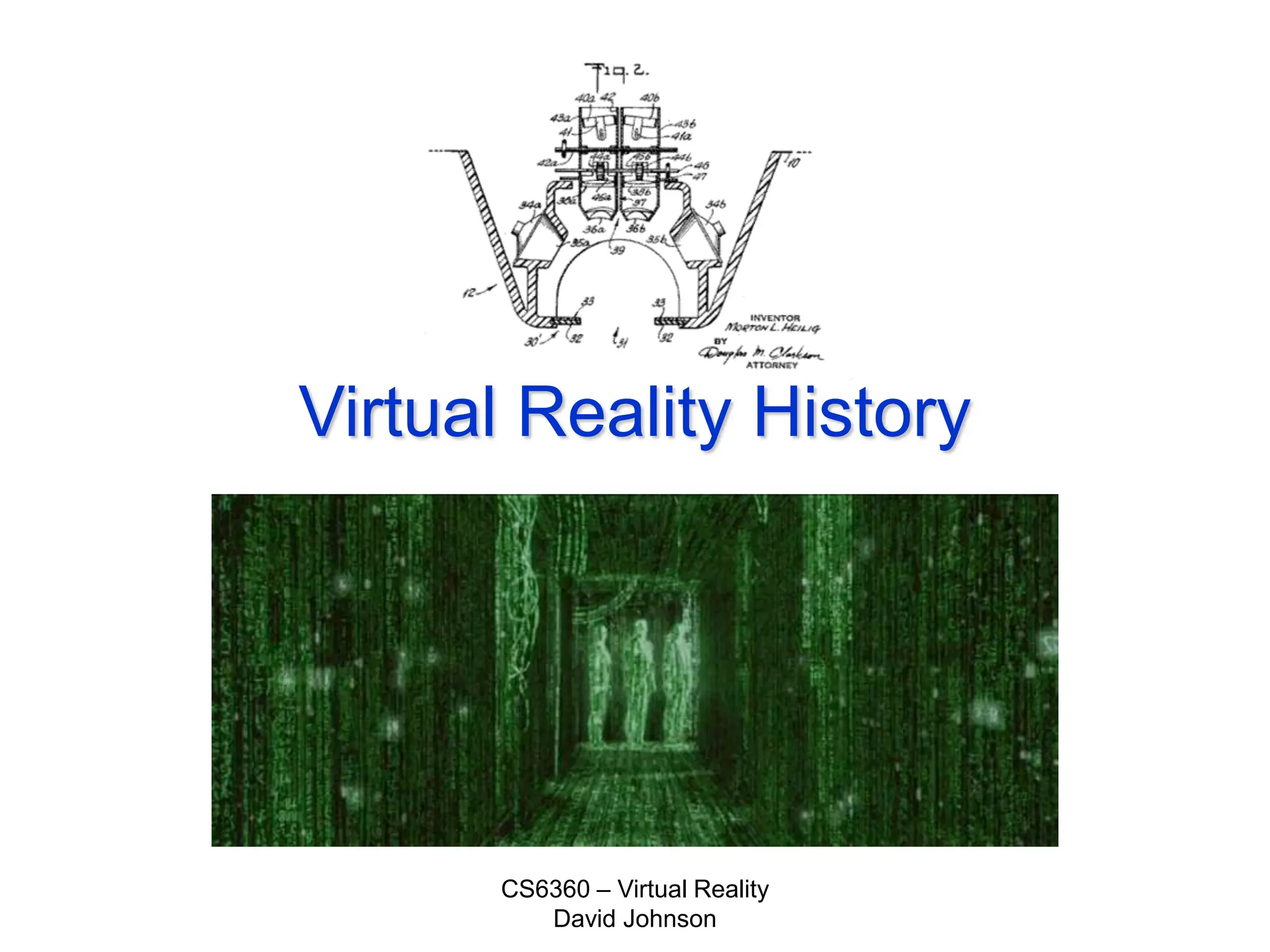
Virtual Reality History
CS6360 – Virtual Reality
David Johnson
First, some class stuff
• Paper critique on Friday
– Look on web page
CS6360 – Virtual Reality
David Johnson
Today’s Goals
• Provide some historical context.
• Where did VR technology come from?
• What applications drove its development?
• Who are some luminaries in the field?
CS6360 – Virtual Reality
David Johnson
Early History
• Remarkably, VR concepts predate
computer graphics and modern VR (HMD,
tracking, etc.) arose simultaneously with
computer imagery.
CS6360 – Virtual Reality
David Johnson
Early History Cont’d…
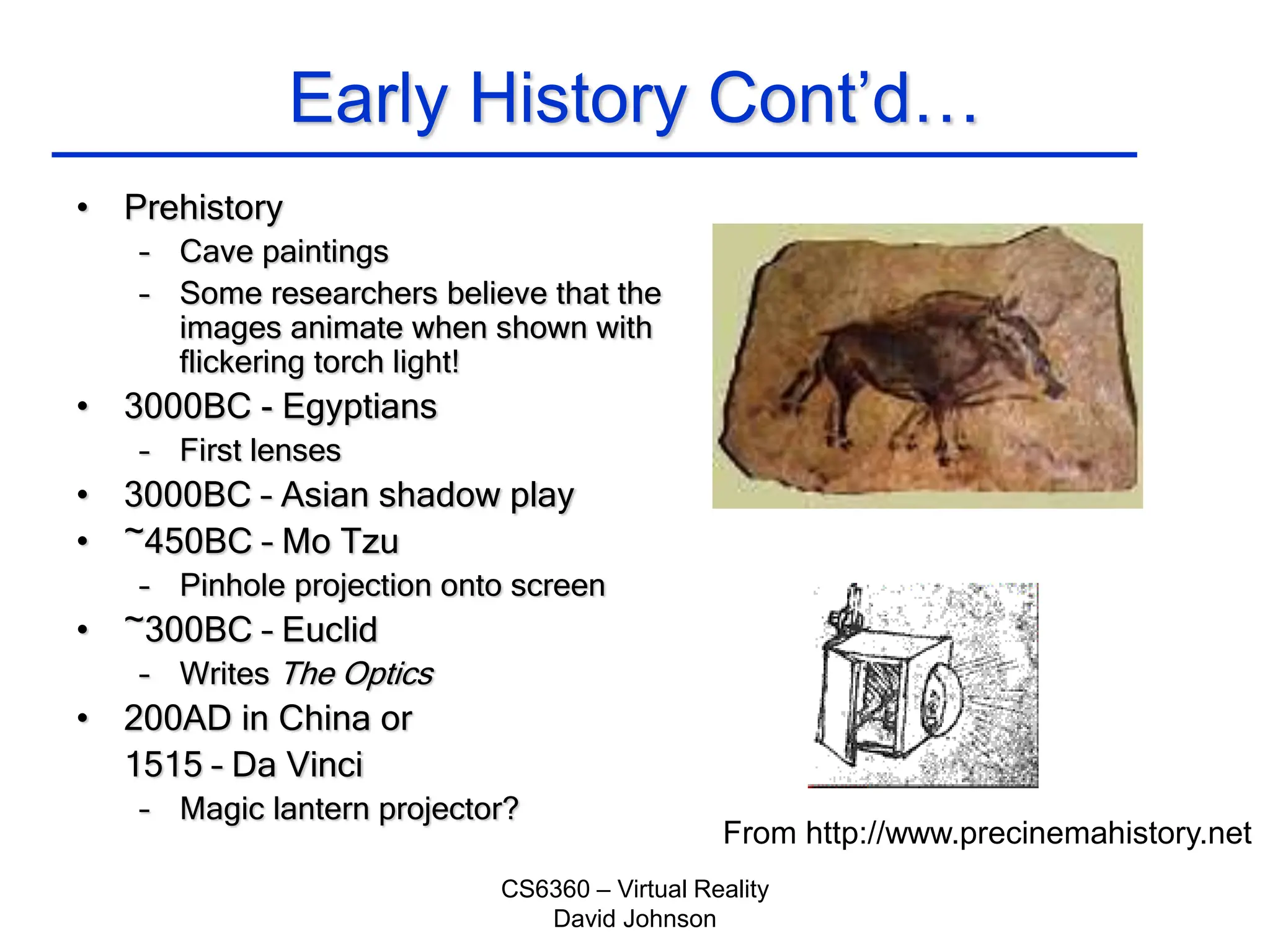
• Prehistory
– Cave paintings
– Some researchers believe that the
images animate when shown with
flickering torch light!
• 3000BC - Egyptians
– First lenses
• 3000BC – Asian shadow play
• ~450BC – Mo Tzu
– Pinhole projection onto screen
• ~300BC – Euclid
– Writes The Optics
• 200AD in China or
1515 – Da Vinci
– Magic lantern projector?
From http://www.precinemahistory.net
CS6360 – Virtual Reality
David Johnson
Early History Cont’d…
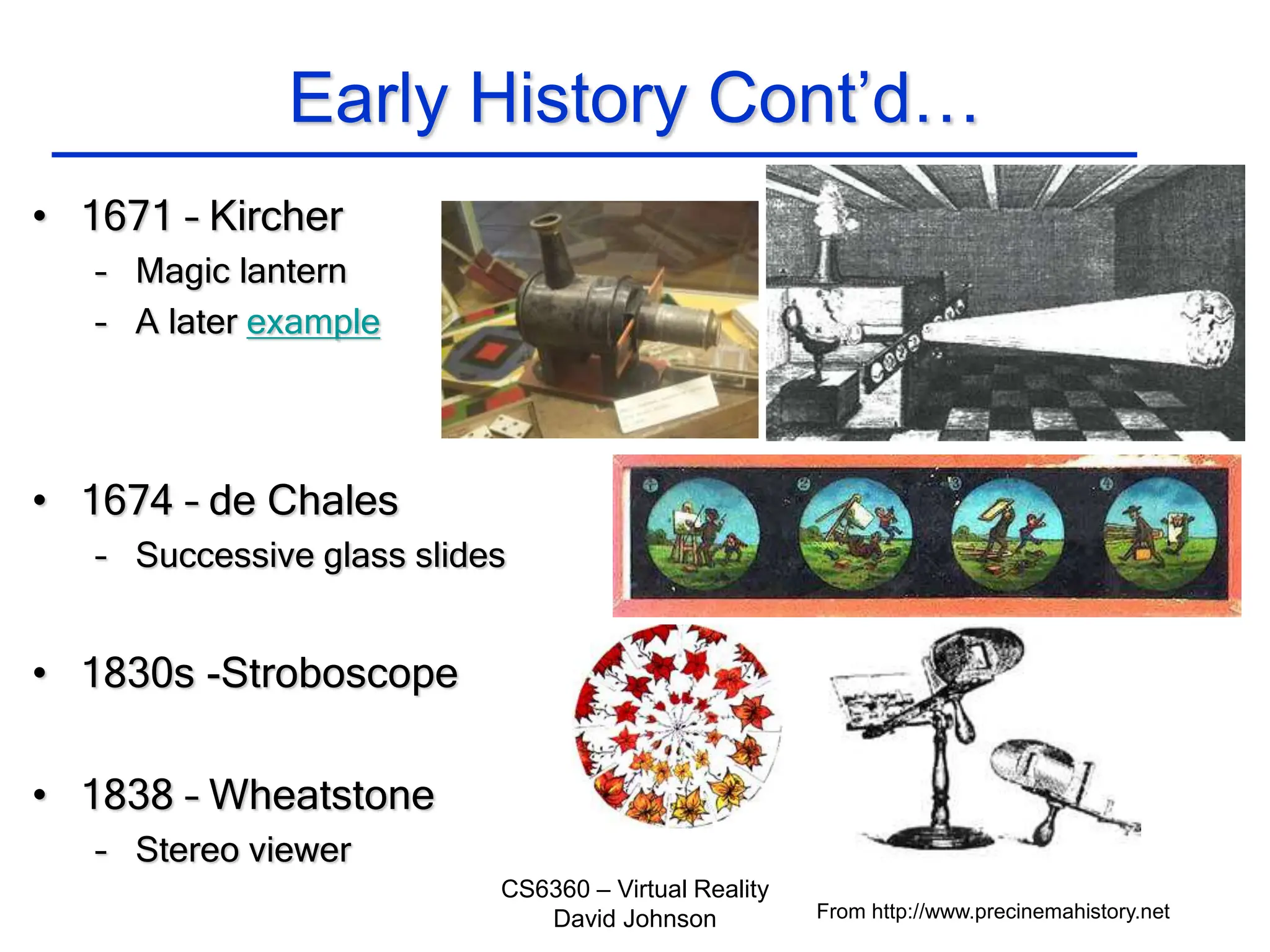
• 1671 – Kircher
– Magic lantern
– A later example
• 1674 – de Chales
– Successive glass slides
• 1830s -Stroboscope
• 1838 – Wheatstone
– Stereo viewer
From http://www.precinemahistory.net
CS6360 – Virtual Reality
David Johnson
Early History Cont’d…
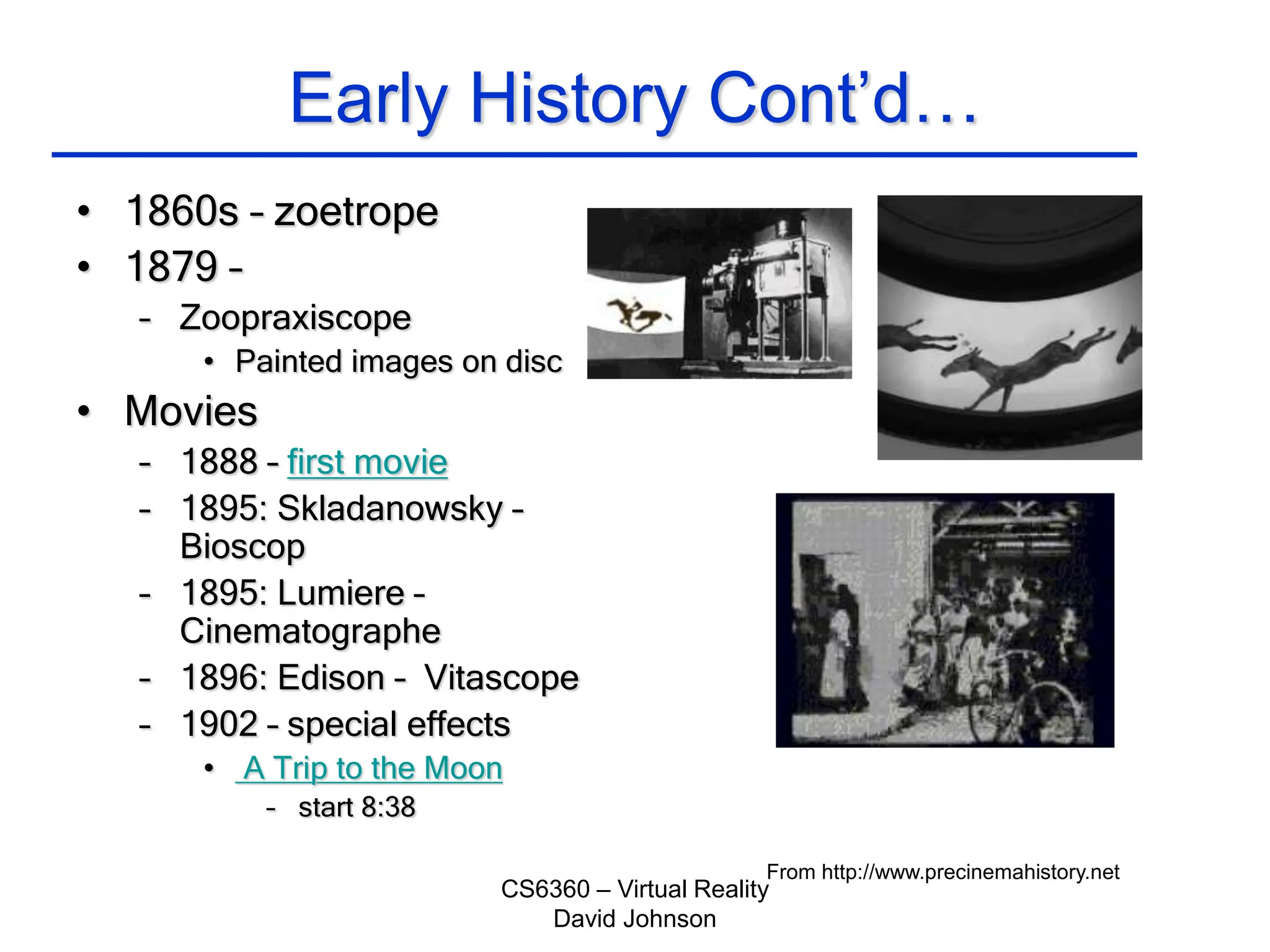
• 1860s – zoetrope
• 1879 –
– Zoopraxiscope
• Painted images on disc
• Movies
– 1888 – first movie
– 1895: Skladanowsky –
Bioscop
– 1895: Lumiere –
Cinematographe
– 1896: Edison – Vitascope
– 1902 – special effects
• A Trip to the Moon
– start 8:38
From http://www.precinemahistory.net
CS6360 – Virtual Reality
David Johnson
Early History Cont’d…
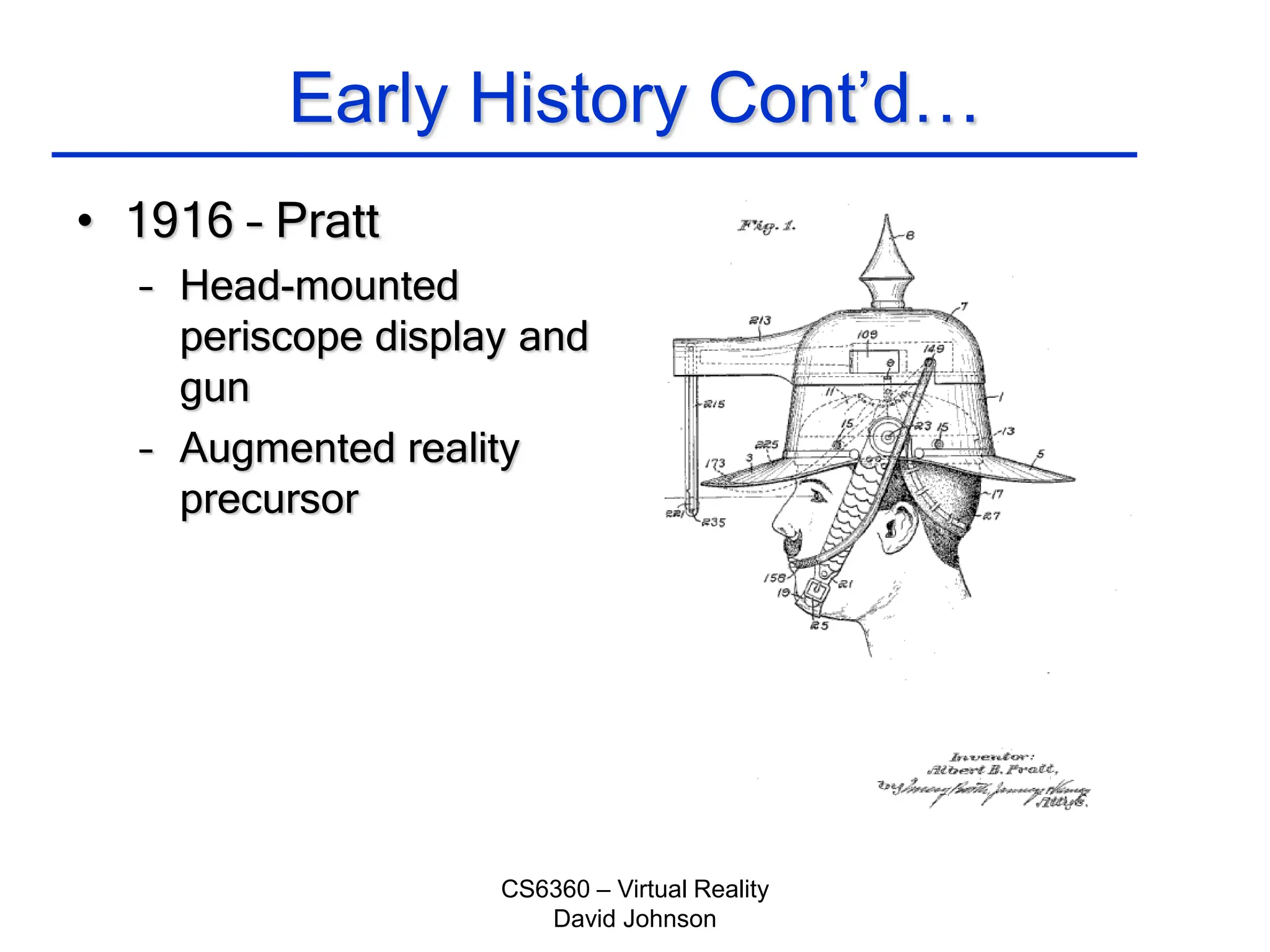
• 1916 – Pratt
– Head-mounted
periscope display and
gun
– Augmented reality
precursor
CS6360 – Virtual Reality
David Johnson
Early History Cont’d…
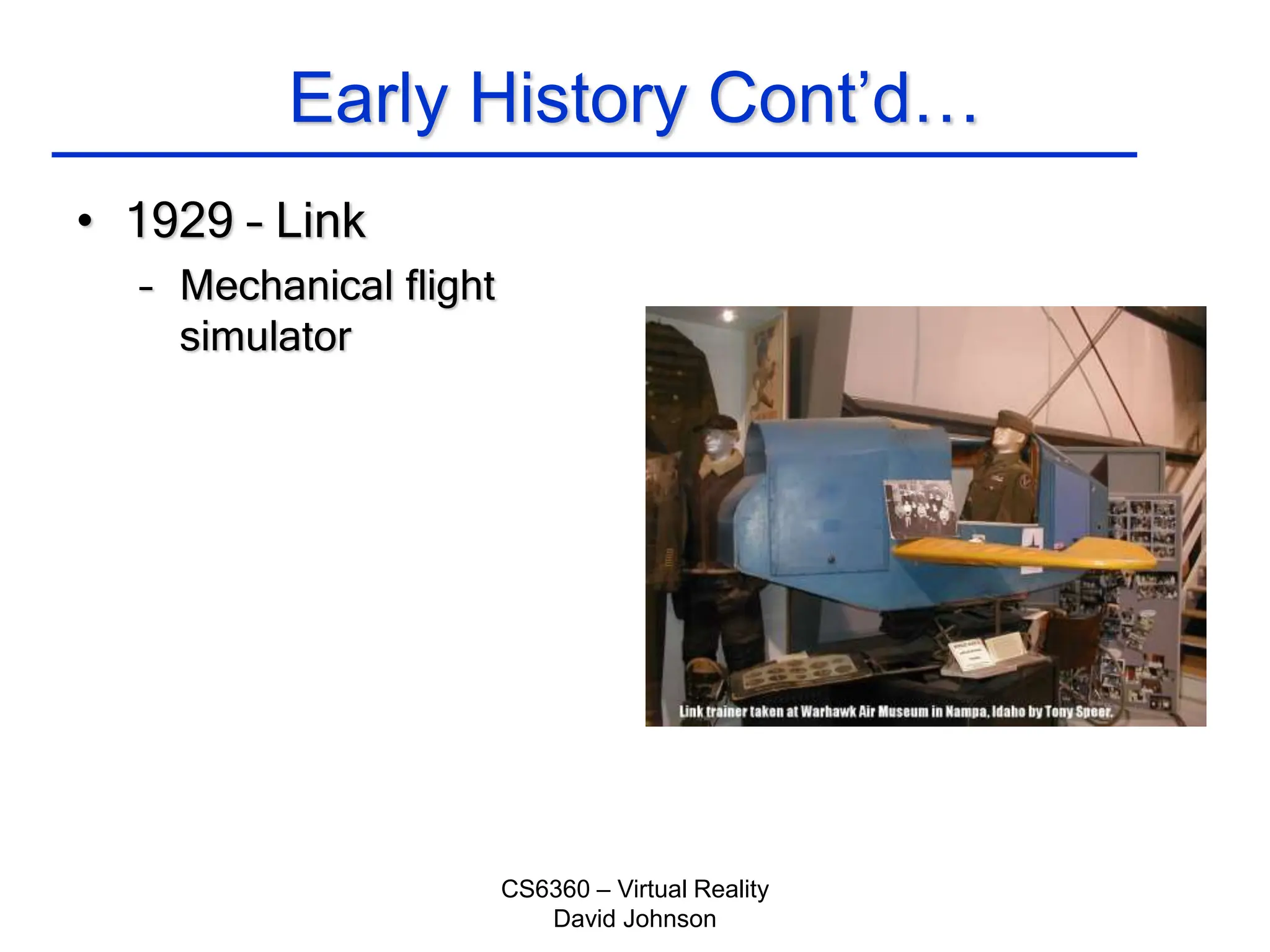
• 1929 – Link
– Mechanical flight
simulator
CS6360 – Virtual Reality
David Johnson
Early History Cont’d…
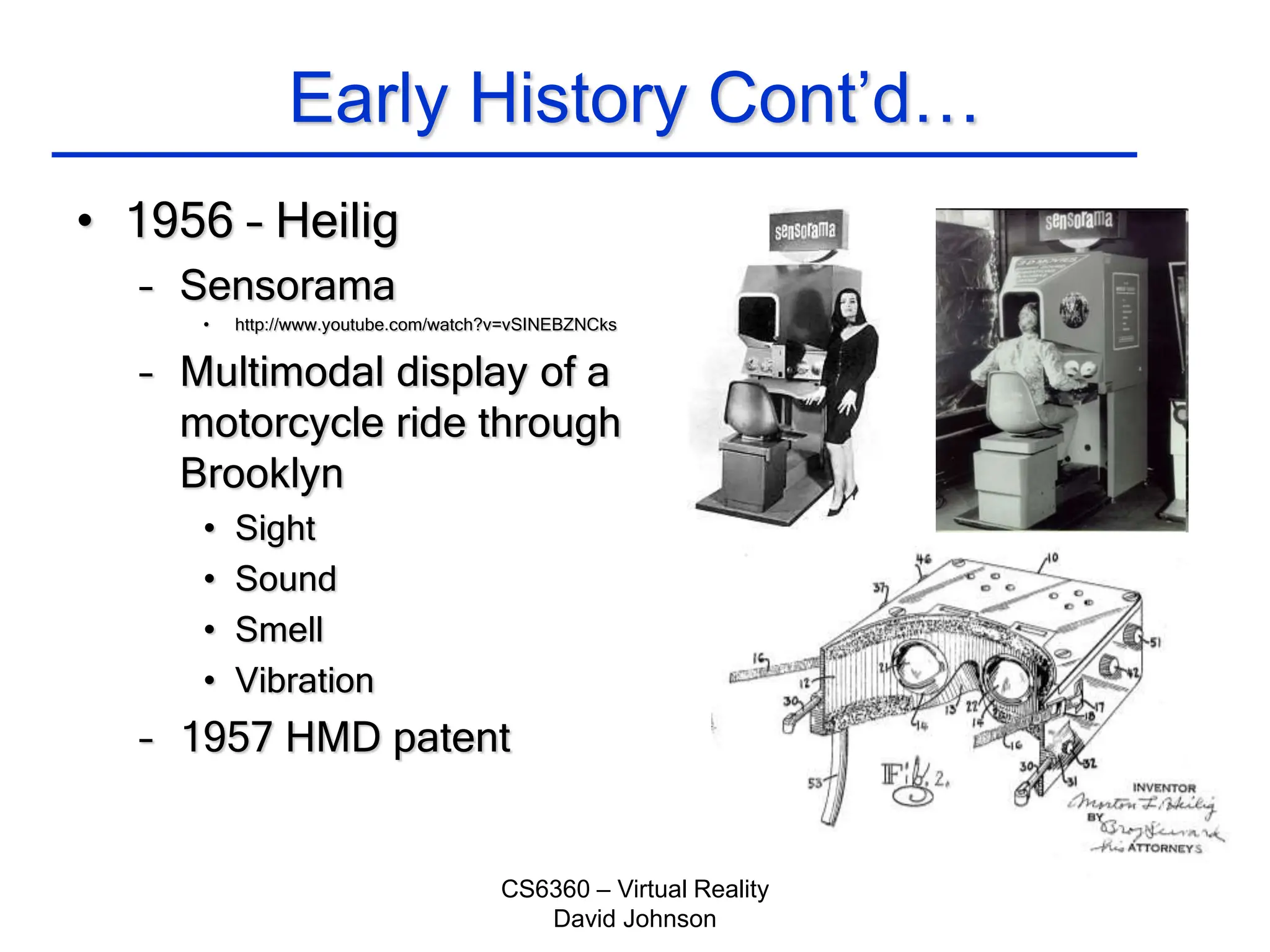
• 1956 – Heilig
– Sensorama
• http://www.youtube.com/watch?v=vSINEBZNCks
– Multimodal display of a
motorcycle ride through
Brooklyn
• Sight
• Sound
• Smell
• Vibration
– 1957 HMD patent
CS6360 – Virtual Reality
David Johnson
Early History Cont’d…
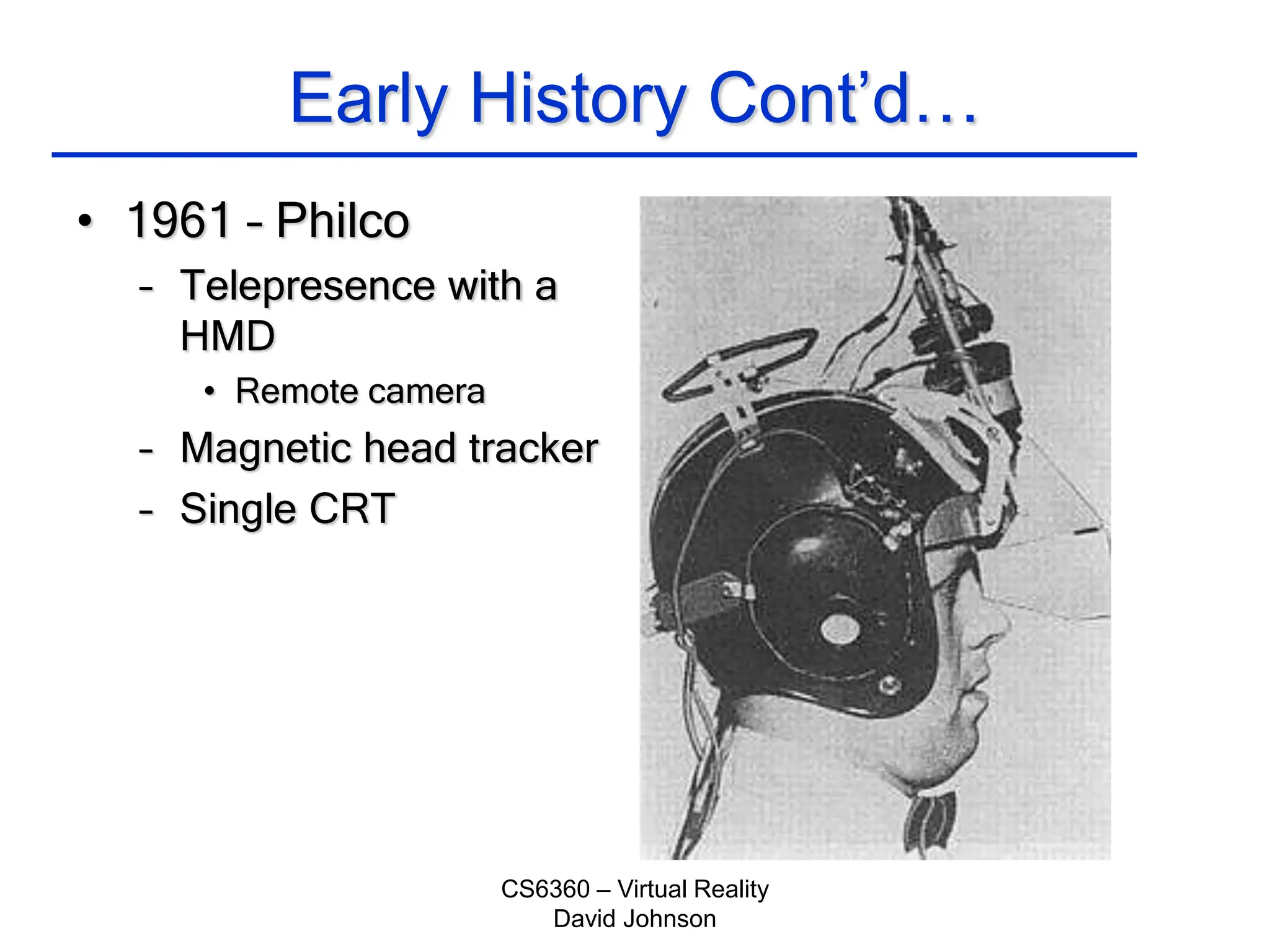
• 1961 – Philco
– Telepresence with a
HMD
• Remote camera
– Magnetic head tracker
– Single CRT
CS6360 – Virtual Reality
David Johnson
Birth of Modern VR
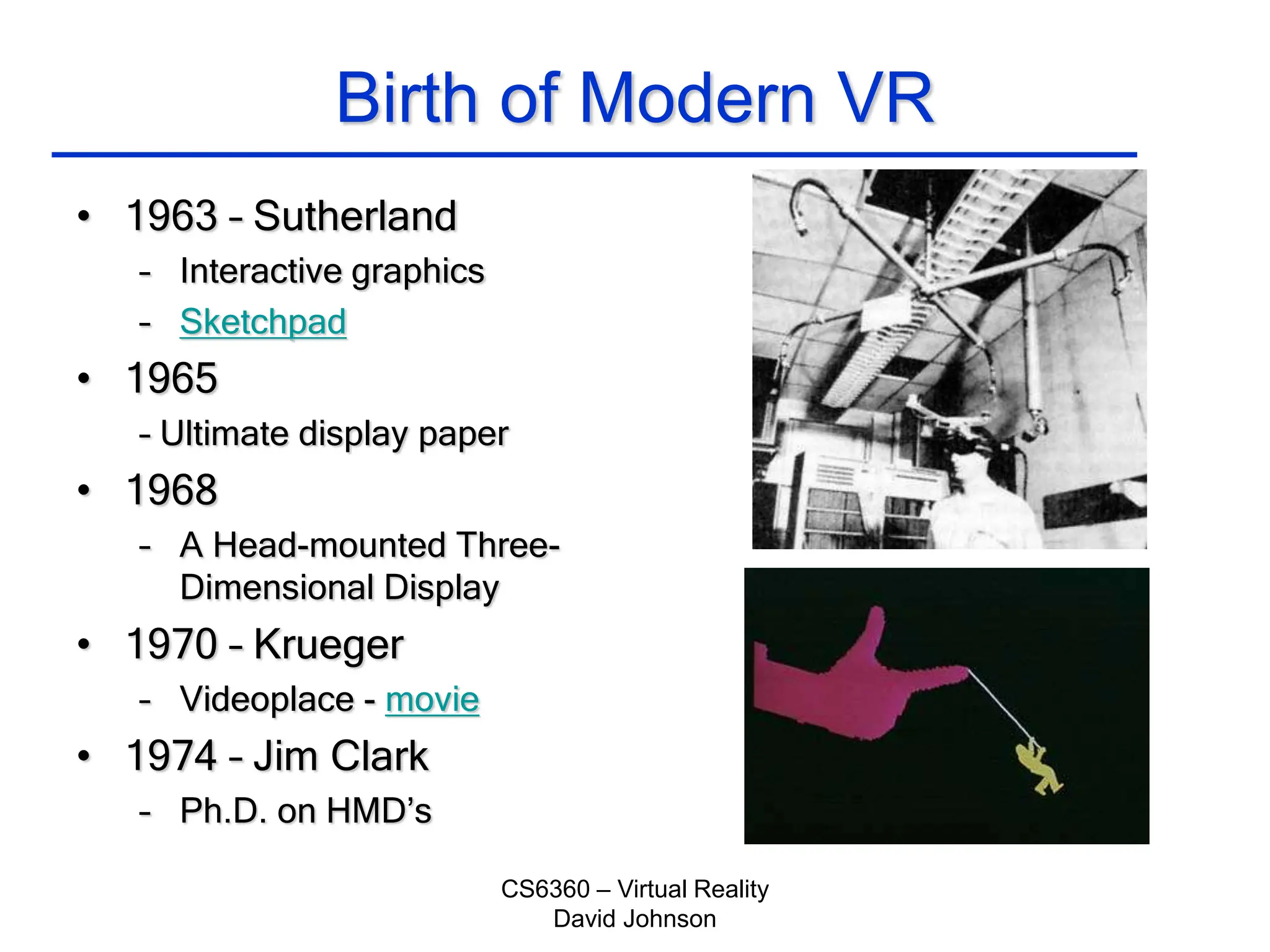
• 1963 – Sutherland
– Interactive graphics
– Sketchpad
• 1965
– Ultimate display paper
• 1968
– A Head-mounted Three-
Dimensional Display
• 1970 – Krueger
– Videoplace - movie
• 1974 – Jim Clark
– Ph.D. on HMD’s
CS6360 – Virtual Reality
David Johnson
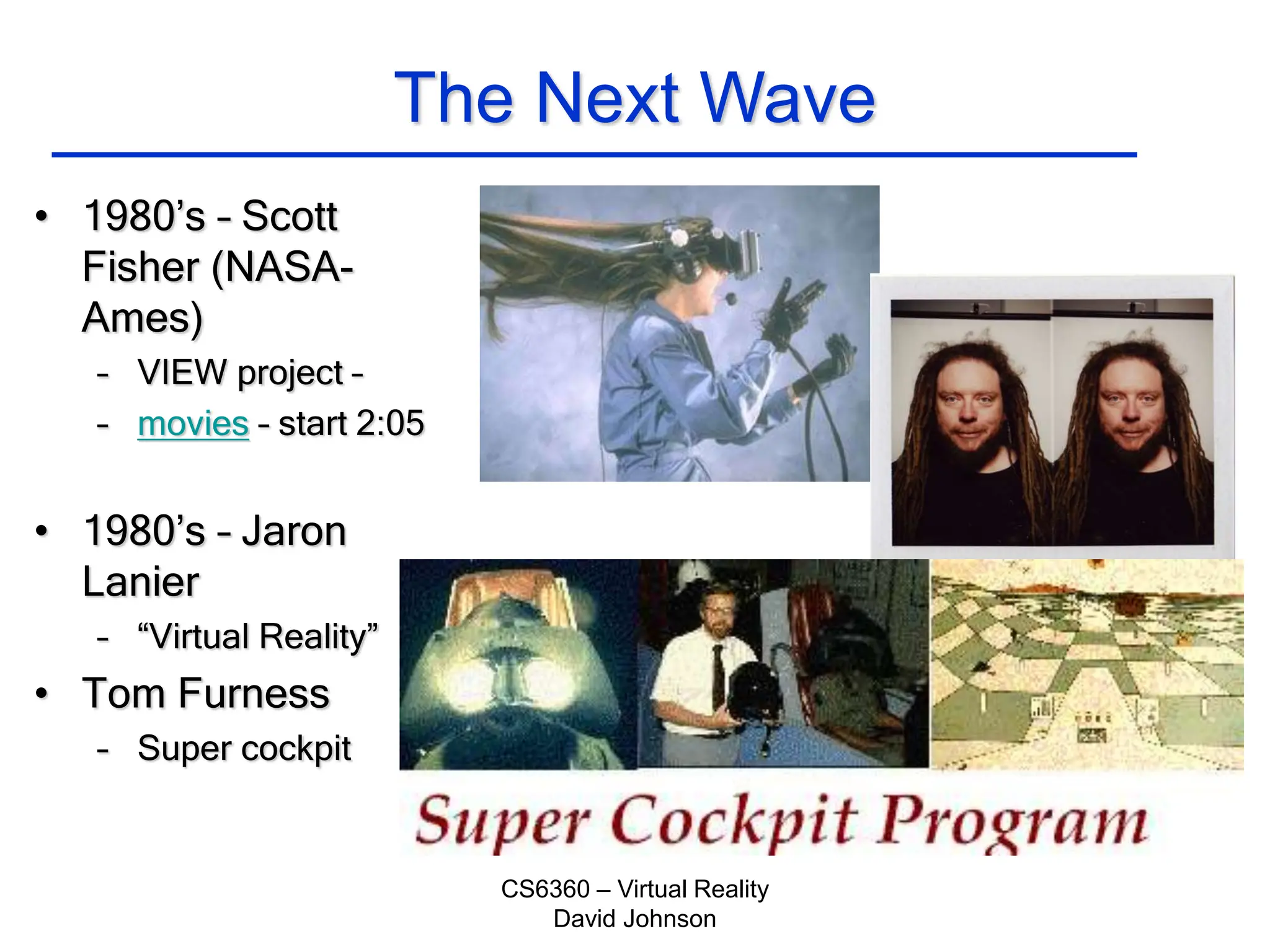
The Next Wave
• 1980’s – Scott
Fisher (NASA-
Ames)
– VIEW project –
– movies – start 2:05
• 1980’s – Jaron
Lanier
– “Virtual Reality”
• Tom Furness
– Super cockpit
CS6360 – Virtual Reality
David Johnson
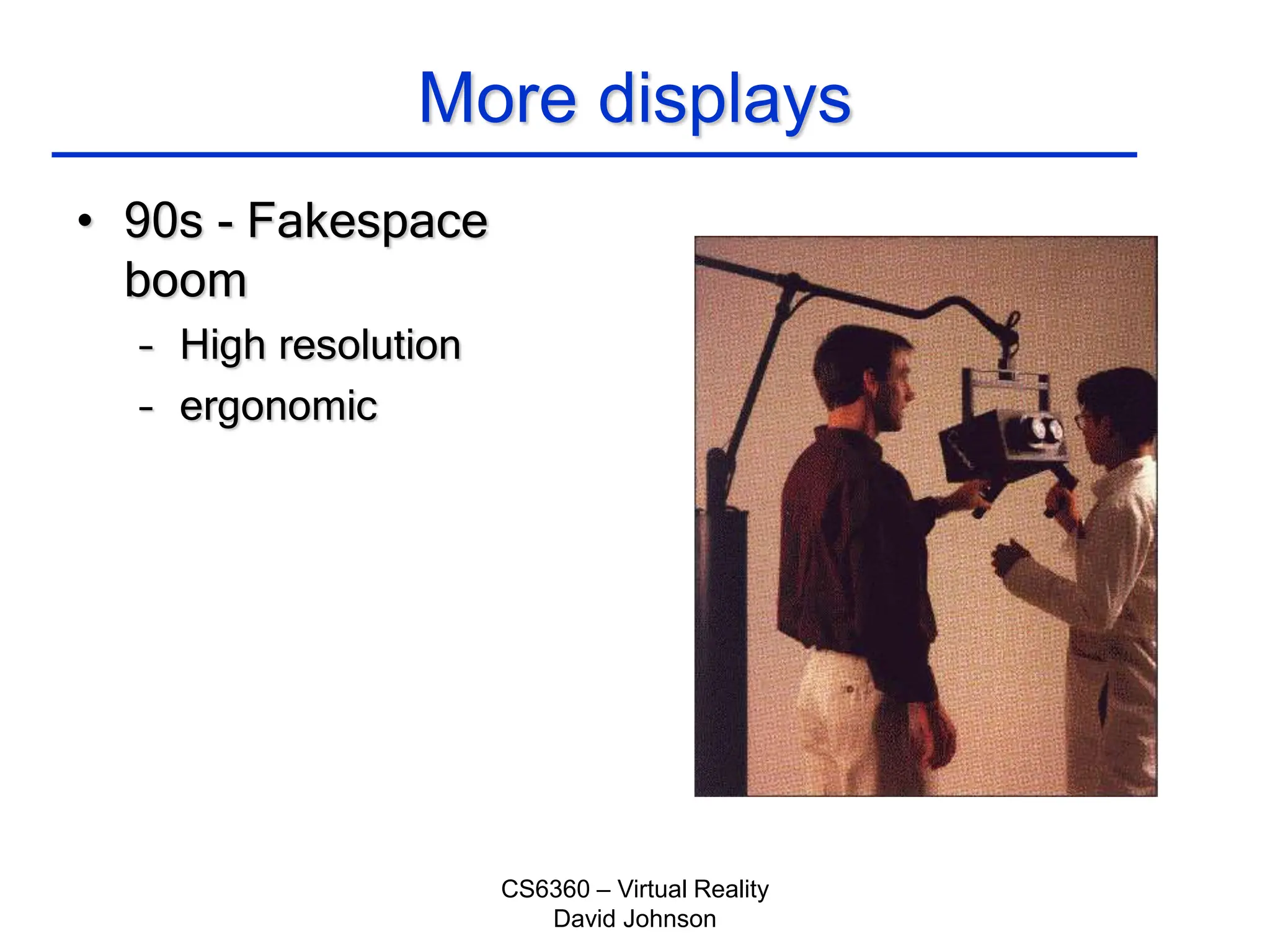
More displays
• 90s - Fakespace
boom
– High resolution
– ergonomic
CS6360 – Virtual Reality
David Johnson
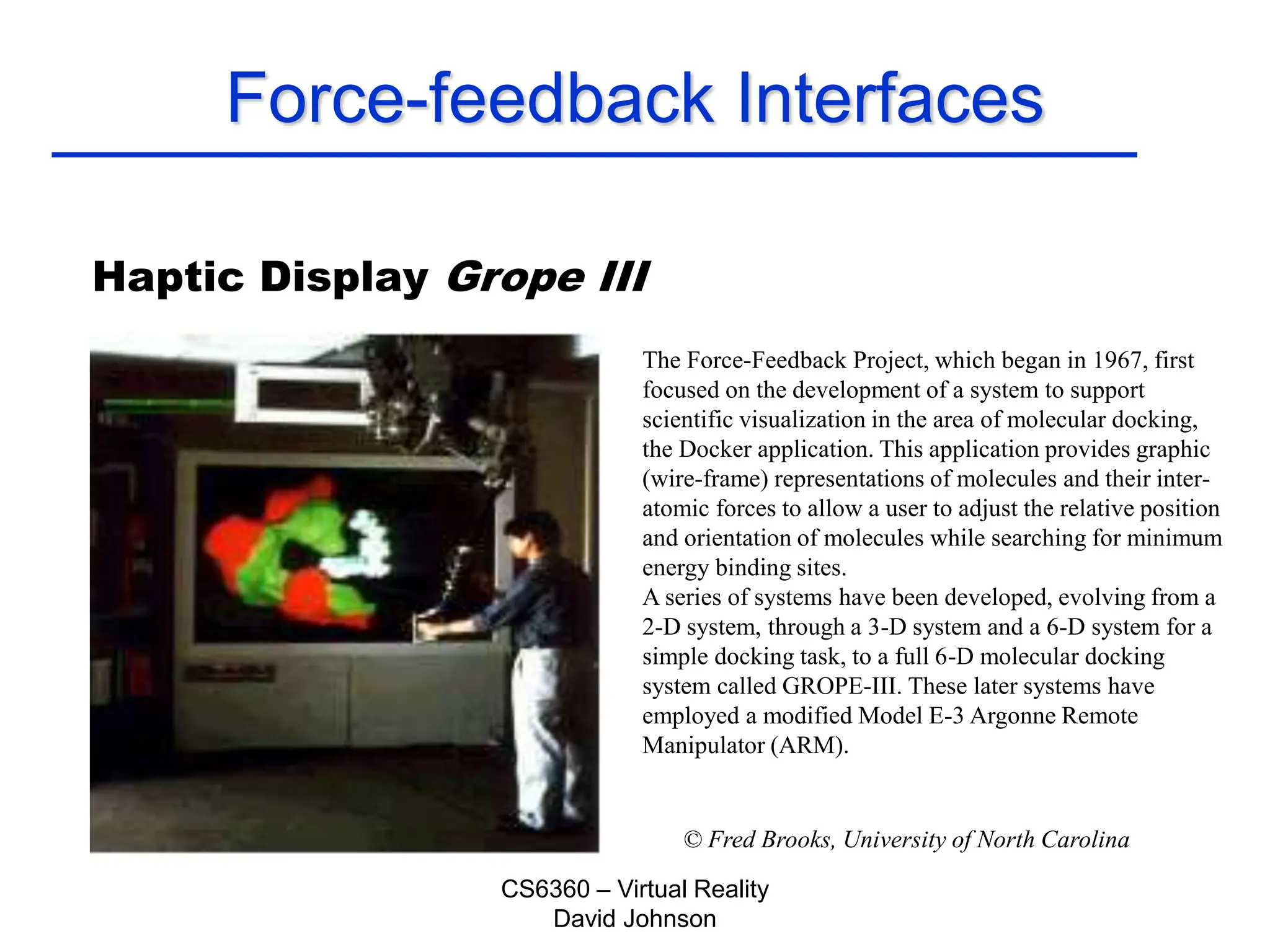
Force-feedback Interfaces
Haptic Display Grope III
© Fred Brooks, University of North Carolina
The Force-Feedback Project, which began in 1967, first
focused on the development of a system to support
scientific visualization in the area of molecular docking,
the Docker application. This application provides graphic
(wire-frame) representations of molecules and their inter-
atomic forces to allow a user to adjust the relative position
and orientation of molecules while searching for minimum
energy binding sites.
A series of systems have been developed, evolving from a
2-D system, through a 3-D system and a 6-D system for a
simple docking task, to a full 6-D molecular docking
system called GROPE-III. These later systems have
employed a modified Model E-3 Argonne Remote
Manipulator (ARM).
CS6360 – Virtual Reality
David Johnson
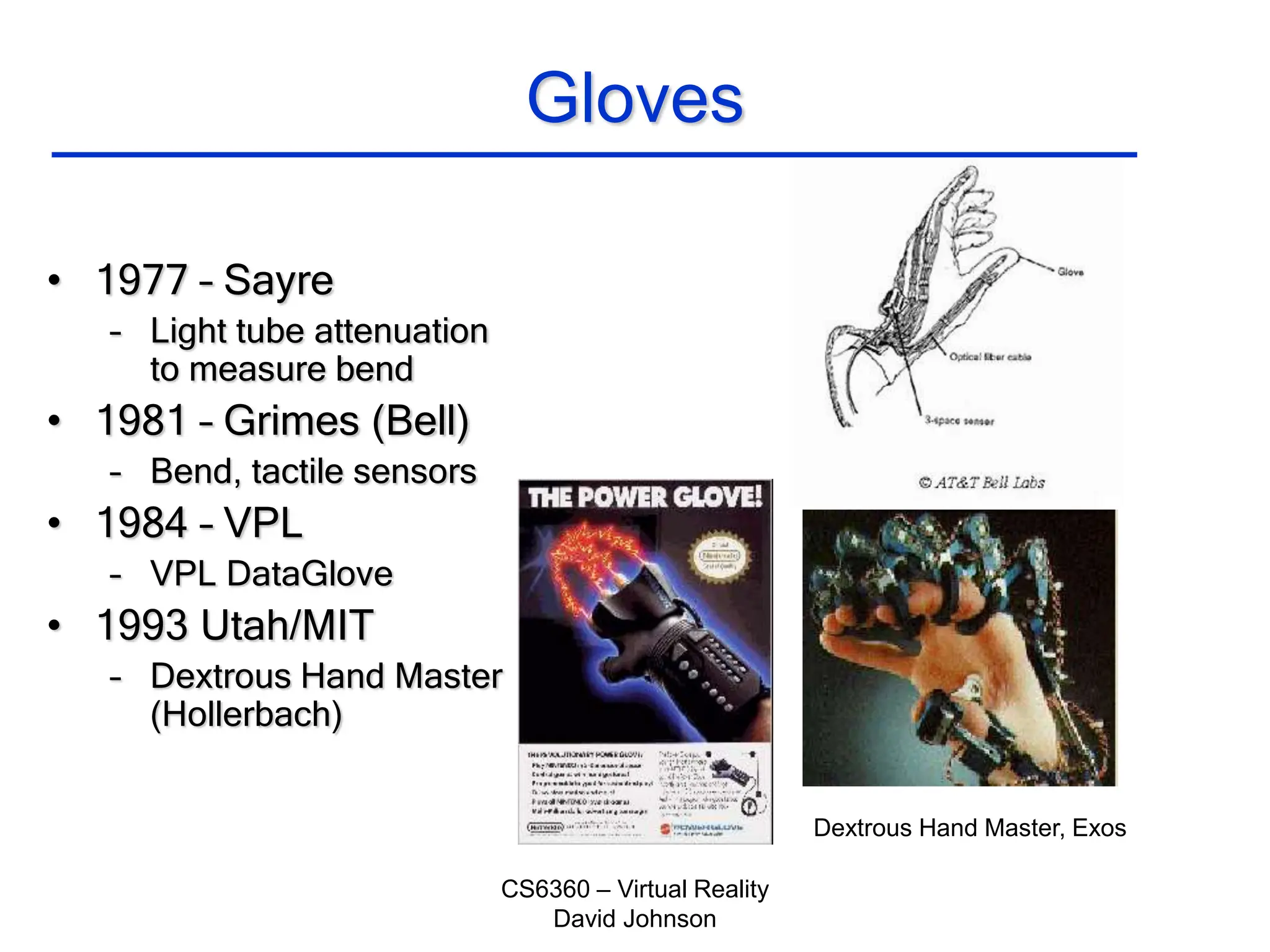
Gloves
• 1977 – Sayre
– Light tube attenuation
to measure bend
• 1981 – Grimes (Bell)
– Bend, tactile sensors
• 1984 – VPL
– VPL DataGlove
• 1993 Utah/MIT
– Dextrous Hand Master
(Hollerbach)
Dextrous Hand Master, Exos
CS6360 – Virtual Reality
David Johnson
CAVE displays
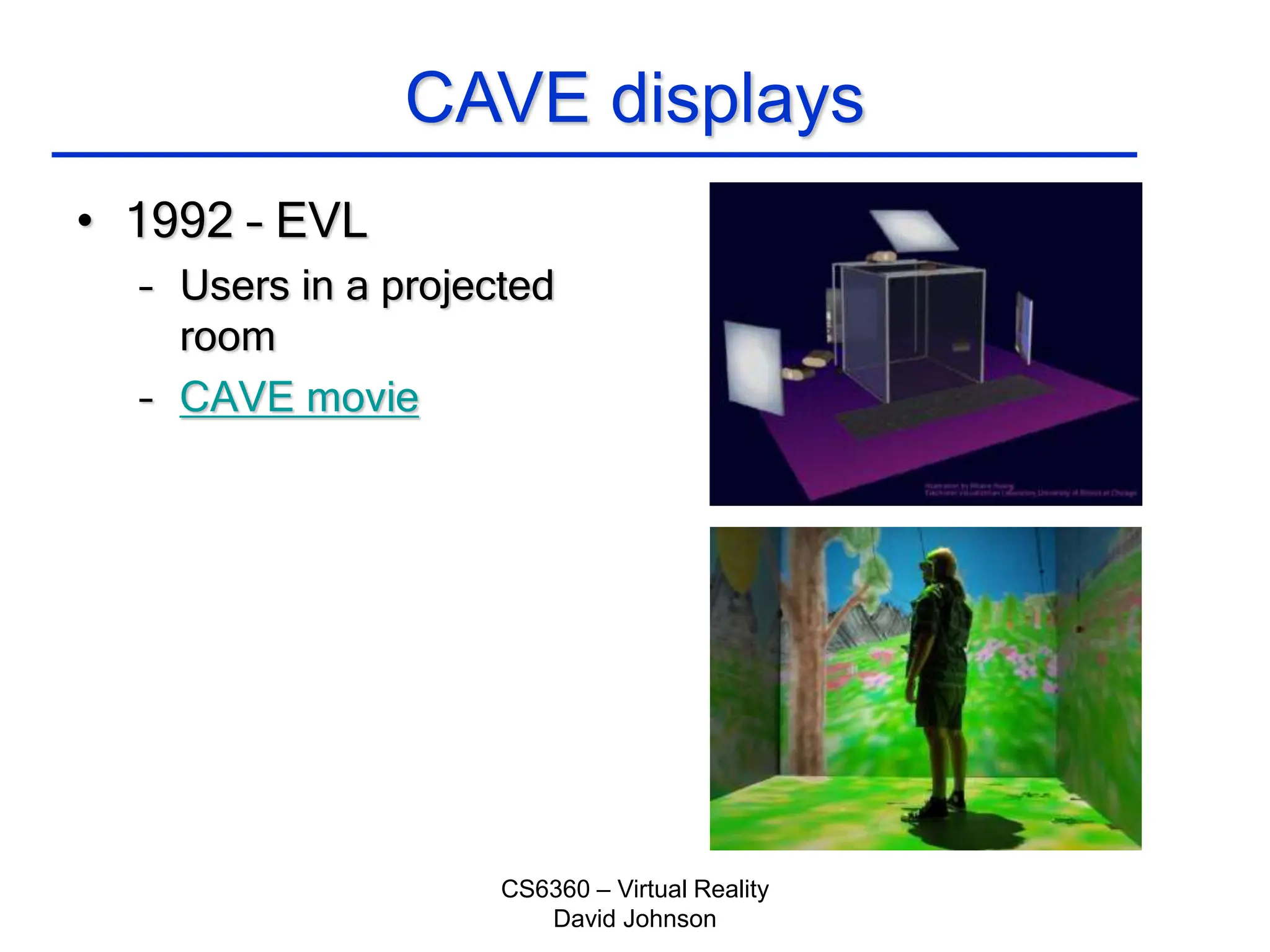
• 1992 – EVL
– Users in a projected
room
– CAVE movie
CS6360 – Virtual Reality
David Johnson
CAVE displays
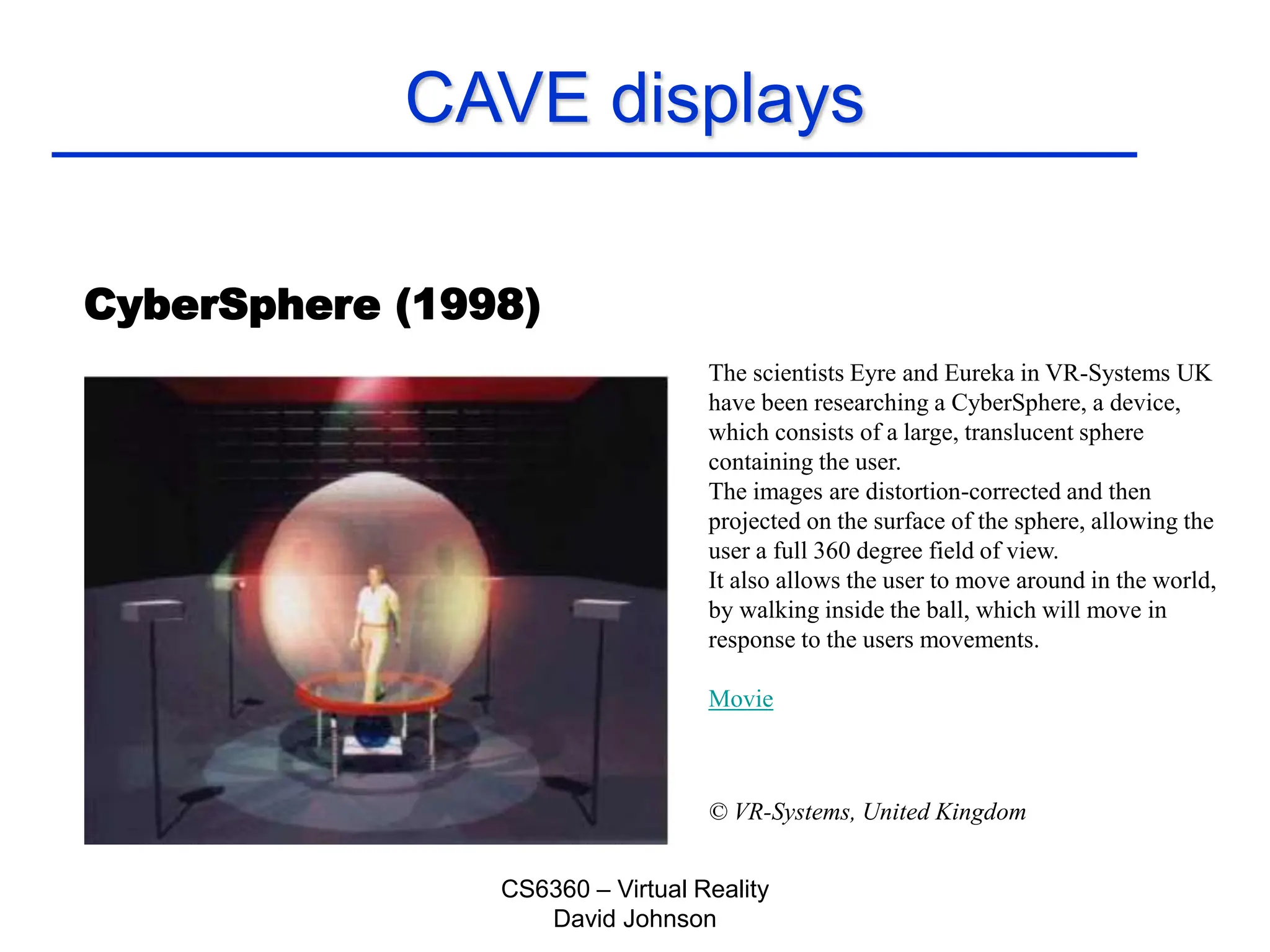
CyberSphere (1998)
The scientists Eyre and Eureka in VR-Systems UK
have been researching a CyberSphere, a device,
which consists of a large, translucent sphere
containing the user.
The images are distortion-corrected and then
projected on the surface of the sphere, allowing the
user a full 360 degree field of view.
It also allows the user to move around in the world,
by walking inside the ball, which will move in
response to the users movements.
Movie
© VR-Systems, United Kingdom
CS6360 – Virtual Reality
David Johnson
Companies
• 1984 – VPL
• 1987 – Polhemus
• 1989 – Division
– Bought tech from UNC-CH
• 1989 – Mattel
– Nintendo powerglove
• 1990 – W
– VR arcade
CS6360 – Virtual Reality
David Johnson
Current Companies
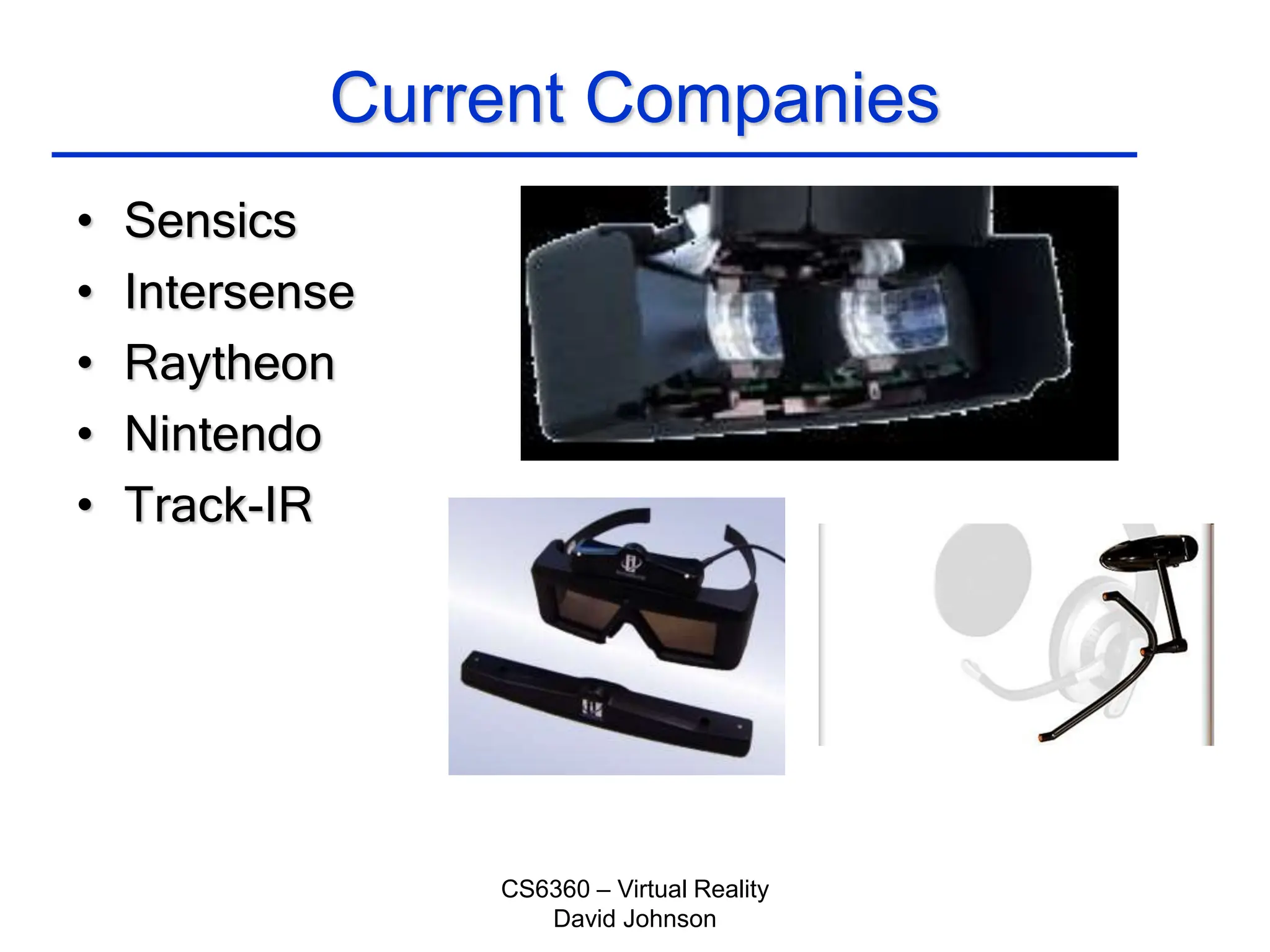
• Sensics
• Intersense
• Raytheon
• Nintendo
• Track-IR
CS6360 – Virtual Reality
David Johnson
Summary
• Entertainment has often driven
“immersive” advances
• The dream of a VR space has a long
history
• High-quality elements of VR are now
consumer products

Virtual Reality History ppt for your presentation

  • 1.
    CS6360 – VirtualReality David Johnson Virtual Reality History
  • 2.
    CS6360 – VirtualReality David Johnson First, some class stuff • Paper critique on Friday – Look on web page
  • 3.
    CS6360 – VirtualReality David Johnson Today’s Goals • Provide some historical context. • Where did VR technology come from? • What applications drove its development? • Who are some luminaries in the field?
  • 4.
    CS6360 – VirtualReality David Johnson Early History • Remarkably, VR concepts predate computer graphics and modern VR (HMD, tracking, etc.) arose simultaneously with computer imagery.
  • 5.
    CS6360 – VirtualReality David Johnson Early History Cont’d… • Prehistory – Cave paintings – Some researchers believe that the images animate when shown with flickering torch light! • 3000BC - Egyptians – First lenses • 3000BC – Asian shadow play • ~450BC – Mo Tzu – Pinhole projection onto screen • ~300BC – Euclid – Writes The Optics • 200AD in China or 1515 – Da Vinci – Magic lantern projector? From http://www.precinemahistory.net
  • 6.
    CS6360 – VirtualReality David Johnson Early History Cont’d… • 1671 – Kircher – Magic lantern – A later example • 1674 – de Chales – Successive glass slides • 1830s -Stroboscope • 1838 – Wheatstone – Stereo viewer From http://www.precinemahistory.net
  • 7.
    CS6360 – VirtualReality David Johnson Early History Cont’d… • 1860s – zoetrope • 1879 – – Zoopraxiscope • Painted images on disc • Movies – 1888 – first movie – 1895: Skladanowsky – Bioscop – 1895: Lumiere – Cinematographe – 1896: Edison – Vitascope – 1902 – special effects • A Trip to the Moon – start 8:38 From http://www.precinemahistory.net
  • 8.
    CS6360 – VirtualReality David Johnson Early History Cont’d… • 1916 – Pratt – Head-mounted periscope display and gun – Augmented reality precursor
  • 9.
    CS6360 – VirtualReality David Johnson Early History Cont’d… • 1929 – Link – Mechanical flight simulator
  • 10.
    CS6360 – VirtualReality David Johnson Early History Cont’d… • 1956 – Heilig – Sensorama • http://www.youtube.com/watch?v=vSINEBZNCks – Multimodal display of a motorcycle ride through Brooklyn • Sight • Sound • Smell • Vibration – 1957 HMD patent
  • 11.
    CS6360 – VirtualReality David Johnson Early History Cont’d… • 1961 – Philco – Telepresence with a HMD • Remote camera – Magnetic head tracker – Single CRT
  • 12.
    CS6360 – VirtualReality David Johnson Birth of Modern VR • 1963 – Sutherland – Interactive graphics – Sketchpad • 1965 – Ultimate display paper • 1968 – A Head-mounted Three- Dimensional Display • 1970 – Krueger – Videoplace - movie • 1974 – Jim Clark – Ph.D. on HMD’s
  • 13.
    CS6360 – VirtualReality David Johnson The Next Wave • 1980’s – Scott Fisher (NASA- Ames) – VIEW project – – movies – start 2:05 • 1980’s – Jaron Lanier – “Virtual Reality” • Tom Furness – Super cockpit
  • 14.
    CS6360 – VirtualReality David Johnson More displays • 90s - Fakespace boom – High resolution – ergonomic
  • 15.
    CS6360 – VirtualReality David Johnson Force-feedback Interfaces Haptic Display Grope III © Fred Brooks, University of North Carolina The Force-Feedback Project, which began in 1967, first focused on the development of a system to support scientific visualization in the area of molecular docking, the Docker application. This application provides graphic (wire-frame) representations of molecules and their inter- atomic forces to allow a user to adjust the relative position and orientation of molecules while searching for minimum energy binding sites. A series of systems have been developed, evolving from a 2-D system, through a 3-D system and a 6-D system for a simple docking task, to a full 6-D molecular docking system called GROPE-III. These later systems have employed a modified Model E-3 Argonne Remote Manipulator (ARM).
  • 16.
    CS6360 – VirtualReality David Johnson Gloves • 1977 – Sayre – Light tube attenuation to measure bend • 1981 – Grimes (Bell) – Bend, tactile sensors • 1984 – VPL – VPL DataGlove • 1993 Utah/MIT – Dextrous Hand Master (Hollerbach) Dextrous Hand Master, Exos
  • 17.
    CS6360 – VirtualReality David Johnson CAVE displays • 1992 – EVL – Users in a projected room – CAVE movie
  • 18.
    CS6360 – VirtualReality David Johnson CAVE displays CyberSphere (1998) The scientists Eyre and Eureka in VR-Systems UK have been researching a CyberSphere, a device, which consists of a large, translucent sphere containing the user. The images are distortion-corrected and then projected on the surface of the sphere, allowing the user a full 360 degree field of view. It also allows the user to move around in the world, by walking inside the ball, which will move in response to the users movements. Movie © VR-Systems, United Kingdom
  • 19.
    CS6360 – VirtualReality David Johnson Companies • 1984 – VPL • 1987 – Polhemus • 1989 – Division – Bought tech from UNC-CH • 1989 – Mattel – Nintendo powerglove • 1990 – W – VR arcade
  • 20.
    CS6360 – VirtualReality David Johnson Current Companies • Sensics • Intersense • Raytheon • Nintendo • Track-IR
  • 21.
    CS6360 – VirtualReality David Johnson Summary • Entertainment has often driven “immersive” advances • The dream of a VR space has a long history • High-quality elements of VR are now consumer products