
Virtual Law
Office:
What It Is and
How to Use It
A Conversation with
Stephanie Kimbro
Why is Virtual Law Practice
Important for the Public?
 Greater Access to Justice
 Court systems and non-profit legal aid organizations
already rely on cloud computing methods to deliver
legal services online
 Affordable and accessible legal services for lower and
moderate income individuals
 Help pro-se litigants
 Create pro-bono opportunities
Why is Virtual Law Practice
Important to Lawyers?
 No in-house software installation needed
 Streamlines and automates the workflow, creates
efficiency & allows the attorney to focus on practicing law
 Lowers overhead, less expensive than paying for software,
storage & server hardware & running it internally with or
without IT assistance
 Creates less office waste, eco-friendly
 Enables access to data anywhere attorney can securely
access the internet
 Prevents Malpractice through automated checks and
processes
 Expanded client base, competitive advantage
 Better quality of life through work/life balance and flexibility
 Be prepared for your future clients: the “Digital Natives”
Prepare Yourself for Future
Innovation
 Features of a virtual law practice will continue to
expand beyond what currently may be imagined
 The core function of a virtual law practice should remain the same –
the ability to securely deliver legal services and work with clients and
other legal professionals online through an online client portal
 The growth of online legal services is largely
consumer-driven
 The legal profession should step up to meet this need or the public
will continue to use methods that are not safe or in their beset
interest to acquire online legal services.
 In order to stay competitive and address the needs of clients, most
firms will need some form of virtual component in the next five to ten
years.
 The Task Force works
through the Law
Practice
Management
Section of the ABA
 Members stay
current on the effect
of technology use
on our profession
 Offers studies and
guidelines on how to
ethically practice
law online
What does the
eLawyering Task
Force Do?
Virtual Law Office vs. Online
Practice Management
Virtual Law Office
 A virtual law office is a
professional law practice
located online through a
secure portal that is
accessible to both the client
and attorney anywhere the
parties can access the
internet.
 Other terminology: VLO,
virtual lawyering, virtual law
firm, web-based or web-
enabled law practice, online
law practice, delivering legal
services online
Online Practice
Management
 Office, case & client
management used as
productivity tool
 Clients have access to their
own online documents with
limited control
 Document archiving,
contact management,
calendaring, conflict &
jurisdictional checks, billing &
invoicing, online payment
 Collaboration spaces such
as deal rooms or workspaces
 “…all the ways lawyers
can do their work using the
web and associated
technologies. These include
new ways to collaborate
and communicate with
clients, prospective clients
and other lawyers, produce
documents, settle disputes
and manage legal
knowledge.
 Think of a lawyering verb –
interview, investigate,
counsel, draft, advocate,
analyze, negotiate,
manage. . .and there are
corresponding electronic
tools.”
 Mark Lauritsen, co-chair,
ABA eLawyering Task Force
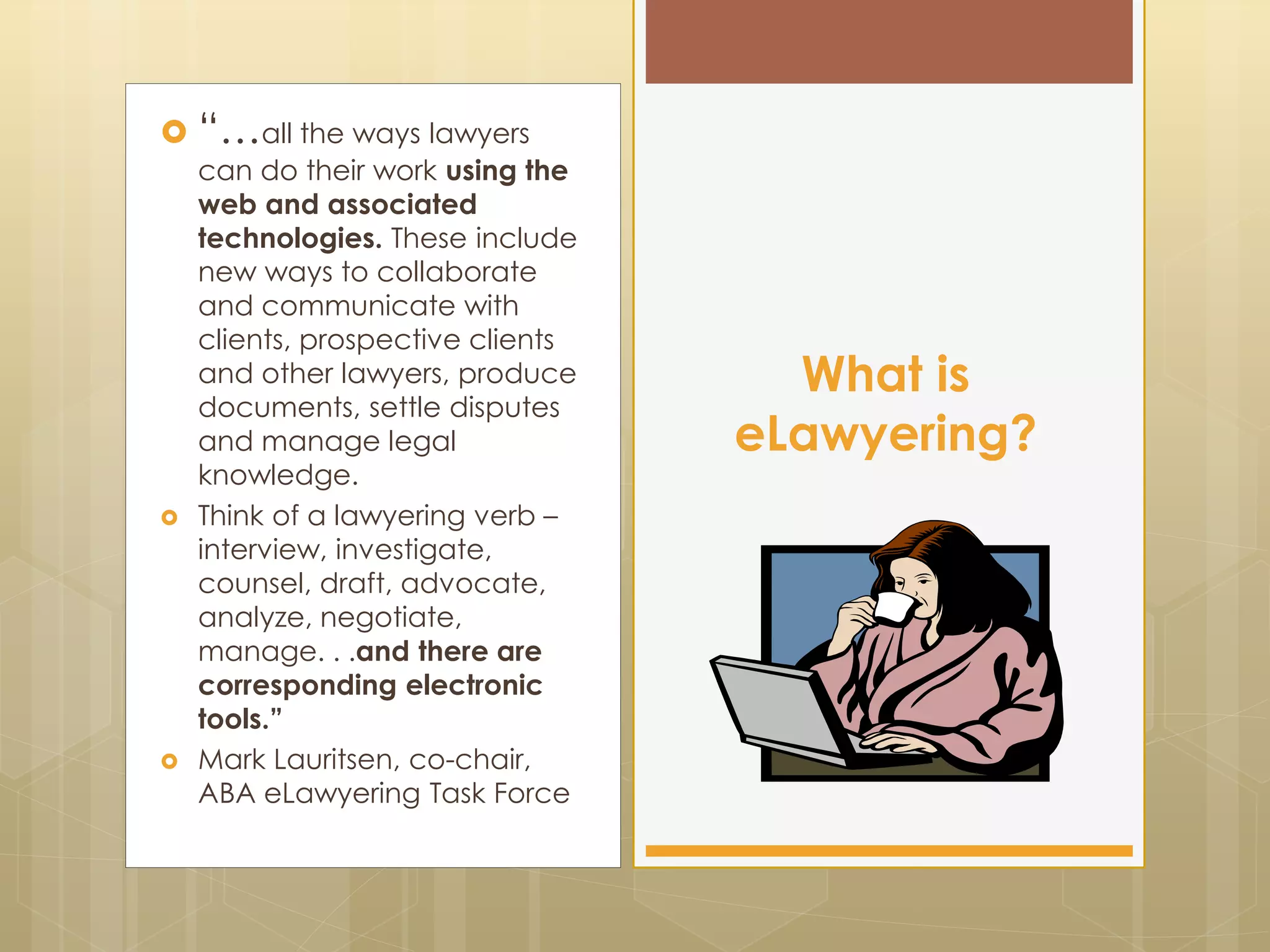
What is
eLawyering?
What Virtual Law Practice is
Not!
 An online website that sells legal documents without attorney
review, such as LegalZoom and other web-based companies
selling online legal forms
 A law firm website with an email “contact us for a free quote”
form for prospective clients
 Communication by email even if sent through law firm’s
website
 A rented physical space that may be shared with other
professionals along with a receptionist
 VPNs, extranets or other services, such as GoToMyPC and
LogMeIn
 A conglomeration of attorneys in remote locations pooling
resources and communicating over the internet
 A law practice based in a virtual reality world such as Second
Life
 Break out tasks
associated with a legal
matter and provide the
client with only specific
portions of the work
 Clearly define for online
client the nature and
scope of unbundled legal
services – what will and
will NOT be covered
 Provide comparisons and
education for the client
to make an informed
judgment
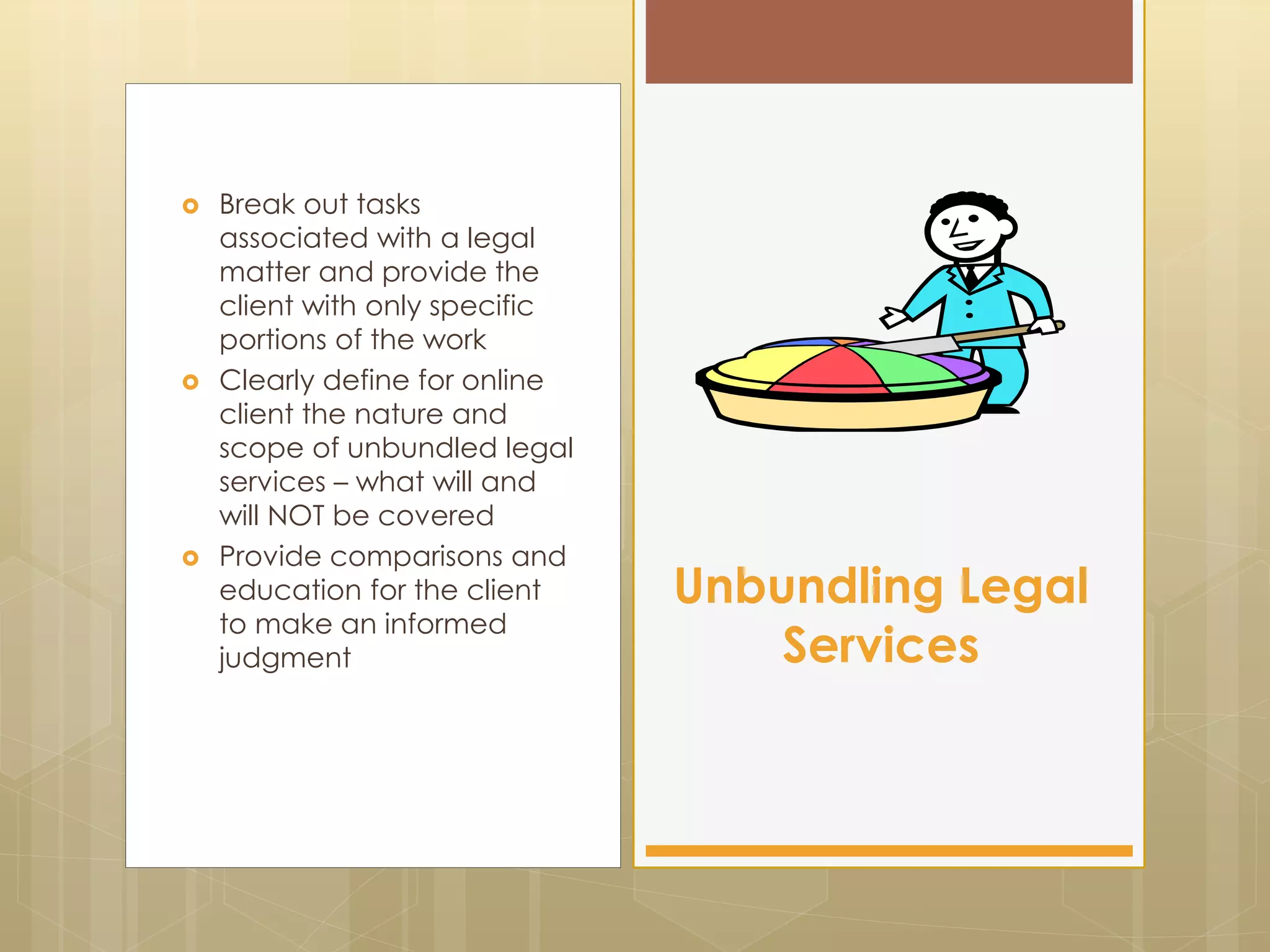
Unbundling Legal
Services
 Automating document
assembly for clients
online
 Uses intuitive legal
forms in combination
with questionnaires
 Purchased directly by
client after attorney
review
 Can also be
purchased in
conjunction with
additional legal
advice
Document
Assembly &
Automation
What is the Market for These
Services?
Your Clients are ready. They shop, bank, conduct business and pay
credit cards and taxes online.
 50% of middle-income
households in the US have at
least 1 legal problem per
year
 Only 20% seek legal
assistance from attorneys
 26% do nothing at all
 Potentially huge market
waiting to be tapped in the
US for personal consumer
legal services
 During March 2010 – one
month alone – an estimated
535,000 people in the US
searched online seeking
legal solutions through the
LegalZoom site
 E-commerce trends are
increasing
 Also consider trends in legal
outsourcing and the
globalization of law firms
How Attorneys Use Virtual Law
Offices
 Completely Web-Based
 Unbundled or limited legal services
 Integrated into a Traditional Law Office
 Unbundled and full service
 As a transition method to allow them to practice law
while meeting other personal and professional needs
 To raise families
 To care for ill spouses or elderly parents
 To ease into retirement
 After layoffs, to start a solo practice or work while searching
for another legal position
Risks of Using Piecemeal Apps
Rather than Law-Specific Saas
 Security Level
 Encryption
 Secure transmission
 Who has access?
 Ethics/Malpractice Concerns Unique to Lawyers
 Confidentiality
 Privacy
 Record Keeping/Consistency
 Data Return and Retention Policies
 Offshore Servers
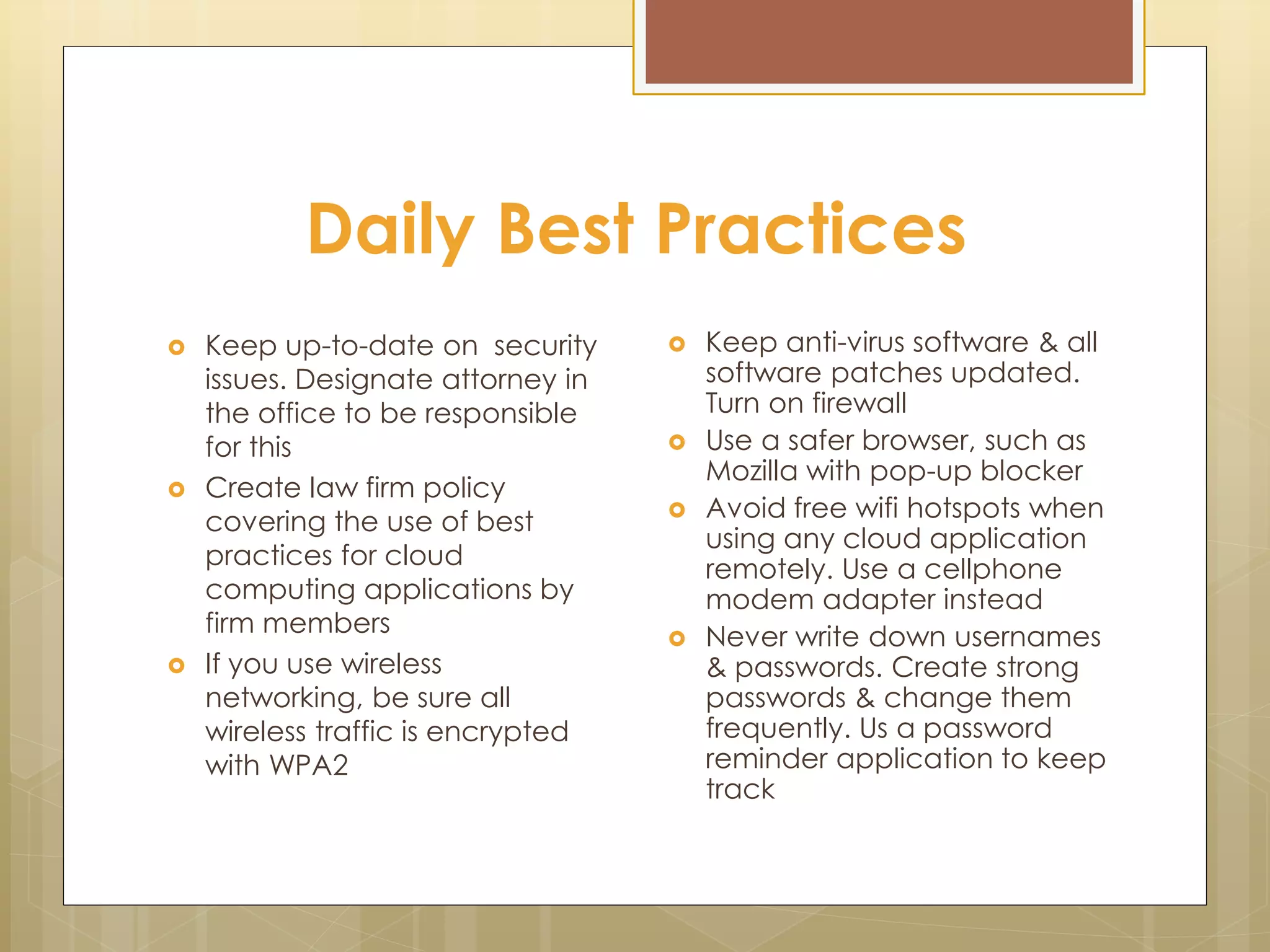
Daily Best Practices
 Keep up-to-date on security
issues. Designate attorney in
the office to be responsible
for this
 Create law firm policy
covering the use of best
practices for cloud
computing applications by
firm members
 If you use wireless
networking, be sure all
wireless traffic is encrypted
with WPA2
 Keep anti-virus software & all
software patches updated.
Turn on firewall
 Use a safer browser, such as
Mozilla with pop-up blocker
 Avoid free wifi hotspots when
using any cloud application
remotely. Use a cellphone
modem adapter instead
 Never write down usernames
& passwords. Create strong
passwords & change them
frequently. Us a password
reminder application to keep
track

Virtual Law Office - What It Is & How to Use It

  • 1.
    Virtual Law Office: What ItIs and How to Use It A Conversation with Stephanie Kimbro
  • 2.
    Why is VirtualLaw Practice Important for the Public?  Greater Access to Justice  Court systems and non-profit legal aid organizations already rely on cloud computing methods to deliver legal services online  Affordable and accessible legal services for lower and moderate income individuals  Help pro-se litigants  Create pro-bono opportunities
  • 3.
    Why is VirtualLaw Practice Important to Lawyers?  No in-house software installation needed  Streamlines and automates the workflow, creates efficiency & allows the attorney to focus on practicing law  Lowers overhead, less expensive than paying for software, storage & server hardware & running it internally with or without IT assistance  Creates less office waste, eco-friendly  Enables access to data anywhere attorney can securely access the internet  Prevents Malpractice through automated checks and processes  Expanded client base, competitive advantage  Better quality of life through work/life balance and flexibility  Be prepared for your future clients: the “Digital Natives”
  • 4.
    Prepare Yourself forFuture Innovation  Features of a virtual law practice will continue to expand beyond what currently may be imagined  The core function of a virtual law practice should remain the same – the ability to securely deliver legal services and work with clients and other legal professionals online through an online client portal  The growth of online legal services is largely consumer-driven  The legal profession should step up to meet this need or the public will continue to use methods that are not safe or in their beset interest to acquire online legal services.  In order to stay competitive and address the needs of clients, most firms will need some form of virtual component in the next five to ten years.
  • 5.
     The TaskForce works through the Law Practice Management Section of the ABA  Members stay current on the effect of technology use on our profession  Offers studies and guidelines on how to ethically practice law online What does the eLawyering Task Force Do?
  • 6.
    Virtual Law Officevs. Online Practice Management Virtual Law Office  A virtual law office is a professional law practice located online through a secure portal that is accessible to both the client and attorney anywhere the parties can access the internet.  Other terminology: VLO, virtual lawyering, virtual law firm, web-based or web- enabled law practice, online law practice, delivering legal services online Online Practice Management  Office, case & client management used as productivity tool  Clients have access to their own online documents with limited control  Document archiving, contact management, calendaring, conflict & jurisdictional checks, billing & invoicing, online payment  Collaboration spaces such as deal rooms or workspaces
  • 7.
     “…all theways lawyers can do their work using the web and associated technologies. These include new ways to collaborate and communicate with clients, prospective clients and other lawyers, produce documents, settle disputes and manage legal knowledge.  Think of a lawyering verb – interview, investigate, counsel, draft, advocate, analyze, negotiate, manage. . .and there are corresponding electronic tools.”  Mark Lauritsen, co-chair, ABA eLawyering Task Force What is eLawyering?
  • 8.
    What Virtual LawPractice is Not!  An online website that sells legal documents without attorney review, such as LegalZoom and other web-based companies selling online legal forms  A law firm website with an email “contact us for a free quote” form for prospective clients  Communication by email even if sent through law firm’s website  A rented physical space that may be shared with other professionals along with a receptionist  VPNs, extranets or other services, such as GoToMyPC and LogMeIn  A conglomeration of attorneys in remote locations pooling resources and communicating over the internet  A law practice based in a virtual reality world such as Second Life
  • 9.
     Break outtasks associated with a legal matter and provide the client with only specific portions of the work  Clearly define for online client the nature and scope of unbundled legal services – what will and will NOT be covered  Provide comparisons and education for the client to make an informed judgment Unbundling Legal Services
  • 10.
     Automating document assemblyfor clients online  Uses intuitive legal forms in combination with questionnaires  Purchased directly by client after attorney review  Can also be purchased in conjunction with additional legal advice Document Assembly & Automation
  • 11.
    What is theMarket for These Services? Your Clients are ready. They shop, bank, conduct business and pay credit cards and taxes online.  50% of middle-income households in the US have at least 1 legal problem per year  Only 20% seek legal assistance from attorneys  26% do nothing at all  Potentially huge market waiting to be tapped in the US for personal consumer legal services  During March 2010 – one month alone – an estimated 535,000 people in the US searched online seeking legal solutions through the LegalZoom site  E-commerce trends are increasing  Also consider trends in legal outsourcing and the globalization of law firms
  • 12.
    How Attorneys UseVirtual Law Offices  Completely Web-Based  Unbundled or limited legal services  Integrated into a Traditional Law Office  Unbundled and full service  As a transition method to allow them to practice law while meeting other personal and professional needs  To raise families  To care for ill spouses or elderly parents  To ease into retirement  After layoffs, to start a solo practice or work while searching for another legal position
  • 13.
    Risks of UsingPiecemeal Apps Rather than Law-Specific Saas  Security Level  Encryption  Secure transmission  Who has access?  Ethics/Malpractice Concerns Unique to Lawyers  Confidentiality  Privacy  Record Keeping/Consistency  Data Return and Retention Policies  Offshore Servers
  • 14.
    Daily Best Practices Keep up-to-date on security issues. Designate attorney in the office to be responsible for this  Create law firm policy covering the use of best practices for cloud computing applications by firm members  If you use wireless networking, be sure all wireless traffic is encrypted with WPA2  Keep anti-virus software & all software patches updated. Turn on firewall  Use a safer browser, such as Mozilla with pop-up blocker  Avoid free wifi hotspots when using any cloud application remotely. Use a cellphone modem adapter instead  Never write down usernames & passwords. Create strong passwords & change them frequently. Us a password reminder application to keep track

Editor's Notes