Urban Design Lessons from
Third Places
Urban Depth & Autonomy Workshops:
Neighbourhood Depth
Art, Architecture & Design Research (LondonMet)
January 28, 2021
Vikas Mehta, PhD
Professor
Fruth/Gemini Chair
Ohio Eminent Scholar of Urban/Env. Design
urban
design:
creating places of distinct identity
creating special and everyday spaces
everyday public/parochial spaces near
home
space overlaid with meaning by humans
central ontological structure of human
experience
continued contact/association w/ space ----
place
regularity of space use ---- emotional
attachment
repeated use of such spaces of meaning
provides a sense of place that is essential to
our experience of the world
place: harrison and dourish, 1996
casey,
1993
tuan, 1977
seamon, 1979
place
experience:occurs at all scales
home -- core of the sense of place
other spaces/settings in the neighborhood
& city also identified as places
these parochial and public spaces complete
our experience of place and the world
both at-home and outside-home place
experience essential to our well being as
social beings
cooper-marcus, 1995
relph, 1986
norberg-schulz, 1980
oldenburg, 1989
seamon, 1979
loss of place:
• increased mobility challenges the notion of
place
• experience of many spaces but fewer places
• even if many contacts, limited repeated
contacts
• loss of place-experience
• loss of nearness . . . . . . . . . . . . . . . . . .
• schism between people and place . . . .
• a placeless geography . . . . . . . . . . . . . .
placelessness . . . . . . . . . . . . . . . . . . . . . . . . .
. . . . .
heideggar, 1962
arendt, 1958
relph, 1976
diminishing
cache of
places
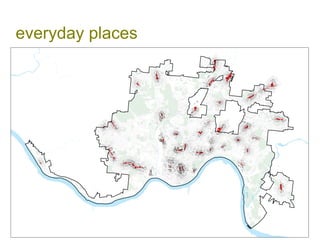
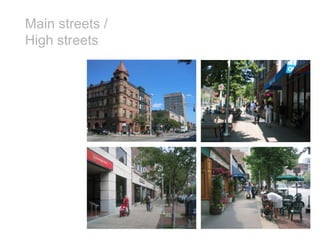
still exist in
neighborhoods on public
spaces such as main/high
streets
everyday places
third place
a place of refuge other than home
/work
a place to regularly visit, to
commune with friends, neighbors,
co-workers and even strangers
small businesses, cafes, coffee
shops, bars, pubs, restaurants,
general stores, community
centers, etc.
everyday places
Main streets /
High streets
the study
structured walk-by observations
structured observations of duration of
stay
semi-structured observations
field notes
interviews
surveys
visual surveys
sketches
drawings
territorial mapping
photographs
short videos
methods
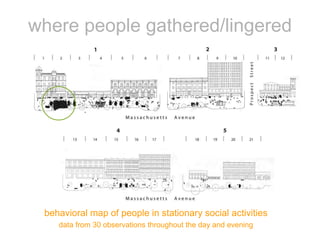
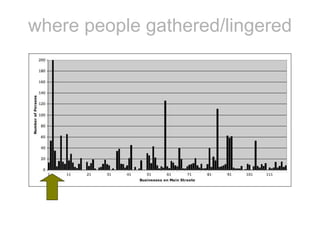
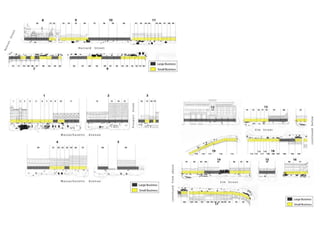
behavioral map of people in stationary social activities
data from 30 observations throughout the day and evening
where people gathered/lingered
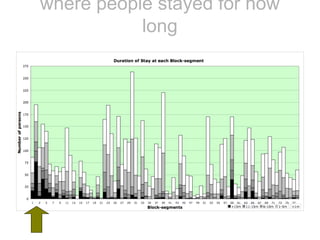
where people stayed for how
long
where people gathered/lingered
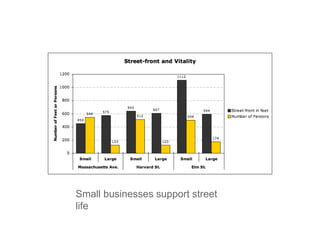
Small businesses support street
life
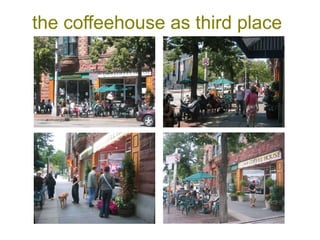
the coffeehouse as third place
the coffeehouse as third
place
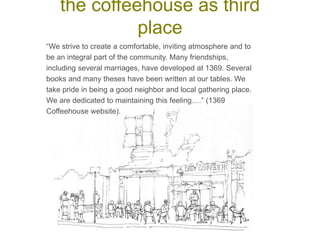
“We strive to create a comfortable, inviting atmosphere and to
be an integral part of the community. Many friendships,
including several marriages, have developed at 1369. Several
books and many theses have been written at our tables. We
take pride in being a good neighbor and local gathering place.
We are dedicated to maintaining this feeling.…” (1369
Coffeehouse website).
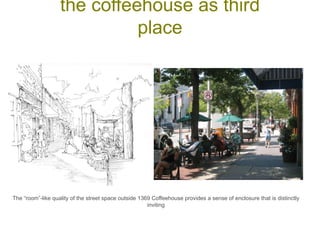
The “room”-like quality of the street space outside 1369 Coffeehouse provides a sense of enclosure that is distinctly
inviting
the coffeehouse as third
place
The people using the street unanimously agreed on the
unique place quality of 1369 Coffeehouse and especially
the street space it extended onto.
“I like the fact that people can hang around here and
socialize and not just be a customer. It [1369
Coffeehouse] is a meeting area, a destination.
Everybody comes here. It attracts [people from] all walks
of life, all races, working class, families, … it has it’s own
unique aura about it.”
“1369 [Coffeehouse] is very personal. There is great
outdoor seating. The music outdoors attracts people. It is
a great place to sit and enjoy your day and people-
watch. It is interesting to see all kinds of people. I
frequently run into people without planning.”
the coffeehouse as third
place
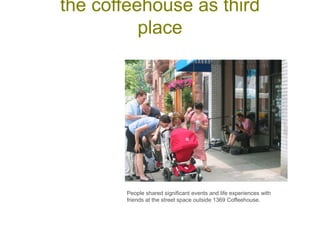
People shared significant events and life experiences with
friends at the street space outside 1369 Coffeehouse.
the coffeehouse as third
place
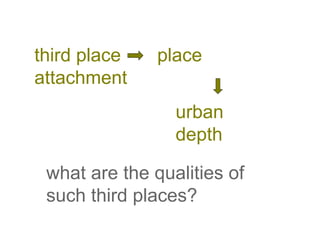
what are the qualities of
such third places?
third place place
attachment
urban
depth
 Uniqueness
 Engagement
 Friendliness
 Responsivenes
s
qualities of third place
• permeability
• personalization
• flexibility
• articulated building facades
• shade and shelter
• well-furnished sidewalk
qualities of third place
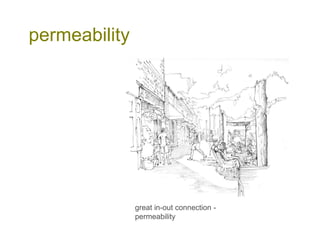
permeability
• more than just transparency
• actively reveal the inside to outside and visa-versa
• street-fronts that engage the senses
• provides sensory stimuli, creating interest, evoking
curiosity
• provides psychological and real sense of safety
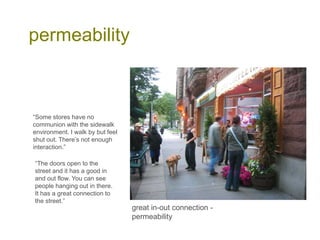
permeability
great in-out connection -
permeability
“Some stores have no
communion with the sidewalk
environment. I walk by but feel
shut out. There’s not enough
interaction.”
“The doors open to the
street and it has a good in
and out flow. You can see
people hanging out in there.
It has a great connection to
the street.”
permeability
great in-out connection -
permeability
personalization
• act of modifying the environment to claim territory
• caring for and nurturing the claimed territory
• ability to personalize leads to attachment to place
• provides psychological security and a symbolic
aesthetic
• provides maintenance and sensory stimuli
• makes the environment distinctive and identifiable
personalization
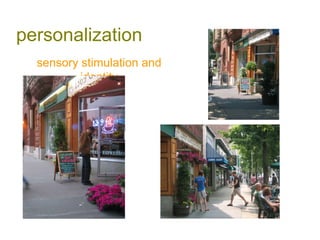
“Signs out on the street [in front of the coffeehouse]
change every few days. They tell you the special
brews or flavors 1369 [Coffeehouse] is serving that
day. And the flowers and planters – they change
every few weeks. It’s very personal and neighborly.
Not like a corporate.”
“We need planters, awnings – things that give off
that people are around. Something that makes the
stores communicate with you.”
“I like 1369 [Coffeehouse] for the music they play,
the artwork on the walls, the ambience. They serve
you in a regular [glass] cup.”
sensory stimulation and
identity
personalization
personalization
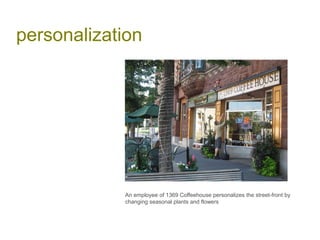
An employee of 1369 Coffeehouse personalizes the street-front by
changing seasonal plants and flowers
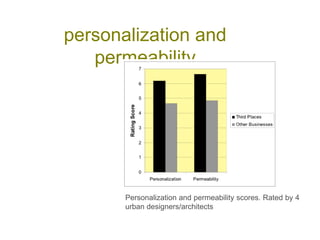
personalization and
permeability
Personalization and permeability scores. Rated by 4
urban designers/architects
flexibility
• ability of space to change with needs of people &
environment
• flexibility and change are crucial in the short-term
• ability of space to be multidimensional
(responsive to needs of diverse groups)
• translates into repeated use that leads to place-
attachment
• change and transformation add interest and intrigue
“Different kinds of people hang out here. On this
section [of the street] attached to 1369
[Coffeehouse]. The business owners are making
some efforts to make it inviting.”
flexibility
“1369 [Coffeehouse is my favorite]. It is affordable
and I meet my friends there. It has a good in-out
flow. The tables on the sidewalk and the benches
are great. It is a magnet for street culture.”
“I love the coffeehouse. You can sit there for hours.
Sit there, read, [and] look at people. I do some of
my work here. It’s an atmosphere not as serious as
a library.”
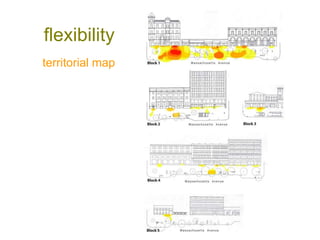
flexibility
territorial map
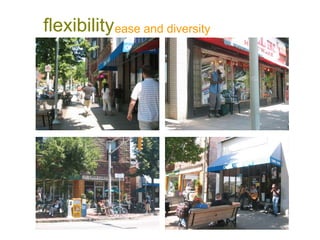
ease and diversity
flexibility
articulated building facade
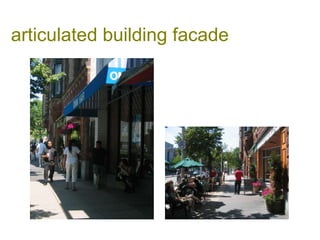
• psychological safety through edge and enclosure
• create a place for personalization
• provide a place to stop before entering or leaving
• provide a refuge - shelter
• provide visual interest in architecture
articulated building facade
shade and
shelter
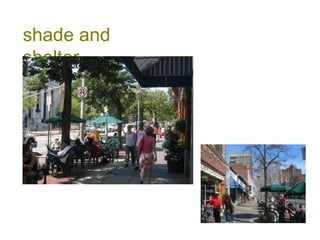
• provides physical comfort
• separates the “there” from “here,” the “in” from the “out”
• provides sense of enclosure - completes the “room”
• trees, canopies, awnings, provide visual interest
• very important to making “rooms” on the street
shade and
shelter
• supports various postures and activities
• provides physical comfort
• furniture and furnishing artifacts inhabit the space
• furniture and furnishing artifacts create smaller spaces
• allows for interpretation
• supports play and discovery by children
• provides sensory stimuli and interest
well-furnished
sidewalk
well-furnished
sidewalk
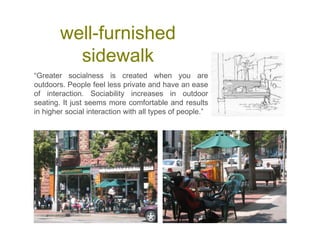
“Greater socialness is created when you are
outdoors. People feel less private and have an ease
of interaction. Sociability increases in outdoor
seating. It just seems more comfortable and results
in higher social interaction with all types of people.”
shade and shelter &
well-furnished
sidewalk
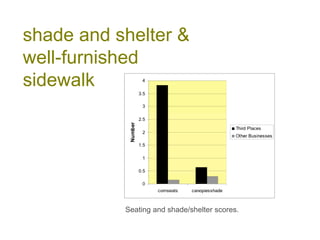
Seating and shade/shelter scores.
lessons for urban
design
• Permeability, personalization, flexibility,
articulated building façade, shade and shelter,
and well-furnished sidewalk provides a sense of
safety, comfort, ownership, visual stimulation and
interest for the users of the street.
• Most importantly, these qualities help create an
identity for 1369 Coffeehouse in the minds of the
people who use the street.
• This makes the street space a people-place and
provided a space to support a sense of
community for the people of the neighborhood.
lessons for urban
design
policy implications
• Value ordinary everyday places that hold much meaning for people
• Preserve and enhance third places (community-gathering places)
• Support businesses and other uses that have existed for a long time
• Consider physical design to accommodate and encourage
personalization
• Allow and encourage third places and other businesses and uses to
modify and control public space as long as they are inclusive
• Consider streets as places, not just channels of movement
Urban Design
Lessons from Third
Places
Urban Depth & Autonomy Workshops:
Neighbourhood Depth
Art, Architecture & Design Research
(LondonMet)
January 28, 2021
Vikas Mehta, PhD
Professor, Fruth/Gemini Chair
Ohio Eminent Scholar of Urban/Env.
Design

Vikas Mehta "Urban Design Lessons from Third Places"

  • 1.
    Urban Design Lessonsfrom Third Places Urban Depth & Autonomy Workshops: Neighbourhood Depth Art, Architecture & Design Research (LondonMet) January 28, 2021 Vikas Mehta, PhD Professor Fruth/Gemini Chair Ohio Eminent Scholar of Urban/Env. Design
  • 2.
    urban design: creating places ofdistinct identity creating special and everyday spaces everyday public/parochial spaces near home
  • 3.
    space overlaid withmeaning by humans central ontological structure of human experience continued contact/association w/ space ---- place regularity of space use ---- emotional attachment repeated use of such spaces of meaning provides a sense of place that is essential to our experience of the world place: harrison and dourish, 1996 casey, 1993 tuan, 1977 seamon, 1979
  • 4.
    place experience:occurs at allscales home -- core of the sense of place other spaces/settings in the neighborhood & city also identified as places these parochial and public spaces complete our experience of place and the world both at-home and outside-home place experience essential to our well being as social beings cooper-marcus, 1995 relph, 1986 norberg-schulz, 1980 oldenburg, 1989 seamon, 1979
  • 5.
    loss of place: •increased mobility challenges the notion of place • experience of many spaces but fewer places • even if many contacts, limited repeated contacts • loss of place-experience • loss of nearness . . . . . . . . . . . . . . . . . . • schism between people and place . . . . • a placeless geography . . . . . . . . . . . . . . placelessness . . . . . . . . . . . . . . . . . . . . . . . . . . . . . . heideggar, 1962 arendt, 1958 relph, 1976 diminishing cache of places
  • 6.
    still exist in neighborhoodson public spaces such as main/high streets everyday places third place a place of refuge other than home /work a place to regularly visit, to commune with friends, neighbors, co-workers and even strangers small businesses, cafes, coffee shops, bars, pubs, restaurants, general stores, community centers, etc.
  • 7.
  • 8.
  • 9.
    the study structured walk-byobservations structured observations of duration of stay semi-structured observations field notes interviews surveys visual surveys sketches drawings territorial mapping photographs short videos methods
  • 10.
    behavioral map ofpeople in stationary social activities data from 30 observations throughout the day and evening where people gathered/lingered
  • 11.
    where people stayedfor how long
  • 12.
  • 14.
  • 15.
    the coffeehouse asthird place
  • 16.
    the coffeehouse asthird place “We strive to create a comfortable, inviting atmosphere and to be an integral part of the community. Many friendships, including several marriages, have developed at 1369. Several books and many theses have been written at our tables. We take pride in being a good neighbor and local gathering place. We are dedicated to maintaining this feeling.…” (1369 Coffeehouse website).
  • 17.
    The “room”-like qualityof the street space outside 1369 Coffeehouse provides a sense of enclosure that is distinctly inviting the coffeehouse as third place
  • 18.
    The people usingthe street unanimously agreed on the unique place quality of 1369 Coffeehouse and especially the street space it extended onto. “I like the fact that people can hang around here and socialize and not just be a customer. It [1369 Coffeehouse] is a meeting area, a destination. Everybody comes here. It attracts [people from] all walks of life, all races, working class, families, … it has it’s own unique aura about it.” “1369 [Coffeehouse] is very personal. There is great outdoor seating. The music outdoors attracts people. It is a great place to sit and enjoy your day and people- watch. It is interesting to see all kinds of people. I frequently run into people without planning.” the coffeehouse as third place
  • 19.
    People shared significantevents and life experiences with friends at the street space outside 1369 Coffeehouse. the coffeehouse as third place
  • 20.
    what are thequalities of such third places? third place place attachment urban depth
  • 21.
     Uniqueness  Engagement Friendliness  Responsivenes s qualities of third place
  • 22.
    • permeability • personalization •flexibility • articulated building facades • shade and shelter • well-furnished sidewalk qualities of third place
  • 23.
    permeability • more thanjust transparency • actively reveal the inside to outside and visa-versa • street-fronts that engage the senses • provides sensory stimuli, creating interest, evoking curiosity • provides psychological and real sense of safety
  • 24.
    permeability great in-out connection- permeability “Some stores have no communion with the sidewalk environment. I walk by but feel shut out. There’s not enough interaction.” “The doors open to the street and it has a good in and out flow. You can see people hanging out in there. It has a great connection to the street.”
  • 25.
  • 26.
    personalization • act ofmodifying the environment to claim territory • caring for and nurturing the claimed territory • ability to personalize leads to attachment to place • provides psychological security and a symbolic aesthetic • provides maintenance and sensory stimuli • makes the environment distinctive and identifiable
  • 27.
    personalization “Signs out onthe street [in front of the coffeehouse] change every few days. They tell you the special brews or flavors 1369 [Coffeehouse] is serving that day. And the flowers and planters – they change every few weeks. It’s very personal and neighborly. Not like a corporate.” “We need planters, awnings – things that give off that people are around. Something that makes the stores communicate with you.” “I like 1369 [Coffeehouse] for the music they play, the artwork on the walls, the ambience. They serve you in a regular [glass] cup.”
  • 28.
  • 29.
    personalization An employee of1369 Coffeehouse personalizes the street-front by changing seasonal plants and flowers
  • 30.
    personalization and permeability Personalization andpermeability scores. Rated by 4 urban designers/architects
  • 31.
    flexibility • ability ofspace to change with needs of people & environment • flexibility and change are crucial in the short-term • ability of space to be multidimensional (responsive to needs of diverse groups) • translates into repeated use that leads to place- attachment • change and transformation add interest and intrigue
  • 32.
    “Different kinds ofpeople hang out here. On this section [of the street] attached to 1369 [Coffeehouse]. The business owners are making some efforts to make it inviting.” flexibility “1369 [Coffeehouse is my favorite]. It is affordable and I meet my friends there. It has a good in-out flow. The tables on the sidewalk and the benches are great. It is a magnet for street culture.” “I love the coffeehouse. You can sit there for hours. Sit there, read, [and] look at people. I do some of my work here. It’s an atmosphere not as serious as a library.”
  • 33.
  • 34.
  • 35.
    articulated building facade •psychological safety through edge and enclosure • create a place for personalization • provide a place to stop before entering or leaving • provide a refuge - shelter • provide visual interest in architecture
  • 36.
  • 37.
    shade and shelter • providesphysical comfort • separates the “there” from “here,” the “in” from the “out” • provides sense of enclosure - completes the “room” • trees, canopies, awnings, provide visual interest • very important to making “rooms” on the street
  • 38.
  • 39.
    • supports variouspostures and activities • provides physical comfort • furniture and furnishing artifacts inhabit the space • furniture and furnishing artifacts create smaller spaces • allows for interpretation • supports play and discovery by children • provides sensory stimuli and interest well-furnished sidewalk
  • 40.
    well-furnished sidewalk “Greater socialness iscreated when you are outdoors. People feel less private and have an ease of interaction. Sociability increases in outdoor seating. It just seems more comfortable and results in higher social interaction with all types of people.”
  • 41.
    shade and shelter& well-furnished sidewalk Seating and shade/shelter scores.
  • 42.
    lessons for urban design •Permeability, personalization, flexibility, articulated building façade, shade and shelter, and well-furnished sidewalk provides a sense of safety, comfort, ownership, visual stimulation and interest for the users of the street. • Most importantly, these qualities help create an identity for 1369 Coffeehouse in the minds of the people who use the street. • This makes the street space a people-place and provided a space to support a sense of community for the people of the neighborhood.
  • 43.
    lessons for urban design policyimplications • Value ordinary everyday places that hold much meaning for people • Preserve and enhance third places (community-gathering places) • Support businesses and other uses that have existed for a long time • Consider physical design to accommodate and encourage personalization • Allow and encourage third places and other businesses and uses to modify and control public space as long as they are inclusive • Consider streets as places, not just channels of movement
  • 44.
    Urban Design Lessons fromThird Places Urban Depth & Autonomy Workshops: Neighbourhood Depth Art, Architecture & Design Research (LondonMet) January 28, 2021 Vikas Mehta, PhD Professor, Fruth/Gemini Chair Ohio Eminent Scholar of Urban/Env. Design