Teacher’s Handbook
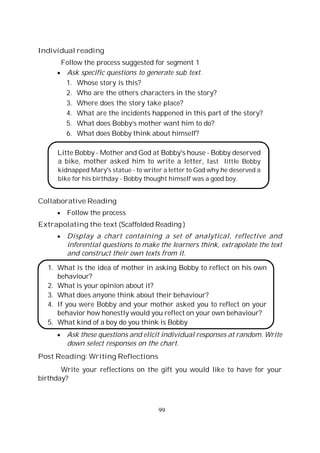
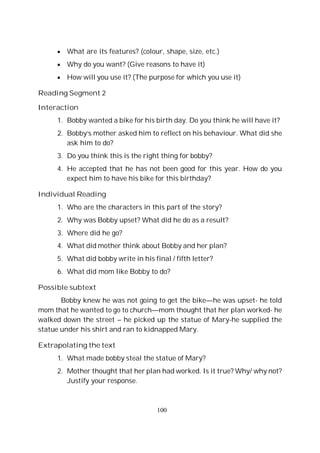
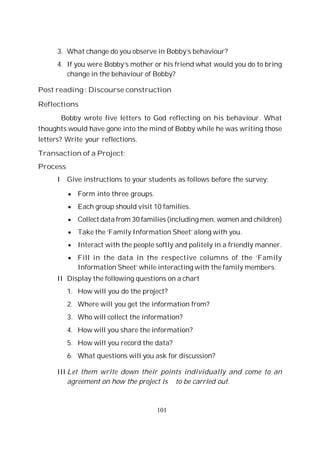
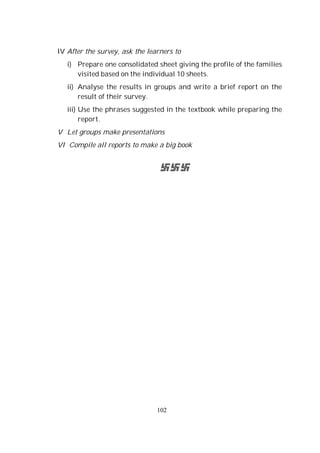
English
Classes VIII & IX
State Council of Educational Research & Training
A.P, Hyderabad.
2013
Handbook Development Committee Members
Mr. N. Peraiah, SA, ZPHS. Ponnaluru, Prakasam
Mr. Y G K Murty, Tutor ELTC, DIET Khammam
Mr. M. Chakradhar, SA, ZPHS. Mudakapally, Nizamabad.
Mr. K. Srinivas Reddy, SA, ZPHS. Kasimdevi Pet, Warangal.
Mrs. Rajanikantha Kumari, Chief Tutor, DCE, Guntur.
Mrs. K. Sudha, Officer-in-Charge ELTC, DIET Neredmet, Hyderabad.
Mr. Nagender, SA, ZPHS. Kanukur, Ananthapur.
Mr. G. Ragava Reddy, lecturer, DIET Nalgonda,
Coordinator
Dr. P. Jani Reddy, Lecturer, DIET Vikarabad, Rangareddy
Academic Support & Editing
Dr. K N Anandan,, ELT Expert and Linguist, Kerala.
Academic advisors
Dr. N. Upender Reddy, Prof. & Head C&T Dept. SCERT AP Hyderabad.
Sri G. Gopal Reddy, Director SCERT AP Hyderabad.
Chief Advisor
Smt. V. Usha Rani, I.A.S.,
Commissioner & Director of School Education,
Andhra Pradesh Hyderabad
Foreword
The SCERT, A.P., Hyderabad has under taken the curricular revision and new
textbooks have been developed. A single English textbook has been designed for both
the English medium and non-English medium students for classes 1 to 10 in school
education. Accordingly textbooks were developed for classes 1, 2, 3, 6 and 7 for the
academic year 20012-13. In the second phase of the revision the remaining classes 4, 5, 8
and 9 have been developed for the academic year 2013-14.
The new textbooks are developed on the basis of the guiding principles of NCF
2005, RTE 2009 and SCF 2011. English textbooks are prepared based on the themes
suggested by NCF. The new textbooks have been developed on the constructivist
paradigm where learner constructs the language by linking the classroom experience
with the real life experience outside the classroom. In order to ensure the holistic
treatment of language certain discourses are identified for Primary and Upper Primary
level classes with specific features or indicators. The entire classroom process is aimed
at achieving the targeted discourses. A detailed transactional process has been
suggested to achieve the discourses targeted in each class.
This module contains the classroom transactional process for all classes, the
identified discourses in each reading slot /segment, a detailed process for oral and
written discourses, classroom theatre, teacher development and CCE based model
question papers. In addition to this a special package to bridging the gap is also
included for acquiring minimum competencies among the children in developing
discourses like description, conversation and narrative or story before starting the
transaction of units.
I hope this module would certainly help the teachers to follow the transactional
process in achieving the academic standards in all classes among all children. The
SCERT AP Hyderabad appreciates the efforts of the members of the textbook
development committee in developing this handbook for the benefit of English
language teachers in the state.
Director
SCERT AP Hyderabad
Upper Primary English Teacher’s Handbook
CONTENTS
Chapter Details of the Chapter Page Number
I Introduction 1-12
II Bridging the Gap 13-22
III Unit wise Transaction of Classes VI-IX 23-102
Class VI 23-46
Class VII 47-60
Class VIII 61-76
Class IX 77-102
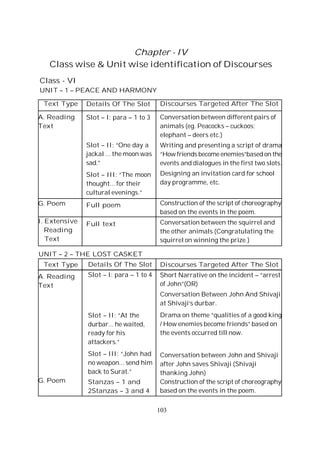
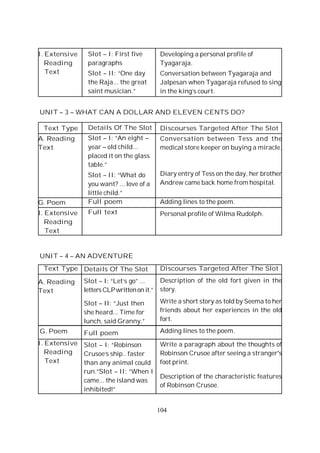
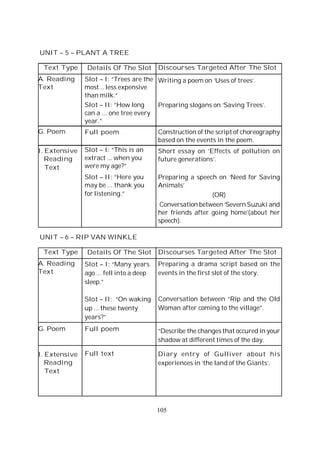
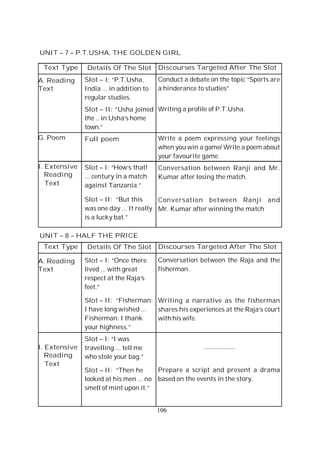
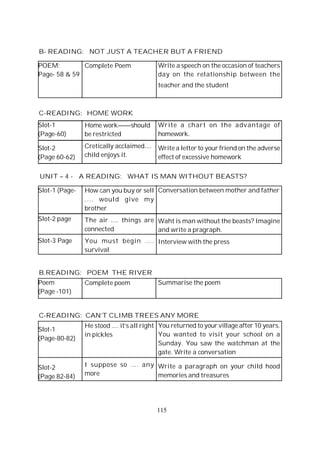
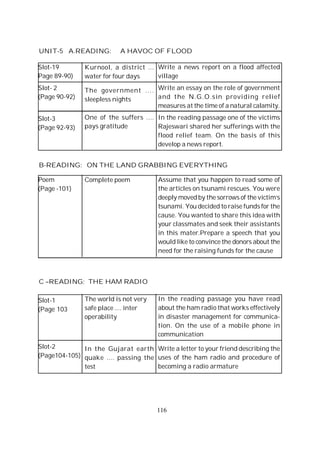
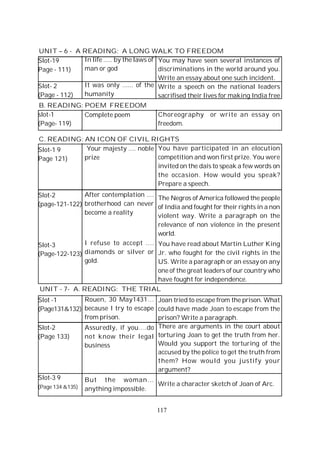
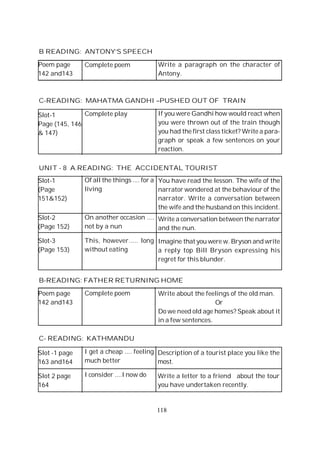
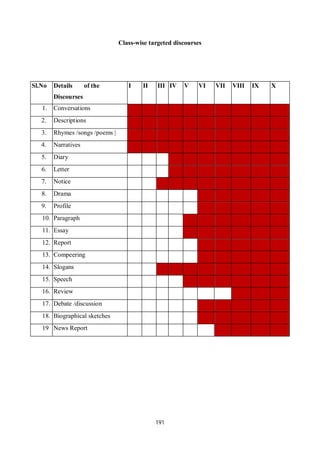
IV Identification of Class wise and Unit wise Discourses 103-118
V Processing of other Discourses 119-133
VI CCE Model Question Papers 134-164
VII Classroom Theatre 165-169
VIII Continuing Professional Development (CPD) 170-173
Appendices 174-219
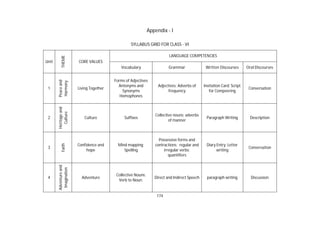
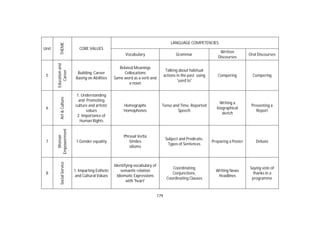
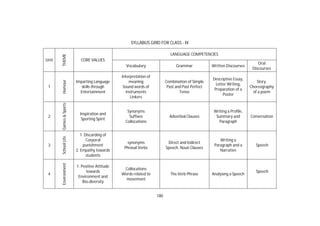
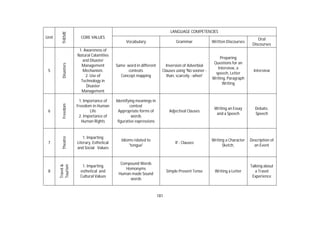
Appendix-I Syllabus Grid 174-181
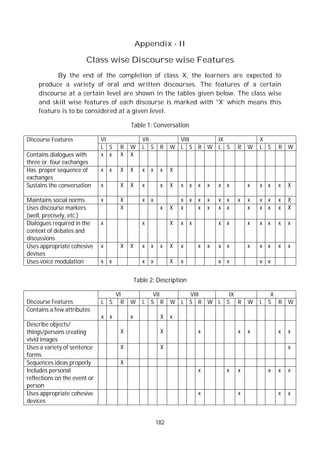
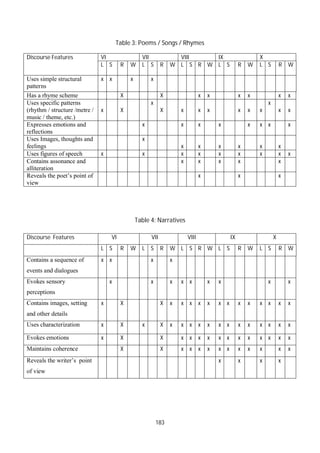
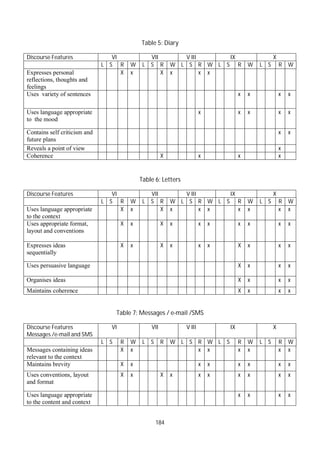
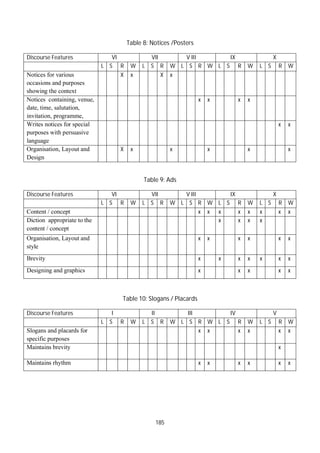
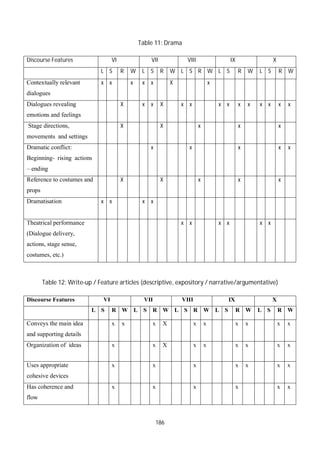
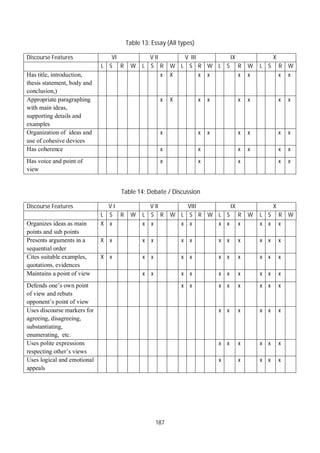
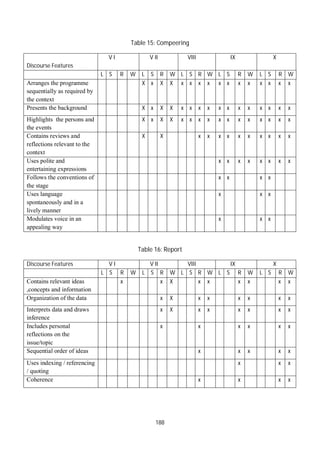
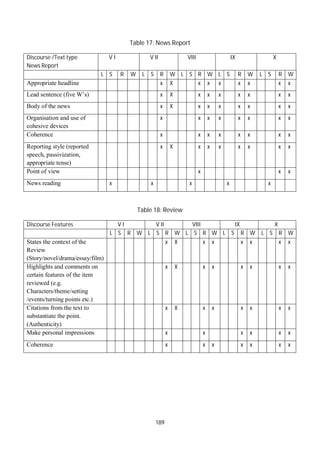
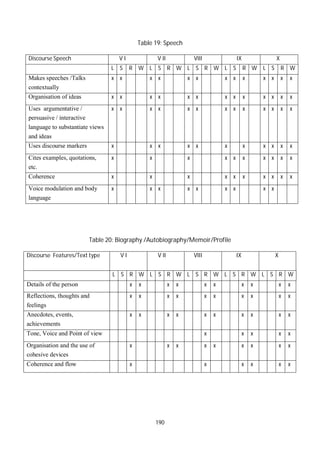
Appendix-II Discourse Features 182-191
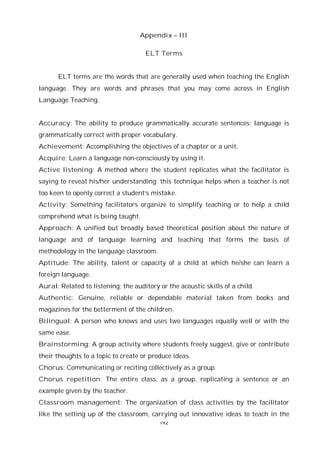
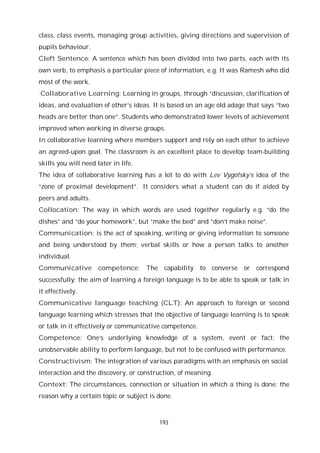
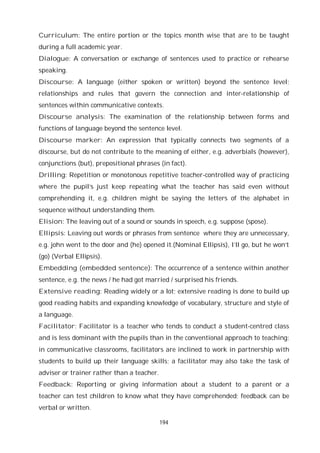
Appendix-III ELT Terms 192-199
Appendix-IV Reading Material for Teachers 200-208
Appendix-V Framing Questions 209-212
Appendix -VI FAQs 213-220
1
Chapter - I
Introduction
1.1. Background
As you know SCERT has entered the second phase of curriculum revision
with the production of new textbooks for the classes 4, 5, 8 and 9. Recall that
a teacher support material was given to all teachers handling English in classes
1,2,3,6 and 7 during last year when the revised textbooks were introduced in
these classes across the state. Wherever teachers followed the classroom
processes suggested as per the transaction module, children were able to
achieve the targeted academic standards. On the contrary, in those classes
where teaching of English took place in the conventional way, no significant
achievement could be discerned; at the most learners ended up with learning
questions and answers given in the textbook.
Though the present handbook is prepared in the context of the
introduction of new textbooks in classes 4, 5, 8 and 9, it is to be used as
supplementary to the handbook given to you in the previous year. Please
follow the classroom process suggested in the handbook as it addresses several
classroom issues (low proficient learners, lack of confidence in using English
for the part of teachers and learners, single teacher classrooms, etc.). It is
extremely important to bear in mind that the aim of classroom transaction
is to help the learners achieve academic standards, and not to teach
the whole text book.
What has been stated above is likely to disturb teachers who haven’t
really understood the pedagogic implication of working for achieving academic
standards. This will not be possible unless teachers develop thorough
understanding about the academic standards and the process for achieving
them. The following points are worth remembering
2
Instead of focusing on comprehension questions and their answers,
we have to go for meaningful interaction with the learners which
will make them think and articulate their ideas.
There is no space for rote-learning; the focus is on using language
contextually and meaningfully.
We want the learners to evolve as independent users of the target
language.
1.2. The organisation of the handbook
The present module is organised as follows:
1. Introduction
In this chapter in addition to brief introduction the details of the
transactional process has given in Telugu.
2. Bridging the gap
This chapter suggests a few activities that are to be carried out before
we actually enter the textbook. The focus of this chapter is to help
teachers understand the pedagogy of picture interaction which
eventually will lead to the construction of basic discourses such as
descriptions, conversations, and narratives. A three- tier classroom
process has been conceived for helping the learners in all classes to
construct each of these discourses in the whole class, in groups and also
individually. Once the learners gain confidence in speaking and writing
creatively and spontaneously, most barriers between the TB and the
learner can be removed.
3. Class-wise unit transaction
This chapter contains a detailed account of the various components of
the TB to be transacted and the process for doing each of these – one
unit in each class has been worked out thoroughly.
3
4. Identifying the discourses to be targeted in the remaining
passages
Since the reading passages given in the textbook belong to different
genre of discourses, Chapter 4 deals with reading passages in the
remaining units (i.e., units 2 to 8). This implies the following:
Segmenting the reading passages in the remaining units.
Identifying the discourses that can be generated after
transacting each segment of readings.
5. Process for constructing the other discourses
The process for constructing the other discourses that are not
covered in the preceding chapters. They will be discussed in this
chapter.
6. CCE and specimen question papers
Chapter 7 deals with some aspects of CCE. This includes the features
of discourses to be targeted at a certain stage and also specimen
question papers.
7. The classroom theatre
The module contains one chapter exclusively on the pedagogy of
classroom theatre. We have tried out the potential of theatre as a
pedagogic tool and have realized that it is a multifaceted tool that
can take care of various language skills, multiple intelligences and
make the classroom inclusive. How to make use of theatre in teaching
of English.
Why theatre.
4
The process of generating theatre based on the stories.
Theatre for developing multiple skills.
Using theatre for making learners independent users of language.
Theatre for making the classroom inclusive .
Social aspects of theatre.
8. Continuing Professional Development
Chapter 8 deals with how a teacher can continue their professional
development for effective implementation of classroom transaction.
Appendices
These include the following:
1. Syllabus grid for classes 6 to 9.
2. Class-wise Discourse features.
3. A glossary of commonly used ELT terms.
4. Reading material for teachers.
5. Framing questions for various instances of interaction .
6. Answers to a number of Frequently Asked Questions (FAQ) which will
help the teachers come out of their belief systems and get tuned to the
pedagogic shift envisaged in the curriculum.
It is expected that the present module will be highly useful for the
teachers. Please bear in that unless we put in concerned efforts for our own
development continuously, we will not be able to meet the challenges that are
before us.
In addition to the above chapters, a detail transaction process has
been given in Telugu language for the benefit of the teachers in this unit
(Unit-I).
5
(Learning)
NCF
APSCF RTE
(Constructivism)
(facilitator)
(themes)
1. Face sheet / Pre-reading / picture interaction / Theme based picture
6
2. A. Reading
3. Vocabulary
4. Grammar
5. Writing
6. Study Skills
7. Listening & Speaking / Oral activity
8. B. Reading
9. C. Reading
10. Project work
Pre-readingActivity
1. Picture interaction (Theme based picture)
Black board Chart
Reading
passage
7
English English
Picture interaction picture Description / dialogue / narrative
or story develop
2. Reading:
Reading Reading for comprehension Reading
text (slots) (dramatic)
discourses develop (slots)
(i) Individual Reading:
Reading
Question mark (?)
Text
individual reading
text
text glossary dictionary
additional meanings teacherchart display
(ii) Collaborative Reading - Group Reading
Individual reading text
(groups)
8
Text
Slot text glossary
text
reading text
text slot
Reading passage allot
groups loud reading positive
qualitative feedback
What are the points that come to your
mind
(iii) Scaffold Reading (Extrapolating the text):
(analytical / extrapolating / cause
consequences)
chart
Mind-mapping technique groups concept mapping
group
collect concept maps bigbook
Post - Reading (Discourse Construction)
reading slot
(targeted discourses- oral and written) (discription / conversation / narra-
tive, letter diary, drama, poster, notice etc., )
discourse features
Blackboard /
chart
9
discourses
discourses
(teachers version)
edit feedback
slots
3. Vocabulary:
feedback
Vocabulary activities
4. Grammar
writing editing
feedback
10
5. Writing(Written discourses)
perfection
supporting
Writing
written scripts
present
feedback
6. Study Skills:
Paragraph tables, diagrams, charts
groups
present
presentation feedback
7. Listening (Oral Discourses)
Listening passage slots
textbook
textbook
11
analytical, global, extrapolative inferential
Speaking oral activity
chart / board
feedback
feedback
8. B. Reading (Poem):
Poem Title
Title
Poem
Suggested Questions for interaction:
1) What are the ideas do you get from the title?
2) Do you understand the meaning of the title?
3) What are the ideas do you get from the picture?
4) What event / events do you notice in the picture?
5) What are the characters do you notice in the poem?
(Note: Teacher frame more questions on the picture)
poem slots
slots A. Reading (individual reading / collaborative
reading / scaffolded reading)
poems teacher's handbook choreography
12
9. C. Reading (Extensive Reading):
A. Reading
extensive reading text
Story / text
Feedback
10. Proect Work
(Reading, writ-
ing, speaking and listening) .
project
project work
present
groups feedback
feedback
display
13
Chapter - II
Bridging the Gap
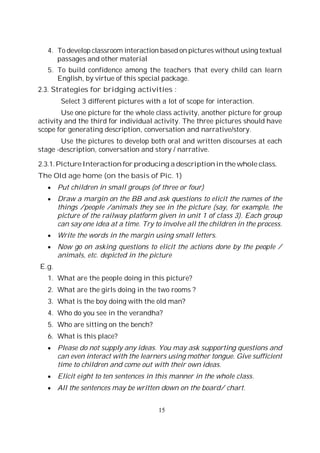
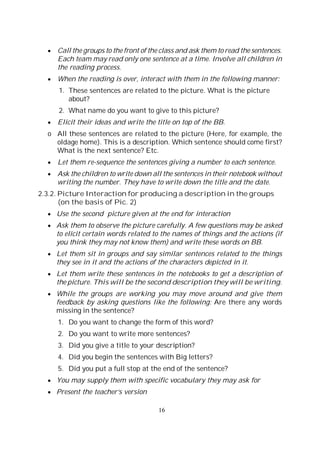
(Picture) : Students of Govt. Primary school AP Lingotam, Narketpally
Mandal of Nalgonda. Displaying the English magazines they produced)
2.1. Introduction
As per the survey conducted during the month of March 2013, on
classroom transaction process in English at Primary and U.P. level revealed
the following facts:
Majority of the teachers and children liked the text book, but they
expressed their inability to transact the lessons because of the low
proficiency of the children.
The orientation on new textbooks and handbooks was not conducted
effectively.
Most of the teachers have not followed the classroom transactional
process suggested in the handbook.
Most of the teachers felt that they are not equipped to make their
children ready to use the textbook.
14
Most of the teachers are not familiar with the new pedagogy of teaching
English.
Most of the teachers felt that experiential mode of training and special
strategies for low proficient learners are required.
Keeping in view the above facts, it has been decided to work with a
special package to equip the children acquire essential competencies in
English so that they can make use of the new textbook creatively; this
will be especially helpful for the children from mother tongue medium.
It may be noticed that the classroom processes and activities suggested
in the special package has been tried out successfully in 42 Government
Primary schools of Narkatpally Mandal, in a rural background of
Nalgonda district is extremely challenging situations like the following:
First generation learners.
Single teacher handling more than one division.
Lack of proper ambience at school in terms of classroom space, toilet
facilities, etc.
Teachers with relatively inadequate language apparatus.
Teachers with traditional belief systems regarding the teaching of
English.
In spite of this non-conducive environment, teachers of Govt. primary
schools were able to achieve the targeted academic standards. They produced
nearly 3000 English magazines containing descriptions, conversations, rhymes
and stories they had written individually. Also, they performed dramas,
choreography, role-plays etc. before a crowded audience.
The special package (Bridging the Gap) has given fruitful results in
Narketpally mandal of Nalgonda district. The SCERT AP has decided to
adapt the same strategy across the state to achieve minimum competencies
among the children before using the textbooks for classes II to V.
2.2.Objectives of the bridging activities
1. To creating English environment by overcoming the inhibitions among
the children.
2. To encourage the children to express their opinions, freely in their own
English.
3. To achieve minimum academic standards as the children develop
conversations, descriptions, story/ narrative orally and in written form
which help them to use of the textbook effectively.
15
4. To develop classroom interaction based on pictures without using textual
passages and other material
5. To build confidence among the teachers that every child can learn
English, by virtue of this special package.
2.3. Strategies for bridging activities :
Select 3 different pictures with a lot of scope for interaction.
Use one picture for the whole class activity, another picture for group
activity and the third for individual activity. The three pictures should have
scope for generating description, conversation and narrative/story.
Use the pictures to develop both oral and written discourses at each
stage -description, conversation and story / narrative.
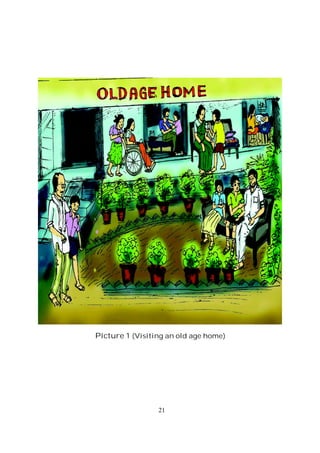
2.3.1. Picture Interaction for producing a description in the whole class.
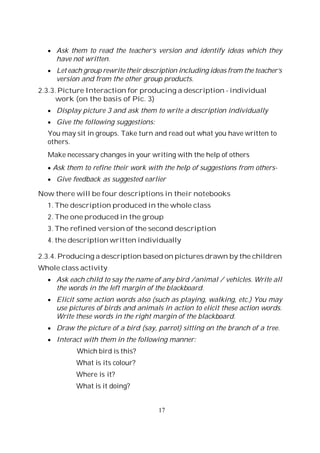
The Old age home (on the basis of Pic. 1)
Put children in small groups (of three or four)
Draw a margin on the BB and ask questions to elicit the names of the
things /people /animals they see in the picture (say, for example, the
picture of the railway platform given in unit 1 of class 3). Each group
can say one idea at a time. Try to involve all the children in the process.
Write the words in the margin using small letters.
Now go on asking questions to elicit the actions done by the people /
animals, etc. depicted in the picture
E.g.
1. What are the people doing in this picture?
2. What are the girls doing in the two rooms ?
3. What is the boy doing with the old man?
4. Who do you see in the verandha?
5. Who are sitting on the bench?
6. What is this place?
Please do not supply any ideas. You may ask supporting questions and
can even interact with the learners using mother tongue. Give sufficient
time to children and come out with their own ideas.
Elicit eight to ten sentences in this manner in the whole class.
All the sentences may be written down on the board/ chart.
16
Call the groups to the front of the class and ask them to read the sentences.
Each team may read only one sentence at a time. Involve all children in
the reading process.
When the reading is over, interact with them in the following manner:
1. These sentences are related to the picture. What is the picture
about?
2. What name do you want to give to this picture?
Elicit their ideas and write the title on top of the BB.
o All these sentences are related to the picture (Here, for example, the
oldage home). This is a description. Which sentence should come first?
What is the next sentence? Etc.
Let them re-sequence the sentences giving a number to each sentence.
Ask the children to write down all the sentences in their notebook without
writing the number. They have to write down the title and the date.
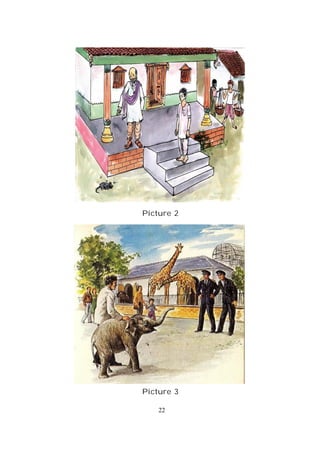
2.3.2. Picture Interaction for producing a description in the groups
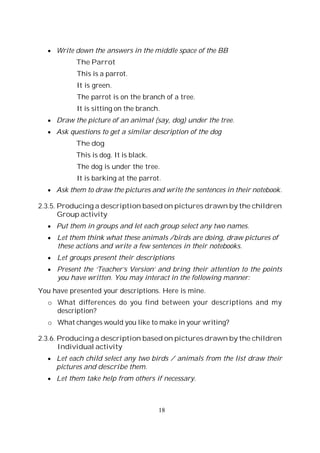
(on the basis of Pic. 2)
Use the second picture given at the end for interaction
Ask them to observe the picture carefully. A few questions may be asked
to elicit certain words related to the names of things and the actions (if
you think they may not know them) and write these words on BB.
Let them sit in groups and say similar sentences related to the things
they see in it and the actions of the characters depicted in it.
Let them write these sentences in the notebooks to get a description of
the picture. This will be the second description they will be writing.
While the groups are working you may move around and give them
feedback by asking questions like the following: Are there any words
missing in the sentence?
1. Do you want to change the form of this word?
2. Do you want to write more sentences?
3. Did you give a title to your description?
4. Did you begin the sentences with Big letters?
5. Did you put a full stop at the end of the sentence?
You may supply them with specific vocabulary they may ask for
Present the teacher’s version
17
Ask them to read the teacher’s version and identify ideas which they
have not written.
Let each group rewrite their description including ideas from the teacher’s
version and from the other group products.
2.3.3. Picture Interaction for producing a description - individual
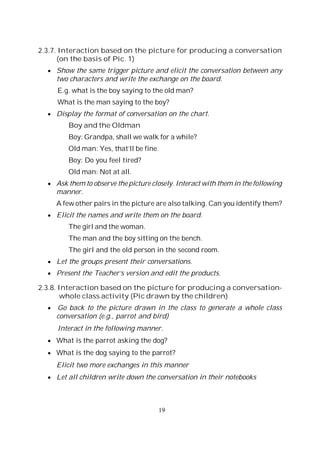
work (on the basis of Pic. 3)
Display picture 3 and ask them to write a description individually
Give the following suggestions:
You may sit in groups. Take turn and read out what you have written to
others.
Make necessary changes in your writing with the help of others
Ask them to refine their work with the help of suggestions from others-
Give feedback as suggested earlier
Now there will be four descriptions in their notebooks
1. The description produced in the whole class
2. The one produced in the group
3. The refined version of the second description
4. the description written individually
2.3.4. Producing a description based on pictures drawn by the children
Whole class activity
Ask each child to say the name of any bird /animal / vehicles. Write all
the words in the left margin of the blackboard.
Elicit some action words also (such as playing, walking, etc.) You may
use pictures of birds and animals in action to elicit these action words.
Write these words in the right margin of the blackboard.
Draw the picture of a bird (say, parrot) sitting on the branch of a tree.
Interact with them in the following manner:
Which bird is this?
What is its colour?
Where is it?
What is it doing?
18
Write down the answers in the middle space of the BB
The Parrot
This is a parrot.
It is green.
The parrot is on the branch of a tree.
It is sitting on the branch.
Draw the picture of an animal (say, dog) under the tree.
Ask questions to get a similar description of the dog
The dog
This is dog. It is black.
The dog is under the tree.
It is barking at the parrot.
Ask them to draw the pictures and write the sentences in their notebook.
2.3.5. Producing a description based on pictures drawn by the children
Group activity
Put them in groups and let each group select any two names.
Let them think what these animals /birds are doing, draw pictures of
these actions and write a few sentences in their notebooks.
Let groups present their descriptions
Present the ‘Teacher’s Version’ and bring their attention to the points
you have written. You may interact in the following manner:
You have presented your descriptions. Here is mine.
o What differences do you find between your descriptions and my
description?
o What changes would you like to make in your writing?
2.3.6. Producing a description based on pictures drawn by the children
Individual activity
Let each child select any two birds / animals from the list draw their
pictures and describe them.
Let them take help from others if necessary.
19
2.3.7. Interaction based on the picture for producing a conversation
(on the basis of Pic. 1)
Show the same trigger picture and elicit the conversation between any
two characters and write the exchange on the board.
E.g. what is the boy saying to the old man?
What is the man saying to the boy?
Display the format of conversation on the chart.
Boy and the Oldman
Boy: Grandpa, shall we walk for a while?
Old man: Yes, that’ll be fine.
Boy: Do you feel tired?
Old man: Not at all.
Ask them to observe the picture closely. Interact with them in the following
manner.
A few other pairs in the picture are also talking. Can you identify them?
Elicit the names and write them on the board.
The girl and the woman.
The man and the boy sitting on the bench.
The girl and the old person in the second room.
Let the groups present their conversations.
Present the Teacher’s version and edit the products.
2.3.8. Interaction based on the picture for producing a conversation-
whole class activity (Pic drawn by the children)
Go back to the picture drawn in the class to generate a whole class
conversation (e.g., parrot and bird)
Interact in the following manner.
What is the parrot asking the dog?
What is the dog saying to the parrot?
Elicit two more exchanges in this manner
Let all children write down the conversation in their notebooks
20
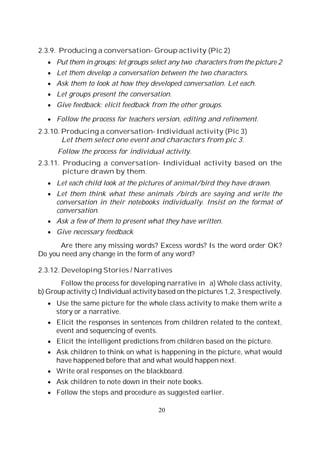
2.3.9. Producing a conversation- Group activity (Pic 2)
Put them in groups; let groups select any two characters from the picture 2
Let them develop a conversation between the two characters.
Ask them to look at how they developed conversation. Let each.
Let groups present the conversation.
Give feedback; elicit feedback from the other groups.
Follow the process for teachers version, editing and refinement.
2.3.10. Producing a conversation- Individual activity (Pic 3)
Let them select one event and characters from pic 3.
Follow the process for individual activity.
2.3.11. Producing a conversation- Individual activity based on the
picture drawn by them.
Let each child look at the pictures of animal/bird they have drawn.
Let them think what these animals /birds are saying and write the
conversation in their notebooks individually. Insist on the format of
conversation.
Ask a few of them to present what they have written.
Give necessary feedback
Are there any missing words? Excess words? Is the word order OK?
Do you need any change in the form of any word?
2.3.12. Developing Stories / Narratives
Follow the process for developing narrative in a) Whole class activity,
b) Group activity c) Individual activity based on the pictures 1,2, 3 respectively.
Use the same picture for the whole class activity to make them write a
story or a narrative.
Elicit the responses in sentences from children related to the context,
event and sequencing of events.
Elicit the intelligent predictions from children based on the picture.
Ask children to think on what is happening in the picture, what would
have happened before that and what would happen next.
Write oral responses on the blackboard.
Ask children to note down in their note books.
Follow the steps and procedure as suggested earlier.
21
Picture 1 (Visiting an old age home)
22
Picture 2
Picture 3
23
Chapter - III
Unit wise Transaction of classes VI to IX
Class- VI: The Lost Casket
We are aware of the recent changes that occurred in the classroom
processes in an English class. The teacher’s handbook supplied last year helped
us understand and internalize those necessary changes and transact the units
successfully. The inputs given in this supplementary module will further
strengthen your understanding on the process of transacting a unit.
I. Pre – reading: (Interaction based on theme picture.)
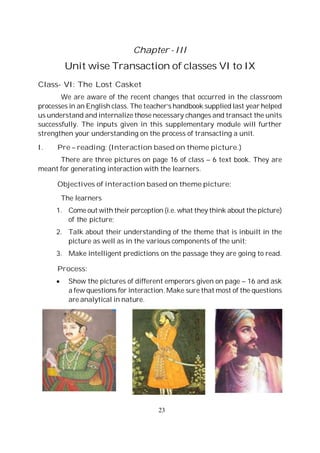
There are three pictures on page 16 of class – 6 text book. They are
meant for generating interaction with the learners.
Objectives of interaction based on theme picture:
The learners
1. Come out with their perception (i.e. what they think about the picture)
of the picture;
2. Talk about their understanding of the theme that is inbuilt in the
picture as well as in the various components of the unit;
3. Make intelligent predictions on the passage they are going to read.
Process:
Show the pictures of different emperors given on page – 16 and ask
a few questions for interaction. Make sure that most of the questions
are analytical in nature.
24
Some questions are suggested below:
1. What do you know about the people in the pictures?
2. What are the qualities of a good king?
3. Why do we read stories about such kings?
4. Do they give inspiration to us? How?
5. Share a story or incident about the bravery and generosity of any
king.
6. One of the persons in the pictures was a brave Maratha king. He
was also known as Chatrapathi. Who was that?
II. Reading
Objectives
1. Children make an effort to read individually and track their own
reading process.
2. They make sense of the reading passage using a number of strategies
such as
Checking their predictions on the reading passage
Locating information that they were able to pool from the
interaction that has taken place
Guessing the meaning of words from the context and also using
familiar words as steppingstones.
Using the glossary given to them, etc.
Sharing ideas with others
3. They make sense of the reading passage through collaboration.
4. They reflect on the passage they have read.
5. They analyze the information given and link it with their personal
experience.
6. They generate their own texts from the given text.
25
Picture Interaction
Process
Show the picture given on page 17 and ask the following questions.
1. What are the things you see in the picture?
2. Who do you think are the people in the picture?
3. What is the king doing?
4. What is the foreigner doing?
5. What other ideas do you get from the picture?
Elicit first some words related to the objects in the picture and write
them in the left margin of the BB.
Then elicit answers to questions 2 to 4
Write these on the BB.
Ask the learners to read the sentences from the BB.
Reading
Individual reading
Ask children to read individually. They can only read it at their
own pace. You may give the following directions to help them track
their own progress in reading.
1. Read the given passage ‘The Lost Casket’ from the beginning up
to ‘He added that he was freeing John but that he would have to
leave Raigarh within three days.’ On page 17.
2. Use a pencil to put a ‘tick’ against the lines you are able to
understand.
26
3. You may put a question mark against the line that contains parts
you are not able to understand.
4. Pick out the important events in this part of the story.
5. Put a star against the lines that you liked the most.
Move round the class to monitor whether they are tracking their
reading process.
You may interact with them while they read the following manner:
1. Don’t worry if you were not able to read and understand the whole
of the passage.
2. Try to guess the meaning of the unfamiliar words with the help of
words you already know.
3. Please do not consult with anyone at this point. You can put
question marks wherever you faced difficulties.
4. Sometimes the glossary may help you.
Addressing Issues and challenges in facilitating individual
reading
If you think there are a few low proficient learners you need to work
out some strategies to generate sub text to help them get at least
some ideas from the reading passage. You can try the following:
Ask specific questions:
Questions: (To generate sub – text)
1. Whose story is this?
2. What did he do at the beginning of the story?
3. Who are the other people in the story?
4. Where did the story take place?
Use supplementary picture of the Gold Casket ask:
5. What do you see in the picture? Can you spot the name of the
thing and its description in Para – 2?
6. What other ideas do you get from the paragraphs?
7. What other words could you read in the first four paragraphs?
8. John wanted to bring the gold casket back from Shivaji. How did
he plan to do it?
27
9. Let me read out his plan from paragraph 3 and 4. (You may read
out a few sentences from paragraphs 3 and 4)
10.What happened to john at the end of the passage? Etc.
The subtext that can be generated from the responses will be
something like this:
Shivaji attacked Surat. Adam Smith and John were upset. Adam
Smith lost his beautiful gold casket containing a picture of his wife. It was
in laid with rubies and diamonds.
John came up with a plan. He decided to go into the Maratha country
with his companion. But, he was caught and taken to a prison. At the King’s
durbar King saw the casket among the other loots.
In the case of CWSN (children with special needs) the sub texts can
be orally generated and the children may be asked to represent it
visually (through drawing) as we do in a picture story and label the
picture.
If the general proficiency level of the whole class is very low, generate
sub texts through whole class negotiation with the help of pictures
depicting the sub text. This is to be displayed on a chart and the
learners may be asked to associate this with the reading passage.
In the case of the learners whose level of proficiency is extremely
low, generate the sub text orally and write in their notebooks; this
can be read graphically and then associated with the reading passage.
Collaborative Reading
Divide the learners into groups.
Give them the following directions:
1. You have tried to read the first part of a story. Now take turn
and share with others the events you were able to identify. Share
only one event at a time.
2. When one member says an idea others can identify the sentence
that contains this idea.
3. Continue sharing till you complete all the ideas.
4. Now take turn and share with others sentences / words you were
not able to understand.
28
4. Finally, take turn and share with others the parts of the passage
you liked the most.
Display the glossary related only to those paragraphs that have
been given for reading; this can supplement the glossary that is
already given in the textbook.
Move round the class and monitor whether they are collaborating
as per the instructions given to them. You may ask:
1. Groups, did you complete sharing ideas you understood?
2. Did you share what you were not able to understand?
3. Etc.
Now you can mediate for sharing between the groups in the following
manner:
1. Group 1, are there any words / sentences that you did not
understand?
2. Which group can help group 1?
3. Group 2, what are your problems, etc.
At this stage all learners in the class will have a fairly good
understanding of the passage.
Ask a few comprehension questions relevant to this part of reading
passage:
1. What did Shivaji do at the beginning of the story?
2. How did it affect the Englishmen at Surat?
3. Why was Adam Smith so upset?
4. What was John’s plan? Was he successful with his plan?
Reading aloud
Reading aloud by the teacher
Read the passage aloud with proper pauses, stress, tone and pitch.
Reading aloud by the pupils
Give the following instructions for loud reading.
a) Now you are going to read aloud in your groups.
29
b) Divide the reading passage into various parts according to the
number of members in your group.
c) Decide among yourselves who will read which part.
d) Each one of you can take turn and read aloud your part. Others
can offer suggestions to make loud reading better.
Continue interaction
o Which group wants to read aloud for the whole class?
After the loud reading by a group give feedback interact with them
in the following manner:
o What changes will you like to make if you read the passage aloud
again?
o What are the points that come to your mind?
Elicit whatever indicators they think are appropriate (You should
not impose or prescribe any of them.)
Come to an agreement on each of the points they make and write
them on the chart (e.g., others can hear our reading, we must stop at
some points, etc.)
Give chance to the members to reflect on their loud reading based on
these agreements.
Invite suggestions from others in terms of the indicators that have
been agreed upon.
You may give your own positive and qualitative feedback so that
they can reflect on their present level of performance and go to the
next higher level (without being prescriptive).
Note: Please remember that we need not work for all the indicators of oral
reading such as pause, stress, tone, etc. at this point. There is no hurry.
These indicators will be emerging in the class in due course with their
ownership. Also indicators are to be written down in from the point of
view of the learners not from the technical point of view using terms
such as stress, pause, pitch, rhythm.
30
Extrapolating the text (Scaffolded Reading):
Display a chart containing a set of analytical, reflective and
inferential questions to make the learners think, extrapolate the text
and construct their own texts from it.
Ask these questions and elicit individual responses at random. Write
down select responses on the chart.
1. Why do you think Shivaji attacked Surat?
2. What are your opinions on having a war? / What could be the
effects of war?
3. John was caught and sent to a prison. What would happen to him
now?
4. What are the problems faced by a prisoner?
Post Reading: (Writing a short narrative)
Process:
Generate a discussion (on writing a narrative) using the following
instructions and questions.
o Read the last two lines of the passage carefully.
1) How many events do you find?
2) What are they?
3) What did John and his companion do in the beginning?
4) What did they talk/say to each other?
5) Did they try to steal anything? How?
6) What did they say to the soldiers?
7) How did the soldiers reply?
8) What happened next?
9) Who caught John & his companions?
10) Where were they finally taken to?
Write the main events on a chart.
Let the children note down the key points or events.
Ask them to use those events to write a narrative
individually.
31
Let them share in groups what they have written. You
may ask the following questions.
1. How did you begin the narrative?
2. Did you include all the necessary events and dialogues?
3. How did you end the narrative?
Ask the groups to present what they have worked out.
Invite suggestion on refinement from the presenters and the others.
Editing
Give your feedback. The questions you ask for giving feedback may
be written and displayed on a chart as follows:
Check your narrative:
1. Did you include ideas and events in the text?
2. How did you begin the narrative?
3. Are all the events and ideas sequenced properly?
4. Are the dialogues used appropriate to it?
5. Did you use formulaic expressions such as
o Hello John, there goes the bullock cart?
o Look! Let us be careful etc.
6. Did you make/ include predictions on what happens next?
7. Did the dialogues used; reveal character’s emotions, feelings and
thoughts?
8. Did the narrative create any mental images?[such as, overtaking a
train of bullock carts]
9. Did you use a variety of sentences?
10. How did you end the narrative?
Let them write the narrative individually based on the feedback.
Note: A conversation between John and Shivaji at Shivaji’s durbar can also be
generated as a discourse, following the process suggested in
Unit – 1.
32
Reading Segment – II
Now we go on to the remaining part of the story.
Pre – reading:
Picture interaction:
Use the supplementary picture depicting the fight described on page 18.
Objectives:
The learners will be able
1. To talk about the persons in the picture
2. To predict the events in the passage they are going to read.
3. To link what they have read with what they are going to read.
Process:
Ask the following types of questions based on the text – based picture
(page – 17) to generate interaction. Write the learner’s responses on
a chart.
1. What do you see in the picture?
2. Where is the scene taking place?
3. Who do you think the people are?
4. What is John doing?
5. Do you think Shivaji gave the casket to John?
Write the responses on the BB.
Reading:
Follow the same process for transacting this part of the reading
module beginning with individual reading.
Ask questions to get the sub – text which may be something like the
following:
Shivaji listened to John’s request – Shivaji did not give the
gold casket to John –Shivaji freed John.
John saw a Maratha soldier being attacked by three men – The
soldier was ready to face the attackers – John helped the soldier. He was
Shivaji.
33
Extrapolating the text: (Scaffolded reading)
Ask the following questions:
1. What would the Maratha soldier do now? Can he face the attackers
alone?
2. What would John do now?
3. Shivaji did not agree to give the gold casket back to John. What
does this show?
4. Why did Shivaji free John? What does this tell us about Shivaji?
5. Can we change our enemies into our friends? How?
Post reading: Discourse Construction (Drama)
Objectives:
Children will be able to
1. identify themes for developing plots
2. enact drama based on the plot
3. self assess based on the performance indicators
4. write down the drama script
5. identify the features of drama script
Process:
How do we process a drama? Just like the role-play the drama also
needs a theme. In addition it needs a plot. So let us begin with
these.
Interaction:
You have identified a theme in this part of the story. What is that?
Elicit expressions such as
o qualities of a good king
o how enemies become friends etc.
o there are few events the took place in a sequence Shall we
identify them?
34
Elicit the sequence of events by asking questions such as
1) Who was brought to the durbar?
2) What happened then?
3) What did Shivaji say?
4) What was John’s reply?
5) What did Shivaji decide?
6) What happened the following evening?
7) What did John see while returning from the fort?
8) What did the three attackers do?
9) What did the Maratha soldier do?
10) How did John help a Maratha soldier? Etc.
Write the sequence of events on a chart as and when they are elicited.
We may get something like the following:
John was brought to the court – he got a private audience with the king
Shivaji. – Shivaji asked why John was brought – John told the whole story –
Shivaji freed John – next evening John was standing alone at a part of the fort
– he saw a Maratha soldier waling – Three persons attacked the soldier – The
soldier took out his sword and stood ready to face them. John helped the
soldier and saved him.
Interact with the learner.
o We can develop a drama on this sequence of events. How will we
do it?
o What do we need to enact a drama?
Elicit points such as:
o Space for enacting the drama
o Actors to take role of characters (animals, birds, jackal )
o Dialogues
o Actions
Now you may give the following instructions
1) Decide the characters (e.g. Shivaji, John, courtiers, three attackers
etc.)
35
2) Decide who will enact these roles (all of you should have roles)
3) Plan the dialogues
4) Plan the scenes, sequence of actions and dialogues
5) Go for rehearsal
6) Perform the drama
Invite one group to perform the drama
The feedback on the drama performance
Conduct a session for giving feedback in the following manner:
1) What modifications will you make in the drama if you have to act
it again?
2) What are the points that come to your mind?
Generate indicators for assessing drama performance with the help
of some questions:
1) Are all the events included?
2) Are there sufficient dialogues?
3) Do you want any changes in the dialogues?
4) Was the whole class able to hear your dialogues?
5) Did you say dialogues with emotions like joy, anger, sorrows, hate,
surprise, doubt, fear, etc.?
6) Do you think your face and actions revealed these emotions?
7) Were the actors standing in the same positions throughout the
performance?
8) Were all the actors on the stage from the beginning to end?
9) What did you do to help the audience identify the characters?
10) Did all members of your group take part in the drama?
Note: The questions given above are related to components such as theme
(1), dialogue (2), language used (3), audibility (4), articulation features
such as stress, tone and pitch (5), facial expressions and gestures (6),
movement (7), enter and exit (8), using props (9), and team work (10).
The technical terms can be used later. First they should understand
what each of these means. Write these points on the same chart
containing roles and themes
36
Discourse construction (Conversation)
Interaction:
o Look at the last paragraph of the story. John saved the life of
Shivaji. Shivaji looked at John and smiled.
o What would Shivaji say to John now?
o What would be John’s reply?
o Sit in pairs and take the roles of John and Shivaji.
o Plan a conversation between them.
Ask any two pairs to present the conversation.
Tell them they can present the idea even by mixing English and
mother tongue if they find it difficult to say only in English.
Conduct a session for giving feedback in the following manner:
o What modifications will you make in the role-play if you have to
do again?
o What are the points that come to your mind?
Elicit whatever indicators they think are appropriate (You should
not impose or prescribe any of them.)
Come to an agreement in the whole class on each of the points they
make and write them on the chart (e.g., more ideas needed, some
sentences are to be changed, others can hear our reading, we must
stop at some points, some actions can be shown, etc. )
Give chance to the performers to reflect on their role-play based on
these agreements.
Invite suggestions from others in terms of the indicators that have
been agreed upon.
You may give your own positive and qualitative feedback so that
they can reflect on their present level of performance and go to the
next higher level (without being prescriptive).
Note: Please remember that we need not work for all the indicators of role-
play at this point.
37
Indicators are to be evolved with their ownership. Also, indicators are
to be written down in their language without using technical terms (jargon).
We can introduce them in due course.
1. The theme – does the role play communicate the theme?
2. The language–whether changes needed in the sentences presented.
3. Oral aspects of presentation – audibility, pause, pitch and tone.
4. Body language – postures, stress, gestures, facial expressions.
Invite reflections from the performers first on what they think the
refinement areas are.
Invite suggestions from the other pairs who planned the same roles
Invite suggestions from the whole class.
Give positive and qualitative feedback which will make them think
and go to the next higher level of learning (neither mere appreciation
nor disapproval by pointing out faults will do good).
Put them in groups by clubbing two or three pairs together
Editing:
Refining the conversation in groups
Put children in small groups. Ask them to share their conversation
with others. The following process may be carried out.
Give instructions to the learners before they are moving into the
groups.
1. Take turn and present the initiation (i.e., the beginning).
2. If you cannot say the idea in English you may say it in fragments
or even in mother tongue. Together you can decide how to say
the idea in English.
3. Select the sentence which you think will make a good beginning.
All of you write this in your notebook.
4. Take turn and respond to this beginning.
5. Select the best response.
38
6. Write this also in the notebook.
7. Continue the same process till you think there are no more ideas
to be shared and written.
8. Write the whole conversation on a chart.
Now you can ask the groups to present their refined conversations
and display the chart in front of the class.
A feedback session can be conducted by inviting suggestions from
the whole class and by giving your own feedback on the
presentations.
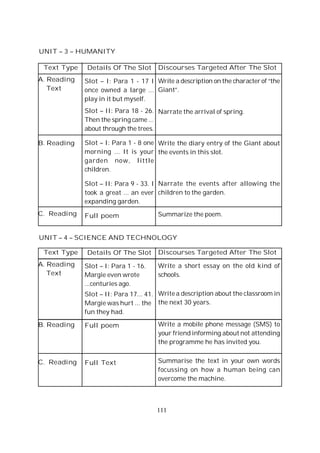
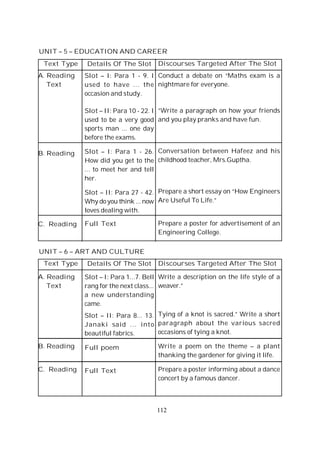
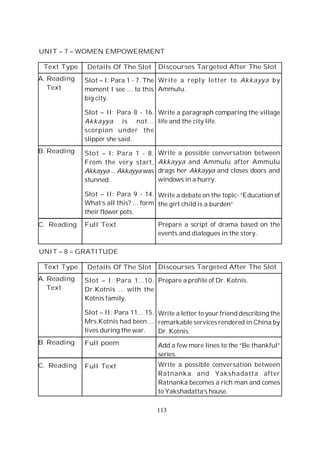
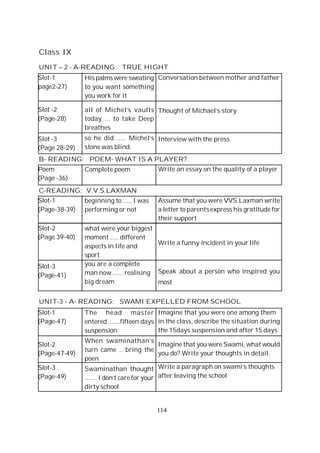
Transacting the poem:
In the Bazaars of Hyderabad
Pre- Reading
Process:
Interaction based on the picture:
Interact with the learners asking a few questions based on the picture
given on page 25 of the text book. The objective of such an interaction is to
familiarize the learners with the theme of the poem and elicit basic words
that help them understand the poem well.
1. What is the poem about?
2. What ideas do you get from the picture?
3. Who are the different people in the picture?
4. What are they doing?
5. What other things do you see? Etc.
Elicit random responses
Follow all the processes of reading beginning with individual reading.
Ask appropriate questions to get the sub text; it will be something
like the following:
Merchants – displayed turbans silver colour – and other things
– vendors, maidens and peddlers – selling saffron, lentil, rice,
sandalwood etc.
39
Follow the similar process for the remaining stanzas of the poem.
Extrapolating the text (Scaffolded Reading)
Display a chart containing a set of analytical, reflective and inferential
questions to make the learners think, extrapolate the text and
construct their own texts from it.
Ask these questions and elicit individual responses at random. Write
down select responses on the chart.
1. Why does the poetess ask questions to the people at the market?
2. How does she vary her questions?
3. Do you go to the market or a bazaar at your place? What different
things do you see there?
4. Is it similar to the bazaar described in the poem? How?
5. What do you mean by the line “To perfume the sleep of the dead”?
6. What is that you like most about the poem? Etc.
Post Reading: (Construction of the script of choreography)
Process:
1. Sing the song three or four times to register the tune and rhythm.
2. Identify the theme of the song by asking questions.
First stanza:
Display of different items by the merchant.
Second stanza to the last stanza:
Various sellers in the market sell different things – the
grandeur of the things sold etc.
3. What are the actions involved? (showing and selling things, weighing
rice, grinding spices etc.)
4. What are the characters involved? (merchants, vendors, maidens,
peddlers, customers etc.)
40
5. Where do the incidents happen? – Location (busy market, streets
main road etc.)
We need the central characters and a chorus team to create the location
Actions:
o The chorus set the setting.
o The characters in action.
o The action of merchant showing things and selling them to
customers.
o The actions of different vendors weighing, grinding etc.
o Actions of peddling the cart etc.
6. Write the above details as a script for the choreography.
7. Sing the poem and do the actions.
Please remember the following
a) Don’t teach grammar using discrete sentences; instead embed them
in the context of discourses.
b) Ask relevant questions so that the learners can analyze a given corpus
of language and make their own observations. These can lead to the
consolidation of the grammatical concepts that are targeted.
c) Please keep in mind that learning grammar does not lead to language
acquisition. It is a knowledgedomain just like mathematics or physics.
Nevertheless, the knowledge they construct in this domain will work
as a monitor to guide them in writing and in editing a written work.
Transaction of Listening Passage:
Charaka
Objectives
To enable the learners
To listen and understand
To listen and speak
41
Process
Give instructions
1. Look at picture given on page 1.
2. Observe the picture and respond.
3. What do you see in the picture?
4. Who do you think are the people in the picture?
5. Who do you think has killed the snake?
6. Whom does the woman try to beat?
Elicit free responses from the learners
Record the responses
Process
Divide the story into two meaningful chunks
o Read 3 paragraphs, the first part from “Prevention is better than…
to … others thin and strong.” with proper pause, stress, intonation
with gestures and facial expressions.
Read the story once or twice.
Interact with the learners by asking some analytical, extrapolative,
inferential questions.
1. “Prevention is better than cure.” … What do you mean by this?
2. Charaka contributed many things in the field of medicine. Which
one do you think is the most important one? Why?
3. What made Charaka such a great man?
4. How would Charaka’s contributions and discoveries help today’s
doctors?
Elicit responses from the learners
Record the evidences on a chart
Please remember the following:
Don’t allow the learners to look into the textbook while giving the
listening input.
42
Allow the learners to think and respond.
See to it that every learner is involved.
Encourage everybody to speak.
Don’t interrupt and correct when the learners are speaking.
Accept all the responses of the learners and give feedback accordingly.
Extensive Reading-
“Tyagaraja, the Immortal Musician”
Interaction: Children, look at the pictures given on 27&28th
pages .
Initiate an interaction and discussion by asking the following types of
questions
Picture 1:
1. Who do you see in the picture?
2. What the person is doing in the picture?
3. What does the picture contain?
4. What do you think about the person in the picture?
5. Is he different from all of us?
6. How is he different?
7. Observe the picture once again to draw some more inferences/
predictions such as person’s special qualities, daily activities and
interests.
Picture 2:
1. Who do you see in the picture?
2. What is happening in the picture?
3. How are the people worshiping God?
4. Why do think the people are so involved in worshipping their deity?
5. Do you worship God? How do you worship God? Share with the class.
6. Have you ever listened/heard about any musician? Share about him/
her with the class?
43
Reading Segment 1 (Para 1 to 5)
Follow the process for individual and collaborative reading.
Elicit responses to the questions taking them one by one. You can
write some select responses on a chart.
It is better to display all the questions on a chart.
Ask a few comprehension and analytical questions relevant to this
part of reading passage:
1. How do you think Tyagaraja could learn two languages?
2. Why do think ‘Tyagaraja was a gifted musician?
3. “There was music in Tyagarja’s blood” what does this sentence
imply to us?
Discourse Construction( Writing a personal profile)
Objectives:
1. Develop a personal profile of a person
2. Get sensitized on the features of profile writing
3. Edit the written profile
Process
Interaction
Ask the children to read the paragraphs from 1 to 5 carefully.
To generate some points, you may interact with the children by asking
the following questions.
1. What is the name of the person ?
2. Who are his parents?
3. Where and when was he born?
4. What were his parents?
5. Number of his siblings(brothers and sisters)
6. What languages does he know/speak?
7. What are his strengths?
44
8. What are his achievements?
9. What are his main interests?
10.Can you describe him in one line?
Elicit the responses and display them on chart.
Ask the children to attempt to develop Tyagaraja’s personal profile
based on the above questions.
Let the learners write the essay individually.
Let them share their ideas and enrich their essay.
Now, conduct a feedback session on the following points to refine
the children’s work.
Initiate a discussion on indicators by asking the following questions?
1. What is a personal profile?
2. How did it begin?
3. What did it contain?
4. How is it structured?
5. Which punctuation mark (s) do we use in it?
6. Is/are punctuation marks used appropriate?
7. Are all the personal details included?
8. Are the details properly (naturally) sequenced?
9. How did it end?
Let the learners develop a personal profile completely and individually.
Reading- Segment 2
Now let us move on to process the next segment of reading (from para
6 to 10). Follow the process suggested earlier.
You may ask questions like the following for quick recapitulation and
generating further discussion.
1. What is the previous passage about?
2. How many songs did he compose in Telugu?
45
3. What is/are the interests of Tyagaraja?
4. Who are the key people involved in making Tyagaraja, a great
musician. Mention them in proper sequence.
5. “He never cared wealth” who does the line refer to? How did he
make his livelihood?
6. Why do you think that Jalpesan wanted Tyagaraja to join the royal
court?
7. Can Jalpesan succeed with his plan?
Elicit responses and write them on a chart.
Ask a few comprehension and analytical questions relevant to this
part of reading passage:
1. What are the traits/characteristics that you can identify in
Tyagaraja?
2. Why does the writer saythat Tyagaraja was an immortal musician?
3. Which part of the passage is appealing to you? Why?
4. Does this remind you of any other eminent musicians like Bhaktha
Ramadasu?
5. Who are they? How are they similar to or different from
Tyagaraja?
Post-reading: Discourse construction- A conversation between
Tyagaraja and Jalpesan
Objectives
1. Produce conversation suitable for a given context?
2. Gain confidence in oral communication.
3. Get sensitized on some articulation features (pause, stress, pitch
and intonation).
4. Edit the written conversation.
46
Process
Interaction
Initiate a discussion with the help of a few questions.
1. Read the paragraph number 5 carefully and critically. Find out the
people involved in the paragraph. Identify possible characters for
developing a conversation. There Jalpesan saying something to
Tyagaraja.
2. Elicit ideas in the form of words and write them on a chart.
3. Then, ask the groups to arrive at the theme of conversation between
Tyagaraja and his brother, Jalpesan.
4. Select the suitable theme evolved from the children’s group work.
Children may be asked to sit in pairs and each pair may be assigned
role from the above.
Let the pairs plan the conversation
You may ask the following questions to generate key points required
for the conversation.
1. What did Jalpesan say to Tyagaraja do?
2. What could be the possible reply?
3. What did Jalpesan say to Tyagaraja to be rich happy?
4. What could be the response?
5. What did Jalpesan do then?
6. How would Tyagaraja have reacted to Jalpesan’s deed?
Ask any two pairs to present the conversation between the Tyagaraja
and his brother. Tell them they can present the idea even by mixing
English and mother tongue if they find it difficult to say only in
English.
Conduct a session for giving feedback in the following manner:
o What modifications will you make in the conversation if you have
to write it again?
o What are the points that come to your mind?
@@@@
47
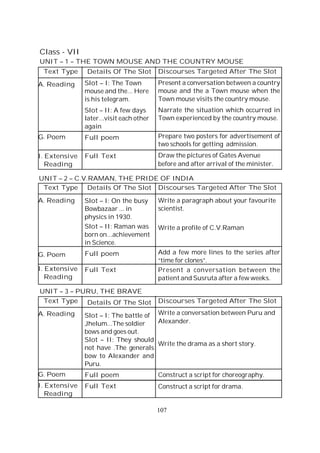
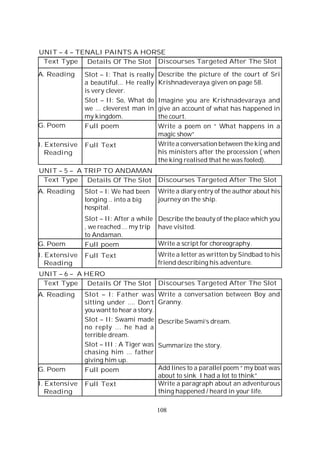
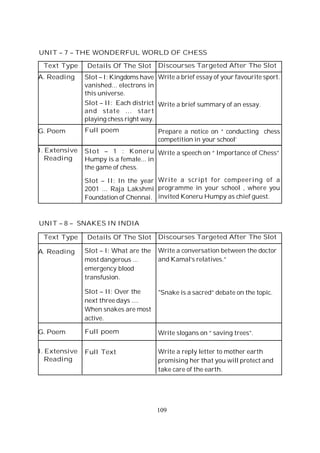
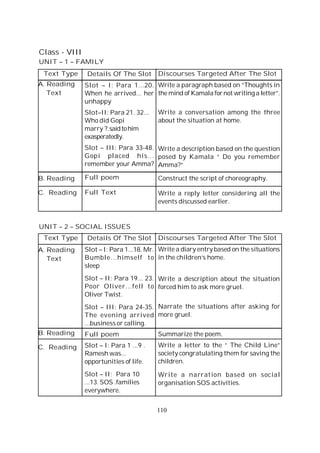
Class VII: The Town Mouse and the Country Mouse
Transaction of Reading
The ultimate aim is not to transmit the information given in the reading
passage, but to transact a reading experience that will help the learners
construct their own texts from the reading passage by personalising and
localising it. We have to help the learners read the passage analytically and
critically and reflect on their reading experience.
Pre-reading
You may have noticed that each unit contains a face sheet with a picture
on it. This is to be used as a trigger for interacting with the learners.
Objectives of interaction based on the picture:
The learners to
1. come out with their perception (i.e. what they think about the picture)
of the picture.
2. talk about their understanding of the theme that is inbuilt in the
picture as well as in various components of the unit.
3. make intelligent predictions on the passage they are going to read.
Process
Show the two pictures given on page 1 of the reader and interact
with the learners by asking a few questions most of which are to be
analytical. Some questions are suggested below:
1. What do you see in the two pictures?
2. Where would you like to live?
3. Where do you think life is peaceful? Why?
4. Do animals feel the same like you?
Elicit responses to the questions taking them one by one. You can
write some select responses on a chart.
Ask any one of the children to describe orally.
Give feedback to the related description.
48
Note:
All responses need not be written on the chart; write only those
responses (consisting of key expressions and sentences) that are
directly relevant to the theme of the reading passage.
The children will be motivated to answer the questions in their own
way based on their own perceptions if we give them freedom to
respond to the questions in their own way.
Suggestions:
Allow them to use mother tongue when they are unable to use
English. You can put their ideas in English for the sake of the whole
class.
Allow the learners to speak freely and fearlessly to promote divergent
thinking.
Accept their responses with a smile and encouraging remarks like
good, fine etc.
At this stage let us appreciate their ability to analyze a situation
and come out with their on perceptions.
Remember, we are facilitating language learning and not teaching
the content of the textbook or language elements.
Reading Segment - 1
The transaction module of reading needs elaborate treatment because
there are a few sub modules to be transacted. Let us begin with the objectives
of transacting this segment.
Objectives
Children make an effort to read individually and track their own
reading process.
They make sense of the reading passage using a number of strategies
such as
o checking their predictions on the reading passage.
o locating information that they were able to pool from the
interaction that has taken place.
o guessing the meaning of words from the context and also using
familiar words as stepping stones.
49
o using the glossary given to them, etc.
o sharing ideas with others.
They make sense of the reading passage through collaboration.
They reflect on the passage they have read.
They analyze the information given and link it with their personal
experience.
They generate their own texts from the given text.
Picture Interaction
You may interact with children based on the picture.
Elicit words related to the picture and write them in the margin of
the BB. You may ask the following questions one after the other.
1. Look at the picture given on page 3. What do you see in it?
2. Name the things you see in the picture.
o Now you may elicit answers to the following questions and write
on the BB
1. There are two mice in it? What are the differences you notice
between them?
2. Which mouse has come by the train? Why has he come?
Reading - Process
Individual reading
Ask children to read individually. They can only read it at their
own pace. You may give the following directions to help them track
their own progress in reading.
1. Read the story ‘The Town Mouse and the Country Mouse’ given
on the pages 3 and 4 silently.
2. Identify the events and the characters in this part of the story.
3. Identify the location of the events?
4. Identify the dialogues of each character.
Note: The objective of this type of interaction is to help the learners get/
prepare their own sub texts from the reading passage. The sub texts
can be in the form of names (characters, objects, places, etc.) and events.
These will provide the learners good support in their efforts to make
sense of the reading passage.
50
If more than half of the class strength is low proficient learners you
can use this as a whole class activity.
If there are around 6 or 7 students who are low proficient, you may
put them in one group and interact with them as a team.
If there are only 3 or four of them, you can interact with one learner.
When he /she starts following your instructions go to the next student.
The sub text that can be generated from this part of the story will be
something like the following:
The images of ice-cream, orange juice, lemonade, sugarcane, the quite
life of a village, the busy and crowded life in a town
In the case of CWSN (children with special needs) the sub texts can
be orally generated and the children may be asked to represent it
visually (through drawing) as we do in a picture story and label the
picture.
If the general proficiency level of the whole class is very low, generate
sub texts through whole class negotiation with the help of pictures
depicting the sub text. This is to be displayed on a chart and the
learners may be asked to associate this with the reading passage.
In the case of the learners whose level of proficiency is extremely
low, generate the sub text orally and write in their notebooks; this
can be read graphically and then associated with the reading passage.
Collaborative Reading
Divide the learners into groups.
Give them the following directions:
You have tried to read the first part of the story. Now take turn
and share with others the events you were able to identify. Share
only one event at a time.
When one member says the idea others can identify the sentence
that contains this idea.
Continue sharing till you complete all the events.
Share with the others the different locations where the events were
taking place.
51
Now take turn and share with others the dialogues related to each
event. Share only the dialogue of one of the characters at a time.
Take turn and share with others the parts of the passage you liked
the most.
Finally, share with others what you were not able to understand.
Display the glossary related only to those paragraphs that have been
given for reading; this can supplement the glossary that is already given in
the textbook.
Move around the class and monitor whether they are collaborating as
per the instructions given to them. You may ask:
Groups, did you complete sharing the events and dialogues?
Did you share the parts you liked the most?
Did you share what you were not able to understand?
Etc.
Now you can mediate the groups for sharing in the following manner.
Group 1, what is the first event?
Group 2, which is the next event?
Are there any words / sentences that you did not understand? etc.
At this stage all learners in the class will have a fairly good
understanding of the passage.
Ask a few comprehension questions relevant to this part of reading
passage:
Loud Reading
Read the passage aloud with proper pause, stress, tone and pitch.
Give the following instructions for loud reading.
o Now you are going to read aloud in your groups.
o Divide the reading passage into various parts according to the
number of members in your group.
o Decide who will read which part among yourselves.
o Each one of you can take turn and read aloud your part. Others
can offer suggestions to make loud reading better.
52
Continue interaction
Which group wants to read aloud for the whole class?
After the loud reading by a group, give feedback and interact with
them in the following manner:
What changes will you like to make if you read the passage aloud
again?
What are the points that come to your mind?
Elicit whatever indicators they think are appropriate (You should
not impose or prescribe any of them.)
Come to an agreement on each of the points they make and write
them on the chart (e.g., others can hear our reading, we must stop at
some points, etc.)
Give chance to the members to reflect on their loud reading based on
these agreements.
Invite suggestions from others in terms of the indicators that have
been agreed upon.
You may give your own positive and qualitative feedback so that
they can reflect on their present level of performance and go to the
next higher level (without being prescriptive).
Note: Please remember that we need not work for all the indicators of oral
reading such as pause, stress, tone, etc. at this point. There is no hurry.
These indicators will be emerging in the class in due course with their
ownership. Also indicators are to be written down from the point of
view of the learners not from the technical point of view using terms
such as stress, pause, pitch, rhythm, etc.
Extrapolating the text (Scaffolded Reading )
Display a chart containing a set of analytical, reflective and
inferential questions to make the learners think, extrapolate the text
and construct their own texts from it.
Ask these questions and elicit individual responses at random. Write
down select responses on the chart.
1. What differences do you find between a country life and a town
life?
2. Where do you want to live?
53
3. Have you ever been to a village or a town?
4. What interesting things and places do you find in a town?
5. Why do you think the town mouse did not enjoy the dinner hosted
by the country mouse?
6. Why do you think the town mouse was surprised?
7. What do you think the town mouse has forgotten?
Mind Mapping (Optional)
Take up the mind mapping with the help of the learners.
Ask them to say a few words or sentences which they remember
from the story. Associate them with their own experiences. E.g., the
learners say some words / sentences from the story such as ‘I Don’t
eat raw food like sugarcane’, ‘cars,’ lorries’, ‘sleep on the ground’.
Ask them to recall more ideas (words, sentences, expressions, etc.)
and make inter connections to develop a concept map of ideas, words,
events, etc. all picked up from their individual reading experience.
The learners can do this work in their notebooks. They can begin
mapping with anything that comes first to their mind (which will be
different from learner to learner). Since individual perceptions are
different, how they interconnect the ideas may also vary.
They may be asked to add their reflections (like their likes and
dislikes, their associations, etc.) also into the concept map.
One or two students can present their concept map before the whole
class.
They may be put in small groups – each group can consolidate their
concept maps on a chart. They can also draw pictures to represent
certain ideas (this will be a task that even CWSN and children with
low proficiency level can do).
Let groups present their concept maps.
All these can be compiled together to make a Big Book of concept
maps. This can be displayed at the reading corner.
Note: You need not go for concept mapping after reading each passage because
it might take a whole period – However, it is a good tool that can be
used to check reading comprehension and proficiency in analytical
reading.
54
Post Reading: (Construction of a conversation)
It is better to go for some discourse tasks after completing the
transaction of a certain segment of the reading passage. Since this is a story,
there is a lot of scope for assigning roles to the learners and asking them to
develop conversations. Remember, the more opportunities we provide for the
learners to produce language, the more will be their growth in language
proficiency. This cannot be substituted by the several tasks related to language
elements that are assigned to them.
Objectives
Produce conversations suitable for a given context.
Gain confidence in oral communication.
Process
Look at the first part of the story which you have just completed
reading. There are two mice belonging to a village and a town respectively. In
the same way you may think of two boys belonging to a village and a town
respectively meet and talk to each other.
Children may be asked to sit in pairs and each pair may be assigned
roles from the above.
Let the pairs plan the conversation.
Ask any two pairs to present the conversation between the town boy
and the country boy. Tell them they can present the idea even by
mixing English and mother tongue if they find it difficult to say only
in English.
Conduct a session for giving feedback in the following manner:
1. What modifications will you make in the role-play if you have to
do again in terms of the following?
2. The theme – does the role play communicate the theme?
3. The language – whether changes needed in the sentences
presented.
4. Oral aspects of presentation – audibility, pause, stress, pitch
and tone.
5. Body language – postures, stress, gestures, facial expressions
55
Write these points on the same chart containing roles and themes.
Invite reflections from the performers first.
Invite suggestions from the other pairs who planned the same roles.
Invite suggestions from the whole class.
Give positive and qualitative feedback which will make them think
and go to the next higher level of learning (neither mere appreciation
nor disapproval by pointing out faults will do good).
Put them in groups by clubbing two or three pairs together.
Refining the conversation in groups
Put children in small groups. Ask them to share their conversation
with others. The following process may be carried out.
Give instructions to the learners before they are moving into the
groups.
1. Take turn and present the initiation (i.e., the beginning).
2. If you cannot say the idea in English, you may say it in fragments
or even in mother tongue. Together you can decide how to say the
idea in English.
3. Select the sentence which you think will make a good beginning.
All of you write this in your notebook.
4. Take turn and respond to this beginning.
5. Select the best response.
6. Write this also in the notebook.
7. Continue the same process till you think there are no more ideas
to be shared and written.
8. Write the whole conversation on a chart.
Now you can ask the groups to present their refined conversations
and display the chart in front of the class.
A feedback session can be conducted by inviting suggestions from
the whole class and by giving your own feedback on the presentations.
Note:Whatever you do and say in the class should not harm the confidence of
the learners and make them feel insecure.
Now we go on to process the next segment of reading. Begin with picture
interaction.
56
Picture Interaction
Use the second picture as a trigger.
Elicit the ideas they get from the picture. Write relevant responses
on the BB
Reading Segment 2 – The remaining part of the story
Follow all the processes for reading suggested earlier.
Ask a few comprehension questions after collaborative reading.
You may ask the following analytical questions for extrapolating
the text.
1. What does the writer mean by the sentence “We may not get
much food there, but at least we can eat in peace?”
2. What would happen if the person who opened the cupboard found
any one of the mice?
3. Do you believe that there is more peace in the country than in
the town? Can you give your reasons?
4. Can you say why most of the villagers are migrating to towns
from villages even though there is no peace?
5. Why do you think that the country mouse and the town mouse
did not visit each other again?
6. What is the central idea of the story you have read ?
7. What do you think is the most striking sentence in the story?
8. You might have read the sentence “They had to run for safety
when somebody opened the cupboard door.” Why do you think
they had to run for safety frequently?
Construction of a Narrative: Process
Ask children to narrate the country mouse’s experience in the town.
Ask the following questions for helping them to develop the narrative.
1. Can you imagine the thoughts of the country mouse while staying
with the town mouse?
2. What could the country mouse have thought about town life before
going there?
57
3. What were the experiences of the country mouse when he came
to the town for the first time?
4. What opinions could he have formed about town life?
5. What were his feelings about the life of the town mouse?
The questions should be asked in the whole class. Let them write the
narrative individually first.
Later let them sit in groups and refined their work.
The groups can present what they have written.
Give feedback.
Writing Letters:
The Process
1. Let children write the letter independently.
2. Let one or two children say how they began the letter.
3. Let a few children say what they wrote in the first part of the letter.
4. Let a few of them take turn and present what they wrote in the last
part of the letter.
5. Let a few of them say how they concluded the letter.
6. Let them sit in groups and share how they began the letter.
7. Let the members come to an agreement on how to begin the letter.
8. Let them share what they wrote in the first part of the letter.
9. Let the group collectively select the best idea.
10. Let them share what they wrote next and come to an agreement on
the best idea.
11. Let them decide on the other ideas they want to write.
12. Let them come to an agreement on how to finish the letter.
13. Ask them to look at the letters given in the textbook to study the
format used for writing letters.
14. They can write the letter on a chart paper for presentation in the
whole class.
15. Take one group product and edit it.
58
Poem
The Town Child and The Country Child
Reading: Process
Follow the same processes (i.e., individual reading, sharing ideas in
groups, etc.)
Ask specific questions to get the sub text for helping the low-proficient
readers:
1. Who does I refer to?
2. Where does he/ she live?
3. How is life there?
4. What does the poet want to have in the town?
5. Why does he think so?
The sub text that can be generated from this part of the story will
be something like the following:
The images of a boy living in a street of a town crowded traffic
with buses, motors and tramps, crowded houses, smoke, the cloudy
sky etc…
The boy living in a village- lonely, sounded by tall trees, birds
on the branches and the flowers etc…
Extrapolating the text (Scaffolded Reading)
Display a chart containing a set of analytical, reflective and inferential
questions to make the learners think, extrapolate the text and
construct their own texts from it.
Ask these questions and elicit individual responses at random. Write
down select responses on the chart.
1. What do you mean by the line “The houses all wait in a row”?
2. Why is there smoke everywhere?
3. What happens if smoke is everywhere?
4. What causes noises in the town?
5. What is the central theme of the poem?
6. Why does the child want to go to the town in the second poem?
7. Can you say why the town child wants to go to the village and the
country child wants to go to the town?
59
8. Why are they not satisfied with their lives?
9. What do the two poems tell us?
10.Where is the population high? What problems will we face if the
population increases?
11.Can you find any similarity between the reading passage “ The
Town Mouse and the Country Mouse” and these two poems? What
is it?
Post Reading: Construction of an Essay
It is better to go for some discourse tasks after completing the
transaction of reading a poem. Since these are two poems, there is a lot of
scope for asking the pupils to write an analytical essay based on the two
poems.
Objectives
Produce an essay suitable for a given context.
Gain confidence in written communication.
Process
Initiate a discussion on the life in a town and in a village.
1. What are the problems of life in a town?
2. What are the problems in a village?
3. How can you make the life better in both a town and a village?
Let the learners write the essay individually.
Let them share their ideas and enrich their essay.
Elicit indicators for refining the essay
1. The main points in the first paragraph, second and the third
2. The linkers used
3. Sentence structure
4. Word forms used
Let the learners write the essay individually based on the feedback.
Let them sit in groups and refine the essay gathering ideas from the
groups.
60
Give feedback based on the indicators developed given above.
Project
Initiate a discussion.
Ask them to do the project as directed.
Let the groups make presentations on the project.
Give feedback.
Extensive Reading
Suggestions:
Don’t ask too many questions on the story.
Don’t translate the story into mother language.
Don’t explain the story. Let the learners read and understand on
their own.
Encourage the learners to read the stories extensively.
Ask them to share their individual reading experience
Note: Regarding the transaction of components such as vocabulary, grammar,
study skills, etc. assign the task individually. After completing the
individual work, children can sit in groups and share their work with
others. Teachers may give feedback on the work done. Avoid explicit
teaching of these components.
@@@@
61
Class VIII - Unit – I: Family
A. Reading: The Tattered Blanket
Reading provides one of the major inputs for the learners to develop
proficiency in language. How will you process a reading passage? At the outset
let us be clear about one thing. The ultimate aim is not to transmit the
information given in the reading passage, but to transact a reading experience
that will help the learners construct their own texts from the reading passage
by personalising and localising it. Therefore, we cannot be satisfied by checking
comprehension by asking information based questions. We have to help the
learners read the passage analytically and critically and reflect on their reading
experience. The module hopefully will help you to translate this concept into
classroom practice.
These are to be as a trigger for interacting with the learners.
Pre – reading:
You may have noticed that each unit contains a face sheet with a
pictures and proverbs.
Objectives of interaction based on the picture.
The learners:
Come out with their perception ( i.e what they think about the
pictures) of the picture.
Talk about their understanding of the theme that is inbuilt in the
picture as well as in various components of the unit.
Make intelligent predictions on the passage, they are going to read
a) Theme based picture interaction
Process:
Show the pictures of families in page 2 of the reader and interact
with the learners by asking a few questions most of which are to be
analytical. Some questions are suggested below:
1. What do you observe in the pictures?
2. What kind of families do you observe?
3. What is a small family?
4. What is a large/ big family?
62
5. Which kind of families do we find in the present society? Small/
big families? Why?
6. Which family do you like to live in? Give reasons.
Elicit the responses to the questions and write them on board/chart.
Display the chart in the classroom.
Note:
a) Write the answers which are related to the theme.
b) The children are motivated to answer the questions in their own
way based on their own perceptions.
c) Do not interfere while responding.
b) Text based picture interaction.
Elicit the responses at random from the picture.
1. Who do you see in the picture?
2. How are the characters related?
3. What is the old woman doing?
4. Do you think that the woman can walk?
5. Who is sitting beside her?
6. What do you know about her appearance?
7. Who is coming through the gate?
8. Who is he?
9. How was he?
Elicit responses to the questions taking them one by one. You can
write some select responses on a chart.
It is better to display all the questions on a chart.
Note:
1. All responses need not be written on the chart; write only those
responses (consisting of key expressions and sentences) that are
directly relevant to the theme of the reading passage.
2. The children will be motivated to answer the questions in their own
way based on their own perceptions if we give them freedom to
respond to the questions in their own way.
63
Reading Segment – 1 (paragraphs 1 to 13)
The transaction module of reading needs elaborate treatment because
there are a few sub modules to be transacted. Let us begin with the objectives
of transacting this segment.
Objectives
1. Children make an effort to read individually and track their own
reading process.
2. They make sense of the reading passage using a number of strategies
such as
checking their predictions on the reading passage.
locating information that they were able to pool from the
interaction that has taken place.
guessing the meaning of words from the context and also using
familiar words as stepping stones.
using the glossary given to them, etc.
sharing ideas with others.
3. They make sense of the reading passage through collaboration.
4. They reflect on the passage they have read.
5. They analyze the information given and link it with their personal
experience.
6. They generate their own texts from the given text.
Process
Individual reading
Ask children to read individually. They read it at their own pace.
You may give the following directions to help them track their own
progress in reading.
1. Read the given passage ‘Tattered Blanket’ from paragraph 1to13
silently.
2. Use a pencil to put a ‘tick’ against the lines you are able to
understand.
3. You may put a question mark against the line that contains parts
you are not able to understand.
64
4. Pick out the important events in this part of the story.
5. Put a star against the lines that you liked the most.
Move round the class to monitor whether they are tracking their
reading process.
You may interact with them in between by asking questions like the
following:
o Don’ worry if you were not able to read and understand the whole
of the passage.
o Try to guess the meaning of the unfamiliar words with the help of
words you already know.
o Please do not consult with anyone at this point. You can put
question marks wherever you faced difficulties. Sometimes the
glossary may help you.
Addressing issues related to low proficient learners
If you think there are a few low proficient learners you need to work
out some strategies to help them get at least some ideas from the reading
passage. You try the following:
Ask specific questions;
1. Who are the people in the passage?
2. How are the characters related?
3. What are the main events in the story?
4. What are the description s involved in the story?
5. Who came home?
6. How did he arrive?
7. Where was the man coming from?
8. Why didn’t mother recognize Gopi?
9. Why didn’t he write a letter to his mother?
Note:
The objective of this type of interaction is to help the learners their
own sub texts from the reading passage. The sub texts can be in the form of
names of the (characters, objects, places, etc.) and events. These will provide
the learners good support in their efforts to make sense of the reading passage.
65
Possible sub text.
Mother-sister-Gopi- same family- Kamala, her eldest daughter , a
widow, who was sitting huddled up on the thinna on the veranda- Gopi came-
in a office jeep- from his office work-because of old age –because with his
office work.
Collaborative Reading:
Divide the learners into groups.
Follow the process suggested earlier.
Ask a few comprehension questions relevant to this part of reading
passage:
1. How was the situation when the man arrived?
2. Why did the old woman loss memory?
3. Why did Gopi travel all the way from Delhi to
Thiruvananthapuram ?
4. Whose school was closed for vacation?
5. Why didn’t Gopi visit his mother over the years?
Loud reading
Loud reading by the teacher
Read the passage aloud with proper pauses, stress, tone and pitch.
Loud reading by the pupils
Give the following instructions for loud reading.
1. Now you are going to read aloud in your groups.
2. Divide the reading passage into various parts according to the
number of members in your group.
3. Decide among yourselves who will read which part.
4. Each one of you can take turn and read aloud your part. Others
can offer suggestions to make loud reading better.
Continue interaction as suggested in the earlier unit.
66
Extrapolating the text
Display a chart containing a set of analytical, reflective and
inferential questions to make the learners think, extrapolate the text
and construct their own texts from it.
Ask these questions and elicit individual responses at random. Write
down select responses on the chart.
Elicit the responses at random.
1. What was the mother’s position?
2. Have you identified any noun phrase/ hrases in opposition in the
passage?
3. What are the consequences for not recognizing Gopi?
4. How did Gopi try to bring back her to memory?
Post Reading: Construction of a narrative
Objectives
1. To produce narratives suitable for a given context.
2. To learns to sequence the ideas/ events.
3. To get sensitized on how to link different ideas using linkers.
Process:
Generate a discussion on writing a narrative using the following
instructions and questions.
Read the passage again carefully.
1. Kamala’s brother Gopi was not writing letters to their mother for
long. How did Kamala feel about it?
2. What is the mood of Kamala now?
3. Do you think Gopi loves his mother?
4. What are her thoughts about Gopi?
Write the responses of the children on a chart.
Let the children note down the key points or events.
Ask them to use those events to write a paragraph individually.
67
Let them share in groups what they have written. You may ask the
following questions.
1. How did you begin the narrative?
2. Did you narrate the thoughts of Gopi?
3. How did you end the narrative?
Ask the groups to present what they have worked out.
Invite suggestion on refinement from the others.
Give your feedback. The questions you ask for giving feedback may
be written and displayed on a chart.
Check your narrative:
1. How did you begin the narrative?
2. Are all the events in a proper order?
3. Did you use any linkers (then, suddenly, at last, finally etc.) to connect
the ideas/ events?
4. What other expressions did you use?
5. How did you end the paragraph?
6. Do you want to make any changes in your paragraph?
(Such as rephrasing the sentences/ re-ordering the ideas.)
Let them write the narrative individually based on the feedback.
Reading segment – 2 (Paragraphs 14 to 32)
Pre reading
Text based picture interaction:
1) What is the mother doing?
2) Why did Gopi bend down towards mother?
Process:
Follow all the processes of reading such as individual reading,
collaborative reading, scaffolded reading and loud reading.
Ask specific questions to generate the possible sub – text.
1. Who are conversing in the passage? What is it about?
68
2. Why did mother ask, who did Gopi marry?
3. Did Kamala receive a letter from Gopi on that day?
4. Who was terribly upset if she didn’t get/receive a letter from Gopi?
5. Who isVuimala? Why did the old woman pose questions? Who is
your amma?
6. Do you find any events/ descriptions in the passage?
Generating the sub text
Gopi, Kamala and mother-lost memory-Vimala-no-the mother-because
she didn’t recognize the man-Vimala District Collector Nambiar’s eldest
daughter-mother asked who is your amma?
Extrapolating the text
1. Do you think the passage refers to past situations? How can you
say?
2. How is it possible to bring back Amma’s memory?
Post Reading: Construction of a conversation
Objectives
1. To produce conversations suitable for a given context.
2. To gain confidence in oral communication through role-play.
3. To get sensitized on some articulation features (pause, stress, tone,
pitch)
4. To edit the written conversation.
5. To produce Big books compiling group products.
Process:
Interaction
Initiate a discussion with the help of a few questions:
Look at the second part of the story which you have just completed
reading. There are three characters in it. Kamala, Gopi and Amma. They
must be saying something to each other. Can you guess the dialogues?
Let the pupils plan the conversation individually and write them in
their notebooks.
69
Now, let them sit in groups and refine their work.
Ask any three individuals from a group to present the conversation
among the mother, daughter and son.
Tell them they can present the idea even by mixing English and
mother tongue if they find it difficult to say only in English.
Conduct a session for giving feedback in the following manner:
o What modifications will you make in the role-play if you have to
do again?
o What are the points that come to your mind?
Elicit whatever indicators they think are appropriate (You should
not impose or prescribe any of them.)
Come to an agreement in the whole class on each of the points they
make and write them on the chart (e.g., more ideas needed, some
sentences are to be changed, others can hear our reading, we must
stop at some points, some actions can be shown, etc. )
Give necessary feed back as suggested for editing a conversation in
the earlier units.
Reading – Segment 3 (Paragraphs 33 to 48)
Follow all the process of reading
Developing sub text:
1. What did Gopi’s briefcase contain?
2. Did he bring any thing for his mother? What did she want?
3. Why was the old woman asking for a blanket?
4. What are the events do you identify in the passage?
5. What are the descriptions do you identify in the passage?
Possible sub – text:
Gopi’s briefcase – clothes, files and shaving set – no - mother wants a
blanket because she was suffering from cold mist – Amma did not recognize
her son – Gopi was busy – he wanted to sell his family property.
70
Extrapolating the text
Analytical questions that may be asked
1. Why did Gopi want to sell his property?
2. Why did Kamala get irritate?
3. What is the central idea/main idea about “the tattered blanket”?
Post Reading: (Description of the character of Gopi)
Process:
Interact with the pupils with the help of the following questions.
1. You have read the story completely now. Do you think Gopi
remembers his Amma?
2. Why do you think so?
3. What kind of a person is Gopi?
4. Why did he come to his village from Delhi? Did he really want to
meet his mother and sister? If no why?
5. What other features of Gopi you identified from the story?
6. What made him behave like that?
7. Attempt a description of Gopi’s character?
Let the children write the description in their notebooks individually.
Follow the process of writing a description and give feed back as
suggested earlier.
Transaction of Listening Passage:
Objectives
To enable the learners
listen and understand.
listen and speak.
get sensitized on the language used for announcements in a live
media.
71
Process
Interact with the children in the following manner
o Did you ever listen to a radio?
o What do we listen?
o Did you ever listen to an announcement?
o Where was it? What was it about?
o Now, let me read an announcement that was made during a radio
programme.
Read the listening text – 1 given at the end of the text book with
proper pause, stress, intonation with gestures and facial expressions.
Read it once or twice.
Interact with the learners by asking the questions given in the text
book under Listening section.
Elicit responses from the learners.
Record the evidences on a chart.
B. Reading Poem: My Mother
Process:
Interaction based on the picture:
1. What is the poem about?
2. What ideas do you get from the picture?
3. What ideas do you observe in the first picture?
4. What ideas do you observe in the second picture?
Elicit the answers and write them on a chart.
Individual Reading:
Children read the poem individually. They read it at their own pace.
You may give the following directions to help them track their own
progress in reading.
o Read the poem ‘my mother’ on page number 12.
o Use a pencil to put a ‘tick’ against the lines you are able to
understand.
72
o You may put a question mark against the line that contains parts
you are not able to understand.
o Pick out the main theme of each stanza of the poem. Write the
themes in your notebook.
o Put a star mark against the lines that you liked most.
Move round the class to monitor whether they are tracking their
reading process.
You may interact with them in between by asking questions like the
following.
Ask specific questions.
1. Who does ‘I’ refer to?
2. Who are the woman and the boy?
3. What do the woman and the man refer to?
4. What emotions does the poem contain?
Collaborative Reading: (Understanding the poem with the help of glossary
or with the teacher.)
Let the children sit in groups and read the poem again. Ask them to
discuss the theme and other features of the poem.
o Try to guess the meaning of the unfamiliar words the help of
words you already know.
o Please do not consult with anyone at this point. You can put
question whenever you faced difficulties.
o Sometimes the glossary may help you.
Elicit the answers at random
1. Where can the writer find his mother in the first stanza?
2. At what sense he identify his mother in the first stanza?
3. When did the writer find his mother in the second stanza?
4. At what sense he identify his mother in the second stanza?
5. Where did the writer find his mother in the third stanza
73
Extrapolating the text. (Scaffolded Reading)
Display a chart containing a set of analytical, reflections and
inferential questions to make the learners think extrapolate the text
and construct their own texts from it.
Ask the questions and elicit individual responses at random. Write
selected responses on the chart.
1. What do you understand the line “I cannot remember my mother’?
2. Where did the writer find his mother’s identity in the first stanza?
3. Where did the writer find his mother’s identity in the second
stanza?
4. Where did the writer find his mother’s identity in the third stanza?
5. What is the central theme of the poem?
Post Reading: (Writing the script of choreography)
Process:
1. Sing the song three or four times to register the theme and rhythm.
2. Identify the theme of the song.
3. What imagery do you find in each stanza? What does it appeal?
4. Who are the characters involved?
5. Where do the incident happen?
We need the central character and a chorus team to create the location.
Actions:
The chorus set the setting.
The characters to action.
The action of mother.
The action related consoling the child.
Sing the poem and do the actions.
Follow the process of giving feedback on the choreography presentation
as suggested earlier.
74
C. Reading:
Pre – reading:
Individual Reading:
Follow the process suggested earlier.
Questions to generate sub - text
1. Who wrote the letter to whom?
2. What is the relation between the two?
3. What are the events you identified?
4. What are the descriptions you identified in the passage/ letter?
5. What is the letter about?
Collaborative Reading:
Follow the process of collaborative reading and ask the following
questions to check comprehension.
1. Describe the event of their childhood memory in Manikonda
village?
2. Describe the present situation of the writer?
3. What did they do in the vacation?
4. What did they do in the schooling?
5. What were their happy moments?
Post – Reading: Letter writing
Process:
Interaction:
Generate interaction based on the following instructions and
questions.
1. Observe the letter that Ramesh wrote to Suresh.
2. How did he begin the letter?
3. How did he wish his friend?
4. What is the first sentence? Would he write the same sentence in
other letters too? Why?
5. How did he write the ideas he wanted to express?
75
6. Are they in a proper order?
7. Is the language formal or informal?
8. What other features do you observe?
9. Elicit a few features of the informal letter.
10. How would Suresh reply to Ramesh’s letter?
11. Imagine that you are Suresh. Attempt a reply letter to Ramesh.
Let one or two students present their work. Interact with them as
follows.
1. How did you begin the letter?
2. How does the salutation begin?
3. What ideas did you include? Are they suitable to answer the
letter by Ramesh?
4. Have you used proper connectives like ‘well, but, while, gradually,
so, etc.?
5. Have you used proper pronouns?
6. How did you conclude the letter?
7. Did you use a proper subscription like yours lovingly, your friend,
etc?
Let the children sit in groups and refine their work.
Ask the groups to present what they have worked out.
Invite suggestions on refinement from the presenters.
Give your feedback.
Let them write the letter individually based on the feedback.
Transaction of a Project:
Process:
Interact with the children in the following manner:
o We see many people around us living with their own families.
What are the different kinds of families?
o What are the advantages in a small or nuclear family?
o How are joint families helpful?
76
o Are there any disadvantages of living in a joint family?
o Now look at the project given under Project Work exercise on
page 16.
o Now, answer these questions :
Display the following questions on a chart:
1. How will you do the project?
2. Where will you get the information from?
3. Who will collect the information?
4. How will you share the information?
5. How will you record the data?
6. What questions will you ask for discussion?
Let them write down their points individually and come to an
agreement on how the project is to be carried out.
Let groups make presentations.
Compile all reports to make a big book.
Note: Regarding the transaction of components such as vocabulary, grammar,
study skills, etc. assign the task individually. After completing the
individual work, children can sit in groups and share their work with
others. Teachers may give feedback on the work done. Avoid explicit
teaching of these components.
@@@
77
Class – IX - Unit-I: The Snake and the Mirror
Theme-based picture interaction
You may have noticed that each unit contains a face sheet with a picture on it.
This is to be used as a trigger for interacting with the learners.
Objectives
The learners to
1. come out with their perception (i.e. what they think about the picture)
of the picture;
2. talk about their understanding of the theme that is inbuilt in the
picture as well as various components of the unit.
Process
Show the picture given on page2 of the reader and interact with the
learners by asking a few questions. Most of them are to be analytical.
Some questions are suggested below.
Interaction specific to this pic.
1. What did the lion do on looking at its own reflection?
a. enjoyed its beauty
b. felt threatened
c. felt angry
2. Give yourreasons foryouroption.
3. Have you heard or read a story of a pet or an animal looking
into a mirror? If yes, how did the animal feel?
Elicit responses to the questions taking them one by one. You can
write some select responses on a chart.
It is better to display all the questions on a chart
Note:
1) All responses need not be written on the chart; write only those
responses (consisting of key expressions and sentences) that are
directly relevant to the theme of the reading passage.
2) The children will be motivated to answer the questions in their own
way based on their own perceptions if we give them freedom to
respond to the questions in their own way.
78
Suggestions:
1. Allow them to use mother tongue when they are unable to use English.
You can put their ideas in English for the sake of the whole class.
2. Allow the learners to speak freely and fearlessly to promote divergent
thinking.
3. Accept their responses with a smile and encouraging remarks like
good, fine etc.
4. At this stage let us appreciate their ability to analyze a situation and
come out with their own perceptions.
Remember, we are facilitating language learning and not teaching the
content of the textbook or language elements.
A. Reading: The Snake and the Mirror
The reading passage ‘The Snake and the Mirror’ is divided into 3
segments;
Pre- Reading
Text related Picture interaction
Before making children read the passage, sensitise them on the picture
given on page-3 to channelize their thoughts towards the main reading passage.
Objectives: the learners
To make intelligent predictions on the passage they are going to
read.
Follow the process of Picture Interaction
Interaction specific to this pic.
1. What do you do at night before going to bed?
2. When do you prefer to remove your shirt at night in summer?
3. What will you do when power goes off at night?
4. How is the room in the picture?
5. What the man did when the power went off for light and air?
6. Where is he sitting?
7. What do you see on the table?
79
Reading Segment 1
The transaction module of reading needs elaborate treatment because
there are a few sub modules to be transacted. Let us begin with the objectives
of transacting this segment.
Objectives:
1. To children make an effort to read individually and track their own
reading process.
2. To make sense of the reading passage using a number of strategies
such as
a. Checking their predictions on the reading passage
b. Locating information that they were able to pool from the
interaction that has taken place
c. Guessing the meaning of words from the context and also using
familiar words as stepping stones.
d. Using the glossary given to them, etc.
e. Sharing ideas with others
3. To make sense of the reading passage through collaboration.
4. To reflect on the passage they have read.
5. To analyze the information given and link it with their personal
experience.
6. To generate their own texts from the given.
7. To learn to describe a room, one’s beauty and feelings.
Process
Individual reading
Ask children to read individually. They can only read it at their own
pace. You may give the following directions to help them track their
own progress in reading.
Read the segment 1 of the given passages ‘The Snake and the Mirror’
silently.
“Has a snake ever coiled itself round any part of your
body?..................
…………. I opened it at the table on which stood the lamp and a
large mirror; a small comb lay beside the mirror.
80
Move round the class to monitor whether they are tracking their reading
process.
You may interact with them in between by asking questions like the
following:
Try to guess the meaning of the unfamiliar words with the help of
words you already know.
Please do not consult with anyone at this point. You can put question
marks wherever you faced difficulties.
Sometimes the glossary may help you.
Issues and challenges in facilitating individual reading
If you think there are a few low proficient learners you need to work
out some strategies to help them get at least some ideas from the
reading passage. You can try the following:
Ask the following specific questions:
1. What is the story about?
2. What time of the year was it?
3. Where did he have his meal?
4. Why did the doctor take his meal at a restaurant?
5. Why did the doctor light a kerosene lamp?
6. What things do you find in the room?
7. What was the climate in the room of the speaker?
8. Do you think the speaker is a bachelor? What evidences do you
find to justify response?
Note:
The objective of this type of interaction is to help the learners their
own sub texts from the reading passage. The sub texts can be in the form of
names of the (characters, objects, places, etc.) and events. These will provide
the learners good support in their efforts to make sense of the reading passage.
81
The sub text that can be generated from this part of the text may be
something like the following:
A doctor- hot summer, 10 O’clock at night- because , he was a
bachelor-thehouse wasnotelectrified-shirts,dothis, blackcoat,
white shirt ,the lamp,the large mirror,white vest , a small comb
andthebookmateriamedika-theroomwasdark,asmallkerosene
lamp - the speaker is a bachelor and the evidence is he had his
meal at the restaurant and shared the room with rats.
Individual Presentation at random: Ask the learners the questions at
random and take the feedback from others asking them as follows:
Do you want to make any changes in this answer?
What other things you can add?
Collaborative Reading
Process
Divide the learners into groups.
You have tried to read this first part of the story. Now take turns and
share with others the events you were able to identify. Share only one event
at a time.
Ask them to discuss the following comprehension questions in
group
1. How can you say that the sound was a familiar one to the doctor?
2. What do you mean by ‘the rats and I shared the room’?
3. Did the doctor respond to the sound heard from above? Why or
why not?
4. Was the doctor rich or poor? What was his economic condition?
Give reasons in support of your answer.
5. What was the dress that the doctor was wearing when this incident
took place?
6. What things did he have in his suitcase?
7. Describe the condition of the room where the doctor lived?
82
8. Pick the sentence which shows that the house was full of rats.
9. Why could the narrator not sleep? What did he do then?
10.Which sentence shows that there was no air outside?
Give them the following directions:
o Share in terms of events and reflections.
o Each member can say one striking action that happened.
o You can say in mother tongue.
o Group can collectively convert it into English.
Move around the class asking some questions related to conventions
of writing.
o Did you use the correct form of the verb?
o Have you left the space between the words etc.
Display the glossary related only to those paragraphs that have been
given for reading; this can supplement the glossary that is already
given in the textbook.
Move round the class and monitor whether they are collaborating as
per the instructions given to them. You may ask:
o Groups, did you complete sharing ideas you understood?
o Did you share what you were not able to understand?
o Did you share the parts you liked most?
Now you can mediate for sharing between the groups in the following
manner:
o Group 1, are there any words / sentences that you did not
understand?
o Which group can help group 1?
o Group 2, what are your problems, etc.
At this stage all learners in the class will have a fairly good
understanding of the passage.
Ask a few comprehension questions relevant to this part of reading
passage:
83
Reading aloud
(a) Reading aloud by the teacher
Read the passage loudly with proper pauses, stress, tone and pitch.
(b) Reading aloud by the pupils
Give the following instructions for loud reading.
a. Now you are going to read aloud in your groups.
b. Divide the reading passage into various parts according to the
number of members in your group.
c. Decide among yourselves who will read which part.
d. Each one of you can take turn and read aloud your part. Others
can offer suggestions to make loud reading better.
Continue interaction
o Which group wants to read aloud for the whole class?
After the loud reading by a group, give feedback and interact with
them in the following manner:
o What changes will you like to make if you read the passage aloud
again?
o What are the points that come to your mind?
Elicit whatever indicators they think are appropriate (You should
not impose or prescribe any of them.)
Come to an agreement on each of the points they make and write
them on the chart (e.g., others can hear our reading, we must stop at
some points, etc.)
Give chance to the members to reflect on their loud reading based on
these agreements.
Invite suggestions from others in terms of the indicators that have
been agreed upon.
You may give your own positive and qualitative feedback so that
they can reflect on their present level of performance and go to the
next higher level (without being prescriptive).
Note: Please remember that we need not work for all the indicators of oral
reading such as pause, stress, tone, etc. at this point. There is no
hurry. These indicators will be emerging in the class in due course
with their ownership. Also indicators are to be written down from the
point of view of the learners not from the technical point of view using
terms such as stress, pause, pitch, rhythm, etc.
84
Extrapolating the text (Scaffolded Reading)
Display a chart containing a set of analytical, reflective and
inferential questions to make the learners think, extrapolate the text
and construct their own texts from it.
Ask these questions and elicit individual responses at random. Write
down select responses how can you say that the sound was a familiar
one to the doctor?
on the chart.
1. How can you say that the sound was a familiar one to
the doctor?
2. He was admiring himself looking at the mirror. What
do you understand about the nature of the doctor?
3. ‘There was traffic of rats to and from the beam.’ What
do you infer about the doctor from this sentence?
Mind Mapping (Optional)
Process
Follow the process given for class VII.
Post Reading: (Description of feelings)
Objectives: the learners
Learn to describe ones room.
Process:
Tell the learners:
You have read about the description of the room of the doctor in this
passage.
Now you describe your room.
Interaction based on the situation for producing a description
1. What are the different things mentioned about the room?
2. What are the describing words used?
3. How did he describe the location of the room?
4. What things do you generally see in a room?
85
5. Develop a concept map in terms of types of roofs, condition, colour
of wall, flooring, location, placing of things etc.
For example thatched roof, painted walls, marble flooring etc.
Please do not supply any ideas. You may ask supporting questions and
can even interact with the learners using mother tongue.
Elicit free responses.
Ask the children to write down these answers in their notebook.
Let them sit in groups and say similar sentences related to the
situation.
Let them write these sentences in the notebooks.
Let groups present their descriptions
Present the ‘Teacher’s Version’ and bring to their attention the points
you have written. You may interact in the following manner:
You have presented your descriptions. Here is mine. What differences
do you find between your descriptions and my description?
What changes would you like to make in your writing?
Reading Segment 2
Pre- Reading
Text-related Picture interaction
Before making children read the passage, sensitise them on the picture
given on page-4 to channelize their thoughts towards the main reading passage.
Objectives: The learners
To make intelligent predictions on the passage they are going to
read.
(Follow the process of Picture Interaction)
Interaction specific to this pic.
1. What do you see in the picture?
2. Where is the snake? What do you think the snake is doing
in front of the mirror?
3. What do you think the man is doing?
86
Reading
The transaction module of reading needs elaborate treatment because
there are a few sub modules to be transacted. Let us begin with the objectives
of transacting this segment.
Objectives:
Learn to describe a situation.
Individual reading (follow the process suggested for segment-1)
One feels tempted to look into a mirror when it is near. I took a
look. ……….……. Was it trying to make an important decision about
growing a moustache or using eye shadow and mascara or wearing a
vermilion spot on its forehead?
If you think there are a few low proficient learners you need to work
out some strategies to help them get at least some ideas from the
reading passage. You can try the following:
Ask specific questions:
1. What was the narrator tempted to?
2. What were the thoughts in the doctor’s mind?
3. What did the doctor find on his shoulder?
4. How did the death lurk on the speaker?
5. What was the important decision taken by the doctor?
6. What did the snake do at the end of this paragraph?
Note: (follow the process suggested earlier.)
The sub text that can be generated from this part of the story will be
something like the following:
The Sub-Text
He was tempted to look into a mirror- would like to marry a
woman doctor, who had plenty of money and good medical
practice and she must be fat- a wiggled snake - the hood was
spread out and its head was hardly three or four inches from
his face- he didn't jump and cry he sat there like a stone image-
the snake looked into the mirror and admired its own beauty.
87
Collaborative Reading
(Follow the process suggested earlier.)
1. Why did the doctor say that he had to make his presence felt?
2. What did the doctor think about his future wife?
3. What sounds are referred to here?
4. Why did he want to grow a thin moustache?
5. Why did the narrator want to keep an attractive smile on his face?
6. Why did the doctor pace up and down the room?
7. What was the lovely thought that struck him?
8. What kind of woman did the doctor want to marry?
9. Why did he feel pain on his left arm?
10.What was the valid reason for his wish of having a fat wife? Do you
think it was a valid reason? Why or why not?
11.Why did the narrator sit like a stone?
12.What did the doctor think about the snake when it looked into the
mirror?
Loud reading
(Follow the process suggested earlier)
(a) Reading aloud by the teacher
(b) Reading aloud by the pupils
Extrapolating the text (Scaffolded Reading)
Display a chart containing a set of analytical, reflective and inferential
questions to make the learners think, extrapolate the text and construct their
own texts from it.
Ask these questions and elicit individual responses at random. Write
down select responses on the chart.
1. ‘I was after all a bachelor and a doctor too on top of it!’ If you
agree with this statement. How do you justify your opinion?
2. If a snake landed on your shoulder, how would you react?
88
Post reading: Writing the thoughts of the doctor
Process
Interaction
1. What did the snake do?
2. How did it move on his body?
3. How did the doctor feel?
4. Can you imagine his thoughts?-Would you keep quiet?
5. Would you pray to God? What would you pray?
6. Would you think of your family?
i) Individual work: let children think about these questions and
write down the thoughts.
ii) Ask the learners to write individually.
iii) Individual Presentation: Let them present at random. Ask them
to say the thoughts orally.
iv) Group work: Let them write their thoughts in groups
v) Presentation of group work.
vi) You can write his thoughts on a chart and present.
Reading segment 3
Now we go on to process the next segment of reading (From ‘I did not
know anything on pg.6 ............ with its beauty’.)
Pre- Reading : Interaction based on the Picture
Before making children read the passage, sensitise them on the picture
given on page-4 to channelize their thoughts towards the main reading passage.
Objectives: the learners
To make intelligent predictions on the passage they are going to
read.
Follow the process of Picture Interaction
1. What is the difference between the room on page 3 and the room on
page 5?
2. Who do you think are the two people?
3. How is the doctor looking?
4. Where is the snake?
89
(You can use a supplementary picture with a snake crawling on the
body of the doctor along with his facial expressions or children to
imagine the same and ask the following questions.)
1. How do you sit when a snake sitting on your shoulder?
2. What will you do when it crawls on your body?
3. How will be your facial expressions and feelings?
Reading
Individual reading
(Follow the process suggested earlier)
I did not know anything for certain. … The doctor laughed,
“I’ve never seen it since. It was a snake which was taken with its own
beauty!”
Ask specific questions:
1. Who are the characters in this part of the story?
2. Where was the snake?
3. What was it doing?
4. What was the doctor doing then?
5. How was the room?
6. How was he sitting?
Note: (follow the process suggested earlier.)
The sub text that can be generated from this part of the story will be
something like the following:
The doctor , his friends and a thief-the snake was infront of the
mirror - it was looking at it's reflection from the mirror- when
the snake was admiring its beauty the doctor was sitting in the
chair like a stone image - the room was dark.
Collaborative Reading
(Follow the process suggested earlier.)
1. Where did the doctor go?
2. What did the snake do?
90
3. Why did the doctor run?
4. What did the doctor do at his friend’s house?
5. Why did the doctor come to his room next morning?
6. What did the doctor find in his room next morning?
7. What was the only thing left by the thief? Why? Give your reason.
8. What was the final insult? Why did the doctor feel insulted?
9. Did the doctor feel this incident humorous or frightened or both?
Give your reasons.
10.Was there a similarity between the doctor and the snake? If so, what
was it?
Loud reading (follow the process suggested earlier.)
Extrapolating the text (Scaffolded Reading )
Display a chart containing a set of analytical, reflective and
inferential questions to make the learners think, extrapolate the text
and construct their own texts from it.
Did the snake want to harm the doctor? Why or why not?
Was the doctor happy for escaping from the snake or unhappy
over the theft? Give reasons in support of your answer.
Post-Reading Process: Construction of a narrative
Process
Ask the following questions
1. What kind of passage did you read?
2. What are the different events?
3. Who are the main characters?
4. What are the other things that you find in the passage?
5. How did the narrator describe his room, clothes and feelings?
6. What terrible things did he experience when the snake crawled on
his body?
91
7. Were there any dialogues in the passage?
8. What happened when he came back from his friend’s house?
o The questions should be asked individually first.
o Later let them sit in groups and the pupils maybe asked to write
a narrative based on the questions.
o Give feedback.
o The best presentation should be displayed in the class and may
be edited.
Construction of an essay
Objectives
To produce an essay suitable for a given context.
To gain confidence in written communication.
Process
Initiate a discussion on the humorous incident they have witnessed or
experienced..
1. What kind of humorous incidents happen in our life?
2. What was the humorous incident in your life that you would never
forget?
3. Where did it happen? Who were there with you at that time?
4. Why do you think it was humorous?
5. Did you ever see such incident happen in anybody’s life?
o Let the learners write the essay individually.
o Let them share their ideas and enrich their essay.
o Elicit indicators for refining the essay.
6. The main points in the first paragraph, second and the third
7. The linkers usage
8. Sentence structure framing
9. Word forms usage
o Give feedback as suggested earlier.
o Let the learners write the essay individually based on the feedback.
92
Process for the preparation of a Poster
Initiate the discussion
o You want to conduct a Dance Competition in your town on the
occasion of cultural dayin your school. Howwould you give publicity
through posters?
Elicit responses
Ask the learners to look at the poster given on page 13
1. What are the elements of an effective poster? (colour, size, layout,
font size, language)
2. Who issued the poster?
3. What is the purpose of issuing that poster?
4. What is the dead line?
5. What are the other details highlighted?
6. What should be highlighted in a poster?
7. Who are the target audience of the poster?
Elicit responses
Ask the learners to prepare a poster.
Tell the learners to collect as many posters as they can.
Posters in Telugu may also be considered.
Let them study the layout of a poster in general.
Compare them with the one given in the textbook on page 13.
Tell them to list out the events/ happenings of each poster collected.
Allow them to share the features of a poster in groups. You may ask
the following questions:
Now ask them to prepare a poster using the information given on
page 14.
Ask them to share it in groups to make the best one in groups and
present it to the class.
Display them in the class.
Present a model poster for the learners to compare with and refine
their work.
93
The Laugher Day
Process for the Listening Passage
Show the picture boys playing cricket and breaking the windows
Interact with the learners
1. What do you see in the picture?
2. Have you ever felt that it was a nuisance to play games?
3. What would you do when you were disturbed by the games?
4. How would you stop the people playing games when they were
playing at night?
Elicit free responses from the learners.
Record the responses.
Read the passage given in page 175 with proper pause, stress,
intonation with gestures and facial expressions.
Read the story once or twice.
Interact with the learners by asking some analytical, extrapolative,
inferential questions.
1. If you were the old man what trick would you play to stop the
boys playing cricket?
2. Suggest an alternative title to this story?
3. Do you believe that the children play for money? Substantiate/
justify your answer.
4. What would have happened if the boys had not stopped playing
cricket? Then how would you conclude the story?
Elicit responses from the learners
Record the evidences on a chart
94
Note: Treatment of Grammar, Vocabulary and Study Skills
Ask the learners to do the task individually, as suggested in the TB.
After completing the task they can sit in groups and share with others what
they have done. You may give feedback.
Transaction of the Poem: The Duck and the Kangaroo
Interaction
1. What do you see in the pictures 1, 2, 3, and 4?
2. What is the poem about?
3. What ideas do you get from the picture1, 2, 3, and 4?
4. Have you ever seen a duck wearing socks?
Elicit random responses
Follow the same process as suggested for the process of picture
interaction
Individual reading
Ask children to read the poem individually. They read it at their own
pace. You may give the following directions to help them track their own
progress in reading.
1. Read the given poem ‘The Duck and the Kangaroo’ on page number
16 and 17.
2. Use a pencil to put a ‘tick’ against the lines you are able to understand.
3. You may put a question mark against the line that contains parts
you are not able to understand.
4. Pick out the main theme of each stanza of the poem. Write the themes
in your note book.
5. Put a star against the lines that you liked the most.
Move round the class to monitor whether they are tracking their
reading process.
You may interact with them in between by using like the following:
o Try to guess the meaning of the unfamiliar words with the help of
the words you already know.
o Please do not consult with anyone at this point. You can put
question marks wherever you faced difficulties.
o Sometimes the glossary may help you.
95
If you think there are a few low proficient learners you need to work
out some strategies to help them get at least some ideas from the
reading passage. You can try the following:
Ask specific questions:
1. What was the wish of the Duck?
2. Why was the Duck bored?
3. Where did the Duck and the Kangaroo want to go?
4. What was the objection of the Kangaroo?
5. Why did the Duck bring socks?
6. Where did the Duck sit on the Kangaroo?
7. Where did the Duck and the Kangaroo go and how?
The sub text that can be generated from this part of the story will be
something like the following:
Sub Text
The wish of the duck was togo around the world- living all the life in the
pond- to goaround the world- kangaroo made an objection that ducks feet
are unpleasantly wet and cold- to keep out the cold - the duck sat on kangaroo
at the end of the tail - the duck and the kangaroo went around the world
happily.
Collaborative Reading
Divide the learners into groups.
Give them the following directions:
You have tried to read the first stanza. Now take turn and share with
others the events you were able to identify. Share only one event at a time.
When one member says the idea others can identify the sentence that
contains this idea.
Continue sharing till you complete all the ideas.
Now take turn and share with others, the sentences / words you were
not able to understand. I will display a chart containing glossary that can help
you.
Finally, take turn and share with others the parts of the poem you
liked the most.
Display the glossary related only to those poems that have been given
for reading; this can supplement the glossary that is already given
in the textbook.
96
Move round the class and monitor whether they are collaborating as
per the instructions given to them. You may ask:
Groups, did you complete sharing ideas you understood?
Did you share what you were not able to understand?
Did you share the parts you liked the most?
Did you share the themes?
Now you can mediate for sharing between the groups in the following
manner:
1. Group 1, are there any words / sentences that you did not understand?
2. Which group can help group 1?
3. Group 2, what are your problems, etc.
At this stage all learners in the class will have a fairly good
understanding of the poem.
Extrapolating the text (Scaffolded Reading)
Display a chart containing a set of analytical, reflective and inferential
questions to make the learners think, extrapolate the text and
construct their own texts from it.
Ask these questions and elicit individual responses at random. Write
down select responses on the chart.
1. The duck lived in the pond for a long time. So, he got bored? Is it
really true that anyone who lives in the same place for a long time
gets bored? Give your opinion about it.
2. Who was happy in the end? Why?
3. What is the underlying message in the poem?
Reading aloud
Follow the process suggested earlier.
Post Reading: Construction of the script of choreography
Process
1. How do we begin the poem?
(Sing the poem three or four times to register the tune and rhythm.)
97
2. What are the characters in the poem?
(The Duck and the Kangaroo).
3. What is the theme of the poem?
(Wish of the Duck to go round the world)
4. What is the theme of each stanza? (sub themes)
o First stanza - Wish of the Duck to hop and go round the world.
o Second stanza - Requesting the Kangaroo to take her for a ride.
o Third stanza - Conditional acceptance of the Kangaroo.
o Fourth stanza - Assurance of comfort from the Duck’s side.
o Fifth stanza - Fulfillment of the desire.
5. Convert the themes into incidents and performable actions.
6. What are the actions involved in the poem?
o Walking, drawing the eye brows and folding the face with disgust,
taking deep breath, looking at the sky. (feelings of boredom, pain)
o Desire to go round the world (miming) showing hands around
indicating to move around with joy.
o Wearing socks and smoking cigarettes (joy)
o Displeasure due to wet and cold feet, bending the nose to show
discomfort. (gestures)
o Sitting on kangaroo at the end of the tail (miming)
o Showing the expression of joy on the face with a smile and throwing
the fists into the air (facial expression and gestures)
7. Who are the characters involved?
o (The Duck, the Kangaroo and other creatures in the pond like
frog’s fish- etc.)
8. Where does the incident take place (Location)?
(By the side of the pond)
1. Presentation of the choreography on the stage:
The chorus team sings the poem.
The characters perform their actions.
98
The action of the Duck and the Kangaroo– expressing boredom, wish,
discomfort, joy etc.
The actions related to miming, facial expressions and gestures.
Actions related to hopping, sitting, walking jumping
C Reading: Little Bobby
Pre reading
You may have noticed a picture on it. This is to be used as a trigger for
interacting with the learners.
Objectives of interaction based on the picture:
The learners
1. To come out with their perception (i.e. what they think about the
picture) of the picture;
2. To talk about their understanding of the theme that is inbuilt in the
picture as well as in various components of the unit;
3. To make intelligent predictions on the passage they are going to
read.
Process
Show the two pictures given on page 1 of the reader and interact
with the learners by asking a few questions most of which are to be
analytical. Some questions are suggested below:
What do you see in the two pictures?
Where would you like to live?
Where do you think life is peaceful? Why?
Do animals feel the same like you?
Elicit responses to the questions taking them one by one. You can
write some selected responses on a chart.
1. What do you see in the picture?
2. What do you think that the boy is writing?
3. What idea do you get from the picture?
4. Why do you think the sheets of paper are thrown in disorder?
5. What is the mood of the writer do you think?
99
Individual reading
Follow the process suggested for segment 1
Ask specific questions to generate sub text.
1. Whose story is this?
2. Who are the others characters in the story?
3. Where does the story take place?
4. What are the incidents happened in this part of the story?
5. What does Bobby’s mother want him to do?
6. What does Bobby think about himself?
Litte Bobby - Mother and God at Bobby's house - Bobby deserved
a bike, mother asked him to write a letter, last little Bobby
kidnapped Mary's statue - to writer a letter to God why he deserved a
bike for his birthday - Bobby thought himself was a good boy.
Collaborative Reading
Follow the process
Extrapolating the text (Scaffolded Reading )
Display a chart containing a set of analytical, reflective and
inferential questions to make the learners think, extrapolate the text
and construct their own texts from it.
1. What is the idea of mother in asking Bobby to reflect on his own
behaviour?
2. What is your opinion about it?
3. What does anyone think about their behaviour?
4. If you were Bobby and your mother asked you to reflect on your
behavior how honestly would you reflect on your own behaviour?
5. What kind of a boy do you think is Bobby
Ask these questions and elicit individual responses at random. Write
down select responses on the chart.
Post Reading: Writing Reflections
Write your reflections on the gift you would like to have for your
birthday?
100
What are its features? (colour, shape, size, etc.)
Why do you want? (Give reasons to have it)
How will you use it? (The purpose for which you use it)
Reading Segment 2
Interaction
1. Bobby wanted a bike for his birth day. Do you think he will have it?
2. Bobby’s mother asked him to reflect on his behaviour. What did she
ask him to do?
3. Do you think this is the right thing for bobby?
4. He accepted that he has not been good for this year. How do you
expect him to have his bike for this birthday?
Individual Reading
1. Who are the characters in this part of the story?
2. Why was Bobby upset? What did he do as a result?
3. Where did he go?
4. What did mother think about Bobby and her plan?
5. What did bobby write in his final / fifth letter?
6. What did mom like Bobby to do?
Possible subtext
Bobby knew he was not going to get the bike—he was upset- he told
mom that he wanted to go to church—mom thought that her plan worked- he
walked down the street – he picked up the statue of Mary-he supplied the
statue under his shirt and ran to kidnapped Mary.
Extrapolating the text
1. What made bobby steal the statue of Mary?
2. Mother thought that her plan had worked. Is it true? Why/ why not?
Justify your response.
101
3. What change do you observe in Bobby’s behaviour?
4. If you were Bobby’s mother or his friend what would you do to bring
change in the behaviour of Bobby?
Post reading : Discourse construction
Reflections
Bobby wrote five letters to God reflecting on his behaviour. What
thoughts would have gone into the mind of Bobby while he was writing those
letters? Write your reflections.
Transaction of a Project:
Process
I Give instructions to your students as follows before the survey:
Form into three groups.
Each group should visit 10 families.
Collect data from 30 families (including men, women and children)
Take the ‘Family Information Sheet’ along with you.
Interact with the people softly and politely in a friendly manner.
Fill in the data in the respective columns of the ‘Family
Information Sheet’ while interacting with the family members.
II Display the following questions on a chart
1. How will you do the project?
2. Where will you get the information from?
3. Who will collect the information?
4. How will you share the information?
5. How will you record the data?
6. What questions will you ask for discussion?
III Let them write down their points individually and come to an
agreement on how the project is to be carried out.
102
IV After the survey, ask the learners to
i) Prepare one consolidated sheet giving the profile of the families
visited based on the individual 10 sheets.
ii) Analyse the results in groups and write a brief report on the
result of their survey.
iii) Use the phrases suggested in the textbook while preparing the
report.
V Let groups make presentations
VI Compile all reports to make a big book
103
Chapter - IV
Class wise & Unit wise identification of Discourses
Class - VI
UNIT – 1 – PEACE AND HARMONY
Text Type
A. Reading
Text
G. Poem
Details Of The Slot
Slot – I: para – 1 to 4
Slot – II: “At the
durbar... he waited,
ready for his
attackers.”
Slot – III: “John had
no weapon... send him
back to Surat.”
Stanzas – 1 and
2Stanzas – 3 and 4
Discourses Targeted After The Slot
Short Narrative on the incident – “arrest
of John”(OR)
Conversation Between John And Shivaji
at Shivaji’s durbar.
Drama on theme “qualities of a good king
/ How enemies become friends” based on
the events occurred till now.
Conversation between John and Shivaji
after John saves Shivaji (Shivaji
thanking John)
Construction of the script of choreography
based on the events in the poem.
UNIT – 2 – THE LOST CASKET
Text Type
A. Reading
Text
G. Poem
I. Extensive
Reading
Text
Details Of The Slot
Slot – I: para – 1 to 3
Slot – II: “One day a
jackal ... the moon was
sad.”
Slot – III: “The moon
thought... for their
cultural evenings.”
Full poem
Full text
Discourses Targeted After The Slot
Conversation between different pairs of
animals (eg. Peacocks – cuckoos;
elephant – deers etc.)
Writing and presenting a script of drama
“How friends become enemies”based on the
events and dialogues in the first two slots.
Designing an invitation card for school
day programme, etc.
Construction of the script of choreography
based on the events in the poem.
Conversation between the squirrel and
the other animals (Congratulating the
squirrel on winning the prize.)
104
I. Extensive
Reading
Text
Slot – I: First five
paragraphs
Slot – II: “One day
the Raja... the great
saint musician.”
Developing a personal profile of
Tyagaraja.
Conversation between Tyagaraja and
Jalpesan when Tyagaraja refused to sing
in the king’s court.
Text Type
A. Reading
Text
G. Poem
I. Extensive
Reading
Text
Details Of The Slot
Slot – I: “An eight –
year – old child...
placed it on the glass
table.”
Slot – II: “What do
you want? ... love of a
little child.”
Full poem
Full text
Discourses Targeted After The Slot
Conversation between Tess and the
medical store keeper on buying a miracle.
Diary entry of Tess on the day, her brother
Andrew came back home from hospital.
Adding lines to the poem.
Personal profile of Wilma Rudolph.
UNIT – 3 – WHAT CAN A DOLLAR AND ELEVEN CENTS DO?
Text Type
A. Reading
Text
G. Poem
I. Extensive
Reading
Text
Details Of The Slot
Slot – I: “Let’s go” ...
lettersCLPwrittenon it.”
Slot – II: “Just then
she heard... Time for
lunch, said Granny.”
Full poem
Slot – I: “Robinson
Crusoe’s ship.. faster
than any animal could
run.”Slot – II: “When I
came... the island was
inhibited!”
Discourses Targeted After The Slot
Description of the old fort given in the
story.
Write a short story as told by Seema to her
friends about her experiences in the old
fort.
Adding lines to the poem.
Write a paragraph about the thoughts of
Robinson Crusoe after seeing a stranger's
foot print.
Description of the characteristic features
of Robinson Crusoe.
UNIT – 4 – AN ADVENTURE
105
Text Type
A. Reading
Text
G. Poem
I. Extensive
Reading
Text
Details Of The Slot
Slot – I: “Trees are the
most... less expensive
than milk.”
Slot – II: “How long
can a ... one tree every
year.”
Full poem
Slot – I: “This is an
extract ... when you
were my age?”
Slot – II: “Here you
may be ... thank you
for listening.”
Discourses Targeted After The Slot
Writing a poem on ‘Uses of trees’.
Preparing slogans on ‘Saving Trees’.
Construction of the script of choreography
based on the events in the poem.
Short essay on ‘Effects of pollution on
future generations’.
Preparing a speech on ‘Need for Saving
Animals’
(OR)
Conversation between ‘Severn Suzuki and
her friends after going home’(about her
speech).
UNIT – 5 – PLANT A TREE
Text Type
A. Reading
Text
G. Poem
I. Extensive
Reading
Text
Details Of The Slot
Slot – I: “Many years
ago ... fell into a deep
sleep.”
Slot – II: “On waking
up ... these twenty
years?”
Full poem
Full text
Discourses Targeted After The Slot
Preparing a drama script based on the
events in the first slot of the story.
Conversation between “Rip and the Old
Woman after coming to the village”.
“Describe the changes that occured in your
shadow at different times of the day.
Diary entry of Gulliver about his
experiences in ‘the land of the Giants’.
UNIT – 6 – RIP VAN WINKLE
106
Text Type
A. Reading
Text
G. Poem
I. Extensive
Reading
Text
Details Of The Slot
Slot – I: “P.T.Usha,
India ... in addition to
regular studies.
Slot – II: “Usha joined
the .. in Usha’s home
town.”
Full poem
Slot – I: “How’s that!
... century in a match
against Tanzania.”
Slot – II: “But this
was one day ... It really
is a lucky bat.”
Discourses Targeted After The Slot
Conduct a debate on the topic “Sports are
a hinderance to studies”
Writing a profile of P.T.Usha.
Write a poem expressing your feelings
when you win a game/ Write a poem about
your favourite game.
Conversation between Ranji and Mr.
Kumar after losing the match.
Conversation between Ranji and
Mr. Kumar after winning the match
UNIT – 7 – P.T.USHA, THE GOLDEN GIRL
Text Type
A. Reading
Text
I. Extensive
Reading
Text
Details Of The Slot
Slot – I: “Once there
lived ... with great
respect at the Raja’s
feet.”
Slot – II: “Fisherman:
I have long wished ...
Fisherman: I thank
your highness.”
Slot – I: “I was
travelling ... tell me
who stole your bag.”
Slot – II: “Then he
looked at his men ... no
smell of mint upon it.”
Discourses Targeted After The Slot
Conversation between the Raja and the
fisherman.
Writing a narrative as the fisherman
shares his experiences at the Raja’s court
with his wife.
....................
Prepare a script and present a drama
based on the events in the story.
UNIT – 8 – HALF THE PRICE
107
Text Type
A. Reading
G. Poem
I. Extensive
Reading
Details Of The Slot
Slot – I: The Town
mouse and the... Here
is his telegram.
Slot – II: A few days
later...visit each other
again
Full poem
Full Text
Discourses Targeted After The Slot
Present a conversation between a country
mouse and the a Town mouse when the
Town mouse visits the country mouse.
Narrate the situation which occurred in
Town experienced by the country mouse.
Prepare two posters for advertisement of
two schools for getting admission.
Draw the pictures of Gates Avenue
before and after arrival of the minister.
Class - VII
UNIT – 1 – THE TOWN MOUSE AND THE COUNTRY MOUSE
Text Type
A. Reading
G. Poem
I. Extensive
Reading
Details Of The Slot
Slot – I: On the busy
Bowbazaar ... in
physics in 1930.
Slot – II: Raman was
born on...achievement
in Science.
Full poem
Full Text
Discourses Targeted After The Slot
Write a paragraph about your favourite
scientist.
Write a profile of C.V.Raman
Add a few more lines to the series after
“time for clones”.
Present a conversation between the
patient and Susruta after a few weeks.
UNIT – 2 – C.V.RAMAN, THE PRIDE OF INDIA
Text Type
A. Reading
G. Poem
I. Extensive
Reading
Details Of The Slot
Slot – I: The battle of
Jhelum...The soldier
bows and goes out.
Slot – II: They should
not have .The generals
bow to Alexander and
Puru.
Full poem
Full Text
Discourses Targeted After The Slot
Write a conversation between Puru and
Alexander.
Write the drama as a short story.
Construct a script for choreography.
Construct a script for drama.
UNIT – 3 – PURU, THE BRAVE
108
Text Type
A. Reading
G. Poem
I. Extensive
Reading
Details Of The Slot
Slot – I: That is really
a beautiful... He really
is very clever.
Slot – II: So, What do
we ... cleverest man in
my kingdom.
Full poem
Full Text
Discourses Targeted After The Slot
Describe the picture of the court of Sri
Krishnadeveraya given on page 58.
Imagine you are Krishnadevaraya and
give an account of what has happened in
the court.
Write a poem on “ What happens in a
magic show”
Write a conversation between the king and
his ministers after the procession ( when
the king realised that he was fooled).
UNIT – 4 – TENALI PAINTS A HORSE
Text Type
A. Reading
G. Poem
I. Extensive
Reading
Details Of The Slot
Slot – I: We had been
longing .. into a big
hospital.
Slot – II: After a while
, we reached ... my trip
to Andaman.
Full poem
Full Text
Discourses Targeted After The Slot
Write a diary entry of the author about his
journey on the ship.
Describe the beauty of the place which you
have visited.
Write a script for choreography.
Write a letter as written by Sindbad to his
friend describing his adventure.
UNIT – 5 – A TRIP TO ANDAMAN
Text Type
A. Reading
G. Poem
I. Extensive
Reading
Details Of The Slot
Slot – I: Father was
sitting under .... Don’t
you want to hear a story.
Slot – II: Swami made
no reply ... he had a
terrible dream.
Slot – III : A Tiger was
chasing him ... father
giving him up.
Full poem
Full Text
Discourses Targeted After The Slot
Write a conversation between Boy and
Granny.
Describe Swami’s dream.
Summarize the story.
Add lines to a parallel poem “ my boat was
about to sink I had a lot to think”
Write a paragraph about an adventurous
thing happened / heard in your life.
UNIT – 6 – A HERO
109
Text Type
A. Reading
G. Poem
I. Extensive
Reading
Details Of The Slot
Slot – I: Kingdoms have
vanished... electrons in
this universe.
Slot – II: Each district
and state ... start
playing chess right way.
Full poem
Slot – 1 : Koneru
Humpy is a female... in
the game of chess.
Slot – II: In the year
2001 ... Raja Lakshmi
Foundation of Chennai.
Discourses Targeted After The Slot
Write a brief essay of your favourite sport.
Write a brief summary of an essay.
Prepare a notice on “ conducting chess
competition in your school’
Write a speech on “ Importance of Chess”
Write a script for compeering of a
programme in your school , where you
invited Koneru Humpy as chief guest.
UNIT – 7 – THE WONDERFUL WORLD OF CHESS
Text Type
A. Reading
G. Poem
I. Extensive
Reading
Details Of The Slot
Slot – I: What are the
most dangerous ...
emergency blood
transfusion.
Slot – II: Over the
next three days ....
When snakes are most
active.
Full poem
Full Text
Discourses Targeted After The Slot
Write a conversation between the doctor
and Kamal’s relatives.”
"Snake is a sacred” debate on the topic.
Write slogans on “ saving trees”.
Write a reply letter to mother earth
promising her that you will protect and
take care of the earth.
UNIT – 8 – SNAKES IN INDIA
110
Text Type
A. Reading
Text
B. Reading
C. Reading
Details Of The Slot
Slot – I: Para 1...20.
When he arrived... her
unhappy
Slot–II: Para 21. 32...
Who did Gopi
marry ?.saidtohim
exasperatedly.
Slot – III: Para 33-48.
Gopi placed his...
remember your Amma?
Full poem
Full Text
Discourses Targeted After The Slot
Write a paragraph based on “Thoughts in
the mind of Kamala fornot writinga letter”.
Write a conversation among the three
about the situation at home.
Write a description based on the question
posed by Kamala “ Do you remember
Amma?”
Construct the script of choreography.
Write a reply letter considering all the
events discussed earlier.
Class - VIII
UNIT – 1 – FAMILY
Text Type
A. Reading
Text
B. Reading
C. Reading
Details Of The Slot
Slot – I: Para 1...18. Mr.
Bumble...himself to
sleep
Slot – II: Para 19... 23.
Poor Oliver...fell to
Oliver Twist.
Slot – III: Para 24-35.
The evening arrived
...business or calling.
Full poem
Slot – I: Para 1 ...9 .
Ramesh was...
opportunities of life.
Slot – II: Para 10
...13. SOS .families
everywhere.
Discourses Targeted After The Slot
Write a diary entry based on the situations
in the children’s home.
Write a description about the situation
forced him to ask more gruel.
Narrate the situations after asking for
more gruel.
Summarize the poem.
Write a letter to the “ The Child Line”
society congratulating them for saving the
children.
Write a narration based on social
organisation SOS activities.
UNIT – 2 – SOCIAL ISSUES
111
Text Type
A. Reading
Text
B. Reading
C. Reading
Details Of The Slot
Slot – I: Para 1 - 17 I
once owned a large ...
play in it but myself.
Slot – II: Para 18 - 26.
Then the spring came ...
about through the trees.
Slot – I: Para 1 - 8 one
morning ... It is your
garden now, little
children.
Slot – II: Para 9 - 33. I
took a great ... an ever
expanding garden.
Full poem
Discourses Targeted After The Slot
Write a description on the character of “the
Giant”.
Narrate the arrival of spring.
Write the diary entry of the Giant about
the events in this slot.
Narrate the events after allowing the
children to the garden.
Summarize the poem.
UNIT – 3 – HUMANITY
Text Type
A. Reading
Text
B. Reading
C. Reading
Details Of The Slot
Slot – I: Para 1 - 16.
Margie even wrote
...centuries ago.
Slot – II: Para 17... 41.
Margie was hurt ... the
fun they had.
Full poem
Full Text
Discourses Targeted After The Slot
Write a short essay on the old kind of
schools.
Write a description about the classroom in
the next 30 years.
Write a mobile phone message (SMS) to
your friend informing about not attending
the programme he has invited you.
Summarise the text in your own words
focussing on how a human being can
overcome the machine.
UNIT – 4 – SCIENCE AND TECHNOLOGY
112
Text Type
A. Reading
Text
B. Reading
C. Reading
Details Of The Slot
Slot – I: Para 1 - 9. I
used to have ... the
occasion and study.
Slot – II: Para 10 - 22. I
used to be a very good
sports man ... one day
before the exams.
Slot – I: Para 1 - 26.
How did you get to the
... to meet her and tell
her.
Slot – II: Para 27 - 42.
Why doyou think ... now
loves dealing with.
Full Text
UNIT – 5 – EDUCATION AND CAREER
Discourses Targeted After The Slot
Conduct a debate on “Maths exam is a
nightmare for everyone.
”Write a paragraph on how your friends
and you play pranks and have fun.
Conversation between Hafeez and his
childhood teacher, Mrs.Guptha.
Prepare a short essay on “How Engineers
Are Useful To Life.”
Prepare a poster for advertisement of an
Engineering College.
Text Type
A. Reading
Text
B. Reading
C. Reading
Details Of The Slot
Slot – I: Para 1...7. Bell
rang for the next class...
a new understanding
came.
Slot – II: Para 8... 13.
Janaki said ... into
beautiful fabrics.
Full poem
Full Text
UNIT – 6 – ART AND CULTURE
Discourses Targeted After The Slot
Write a description on the life style of a
weaver.”
Tying of a knot is sacred.” Write a short
paragraph about the various sacred
occasions of tying a knot.
Write a poem on the theme – a plant
thanking the gardener for giving it life.
Prepare a poster informing about a dance
concert by a famous dancer.
113
Text Type
A. Reading
Text
B. Reading
C. Reading
Details Of The Slot
Slot – I: Para 1 - 7. The
moment I see ... to this
big city.
Slot – II: Para 8 - 16.
Akkayya is not...
scorpion under the
slipper she said.
Slot – I: Para 1 - 8.
From the very start,
Akkayya ... Akkayya was
stunned.
Slot – II: Para 9 - 14.
What’s all this? ... form
their flower pots.
Full Text
UNIT – 7 – WOMEN EMPOWERMENT
Discourses Targeted After The Slot
Write a reply letter to Akkayya by
Ammulu.
Write a paragraph comparing the village
life and the city life.
Write a possible conversation between
Akkayya and Ammulu after Ammulu
drags her Akkayya and closes doors and
windows in a hurry.
Write a debate on the topic- “Education of
the girl child is a burden”
Prepare a script of drama based on the
events and dialogues in the story.
Text Type
A. Reading
Text
B. Reading
C. Reading
Details Of The Slot
Slot – I: Para 1...10.
Dr.Kotnis ... with the
Kotnis family.
Slot – II: Para 11... 15.
Mrs.Kotnis had been ...
lives during the war.
Full poem
Full Text
UNIT – 8 – GRATITUDE
Discourses Targeted After The Slot
Prepare a profile of Dr. Kotnis.
Write a letter to your friend describing the
remarkable services rendered in China by
Dr. Kotnis.
Add a few more lines to the “Be thankful”
series.
Write a possible conversation between
Ratnanka and Yakshadatta after
Ratnanka becomes a rich man and comes
to Yakshadatta’s house.
114
Slot-1
page2-27)
Slot -2
(Page-28)
Slot -3
(Page 28-29)
His palmswere sweating
to you want something
you work for it
all of Michel’s vaults
today ... to take Deep
breathes
so he did ..... Michel’s
stone was blind.
Class IX
UNIT – 2 - A-READING: TRUE HIGHT
Conversation between mother and father
Thought of Michael’s story
Interview with the press
Poem
(Page -36)
Complete poem Write an essay on the quality of a player
B- READING: POEM- WHAT IS A PLAYER?
Slot-1
(Page-38-39)
Slot-2
(Page 39-40)
Slot-3
(Page-41)
beginning to ..... I was
performing or not
what were your biggest
moment ..... different
aspects in life and
sport
you are a complete
man now ...... realising
big dream
Assume that you were VVS.Laxman write
a letter to parents express his gratitude for
their support
Write a funny incident in your life
Speak about a person who inspired you
most
C-READING: V.V.S.LAXMAN
Slot-1
(Page-47)
Slot-2
(Page-47-49)
Slot-3
(Page-49)
The head master
entered .......fifteen days
suspension
When swaminathan’s
turn came .. bring the
poen
Swaminathan thought
....... I don’t care for your
dirty school
UNIT-3 - A- READING: SWAMI EXPELLED FROM SCHOOL
Imagine that you were one among them
in the class, describe the situation during
the 15days suspension and after 15 days.
Imagine that you were Swami, what would
you do? Write your thoughts in detail.
Write a paragraph on swami’s thoughts
after leaving the school
115
POEM:
Page- 58 & 59
Complete Poem Write a speech on the occasion of teachers
day on the relationship between the
teacher and the student
B- READING: NOT JUST A TEACHER BUT A FRIEND
Slot-1
(Page-60)
Slot-2
(Page 60-62)
Home work——should
be restricted
Cretically acclaimed....
child enjoys it.
Write a chart on the advantage of
homework.
Write a letter to your friend on the adverse
effect of excessive homework
C-READING: HOME WORK
Slot-1 (Page-
Slot-2 page
Slot-3 Page
How can you buy or sell
.... would give my
brother
The air .... things are
connected
You must begin ....
survival
UNIT – 4 - A READING: WHAT IS MAN WITHOUT BEASTS?
Conversation between mother and father
Waht is man without the beasts? Imagine
and write a pragraph.
Interview with the press
Poem
(Page -101)
Complete poem Summarise the poem
B.READING: POEM THE RIVER
Slot-1
(Page-80-82)
Slot-2
(Page 82-84)
He stood .... it’s all right
in pickles
I suppose so .... any
more
You returned to your village after 10 years.
You wanted to visit your school on a
Sunday. You saw the watchman at the
gate. Write a conversation
Write a paragraph on your child hood
memories and treasures
C-READING: CAN’T CLIMB TREES ANY MORE
116
Slot-19
Page 89-90)
Slot- 2
(Page 90-92)
Slot-3
(Page 92-93)
Kurnool, a district ...
water for four days
The government ....
sleepless nights
One of the suffers ....
pays gratitude
Write a news report on a flood affected
village
Write an essay on the role of government
and the N.G.O.sin providing relief
measures at the time of a natural calamity.
In the reading passage one of the victims
Rajeswari shared her sufferings with the
flood relief team. On the basis of this
develop a news report.
UNIT-5 A.READING: A HAVOC OF FLOOD
Poem
(Page -101)
Complete poem Assume that you happen to read some of
the articles on tsunami rescues. You were
deeply moved by the sorrows of the victim’s
tsunami. You decided to raise funds for the
cause. You wanted to share this idea with
your classmates and seek their assistants
in this mater.Prepare a speech that you
would like to convince the donors about the
need for the raising funds for the cause
B-READING: ON THE LAND GRABBING EVERYTHING
The world is not very
safe place .... inter
operability
In the Gujarat earth
quake .... passing the
test
In the reading passage you have read
about the ham radio that works effectively
in disaster management for communica-
tion. On the use of a mobile phone in
communication
Write a letter to your friend describing the
uses of the ham radio and procedure of
becoming a radio armature
C –READING; THE HAM RADIO
Slot-1
(Page 103
Slot-2
(Page104-105)
117
Slot-19
Page - 111)
Slot- 2
(Page - 112)
In life ..... by the laws of
man or god
It was only ...... of the
humanity
You may have seen several instances of
discriminations in the world around you.
Write an essay about one such incident.
Write a speech on the national leaders
sacrifised their lives for making India free
UNIT – 6 - A READING: A LONG WALK TO FREEDOM
slot-1
(Page- 119)
Complete poem Choreography or write an essay on
freedom.
B. READING: POEM FREEDOM
Your majesty .... noble
prize
After contemplation ....
brotherhood can never
become a reality
I refuse to accept ....
diamonds or silver or
gold.
You have participated in an elocution
competition and won first prize. You were
invited on the dais to speak a few words on
the occasion. How would you speak?
Prepare a speech.
The Negros of America followed the people
of India and fought for their rights in a non
violent way. Write a paragraph on the
relevance of non violence in the present
world.
You have read about Martin Luther King
Jr. who fought for the civil rights in the
US. Write a paragraph or an essay on any
one of the great leaders of our country who
have fought for independence.
C. READING: AN ICON OF CIVIL RIGHTS
Slot-1 9
Page 121)
Slot-2
(page-121-122)
Slot-3
(Page-122-123)
Slot -1
(Page131&132)
Slot-2
(Page 133)
Slot-3 9
(Page 134 &135)
Rouen, 30 May1431…
because I try to escape
from prison.
Assuredly, if you….do
not know their legal
business
But the woman…
anything impossible.
Joan tried to escape from the prison. What
could have made Joan to escape from the
prison? Write a paragraph.
There are arguments in the court about
torturing Joan to get the truth from her.
Would you support the torturing of the
accused by the police to get the truth from
them? How would you justify your
argument?
Write a character sketch of Joan of Arc.
UNIT - 7- A. READING: THE TRIAL
118
Poem page
142 and143
Complete poem Write a paragraph on the character of
Antony.
B READING: ANTONY’S SPEECH
Complete play If you were Gandhi how would react when
you were thrown out of the train though
you had the first class ticket? Write a para-
graph or speak a few sentences on your
reaction.
C-READING: MAHATMA GANDHI –PUSHED OUT OF TRAIN
Slot-1
Page (145, 146
& 147)
Slot-1
(Page
151&152)
Slot-2
(Page 152)
Slot-3
(Page 153)
Of all the things .... for a
living
On another occasion ....
not by a nun
This, however..... long
without eating
You have read the lesson. The wife of the
narrator wondered at the behaviour of the
narrator. Write a conversation between
the wife and the husband on this incident.
Write a conversation between the narrator
and the nun.
Imagine thatyou were w. Bryson and write
a reply top Bill Bryson expressing his
regret for this blunder.
UNIT - 8 A.READING: THE ACCIDENTAL TOURIST
Poem page
142 and143
Complete poem
Description of a tourist place you like the
most.
Write a letter to a friend about the tour
you have undertaken recently.
B-READING: FATHER RETURNING HOME
I get a cheap .... feeling
much better
I consider ....I now do
Write about the feelings of the old man.
Or
Do we need old age homes? Speak about it
in a few sentences.
C- READING: KATHMANDU
Slot -1 page
163 and164
Slot 2 page
164
119
Chapter - V
Processing of other Discourse
In the unit transaction we have learnt transaction process of some
discourses in this unit processing of the following other discourses are given
1. Conversation:
Objectives:
1. To produce conversations suitable for a given context.
2. To gain confidence in oral communication through role – play.
3. Get sensitized on some articulating features like pause, stress, tone,
pitch etc.)
4. To familiarize the features of a conversation.
Process:
Interaction:
Decide a slot in a reading passage or a picture where there is a scope
to generate conversation between two persons or characters. Initiate a
discussion with the learners with the help of a few questions to-
Elicit the idea that the characters are about to say something to
each other.
e.g.:
1) What would A say now?
2) What would be B’s reply? etc.
3) What would they talk about?
Elicit the theme of the conversation.
e.g.:
o sharing information
o seeking information
o talking about someone
o asking and giving opinion etc.
Children may be asked to sit in pairs and each pair may be assigned
a role from the two characters of the conversation.
120
Let the pairs plan the conversation.
Ask any two pairs to present the conversation. Tell them they can
present the ideas even by mixing English and mother tongue if they
find it difficult to say only in English.
Conduct a session for giving feedback in the following manner:
o What modifications will you make in the role-play if you have to
do again?
o What are the points that come to your mind?
Elicit whatever indicators they think are appropriate (You should
not impose or prescribe any of them.)
Come to an agreement in the whole class on each of the points they
make and write them on the chart (e.g., more ideas needed, some
sentences are to be changed, others can hear our reading, we must
stop at some points, some actions can be shown, etc. )
Give chance to the performers to reflect on their role-play based on
these agreements.
Invite suggestions from others in terms of the indicators that have
been agreed upon.
You may give your own positive and qualitative feedback so that
they can reflect on their present level of performance and go to the
next higher level (without being prescriptive).
Note: Please remember that we need not work for all the indicators of role-
play at this point. Indicators are to be evolved with their ownership.
Also, indicators are to be written down in their language without using
jargons. In due course we can introduce technical terms.
1) The theme – does the role play communicate the theme?
2) The language – whether changes needed in the sentences presented
3) Oral aspects of presentation – audibility, pause, stress, pitch and
tone
4) Body language – postures, stress, gestures, facial expressions
Invite reflections from the performers first on what they think the
refinement areas are.
Invite suggestions from the other pairs who planned the same roles
Invite suggestions from the whole class.
121
Give positive and qualitative feedback which will make them think
and go to the next higher level of learning (neither mere appreciation
nor disapproval by pointing out faults will do good).
Put them in groups by clubbing two or three pairs together
Refining the conversation in groups
Put children in small groups. Ask them to share their conversation
with others. The following process may be carried out.
Give instructions to the learners before they are moving into the
groups
1. Take turn and present the initiation (i.e., the beginning).
2. If you cannot say the idea in English, you may say it in fragments
or even in mother tongue. Together you can decide how to say
the idea in English.
3. Select the sentence which you think will make a good beginning.
All of you write this in your notebook.
4. Take turn and respond to this beginning.
5. Select the best response.
6. Write this also in the notebook.
7. Continue the same process till you think there are no more ideas
to be shared and written.
8. Write the whole conversation on a chart.
Now you can ask the groups to present their refined conversations
and display the chart in front of the class.
A feedback session can be conducted by inviting suggestions from
the whole class and by giving your own feedback on the presentations.
What is not a feedback?
Pointing out errors is not a feed back
Mere appreciation of the learner’s work is not a feedback
Grading their work is not a feedback
Prescribing do’s and don’ts is not a feedback
Giving them a model to follow is not a feedback
122
Then what exactly is a feedback? Feedback should help the learners
reflect on their own performance and develop further. How can we make a
feedback effective? What are the points to be taken care of while giving a
feedback? Please read the session on feedback given in Chapter IV.
Note: Whatever you do and say in the class should not harm the confidence
of the learners and make them feel insecure.
2. Drama
Objectives:
Children will be able to
1. Identify themes for developing plots.
2. Enact drama based on the plot.
3. Identify the features of a drama script.
4. Develop multiple intelligences in them.
Process:
Just like a role play or a conversation, the drama also needs a theme.
In addition to it, it needs a plot. The initial interaction should focus on the
theme and the plot of the drama.
Interaction:
Ask the following questions to generate interest and interaction.
Let us now convert this story into live actions. (drama)
How can we do it?
What does the story tell about?
What could be the central idea of the story?
o Elicit expressions like -
- Bravery and generosity of the main character.
- How friends became enemies.
- Planning for the future.
- Adventures to win a situation etc.
There are a few sequences of events that happened in the story.
123
Shall we identify them?
Elicit the sequence of events by asking questions such as
1. How did the story begin?
2. What happened then?
3. What did ‘A’ do?
4. What did ‘B’ and ‘C’ do?
5. What happened next?
6. How did the story end?
Write the events on a chart as they are elicited.
Interact with the learners as follows:
o We can develop a drama based on these events.
o How can we do it?
o What do we need to perform a drama?
Elicit points such as:
o Space for performing the drama
o Actors to take the role of characters.
o Dialogues and actions.
Now, you may give the following instructions to perform the drama.
1. Decide the characters. (List out the characters required, from
the story)
2. Decide who will enact these roles. (Ensure that all of you should
have a role)
3. Plan the sequences of actions and dialogues.
4. Write the above details as a script for the drama.
5. Try it out as a rehearsal.
6. Perform the drama.
Invite one group to perform the drama.
Feedback on the drama performance:
Conduct a session for giving feedback in the following manner:
124
o What changes would you make in the drama if you have to act it
again?
o What are the points that come to your mind?
Generate indicators for assessing drama performance with the help
of some questions:
1. Are all events included?
2. Are there sufficient dialogues?
3. Do you want any changes in the dialogues?
4. Was the whole class able to hear your dialogues?
5. Did you say dialogues with emotions like – joy, anger, sorrow,
hatred surprise, doubt, fear etc.?
6. Do you think your face and actions revealed these emotions?
7. Were the actors standing in the same positions throughout the
performance?
8. Were all the actors on the stage present from the beginning to
end?
9. What did you do to help the audience identify the characters?
10.Did all members of your group take part in the drama?
Invite reflections from the performers on what they think are the
refinement areas.
Invite suggestions from the other children based on the indicators.
Give positive and qualitative feedback which will make them think
and go to the next level of learning.
3. Diary
Objectives:
Children will be able to
1. Understand the powerful expression of thoughts and feelings.
2. Keep a track of key events/ thoughts and feelings in their daily life.
3. Express their likes and dislikes in short and powerful sentences.
4. Use language appropriate to the mood of the situation.
125
Process:
A diary is a tool for expressing thoughts and feelings of a person. The
language and format of diary is different from the other discourses. The
learners should be sensitized on the features of a diary.
Interaction:
Pick out a character from the reading text, who would reveal his
thoughts and feelings.
Ask questions as follows:
What are his/her feelings at this point?
How is his/her mood?(Happy/ sad/ angry/ anxious/ curious etc)
What events/feelings would he/she express in his/her diary?
Attempt a diary entry of that person.
Let the children attempt the diary entry individually.
Ask a few questions on the features of a diary.
o Did you write the personal feelings/thoughts?
o Are the events other than routine?
o Did you use a variety of sentences? etc.,
Let the children share their work in groups.
Ask 2 – 3 groups to present their group work.
Invite suggestions on refinement from the presenters and the others.
Feedback
Conduct a session for giving the feedback in the following manner.
o What modifications/changes will you make in the diary entry if
you have to write it again?
o What are the points that come to your mind?
Generate indicators for assessing diary entry with the help of some
questions.
1. Did you write all the necessary events?
2. Are they other than routine?
3. Do the events lead to the expression of inner thoughts and
feelings?
126
4. Did you use a variety of sentences to reveal the mood of the
situation?
5. Are there any ideas of self criticism and future plans?
6. Did you connect the ideas using linkers [but, even though , while,
unfortunate, surprisingly, luckily…….etc]?
Invite reflections from the presenters and the others.
Give positive and qualitative feedback which will make them think
and go to the next level of learning.
4. Narrative/ Story
A narrative has events and dialogues. They are filled with series of
emotions and sensual perceptions (What we see, hear, smell, feel etc)
Objectives:
Children will be able to
1. Use a variety of sentences.
2. Bring out emotions and feelings.
3. Express sensual perceptions based on the situation.
4. Understand a series of events and dialogues.
Process:
Remember that just like drama; narrative also needs events and
dialogues.
How can we locate/ identify events and dialogues from a reading
text?
Go back to any meaningful part of text. Locate an event or situation
that took place in the text. (It is better to rewrite the ideas found in
the text)
Interact in the following manner.
Now for example:
Read the last two lines of the passage 1 of the second unit of class 6
- “The Lost Casket”
o To elicit the idea, ask the following questions.
1. What was John’s plan?
127
2. What did John and his companion do many days later?
3. What did they see there? What did they talk to each other?
4. What did they try to do after seeing the bullock carts?
5. Did they try to get the stolen goods back? How?
6. What did they say to the soldiers?
7. What was the soldiers’ reply?
8. What happened then?
Write the responses of the children on a chart.
Let the children make a note of all the key ideas/ events and dialogues
Ask them to use those events, ideas and dialogues to write a small
narrative individually.
Let them share in groups what they have written.
To better their narratives, you may ask the following questions.
1. How did you begin the narrative?
2. Did you include all the necessary ideas and events in the text?
3. Are all the events and ideas sequenced properly?
4. Are the dialogues used appropriate/ relevant to it?
5. Did you use formulaic expressions such as
Hello John, there goes the bullock cart?
Look! Let us be careful etc.
6. Did you make/ include predictions on what happens next?
7. Did the dialogues used, reveal character’s emotions, feelings and
thoughts?
8. Did the narrative create any mental images?[such as train of
bullock carts overtaking]
9. Did you use variety of sentences?
10.How did you end the narrative?
128
5. Description:
Objectives:
Children will be able to
1. Use attributes to describe a picture/ person/ thing.
2. Uses language to create images.
3. Write ideas in a proper sequence.
4. Write connected sentences without digression.
Process:
The main aim of writing descriptions is to create mental images about
the thing described. Plain sentences may not fulfill this idea. We should
encourage children to use attributes and connected sentences.
Interaction:
Generate interaction with the learners based on a picture, person or
thing you want them to describe.
Ask questions of the following type:
o What do you see in the picture?
o Where are they? How are they?
o What time of the day is it? etc.
Elicit words or phrases related to the picture and write them on a
chart. This will not be enough for describing a picture.
The pictures depict some actions. Elicit sentences related to the
actions of the characters in it. Ask –
o What is the man/ woman doing? (He/ She is teaching in the
classroom)
o What is he/she writing?
o What is the boy in the last row doing? etc.,
Please do not supply any ideas. You may ask supporting questions
and can even interact with the learners using mother tongue.
Elicit four or five sentences in this manner in the whole class.
Write those sentences on the chart/ board.
Ask the children to write them down in their notebooks.
129
Ask them to describe the picture/ person individually taking the
help of the above ideas.
Ask a few basic questions.
o How did you start the description?
o Did you use any describing words like big, long, beautiful, yellow,
black etc?
o Did you arrange the ideas in a proper order?
o How did you end the description?
Ask the learners to share their work in groups.
Ask one or two groups to present.
Give necessary feedback by asking questions.
o What changes would you make if you have to write the description
again?
o Have you used any describing words?
o Are all the ideas in a proper order?
o Which sentences in your description or phrases create mental
images?
o Have you used proper pronouns like he, she, it, they etc. to avoid
repeating the names?
o Are all the sentences relevant to the context (description)?
o Are there any additional/ unnecessary sentences in the
description? etc
You may present the ‘teacher’s version’ at this point.
Ask the children to refine their description based on the indicators
evolved.
6. Poem
Objectives:
Children will be able to:
1. Express their thoughts and feelings by creating images.
2. Come up with the language suitable to the theme.
3. Add lines to the poem as per music and theme.
4. Use figurative expressions appropriate to the context.
130
Process:
Interaction:
Select a situation from the text which would lead to writing a poem.
Interact with the learners by asking the following questions:
o What is the central idea of the situation/ context?
o What emotions or feelings does the situation generate in you?
Elicit expressions like:
o Sorrows of poor children
o Effects of war
o Describing the nature and its beauty ……..etc.
Interact further by asking the following questions?
o How would you write a poem based on the theme?
o What ideas or feeling would you put in the lines?
o What mental images do you want to create in the reader’s mind?
o What words and phrases would help you do so?
o What words and phrases would make your poem musical?
Ask them to attempt a poem individually.
Let two or three children present the poem.
Ask the children to share their work in groups.
Feedback:
Give positive and qualitative feedback by evolving necessary
indicators for a poem.
Ask the following questions to generate interactions.
1. What is the first line of the poem?
2. What idea does it express?
3. What is the second line?
4. Does the structure pattern of second line follow the first line?
5. How do you proceed with other lines of the stanza?
131
6. Did you use any figurative expressions like – shining like stars ,
red like rose, flowing like a river…….etc.
7. Could you put all necessary feelings/ ideas/ emotions into the
poem?
8. Are they all in sequence? etc.
Follow the similar process for the remaining stanzas.
Ask the children to refine the work based on the given feedback.
7. Notice / Poster
Objectives:
1. To help the children in writing a poster/notice
2. To familiarize them with features.
Musical Concert
Organized By All the Depts of Language – Eng
Date and time: 24.4.2013 – 6.00 P.M.
Venue: Ravindra Bharathi – Hyderabad
Purpose: To help the physically challenged
Performed By
Dr. M. Bala Murali Krishna
Central University, Hyderabad.
Interaction
How do we write a notice/poster?
Features:
Have a clear picture of the programme.
Notices/ posters should contain venue, date , time, salutation,
invitation, programme.
Have the clear idea about organization, layout and design.
Write notice/posters for special purposes with persuasive language.
Low
entry fee
132
Maintain sequential order.
Use proper connectives.
Use illustrations
Maintain brevity
Maintain rhythm
Generate a discussion on what they are going to do.
1. To whom are we addressing?
2. For what purpose are we writing a notice/ preparing a poster.
3. Who are the people to be given notice/ invited?
4. Who are the chief guests for the programme?
5. Have you mentioned date, time and venue for the programme?
Build up a consensus on notice/ poster and write on a chart.
Let the children note down the points in their notes.
Let them share what they have written in terms of the following and
reach at an agreement on how to say.
1. How do you begin the notice/ poster?
2. How will you present the notice/ poster?
3. Have you identified the venue, date , time of programme?
4. Who are the organizers for the programme?
Select the three children to present notice / poster.
Ask the groups to present, what they have worked out.
Invite suggestions on refinement from the presenters
Give your feedback
Let them write notice / poster individually based on the feedback.
8. SMS
Process:
1. You may interact with the learners in the following manner:
How do we write an SMS?
Do we have to write all the words with all the letters in them?
133
What are the features of an SMS?
Show specimens of SMS and ask the learners to identify the features
Specimens of SMS
Send auto imtly; Hov R U; ThanQ 4 U VZT; Vaiting 4 U; LIV long!;
Hap B’day;
Nov; B bold!
Features:
o Message should contain ideas relevant to the context.
o Use persuasive language and exhortations.
o Maintain brevity
o Use conventions, layout and format.
o Use connectives contextually.
o Maintain sequential order.
Let the learners write a few messages using SMS conventions.
Let them sit in groups and share what they have written with others
Elicit feedback and give your own feedback.
134
Chapter - VI
Summative Model Question Papers
Classes - 6, 7, 8 and 9
General guidelines for preparation of test items under each
language domains for summative question paper.
To assess the children performance in English 6 domains have been
identified:
Accordingly the test items are to be prepared.
1. Listening and Speaking.
2. Reading Comprehension
3. Conventions of Writing
4. Vocabulary
5. Grammar
6. Creative Expressions (Discourses): (a) Oral (b) Written
Domain 1: Listening and Speaking (Oral)
This domain is purely oral. Awarding the grades under this domain
should be based on the performance of the children for that particular period.
It doesn’t mean that the assessment based on 1-day or 2- day or a
week it should be based on over a period of time
The following may be considered while awarding grades under this domain.
Pupils’ responses’ to the questions during the TLP. These may be in
words /phrases /sentences.
Pupils ‘ability to question during TLP.
Pupils’ ability to use formulaic expressions during the interaction
with the teachers and the peer group.
Pupils’ responses during picture interaction, presentation of
narratives, reading process etc.
Oral Discourses - Under Creative Expression
Pupils’ responses to the oral discourses targeted to the particular
class i.e., Conversations,descriptions, narrativies, Role Play,
Reporting, Compeering, Speech, Review, Debate /Discussion, News
Report etc.,
135
Domain-2: Conventions of Writing
Under this, a meaningful paragraph or a narrative may be given.
Students are expected to edit the text by following given instructions. Under
this the students are edit by the items like Capitalization, Spelling,
Abbreviations / Acronyms and Punctation Marks.
Domain – 3: Reading Comprehension
Pupils’ responses to the different types of questions based on a reading
passage / conversation / poem /paragraph / story /narrative / description /
posters /notices /advertisements / letter.
By using the texts the teacher may plan different test items as given
below
1. Ask different types of questions—(inferential, analytical, predicting,
cause & effect, global, local, personal etc.)
2. Sequence the events
3. Fill the table
4. Classify the information and
5. Multiple Choice Questions (MCQ)
Domain - 4: Vocabulary
The following activities can be designed based on a narrative/ story/
conversation etc.
1. Place words under headings, concept maps, word classification, odd
man out.
2. Prefixes, suffixes.
3. Words related to different areas forming new words by removing or
adding letters to a given word Ex: price –rice- ice.
4. Synonyms and Antonyms.
5. Singulars-plurals, He-words ,She-words.
6. Abbreviations
7. Acronyms
8. Short forms / contracted forms
9. Any other item discussed in the textbook
136
Domain – 5: Grammar (Editing).
A meaningful paragraph or a passage may be given with some grammar
mistakes in it. Pupils shall be asked to make necessary corrections to the
underlined mistakes in it. Questions on grammar points covered in the textbook
contextually. Try to avoid asking any discrete questions.
Domain – 6: Creative Expressions (Oral and Written Discourses)
The oral part does not include in the written test. For this oral part
children performance should be assessed basing on the classroom performance
in oral discourses during the assessment period.
Under written discourses a reading text may be given in the form of a
narrative /story/ description / dialogues/ poem / passage etc., The students
are expected to write the targeted discourses.
The text should be related to the themes given in the textbooks. Some
times the text can be an extension of a story in the text book.
The gaps in the reading texts should provide scope for writing a
discourse targeted in that particular class. i.e., discription, conversation, diary,
notice, drama script, profile, essay, report, slogans, news report and write ups.
Note: After assessment the marks should be posted in the table given on the top of the
question paper. Each task is aimed to assess certain competencies. Accordingly the marks
should be posted.
CCE Summative Model Test Paper
VI-Class English Marks - 80
Time: 2 ½ Hrs
Acadamic Reading Conventions Vocabulary Grammar Written Total Grade
Standards Comprehension of writing Discourses Marks
Task No. 1,4 5 7 6 2,3,8,9 --- ---
Marks alloted 6+4 10 10 10 10+10+10+10 80 ----
Marks obtained
Read the following narrative.
One day a Rabbit was walking through the jungle. He was carrying a
bundle of invitation cards. He wanted to invite all the animals of the forest to
its newly built house. On his way, he met an Elephant, who was making a fine
meal of the treetops. “Hello, brother,” said Rabbit, “Fine day, isn’t it?” Elephant
paused to look down at the tiny little creature at his feet and snorted. “Leave
me be, Rabbit. I don’t have the time to waste on someone so small.”
Rabbit was shocked to be talked to in such a manner. He wasn’t sure
what to do so he left quietly to go and think about what had happened. As he
137
walked along, he saw a mighty Whale far out at the sea. He cupped his tiny
paws and yelled as loud as he could, “Whaaaaale!! Come heeeeere!!”
TASK-1
Now answer the following. 6 Marks
1. How did the elephant respond when the rabbit called it?
2. Do you think the elephant was very hungry? Why?
3. Why do you think the rabbit called the whale?
TASK-2
Write a possible conversation between the rabbit and the whale.
10 Marks
Rabbit: Whaaaaale!! Come heeeeere!!
Whale: ______________________________________________________
Rabbit: ______________________________________________________
Whale: ______________________________________________________
Rabbit: ______________________________________________________
138
Whale: ______________________________________________________
TASK-3
You have read that the rabbit wanted to invite all the animals
to its new house. How would the invitation be? Write down an invitation
which the rabbit might have made. 10 Marks
Continue reading the narrative.
Whale swam over to see who was calling her and looked about. After a
few minutes she saw the tiny little Rabbit jumping up and down on a cliff.
“Rabbit,” Whale said impatiently, “Did you just call me over here?” “Of course,”
said Rabbit. “Just who do you think you are? You are far too small and weak to
have anything to say to me.” And at that she turned, flipped her huge tail, and
set off back into the deep ocean. But just then Rabbit had an idea.
TASK-4
State whether the statements are true or false. 4 Marks
1. The rabbit was happy with the whale’s response.
2. The whale was rude with the rabbit.
3. The rabbit was proud of its size.
4. The elephant is the biggest animal on the earth.
Continue reading the narrative.
TASK-5:
Punctuate the following paragraph and correct the spellings of the
words underlined. Rewrite the paragraph 10 Marks
He called out to the whale one more time, Whale! do you think that I
am week in fact, I am stronger than you. You wouldnt be so quick to ignor me
if I beat you at Tug-of-War. Whale looked at him for a momant before falling
139
into a fit of laghter. Very well litle one, said Whale. “Go get a rope and we will
see who is stronger.
TASK-6:
Continue reading the narrative and edit the underlined parts.
5X 2 = 10 Marks
Rabbit ran off to gather up the most strongest (1) and thickest vine he
could. When he finded (2) it, he went to Elephant and said to the giant animal,
“Elephant, you had no cause to treat me with such miscourtesy (3) this
afternoon. I shall have to prove to you that we are equals. Elephant looked
down among (4) chews and chuckled. “And how will you do that, small one?”
Rabbit stood up so high as (5) he could, looked Elephant right in the eye and
said, “By beating you at a game of Tug-of-War.” Elephant laughed so hard he
nearly choked on his leaves, but agreed to humor the tiny animal. He tied the
vine around his huge, hefty waist, snickering the whole time.
(1) ________________________ (2) _________________________
(3) _________________________ (4) _________________________
(5) _________________________
Now, continue reading the narrative.
Rabbit took the other end(1) and started off into the jungle. He called
back(2) to Elephant, “Wait until I say ‘pull’ and then pull(3) with all of your
might.” Rabbit took(4) the other end of the rope to Whale and said, “Tie this
to your tail and when I say ‘pull’ you swim with all of your might.” Whale tied
the vine to her tail, all the while smiling at Rabbit’s foolishness.(5)
Task 7
(A) Write suitable opposite words to the words underlined. 5 Marks
140
(B) Write the synonyms of the following words from the passage. (3)
start = ___________________
smiling = ____________________
might = ____________________
(C) Write the related wrods to the word 'SWIMMING' 2 Marks
Read the following narrataive.
Seema and Arun went to Vishnupur, their grandmother's village. There
were some green hills around the village. They spent their entire
summer holidays there and visited many places near by. One day
they went to a village fair near their grandparents' village.
TASK - 8
Describe the village fair where Seema and Arun went. 10 Marks
TASK - 9
Imagine taht you are Arun and write a letter to your friend describe
how you sepent your summer holidays in your grandparents' village.
10 Marks
141
CCE Summative Model Test Paper
VII-Class English Marks - 80
Time: 2 ½ Hrs
Acadamic Reading Conventions Vocabulary Grammar Written Total Grade
Standards Comprehension of writing Discourses Marks
Task No. 3,5 4 2 6,8,10 1,7,9,11
Marks alloted 6+4 10 10 5+5 40 80
Marks obtained
Read the following Narrative
A cosmic god had a horse. The horse was beautiful and also it had
many good qualities. But it wanted to be more perfect in every way. It especially
wanted to enjoy the beauty unparalleled.
One day the horse said to the cosmic god, “O! Lord, you have given me
beauty. You have given me other good qualities. I am so grateful to you. But
now I wish you could make me more beautiful. I would be extremely, extremely
grateful if you could make me more beautiful.”
The cosmic god said, “I am more than ready to make you more beautiful.
Tell me in what way you want to be changed.”
TASK-1
Now write a possible conversation between the cosmic god and the
horse. (at least 5 exchanges) 10 Marks
Horse: ___________________________________________________
Cosmic god: ___________________________________________________
Horse: ___________________________________________________
Cosmic god: ___________________________________________________
Horse: ___________________________________________________
Cosmic god: ___________________________________________________
Horse: ___________________________________________________
Cosmic god: __________________________________________________
Horse: __________________________________________________
Cosmic god: __________________________________________________
142
TASK - 2
(A) Read the following words / phrases and pickout the words which
mean the same in meaning from the above passage. 5 Marks
1. without any fault : _______________________
2. feature and character of a person or a thing. : _______________________
3. very much : _______________________
4. want : _______________________
5. thankful : _______________________
(B) Write suitable opposite words to the underlined words in the
above story. 5 Marks
(1) perfect X ___________ (2) good X _________ (3) grateful X __________
(4) beautiful X ____________ (5) more X _________________
Continue reading the narrative:
The horse said, “It seems to me that I am not well proportioned. I am
worried that my neck is too short. If you can make my neck a little longer, my
upper body will be infinitely more beautiful. And if you can make my legs
much longer and thinner, then I will look infinitely more beautiful in my lower
body.”
The cosmic god said, “Amen!” Then immediately he made a camel
appear in place of the horse.
TASK- 3
Now answer the following questions. (3 x 2 = 6)
1. What would be the reaction of the horse after becoming a camel?
2. What is the nature of the horse?
143
3. Do you think there will be any change in the horse’s thinking now?
How can you say?
TASK- 4
Continue reading the narrative. Correct the spellings of the
highlighted words and punctuate the underlined parts of the
sentences. 10 Marks
The horse was so disappointed that it started to cry, “O Lord, I wanted
to become more beautiful. In what way is this kind of outer form more
beautiful.”
The cosmic god said, “This is exactly what you asked for you have
become a camel.”
The horse cried, “Oh no I do not want to become a camel I wish to
remain a horse. As a horse, everybody appreciated my good qualities. Nobody
will apreciate me as a camel.”
The cosmic god said, “Never try to achieve or recieve more than I
have given you. If you want to lead a desire-life, then at every moment you
will want more and more. You will never be satisfied. but you have no idea
what the outcome will be. If you cry for a longer neck and legs, this is what will
happen. Each thing in my creation has its own good qualtis. the camel is not
as good looking as you are, but it carries heavy loads and has a wonderful
sense of responsability.
Punctuation Spellings
TASK- 5 ( 4 Marks)
Read the above narrative once again and fill in the following blanks.
1. The horse felt that its neck was _________________________________
144
2. The horse wanted its legs to be _________________________________
3. The cosmic god’s message was __________________________________
4. One good quality of the horse is____________________________________
TASK- 6
Look at the following words taken from the above story. Write the
nouns that express those feelings. 2 1/2 Marks
Verb Nouns
enjoy
worried
satisfied
appreciated
disappointed
Read the following story.
Ali was a servant in Nasiruddin’s house. He was working a long way
from home. He wanted to send a letter to his wife, but he could neither read
nor write, and he had to work in the day, so he could only look for somebody
to write his letter late at night. At last he decided to ask his owner, Nasiruddin.
Nasruddin was already in bed. ‘May I come in sir?’ Ali asked him politely. ‘It is
late,’ he said. ‘What do you want?’ ‘Would you please write a letter to my wife?’
said Ali.
TASK- 7
How would be the letter that Ali liked to write to his wife? Write it.
10 Marks
145
TASK- 8
Classify the underlined words into prepositions of time and
prepositions of place. 5 Marks
Prepositions of Time Prepositions of place
Continue reading the story.
Nasiruddin was not pleased. He thought for a few seconds and then
said, ‘Has the letter got to go far?’ ‘What does that matter?’ answered Ali.
‘Well, my writing is so strange that only I can read it.’
TASK- 9
Now complete the story in your own words. 10 Marks
TASK- 10
Continue reading the narrative. Fill the gaps with proper articles ‘a,
an or the’. 2 1/2 Marks
Nasiruddin wanted to start _____ new business. He planned to buy silk
clothes from ______ nearby city. The road to ______city was very dusty. He
was worried how to bring ______ clothes without making them dusty. suddenly
he got _____ Idea.
TASK- 11
Nasiruddin wants to open up a cloth shop to sell silk clothes. Prepare
a poster suitable to it. 10 marks
146
Summative Model Test Paper
VIII-Class English Marks - 80
Time: 2 ½ Hrs
Acadamic Reading Conventions Vocabulary Grammar Written Total Grade
Standards Comprehension of writing Discourses Marks
Task No. 1,2 9 7,11 8,10 3,4,5,6
Marks alloted 15 5 10 10 40 80
Marks obtained
I. Read the following story:
Oliver twist was a poor orphan living in an orphanage. One day he
asked for more food because the food given to him was very meagre . Asking
for more food was considered a big mistake and the board ordered Oliver
into instant confinement. A bill was next morning pasted on the outside of
the gate offering a reward of five pounds to anybody who would take Oliver
Twist off the hands of the parish. In other words , five pounds and Oliver
Twist were offered to any man or woman who wanted on apprentice to any
trade business or calling.
Now, there was a man who come to the parish to have a look at Oliver
and take him away with him. Oliver was called to the white washed room
once again. The man was introduced to Oliver as Mr. James Corner. He was
thin, with a beard and reddish eyes. He said, “ Dear Oliver , will you come
with me ?” Oliver was afraid to go with anybody. He was afraid of the red
eyes of Mr. James.
TASK – 1
Answer the following: (5 x 2 = 10 Marks)
1) Why was Oliver ordered into confinement ?
2) Why was a reward of five pounds placed on Oliver ?
What does this show?
147
3) What would be Oliver’s answer to James’ question ?
4) Will Mr. James take away Oliver with him? What would happen to
Oliver ?
5) Do you think the Parish was right or wrong in selling Oliver ? Why ?
Continue reading the narrative:
Oliver had no chance to answer . The head of the board was looking at
Oliver as if he would eat away Oliver. Oliver followed Mr.James out of the
parish. Mr. James took Oliver to his house. There, James’ wife Maria was
surprised to see a small poor boy with Mr. James.
TASK – 2
Answer the following questions. (2 X 2 ½ = 5 Marks)
1. What kind of man was the head of the board?
A:
2. Why, do you think, Mr. James brought Oliver to his home?
A:
148
TASK – 3 (10 marks)
Write a possible conversation between Mr. James and his wife Maria.
Maria : ..........................................................................................................
James : ..........................................................................................................
Maria : ..........................................................................................................
James : ..........................................................................................................
Maria : ..........................................................................................................
James : I will send him to School
Maria: ..........................................................................................................
James: ..........................................................................................................
Maria: ..........................................................................................................
James: ..........................................................................................................
Continue reading the narrative:
Mr. James and Maria had no children. So, they treated Oliver as
their own son . They fed him well , and Oliver was admitted to a good school.
The teachers there were very kind to Oliver.
“You can come to us whenever you have a problem,“ they said to him.
He also made friends with some of the boys. They were different from those
at the orphanage.
TASK- 4 (10 Marks)
Write a paragraph on Oliver’s thoughts at this point of the story.
149
Continue reading the narrative:
Oliver continued to go to school for a week now. He started learning
things. He felt the school a heaven. He read, played, sang and painted. One
evening he thought of his old friend, Henry at the orphanage. He wanted to
write his experiences at school and home.
TASK – 5 (10 marks)
Imagine that you are Oliver and write a letter to Henry.
150
Continue reading the narrative:
Next day when he reached school, he saw many children crowded near
the notice board. He asked Rosy, “What’s the matter? “ Why are so many
looking at the notice board? “
“Don’t you know? There is a notice about the upcoming painting
competitions. “
Oliver had a look at the notice.
‘Interested students shall register their names for the painting
competition with Mr. William (Science Teacher).
TASK – 6 (10 Marks)
Now prepare similar notices for the following situations.
a) At a wash basin in a hotel :
b) At a ticket counter in a theatre / bus stop :
c) In a public park :
d) In a reading room of a library :
e) In a hospital :
151
TASK - 7
Read the following paragraphs and fill in the blanks in (b) with the
opposites of the underlined words in (a)
(a) The heads and workers at the orphanage were very cruel. He spoke
very harshly to the children there. The children were given meagre food.
Oliver was regularly punished. He felt like he was in hell.
(b) When Oliver, came to James’s house, he found that Mr and Mrs. James
were very —————— to him. He was given ————— food and even sent
to school . The teachers there spoke ——————— to him . He was ———
——— for his achievements. The school was like ———— to him.
TASK – 8
Make necessary corrections to the underlined parts in the following
conversation . (5 Marks)
Themembers by (1)this boardwas (2)very wise andphilosophical man.(3)
As they turned their attention to the workhouse, they discovered that it was
the regular place of public entertainment for the poorer classes. It was the
place where they had breakfast, dinner, tea, and the supper (4) all the year
round and free; where it was all play and no work. This was really shocking
state of affairs, they are (5)of the opinion that poor(6) should be give (7)only
two alternatives, Either to starve quickly outside the workhouse, nor(8)
gradually inside the house. With this view, they decided that the inmates of
the workhouse would be issued three meals of thin gruel a day, with a (9)onion
twice a weak.(10)
152
TASK - 9
Read the following paragraph. (5 marks)
‘I heard somebody comeing in a car. Who is it’
‘I told you, its Gopi.’
‘But Gopi is in Delhi, isn’t he’
‘Yes, Amma, it’s me Ive come from delhi.’
‘Who did Gopi marry?’ Amma said, suddenly lowering her voice ‘I mean,
what’s his wife’s name?’
‘Don’t say you’ve forgoten her name too. don’t you remember, Vimala,
District Collector Nambiar’s eldest daughter?’ Gopi’s sister said
Supply full stops (.), question marks (?), capital letters,
apostrophes (‘) etc., wherever necessary and correct the wrongly spelt
words in italicized parts.
Read the following passage
Satyam was too big in his aspiration and too small in his achievements.
He faced many hardships in his childhood. He had a strong desire to learn
Kuchipudi. In spite of that, he was humiliated by a teacher in his village. The
teacher said, “Don’t attempt to learn Kuchipudi again. You are unfit for it”.
He made this comment in the presence of his friends! Some ridiculed him.
Yet, some others sympathized with him. And then, died his father. He had to
feed four sisters and mother. Beyond this Satyam was interested in nothing
153
but his favourite art form with some rudimentary knowledge in it. That is
hardly of any use to a person with a lofty desire!
TASK – 10 (5 Marks)
Now, frame five questions based on the above paragraph. (Yes / No Questions
or ‘Wh’ Questions)
1. ...................................................................................................................
2. ...................................................................................................................
3. ...................................................................................................................
4. ...................................................................................................................
5. ...................................................................................................................
TASK – 11 (5 Marks)
Read the following paragraph carefully. Write the different meanings
of the word ‘present’ in the space provided.
Last Sunday, I attended Lahari’s birthday party. Allher family members
and friends were present (1) there. In the beginning of the party, Lahari’s
father presented (2) Ms.Mrunalini Guptha, the world number one Kathak
artist at present (3). Ms. Guptha did present (4) a scintillating show. I enjoyed
the party a lot. At the end, I gave Lahari a marvellous present (5).
1. ...................................................................................................................
2. ...................................................................................................................
3. ...................................................................................................................
4. ...................................................................................................................
5. ...................................................................................................................
154
Summative Model Test Paper
IX-Class English Marks - 80
Time: 2 ½ Hrs
Acadamic Reading Conventions Vocabulary Grammar Written Total Grade
Standards Comprehension of writing Discourses Marks
Task No. 1, 2 4 3, 7 5, 6 8, 9, 10, 11
Marks alloted 15 5 10 10 40 80
Marks obtained
Read the following narrative:
A philosophy professor stood before his class with some items on the
table in front of him. When the class began, he picked up a very large and
empty jar and proceeded to fill it with STONES; He then asked the students
if the jar was full. They agreed that it was.
So the professor then picked up a box of pebbles and poured them into
the jar. He shook the jar lightly. The pebbles, of course, rolled into the open
areas between the stones.
He then asked the students again if the jar was full. They agreed it
was.
The professor picked up a box of sand and poured it into the jar. Of
course, the sand filled up everything else.
He then asked once more if the jar was full. The students responded
with “Yes.”
TASK- 1
Now answer the questions. (3 X 2 ½ =7 ½ Marks)
1. Do you think that the professor was correct in his views? How?
2. What do you understand by the professor’s experiment?
3. Was the jar really full when the professor filled it with stones? If not,
how?
155
Continue reading the Narrative
“Now,” said the professor, “I want you to recognize that this jar
represents your life. The stones are the important things – your family, your
relatives, your health, your friends – think that, if everything else was lost
and only they remained, your life would still be full.
The pebbles are the other things that matter – like your education,
your house, your responsibilities.
The sand is everything else. The small stuff.”
“If you put the sand into the jar first,” he continued “there is no room
for the pebbles or the stones. The same goes for your life.
If you spend all your time and energy on the small stuff, you will never
have room for the things that are important to you. Pay attention to the
things that are critical to your happiness. Take care of the stones first – the
things that really matter. Set your priorities. The rest is just sand.”
TASK- 2
Answer the following questions. (3 X 2 ½ =7 ½ Marks)
Q. How does the professor try to change the life of the students?
Q. What are the three things stressed by the professor for everyone?
Q. If a student fails to fill his life jar with big stones what will happen?
TASK- 3 5 Marks
Write the synonyms of the underlined words in the above passage.
156
TASK- 4
Punctuate the following paragraph and correct the wrongly spelt
words in italicised letters. 5 Marks
The next day the profesor gave his students a sieve and asked them to
fill it with water at sea. Youve set us an imposible task sir said the oldest of
the disciples. "It's just not possible to fill a sieve with water."
are you sure asked the professor piking up the sieve somtimes. "it
helps to step back and view the problem from a diferent angle."
He waded into the water and threw the sieve far out into the sea it
sank there. Said the professor, It's full of water now.
Continue reading the narrative
In this way the professor made all his students to think and act practically
.Surya was one of his students. Once he got an interview letter from a reputed
company. His father wanted him to face the interview well and settle in life.
But Surya wanted to continue his studies abroad. He wanted to avoid but his
father forced him to attend. Here is an abstract of his interview.
TASK- 5
Edit the underlined parts in the following conversation. 5 Marks
Interviewer: What is the three steps to putting an elephant into a fridge?
Surya: Open the fridge. Put the elephant in and closed the fridge.
Interviewer: What are the four steps to put a deer into the fridge?
157
Surya: Open the fridge. Took the elephant out. Put the deer in. Closed
the fridge.
Interviewer: It’s lion’s birthday, all the animals are there except one, why?
Surya: Because the deer is in the fridge.
Read the following conversation between two friends.
Ramu: Why did you meet your family doctor yesterday?
Gopi: I fell seriousill. And so Imet my family doctor.
Ramu: What did the doctor say?
Gopi: He advised me to take good food and go for a walk every morning.
Ramu: Don't you go for a walk daily?
Gopi I stopped going for a walk last year because Iwas busy with my work.
Ramu: You should follow the doctor's advice. I wish you a speedy recovery.
TASK- 6
(a) Change the first exchange of the conversation into indirect speech.
2 Marks
(b) Complete the following sentence using; as / since. 1 Mark
I met my family doctor _____________________________________ .
(c) Combine the two sentences in Gopi's dialogue from the first
exchange using past perfect and past simple tenses. 1 Mark
(d) Write a sentence using 'used to' on Gopi's discontinued walking
habit. 1 Mark
158
TASK- 7
Fill in the blanks by adding suitable suffixes to the words given in
brackets. 5 Marks
An atheist was walking through the woods, admiring all that the
“accidents” that————— (evolve) had created. “What —————(majesty)
trees! What ———————(power) rivers! What —————————(beauty)
animals!” he said to himself. As he was walking along the river he heard a
rustling in the bushes behind him. Turning to look, he saw a 7-foot grizzly
bear charge towards him.
He ran as fast as he could up the path. He looked over his shoulder and
saw the grizzly was closing.
Somehow, he ran even faster. The bear was so —————(scare) that
tears came to his eyes. He looked again and the bear was even closer.
You happened to read the following advertisement in a newspaper.
Hurry Up!!!
A CRASH COURSE IN COMPUTER HARDWARE
* Fee: only Rs.500/- * 30 Days Course
* Part time Job Opportunities * Limited Seats
* Daily Practicals
Contact: A-Z SOLUTIONS, Ameerpet, Hyderabad
TASK - 8
Now write a letter to your friend who is studying in a avillage, giving
the details of the advertisement. Advise him to join the course.
10 Marks
159
TASK- 9
Look at the following pictures.
Write a narrative based on the below pictures. It should include
dialogue sensory perceptions, etc. 10 Marks
160
TASK – 10
Prepare a poster with the help of the information provided in the
following table. 10 Marks
Highlights Information
Theme Patriotism
Occasion Independence
Category Stories, Songs, Poems, Essays
Award Best Patriotic Writer Award
Prize Amount 1st Prize - Rs.10,000 in each category
2nd Prize - Rs.5,000 in each category
3rd Prize - Rs.2,000 in each category
Contact No. 9849381093
Last Date for Submission 9th August
by Post / mail
Issued by Bharat Mata Organisation, Ammerpet,
Hyderabad - 10
Target Audience Children Studying classes 6 to 9
161
Read the following details about Dr. A. P. J. Abdul Kalam.
Name : A.P.J.ABDUL KALAM
Date & Place of Birth : 15-OCT-1935, Rameswaram in Tamil Nadu.
Parents : Jainulabdeen &Ashiamma
Achievements : Padma Bhushan-1981; Padma Vibhushan-
1990; Bharatratna-1997.
Important Events :
Schooling at Schwartz H.S.Ramanadhapuram, Aeronautical Engineering
at MIT.Trichi.
Joined ISRO as Missile and Rocket Scientist
Worked as President of India (2002-2007)
Inspiration to others /Message to society: -Proposed a mission plan to
develop India by 2020 (Vision-2020)
Inspired children all over the country by calling them “the future of the
country”
Contribution to his field and society : -Played important role in Indian
nuclear test at Pokhran in 1998.
Designed many successful rockets and missiles
Popularly known as “missile man of India”
TASK- 11
Now write a biographical sketch of Dr. Abdul Kalam 10 Marks
162
Academic Standards – Weightage Table for
Formative and Summative
Classes - 6,7
Formative Assessment Summative Assessment
Academic Weight Obser Note Pro- Slip Total Weight- Oral Written Total
Standards - age -vation Books jects Test age
Listening 10% 5 5 10% 10 10
&
Speaking
Reading 10% 5 5 10% 10 10
Comprehension
Conventions 10% 5 5 10% 10 10
of Writing
Vocabulary 10% 5 5 10% 10 10
Grammar 10% 5 5 10% 10 10
a) Oral 10% 10 10
b) Written 30% 5 10 15 40% 40 40
Projects 20% 10 10
Total 100% 10 10 10 20 50 100% 20 80 100
Creative
Expression
163
Weightage Table (Academic Standard Wise) for
Formative and Summative Tests - Classes - 8,9
Formative Assessment Summative Assessment
Academic Weight Obser Note Pro Slip Total Weight Oral Written Total
Standards age vation Books jects Test age
Listening 10% 5 5 10% 10 10
&
Speaking
Reading 10% 5 5 15% 15 15
Comprehension
Conventions 10% 5 5 5% 5 5
of Writing
Vocabulary 10% 5 5 10% 10 10
Grammar 10% 5 5 10% 10 10
a) Oral 10% 10 10
b) Written 30% 5 10 15 40% 40 40
Projects 20% 10 10
Total 100% 10 10 10 20 50 100% 20 80 100
Guidelines for preparation of Summative and Formative Question
Papers and evaluation
1. In summative assessment 20% of Marks are allotted to oral test and 80%
of marks is allotted for written test. The summative Upper primary question
paper should be prepared for 80 marks. Question paper for the written
test to be prepared and conducted accordingly .
2. Under Oral test 10% of marks are allotted to listening and speaking and
remaining 10% of marks allotted to oral discourses as per targeted in
each class. These marks should be taken over a period of time but not on
assessment day.
3. The weightage of marks for each domain is different in summative
assessment. The question paper should be prepared and grades to be
awarded accordingly.
4. The test items should not be in discrete componentsThey should be holistic.
Hence narrative is the best tool to assess the children's performance in
different domains of language. Narrative gaps should be provided where
Creative
Expression
164
children can think and write a discourse under the given task. In case of
chose narrative contains any difficult vocabulary to their level,vthat should
be simplified. That should be the comprehension level of the children.
5. The same narrative should be continued and another task has to be given
based on the narrative. The narratives should be given in diffrent genres.
6. The narrative gap provides a chance for children to think differently on
the basis of their experiences and present them in their own language.
Hence each child presents their views differently.
7. While preparing the question paper the teacher should have a clear idea
about the discourses targeted in each class. Refer the Teacher’s handbook
for class wise targeted discourses.
8. Conventions of writing and Grammar should be placed under the task
editing a discourse shall be given with errors and marks to be awarded
accordingly . Grades should be awarded under their respective headings
or columns of conventions of writing and grammar.
9. The narratives should be taken either from the textbook by extending the
events or from outside the textbook on the basis of the themes of the
textbook.
10. Each task should carry with 5 or 10 marks. You can also give it in parts,
but you should award a single grade for each domain Under each
competence one or more tasks may be given.
11. The weightage given under the written discourses is 40%., which means
40 marks in classes 6 to 9. After evaluation of the answer scripts all the
marks given for written discourses should be added and a single grade to
be awarded. The discourses features and content should be considered for
awarding of grades.
12. While evaluating the answer scripts, the indicators for each discourses
under each class should be keep in mind and marks are to be awarded
accordingly .
Guidelines for Formative Assessment
Formative assessment is done based on four tools that cover all the
language competencies (academic standards). These are:
(1) Observation (2) Notebooks (3) Project work (4) Slip tests.
Weightage for each tool is given in the table. Accordingly the teacher
has to assess the performance of the learners during the term. This is not a
single day activity; it is a cumulative account of what has happened on a
day- to-day class room transaction.
Note: Refer the CCE Module for grading and other instructions.
165
CHAPTER - VII
Classroom Theatre
Theatre as a pedagogic tool for facilitating the development of language
proficiency. Most of the lessons in primary classes are stories. These will easily yield
classroom theatre. The process of working out classroom theatre is given below:
1. Process
Elicit responses to questions like thefollowing:
1. Where is the story taking place?
2. Who are the characters?
3. What are the events / actions narrated in the story?
4. What are the characters saying or thinking?
Let children sit in groups and plan the drama.
Ask one group to enact the drama.
Initiate a discussion on the drama
Did the actors include all the dialogues in the story?
Did they add any dialogues of their own?
Did the group act out all the events in the story?
Did they add any events?
Could the audience understand where the events were taking place?
All the groups have already planned the drama.
Do you want to make any changes in the plan before presenting the drama?
Let the groups to rework on the drama if necessary.
Ask one more group to act out the drama.
Initiate further discussion.
What are your observations on the present performance?
How many scenes will be required? Why?
166
Do you want to include some actions inthe drama?
What are the slots where you can include them?
How will you state the mood of a character at a certain moment in the drama?
How can we improve the presentation?
Initiate a discussion on the indicators for the performance of the drama.
Consolidate the indicators on a flip chart.
Ask the remaining groups to present the drama.
Give positive feedback.
2. Why Theatre in English Class
The classroom theatres can yield much pedagogic mileage.
It creates sustainable linguistic experience.
It promotes collaboration and cooperation among the learners
It caters to the development of multiple intelligences.
It provides space for the spontaneous production of language.
It paves way for deeper understanding of the lessons.
It engages all children psychologically as well as emotionally.
It makes the textbook come alive.
It helps the learners read the text analytically and critically.
3. The Theoretical aspects of Narrative
The focus is not on transmitting information but transacting experience. We
are addressing the inner language of the listeners which is generated through
thinking.
Comprehension takes place by virtue of the context, familiar words, voice
modulation, facial expressions and optimal gestures. The narrative allows a holistic
treatment of second language. It accommodates different discourses; we can
incorporate descriptions,
Conversations and rhymes. The focus is not on transmitting information but
transacting experience. We are addressing the inner language of the listeners which
167
is generated through thinking. Comprehension takes place by virtue of the context,
familiar words, voice modulation, facial expressions and optimal gestures.
The narrative allows a holistic treatment of second language.It
accommodates different discourses; we can incorporate descriptions, conversations
and rhymes into the text of a narrative. Unlike the other discourse forms (for
example, essay, poem, letter, etc.) a narrative as a discourse can accommodate all
these types of sentences quite naturally. It incorporates all possible prosodic
features such as stress, intonation, modulation. The “narrative gaps” created by the
teacher can be filled by the learners by constructing target discourses. Narratives
capitalize on the emotive aspect of the language.This is of vital importance in the
language class because experience is sustained in human minds as emotional
gestalts. It can channel the thoughts of the listeners so that they can perform the
tasks assigned to them in a better way.
4. Textbook to the Theatre
For most teachers the sole objective of teaching English has been
transmitting information contained in the textbook. However, the new textbooks
demands that there is need to be a shift from transmitting information to
transacting experience in such a way that from the given text multiple texts are
generated by the learners The theatrical components such as the narrative,
choreography and drama help us materialize this shift. Most of the lessons in the
textbooks of primary classes are stories.These can be easily transacted as dramas
because both of these discourses have events and dialogues. In narratives, events
are presented either orally or in writing whereas in dramas these events get
translated into actions that can be performed. Once children get used to performing
dramas basedon the stories given in the textbook they can develop dramas from
texts that are not stories. For this they have to identify the themes of the lessons.
From these themes, plots can be developed which in turn can yield dramas. The
transition from Textbook to Theatre will be a pleasant experience for the learners at
all levels.
168
5. Working on Social Issues and Themes
Children can also develop plots based on social themes if they given chance.
These plots in turn yielded dramas.
The following steps are to be followed:
1) Identifying a social theme
2) Developing a plot that has a beginning, the middle and the end.
3) Deciding dramatic events
4) Fixing the characters
5) Deciding the scenes
6) Developing the participants of the theatre workshop got hands on experience
on dialogues and actions
7) Deciding position and movement of characters
8) Planning the drama without writing the script and performing it.
9) Reflecting on the presentation both by the performers and the viewers.
Dramas were worked out on themes such as marginalization and child
labour.
6. Role-plays and Dramas
In classes 1 to 5 all stories are being performed as role-plays and dramas.
This liberates the children from the lethargy of reading the text mechanically and
reproducing the information given in it. They make sense of the text through
collaborative reading and generate multiple texts from a given text through
personalizing and localizing it. In the initial stages children are likely to reproduce
the dialogues given in the text. By virtue of the feedback given to them they will be
able to reflect on their own performance. This will eventually help them improve
their performance in terms of delivering dialogues, showing facial expressions and
actions and maintaining some of the theatrical conventions. The role-plays and
dramas performed in the classrooms will provide ample opportunities for children to
develop their communication skills.
169
7. Choreography, a Multifaceted Tool
Choreography is a performance art and it makes use of some theatrical
components. It is a discourse that can communicate effectively to its views. As a
pedagogic tool it can be used to facilitate the development of communication skills.
Like the drama it caters to the development of multiple intelligences.
Choreographing a poem implies deeper understanding of its theme.
The following process issued for choreographing the poem:
1) Identifying the theme/themes of the poem(stanza-wise)
2) Identifying instances from life that manifest the theme
3) Identify the characters and their actions
4) Deciding the location where the actions take place.
5) Deciding the actions of the chorus to create the setting
6) Sequencing the actions
7) Setting music to the poem
8) Singing the poem and synchronizing the movements and actions of the
characters with the rhythm of the song.
The theme can be interpreted in multiple ways and each interpretation will yield
a different choreography of the poem.
170
CHAPTER – VIII
Continuing Professional Development (CPD)
Lifelong learning and the continuing professional development is almost the
same thing. Learning throughout one’s life is a good aim to have for every teacher,
especially for a teacher of English. This is especially important in the context of the
changing belief systems in tune with the emergence of new paradigms. But it is
very disheartening to know that most of the teachers of English are happy with the
way they are going perhaps with the belief that they are doing a reasonably fair job
and they have been well trained. So they do not want to develop to any further
extent. But there are a few teachers who always strive to push their boundaries and
actively create challenges for themselves. They learn from their own experiences
and add to their skills and their self knowledge, often on their own.
Many of us are somewhere in the middle. We want to develop
professionally but we feel we do not get time for learning within the busy schedule
of our work.
Professional development takes place in two ways one is a narrow way and the
second is a broad one.
1. The narrow view is to acquiring some specific sets of skills and knowledge in
order to deal with some specific new requirements like attending teachers
training to handle new textbooks or to use new teaching aid.
2. The broad view conceives CPD as a much deeper, wider and longer-term
process, in which the professionals continuously enhance not only their
knowledge and skills, but also their thinking, understanding and maturity,
they grow not only as professionals, but also as persons; their development is
not restricted to their work roles, but may also extend to new roles and
responsibilities.
However some experts on ELT and some experienced English teachers
suggest certain ways for the continuous professional development (CPD). They are:
171
Experts Help:
We can learn a lot from the experienced and expert practitioners in the field
of ELT by attending the workshops and seminars on our own. The teachers are
lucky for whom the talks are available in their vicinity. But others can read the
articles and books written by “experts” and can participate in online events or blogs
with invited professionals as an alternative if the experts are not available in the
flesh somewhere near them.
Workshops:
The teachers often can get a lot more out of smaller, more intimate
workshops where there is more opportunity to discuss and debate ideas and
opinions and take away ideas for class room activities to one’s own reflection.
Online communities:
These include an interactive virtual conference such as the annual IATEFL
(International Association for Teachers of English as a foreign language) online
conferences sponsored by the British Council or the blogs on the ‘Teaching English’
website or other forums and discussion boards set up to encourage participation
around ELT topics by teachers from all over the world. We can get online
membership from the British council to post our own blogs or read other’s blogs and
share our opinions or add our own comments with a better understanding of what
language is and how it is learnt. We must also be alert about the increasing spread
of linguistic imperialism that are being created and propagated by individuals and
agencies within the country and outside it.
Informal Talks:
Staff room is the best place for our informal chitchat. We can join other
teachers discussing their next lesson or the material they are using. This is the
most effective and one of the easiest ways of developing professionally, especially if
you are really serious about borrowing ideas from your colleagues and trying out
them in your own English classes.
Individual Reading:
Bacon says reading makes a man, conference a ready man and writing an
exact man. Reading is the most important professional requirement of a teacher,
172
especially on English teacher. The teachers can read internet Journals, materials as
well as actual text books. Sometimes the reference books may be very expensive, so
we may make it a habit to go to the library in our area and read the latest arrivals
on ELT.
Reading groups:
While reading is done individually, what is learnt can be formalized in
discussion in a reading group? We may read a text to our colleagues or during
Cluster Resource Centre (CRC) meetings and we may come together a few weeks
later and discuss the contents. We learn so much through sharing of our ideas,
impressions and discussing issues the reading material raise.
Action research:
We may be involved in action research on day today classroom challenges
faced by us and find solutions. For example, at the primary level, we may take up
research on “why our pupils are not able to read English words? At upper primary
level “problems of students in speaking”, etc. The findings can be shared in Teacher
Centre meetings. SSA is supporting teachers in doing action research studies.
Giving sessions:
This may be in school meetings, and teacher centre meetings, where teaching
ideas are shared. Local ELTC meetings will provide as platform for giving sessions.
Participating in any sessions at any stage is very effective for professional
development due to the planning and research which takes place before the session
and the discussion and feedback which the session provokes later. We grow
professionally before and after the session.
Writing:
According to Bacon, writing makes an exact man, teacher may write short
articles or even books. Keeping a diary and reflecting on our teaching is a very good
way to start with. We have to write an article and re-write it many times so that it
can be refined considerably. Those who have done a course like P.G.C.T.E. from
English and foreign language university or participated in the teacher development
programme from Regional Institute of English, South India know the importance of
writing and re-writing the assignments.
173
A need-based writing programme for the teachers would be to undertake the
production of material for children to read. In the revised pedagogy we have aimed
at helping the children to produce a variety of discourses at all levels of their
learning. We have also conceived classroom processes to materialise this goal.
Teachers also apply these processes in their own enterprise in the domain of
creative writing,
Doing a formal Course:
Course like P.G.C.T.E. from English and foreign language university, the
teacher development programmes from Regional Institute of English, South India
will be more helpful for teachers.. British council is also offering some courses for in-
service teachers.
Membership of professional bodies
We can be members of professional bodies. There are already some of these in the
field. Teachers can also work for building up an academic networking among them
by blogging, podcasting or through other internet programmes such as face book,
twitter for sharing their field experiences with other teachers across the world.
Other Ways: There are certain other ways for our professional development.
Engaging in new professional activities and doing things for the first time
Peer observation
Exploring different methods, strategies and techniques within the
parameters of the emerging paradigm
Following reflective and explorative practices
Participating in projects in a group with fellow professionals
Forming a local group like English clubs to discuss and take turns to lead
sessions
In fact the possibilities are many. The only decisive criteria for our actions
should be our own critical thinking – looking at everything including our actions
from multiple perspectives.
@ @ @
174
Appendix - I
SYLLABUS GRID FOR CLASS - VI
Unit THEME CORE VALUES
LANGUAGE COMPETENCIES
Vocabulary Grammar Written Discourses Oral Discourses
1
Peaceand
Harmony
Living Together
Forms of Adjectives
Antonyms and
Synonyms
Homophones
Adjectives; Adverbs of
frequency
Invitation Card; Script
for Compeering
Conversation
2
Heritageand
Culture
Culture Suffixes
Collective nouns; adverbs
of manner
Paragraph Writing Description
3
Faith
Confidence and
hope
Mind mapping;
Spelling
Possessive forms and
contractions; regular and
irregular verbs;
quantifiers
Diary Entry; Letter
writing
Conversation
4
Adventureand
Imagination
Adventure
Collective Nouns;
Verb to Noun;
Direct and Indirect Speech paragraph writing Discussion
175
Unit
THEME
CORE VALUES
LANGUAGE COMPETENCIES
Vocabulary Grammar Written Discourses Oral Discourses
5
Environment
Appreciation of
Plant Life
Mind map if Clause '0-type' paragraph writing
Description and
analyses and
interpretation
6
Travelogue
Imagination
Contextual meanings;
compound adjectives
Passive voice; Adverbs of
Frequency
Narration
Conversation;
Skit
7
GamesandSports
Sporting Spirit Synonyms
Order of Adjectives;
To infinitive
paragraph writing
Discussion and
Conversation
8
WitandHumour
Entertainment
Synonyms and
Antonyms; suffixes;
forming verb ing
forms
Usage of 'must'; present
continuous tense; 'wh'
questions.
Writing a Letter;
Capitalization
Narrative
176
SYLLABUS GRID FOR CLASS - VII
Unit THEME CORE VALUES
LANGUAGE COMPETENCIES
Vocabulary Grammar Written Discourses Oral Discourses
1
Neighbourhood
Appreciation of
rural and urban life
styles
Contextual meanings;
phrases; compound
nouns;
Formation of Degrees of
comparison; usage of
'may'; Expressing unreal
past
Personal Letter Conversation
2
Scienceand
Technology
Scientific temper
Building New words
Collective nouns
Antonyms
prepositions of time and
place; Articles
paragraph writing;
Editing
Debate;
Conversation
3
Nationand
Diversity
Socio cultural
values
Antonyms; vocabulary
in context
Use of 'should and must';
Degrees of Comparison
Rearranging jumbled
sentences using
linkers
Conversation
4
WitandHumour
Entertainment
Vocabulary in content;
phrasal verbs; idioms;
proverbs
Contractions; short forms;
Adverbs of manner
Imaginary writing Enacting a play
177
Unit
THEME
CORE VALUES
LANGUAGE COMPETENCIES
Vocabulary Grammar Written Discourses Oral Discourses
5
TravelandTourism
Pleasure
Antonyms; Same word
in different parts of
speech; phrasal verbs
Simple past tense; Past
Continuous tense
Rearrangement of
sentences; writing a
letter
Conversation
6
Adventure
Appreciation of
adventurous
activities
Synonyms; vocabulary
in context; word ladder
Simple past tense; Past
Continuous tense
writing a paragraph,
letter, paragraph,
drama
discussion;
Conversation
7
GamesandSports
Appreciation of
games
hypernyms; hyponyms;
suffixes; knowing
unfamiliar words
If Clauses; writing
sentences using 'when'
Writing a summary,
essay, paragraph
Conversation
8
Environment
Bio-diversity
Prefixes ; suffixes;
vocabulary in context
Conjunctions; subject and
predicate;
Preparation of a
poster
Conversation
178
SYLLABUS GRID FOR CLASS -VIII
Unit
THEME
CORE VALUES
LANGUAGE COMPETENCIES
Vocabulary Grammar
Written
Discourses
Oral Discourses
1
Family
Human Relations in
the context of
Globalisation
Synonyms
Contextual use of words
Noun, Verb, Prepositional
Phrases
Writing a
Paragraph
Choreography
of a poem
2
SocialIssues
Developing a
positive attitude
towards destitute
children
compound Adjectives
Framing Questions using
Helping verbs
Writing a Diary
3
Humanity
Developing the
value of 'Live and
Let Live'
Phrasal Verbs
Antonyms
Sound Words
Progressive forms and
gerunds of verbs
Writing small
notices
A talk
4
Scienceand
Technology
Understanding the
impact of Scientific
Development
Antonyms
Contextual use of words
Order of Adjectives
Using Adverbs and
Relative Clauses
Writing a Letter
179
Unit
THEME
CORE VALUES
LANGUAGE COMPETENCIES
Vocabulary Grammar
Written
Discourses
Oral Discourses
5
Educationand
Career
Building Career
Basing on Abilities
Related Meanings
Collocations
Same word as a verb and
a noun
Talking about habitual
actions in the past using
'used to'
Compering Compering
6
Art&Culture
1. Understanding
and Promoting
culture and artistic
values
2. Importance of
Human Rights
Homographs
Homophones
Tense and Time, Reported
Speech
Writing a
biographical
sketch
Presenting a
Report
7
Woman
Empowerment
1.Gender equality
Phrasal Verbs
Similes
idioms
Subject and Predicate,
Types of Sentences
Preparing a Poster Debate
8
SocialService
1. Imparting Esthetic
and Cultural Values
Identifying vocabulary of
semantic relation
Idiomatic Expressions
with 'heart'
Coordinating
Conjunctions,
Coordinating Clauses
Writing News
Headlines
Saying vote of
thanks in a
programme
180
SYLLABUS GRID FOR CLASS - IX
Unit
THEME
CORE VALUES
LANGUAGE COMPETENCIES
Vocabulary Grammar Written Discourses
Oral
Discourses
1
Humour
Imparting Language
skills through
Entertainment
Interpretation of
meaning
Sound words of
instruments
Linkers
Combination of Simple
Past and Past Perfect
Tense
Descriptive Essay,
Letter Writing,
Preparation of a
Poster
Story,
Choreography
of a poem
2
Games&Sports
Inspiration and
Sporting Spirit
Synonyms
Suffixes
Collocations
Adverbial Clauses
Writing a Profile,
Summary and
Paragraph
Conversation
3
SchoolLife
1. Discarding of
Corporal
punishment
2. Empathy towards
students
synonyms
Phrasal Verbs
Direct and Indirect
Speech, Noun Clauses
Writing a
Paragraph and a
Narrative
Speech
4
Environment
1. Positive Attitude
towards
Environment and
Bio-diversity
Collocations
Words related to
movement
The Verb Phrase Analysing a Speech
Speech
181
Unit
THEME
CORE VALUES
LANGUAGE COMPETENCIES
Vocabulary Grammar Written Discourses
Oral
Discourses
5
Disasters
1. Awareness of
Natural Calamities
and Disaster
Management
Mechanism.
2. Use of
Technology in
Disaster
Management
Same word in different
contexts
Concept mapping
Inversion of Adverbial
Clauses using 'No sooner -
than, scarcely - when'
Preparing
Questions for an
Interview, a
speech, Letter
Writing, Paragraph
Writing
Interview
6
Freedom
1. Importance of
Freedom in Human
Life
2. Importance of
Human Rights
Identifying meanings in
context
Appropriate forms of
words
figurative expressions
Adjectival Clauses
Writing an Essay
and a Speech
Debate,
Speech
7
Theatre
1. Imparting
Literary, Esthetical
and Social Values
Idioms related to
'tongue'
If - Clauses
Writing a Character
Sketch,
Description of
an Event
8
Travel&
Tourism
1. Imparting
esthetical and
Cultural Values
Compound Words
Homonyms
Human made Sound
words
Simple Present Tense Writing a Letter
Talking about
a Travel
Experience
182
Appendix - II
Class wise Discourse wise Features
By the end of the completion of class X, the learners are expected to
produce a variety of oral and written discourses. The features of a certain
discourse at a certain level are shown in the tables given below. The class wise
and skill wise features of each discourse is marked with "X’ which means this
feature is to be considered at a given level.
Table 1: Conversation
Discourse Features VI VII VIII IX X
L S R W L S R W L S R W L S R W L S R W
Contains dialogues with
three or four exchanges
x x X X
Has proper sequence of
exchanges
x x X X x x x X
Sustains the conversation x X X x x X x x x x x x x x x x X
Maintains social norms x X x x x x x x x x x x x x x X
Uses discourse markers
(well, precisely, etc.)
X x X x x x x x x x x x X
Dialogues required in the
context of debates and
discussions
x x X x x x x x x x x x
Uses appropriate cohesive
devises
x X X x x x X x x x x x x x x x x
Uses voice modulation x x x x X x x x x x
Table 2: Description
Discourse Features
VI VII VIII IX X
L S R W L S R W L S R W L S R W L S R W
Contains a few attributes
x x x X x
Describe objects/
things/persons creating
vivid images
X X x x x x x
Uses a variety of sentence
forms
X X x
Sequences ideas properly X
Includes personal
reflections on the event or
person
x x x x x x
Uses appropriate cohesive
devices
x x x x
183
Table 3: Poems / Songs / Rhymes
Discourse Features VI VII VIII IX X
L S R W L S R W L S R W L S R W L S R W
Uses simple structural
patterns
x x x x
Has a rhyme scheme X X x x x x x x
Uses specific patterns
(rhythm / structure /metre /
music / theme, etc.)
x X
x
X x x x x x x
x
x x
Expresses emotions and
reflections
x x x x x x x x
Uses Images, thoughts and
feelings
x
x x x x x x
Uses figures of speech x x x x x x x x x
Contains assonance and
alliteration
x x x x x
Reveals the poet’s point of
view
x x x
Table 4: Narratives
Discourse Features VI VII VIII IX X
L S R W L S R W L S R W L S R W L S R W
Contains a sequence of
events and dialogues
x x x x
Evokes sensory
perceptions
x x x x x x x x x
Contains images, setting
and other details
x X X x x x x x x x x x x x x x
Uses characterization x X x X x x x x x x x x x x x x x
Evokes emotions x X X x x x x x x x x x x x x
Maintains coherence X X x x x x x x x x x x x
Reveals the writer’s point
of view
x x x x
184
Table 5: Diary
Discourse Features VI VII V III IX X
L S R W L S R W L S R W L S R W L S R W
Expresses personal
reflections, thoughts and
feelings
X x X x x x
Uses variety of sentences x x x x
Uses language appropriate
to the mood
x x x x x
Contains self criticism and
future plans
x x
Reveals a point of view x
Coherence X x x x
Table 6: Letters
Discourse Features VI VII V III IX X
L S R W L S R W L S R W L S R W L S R W
Uses language appropriate
to the context
X x X x x x x x x x
Uses appropriate format,
layout and conventions
X x X x x x x x x x
Expresses ideas
sequentially
X x X x x x X x x x
Uses persuasive language X x x x
Organises ideas X x x x
Maintains coherence X x x x
Table 7: Messages / e-mail /SMS
Discourse Features
Messages /e-mail and SMS
VI VII V III IX X
L S R W L S R W L S R W L S R W L S R W
Messages containing ideas
relevant to the context
X x x x x x x x
Maintains brevity X x x x x x x x
Uses conventions, layout
and format
X x X x x x x x x x
Uses language appropriate
to the content and context
x x x x
185
Table 8: Notices /Posters
Discourse Features VI VII V III IX X
L S R W L S R W L S R W L S R W L S R W
Notices for various
occasions and purposes
showing the context
X x X x
Notices containing, venue,
date, time, salutation,
invitation, programme,
x x x x
Writes notices for special
purposes with persuasive
language
x x
Organisation, Layout and
Design
X x x x x x
Table 9: Ads
Discourse Features VI VII V III IX X
L S R W L S R W L S R W L S R W L S R W
Content / concept x x x x x x x x
Diction appropriate to the
content / concept
x x x x
Organisation, Layout and
style
x x x x x x
Brevity x x x x x x x
Designing and graphics x x x x x
Table 10: Slogans / Placards
Discourse Features I II III IV V
L S R W L S R W L S R W L S R W L S R W
Slogans and placards for
specific purposes
x x x x x x
Maintains brevity x
Maintains rhythm x x x x x x
186
Table 11: Drama
Discourse Features VI VII VIII IX X
L S R W L S R W L S R W L S R W L S R W
Contextually relevant
dialogues
x x x x x X x
Dialogues revealing
emotions and feelings
X x x X x x x x x x x x x x
Stage directions,
movements and settings
X X x x x
Dramatic conflict:
Beginning- rising actions
– ending
x x x x x
Reference to costumes and
props
X X x x x
Dramatisation x x x x
Theatrical performance
(Dialogue delivery,
actions, stage sense,
costumes, etc.)
x x x x x x
Table 12: Write-up / Feature articles (descriptive, expository / narrative/argumentative)
Discourse Features VI VII VIII IX X
L S R W L S R W L S R W L S R W L S R W
Conveys the main idea
and supporting details
x x x X x x x x x x
Organization of ideas x x X x x x x x x
Uses appropriate
cohesive devices
x x x x x x x
Has coherence and
flow
x x x x x x
187
Table 13: Essay (All types)
Discourse Features VI V II V III IX X
L S R W L S R W L S R W L S R W L S R W
Has title, introduction,
thesis statement, body and
conclusion,)
x X x x x x x x
Appropriate paragraphing
with main ideas,
supporting details and
examples
x X x x x x x x
Organization of ideas and
use of cohesive devices
x x x x x x x
Has coherence x x x x x x
Has voice and point of
view
x x x x x
Table 14: Debate / Discussion
Discourse Features V I V II VIII IX X
L S R W L S R W L S R W L S R W L S R W
Organizes ideas as main
points and sub points
X x x x x x x x x x x x
Presents arguments in a
sequential order
X x x x x x x x x x x x
Cites suitable examples,
quotations, evidences
X x x x x x x x x x x x
Maintains a point of view x x x x x x x x x x
Defends one’s own point
of view and rebuts
opponent’s point of view
x x x x x x x x
Uses discourse markers for
agreeing, disagreeing,
substantiating,
enumerating, etc.
x x x x x x
Uses polite expressions
respecting other’s views
x x x x x x
Uses logical and emotional
appeals
x x x x x
188
Table 15: Compeering
Discourse Features
V I V II VIII IX X
L S R W L S R W L S R W L S R W L S R W
Arranges the programme
sequentially as required by
the context
X x X X x x x x x x x x x x x x
Presents the background X x X X x x x x x x x x x x x x
Highlights the persons and
the events
X x X X x x x x x x x x x x x x
Contains reviews and
reflections relevant to the
context
X X x x x x x x x x x x
Uses polite and
entertaining expressions
x x x x x x x x
Follows the conventions of
the stage
x x x x
Uses language
spontaneously and in a
lively manner
x x x
Modulates voice in an
appealing way
x x x
Table 16: Report
Discourse Features V I V II VIII IX X
L S R W L S R W L S R W L S R W L S R W
Contains relevant ideas
,concepts and information
x x X x x x x x x
Organization of the data x X x x x x x x
Interprets data and draws
inference
x X x x x x x x
Includes personal
reflections on the
issue/topic
x x x x x x
Sequential order of ideas x x x x x
Uses indexing / referencing
/ quoting
x x x
Coherence x x x x
189
Table 17: News Report
Discourse /Text type
News Report
V I V II VIII IX X
L S R W L S R W L S R W L S R W L S R W
Appropriate headline x X x x x x x x x
Lead sentence (five W’s) x X x x x x x x x
Body of the news x X x x x x x x x
Organisation and use of
cohesive devices
x x x x x x x x
Coherence x x x x x x x x
Reporting style (reported
speech, passivization,
appropriate tense)
x X x x x x x x x
Point of view x x x
News reading x x x x x
Table 18: Review
Discourse Features V I V II VIII IX X
L S R W L S R W L S R W L S R W L S R W
States the context of the
Review
(Story/novel/drama/essay/film)
x X x x x x x x
Highlights and comments on
certain features of the item
reviewed (e.g.
Characters/theme/setting
/events/turning points etc.)
x X x x x x x x
Citations from the text to
substantiate the point.
(Authenticity)
x X x x x x x x
Make personal impressions x x x x x x
Coherence x x x x x x x
190
Table 19: Speech
Discourse Speech V I V II VIII IX X
L S R W L S R W L S R W L S R W L S R W
Makes speeches /Talks
contextually
x x x x x x x x x x x x x
Organisation of ideas x x x x x x x x x x x x x
Uses argumentative /
persuasive / interactive
language to substantiate views
and ideas
x x x x x x x x x x x x x
Uses discourse markers x x x x x x x x x x x
Cites examples, quotations,
etc.
x x x x x x x x x x
Coherence x x x x x x x x x x
Voice modulation and body
language
x x x x x x x x x
Table 20: Biography /Autobiography/Memoir/Profile
Discourse Features/Text type V I V II VIII IX X
L S R W L S R W L S R W L S R W L S R W
Details of the person x x x x x x x x x x
Reflections, thoughts and
feelings
x x x x x x x x x x
Anecdotes, events,
achievements
x x x x x x x x x x
Tone, Voice and Point of view x x x x x
Organisation and the use of
cohesive devices
x x x x x x x x x
Coherence and flow x x x x x x
191
Class-wise targeted discourses
Sl.No Details of the
Discourses
I II III IV V VI VII VIII IX X
1. Conversations
2. Descriptions
3. Rhymes /songs /poems |
4. Narratives
5. Diary
6. Letter
7. Notice
8. Drama
9. Profile
10. Paragraph
11. Essay
12. Report
13. Compeering
14. Slogans
15. Speech
16. Review
17. Debate /discussion
18. Biographical sketches
19 News Report
192
Appendix – III
ELT Terms
ELT terms are the words that are generally used when teaching the English
language. They are words and phrases that you may come across in English
Language Teaching.
Accuracy: The ability to produce grammatically accurate sentences; language is
grammatically correct with proper vocabulary.
Achievement: Accomplishing the objectives of a chapter or a unit.
Acquire: Learn a language non-consciously by using it.
Active listening: A method where the student replicates what the facilitator is
saying to reveal his/her understanding; this technique helps when a teacher is not
too keen to openly correct a student’s mistake.
Activity: Something facilitators organize to simplify teaching or to help a child
comprehend what is being taught.
Approach: A unified but broadly based theoretical position about the nature of
language and of language learning and teaching that forms the basis of
methodology in the language classroom.
Aptitude: The ability, talent or capacity of a child at which he/she can learn a
foreign language.
Aural: Related to listening; the auditory or the acoustic skills of a child.
Authentic: Genuine, reliable or dependable material taken from books and
magazines for the betterment of the children.
Bilingual: A person who knows and uses two languages equally well or with the
same ease.
Brainstorming: A group activity where students freely suggest, give or contribute
their thoughts to a topic to create or produce ideas.
Chorus: Communicating or reciting collectively as a group.
Chorus repetition: The entire class, as a group, replicating a sentence or an
example given by the teacher.
Classroom management: The organization of class activities by the facilitator
like the setting up of the classroom, carrying out innovative ideas to teach in the
193
class, class events, managing group activities, giving directions and supervision of
pupils behaviour.
Cleft Sentence: A sentence which has been divided into two parts, each with its
own verb, to emphasis a particular piece of information, e.g. It was Ramesh who did
most of the work.
Collaborative Learning: Learning in groups, through “discussion, clarification of
ideas, and evaluation of other’s ideas. It is based on an age old adage that says “two
heads are better than one”. Students who demonstrated lower levels of achievement
improved when working in diverse groups.
In collaborative learning where members support and rely on each other to achieve
an agreed-upon goal. The classroom is an excellent place to develop team-building
skills you will need later in life.
The idea of collaborative learning has a lot to do with Lev Vygotsky’s idea of the
“zone of proximal development”. It considers what a student can do if aided by
peers and adults.
Collocation: The way in which words are used together regularly e.g. “do the
dishes” and “do your homework”, but “make the bed” and “don’t make noise”.
Communication: is the act of speaking, writing or giving information to someone
and being understood by them; verbal skills or how a person talks to another
individual.
Communicative competence: The capability to converse or correspond
successfully; the aim of learning a foreign language is to be able to speak or talk in
it effectively.
Communicative language teaching (CLT): An approach to foreign or second
language learning which stresses that the objective of language learning is to speak
or talk in it effectively or communicative competence.
Competence: One’s underlying knowledge of a system, event or fact; the
unobservable ability to perform language, but not to be confused with performance.
Constructivism: The integration of various paradigms with an emphasis on social
interaction and the discovery, or construction, of meaning.
Context: The circumstances, connection or situation in which a thing is done; the
reason why a certain topic or subject is done.
194
Curriculum: The entire portion or the topics month wise that are to be taught
during a full academic year.
Dialogue: A conversation or exchange of sentences used to practice or rehearse
speaking.
Discourse: A language (either spoken or written) beyond the sentence level;
relationships and rules that govern the connection and inter-relationship of
sentences within communicative contexts.
Discourse analysis: The examination of the relationship between forms and
functions of language beyond the sentence level.
Discourse marker: An expression that typically connects two segments of a
discourse, but do not contribute to the meaning of either, e.g. adverbials (however),
conjunctions (but), prepositional phrases (in fact).
Drilling: Repetition or monotonous repetitive teacher-controlled way of practicing
where the pupil’s just keep repeating what the teacher has said even without
comprehending it, e.g. children might be saying the letters of the alphabet in
sequence without understanding them.
Elision: The leaving out of a sound or sounds in speech, e.g. suppose (spose).
Ellipsis: Leaving out words or phrases from sentence where they are unnecessary,
e.g. john went to the door and (he) opened it.(Nominal Ellipsis), I’ll go, but he won’t
(go) (Verbal Ellipsis).
Embedding (embedded sentence): The occurrence of a sentence within another
sentence, e.g. the news / he had got married / surprised his friends.
Extensive reading: Reading widely or a lot; extensive reading is done to build up
good reading habits and expanding knowledge of vocabulary, structure and style of
a language.
Facilitator: Facilitator is a teacher who tends to conduct a student-centred class
and is less dominant with the pupils than in the conventional approach to teaching;
in communicative classrooms, facilitators are inclined to work in partnership with
students to build up their language skills; a facilitator may also take the task of
adviser or trainer rather than a teacher.
Feedback: Reporting or giving information about a student to a parent or a
teacher can test children to know what they have comprehended; feedback can be
verbal or written.
195
Fluent: Conversing or communicating in a foreign language with ease; talking in a
very natural, free, native like and normal manner, not forcefully or artificially.
Forms: (of language): The “bits and pieces” of language, such as morphemes,
words, grammar rules, discourse rules, and other organisational elements of
language.
Functions: (of language) The meaningful, interactive purposes within a social (pragmatic)
context, that we accomplish with forms of language.
Genre: A typical of discourse that occurs in a particular setting that has distinctive
recognizable patterns and norms of organisation and structure, and has particular
and distinctive communicative function.
Gesture: A facial or body expression like a frown or smile that silently says
something.
Idiom: A phrase or a saying where the meaning of the expression is different from
that of the individual words e.g. ‘He backed up his friend’s claim’ or ‘Please hear me
out’.
Imagery: The pattern of related comparative aspects of language, particularly of
images, in a literary work. Language which appeals to the five sense .E.g: Mother
rocking the cradle. Here child senses with eyes and ears.
Inductive Teaching: It is the most popular method of communicative language
teaching; this is a student-centred teaching methodology where the pupils use the
language extensively to find out the sentence structure and language rules through
various examples –first examples then rules.
Integrated approach: A teaching methodology where all the subjects are inter
linked with one another and are taught in synchronization with each other;
teaching is done through a theme which is predominant in all the subjects; all the
four skills, i.e., listening, speaking, reading and writing are taught in coordination
and not cut off from each other.
Intensive reading: When a child reads his/her text books slowly, where he/she is
able to understand and grasp everything read.
Intrinsic Motivation: Learning due to an enjoyable of the process itself.
Jargon: Speech or writing used by a group of people who belong to a particular
trade, profession or interest group, usually disliked by and incomprehensible to
people outside the group.
196
Language acquisition device (LAD): An innate, metaphorical "mechanism" in
young children's brains that predisposes them to acquire language (cf. Chomsky).
language skills: There are four language skills - listening, speaking, reading and
writing; speaking and writing are productive skills where a child develops his/her
creative ability; reading and listening are the receptive skills where a pupil builds
his/her aural proficiency.
Meta language: Language used to analyse or describe a language.
Metaphor: A comparison between essentially unlike things, Meter the measured
pattern of rhythmic accents in poems. Like the other is a metaphor. Examples are,
Harry was a lion in the fight, the birth of laughter, stealing eyes, noisy looms and
broken heart. Life is a dream. She is a tower of strength.
Method: A coherent, prescribed group of activities and techniques for language
teaching unified by a homogeneous set of principles or foundations; sometimes
proclaimed to be suitable for all foreign language teaching contexts.
Motivation: An incentive, inspiration or encouragement given to children to learn
something new; the desire to learn.
Multiple intelligence(s): A theory developed by Dr. Howard Gardner. He
suggests that there are at least eight different types of intelligences or ways in
which a child can learn; for ELT, linguistic, intelligence is the most vital, though
other intelligences, like intra-personal intelligence and inter-personal intelligence,
can also have an effect on the activities in the class.
Native speakers: Those people who speak their mother tongue, English is the
native language of the people of UK.
Objective: The main purpose, aim or the idea behind teaching a lesson to the
pupils; the learning objective is based on the learning outcome from a lesson;
objectives state particularly what the students will be able to do in a specified time
period.
Open-ended question: A question which can have various answers; a question
like ‘What did you eat for breakfast?’ will have a different answer from each
student; a question which has a very wide range of options.
Oral: It is related to speaking or by word of mouth; the verbal ability of a child to
communicate in a foreign language is of immense importance and should be
developed.
197
Parallelism: I HATE cohesion, I HATE sentence structure, I HATE phonology,
and what is more, I'm even starting to HATE Quiz let.
Pedagogy: The art or science of being a teacher, teaching or educating little
children; the function or work of a teacher; it is the art or the ability to teach; it is
generally the plan or the approach a teacher takes or the style of instruction that is
followed in the classroom; the interest of a child is developed only if the teaching
style is creative; it is sometimes referred to as the correct use of teaching
methodologies or strategies.
Performance: One’s actual “doing” of language in the form of speaking and
writing (production) and listening and reading (comprehension).
Portfolio: A purposeful collection of student work that exhibits the student or the
students’ efforts, progress or achievement in a given area.
Portfolio Assessment: The assessment based on the portfolio that consists of
samples of work produced by students over a period of time may be called portfolio
assessment.
Pragmatics: Study of the use of language in communication, particularly the
relationship between sentences and the contexts and situation in which they are
used, e.g. dependence on real world knowledge, understanding of speech acts, and
influence of relationship.
Rapport: A calm association or connection between the facilitator and all the children of a
class.
Realia: Real items used as teaching aids to make learning interesting; these can be
pictures from magazines or newspapers, objects, toys, real fruits or vegetables etc.,
Receptive language skills: Reading and listening are receptive language skills
where a pupil builds his/her aural skills.
Redundancy: The degree to which a message contains more information that is
needed, most languages have built-in redundancy, e.g. he looks sad (the‘s’ is not
needed for comprehension).
Rubric: Instructions which indicate what has to be done in a test or instructional
activity.
Reinforcement: The support or revision practice which is given to the pupils after
the completion of a lesson or chapter; this is done to make sure the children have
understood what has been done in the class or taught to them.
198
Role play: An activity where pupils enact plays, maybe from their text books; this
innovative methodology helps children comprehend the language and develops an
interest in the students to learn.
Rote learning: Mugging up or memorization without understanding the meaning
of the lesson studied.
Scaffolding: Support given to learners to enable them to perform tasks beyond
their capacity.
Sight word approach: When a word is taught to a child as a whole and not
through phonics or spellings; sight words can be put up in the class room and read
daily, helping the children recognizing them as a word rather than mugging them
up.
Stimulus: An incentive or inspiration given to a child to bring about a change for
the better in him/her.
Simile: A figure of speech involving a comparison between unlike things using like,
as, or as though. Examples include as cool as a cucumber, as white as snow, life is
just like an ice-cream, enjoy it before.
Social constructivism: A branch of constructivism that emphasizes the
importance if social interaction and co-operative learning in constructing both
cognitive and emotional images of reality.
Student-centred: Student is the most important person in the classroom; here the
students actively participate in the teaching or learning; under the supervision of
the teacher, the students organize role play, debates, discussions etc to help each
other learn a topic; facilitators can ask students to create or make teaching aids or
material to facilitate teaching; the teacher is seen more as a facilitator or helper
than the dominant figure in the classroom; in a student-centred class, the focus is
on what the students are doing and saying.
Syllabus: The entire portion or the topics month wise that are to be taught during
a full academic year.
Thematic syllabus: A curriculum or syllabus which is based on themes; where all
the subjects of the unit revolve around one idea.
Vocabulary: The words, terminology or expressions which make the foundation of
a language; these should be practiced well by the children till they become a habit
199
or a routine for the children or till they are fluent with them; children should be at
ease conversing in that particular language.
Whole word approach or sight word approach: When a word is taught to a
child as a whole and not through phonics or spellings; sight words can be put up in
the class room and read daily, helping the children in recognizing them as a word
rather than mugging them up.
Whole language learning: Whole language integrates reading, writing, listening
and speaking and defines the role of the teacher as one of facilitator and the role of
the student as an active participant in a community of learners.
@@@
200
Appendix – IV
Reading Material for Teachers
Dear teacher,
A few passages are given below. Please read and reflect on them. You may share
your reading experience with your fellow teachers and friends.
Challenges
“I have come to a frightening conclusion. I am the decisive element in
the classroom. It is my personal approach that creates the climate. As a
teacher I possess tremendous power to make a child’s life miserable or
joyous. I can be an instrument of inspiration or a tool of torture. I can
humor or humiliate, heal or hurt. In all situations it is my response that
decides whether crisis will be escalated or de-escalated, and a child
humanized or dehumanized.”
A. Letter written by a student.
Dear teacher
You once meant the world to me. Among all the people who were there to
teach me something, I believe you were the one who had it all figure out. You
enticed me with your love for the new, you lured me into a world of learning, but
yet, I now feel I’ve failed to learn what you were trying to teach me. And I believe
that I should apologize for not being able to learn things so well… or should I?
I’ve been thinking it over, and my reasons for doubting my need to apologize go
far beyond your need to constantly say that if I didn’t learn it, it’s because you
haven’t done a good job.
Dear teacher, do you truly mean what you say when you publicly claim
that your students failure are your own? Are you such an almighty being that no
one can fail on their own accord and that your ability to teach or not is what
makes it or breaks it in my education? Perhaps, if you really meant what you
201
say, this would be true. I must confess I’m slightly disappointed in you, though.
And I’ll now explain why.
You once believed you could teach me by being friends with me. You’ve
probably read somewhere that affection makes a difference in learning. You’ve
also probably read, somewhere else, that laughter lubricates learning, and you
tried to make your lessons funny. And then you may have heard from a friend
that learning should be student-centred. How perfect was that, huh, dear
teacher? All you had to do was come to class and chat with your students, let
them discover new things on their own. This is probably something else you
claim to have read – students ought to become autonomous learners.
To make things even better, you found arguments to support the use of
things you so much enjoy using in your daily life in our lessons. You’ve read
somewhere that I’m a digital native, and that technology would make learning a
lot easier to me. You’ve enticed me to follow you through a path of discovery of
things you were supposed to be teaching me, but that I’d eventually find out on
my own by using the gadgets that are so common to those of my generation. To
be fair with you, you could even mention the names of the people you’ve
supposedly read, and even name theories.
How much longer do you think you could have gone? You’ve read
somewhere that there are teachers using technology and whose students are
succeeding, and you’ve also read somewhere else that there are teachers who
simply talk to their students and they miraculously learn. Oh, dear teacher, you
have as one of your favorite quotes the one that says that you’re not preparing
students – you’re helping them become life-long learners. Isn’t it a tad
contradictory that you haven’t been doing what you’ve been preaching?
You expect me to accept that mistakes are part of the learning process.
However, you cannot conceive of having done me wrong in your attempts to
educate me. Wouldn’t it be much easier to help me if you took your own advice
and said, just for a change, that you may not know exactly what you’re doing?
How much longer will you cling to book titles, halves of first chapters, headlines
and superficial talks to base your principles? How much longer, dear teacher, till
you start taking responsibility for the choices you’ve made for my education to
your hands instead of blaming it on what others have been doing?
Isn’t it time you started reading beyond the headline? Isn’t it time you
started accepting that there are people who know more than you and that you
can learn from them? Is it that heard to keep an open mind to different thoughts
and ideas? Why is it, then, that you keep asking me to keep mine open?
202
Dear teacher, how often have you said that grades don’t represent
learning, and yet it was the final yardstick against which you measured my
success or failure? When will you stop paying lip service to what others say
regarding education and start walking with your own feet? When will you be able
to accept responsibility for what you have done in your classes because you
believed that was best for me, not because a PhD somewhere said this is what
had to be done? What if you yourself bought into the idea of being a life-long
learner and were willing to truly lead me to discovering what I should discover?
Instead, your option has been to say to me things you don’t actually mean. You
say one thing, but you do something else.
Dear teacher, it’s time you stopped mentioning the names of John Dewey
or Paulo Freire if all you know about what they’ve done is what someone else has
told you. It’s time you stopped using flashy gadgets and technology in class
simply because you’ve been told I love that and this is how I learn best. I want to
remember you for what I’ve learnt from you, not for the jokes you told me when
you were supposed to have taught me something.
Dear teacher, you have no idea how much I’ll idolize you for having taught
me something. Please, understand that my education is not a popularity contest
among all those who walk into my classroom to talk to me. This is serious stuff,
and I may be just a bit too young to realize how serious a business it is. I depend
on you to show me what I can do. You’ve often said you’d like to be responsible
for my learning – I put myself in your hands. As much of a cliché this may be,
I’m placing all my dreams and hopes for the future in your hands. Will you truly
help me live up to my potential? Have you been constantly trying to improve for
that to happen?
Dear teacher, all I ask of you is that you mean what you say. Don’t take
the soft way out by placing all the responsibility of my learning in my hands.
Learn what learner centered education truly is before you say your lessons are
learner centered. Learn how to effectively integrate technology into your
teaching before you say that all those videos and Internet use are actually
teaching. Criticise me! We only set high standards for those we believe to be able
to get there. Don’t settle for anything less than what I can do. You see, I believe
all you say about my learning, so if you say I’m ready to move on to the next step,
I will be happy to do so – I’ll only be mature enough to realize I wasn’t ready
when it’s too late. It’s your call, my dearest teacher.
It’s your call… are you going to face the challenge of educating me, or are
you going to really leave me to my own fortune? Are you prepared to challenge
me, to tell me I’m wrong, to tell me my work is not good enough, and to put up
203
with my tantrum, or will you take the easy way out? If you choose the easy way
out, if you’re not prepared to mean your words and to act accordingly, please,
step out of the way. The world is tough enough as it is. I most certainly don’t
need you holding me back.
You say my failure is your failure, dear teacher. As long as you believe
that success is the same thing as moving on to the next grade or level, you’ve
failed me for sure. If you’re going to treat me as a human being, you’d better
understand sooner than later that education is a complex issue, and there’s no
way you’re going to be able to help me without hard work from me and you. I’m
in your hands, dear teacher, make sure you know what you’re doing.
Yours faithfully,
A student”
B. Inspirational Poem:
THIS SMALL CHILD, WHO IS FOLLOWING ME: WALKING BEHIND ME
I want to walk very carefully
Because, a small child is following me.
I cannot take the risk of losing my path
Because I am afraid that he can lose the path.
I cannot skip from his vision
As he is observing me, he wants to do
The same thing I do.
He wants to be like me
He wants to imitate me.
While walking I have to always remember that
That a small child is following me.
While walking (moving forward) I have to remember.
I have to face the ups and downs
And I have to prepare for the hurdles ahead?
This little child who is following me
I want to walk, but carefully, because this little child is following me.
I cannot take the risk to get lost because I am afraid that he will also get lost.
204
I cannot lose sight from him because he sees whatever I do and does the same.
He says he wants to be like me, that little child who’s following me
While walking I must remember in the middle of heat of the sun and the
coldness of ice
I am made for the rains.
C. It can be difficult to improve your use of grammar. Why?
Many people, unfortunately, believe that by studying grammar out of
books, your grammar can get better very quickly. Unfortunately, this is not the
case. In fact, it can be very difficult to improve our use of grammar.
Some of the reasons for this difficulty are as follows:
Grammar skills in a language develop over a long time, so even
advanced learners of English continue to make small mistakes with the
language.
Just 'knowing' about a grammar point does not necessarily mean we will
be able to use it very well. It takes more time than we think to put into
practice what we have learned.
It is possible to understand a grammar point very well, yet still make
mistakes when we write or speak.
Some grammar points are almost 'un-teachable' such as the use of articles.
This is because their use can often depends on psychological perspectives
rather than absolute truth.
We often experience what is known as 'L1 interference'; we have in our
mind patterns from our first language when we write and speak, and
these can affect our accuracy.
We do not always use a systematic checking system when we look over our
writing, because we do not always know what our main grammar
problems are.
There are several theories of language learning that tell us that we have
to be able to make mistakes in grammar before we can get better.
205
D. Here is a list of the 12 Most Important things that came out
of the conversations with students:
1. Greet me each day
Wish me good morning, and send me off with a “see you tomorrow.”
2. Smile
When you look at me, let me see happiness in your eyes.
3. Give me your attention
Sit and talk with me privately; even if only for a second.
4. Imagine with me
Help me dream of things I might be able to do; not just the things I need to do
now.
5. Give me challenging content and assignments
Show me how to handle it. Teach me what to do.
6. Ask about me
Inquire about my weekend, the game a played, the places I go. It shows you care
about my life.
7. Let me have time
Time to let things sink in.Time to think.Time to reflect, process, and play.
8. Demand of me
Hold me accountable to high standards. Don’t let me get away with what you
know I am capable of doing better.
9. Notice Me
Leave special messages in my desk or locker. Just a quick not that says you
notice something right.
10. Let me ask the questions
Even, if they are off topic. It will show that I am thinking about new
perspectives, curious, and willing to learn more. Let me have the chance to show
what I am wondering about, not just what I know.
206
11. Engage me
I came to you in love with learning, keep me excited, keep me wanting more.
12. Trust me
Believe that I can do it. Allow me the chance. I promise to show you I can.
E. What they say really hurt me
This about the classroom experiences of an ELT expert related to
nature of the learner while learning a Second Language.
Learning a language is hard work and requires copious amounts of patience
and determination. Its process is a complex one that, despite prevailing research
into SLA (Second Language Acquisition) and Psycholinguistics, most still
struggle to fully understand.
Yet many have fixed ideas about the language learning process and judge
themselves harshly when it comes to their language experiences and
expectations.
Undoubtedly, learning to speak a foreign language is an emotional experience
that at times can be daunting and make one feel like a child, void of control over
the simplest forms of communication.
And such emotions can be overwhelming at times.
I have heard different learners say similar things prompted by such emotions,
and I feel for them each and every time. And perhaps the best thing is to
understand why they are saying these things, and to make them better aware of
the processes involved.
Here are some of the heart-breakers:
What they say: I feel stupid when I have to think and hesitate when I answer a
question.
What’s really happening: When asked questions like ‘What’s your name?’ or
‘Where are you from? Students are less likely to hesitate when answering. That’s
only because they have been asked these questions a million times and no longer
need to think before they answer. This also means that there is no thinking or
complicated mental process needed to formulate these answers. The needed
language has already been learnt and no more language learning is taking place.
207
When students have to think and hesitate, this indicates that they are finding
ways to construct the sentence by drawing on all the lexicogrammatical and
discoursal resources they have, paraphrasing, looking for synonyms and
antonyms, making use of cohesive devices and trying anything to get their
meaning across. Complex mental processes are activated while meaning
negotiation and accuracy and fluency practice are being carried out.
I love it when students hum and haw. That’s language acquisition happening
right before your eyes!
What they say: I feel embarrassed and insecure when I have to speak English
in front of native speakers.
What’s really happening: Native speakers are often seen as target role models
that students would like to emulate, and this no doubt comes from the fact that
people traditionally learnt foreign languages in order to speak to native speakers
and to get to know the target culture.
But in an era where English is now the lingua franca, and more and more
are learning the language to further their career prospects and to travel, the
target interlocutors and target culture are no longer simply those from the UK
and the US.
Furthermore, the fact that one is biologically a native speaker is no guarantee of
their abilities to speak eloquently or write clearly, and definitely no indication of
adeptness at effective communication with other non-native speakers. In fact, it
is not uncommon to find UK businesses employing trainers to give their British
employees English workshops so as to enable them to successfully communicate
in a global environment.
Alternatively, students might say the above because they have had a bad
encounter with a rude or impatient native speaker. If this was the case, I just tell
them this: They can’t sympathise with your position because you speak two
languages (or more), and they probably speak one. You should feel sorry for
them.
What they say: My last teacher said ‘I need more grammar’.
What’s really happening: There is a traditional belief, rooted in the tradition
of the way Latin and Greek were taught, whereby learning a language was
equated to the learning of grammar. One could even go so far as to argue that
with most European languages, morphology and verb inflections make up the
foundations on which the languages are based. While vocabulary acquisition has
208
always been thought to be a simplistic matter of memorization, the ability to
string the lexis into a syntactically correct and coherent sentence is a mental
process that few understand.
So, telling a student ‘You need more grammar’ is more like saying ‘You need to
know more about the English language’.
What they say: I felt like I was improving at first, but now I feel like I am
deteriorating.
What’s really happening: For students on an intensive course, what might be
happening is that they started out feeling motivated and were taking on all the
learning opportunities offered to them, and therefore felt like they were
improving.
However, this also means that they have started to notice the gaps in their
knowledge and become more aware of their mistakes and the things they can’t
do. Unlike before the course, the student is now paying extra attention to his/her
language use and feeling self-conscious about it. This naturally leads to a feeling
that they are deteriorating.
In actual fact, they are improving.
Because awareness is the mother of all progress.
For students on a long-term programme, this issue might simply be a lack of
motivation and a feeling that they would never arrive at their destination.
The novelty of learning a new language has worn off and ‘Mid-Int-initis’ has set
in. Their improvement curve seems to have stagnated. And there is still so much
more they don’t know.
If this is the case, perhaps it is time to review their goals. Set specific
performance-related mini-goals that could be met in shorter time frames and flag
up the fact that no one knows everything and every word in a language. It is
being able to do the things one wants to do with the language that counts.
Besides, we know that embracing the journey is sometimes more important than
the destination. And we as teachers are at liberty to make that journey all the
more enjoyable.
209
Appendix – V
Framing Question
Question type and examples
Recalling -
Who, what, when, where, how _______?
Identifying Errors -
What is wrong with _______?
Comparing -
How is similar to/different from_______?
Inferring -
What might we infer from _______?
What conclusions might be drawn from _______?
Identifying Attributes and Components -
What are the characteristics/parts of _______?
Predicting -
What might happen if _______?
Classifying -
How might we organize into categories_______?
Elaborating -
What ideas/details can you add to _______?
Give an example of _______.
Ordering -
Arrange into sequence according to _______?
Summarizing -
Can you summarize _______?
Establishing Criteria -
What criteria would you use to judge/evaluate _______?
210
Identifying Relationships and Patterns -
Develop an outline/diagram/web of _______?
Identifying Main Ideas -
What is wrong with _______?
What conclusions might be drawn from_______?
Verifying -
What evidence supports _______?
How might we prove/confirm _______?
Representing -
In what other ways might we show/illustrate _______?
Question Stems to ask different types of comprehension questions.
Sample Question Stems
1. What happened after...?
2. How many...?
3. Who was it that...?
4. Can you name the...?
5. Describe what happened at
6. Who spoke to...?
7. Can you tell why...?
8. Find the meaning of...?
9. What is...?
10.Which is true or false...?
11.Can you write in your own words….?
12.Can you write a brief outline...?
13.What do you think could have happened next...?
14.Who do you think...?
15.What was the main idea...?
16.Who was the key character...?
211
17.Can you distinguish between...?
18.What differences exist between...?
19.Can you provide an example of what you mean...?
20.Can you provide a definition for...?
21.Do you know another instance where...?
22.Could this have happened in…?
23.Can you group by
24.What factors would you change if...?
25.Can you apply the method used to some experience of your own...?
26.What questions would you ask of...?
27.From the information given, can you develop a set of instructions about...?
28.Which events could have happened...?
29.I ... happened, what might the ending have been?
30.How was this similar to...?
31.What was the underlying theme of...?
32.What do you see as other possible outcomes?
33.Why did ... changes occur?
34.Can you compare your ... with that presented in...?
35.Can you explain what must have happened when...?
36.How is ... similar to...?
37.What are some of the problems of...?
38.Can you distinguish between...?
39.What were some of the motives behind...?
40.What was the turning point in the game?
41.What was the problem with...?
42.Can you design a ... to...?
43.Why not compose a song about...?
44.Can you see a possible solution to...?
45.If you had access to all resources how would you deal with...?
46.Why don't you devise your own way to deal with...?
212
47.What would happen if...?
48.How many ways can you...?
49.Can you create new and unusual uses for...?
50.Can you write a new recipe for a tasty dish?
51.Is there a better solution to...?
52.Judge the value of...
53.Can you defend your position about...?
54.Do you think ... is a good or a bad thing?
55.How would you have handled...?
56.What changes to ….. would you recommend?
57.Do you believe?
58.Are you a ... person?
59.How would you feel if...?
60.How effective are...?
213
Appendix- VI
Frequently Asked Questions
In the context of introducing the emergent constructivist pedagogy,
teachers have often come out with several questions. Some of these have
been addressed by Dr. K.N. Anandan, during the training programmes as
given below:
Related to teachers:
Q. Teachers are reluctant to change / No belief in new methods of
teaching / No positive attitude in Teaching Learning Process/ Less
commitment.
It is the natural tendency of human being to oppose new changes in
a system. Teachers are accustomed to the present system. It is
natural to oppose the new aspects. Initially they think it’s a burden
and they don’t believe it. Most of them are not applying their mind
in TLP and just following the seniors. Hence they have neither their
own attitude nor positive attitude towards the TLP and achieving
good results.
Once the teachers get results, happiness from his classroom
naturally he /she will get positive attitude towards profession. On
job support is badly required for them.
Q. Teachers have poor language ability/ No linguistic
empowerment/ Unable to make conversations in English/ Lack of
English background / Phobia towards English / lack of basic
knowledge in English /Trs can read and write but cannot speak in
English/ No proficiency/ feel shame before others.
English is a colonial language. Once, only a few people had access to
English language. Hence a kind of distance has been developed
between English language and common man. Some people created
unnecessary fears towards language.
Now the scenario of the English language has been changed due to
globalization, Mass Media, and science and technology. People are
being exposed to English language more than ever before.
214
Once the teachers change their thinking towards English it will not
be a difficult language for them. If they wish they can develop
communicative skills easily with minimum inputs.
Most of us are not empowered even in our mother Tongue, hence
need not worry about empowerment in English language.
Empowerment takes place when teachers start using English for
classroom transaction.
The new pedagogy will provide minimum inputs for the
teacher for language development. It guides them properly
in order to remove phobia and TLP skills.
Q. New approach is not reaching grassroots. Teacher / not getting
proper academic support/ less exposure to language/ less
knowledge on new pedagogy / Unable to create language
atmosphere in classroom/ teachers need support in new pedagogy
Already some inputs have reached the teachers related to the new
approach i.e. Discourse oriented pedagogy in our state since 2007 in
the form of Teacher training, Teacher module and Teleconferences.
Efforts shall be intensified to reach all teachers with more
theoretical clarity and materials. MRC and CRC and Subject
Forums will be involved in coming days.
Q. Teachers have no clarity in TLP / Poor learning outcomes in
language classroom/ misconception in ELT/ unable to complete
syllabus.
Once the teacher understand the problems in present ELT, and feel
the need for change, the new pedagogy will address all his
classroom problems. With the help of on job support, material and
training the teacher’s confidence in new approach can be boosted.
Q. Without teaching alphabet it is not possible to teach English/
Teaching English take time/ unable to provide appropriate
activities.
215
Alphabet doesn’t give sense or meaning to the child as language is a
system and it has to be learnt holistically. We learnt our mother
tongue in a natural way. In the alphabetic method we are not
utilizing the child’s experiences and are teaching without meaning.
The new approach is based on the child’s experience.
Related to Learner:
Q. Children studying in Government school are with poor
parental background/ they are not exposed to English language
outside school.
Though the children are from poor parental background they are
not poor in their mental abilities. If they are nurtured properly
definitely they can achieve good results.
Due to the media explosion all children are equally exposed to
English language. Urban children have a bit more exposure than
the rural child. If the teacher handles the children’s experience
properly it will sufficient for the child to acquire language.
Q. Poor vocabulary of children/ Poor listening ability/ children
unable to cope up with the syllabus/ Always depends on
translation/ unable to question using English / Influence of Mother
tongue in classroom.
There is no rigidity in vocabulary. Need based vocabulary will serve
the purpose. If classroom activities are related to real life situations
and children’s background, they will pay attention towards
classroom activities.
Children are habituated to translate from English to Telugu from
class I. Once if we break this tradition definitely children will never
depend on translation. In the new approach Telugu is used for code
switching which is different from translation. Hence mother tongue
is an advantage but not a problem for the learners.
Sufficient exposure is required to English. If teacher gives that
exposure children will come out with questions. Gradually they
acquire these skills.
216
Q. Children could not write the rhymes on their own.
At primary stage one word or two words lines can also be considered
as rhymes. If we create situations children will add lines to
teacher’s rhyme and gradually they can create their own.
Related to Material:
Q. A.V Aids should be available in classroom / Library books
should available / Teachers need material / Activities are not
available.
The teacher is a great resource for the learner. In lower classes AV
aides don’t play major role, but they may work better at later
stages. Teacher should create situations based on children
experiences.
Children Literature shall be made available to all primary schools
which will help the children develop reading habit and later make
them better readers.
Teacher will be provided with required material which guides them
in day to day TLP.
Reading
What is scaffold reading? How do we develop it?
Think beyond the text
Triggers higher order thinking process
Personalizes and localizes the text
Develops analytical thinking
After individual reading, collaborate reading, scaffold reading is
provided by the facilitator.
The facilitator may ask the analytical questions that can make the
learner think beyond the text.
Writing
Is it possible to improve writing?
Writing is to be need based, level based and meaningful for the
child.
217
Writing is to be processed properly.
How can we edit the written work of the students?
Editing has to be done at various levels such as thematic, syntactic,
morphological and punctuation.
Take one of the group products and ask questions to the learners to
help them check the theme, missing words, excess words, word
order, word forms and punctuations.
Editing is for sensitizing on the learners on certain linguistic
features.
Error treatment of oral production should be done through giving
proper feedback that will make them think further.
Forceful intervention of teachers is to be avoided.
General Questions
What is Discourse Oriented Pedagogy?
A new pedagogy that facilitates learning through the construction of
discourses.
Language exists in different types of discourses such as
descriptions, conversations, letters, messages. reports, posters,
pamphlets, poems. stories, etc.
How can we make a child construct knowledge?
New pedagogy helps the learner to learn the language in holistic
approach.
Language, does not exist in fragments or isolated sentences or
words. But exists as discourse.
It allows every learner to make use of the different functions in a
number of ways leading to the construction of knowledge of
language.
By deriving the meaning by the children themselves
Child can construct knowledge by associating the idea with the
context of the sentence
218
Why do we need holistic approach?
Since language does not exist as discrete letters, words and
sentences. It exists in meaningful discourses.
Their needs a shift from teaching language as fragments to treating
language in terms of discourses.
Cognitive process like prediction, logical thinking is ensured.
What is meant by trigger?
Trigger is something that is the cause of a particular development.
In other words a device used to channelize the thoughts.
What is a narrative?
Narrative is a discourse which contains a sequence of events and
dialogues. It
creates images in the minds of the learners
deal with emotive aspects of language
instills empathy with the characters in the minds of the learners
accommodates other discourses
contains variety of sentences
What is code switching? What is the purpose of it?
It means using English while speaking Telugu. It ensures that the
English expressions are comprehended without translation.
At stage 1, it can be used to make learning as natural and
contextualized
To minimize the language resistance.
For natural way of learning
What is the role of Pronunciation?
It is the sound which represents the symbols of any language.
To make the sound of a word or letter in a particular way.
Loud reading by the teacher helps the child to understand the
articulatory features of language
219
Prosodic features carry meaning which constitutes a pre requisite
for language acquisition.
The articulatory features give oral production of language in a
phonetic form.
Prosodic features embedded in narrative brings correct of form
expressions.
Without learning alphabet can the children speak?
Alphabet has no meaning to a child.
He picks up the graph of the vocabulary and its phoneme non
consciously.
The child has an innate system to pick up the language with out
learning alphabet.
Different language elements can be placed contextually and
meaningfully.
Spiraling and recurrence of language elements help the learner
acquire the language.
What is meant by an image? Why do we go for images?
Images are pictures or ideas create in the mind.
Generate thoughts
Help in the process of concept mapping
Helpful in visualizing the context
@ @ @
220
Discourse Construction Process
After every reading experience a discourse is to be generated. Identify an
appropriate discourse related to the given passage (as per academic standards). The process
for discourse construction is level-specific as well as discourse- specific. Instructions are to
be given for constructing discourse individually and refining it in groups; meanwhile
teacher has to monitor the group work. Feedback is to be given to the learners while writing
the discourse individually and also refining it in groups. Slots are to be provided for
individual presentation as well as group presentation. Teacher has to present her version;
finally editing should be taken up.
Interaction for helping the low-proficient learners
Ask the questions like; What are you going to write? How will you begin? What are the
ideas that you want to write? If you don’t know the spelling of a word, guess the
spelling and write. How will you end the writing?
Feedback after individual presentation
Interact the students to give proper feedback; Did you include all the points? (for
example, in a story, events and dialogues) Are there any words missing in the sentences
you have written? Did you use proper word forms? Did you punctuate your writing
properly? Did you check the spellings?
Monitor the sharing process
Enquire whether each one of them share their ideas with others? Did they come to an
agreement on how to begin, what ideas are to be written? Did they check whether all
ideas have been included? Did they check the word order, missing words and
unnecessary words? Did they check the word forms? Did they use proper punctuations?
Did they check the spellings? Did all of them write down the group product?
Editing Process
Select one of the group products for editing in negotiation with the whole class.
Go for discourse level editing (checking the theme, ensuring linkage between the
different pieces, proper sequencing, using proper pronouns, etc.) by asking
appropriate questions to sensitize on these features
Go for syntactic editing (sensitizing the learners on the cases of sentences with
wrong word order, missing words and excess words) through negotiation ( on
missing words, excess words, and word order)
Go for morphological editing (sensitizing the learners on the cases of morphological
errors such as those related to tense, aspects, agreement, inflections and so on)
through negotiation (checking word forms in terms of Tense, prefix, suffix,
agreement, etc.) without using grammatical terminology..
Go for editing punctuation errors; Lead the learners to undertake the editing of
spelling errors with the help of the text book or the dictionary, or by seeking the help
of others (including the teacher).

Viii & ix hand book

  • 1.
    Teacher’s Handbook English Classes VIII& IX State Council of Educational Research & Training A.P, Hyderabad. 2013
  • 2.
    Handbook Development CommitteeMembers Mr. N. Peraiah, SA, ZPHS. Ponnaluru, Prakasam Mr. Y G K Murty, Tutor ELTC, DIET Khammam Mr. M. Chakradhar, SA, ZPHS. Mudakapally, Nizamabad. Mr. K. Srinivas Reddy, SA, ZPHS. Kasimdevi Pet, Warangal. Mrs. Rajanikantha Kumari, Chief Tutor, DCE, Guntur. Mrs. K. Sudha, Officer-in-Charge ELTC, DIET Neredmet, Hyderabad. Mr. Nagender, SA, ZPHS. Kanukur, Ananthapur. Mr. G. Ragava Reddy, lecturer, DIET Nalgonda, Coordinator Dr. P. Jani Reddy, Lecturer, DIET Vikarabad, Rangareddy Academic Support & Editing Dr. K N Anandan,, ELT Expert and Linguist, Kerala. Academic advisors Dr. N. Upender Reddy, Prof. & Head C&T Dept. SCERT AP Hyderabad. Sri G. Gopal Reddy, Director SCERT AP Hyderabad. Chief Advisor Smt. V. Usha Rani, I.A.S., Commissioner & Director of School Education, Andhra Pradesh Hyderabad
  • 3.
    Foreword The SCERT, A.P.,Hyderabad has under taken the curricular revision and new textbooks have been developed. A single English textbook has been designed for both the English medium and non-English medium students for classes 1 to 10 in school education. Accordingly textbooks were developed for classes 1, 2, 3, 6 and 7 for the academic year 20012-13. In the second phase of the revision the remaining classes 4, 5, 8 and 9 have been developed for the academic year 2013-14. The new textbooks are developed on the basis of the guiding principles of NCF 2005, RTE 2009 and SCF 2011. English textbooks are prepared based on the themes suggested by NCF. The new textbooks have been developed on the constructivist paradigm where learner constructs the language by linking the classroom experience with the real life experience outside the classroom. In order to ensure the holistic treatment of language certain discourses are identified for Primary and Upper Primary level classes with specific features or indicators. The entire classroom process is aimed at achieving the targeted discourses. A detailed transactional process has been suggested to achieve the discourses targeted in each class. This module contains the classroom transactional process for all classes, the identified discourses in each reading slot /segment, a detailed process for oral and written discourses, classroom theatre, teacher development and CCE based model question papers. In addition to this a special package to bridging the gap is also included for acquiring minimum competencies among the children in developing discourses like description, conversation and narrative or story before starting the transaction of units. I hope this module would certainly help the teachers to follow the transactional process in achieving the academic standards in all classes among all children. The SCERT AP Hyderabad appreciates the efforts of the members of the textbook development committee in developing this handbook for the benefit of English language teachers in the state. Director SCERT AP Hyderabad
  • 4.
    Upper Primary EnglishTeacher’s Handbook CONTENTS Chapter Details of the Chapter Page Number I Introduction 1-12 II Bridging the Gap 13-22 III Unit wise Transaction of Classes VI-IX 23-102 Class VI 23-46 Class VII 47-60 Class VIII 61-76 Class IX 77-102 IV Identification of Class wise and Unit wise Discourses 103-118 V Processing of other Discourses 119-133 VI CCE Model Question Papers 134-164 VII Classroom Theatre 165-169 VIII Continuing Professional Development (CPD) 170-173 Appendices 174-219 Appendix-I Syllabus Grid 174-181 Appendix-II Discourse Features 182-191 Appendix-III ELT Terms 192-199 Appendix-IV Reading Material for Teachers 200-208 Appendix-V Framing Questions 209-212 Appendix -VI FAQs 213-220
  • 5.
    1 Chapter - I Introduction 1.1.Background As you know SCERT has entered the second phase of curriculum revision with the production of new textbooks for the classes 4, 5, 8 and 9. Recall that a teacher support material was given to all teachers handling English in classes 1,2,3,6 and 7 during last year when the revised textbooks were introduced in these classes across the state. Wherever teachers followed the classroom processes suggested as per the transaction module, children were able to achieve the targeted academic standards. On the contrary, in those classes where teaching of English took place in the conventional way, no significant achievement could be discerned; at the most learners ended up with learning questions and answers given in the textbook. Though the present handbook is prepared in the context of the introduction of new textbooks in classes 4, 5, 8 and 9, it is to be used as supplementary to the handbook given to you in the previous year. Please follow the classroom process suggested in the handbook as it addresses several classroom issues (low proficient learners, lack of confidence in using English for the part of teachers and learners, single teacher classrooms, etc.). It is extremely important to bear in mind that the aim of classroom transaction is to help the learners achieve academic standards, and not to teach the whole text book. What has been stated above is likely to disturb teachers who haven’t really understood the pedagogic implication of working for achieving academic standards. This will not be possible unless teachers develop thorough understanding about the academic standards and the process for achieving them. The following points are worth remembering
  • 6.
    2 Instead of focusingon comprehension questions and their answers, we have to go for meaningful interaction with the learners which will make them think and articulate their ideas. There is no space for rote-learning; the focus is on using language contextually and meaningfully. We want the learners to evolve as independent users of the target language. 1.2. The organisation of the handbook The present module is organised as follows: 1. Introduction In this chapter in addition to brief introduction the details of the transactional process has given in Telugu. 2. Bridging the gap This chapter suggests a few activities that are to be carried out before we actually enter the textbook. The focus of this chapter is to help teachers understand the pedagogy of picture interaction which eventually will lead to the construction of basic discourses such as descriptions, conversations, and narratives. A three- tier classroom process has been conceived for helping the learners in all classes to construct each of these discourses in the whole class, in groups and also individually. Once the learners gain confidence in speaking and writing creatively and spontaneously, most barriers between the TB and the learner can be removed. 3. Class-wise unit transaction This chapter contains a detailed account of the various components of the TB to be transacted and the process for doing each of these – one unit in each class has been worked out thoroughly.
  • 7.
    3 4. Identifying thediscourses to be targeted in the remaining passages Since the reading passages given in the textbook belong to different genre of discourses, Chapter 4 deals with reading passages in the remaining units (i.e., units 2 to 8). This implies the following: Segmenting the reading passages in the remaining units. Identifying the discourses that can be generated after transacting each segment of readings. 5. Process for constructing the other discourses The process for constructing the other discourses that are not covered in the preceding chapters. They will be discussed in this chapter. 6. CCE and specimen question papers Chapter 7 deals with some aspects of CCE. This includes the features of discourses to be targeted at a certain stage and also specimen question papers. 7. The classroom theatre The module contains one chapter exclusively on the pedagogy of classroom theatre. We have tried out the potential of theatre as a pedagogic tool and have realized that it is a multifaceted tool that can take care of various language skills, multiple intelligences and make the classroom inclusive. How to make use of theatre in teaching of English. Why theatre.
  • 8.
    4 The process ofgenerating theatre based on the stories. Theatre for developing multiple skills. Using theatre for making learners independent users of language. Theatre for making the classroom inclusive . Social aspects of theatre. 8. Continuing Professional Development Chapter 8 deals with how a teacher can continue their professional development for effective implementation of classroom transaction. Appendices These include the following: 1. Syllabus grid for classes 6 to 9. 2. Class-wise Discourse features. 3. A glossary of commonly used ELT terms. 4. Reading material for teachers. 5. Framing questions for various instances of interaction . 6. Answers to a number of Frequently Asked Questions (FAQ) which will help the teachers come out of their belief systems and get tuned to the pedagogic shift envisaged in the curriculum. It is expected that the present module will be highly useful for the teachers. Please bear in that unless we put in concerned efforts for our own development continuously, we will not be able to meet the challenges that are before us. In addition to the above chapters, a detail transaction process has been given in Telugu language for the benefit of the teachers in this unit (Unit-I).
  • 9.
    5 (Learning) NCF APSCF RTE (Constructivism) (facilitator) (themes) 1. Facesheet / Pre-reading / picture interaction / Theme based picture
  • 10.
    6 2. A. Reading 3.Vocabulary 4. Grammar 5. Writing 6. Study Skills 7. Listening & Speaking / Oral activity 8. B. Reading 9. C. Reading 10. Project work Pre-readingActivity 1. Picture interaction (Theme based picture) Black board Chart Reading passage
  • 11.
    7 English English Picture interactionpicture Description / dialogue / narrative or story develop 2. Reading: Reading Reading for comprehension Reading text (slots) (dramatic) discourses develop (slots) (i) Individual Reading: Reading Question mark (?) Text individual reading text text glossary dictionary additional meanings teacherchart display (ii) Collaborative Reading - Group Reading Individual reading text (groups)
  • 12.
    8 Text Slot text glossary text readingtext text slot Reading passage allot groups loud reading positive qualitative feedback What are the points that come to your mind (iii) Scaffold Reading (Extrapolating the text): (analytical / extrapolating / cause consequences) chart Mind-mapping technique groups concept mapping group collect concept maps bigbook Post - Reading (Discourse Construction) reading slot (targeted discourses- oral and written) (discription / conversation / narra- tive, letter diary, drama, poster, notice etc., ) discourse features Blackboard / chart
  • 13.
    9 discourses discourses (teachers version) edit feedback slots 3.Vocabulary: feedback Vocabulary activities 4. Grammar writing editing feedback
  • 14.
    10 5. Writing(Written discourses) perfection supporting Writing writtenscripts present feedback 6. Study Skills: Paragraph tables, diagrams, charts groups present presentation feedback 7. Listening (Oral Discourses) Listening passage slots textbook textbook
  • 15.
    11 analytical, global, extrapolativeinferential Speaking oral activity chart / board feedback feedback 8. B. Reading (Poem): Poem Title Title Poem Suggested Questions for interaction: 1) What are the ideas do you get from the title? 2) Do you understand the meaning of the title? 3) What are the ideas do you get from the picture? 4) What event / events do you notice in the picture? 5) What are the characters do you notice in the poem? (Note: Teacher frame more questions on the picture) poem slots slots A. Reading (individual reading / collaborative reading / scaffolded reading) poems teacher's handbook choreography
  • 16.
    12 9. C. Reading(Extensive Reading): A. Reading extensive reading text Story / text Feedback 10. Proect Work (Reading, writ- ing, speaking and listening) . project project work present groups feedback feedback display
  • 17.
    13 Chapter - II Bridgingthe Gap (Picture) : Students of Govt. Primary school AP Lingotam, Narketpally Mandal of Nalgonda. Displaying the English magazines they produced) 2.1. Introduction As per the survey conducted during the month of March 2013, on classroom transaction process in English at Primary and U.P. level revealed the following facts: Majority of the teachers and children liked the text book, but they expressed their inability to transact the lessons because of the low proficiency of the children. The orientation on new textbooks and handbooks was not conducted effectively. Most of the teachers have not followed the classroom transactional process suggested in the handbook. Most of the teachers felt that they are not equipped to make their children ready to use the textbook.
  • 18.
    14 Most of theteachers are not familiar with the new pedagogy of teaching English. Most of the teachers felt that experiential mode of training and special strategies for low proficient learners are required. Keeping in view the above facts, it has been decided to work with a special package to equip the children acquire essential competencies in English so that they can make use of the new textbook creatively; this will be especially helpful for the children from mother tongue medium. It may be noticed that the classroom processes and activities suggested in the special package has been tried out successfully in 42 Government Primary schools of Narkatpally Mandal, in a rural background of Nalgonda district is extremely challenging situations like the following: First generation learners. Single teacher handling more than one division. Lack of proper ambience at school in terms of classroom space, toilet facilities, etc. Teachers with relatively inadequate language apparatus. Teachers with traditional belief systems regarding the teaching of English. In spite of this non-conducive environment, teachers of Govt. primary schools were able to achieve the targeted academic standards. They produced nearly 3000 English magazines containing descriptions, conversations, rhymes and stories they had written individually. Also, they performed dramas, choreography, role-plays etc. before a crowded audience. The special package (Bridging the Gap) has given fruitful results in Narketpally mandal of Nalgonda district. The SCERT AP has decided to adapt the same strategy across the state to achieve minimum competencies among the children before using the textbooks for classes II to V. 2.2.Objectives of the bridging activities 1. To creating English environment by overcoming the inhibitions among the children. 2. To encourage the children to express their opinions, freely in their own English. 3. To achieve minimum academic standards as the children develop conversations, descriptions, story/ narrative orally and in written form which help them to use of the textbook effectively.
  • 19.
    15 4. To developclassroom interaction based on pictures without using textual passages and other material 5. To build confidence among the teachers that every child can learn English, by virtue of this special package. 2.3. Strategies for bridging activities : Select 3 different pictures with a lot of scope for interaction. Use one picture for the whole class activity, another picture for group activity and the third for individual activity. The three pictures should have scope for generating description, conversation and narrative/story. Use the pictures to develop both oral and written discourses at each stage -description, conversation and story / narrative. 2.3.1. Picture Interaction for producing a description in the whole class. The Old age home (on the basis of Pic. 1) Put children in small groups (of three or four) Draw a margin on the BB and ask questions to elicit the names of the things /people /animals they see in the picture (say, for example, the picture of the railway platform given in unit 1 of class 3). Each group can say one idea at a time. Try to involve all the children in the process. Write the words in the margin using small letters. Now go on asking questions to elicit the actions done by the people / animals, etc. depicted in the picture E.g. 1. What are the people doing in this picture? 2. What are the girls doing in the two rooms ? 3. What is the boy doing with the old man? 4. Who do you see in the verandha? 5. Who are sitting on the bench? 6. What is this place? Please do not supply any ideas. You may ask supporting questions and can even interact with the learners using mother tongue. Give sufficient time to children and come out with their own ideas. Elicit eight to ten sentences in this manner in the whole class. All the sentences may be written down on the board/ chart.
  • 20.
    16 Call the groupsto the front of the class and ask them to read the sentences. Each team may read only one sentence at a time. Involve all children in the reading process. When the reading is over, interact with them in the following manner: 1. These sentences are related to the picture. What is the picture about? 2. What name do you want to give to this picture? Elicit their ideas and write the title on top of the BB. o All these sentences are related to the picture (Here, for example, the oldage home). This is a description. Which sentence should come first? What is the next sentence? Etc. Let them re-sequence the sentences giving a number to each sentence. Ask the children to write down all the sentences in their notebook without writing the number. They have to write down the title and the date. 2.3.2. Picture Interaction for producing a description in the groups (on the basis of Pic. 2) Use the second picture given at the end for interaction Ask them to observe the picture carefully. A few questions may be asked to elicit certain words related to the names of things and the actions (if you think they may not know them) and write these words on BB. Let them sit in groups and say similar sentences related to the things they see in it and the actions of the characters depicted in it. Let them write these sentences in the notebooks to get a description of the picture. This will be the second description they will be writing. While the groups are working you may move around and give them feedback by asking questions like the following: Are there any words missing in the sentence? 1. Do you want to change the form of this word? 2. Do you want to write more sentences? 3. Did you give a title to your description? 4. Did you begin the sentences with Big letters? 5. Did you put a full stop at the end of the sentence? You may supply them with specific vocabulary they may ask for Present the teacher’s version
  • 21.
    17 Ask them toread the teacher’s version and identify ideas which they have not written. Let each group rewrite their description including ideas from the teacher’s version and from the other group products. 2.3.3. Picture Interaction for producing a description - individual work (on the basis of Pic. 3) Display picture 3 and ask them to write a description individually Give the following suggestions: You may sit in groups. Take turn and read out what you have written to others. Make necessary changes in your writing with the help of others Ask them to refine their work with the help of suggestions from others- Give feedback as suggested earlier Now there will be four descriptions in their notebooks 1. The description produced in the whole class 2. The one produced in the group 3. The refined version of the second description 4. the description written individually 2.3.4. Producing a description based on pictures drawn by the children Whole class activity Ask each child to say the name of any bird /animal / vehicles. Write all the words in the left margin of the blackboard. Elicit some action words also (such as playing, walking, etc.) You may use pictures of birds and animals in action to elicit these action words. Write these words in the right margin of the blackboard. Draw the picture of a bird (say, parrot) sitting on the branch of a tree. Interact with them in the following manner: Which bird is this? What is its colour? Where is it? What is it doing?
  • 22.
    18 Write down theanswers in the middle space of the BB The Parrot This is a parrot. It is green. The parrot is on the branch of a tree. It is sitting on the branch. Draw the picture of an animal (say, dog) under the tree. Ask questions to get a similar description of the dog The dog This is dog. It is black. The dog is under the tree. It is barking at the parrot. Ask them to draw the pictures and write the sentences in their notebook. 2.3.5. Producing a description based on pictures drawn by the children Group activity Put them in groups and let each group select any two names. Let them think what these animals /birds are doing, draw pictures of these actions and write a few sentences in their notebooks. Let groups present their descriptions Present the ‘Teacher’s Version’ and bring their attention to the points you have written. You may interact in the following manner: You have presented your descriptions. Here is mine. o What differences do you find between your descriptions and my description? o What changes would you like to make in your writing? 2.3.6. Producing a description based on pictures drawn by the children Individual activity Let each child select any two birds / animals from the list draw their pictures and describe them. Let them take help from others if necessary.
  • 23.
    19 2.3.7. Interaction basedon the picture for producing a conversation (on the basis of Pic. 1) Show the same trigger picture and elicit the conversation between any two characters and write the exchange on the board. E.g. what is the boy saying to the old man? What is the man saying to the boy? Display the format of conversation on the chart. Boy and the Oldman Boy: Grandpa, shall we walk for a while? Old man: Yes, that’ll be fine. Boy: Do you feel tired? Old man: Not at all. Ask them to observe the picture closely. Interact with them in the following manner. A few other pairs in the picture are also talking. Can you identify them? Elicit the names and write them on the board. The girl and the woman. The man and the boy sitting on the bench. The girl and the old person in the second room. Let the groups present their conversations. Present the Teacher’s version and edit the products. 2.3.8. Interaction based on the picture for producing a conversation- whole class activity (Pic drawn by the children) Go back to the picture drawn in the class to generate a whole class conversation (e.g., parrot and bird) Interact in the following manner. What is the parrot asking the dog? What is the dog saying to the parrot? Elicit two more exchanges in this manner Let all children write down the conversation in their notebooks
  • 24.
    20 2.3.9. Producing aconversation- Group activity (Pic 2) Put them in groups; let groups select any two characters from the picture 2 Let them develop a conversation between the two characters. Ask them to look at how they developed conversation. Let each. Let groups present the conversation. Give feedback; elicit feedback from the other groups. Follow the process for teachers version, editing and refinement. 2.3.10. Producing a conversation- Individual activity (Pic 3) Let them select one event and characters from pic 3. Follow the process for individual activity. 2.3.11. Producing a conversation- Individual activity based on the picture drawn by them. Let each child look at the pictures of animal/bird they have drawn. Let them think what these animals /birds are saying and write the conversation in their notebooks individually. Insist on the format of conversation. Ask a few of them to present what they have written. Give necessary feedback Are there any missing words? Excess words? Is the word order OK? Do you need any change in the form of any word? 2.3.12. Developing Stories / Narratives Follow the process for developing narrative in a) Whole class activity, b) Group activity c) Individual activity based on the pictures 1,2, 3 respectively. Use the same picture for the whole class activity to make them write a story or a narrative. Elicit the responses in sentences from children related to the context, event and sequencing of events. Elicit the intelligent predictions from children based on the picture. Ask children to think on what is happening in the picture, what would have happened before that and what would happen next. Write oral responses on the blackboard. Ask children to note down in their note books. Follow the steps and procedure as suggested earlier.
  • 25.
    21 Picture 1 (Visitingan old age home)
  • 26.
  • 27.
    23 Chapter - III Unitwise Transaction of classes VI to IX Class- VI: The Lost Casket We are aware of the recent changes that occurred in the classroom processes in an English class. The teacher’s handbook supplied last year helped us understand and internalize those necessary changes and transact the units successfully. The inputs given in this supplementary module will further strengthen your understanding on the process of transacting a unit. I. Pre – reading: (Interaction based on theme picture.) There are three pictures on page 16 of class – 6 text book. They are meant for generating interaction with the learners. Objectives of interaction based on theme picture: The learners 1. Come out with their perception (i.e. what they think about the picture) of the picture; 2. Talk about their understanding of the theme that is inbuilt in the picture as well as in the various components of the unit; 3. Make intelligent predictions on the passage they are going to read. Process: Show the pictures of different emperors given on page – 16 and ask a few questions for interaction. Make sure that most of the questions are analytical in nature.
  • 28.
    24 Some questions aresuggested below: 1. What do you know about the people in the pictures? 2. What are the qualities of a good king? 3. Why do we read stories about such kings? 4. Do they give inspiration to us? How? 5. Share a story or incident about the bravery and generosity of any king. 6. One of the persons in the pictures was a brave Maratha king. He was also known as Chatrapathi. Who was that? II. Reading Objectives 1. Children make an effort to read individually and track their own reading process. 2. They make sense of the reading passage using a number of strategies such as Checking their predictions on the reading passage Locating information that they were able to pool from the interaction that has taken place Guessing the meaning of words from the context and also using familiar words as steppingstones. Using the glossary given to them, etc. Sharing ideas with others 3. They make sense of the reading passage through collaboration. 4. They reflect on the passage they have read. 5. They analyze the information given and link it with their personal experience. 6. They generate their own texts from the given text.
  • 29.
    25 Picture Interaction Process Show thepicture given on page 17 and ask the following questions. 1. What are the things you see in the picture? 2. Who do you think are the people in the picture? 3. What is the king doing? 4. What is the foreigner doing? 5. What other ideas do you get from the picture? Elicit first some words related to the objects in the picture and write them in the left margin of the BB. Then elicit answers to questions 2 to 4 Write these on the BB. Ask the learners to read the sentences from the BB. Reading Individual reading Ask children to read individually. They can only read it at their own pace. You may give the following directions to help them track their own progress in reading. 1. Read the given passage ‘The Lost Casket’ from the beginning up to ‘He added that he was freeing John but that he would have to leave Raigarh within three days.’ On page 17. 2. Use a pencil to put a ‘tick’ against the lines you are able to understand.
  • 30.
    26 3. You mayput a question mark against the line that contains parts you are not able to understand. 4. Pick out the important events in this part of the story. 5. Put a star against the lines that you liked the most. Move round the class to monitor whether they are tracking their reading process. You may interact with them while they read the following manner: 1. Don’t worry if you were not able to read and understand the whole of the passage. 2. Try to guess the meaning of the unfamiliar words with the help of words you already know. 3. Please do not consult with anyone at this point. You can put question marks wherever you faced difficulties. 4. Sometimes the glossary may help you. Addressing Issues and challenges in facilitating individual reading If you think there are a few low proficient learners you need to work out some strategies to generate sub text to help them get at least some ideas from the reading passage. You can try the following: Ask specific questions: Questions: (To generate sub – text) 1. Whose story is this? 2. What did he do at the beginning of the story? 3. Who are the other people in the story? 4. Where did the story take place? Use supplementary picture of the Gold Casket ask: 5. What do you see in the picture? Can you spot the name of the thing and its description in Para – 2? 6. What other ideas do you get from the paragraphs? 7. What other words could you read in the first four paragraphs? 8. John wanted to bring the gold casket back from Shivaji. How did he plan to do it?
  • 31.
    27 9. Let meread out his plan from paragraph 3 and 4. (You may read out a few sentences from paragraphs 3 and 4) 10.What happened to john at the end of the passage? Etc. The subtext that can be generated from the responses will be something like this: Shivaji attacked Surat. Adam Smith and John were upset. Adam Smith lost his beautiful gold casket containing a picture of his wife. It was in laid with rubies and diamonds. John came up with a plan. He decided to go into the Maratha country with his companion. But, he was caught and taken to a prison. At the King’s durbar King saw the casket among the other loots. In the case of CWSN (children with special needs) the sub texts can be orally generated and the children may be asked to represent it visually (through drawing) as we do in a picture story and label the picture. If the general proficiency level of the whole class is very low, generate sub texts through whole class negotiation with the help of pictures depicting the sub text. This is to be displayed on a chart and the learners may be asked to associate this with the reading passage. In the case of the learners whose level of proficiency is extremely low, generate the sub text orally and write in their notebooks; this can be read graphically and then associated with the reading passage. Collaborative Reading Divide the learners into groups. Give them the following directions: 1. You have tried to read the first part of a story. Now take turn and share with others the events you were able to identify. Share only one event at a time. 2. When one member says an idea others can identify the sentence that contains this idea. 3. Continue sharing till you complete all the ideas. 4. Now take turn and share with others sentences / words you were not able to understand.
  • 32.
    28 4. Finally, taketurn and share with others the parts of the passage you liked the most. Display the glossary related only to those paragraphs that have been given for reading; this can supplement the glossary that is already given in the textbook. Move round the class and monitor whether they are collaborating as per the instructions given to them. You may ask: 1. Groups, did you complete sharing ideas you understood? 2. Did you share what you were not able to understand? 3. Etc. Now you can mediate for sharing between the groups in the following manner: 1. Group 1, are there any words / sentences that you did not understand? 2. Which group can help group 1? 3. Group 2, what are your problems, etc. At this stage all learners in the class will have a fairly good understanding of the passage. Ask a few comprehension questions relevant to this part of reading passage: 1. What did Shivaji do at the beginning of the story? 2. How did it affect the Englishmen at Surat? 3. Why was Adam Smith so upset? 4. What was John’s plan? Was he successful with his plan? Reading aloud Reading aloud by the teacher Read the passage aloud with proper pauses, stress, tone and pitch. Reading aloud by the pupils Give the following instructions for loud reading. a) Now you are going to read aloud in your groups.
  • 33.
    29 b) Divide thereading passage into various parts according to the number of members in your group. c) Decide among yourselves who will read which part. d) Each one of you can take turn and read aloud your part. Others can offer suggestions to make loud reading better. Continue interaction o Which group wants to read aloud for the whole class? After the loud reading by a group give feedback interact with them in the following manner: o What changes will you like to make if you read the passage aloud again? o What are the points that come to your mind? Elicit whatever indicators they think are appropriate (You should not impose or prescribe any of them.) Come to an agreement on each of the points they make and write them on the chart (e.g., others can hear our reading, we must stop at some points, etc.) Give chance to the members to reflect on their loud reading based on these agreements. Invite suggestions from others in terms of the indicators that have been agreed upon. You may give your own positive and qualitative feedback so that they can reflect on their present level of performance and go to the next higher level (without being prescriptive). Note: Please remember that we need not work for all the indicators of oral reading such as pause, stress, tone, etc. at this point. There is no hurry. These indicators will be emerging in the class in due course with their ownership. Also indicators are to be written down in from the point of view of the learners not from the technical point of view using terms such as stress, pause, pitch, rhythm.
  • 34.
    30 Extrapolating the text(Scaffolded Reading): Display a chart containing a set of analytical, reflective and inferential questions to make the learners think, extrapolate the text and construct their own texts from it. Ask these questions and elicit individual responses at random. Write down select responses on the chart. 1. Why do you think Shivaji attacked Surat? 2. What are your opinions on having a war? / What could be the effects of war? 3. John was caught and sent to a prison. What would happen to him now? 4. What are the problems faced by a prisoner? Post Reading: (Writing a short narrative) Process: Generate a discussion (on writing a narrative) using the following instructions and questions. o Read the last two lines of the passage carefully. 1) How many events do you find? 2) What are they? 3) What did John and his companion do in the beginning? 4) What did they talk/say to each other? 5) Did they try to steal anything? How? 6) What did they say to the soldiers? 7) How did the soldiers reply? 8) What happened next? 9) Who caught John & his companions? 10) Where were they finally taken to? Write the main events on a chart. Let the children note down the key points or events. Ask them to use those events to write a narrative individually.
  • 35.
    31 Let them sharein groups what they have written. You may ask the following questions. 1. How did you begin the narrative? 2. Did you include all the necessary events and dialogues? 3. How did you end the narrative? Ask the groups to present what they have worked out. Invite suggestion on refinement from the presenters and the others. Editing Give your feedback. The questions you ask for giving feedback may be written and displayed on a chart as follows: Check your narrative: 1. Did you include ideas and events in the text? 2. How did you begin the narrative? 3. Are all the events and ideas sequenced properly? 4. Are the dialogues used appropriate to it? 5. Did you use formulaic expressions such as o Hello John, there goes the bullock cart? o Look! Let us be careful etc. 6. Did you make/ include predictions on what happens next? 7. Did the dialogues used; reveal character’s emotions, feelings and thoughts? 8. Did the narrative create any mental images?[such as, overtaking a train of bullock carts] 9. Did you use a variety of sentences? 10. How did you end the narrative? Let them write the narrative individually based on the feedback. Note: A conversation between John and Shivaji at Shivaji’s durbar can also be generated as a discourse, following the process suggested in Unit – 1.
  • 36.
    32 Reading Segment –II Now we go on to the remaining part of the story. Pre – reading: Picture interaction: Use the supplementary picture depicting the fight described on page 18. Objectives: The learners will be able 1. To talk about the persons in the picture 2. To predict the events in the passage they are going to read. 3. To link what they have read with what they are going to read. Process: Ask the following types of questions based on the text – based picture (page – 17) to generate interaction. Write the learner’s responses on a chart. 1. What do you see in the picture? 2. Where is the scene taking place? 3. Who do you think the people are? 4. What is John doing? 5. Do you think Shivaji gave the casket to John? Write the responses on the BB. Reading: Follow the same process for transacting this part of the reading module beginning with individual reading. Ask questions to get the sub – text which may be something like the following: Shivaji listened to John’s request – Shivaji did not give the gold casket to John –Shivaji freed John. John saw a Maratha soldier being attacked by three men – The soldier was ready to face the attackers – John helped the soldier. He was Shivaji.
  • 37.
    33 Extrapolating the text:(Scaffolded reading) Ask the following questions: 1. What would the Maratha soldier do now? Can he face the attackers alone? 2. What would John do now? 3. Shivaji did not agree to give the gold casket back to John. What does this show? 4. Why did Shivaji free John? What does this tell us about Shivaji? 5. Can we change our enemies into our friends? How? Post reading: Discourse Construction (Drama) Objectives: Children will be able to 1. identify themes for developing plots 2. enact drama based on the plot 3. self assess based on the performance indicators 4. write down the drama script 5. identify the features of drama script Process: How do we process a drama? Just like the role-play the drama also needs a theme. In addition it needs a plot. So let us begin with these. Interaction: You have identified a theme in this part of the story. What is that? Elicit expressions such as o qualities of a good king o how enemies become friends etc. o there are few events the took place in a sequence Shall we identify them?
  • 38.
    34 Elicit the sequenceof events by asking questions such as 1) Who was brought to the durbar? 2) What happened then? 3) What did Shivaji say? 4) What was John’s reply? 5) What did Shivaji decide? 6) What happened the following evening? 7) What did John see while returning from the fort? 8) What did the three attackers do? 9) What did the Maratha soldier do? 10) How did John help a Maratha soldier? Etc. Write the sequence of events on a chart as and when they are elicited. We may get something like the following: John was brought to the court – he got a private audience with the king Shivaji. – Shivaji asked why John was brought – John told the whole story – Shivaji freed John – next evening John was standing alone at a part of the fort – he saw a Maratha soldier waling – Three persons attacked the soldier – The soldier took out his sword and stood ready to face them. John helped the soldier and saved him. Interact with the learner. o We can develop a drama on this sequence of events. How will we do it? o What do we need to enact a drama? Elicit points such as: o Space for enacting the drama o Actors to take role of characters (animals, birds, jackal ) o Dialogues o Actions Now you may give the following instructions 1) Decide the characters (e.g. Shivaji, John, courtiers, three attackers etc.)
  • 39.
    35 2) Decide whowill enact these roles (all of you should have roles) 3) Plan the dialogues 4) Plan the scenes, sequence of actions and dialogues 5) Go for rehearsal 6) Perform the drama Invite one group to perform the drama The feedback on the drama performance Conduct a session for giving feedback in the following manner: 1) What modifications will you make in the drama if you have to act it again? 2) What are the points that come to your mind? Generate indicators for assessing drama performance with the help of some questions: 1) Are all the events included? 2) Are there sufficient dialogues? 3) Do you want any changes in the dialogues? 4) Was the whole class able to hear your dialogues? 5) Did you say dialogues with emotions like joy, anger, sorrows, hate, surprise, doubt, fear, etc.? 6) Do you think your face and actions revealed these emotions? 7) Were the actors standing in the same positions throughout the performance? 8) Were all the actors on the stage from the beginning to end? 9) What did you do to help the audience identify the characters? 10) Did all members of your group take part in the drama? Note: The questions given above are related to components such as theme (1), dialogue (2), language used (3), audibility (4), articulation features such as stress, tone and pitch (5), facial expressions and gestures (6), movement (7), enter and exit (8), using props (9), and team work (10). The technical terms can be used later. First they should understand what each of these means. Write these points on the same chart containing roles and themes
  • 40.
    36 Discourse construction (Conversation) Interaction: oLook at the last paragraph of the story. John saved the life of Shivaji. Shivaji looked at John and smiled. o What would Shivaji say to John now? o What would be John’s reply? o Sit in pairs and take the roles of John and Shivaji. o Plan a conversation between them. Ask any two pairs to present the conversation. Tell them they can present the idea even by mixing English and mother tongue if they find it difficult to say only in English. Conduct a session for giving feedback in the following manner: o What modifications will you make in the role-play if you have to do again? o What are the points that come to your mind? Elicit whatever indicators they think are appropriate (You should not impose or prescribe any of them.) Come to an agreement in the whole class on each of the points they make and write them on the chart (e.g., more ideas needed, some sentences are to be changed, others can hear our reading, we must stop at some points, some actions can be shown, etc. ) Give chance to the performers to reflect on their role-play based on these agreements. Invite suggestions from others in terms of the indicators that have been agreed upon. You may give your own positive and qualitative feedback so that they can reflect on their present level of performance and go to the next higher level (without being prescriptive). Note: Please remember that we need not work for all the indicators of role- play at this point.
  • 41.
    37 Indicators are tobe evolved with their ownership. Also, indicators are to be written down in their language without using technical terms (jargon). We can introduce them in due course. 1. The theme – does the role play communicate the theme? 2. The language–whether changes needed in the sentences presented. 3. Oral aspects of presentation – audibility, pause, pitch and tone. 4. Body language – postures, stress, gestures, facial expressions. Invite reflections from the performers first on what they think the refinement areas are. Invite suggestions from the other pairs who planned the same roles Invite suggestions from the whole class. Give positive and qualitative feedback which will make them think and go to the next higher level of learning (neither mere appreciation nor disapproval by pointing out faults will do good). Put them in groups by clubbing two or three pairs together Editing: Refining the conversation in groups Put children in small groups. Ask them to share their conversation with others. The following process may be carried out. Give instructions to the learners before they are moving into the groups. 1. Take turn and present the initiation (i.e., the beginning). 2. If you cannot say the idea in English you may say it in fragments or even in mother tongue. Together you can decide how to say the idea in English. 3. Select the sentence which you think will make a good beginning. All of you write this in your notebook. 4. Take turn and respond to this beginning. 5. Select the best response.
  • 42.
    38 6. Write thisalso in the notebook. 7. Continue the same process till you think there are no more ideas to be shared and written. 8. Write the whole conversation on a chart. Now you can ask the groups to present their refined conversations and display the chart in front of the class. A feedback session can be conducted by inviting suggestions from the whole class and by giving your own feedback on the presentations. Transacting the poem: In the Bazaars of Hyderabad Pre- Reading Process: Interaction based on the picture: Interact with the learners asking a few questions based on the picture given on page 25 of the text book. The objective of such an interaction is to familiarize the learners with the theme of the poem and elicit basic words that help them understand the poem well. 1. What is the poem about? 2. What ideas do you get from the picture? 3. Who are the different people in the picture? 4. What are they doing? 5. What other things do you see? Etc. Elicit random responses Follow all the processes of reading beginning with individual reading. Ask appropriate questions to get the sub text; it will be something like the following: Merchants – displayed turbans silver colour – and other things – vendors, maidens and peddlers – selling saffron, lentil, rice, sandalwood etc.
  • 43.
    39 Follow the similarprocess for the remaining stanzas of the poem. Extrapolating the text (Scaffolded Reading) Display a chart containing a set of analytical, reflective and inferential questions to make the learners think, extrapolate the text and construct their own texts from it. Ask these questions and elicit individual responses at random. Write down select responses on the chart. 1. Why does the poetess ask questions to the people at the market? 2. How does she vary her questions? 3. Do you go to the market or a bazaar at your place? What different things do you see there? 4. Is it similar to the bazaar described in the poem? How? 5. What do you mean by the line “To perfume the sleep of the dead”? 6. What is that you like most about the poem? Etc. Post Reading: (Construction of the script of choreography) Process: 1. Sing the song three or four times to register the tune and rhythm. 2. Identify the theme of the song by asking questions. First stanza: Display of different items by the merchant. Second stanza to the last stanza: Various sellers in the market sell different things – the grandeur of the things sold etc. 3. What are the actions involved? (showing and selling things, weighing rice, grinding spices etc.) 4. What are the characters involved? (merchants, vendors, maidens, peddlers, customers etc.)
  • 44.
    40 5. Where dothe incidents happen? – Location (busy market, streets main road etc.) We need the central characters and a chorus team to create the location Actions: o The chorus set the setting. o The characters in action. o The action of merchant showing things and selling them to customers. o The actions of different vendors weighing, grinding etc. o Actions of peddling the cart etc. 6. Write the above details as a script for the choreography. 7. Sing the poem and do the actions. Please remember the following a) Don’t teach grammar using discrete sentences; instead embed them in the context of discourses. b) Ask relevant questions so that the learners can analyze a given corpus of language and make their own observations. These can lead to the consolidation of the grammatical concepts that are targeted. c) Please keep in mind that learning grammar does not lead to language acquisition. It is a knowledgedomain just like mathematics or physics. Nevertheless, the knowledge they construct in this domain will work as a monitor to guide them in writing and in editing a written work. Transaction of Listening Passage: Charaka Objectives To enable the learners To listen and understand To listen and speak
  • 45.
    41 Process Give instructions 1. Lookat picture given on page 1. 2. Observe the picture and respond. 3. What do you see in the picture? 4. Who do you think are the people in the picture? 5. Who do you think has killed the snake? 6. Whom does the woman try to beat? Elicit free responses from the learners Record the responses Process Divide the story into two meaningful chunks o Read 3 paragraphs, the first part from “Prevention is better than… to … others thin and strong.” with proper pause, stress, intonation with gestures and facial expressions. Read the story once or twice. Interact with the learners by asking some analytical, extrapolative, inferential questions. 1. “Prevention is better than cure.” … What do you mean by this? 2. Charaka contributed many things in the field of medicine. Which one do you think is the most important one? Why? 3. What made Charaka such a great man? 4. How would Charaka’s contributions and discoveries help today’s doctors? Elicit responses from the learners Record the evidences on a chart Please remember the following: Don’t allow the learners to look into the textbook while giving the listening input.
  • 46.
    42 Allow the learnersto think and respond. See to it that every learner is involved. Encourage everybody to speak. Don’t interrupt and correct when the learners are speaking. Accept all the responses of the learners and give feedback accordingly. Extensive Reading- “Tyagaraja, the Immortal Musician” Interaction: Children, look at the pictures given on 27&28th pages . Initiate an interaction and discussion by asking the following types of questions Picture 1: 1. Who do you see in the picture? 2. What the person is doing in the picture? 3. What does the picture contain? 4. What do you think about the person in the picture? 5. Is he different from all of us? 6. How is he different? 7. Observe the picture once again to draw some more inferences/ predictions such as person’s special qualities, daily activities and interests. Picture 2: 1. Who do you see in the picture? 2. What is happening in the picture? 3. How are the people worshiping God? 4. Why do think the people are so involved in worshipping their deity? 5. Do you worship God? How do you worship God? Share with the class. 6. Have you ever listened/heard about any musician? Share about him/ her with the class?
  • 47.
    43 Reading Segment 1(Para 1 to 5) Follow the process for individual and collaborative reading. Elicit responses to the questions taking them one by one. You can write some select responses on a chart. It is better to display all the questions on a chart. Ask a few comprehension and analytical questions relevant to this part of reading passage: 1. How do you think Tyagaraja could learn two languages? 2. Why do think ‘Tyagaraja was a gifted musician? 3. “There was music in Tyagarja’s blood” what does this sentence imply to us? Discourse Construction( Writing a personal profile) Objectives: 1. Develop a personal profile of a person 2. Get sensitized on the features of profile writing 3. Edit the written profile Process Interaction Ask the children to read the paragraphs from 1 to 5 carefully. To generate some points, you may interact with the children by asking the following questions. 1. What is the name of the person ? 2. Who are his parents? 3. Where and when was he born? 4. What were his parents? 5. Number of his siblings(brothers and sisters) 6. What languages does he know/speak? 7. What are his strengths?
  • 48.
    44 8. What arehis achievements? 9. What are his main interests? 10.Can you describe him in one line? Elicit the responses and display them on chart. Ask the children to attempt to develop Tyagaraja’s personal profile based on the above questions. Let the learners write the essay individually. Let them share their ideas and enrich their essay. Now, conduct a feedback session on the following points to refine the children’s work. Initiate a discussion on indicators by asking the following questions? 1. What is a personal profile? 2. How did it begin? 3. What did it contain? 4. How is it structured? 5. Which punctuation mark (s) do we use in it? 6. Is/are punctuation marks used appropriate? 7. Are all the personal details included? 8. Are the details properly (naturally) sequenced? 9. How did it end? Let the learners develop a personal profile completely and individually. Reading- Segment 2 Now let us move on to process the next segment of reading (from para 6 to 10). Follow the process suggested earlier. You may ask questions like the following for quick recapitulation and generating further discussion. 1. What is the previous passage about? 2. How many songs did he compose in Telugu?
  • 49.
    45 3. What is/arethe interests of Tyagaraja? 4. Who are the key people involved in making Tyagaraja, a great musician. Mention them in proper sequence. 5. “He never cared wealth” who does the line refer to? How did he make his livelihood? 6. Why do you think that Jalpesan wanted Tyagaraja to join the royal court? 7. Can Jalpesan succeed with his plan? Elicit responses and write them on a chart. Ask a few comprehension and analytical questions relevant to this part of reading passage: 1. What are the traits/characteristics that you can identify in Tyagaraja? 2. Why does the writer saythat Tyagaraja was an immortal musician? 3. Which part of the passage is appealing to you? Why? 4. Does this remind you of any other eminent musicians like Bhaktha Ramadasu? 5. Who are they? How are they similar to or different from Tyagaraja? Post-reading: Discourse construction- A conversation between Tyagaraja and Jalpesan Objectives 1. Produce conversation suitable for a given context? 2. Gain confidence in oral communication. 3. Get sensitized on some articulation features (pause, stress, pitch and intonation). 4. Edit the written conversation.
  • 50.
    46 Process Interaction Initiate a discussionwith the help of a few questions. 1. Read the paragraph number 5 carefully and critically. Find out the people involved in the paragraph. Identify possible characters for developing a conversation. There Jalpesan saying something to Tyagaraja. 2. Elicit ideas in the form of words and write them on a chart. 3. Then, ask the groups to arrive at the theme of conversation between Tyagaraja and his brother, Jalpesan. 4. Select the suitable theme evolved from the children’s group work. Children may be asked to sit in pairs and each pair may be assigned role from the above. Let the pairs plan the conversation You may ask the following questions to generate key points required for the conversation. 1. What did Jalpesan say to Tyagaraja do? 2. What could be the possible reply? 3. What did Jalpesan say to Tyagaraja to be rich happy? 4. What could be the response? 5. What did Jalpesan do then? 6. How would Tyagaraja have reacted to Jalpesan’s deed? Ask any two pairs to present the conversation between the Tyagaraja and his brother. Tell them they can present the idea even by mixing English and mother tongue if they find it difficult to say only in English. Conduct a session for giving feedback in the following manner: o What modifications will you make in the conversation if you have to write it again? o What are the points that come to your mind? @@@@
  • 51.
    47 Class VII: TheTown Mouse and the Country Mouse Transaction of Reading The ultimate aim is not to transmit the information given in the reading passage, but to transact a reading experience that will help the learners construct their own texts from the reading passage by personalising and localising it. We have to help the learners read the passage analytically and critically and reflect on their reading experience. Pre-reading You may have noticed that each unit contains a face sheet with a picture on it. This is to be used as a trigger for interacting with the learners. Objectives of interaction based on the picture: The learners to 1. come out with their perception (i.e. what they think about the picture) of the picture. 2. talk about their understanding of the theme that is inbuilt in the picture as well as in various components of the unit. 3. make intelligent predictions on the passage they are going to read. Process Show the two pictures given on page 1 of the reader and interact with the learners by asking a few questions most of which are to be analytical. Some questions are suggested below: 1. What do you see in the two pictures? 2. Where would you like to live? 3. Where do you think life is peaceful? Why? 4. Do animals feel the same like you? Elicit responses to the questions taking them one by one. You can write some select responses on a chart. Ask any one of the children to describe orally. Give feedback to the related description.
  • 52.
    48 Note: All responses neednot be written on the chart; write only those responses (consisting of key expressions and sentences) that are directly relevant to the theme of the reading passage. The children will be motivated to answer the questions in their own way based on their own perceptions if we give them freedom to respond to the questions in their own way. Suggestions: Allow them to use mother tongue when they are unable to use English. You can put their ideas in English for the sake of the whole class. Allow the learners to speak freely and fearlessly to promote divergent thinking. Accept their responses with a smile and encouraging remarks like good, fine etc. At this stage let us appreciate their ability to analyze a situation and come out with their on perceptions. Remember, we are facilitating language learning and not teaching the content of the textbook or language elements. Reading Segment - 1 The transaction module of reading needs elaborate treatment because there are a few sub modules to be transacted. Let us begin with the objectives of transacting this segment. Objectives Children make an effort to read individually and track their own reading process. They make sense of the reading passage using a number of strategies such as o checking their predictions on the reading passage. o locating information that they were able to pool from the interaction that has taken place. o guessing the meaning of words from the context and also using familiar words as stepping stones.
  • 53.
    49 o using theglossary given to them, etc. o sharing ideas with others. They make sense of the reading passage through collaboration. They reflect on the passage they have read. They analyze the information given and link it with their personal experience. They generate their own texts from the given text. Picture Interaction You may interact with children based on the picture. Elicit words related to the picture and write them in the margin of the BB. You may ask the following questions one after the other. 1. Look at the picture given on page 3. What do you see in it? 2. Name the things you see in the picture. o Now you may elicit answers to the following questions and write on the BB 1. There are two mice in it? What are the differences you notice between them? 2. Which mouse has come by the train? Why has he come? Reading - Process Individual reading Ask children to read individually. They can only read it at their own pace. You may give the following directions to help them track their own progress in reading. 1. Read the story ‘The Town Mouse and the Country Mouse’ given on the pages 3 and 4 silently. 2. Identify the events and the characters in this part of the story. 3. Identify the location of the events? 4. Identify the dialogues of each character. Note: The objective of this type of interaction is to help the learners get/ prepare their own sub texts from the reading passage. The sub texts can be in the form of names (characters, objects, places, etc.) and events. These will provide the learners good support in their efforts to make sense of the reading passage.
  • 54.
    50 If more thanhalf of the class strength is low proficient learners you can use this as a whole class activity. If there are around 6 or 7 students who are low proficient, you may put them in one group and interact with them as a team. If there are only 3 or four of them, you can interact with one learner. When he /she starts following your instructions go to the next student. The sub text that can be generated from this part of the story will be something like the following: The images of ice-cream, orange juice, lemonade, sugarcane, the quite life of a village, the busy and crowded life in a town In the case of CWSN (children with special needs) the sub texts can be orally generated and the children may be asked to represent it visually (through drawing) as we do in a picture story and label the picture. If the general proficiency level of the whole class is very low, generate sub texts through whole class negotiation with the help of pictures depicting the sub text. This is to be displayed on a chart and the learners may be asked to associate this with the reading passage. In the case of the learners whose level of proficiency is extremely low, generate the sub text orally and write in their notebooks; this can be read graphically and then associated with the reading passage. Collaborative Reading Divide the learners into groups. Give them the following directions: You have tried to read the first part of the story. Now take turn and share with others the events you were able to identify. Share only one event at a time. When one member says the idea others can identify the sentence that contains this idea. Continue sharing till you complete all the events. Share with the others the different locations where the events were taking place.
  • 55.
    51 Now take turnand share with others the dialogues related to each event. Share only the dialogue of one of the characters at a time. Take turn and share with others the parts of the passage you liked the most. Finally, share with others what you were not able to understand. Display the glossary related only to those paragraphs that have been given for reading; this can supplement the glossary that is already given in the textbook. Move around the class and monitor whether they are collaborating as per the instructions given to them. You may ask: Groups, did you complete sharing the events and dialogues? Did you share the parts you liked the most? Did you share what you were not able to understand? Etc. Now you can mediate the groups for sharing in the following manner. Group 1, what is the first event? Group 2, which is the next event? Are there any words / sentences that you did not understand? etc. At this stage all learners in the class will have a fairly good understanding of the passage. Ask a few comprehension questions relevant to this part of reading passage: Loud Reading Read the passage aloud with proper pause, stress, tone and pitch. Give the following instructions for loud reading. o Now you are going to read aloud in your groups. o Divide the reading passage into various parts according to the number of members in your group. o Decide who will read which part among yourselves. o Each one of you can take turn and read aloud your part. Others can offer suggestions to make loud reading better.
  • 56.
    52 Continue interaction Which groupwants to read aloud for the whole class? After the loud reading by a group, give feedback and interact with them in the following manner: What changes will you like to make if you read the passage aloud again? What are the points that come to your mind? Elicit whatever indicators they think are appropriate (You should not impose or prescribe any of them.) Come to an agreement on each of the points they make and write them on the chart (e.g., others can hear our reading, we must stop at some points, etc.) Give chance to the members to reflect on their loud reading based on these agreements. Invite suggestions from others in terms of the indicators that have been agreed upon. You may give your own positive and qualitative feedback so that they can reflect on their present level of performance and go to the next higher level (without being prescriptive). Note: Please remember that we need not work for all the indicators of oral reading such as pause, stress, tone, etc. at this point. There is no hurry. These indicators will be emerging in the class in due course with their ownership. Also indicators are to be written down from the point of view of the learners not from the technical point of view using terms such as stress, pause, pitch, rhythm, etc. Extrapolating the text (Scaffolded Reading ) Display a chart containing a set of analytical, reflective and inferential questions to make the learners think, extrapolate the text and construct their own texts from it. Ask these questions and elicit individual responses at random. Write down select responses on the chart. 1. What differences do you find between a country life and a town life? 2. Where do you want to live?
  • 57.
    53 3. Have youever been to a village or a town? 4. What interesting things and places do you find in a town? 5. Why do you think the town mouse did not enjoy the dinner hosted by the country mouse? 6. Why do you think the town mouse was surprised? 7. What do you think the town mouse has forgotten? Mind Mapping (Optional) Take up the mind mapping with the help of the learners. Ask them to say a few words or sentences which they remember from the story. Associate them with their own experiences. E.g., the learners say some words / sentences from the story such as ‘I Don’t eat raw food like sugarcane’, ‘cars,’ lorries’, ‘sleep on the ground’. Ask them to recall more ideas (words, sentences, expressions, etc.) and make inter connections to develop a concept map of ideas, words, events, etc. all picked up from their individual reading experience. The learners can do this work in their notebooks. They can begin mapping with anything that comes first to their mind (which will be different from learner to learner). Since individual perceptions are different, how they interconnect the ideas may also vary. They may be asked to add their reflections (like their likes and dislikes, their associations, etc.) also into the concept map. One or two students can present their concept map before the whole class. They may be put in small groups – each group can consolidate their concept maps on a chart. They can also draw pictures to represent certain ideas (this will be a task that even CWSN and children with low proficiency level can do). Let groups present their concept maps. All these can be compiled together to make a Big Book of concept maps. This can be displayed at the reading corner. Note: You need not go for concept mapping after reading each passage because it might take a whole period – However, it is a good tool that can be used to check reading comprehension and proficiency in analytical reading.
  • 58.
    54 Post Reading: (Constructionof a conversation) It is better to go for some discourse tasks after completing the transaction of a certain segment of the reading passage. Since this is a story, there is a lot of scope for assigning roles to the learners and asking them to develop conversations. Remember, the more opportunities we provide for the learners to produce language, the more will be their growth in language proficiency. This cannot be substituted by the several tasks related to language elements that are assigned to them. Objectives Produce conversations suitable for a given context. Gain confidence in oral communication. Process Look at the first part of the story which you have just completed reading. There are two mice belonging to a village and a town respectively. In the same way you may think of two boys belonging to a village and a town respectively meet and talk to each other. Children may be asked to sit in pairs and each pair may be assigned roles from the above. Let the pairs plan the conversation. Ask any two pairs to present the conversation between the town boy and the country boy. Tell them they can present the idea even by mixing English and mother tongue if they find it difficult to say only in English. Conduct a session for giving feedback in the following manner: 1. What modifications will you make in the role-play if you have to do again in terms of the following? 2. The theme – does the role play communicate the theme? 3. The language – whether changes needed in the sentences presented. 4. Oral aspects of presentation – audibility, pause, stress, pitch and tone. 5. Body language – postures, stress, gestures, facial expressions
  • 59.
    55 Write these pointson the same chart containing roles and themes. Invite reflections from the performers first. Invite suggestions from the other pairs who planned the same roles. Invite suggestions from the whole class. Give positive and qualitative feedback which will make them think and go to the next higher level of learning (neither mere appreciation nor disapproval by pointing out faults will do good). Put them in groups by clubbing two or three pairs together. Refining the conversation in groups Put children in small groups. Ask them to share their conversation with others. The following process may be carried out. Give instructions to the learners before they are moving into the groups. 1. Take turn and present the initiation (i.e., the beginning). 2. If you cannot say the idea in English, you may say it in fragments or even in mother tongue. Together you can decide how to say the idea in English. 3. Select the sentence which you think will make a good beginning. All of you write this in your notebook. 4. Take turn and respond to this beginning. 5. Select the best response. 6. Write this also in the notebook. 7. Continue the same process till you think there are no more ideas to be shared and written. 8. Write the whole conversation on a chart. Now you can ask the groups to present their refined conversations and display the chart in front of the class. A feedback session can be conducted by inviting suggestions from the whole class and by giving your own feedback on the presentations. Note:Whatever you do and say in the class should not harm the confidence of the learners and make them feel insecure. Now we go on to process the next segment of reading. Begin with picture interaction.
  • 60.
    56 Picture Interaction Use thesecond picture as a trigger. Elicit the ideas they get from the picture. Write relevant responses on the BB Reading Segment 2 – The remaining part of the story Follow all the processes for reading suggested earlier. Ask a few comprehension questions after collaborative reading. You may ask the following analytical questions for extrapolating the text. 1. What does the writer mean by the sentence “We may not get much food there, but at least we can eat in peace?” 2. What would happen if the person who opened the cupboard found any one of the mice? 3. Do you believe that there is more peace in the country than in the town? Can you give your reasons? 4. Can you say why most of the villagers are migrating to towns from villages even though there is no peace? 5. Why do you think that the country mouse and the town mouse did not visit each other again? 6. What is the central idea of the story you have read ? 7. What do you think is the most striking sentence in the story? 8. You might have read the sentence “They had to run for safety when somebody opened the cupboard door.” Why do you think they had to run for safety frequently? Construction of a Narrative: Process Ask children to narrate the country mouse’s experience in the town. Ask the following questions for helping them to develop the narrative. 1. Can you imagine the thoughts of the country mouse while staying with the town mouse? 2. What could the country mouse have thought about town life before going there?
  • 61.
    57 3. What werethe experiences of the country mouse when he came to the town for the first time? 4. What opinions could he have formed about town life? 5. What were his feelings about the life of the town mouse? The questions should be asked in the whole class. Let them write the narrative individually first. Later let them sit in groups and refined their work. The groups can present what they have written. Give feedback. Writing Letters: The Process 1. Let children write the letter independently. 2. Let one or two children say how they began the letter. 3. Let a few children say what they wrote in the first part of the letter. 4. Let a few of them take turn and present what they wrote in the last part of the letter. 5. Let a few of them say how they concluded the letter. 6. Let them sit in groups and share how they began the letter. 7. Let the members come to an agreement on how to begin the letter. 8. Let them share what they wrote in the first part of the letter. 9. Let the group collectively select the best idea. 10. Let them share what they wrote next and come to an agreement on the best idea. 11. Let them decide on the other ideas they want to write. 12. Let them come to an agreement on how to finish the letter. 13. Ask them to look at the letters given in the textbook to study the format used for writing letters. 14. They can write the letter on a chart paper for presentation in the whole class. 15. Take one group product and edit it.
  • 62.
    58 Poem The Town Childand The Country Child Reading: Process Follow the same processes (i.e., individual reading, sharing ideas in groups, etc.) Ask specific questions to get the sub text for helping the low-proficient readers: 1. Who does I refer to? 2. Where does he/ she live? 3. How is life there? 4. What does the poet want to have in the town? 5. Why does he think so? The sub text that can be generated from this part of the story will be something like the following: The images of a boy living in a street of a town crowded traffic with buses, motors and tramps, crowded houses, smoke, the cloudy sky etc… The boy living in a village- lonely, sounded by tall trees, birds on the branches and the flowers etc… Extrapolating the text (Scaffolded Reading) Display a chart containing a set of analytical, reflective and inferential questions to make the learners think, extrapolate the text and construct their own texts from it. Ask these questions and elicit individual responses at random. Write down select responses on the chart. 1. What do you mean by the line “The houses all wait in a row”? 2. Why is there smoke everywhere? 3. What happens if smoke is everywhere? 4. What causes noises in the town? 5. What is the central theme of the poem? 6. Why does the child want to go to the town in the second poem? 7. Can you say why the town child wants to go to the village and the country child wants to go to the town?
  • 63.
    59 8. Why arethey not satisfied with their lives? 9. What do the two poems tell us? 10.Where is the population high? What problems will we face if the population increases? 11.Can you find any similarity between the reading passage “ The Town Mouse and the Country Mouse” and these two poems? What is it? Post Reading: Construction of an Essay It is better to go for some discourse tasks after completing the transaction of reading a poem. Since these are two poems, there is a lot of scope for asking the pupils to write an analytical essay based on the two poems. Objectives Produce an essay suitable for a given context. Gain confidence in written communication. Process Initiate a discussion on the life in a town and in a village. 1. What are the problems of life in a town? 2. What are the problems in a village? 3. How can you make the life better in both a town and a village? Let the learners write the essay individually. Let them share their ideas and enrich their essay. Elicit indicators for refining the essay 1. The main points in the first paragraph, second and the third 2. The linkers used 3. Sentence structure 4. Word forms used Let the learners write the essay individually based on the feedback. Let them sit in groups and refine the essay gathering ideas from the groups.
  • 64.
    60 Give feedback basedon the indicators developed given above. Project Initiate a discussion. Ask them to do the project as directed. Let the groups make presentations on the project. Give feedback. Extensive Reading Suggestions: Don’t ask too many questions on the story. Don’t translate the story into mother language. Don’t explain the story. Let the learners read and understand on their own. Encourage the learners to read the stories extensively. Ask them to share their individual reading experience Note: Regarding the transaction of components such as vocabulary, grammar, study skills, etc. assign the task individually. After completing the individual work, children can sit in groups and share their work with others. Teachers may give feedback on the work done. Avoid explicit teaching of these components. @@@@
  • 65.
    61 Class VIII -Unit – I: Family A. Reading: The Tattered Blanket Reading provides one of the major inputs for the learners to develop proficiency in language. How will you process a reading passage? At the outset let us be clear about one thing. The ultimate aim is not to transmit the information given in the reading passage, but to transact a reading experience that will help the learners construct their own texts from the reading passage by personalising and localising it. Therefore, we cannot be satisfied by checking comprehension by asking information based questions. We have to help the learners read the passage analytically and critically and reflect on their reading experience. The module hopefully will help you to translate this concept into classroom practice. These are to be as a trigger for interacting with the learners. Pre – reading: You may have noticed that each unit contains a face sheet with a pictures and proverbs. Objectives of interaction based on the picture. The learners: Come out with their perception ( i.e what they think about the pictures) of the picture. Talk about their understanding of the theme that is inbuilt in the picture as well as in various components of the unit. Make intelligent predictions on the passage, they are going to read a) Theme based picture interaction Process: Show the pictures of families in page 2 of the reader and interact with the learners by asking a few questions most of which are to be analytical. Some questions are suggested below: 1. What do you observe in the pictures? 2. What kind of families do you observe? 3. What is a small family? 4. What is a large/ big family?
  • 66.
    62 5. Which kindof families do we find in the present society? Small/ big families? Why? 6. Which family do you like to live in? Give reasons. Elicit the responses to the questions and write them on board/chart. Display the chart in the classroom. Note: a) Write the answers which are related to the theme. b) The children are motivated to answer the questions in their own way based on their own perceptions. c) Do not interfere while responding. b) Text based picture interaction. Elicit the responses at random from the picture. 1. Who do you see in the picture? 2. How are the characters related? 3. What is the old woman doing? 4. Do you think that the woman can walk? 5. Who is sitting beside her? 6. What do you know about her appearance? 7. Who is coming through the gate? 8. Who is he? 9. How was he? Elicit responses to the questions taking them one by one. You can write some select responses on a chart. It is better to display all the questions on a chart. Note: 1. All responses need not be written on the chart; write only those responses (consisting of key expressions and sentences) that are directly relevant to the theme of the reading passage. 2. The children will be motivated to answer the questions in their own way based on their own perceptions if we give them freedom to respond to the questions in their own way.
  • 67.
    63 Reading Segment –1 (paragraphs 1 to 13) The transaction module of reading needs elaborate treatment because there are a few sub modules to be transacted. Let us begin with the objectives of transacting this segment. Objectives 1. Children make an effort to read individually and track their own reading process. 2. They make sense of the reading passage using a number of strategies such as checking their predictions on the reading passage. locating information that they were able to pool from the interaction that has taken place. guessing the meaning of words from the context and also using familiar words as stepping stones. using the glossary given to them, etc. sharing ideas with others. 3. They make sense of the reading passage through collaboration. 4. They reflect on the passage they have read. 5. They analyze the information given and link it with their personal experience. 6. They generate their own texts from the given text. Process Individual reading Ask children to read individually. They read it at their own pace. You may give the following directions to help them track their own progress in reading. 1. Read the given passage ‘Tattered Blanket’ from paragraph 1to13 silently. 2. Use a pencil to put a ‘tick’ against the lines you are able to understand. 3. You may put a question mark against the line that contains parts you are not able to understand.
  • 68.
    64 4. Pick outthe important events in this part of the story. 5. Put a star against the lines that you liked the most. Move round the class to monitor whether they are tracking their reading process. You may interact with them in between by asking questions like the following: o Don’ worry if you were not able to read and understand the whole of the passage. o Try to guess the meaning of the unfamiliar words with the help of words you already know. o Please do not consult with anyone at this point. You can put question marks wherever you faced difficulties. Sometimes the glossary may help you. Addressing issues related to low proficient learners If you think there are a few low proficient learners you need to work out some strategies to help them get at least some ideas from the reading passage. You try the following: Ask specific questions; 1. Who are the people in the passage? 2. How are the characters related? 3. What are the main events in the story? 4. What are the description s involved in the story? 5. Who came home? 6. How did he arrive? 7. Where was the man coming from? 8. Why didn’t mother recognize Gopi? 9. Why didn’t he write a letter to his mother? Note: The objective of this type of interaction is to help the learners their own sub texts from the reading passage. The sub texts can be in the form of names of the (characters, objects, places, etc.) and events. These will provide the learners good support in their efforts to make sense of the reading passage.
  • 69.
    65 Possible sub text. Mother-sister-Gopi-same family- Kamala, her eldest daughter , a widow, who was sitting huddled up on the thinna on the veranda- Gopi came- in a office jeep- from his office work-because of old age –because with his office work. Collaborative Reading: Divide the learners into groups. Follow the process suggested earlier. Ask a few comprehension questions relevant to this part of reading passage: 1. How was the situation when the man arrived? 2. Why did the old woman loss memory? 3. Why did Gopi travel all the way from Delhi to Thiruvananthapuram ? 4. Whose school was closed for vacation? 5. Why didn’t Gopi visit his mother over the years? Loud reading Loud reading by the teacher Read the passage aloud with proper pauses, stress, tone and pitch. Loud reading by the pupils Give the following instructions for loud reading. 1. Now you are going to read aloud in your groups. 2. Divide the reading passage into various parts according to the number of members in your group. 3. Decide among yourselves who will read which part. 4. Each one of you can take turn and read aloud your part. Others can offer suggestions to make loud reading better. Continue interaction as suggested in the earlier unit.
  • 70.
    66 Extrapolating the text Displaya chart containing a set of analytical, reflective and inferential questions to make the learners think, extrapolate the text and construct their own texts from it. Ask these questions and elicit individual responses at random. Write down select responses on the chart. Elicit the responses at random. 1. What was the mother’s position? 2. Have you identified any noun phrase/ hrases in opposition in the passage? 3. What are the consequences for not recognizing Gopi? 4. How did Gopi try to bring back her to memory? Post Reading: Construction of a narrative Objectives 1. To produce narratives suitable for a given context. 2. To learns to sequence the ideas/ events. 3. To get sensitized on how to link different ideas using linkers. Process: Generate a discussion on writing a narrative using the following instructions and questions. Read the passage again carefully. 1. Kamala’s brother Gopi was not writing letters to their mother for long. How did Kamala feel about it? 2. What is the mood of Kamala now? 3. Do you think Gopi loves his mother? 4. What are her thoughts about Gopi? Write the responses of the children on a chart. Let the children note down the key points or events. Ask them to use those events to write a paragraph individually.
  • 71.
    67 Let them sharein groups what they have written. You may ask the following questions. 1. How did you begin the narrative? 2. Did you narrate the thoughts of Gopi? 3. How did you end the narrative? Ask the groups to present what they have worked out. Invite suggestion on refinement from the others. Give your feedback. The questions you ask for giving feedback may be written and displayed on a chart. Check your narrative: 1. How did you begin the narrative? 2. Are all the events in a proper order? 3. Did you use any linkers (then, suddenly, at last, finally etc.) to connect the ideas/ events? 4. What other expressions did you use? 5. How did you end the paragraph? 6. Do you want to make any changes in your paragraph? (Such as rephrasing the sentences/ re-ordering the ideas.) Let them write the narrative individually based on the feedback. Reading segment – 2 (Paragraphs 14 to 32) Pre reading Text based picture interaction: 1) What is the mother doing? 2) Why did Gopi bend down towards mother? Process: Follow all the processes of reading such as individual reading, collaborative reading, scaffolded reading and loud reading. Ask specific questions to generate the possible sub – text. 1. Who are conversing in the passage? What is it about?
  • 72.
    68 2. Why didmother ask, who did Gopi marry? 3. Did Kamala receive a letter from Gopi on that day? 4. Who was terribly upset if she didn’t get/receive a letter from Gopi? 5. Who isVuimala? Why did the old woman pose questions? Who is your amma? 6. Do you find any events/ descriptions in the passage? Generating the sub text Gopi, Kamala and mother-lost memory-Vimala-no-the mother-because she didn’t recognize the man-Vimala District Collector Nambiar’s eldest daughter-mother asked who is your amma? Extrapolating the text 1. Do you think the passage refers to past situations? How can you say? 2. How is it possible to bring back Amma’s memory? Post Reading: Construction of a conversation Objectives 1. To produce conversations suitable for a given context. 2. To gain confidence in oral communication through role-play. 3. To get sensitized on some articulation features (pause, stress, tone, pitch) 4. To edit the written conversation. 5. To produce Big books compiling group products. Process: Interaction Initiate a discussion with the help of a few questions: Look at the second part of the story which you have just completed reading. There are three characters in it. Kamala, Gopi and Amma. They must be saying something to each other. Can you guess the dialogues? Let the pupils plan the conversation individually and write them in their notebooks.
  • 73.
    69 Now, let themsit in groups and refine their work. Ask any three individuals from a group to present the conversation among the mother, daughter and son. Tell them they can present the idea even by mixing English and mother tongue if they find it difficult to say only in English. Conduct a session for giving feedback in the following manner: o What modifications will you make in the role-play if you have to do again? o What are the points that come to your mind? Elicit whatever indicators they think are appropriate (You should not impose or prescribe any of them.) Come to an agreement in the whole class on each of the points they make and write them on the chart (e.g., more ideas needed, some sentences are to be changed, others can hear our reading, we must stop at some points, some actions can be shown, etc. ) Give necessary feed back as suggested for editing a conversation in the earlier units. Reading – Segment 3 (Paragraphs 33 to 48) Follow all the process of reading Developing sub text: 1. What did Gopi’s briefcase contain? 2. Did he bring any thing for his mother? What did she want? 3. Why was the old woman asking for a blanket? 4. What are the events do you identify in the passage? 5. What are the descriptions do you identify in the passage? Possible sub – text: Gopi’s briefcase – clothes, files and shaving set – no - mother wants a blanket because she was suffering from cold mist – Amma did not recognize her son – Gopi was busy – he wanted to sell his family property.
  • 74.
    70 Extrapolating the text Analyticalquestions that may be asked 1. Why did Gopi want to sell his property? 2. Why did Kamala get irritate? 3. What is the central idea/main idea about “the tattered blanket”? Post Reading: (Description of the character of Gopi) Process: Interact with the pupils with the help of the following questions. 1. You have read the story completely now. Do you think Gopi remembers his Amma? 2. Why do you think so? 3. What kind of a person is Gopi? 4. Why did he come to his village from Delhi? Did he really want to meet his mother and sister? If no why? 5. What other features of Gopi you identified from the story? 6. What made him behave like that? 7. Attempt a description of Gopi’s character? Let the children write the description in their notebooks individually. Follow the process of writing a description and give feed back as suggested earlier. Transaction of Listening Passage: Objectives To enable the learners listen and understand. listen and speak. get sensitized on the language used for announcements in a live media.
  • 75.
    71 Process Interact with thechildren in the following manner o Did you ever listen to a radio? o What do we listen? o Did you ever listen to an announcement? o Where was it? What was it about? o Now, let me read an announcement that was made during a radio programme. Read the listening text – 1 given at the end of the text book with proper pause, stress, intonation with gestures and facial expressions. Read it once or twice. Interact with the learners by asking the questions given in the text book under Listening section. Elicit responses from the learners. Record the evidences on a chart. B. Reading Poem: My Mother Process: Interaction based on the picture: 1. What is the poem about? 2. What ideas do you get from the picture? 3. What ideas do you observe in the first picture? 4. What ideas do you observe in the second picture? Elicit the answers and write them on a chart. Individual Reading: Children read the poem individually. They read it at their own pace. You may give the following directions to help them track their own progress in reading. o Read the poem ‘my mother’ on page number 12. o Use a pencil to put a ‘tick’ against the lines you are able to understand.
  • 76.
    72 o You mayput a question mark against the line that contains parts you are not able to understand. o Pick out the main theme of each stanza of the poem. Write the themes in your notebook. o Put a star mark against the lines that you liked most. Move round the class to monitor whether they are tracking their reading process. You may interact with them in between by asking questions like the following. Ask specific questions. 1. Who does ‘I’ refer to? 2. Who are the woman and the boy? 3. What do the woman and the man refer to? 4. What emotions does the poem contain? Collaborative Reading: (Understanding the poem with the help of glossary or with the teacher.) Let the children sit in groups and read the poem again. Ask them to discuss the theme and other features of the poem. o Try to guess the meaning of the unfamiliar words the help of words you already know. o Please do not consult with anyone at this point. You can put question whenever you faced difficulties. o Sometimes the glossary may help you. Elicit the answers at random 1. Where can the writer find his mother in the first stanza? 2. At what sense he identify his mother in the first stanza? 3. When did the writer find his mother in the second stanza? 4. At what sense he identify his mother in the second stanza? 5. Where did the writer find his mother in the third stanza
  • 77.
    73 Extrapolating the text.(Scaffolded Reading) Display a chart containing a set of analytical, reflections and inferential questions to make the learners think extrapolate the text and construct their own texts from it. Ask the questions and elicit individual responses at random. Write selected responses on the chart. 1. What do you understand the line “I cannot remember my mother’? 2. Where did the writer find his mother’s identity in the first stanza? 3. Where did the writer find his mother’s identity in the second stanza? 4. Where did the writer find his mother’s identity in the third stanza? 5. What is the central theme of the poem? Post Reading: (Writing the script of choreography) Process: 1. Sing the song three or four times to register the theme and rhythm. 2. Identify the theme of the song. 3. What imagery do you find in each stanza? What does it appeal? 4. Who are the characters involved? 5. Where do the incident happen? We need the central character and a chorus team to create the location. Actions: The chorus set the setting. The characters to action. The action of mother. The action related consoling the child. Sing the poem and do the actions. Follow the process of giving feedback on the choreography presentation as suggested earlier.
  • 78.
    74 C. Reading: Pre –reading: Individual Reading: Follow the process suggested earlier. Questions to generate sub - text 1. Who wrote the letter to whom? 2. What is the relation between the two? 3. What are the events you identified? 4. What are the descriptions you identified in the passage/ letter? 5. What is the letter about? Collaborative Reading: Follow the process of collaborative reading and ask the following questions to check comprehension. 1. Describe the event of their childhood memory in Manikonda village? 2. Describe the present situation of the writer? 3. What did they do in the vacation? 4. What did they do in the schooling? 5. What were their happy moments? Post – Reading: Letter writing Process: Interaction: Generate interaction based on the following instructions and questions. 1. Observe the letter that Ramesh wrote to Suresh. 2. How did he begin the letter? 3. How did he wish his friend? 4. What is the first sentence? Would he write the same sentence in other letters too? Why? 5. How did he write the ideas he wanted to express?
  • 79.
    75 6. Are theyin a proper order? 7. Is the language formal or informal? 8. What other features do you observe? 9. Elicit a few features of the informal letter. 10. How would Suresh reply to Ramesh’s letter? 11. Imagine that you are Suresh. Attempt a reply letter to Ramesh. Let one or two students present their work. Interact with them as follows. 1. How did you begin the letter? 2. How does the salutation begin? 3. What ideas did you include? Are they suitable to answer the letter by Ramesh? 4. Have you used proper connectives like ‘well, but, while, gradually, so, etc.? 5. Have you used proper pronouns? 6. How did you conclude the letter? 7. Did you use a proper subscription like yours lovingly, your friend, etc? Let the children sit in groups and refine their work. Ask the groups to present what they have worked out. Invite suggestions on refinement from the presenters. Give your feedback. Let them write the letter individually based on the feedback. Transaction of a Project: Process: Interact with the children in the following manner: o We see many people around us living with their own families. What are the different kinds of families? o What are the advantages in a small or nuclear family? o How are joint families helpful?
  • 80.
    76 o Are thereany disadvantages of living in a joint family? o Now look at the project given under Project Work exercise on page 16. o Now, answer these questions : Display the following questions on a chart: 1. How will you do the project? 2. Where will you get the information from? 3. Who will collect the information? 4. How will you share the information? 5. How will you record the data? 6. What questions will you ask for discussion? Let them write down their points individually and come to an agreement on how the project is to be carried out. Let groups make presentations. Compile all reports to make a big book. Note: Regarding the transaction of components such as vocabulary, grammar, study skills, etc. assign the task individually. After completing the individual work, children can sit in groups and share their work with others. Teachers may give feedback on the work done. Avoid explicit teaching of these components. @@@
  • 81.
    77 Class – IX- Unit-I: The Snake and the Mirror Theme-based picture interaction You may have noticed that each unit contains a face sheet with a picture on it. This is to be used as a trigger for interacting with the learners. Objectives The learners to 1. come out with their perception (i.e. what they think about the picture) of the picture; 2. talk about their understanding of the theme that is inbuilt in the picture as well as various components of the unit. Process Show the picture given on page2 of the reader and interact with the learners by asking a few questions. Most of them are to be analytical. Some questions are suggested below. Interaction specific to this pic. 1. What did the lion do on looking at its own reflection? a. enjoyed its beauty b. felt threatened c. felt angry 2. Give yourreasons foryouroption. 3. Have you heard or read a story of a pet or an animal looking into a mirror? If yes, how did the animal feel? Elicit responses to the questions taking them one by one. You can write some select responses on a chart. It is better to display all the questions on a chart Note: 1) All responses need not be written on the chart; write only those responses (consisting of key expressions and sentences) that are directly relevant to the theme of the reading passage. 2) The children will be motivated to answer the questions in their own way based on their own perceptions if we give them freedom to respond to the questions in their own way.
  • 82.
    78 Suggestions: 1. Allow themto use mother tongue when they are unable to use English. You can put their ideas in English for the sake of the whole class. 2. Allow the learners to speak freely and fearlessly to promote divergent thinking. 3. Accept their responses with a smile and encouraging remarks like good, fine etc. 4. At this stage let us appreciate their ability to analyze a situation and come out with their own perceptions. Remember, we are facilitating language learning and not teaching the content of the textbook or language elements. A. Reading: The Snake and the Mirror The reading passage ‘The Snake and the Mirror’ is divided into 3 segments; Pre- Reading Text related Picture interaction Before making children read the passage, sensitise them on the picture given on page-3 to channelize their thoughts towards the main reading passage. Objectives: the learners To make intelligent predictions on the passage they are going to read. Follow the process of Picture Interaction Interaction specific to this pic. 1. What do you do at night before going to bed? 2. When do you prefer to remove your shirt at night in summer? 3. What will you do when power goes off at night? 4. How is the room in the picture? 5. What the man did when the power went off for light and air? 6. Where is he sitting? 7. What do you see on the table?
  • 83.
    79 Reading Segment 1 Thetransaction module of reading needs elaborate treatment because there are a few sub modules to be transacted. Let us begin with the objectives of transacting this segment. Objectives: 1. To children make an effort to read individually and track their own reading process. 2. To make sense of the reading passage using a number of strategies such as a. Checking their predictions on the reading passage b. Locating information that they were able to pool from the interaction that has taken place c. Guessing the meaning of words from the context and also using familiar words as stepping stones. d. Using the glossary given to them, etc. e. Sharing ideas with others 3. To make sense of the reading passage through collaboration. 4. To reflect on the passage they have read. 5. To analyze the information given and link it with their personal experience. 6. To generate their own texts from the given. 7. To learn to describe a room, one’s beauty and feelings. Process Individual reading Ask children to read individually. They can only read it at their own pace. You may give the following directions to help them track their own progress in reading. Read the segment 1 of the given passages ‘The Snake and the Mirror’ silently. “Has a snake ever coiled itself round any part of your body?.................. …………. I opened it at the table on which stood the lamp and a large mirror; a small comb lay beside the mirror.
  • 84.
    80 Move round theclass to monitor whether they are tracking their reading process. You may interact with them in between by asking questions like the following: Try to guess the meaning of the unfamiliar words with the help of words you already know. Please do not consult with anyone at this point. You can put question marks wherever you faced difficulties. Sometimes the glossary may help you. Issues and challenges in facilitating individual reading If you think there are a few low proficient learners you need to work out some strategies to help them get at least some ideas from the reading passage. You can try the following: Ask the following specific questions: 1. What is the story about? 2. What time of the year was it? 3. Where did he have his meal? 4. Why did the doctor take his meal at a restaurant? 5. Why did the doctor light a kerosene lamp? 6. What things do you find in the room? 7. What was the climate in the room of the speaker? 8. Do you think the speaker is a bachelor? What evidences do you find to justify response? Note: The objective of this type of interaction is to help the learners their own sub texts from the reading passage. The sub texts can be in the form of names of the (characters, objects, places, etc.) and events. These will provide the learners good support in their efforts to make sense of the reading passage.
  • 85.
    81 The sub textthat can be generated from this part of the text may be something like the following: A doctor- hot summer, 10 O’clock at night- because , he was a bachelor-thehouse wasnotelectrified-shirts,dothis, blackcoat, white shirt ,the lamp,the large mirror,white vest , a small comb andthebookmateriamedika-theroomwasdark,asmallkerosene lamp - the speaker is a bachelor and the evidence is he had his meal at the restaurant and shared the room with rats. Individual Presentation at random: Ask the learners the questions at random and take the feedback from others asking them as follows: Do you want to make any changes in this answer? What other things you can add? Collaborative Reading Process Divide the learners into groups. You have tried to read this first part of the story. Now take turns and share with others the events you were able to identify. Share only one event at a time. Ask them to discuss the following comprehension questions in group 1. How can you say that the sound was a familiar one to the doctor? 2. What do you mean by ‘the rats and I shared the room’? 3. Did the doctor respond to the sound heard from above? Why or why not? 4. Was the doctor rich or poor? What was his economic condition? Give reasons in support of your answer. 5. What was the dress that the doctor was wearing when this incident took place? 6. What things did he have in his suitcase? 7. Describe the condition of the room where the doctor lived?
  • 86.
    82 8. Pick thesentence which shows that the house was full of rats. 9. Why could the narrator not sleep? What did he do then? 10.Which sentence shows that there was no air outside? Give them the following directions: o Share in terms of events and reflections. o Each member can say one striking action that happened. o You can say in mother tongue. o Group can collectively convert it into English. Move around the class asking some questions related to conventions of writing. o Did you use the correct form of the verb? o Have you left the space between the words etc. Display the glossary related only to those paragraphs that have been given for reading; this can supplement the glossary that is already given in the textbook. Move round the class and monitor whether they are collaborating as per the instructions given to them. You may ask: o Groups, did you complete sharing ideas you understood? o Did you share what you were not able to understand? o Did you share the parts you liked most? Now you can mediate for sharing between the groups in the following manner: o Group 1, are there any words / sentences that you did not understand? o Which group can help group 1? o Group 2, what are your problems, etc. At this stage all learners in the class will have a fairly good understanding of the passage. Ask a few comprehension questions relevant to this part of reading passage:
  • 87.
    83 Reading aloud (a) Readingaloud by the teacher Read the passage loudly with proper pauses, stress, tone and pitch. (b) Reading aloud by the pupils Give the following instructions for loud reading. a. Now you are going to read aloud in your groups. b. Divide the reading passage into various parts according to the number of members in your group. c. Decide among yourselves who will read which part. d. Each one of you can take turn and read aloud your part. Others can offer suggestions to make loud reading better. Continue interaction o Which group wants to read aloud for the whole class? After the loud reading by a group, give feedback and interact with them in the following manner: o What changes will you like to make if you read the passage aloud again? o What are the points that come to your mind? Elicit whatever indicators they think are appropriate (You should not impose or prescribe any of them.) Come to an agreement on each of the points they make and write them on the chart (e.g., others can hear our reading, we must stop at some points, etc.) Give chance to the members to reflect on their loud reading based on these agreements. Invite suggestions from others in terms of the indicators that have been agreed upon. You may give your own positive and qualitative feedback so that they can reflect on their present level of performance and go to the next higher level (without being prescriptive). Note: Please remember that we need not work for all the indicators of oral reading such as pause, stress, tone, etc. at this point. There is no hurry. These indicators will be emerging in the class in due course with their ownership. Also indicators are to be written down from the point of view of the learners not from the technical point of view using terms such as stress, pause, pitch, rhythm, etc.
  • 88.
    84 Extrapolating the text(Scaffolded Reading) Display a chart containing a set of analytical, reflective and inferential questions to make the learners think, extrapolate the text and construct their own texts from it. Ask these questions and elicit individual responses at random. Write down select responses how can you say that the sound was a familiar one to the doctor? on the chart. 1. How can you say that the sound was a familiar one to the doctor? 2. He was admiring himself looking at the mirror. What do you understand about the nature of the doctor? 3. ‘There was traffic of rats to and from the beam.’ What do you infer about the doctor from this sentence? Mind Mapping (Optional) Process Follow the process given for class VII. Post Reading: (Description of feelings) Objectives: the learners Learn to describe ones room. Process: Tell the learners: You have read about the description of the room of the doctor in this passage. Now you describe your room. Interaction based on the situation for producing a description 1. What are the different things mentioned about the room? 2. What are the describing words used? 3. How did he describe the location of the room? 4. What things do you generally see in a room?
  • 89.
    85 5. Develop aconcept map in terms of types of roofs, condition, colour of wall, flooring, location, placing of things etc. For example thatched roof, painted walls, marble flooring etc. Please do not supply any ideas. You may ask supporting questions and can even interact with the learners using mother tongue. Elicit free responses. Ask the children to write down these answers in their notebook. Let them sit in groups and say similar sentences related to the situation. Let them write these sentences in the notebooks. Let groups present their descriptions Present the ‘Teacher’s Version’ and bring to their attention the points you have written. You may interact in the following manner: You have presented your descriptions. Here is mine. What differences do you find between your descriptions and my description? What changes would you like to make in your writing? Reading Segment 2 Pre- Reading Text-related Picture interaction Before making children read the passage, sensitise them on the picture given on page-4 to channelize their thoughts towards the main reading passage. Objectives: The learners To make intelligent predictions on the passage they are going to read. (Follow the process of Picture Interaction) Interaction specific to this pic. 1. What do you see in the picture? 2. Where is the snake? What do you think the snake is doing in front of the mirror? 3. What do you think the man is doing?
  • 90.
    86 Reading The transaction moduleof reading needs elaborate treatment because there are a few sub modules to be transacted. Let us begin with the objectives of transacting this segment. Objectives: Learn to describe a situation. Individual reading (follow the process suggested for segment-1) One feels tempted to look into a mirror when it is near. I took a look. ……….……. Was it trying to make an important decision about growing a moustache or using eye shadow and mascara or wearing a vermilion spot on its forehead? If you think there are a few low proficient learners you need to work out some strategies to help them get at least some ideas from the reading passage. You can try the following: Ask specific questions: 1. What was the narrator tempted to? 2. What were the thoughts in the doctor’s mind? 3. What did the doctor find on his shoulder? 4. How did the death lurk on the speaker? 5. What was the important decision taken by the doctor? 6. What did the snake do at the end of this paragraph? Note: (follow the process suggested earlier.) The sub text that can be generated from this part of the story will be something like the following: The Sub-Text He was tempted to look into a mirror- would like to marry a woman doctor, who had plenty of money and good medical practice and she must be fat- a wiggled snake - the hood was spread out and its head was hardly three or four inches from his face- he didn't jump and cry he sat there like a stone image- the snake looked into the mirror and admired its own beauty.
  • 91.
    87 Collaborative Reading (Follow theprocess suggested earlier.) 1. Why did the doctor say that he had to make his presence felt? 2. What did the doctor think about his future wife? 3. What sounds are referred to here? 4. Why did he want to grow a thin moustache? 5. Why did the narrator want to keep an attractive smile on his face? 6. Why did the doctor pace up and down the room? 7. What was the lovely thought that struck him? 8. What kind of woman did the doctor want to marry? 9. Why did he feel pain on his left arm? 10.What was the valid reason for his wish of having a fat wife? Do you think it was a valid reason? Why or why not? 11.Why did the narrator sit like a stone? 12.What did the doctor think about the snake when it looked into the mirror? Loud reading (Follow the process suggested earlier) (a) Reading aloud by the teacher (b) Reading aloud by the pupils Extrapolating the text (Scaffolded Reading) Display a chart containing a set of analytical, reflective and inferential questions to make the learners think, extrapolate the text and construct their own texts from it. Ask these questions and elicit individual responses at random. Write down select responses on the chart. 1. ‘I was after all a bachelor and a doctor too on top of it!’ If you agree with this statement. How do you justify your opinion? 2. If a snake landed on your shoulder, how would you react?
  • 92.
    88 Post reading: Writingthe thoughts of the doctor Process Interaction 1. What did the snake do? 2. How did it move on his body? 3. How did the doctor feel? 4. Can you imagine his thoughts?-Would you keep quiet? 5. Would you pray to God? What would you pray? 6. Would you think of your family? i) Individual work: let children think about these questions and write down the thoughts. ii) Ask the learners to write individually. iii) Individual Presentation: Let them present at random. Ask them to say the thoughts orally. iv) Group work: Let them write their thoughts in groups v) Presentation of group work. vi) You can write his thoughts on a chart and present. Reading segment 3 Now we go on to process the next segment of reading (From ‘I did not know anything on pg.6 ............ with its beauty’.) Pre- Reading : Interaction based on the Picture Before making children read the passage, sensitise them on the picture given on page-4 to channelize their thoughts towards the main reading passage. Objectives: the learners To make intelligent predictions on the passage they are going to read. Follow the process of Picture Interaction 1. What is the difference between the room on page 3 and the room on page 5? 2. Who do you think are the two people? 3. How is the doctor looking? 4. Where is the snake?
  • 93.
    89 (You can usea supplementary picture with a snake crawling on the body of the doctor along with his facial expressions or children to imagine the same and ask the following questions.) 1. How do you sit when a snake sitting on your shoulder? 2. What will you do when it crawls on your body? 3. How will be your facial expressions and feelings? Reading Individual reading (Follow the process suggested earlier) I did not know anything for certain. … The doctor laughed, “I’ve never seen it since. It was a snake which was taken with its own beauty!” Ask specific questions: 1. Who are the characters in this part of the story? 2. Where was the snake? 3. What was it doing? 4. What was the doctor doing then? 5. How was the room? 6. How was he sitting? Note: (follow the process suggested earlier.) The sub text that can be generated from this part of the story will be something like the following: The doctor , his friends and a thief-the snake was infront of the mirror - it was looking at it's reflection from the mirror- when the snake was admiring its beauty the doctor was sitting in the chair like a stone image - the room was dark. Collaborative Reading (Follow the process suggested earlier.) 1. Where did the doctor go? 2. What did the snake do?
  • 94.
    90 3. Why didthe doctor run? 4. What did the doctor do at his friend’s house? 5. Why did the doctor come to his room next morning? 6. What did the doctor find in his room next morning? 7. What was the only thing left by the thief? Why? Give your reason. 8. What was the final insult? Why did the doctor feel insulted? 9. Did the doctor feel this incident humorous or frightened or both? Give your reasons. 10.Was there a similarity between the doctor and the snake? If so, what was it? Loud reading (follow the process suggested earlier.) Extrapolating the text (Scaffolded Reading ) Display a chart containing a set of analytical, reflective and inferential questions to make the learners think, extrapolate the text and construct their own texts from it. Did the snake want to harm the doctor? Why or why not? Was the doctor happy for escaping from the snake or unhappy over the theft? Give reasons in support of your answer. Post-Reading Process: Construction of a narrative Process Ask the following questions 1. What kind of passage did you read? 2. What are the different events? 3. Who are the main characters? 4. What are the other things that you find in the passage? 5. How did the narrator describe his room, clothes and feelings? 6. What terrible things did he experience when the snake crawled on his body?
  • 95.
    91 7. Were thereany dialogues in the passage? 8. What happened when he came back from his friend’s house? o The questions should be asked individually first. o Later let them sit in groups and the pupils maybe asked to write a narrative based on the questions. o Give feedback. o The best presentation should be displayed in the class and may be edited. Construction of an essay Objectives To produce an essay suitable for a given context. To gain confidence in written communication. Process Initiate a discussion on the humorous incident they have witnessed or experienced.. 1. What kind of humorous incidents happen in our life? 2. What was the humorous incident in your life that you would never forget? 3. Where did it happen? Who were there with you at that time? 4. Why do you think it was humorous? 5. Did you ever see such incident happen in anybody’s life? o Let the learners write the essay individually. o Let them share their ideas and enrich their essay. o Elicit indicators for refining the essay. 6. The main points in the first paragraph, second and the third 7. The linkers usage 8. Sentence structure framing 9. Word forms usage o Give feedback as suggested earlier. o Let the learners write the essay individually based on the feedback.
  • 96.
    92 Process for thepreparation of a Poster Initiate the discussion o You want to conduct a Dance Competition in your town on the occasion of cultural dayin your school. Howwould you give publicity through posters? Elicit responses Ask the learners to look at the poster given on page 13 1. What are the elements of an effective poster? (colour, size, layout, font size, language) 2. Who issued the poster? 3. What is the purpose of issuing that poster? 4. What is the dead line? 5. What are the other details highlighted? 6. What should be highlighted in a poster? 7. Who are the target audience of the poster? Elicit responses Ask the learners to prepare a poster. Tell the learners to collect as many posters as they can. Posters in Telugu may also be considered. Let them study the layout of a poster in general. Compare them with the one given in the textbook on page 13. Tell them to list out the events/ happenings of each poster collected. Allow them to share the features of a poster in groups. You may ask the following questions: Now ask them to prepare a poster using the information given on page 14. Ask them to share it in groups to make the best one in groups and present it to the class. Display them in the class. Present a model poster for the learners to compare with and refine their work.
  • 97.
    93 The Laugher Day Processfor the Listening Passage Show the picture boys playing cricket and breaking the windows Interact with the learners 1. What do you see in the picture? 2. Have you ever felt that it was a nuisance to play games? 3. What would you do when you were disturbed by the games? 4. How would you stop the people playing games when they were playing at night? Elicit free responses from the learners. Record the responses. Read the passage given in page 175 with proper pause, stress, intonation with gestures and facial expressions. Read the story once or twice. Interact with the learners by asking some analytical, extrapolative, inferential questions. 1. If you were the old man what trick would you play to stop the boys playing cricket? 2. Suggest an alternative title to this story? 3. Do you believe that the children play for money? Substantiate/ justify your answer. 4. What would have happened if the boys had not stopped playing cricket? Then how would you conclude the story? Elicit responses from the learners Record the evidences on a chart
  • 98.
    94 Note: Treatment ofGrammar, Vocabulary and Study Skills Ask the learners to do the task individually, as suggested in the TB. After completing the task they can sit in groups and share with others what they have done. You may give feedback. Transaction of the Poem: The Duck and the Kangaroo Interaction 1. What do you see in the pictures 1, 2, 3, and 4? 2. What is the poem about? 3. What ideas do you get from the picture1, 2, 3, and 4? 4. Have you ever seen a duck wearing socks? Elicit random responses Follow the same process as suggested for the process of picture interaction Individual reading Ask children to read the poem individually. They read it at their own pace. You may give the following directions to help them track their own progress in reading. 1. Read the given poem ‘The Duck and the Kangaroo’ on page number 16 and 17. 2. Use a pencil to put a ‘tick’ against the lines you are able to understand. 3. You may put a question mark against the line that contains parts you are not able to understand. 4. Pick out the main theme of each stanza of the poem. Write the themes in your note book. 5. Put a star against the lines that you liked the most. Move round the class to monitor whether they are tracking their reading process. You may interact with them in between by using like the following: o Try to guess the meaning of the unfamiliar words with the help of the words you already know. o Please do not consult with anyone at this point. You can put question marks wherever you faced difficulties. o Sometimes the glossary may help you.
  • 99.
    95 If you thinkthere are a few low proficient learners you need to work out some strategies to help them get at least some ideas from the reading passage. You can try the following: Ask specific questions: 1. What was the wish of the Duck? 2. Why was the Duck bored? 3. Where did the Duck and the Kangaroo want to go? 4. What was the objection of the Kangaroo? 5. Why did the Duck bring socks? 6. Where did the Duck sit on the Kangaroo? 7. Where did the Duck and the Kangaroo go and how? The sub text that can be generated from this part of the story will be something like the following: Sub Text The wish of the duck was togo around the world- living all the life in the pond- to goaround the world- kangaroo made an objection that ducks feet are unpleasantly wet and cold- to keep out the cold - the duck sat on kangaroo at the end of the tail - the duck and the kangaroo went around the world happily. Collaborative Reading Divide the learners into groups. Give them the following directions: You have tried to read the first stanza. Now take turn and share with others the events you were able to identify. Share only one event at a time. When one member says the idea others can identify the sentence that contains this idea. Continue sharing till you complete all the ideas. Now take turn and share with others, the sentences / words you were not able to understand. I will display a chart containing glossary that can help you. Finally, take turn and share with others the parts of the poem you liked the most. Display the glossary related only to those poems that have been given for reading; this can supplement the glossary that is already given in the textbook.
  • 100.
    96 Move round theclass and monitor whether they are collaborating as per the instructions given to them. You may ask: Groups, did you complete sharing ideas you understood? Did you share what you were not able to understand? Did you share the parts you liked the most? Did you share the themes? Now you can mediate for sharing between the groups in the following manner: 1. Group 1, are there any words / sentences that you did not understand? 2. Which group can help group 1? 3. Group 2, what are your problems, etc. At this stage all learners in the class will have a fairly good understanding of the poem. Extrapolating the text (Scaffolded Reading) Display a chart containing a set of analytical, reflective and inferential questions to make the learners think, extrapolate the text and construct their own texts from it. Ask these questions and elicit individual responses at random. Write down select responses on the chart. 1. The duck lived in the pond for a long time. So, he got bored? Is it really true that anyone who lives in the same place for a long time gets bored? Give your opinion about it. 2. Who was happy in the end? Why? 3. What is the underlying message in the poem? Reading aloud Follow the process suggested earlier. Post Reading: Construction of the script of choreography Process 1. How do we begin the poem? (Sing the poem three or four times to register the tune and rhythm.)
  • 101.
    97 2. What arethe characters in the poem? (The Duck and the Kangaroo). 3. What is the theme of the poem? (Wish of the Duck to go round the world) 4. What is the theme of each stanza? (sub themes) o First stanza - Wish of the Duck to hop and go round the world. o Second stanza - Requesting the Kangaroo to take her for a ride. o Third stanza - Conditional acceptance of the Kangaroo. o Fourth stanza - Assurance of comfort from the Duck’s side. o Fifth stanza - Fulfillment of the desire. 5. Convert the themes into incidents and performable actions. 6. What are the actions involved in the poem? o Walking, drawing the eye brows and folding the face with disgust, taking deep breath, looking at the sky. (feelings of boredom, pain) o Desire to go round the world (miming) showing hands around indicating to move around with joy. o Wearing socks and smoking cigarettes (joy) o Displeasure due to wet and cold feet, bending the nose to show discomfort. (gestures) o Sitting on kangaroo at the end of the tail (miming) o Showing the expression of joy on the face with a smile and throwing the fists into the air (facial expression and gestures) 7. Who are the characters involved? o (The Duck, the Kangaroo and other creatures in the pond like frog’s fish- etc.) 8. Where does the incident take place (Location)? (By the side of the pond) 1. Presentation of the choreography on the stage: The chorus team sings the poem. The characters perform their actions.
  • 102.
    98 The action ofthe Duck and the Kangaroo– expressing boredom, wish, discomfort, joy etc. The actions related to miming, facial expressions and gestures. Actions related to hopping, sitting, walking jumping C Reading: Little Bobby Pre reading You may have noticed a picture on it. This is to be used as a trigger for interacting with the learners. Objectives of interaction based on the picture: The learners 1. To come out with their perception (i.e. what they think about the picture) of the picture; 2. To talk about their understanding of the theme that is inbuilt in the picture as well as in various components of the unit; 3. To make intelligent predictions on the passage they are going to read. Process Show the two pictures given on page 1 of the reader and interact with the learners by asking a few questions most of which are to be analytical. Some questions are suggested below: What do you see in the two pictures? Where would you like to live? Where do you think life is peaceful? Why? Do animals feel the same like you? Elicit responses to the questions taking them one by one. You can write some selected responses on a chart. 1. What do you see in the picture? 2. What do you think that the boy is writing? 3. What idea do you get from the picture? 4. Why do you think the sheets of paper are thrown in disorder? 5. What is the mood of the writer do you think?
  • 103.
    99 Individual reading Follow theprocess suggested for segment 1 Ask specific questions to generate sub text. 1. Whose story is this? 2. Who are the others characters in the story? 3. Where does the story take place? 4. What are the incidents happened in this part of the story? 5. What does Bobby’s mother want him to do? 6. What does Bobby think about himself? Litte Bobby - Mother and God at Bobby's house - Bobby deserved a bike, mother asked him to write a letter, last little Bobby kidnapped Mary's statue - to writer a letter to God why he deserved a bike for his birthday - Bobby thought himself was a good boy. Collaborative Reading Follow the process Extrapolating the text (Scaffolded Reading ) Display a chart containing a set of analytical, reflective and inferential questions to make the learners think, extrapolate the text and construct their own texts from it. 1. What is the idea of mother in asking Bobby to reflect on his own behaviour? 2. What is your opinion about it? 3. What does anyone think about their behaviour? 4. If you were Bobby and your mother asked you to reflect on your behavior how honestly would you reflect on your own behaviour? 5. What kind of a boy do you think is Bobby Ask these questions and elicit individual responses at random. Write down select responses on the chart. Post Reading: Writing Reflections Write your reflections on the gift you would like to have for your birthday?
  • 104.
    100 What are itsfeatures? (colour, shape, size, etc.) Why do you want? (Give reasons to have it) How will you use it? (The purpose for which you use it) Reading Segment 2 Interaction 1. Bobby wanted a bike for his birth day. Do you think he will have it? 2. Bobby’s mother asked him to reflect on his behaviour. What did she ask him to do? 3. Do you think this is the right thing for bobby? 4. He accepted that he has not been good for this year. How do you expect him to have his bike for this birthday? Individual Reading 1. Who are the characters in this part of the story? 2. Why was Bobby upset? What did he do as a result? 3. Where did he go? 4. What did mother think about Bobby and her plan? 5. What did bobby write in his final / fifth letter? 6. What did mom like Bobby to do? Possible subtext Bobby knew he was not going to get the bike—he was upset- he told mom that he wanted to go to church—mom thought that her plan worked- he walked down the street – he picked up the statue of Mary-he supplied the statue under his shirt and ran to kidnapped Mary. Extrapolating the text 1. What made bobby steal the statue of Mary? 2. Mother thought that her plan had worked. Is it true? Why/ why not? Justify your response.
  • 105.
    101 3. What changedo you observe in Bobby’s behaviour? 4. If you were Bobby’s mother or his friend what would you do to bring change in the behaviour of Bobby? Post reading : Discourse construction Reflections Bobby wrote five letters to God reflecting on his behaviour. What thoughts would have gone into the mind of Bobby while he was writing those letters? Write your reflections. Transaction of a Project: Process I Give instructions to your students as follows before the survey: Form into three groups. Each group should visit 10 families. Collect data from 30 families (including men, women and children) Take the ‘Family Information Sheet’ along with you. Interact with the people softly and politely in a friendly manner. Fill in the data in the respective columns of the ‘Family Information Sheet’ while interacting with the family members. II Display the following questions on a chart 1. How will you do the project? 2. Where will you get the information from? 3. Who will collect the information? 4. How will you share the information? 5. How will you record the data? 6. What questions will you ask for discussion? III Let them write down their points individually and come to an agreement on how the project is to be carried out.
  • 106.
    102 IV After thesurvey, ask the learners to i) Prepare one consolidated sheet giving the profile of the families visited based on the individual 10 sheets. ii) Analyse the results in groups and write a brief report on the result of their survey. iii) Use the phrases suggested in the textbook while preparing the report. V Let groups make presentations VI Compile all reports to make a big book
  • 107.
    103 Chapter - IV Classwise & Unit wise identification of Discourses Class - VI UNIT – 1 – PEACE AND HARMONY Text Type A. Reading Text G. Poem Details Of The Slot Slot – I: para – 1 to 4 Slot – II: “At the durbar... he waited, ready for his attackers.” Slot – III: “John had no weapon... send him back to Surat.” Stanzas – 1 and 2Stanzas – 3 and 4 Discourses Targeted After The Slot Short Narrative on the incident – “arrest of John”(OR) Conversation Between John And Shivaji at Shivaji’s durbar. Drama on theme “qualities of a good king / How enemies become friends” based on the events occurred till now. Conversation between John and Shivaji after John saves Shivaji (Shivaji thanking John) Construction of the script of choreography based on the events in the poem. UNIT – 2 – THE LOST CASKET Text Type A. Reading Text G. Poem I. Extensive Reading Text Details Of The Slot Slot – I: para – 1 to 3 Slot – II: “One day a jackal ... the moon was sad.” Slot – III: “The moon thought... for their cultural evenings.” Full poem Full text Discourses Targeted After The Slot Conversation between different pairs of animals (eg. Peacocks – cuckoos; elephant – deers etc.) Writing and presenting a script of drama “How friends become enemies”based on the events and dialogues in the first two slots. Designing an invitation card for school day programme, etc. Construction of the script of choreography based on the events in the poem. Conversation between the squirrel and the other animals (Congratulating the squirrel on winning the prize.)
  • 108.
    104 I. Extensive Reading Text Slot –I: First five paragraphs Slot – II: “One day the Raja... the great saint musician.” Developing a personal profile of Tyagaraja. Conversation between Tyagaraja and Jalpesan when Tyagaraja refused to sing in the king’s court. Text Type A. Reading Text G. Poem I. Extensive Reading Text Details Of The Slot Slot – I: “An eight – year – old child... placed it on the glass table.” Slot – II: “What do you want? ... love of a little child.” Full poem Full text Discourses Targeted After The Slot Conversation between Tess and the medical store keeper on buying a miracle. Diary entry of Tess on the day, her brother Andrew came back home from hospital. Adding lines to the poem. Personal profile of Wilma Rudolph. UNIT – 3 – WHAT CAN A DOLLAR AND ELEVEN CENTS DO? Text Type A. Reading Text G. Poem I. Extensive Reading Text Details Of The Slot Slot – I: “Let’s go” ... lettersCLPwrittenon it.” Slot – II: “Just then she heard... Time for lunch, said Granny.” Full poem Slot – I: “Robinson Crusoe’s ship.. faster than any animal could run.”Slot – II: “When I came... the island was inhibited!” Discourses Targeted After The Slot Description of the old fort given in the story. Write a short story as told by Seema to her friends about her experiences in the old fort. Adding lines to the poem. Write a paragraph about the thoughts of Robinson Crusoe after seeing a stranger's foot print. Description of the characteristic features of Robinson Crusoe. UNIT – 4 – AN ADVENTURE
  • 109.
    105 Text Type A. Reading Text G.Poem I. Extensive Reading Text Details Of The Slot Slot – I: “Trees are the most... less expensive than milk.” Slot – II: “How long can a ... one tree every year.” Full poem Slot – I: “This is an extract ... when you were my age?” Slot – II: “Here you may be ... thank you for listening.” Discourses Targeted After The Slot Writing a poem on ‘Uses of trees’. Preparing slogans on ‘Saving Trees’. Construction of the script of choreography based on the events in the poem. Short essay on ‘Effects of pollution on future generations’. Preparing a speech on ‘Need for Saving Animals’ (OR) Conversation between ‘Severn Suzuki and her friends after going home’(about her speech). UNIT – 5 – PLANT A TREE Text Type A. Reading Text G. Poem I. Extensive Reading Text Details Of The Slot Slot – I: “Many years ago ... fell into a deep sleep.” Slot – II: “On waking up ... these twenty years?” Full poem Full text Discourses Targeted After The Slot Preparing a drama script based on the events in the first slot of the story. Conversation between “Rip and the Old Woman after coming to the village”. “Describe the changes that occured in your shadow at different times of the day. Diary entry of Gulliver about his experiences in ‘the land of the Giants’. UNIT – 6 – RIP VAN WINKLE
  • 110.
    106 Text Type A. Reading Text G.Poem I. Extensive Reading Text Details Of The Slot Slot – I: “P.T.Usha, India ... in addition to regular studies. Slot – II: “Usha joined the .. in Usha’s home town.” Full poem Slot – I: “How’s that! ... century in a match against Tanzania.” Slot – II: “But this was one day ... It really is a lucky bat.” Discourses Targeted After The Slot Conduct a debate on the topic “Sports are a hinderance to studies” Writing a profile of P.T.Usha. Write a poem expressing your feelings when you win a game/ Write a poem about your favourite game. Conversation between Ranji and Mr. Kumar after losing the match. Conversation between Ranji and Mr. Kumar after winning the match UNIT – 7 – P.T.USHA, THE GOLDEN GIRL Text Type A. Reading Text I. Extensive Reading Text Details Of The Slot Slot – I: “Once there lived ... with great respect at the Raja’s feet.” Slot – II: “Fisherman: I have long wished ... Fisherman: I thank your highness.” Slot – I: “I was travelling ... tell me who stole your bag.” Slot – II: “Then he looked at his men ... no smell of mint upon it.” Discourses Targeted After The Slot Conversation between the Raja and the fisherman. Writing a narrative as the fisherman shares his experiences at the Raja’s court with his wife. .................... Prepare a script and present a drama based on the events in the story. UNIT – 8 – HALF THE PRICE
  • 111.
    107 Text Type A. Reading G.Poem I. Extensive Reading Details Of The Slot Slot – I: The Town mouse and the... Here is his telegram. Slot – II: A few days later...visit each other again Full poem Full Text Discourses Targeted After The Slot Present a conversation between a country mouse and the a Town mouse when the Town mouse visits the country mouse. Narrate the situation which occurred in Town experienced by the country mouse. Prepare two posters for advertisement of two schools for getting admission. Draw the pictures of Gates Avenue before and after arrival of the minister. Class - VII UNIT – 1 – THE TOWN MOUSE AND THE COUNTRY MOUSE Text Type A. Reading G. Poem I. Extensive Reading Details Of The Slot Slot – I: On the busy Bowbazaar ... in physics in 1930. Slot – II: Raman was born on...achievement in Science. Full poem Full Text Discourses Targeted After The Slot Write a paragraph about your favourite scientist. Write a profile of C.V.Raman Add a few more lines to the series after “time for clones”. Present a conversation between the patient and Susruta after a few weeks. UNIT – 2 – C.V.RAMAN, THE PRIDE OF INDIA Text Type A. Reading G. Poem I. Extensive Reading Details Of The Slot Slot – I: The battle of Jhelum...The soldier bows and goes out. Slot – II: They should not have .The generals bow to Alexander and Puru. Full poem Full Text Discourses Targeted After The Slot Write a conversation between Puru and Alexander. Write the drama as a short story. Construct a script for choreography. Construct a script for drama. UNIT – 3 – PURU, THE BRAVE
  • 112.
    108 Text Type A. Reading G.Poem I. Extensive Reading Details Of The Slot Slot – I: That is really a beautiful... He really is very clever. Slot – II: So, What do we ... cleverest man in my kingdom. Full poem Full Text Discourses Targeted After The Slot Describe the picture of the court of Sri Krishnadeveraya given on page 58. Imagine you are Krishnadevaraya and give an account of what has happened in the court. Write a poem on “ What happens in a magic show” Write a conversation between the king and his ministers after the procession ( when the king realised that he was fooled). UNIT – 4 – TENALI PAINTS A HORSE Text Type A. Reading G. Poem I. Extensive Reading Details Of The Slot Slot – I: We had been longing .. into a big hospital. Slot – II: After a while , we reached ... my trip to Andaman. Full poem Full Text Discourses Targeted After The Slot Write a diary entry of the author about his journey on the ship. Describe the beauty of the place which you have visited. Write a script for choreography. Write a letter as written by Sindbad to his friend describing his adventure. UNIT – 5 – A TRIP TO ANDAMAN Text Type A. Reading G. Poem I. Extensive Reading Details Of The Slot Slot – I: Father was sitting under .... Don’t you want to hear a story. Slot – II: Swami made no reply ... he had a terrible dream. Slot – III : A Tiger was chasing him ... father giving him up. Full poem Full Text Discourses Targeted After The Slot Write a conversation between Boy and Granny. Describe Swami’s dream. Summarize the story. Add lines to a parallel poem “ my boat was about to sink I had a lot to think” Write a paragraph about an adventurous thing happened / heard in your life. UNIT – 6 – A HERO
  • 113.
    109 Text Type A. Reading G.Poem I. Extensive Reading Details Of The Slot Slot – I: Kingdoms have vanished... electrons in this universe. Slot – II: Each district and state ... start playing chess right way. Full poem Slot – 1 : Koneru Humpy is a female... in the game of chess. Slot – II: In the year 2001 ... Raja Lakshmi Foundation of Chennai. Discourses Targeted After The Slot Write a brief essay of your favourite sport. Write a brief summary of an essay. Prepare a notice on “ conducting chess competition in your school’ Write a speech on “ Importance of Chess” Write a script for compeering of a programme in your school , where you invited Koneru Humpy as chief guest. UNIT – 7 – THE WONDERFUL WORLD OF CHESS Text Type A. Reading G. Poem I. Extensive Reading Details Of The Slot Slot – I: What are the most dangerous ... emergency blood transfusion. Slot – II: Over the next three days .... When snakes are most active. Full poem Full Text Discourses Targeted After The Slot Write a conversation between the doctor and Kamal’s relatives.” "Snake is a sacred” debate on the topic. Write slogans on “ saving trees”. Write a reply letter to mother earth promising her that you will protect and take care of the earth. UNIT – 8 – SNAKES IN INDIA
  • 114.
    110 Text Type A. Reading Text B.Reading C. Reading Details Of The Slot Slot – I: Para 1...20. When he arrived... her unhappy Slot–II: Para 21. 32... Who did Gopi marry ?.saidtohim exasperatedly. Slot – III: Para 33-48. Gopi placed his... remember your Amma? Full poem Full Text Discourses Targeted After The Slot Write a paragraph based on “Thoughts in the mind of Kamala fornot writinga letter”. Write a conversation among the three about the situation at home. Write a description based on the question posed by Kamala “ Do you remember Amma?” Construct the script of choreography. Write a reply letter considering all the events discussed earlier. Class - VIII UNIT – 1 – FAMILY Text Type A. Reading Text B. Reading C. Reading Details Of The Slot Slot – I: Para 1...18. Mr. Bumble...himself to sleep Slot – II: Para 19... 23. Poor Oliver...fell to Oliver Twist. Slot – III: Para 24-35. The evening arrived ...business or calling. Full poem Slot – I: Para 1 ...9 . Ramesh was... opportunities of life. Slot – II: Para 10 ...13. SOS .families everywhere. Discourses Targeted After The Slot Write a diary entry based on the situations in the children’s home. Write a description about the situation forced him to ask more gruel. Narrate the situations after asking for more gruel. Summarize the poem. Write a letter to the “ The Child Line” society congratulating them for saving the children. Write a narration based on social organisation SOS activities. UNIT – 2 – SOCIAL ISSUES
  • 115.
    111 Text Type A. Reading Text B.Reading C. Reading Details Of The Slot Slot – I: Para 1 - 17 I once owned a large ... play in it but myself. Slot – II: Para 18 - 26. Then the spring came ... about through the trees. Slot – I: Para 1 - 8 one morning ... It is your garden now, little children. Slot – II: Para 9 - 33. I took a great ... an ever expanding garden. Full poem Discourses Targeted After The Slot Write a description on the character of “the Giant”. Narrate the arrival of spring. Write the diary entry of the Giant about the events in this slot. Narrate the events after allowing the children to the garden. Summarize the poem. UNIT – 3 – HUMANITY Text Type A. Reading Text B. Reading C. Reading Details Of The Slot Slot – I: Para 1 - 16. Margie even wrote ...centuries ago. Slot – II: Para 17... 41. Margie was hurt ... the fun they had. Full poem Full Text Discourses Targeted After The Slot Write a short essay on the old kind of schools. Write a description about the classroom in the next 30 years. Write a mobile phone message (SMS) to your friend informing about not attending the programme he has invited you. Summarise the text in your own words focussing on how a human being can overcome the machine. UNIT – 4 – SCIENCE AND TECHNOLOGY
  • 116.
    112 Text Type A. Reading Text B.Reading C. Reading Details Of The Slot Slot – I: Para 1 - 9. I used to have ... the occasion and study. Slot – II: Para 10 - 22. I used to be a very good sports man ... one day before the exams. Slot – I: Para 1 - 26. How did you get to the ... to meet her and tell her. Slot – II: Para 27 - 42. Why doyou think ... now loves dealing with. Full Text UNIT – 5 – EDUCATION AND CAREER Discourses Targeted After The Slot Conduct a debate on “Maths exam is a nightmare for everyone. ”Write a paragraph on how your friends and you play pranks and have fun. Conversation between Hafeez and his childhood teacher, Mrs.Guptha. Prepare a short essay on “How Engineers Are Useful To Life.” Prepare a poster for advertisement of an Engineering College. Text Type A. Reading Text B. Reading C. Reading Details Of The Slot Slot – I: Para 1...7. Bell rang for the next class... a new understanding came. Slot – II: Para 8... 13. Janaki said ... into beautiful fabrics. Full poem Full Text UNIT – 6 – ART AND CULTURE Discourses Targeted After The Slot Write a description on the life style of a weaver.” Tying of a knot is sacred.” Write a short paragraph about the various sacred occasions of tying a knot. Write a poem on the theme – a plant thanking the gardener for giving it life. Prepare a poster informing about a dance concert by a famous dancer.
  • 117.
    113 Text Type A. Reading Text B.Reading C. Reading Details Of The Slot Slot – I: Para 1 - 7. The moment I see ... to this big city. Slot – II: Para 8 - 16. Akkayya is not... scorpion under the slipper she said. Slot – I: Para 1 - 8. From the very start, Akkayya ... Akkayya was stunned. Slot – II: Para 9 - 14. What’s all this? ... form their flower pots. Full Text UNIT – 7 – WOMEN EMPOWERMENT Discourses Targeted After The Slot Write a reply letter to Akkayya by Ammulu. Write a paragraph comparing the village life and the city life. Write a possible conversation between Akkayya and Ammulu after Ammulu drags her Akkayya and closes doors and windows in a hurry. Write a debate on the topic- “Education of the girl child is a burden” Prepare a script of drama based on the events and dialogues in the story. Text Type A. Reading Text B. Reading C. Reading Details Of The Slot Slot – I: Para 1...10. Dr.Kotnis ... with the Kotnis family. Slot – II: Para 11... 15. Mrs.Kotnis had been ... lives during the war. Full poem Full Text UNIT – 8 – GRATITUDE Discourses Targeted After The Slot Prepare a profile of Dr. Kotnis. Write a letter to your friend describing the remarkable services rendered in China by Dr. Kotnis. Add a few more lines to the “Be thankful” series. Write a possible conversation between Ratnanka and Yakshadatta after Ratnanka becomes a rich man and comes to Yakshadatta’s house.
  • 118.
    114 Slot-1 page2-27) Slot -2 (Page-28) Slot -3 (Page28-29) His palmswere sweating to you want something you work for it all of Michel’s vaults today ... to take Deep breathes so he did ..... Michel’s stone was blind. Class IX UNIT – 2 - A-READING: TRUE HIGHT Conversation between mother and father Thought of Michael’s story Interview with the press Poem (Page -36) Complete poem Write an essay on the quality of a player B- READING: POEM- WHAT IS A PLAYER? Slot-1 (Page-38-39) Slot-2 (Page 39-40) Slot-3 (Page-41) beginning to ..... I was performing or not what were your biggest moment ..... different aspects in life and sport you are a complete man now ...... realising big dream Assume that you were VVS.Laxman write a letter to parents express his gratitude for their support Write a funny incident in your life Speak about a person who inspired you most C-READING: V.V.S.LAXMAN Slot-1 (Page-47) Slot-2 (Page-47-49) Slot-3 (Page-49) The head master entered .......fifteen days suspension When swaminathan’s turn came .. bring the poen Swaminathan thought ....... I don’t care for your dirty school UNIT-3 - A- READING: SWAMI EXPELLED FROM SCHOOL Imagine that you were one among them in the class, describe the situation during the 15days suspension and after 15 days. Imagine that you were Swami, what would you do? Write your thoughts in detail. Write a paragraph on swami’s thoughts after leaving the school
  • 119.
    115 POEM: Page- 58 &59 Complete Poem Write a speech on the occasion of teachers day on the relationship between the teacher and the student B- READING: NOT JUST A TEACHER BUT A FRIEND Slot-1 (Page-60) Slot-2 (Page 60-62) Home work——should be restricted Cretically acclaimed.... child enjoys it. Write a chart on the advantage of homework. Write a letter to your friend on the adverse effect of excessive homework C-READING: HOME WORK Slot-1 (Page- Slot-2 page Slot-3 Page How can you buy or sell .... would give my brother The air .... things are connected You must begin .... survival UNIT – 4 - A READING: WHAT IS MAN WITHOUT BEASTS? Conversation between mother and father Waht is man without the beasts? Imagine and write a pragraph. Interview with the press Poem (Page -101) Complete poem Summarise the poem B.READING: POEM THE RIVER Slot-1 (Page-80-82) Slot-2 (Page 82-84) He stood .... it’s all right in pickles I suppose so .... any more You returned to your village after 10 years. You wanted to visit your school on a Sunday. You saw the watchman at the gate. Write a conversation Write a paragraph on your child hood memories and treasures C-READING: CAN’T CLIMB TREES ANY MORE
  • 120.
    116 Slot-19 Page 89-90) Slot- 2 (Page90-92) Slot-3 (Page 92-93) Kurnool, a district ... water for four days The government .... sleepless nights One of the suffers .... pays gratitude Write a news report on a flood affected village Write an essay on the role of government and the N.G.O.sin providing relief measures at the time of a natural calamity. In the reading passage one of the victims Rajeswari shared her sufferings with the flood relief team. On the basis of this develop a news report. UNIT-5 A.READING: A HAVOC OF FLOOD Poem (Page -101) Complete poem Assume that you happen to read some of the articles on tsunami rescues. You were deeply moved by the sorrows of the victim’s tsunami. You decided to raise funds for the cause. You wanted to share this idea with your classmates and seek their assistants in this mater.Prepare a speech that you would like to convince the donors about the need for the raising funds for the cause B-READING: ON THE LAND GRABBING EVERYTHING The world is not very safe place .... inter operability In the Gujarat earth quake .... passing the test In the reading passage you have read about the ham radio that works effectively in disaster management for communica- tion. On the use of a mobile phone in communication Write a letter to your friend describing the uses of the ham radio and procedure of becoming a radio armature C –READING; THE HAM RADIO Slot-1 (Page 103 Slot-2 (Page104-105)
  • 121.
    117 Slot-19 Page - 111) Slot-2 (Page - 112) In life ..... by the laws of man or god It was only ...... of the humanity You may have seen several instances of discriminations in the world around you. Write an essay about one such incident. Write a speech on the national leaders sacrifised their lives for making India free UNIT – 6 - A READING: A LONG WALK TO FREEDOM slot-1 (Page- 119) Complete poem Choreography or write an essay on freedom. B. READING: POEM FREEDOM Your majesty .... noble prize After contemplation .... brotherhood can never become a reality I refuse to accept .... diamonds or silver or gold. You have participated in an elocution competition and won first prize. You were invited on the dais to speak a few words on the occasion. How would you speak? Prepare a speech. The Negros of America followed the people of India and fought for their rights in a non violent way. Write a paragraph on the relevance of non violence in the present world. You have read about Martin Luther King Jr. who fought for the civil rights in the US. Write a paragraph or an essay on any one of the great leaders of our country who have fought for independence. C. READING: AN ICON OF CIVIL RIGHTS Slot-1 9 Page 121) Slot-2 (page-121-122) Slot-3 (Page-122-123) Slot -1 (Page131&132) Slot-2 (Page 133) Slot-3 9 (Page 134 &135) Rouen, 30 May1431… because I try to escape from prison. Assuredly, if you….do not know their legal business But the woman… anything impossible. Joan tried to escape from the prison. What could have made Joan to escape from the prison? Write a paragraph. There are arguments in the court about torturing Joan to get the truth from her. Would you support the torturing of the accused by the police to get the truth from them? How would you justify your argument? Write a character sketch of Joan of Arc. UNIT - 7- A. READING: THE TRIAL
  • 122.
    118 Poem page 142 and143 Completepoem Write a paragraph on the character of Antony. B READING: ANTONY’S SPEECH Complete play If you were Gandhi how would react when you were thrown out of the train though you had the first class ticket? Write a para- graph or speak a few sentences on your reaction. C-READING: MAHATMA GANDHI –PUSHED OUT OF TRAIN Slot-1 Page (145, 146 & 147) Slot-1 (Page 151&152) Slot-2 (Page 152) Slot-3 (Page 153) Of all the things .... for a living On another occasion .... not by a nun This, however..... long without eating You have read the lesson. The wife of the narrator wondered at the behaviour of the narrator. Write a conversation between the wife and the husband on this incident. Write a conversation between the narrator and the nun. Imagine thatyou were w. Bryson and write a reply top Bill Bryson expressing his regret for this blunder. UNIT - 8 A.READING: THE ACCIDENTAL TOURIST Poem page 142 and143 Complete poem Description of a tourist place you like the most. Write a letter to a friend about the tour you have undertaken recently. B-READING: FATHER RETURNING HOME I get a cheap .... feeling much better I consider ....I now do Write about the feelings of the old man. Or Do we need old age homes? Speak about it in a few sentences. C- READING: KATHMANDU Slot -1 page 163 and164 Slot 2 page 164
  • 123.
    119 Chapter - V Processingof other Discourse In the unit transaction we have learnt transaction process of some discourses in this unit processing of the following other discourses are given 1. Conversation: Objectives: 1. To produce conversations suitable for a given context. 2. To gain confidence in oral communication through role – play. 3. Get sensitized on some articulating features like pause, stress, tone, pitch etc.) 4. To familiarize the features of a conversation. Process: Interaction: Decide a slot in a reading passage or a picture where there is a scope to generate conversation between two persons or characters. Initiate a discussion with the learners with the help of a few questions to- Elicit the idea that the characters are about to say something to each other. e.g.: 1) What would A say now? 2) What would be B’s reply? etc. 3) What would they talk about? Elicit the theme of the conversation. e.g.: o sharing information o seeking information o talking about someone o asking and giving opinion etc. Children may be asked to sit in pairs and each pair may be assigned a role from the two characters of the conversation.
  • 124.
    120 Let the pairsplan the conversation. Ask any two pairs to present the conversation. Tell them they can present the ideas even by mixing English and mother tongue if they find it difficult to say only in English. Conduct a session for giving feedback in the following manner: o What modifications will you make in the role-play if you have to do again? o What are the points that come to your mind? Elicit whatever indicators they think are appropriate (You should not impose or prescribe any of them.) Come to an agreement in the whole class on each of the points they make and write them on the chart (e.g., more ideas needed, some sentences are to be changed, others can hear our reading, we must stop at some points, some actions can be shown, etc. ) Give chance to the performers to reflect on their role-play based on these agreements. Invite suggestions from others in terms of the indicators that have been agreed upon. You may give your own positive and qualitative feedback so that they can reflect on their present level of performance and go to the next higher level (without being prescriptive). Note: Please remember that we need not work for all the indicators of role- play at this point. Indicators are to be evolved with their ownership. Also, indicators are to be written down in their language without using jargons. In due course we can introduce technical terms. 1) The theme – does the role play communicate the theme? 2) The language – whether changes needed in the sentences presented 3) Oral aspects of presentation – audibility, pause, stress, pitch and tone 4) Body language – postures, stress, gestures, facial expressions Invite reflections from the performers first on what they think the refinement areas are. Invite suggestions from the other pairs who planned the same roles Invite suggestions from the whole class.
  • 125.
    121 Give positive andqualitative feedback which will make them think and go to the next higher level of learning (neither mere appreciation nor disapproval by pointing out faults will do good). Put them in groups by clubbing two or three pairs together Refining the conversation in groups Put children in small groups. Ask them to share their conversation with others. The following process may be carried out. Give instructions to the learners before they are moving into the groups 1. Take turn and present the initiation (i.e., the beginning). 2. If you cannot say the idea in English, you may say it in fragments or even in mother tongue. Together you can decide how to say the idea in English. 3. Select the sentence which you think will make a good beginning. All of you write this in your notebook. 4. Take turn and respond to this beginning. 5. Select the best response. 6. Write this also in the notebook. 7. Continue the same process till you think there are no more ideas to be shared and written. 8. Write the whole conversation on a chart. Now you can ask the groups to present their refined conversations and display the chart in front of the class. A feedback session can be conducted by inviting suggestions from the whole class and by giving your own feedback on the presentations. What is not a feedback? Pointing out errors is not a feed back Mere appreciation of the learner’s work is not a feedback Grading their work is not a feedback Prescribing do’s and don’ts is not a feedback Giving them a model to follow is not a feedback
  • 126.
    122 Then what exactlyis a feedback? Feedback should help the learners reflect on their own performance and develop further. How can we make a feedback effective? What are the points to be taken care of while giving a feedback? Please read the session on feedback given in Chapter IV. Note: Whatever you do and say in the class should not harm the confidence of the learners and make them feel insecure. 2. Drama Objectives: Children will be able to 1. Identify themes for developing plots. 2. Enact drama based on the plot. 3. Identify the features of a drama script. 4. Develop multiple intelligences in them. Process: Just like a role play or a conversation, the drama also needs a theme. In addition to it, it needs a plot. The initial interaction should focus on the theme and the plot of the drama. Interaction: Ask the following questions to generate interest and interaction. Let us now convert this story into live actions. (drama) How can we do it? What does the story tell about? What could be the central idea of the story? o Elicit expressions like - - Bravery and generosity of the main character. - How friends became enemies. - Planning for the future. - Adventures to win a situation etc. There are a few sequences of events that happened in the story.
  • 127.
    123 Shall we identifythem? Elicit the sequence of events by asking questions such as 1. How did the story begin? 2. What happened then? 3. What did ‘A’ do? 4. What did ‘B’ and ‘C’ do? 5. What happened next? 6. How did the story end? Write the events on a chart as they are elicited. Interact with the learners as follows: o We can develop a drama based on these events. o How can we do it? o What do we need to perform a drama? Elicit points such as: o Space for performing the drama o Actors to take the role of characters. o Dialogues and actions. Now, you may give the following instructions to perform the drama. 1. Decide the characters. (List out the characters required, from the story) 2. Decide who will enact these roles. (Ensure that all of you should have a role) 3. Plan the sequences of actions and dialogues. 4. Write the above details as a script for the drama. 5. Try it out as a rehearsal. 6. Perform the drama. Invite one group to perform the drama. Feedback on the drama performance: Conduct a session for giving feedback in the following manner:
  • 128.
    124 o What changeswould you make in the drama if you have to act it again? o What are the points that come to your mind? Generate indicators for assessing drama performance with the help of some questions: 1. Are all events included? 2. Are there sufficient dialogues? 3. Do you want any changes in the dialogues? 4. Was the whole class able to hear your dialogues? 5. Did you say dialogues with emotions like – joy, anger, sorrow, hatred surprise, doubt, fear etc.? 6. Do you think your face and actions revealed these emotions? 7. Were the actors standing in the same positions throughout the performance? 8. Were all the actors on the stage present from the beginning to end? 9. What did you do to help the audience identify the characters? 10.Did all members of your group take part in the drama? Invite reflections from the performers on what they think are the refinement areas. Invite suggestions from the other children based on the indicators. Give positive and qualitative feedback which will make them think and go to the next level of learning. 3. Diary Objectives: Children will be able to 1. Understand the powerful expression of thoughts and feelings. 2. Keep a track of key events/ thoughts and feelings in their daily life. 3. Express their likes and dislikes in short and powerful sentences. 4. Use language appropriate to the mood of the situation.
  • 129.
    125 Process: A diary isa tool for expressing thoughts and feelings of a person. The language and format of diary is different from the other discourses. The learners should be sensitized on the features of a diary. Interaction: Pick out a character from the reading text, who would reveal his thoughts and feelings. Ask questions as follows: What are his/her feelings at this point? How is his/her mood?(Happy/ sad/ angry/ anxious/ curious etc) What events/feelings would he/she express in his/her diary? Attempt a diary entry of that person. Let the children attempt the diary entry individually. Ask a few questions on the features of a diary. o Did you write the personal feelings/thoughts? o Are the events other than routine? o Did you use a variety of sentences? etc., Let the children share their work in groups. Ask 2 – 3 groups to present their group work. Invite suggestions on refinement from the presenters and the others. Feedback Conduct a session for giving the feedback in the following manner. o What modifications/changes will you make in the diary entry if you have to write it again? o What are the points that come to your mind? Generate indicators for assessing diary entry with the help of some questions. 1. Did you write all the necessary events? 2. Are they other than routine? 3. Do the events lead to the expression of inner thoughts and feelings?
  • 130.
    126 4. Did youuse a variety of sentences to reveal the mood of the situation? 5. Are there any ideas of self criticism and future plans? 6. Did you connect the ideas using linkers [but, even though , while, unfortunate, surprisingly, luckily…….etc]? Invite reflections from the presenters and the others. Give positive and qualitative feedback which will make them think and go to the next level of learning. 4. Narrative/ Story A narrative has events and dialogues. They are filled with series of emotions and sensual perceptions (What we see, hear, smell, feel etc) Objectives: Children will be able to 1. Use a variety of sentences. 2. Bring out emotions and feelings. 3. Express sensual perceptions based on the situation. 4. Understand a series of events and dialogues. Process: Remember that just like drama; narrative also needs events and dialogues. How can we locate/ identify events and dialogues from a reading text? Go back to any meaningful part of text. Locate an event or situation that took place in the text. (It is better to rewrite the ideas found in the text) Interact in the following manner. Now for example: Read the last two lines of the passage 1 of the second unit of class 6 - “The Lost Casket” o To elicit the idea, ask the following questions. 1. What was John’s plan?
  • 131.
    127 2. What didJohn and his companion do many days later? 3. What did they see there? What did they talk to each other? 4. What did they try to do after seeing the bullock carts? 5. Did they try to get the stolen goods back? How? 6. What did they say to the soldiers? 7. What was the soldiers’ reply? 8. What happened then? Write the responses of the children on a chart. Let the children make a note of all the key ideas/ events and dialogues Ask them to use those events, ideas and dialogues to write a small narrative individually. Let them share in groups what they have written. To better their narratives, you may ask the following questions. 1. How did you begin the narrative? 2. Did you include all the necessary ideas and events in the text? 3. Are all the events and ideas sequenced properly? 4. Are the dialogues used appropriate/ relevant to it? 5. Did you use formulaic expressions such as Hello John, there goes the bullock cart? Look! Let us be careful etc. 6. Did you make/ include predictions on what happens next? 7. Did the dialogues used, reveal character’s emotions, feelings and thoughts? 8. Did the narrative create any mental images?[such as train of bullock carts overtaking] 9. Did you use variety of sentences? 10.How did you end the narrative?
  • 132.
    128 5. Description: Objectives: Children willbe able to 1. Use attributes to describe a picture/ person/ thing. 2. Uses language to create images. 3. Write ideas in a proper sequence. 4. Write connected sentences without digression. Process: The main aim of writing descriptions is to create mental images about the thing described. Plain sentences may not fulfill this idea. We should encourage children to use attributes and connected sentences. Interaction: Generate interaction with the learners based on a picture, person or thing you want them to describe. Ask questions of the following type: o What do you see in the picture? o Where are they? How are they? o What time of the day is it? etc. Elicit words or phrases related to the picture and write them on a chart. This will not be enough for describing a picture. The pictures depict some actions. Elicit sentences related to the actions of the characters in it. Ask – o What is the man/ woman doing? (He/ She is teaching in the classroom) o What is he/she writing? o What is the boy in the last row doing? etc., Please do not supply any ideas. You may ask supporting questions and can even interact with the learners using mother tongue. Elicit four or five sentences in this manner in the whole class. Write those sentences on the chart/ board. Ask the children to write them down in their notebooks.
  • 133.
    129 Ask them todescribe the picture/ person individually taking the help of the above ideas. Ask a few basic questions. o How did you start the description? o Did you use any describing words like big, long, beautiful, yellow, black etc? o Did you arrange the ideas in a proper order? o How did you end the description? Ask the learners to share their work in groups. Ask one or two groups to present. Give necessary feedback by asking questions. o What changes would you make if you have to write the description again? o Have you used any describing words? o Are all the ideas in a proper order? o Which sentences in your description or phrases create mental images? o Have you used proper pronouns like he, she, it, they etc. to avoid repeating the names? o Are all the sentences relevant to the context (description)? o Are there any additional/ unnecessary sentences in the description? etc You may present the ‘teacher’s version’ at this point. Ask the children to refine their description based on the indicators evolved. 6. Poem Objectives: Children will be able to: 1. Express their thoughts and feelings by creating images. 2. Come up with the language suitable to the theme. 3. Add lines to the poem as per music and theme. 4. Use figurative expressions appropriate to the context.
  • 134.
    130 Process: Interaction: Select a situationfrom the text which would lead to writing a poem. Interact with the learners by asking the following questions: o What is the central idea of the situation/ context? o What emotions or feelings does the situation generate in you? Elicit expressions like: o Sorrows of poor children o Effects of war o Describing the nature and its beauty ……..etc. Interact further by asking the following questions? o How would you write a poem based on the theme? o What ideas or feeling would you put in the lines? o What mental images do you want to create in the reader’s mind? o What words and phrases would help you do so? o What words and phrases would make your poem musical? Ask them to attempt a poem individually. Let two or three children present the poem. Ask the children to share their work in groups. Feedback: Give positive and qualitative feedback by evolving necessary indicators for a poem. Ask the following questions to generate interactions. 1. What is the first line of the poem? 2. What idea does it express? 3. What is the second line? 4. Does the structure pattern of second line follow the first line? 5. How do you proceed with other lines of the stanza?
  • 135.
    131 6. Did youuse any figurative expressions like – shining like stars , red like rose, flowing like a river…….etc. 7. Could you put all necessary feelings/ ideas/ emotions into the poem? 8. Are they all in sequence? etc. Follow the similar process for the remaining stanzas. Ask the children to refine the work based on the given feedback. 7. Notice / Poster Objectives: 1. To help the children in writing a poster/notice 2. To familiarize them with features. Musical Concert Organized By All the Depts of Language – Eng Date and time: 24.4.2013 – 6.00 P.M. Venue: Ravindra Bharathi – Hyderabad Purpose: To help the physically challenged Performed By Dr. M. Bala Murali Krishna Central University, Hyderabad. Interaction How do we write a notice/poster? Features: Have a clear picture of the programme. Notices/ posters should contain venue, date , time, salutation, invitation, programme. Have the clear idea about organization, layout and design. Write notice/posters for special purposes with persuasive language. Low entry fee
  • 136.
    132 Maintain sequential order. Useproper connectives. Use illustrations Maintain brevity Maintain rhythm Generate a discussion on what they are going to do. 1. To whom are we addressing? 2. For what purpose are we writing a notice/ preparing a poster. 3. Who are the people to be given notice/ invited? 4. Who are the chief guests for the programme? 5. Have you mentioned date, time and venue for the programme? Build up a consensus on notice/ poster and write on a chart. Let the children note down the points in their notes. Let them share what they have written in terms of the following and reach at an agreement on how to say. 1. How do you begin the notice/ poster? 2. How will you present the notice/ poster? 3. Have you identified the venue, date , time of programme? 4. Who are the organizers for the programme? Select the three children to present notice / poster. Ask the groups to present, what they have worked out. Invite suggestions on refinement from the presenters Give your feedback Let them write notice / poster individually based on the feedback. 8. SMS Process: 1. You may interact with the learners in the following manner: How do we write an SMS? Do we have to write all the words with all the letters in them?
  • 137.
    133 What are thefeatures of an SMS? Show specimens of SMS and ask the learners to identify the features Specimens of SMS Send auto imtly; Hov R U; ThanQ 4 U VZT; Vaiting 4 U; LIV long!; Hap B’day; Nov; B bold! Features: o Message should contain ideas relevant to the context. o Use persuasive language and exhortations. o Maintain brevity o Use conventions, layout and format. o Use connectives contextually. o Maintain sequential order. Let the learners write a few messages using SMS conventions. Let them sit in groups and share what they have written with others Elicit feedback and give your own feedback.
  • 139.
    134 Chapter - VI SummativeModel Question Papers Classes - 6, 7, 8 and 9 General guidelines for preparation of test items under each language domains for summative question paper. To assess the children performance in English 6 domains have been identified: Accordingly the test items are to be prepared. 1. Listening and Speaking. 2. Reading Comprehension 3. Conventions of Writing 4. Vocabulary 5. Grammar 6. Creative Expressions (Discourses): (a) Oral (b) Written Domain 1: Listening and Speaking (Oral) This domain is purely oral. Awarding the grades under this domain should be based on the performance of the children for that particular period. It doesn’t mean that the assessment based on 1-day or 2- day or a week it should be based on over a period of time The following may be considered while awarding grades under this domain. Pupils’ responses’ to the questions during the TLP. These may be in words /phrases /sentences. Pupils ‘ability to question during TLP. Pupils’ ability to use formulaic expressions during the interaction with the teachers and the peer group. Pupils’ responses during picture interaction, presentation of narratives, reading process etc. Oral Discourses - Under Creative Expression Pupils’ responses to the oral discourses targeted to the particular class i.e., Conversations,descriptions, narrativies, Role Play, Reporting, Compeering, Speech, Review, Debate /Discussion, News Report etc.,
  • 140.
    135 Domain-2: Conventions ofWriting Under this, a meaningful paragraph or a narrative may be given. Students are expected to edit the text by following given instructions. Under this the students are edit by the items like Capitalization, Spelling, Abbreviations / Acronyms and Punctation Marks. Domain – 3: Reading Comprehension Pupils’ responses to the different types of questions based on a reading passage / conversation / poem /paragraph / story /narrative / description / posters /notices /advertisements / letter. By using the texts the teacher may plan different test items as given below 1. Ask different types of questions—(inferential, analytical, predicting, cause & effect, global, local, personal etc.) 2. Sequence the events 3. Fill the table 4. Classify the information and 5. Multiple Choice Questions (MCQ) Domain - 4: Vocabulary The following activities can be designed based on a narrative/ story/ conversation etc. 1. Place words under headings, concept maps, word classification, odd man out. 2. Prefixes, suffixes. 3. Words related to different areas forming new words by removing or adding letters to a given word Ex: price –rice- ice. 4. Synonyms and Antonyms. 5. Singulars-plurals, He-words ,She-words. 6. Abbreviations 7. Acronyms 8. Short forms / contracted forms 9. Any other item discussed in the textbook
  • 141.
    136 Domain – 5:Grammar (Editing). A meaningful paragraph or a passage may be given with some grammar mistakes in it. Pupils shall be asked to make necessary corrections to the underlined mistakes in it. Questions on grammar points covered in the textbook contextually. Try to avoid asking any discrete questions. Domain – 6: Creative Expressions (Oral and Written Discourses) The oral part does not include in the written test. For this oral part children performance should be assessed basing on the classroom performance in oral discourses during the assessment period. Under written discourses a reading text may be given in the form of a narrative /story/ description / dialogues/ poem / passage etc., The students are expected to write the targeted discourses. The text should be related to the themes given in the textbooks. Some times the text can be an extension of a story in the text book. The gaps in the reading texts should provide scope for writing a discourse targeted in that particular class. i.e., discription, conversation, diary, notice, drama script, profile, essay, report, slogans, news report and write ups. Note: After assessment the marks should be posted in the table given on the top of the question paper. Each task is aimed to assess certain competencies. Accordingly the marks should be posted. CCE Summative Model Test Paper VI-Class English Marks - 80 Time: 2 ½ Hrs Acadamic Reading Conventions Vocabulary Grammar Written Total Grade Standards Comprehension of writing Discourses Marks Task No. 1,4 5 7 6 2,3,8,9 --- --- Marks alloted 6+4 10 10 10 10+10+10+10 80 ---- Marks obtained Read the following narrative. One day a Rabbit was walking through the jungle. He was carrying a bundle of invitation cards. He wanted to invite all the animals of the forest to its newly built house. On his way, he met an Elephant, who was making a fine meal of the treetops. “Hello, brother,” said Rabbit, “Fine day, isn’t it?” Elephant paused to look down at the tiny little creature at his feet and snorted. “Leave me be, Rabbit. I don’t have the time to waste on someone so small.” Rabbit was shocked to be talked to in such a manner. He wasn’t sure what to do so he left quietly to go and think about what had happened. As he
  • 142.
    137 walked along, hesaw a mighty Whale far out at the sea. He cupped his tiny paws and yelled as loud as he could, “Whaaaaale!! Come heeeeere!!” TASK-1 Now answer the following. 6 Marks 1. How did the elephant respond when the rabbit called it? 2. Do you think the elephant was very hungry? Why? 3. Why do you think the rabbit called the whale? TASK-2 Write a possible conversation between the rabbit and the whale. 10 Marks Rabbit: Whaaaaale!! Come heeeeere!! Whale: ______________________________________________________ Rabbit: ______________________________________________________ Whale: ______________________________________________________ Rabbit: ______________________________________________________
  • 143.
    138 Whale: ______________________________________________________ TASK-3 You haveread that the rabbit wanted to invite all the animals to its new house. How would the invitation be? Write down an invitation which the rabbit might have made. 10 Marks Continue reading the narrative. Whale swam over to see who was calling her and looked about. After a few minutes she saw the tiny little Rabbit jumping up and down on a cliff. “Rabbit,” Whale said impatiently, “Did you just call me over here?” “Of course,” said Rabbit. “Just who do you think you are? You are far too small and weak to have anything to say to me.” And at that she turned, flipped her huge tail, and set off back into the deep ocean. But just then Rabbit had an idea. TASK-4 State whether the statements are true or false. 4 Marks 1. The rabbit was happy with the whale’s response. 2. The whale was rude with the rabbit. 3. The rabbit was proud of its size. 4. The elephant is the biggest animal on the earth. Continue reading the narrative. TASK-5: Punctuate the following paragraph and correct the spellings of the words underlined. Rewrite the paragraph 10 Marks He called out to the whale one more time, Whale! do you think that I am week in fact, I am stronger than you. You wouldnt be so quick to ignor me if I beat you at Tug-of-War. Whale looked at him for a momant before falling
  • 144.
    139 into a fitof laghter. Very well litle one, said Whale. “Go get a rope and we will see who is stronger. TASK-6: Continue reading the narrative and edit the underlined parts. 5X 2 = 10 Marks Rabbit ran off to gather up the most strongest (1) and thickest vine he could. When he finded (2) it, he went to Elephant and said to the giant animal, “Elephant, you had no cause to treat me with such miscourtesy (3) this afternoon. I shall have to prove to you that we are equals. Elephant looked down among (4) chews and chuckled. “And how will you do that, small one?” Rabbit stood up so high as (5) he could, looked Elephant right in the eye and said, “By beating you at a game of Tug-of-War.” Elephant laughed so hard he nearly choked on his leaves, but agreed to humor the tiny animal. He tied the vine around his huge, hefty waist, snickering the whole time. (1) ________________________ (2) _________________________ (3) _________________________ (4) _________________________ (5) _________________________ Now, continue reading the narrative. Rabbit took the other end(1) and started off into the jungle. He called back(2) to Elephant, “Wait until I say ‘pull’ and then pull(3) with all of your might.” Rabbit took(4) the other end of the rope to Whale and said, “Tie this to your tail and when I say ‘pull’ you swim with all of your might.” Whale tied the vine to her tail, all the while smiling at Rabbit’s foolishness.(5) Task 7 (A) Write suitable opposite words to the words underlined. 5 Marks
  • 145.
    140 (B) Write thesynonyms of the following words from the passage. (3) start = ___________________ smiling = ____________________ might = ____________________ (C) Write the related wrods to the word 'SWIMMING' 2 Marks Read the following narrataive. Seema and Arun went to Vishnupur, their grandmother's village. There were some green hills around the village. They spent their entire summer holidays there and visited many places near by. One day they went to a village fair near their grandparents' village. TASK - 8 Describe the village fair where Seema and Arun went. 10 Marks TASK - 9 Imagine taht you are Arun and write a letter to your friend describe how you sepent your summer holidays in your grandparents' village. 10 Marks
  • 146.
    141 CCE Summative ModelTest Paper VII-Class English Marks - 80 Time: 2 ½ Hrs Acadamic Reading Conventions Vocabulary Grammar Written Total Grade Standards Comprehension of writing Discourses Marks Task No. 3,5 4 2 6,8,10 1,7,9,11 Marks alloted 6+4 10 10 5+5 40 80 Marks obtained Read the following Narrative A cosmic god had a horse. The horse was beautiful and also it had many good qualities. But it wanted to be more perfect in every way. It especially wanted to enjoy the beauty unparalleled. One day the horse said to the cosmic god, “O! Lord, you have given me beauty. You have given me other good qualities. I am so grateful to you. But now I wish you could make me more beautiful. I would be extremely, extremely grateful if you could make me more beautiful.” The cosmic god said, “I am more than ready to make you more beautiful. Tell me in what way you want to be changed.” TASK-1 Now write a possible conversation between the cosmic god and the horse. (at least 5 exchanges) 10 Marks Horse: ___________________________________________________ Cosmic god: ___________________________________________________ Horse: ___________________________________________________ Cosmic god: ___________________________________________________ Horse: ___________________________________________________ Cosmic god: ___________________________________________________ Horse: ___________________________________________________ Cosmic god: __________________________________________________ Horse: __________________________________________________ Cosmic god: __________________________________________________
  • 147.
    142 TASK - 2 (A)Read the following words / phrases and pickout the words which mean the same in meaning from the above passage. 5 Marks 1. without any fault : _______________________ 2. feature and character of a person or a thing. : _______________________ 3. very much : _______________________ 4. want : _______________________ 5. thankful : _______________________ (B) Write suitable opposite words to the underlined words in the above story. 5 Marks (1) perfect X ___________ (2) good X _________ (3) grateful X __________ (4) beautiful X ____________ (5) more X _________________ Continue reading the narrative: The horse said, “It seems to me that I am not well proportioned. I am worried that my neck is too short. If you can make my neck a little longer, my upper body will be infinitely more beautiful. And if you can make my legs much longer and thinner, then I will look infinitely more beautiful in my lower body.” The cosmic god said, “Amen!” Then immediately he made a camel appear in place of the horse. TASK- 3 Now answer the following questions. (3 x 2 = 6) 1. What would be the reaction of the horse after becoming a camel? 2. What is the nature of the horse?
  • 148.
    143 3. Do youthink there will be any change in the horse’s thinking now? How can you say? TASK- 4 Continue reading the narrative. Correct the spellings of the highlighted words and punctuate the underlined parts of the sentences. 10 Marks The horse was so disappointed that it started to cry, “O Lord, I wanted to become more beautiful. In what way is this kind of outer form more beautiful.” The cosmic god said, “This is exactly what you asked for you have become a camel.” The horse cried, “Oh no I do not want to become a camel I wish to remain a horse. As a horse, everybody appreciated my good qualities. Nobody will apreciate me as a camel.” The cosmic god said, “Never try to achieve or recieve more than I have given you. If you want to lead a desire-life, then at every moment you will want more and more. You will never be satisfied. but you have no idea what the outcome will be. If you cry for a longer neck and legs, this is what will happen. Each thing in my creation has its own good qualtis. the camel is not as good looking as you are, but it carries heavy loads and has a wonderful sense of responsability. Punctuation Spellings TASK- 5 ( 4 Marks) Read the above narrative once again and fill in the following blanks. 1. The horse felt that its neck was _________________________________
  • 149.
    144 2. The horsewanted its legs to be _________________________________ 3. The cosmic god’s message was __________________________________ 4. One good quality of the horse is____________________________________ TASK- 6 Look at the following words taken from the above story. Write the nouns that express those feelings. 2 1/2 Marks Verb Nouns enjoy worried satisfied appreciated disappointed Read the following story. Ali was a servant in Nasiruddin’s house. He was working a long way from home. He wanted to send a letter to his wife, but he could neither read nor write, and he had to work in the day, so he could only look for somebody to write his letter late at night. At last he decided to ask his owner, Nasiruddin. Nasruddin was already in bed. ‘May I come in sir?’ Ali asked him politely. ‘It is late,’ he said. ‘What do you want?’ ‘Would you please write a letter to my wife?’ said Ali. TASK- 7 How would be the letter that Ali liked to write to his wife? Write it. 10 Marks
  • 150.
    145 TASK- 8 Classify theunderlined words into prepositions of time and prepositions of place. 5 Marks Prepositions of Time Prepositions of place Continue reading the story. Nasiruddin was not pleased. He thought for a few seconds and then said, ‘Has the letter got to go far?’ ‘What does that matter?’ answered Ali. ‘Well, my writing is so strange that only I can read it.’ TASK- 9 Now complete the story in your own words. 10 Marks TASK- 10 Continue reading the narrative. Fill the gaps with proper articles ‘a, an or the’. 2 1/2 Marks Nasiruddin wanted to start _____ new business. He planned to buy silk clothes from ______ nearby city. The road to ______city was very dusty. He was worried how to bring ______ clothes without making them dusty. suddenly he got _____ Idea. TASK- 11 Nasiruddin wants to open up a cloth shop to sell silk clothes. Prepare a poster suitable to it. 10 marks
  • 151.
    146 Summative Model TestPaper VIII-Class English Marks - 80 Time: 2 ½ Hrs Acadamic Reading Conventions Vocabulary Grammar Written Total Grade Standards Comprehension of writing Discourses Marks Task No. 1,2 9 7,11 8,10 3,4,5,6 Marks alloted 15 5 10 10 40 80 Marks obtained I. Read the following story: Oliver twist was a poor orphan living in an orphanage. One day he asked for more food because the food given to him was very meagre . Asking for more food was considered a big mistake and the board ordered Oliver into instant confinement. A bill was next morning pasted on the outside of the gate offering a reward of five pounds to anybody who would take Oliver Twist off the hands of the parish. In other words , five pounds and Oliver Twist were offered to any man or woman who wanted on apprentice to any trade business or calling. Now, there was a man who come to the parish to have a look at Oliver and take him away with him. Oliver was called to the white washed room once again. The man was introduced to Oliver as Mr. James Corner. He was thin, with a beard and reddish eyes. He said, “ Dear Oliver , will you come with me ?” Oliver was afraid to go with anybody. He was afraid of the red eyes of Mr. James. TASK – 1 Answer the following: (5 x 2 = 10 Marks) 1) Why was Oliver ordered into confinement ? 2) Why was a reward of five pounds placed on Oliver ? What does this show?
  • 152.
    147 3) What wouldbe Oliver’s answer to James’ question ? 4) Will Mr. James take away Oliver with him? What would happen to Oliver ? 5) Do you think the Parish was right or wrong in selling Oliver ? Why ? Continue reading the narrative: Oliver had no chance to answer . The head of the board was looking at Oliver as if he would eat away Oliver. Oliver followed Mr.James out of the parish. Mr. James took Oliver to his house. There, James’ wife Maria was surprised to see a small poor boy with Mr. James. TASK – 2 Answer the following questions. (2 X 2 ½ = 5 Marks) 1. What kind of man was the head of the board? A: 2. Why, do you think, Mr. James brought Oliver to his home? A:
  • 153.
    148 TASK – 3(10 marks) Write a possible conversation between Mr. James and his wife Maria. Maria : .......................................................................................................... James : .......................................................................................................... Maria : .......................................................................................................... James : .......................................................................................................... Maria : .......................................................................................................... James : I will send him to School Maria: .......................................................................................................... James: .......................................................................................................... Maria: .......................................................................................................... James: .......................................................................................................... Continue reading the narrative: Mr. James and Maria had no children. So, they treated Oliver as their own son . They fed him well , and Oliver was admitted to a good school. The teachers there were very kind to Oliver. “You can come to us whenever you have a problem,“ they said to him. He also made friends with some of the boys. They were different from those at the orphanage. TASK- 4 (10 Marks) Write a paragraph on Oliver’s thoughts at this point of the story.
  • 154.
    149 Continue reading thenarrative: Oliver continued to go to school for a week now. He started learning things. He felt the school a heaven. He read, played, sang and painted. One evening he thought of his old friend, Henry at the orphanage. He wanted to write his experiences at school and home. TASK – 5 (10 marks) Imagine that you are Oliver and write a letter to Henry.
  • 155.
    150 Continue reading thenarrative: Next day when he reached school, he saw many children crowded near the notice board. He asked Rosy, “What’s the matter? “ Why are so many looking at the notice board? “ “Don’t you know? There is a notice about the upcoming painting competitions. “ Oliver had a look at the notice. ‘Interested students shall register their names for the painting competition with Mr. William (Science Teacher). TASK – 6 (10 Marks) Now prepare similar notices for the following situations. a) At a wash basin in a hotel : b) At a ticket counter in a theatre / bus stop : c) In a public park : d) In a reading room of a library : e) In a hospital :
  • 156.
    151 TASK - 7 Readthe following paragraphs and fill in the blanks in (b) with the opposites of the underlined words in (a) (a) The heads and workers at the orphanage were very cruel. He spoke very harshly to the children there. The children were given meagre food. Oliver was regularly punished. He felt like he was in hell. (b) When Oliver, came to James’s house, he found that Mr and Mrs. James were very —————— to him. He was given ————— food and even sent to school . The teachers there spoke ——————— to him . He was ——— ——— for his achievements. The school was like ———— to him. TASK – 8 Make necessary corrections to the underlined parts in the following conversation . (5 Marks) Themembers by (1)this boardwas (2)very wise andphilosophical man.(3) As they turned their attention to the workhouse, they discovered that it was the regular place of public entertainment for the poorer classes. It was the place where they had breakfast, dinner, tea, and the supper (4) all the year round and free; where it was all play and no work. This was really shocking state of affairs, they are (5)of the opinion that poor(6) should be give (7)only two alternatives, Either to starve quickly outside the workhouse, nor(8) gradually inside the house. With this view, they decided that the inmates of the workhouse would be issued three meals of thin gruel a day, with a (9)onion twice a weak.(10)
  • 157.
    152 TASK - 9 Readthe following paragraph. (5 marks) ‘I heard somebody comeing in a car. Who is it’ ‘I told you, its Gopi.’ ‘But Gopi is in Delhi, isn’t he’ ‘Yes, Amma, it’s me Ive come from delhi.’ ‘Who did Gopi marry?’ Amma said, suddenly lowering her voice ‘I mean, what’s his wife’s name?’ ‘Don’t say you’ve forgoten her name too. don’t you remember, Vimala, District Collector Nambiar’s eldest daughter?’ Gopi’s sister said Supply full stops (.), question marks (?), capital letters, apostrophes (‘) etc., wherever necessary and correct the wrongly spelt words in italicized parts. Read the following passage Satyam was too big in his aspiration and too small in his achievements. He faced many hardships in his childhood. He had a strong desire to learn Kuchipudi. In spite of that, he was humiliated by a teacher in his village. The teacher said, “Don’t attempt to learn Kuchipudi again. You are unfit for it”. He made this comment in the presence of his friends! Some ridiculed him. Yet, some others sympathized with him. And then, died his father. He had to feed four sisters and mother. Beyond this Satyam was interested in nothing
  • 158.
    153 but his favouriteart form with some rudimentary knowledge in it. That is hardly of any use to a person with a lofty desire! TASK – 10 (5 Marks) Now, frame five questions based on the above paragraph. (Yes / No Questions or ‘Wh’ Questions) 1. ................................................................................................................... 2. ................................................................................................................... 3. ................................................................................................................... 4. ................................................................................................................... 5. ................................................................................................................... TASK – 11 (5 Marks) Read the following paragraph carefully. Write the different meanings of the word ‘present’ in the space provided. Last Sunday, I attended Lahari’s birthday party. Allher family members and friends were present (1) there. In the beginning of the party, Lahari’s father presented (2) Ms.Mrunalini Guptha, the world number one Kathak artist at present (3). Ms. Guptha did present (4) a scintillating show. I enjoyed the party a lot. At the end, I gave Lahari a marvellous present (5). 1. ................................................................................................................... 2. ................................................................................................................... 3. ................................................................................................................... 4. ................................................................................................................... 5. ...................................................................................................................
  • 159.
    154 Summative Model TestPaper IX-Class English Marks - 80 Time: 2 ½ Hrs Acadamic Reading Conventions Vocabulary Grammar Written Total Grade Standards Comprehension of writing Discourses Marks Task No. 1, 2 4 3, 7 5, 6 8, 9, 10, 11 Marks alloted 15 5 10 10 40 80 Marks obtained Read the following narrative: A philosophy professor stood before his class with some items on the table in front of him. When the class began, he picked up a very large and empty jar and proceeded to fill it with STONES; He then asked the students if the jar was full. They agreed that it was. So the professor then picked up a box of pebbles and poured them into the jar. He shook the jar lightly. The pebbles, of course, rolled into the open areas between the stones. He then asked the students again if the jar was full. They agreed it was. The professor picked up a box of sand and poured it into the jar. Of course, the sand filled up everything else. He then asked once more if the jar was full. The students responded with “Yes.” TASK- 1 Now answer the questions. (3 X 2 ½ =7 ½ Marks) 1. Do you think that the professor was correct in his views? How? 2. What do you understand by the professor’s experiment? 3. Was the jar really full when the professor filled it with stones? If not, how?
  • 160.
    155 Continue reading theNarrative “Now,” said the professor, “I want you to recognize that this jar represents your life. The stones are the important things – your family, your relatives, your health, your friends – think that, if everything else was lost and only they remained, your life would still be full. The pebbles are the other things that matter – like your education, your house, your responsibilities. The sand is everything else. The small stuff.” “If you put the sand into the jar first,” he continued “there is no room for the pebbles or the stones. The same goes for your life. If you spend all your time and energy on the small stuff, you will never have room for the things that are important to you. Pay attention to the things that are critical to your happiness. Take care of the stones first – the things that really matter. Set your priorities. The rest is just sand.” TASK- 2 Answer the following questions. (3 X 2 ½ =7 ½ Marks) Q. How does the professor try to change the life of the students? Q. What are the three things stressed by the professor for everyone? Q. If a student fails to fill his life jar with big stones what will happen? TASK- 3 5 Marks Write the synonyms of the underlined words in the above passage.
  • 161.
    156 TASK- 4 Punctuate thefollowing paragraph and correct the wrongly spelt words in italicised letters. 5 Marks The next day the profesor gave his students a sieve and asked them to fill it with water at sea. Youve set us an imposible task sir said the oldest of the disciples. "It's just not possible to fill a sieve with water." are you sure asked the professor piking up the sieve somtimes. "it helps to step back and view the problem from a diferent angle." He waded into the water and threw the sieve far out into the sea it sank there. Said the professor, It's full of water now. Continue reading the narrative In this way the professor made all his students to think and act practically .Surya was one of his students. Once he got an interview letter from a reputed company. His father wanted him to face the interview well and settle in life. But Surya wanted to continue his studies abroad. He wanted to avoid but his father forced him to attend. Here is an abstract of his interview. TASK- 5 Edit the underlined parts in the following conversation. 5 Marks Interviewer: What is the three steps to putting an elephant into a fridge? Surya: Open the fridge. Put the elephant in and closed the fridge. Interviewer: What are the four steps to put a deer into the fridge?
  • 162.
    157 Surya: Open thefridge. Took the elephant out. Put the deer in. Closed the fridge. Interviewer: It’s lion’s birthday, all the animals are there except one, why? Surya: Because the deer is in the fridge. Read the following conversation between two friends. Ramu: Why did you meet your family doctor yesterday? Gopi: I fell seriousill. And so Imet my family doctor. Ramu: What did the doctor say? Gopi: He advised me to take good food and go for a walk every morning. Ramu: Don't you go for a walk daily? Gopi I stopped going for a walk last year because Iwas busy with my work. Ramu: You should follow the doctor's advice. I wish you a speedy recovery. TASK- 6 (a) Change the first exchange of the conversation into indirect speech. 2 Marks (b) Complete the following sentence using; as / since. 1 Mark I met my family doctor _____________________________________ . (c) Combine the two sentences in Gopi's dialogue from the first exchange using past perfect and past simple tenses. 1 Mark (d) Write a sentence using 'used to' on Gopi's discontinued walking habit. 1 Mark
  • 163.
    158 TASK- 7 Fill inthe blanks by adding suitable suffixes to the words given in brackets. 5 Marks An atheist was walking through the woods, admiring all that the “accidents” that————— (evolve) had created. “What —————(majesty) trees! What ———————(power) rivers! What —————————(beauty) animals!” he said to himself. As he was walking along the river he heard a rustling in the bushes behind him. Turning to look, he saw a 7-foot grizzly bear charge towards him. He ran as fast as he could up the path. He looked over his shoulder and saw the grizzly was closing. Somehow, he ran even faster. The bear was so —————(scare) that tears came to his eyes. He looked again and the bear was even closer. You happened to read the following advertisement in a newspaper. Hurry Up!!! A CRASH COURSE IN COMPUTER HARDWARE * Fee: only Rs.500/- * 30 Days Course * Part time Job Opportunities * Limited Seats * Daily Practicals Contact: A-Z SOLUTIONS, Ameerpet, Hyderabad TASK - 8 Now write a letter to your friend who is studying in a avillage, giving the details of the advertisement. Advise him to join the course. 10 Marks
  • 164.
    159 TASK- 9 Look atthe following pictures. Write a narrative based on the below pictures. It should include dialogue sensory perceptions, etc. 10 Marks
  • 165.
    160 TASK – 10 Preparea poster with the help of the information provided in the following table. 10 Marks Highlights Information Theme Patriotism Occasion Independence Category Stories, Songs, Poems, Essays Award Best Patriotic Writer Award Prize Amount 1st Prize - Rs.10,000 in each category 2nd Prize - Rs.5,000 in each category 3rd Prize - Rs.2,000 in each category Contact No. 9849381093 Last Date for Submission 9th August by Post / mail Issued by Bharat Mata Organisation, Ammerpet, Hyderabad - 10 Target Audience Children Studying classes 6 to 9
  • 166.
    161 Read the followingdetails about Dr. A. P. J. Abdul Kalam. Name : A.P.J.ABDUL KALAM Date & Place of Birth : 15-OCT-1935, Rameswaram in Tamil Nadu. Parents : Jainulabdeen &Ashiamma Achievements : Padma Bhushan-1981; Padma Vibhushan- 1990; Bharatratna-1997. Important Events : Schooling at Schwartz H.S.Ramanadhapuram, Aeronautical Engineering at MIT.Trichi. Joined ISRO as Missile and Rocket Scientist Worked as President of India (2002-2007) Inspiration to others /Message to society: -Proposed a mission plan to develop India by 2020 (Vision-2020) Inspired children all over the country by calling them “the future of the country” Contribution to his field and society : -Played important role in Indian nuclear test at Pokhran in 1998. Designed many successful rockets and missiles Popularly known as “missile man of India” TASK- 11 Now write a biographical sketch of Dr. Abdul Kalam 10 Marks
  • 167.
    162 Academic Standards –Weightage Table for Formative and Summative Classes - 6,7 Formative Assessment Summative Assessment Academic Weight Obser Note Pro- Slip Total Weight- Oral Written Total Standards - age -vation Books jects Test age Listening 10% 5 5 10% 10 10 & Speaking Reading 10% 5 5 10% 10 10 Comprehension Conventions 10% 5 5 10% 10 10 of Writing Vocabulary 10% 5 5 10% 10 10 Grammar 10% 5 5 10% 10 10 a) Oral 10% 10 10 b) Written 30% 5 10 15 40% 40 40 Projects 20% 10 10 Total 100% 10 10 10 20 50 100% 20 80 100 Creative Expression
  • 168.
    163 Weightage Table (AcademicStandard Wise) for Formative and Summative Tests - Classes - 8,9 Formative Assessment Summative Assessment Academic Weight Obser Note Pro Slip Total Weight Oral Written Total Standards age vation Books jects Test age Listening 10% 5 5 10% 10 10 & Speaking Reading 10% 5 5 15% 15 15 Comprehension Conventions 10% 5 5 5% 5 5 of Writing Vocabulary 10% 5 5 10% 10 10 Grammar 10% 5 5 10% 10 10 a) Oral 10% 10 10 b) Written 30% 5 10 15 40% 40 40 Projects 20% 10 10 Total 100% 10 10 10 20 50 100% 20 80 100 Guidelines for preparation of Summative and Formative Question Papers and evaluation 1. In summative assessment 20% of Marks are allotted to oral test and 80% of marks is allotted for written test. The summative Upper primary question paper should be prepared for 80 marks. Question paper for the written test to be prepared and conducted accordingly . 2. Under Oral test 10% of marks are allotted to listening and speaking and remaining 10% of marks allotted to oral discourses as per targeted in each class. These marks should be taken over a period of time but not on assessment day. 3. The weightage of marks for each domain is different in summative assessment. The question paper should be prepared and grades to be awarded accordingly. 4. The test items should not be in discrete componentsThey should be holistic. Hence narrative is the best tool to assess the children's performance in different domains of language. Narrative gaps should be provided where Creative Expression
  • 169.
    164 children can thinkand write a discourse under the given task. In case of chose narrative contains any difficult vocabulary to their level,vthat should be simplified. That should be the comprehension level of the children. 5. The same narrative should be continued and another task has to be given based on the narrative. The narratives should be given in diffrent genres. 6. The narrative gap provides a chance for children to think differently on the basis of their experiences and present them in their own language. Hence each child presents their views differently. 7. While preparing the question paper the teacher should have a clear idea about the discourses targeted in each class. Refer the Teacher’s handbook for class wise targeted discourses. 8. Conventions of writing and Grammar should be placed under the task editing a discourse shall be given with errors and marks to be awarded accordingly . Grades should be awarded under their respective headings or columns of conventions of writing and grammar. 9. The narratives should be taken either from the textbook by extending the events or from outside the textbook on the basis of the themes of the textbook. 10. Each task should carry with 5 or 10 marks. You can also give it in parts, but you should award a single grade for each domain Under each competence one or more tasks may be given. 11. The weightage given under the written discourses is 40%., which means 40 marks in classes 6 to 9. After evaluation of the answer scripts all the marks given for written discourses should be added and a single grade to be awarded. The discourses features and content should be considered for awarding of grades. 12. While evaluating the answer scripts, the indicators for each discourses under each class should be keep in mind and marks are to be awarded accordingly . Guidelines for Formative Assessment Formative assessment is done based on four tools that cover all the language competencies (academic standards). These are: (1) Observation (2) Notebooks (3) Project work (4) Slip tests. Weightage for each tool is given in the table. Accordingly the teacher has to assess the performance of the learners during the term. This is not a single day activity; it is a cumulative account of what has happened on a day- to-day class room transaction. Note: Refer the CCE Module for grading and other instructions.
  • 170.
    165 CHAPTER - VII ClassroomTheatre Theatre as a pedagogic tool for facilitating the development of language proficiency. Most of the lessons in primary classes are stories. These will easily yield classroom theatre. The process of working out classroom theatre is given below: 1. Process Elicit responses to questions like thefollowing: 1. Where is the story taking place? 2. Who are the characters? 3. What are the events / actions narrated in the story? 4. What are the characters saying or thinking? Let children sit in groups and plan the drama. Ask one group to enact the drama. Initiate a discussion on the drama Did the actors include all the dialogues in the story? Did they add any dialogues of their own? Did the group act out all the events in the story? Did they add any events? Could the audience understand where the events were taking place? All the groups have already planned the drama. Do you want to make any changes in the plan before presenting the drama? Let the groups to rework on the drama if necessary. Ask one more group to act out the drama. Initiate further discussion. What are your observations on the present performance? How many scenes will be required? Why?
  • 171.
    166 Do you wantto include some actions inthe drama? What are the slots where you can include them? How will you state the mood of a character at a certain moment in the drama? How can we improve the presentation? Initiate a discussion on the indicators for the performance of the drama. Consolidate the indicators on a flip chart. Ask the remaining groups to present the drama. Give positive feedback. 2. Why Theatre in English Class The classroom theatres can yield much pedagogic mileage. It creates sustainable linguistic experience. It promotes collaboration and cooperation among the learners It caters to the development of multiple intelligences. It provides space for the spontaneous production of language. It paves way for deeper understanding of the lessons. It engages all children psychologically as well as emotionally. It makes the textbook come alive. It helps the learners read the text analytically and critically. 3. The Theoretical aspects of Narrative The focus is not on transmitting information but transacting experience. We are addressing the inner language of the listeners which is generated through thinking. Comprehension takes place by virtue of the context, familiar words, voice modulation, facial expressions and optimal gestures. The narrative allows a holistic treatment of second language. It accommodates different discourses; we can incorporate descriptions, Conversations and rhymes. The focus is not on transmitting information but transacting experience. We are addressing the inner language of the listeners which
  • 172.
    167 is generated throughthinking. Comprehension takes place by virtue of the context, familiar words, voice modulation, facial expressions and optimal gestures. The narrative allows a holistic treatment of second language.It accommodates different discourses; we can incorporate descriptions, conversations and rhymes into the text of a narrative. Unlike the other discourse forms (for example, essay, poem, letter, etc.) a narrative as a discourse can accommodate all these types of sentences quite naturally. It incorporates all possible prosodic features such as stress, intonation, modulation. The “narrative gaps” created by the teacher can be filled by the learners by constructing target discourses. Narratives capitalize on the emotive aspect of the language.This is of vital importance in the language class because experience is sustained in human minds as emotional gestalts. It can channel the thoughts of the listeners so that they can perform the tasks assigned to them in a better way. 4. Textbook to the Theatre For most teachers the sole objective of teaching English has been transmitting information contained in the textbook. However, the new textbooks demands that there is need to be a shift from transmitting information to transacting experience in such a way that from the given text multiple texts are generated by the learners The theatrical components such as the narrative, choreography and drama help us materialize this shift. Most of the lessons in the textbooks of primary classes are stories.These can be easily transacted as dramas because both of these discourses have events and dialogues. In narratives, events are presented either orally or in writing whereas in dramas these events get translated into actions that can be performed. Once children get used to performing dramas basedon the stories given in the textbook they can develop dramas from texts that are not stories. For this they have to identify the themes of the lessons. From these themes, plots can be developed which in turn can yield dramas. The transition from Textbook to Theatre will be a pleasant experience for the learners at all levels.
  • 173.
    168 5. Working onSocial Issues and Themes Children can also develop plots based on social themes if they given chance. These plots in turn yielded dramas. The following steps are to be followed: 1) Identifying a social theme 2) Developing a plot that has a beginning, the middle and the end. 3) Deciding dramatic events 4) Fixing the characters 5) Deciding the scenes 6) Developing the participants of the theatre workshop got hands on experience on dialogues and actions 7) Deciding position and movement of characters 8) Planning the drama without writing the script and performing it. 9) Reflecting on the presentation both by the performers and the viewers. Dramas were worked out on themes such as marginalization and child labour. 6. Role-plays and Dramas In classes 1 to 5 all stories are being performed as role-plays and dramas. This liberates the children from the lethargy of reading the text mechanically and reproducing the information given in it. They make sense of the text through collaborative reading and generate multiple texts from a given text through personalizing and localizing it. In the initial stages children are likely to reproduce the dialogues given in the text. By virtue of the feedback given to them they will be able to reflect on their own performance. This will eventually help them improve their performance in terms of delivering dialogues, showing facial expressions and actions and maintaining some of the theatrical conventions. The role-plays and dramas performed in the classrooms will provide ample opportunities for children to develop their communication skills.
  • 174.
    169 7. Choreography, aMultifaceted Tool Choreography is a performance art and it makes use of some theatrical components. It is a discourse that can communicate effectively to its views. As a pedagogic tool it can be used to facilitate the development of communication skills. Like the drama it caters to the development of multiple intelligences. Choreographing a poem implies deeper understanding of its theme. The following process issued for choreographing the poem: 1) Identifying the theme/themes of the poem(stanza-wise) 2) Identifying instances from life that manifest the theme 3) Identify the characters and their actions 4) Deciding the location where the actions take place. 5) Deciding the actions of the chorus to create the setting 6) Sequencing the actions 7) Setting music to the poem 8) Singing the poem and synchronizing the movements and actions of the characters with the rhythm of the song. The theme can be interpreted in multiple ways and each interpretation will yield a different choreography of the poem.
  • 175.
    170 CHAPTER – VIII ContinuingProfessional Development (CPD) Lifelong learning and the continuing professional development is almost the same thing. Learning throughout one’s life is a good aim to have for every teacher, especially for a teacher of English. This is especially important in the context of the changing belief systems in tune with the emergence of new paradigms. But it is very disheartening to know that most of the teachers of English are happy with the way they are going perhaps with the belief that they are doing a reasonably fair job and they have been well trained. So they do not want to develop to any further extent. But there are a few teachers who always strive to push their boundaries and actively create challenges for themselves. They learn from their own experiences and add to their skills and their self knowledge, often on their own. Many of us are somewhere in the middle. We want to develop professionally but we feel we do not get time for learning within the busy schedule of our work. Professional development takes place in two ways one is a narrow way and the second is a broad one. 1. The narrow view is to acquiring some specific sets of skills and knowledge in order to deal with some specific new requirements like attending teachers training to handle new textbooks or to use new teaching aid. 2. The broad view conceives CPD as a much deeper, wider and longer-term process, in which the professionals continuously enhance not only their knowledge and skills, but also their thinking, understanding and maturity, they grow not only as professionals, but also as persons; their development is not restricted to their work roles, but may also extend to new roles and responsibilities. However some experts on ELT and some experienced English teachers suggest certain ways for the continuous professional development (CPD). They are:
  • 176.
    171 Experts Help: We canlearn a lot from the experienced and expert practitioners in the field of ELT by attending the workshops and seminars on our own. The teachers are lucky for whom the talks are available in their vicinity. But others can read the articles and books written by “experts” and can participate in online events or blogs with invited professionals as an alternative if the experts are not available in the flesh somewhere near them. Workshops: The teachers often can get a lot more out of smaller, more intimate workshops where there is more opportunity to discuss and debate ideas and opinions and take away ideas for class room activities to one’s own reflection. Online communities: These include an interactive virtual conference such as the annual IATEFL (International Association for Teachers of English as a foreign language) online conferences sponsored by the British Council or the blogs on the ‘Teaching English’ website or other forums and discussion boards set up to encourage participation around ELT topics by teachers from all over the world. We can get online membership from the British council to post our own blogs or read other’s blogs and share our opinions or add our own comments with a better understanding of what language is and how it is learnt. We must also be alert about the increasing spread of linguistic imperialism that are being created and propagated by individuals and agencies within the country and outside it. Informal Talks: Staff room is the best place for our informal chitchat. We can join other teachers discussing their next lesson or the material they are using. This is the most effective and one of the easiest ways of developing professionally, especially if you are really serious about borrowing ideas from your colleagues and trying out them in your own English classes. Individual Reading: Bacon says reading makes a man, conference a ready man and writing an exact man. Reading is the most important professional requirement of a teacher,
  • 177.
    172 especially on Englishteacher. The teachers can read internet Journals, materials as well as actual text books. Sometimes the reference books may be very expensive, so we may make it a habit to go to the library in our area and read the latest arrivals on ELT. Reading groups: While reading is done individually, what is learnt can be formalized in discussion in a reading group? We may read a text to our colleagues or during Cluster Resource Centre (CRC) meetings and we may come together a few weeks later and discuss the contents. We learn so much through sharing of our ideas, impressions and discussing issues the reading material raise. Action research: We may be involved in action research on day today classroom challenges faced by us and find solutions. For example, at the primary level, we may take up research on “why our pupils are not able to read English words? At upper primary level “problems of students in speaking”, etc. The findings can be shared in Teacher Centre meetings. SSA is supporting teachers in doing action research studies. Giving sessions: This may be in school meetings, and teacher centre meetings, where teaching ideas are shared. Local ELTC meetings will provide as platform for giving sessions. Participating in any sessions at any stage is very effective for professional development due to the planning and research which takes place before the session and the discussion and feedback which the session provokes later. We grow professionally before and after the session. Writing: According to Bacon, writing makes an exact man, teacher may write short articles or even books. Keeping a diary and reflecting on our teaching is a very good way to start with. We have to write an article and re-write it many times so that it can be refined considerably. Those who have done a course like P.G.C.T.E. from English and foreign language university or participated in the teacher development programme from Regional Institute of English, South India know the importance of writing and re-writing the assignments.
  • 178.
    173 A need-based writingprogramme for the teachers would be to undertake the production of material for children to read. In the revised pedagogy we have aimed at helping the children to produce a variety of discourses at all levels of their learning. We have also conceived classroom processes to materialise this goal. Teachers also apply these processes in their own enterprise in the domain of creative writing, Doing a formal Course: Course like P.G.C.T.E. from English and foreign language university, the teacher development programmes from Regional Institute of English, South India will be more helpful for teachers.. British council is also offering some courses for in- service teachers. Membership of professional bodies We can be members of professional bodies. There are already some of these in the field. Teachers can also work for building up an academic networking among them by blogging, podcasting or through other internet programmes such as face book, twitter for sharing their field experiences with other teachers across the world. Other Ways: There are certain other ways for our professional development. Engaging in new professional activities and doing things for the first time Peer observation Exploring different methods, strategies and techniques within the parameters of the emerging paradigm Following reflective and explorative practices Participating in projects in a group with fellow professionals Forming a local group like English clubs to discuss and take turns to lead sessions In fact the possibilities are many. The only decisive criteria for our actions should be our own critical thinking – looking at everything including our actions from multiple perspectives. @ @ @
  • 179.
    174 Appendix - I SYLLABUSGRID FOR CLASS - VI Unit THEME CORE VALUES LANGUAGE COMPETENCIES Vocabulary Grammar Written Discourses Oral Discourses 1 Peaceand Harmony Living Together Forms of Adjectives Antonyms and Synonyms Homophones Adjectives; Adverbs of frequency Invitation Card; Script for Compeering Conversation 2 Heritageand Culture Culture Suffixes Collective nouns; adverbs of manner Paragraph Writing Description 3 Faith Confidence and hope Mind mapping; Spelling Possessive forms and contractions; regular and irregular verbs; quantifiers Diary Entry; Letter writing Conversation 4 Adventureand Imagination Adventure Collective Nouns; Verb to Noun; Direct and Indirect Speech paragraph writing Discussion
  • 180.
    175 Unit THEME CORE VALUES LANGUAGE COMPETENCIES VocabularyGrammar Written Discourses Oral Discourses 5 Environment Appreciation of Plant Life Mind map if Clause '0-type' paragraph writing Description and analyses and interpretation 6 Travelogue Imagination Contextual meanings; compound adjectives Passive voice; Adverbs of Frequency Narration Conversation; Skit 7 GamesandSports Sporting Spirit Synonyms Order of Adjectives; To infinitive paragraph writing Discussion and Conversation 8 WitandHumour Entertainment Synonyms and Antonyms; suffixes; forming verb ing forms Usage of 'must'; present continuous tense; 'wh' questions. Writing a Letter; Capitalization Narrative
  • 181.
    176 SYLLABUS GRID FORCLASS - VII Unit THEME CORE VALUES LANGUAGE COMPETENCIES Vocabulary Grammar Written Discourses Oral Discourses 1 Neighbourhood Appreciation of rural and urban life styles Contextual meanings; phrases; compound nouns; Formation of Degrees of comparison; usage of 'may'; Expressing unreal past Personal Letter Conversation 2 Scienceand Technology Scientific temper Building New words Collective nouns Antonyms prepositions of time and place; Articles paragraph writing; Editing Debate; Conversation 3 Nationand Diversity Socio cultural values Antonyms; vocabulary in context Use of 'should and must'; Degrees of Comparison Rearranging jumbled sentences using linkers Conversation 4 WitandHumour Entertainment Vocabulary in content; phrasal verbs; idioms; proverbs Contractions; short forms; Adverbs of manner Imaginary writing Enacting a play
  • 182.
    177 Unit THEME CORE VALUES LANGUAGE COMPETENCIES VocabularyGrammar Written Discourses Oral Discourses 5 TravelandTourism Pleasure Antonyms; Same word in different parts of speech; phrasal verbs Simple past tense; Past Continuous tense Rearrangement of sentences; writing a letter Conversation 6 Adventure Appreciation of adventurous activities Synonyms; vocabulary in context; word ladder Simple past tense; Past Continuous tense writing a paragraph, letter, paragraph, drama discussion; Conversation 7 GamesandSports Appreciation of games hypernyms; hyponyms; suffixes; knowing unfamiliar words If Clauses; writing sentences using 'when' Writing a summary, essay, paragraph Conversation 8 Environment Bio-diversity Prefixes ; suffixes; vocabulary in context Conjunctions; subject and predicate; Preparation of a poster Conversation
  • 183.
    178 SYLLABUS GRID FORCLASS -VIII Unit THEME CORE VALUES LANGUAGE COMPETENCIES Vocabulary Grammar Written Discourses Oral Discourses 1 Family Human Relations in the context of Globalisation Synonyms Contextual use of words Noun, Verb, Prepositional Phrases Writing a Paragraph Choreography of a poem 2 SocialIssues Developing a positive attitude towards destitute children compound Adjectives Framing Questions using Helping verbs Writing a Diary 3 Humanity Developing the value of 'Live and Let Live' Phrasal Verbs Antonyms Sound Words Progressive forms and gerunds of verbs Writing small notices A talk 4 Scienceand Technology Understanding the impact of Scientific Development Antonyms Contextual use of words Order of Adjectives Using Adverbs and Relative Clauses Writing a Letter
  • 184.
    179 Unit THEME CORE VALUES LANGUAGE COMPETENCIES VocabularyGrammar Written Discourses Oral Discourses 5 Educationand Career Building Career Basing on Abilities Related Meanings Collocations Same word as a verb and a noun Talking about habitual actions in the past using 'used to' Compering Compering 6 Art&Culture 1. Understanding and Promoting culture and artistic values 2. Importance of Human Rights Homographs Homophones Tense and Time, Reported Speech Writing a biographical sketch Presenting a Report 7 Woman Empowerment 1.Gender equality Phrasal Verbs Similes idioms Subject and Predicate, Types of Sentences Preparing a Poster Debate 8 SocialService 1. Imparting Esthetic and Cultural Values Identifying vocabulary of semantic relation Idiomatic Expressions with 'heart' Coordinating Conjunctions, Coordinating Clauses Writing News Headlines Saying vote of thanks in a programme
  • 185.
    180 SYLLABUS GRID FORCLASS - IX Unit THEME CORE VALUES LANGUAGE COMPETENCIES Vocabulary Grammar Written Discourses Oral Discourses 1 Humour Imparting Language skills through Entertainment Interpretation of meaning Sound words of instruments Linkers Combination of Simple Past and Past Perfect Tense Descriptive Essay, Letter Writing, Preparation of a Poster Story, Choreography of a poem 2 Games&Sports Inspiration and Sporting Spirit Synonyms Suffixes Collocations Adverbial Clauses Writing a Profile, Summary and Paragraph Conversation 3 SchoolLife 1. Discarding of Corporal punishment 2. Empathy towards students synonyms Phrasal Verbs Direct and Indirect Speech, Noun Clauses Writing a Paragraph and a Narrative Speech 4 Environment 1. Positive Attitude towards Environment and Bio-diversity Collocations Words related to movement The Verb Phrase Analysing a Speech Speech
  • 186.
    181 Unit THEME CORE VALUES LANGUAGE COMPETENCIES VocabularyGrammar Written Discourses Oral Discourses 5 Disasters 1. Awareness of Natural Calamities and Disaster Management Mechanism. 2. Use of Technology in Disaster Management Same word in different contexts Concept mapping Inversion of Adverbial Clauses using 'No sooner - than, scarcely - when' Preparing Questions for an Interview, a speech, Letter Writing, Paragraph Writing Interview 6 Freedom 1. Importance of Freedom in Human Life 2. Importance of Human Rights Identifying meanings in context Appropriate forms of words figurative expressions Adjectival Clauses Writing an Essay and a Speech Debate, Speech 7 Theatre 1. Imparting Literary, Esthetical and Social Values Idioms related to 'tongue' If - Clauses Writing a Character Sketch, Description of an Event 8 Travel& Tourism 1. Imparting esthetical and Cultural Values Compound Words Homonyms Human made Sound words Simple Present Tense Writing a Letter Talking about a Travel Experience
  • 187.
    182 Appendix - II Classwise Discourse wise Features By the end of the completion of class X, the learners are expected to produce a variety of oral and written discourses. The features of a certain discourse at a certain level are shown in the tables given below. The class wise and skill wise features of each discourse is marked with "X’ which means this feature is to be considered at a given level. Table 1: Conversation Discourse Features VI VII VIII IX X L S R W L S R W L S R W L S R W L S R W Contains dialogues with three or four exchanges x x X X Has proper sequence of exchanges x x X X x x x X Sustains the conversation x X X x x X x x x x x x x x x x X Maintains social norms x X x x x x x x x x x x x x x X Uses discourse markers (well, precisely, etc.) X x X x x x x x x x x x X Dialogues required in the context of debates and discussions x x X x x x x x x x x x Uses appropriate cohesive devises x X X x x x X x x x x x x x x x x Uses voice modulation x x x x X x x x x x Table 2: Description Discourse Features VI VII VIII IX X L S R W L S R W L S R W L S R W L S R W Contains a few attributes x x x X x Describe objects/ things/persons creating vivid images X X x x x x x Uses a variety of sentence forms X X x Sequences ideas properly X Includes personal reflections on the event or person x x x x x x Uses appropriate cohesive devices x x x x
  • 188.
    183 Table 3: Poems/ Songs / Rhymes Discourse Features VI VII VIII IX X L S R W L S R W L S R W L S R W L S R W Uses simple structural patterns x x x x Has a rhyme scheme X X x x x x x x Uses specific patterns (rhythm / structure /metre / music / theme, etc.) x X x X x x x x x x x x x Expresses emotions and reflections x x x x x x x x Uses Images, thoughts and feelings x x x x x x x Uses figures of speech x x x x x x x x x Contains assonance and alliteration x x x x x Reveals the poet’s point of view x x x Table 4: Narratives Discourse Features VI VII VIII IX X L S R W L S R W L S R W L S R W L S R W Contains a sequence of events and dialogues x x x x Evokes sensory perceptions x x x x x x x x x Contains images, setting and other details x X X x x x x x x x x x x x x x Uses characterization x X x X x x x x x x x x x x x x x Evokes emotions x X X x x x x x x x x x x x x Maintains coherence X X x x x x x x x x x x x Reveals the writer’s point of view x x x x
  • 189.
    184 Table 5: Diary DiscourseFeatures VI VII V III IX X L S R W L S R W L S R W L S R W L S R W Expresses personal reflections, thoughts and feelings X x X x x x Uses variety of sentences x x x x Uses language appropriate to the mood x x x x x Contains self criticism and future plans x x Reveals a point of view x Coherence X x x x Table 6: Letters Discourse Features VI VII V III IX X L S R W L S R W L S R W L S R W L S R W Uses language appropriate to the context X x X x x x x x x x Uses appropriate format, layout and conventions X x X x x x x x x x Expresses ideas sequentially X x X x x x X x x x Uses persuasive language X x x x Organises ideas X x x x Maintains coherence X x x x Table 7: Messages / e-mail /SMS Discourse Features Messages /e-mail and SMS VI VII V III IX X L S R W L S R W L S R W L S R W L S R W Messages containing ideas relevant to the context X x x x x x x x Maintains brevity X x x x x x x x Uses conventions, layout and format X x X x x x x x x x Uses language appropriate to the content and context x x x x
  • 190.
    185 Table 8: Notices/Posters Discourse Features VI VII V III IX X L S R W L S R W L S R W L S R W L S R W Notices for various occasions and purposes showing the context X x X x Notices containing, venue, date, time, salutation, invitation, programme, x x x x Writes notices for special purposes with persuasive language x x Organisation, Layout and Design X x x x x x Table 9: Ads Discourse Features VI VII V III IX X L S R W L S R W L S R W L S R W L S R W Content / concept x x x x x x x x Diction appropriate to the content / concept x x x x Organisation, Layout and style x x x x x x Brevity x x x x x x x Designing and graphics x x x x x Table 10: Slogans / Placards Discourse Features I II III IV V L S R W L S R W L S R W L S R W L S R W Slogans and placards for specific purposes x x x x x x Maintains brevity x Maintains rhythm x x x x x x
  • 191.
    186 Table 11: Drama DiscourseFeatures VI VII VIII IX X L S R W L S R W L S R W L S R W L S R W Contextually relevant dialogues x x x x x X x Dialogues revealing emotions and feelings X x x X x x x x x x x x x x Stage directions, movements and settings X X x x x Dramatic conflict: Beginning- rising actions – ending x x x x x Reference to costumes and props X X x x x Dramatisation x x x x Theatrical performance (Dialogue delivery, actions, stage sense, costumes, etc.) x x x x x x Table 12: Write-up / Feature articles (descriptive, expository / narrative/argumentative) Discourse Features VI VII VIII IX X L S R W L S R W L S R W L S R W L S R W Conveys the main idea and supporting details x x x X x x x x x x Organization of ideas x x X x x x x x x Uses appropriate cohesive devices x x x x x x x Has coherence and flow x x x x x x
  • 192.
    187 Table 13: Essay(All types) Discourse Features VI V II V III IX X L S R W L S R W L S R W L S R W L S R W Has title, introduction, thesis statement, body and conclusion,) x X x x x x x x Appropriate paragraphing with main ideas, supporting details and examples x X x x x x x x Organization of ideas and use of cohesive devices x x x x x x x Has coherence x x x x x x Has voice and point of view x x x x x Table 14: Debate / Discussion Discourse Features V I V II VIII IX X L S R W L S R W L S R W L S R W L S R W Organizes ideas as main points and sub points X x x x x x x x x x x x Presents arguments in a sequential order X x x x x x x x x x x x Cites suitable examples, quotations, evidences X x x x x x x x x x x x Maintains a point of view x x x x x x x x x x Defends one’s own point of view and rebuts opponent’s point of view x x x x x x x x Uses discourse markers for agreeing, disagreeing, substantiating, enumerating, etc. x x x x x x Uses polite expressions respecting other’s views x x x x x x Uses logical and emotional appeals x x x x x
  • 193.
    188 Table 15: Compeering DiscourseFeatures V I V II VIII IX X L S R W L S R W L S R W L S R W L S R W Arranges the programme sequentially as required by the context X x X X x x x x x x x x x x x x Presents the background X x X X x x x x x x x x x x x x Highlights the persons and the events X x X X x x x x x x x x x x x x Contains reviews and reflections relevant to the context X X x x x x x x x x x x Uses polite and entertaining expressions x x x x x x x x Follows the conventions of the stage x x x x Uses language spontaneously and in a lively manner x x x Modulates voice in an appealing way x x x Table 16: Report Discourse Features V I V II VIII IX X L S R W L S R W L S R W L S R W L S R W Contains relevant ideas ,concepts and information x x X x x x x x x Organization of the data x X x x x x x x Interprets data and draws inference x X x x x x x x Includes personal reflections on the issue/topic x x x x x x Sequential order of ideas x x x x x Uses indexing / referencing / quoting x x x Coherence x x x x
  • 194.
    189 Table 17: NewsReport Discourse /Text type News Report V I V II VIII IX X L S R W L S R W L S R W L S R W L S R W Appropriate headline x X x x x x x x x Lead sentence (five W’s) x X x x x x x x x Body of the news x X x x x x x x x Organisation and use of cohesive devices x x x x x x x x Coherence x x x x x x x x Reporting style (reported speech, passivization, appropriate tense) x X x x x x x x x Point of view x x x News reading x x x x x Table 18: Review Discourse Features V I V II VIII IX X L S R W L S R W L S R W L S R W L S R W States the context of the Review (Story/novel/drama/essay/film) x X x x x x x x Highlights and comments on certain features of the item reviewed (e.g. Characters/theme/setting /events/turning points etc.) x X x x x x x x Citations from the text to substantiate the point. (Authenticity) x X x x x x x x Make personal impressions x x x x x x Coherence x x x x x x x
  • 195.
    190 Table 19: Speech DiscourseSpeech V I V II VIII IX X L S R W L S R W L S R W L S R W L S R W Makes speeches /Talks contextually x x x x x x x x x x x x x Organisation of ideas x x x x x x x x x x x x x Uses argumentative / persuasive / interactive language to substantiate views and ideas x x x x x x x x x x x x x Uses discourse markers x x x x x x x x x x x Cites examples, quotations, etc. x x x x x x x x x x Coherence x x x x x x x x x x Voice modulation and body language x x x x x x x x x Table 20: Biography /Autobiography/Memoir/Profile Discourse Features/Text type V I V II VIII IX X L S R W L S R W L S R W L S R W L S R W Details of the person x x x x x x x x x x Reflections, thoughts and feelings x x x x x x x x x x Anecdotes, events, achievements x x x x x x x x x x Tone, Voice and Point of view x x x x x Organisation and the use of cohesive devices x x x x x x x x x Coherence and flow x x x x x x
  • 196.
    191 Class-wise targeted discourses Sl.NoDetails of the Discourses I II III IV V VI VII VIII IX X 1. Conversations 2. Descriptions 3. Rhymes /songs /poems | 4. Narratives 5. Diary 6. Letter 7. Notice 8. Drama 9. Profile 10. Paragraph 11. Essay 12. Report 13. Compeering 14. Slogans 15. Speech 16. Review 17. Debate /discussion 18. Biographical sketches 19 News Report
  • 197.
    192 Appendix – III ELTTerms ELT terms are the words that are generally used when teaching the English language. They are words and phrases that you may come across in English Language Teaching. Accuracy: The ability to produce grammatically accurate sentences; language is grammatically correct with proper vocabulary. Achievement: Accomplishing the objectives of a chapter or a unit. Acquire: Learn a language non-consciously by using it. Active listening: A method where the student replicates what the facilitator is saying to reveal his/her understanding; this technique helps when a teacher is not too keen to openly correct a student’s mistake. Activity: Something facilitators organize to simplify teaching or to help a child comprehend what is being taught. Approach: A unified but broadly based theoretical position about the nature of language and of language learning and teaching that forms the basis of methodology in the language classroom. Aptitude: The ability, talent or capacity of a child at which he/she can learn a foreign language. Aural: Related to listening; the auditory or the acoustic skills of a child. Authentic: Genuine, reliable or dependable material taken from books and magazines for the betterment of the children. Bilingual: A person who knows and uses two languages equally well or with the same ease. Brainstorming: A group activity where students freely suggest, give or contribute their thoughts to a topic to create or produce ideas. Chorus: Communicating or reciting collectively as a group. Chorus repetition: The entire class, as a group, replicating a sentence or an example given by the teacher. Classroom management: The organization of class activities by the facilitator like the setting up of the classroom, carrying out innovative ideas to teach in the
  • 198.
    193 class, class events,managing group activities, giving directions and supervision of pupils behaviour. Cleft Sentence: A sentence which has been divided into two parts, each with its own verb, to emphasis a particular piece of information, e.g. It was Ramesh who did most of the work. Collaborative Learning: Learning in groups, through “discussion, clarification of ideas, and evaluation of other’s ideas. It is based on an age old adage that says “two heads are better than one”. Students who demonstrated lower levels of achievement improved when working in diverse groups. In collaborative learning where members support and rely on each other to achieve an agreed-upon goal. The classroom is an excellent place to develop team-building skills you will need later in life. The idea of collaborative learning has a lot to do with Lev Vygotsky’s idea of the “zone of proximal development”. It considers what a student can do if aided by peers and adults. Collocation: The way in which words are used together regularly e.g. “do the dishes” and “do your homework”, but “make the bed” and “don’t make noise”. Communication: is the act of speaking, writing or giving information to someone and being understood by them; verbal skills or how a person talks to another individual. Communicative competence: The capability to converse or correspond successfully; the aim of learning a foreign language is to be able to speak or talk in it effectively. Communicative language teaching (CLT): An approach to foreign or second language learning which stresses that the objective of language learning is to speak or talk in it effectively or communicative competence. Competence: One’s underlying knowledge of a system, event or fact; the unobservable ability to perform language, but not to be confused with performance. Constructivism: The integration of various paradigms with an emphasis on social interaction and the discovery, or construction, of meaning. Context: The circumstances, connection or situation in which a thing is done; the reason why a certain topic or subject is done.
  • 199.
    194 Curriculum: The entireportion or the topics month wise that are to be taught during a full academic year. Dialogue: A conversation or exchange of sentences used to practice or rehearse speaking. Discourse: A language (either spoken or written) beyond the sentence level; relationships and rules that govern the connection and inter-relationship of sentences within communicative contexts. Discourse analysis: The examination of the relationship between forms and functions of language beyond the sentence level. Discourse marker: An expression that typically connects two segments of a discourse, but do not contribute to the meaning of either, e.g. adverbials (however), conjunctions (but), prepositional phrases (in fact). Drilling: Repetition or monotonous repetitive teacher-controlled way of practicing where the pupil’s just keep repeating what the teacher has said even without comprehending it, e.g. children might be saying the letters of the alphabet in sequence without understanding them. Elision: The leaving out of a sound or sounds in speech, e.g. suppose (spose). Ellipsis: Leaving out words or phrases from sentence where they are unnecessary, e.g. john went to the door and (he) opened it.(Nominal Ellipsis), I’ll go, but he won’t (go) (Verbal Ellipsis). Embedding (embedded sentence): The occurrence of a sentence within another sentence, e.g. the news / he had got married / surprised his friends. Extensive reading: Reading widely or a lot; extensive reading is done to build up good reading habits and expanding knowledge of vocabulary, structure and style of a language. Facilitator: Facilitator is a teacher who tends to conduct a student-centred class and is less dominant with the pupils than in the conventional approach to teaching; in communicative classrooms, facilitators are inclined to work in partnership with students to build up their language skills; a facilitator may also take the task of adviser or trainer rather than a teacher. Feedback: Reporting or giving information about a student to a parent or a teacher can test children to know what they have comprehended; feedback can be verbal or written.
  • 200.
    195 Fluent: Conversing orcommunicating in a foreign language with ease; talking in a very natural, free, native like and normal manner, not forcefully or artificially. Forms: (of language): The “bits and pieces” of language, such as morphemes, words, grammar rules, discourse rules, and other organisational elements of language. Functions: (of language) The meaningful, interactive purposes within a social (pragmatic) context, that we accomplish with forms of language. Genre: A typical of discourse that occurs in a particular setting that has distinctive recognizable patterns and norms of organisation and structure, and has particular and distinctive communicative function. Gesture: A facial or body expression like a frown or smile that silently says something. Idiom: A phrase or a saying where the meaning of the expression is different from that of the individual words e.g. ‘He backed up his friend’s claim’ or ‘Please hear me out’. Imagery: The pattern of related comparative aspects of language, particularly of images, in a literary work. Language which appeals to the five sense .E.g: Mother rocking the cradle. Here child senses with eyes and ears. Inductive Teaching: It is the most popular method of communicative language teaching; this is a student-centred teaching methodology where the pupils use the language extensively to find out the sentence structure and language rules through various examples –first examples then rules. Integrated approach: A teaching methodology where all the subjects are inter linked with one another and are taught in synchronization with each other; teaching is done through a theme which is predominant in all the subjects; all the four skills, i.e., listening, speaking, reading and writing are taught in coordination and not cut off from each other. Intensive reading: When a child reads his/her text books slowly, where he/she is able to understand and grasp everything read. Intrinsic Motivation: Learning due to an enjoyable of the process itself. Jargon: Speech or writing used by a group of people who belong to a particular trade, profession or interest group, usually disliked by and incomprehensible to people outside the group.
  • 201.
    196 Language acquisition device(LAD): An innate, metaphorical "mechanism" in young children's brains that predisposes them to acquire language (cf. Chomsky). language skills: There are four language skills - listening, speaking, reading and writing; speaking and writing are productive skills where a child develops his/her creative ability; reading and listening are the receptive skills where a pupil builds his/her aural proficiency. Meta language: Language used to analyse or describe a language. Metaphor: A comparison between essentially unlike things, Meter the measured pattern of rhythmic accents in poems. Like the other is a metaphor. Examples are, Harry was a lion in the fight, the birth of laughter, stealing eyes, noisy looms and broken heart. Life is a dream. She is a tower of strength. Method: A coherent, prescribed group of activities and techniques for language teaching unified by a homogeneous set of principles or foundations; sometimes proclaimed to be suitable for all foreign language teaching contexts. Motivation: An incentive, inspiration or encouragement given to children to learn something new; the desire to learn. Multiple intelligence(s): A theory developed by Dr. Howard Gardner. He suggests that there are at least eight different types of intelligences or ways in which a child can learn; for ELT, linguistic, intelligence is the most vital, though other intelligences, like intra-personal intelligence and inter-personal intelligence, can also have an effect on the activities in the class. Native speakers: Those people who speak their mother tongue, English is the native language of the people of UK. Objective: The main purpose, aim or the idea behind teaching a lesson to the pupils; the learning objective is based on the learning outcome from a lesson; objectives state particularly what the students will be able to do in a specified time period. Open-ended question: A question which can have various answers; a question like ‘What did you eat for breakfast?’ will have a different answer from each student; a question which has a very wide range of options. Oral: It is related to speaking or by word of mouth; the verbal ability of a child to communicate in a foreign language is of immense importance and should be developed.
  • 202.
    197 Parallelism: I HATEcohesion, I HATE sentence structure, I HATE phonology, and what is more, I'm even starting to HATE Quiz let. Pedagogy: The art or science of being a teacher, teaching or educating little children; the function or work of a teacher; it is the art or the ability to teach; it is generally the plan or the approach a teacher takes or the style of instruction that is followed in the classroom; the interest of a child is developed only if the teaching style is creative; it is sometimes referred to as the correct use of teaching methodologies or strategies. Performance: One’s actual “doing” of language in the form of speaking and writing (production) and listening and reading (comprehension). Portfolio: A purposeful collection of student work that exhibits the student or the students’ efforts, progress or achievement in a given area. Portfolio Assessment: The assessment based on the portfolio that consists of samples of work produced by students over a period of time may be called portfolio assessment. Pragmatics: Study of the use of language in communication, particularly the relationship between sentences and the contexts and situation in which they are used, e.g. dependence on real world knowledge, understanding of speech acts, and influence of relationship. Rapport: A calm association or connection between the facilitator and all the children of a class. Realia: Real items used as teaching aids to make learning interesting; these can be pictures from magazines or newspapers, objects, toys, real fruits or vegetables etc., Receptive language skills: Reading and listening are receptive language skills where a pupil builds his/her aural skills. Redundancy: The degree to which a message contains more information that is needed, most languages have built-in redundancy, e.g. he looks sad (the‘s’ is not needed for comprehension). Rubric: Instructions which indicate what has to be done in a test or instructional activity. Reinforcement: The support or revision practice which is given to the pupils after the completion of a lesson or chapter; this is done to make sure the children have understood what has been done in the class or taught to them.
  • 203.
    198 Role play: Anactivity where pupils enact plays, maybe from their text books; this innovative methodology helps children comprehend the language and develops an interest in the students to learn. Rote learning: Mugging up or memorization without understanding the meaning of the lesson studied. Scaffolding: Support given to learners to enable them to perform tasks beyond their capacity. Sight word approach: When a word is taught to a child as a whole and not through phonics or spellings; sight words can be put up in the class room and read daily, helping the children recognizing them as a word rather than mugging them up. Stimulus: An incentive or inspiration given to a child to bring about a change for the better in him/her. Simile: A figure of speech involving a comparison between unlike things using like, as, or as though. Examples include as cool as a cucumber, as white as snow, life is just like an ice-cream, enjoy it before. Social constructivism: A branch of constructivism that emphasizes the importance if social interaction and co-operative learning in constructing both cognitive and emotional images of reality. Student-centred: Student is the most important person in the classroom; here the students actively participate in the teaching or learning; under the supervision of the teacher, the students organize role play, debates, discussions etc to help each other learn a topic; facilitators can ask students to create or make teaching aids or material to facilitate teaching; the teacher is seen more as a facilitator or helper than the dominant figure in the classroom; in a student-centred class, the focus is on what the students are doing and saying. Syllabus: The entire portion or the topics month wise that are to be taught during a full academic year. Thematic syllabus: A curriculum or syllabus which is based on themes; where all the subjects of the unit revolve around one idea. Vocabulary: The words, terminology or expressions which make the foundation of a language; these should be practiced well by the children till they become a habit
  • 204.
    199 or a routinefor the children or till they are fluent with them; children should be at ease conversing in that particular language. Whole word approach or sight word approach: When a word is taught to a child as a whole and not through phonics or spellings; sight words can be put up in the class room and read daily, helping the children in recognizing them as a word rather than mugging them up. Whole language learning: Whole language integrates reading, writing, listening and speaking and defines the role of the teacher as one of facilitator and the role of the student as an active participant in a community of learners. @@@
  • 205.
    200 Appendix – IV ReadingMaterial for Teachers Dear teacher, A few passages are given below. Please read and reflect on them. You may share your reading experience with your fellow teachers and friends. Challenges “I have come to a frightening conclusion. I am the decisive element in the classroom. It is my personal approach that creates the climate. As a teacher I possess tremendous power to make a child’s life miserable or joyous. I can be an instrument of inspiration or a tool of torture. I can humor or humiliate, heal or hurt. In all situations it is my response that decides whether crisis will be escalated or de-escalated, and a child humanized or dehumanized.” A. Letter written by a student. Dear teacher You once meant the world to me. Among all the people who were there to teach me something, I believe you were the one who had it all figure out. You enticed me with your love for the new, you lured me into a world of learning, but yet, I now feel I’ve failed to learn what you were trying to teach me. And I believe that I should apologize for not being able to learn things so well… or should I? I’ve been thinking it over, and my reasons for doubting my need to apologize go far beyond your need to constantly say that if I didn’t learn it, it’s because you haven’t done a good job. Dear teacher, do you truly mean what you say when you publicly claim that your students failure are your own? Are you such an almighty being that no one can fail on their own accord and that your ability to teach or not is what makes it or breaks it in my education? Perhaps, if you really meant what you
  • 206.
    201 say, this wouldbe true. I must confess I’m slightly disappointed in you, though. And I’ll now explain why. You once believed you could teach me by being friends with me. You’ve probably read somewhere that affection makes a difference in learning. You’ve also probably read, somewhere else, that laughter lubricates learning, and you tried to make your lessons funny. And then you may have heard from a friend that learning should be student-centred. How perfect was that, huh, dear teacher? All you had to do was come to class and chat with your students, let them discover new things on their own. This is probably something else you claim to have read – students ought to become autonomous learners. To make things even better, you found arguments to support the use of things you so much enjoy using in your daily life in our lessons. You’ve read somewhere that I’m a digital native, and that technology would make learning a lot easier to me. You’ve enticed me to follow you through a path of discovery of things you were supposed to be teaching me, but that I’d eventually find out on my own by using the gadgets that are so common to those of my generation. To be fair with you, you could even mention the names of the people you’ve supposedly read, and even name theories. How much longer do you think you could have gone? You’ve read somewhere that there are teachers using technology and whose students are succeeding, and you’ve also read somewhere else that there are teachers who simply talk to their students and they miraculously learn. Oh, dear teacher, you have as one of your favorite quotes the one that says that you’re not preparing students – you’re helping them become life-long learners. Isn’t it a tad contradictory that you haven’t been doing what you’ve been preaching? You expect me to accept that mistakes are part of the learning process. However, you cannot conceive of having done me wrong in your attempts to educate me. Wouldn’t it be much easier to help me if you took your own advice and said, just for a change, that you may not know exactly what you’re doing? How much longer will you cling to book titles, halves of first chapters, headlines and superficial talks to base your principles? How much longer, dear teacher, till you start taking responsibility for the choices you’ve made for my education to your hands instead of blaming it on what others have been doing? Isn’t it time you started reading beyond the headline? Isn’t it time you started accepting that there are people who know more than you and that you can learn from them? Is it that heard to keep an open mind to different thoughts and ideas? Why is it, then, that you keep asking me to keep mine open?
  • 207.
    202 Dear teacher, howoften have you said that grades don’t represent learning, and yet it was the final yardstick against which you measured my success or failure? When will you stop paying lip service to what others say regarding education and start walking with your own feet? When will you be able to accept responsibility for what you have done in your classes because you believed that was best for me, not because a PhD somewhere said this is what had to be done? What if you yourself bought into the idea of being a life-long learner and were willing to truly lead me to discovering what I should discover? Instead, your option has been to say to me things you don’t actually mean. You say one thing, but you do something else. Dear teacher, it’s time you stopped mentioning the names of John Dewey or Paulo Freire if all you know about what they’ve done is what someone else has told you. It’s time you stopped using flashy gadgets and technology in class simply because you’ve been told I love that and this is how I learn best. I want to remember you for what I’ve learnt from you, not for the jokes you told me when you were supposed to have taught me something. Dear teacher, you have no idea how much I’ll idolize you for having taught me something. Please, understand that my education is not a popularity contest among all those who walk into my classroom to talk to me. This is serious stuff, and I may be just a bit too young to realize how serious a business it is. I depend on you to show me what I can do. You’ve often said you’d like to be responsible for my learning – I put myself in your hands. As much of a cliché this may be, I’m placing all my dreams and hopes for the future in your hands. Will you truly help me live up to my potential? Have you been constantly trying to improve for that to happen? Dear teacher, all I ask of you is that you mean what you say. Don’t take the soft way out by placing all the responsibility of my learning in my hands. Learn what learner centered education truly is before you say your lessons are learner centered. Learn how to effectively integrate technology into your teaching before you say that all those videos and Internet use are actually teaching. Criticise me! We only set high standards for those we believe to be able to get there. Don’t settle for anything less than what I can do. You see, I believe all you say about my learning, so if you say I’m ready to move on to the next step, I will be happy to do so – I’ll only be mature enough to realize I wasn’t ready when it’s too late. It’s your call, my dearest teacher. It’s your call… are you going to face the challenge of educating me, or are you going to really leave me to my own fortune? Are you prepared to challenge me, to tell me I’m wrong, to tell me my work is not good enough, and to put up
  • 208.
    203 with my tantrum,or will you take the easy way out? If you choose the easy way out, if you’re not prepared to mean your words and to act accordingly, please, step out of the way. The world is tough enough as it is. I most certainly don’t need you holding me back. You say my failure is your failure, dear teacher. As long as you believe that success is the same thing as moving on to the next grade or level, you’ve failed me for sure. If you’re going to treat me as a human being, you’d better understand sooner than later that education is a complex issue, and there’s no way you’re going to be able to help me without hard work from me and you. I’m in your hands, dear teacher, make sure you know what you’re doing. Yours faithfully, A student” B. Inspirational Poem: THIS SMALL CHILD, WHO IS FOLLOWING ME: WALKING BEHIND ME I want to walk very carefully Because, a small child is following me. I cannot take the risk of losing my path Because I am afraid that he can lose the path. I cannot skip from his vision As he is observing me, he wants to do The same thing I do. He wants to be like me He wants to imitate me. While walking I have to always remember that That a small child is following me. While walking (moving forward) I have to remember. I have to face the ups and downs And I have to prepare for the hurdles ahead? This little child who is following me I want to walk, but carefully, because this little child is following me. I cannot take the risk to get lost because I am afraid that he will also get lost.
  • 209.
    204 I cannot losesight from him because he sees whatever I do and does the same. He says he wants to be like me, that little child who’s following me While walking I must remember in the middle of heat of the sun and the coldness of ice I am made for the rains. C. It can be difficult to improve your use of grammar. Why? Many people, unfortunately, believe that by studying grammar out of books, your grammar can get better very quickly. Unfortunately, this is not the case. In fact, it can be very difficult to improve our use of grammar. Some of the reasons for this difficulty are as follows: Grammar skills in a language develop over a long time, so even advanced learners of English continue to make small mistakes with the language. Just 'knowing' about a grammar point does not necessarily mean we will be able to use it very well. It takes more time than we think to put into practice what we have learned. It is possible to understand a grammar point very well, yet still make mistakes when we write or speak. Some grammar points are almost 'un-teachable' such as the use of articles. This is because their use can often depends on psychological perspectives rather than absolute truth. We often experience what is known as 'L1 interference'; we have in our mind patterns from our first language when we write and speak, and these can affect our accuracy. We do not always use a systematic checking system when we look over our writing, because we do not always know what our main grammar problems are. There are several theories of language learning that tell us that we have to be able to make mistakes in grammar before we can get better.
  • 210.
    205 D. Here isa list of the 12 Most Important things that came out of the conversations with students: 1. Greet me each day Wish me good morning, and send me off with a “see you tomorrow.” 2. Smile When you look at me, let me see happiness in your eyes. 3. Give me your attention Sit and talk with me privately; even if only for a second. 4. Imagine with me Help me dream of things I might be able to do; not just the things I need to do now. 5. Give me challenging content and assignments Show me how to handle it. Teach me what to do. 6. Ask about me Inquire about my weekend, the game a played, the places I go. It shows you care about my life. 7. Let me have time Time to let things sink in.Time to think.Time to reflect, process, and play. 8. Demand of me Hold me accountable to high standards. Don’t let me get away with what you know I am capable of doing better. 9. Notice Me Leave special messages in my desk or locker. Just a quick not that says you notice something right. 10. Let me ask the questions Even, if they are off topic. It will show that I am thinking about new perspectives, curious, and willing to learn more. Let me have the chance to show what I am wondering about, not just what I know.
  • 211.
    206 11. Engage me Icame to you in love with learning, keep me excited, keep me wanting more. 12. Trust me Believe that I can do it. Allow me the chance. I promise to show you I can. E. What they say really hurt me This about the classroom experiences of an ELT expert related to nature of the learner while learning a Second Language. Learning a language is hard work and requires copious amounts of patience and determination. Its process is a complex one that, despite prevailing research into SLA (Second Language Acquisition) and Psycholinguistics, most still struggle to fully understand. Yet many have fixed ideas about the language learning process and judge themselves harshly when it comes to their language experiences and expectations. Undoubtedly, learning to speak a foreign language is an emotional experience that at times can be daunting and make one feel like a child, void of control over the simplest forms of communication. And such emotions can be overwhelming at times. I have heard different learners say similar things prompted by such emotions, and I feel for them each and every time. And perhaps the best thing is to understand why they are saying these things, and to make them better aware of the processes involved. Here are some of the heart-breakers: What they say: I feel stupid when I have to think and hesitate when I answer a question. What’s really happening: When asked questions like ‘What’s your name?’ or ‘Where are you from? Students are less likely to hesitate when answering. That’s only because they have been asked these questions a million times and no longer need to think before they answer. This also means that there is no thinking or complicated mental process needed to formulate these answers. The needed language has already been learnt and no more language learning is taking place.
  • 212.
    207 When students haveto think and hesitate, this indicates that they are finding ways to construct the sentence by drawing on all the lexicogrammatical and discoursal resources they have, paraphrasing, looking for synonyms and antonyms, making use of cohesive devices and trying anything to get their meaning across. Complex mental processes are activated while meaning negotiation and accuracy and fluency practice are being carried out. I love it when students hum and haw. That’s language acquisition happening right before your eyes! What they say: I feel embarrassed and insecure when I have to speak English in front of native speakers. What’s really happening: Native speakers are often seen as target role models that students would like to emulate, and this no doubt comes from the fact that people traditionally learnt foreign languages in order to speak to native speakers and to get to know the target culture. But in an era where English is now the lingua franca, and more and more are learning the language to further their career prospects and to travel, the target interlocutors and target culture are no longer simply those from the UK and the US. Furthermore, the fact that one is biologically a native speaker is no guarantee of their abilities to speak eloquently or write clearly, and definitely no indication of adeptness at effective communication with other non-native speakers. In fact, it is not uncommon to find UK businesses employing trainers to give their British employees English workshops so as to enable them to successfully communicate in a global environment. Alternatively, students might say the above because they have had a bad encounter with a rude or impatient native speaker. If this was the case, I just tell them this: They can’t sympathise with your position because you speak two languages (or more), and they probably speak one. You should feel sorry for them. What they say: My last teacher said ‘I need more grammar’. What’s really happening: There is a traditional belief, rooted in the tradition of the way Latin and Greek were taught, whereby learning a language was equated to the learning of grammar. One could even go so far as to argue that with most European languages, morphology and verb inflections make up the foundations on which the languages are based. While vocabulary acquisition has
  • 213.
    208 always been thoughtto be a simplistic matter of memorization, the ability to string the lexis into a syntactically correct and coherent sentence is a mental process that few understand. So, telling a student ‘You need more grammar’ is more like saying ‘You need to know more about the English language’. What they say: I felt like I was improving at first, but now I feel like I am deteriorating. What’s really happening: For students on an intensive course, what might be happening is that they started out feeling motivated and were taking on all the learning opportunities offered to them, and therefore felt like they were improving. However, this also means that they have started to notice the gaps in their knowledge and become more aware of their mistakes and the things they can’t do. Unlike before the course, the student is now paying extra attention to his/her language use and feeling self-conscious about it. This naturally leads to a feeling that they are deteriorating. In actual fact, they are improving. Because awareness is the mother of all progress. For students on a long-term programme, this issue might simply be a lack of motivation and a feeling that they would never arrive at their destination. The novelty of learning a new language has worn off and ‘Mid-Int-initis’ has set in. Their improvement curve seems to have stagnated. And there is still so much more they don’t know. If this is the case, perhaps it is time to review their goals. Set specific performance-related mini-goals that could be met in shorter time frames and flag up the fact that no one knows everything and every word in a language. It is being able to do the things one wants to do with the language that counts. Besides, we know that embracing the journey is sometimes more important than the destination. And we as teachers are at liberty to make that journey all the more enjoyable.
  • 214.
    209 Appendix – V FramingQuestion Question type and examples Recalling - Who, what, when, where, how _______? Identifying Errors - What is wrong with _______? Comparing - How is similar to/different from_______? Inferring - What might we infer from _______? What conclusions might be drawn from _______? Identifying Attributes and Components - What are the characteristics/parts of _______? Predicting - What might happen if _______? Classifying - How might we organize into categories_______? Elaborating - What ideas/details can you add to _______? Give an example of _______. Ordering - Arrange into sequence according to _______? Summarizing - Can you summarize _______? Establishing Criteria - What criteria would you use to judge/evaluate _______?
  • 215.
    210 Identifying Relationships andPatterns - Develop an outline/diagram/web of _______? Identifying Main Ideas - What is wrong with _______? What conclusions might be drawn from_______? Verifying - What evidence supports _______? How might we prove/confirm _______? Representing - In what other ways might we show/illustrate _______? Question Stems to ask different types of comprehension questions. Sample Question Stems 1. What happened after...? 2. How many...? 3. Who was it that...? 4. Can you name the...? 5. Describe what happened at 6. Who spoke to...? 7. Can you tell why...? 8. Find the meaning of...? 9. What is...? 10.Which is true or false...? 11.Can you write in your own words….? 12.Can you write a brief outline...? 13.What do you think could have happened next...? 14.Who do you think...? 15.What was the main idea...? 16.Who was the key character...?
  • 216.
    211 17.Can you distinguishbetween...? 18.What differences exist between...? 19.Can you provide an example of what you mean...? 20.Can you provide a definition for...? 21.Do you know another instance where...? 22.Could this have happened in…? 23.Can you group by 24.What factors would you change if...? 25.Can you apply the method used to some experience of your own...? 26.What questions would you ask of...? 27.From the information given, can you develop a set of instructions about...? 28.Which events could have happened...? 29.I ... happened, what might the ending have been? 30.How was this similar to...? 31.What was the underlying theme of...? 32.What do you see as other possible outcomes? 33.Why did ... changes occur? 34.Can you compare your ... with that presented in...? 35.Can you explain what must have happened when...? 36.How is ... similar to...? 37.What are some of the problems of...? 38.Can you distinguish between...? 39.What were some of the motives behind...? 40.What was the turning point in the game? 41.What was the problem with...? 42.Can you design a ... to...? 43.Why not compose a song about...? 44.Can you see a possible solution to...? 45.If you had access to all resources how would you deal with...? 46.Why don't you devise your own way to deal with...?
  • 217.
    212 47.What would happenif...? 48.How many ways can you...? 49.Can you create new and unusual uses for...? 50.Can you write a new recipe for a tasty dish? 51.Is there a better solution to...? 52.Judge the value of... 53.Can you defend your position about...? 54.Do you think ... is a good or a bad thing? 55.How would you have handled...? 56.What changes to ….. would you recommend? 57.Do you believe? 58.Are you a ... person? 59.How would you feel if...? 60.How effective are...?
  • 218.
    213 Appendix- VI Frequently AskedQuestions In the context of introducing the emergent constructivist pedagogy, teachers have often come out with several questions. Some of these have been addressed by Dr. K.N. Anandan, during the training programmes as given below: Related to teachers: Q. Teachers are reluctant to change / No belief in new methods of teaching / No positive attitude in Teaching Learning Process/ Less commitment. It is the natural tendency of human being to oppose new changes in a system. Teachers are accustomed to the present system. It is natural to oppose the new aspects. Initially they think it’s a burden and they don’t believe it. Most of them are not applying their mind in TLP and just following the seniors. Hence they have neither their own attitude nor positive attitude towards the TLP and achieving good results. Once the teachers get results, happiness from his classroom naturally he /she will get positive attitude towards profession. On job support is badly required for them. Q. Teachers have poor language ability/ No linguistic empowerment/ Unable to make conversations in English/ Lack of English background / Phobia towards English / lack of basic knowledge in English /Trs can read and write but cannot speak in English/ No proficiency/ feel shame before others. English is a colonial language. Once, only a few people had access to English language. Hence a kind of distance has been developed between English language and common man. Some people created unnecessary fears towards language. Now the scenario of the English language has been changed due to globalization, Mass Media, and science and technology. People are being exposed to English language more than ever before.
  • 219.
    214 Once the teacherschange their thinking towards English it will not be a difficult language for them. If they wish they can develop communicative skills easily with minimum inputs. Most of us are not empowered even in our mother Tongue, hence need not worry about empowerment in English language. Empowerment takes place when teachers start using English for classroom transaction. The new pedagogy will provide minimum inputs for the teacher for language development. It guides them properly in order to remove phobia and TLP skills. Q. New approach is not reaching grassroots. Teacher / not getting proper academic support/ less exposure to language/ less knowledge on new pedagogy / Unable to create language atmosphere in classroom/ teachers need support in new pedagogy Already some inputs have reached the teachers related to the new approach i.e. Discourse oriented pedagogy in our state since 2007 in the form of Teacher training, Teacher module and Teleconferences. Efforts shall be intensified to reach all teachers with more theoretical clarity and materials. MRC and CRC and Subject Forums will be involved in coming days. Q. Teachers have no clarity in TLP / Poor learning outcomes in language classroom/ misconception in ELT/ unable to complete syllabus. Once the teacher understand the problems in present ELT, and feel the need for change, the new pedagogy will address all his classroom problems. With the help of on job support, material and training the teacher’s confidence in new approach can be boosted. Q. Without teaching alphabet it is not possible to teach English/ Teaching English take time/ unable to provide appropriate activities.
  • 220.
    215 Alphabet doesn’t givesense or meaning to the child as language is a system and it has to be learnt holistically. We learnt our mother tongue in a natural way. In the alphabetic method we are not utilizing the child’s experiences and are teaching without meaning. The new approach is based on the child’s experience. Related to Learner: Q. Children studying in Government school are with poor parental background/ they are not exposed to English language outside school. Though the children are from poor parental background they are not poor in their mental abilities. If they are nurtured properly definitely they can achieve good results. Due to the media explosion all children are equally exposed to English language. Urban children have a bit more exposure than the rural child. If the teacher handles the children’s experience properly it will sufficient for the child to acquire language. Q. Poor vocabulary of children/ Poor listening ability/ children unable to cope up with the syllabus/ Always depends on translation/ unable to question using English / Influence of Mother tongue in classroom. There is no rigidity in vocabulary. Need based vocabulary will serve the purpose. If classroom activities are related to real life situations and children’s background, they will pay attention towards classroom activities. Children are habituated to translate from English to Telugu from class I. Once if we break this tradition definitely children will never depend on translation. In the new approach Telugu is used for code switching which is different from translation. Hence mother tongue is an advantage but not a problem for the learners. Sufficient exposure is required to English. If teacher gives that exposure children will come out with questions. Gradually they acquire these skills.
  • 221.
    216 Q. Children couldnot write the rhymes on their own. At primary stage one word or two words lines can also be considered as rhymes. If we create situations children will add lines to teacher’s rhyme and gradually they can create their own. Related to Material: Q. A.V Aids should be available in classroom / Library books should available / Teachers need material / Activities are not available. The teacher is a great resource for the learner. In lower classes AV aides don’t play major role, but they may work better at later stages. Teacher should create situations based on children experiences. Children Literature shall be made available to all primary schools which will help the children develop reading habit and later make them better readers. Teacher will be provided with required material which guides them in day to day TLP. Reading What is scaffold reading? How do we develop it? Think beyond the text Triggers higher order thinking process Personalizes and localizes the text Develops analytical thinking After individual reading, collaborate reading, scaffold reading is provided by the facilitator. The facilitator may ask the analytical questions that can make the learner think beyond the text. Writing Is it possible to improve writing? Writing is to be need based, level based and meaningful for the child.
  • 222.
    217 Writing is tobe processed properly. How can we edit the written work of the students? Editing has to be done at various levels such as thematic, syntactic, morphological and punctuation. Take one of the group products and ask questions to the learners to help them check the theme, missing words, excess words, word order, word forms and punctuations. Editing is for sensitizing on the learners on certain linguistic features. Error treatment of oral production should be done through giving proper feedback that will make them think further. Forceful intervention of teachers is to be avoided. General Questions What is Discourse Oriented Pedagogy? A new pedagogy that facilitates learning through the construction of discourses. Language exists in different types of discourses such as descriptions, conversations, letters, messages. reports, posters, pamphlets, poems. stories, etc. How can we make a child construct knowledge? New pedagogy helps the learner to learn the language in holistic approach. Language, does not exist in fragments or isolated sentences or words. But exists as discourse. It allows every learner to make use of the different functions in a number of ways leading to the construction of knowledge of language. By deriving the meaning by the children themselves Child can construct knowledge by associating the idea with the context of the sentence
  • 223.
    218 Why do weneed holistic approach? Since language does not exist as discrete letters, words and sentences. It exists in meaningful discourses. Their needs a shift from teaching language as fragments to treating language in terms of discourses. Cognitive process like prediction, logical thinking is ensured. What is meant by trigger? Trigger is something that is the cause of a particular development. In other words a device used to channelize the thoughts. What is a narrative? Narrative is a discourse which contains a sequence of events and dialogues. It creates images in the minds of the learners deal with emotive aspects of language instills empathy with the characters in the minds of the learners accommodates other discourses contains variety of sentences What is code switching? What is the purpose of it? It means using English while speaking Telugu. It ensures that the English expressions are comprehended without translation. At stage 1, it can be used to make learning as natural and contextualized To minimize the language resistance. For natural way of learning What is the role of Pronunciation? It is the sound which represents the symbols of any language. To make the sound of a word or letter in a particular way. Loud reading by the teacher helps the child to understand the articulatory features of language
  • 224.
    219 Prosodic features carrymeaning which constitutes a pre requisite for language acquisition. The articulatory features give oral production of language in a phonetic form. Prosodic features embedded in narrative brings correct of form expressions. Without learning alphabet can the children speak? Alphabet has no meaning to a child. He picks up the graph of the vocabulary and its phoneme non consciously. The child has an innate system to pick up the language with out learning alphabet. Different language elements can be placed contextually and meaningfully. Spiraling and recurrence of language elements help the learner acquire the language. What is meant by an image? Why do we go for images? Images are pictures or ideas create in the mind. Generate thoughts Help in the process of concept mapping Helpful in visualizing the context @ @ @
  • 225.
    220 Discourse Construction Process Afterevery reading experience a discourse is to be generated. Identify an appropriate discourse related to the given passage (as per academic standards). The process for discourse construction is level-specific as well as discourse- specific. Instructions are to be given for constructing discourse individually and refining it in groups; meanwhile teacher has to monitor the group work. Feedback is to be given to the learners while writing the discourse individually and also refining it in groups. Slots are to be provided for individual presentation as well as group presentation. Teacher has to present her version; finally editing should be taken up. Interaction for helping the low-proficient learners Ask the questions like; What are you going to write? How will you begin? What are the ideas that you want to write? If you don’t know the spelling of a word, guess the spelling and write. How will you end the writing? Feedback after individual presentation Interact the students to give proper feedback; Did you include all the points? (for example, in a story, events and dialogues) Are there any words missing in the sentences you have written? Did you use proper word forms? Did you punctuate your writing properly? Did you check the spellings? Monitor the sharing process Enquire whether each one of them share their ideas with others? Did they come to an agreement on how to begin, what ideas are to be written? Did they check whether all ideas have been included? Did they check the word order, missing words and unnecessary words? Did they check the word forms? Did they use proper punctuations? Did they check the spellings? Did all of them write down the group product? Editing Process Select one of the group products for editing in negotiation with the whole class. Go for discourse level editing (checking the theme, ensuring linkage between the different pieces, proper sequencing, using proper pronouns, etc.) by asking appropriate questions to sensitize on these features Go for syntactic editing (sensitizing the learners on the cases of sentences with wrong word order, missing words and excess words) through negotiation ( on missing words, excess words, and word order) Go for morphological editing (sensitizing the learners on the cases of morphological errors such as those related to tense, aspects, agreement, inflections and so on) through negotiation (checking word forms in terms of Tense, prefix, suffix, agreement, etc.) without using grammatical terminology.. Go for editing punctuation errors; Lead the learners to undertake the editing of spelling errors with the help of the text book or the dictionary, or by seeking the help of others (including the teacher).