Limiting and Excess Reactants
Kenneth Frias
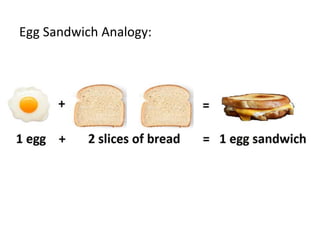
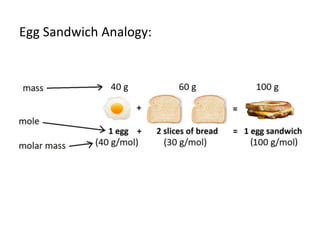
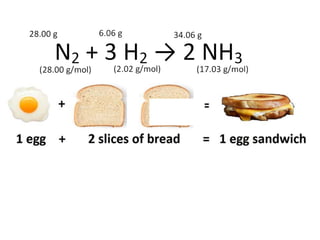
Egg Sandwich Analogy:
Limiting vs. Excess Reactant
‱ Limiting reactant is completely consumed
after a reaction; it is expected to produce
lesser amount of product.
‱ Excess reactant is NOT completely consumed
after a reaction; it is expected to produce
more amount of product.
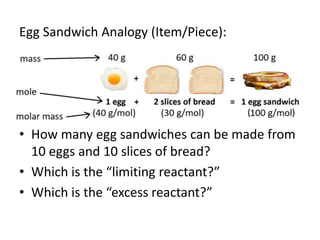
Egg Sandwich Analogy (Item/Piece):
‱ How many egg sandwiches can be made from
10 eggs and 10 slices of bread?
‱ Which is the “limiting reactant?”
‱ Which is the “excess reactant?”
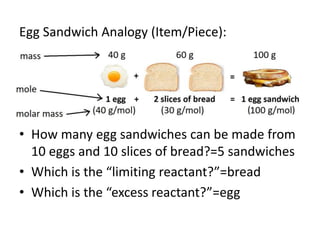
Egg Sandwich Analogy (Item/Piece):
‱ How many egg sandwiches can be made from
10 eggs and 10 slices of bread?=5 sandwiches
‱ Which is the “limiting reactant?”=bread
‱ Which is the “excess reactant?”=egg
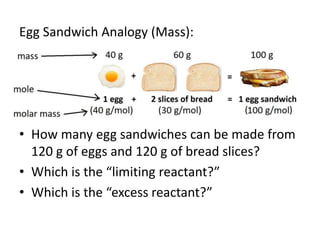
Egg Sandwich Analogy (Mass):
‱ How many egg sandwiches can be made from
120 g of eggs and 120 g of bread slices?
‱ Which is the “limiting reactant?”
‱ Which is the “excess reactant?”
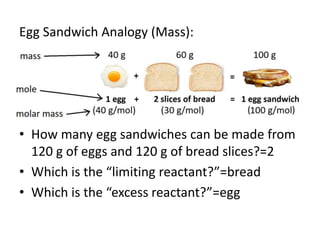
Egg Sandwich Analogy (Mass):
‱ How many egg sandwiches can be made from
120 g of eggs and 120 g of bread slices?=2
‱ Which is the “limiting reactant?”=bread
‱ Which is the “excess reactant?”=egg
‱ Limiting reactant is completely consumed
after a reaction; it theoretically produces
lesser amount of product.
‱ Excess reactant is NOT completely consumed
after a reaction; it theoretically produces
more amount of product.
Example:
‱ If 5 grams of hydrogen reacts with 5 grams of
oxygen to produce water, which reactant will
be completely consumed (limiting) and which
reactant will have residue (excess)?
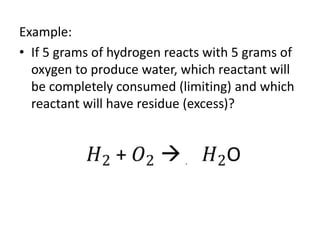
Example:
‱ If 5 grams of hydrogen reacts with 5 grams of
oxygen to produce water, which reactant will
be completely consumed (limiting) and which
reactant will have residue (excess)?
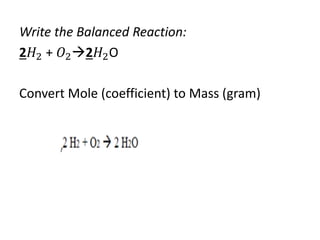
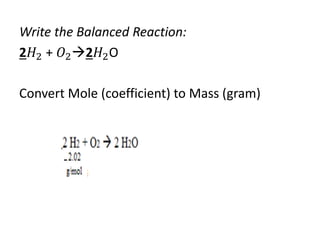
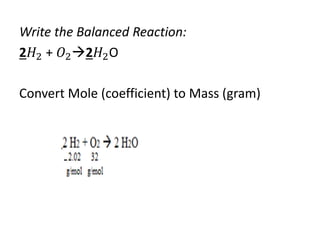
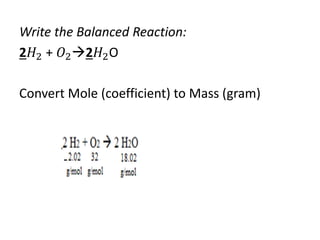
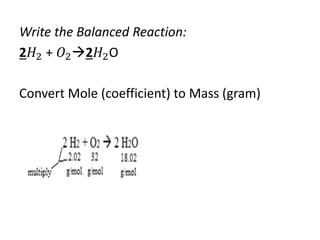
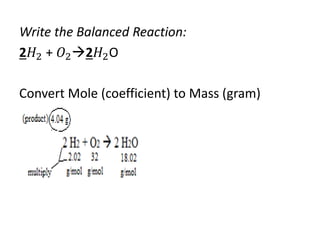
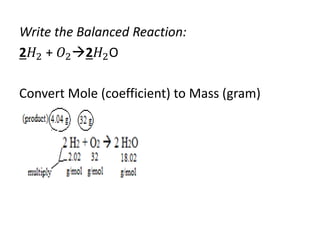
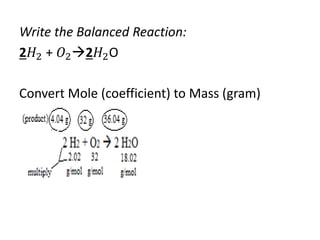
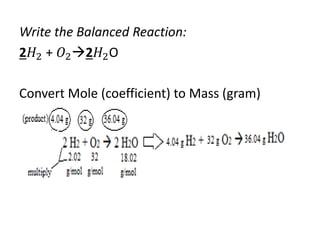
Write the Balanced Reaction:
2đ»2 + 𝑂22đ»2O
Convert Mole (coefficient) to Mass (gram)
Write the Balanced Reaction:
2đ»2 + 𝑂22đ»2O
Convert Mole (coefficient) to Mass (gram)
Write the Balanced Reaction:
2đ»2 + 𝑂22đ»2O
Convert Mole (coefficient) to Mass (gram)
Write the Balanced Reaction:
2đ»2 + 𝑂22đ»2O
Convert Mole (coefficient) to Mass (gram)
Write the Balanced Reaction:
2đ»2 + 𝑂22đ»2O
Convert Mole (coefficient) to Mass (gram)
Write the Balanced Reaction:
2đ»2 + 𝑂22đ»2O
Convert Mole (coefficient) to Mass (gram)
Write the Balanced Reaction:
2đ»2 + 𝑂22đ»2O
Convert Mole (coefficient) to Mass (gram)
Write the Balanced Reaction:
2đ»2 + 𝑂22đ»2O
Convert Mole (coefficient) to Mass (gram)
Write the Balanced Reaction:
2đ»2 + 𝑂22đ»2O
Convert Mole (coefficient) to Mass (gram)
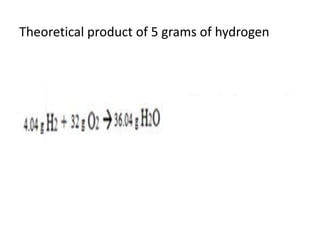
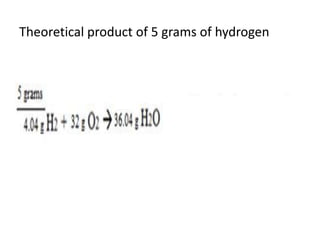
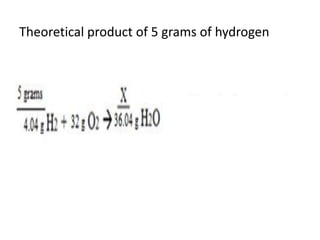
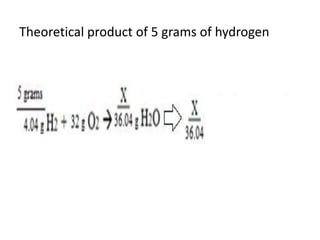
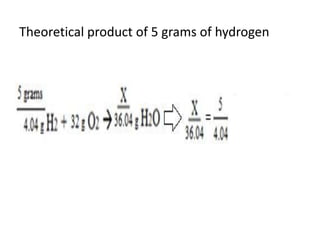
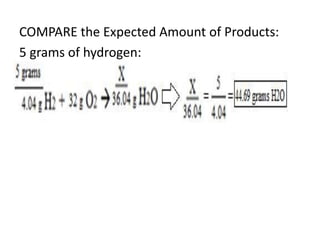
Theoretical product of 5 grams of hydrogen
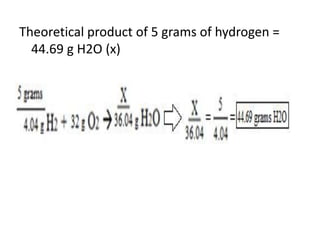
Theoretical product of 5 grams of hydrogen =
44.69 g H2O (x)
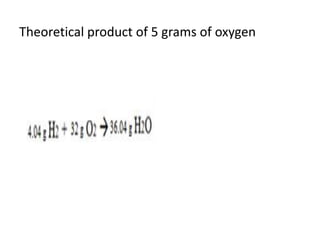
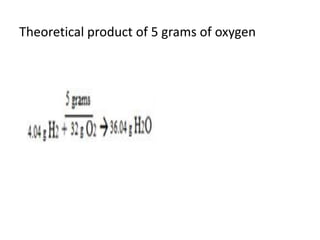
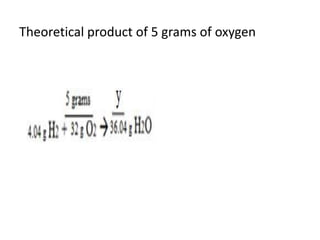
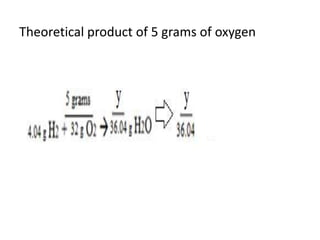
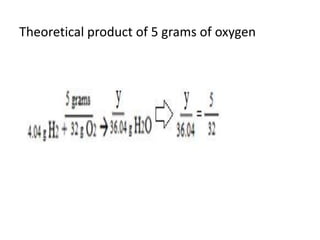
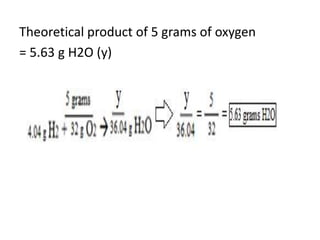
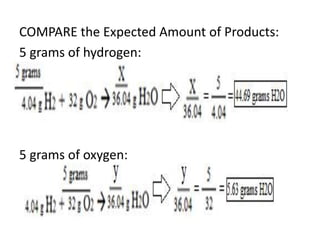
Theoretical product of 5 grams of oxygen
= 5.63 g H2O (y)
COMPARE the Expected Amount of Products:
5 grams of hydrogen:
5 grams of oxygen:
COMPARE the Expected Amount of Products:
5 grams of hydrogen:
5 grams of oxygen:
COMPARE the Expected Amount of Products:
5 grams of hydrogen:
5 grams of oxygen:
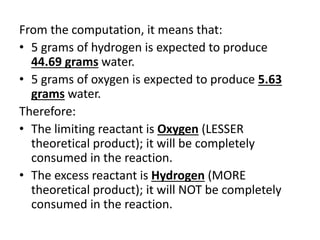
From the computation, it means that:
‱ 5 grams of hydrogen is expected to produce
44.69 grams water.
‱ 5 grams of oxygen is expected to produce 5.63
grams water.
Therefore:
‱ The limiting reactant is Oxygen (LESSER
theoretical product); it will be completely
consumed in the reaction.
‱ The excess reactant is Hydrogen (MORE
theoretical product); it will NOT be completely
consumed in the reaction.
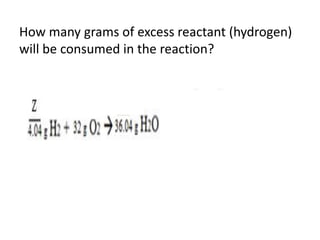
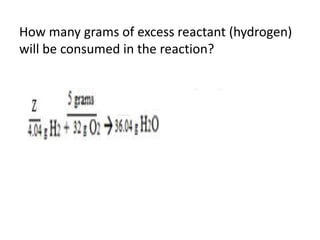
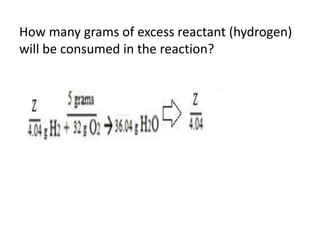
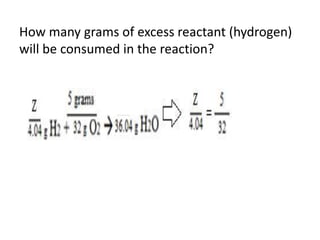
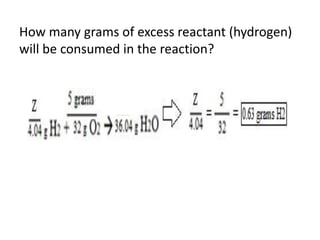
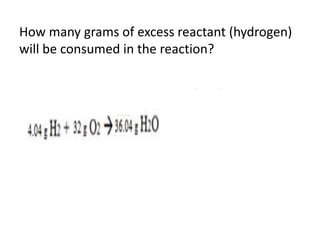
How many grams of excess reactant (hydrogen)
will be consumed in the reaction?
How many grams of excess reactant (hydrogen)
will be consumed in the reaction?
How many grams of excess reactant (hydrogen)
will be consumed in the reaction?
How many grams of excess reactant (hydrogen)
will be consumed in the reaction?
How many grams of excess reactant (hydrogen)
will be consumed in the reaction?
How many grams of excess reactant (hydrogen)
will be consumed in the reaction?
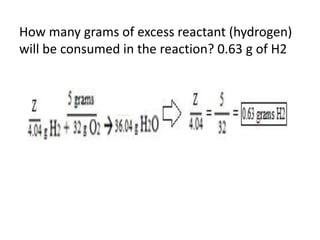
How many grams of excess reactant (hydrogen)
will be consumed in the reaction? 0.63 g of H2
How many grams of excess reactant (hydrogen)
will remain after the reaction?
‱ 5 grams of hydrogen used minus 0.63 grams
consumed hydrogen =
‱ 4.37 grams of excess hydrogen after the
reaction
How many grams of excess reactant (hydrogen)
will remain after the reaction? 4.37 g of H2
‱ 5 grams of hydrogen used minus 0.63 grams
consumed hydrogen =
‱ 4.37 grams of excess hydrogen after the
reaction
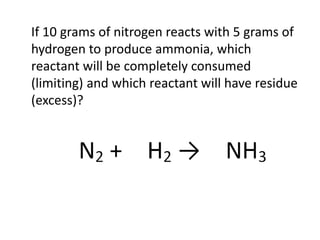
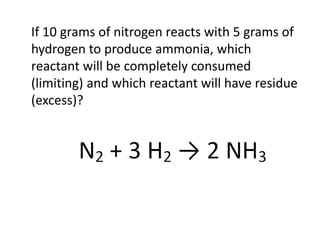
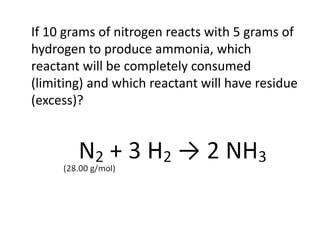
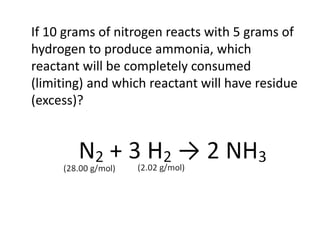
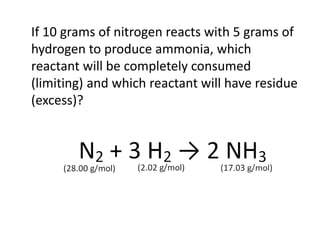
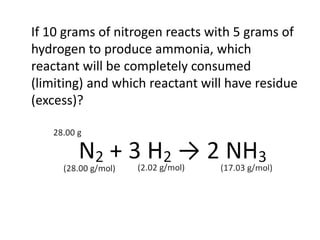
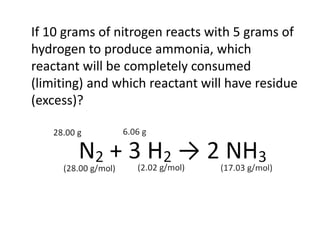
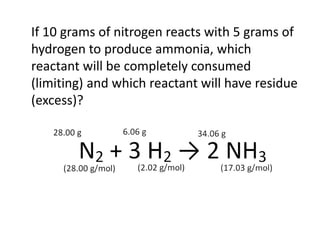
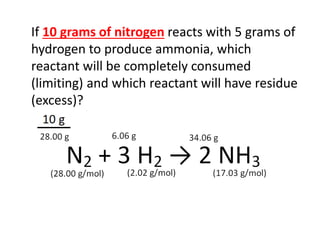
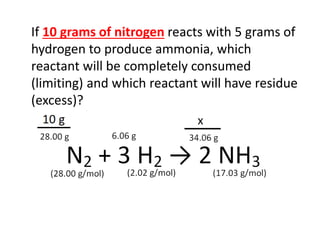
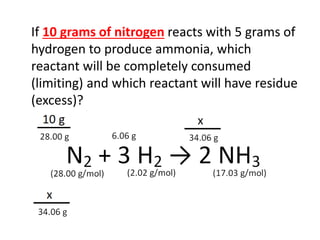
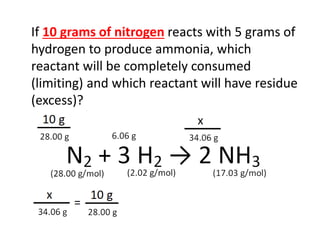
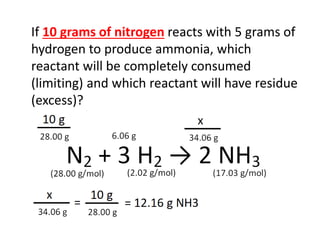
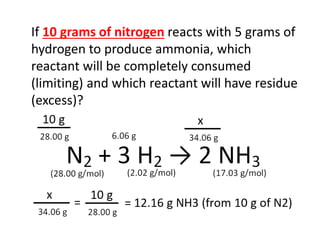
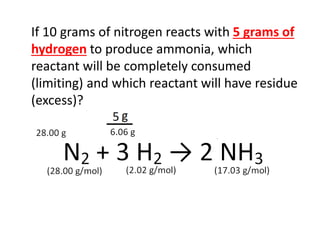
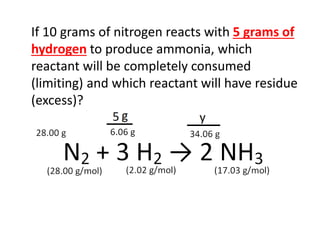
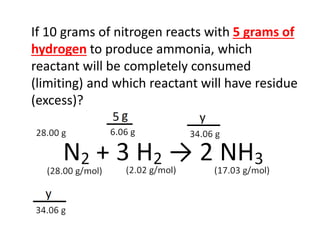
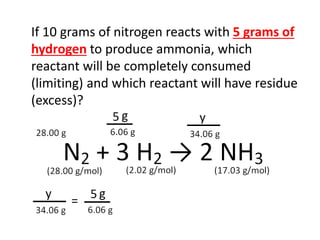
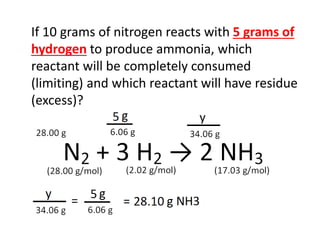
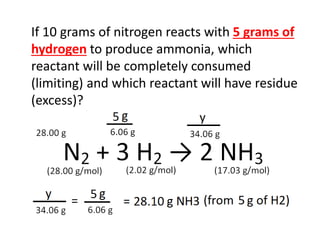
If 10 grams of nitrogen reacts with 5 grams of
hydrogen to produce ammonia, which
reactant will be completely consumed
(limiting) and which reactant will have residue
(excess)?
If 10 grams of nitrogen reacts with 5 grams of
hydrogen to produce ammonia, which
reactant will be completely consumed
(limiting) and which reactant will have residue
(excess)?
If 10 grams of nitrogen reacts with 5 grams of
hydrogen to produce ammonia, which
reactant will be completely consumed
(limiting) and which reactant will have residue
(excess)?
If 10 grams of nitrogen reacts with 5 grams of
hydrogen to produce ammonia, which
reactant will be completely consumed
(limiting) and which reactant will have residue
(excess)?
If 10 grams of nitrogen reacts with 5 grams of
hydrogen to produce ammonia, which
reactant will be completely consumed
(limiting) and which reactant will have residue
(excess)?
If 10 grams of nitrogen reacts with 5 grams of
hydrogen to produce ammonia, which
reactant will be completely consumed
(limiting) and which reactant will have residue
(excess)?
If 10 grams of nitrogen reacts with 5 grams of
hydrogen to produce ammonia, which
reactant will be completely consumed
(limiting) and which reactant will have residue
(excess)?
If 10 grams of nitrogen reacts with 5 grams of
hydrogen to produce ammonia, which
reactant will be completely consumed
(limiting) and which reactant will have residue
(excess)?
If 10 grams of nitrogen reacts with 5 grams of
hydrogen to produce ammonia, which
reactant will be completely consumed
(limiting) and which reactant will have residue
(excess)?
If 10 grams of nitrogen reacts with 5 grams of
hydrogen to produce ammonia, which
reactant will be completely consumed
(limiting) and which reactant will have residue
(excess)?
If 10 grams of nitrogen reacts with 5 grams of
hydrogen to produce ammonia, which
reactant will be completely consumed
(limiting) and which reactant will have residue
(excess)?
If 10 grams of nitrogen reacts with 5 grams of
hydrogen to produce ammonia, which
reactant will be completely consumed
(limiting) and which reactant will have residue
(excess)?
If 10 grams of nitrogen reacts with 5 grams of
hydrogen to produce ammonia, which
reactant will be completely consumed
(limiting) and which reactant will have residue
(excess)?
If 10 grams of nitrogen reacts with 5 grams of
hydrogen to produce ammonia, which
reactant will be completely consumed
(limiting) and which reactant will have residue
(excess)?
If 10 grams of nitrogen reacts with 5 grams of
hydrogen to produce ammonia, which
reactant will be completely consumed
(limiting) and which reactant will have residue
(excess)?
If 10 grams of nitrogen reacts with 5 grams of
hydrogen to produce ammonia, which
reactant will be completely consumed
(limiting) and which reactant will have residue
(excess)?
If 10 grams of nitrogen reacts with 5 grams of
hydrogen to produce ammonia, which
reactant will be completely consumed
(limiting) and which reactant will have residue
(excess)?
If 10 grams of nitrogen reacts with 5 grams of
hydrogen to produce ammonia, which
reactant will be completely consumed
(limiting) and which reactant will have residue
(excess)?
If 10 grams of nitrogen reacts with 5 grams of
hydrogen to produce ammonia, which
reactant will be completely consumed
(limiting) and which reactant will have residue
(excess)?
If 10 grams of nitrogen reacts with 5 grams of
hydrogen to produce ammonia, which
reactant will be completely consumed
(limiting) and which reactant will have residue
(excess)?
If 10 grams of nitrogen reacts with 5 grams of
hydrogen to produce ammonia, which
reactant will be completely consumed
(limiting) and which reactant will have residue
(excess)?
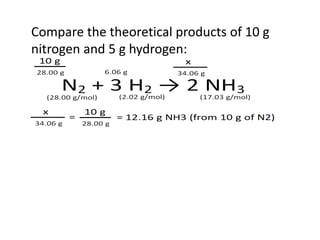
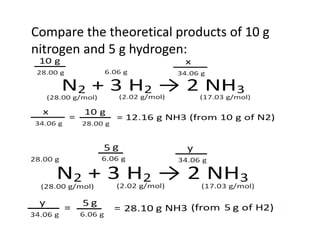
Compare the theoretical products of 10 g
nitrogen and 5 g hydrogen:
Compare the theoretical products of 10 g
nitrogen and 5 g hydrogen:
Compare the theoretical products of 10 g
nitrogen and 5 g hydrogen:
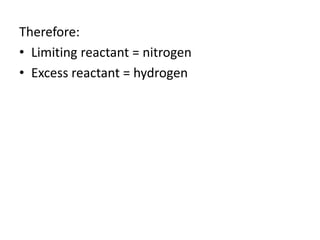
Therefore:
‱ Limiting reactant = nitrogen
‱ Excess reactant = hydrogen
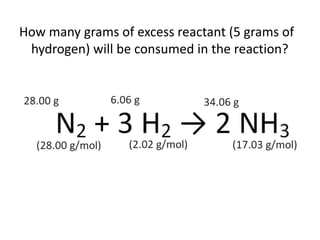
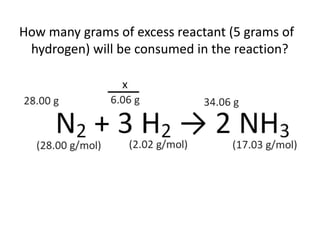
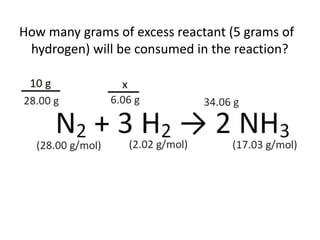
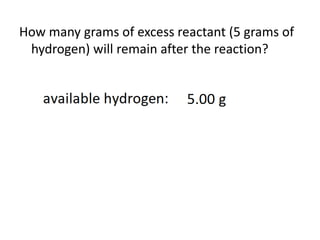
How many grams of excess reactant (5 grams of
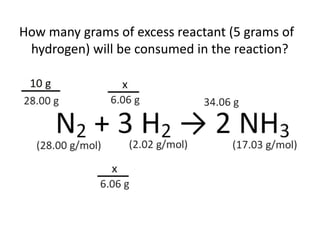
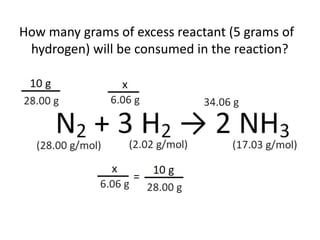
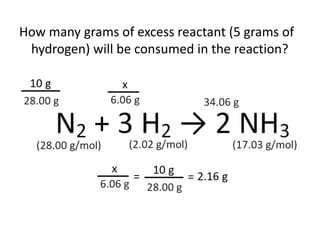
hydrogen) will be consumed in the reaction?
How many grams of excess reactant (5 grams of
hydrogen) will be consumed in the reaction?
How many grams of excess reactant (5 grams of
hydrogen) will be consumed in the reaction?
How many grams of excess reactant (5 grams of
hydrogen) will be consumed in the reaction?
How many grams of excess reactant (5 grams of
hydrogen) will be consumed in the reaction?
How many grams of excess reactant (5 grams of
hydrogen) will be consumed in the reaction?
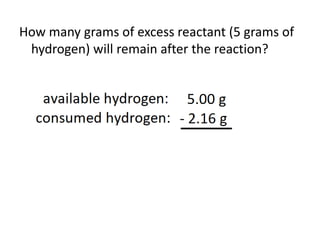
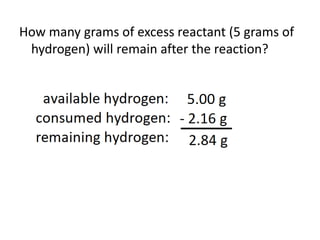
How many grams of excess reactant (5 grams of
hydrogen) will remain after the reaction?
How many grams of excess reactant (5 grams of
hydrogen) will remain after the reaction?
How many grams of excess reactant (5 grams of
hydrogen) will remain after the reaction?
How many grams of excess reactant (5 grams of
hydrogen) will remain after the reaction?
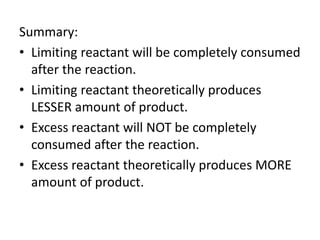
Summary:
‱ Limiting reactant will be completely consumed
after the reaction.
‱ Limiting reactant theoretically produces
LESSER amount of product.
‱ Excess reactant will NOT be completely
consumed after the reaction.
‱ Excess reactant theoretically produces MORE
amount of product.
Thank you.
<Sub-topic type here>
‱ <type here>
VIDEO LESSON 3.6 - Limiting and Excess Reactants - Elective Science 10.pptx

VIDEO LESSON 3.6 - Limiting and Excess Reactants - Elective Science 10.pptx

  • 2.
    Limiting and ExcessReactants Kenneth Frias
  • 3.
  • 4.
  • 5.
    Limiting vs. ExcessReactant ‱ Limiting reactant is completely consumed after a reaction; it is expected to produce lesser amount of product. ‱ Excess reactant is NOT completely consumed after a reaction; it is expected to produce more amount of product.
  • 6.
    Egg Sandwich Analogy(Item/Piece): ‱ How many egg sandwiches can be made from 10 eggs and 10 slices of bread? ‱ Which is the “limiting reactant?” ‱ Which is the “excess reactant?”
  • 7.
    Egg Sandwich Analogy(Item/Piece): ‱ How many egg sandwiches can be made from 10 eggs and 10 slices of bread?=5 sandwiches ‱ Which is the “limiting reactant?”=bread ‱ Which is the “excess reactant?”=egg
  • 8.
    Egg Sandwich Analogy(Mass): ‱ How many egg sandwiches can be made from 120 g of eggs and 120 g of bread slices? ‱ Which is the “limiting reactant?” ‱ Which is the “excess reactant?”
  • 9.
    Egg Sandwich Analogy(Mass): ‱ How many egg sandwiches can be made from 120 g of eggs and 120 g of bread slices?=2 ‱ Which is the “limiting reactant?”=bread ‱ Which is the “excess reactant?”=egg
  • 10.
    ‱ Limiting reactantis completely consumed after a reaction; it theoretically produces lesser amount of product. ‱ Excess reactant is NOT completely consumed after a reaction; it theoretically produces more amount of product.
  • 11.
    Example: ‱ If 5grams of hydrogen reacts with 5 grams of oxygen to produce water, which reactant will be completely consumed (limiting) and which reactant will have residue (excess)?
  • 12.
    Example: ‱ If 5grams of hydrogen reacts with 5 grams of oxygen to produce water, which reactant will be completely consumed (limiting) and which reactant will have residue (excess)?
  • 13.
    Write the BalancedReaction: 2đ»2 + 𝑂22đ»2O Convert Mole (coefficient) to Mass (gram)
  • 14.
    Write the BalancedReaction: 2đ»2 + 𝑂22đ»2O Convert Mole (coefficient) to Mass (gram)
  • 15.
    Write the BalancedReaction: 2đ»2 + 𝑂22đ»2O Convert Mole (coefficient) to Mass (gram)
  • 16.
    Write the BalancedReaction: 2đ»2 + 𝑂22đ»2O Convert Mole (coefficient) to Mass (gram)
  • 17.
    Write the BalancedReaction: 2đ»2 + 𝑂22đ»2O Convert Mole (coefficient) to Mass (gram)
  • 18.
    Write the BalancedReaction: 2đ»2 + 𝑂22đ»2O Convert Mole (coefficient) to Mass (gram)
  • 19.
    Write the BalancedReaction: 2đ»2 + 𝑂22đ»2O Convert Mole (coefficient) to Mass (gram)
  • 20.
    Write the BalancedReaction: 2đ»2 + 𝑂22đ»2O Convert Mole (coefficient) to Mass (gram)
  • 21.
    Write the BalancedReaction: 2đ»2 + 𝑂22đ»2O Convert Mole (coefficient) to Mass (gram)
  • 22.
    Theoretical product of5 grams of hydrogen
  • 23.
    Theoretical product of5 grams of hydrogen
  • 24.
    Theoretical product of5 grams of hydrogen
  • 25.
    Theoretical product of5 grams of hydrogen
  • 26.
    Theoretical product of5 grams of hydrogen
  • 27.
    Theoretical product of5 grams of hydrogen = 44.69 g H2O (x)
  • 28.
    Theoretical product of5 grams of oxygen
  • 29.
    Theoretical product of5 grams of oxygen
  • 30.
    Theoretical product of5 grams of oxygen
  • 31.
    Theoretical product of5 grams of oxygen
  • 32.
    Theoretical product of5 grams of oxygen
  • 33.
    Theoretical product of5 grams of oxygen = 5.63 g H2O (y)
  • 34.
    COMPARE the ExpectedAmount of Products: 5 grams of hydrogen: 5 grams of oxygen:
  • 35.
    COMPARE the ExpectedAmount of Products: 5 grams of hydrogen: 5 grams of oxygen:
  • 36.
    COMPARE the ExpectedAmount of Products: 5 grams of hydrogen: 5 grams of oxygen:
  • 37.
    From the computation,it means that: ‱ 5 grams of hydrogen is expected to produce 44.69 grams water. ‱ 5 grams of oxygen is expected to produce 5.63 grams water. Therefore: ‱ The limiting reactant is Oxygen (LESSER theoretical product); it will be completely consumed in the reaction. ‱ The excess reactant is Hydrogen (MORE theoretical product); it will NOT be completely consumed in the reaction.
  • 38.
    How many gramsof excess reactant (hydrogen) will be consumed in the reaction?
  • 39.
    How many gramsof excess reactant (hydrogen) will be consumed in the reaction?
  • 40.
    How many gramsof excess reactant (hydrogen) will be consumed in the reaction?
  • 41.
    How many gramsof excess reactant (hydrogen) will be consumed in the reaction?
  • 42.
    How many gramsof excess reactant (hydrogen) will be consumed in the reaction?
  • 43.
    How many gramsof excess reactant (hydrogen) will be consumed in the reaction?
  • 44.
    How many gramsof excess reactant (hydrogen) will be consumed in the reaction? 0.63 g of H2
  • 45.
    How many gramsof excess reactant (hydrogen) will remain after the reaction? ‱ 5 grams of hydrogen used minus 0.63 grams consumed hydrogen = ‱ 4.37 grams of excess hydrogen after the reaction
  • 46.
    How many gramsof excess reactant (hydrogen) will remain after the reaction? 4.37 g of H2 ‱ 5 grams of hydrogen used minus 0.63 grams consumed hydrogen = ‱ 4.37 grams of excess hydrogen after the reaction
  • 47.
    If 10 gramsof nitrogen reacts with 5 grams of hydrogen to produce ammonia, which reactant will be completely consumed (limiting) and which reactant will have residue (excess)?
  • 48.
    If 10 gramsof nitrogen reacts with 5 grams of hydrogen to produce ammonia, which reactant will be completely consumed (limiting) and which reactant will have residue (excess)?
  • 49.
    If 10 gramsof nitrogen reacts with 5 grams of hydrogen to produce ammonia, which reactant will be completely consumed (limiting) and which reactant will have residue (excess)?
  • 50.
    If 10 gramsof nitrogen reacts with 5 grams of hydrogen to produce ammonia, which reactant will be completely consumed (limiting) and which reactant will have residue (excess)?
  • 51.
    If 10 gramsof nitrogen reacts with 5 grams of hydrogen to produce ammonia, which reactant will be completely consumed (limiting) and which reactant will have residue (excess)?
  • 52.
    If 10 gramsof nitrogen reacts with 5 grams of hydrogen to produce ammonia, which reactant will be completely consumed (limiting) and which reactant will have residue (excess)?
  • 53.
    If 10 gramsof nitrogen reacts with 5 grams of hydrogen to produce ammonia, which reactant will be completely consumed (limiting) and which reactant will have residue (excess)?
  • 54.
    If 10 gramsof nitrogen reacts with 5 grams of hydrogen to produce ammonia, which reactant will be completely consumed (limiting) and which reactant will have residue (excess)?
  • 55.
    If 10 gramsof nitrogen reacts with 5 grams of hydrogen to produce ammonia, which reactant will be completely consumed (limiting) and which reactant will have residue (excess)?
  • 56.
    If 10 gramsof nitrogen reacts with 5 grams of hydrogen to produce ammonia, which reactant will be completely consumed (limiting) and which reactant will have residue (excess)?
  • 57.
    If 10 gramsof nitrogen reacts with 5 grams of hydrogen to produce ammonia, which reactant will be completely consumed (limiting) and which reactant will have residue (excess)?
  • 58.
    If 10 gramsof nitrogen reacts with 5 grams of hydrogen to produce ammonia, which reactant will be completely consumed (limiting) and which reactant will have residue (excess)?
  • 59.
    If 10 gramsof nitrogen reacts with 5 grams of hydrogen to produce ammonia, which reactant will be completely consumed (limiting) and which reactant will have residue (excess)?
  • 60.
    If 10 gramsof nitrogen reacts with 5 grams of hydrogen to produce ammonia, which reactant will be completely consumed (limiting) and which reactant will have residue (excess)?
  • 61.
    If 10 gramsof nitrogen reacts with 5 grams of hydrogen to produce ammonia, which reactant will be completely consumed (limiting) and which reactant will have residue (excess)?
  • 62.
    If 10 gramsof nitrogen reacts with 5 grams of hydrogen to produce ammonia, which reactant will be completely consumed (limiting) and which reactant will have residue (excess)?
  • 63.
    If 10 gramsof nitrogen reacts with 5 grams of hydrogen to produce ammonia, which reactant will be completely consumed (limiting) and which reactant will have residue (excess)?
  • 64.
    If 10 gramsof nitrogen reacts with 5 grams of hydrogen to produce ammonia, which reactant will be completely consumed (limiting) and which reactant will have residue (excess)?
  • 65.
    If 10 gramsof nitrogen reacts with 5 grams of hydrogen to produce ammonia, which reactant will be completely consumed (limiting) and which reactant will have residue (excess)?
  • 66.
    If 10 gramsof nitrogen reacts with 5 grams of hydrogen to produce ammonia, which reactant will be completely consumed (limiting) and which reactant will have residue (excess)?
  • 67.
    If 10 gramsof nitrogen reacts with 5 grams of hydrogen to produce ammonia, which reactant will be completely consumed (limiting) and which reactant will have residue (excess)?
  • 68.
    Compare the theoreticalproducts of 10 g nitrogen and 5 g hydrogen:
  • 69.
    Compare the theoreticalproducts of 10 g nitrogen and 5 g hydrogen:
  • 70.
    Compare the theoreticalproducts of 10 g nitrogen and 5 g hydrogen:
  • 71.
    Therefore: ‱ Limiting reactant= nitrogen ‱ Excess reactant = hydrogen
  • 72.
    How many gramsof excess reactant (5 grams of hydrogen) will be consumed in the reaction?
  • 73.
    How many gramsof excess reactant (5 grams of hydrogen) will be consumed in the reaction?
  • 74.
    How many gramsof excess reactant (5 grams of hydrogen) will be consumed in the reaction?
  • 75.
    How many gramsof excess reactant (5 grams of hydrogen) will be consumed in the reaction?
  • 76.
    How many gramsof excess reactant (5 grams of hydrogen) will be consumed in the reaction?
  • 77.
    How many gramsof excess reactant (5 grams of hydrogen) will be consumed in the reaction?
  • 78.
    How many gramsof excess reactant (5 grams of hydrogen) will remain after the reaction?
  • 79.
    How many gramsof excess reactant (5 grams of hydrogen) will remain after the reaction?
  • 80.
    How many gramsof excess reactant (5 grams of hydrogen) will remain after the reaction?
  • 81.
    How many gramsof excess reactant (5 grams of hydrogen) will remain after the reaction?
  • 82.
    Summary: ‱ Limiting reactantwill be completely consumed after the reaction. ‱ Limiting reactant theoretically produces LESSER amount of product. ‱ Excess reactant will NOT be completely consumed after the reaction. ‱ Excess reactant theoretically produces MORE amount of product.
  • 83.
  • 84.