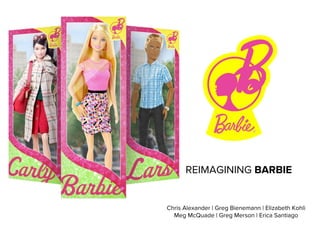
REIMAGINING BARBIE
Chris Alexander | Greg Bienemann | Elizabeth Kohli
Meg McQuade | Greg Merson | Erica Santiago
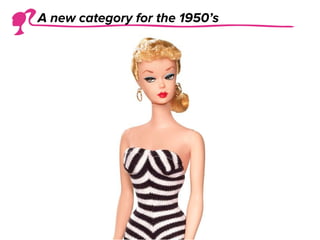
A new category for the 1950’s
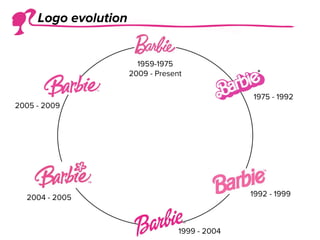
Logo evolution
1992 - 1999
1999 - 2004
2004 - 2005
2005 - 2009
1959-1975
2009 - Present
1975 - 1992
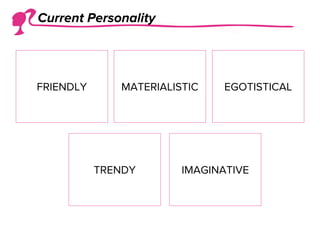
FRIENDLY MATERIALISTIC EGOTISTICAL
TRENDY IMAGINATIVE
Current Personality
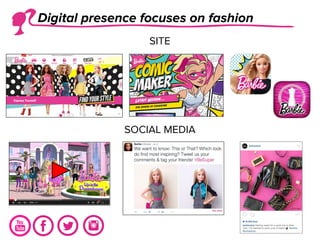
SITE
SOCIAL MEDIA
Digital presence focuses on fashion
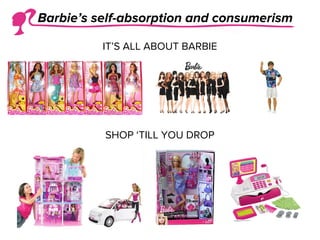
IT’S ALL ABOUT BARBIE
SHOP ‘TILL YOU DROP
Barbie’s self-absorption and consumerism
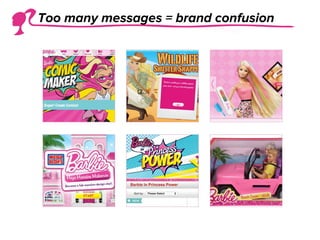
Too many messages = brand confusion
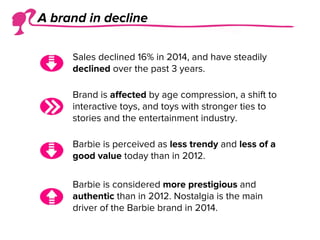
A brand in decline
Sales declined 16% in 2014, and have steadily
declined over the past 3 years.
Brand is affected by age compression, a shift to
interactive toys, and toys with stronger ties to
stories and the entertainment industry.
Barbie is perceived as less trendy and less of a
good value today than in 2012.
Barbie is considered more prestigious and
authentic than in 2012. Nostalgia is the main
driver of the Barbie brand in 2014.
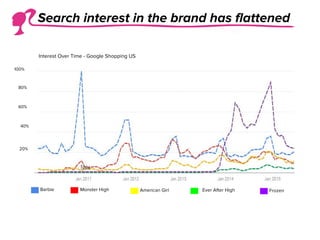
Monster High
100%
Interest Over Time - Google Shopping US
80%
60%
20%
40%
FrozenAmerican Girl Ever After HighBarbie
Search interest in the brand has flattened
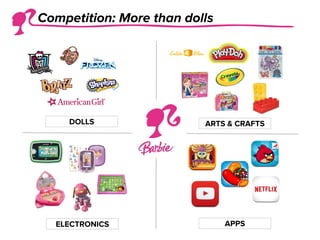
DOLLS
ELECTRONICS
ARTS & CRAFTS
APPS
Competition: More than dolls
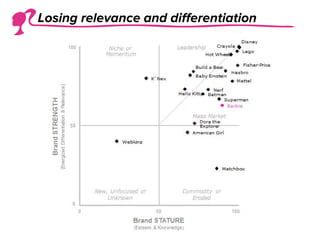
Losing relevance and differentiation
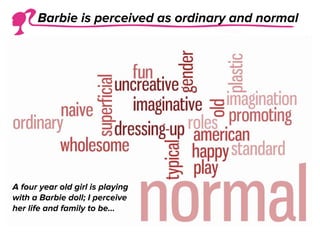
A four year old girl is playing
with a Barbie doll; I perceive
her life and family to be...
Barbie is perceived as ordinary and normal
The Barbie brand is in decline because of age
compression, a lack of true inclusivity, and an
outdated worldview. We plan to leverage
Barbie’s iconic status with a reimagined
approach and renewed priorities to create a
story that makes her more relevant,
accessible, and exciting, so that daughters are
proactively asking Mom to “buy me a Barbie!”
Lack of inclusivity and outdated worldview
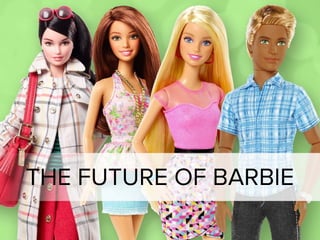
THE FUTURE OF BARBIE
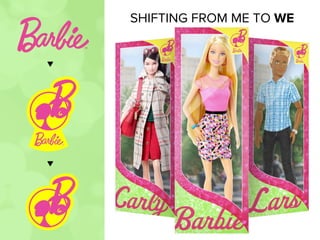
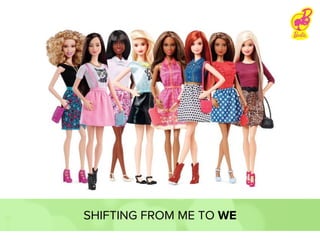
SHIFTING FROM ME TO WE
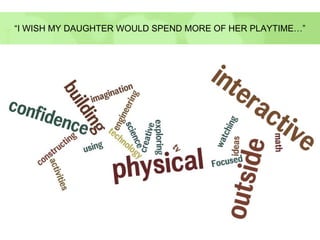
“I WISH MY DAUGHTER WOULD SPEND MORE OF HER PLAYTIME…”
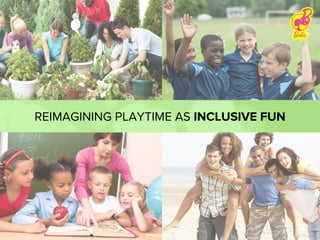
REIMAGINING PLAYTIME AS INCLUSIVE FUN
To Mothers and Daughters in the
market for a new favorite toy, the
Barbie family is your EXCITING and
FUN choice, providing
COLLABORATIVE, EMPOWERING,
and ALL-EMBRACING experiences;
experiences that promote HEALTHY
and POSITIVE values while also
creating memories that will last a
LIFETIME.
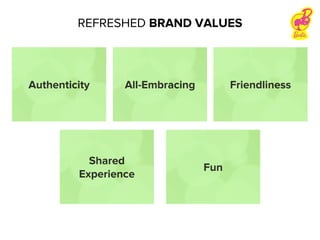
REFRESHED
BRAND
POSITIONING
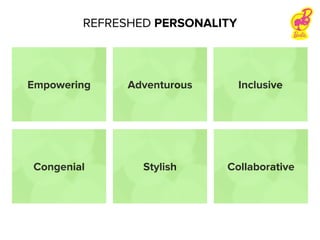
InclusiveEmpowering Adventurous
Congenial CollaborativeStylish
REFRESHED PERSONALITY
All-EmbracingAuthenticity Friendliness
Shared
Experience
Fun
REFRESHED BRAND VALUES
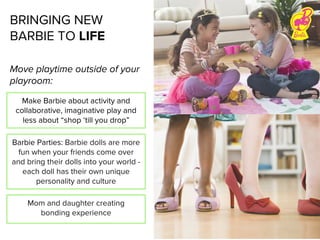
Move playtime outside of your
playroom:
BRINGING NEW
BARBIE TO LIFE
Make Barbie about activity and
collaborative, imaginative play and
less about “shop ‘till you drop”
Barbie Parties: Barbie dolls are more
fun when your friends come over
and bring their dolls into your world -
each doll has their own unique
personality and culture
Mom and daughter creating
bonding experience
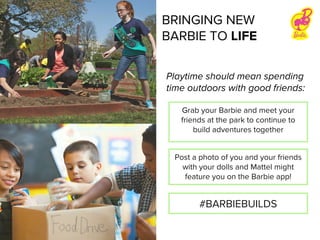
Playtime should mean spending
time outdoors with good friends:
Grab your Barbie and meet your
friends at the park to continue to
build adventures together
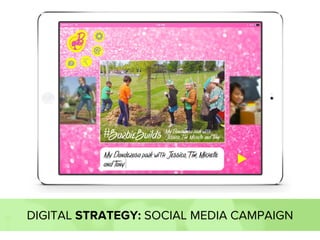
Post a photo of you and your friends
with your dolls and Mattel might
feature you on the Barbie app!
#BARBIEBUILDS
BRINGING NEW
BARBIE TO LIFE
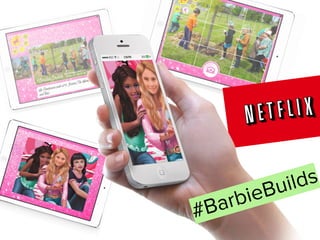
#BarbieBuilds
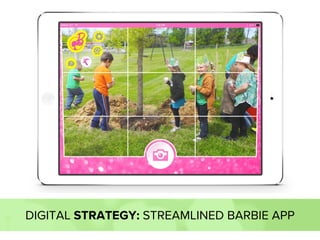
DIGITAL STRATEGY: STREAMLINED BARBIE APP
DIGITAL STRATEGY: SOCIAL MEDIA CAMPAIGN
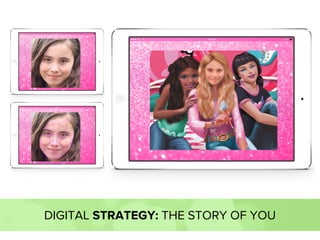
DIGITAL STRATEGY: THE STORY OF YOU
#BarbieBuilds CONFIDENCE
#BarbieBuilds TRUST
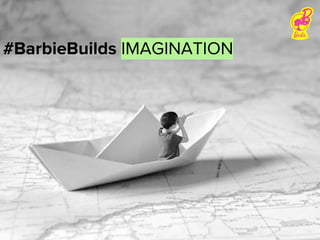
#BarbieBuilds IMAGINATION
#BarbieBuilds COMMUNITY
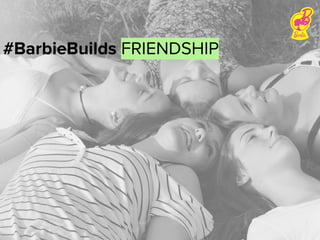
#BarbieBuilds FRIENDSHIP
#BarbieBuilds YOUR STORY
By reimagining the classic Barbie
brand values with a focus on
COLLABORATION and INCLUSIVITY,
the new and improved Barbie family
will encourage active, social, fun, and
POSITIVE value-based playtime,
inspiring and EMPOWERING a new
generation of Barbie fans, and
making Moms PROUD to purchase
Barbie brand products for their
Daughters.
BRINGING
BARBIE BACK
REIMAGINING BARBIE
Chris Alexander | Greg Bienemann | Elizabeth Kohli
Meg McQuade | Greg Merson | Erica Santiago
APPENDIX
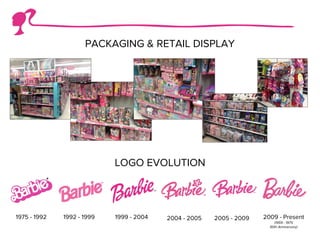
PACKAGING & RETAIL DISPLAY
LOGO EVOLUTION
1975 - 1992 1992 - 1999 1999 - 2004 2004 - 2005 2005 - 2009 2009 - Present
(1959 - 1975
50th Anniversary)
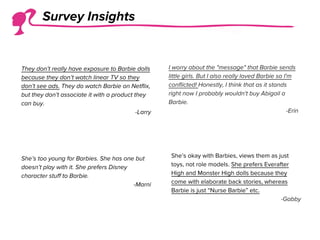
They don’t really have exposure to Barbie dolls
because they don’t watch linear TV so they
don’t see ads. They do watch Barbie on Netflix,
but they don’t associate it with a product they
can buy.
-Larry
She’s too young for Barbies. She has one but
doesn’t play with it. She prefers Disney
character stuff to Barbie.
-Marni
I worry about the "message" that Barbie sends
little girls. But I also really loved Barbie so I'm
conflicted! Honestly, I think that as it stands
right now I probably wouldn't buy Abigail a
Barbie.
-Erin
She’s okay with Barbies, views them as just
toys, not role models. She prefers Everafter
High and Monster High dolls because they
come with elaborate back stories, whereas
Barbie is just “Nurse Barbie” etc.
-Gabby
Survey Insights
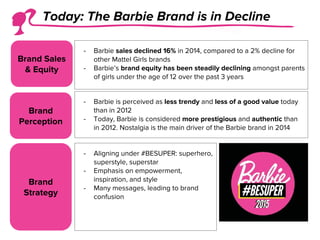
- Aligning under #BESUPER: superhero,
superstyle, superstar
- Emphasis on empowerment,
inspiration, and style
- Many messages, leading to brand
confusion
- Barbie sales declined 16% in 2014, compared to a 2% decline for
other Mattel Girls brands
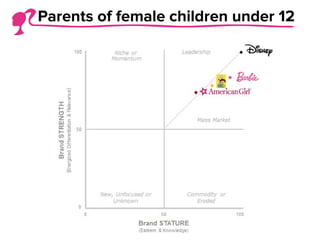
- Barbie’s brand equity has been steadily declining amongst parents
of girls under the age of 12 over the past 3 years
Brand Sales
& Equity
Brand
Perception
Brand
Strategy
- Barbie is perceived as less trendy and less of a good value today
than in 2012
- Today, Barbie is considered more prestigious and authentic than
in 2012. Nostalgia is the main driver of the Barbie brand in 2014
Today: The Barbie Brand is in Decline
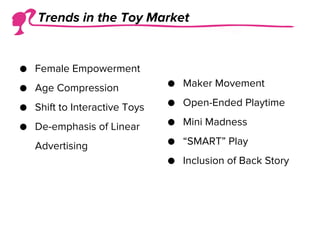
● Female Empowerment
● Age Compression
● Shift to Interactive Toys
● De-emphasis of Linear
Advertising
● Maker Movement
● Open-Ended Playtime
● Mini Madness
● “SMART” Play
● Inclusion of Back Story
Trends in the Toy Market
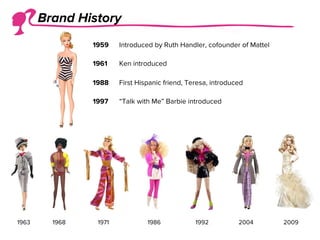
Brand History
1959 Introduced by Ruth Handler, cofounder of Mattel
1961 Ken introduced
1988 First Hispanic friend, Teresa, introduced
1997 “Talk with Me” Barbie introduced
1963 1968 1971 1986 1992 2004 2009
● Introduced in 1959 by Ruth Handler, cofounder of Mattel
● Barbie filled an untapped niche for teen and adult dolls in
America
○ At the time, baby and toddler dolls dominated the
market
● Over the next 55+ years, hundreds of Barbie variants have
been introduced, along with numerous complementary toys
● The Barbie doll has become an iconic symbol of childhood,
and America, across the world
● The Barbie brand today is about more than just the doll; it is
about inspiring and encouraging young girls to express and
explore their individuality
Brand History
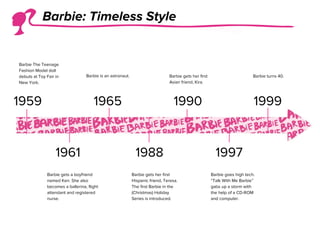
Barbie The Teenage
Fashion Model doll
debuts at Toy Fair in
New York.
Barbie: Timeless Style
Barbie gets a boyfriend
named Ken. She also
becomes a ballerina, flight
attendant and registered
nurse.
Barbie is an astronaut.
Barbie gets her first
Hispanic friend, Teresa.
The first Barbie in the
(Christmas) Holiday
Series is introduced.
Barbie gets her first
Asian friend, Kira.
Barbie goes high tech.
“Talk With Me Barbie”
gabs up a storm with
the help of a CD-ROM
and computer.
Barbie turns 40.
1959 1965 1990 1999
1961 1988 1997
Parents of female children under 12
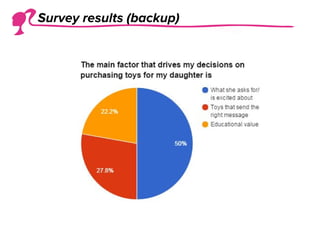
Survey results (backup)
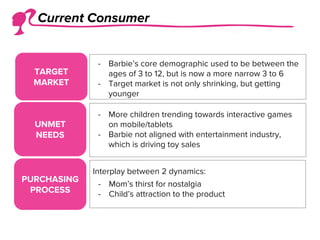
Current Consumer
TARGET
MARKET
UNMET
NEEDS
- More children trending towards interactive games
on mobile/tablets
- Barbie not aligned with entertainment industry,
which is driving toy sales
Interplay between 2 dynamics:
- Mom’s thirst for nostalgia
- Child’s attraction to the product
PURCHASING
PROCESS
- Barbie’s core demographic used to be between the
ages of 3 to 12, but is now a more narrow 3 to 6
- Target market is not only shrinking, but getting
younger

Barbie - Brand Strategy Presentation

  • 1.
    REIMAGINING BARBIE Chris Alexander| Greg Bienemann | Elizabeth Kohli Meg McQuade | Greg Merson | Erica Santiago
  • 2.
    A new categoryfor the 1950’s
  • 3.
    Logo evolution 1992 -1999 1999 - 2004 2004 - 2005 2005 - 2009 1959-1975 2009 - Present 1975 - 1992
  • 4.
    FRIENDLY MATERIALISTIC EGOTISTICAL TRENDYIMAGINATIVE Current Personality
  • 5.
  • 6.
    IT’S ALL ABOUTBARBIE SHOP ‘TILL YOU DROP Barbie’s self-absorption and consumerism
  • 7.
    Too many messages= brand confusion
  • 8.
    A brand indecline Sales declined 16% in 2014, and have steadily declined over the past 3 years. Brand is affected by age compression, a shift to interactive toys, and toys with stronger ties to stories and the entertainment industry. Barbie is perceived as less trendy and less of a good value today than in 2012. Barbie is considered more prestigious and authentic than in 2012. Nostalgia is the main driver of the Barbie brand in 2014.
  • 9.
    Monster High 100% Interest OverTime - Google Shopping US 80% 60% 20% 40% FrozenAmerican Girl Ever After HighBarbie Search interest in the brand has flattened
  • 10.
  • 11.
    Losing relevance anddifferentiation
  • 12.
    A four yearold girl is playing with a Barbie doll; I perceive her life and family to be... Barbie is perceived as ordinary and normal
  • 13.
    The Barbie brandis in decline because of age compression, a lack of true inclusivity, and an outdated worldview. We plan to leverage Barbie’s iconic status with a reimagined approach and renewed priorities to create a story that makes her more relevant, accessible, and exciting, so that daughters are proactively asking Mom to “buy me a Barbie!” Lack of inclusivity and outdated worldview
  • 14.
  • 15.
  • 16.
  • 17.
    “I WISH MYDAUGHTER WOULD SPEND MORE OF HER PLAYTIME…”
  • 18.
  • 19.
    To Mothers andDaughters in the market for a new favorite toy, the Barbie family is your EXCITING and FUN choice, providing COLLABORATIVE, EMPOWERING, and ALL-EMBRACING experiences; experiences that promote HEALTHY and POSITIVE values while also creating memories that will last a LIFETIME. REFRESHED BRAND POSITIONING
  • 20.
  • 21.
  • 22.
    Move playtime outsideof your playroom: BRINGING NEW BARBIE TO LIFE Make Barbie about activity and collaborative, imaginative play and less about “shop ‘till you drop” Barbie Parties: Barbie dolls are more fun when your friends come over and bring their dolls into your world - each doll has their own unique personality and culture Mom and daughter creating bonding experience
  • 23.
    Playtime should meanspending time outdoors with good friends: Grab your Barbie and meet your friends at the park to continue to build adventures together Post a photo of you and your friends with your dolls and Mattel might feature you on the Barbie app! #BARBIEBUILDS BRINGING NEW BARBIE TO LIFE
  • 24.
  • 25.
  • 26.
  • 27.
  • 28.
  • 29.
  • 30.
  • 31.
  • 32.
  • 33.
  • 34.
    By reimagining theclassic Barbie brand values with a focus on COLLABORATION and INCLUSIVITY, the new and improved Barbie family will encourage active, social, fun, and POSITIVE value-based playtime, inspiring and EMPOWERING a new generation of Barbie fans, and making Moms PROUD to purchase Barbie brand products for their Daughters. BRINGING BARBIE BACK
  • 35.
    REIMAGINING BARBIE Chris Alexander| Greg Bienemann | Elizabeth Kohli Meg McQuade | Greg Merson | Erica Santiago
  • 36.
  • 37.
    PACKAGING & RETAILDISPLAY LOGO EVOLUTION 1975 - 1992 1992 - 1999 1999 - 2004 2004 - 2005 2005 - 2009 2009 - Present (1959 - 1975 50th Anniversary)
  • 38.
    They don’t reallyhave exposure to Barbie dolls because they don’t watch linear TV so they don’t see ads. They do watch Barbie on Netflix, but they don’t associate it with a product they can buy. -Larry She’s too young for Barbies. She has one but doesn’t play with it. She prefers Disney character stuff to Barbie. -Marni I worry about the "message" that Barbie sends little girls. But I also really loved Barbie so I'm conflicted! Honestly, I think that as it stands right now I probably wouldn't buy Abigail a Barbie. -Erin She’s okay with Barbies, views them as just toys, not role models. She prefers Everafter High and Monster High dolls because they come with elaborate back stories, whereas Barbie is just “Nurse Barbie” etc. -Gabby Survey Insights
  • 39.
    - Aligning under#BESUPER: superhero, superstyle, superstar - Emphasis on empowerment, inspiration, and style - Many messages, leading to brand confusion - Barbie sales declined 16% in 2014, compared to a 2% decline for other Mattel Girls brands - Barbie’s brand equity has been steadily declining amongst parents of girls under the age of 12 over the past 3 years Brand Sales & Equity Brand Perception Brand Strategy - Barbie is perceived as less trendy and less of a good value today than in 2012 - Today, Barbie is considered more prestigious and authentic than in 2012. Nostalgia is the main driver of the Barbie brand in 2014 Today: The Barbie Brand is in Decline
  • 40.
    ● Female Empowerment ●Age Compression ● Shift to Interactive Toys ● De-emphasis of Linear Advertising ● Maker Movement ● Open-Ended Playtime ● Mini Madness ● “SMART” Play ● Inclusion of Back Story Trends in the Toy Market
  • 41.
    Brand History 1959 Introducedby Ruth Handler, cofounder of Mattel 1961 Ken introduced 1988 First Hispanic friend, Teresa, introduced 1997 “Talk with Me” Barbie introduced 1963 1968 1971 1986 1992 2004 2009
  • 42.
    ● Introduced in1959 by Ruth Handler, cofounder of Mattel ● Barbie filled an untapped niche for teen and adult dolls in America ○ At the time, baby and toddler dolls dominated the market ● Over the next 55+ years, hundreds of Barbie variants have been introduced, along with numerous complementary toys ● The Barbie doll has become an iconic symbol of childhood, and America, across the world ● The Barbie brand today is about more than just the doll; it is about inspiring and encouraging young girls to express and explore their individuality Brand History
  • 43.
    Barbie The Teenage FashionModel doll debuts at Toy Fair in New York. Barbie: Timeless Style Barbie gets a boyfriend named Ken. She also becomes a ballerina, flight attendant and registered nurse. Barbie is an astronaut. Barbie gets her first Hispanic friend, Teresa. The first Barbie in the (Christmas) Holiday Series is introduced. Barbie gets her first Asian friend, Kira. Barbie goes high tech. “Talk With Me Barbie” gabs up a storm with the help of a CD-ROM and computer. Barbie turns 40. 1959 1965 1990 1999 1961 1988 1997
  • 44.
    Parents of femalechildren under 12
  • 45.
  • 46.
    Current Consumer TARGET MARKET UNMET NEEDS - Morechildren trending towards interactive games on mobile/tablets - Barbie not aligned with entertainment industry, which is driving toy sales Interplay between 2 dynamics: - Mom’s thirst for nostalgia - Child’s attraction to the product PURCHASING PROCESS - Barbie’s core demographic used to be between the ages of 3 to 12, but is now a more narrow 3 to 6 - Target market is not only shrinking, but getting younger