VICTORIA’S
REGIONAL STATEMENT
YOUR VOICE, YOUR REGION, YOUR STATE.
Aboriginal and Torres Strait Islander people should
be aware that this document may contain images or
names of people who may have passed away since
the time of publishing.
This publication may be of assistance to you but the
State of Victoria and its employees do not guarantee
that the publication is without flaw of any kind or is
wholly appropriate for your particular purposes and
therefore disclaims all liability for any error, loss or other
consequence which may arise from you relying on
any information in this publication. You should seek
appropriately qualified advice before making
any decisions regarding your particular project.
Authorised by the Victorian Government,
1 Treasury Place Melbourne
November 2015
© Copyright State of Victoria 2015
Except for any logos, emblems, trademarks, artwork
and photography this document is
made available under the terms of the Creative
Commons Attribution 3.0 Australia licence.
This document is also available in PDF and accessible
Word format at www.ecodev.vic.gov.au.
Photography Credits:
Page 26. Lake Condah
Page 28. Castlemaine State Festival Opening Night (2013)
Photo: Michael Nix
Page 60. A Local Elder Participating in the Community
Performance for the Shepparton Festival in 2013
Photo: Speed Shop Photography
CONTENTS
PREMIER’S MESSAGE 	 6
MINISTER’S MESSAGE	 7
PUTTING GOVERNMENT BACK TO WORK FOR REGIONAL VICTORIA	 8
REGIONAL PARTNERSHIPS	 12
The case for change	 14
Regional Partnerships: bringing regional priorities to the heart of government	 14
Everyone has a role to play	 17
Turning ideas into action	 18
What does this mean for existing regional leadership groups?	 18
What’s next	 18
GETTING ON WITH IT IN REGIONAL VICTORIA	 20
REGIONAL JOBS FOR A GROWING ECONOMY	 24
Funding our future	 24
Agriculture	25
Tourism and events	 26
Renewable energy	 27
Small business	 27
Racing	27
Creative industries	 27
Water	28
Planning	30
What’s next	 30
TRANSPORT AND INFRASTRUCTURE FOR GROWTH 	 32
Regional rail	 32
Regional Network Development Plan	 33
Regional buses	 33
Freight rail	 33
Regional roads	 34
Road safety	 34
Telecommunications	34
What’s next	 35
DELIVERING THE EDUCATION STATE IN REGIONAL VICTORIA	 36
Early childhood	 36
Schools	37
Skills and training	 38
What’s next	 39
BETTER HEALTHCARE FOR REGIONAL FAMILIES	 40
Improving health in the regions	 40
Ambulance	41
Aboriginal health	 41
Mental health	 42
Children and young people	 42
What’s next	 43
SAFER REGIONAL COMMUNITIES	 44
Family violence	 44
Police and emergency services	 45
Tackling the ice crisis	 46
What’s next	 46
PROTECTING THE QUALITY OF LIFE IN OUR REGIONS	 48
Environment and climate change	 48
Local councils: the backbone of rural and regional communities	 49
Sport	49
Aboriginal communities	 50
Multicultural communities	 50
Equality	50
Women	51
Veterans	51
What’s next	 51
REGIONS	52
BARWON	54
CENTRAL HIGHLANDS	 56
GIPPSLAND	58
GOULBURN	60
GREAT SOUTH COAST	 62
LODDON CAMPASPE	 64
MALLEE	66
OVENS MURRAY	 68
WIMMERA SOUTHERN MALLEE	 70
6	 Victoria’s Regional Statement
I was raised in regional Victoria.
Let me make one thing clear: no government should
ever take the people of regional Victoria for granted.
Families here deserve a government that works as hard
as they do, and that’s what this Regional Statement
is all about.
It starts with more jobs, in industries new and old.
We’ve hit the ground running since coming to office,
creating more jobs, reducing unemployment,
saving Victoria’s TAFE system and establishing the
$500 million Regional Jobs and Infrastructure Fund.
This is just the start.
Education is the key to the future of regional Victoria.
Instead of cutting funds to our TAFE system, we’re
saving it. We’re building the Education State in regional
Victoria, delivering the single biggest injection of funds
to the education system in our state’s history.
More jobs and a better education system mean more
opportunities for the next generation. Families shouldn’t
have to be forced to watch their kids move away from
home just to get a job or start a career. Every young
person deserves the same chance, no matter where
they live.
We need to invest more in transport and infrastructure
to make food and fibre more competitive in the overseas
markets and regional tourism more accessible to our
growing number of tourists. These are two rapidly-growing
export sectors and its where regional Victoria’s
future lies.
It’s also about making regional Victorian cities and
communities better places to live. The basics first:
Supporting local paramedics, police and emergency
services. Helping families overcome the plague of
ice. Working with community groups to embrace the
diversity that makes our state great.
But after all, this is your voice, your region and your
state. Governments shouldn’t try to tell you precisely
what you need. They should listen to what you want,
because you know best. That’s exactly what we’ve
done, consulting with families and businesses and
councils across Victoria.
At its heart, this Regional Statement is about more jobs,
more security and a better start for young people right
across our state. I truly believe that Victoria can’t be the
best place in the world unless its regional communities
are the most successful in the nation. So we’re getting
on with it.
The Hon. Daniel Andrews MP
Premier
PREMIER’S MESSAGE
Victoria’s Regional Statement	 7
In February this year, the Government commissioned
an independent review into Regional Economic
Development and Services (“the Regional Review”),
led by former Victorian Premier, John Brumby.
We wanted to give regional communities a say about
what matters. We wanted to hear about their hopes
for the future and the role government can play.
I was delighted by the interest, energy and
enthusiasm brought to this process.
Throughout the course of the Regional Review,
almost 700 regional stakeholders provided their
views. A taskforce was established across the nine
government departments to develop a co-ordinated
approach to regional policy and governance and
respond to the Regional Review. And, I chaired
a Ministerial Working Group to consider the
government’s response. The culmination of this
work is the Regional Statement.
I would particularly like to make mention of the
dedication and hard work volunteered by each
member of the External Advisory Board that
oversaw the Regional Review. It was outstanding.
They travelled all over the state to participate
in meetings, sought and considered input from
hundreds of individuals, communities and businesses.
The Regional Review has played a key role in the
development of Victoria’s Regional Statement.
However, this statement goes well beyond the Review’s
focus on economic development and acknowledges
the changes impacting on regional communities and
the urgent need to tackle pockets of entrenched
disadvantage and disparity in some parts of Victoria.
It sets a new approach that will change the way
government works with regional Victorians. We
don’t have all the answers. No government can
ever promise that. But we can pledge to ask the
right questions and consult with as many families,
workers and business owners as possible.
We can promise to work hard and come up with
a fair plan for our future – one that gives regional
Victorians a real voice and a true sense of ownership
over their future. And that’s what we’ve done.
It’s a clear way forward that’s about working directly
with local communities to build on regional Victoria’s
strengths and tackle the issues that matter most.
I’m proud to call myself a country Victorian. It’s
such an exciting time to live and work here, and I
look forward to working with you to take up these
opportunities and to secure not only a bright future for
our regional communities and businesses, but also
to deliver the substantial benefits generated for all
Victorians by a strong and prosperous regional Victoria.
The Hon. Jaala Pulford MP
Minister for Regional Development
MINISTER’S MESSAGE
8	 Victoria’s Regional Statement
PUTTING
GOVERNMENT
BACK TO WORK FOR
REGIONAL VICTORIA
Victoria’s Regional Statement	 9
10	 Victoria’s Regional Statement
The Andrews
Labor Government
understands the
enormous contribution
regional Victoria makes
to Victoria’s economic
strength and way of life.
We understand that every
region is different. From dryland
to irrigated farming; and from
big cities to small towns. From
economies reliant on food and fibre,
to tourism, manufacturing and
natural resources. Some regions are
experiencing significant population
growth, while others are facing
population adjustment and decline.
Regional communities have their
own character, their own aspirations,
and their own common sense
understanding of the challenges and
opportunities that they face.
We want to put government back
to work for regional Victoria.
Regional Victoria deserves a
government that is responsive to
its diverse strengths, opportunities
and aspirations. A government
that acts on local opportunities
and challenges.
That’s why we took to the election
last year a clear commitment to
grow jobs in regional Victoria,
rebuild schools and reinvigorate
communities.
It’s also why the Regional Jobs
and Infrastructure Fund was the
first major fund we established on
coming to government.
It’s why we asked regional leaders –
including a former Premier – to build
on previous Labor Government
strategies for regional Victoria and
undertake an independent Review
into regional economic development
at the very beginning of this term.
The Review was a very important
step in developing this Statement
for regional Victoria.
The Statement is about creating
jobs, providing a better start for
young people, and supporting
a brighter future for families
and communities.
The Regional Statement’s
centrepiece is the establishment
of nine new Regional Partnerships
across the State that will direct
regional priorities straight into
the heart of government. This
will make sure that more than
ever, government is working for
regional communities. Not those
with the loudest voices – but the
families, workers and communities
that are the heart and soul of
regional Victoria.
The Partnerships will look at
the strategic priorities regional
communities have identified
themselves – across economic,
social and environmental issues –
and oversee implementation of
the top priorities on a year-by-year
basis. These will be published
and Partnerships will be publicly
accountable for getting things done.
To support this new approach
we will significantly strengthen
the seniority of regional executive
leadership in Regional Development
Victoria (RDV).
The Partnerships will recognise that
the opportunities and challenges
facing regional communities are
complex and intertwined, and that
a narrow, sectional view of the
world will not take us where we
need to go.
Partnerships will recognise that
government needs to change how
it operates to respond to the needs
of communities, and not the other
way around.
Communities have said they want
a greater say and to see a clearer
link with government actions.
Through this Statement we will
deliver a louder voice for regional
communities in government
decision-making.
The Andrews Labor Government
looks forward to working with you
on the next exciting chapter,
building stronger, more resilient,
and more prosperous rural and
regional communities.
PUTTING GOVERNMENT BACK TO
WORK FOR REGIONAL VICTORIA
Victoria’s Regional Statement	 11
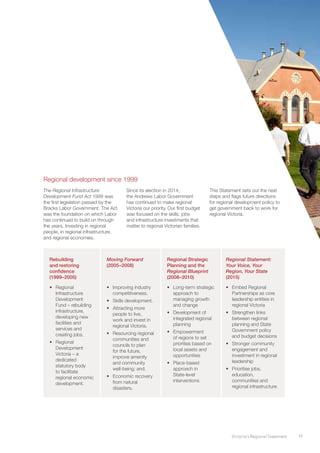
Regional development since 1999
The Regional Infrastructure
Development Fund Act 1999 was
the first legislation passed by the
Bracks Labor Government. The Act
was the foundation on which Labor
has continued to build on through
the years. Investing in regional
people, in regional infrastructure,
and regional economies.
Since its election in 2014,
the Andrews Labor Government
has continued to make regional
Victoria our priority. Our first budget
was focused on the skills, jobs
and infrastructure investments that
matter to regional Victorian families.
This Statement sets out the next
steps and flags future directions
for regional development policy to
get government back to work for
regional Victoria.
Rebuilding
and restoring
confidence
(1999–2005)
Moving Forward
(2005–2008)
Regional Strategic
Planning and the
Regional Blueprint
(2008–2010)
Regional Statement:
Your Voice, Your
Region, Your State
(2015)
•	 Regional
Infrastructure
Development
Fund – rebuilding
infrastructure,
developing new
facilities and
services and
creating jobs.
•	 Regional
Development
Victoria – a
dedicated
statutory body
to facilitate
regional economic
development.
•	 Improving industry
competitiveness.
•	 Skills development.
•	 Attracting more
people to live,
work and invest in
regional Victoria.
•	 Resourcing regional
communities and
councils to plan
for the future,
improve amenity
and community
well-being; and,
•	 Economic recovery
from natural
disasters.
•	 Long-term strategic
approach to
managing growth
and change
•	 Development of
integrated regional
planning
•	 Empowerment
of regions to set
priorities based on
local assets and
opportunities
•	 Place-based
approach in
State-level
interventions
•	 Embed Regional
Partnerships as core
leadership entities in
regional Victoria
•	 Strengthen links
between regional
planning and State
Government policy
and budget decisions
•	 Stronger community
engagement and
investment in regional
leadership
•	 Prioritise jobs,
education,
communities and
regional infrastructure
12	 Victoria’s Regional Statement
REGIONAL
PARTNERSHIPS
Victoria’s Regional Statement	 13
14	 Victoria’s Regional Statement
Adapting to change
through community
participation and
leadership is not
new to rural and
regional Victoria.
Many successful
projects have been
driven by local action.
A common ingredient to success is
a lot of hard work and commitment.
But the people involved have
said that, too often, their hard
work doesn’t pay off because
government isn’t really listening.
We want to change that.
We genuinely want to hear from
community about the aspirations
and goals they have for their regions.
We want people to feel enthusiastic
but also empowered to improve
their region. And we want people
to feel confident that the actions
they drive are delivering the results
they desire.
To make this happen, we are
changing the way the Victorian
Government works with the regions.
The case for change
Through consultation conducted
during the Regional Review, many
regional Victorians said they
didn’t see a clear pathway into
government decision-making
for the priorities and problems
they identified in their
Regional Strategic Plans.
The Review also noted that there
were some limitations in the
ability of the current governance
arrangements to deliver better
outcomes for regional communities.
This needs to change.
That’s why we have developed a
new approach that will enhance
regional leadership and give
regional communities more say and
build stronger connections with
government by:
•	 Connecting regional priorities
and regional investment
opportunities directly with the
Victorian Government’s
decision-making processes.
•	 Ensuring all ministerial portfolios
across government – from
education to transport, health,
justice and planning – are
addressing rural and regional
problems, with a strong focus
on creating jobs and tackling
disadvantage.
•	 Creating opportunities for local
communities and individuals to
have a greater say about the
issues of importance to them.
This is the model that regional
Victoria asked for through the
extensive consultation conducted
earlier this year as part of the
Regional Review.
Regional Partnerships:
bringing regional priorities
to the heart of government
The Regional Partnerships will bring
together representatives from local
business, education, social services
and community groups with the
three tiers of government.
The new Partnerships will build
on the work already done by
existing regional leadership groups,
including Regional Strategic Plans.
The work of the Regional
Partnerships will encompass all
these areas. Everyone will have
an opportunity to contribute.
REGIONAL PARTNERSHIPS
Each Regional Partnership will
communicate directly with a Rural
and Regional Ministerial Committee.
This means that priorities identified
by regional areas will have
a direct and clear pathway into
the resourcing decisions made
by departments and Ministers.
The Government will work with
communities to design new policies
and services. We will also share
more information so more groups
can contribute to problem-solving.
From 1 July 2016, Regional
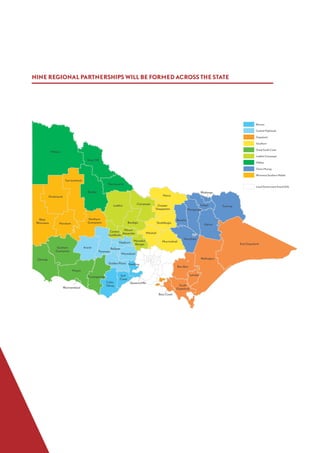
Partnerships will be formed in nine
regions in rural and regional Victoria.
Boundaries for the nine regions
better reflect the real communities-
of-interest that exist throughout
regional Victoria and will ensure that
decisions and plans made take into
account the aspirations and goals of
each community. The membership
of Regional Partnerships will reflect
this new vision.
These changes form part of a
broader shift in thinking across
government. The public sector
is no longer the sole, or even the
major provider of many services and
programs that deliver ‘public value’.
There is knowledge, expertise,
resources and experience held
across the public, private and
community sectors.
People from across these sectors
have many shared goals, and we
can maximise our effectiveness
if we all work together. Regional
Partnerships will apply this thinking.
It’s a fundamental shift.
Barwon
Central Highlands
Gippsland
Goulburn
Great South Coast
Loddon Campaspe
Mallee
Ovens Murray
Wimmera Southern Mallee
Local Government Area (LGA)
West
Wimmera Horsham
Hindmarsh
Yarriambiack
Northern
Grampians
Benalla
Indigo
Mansfield
Wodonga
Alpine
Towong
Wangaratta
Mildura
Buloke
Gannawarra
Swan Hill
Glenelg
Southern
Grampians
Warrnambool
Moyne
Corangamite
Greater
Shepparton
Mitchell
Strathbogie
Moira
Murrindindi
Baw Baw
South
Gippsland
Latrobe
Wellington
East Gippsland
Bass Coast
Ararat
Golden Plains
Hepburn
Moorabool
Ballarat
Pyrenees
Loddon
Macedon
Ranges
Campaspe
Mount
Alexander
Bendigo
Central
Goldfields
Colac
Otway
Surf
Coast
Queenscliffe
Geelong
NINE REGIONAL PARTNERSHIPS WILL BE FORMED ACROSS THE STATE
Victoria’s Regional Statement	 17
Everyone has a role to play
The Regional Partnerships will ask
communities about their biggest
issues and what matters most.
Every Victorian should have the
opportunity to have their voice
heard by government, and to
participate in decisions that
impact their lives. We want to
have a proper conversation with
communities – not just talking,
but listening.
They will use existing networks
and build new opportunities for
communities and individuals to
have a greater say.
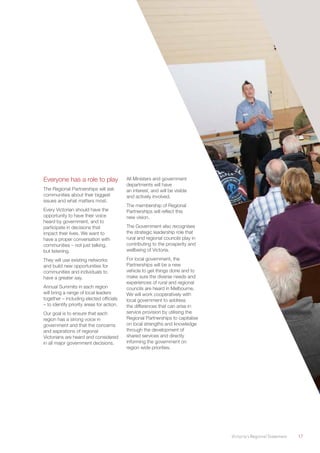
Annual Summits in each region
will bring a range of local leaders
together – including elected officials
– to identify priority areas for action.
Our goal is to ensure that each
region has a strong voice in
government and that the concerns
and aspirations of regional
Victorians are heard and considered
in all major government decisions.
All Ministers and government
departments will have
an interest, and will be visible
and actively involved.
The membership of Regional
Partnerships will reflect this
new vision.
The Government also recognises
the strategic leadership role that
rural and regional councils play in
contributing to the prosperity and
wellbeing of Victoria.
For local government, the
Partnerships will be a new
vehicle to get things done and to
make sure the diverse needs and
experiences of rural and regional
councils are heard in Melbourne.
We will work cooperatively with
local government to address
the differences that can arise in
service provision by utilising the
Regional Partnerships to capitalise
on local strengths and knowledge
through the development of
shared services and directly
informing the government on
region wide priorities.
18	 Victoria’s Regional Statement
Turning ideas into action
Interest from locals, a wide range
of stakeholders, an active and open
process, a channel to the heart of
government – all this only matters
if the results are realised. That’s
why the Regional Partnerships
will be open and accountable for
their work.
The Partnerships will build on
existing Regional Strategic Plans
and, each year, will agree actions
and outcomes to progress
economic and social priorities.
These will be available publicly and
the Partnerships will report on how
they are going. Transparency will be
a key factor for success.
What does this mean for
existing regional leadership
groups?
Partnerships will build on and
complement existing regional
leadership groups and will form
relationships with relevant groups
in each region in whatever way
works best.
Regional Partnerships will replace
Regional Management Forums as
the Victorian Government’s primary
means of organising in regional
Victoria. We thank members of
these forums for their participation
and enthusiasm over many years.
The Regional Development Australia
Committees which operate as
critical leadership groups and
provide a pathway for regional
Victoria into the Commonwealth
Government will work closely
with Regional Partnerships in
each region through co-ordinated
support from RDV.
Other regional leadership,
governance or service delivery
groups, such as Children
and Youth Area Partnerships,
will continue unchanged.
We recognise that a ‘one size fits
all’ approach often doesn’t work.
We will continue to work with
regional leaders before any changes
are bedded down to ensure the
plans and boundaries in each
region are the best fit for each
local community.
Expressions of Interest to be part of
the Partnerships will open in early
2016. Information sessions will be
held in the New Year, but for further
information, contact your local
RDV office.
WHAT’S NEXT
Through the new Regional
Partnerships, regional Victorians
will have:
•	 A simple and effective way to
influence the priorities of their
communities – getting the filters
and delays of bureaucracy out of
the way.
•	 A direct channel to identify new
opportunities and get them
in front of State Government
decision makers – giving life
to the region’s creative and
entrepreneurial thinkers.
•	 A better way to collaboratively
solve problems – no more
us and them, these are our
problems to solve.
•	 A greater influence on the
decisions that affect their lives.
In part this will be achieved by
bringing communities closer to
Victorian Government decision
makers, including the Premier
and Ministers, through the new
governance arrangements and
transparent consultation.
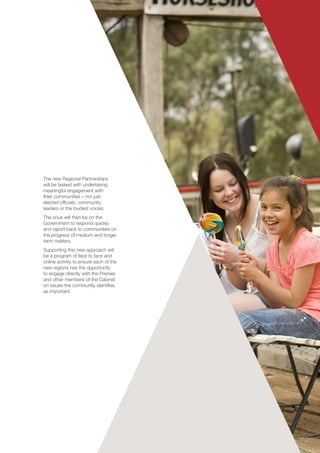
The new Regional Partnerships
will be tasked with undertaking
meaningful engagement with
their communities – not just
elected officials, community
leaders or the loudest voices.
The onus will then be on the
Government to respond quickly
and report back to communities on
the progress of medium and longer
term matters.
Supporting this new approach will
be a program of face to face and
online activity to ensure each of the
new regions has the opportunity
to engage directly with the Premier
and other members of the Cabinet
on issues the community identifies
as important.
20	 Victoria’s Regional Statement
GETTING
ON WITH IT IN
REGIONAL VICTORIA
Victoria’s Regional Statement	 21
22	 Victoria’s Regional Statement
Our regions are
an integral part of
Victoria’s culture and
economy – in many
ways, the most integral
part. That’s what this
Regional Statement is
all about.
The Andrews Labor Government is
committed to delivering the services
and infrastructure that regional
Victorians need to prosper.
Work is already underway on
hundreds of projects to address
these needs, and more are on
the way.
We want to be a government for
all Victorians. A government that
listens, responds and gets on with it.
This Statement for regional
Victoria outlines our priorities,
policies and projects funded so far.
The Statement also details our
vision for a new, more collaborative
approach to regional government.
Regional population growth is
a great vote of confidence in
the quality of life that regional
Victoria offers. Population growth,
if managed well, can bring
significant opportunities through
new skills and economic activity.
For these reasons, this plan reflects
our aim for strong regional growth,
but in a way that preserves and
strengthens the unique qualities
of our regional communities.
Equally it recognises the complex
and dynamic nature of the
unique challenges facing rural
and regional Victoria.
The independent Regional
Economic Development and
Services Review (‘the Regional
Review’) was developed with
extensive whole-of-government
input, and was the product of
significant stakeholder consultation
across business, community and
local government.
The Regional Review contains
61 recommendations to drive
regional economic growth,
including:
•	 Changes to the way government
works with regional Victorians
to determine and implement
regional priorities.
•	 Growing the food and fibre,
and tourism sectors, including
by attracting investment into
the visitor economy and adding
more value to primary products
and services.
•	 Improvements to the productivity
of the road and rail network
to benefit regional producers,
and better access to ICT in
regional areas.
•	 Expanding access to early
childhood education, and
stronger pathways from
school to work.
•	 Stronger, place-based
approaches to addressing
disadvantage.
This Regional Statement takes
into account the recommendations
of the Review and the views
of stakeholders. It also provides
an overview of the significant work
underway across government to
invest in services and policies for
the benefit of the regions.
GETTING ON WITH IT IN
REGIONAL VICTORIA
Victoria’s Regional Statement	 23
Since coming to office, we’ve
developed new plans and invested
in regional cities and communities.
We’re proud of that, but it can’t
end here.
Every Victorian deserves access to
high quality government services,
wherever they live and whatever
their personal circumstances.
And we want to work with regional
and rural businesses to create jobs
and drive growth.
The following section of the
Regional Statement details how
we are getting on with it.
Further information on these and
other government initiatives in
regional Victoria can be found at
www.regions.vic.gov.au
24	 Victoria’s Regional Statement
The regional Victorian
economy was worth
$66.9 billion in 2014
and is responsible
for about a third of
Victoria’s $36 billion
export trade. Over
650,000 regional
Victorians are
employed across
the State.
The Andrews Labor Government
wants to ensure our regions are
made up of strong communities.
For communities to thrive regional
Victorians need access to good
local jobs.
Victoria’s economy would be
nothing without our regions.
From food, fibre and wine to
tourism, innovation and renewable
energy, it’s where the traditional
and the new come together.
The way we work and the things
we produce in regional Victoria
are changing. Back in 2005,
manufacturing was the largest
employing industry in regional
Victoria. It is now fourth, behind
healthcare, agriculture and retail.
Government and local communities
need to work together to deliver
the projects and services that will
bring more jobs and families to
regional Victoria, so businesses
can maximise opportunities
and succeed.
Funding our future
The $500 million Regional
Jobs and Infrastructure Fund
(RJIF) is growing jobs, building
infrastructure and strengthening
communities throughout regional
Victoria. As a dedicated regional
development fund, RJIF addresses
key challenges and opportunities
to unlock regional Victoria’s
growth potential.
RJIF is complemented by other
statewide funds that focus on
jobs and growth:
•	 The $508 million Premier’s Jobs
and Investment Fund will drive
economic growth, create stable
jobs in Victoria and help foster
new, innovative businesses.
•	 The $200 million Future
Industries Fund will support the
six high-growth industries that
will define our economic future,
including food and fibre and new
energy technology.
•	 The $100 million Back to Work
Scheme will give businesses an
incentive to hire unemployed
youth and the long-term
unemployed. It’s a real plan to
reduce youth unemployment.
REGIONAL JOBS FOR
A GROWING ECONOMY
Victoria’s Regional Statement	 25
•	 The $200 million Agriculture
Infrastructure and Jobs Fund
will drive growth, create jobs
and boost exports from paddock
to port.1
We will work with the
Victorian Farmers’ Federation
and other regional stakeholders
as we design and roll out
the fund.
Sovereign Hill by day
and night
More than half a million people
visit Sovereign Hill each year.
Sovereign Hill contributes
more than $228 million of
economic activity each year to
Ballarat and Victoria, creating
and sustaining 1422 full-time,
casual and part-time jobs. The
Andrews Labor Government’s
$8 million commitment to
upgrade the Sovereign Hill by
day and by night will further
boost Sovereign Hill as a
driver of economic growth
and tourism. The project
will create a new sound and
light show night experience,
enhanced play space and
indigenous areas, a new
costume school and a 32-bed
accommodation facility.
1,2 The Agriculture Infrastructure and Jobs
Fund is subject to the successful passage of
the Delivering Victorian Infrastructure (Port of
Melbourne Lease Transaction) Bill 2015.
Agriculture
Agriculture and farming families,
firms and workers are at the heart
of rural and regional Victoria.
In 2014-15, Victoria’s food and
fibre exports reached a record
$12 billion. We want to ensure
Victorian exports continue to grow
and that regional businesses have
the best access to global markets,
particularly in the Asian region.
That’s why we have:
•	 Established the $20 million
Food Source Victoria program,
to help agri-food businesses
work together to grow exports,
create new jobs and promote
their unique products to
the world.
•	 Kicked off our program of
inbound trade missions to
regional Victoria connecting
global buyers with our
best regional producers.
Just recently, we hosted
visits by 150 international
buyers from Asia, Europe
and the Middle East to Victoria’s
21 wine regions, followed by
Food and Beverage Trade Week,
hosting over 240 international
buyers and investors,
to sample our world class
food and beverages.
•	 Supported our fruit growers
to export through the global
Now! In Season promotion –
a joint initiative with Austrade
and industry to promote our
citrus, table grapes, stone fruit,
apples and pears.
•	 Invested in the projects that
underpin farming jobs, such
as irrigated water, ICT and
safer rural roads and bridges.
Producers and councils will be
able to share in $200 million of
funding for these projects from
the Agriculture Infrastructure and
Jobs Fund.2
•	 Begun growing the next
generation of farmers, producers,
exporters and innovators
through the Upskill and Invest
Young Farmers Scholarship
program and the Young Farmers
Ministerial Advisory Council.
26	 Victoria’s Regional Statement
Tourism and events
Victoria has the best of everything.
Regional Victoria attracts over
13 million domestic and over
400,000 international visitors
each year and its tourism and
events industry already generates
110,000 jobs each year, but we
want to grow tourism across
regional Victoria by stimulating
new investment, improving the
visitor experience and helping
with marketing and product
development.
The new Brand Victoria will
showcase what our state has to
offer, selling our cultural diversity,
world-class events, natural
attractions and landscapes and
diverse regions to Australia and
the world.
Following the Visitor Economy
Review, we have created Visit
Victoria and tasked it with driving
tourism and events across the
State. Bringing together Tourism
Victoria and the Victorian Major
Events Company and a new
conventions division, the new entity
aims to grow regional Victoria’s
$11 billion visitor economy.
Visit Victoria will have a distinct
Regional Division, with its own
General Manager, designed to
work directly with Regional Tourism
Boards and operators to grow
tourism in Victoria’s regions.
The new entity will also be charged
with growing regional Victoria’s
enviable calendar of events.
It means a more resilient tourism
and events industry – and that
means a stronger State.
The Government will also invest
$3 million to embark on an
ambitious regional marketing
campaign, highlighting regional
Victoria’s treasures and showcasing
our regions.
A new Ministerial Advisory
Committee will work closely
with industry experts in fields
such as international education,
arts and culture, and sport to
develop an action plan to attract
tourism investment and visitors to
regional Victoria.
That’s why we are supporting
investment in appropriate nature-
based tourism that helps Victoria
to preserve and protect our natural
environment while enabling people
to visit and enjoy our wonderful
natural landscapes. We have also:
•	 Provided $19 million from the
RJIF to complete stages two
and three of the 145 kilometre
Grampians Peaks Trail, expected
to create 35 full-time jobs and
boost the local economy by
$6.4 million each year.
•	 Invested $25 million to revive
the Ballarat Station precinct to
revitalise Ballarat’s CBD into a
commercial and cultural hub.
The redevelopment includes
a proposed hotel and
convention centre.
•	 Provided $30 million for the next
stage of the Geelong Performing
Arts Centre.
•	 Enhanced marine infrastructure
with $13.5 million allocated for
the Portarlington Safe Harbour
Development.
•	 Committed $1 million to develop
the Harcourt Mountain Bike Park.
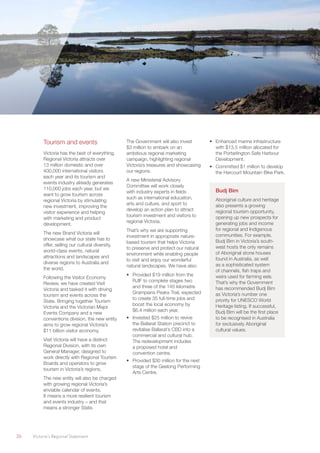
Budj Bim
Aboriginal culture and heritage
also presents a growing
regional tourism opportunity,
opening up new prospects for
generating jobs and income
for regional and Indigenous
communities. For example,
Budj Bim in Victoria’s south-
west hosts the only remains
of Aboriginal stone houses
found in Australia, as well
as a sophisticated system
of channels, fish traps and
weirs used for farming eels.
That’s why the Government
has recommended Budj Bim
as Victoria’s number one
priority for UNESCO World
Heritage listing. If successful,
Budj Bim will be the first place
to be recognised in Australia
for exclusively Aboriginal
cultural values.
Victoria’s Regional Statement	 27
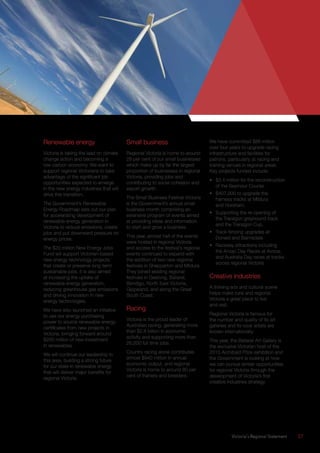
Renewable energy
Victoria is taking the lead on climate
change action and becoming a
low-carbon economy. We want to
support regional Victorians to take
advantage of the significant job
opportunities expected to emerge
in the new energy industries that will
drive this transition.
The Government’s Renewable
Energy Roadmap sets out our plan
for accelerating development of
renewable energy generation in
Victoria to reduce emissions, create
jobs and put downward pressure on
energy prices.
The $20 million New Energy Jobs
Fund will support Victorian-based
new energy technology projects
that create or preserve long-term
sustainable jobs. It is also aimed
at increasing the uptake of
renewable energy generation,
reducing greenhouse gas emissions
and driving innovation in new
energy technologies.
We have also launched an initiative
to use our energy purchasing
power to source renewable energy
certificates from new projects in
Victoria, bringing forward around
$200 million of new investment
in renewables.
We will continue our leadership in
this area, building a strong future
for our state in renewable energy
that will deliver major benefits for
regional Victoria.
Small business
Regional Victoria is home to around
28 per cent of our small businesses
which make up by far the largest
proportion of businesses in regional
Victoria, providing jobs and
contributing to social cohesion and
export growth.
The Small Business Festival Victoria
is the Government’s annual small
business month comprising an
extensive program of events aimed
at providing ideas and information
to start and grow a business.
This year, almost half of the events
were hosted in regional Victoria
and access to the festival’s regional
events continued to expand with
the addition of two new regional
festivals in Shepparton and Mildura.
They joined existing regional
festivals in Geelong, Ballarat,
Bendigo, North East Victoria,
Gippsland, and along the Great
South Coast.
Racing
Victoria is the proud leader of
Australian racing, generating more
than $2.8 billion in economic
activity and supporting more than
26,500 full time jobs.
Country racing alone contributes
almost $940 million in annual
economic output, and regional
Victoria is home to around 80 per
cent of trainers and breeders.
We have committed $86 million
over four years to upgrade racing
infrastructure and facilities for
patrons, particularly at racing and
training venues in regional areas.
Key projects funded include:
•	 $3.4 million for the reconstruction
of the Seymour Course.
•	 $407,000 to upgrade the
harness tracks at Mildura
and Horsham.
•	 Supporting the re-opening of
the Traralgon greyhound track
and the Traralgon Cup.
•	 Track fencing upgrades at
Donald and Bairnsdale.
•	 Raceday attractions including
the Anzac Day Races at Avoca,
and Australia Day races at tracks
across regional Victoria.
Creative industries
A thriving arts and cultural scene
helps make rural and regional
Victoria a great place to live
and visit.
Regional Victoria is famous for
the number and quality of its art
galleries and its local artists are
known internationally.
This year, the Ballarat Art Gallery is
the exclusive Victorian host of the
2015 Archibald Prize exhibition and
the Government is looking at how
we can pursue similar opportunities
for regional Victoria through the
development of Victoria’s first
creative industries strategy.
28	 Victoria’s Regional Statement
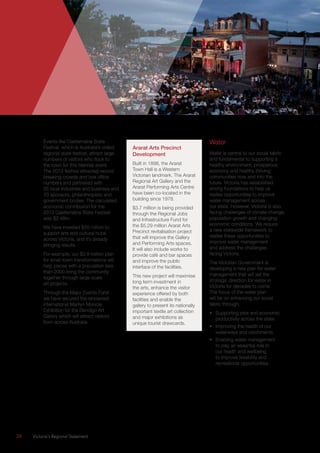
Events like Castlemaine State
Festival, which is Australia’s oldest
regional state festival, attract large
numbers of visitors who flock to
the town for this biennial event.
The 2013 festival attracted record
breaking crowds and box office
numbers and partnered with
35 local industries and business and
70 sponsors, philanthropists and
government bodies. The calculated
economic contribution for the
2013 Castlemaine State Festival
was $2.48m.
We have invested $20 million to
support arts and cultural hubs
across Victoria, and it’s already
bringing results.
For example, our $2.8 million plan
for small town transformations will
help places with a population less
than 2000 bring the community
together through large-scale
art projects.
Through the Major Events Fund
we have secured the renowned
international Marilyn Monroe
Exhibition for the Bendigo Art
Gallery which will attract visitors
from across Australia.
Ararat Arts Precinct
Development
Built in 1898, the Ararat
Town Hall is a Western
Victorian landmark. The Ararat
Regional Art Gallery and the
Ararat Performing Arts Centre
have been co-located in the
building since 1978.
$3.7 million is being provided
through the Regional Jobs
and Infrastructure Fund for
the $5.29 million Ararat Arts
Precinct revitalisation project
that will improve the Gallery
and Performing Arts spaces.
It will also include works to
provide café and bar spaces
and improve the public
interface of the facilities.
This new project will maximise
long term investment in
the arts, enhance the visitor
experience offered by both
facilities and enable the
gallery to present its nationally
important textile art collection
and major exhibitions as
unique tourist drawcards.
Water
Water is central to our social fabric
and fundamental to supporting a
healthy environment, prosperous
economy and healthy thriving
communities now and into the
future. Victoria has established
strong foundations to help us
realise opportunities to improve
water management across
our state. However, Victoria is also
facing challenges of climate change,
population growth and changing
economic conditions. We require
a new statewide framework to
realise these opportunities to
improve water management
and address the challenges
facing Victoria.
The Victorian Government is
developing a new plan for water
management that will set the
strategic direction for water in
Victoria for decades to come.
The focus of the water plan
will be on enhancing our social
fabric through:
•	 Supporting jobs and economic
productivity across the state.
•	 Improving the health of our
waterways and catchments.
•	 Enabling water management
to play an essential role in
our health and wellbeing
to improve liveability and
recreational opportunities.
Victoria’s Regional Statement	 29
•	 Supporting Aboriginal values.
•	 Preparing for drought, flood
and climate change.
•	 Realising the potential of
Victoria’s water grid and markets.
•	 Delivering safe, reliable
and affordable water and
sanitation services.
Our water plan will also build
on and improve the statewide
framework to realise these
opportunities to improve water
management and address the
challenges facing Victoria.
Better engagement with local
communities is fundamental to
improving water management
across Victoria and enhancing
our social fabric. The Andrews
Labor Government is committed
to engaging broadly with our
stakeholders and local communities.
We all know the incredible impact
of the Millennium drought. Our water
storages dropped to unimaginably
low levels and crops failed across
the state. Our sporting fields were
rock hard, gardens were brown
and our children playing under the
sprinkler was a forgotten image.
Our lakes emptied – not only
did it impact on our economy but
on the health and wellbeing of
our communities.
During this time, we saw
communities come together and
become innovative in terms of using
every drop of water wisely.
Since 1 January 2015, there has
been below average rainfall across
Victoria. The picture on just how
dry it is going to be is changing
quickly. Science tells us that
average temperatures will continue
to increase – there will be hotter and
dryer spells but also more intense,
extreme rain.
These conditions are already
affecting parts of our state. This will
be the second consecutive poor
season for most farmers in Victoria’s
north west. Some are facing their
third poor season.
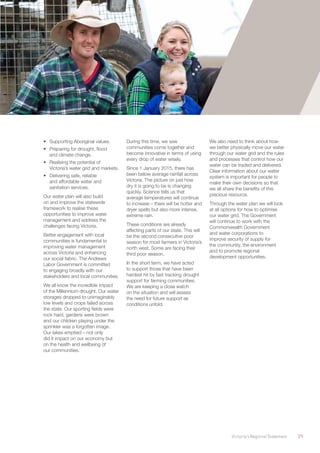
In the short term, we have acted
to support those that have been
hardest hit by fast tracking drought
support for farming communities.
We are keeping a close watch
on the situation and will assess
the need for future support as
conditions unfold.
We also need to think about how
we better physically move our water
through our water grid and the rules
and processes that control how our
water can be traded and delivered.
Clear information about our water
system is important for people to
make their own decisions so that
we all share the benefits of this
precious resource.
Through the water plan we will look
at all options for how to optimise
our water grid. The Government
will continue to work with the
Commonwealth Government
and water corporations to
improve security of supply for
the community, the environment
and to promote regional
development opportunities.
30	 Victoria’s Regional Statement
Planning
Victoria’s population is forecast
to grow by 2.2 million people to
7.7 million by 2031. But we know
that growth in regional areas will
be uneven.
Forty per cent of all regional
population growth over that
period is forecast to occur in the
regional cities of Greater Geelong,
Bendigo and Ballarat.
Some areas are forecast to suffer
significant population falls, including
in the shires of Buloke, Gannawarra,
Corangamite and the Southern
Grampians.
A stronger planning system will
help councils manage growth.
In particular, the Government
is committed to supporting the
more productive uses of regional
non-urban land through a planning
system that facilitates growth
of primary production and rural
industries. We’re therefore providing
direct guidance with planning
scheme amendments, with
planning officers located throughout
regional Victoria.
We’re also helping support
smaller rural councils to become
more sustainable and develop
the local economy, providing
$3.5 million for the Networked
Rural Councils program.
Geelong Authority
We established the Geelong
Authority to advise the
Minister for Planning on major
planning applications to
create jobs and growth and
ways to attract investment in
central Geelong.
It’s all about giving local
residents and leaders a real
voice in the future of their
city – cutting through the red
tape and bureaucracy to get
things done.
Vision 2 is a plan to renew
Geelong’s CBD, with a new
city square, major street
enhancements and a new
direction to attract investment,
jobs and growth.
But the plan has struggled to
get off paper. The Geelong
Authority will advise the
Minister on what council and
local businesses need to
make Vision 2 a reality.
WHAT’S NEXT
•	 We will invest up to $25 million
from the Agriculture
Infrastructure and Jobs
Fund3
 to identify opportunities
to support the competitiveness
of local agriculture, improve their
access to markets and attract
investment through better co-
ordination of planning for industry
development and by upgrading
‘first and last kilometre’ routes
across Victoria. We will work
with industry and local councils
to identify and prioritise
these opportunities.
•	 Back to Work Central Goldfields
and Back to Work Shepparton
will focus and co-ordinate efforts
to improve job prospects for
disadvantaged job seekers.
These trials will bring all tiers of
government together with local
employers and combine Back
to Work initiatives with other
employment, training and social
services to help people find and
keep good local jobs.
•	 An $80 million package to bring
more major events to regional
Victoria and Melbourne, along
with $11 million to upgrade
buildings, toilets, paths and
roads and build new facilities
in parks across the state.
3 The Agriculture Infrastructure and Jobs
Fund is subject to the successful passage of
the Delivering Victorian Infrastructure (Port of
Melbourne Lease Transaction) Bill 2015.
Victoria’s Regional Statement	 31
•	 We will develop a contestable
pipeline of the ten most
significant regional tourism
projects to fully realise the
economic potential of iconic
assets (e.g. Budj Bim, and
activating rail trains in the
North East).
•	 We will improve the way we
support rural and regional
businesses by transitioning our
Regional Development Victoria
(RDV) offices into Regional
Business Centres, beginning
with Bendigo, Ballarat, Geelong
and Traralgon. The Centres will
provide a one-stop-shop for
businesses looking to grow,
and will house new trade and
investment teams, economic
development specialists from
across State Government
departments, and will work
with local and Commonwealth
governments to access grant
programs and advice.
•	 We will work with Regional
Partnerships to identify
investment and infrastructure
opportunities and promote
regional Victoria as an
investment destination.
•	 We will continue to partner
with relevant agencies,
service providers and industry
associations to build export
capability in regional Victoria
through an Export Skills and
Training Program.
•	 We will finalise strategies for each
of the six high-growth sectors
under the $200 million Future
Industries Fund and ensure that
each supports the growth and
development of these sectors in
rural and regional Victoria.
•	 We will boost visitation and
expenditure in regional Victoria
by working more closely with
Regional Tourism Boards to
identify specific regional
tourism segments (such as
food and wine, cultural or
nature-based tourism) and
develop unique products, events,
branding and marketing.
•	 We will identify projects that are
of State or regional significance
where government consideration
of the need for intervention
(e.g. exercising Ministerial
‘call-in’ powers) may be able
to fast-track appropriate
developments that boost jobs
and local economies. We will
have criteria and processes in
place within six months.
•	 A Renewable Energy Action
Plan setting out a series of
initiatives to capture Victoria’s
share of the estimated
$14.7 billion in renewable
energy investment expected
in Australia by 2020, including
actions to support the uptake of
energy storage.
•	 A new Water Plan for Victoria,
to drive water efficiency and the
best use of our water resources.
•	 We will use our $200 million
Agriculture Infrastructure and
Jobs Fund to invest $20 million
into the next stage of the
Macalister Irrigation District
project as a co-investment with
Commonwealth Government
and industry.
•	 We will support more
productive use of non-urban
regional land by trialling new
systems to assist businesses
looking to expand through the
Agribusiness Development
Facilitation model.
•	 Establishing a new Animal
Industries Advisory
Committee to report on how
the planning system could
deliver clearer rules and
greater confidence for farmers
and councils around animal
husbandry, while balancing
environmental outcomes and
community expectations.
32	 Victoria’s Regional Statement
For regional
Victorians, reliable
public transport is
about connecting
communities to
sporting events, jobs,
regional centres
and education
opportunities.
We are improving safety for
regional Victorians by upgrading
the regional road and rail networks,
reducing travel times for freight and
making it easier for visitors to get to
regional Victoria.
Investing in road and rail
infrastructure is also about
creating jobs and building stronger
regional communities.
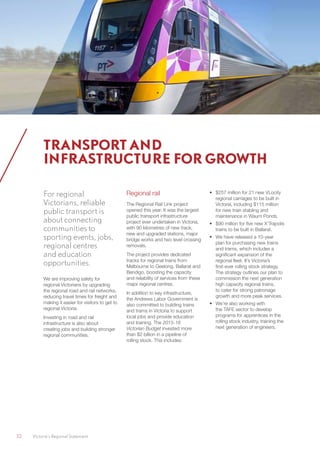
Regional rail
The Regional Rail Link project
opened this year. It was the largest
public transport infrastructure
project ever undertaken in Victoria,
with 90 kilometres of new track,
new and upgraded stations, major
bridge works and two level crossing
removals.
The project provides dedicated
tracks for regional trains from
Melbourne to Geelong, Ballarat and
Bendigo, boosting the capacity
and reliability of services from these
major regional centres.
In addition to key infrastructure,
the Andrews Labor Government is
also committed to building trains
and trams in Victoria to support
local jobs and provide education
and training. The 2015-16
Victorian Budget invested more
than $2 billion in a pipeline of
rolling stock. This includes:
•	 $257 million for 21 new VLocity
regional carriages to be built in
Victoria, including $115 million
for new train stabling and
maintenance in Waurn Ponds.
•	 $90 million for five new X’Trapolis
trains to be built in Ballarat.
•	 We have released a 10-year
plan for purchasing new trains
and trams, which includes a
significant expansion of the
regional fleet. It’s Victoria’s
first-ever rolling stock strategy.
The strategy outlines our plan to
commission the next generation
high capacity regional trains,
to cater for strong patronage
growth and more peak services.
•	 We’re also working with
the TAFE sector to develop
programs for apprentices in the
rolling stock industry, training the
next generation of engineers.
TRANSPORT AND
INFRASTRUCTURE FOR GROWTH
Victoria’s Regional Statement	 33
Regional Network
Development Plan
The Regional Network Development
Plan will move Victoria away from
ad hoc service improvements,
towards a more coordinated
regional public transport network
where train and bus services work
together to get people where they
need to go quicker and safer.
For the first time, regional
communities were consulted on
the specific public transport needs
of their region.
A Regional Transport Advisory
Group was established to
oversee an extensive community
consultation period held from
23 June until 11 September.
Community and stakeholder
workshops were held in regional
cities and towns across Gippsland,
Grampians, Hume, Loddon-Mallee
and Barwon-South West.
More than 1,400 community
members and stakeholders
attended workshops and over
15,000 pieces of feedback were
collected through the online survey
and online discussion tool.
During the consultation, a range
of issues and challenges that
passengers are experiencing on the
existing network as well as many
ideas for better outcomes and
solutions into the future were raised.
This information will be fed back into
a plan to address the short, medium
and long term regional infrastructure
needs of communities.
Regional buses
As part of the Government’s $100
million investment to improving bus
networks across Victoria, stronger
bus networks will be developed in
regional areas. We will work with
communities and councils to plan
new bus routes, fix the missing links
and add more services.
A new bus network has been
introduced in Geelong and the
Bellarine, providing better bus
connections to trains. We have
consulted with the local community,
bus operators and council on the
future Bendigo bus network. We
will develop future bus networks in
Ballarat and the Latrobe Valley.
Consultation with communities and
local councils will be central to bus
planning for the future.
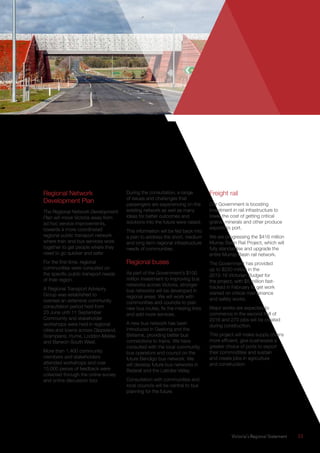
Freight rail
Our Government is boosting
investment in rail infrastructure to
lower the cost of getting critical
grains, minerals and other produce
exports to port.
We are progressing the $416 million
Murray Basin Rail Project, which will
fully standardise and upgrade the
entire Murray Basin rail network.
The Government has provided
up to $220 million in the
2015-16 Victorian Budget for
the project, with $5 million fast-
tracked in February to get work
started on critical maintenance
and safety works.
Major works are expected to
commence in the second half of
2016 and 270 jobs will be created
during construction.
This project will make supply chains
more efficient, give businesses a
greater choice of ports to export
their commodities and sustain
and create jobs in agriculture
and construction.
34	 Victoria’s Regional Statement
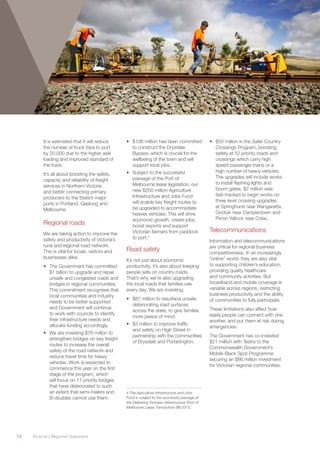
It is estimated that it will reduce
the number of truck trips to port
by 20,000 due to the higher axle
loading and improved standard of
the track.
It’s all about boosting the safety,
capacity and reliability of freight
services in Northern Victoria
and better connecting primary
producers to the State’s major
ports in Portland, Geelong and
Melbourne.
Regional roads
We are taking action to improve the
safety and productivity of Victoria’s
rural and regional road network.
This is vital for locals, visitors and
businesses alike.
•	 The Government has committed
$1 billion to upgrade and repair
unsafe and congested roads and
bridges in regional communities.
This commitment recognises that
local communities and industry
needs to be better supported
and Government will continue
to work with councils to identify
their infrastructure needs and
allocate funding accordingly.
•	 We are investing $76 million to
strengthen bridges on key freight
routes to increase the overall
safety of the road network and
reduce travel time for heavy
vehicles. Work is expected to
commence this year on the first
stage of the program, which
will focus on 17 priority bridges
that have deteriorated to such
an extent that semi-trailers and
B-doubles cannot use them.
•	 $106 million has been committed
to construct the Drysdale
Bypass, which is crucial for the
wellbeing of the town and will
support local jobs.
•	 Subject to the successful
passage of the Port of
Melbourne lease legislation, our
new $200 million Agriculture
Infrastructure and Jobs Fund
will enable key freight routes to
be upgraded to accommodate
heavier vehicles. This will drive
economic growth, create jobs,
boost exports and support
Victorian farmers from paddock
to port.4
Road safety
It’s not just about economic
productivity, it’s also about keeping
people safe on country roads.
That’s why we’re also upgrading
the local roads that families use
every day. We are investing:
•	 $87 million to resurface unsafe,
deteriorating road surfaces
across the state, to give families
more peace of mind.
•	 $3 million to improve traffic
and safety on High Street in
partnership with the communities
of Drysdale and Portarlington.
4 The Agriculture Infrastructure and Jobs
Fund is subject to the successful passage of
the Delivering Victorian Infrastructure (Port of
Melbourne Lease Transaction) Bill 2015.
•	 $50 million in the Safer Country
Crossings Program, boosting
safety at 52 priority roads and
crossings which carry high
speed passenger trains or a
high number of heavy vehicles.
The upgrades will include works
to install flashing lights and
boom gates. $2 million was
fast-tracked to begin works on
three level crossing upgrades:
at Springhurst near Wangaratta,
Gnotuk near Camperdown and
Pirron Yallock near Colac.
Telecommunications
Information and telecommunications
are critical for regional business
competitiveness. In an increasingly
“online” world, they are also vital
to supporting children’s education,
providing quality healthcare
and community activities. But
broadband and mobile coverage is
variable across regions, restricting
business productivity and the ability
of communities to fully participate.
These limitations also affect how
easily people can connect with one
another, and put them at risk during
emergencies.
The Government has co-invested
$21 million with Testra to the
Commonwealth Government’s
Mobile Black Spot Programme
securing an $86 million investment
for Victorian regional communities.
Victoria’s Regional Statement	 35
This will see 110 new mobile
towers built in regional Victoria
over the next three years, providing
approximately 12,000 households
and businesses with new access
to mobile services. The new
infrastructure is expected to
generate up to $120 million
per annum in productivity benefits
for regional Victoria, benefiting
residents, businesses and tourists
to these areas.
The Government worked closely
with the Emergency Management
Commissioner to ensure that
bushfire vulnerable areas
were addressed.
WHAT’S NEXT
•	 We will finalise a Regional
Network Development Plan
for regional Victoria by the end
of 2015. As part of this Plan,
we are:
•	 Improving long distance
rail services;
•	 Responding to regional
communities about their
specific public transport
needs; and
•	 Improving connections and
services to regional Victoria.
•	 We will deliver Bendigo
Metro Rail which will provide
a commuter train service to
support Bendigo’s growth and
improve access to the Bendigo
CBD, with an increased number
of services running from Epsom,
Eaglehawk, and Kangaroo Flat
to Bendigo.
•	 We will deliver better reception
for mobile devices along
Victoria’s busiest V/Line rail
routes through the $18 million
Regional Rail Connectivity
Project which will provide
government grants for mobile
telephone carriers to improve
their services along the following
routes: Geelong, Ballarat,
Bendigo, Seymour, Traralgon.
These rail routes carry over 13
million passenger trips annually,
and about 40 per cent of the rail
routes are affected by mobile
coverage black spots, disrupting
passengers phone and internet
services. This investment will
make it easier to commute to
and from regional Victoria, and
strengthen the visitor experience.
36	 Victoria’s Regional Statement
Every Victorian
has the right to the
knowledge and skills
to shape their lives,
regardless of their
background, personal
circumstances or
where they live.
There is abundant evidence that
higher educational attainment
significantly increases life
opportunities, employment choices
and lifetime income.
Moreover, regional Victoria’s
economy is changing rapidly. Global
forces are shaping the market for
jobs and the industries of the future.
Tertiary education and training will
increasingly play an integral role
in regional Victoria, generating
social and economic benefits
for individuals, communities and
local industries.
The public delivery of vocational
education and training through
TAFE is vital in supporting regional
communities, as is the improved
access for regional young people to
participate in higher education.
Access to a quality education
shouldn’t be determined by
geography but a recent Auditor-
General’s report found that rural
students are falling behind their
peers in Melbourne on academic
achievement, attendance and
school completion. Clearly,
we need to do better.
That’s why we are investing record
amounts into regional schools and
rescuing rural TAFE campuses,
because the Education State
extends to the banks of the Murray,
not the borders of Melbourne.
The 2015-16 Victorian Budget
delivered the single biggest injection
of funds in our education system
in Victoria’s history. It will transform
regional kinders, schools and TAFEs.
We also set ambitious targets
designed to lift school results
state-wide. But targets can only
be achieved if we have the best
resources available to all students.
Early childhood
Every child has the right to the best
start in life, with access to safe,
quality early childhood services and
support to learn, play and grow.
A good early childhood education is
the best possible start for our kids,
especially for families in rural and
regional areas.
Fears that the Commonwealth
Government may strip families
of their right to 15 hours of
kindergarten every week has only
made things worse.
We know that parents just want
certainty and confidence in
the system, and early childhood
services just want to get on
with their job. That’s why we
are providing:
•	 $50 million to build and upgrade
kindergartens and children’s
hubs across the state, allowing
them to grow and deliver better
and more convenient services
for families.
•	 New integrated children’s centres
in Highton and Bonshaw and
we’re upgrading nine early
learning facilities in Macedon
Ranges, Greater Bendigo
and Ballarat.
DELIVERING THE EDUCATION
STATE IN REGIONAL VICTORIA
Victoria’s Regional Statement	 37
•	 $83.7 million to support
kindergartens to transition to
new staff qualifications and
ratio requirements.
•	 $9 million for specialised,
tailored support for children with
disabilities or developmental
delays before they start school.
Everyone deserves the best start.
Schools
Every family has the right to access
great schools for their kids with
great teaching in every classroom.
Our kids deserve the best education
system in Australia. Under our plan,
every single student in every single
government school will be better off.
From the start of the 2016 school
year, schools around Victoria will
share in $747 million extra funding
over four years to support great
schools for every community and
great teachers in every classroom.
This funding includes $566 million
over four years that will be targeted
at individual students who need
it most.
This means that in 2016, rural and
regional schools will gain an average
of $456 per student as a result of
equity loadings – more than double
what their metropolitan peers are
receiving. This additional funding
will help our regional kids reach their
full potential.
In addition, we’re providing:
•	 Nearly $42 million on new
schools in rural and regional
locations and just over $120
million on modernisations and
upgrades at rural and regional
schools.
•	 $30 million to improve the
teaching of science, technology,
engineering and maths subjects,
which will include funding
for teachers from rural and
regional Victoria.
•	 We are also establishing 10
Tech Schools across Victoria,
including in Gippsland, Ballarat,
Bendigo and Geelong, at a cost
of $125 million. Tech Schools
will give secondary school
students a real start at a hands-
on education – not in place of
a comprehensive education,
but as a vital part of it.
•	 $13.7 million for Breakfast Clubs
to make sure no student misses
out on the most important
meal of the day. This will help
around 7,500 students in
rural and regional schools.
This is part of our package to
support struggling families with
the extra costs of schooling,
such as uniforms, textbooks
and eye glasses.
•	 Our $148 million Camps,
Sports and Excursions Fund will
help parents cover the costs of
these essential parts of a child’s
development and learning. It also
supports campgrounds and
tourism in regional areas.
Go Goldfields
We’re supporting Go
Goldfields, an alliance of
agencies working together to
support vulnerable kids in the
Central Goldfields Shire. It has
already produced real change,
including improved literacy
levels, decreased school
absenteeism and reduced
incidences of family violence.
It’s community initiatives like
this that the Government has
a role to support.
38	 Victoria’s Regional Statement
Skills and training
Every Victorian has the right to
access quality training to get the
skills they need for the job they
want in order to contribute fully
to the prosperity and future of
our State.
TAFE cuts closed down campuses
across our state. Other institutes
that managed to survive had to cut
staff and courses. This should never
have been allowed to happen.
TAFE campuses form the heart of
many regional communities. It’s
where local jobs and businesses
and ideas are born. Supporting
regional training is supporting
regional growth.
Moving to Melbourne shouldn’t be
your only option to study or train
and we know people who train in
the regions are more likely to stay
there. That’s why we want to make
our local TAFE campuses stronger.
•	 Our $320 million TAFE
Rescue Fund is already
flowing – reopening closed
campuses, upgrading buildings,
workshops and labs and helping
TAFEs get back on their feet.
Campuses like Bendigo Kangan
Institute, Federation Training,
SuniTAFE, GoTAFE, the Gordon,
South West TAFE, and
Wodonga TAFE have received
emergency funding.
•	 The Back To Work Scheme will
mean businesses that provide
training opportunities for eligible
employees will be able to receive
up to $4000.
•	 A further $15 million is being
invested in Skills and Jobs
Centres, which will feature at
regional TAFEs as a first point-
of-call for students who are
looking to start training, for those
workers needing to re-skill and
for unemployed workers needing
support for retraining and
job placement.
•	 A $2 million scholarship program
will encourage more students
to build their career on the
land, providing study grants to
ambitious professionals who
live in regional Victoria and
work in agri-food businesses.
Half these funds will be
dedicated to women.
Regional Higher
Education
The Andrews Labor
Government understands
the importance of the
higher education sector to
regional Victorians. Young
people need opportunities
to study close to where
they live and rely on thriving
regionally based university
campuses, and they need
the opportunities available
from strong pathways
between schools, TAFEs and
Universities. The Regional
Jobs and Infrastructure Fund
presents new opportunities
for regionally based university
campuses, supporting
investments that will deliver
improved education and
training outcomes.
Victoria’s Regional Statement	 39
WHAT’S NEXT
•	 A $70 million package to bolster
jobs and training. This recently
announced package includes
our $50 million TAFE Back to
Work Fund that will support
TAFEs to train local students
in the skills that local industries
and businesses need. This is a
real and targeted way to match
up workers and industries. The
Fund will enable TAFEs to better
engage with local businesses
to seek their input on course
design. A new $20 million
Reconnect Program will also help
address the drop in early school
leavers taking up training.
•	 We will develop a $34 million
Regional Skills and Training
package to support local
communities and in particular
disadvantaged groups and areas
to access relevant training that
leads to local jobs.
•	 We will work with professionals,
parents, caregivers, academics,
experts and the broader
Victorian community to develop
substantial reforms that
transform early childhood health,
development and learning. The
Education State Early Childhood
Consultation Paper, launched
earlier this year, has been
designed to start this discussion
on identifying reform directions,
looking at all parts of the early
childhood experience. This will
include consideration of how
we can better support children
in regional and rural areas to
access the early childhood
services they need.
40	 Victoria’s Regional Statement
No matter where we
live, whether it’s in the
city or in the regions,
we deserve to be able
to access high-quality,
timely health care.
The Andrews Labor Government
is investing significant resources
in improving health, ambulance
services and infrastructure in
regional Victoria.
Victorians have a right to feel proud
of the world-class doctors, nurses,
and paramedics working in our
health system. The Government is
committed to making sure that our
hospitals meet the needs of our
growing and ageing community –
that means the right care provided
locally and specialist care provided
at major hospitals. We recognise
there are difficulties that regional
communities face in accessing
health care and that this can have
an impact on health outcomes.
As an industry, healthcare
has boomed in recent years,
with 65 per cent of all jobs added
in regional Victoria in the past
10 years coming in the healthcare
and social services sector.
More than 98,000 regional
Victorians are employed in the
healthcare and social services
sector – 16 per cent of all regional
Victorian jobs. Healthcare now
accounts for 19 per cent of jobs
in Wangaratta and Hindmarsh and
18 per cent in Warrnambool.
Improving health in
the regions
The Government is providing an
extra $1.38 billion for our health
system for new buildings and vital
equipment, new health initiatives
and increased capacity. This will
save lives across our state.
We are investing $10 million in a
new cardiac catheterisation lab at
Ballarat Base Hospital, so locals
don’t have to drive to Melbourne
for urgent heart treatment.
We are also progressing planning
for the proposed redevelopment
of the Goulburn Valley Health
Shepparton campus, so it can
support the growing population.
Almost 35 per cent of the
$200 million Hospital Beds Rescue
Fund has been given to health
services in regional areas to open
beds and points of care right
across the state – that’s an extra
$19.1 million per year.
The Hospital Beds Rescue Fund will
see an additional 4600 patients in
regional Victoria treated every year.
New beds are already open across
rural Victoria at health service in
Ballarat, Mildura, Bass Coast,
Castlemaine, Djerriwarrh, Echuca,
Kilmore, West Gippsland and
Yarrawonga.
We have also provided $1.1 million
for dental capital in regional and
rural Victoria.
Our $4 million investment in the
National Centre for Farmer Health
is rebuilding the Centre to its
former strength after funding cuts
almost caused it to close, so it can
continue to improve quality of life
for Victorian farmers by providing
unique health assessments,
promotion and advice.
BETTER HEALTHCARE FOR
REGIONAL FAMILIES
Victoria’s Regional Statement	 41
We are also exploring ways to
secure a statewide tele-health
platform to help patients consult
with specialists, doctors and
nurses. For people in remote rural
communities, it’s all about bringing
the best standards of care closer
to home.
Some regional cities have smoking
rates far higher than the Victorian
average. Prevention is better than
a cure, and our smoking ban for
outdoor dining areas will protect
children from second-hand smoke
and take smokers further out of the
public eye.
Ambulance
We have a plan to end the
ambulance crisis. We are working
in partnership with paramedics
to improve response times,
reduce ambulance ramping and
improve transfer times for patients.
We immediately resolved the
ambulance dispute and have
invested an additional $99 million
to improve response times and
give our hardworking paramedics
the resources they need and the
support they deserve.
A $60 million Response Time
Rescue Fund is also on the way
– developed alongside paramedics
who know best – so families get
the emergency care they need,
when they need it.
The Ambulance Performance and
Policy Committee’s final report in
December will provide a clear way
forward about how the Response
Time Rescue Fund can reduce
ambulance response times so
that Victorians can receive the
emergency care they need sooner.
Part of this work will include
reviewing call-taking and dispatch
procedures at the Emergency
Services Telecommunications
Authority so that ambulances
can arrive sooner.
Regional Victorians deserve to
know about the state of emergency
services in their region. Under this
government, ambulance response
time data will be publicly released
every quarter.
Aboriginal health
Just over half of Aboriginal
Victorians live in regional and rural
areas. Partnering with Aboriginal
communities to improve health
equality is an essential part of
closing the gap.
•	 We are supporting 39 Local
Indigenous Networks across
Victoria to provide a space for
all local Aboriginal community
members to lead their
community.
•	 Through the Taskforce
1000 project, we are working
to improve the lives and
circumstances of the more
than 1000 Aboriginal children
and young people in
out-of-home care.
•	 We are also supporting the
operation of eight regional
Aboriginal health committees,
each involving regional hospitals,
mainstream services and
Aboriginal community-controlled
organisations. These committees
are helping to plan and deliver
$8.26 million in social and
health initiatives.
42	 Victoria’s Regional Statement
Mental health
Life is tough for many regional
families. Part of the problem is that
the mental health services that are
so readily available in Melbourne
aren’t as accessible in rural areas.
This must change.
•	 We are developing a 10 Year
Mental Health Plan. It will make
sure that mental health services
are there for individuals and their
carers, when and where they
need it.
•	 The new Mental Health and
Police Response Partnerships
in Ballarat, Goulburn Valley,
Gippsland, Wodonga and the
South West will deliver a more
targeted and timely response.
•	 Our $750,000 investment in
Men’s Sheds will reduce social
isolation and increase awareness
of anxiety and depression among
people that are less likely to seek
the help they need.
The NDIS
We’re proud to be rolling
out the National Disability
Insurance Scheme (NDIS)
in Victoria. Through the NDIS,
people with a disability will
get the support they need to
live full and active lives – go to
University or TAFE, get a
job and be active members
of their community.
•	 In Victoria the NDIS
is being trialled in the
Barwon area, with 4392
people with a disability
participating as at 30
June 2015. Of the 4392
participants, 1449 of those
people are receiving much
needed support for the
very first time.
•	 Regional Victorians will be
some of the first to benefit
from the full scheme, with
Central Highlands rolling
out from 1 January 2017
and Loddon region rolling
out from 1 May 2017.
•	 Our Government will be
providing $2.5 billion a
year to the scheme by the
time it is fully implemented
state-wide.
Children and young people
Young people in rural and regional
Victoria are at higher risk of being
socially isolated. We want to make
sure we hear their voices and that
our policies reflect their views.
That’s why we are setting up a
new youth reference group with
young people from different areas,
backgrounds and experiences
to help guide our new youth
policy framework.
We also invite young Victorians to
have their say online about issues
that are important to them through
www.youthcentral.vic.gov.au.
We have built great connections
with the school-based Advance
program, which encourages young
people to volunteer in their local
communities on projects or activities
of their choice. Around 40 per cent
of all participants in the program
come from rural communities.
Victoria’s innovative FReeZA
program continues to provide
drug- and alcohol-free events
throughout rural and regional
Victoria, and we are expanding
the reach of organisations such
as the Centre for Multicultural
Youth and YACVIC to connect
with multicultural young people
in regional Victoria.
Victoria’s Regional Statement	 43
We are providing an extra
$257 million to boost child
protection and family services.
A better start for vulnerable kids
is invaluable for them and for
our whole society, now and in
the future. Our plan includes:
•	 Up to 16 out-of-home care
properties will be renovated or
upgraded to ensure they provide
a safe environment for kids.
•	 13 child protection workers
to boost after hours services
across the state, including in
regional areas such as Goulburn,
Ovens Murray, Mallee and
East Gippsland.
•	 $48.1 million in Child FIRST
and Family Services, early
intervention services that work
with families before they reach
crisis point.
•	 $21.3 million to keep a helpful
eye on young people as they
move from residential out of
home care to independent living,
making sure they are getting
the training, support and
education they need.
WHAT’S NEXT
•	 The Victorian Public Health and
Wellbeing Plan 2015-19 sets
out the government’s priorities
and vision to improve the health
and wellbeing of Victorians,
particularly over the next four
years. This will include a focus
on better leveraging Victorian
Government investment
in preventative health and
advocate the Commonwealth
Government for ongoing funding
and collaboration on initiatives
aimed at preventing avoidable
chronic disease.
•	 We’re upgrading regional
ambulance stations in Sale,
Traralgon, Murchison, Orbost
and Echuca, and building a
new station in Wendouree,
so that paramedics have the
facilities they need to care for
regional patients.
44	 Victoria’s Regional Statement
People in regional
Victoria want the
same as everyone
else: the right to live a
comfortable life and
raise a family in peace
and safety, alongside
their friends and
neighbours.
The issues are the same, but the
solutions might be slightly different.
Often, they require more input and
advice from local communities,
councils and experts – because
locals know best.
Everyone should be able to feel
safe in their communities and in
their homes. That’s why we are
doing our best to support the men
and women who can keep us safe
– giving them the resources,
funding, information and equipment
they need to do their job.
Nurturing a strong and diverse
community is important, too: places
where locals look out for each other,
respect every family and faith, and
celebrate our differences.
Family violence
Unfortunately, family violence
disproportionately affects women
in rural and regional communities
more frequently than in Melbourne.
Between 2013-14, 1526 family
violence reports where made to
the police per 100,000 people in
regional Victoria compared with
1,007 reports per 100,000 people
in Melbourne.
Family violence is the number
one law and order issue in
Australia. It takes up a third of
police work, costs our economy
billions every year and clogs up
regional courtrooms.
Far more seriously, it also takes the
life of an Australian woman every
single week. In fact, it’s the number
one contributor to death, disability
and injury in Australian women
under the age of 45.
That’s why we have established
Australia’s first Royal Commission
into Family Violence. It is
investigating our broken system
from the ground up – and nothing
is off limits.
•	 To date, we have provided
over $80 million to tackle family
violence through the 2015-
16 Budget, which includes
investment in regional and rural
Victorian communities.
•	 Regional Integration Committees
are bringing together vital
services to improve the way we
respond to family violence and
promote community awareness
and education.
•	 We are providing $1 million
for crisis accommodation
and transport for women and
children and a further $1 million
to agencies that offer family
violence counselling services.
•	 We are expanding the number of
courts that provide specialised
family violence services, including
four additional specialised
services in regional courts.
•	 The 2015-16 Budget is providing
additional men’s behaviour
change programs targeting
offenders on community
corrections orders and in prisons
across the state.
•	 In regional Victoria, we have
allocated $200,000 to the Mallee
Sexual Assault Centre and
Domestic Violence Service to
boost counselling services and
housing assistance.
•	 We are also providing $650,000
to fund 33 targeted projects to
respond to family violence in
Victorian Aboriginal communities.
SAFER REGIONAL COMMUNITIES
Victoria’s Regional Statement	 45
Police and
emergency services
When communities are threatened
by fire and flood, regional Victorians
work as one. We want to honour
that effort with real support for
the men and women who work on
the frontline.
We are working hard to develop
stronger, more effective emergency
services across Victoria. It’s about
giving them the resources they need
to do their job. This includes:
•	 $50 million for planned burning
on public land.
•	 A $750 million, 10-year power
line bushfire safety program to
reduce risk.
•	 Recruiting additional Country Fire
Authority (CFA) firefighters over
the next four years.
•	 Rebuilding and upgrading a
number of regional firefighting
facilities including:
•	 Huntly CFA and Buninyong
fire stations.
•	 Upgrading fire towers in the
Grampians, Gippsland and
south-west Victoria.
•	 Purchasing 70 new CFA trucks,
at a cost of $33.5 million.
•	 Purchasing tray bodies for the
next instalment of 112 new
ultra-light G-Wagons, at a cost
of $8 million.
•	 $40.8 million to rebuild or
upgrade Government offices and
depots at Broadford, Beaufort,
Gellibrand, Mitta Mitta, Knoxfield
and Swifts Creek.
The previous Government let down
the people of the Latrobe Valley
in 2014, when the region was
engulfed in a mine fire. We can’t
let it happen again. That’s why we
are providing:
•	 $30 million to implement all of
the Recommendations and
Affirmations from the 2014
Hazelwood Mine Fire Inquiry.
•	 $5.5 million to create a new
CFA fire district in the Latrobe
Valley to better prepare for and
respond to fires.
•	 $3 million to establish a new
Morwell Emergency Services
Hub and with the latest
technology, and $2.5 million for
specialist mine fire training for
firefighters.
Police officers keep us safe –
but that’s not all they do. They’re a
reassuring presence in every town,
working with locals and businesses
to build a strong community that
looks out for each other. It’s the
Government’s duty to give country
cops the resources they need,
so they can focus on the job.
•	 We’re upgrading the unsafe
and unreliable police radio
system with a secure and
encrypted network. This will
keep regional police safer when
they’re on patrol.
•	 Fifteen new police officers will be
on duty in the Bellarine Peninsula
and Geelong area. We are also
supplying tasers at all regional
24-hour police stations.
•	 A $148.6 million investment in
400 police custody officers so
that sworn police officers across
Victoria can get back onto
the beat.
46	 Victoria’s Regional Statement
Tackling the ice crisis
Crystal methamphetamine or ice
is a dangerous and highly addictive
drug that has had a devastating
impact in parts of Victoria,
including some rural communities.
The Victorian Government’s
Ice Action Plan is a landmark
$45.5 million effort to reduce the
supply, demand and harm of this
illicit drug that is ruining people’s
lives, destroying families and
damaging communities. Under the
Plan, $18 million will be spent to
expand rehabilitation for ice users,
with a focus on regional Victoria.
We will ensure users get the
treatment they need and families
the support they need.
Along with statewide action,
we know that regional communities
are best positioned to engage local
resources to combat the use of
ice. That’s why we are providing
$500,000 to grassroots Community
Ice Action Groups in regional and
rural Victoria. This funding will
allow local community members to
come together for the first time to
develop local solutions in the fight
against ice.
These groups include:
•	 East Gippsland Ice Prevention
Working Group, based in Orbost.
•	 Rotary Club of Warrnambool
Daybreak Inc.
•	 Northern District Community
Health Service, based in Kerang.
•	 Rochester and Elmore District
Health Service.
•	 Macedon Ranges Local Safety
Committee, based in Gisborne.
•	 Rumbalara Aboriginal Cooperative,
based in Mooroopna.
•	 AFL Gippsland, based in Morwell.
•	 Connect Youth, based in Donald.
•	 Ballarat and District Aboriginal
Cooperative (BADAC).
•	 Bendigo Safe Community Forum.
•	 The Centre for Continuing
Education, based in Wangaratta.
•	 Leisure Networks Inc., based
in Geelong.
•	 Project Ice Mildura.
WHAT’S NEXT
•	 The government will
implement the Family
Violence Royal Commission’s
recommendations when its
report is completed next year.
Major reforms will take place so
that family violence is prevented
and Victorian women and
children are safe in their homes.
•	 $20 million will fund a fleet
of 47 firefighting aircraft
and give our firefighters the
critical resources they need
on the frontline this summer.
This includes two Large Air
Tankers (LATs), which are some
of the biggest firefighting aircraft
in the world and critical in
stopping the spread of bushfires.
•	 The deployment of Police
Custody Officers in early
2016, including at priority pilot
stations in Ballarat and Geelong.
Other stations where Custody
Officers will be deployed include
Bairnsdale, Bendigo, Horsham,
Mildura, Morwell, Shepparton,
Swan Hill, Wangaratta,
Warrnambool, Wodonga, and
Sale. Police in these regional
communities will be free to return
to the beat.
Victoria’s Regional Statement	 47
•	 Over the next three years,
Emergency Medical Response is
being implemented at integrated
CFA stations, meaning,
firefighters will be dispatched at
the same time as paramedics
to attend to cardiac arrests and
non-breathing patients. Specialist
training will be provided so
firefighters can provide basic
life support and give CPR.
Defibrillators will be installed on
fire trucks.
•	 We will adopt place-based
approaches to tackling
disadvantage, focusing attention
on areas and communities
in rural and regional Victoria
where it is most concentrated
and entrenched. The nine new
Regional Partnerships will have
a role in identifying the most
vulnerable communities and
advising the Government to
ensure our interventions are
targeted and making a difference
in the areas of highest need.
•	 We will provide additional
support to agencies in regional
Victoria so that they can deal
with increased demand from
family violence incidents. This
includes $52,000 grants for
Family Violence Duty Lawyers
at Gippsland Community Legal
Centre, Central Highlands
Community Legal Centre,
Goulburn Valley Community
Legal Centre, Loddon Campaspe
Community Legal Centre, and
the Murray Mallee Community
Legal Centre.
•	 We want to ensure regional
communities have the firefighting
services they need so we’re
recruiting new CFA firefighters,
deploying new trucks and
equipment, and building
new CFA stations in Huntly
and Buninyong.
48	 Victoria’s Regional Statement
Regional Victorian
communities rely
on a healthy natural
environment.
Victoria’s natural
capital underpins
almost every single
economic foundation
in rural areas and is
crucial to regional
prosperity and what
makes regional cities
and towns great
places to live and raise
a family.
A sustainable environment means
sustainable jobs. Our Government
is ready to support sustainable
enterprises such as nature-based
tourism, resource recovery /
recycling industries and clean and
innovative industries that have
a natural home in the regions,
such as new energy technology.
The $200 million Future Industries
Fund will support the six high-
growth industries that will define
our economic future, including new
energy technology.
Our State-wide Waste and
Resource Recovery Infrastructure
Plan will guide investment in
Victoria’s waste and resource
recovery sector, creating new jobs
and new markets for recovered
resources. This will ensure
the essential service of waste
management can continue to be
delivered safely and effectively as
our population grows, supporting
the quality of life in regional Victoria.
When it comes to protecting our
environment, local knowledge is
critical and Victoria’s rural and
regional councils form the backbone
of this effort.
These councils sometimes
struggle to work through planning
applications of great complexity
and volume, so we’re working
with councils to simplify the
process because we want to
get things done.
Environment and
climate change
Biodiversity contributes to essential
human needs such as clean air and
water and supports our agricultural,
tourism and natural resource
industries. Our projects include:
•	 $7 million for the Landcare
program, including $2 million
for the current round of
Victorian Landcare Grants.
New and existing Landcare
groups and networks across
the state are able to apply for
a grant to address their local
environmental priorities.
•	 A $5.2 million Threatened
Species Protection plan, taking
immediate action on threatened
species and habitat protection.
This includes $200,000 for an
innovative pilot to give community
groups a way to raise funds.
Their fundraising efforts will be
matched by Government up
to $25,000.
Victoria is taking the lead on
climate change. We’re helping
build a sustainable economy and
encouraging regional Victorians
to take advantage of the jobs that
come with it.
To help restore Victoria’s reputation
as a climate change leader,
we will complete an independent
review of the Climate Change Act
and Victoria’s Climate Change
Adaptation Plan.
We’re also working with regional
communities to help make our
cities and communities adaptable
to a changing climate, including
being prepared for extreme weather
events. We have also:
PROTECTING THE QUALITY
OF LIFE IN OUR REGIONS
Victoria’s Regional Statement	 49
•	 Provided $200,000 to Newstead
2021, a community group in
central Victoria, to develop a
master plan for transitioning
the town of Newstead to
100 per cent renewable energy.
•	 Provided $100,000 to
support the Macedon Ranges
Sustainability Group, which is
building a solar farm at the Black
Forest Timber Mill in Woodend.
Local councils: the
backbone of rural and
regional communities
Victoria’s 48 rural and regional
councils make a vital contribution
to the prosperity and wellbeing
of Victoria. In addition to being
responsible for managing the urban
growth of their cities and towns
they are social and economic
development hubs.
The Government recognises the
strategic leadership role that rural
and regional councils play and
through the Ministerial Statement
on Local Government has adopted
a strong reform agenda that will
improve governance, accountability
and capacity. These reforms are
centred on the major review of
the Local Government Act 1989
currently underway.
We will work cooperatively with
local government to address the
differences that can arise in service
provision by utilising the Regional
Partnerships to capitalise on local
strengths and knowledge through
the development of shared services
and directly informing the Cabinet
on region wide priorities.
This approach for example
underpins the Municipal Emergency
Resourcing Program currently
being reviewed and delivered
in partnership local councils.
The review will ensure the
program is effective in supporting
local government’s capacity to
manage emergencies.
Sport
Community sport is the heart and
soul of regional Victoria. We know
that healthy people make healthy
communities which is why we
encourage all Victorians to live
a healthy and active lifestyle.
We’re doing this through programs
to encourage greater participation in
sport and recreational activities such
as our Target One Million program
which is setting the ambitious target
of increasing recreational fishing
participation in Victoria to over one
million people by 2020, an increase
of 25 per cent. Target One Million
is already delivering great results
across Victoria, with the creation
of a bass fishery in Gippsland and
Australia’s only trout cod fishery
at Beechworth.
Investing in multi-purpose,
accessible community sporting
facilities creates opportunities
for people of all ages to get
involved and helps our regional
sporting clubs. We’re doing this
through initiatives such as:
•	 $10 million for women’s change
rooms and facilities.
•	 $10 million to upgrade local
cricket clubs.
•	 Providing 1000 defibrillators
to Victorian sporting clubs
and facilities.
We’re also investing in upgrades
of major regional sports stadiums
to ensure that regional people can
access top quality sport and the
best facilities. These include:
•	 $70 million to build a new
grandstand at Geelong’s
Simonds Stadium, improving
facilities and increasing the
ground’s capacity to 36,000.
•	 $31.5 million to upgrade
Ballarat’s Eureka Stadium and
sporting precinct and bring AFL
games to Ballarat.
•	 $5 million towards the upgrade
of Bendigo Stadium.
50	 Victoria’s Regional Statement
Aboriginal communities
The oldest continuous culture
in human history deserves our
recognition and support. That’s
what true and fundamental respect
for all Australians means.
At the same time, Aboriginal and
Torres Strait Islander peoples must
have the right to determine their
own future. No Government should
dictate the shape and structure of
their communities.
The Government is working with
Traditional Owner groups to develop
Settlement Agreements that
recognise the rights of Traditional
Owners. A comprehensive
agreement has been signed with the
Dja Dja Wurrung Clans Aboriginal
Corporation. Further agreements
are anticipated in the future.
Registered Aboriginal Parties are
the local voice of Aboriginal people
and play a vital part of Victoria’s
Aboriginal cultural preservation
and heritage.
We provided $20.9 million in the
2015-16 State Budget to give
Registered Aboriginal Parties
the support they need to make
important decisions about the
management and protection of
their cultural heritage.
There are currently RAP’s
representing around 60 per cent
of the state and the Government
is committed to working with
Indigenous communities and the
Victorian Aboriginal Heritage Council
to expand the coverage.
We are also supporting the
operation of eight regional
Aboriginal Health committees
each involving regional hospitals,
mainstream services and Aboriginal
community-controlled organisations.
These committees help steer local
planning and the implementation
of some $8.26 million in funded
initiatives that over the next two
years will identify and address the
needs and priorities for Aboriginal
people, families and communities
in regional areas, complementing
other statewide investments in
Aboriginal Health and wellbeing.
As a part of the Victorian Aboriginal
Justice Agreement, the Community
Initiatives Program provides
grants of up to $50,000 a year
to Koori Community groups to
design and implement projects
that support research into
reoffending and promote social
and healthy activities.
Under the Frontline Youth Initiatives
Program, grants of up to $110,000
a year, over a maximum of three
years, are available for programs
focussing on working with at-risk
Koori youth from ages 10 to 24.
Multicultural communities
Victoria is home to one of the
most successful and diverse
multicultural societies in the world.
We will always be at our best when
we not only value our cultures,
but embrace them, because that’s
who we are.
The Refugee Action Program builds
the capacity of refugee and asylum
seeker communities to respond
to priority settlement issues, and
also supports service access
through the provision of rights
and responsibilities information.
The Action Program is delivered
in the operating in regional areas
including Mildura, Greater Bendigo,
Moira, Greater Shepparton,
Geelong and Colac.
Through the Peak Multicultural
Organisations Grants Program we
are providing funding across Victoria
with a particular focus on Regional
Ethnic Communities’ Councils.
The program assists local groups
to help newly arrived refugees
settle into our communities across
the state.
The Government is also supporting
regional cities to promote social
cohesion with $40,000 to
bring families and communities
together in the City of Greater
Bendigo and $30,000 towards the
development of intercultural and
interfaith connections in the City
of Greater Shepparton.
Equality
The Government affirms the right
to equality, fairness and decency
for lesbian, gay, bisexual, trans
and gender diverse, and intersex
(LGBTI) Victorians and is committed
to removing discrimination from
Victorian laws, services and society.
Victoria’s Regional Statement	 51
We recognise that research
consistently indicates that LGBTI
people living in rural and regional
Victoria are exposed to higher
levels of homophobia than those
in metropolitan areas. In addition,
LGBTI people in rural areas can also
be more isolated, with fewer social
and support networks and greater
difficulty in accessing services.
An LGBTI Taskforce has been
established to work closely with
Rowena Allen, Victoria’s first
Commissioner for Gender and
Sexuality, to develop a work
plan and provide advice to the
Minister for Equality to ensure
that the Government’s equality
initiatives are driven by genuine
community consultation.
Commissioner Allen has a long
history of advocacy for regional
LGBTI Victorians and the Taskforce
is supported by a Health and
Human Services Working Group
and a Justice Working Group
both of which are co-chaired by
a regional Member of Parliament.
The Government’s priorities
include creating safe and supportive
classrooms for same-sex attracted
and gender diverse students
and promoting acceptance of
diversity, eliminating stigma and
discrimination, and improving
mental health, including tackling
suicide in young LGBTI people.
Women
Under the Andrews Labor
Government, no less than
50 per cent of all future
appointments to paid Government
boards and Victorian courts
will be women. Ministers will
be responsible for ensuring all
appointments meet the new
requirements, which apply to
all paid government boards
and the Supreme, County and
Magistrates’ courts.
This commitment is already
providing women in regional
areas with greater opportunities
to shape local decision making,
create a deeper pool of talent on
boards, and train more people
from a broader range of experience
to become community leaders.
Veterans
The Government will give
regional veterans and their
families the support, respect and
commemoration they deserve.
Events to mark the 50th anniversary
of Long Tan will include parades,
a touring quilt exhibition, Vetride,
regional grave vigils, a State
Reception, and a $250,000 grant
to the Vietnam Veterans Museum
at Phillip Island so that the venue
can protect the memories that are
forever etched in our national story.
Through Younger Eyes – The Impact
of WWI on Geelong initiative
received a $30,000 grant, just one
of many initiatives funded through
the $175,000 Anzac Centenary
Major Grants Program. In addition,
23 communities across Victoria will
share in nearly $250,000 provided
by the Government’s Restoring
Community War Memorials and
Avenues of Honour grants program.
We’ve also committed $400,000
to support RSL sub-branches
implement veterans’ welfare
projects, so veterans can live their
lives after service with the dignity
they deserve.
WHAT’S NEXT
We will use Council Strategic
Resource Plans to improve
State and local government
investments and outcomes for
local communities. This is especially
critical in regional cities where we
can co-locate related services and
make assets work to full capacity.
With this approach we will improve
outcomes, protect liveability and
stimulate local economies in
regional Victoria.
52	 Victoria’s Regional Statement
REGIONS
Victoria’s Regional Statement	 53
$12.1B
GROSS REGIONAL
PRODUCT (2014)
45%of population over
15 years have
completed year 12
276,935
POPULATION
$6Billion
value of imports and
exports handled by the
port of geelong annually
LOCAL GOVERNMENT AREAS
Colac-Otway Shire
Surf Coast Shire
Borough of Queenscliffe
Greater Geelong City
54	 Victoria’s Regional Statement
The Barwon region is home to
Victoria’s second largest city,
Geelong, and includes unique
landscapes such as the Great
Ocean Road, the Otway forests,
marine protected areas and rich
inland agricultural districts.
Collaboration between the education and health sectors
is demonstrated by Epworth HealthCare and Deakin
University working in partnership to deliver Epworth
Geelong: a state-of-the-art acute and rehabilitation
private hospital for the region that will integrate
healthcare with teaching and research. The region
has a diverse economy, supported by interstate road
and rail links Avalon Airport and the Port of Geelong.
Geelong has a strong advanced manufacturing and
processing sector with competitive strengths in
biotechnology, ICT and carbon fibre.
NEXT STEPS IN BARWON
With a population of over a quarter of a million people
and growing, the Barwon region has identified priorities
to address a number of environmental, demographic,
social and economic challenges.
The Government will work with the region to meet these
challenges and achieve its objectives, including:
•	 Tackling disadvantage in Corio and Norlane,
two of the most disadvantaged postcodes in Victoria;
•	 Refocusing the economy to accommodate growth
through employment opportunities like the 150 new
jobs at the DisabilityCare national headquarters and
structural adjustment impacts in the region from
closures such as the Point Henry smelter and the
Ford manufacturing plant; and
•	 Supporting the important role advanced
manufacturing will play in the local economy
through cutting edge projects such as ManuFuture.
BARWON
Victoria’s Regional Statement	 55
Colac
Otway
Surf
Coast
Queenscliffe
Geelong
The Government has
allocated funds for 21 new
VLocity carriages to carry
more passengers on the
V/Line network. There
is also $115 million for
new train stabling and
maintenance in Waurn
Ponds, which will create
30 ongoing jobs once
completed.
A $7.8 million investment will
provide for more police to be
stationed in the growing areas of
Bellarine and Geelong, and for
longer opening hours at Drysdale,
Portarlington and Queenscliff.
The Wathaurung Aboriginal
Corporation is the Registered
Aboriginal Party within the
Barwon Region, supporting
Victoria’s Aboriginal cultural
preservation and heritage.
The Government is partnering with
schools and The Gordon Institute of TAFE
to improve education, employment and
skills outcomes through Skilling the Bay
initiatives.
G21 Region Opportunities for Work (GROW)
is a plan to support people in the G21 region to
find work. GROW links the region’s procurers
and suppliers with employment and training to
support jobseekers.
To give secondary students a head
start on a hands-on vocation, the
Government is establishing a new
tech school in Geelong.
The Government is investing
$3 million to refurbish and
enhance the facilities of Moriac
Primary School.
The Government is supporting
initiatives such as the $7.5 million
expansion to the Geelong Regional
Innovation and Investment Fund and
the establishment of the $5 million
Defence Procurement Office.
The $13.5 million
Portarlington Safe
Harbour project will see the
development of a precinct
for boating, recreation and
aquaculture.
Funding has been provided to increase the profile of the
2015–2018 Men’s and Women’s Victorian Open Golf
Championship by increasing the prize money, gaining LGPA
sanctioning and attracting international players.
As part of the Queenscliff
Sport and Recreation
Precinct Development,
$3.15 million will go to
completing stage 2 of the
Monahan Centre, including
the community gymnasium,
spa and sauna.
The Anglesea Heath adjoins the
Great Otway National Park and
contains about a quarter of Victoria’s
plant species and many nationally
threatened and endangered species.
The Government will incorporate
the Anglesea Heath into the Great
Otway National Park.
The $50 million Safer Country
Crossing Program is boosting safety
at 52 priority roads and level crossings
including Phalps Road at Pirron Yallock
near Colac.
REGIONAL PROJECTS
For other local projects please visit regions.vic.gov.au/barwon
56	 Victoria’s Regional Statement
The Central Highlands is home
to more than 180, 000 people.
The region is located on the east-west transport
corridor connecting Melbourne, western Victoria
and Adelaide. The region’s key strengths include its
attractive rural landscapes, rich heritage in Aboriginal
culture and goldmining history, and environmental
features. The region’s major centre, Ballarat, is the
fastest growing regional city in Victoria by population.
NEXT STEPS IN CENTRAL HIGHLANDS
Central Highlands is seeking to build on strategic
advantages such as proximity to Melbourne and high
population growth in peri-urban areas like Bacchus
Marsh, the diversity of its economy (including
strengths in food processing, information technology,
research and education), a rich agricultural base,
outstanding natural and cultural tourism assets,
and the quality of the region’s transport connections.
To support Central Highlands to achieve these
objectives, the Government will work with the region
to address a number of challenges it has identified,
including:
•	 Capturing opportunities in intensive animal
and horticultural industries, the region has
untapped potential with some of Victoria’s most
productive soils;
•	 Addressing health challenges for a growing
population. A master plan for the Ballarat Health
Precinct will seek to encourage research,
employment, investment and collaboration
between Ballarat hospitals, education providers,
medical service providers and related industries; and
•	 Towns and communities around Ballarat and along
the Melbourne to Ballarat corridor, as well as towns
in the Grampians National Park are exposed to the
increased risk of bushfires.
CENTRAL HIGHLANDS
$7.0B
GROSS REGIONAL
PRODUCT (2014)
184,804
POPULATION
20%
of jobs are
in Accommodation,
Food Service & Retail
94%of Children fully
immunised at
24-27 months
LOCAL GOVERNMENT AREAS
Ararat Rural City
Ballarat City
Golden Plains Shire
Hepburn Shire
Moorabool Shire
Pyrenees Shire
REGIONAL PROJECTS
For other local projects please visit regions.vic.gov.au/centralhighlands
Ararat
Golden Plains
Hepburn
Moorabool
Ballarat
Pyrenees
The Ballarat West Employment Zone has reached a
significant milestone, securing Broadbent Grain as an
anchor tenant. The construction of Broadbent Grain’s
$24 million export grain-handling and storage facility is a
major step in the development of the employment zone.
The Government is providing $5 million to
redevelop Beaufort Secondary College
and upgrade its facilities for students.
The Wurundjeri Tribe Land and Compensation Cultural
Heritage Counil Inc, the Dja Dja Wurung Clans Aboriginal
Corporation, the Wathaurung Aboriginal Corporation
and Martang Pty Ltd are the Registered Aboriginal Parties
within the Central Highlands Region, supporting Victoria’s
Aboriginal cultural preservation and heritage.
$90 million will be spent on five new
X’Trapolis trains to be built in Ballarat.
This is strengthening the region’s
manufacturing industries and creating
jobs for regional Victorians.
The Government is turning Eureka
Stadium into a world class venue.
With more seating, improved lighting and
scoreboard, the new stadium will soon
host AFL Premiership matches.
$8 million upgrades at Sovereign Hill will
include a new sound and light show at the
outdoor museum, a costume school, a 32-bed
accommodation facility, a new ‘voyage to discovery’
exhibit and other new museum exhibits.
Community groups are renewing their towns through initiatives such as
the Clunes Booktown Festival. Held in the historic goldmining town
of Clunes, the festival promotes the town, attracts visitors, contributes
to the economy and strengthens community spirit. The Government
has supported a delegation travelling to South Korea to develop future
partnerships and exchange projects.
The Government is investing
$43 million in school
facilities for the Central
Highlands. This includes
$5 million for the Bacchus
Marsh Secondary College
to construct a Year 9 centre.
The Victorian Government is investing $5 million to
expand the planned new Bannockburn P-6 project to
become a P-12 school. This funding will go towards
the first stage of this project, to provide facilities for
use in the early years of secondary school.
As part of the
Government’s
Stronger Country
Bridges program,
$1.75 million will be
used to replace the
Mortlake Ararat Road
Bridge. The new
bridge will be able to
support heavier loads
and trucks, increasing
productivity,
improving safety and
helping to reduce
supply chain costs.
Victoria’s Regional Statement	 57
$14.3B
GROSS REGIONAL
PRODUCT (2014)
38,662
recipients of the
aged pension
265,150
POPULATION
17%
of jobs are
in Accommodation,
Food Service & Retail
LOCAL GOVERNMENT AREAS
Bass Coast Shire
Baw Baw Shire
East Gippsland Shire
Latrobe City
South Gippsland Shire
Wellington Shire
58	 Victoria’s Regional Statement
From beaches to snowfields and
rainforests to alpine mountain
landscapes, Gippsland has plenty
to offer locals and visitors alike.
Gippsland’s growth has traditionally derived from its
strengths in natural resources, energy, agriculture
and forestry, manufacturing and tourism. The region
produces around 90 per cent of Victoria’s electricity,
97 per cent of Victoria’s natural gas and 14 per cent
of Australia’s oil. The region is experiencing economic
and demographic changes which will present both
opportunities and challenge.
NEXT STEPS IN GIPPSLAND
Gippsland is working to strengthen its resilience by
developing a more diverse economy, supported by
investment through better connections with global
and national markets, innovation and improving on
traditional strengths. Gippsland is looking to identify
opportunities for environmental protection and
enhancement that will improve liveability and provide
opportunities for nature based tourism. Gippsland aims
to accommodate growth by delivering infrastructure
to meet community needs.
To support Gippsland in achieving its objectives,
the Government will work with the region to address
a number of challenges it has identified, including:
•	 Improving social and economic opportunities while
tackling high localised levels of unemployment
- for example, Morwell has 12 per cent unemployment;
•	 Improving health in the Latrobe Valley, through
place-based initiatives under the Victorian Public
Health and Wellbeing Plan; and
•	 Identifying opportunities for environmental protection
and enhancement that will support new and improve
existing nature based tourism opportunities in
the region - from further development at Phillip Island
Nature Parks, to better linking of natural assets at
Wilsons Promontory and the Gippsland Lakes.
GIPPSLAND
Victoria’s Regional Statement	 59
Baw Baw
South
Gippsland
Latrobe
Wellington
East Gippsland
Bass Coast
REGIONAL PROJECTS
For other local projects please visit regions.vic.gov.au/gippsland
The Government is establishing
a new tech school in Morwell to
build entrepreneurial, innovation
and problem solving skills into
curriculum development and to
align skills with industry.
The Government is investing $3 million to build a new Morwell
Emergency Services Hub for better fire and ambulance services.
The Broadening Horizons initiative
partners Gippsland secondary schools with
major regional employers to strengthen
links between school, workplace and
educational attainment.
The Government
is helping to
refurbish Fish Creek
Kindergarten to
better accommodate
the improved
educator-to-child
ratios from 1 January
2016 and to ensure
Victorian children get
more value out of
the time they spend
at kindergarten.
The Gunaikurnai Land and Waters Aboriginal Corporation is the
Registered Aboriginal Party within the Gippsland Region, supporting
Victoria’s Aboriginal cultural preservation and heritage.
West Gippsland Health Care will be one of a number of
services across regional Victoria that will benefit from the
$200 million Hospital Beds Rescue Fund, providing
new hospital beds and points of care. The fund will help
hospitals increase capacity, treat more patients sooner,
reduce elective surgery waits and waiting times in
emergency departments.
The Government is providing $7.6 million
to rebuild the Sale Specialist School.
The Government is providing
$2.5 million to Federation
Training to establish an
innovative student support
and advice centre, and keep
vital courses open to meet
community needs.
The Victorian Government has invested
$16 million in the Macalister Irrigation
District project. The Government will
use the Agriculture Infrastructure and
Jobs Fund to invest $20 million into the
next stage of the project.
The Victorian Government is committing
$1 million towards the new Latrobe
Valley University Training Clinic and
Dental Prosthetics Laboratory.
Bass Coast Regional Health will be one
of a number of services across regional
Victoria that will benefit from the $200
million Hospital Beds Rescue Fund,
providing new hospital beds and points of
care. The fund will help hospitals increase
capacity, treat more patients sooner,
reduce elective surgery waits and waiting
times in emergency departments.
The Government has invested
$2.5 million in 2015-16 and
is improving the management
structure of the Gippsland
Lakes Coordinating
Committee to deliver an
integrated program of practical,
on-ground environmental works
and community engagement to
protect and improve the health
of the Gippsland Lakes.
60	 Victoria’s Regional Statement
The Goulburn region extends from
Melbourne’s northern growth
corridor to the Murray River in
the north. The Goulburn Valley is
sometimes described as the ‘food
bowl of Australia’.
Shepparton is the largest regional city and is a major
service centre for central northern Victoria, offering a
range of higher education options and extensive health
services. With water resources, fertile soils, a mild
climate, substantial native riverine woodlands and a
central geographic location, the food and fibre sector
underpins Goulburn’s region economy. The Shires of
Murrindindi and Mitchell are located on the cusp of
a growing Melbourne, perfect places for a weekend
getaway or to settle down.
NEXT STEPS IN GOULBURN
The Goulburn region is seeking to capitalise on
its significant food industry capability. The GMW
Connections project, Australia’s largest irrigation
modernisation project, is a high priority of the region.
Other priorities include protecting prime agricultural
land and maintaining healthy communities and a
thriving and dynamic economy.
To support the Goulburn region in achieving its growth
objectives, the Government will work with the region to
address a number of challenges, including:
•	 Continuing to support the region (particularly the
Murrindindi Shire) to recover from the significant
economic, social and environmental damage from
the 2009 Black Saturday bushfires;
•	 Managing structural adjustment impacts arising from
industry changes, international competition, slowing
economic growth and environmental change; and
•	 Improving education and employment outcomes for
Aboriginal people in the Greater Shepparton area.
GOULBURN
$6.1B
GROSS REGIONAL
PRODUCT (2014)
154,022
POPULATION
11%
of jobs are
in Agriculture,
Forestry and Fishing
12%born overseas
LOCAL GOVERNMENT AREAS
Mitchell Shire
Moira Shire
Murrindindi Shire
Strathbogie Shire
Greater Shepparton City
Greater
Shepparton
Mitchell
Strathbogie
Moira
Murrindindi
The Government is supporting
the management of fruit fly
through the implementation of
the State and Regional Fruit
Fly Action Plans to improve
horticulture production and
optimise trade opportunities.
Regional Action Plans are
being developed in key
horticultural production areas
including the Goulburn Valley.
The Victorian Government
provides $280,000 each year
to Greater Shepparton City
Council to support arts and
cultural facilities, including
support for the Shepparton
Art Museum to connect with
the local Aboriginal community
and provide a resident
with professional curatorial
programming skills.
The Yorta Yorta Nation
Aboriginal Corporation
and the Taungurung Clans
Aboriginal Corporation are
the Registered Aboriginal
Parties within the Goulburn
Region, supporting Victoria’s
Aboriginal cultural
preservation and heritage.
Yarrawonga District Health Service will be one of a number
of services across regional Victoria that will benefit from the
$200 million Hospital Beds Rescue Fund, providing new
hospital beds and points of care. The fund will help hospitals
increase capacity, treat more patients sooner, reduce elective
surgery waits and waiting times in emergency departments.
Communities are recovering from the
2009 Black Saturday bushfires through
long-term economic recovery projects
such as the $28 million Vibe Hotel and
Conference Centre, a bipartisan project
in Marysville.
The Government has
committed $1.5 million
to redevelop Wallan
town centre.
The Eurora Saleyards are being
redeveloped through a $500,000
contribution from the Government.
$5 million has been
allocated to complete
the Stage 4 upgrade
of the Wallan
Secondary College.
REGIONAL PROJECTS
For other local projects please visit regions.vic.gov.au/goulburn
Victoria’s Regional Statement	 61
Great South Coast
$5.2B
GROSS REGIONAL
PRODUCT (2014)
101,117
POPULATION
25%
of Australia’s milk
is produced in the
Warrnambool region
LOCAL GOVERNMENT AREAS
31%volunteer
Corangamite Shire
Glenelg Shire
Southern Grampians Shire
Moyne Shire
Warrnambool City
62	 Victoria’s Regional Statement
GREAT SOUTH COAST
Extending from the Shipwreck
Coast to the South Australian
border, the Great South
Coast is largely a rural region
with a population of about
100,000. Warrnambool is
the region’s largest centre with
around 33,000 people.
The Great South Coast is home to internationally
recognised areas of Indigenous significance, including
Budj Bim, Tower Hill and Moyjil at Point Ritchie.
The region has strong tourism, agricultural and fishing
industries with considerable potential for future growth.
There are opportunities for job creation in the renewable
energy sector with the development of co-generation,
wind power, natural gas, geothermal, wave and
tidal energy.
NEXT STEPS IN GREAT SOUTH COAST
The key drivers of growth in the Great South Coast
region are agriculture, tourism, retail trade and
healthcare and social services.
To support the Great South Coast in achieving its
growth objectives, the Government will work with the
region to address a number of challenges, including:
•	 Implementing the Shipwreck Coast Master plan
to protect the coast, increase visitor numbers and
contribute more to the local economy. Improved
facilities will encourage visitors to stay longer and
contribute more to the regional economy;
•	 Improving educational attainment outcomes,
for example in Glenelg only 54 per cent of 20
to 24 year olds complete year 12 (compared to
79.8 per cent state-wide); and
•	 Strengthening communities, with almost 10 per cent
of the population of the Great South Coast region is
living in areas of disadvantage.
Victoria’s Regional Statement	 63
Glenelg
Southern
Grampians
Warrnambool
Moyne
Corangamite
REGIONAL PROJECTS
For other local projects please visit regions.vic.gov.au/greatsouthcoast
As part of the Government’s Stronger Country
Bridges program, $952,000 will be used to
strengthen the Portland-Casterton road bridge.
Strengthening bridges on key freight routes
will support heavier loads and trucks, increase
productivity, improve safety and help to reduce
supply chain costs.
The Government has invested $4 million to rebuild the
National Centre for Farmer Health in Hamilton, which
helps improve the health, wellbeing and safety of farmers
and farm workers.
As part of the $416 million
Murray Basin Rail Project,
the Port of Portland will gain
direct access to the Murray
Basin freight network for the
first time. As a result the Port
of Portland will share in up
to an extra 500,000 tonnes
of grain transported by rail
per annum.
The $50 million Safer Country Crossings
Program will boost safety at 52 priority
roads and level crossings, including
Sandys Lane at Gnotuk near Camperdown.
The Barengi Gadjin Land Council Aboriginal Corporation,
the Eastern Maar Aboriginal Corporation, the Gunditj
Mirring Traditional Owners Aboriginal Corporation and
Martang Pty Ltd are the Registered Aboriginal Parties within
the Great South Coast Region, supporting Victoria’s Aboriginal
cultural preservation and heritage.
The Government is committing
$15 million to establish Skills
and Jobs Centres across
Victoria. $1 million will go
towards a new hub in the
Old Courthouse Building as a
first point-of-call for students
looking to start training,
workers needing to reskill,
unemployed workers needing
support for retraining and work
placements and for employers.
The Great South
Coast is home to
internationally
recognised areas
of indigenous
significance, including
Budj Bim, Tower Hill and
Moyjil at Point Ritchie.
$5 million is being
spent to build a
new home for the
Warrnambool Special
Development School.
This funding will be
for the first stage of
the project, including
the purchase of a site
helping to ensure that
children that need
support are able to
access education.
The Government has committed
$19 million to the 145km Grampians
Peaks Trail, which will position the
Grampians as one of Victoria’s key
nature-based tourism destinations.
64	 Victoria’s Regional Statement
LODDON CAMPASPE
The Loddon Campaspe Region
stretches from the outskirts of
Melbourne to the floodplains
of the mid-Loddon River.
The region is home to the prosperous and vibrant
regional city of Bendigo, one of the state’s largest
and fastest growing regional cities. Castlemaine,
Gisborne, Kyneton, Echuca and Maryborough are
also important centres, offering high quality lifestyles,
jobs and education. The region boasts a diverse and
buoyant economy; however, there are also areas with
socio-economic disadvantage.
NEXT STEPS IN LODDON CAMPASPE
The Loddon Campaspe region is seeking to maintain
economic and social diversity while fostering its
competitive advantages. Cultural diversity is an asset for
the region with many migrant and refugee communities
living in Bendigo and other towns in the area.
To support Loddon Campaspe to achieve these
objectives, the Government will work with the region
to address a number of challenges it has identified,
including:
•	 Improving productivity and job creation while
continuing to support irrigation farmers through
a period of immense change;
•	 Improving the appreciation of cultural diversity
through initiatives such as the “Aspire Precinct’
interfaith development - a learning, community and
business hub for the Greater Bendigo community; and
•	 Improving health and education outcomes
in Maryborough, which is one of the most
disadvantaged postcodes in Victoria.
$9.3B
GROSS REGIONAL
PRODUCT (2014)
33%have a higher
education
qualification
226,640
POPULATION
20%
of jobs are
in Accommodation,
Food Service & Retail
LOCAL GOVERNMENT AREAS
Campaspe Shire
Central Goldfields Shire
Greater Bendigo City
Loddon Shire
Macedon Ranges Shire
Mount Alexander Shire
Loddon
Macedon
Ranges
Campaspe
Mount
Alexander
Bendigo
Central
Goldfields
Newstead will become
Victoria’s first town to
run on 100 per cent
renewables with the help
of $200,000 from the
Victorian Government.
The Government is
investing $11.5 million
to relocate Kyneton
Primary School next
to the local Secondary
College, forming an
education precinct
as per the Kyneton
Education Plan.
As part of a $50 million program to build and
upgrade kindergartens, the Government is
investing across Bendigo – with improvements
in Spring Gully, White Hills, Huntly, Axedale,
North Bendigo and Kennington.
The Government is contributing $500,000 to improve
the Wedderburn streetscape. The project will improve
access and amenity for resident and visitors and create
a safer, more attractive street environment for all people.
The Government is investing
$1 million for the development of
the Harcourt Mountain Bike Park,
a state-significant, world-class
mountain bike facility on a former
pine plantation.
Tthe Government is providing
$3.7 million to rebuild the
Huntly CFA fire station.
The new $630 million Bendigo Hospital
Project will be Victoria’s largest regional
hospital, incorporating: 372 acute beds
and 72 same day beds, 11 operating
theatres, a new Integrated Cancer Centre,
an integrated mental health unit and a
helipad on top of a multi-storey carpark.
The Wurundjeri Tribe
Land and Compensation
Cultural Heritage Counil
Inc, the Yorta Yorta Nation
Aboriginal Corporation,
the Dja Dja Wurrung Clans
Aboriginal Corporation
and the Taungurung Clans
Aboriginal Corporation are
the Registered Aboriginal
Parties within the Loddon
Campaspe Region, supporting
Victoria’s Aboriginal cultural
preservation and heritage.
The Government is providing
$65.6 million for the Echuca
Hospital redevelopment.
Echuca Regional Health is the
sub-regional hub for acute,
sub-acute and community
mental health services and
provides a vital service to the
people of the Echuca/Moama
catchment, as well as to many
visitors each year.
Go Goldfields is an alliance of
agencies working together to deliver
community-driven approaches to
improve health, education and social
outcomes for children, teenagers and
families in the Central Goldfields Shire.
REGIONAL PROJECTS
For other local projects please visit regions.vic.gov.au/loddoncampaspe
Victoria’s Regional Statement	 65
66	 Victoria’s Regional Statement
MALLEE
Bordering on the Murray River,
the Mallee Region extends to
the edge of the outback in far
north-western Victoria.
Mildura is the region’s major regional city and largest
urban centre. Mildura is located on major inland
road and rail routes that cross states boundaries.
The Mallee’s economy is driven by agriculture
– both broadacre cropping and irrigated agriculture.
The areas surrounding Mildura, Robinvale and Swan
Hill are Victoria’s most productive horticultural areas.
Its produce is showcased by the Mildura Jazz,
Food and Wine Festival, which brings visitors from
across the state. The region has a strong Indigenous
heritage, a large Aboriginal population and a growing
number of skilled migrants and people holding
humanitarian visas.
Mallee is leading the way with innovative partnerships
like FLO Connect, between Mildura Rural City Council
and Red Cliffs Secondary College, which addresses
the low level of youth engagement in education,
training and employment. In three years, FLO Connect
has resulted in 374 young people retained in education,
training or employment, and 217 young people
re-engaged in education.
NEXT STEPS IN THE MALLEE
The Mallee region aims to improve the wellbeing
and economic participation of its people and protect
and enhance the liveability and appeal of the region.
The region also is seeking to grow through its
advantages in agriculture, food processing and
other regionally significant industries.
To support the Mallee to achieve these objectives,
the Government will work with the region to address
a number of challenges it has identified, including:
•	 Issues which are particular challenges for rural
communities like population retention, small town
liveability and access to services;
•	 Improving productivity from irrigated agriculture
through modernisation of Sunraysia’s irrigation
infrastructure; and
•	 Addressing high rates of obesity, chronic disease
and mental health problems in the area.
$3.9B
GROSS REGIONAL
PRODUCT (2014)
16,381
students
89,847
POPULATION
16%
of jobs are
in Agriculture,
Forestry and Fishing
LOCAL GOVERNMENT AREAS
Buloke Shire
Gannawarra Shire
Mildura Rural City
Swan Hill Rural City
Victoria’s Regional Statement	 67
Mildura
Buloke
Gannawarra
Swan Hill
REGIONAL PROJECTS
For other local projects please visit regions.vic.gov.au/mallee
The Government is investing
$4.4 million to expand mental
health treatment services
in Mildura.
Kilter Rural (funded through Vic Super) is trialling
new agricultural crops with a sustainability focus
in the Swan Hill – Kerang area, including cotton,
tomatoes and hemp.
The Mallee region has a beautiful
natural environment and a rich
pioneering history. With towns
embracing the Murray River, there is
plenty for visitors to explore and many
opportunities for the region to build on
its tourism assets.
The Government has supported
SuniTAFE with $4 million to
support the institute to rebuild
and grow its operation and
training delivery.
$200,000 has been allocated
to Mallee Sexual Assault Unit
and Mallee Domestic Violence
Services to boost its counselling
services and housing assistance
for women and children who have
experienced family violence.
As part of the Government’s
Stronger Country Bridges
program, the Barham Bridge
(on Kerang-Koondrook Road),
one of the oldest bridges
on the Murray River, will be
strengthened to allow for greater
freight loads. Strengthening
bridges on key freight routes will
support heavier loads and trucks,
increase productivity, improve
safety and help to reduce supply
chain costs.
The Government is transforming disused railway
stations in Donald, Wycheproof and Birchip into
thriving community spaces through the $1.2 million
Community Use of Vacant Rail Buildings Program.
The Government is progressing the $416 million
Murray Basin Rail Project, which will fully standardise
and upgrade the entire Murray Basin rail network.
The Government has provided up to $220 million in
the 2015-16 Victorian Budget for the project, with
$5 million fast-tracked in February 2015 to get work
started on critical maintenance and safety works. The Government is
contributing $243,000
for the Quambatook
North pipeline extension,
part of the $589,000
Government contribution
to connect farmers to
the Wimmera-Mallee
Pipeline.
The Barengi Gadjin Land Council Aboriginal
Corporation, the Yorta Yorta Nation Aboriginal
Corporation, and the Dja Dja Wurrung Clans
Aboriginal Corporation are the Registered Aboriginal
Parties within the Mallee Region, supporting Victoria’s
Aboriginal cultural preservation and heritage.
$5.3B
GROSS REGIONAL
PRODUCT (2014)
95%of children fully
immunised at
24-27 months
120,296
POPULATION
14%
of jobs are
in Manufacturing
LOCAL GOVERNMENT AREAS
Alpine Shire
Benalla Rural City
Indigo Shire
Mansfield Shire
Towong Shire
Wodonga City
Wangaratta Rural City
68	 Victoria’s Regional Statement
Bordering New South Wales to
the north and the Victorian Alps in
the south and east, Wodonga and
Wangaratta are the region’s two
largest regional cities.
On the southern banks of the Murray River, Wodonga
is the gateway between Victoria and New South Wales.
Ovens Murray is strategically located on national freight
transport routes and has a thriving tourism sector based
on major attractions including the Alpine National Park,
ski fields, Lake Hume, the Murray River and Lake Eildon.
NEXT STEPS IN OVENS MURRAY
A triple-bottom-line approach to growth that
encompasses economic, social and environmental
initiatives is important to the region. Ovens Murray can
build on competitive strengths such as Wodonga’s
position as a transport and freight hub between
Melbourne, Sydney and Brisbane, ready access
to water and regional tourism assets such as the
alpine resorts, high quality food and wine production,
heritage towns and iconic tracks and trails.
To support Ovens Murray in achieving its growth
objectives, the Government will work with the region
to address a number of challenges it has identified,
including:
•	 Improving economic development through
employment clusters, workforce skills development,
providing opportunities for adult learning, and
attracting and retaining skilled workers;
•	 Attracting international visitors to the area’s natural
attractions, particularly in the alpine and north east
food and wine areas; and
•	 Supporting Central Business District revitalisation in
regional cities to enhance liveability and improve their
role as service centres.
OVENS MURRAY
Benalla
Indigo
Mansfield
Wodonga
Alpine
Towong
Wangaratta
$500,000 is being provided to upgrade the
Wangaratta saleyards. This will result in
improvements to the safety, functionality and
capacity of the facilities and reduce operating costs.
The Region will benefit from Visit Victoria, which will
have a Regional Division, designed to work with Regional
Tourism Boards and operators to grow tourism based on
regional strengths, such as the Murray to the Mountains
and High Country Rail Trail. This draws cyclists attracted
by the natural environment and who contribute strongly to
the local economy.
Communities across the region
are tackling the issue of drug use
through initiatives such as the
Local Ice Steering Committee in
Wangaratta and the Wangaratta
Ice Action Plan.
The Government provided $66,000 for
the Benalla Racing Club to put on an
AFL-themed race meeting featuring
the Benalla Gold Cup on the inaugural
Grand Final Friday. Victoria is the proud
leader of Australian racing, generating
more than $2.8 billion in economic activity.
New mobile towers are being built in the
Shire of Towong and regional municipalities
across Victoria. 109 mobile towers will
be built over three years to eliminate
communications black spots and boost the
state’s regional economy by an estimated
$120 million per year.
The Victorian Government is providing
assistance with the implementation of process
improvement initiatives for the Mansfield Shire
Domestic Wastewater Management Plan
(DWMP) Action and Resource Plan.
With support from the National Trout Cod
Recovery Plan, anglers can legally fish for
trout cod in Beechworth. This delivers on
the Government’s Target One Million plan
for recreational fishing, which aims to get
more Victorians fishing, more often.
SCT Logistics has invested in an intermodal
freight terminal south of Wodonga, part of
a $39 million commitment to increase rail freight
along the Melbourne-Brisbane corridor.
The Yorta Yorta Nation Aboriginal Corporation
is the Registered Aboriginal Party within the Ovens
Murray Region, supporting Victoria’s Aboriginal
cultural preservation and heritage.
REGIONAL PROJECTS
For other local projects please visit regions.vic.gov.au/ovensmurray
Victoria’s Regional Statement	 69
70	 Victoria’s Regional Statement
WIMMERA SOUTHERN MALLEE
Wimmera Southern Mallee
extends from the Great Dividing
Range to the South Australian
border and north to the Mallee.
As one of the world’s great wheat and cereal growing
regions, Wimmera Southern Mallee’s economy is led
by agriculture, which generates $600 million each
year for the local economy and directly supports
over 5,000 jobs. The region includes notable natural
features such as the stunning Grampians National Park,
the Wimmera River, which includes major wetlands
and lakes (Hindmarsh and Albacutya) and Mt Arapiles,
a world renowned rock-climbing destination.
NEXT STEPS IN THE WIMMERA
SOUTHERN MALLEE
The region is seeking to develop a more diverse
and innovative economy – including new agricultural
products, tourism, research and education.
To support Wimmera Southern Mallee to achieve
these objectives, the Government will work with
the region to address a number of challenges it
has identified, including:
•	 Building community resilience to drought
and bushfire;
•	 Attracting new residents and addressing
population decline and ageing, with Yarriambiack,
West Wimmera and Hindmarsh’ population
projected to decline between 14-16 per cent for
the 2011-2031 period; and
•	 Lifting levels of broadband access, currently,
just 59.5 per cent of the population has access to
broadband, the lowest level of access of any region
in the state.
Wimmera Southern Mallee
volunteer
$2.4B
GROSS REGIONAL
PRODUCT (2014)
48,261
POPULATION
18%
of jobs are
in Agriculture,
Forestry and Fishing
LOCAL GOVERNMENT AREAS
35%volunteer
Hindmarsh Shire
Horsham Rural City
Northern Grampians Shire
West Wimmera Shire
Yarriambiack Shire
Victoria’s Regional Statement	 71
West
Wimmera Horsham
Hindmarsh
Yarriambiack
Northern
Grampians
With the support of the Stawell Jobs Panel, $1.75 million
is being provided to kick-start a particle physics laboratory
at the Stawell Gold Mine. A kilometre below the ground,
this state-of-the-art laboratory will conduct research on dark
matter and neutrinos.
The Grains Innovation Park Horsham conducts research, development
and extension programs for a wide range of crops including wheat, barley,
canola, field peas, lentils and chick peas as well as associated agronomy,
plant pathology and grains chemistry.
The extension of Lake
Wallace Walking Trail
completed an all-abilities
access trail around Lake
Wallace. The project
has had a lasting impact
on strengthening the
liveability of the Edenhope
community. To this day
the trail attracts locals,
visitors, bird watchers,
bikes, scooters, and
people of all ages to enjoy
the surrounds of Lake
Wallace and Edenhope.
Horsham’s Harness Track will be one of the first venues to benefit
from the Government’s Victorian Racing Industry Fund, with a
$225,818 investment to improve the welfare and safety of horses and
drivers. Racing in the Wimmera alone generates $37 million for local
businesses and close to 370 full-time jobs.
REGIONAL PROJECTS
For other local projects please visit regions.vic.gov.au/wimmerasouthernmallee
Luv-a-Duck is a family owned duck-
processing business based in Nhill.
Its recent $28 million expansion will
create 80 new jobs, reinforcing the
company’s proud reputation for helping
new migrants successfully settle into
the local community.
The Barengi Gadjin Land Council
Aboriginal Corporation, the Dja Dja
Wurrung Clans Aboriginal Corporation
and the Gunditj Mirring Traditional
Owners Aboriginal Corporation are
the Registered Aboriginal Parties within
the Wimmera Southern Mallee Region,
supporting Victoria’s Aboriginal cultural
preservation and heritage.
Through the Stronger Country Bridges program
to increase productivity, improve safety and help
reduce supply chain costs, $1.4 million is going
towards the strengthening of the Nhill-Jeparit
road bridge.
New mobile towers are
being built in the Shire of
Yarriambiack and regional
municipalities across Victoria.
109 mobile towers will be built
over three years to eliminate
communications black spots
and boost the state’s regional
economy by an estimated
$120 million per year.
DEDJTR9366/15

Victoria's Regional Statement 2015

  • 1.
  • 2.
    Aboriginal and TorresStrait Islander people should be aware that this document may contain images or names of people who may have passed away since the time of publishing. This publication may be of assistance to you but the State of Victoria and its employees do not guarantee that the publication is without flaw of any kind or is wholly appropriate for your particular purposes and therefore disclaims all liability for any error, loss or other consequence which may arise from you relying on any information in this publication. You should seek appropriately qualified advice before making any decisions regarding your particular project. Authorised by the Victorian Government, 1 Treasury Place Melbourne November 2015 © Copyright State of Victoria 2015 Except for any logos, emblems, trademarks, artwork and photography this document is made available under the terms of the Creative Commons Attribution 3.0 Australia licence. This document is also available in PDF and accessible Word format at www.ecodev.vic.gov.au. Photography Credits: Page 26. Lake Condah Page 28. Castlemaine State Festival Opening Night (2013) Photo: Michael Nix Page 60. A Local Elder Participating in the Community Performance for the Shepparton Festival in 2013 Photo: Speed Shop Photography
  • 4.
    CONTENTS PREMIER’S MESSAGE 6 MINISTER’S MESSAGE 7 PUTTING GOVERNMENT BACK TO WORK FOR REGIONAL VICTORIA 8 REGIONAL PARTNERSHIPS 12 The case for change 14 Regional Partnerships: bringing regional priorities to the heart of government 14 Everyone has a role to play 17 Turning ideas into action 18 What does this mean for existing regional leadership groups? 18 What’s next 18 GETTING ON WITH IT IN REGIONAL VICTORIA 20 REGIONAL JOBS FOR A GROWING ECONOMY 24 Funding our future 24 Agriculture 25 Tourism and events 26 Renewable energy 27 Small business 27 Racing 27 Creative industries 27 Water 28 Planning 30 What’s next 30 TRANSPORT AND INFRASTRUCTURE FOR GROWTH  32 Regional rail 32 Regional Network Development Plan 33 Regional buses 33 Freight rail 33 Regional roads 34 Road safety 34 Telecommunications 34 What’s next 35 DELIVERING THE EDUCATION STATE IN REGIONAL VICTORIA 36 Early childhood 36 Schools 37 Skills and training 38 What’s next 39
  • 5.
    BETTER HEALTHCARE FORREGIONAL FAMILIES 40 Improving health in the regions 40 Ambulance 41 Aboriginal health 41 Mental health 42 Children and young people 42 What’s next 43 SAFER REGIONAL COMMUNITIES 44 Family violence 44 Police and emergency services 45 Tackling the ice crisis 46 What’s next 46 PROTECTING THE QUALITY OF LIFE IN OUR REGIONS 48 Environment and climate change 48 Local councils: the backbone of rural and regional communities 49 Sport 49 Aboriginal communities 50 Multicultural communities 50 Equality 50 Women 51 Veterans 51 What’s next 51 REGIONS 52 BARWON 54 CENTRAL HIGHLANDS 56 GIPPSLAND 58 GOULBURN 60 GREAT SOUTH COAST 62 LODDON CAMPASPE 64 MALLEE 66 OVENS MURRAY 68 WIMMERA SOUTHERN MALLEE 70
  • 6.
    6 Victoria’s RegionalStatement I was raised in regional Victoria. Let me make one thing clear: no government should ever take the people of regional Victoria for granted. Families here deserve a government that works as hard as they do, and that’s what this Regional Statement is all about. It starts with more jobs, in industries new and old. We’ve hit the ground running since coming to office, creating more jobs, reducing unemployment, saving Victoria’s TAFE system and establishing the $500 million Regional Jobs and Infrastructure Fund. This is just the start. Education is the key to the future of regional Victoria. Instead of cutting funds to our TAFE system, we’re saving it. We’re building the Education State in regional Victoria, delivering the single biggest injection of funds to the education system in our state’s history. More jobs and a better education system mean more opportunities for the next generation. Families shouldn’t have to be forced to watch their kids move away from home just to get a job or start a career. Every young person deserves the same chance, no matter where they live. We need to invest more in transport and infrastructure to make food and fibre more competitive in the overseas markets and regional tourism more accessible to our growing number of tourists. These are two rapidly-growing export sectors and its where regional Victoria’s future lies. It’s also about making regional Victorian cities and communities better places to live. The basics first: Supporting local paramedics, police and emergency services. Helping families overcome the plague of ice. Working with community groups to embrace the diversity that makes our state great. But after all, this is your voice, your region and your state. Governments shouldn’t try to tell you precisely what you need. They should listen to what you want, because you know best. That’s exactly what we’ve done, consulting with families and businesses and councils across Victoria. At its heart, this Regional Statement is about more jobs, more security and a better start for young people right across our state. I truly believe that Victoria can’t be the best place in the world unless its regional communities are the most successful in the nation. So we’re getting on with it. The Hon. Daniel Andrews MP Premier PREMIER’S MESSAGE
  • 7.
    Victoria’s Regional Statement 7 In February this year, the Government commissioned an independent review into Regional Economic Development and Services (“the Regional Review”), led by former Victorian Premier, John Brumby. We wanted to give regional communities a say about what matters. We wanted to hear about their hopes for the future and the role government can play. I was delighted by the interest, energy and enthusiasm brought to this process. Throughout the course of the Regional Review, almost 700 regional stakeholders provided their views. A taskforce was established across the nine government departments to develop a co-ordinated approach to regional policy and governance and respond to the Regional Review. And, I chaired a Ministerial Working Group to consider the government’s response. The culmination of this work is the Regional Statement. I would particularly like to make mention of the dedication and hard work volunteered by each member of the External Advisory Board that oversaw the Regional Review. It was outstanding. They travelled all over the state to participate in meetings, sought and considered input from hundreds of individuals, communities and businesses. The Regional Review has played a key role in the development of Victoria’s Regional Statement. However, this statement goes well beyond the Review’s focus on economic development and acknowledges the changes impacting on regional communities and the urgent need to tackle pockets of entrenched disadvantage and disparity in some parts of Victoria. It sets a new approach that will change the way government works with regional Victorians. We don’t have all the answers. No government can ever promise that. But we can pledge to ask the right questions and consult with as many families, workers and business owners as possible. We can promise to work hard and come up with a fair plan for our future – one that gives regional Victorians a real voice and a true sense of ownership over their future. And that’s what we’ve done. It’s a clear way forward that’s about working directly with local communities to build on regional Victoria’s strengths and tackle the issues that matter most. I’m proud to call myself a country Victorian. It’s such an exciting time to live and work here, and I look forward to working with you to take up these opportunities and to secure not only a bright future for our regional communities and businesses, but also to deliver the substantial benefits generated for all Victorians by a strong and prosperous regional Victoria. The Hon. Jaala Pulford MP Minister for Regional Development MINISTER’S MESSAGE
  • 8.
    8 Victoria’s RegionalStatement PUTTING GOVERNMENT BACK TO WORK FOR REGIONAL VICTORIA
  • 9.
  • 10.
    10 Victoria’s RegionalStatement The Andrews Labor Government understands the enormous contribution regional Victoria makes to Victoria’s economic strength and way of life. We understand that every region is different. From dryland to irrigated farming; and from big cities to small towns. From economies reliant on food and fibre, to tourism, manufacturing and natural resources. Some regions are experiencing significant population growth, while others are facing population adjustment and decline. Regional communities have their own character, their own aspirations, and their own common sense understanding of the challenges and opportunities that they face. We want to put government back to work for regional Victoria. Regional Victoria deserves a government that is responsive to its diverse strengths, opportunities and aspirations. A government that acts on local opportunities and challenges. That’s why we took to the election last year a clear commitment to grow jobs in regional Victoria, rebuild schools and reinvigorate communities. It’s also why the Regional Jobs and Infrastructure Fund was the first major fund we established on coming to government. It’s why we asked regional leaders – including a former Premier – to build on previous Labor Government strategies for regional Victoria and undertake an independent Review into regional economic development at the very beginning of this term. The Review was a very important step in developing this Statement for regional Victoria. The Statement is about creating jobs, providing a better start for young people, and supporting a brighter future for families and communities. The Regional Statement’s centrepiece is the establishment of nine new Regional Partnerships across the State that will direct regional priorities straight into the heart of government. This will make sure that more than ever, government is working for regional communities. Not those with the loudest voices – but the families, workers and communities that are the heart and soul of regional Victoria. The Partnerships will look at the strategic priorities regional communities have identified themselves – across economic, social and environmental issues – and oversee implementation of the top priorities on a year-by-year basis. These will be published and Partnerships will be publicly accountable for getting things done. To support this new approach we will significantly strengthen the seniority of regional executive leadership in Regional Development Victoria (RDV). The Partnerships will recognise that the opportunities and challenges facing regional communities are complex and intertwined, and that a narrow, sectional view of the world will not take us where we need to go. Partnerships will recognise that government needs to change how it operates to respond to the needs of communities, and not the other way around. Communities have said they want a greater say and to see a clearer link with government actions. Through this Statement we will deliver a louder voice for regional communities in government decision-making. The Andrews Labor Government looks forward to working with you on the next exciting chapter, building stronger, more resilient, and more prosperous rural and regional communities. PUTTING GOVERNMENT BACK TO WORK FOR REGIONAL VICTORIA
  • 11.
    Victoria’s Regional Statement 11 Regional development since 1999 The Regional Infrastructure Development Fund Act 1999 was the first legislation passed by the Bracks Labor Government. The Act was the foundation on which Labor has continued to build on through the years. Investing in regional people, in regional infrastructure, and regional economies. Since its election in 2014, the Andrews Labor Government has continued to make regional Victoria our priority. Our first budget was focused on the skills, jobs and infrastructure investments that matter to regional Victorian families. This Statement sets out the next steps and flags future directions for regional development policy to get government back to work for regional Victoria. Rebuilding and restoring confidence (1999–2005) Moving Forward (2005–2008) Regional Strategic Planning and the Regional Blueprint (2008–2010) Regional Statement: Your Voice, Your Region, Your State (2015) • Regional Infrastructure Development Fund – rebuilding infrastructure, developing new facilities and services and creating jobs. • Regional Development Victoria – a dedicated statutory body to facilitate regional economic development. • Improving industry competitiveness. • Skills development. • Attracting more people to live, work and invest in regional Victoria. • Resourcing regional communities and councils to plan for the future, improve amenity and community well-being; and, • Economic recovery from natural disasters. • Long-term strategic approach to managing growth and change • Development of integrated regional planning • Empowerment of regions to set priorities based on local assets and opportunities • Place-based approach in State-level interventions • Embed Regional Partnerships as core leadership entities in regional Victoria • Strengthen links between regional planning and State Government policy and budget decisions • Stronger community engagement and investment in regional leadership • Prioritise jobs, education, communities and regional infrastructure
  • 12.
    12 Victoria’s RegionalStatement REGIONAL PARTNERSHIPS
  • 13.
  • 14.
    14 Victoria’s RegionalStatement Adapting to change through community participation and leadership is not new to rural and regional Victoria. Many successful projects have been driven by local action. A common ingredient to success is a lot of hard work and commitment. But the people involved have said that, too often, their hard work doesn’t pay off because government isn’t really listening. We want to change that. We genuinely want to hear from community about the aspirations and goals they have for their regions. We want people to feel enthusiastic but also empowered to improve their region. And we want people to feel confident that the actions they drive are delivering the results they desire. To make this happen, we are changing the way the Victorian Government works with the regions. The case for change Through consultation conducted during the Regional Review, many regional Victorians said they didn’t see a clear pathway into government decision-making for the priorities and problems they identified in their Regional Strategic Plans. The Review also noted that there were some limitations in the ability of the current governance arrangements to deliver better outcomes for regional communities. This needs to change. That’s why we have developed a new approach that will enhance regional leadership and give regional communities more say and build stronger connections with government by: • Connecting regional priorities and regional investment opportunities directly with the Victorian Government’s decision-making processes. • Ensuring all ministerial portfolios across government – from education to transport, health, justice and planning – are addressing rural and regional problems, with a strong focus on creating jobs and tackling disadvantage. • Creating opportunities for local communities and individuals to have a greater say about the issues of importance to them. This is the model that regional Victoria asked for through the extensive consultation conducted earlier this year as part of the Regional Review. Regional Partnerships: bringing regional priorities to the heart of government The Regional Partnerships will bring together representatives from local business, education, social services and community groups with the three tiers of government. The new Partnerships will build on the work already done by existing regional leadership groups, including Regional Strategic Plans. The work of the Regional Partnerships will encompass all these areas. Everyone will have an opportunity to contribute. REGIONAL PARTNERSHIPS
  • 15.
    Each Regional Partnershipwill communicate directly with a Rural and Regional Ministerial Committee. This means that priorities identified by regional areas will have a direct and clear pathway into the resourcing decisions made by departments and Ministers. The Government will work with communities to design new policies and services. We will also share more information so more groups can contribute to problem-solving. From 1 July 2016, Regional Partnerships will be formed in nine regions in rural and regional Victoria. Boundaries for the nine regions better reflect the real communities- of-interest that exist throughout regional Victoria and will ensure that decisions and plans made take into account the aspirations and goals of each community. The membership of Regional Partnerships will reflect this new vision. These changes form part of a broader shift in thinking across government. The public sector is no longer the sole, or even the major provider of many services and programs that deliver ‘public value’. There is knowledge, expertise, resources and experience held across the public, private and community sectors. People from across these sectors have many shared goals, and we can maximise our effectiveness if we all work together. Regional Partnerships will apply this thinking. It’s a fundamental shift.
  • 16.
    Barwon Central Highlands Gippsland Goulburn Great SouthCoast Loddon Campaspe Mallee Ovens Murray Wimmera Southern Mallee Local Government Area (LGA) West Wimmera Horsham Hindmarsh Yarriambiack Northern Grampians Benalla Indigo Mansfield Wodonga Alpine Towong Wangaratta Mildura Buloke Gannawarra Swan Hill Glenelg Southern Grampians Warrnambool Moyne Corangamite Greater Shepparton Mitchell Strathbogie Moira Murrindindi Baw Baw South Gippsland Latrobe Wellington East Gippsland Bass Coast Ararat Golden Plains Hepburn Moorabool Ballarat Pyrenees Loddon Macedon Ranges Campaspe Mount Alexander Bendigo Central Goldfields Colac Otway Surf Coast Queenscliffe Geelong NINE REGIONAL PARTNERSHIPS WILL BE FORMED ACROSS THE STATE
  • 17.
    Victoria’s Regional Statement 17 Everyone has a role to play The Regional Partnerships will ask communities about their biggest issues and what matters most. Every Victorian should have the opportunity to have their voice heard by government, and to participate in decisions that impact their lives. We want to have a proper conversation with communities – not just talking, but listening. They will use existing networks and build new opportunities for communities and individuals to have a greater say. Annual Summits in each region will bring a range of local leaders together – including elected officials – to identify priority areas for action. Our goal is to ensure that each region has a strong voice in government and that the concerns and aspirations of regional Victorians are heard and considered in all major government decisions. All Ministers and government departments will have an interest, and will be visible and actively involved. The membership of Regional Partnerships will reflect this new vision. The Government also recognises the strategic leadership role that rural and regional councils play in contributing to the prosperity and wellbeing of Victoria. For local government, the Partnerships will be a new vehicle to get things done and to make sure the diverse needs and experiences of rural and regional councils are heard in Melbourne. We will work cooperatively with local government to address the differences that can arise in service provision by utilising the Regional Partnerships to capitalise on local strengths and knowledge through the development of shared services and directly informing the government on region wide priorities.
  • 18.
    18 Victoria’s RegionalStatement Turning ideas into action Interest from locals, a wide range of stakeholders, an active and open process, a channel to the heart of government – all this only matters if the results are realised. That’s why the Regional Partnerships will be open and accountable for their work. The Partnerships will build on existing Regional Strategic Plans and, each year, will agree actions and outcomes to progress economic and social priorities. These will be available publicly and the Partnerships will report on how they are going. Transparency will be a key factor for success. What does this mean for existing regional leadership groups? Partnerships will build on and complement existing regional leadership groups and will form relationships with relevant groups in each region in whatever way works best. Regional Partnerships will replace Regional Management Forums as the Victorian Government’s primary means of organising in regional Victoria. We thank members of these forums for their participation and enthusiasm over many years. The Regional Development Australia Committees which operate as critical leadership groups and provide a pathway for regional Victoria into the Commonwealth Government will work closely with Regional Partnerships in each region through co-ordinated support from RDV. Other regional leadership, governance or service delivery groups, such as Children and Youth Area Partnerships, will continue unchanged. We recognise that a ‘one size fits all’ approach often doesn’t work. We will continue to work with regional leaders before any changes are bedded down to ensure the plans and boundaries in each region are the best fit for each local community. Expressions of Interest to be part of the Partnerships will open in early 2016. Information sessions will be held in the New Year, but for further information, contact your local RDV office. WHAT’S NEXT Through the new Regional Partnerships, regional Victorians will have: • A simple and effective way to influence the priorities of their communities – getting the filters and delays of bureaucracy out of the way. • A direct channel to identify new opportunities and get them in front of State Government decision makers – giving life to the region’s creative and entrepreneurial thinkers. • A better way to collaboratively solve problems – no more us and them, these are our problems to solve. • A greater influence on the decisions that affect their lives. In part this will be achieved by bringing communities closer to Victorian Government decision makers, including the Premier and Ministers, through the new governance arrangements and transparent consultation.
  • 19.
    The new RegionalPartnerships will be tasked with undertaking meaningful engagement with their communities – not just elected officials, community leaders or the loudest voices. The onus will then be on the Government to respond quickly and report back to communities on the progress of medium and longer term matters. Supporting this new approach will be a program of face to face and online activity to ensure each of the new regions has the opportunity to engage directly with the Premier and other members of the Cabinet on issues the community identifies as important.
  • 20.
    20 Victoria’s RegionalStatement GETTING ON WITH IT IN REGIONAL VICTORIA
  • 21.
  • 22.
    22 Victoria’s RegionalStatement Our regions are an integral part of Victoria’s culture and economy – in many ways, the most integral part. That’s what this Regional Statement is all about. The Andrews Labor Government is committed to delivering the services and infrastructure that regional Victorians need to prosper. Work is already underway on hundreds of projects to address these needs, and more are on the way. We want to be a government for all Victorians. A government that listens, responds and gets on with it. This Statement for regional Victoria outlines our priorities, policies and projects funded so far. The Statement also details our vision for a new, more collaborative approach to regional government. Regional population growth is a great vote of confidence in the quality of life that regional Victoria offers. Population growth, if managed well, can bring significant opportunities through new skills and economic activity. For these reasons, this plan reflects our aim for strong regional growth, but in a way that preserves and strengthens the unique qualities of our regional communities. Equally it recognises the complex and dynamic nature of the unique challenges facing rural and regional Victoria. The independent Regional Economic Development and Services Review (‘the Regional Review’) was developed with extensive whole-of-government input, and was the product of significant stakeholder consultation across business, community and local government. The Regional Review contains 61 recommendations to drive regional economic growth, including: • Changes to the way government works with regional Victorians to determine and implement regional priorities. • Growing the food and fibre, and tourism sectors, including by attracting investment into the visitor economy and adding more value to primary products and services. • Improvements to the productivity of the road and rail network to benefit regional producers, and better access to ICT in regional areas. • Expanding access to early childhood education, and stronger pathways from school to work. • Stronger, place-based approaches to addressing disadvantage. This Regional Statement takes into account the recommendations of the Review and the views of stakeholders. It also provides an overview of the significant work underway across government to invest in services and policies for the benefit of the regions. GETTING ON WITH IT IN REGIONAL VICTORIA
  • 23.
    Victoria’s Regional Statement 23 Since coming to office, we’ve developed new plans and invested in regional cities and communities. We’re proud of that, but it can’t end here. Every Victorian deserves access to high quality government services, wherever they live and whatever their personal circumstances. And we want to work with regional and rural businesses to create jobs and drive growth. The following section of the Regional Statement details how we are getting on with it. Further information on these and other government initiatives in regional Victoria can be found at www.regions.vic.gov.au
  • 24.
    24 Victoria’s RegionalStatement The regional Victorian economy was worth $66.9 billion in 2014 and is responsible for about a third of Victoria’s $36 billion export trade. Over 650,000 regional Victorians are employed across the State. The Andrews Labor Government wants to ensure our regions are made up of strong communities. For communities to thrive regional Victorians need access to good local jobs. Victoria’s economy would be nothing without our regions. From food, fibre and wine to tourism, innovation and renewable energy, it’s where the traditional and the new come together. The way we work and the things we produce in regional Victoria are changing. Back in 2005, manufacturing was the largest employing industry in regional Victoria. It is now fourth, behind healthcare, agriculture and retail. Government and local communities need to work together to deliver the projects and services that will bring more jobs and families to regional Victoria, so businesses can maximise opportunities and succeed. Funding our future The $500 million Regional Jobs and Infrastructure Fund (RJIF) is growing jobs, building infrastructure and strengthening communities throughout regional Victoria. As a dedicated regional development fund, RJIF addresses key challenges and opportunities to unlock regional Victoria’s growth potential. RJIF is complemented by other statewide funds that focus on jobs and growth: • The $508 million Premier’s Jobs and Investment Fund will drive economic growth, create stable jobs in Victoria and help foster new, innovative businesses. • The $200 million Future Industries Fund will support the six high-growth industries that will define our economic future, including food and fibre and new energy technology. • The $100 million Back to Work Scheme will give businesses an incentive to hire unemployed youth and the long-term unemployed. It’s a real plan to reduce youth unemployment. REGIONAL JOBS FOR A GROWING ECONOMY
  • 25.
    Victoria’s Regional Statement 25 • The $200 million Agriculture Infrastructure and Jobs Fund will drive growth, create jobs and boost exports from paddock to port.1 We will work with the Victorian Farmers’ Federation and other regional stakeholders as we design and roll out the fund. Sovereign Hill by day and night More than half a million people visit Sovereign Hill each year. Sovereign Hill contributes more than $228 million of economic activity each year to Ballarat and Victoria, creating and sustaining 1422 full-time, casual and part-time jobs. The Andrews Labor Government’s $8 million commitment to upgrade the Sovereign Hill by day and by night will further boost Sovereign Hill as a driver of economic growth and tourism. The project will create a new sound and light show night experience, enhanced play space and indigenous areas, a new costume school and a 32-bed accommodation facility. 1,2 The Agriculture Infrastructure and Jobs Fund is subject to the successful passage of the Delivering Victorian Infrastructure (Port of Melbourne Lease Transaction) Bill 2015. Agriculture Agriculture and farming families, firms and workers are at the heart of rural and regional Victoria. In 2014-15, Victoria’s food and fibre exports reached a record $12 billion. We want to ensure Victorian exports continue to grow and that regional businesses have the best access to global markets, particularly in the Asian region. That’s why we have: • Established the $20 million Food Source Victoria program, to help agri-food businesses work together to grow exports, create new jobs and promote their unique products to the world. • Kicked off our program of inbound trade missions to regional Victoria connecting global buyers with our best regional producers. Just recently, we hosted visits by 150 international buyers from Asia, Europe and the Middle East to Victoria’s 21 wine regions, followed by Food and Beverage Trade Week, hosting over 240 international buyers and investors, to sample our world class food and beverages. • Supported our fruit growers to export through the global Now! In Season promotion – a joint initiative with Austrade and industry to promote our citrus, table grapes, stone fruit, apples and pears. • Invested in the projects that underpin farming jobs, such as irrigated water, ICT and safer rural roads and bridges. Producers and councils will be able to share in $200 million of funding for these projects from the Agriculture Infrastructure and Jobs Fund.2 • Begun growing the next generation of farmers, producers, exporters and innovators through the Upskill and Invest Young Farmers Scholarship program and the Young Farmers Ministerial Advisory Council.
  • 26.
    26 Victoria’s RegionalStatement Tourism and events Victoria has the best of everything. Regional Victoria attracts over 13 million domestic and over 400,000 international visitors each year and its tourism and events industry already generates 110,000 jobs each year, but we want to grow tourism across regional Victoria by stimulating new investment, improving the visitor experience and helping with marketing and product development. The new Brand Victoria will showcase what our state has to offer, selling our cultural diversity, world-class events, natural attractions and landscapes and diverse regions to Australia and the world. Following the Visitor Economy Review, we have created Visit Victoria and tasked it with driving tourism and events across the State. Bringing together Tourism Victoria and the Victorian Major Events Company and a new conventions division, the new entity aims to grow regional Victoria’s $11 billion visitor economy. Visit Victoria will have a distinct Regional Division, with its own General Manager, designed to work directly with Regional Tourism Boards and operators to grow tourism in Victoria’s regions. The new entity will also be charged with growing regional Victoria’s enviable calendar of events. It means a more resilient tourism and events industry – and that means a stronger State. The Government will also invest $3 million to embark on an ambitious regional marketing campaign, highlighting regional Victoria’s treasures and showcasing our regions. A new Ministerial Advisory Committee will work closely with industry experts in fields such as international education, arts and culture, and sport to develop an action plan to attract tourism investment and visitors to regional Victoria. That’s why we are supporting investment in appropriate nature- based tourism that helps Victoria to preserve and protect our natural environment while enabling people to visit and enjoy our wonderful natural landscapes. We have also: • Provided $19 million from the RJIF to complete stages two and three of the 145 kilometre Grampians Peaks Trail, expected to create 35 full-time jobs and boost the local economy by $6.4 million each year. • Invested $25 million to revive the Ballarat Station precinct to revitalise Ballarat’s CBD into a commercial and cultural hub. The redevelopment includes a proposed hotel and convention centre. • Provided $30 million for the next stage of the Geelong Performing Arts Centre. • Enhanced marine infrastructure with $13.5 million allocated for the Portarlington Safe Harbour Development. • Committed $1 million to develop the Harcourt Mountain Bike Park. Budj Bim Aboriginal culture and heritage also presents a growing regional tourism opportunity, opening up new prospects for generating jobs and income for regional and Indigenous communities. For example, Budj Bim in Victoria’s south- west hosts the only remains of Aboriginal stone houses found in Australia, as well as a sophisticated system of channels, fish traps and weirs used for farming eels. That’s why the Government has recommended Budj Bim as Victoria’s number one priority for UNESCO World Heritage listing. If successful, Budj Bim will be the first place to be recognised in Australia for exclusively Aboriginal cultural values.
  • 27.
    Victoria’s Regional Statement 27 Renewable energy Victoria is taking the lead on climate change action and becoming a low-carbon economy. We want to support regional Victorians to take advantage of the significant job opportunities expected to emerge in the new energy industries that will drive this transition. The Government’s Renewable Energy Roadmap sets out our plan for accelerating development of renewable energy generation in Victoria to reduce emissions, create jobs and put downward pressure on energy prices. The $20 million New Energy Jobs Fund will support Victorian-based new energy technology projects that create or preserve long-term sustainable jobs. It is also aimed at increasing the uptake of renewable energy generation, reducing greenhouse gas emissions and driving innovation in new energy technologies. We have also launched an initiative to use our energy purchasing power to source renewable energy certificates from new projects in Victoria, bringing forward around $200 million of new investment in renewables. We will continue our leadership in this area, building a strong future for our state in renewable energy that will deliver major benefits for regional Victoria. Small business Regional Victoria is home to around 28 per cent of our small businesses which make up by far the largest proportion of businesses in regional Victoria, providing jobs and contributing to social cohesion and export growth. The Small Business Festival Victoria is the Government’s annual small business month comprising an extensive program of events aimed at providing ideas and information to start and grow a business. This year, almost half of the events were hosted in regional Victoria and access to the festival’s regional events continued to expand with the addition of two new regional festivals in Shepparton and Mildura. They joined existing regional festivals in Geelong, Ballarat, Bendigo, North East Victoria, Gippsland, and along the Great South Coast. Racing Victoria is the proud leader of Australian racing, generating more than $2.8 billion in economic activity and supporting more than 26,500 full time jobs. Country racing alone contributes almost $940 million in annual economic output, and regional Victoria is home to around 80 per cent of trainers and breeders. We have committed $86 million over four years to upgrade racing infrastructure and facilities for patrons, particularly at racing and training venues in regional areas. Key projects funded include: • $3.4 million for the reconstruction of the Seymour Course. • $407,000 to upgrade the harness tracks at Mildura and Horsham. • Supporting the re-opening of the Traralgon greyhound track and the Traralgon Cup. • Track fencing upgrades at Donald and Bairnsdale. • Raceday attractions including the Anzac Day Races at Avoca, and Australia Day races at tracks across regional Victoria. Creative industries A thriving arts and cultural scene helps make rural and regional Victoria a great place to live and visit. Regional Victoria is famous for the number and quality of its art galleries and its local artists are known internationally. This year, the Ballarat Art Gallery is the exclusive Victorian host of the 2015 Archibald Prize exhibition and the Government is looking at how we can pursue similar opportunities for regional Victoria through the development of Victoria’s first creative industries strategy.
  • 28.
    28 Victoria’s RegionalStatement Events like Castlemaine State Festival, which is Australia’s oldest regional state festival, attract large numbers of visitors who flock to the town for this biennial event. The 2013 festival attracted record breaking crowds and box office numbers and partnered with 35 local industries and business and 70 sponsors, philanthropists and government bodies. The calculated economic contribution for the 2013 Castlemaine State Festival was $2.48m. We have invested $20 million to support arts and cultural hubs across Victoria, and it’s already bringing results. For example, our $2.8 million plan for small town transformations will help places with a population less than 2000 bring the community together through large-scale art projects. Through the Major Events Fund we have secured the renowned international Marilyn Monroe Exhibition for the Bendigo Art Gallery which will attract visitors from across Australia. Ararat Arts Precinct Development Built in 1898, the Ararat Town Hall is a Western Victorian landmark. The Ararat Regional Art Gallery and the Ararat Performing Arts Centre have been co-located in the building since 1978. $3.7 million is being provided through the Regional Jobs and Infrastructure Fund for the $5.29 million Ararat Arts Precinct revitalisation project that will improve the Gallery and Performing Arts spaces. It will also include works to provide café and bar spaces and improve the public interface of the facilities. This new project will maximise long term investment in the arts, enhance the visitor experience offered by both facilities and enable the gallery to present its nationally important textile art collection and major exhibitions as unique tourist drawcards. Water Water is central to our social fabric and fundamental to supporting a healthy environment, prosperous economy and healthy thriving communities now and into the future. Victoria has established strong foundations to help us realise opportunities to improve water management across our state. However, Victoria is also facing challenges of climate change, population growth and changing economic conditions. We require a new statewide framework to realise these opportunities to improve water management and address the challenges facing Victoria. The Victorian Government is developing a new plan for water management that will set the strategic direction for water in Victoria for decades to come. The focus of the water plan will be on enhancing our social fabric through: • Supporting jobs and economic productivity across the state. • Improving the health of our waterways and catchments. • Enabling water management to play an essential role in our health and wellbeing to improve liveability and recreational opportunities.
  • 29.
    Victoria’s Regional Statement 29 • Supporting Aboriginal values. • Preparing for drought, flood and climate change. • Realising the potential of Victoria’s water grid and markets. • Delivering safe, reliable and affordable water and sanitation services. Our water plan will also build on and improve the statewide framework to realise these opportunities to improve water management and address the challenges facing Victoria. Better engagement with local communities is fundamental to improving water management across Victoria and enhancing our social fabric. The Andrews Labor Government is committed to engaging broadly with our stakeholders and local communities. We all know the incredible impact of the Millennium drought. Our water storages dropped to unimaginably low levels and crops failed across the state. Our sporting fields were rock hard, gardens were brown and our children playing under the sprinkler was a forgotten image. Our lakes emptied – not only did it impact on our economy but on the health and wellbeing of our communities. During this time, we saw communities come together and become innovative in terms of using every drop of water wisely. Since 1 January 2015, there has been below average rainfall across Victoria. The picture on just how dry it is going to be is changing quickly. Science tells us that average temperatures will continue to increase – there will be hotter and dryer spells but also more intense, extreme rain. These conditions are already affecting parts of our state. This will be the second consecutive poor season for most farmers in Victoria’s north west. Some are facing their third poor season. In the short term, we have acted to support those that have been hardest hit by fast tracking drought support for farming communities. We are keeping a close watch on the situation and will assess the need for future support as conditions unfold. We also need to think about how we better physically move our water through our water grid and the rules and processes that control how our water can be traded and delivered. Clear information about our water system is important for people to make their own decisions so that we all share the benefits of this precious resource. Through the water plan we will look at all options for how to optimise our water grid. The Government will continue to work with the Commonwealth Government and water corporations to improve security of supply for the community, the environment and to promote regional development opportunities.
  • 30.
    30 Victoria’s RegionalStatement Planning Victoria’s population is forecast to grow by 2.2 million people to 7.7 million by 2031. But we know that growth in regional areas will be uneven. Forty per cent of all regional population growth over that period is forecast to occur in the regional cities of Greater Geelong, Bendigo and Ballarat. Some areas are forecast to suffer significant population falls, including in the shires of Buloke, Gannawarra, Corangamite and the Southern Grampians. A stronger planning system will help councils manage growth. In particular, the Government is committed to supporting the more productive uses of regional non-urban land through a planning system that facilitates growth of primary production and rural industries. We’re therefore providing direct guidance with planning scheme amendments, with planning officers located throughout regional Victoria. We’re also helping support smaller rural councils to become more sustainable and develop the local economy, providing $3.5 million for the Networked Rural Councils program. Geelong Authority We established the Geelong Authority to advise the Minister for Planning on major planning applications to create jobs and growth and ways to attract investment in central Geelong. It’s all about giving local residents and leaders a real voice in the future of their city – cutting through the red tape and bureaucracy to get things done. Vision 2 is a plan to renew Geelong’s CBD, with a new city square, major street enhancements and a new direction to attract investment, jobs and growth. But the plan has struggled to get off paper. The Geelong Authority will advise the Minister on what council and local businesses need to make Vision 2 a reality. WHAT’S NEXT • We will invest up to $25 million from the Agriculture Infrastructure and Jobs Fund3  to identify opportunities to support the competitiveness of local agriculture, improve their access to markets and attract investment through better co- ordination of planning for industry development and by upgrading ‘first and last kilometre’ routes across Victoria. We will work with industry and local councils to identify and prioritise these opportunities. • Back to Work Central Goldfields and Back to Work Shepparton will focus and co-ordinate efforts to improve job prospects for disadvantaged job seekers. These trials will bring all tiers of government together with local employers and combine Back to Work initiatives with other employment, training and social services to help people find and keep good local jobs. • An $80 million package to bring more major events to regional Victoria and Melbourne, along with $11 million to upgrade buildings, toilets, paths and roads and build new facilities in parks across the state. 3 The Agriculture Infrastructure and Jobs Fund is subject to the successful passage of the Delivering Victorian Infrastructure (Port of Melbourne Lease Transaction) Bill 2015.
  • 31.
    Victoria’s Regional Statement 31 • We will develop a contestable pipeline of the ten most significant regional tourism projects to fully realise the economic potential of iconic assets (e.g. Budj Bim, and activating rail trains in the North East). • We will improve the way we support rural and regional businesses by transitioning our Regional Development Victoria (RDV) offices into Regional Business Centres, beginning with Bendigo, Ballarat, Geelong and Traralgon. The Centres will provide a one-stop-shop for businesses looking to grow, and will house new trade and investment teams, economic development specialists from across State Government departments, and will work with local and Commonwealth governments to access grant programs and advice. • We will work with Regional Partnerships to identify investment and infrastructure opportunities and promote regional Victoria as an investment destination. • We will continue to partner with relevant agencies, service providers and industry associations to build export capability in regional Victoria through an Export Skills and Training Program. • We will finalise strategies for each of the six high-growth sectors under the $200 million Future Industries Fund and ensure that each supports the growth and development of these sectors in rural and regional Victoria. • We will boost visitation and expenditure in regional Victoria by working more closely with Regional Tourism Boards to identify specific regional tourism segments (such as food and wine, cultural or nature-based tourism) and develop unique products, events, branding and marketing. • We will identify projects that are of State or regional significance where government consideration of the need for intervention (e.g. exercising Ministerial ‘call-in’ powers) may be able to fast-track appropriate developments that boost jobs and local economies. We will have criteria and processes in place within six months. • A Renewable Energy Action Plan setting out a series of initiatives to capture Victoria’s share of the estimated $14.7 billion in renewable energy investment expected in Australia by 2020, including actions to support the uptake of energy storage. • A new Water Plan for Victoria, to drive water efficiency and the best use of our water resources. • We will use our $200 million Agriculture Infrastructure and Jobs Fund to invest $20 million into the next stage of the Macalister Irrigation District project as a co-investment with Commonwealth Government and industry. • We will support more productive use of non-urban regional land by trialling new systems to assist businesses looking to expand through the Agribusiness Development Facilitation model. • Establishing a new Animal Industries Advisory Committee to report on how the planning system could deliver clearer rules and greater confidence for farmers and councils around animal husbandry, while balancing environmental outcomes and community expectations.
  • 32.
    32 Victoria’s RegionalStatement For regional Victorians, reliable public transport is about connecting communities to sporting events, jobs, regional centres and education opportunities. We are improving safety for regional Victorians by upgrading the regional road and rail networks, reducing travel times for freight and making it easier for visitors to get to regional Victoria. Investing in road and rail infrastructure is also about creating jobs and building stronger regional communities. Regional rail The Regional Rail Link project opened this year. It was the largest public transport infrastructure project ever undertaken in Victoria, with 90 kilometres of new track, new and upgraded stations, major bridge works and two level crossing removals. The project provides dedicated tracks for regional trains from Melbourne to Geelong, Ballarat and Bendigo, boosting the capacity and reliability of services from these major regional centres. In addition to key infrastructure, the Andrews Labor Government is also committed to building trains and trams in Victoria to support local jobs and provide education and training. The 2015-16 Victorian Budget invested more than $2 billion in a pipeline of rolling stock. This includes: • $257 million for 21 new VLocity regional carriages to be built in Victoria, including $115 million for new train stabling and maintenance in Waurn Ponds. • $90 million for five new X’Trapolis trains to be built in Ballarat. • We have released a 10-year plan for purchasing new trains and trams, which includes a significant expansion of the regional fleet. It’s Victoria’s first-ever rolling stock strategy. The strategy outlines our plan to commission the next generation high capacity regional trains, to cater for strong patronage growth and more peak services. • We’re also working with the TAFE sector to develop programs for apprentices in the rolling stock industry, training the next generation of engineers. TRANSPORT AND INFRASTRUCTURE FOR GROWTH
  • 33.
    Victoria’s Regional Statement 33 Regional Network Development Plan The Regional Network Development Plan will move Victoria away from ad hoc service improvements, towards a more coordinated regional public transport network where train and bus services work together to get people where they need to go quicker and safer. For the first time, regional communities were consulted on the specific public transport needs of their region. A Regional Transport Advisory Group was established to oversee an extensive community consultation period held from 23 June until 11 September. Community and stakeholder workshops were held in regional cities and towns across Gippsland, Grampians, Hume, Loddon-Mallee and Barwon-South West. More than 1,400 community members and stakeholders attended workshops and over 15,000 pieces of feedback were collected through the online survey and online discussion tool. During the consultation, a range of issues and challenges that passengers are experiencing on the existing network as well as many ideas for better outcomes and solutions into the future were raised. This information will be fed back into a plan to address the short, medium and long term regional infrastructure needs of communities. Regional buses As part of the Government’s $100 million investment to improving bus networks across Victoria, stronger bus networks will be developed in regional areas. We will work with communities and councils to plan new bus routes, fix the missing links and add more services. A new bus network has been introduced in Geelong and the Bellarine, providing better bus connections to trains. We have consulted with the local community, bus operators and council on the future Bendigo bus network. We will develop future bus networks in Ballarat and the Latrobe Valley. Consultation with communities and local councils will be central to bus planning for the future. Freight rail Our Government is boosting investment in rail infrastructure to lower the cost of getting critical grains, minerals and other produce exports to port. We are progressing the $416 million Murray Basin Rail Project, which will fully standardise and upgrade the entire Murray Basin rail network. The Government has provided up to $220 million in the 2015-16 Victorian Budget for the project, with $5 million fast- tracked in February to get work started on critical maintenance and safety works. Major works are expected to commence in the second half of 2016 and 270 jobs will be created during construction. This project will make supply chains more efficient, give businesses a greater choice of ports to export their commodities and sustain and create jobs in agriculture and construction.
  • 34.
    34 Victoria’s RegionalStatement It is estimated that it will reduce the number of truck trips to port by 20,000 due to the higher axle loading and improved standard of the track. It’s all about boosting the safety, capacity and reliability of freight services in Northern Victoria and better connecting primary producers to the State’s major ports in Portland, Geelong and Melbourne. Regional roads We are taking action to improve the safety and productivity of Victoria’s rural and regional road network. This is vital for locals, visitors and businesses alike. • The Government has committed $1 billion to upgrade and repair unsafe and congested roads and bridges in regional communities. This commitment recognises that local communities and industry needs to be better supported and Government will continue to work with councils to identify their infrastructure needs and allocate funding accordingly. • We are investing $76 million to strengthen bridges on key freight routes to increase the overall safety of the road network and reduce travel time for heavy vehicles. Work is expected to commence this year on the first stage of the program, which will focus on 17 priority bridges that have deteriorated to such an extent that semi-trailers and B-doubles cannot use them. • $106 million has been committed to construct the Drysdale Bypass, which is crucial for the wellbeing of the town and will support local jobs. • Subject to the successful passage of the Port of Melbourne lease legislation, our new $200 million Agriculture Infrastructure and Jobs Fund will enable key freight routes to be upgraded to accommodate heavier vehicles. This will drive economic growth, create jobs, boost exports and support Victorian farmers from paddock to port.4 Road safety It’s not just about economic productivity, it’s also about keeping people safe on country roads. That’s why we’re also upgrading the local roads that families use every day. We are investing: • $87 million to resurface unsafe, deteriorating road surfaces across the state, to give families more peace of mind. • $3 million to improve traffic and safety on High Street in partnership with the communities of Drysdale and Portarlington. 4 The Agriculture Infrastructure and Jobs Fund is subject to the successful passage of the Delivering Victorian Infrastructure (Port of Melbourne Lease Transaction) Bill 2015. • $50 million in the Safer Country Crossings Program, boosting safety at 52 priority roads and crossings which carry high speed passenger trains or a high number of heavy vehicles. The upgrades will include works to install flashing lights and boom gates. $2 million was fast-tracked to begin works on three level crossing upgrades: at Springhurst near Wangaratta, Gnotuk near Camperdown and Pirron Yallock near Colac. Telecommunications Information and telecommunications are critical for regional business competitiveness. In an increasingly “online” world, they are also vital to supporting children’s education, providing quality healthcare and community activities. But broadband and mobile coverage is variable across regions, restricting business productivity and the ability of communities to fully participate. These limitations also affect how easily people can connect with one another, and put them at risk during emergencies. The Government has co-invested $21 million with Testra to the Commonwealth Government’s Mobile Black Spot Programme securing an $86 million investment for Victorian regional communities.
  • 35.
    Victoria’s Regional Statement 35 This will see 110 new mobile towers built in regional Victoria over the next three years, providing approximately 12,000 households and businesses with new access to mobile services. The new infrastructure is expected to generate up to $120 million per annum in productivity benefits for regional Victoria, benefiting residents, businesses and tourists to these areas. The Government worked closely with the Emergency Management Commissioner to ensure that bushfire vulnerable areas were addressed. WHAT’S NEXT • We will finalise a Regional Network Development Plan for regional Victoria by the end of 2015. As part of this Plan, we are: • Improving long distance rail services; • Responding to regional communities about their specific public transport needs; and • Improving connections and services to regional Victoria. • We will deliver Bendigo Metro Rail which will provide a commuter train service to support Bendigo’s growth and improve access to the Bendigo CBD, with an increased number of services running from Epsom, Eaglehawk, and Kangaroo Flat to Bendigo. • We will deliver better reception for mobile devices along Victoria’s busiest V/Line rail routes through the $18 million Regional Rail Connectivity Project which will provide government grants for mobile telephone carriers to improve their services along the following routes: Geelong, Ballarat, Bendigo, Seymour, Traralgon. These rail routes carry over 13 million passenger trips annually, and about 40 per cent of the rail routes are affected by mobile coverage black spots, disrupting passengers phone and internet services. This investment will make it easier to commute to and from regional Victoria, and strengthen the visitor experience.
  • 36.
    36 Victoria’s RegionalStatement Every Victorian has the right to the knowledge and skills to shape their lives, regardless of their background, personal circumstances or where they live. There is abundant evidence that higher educational attainment significantly increases life opportunities, employment choices and lifetime income. Moreover, regional Victoria’s economy is changing rapidly. Global forces are shaping the market for jobs and the industries of the future. Tertiary education and training will increasingly play an integral role in regional Victoria, generating social and economic benefits for individuals, communities and local industries. The public delivery of vocational education and training through TAFE is vital in supporting regional communities, as is the improved access for regional young people to participate in higher education. Access to a quality education shouldn’t be determined by geography but a recent Auditor- General’s report found that rural students are falling behind their peers in Melbourne on academic achievement, attendance and school completion. Clearly, we need to do better. That’s why we are investing record amounts into regional schools and rescuing rural TAFE campuses, because the Education State extends to the banks of the Murray, not the borders of Melbourne. The 2015-16 Victorian Budget delivered the single biggest injection of funds in our education system in Victoria’s history. It will transform regional kinders, schools and TAFEs. We also set ambitious targets designed to lift school results state-wide. But targets can only be achieved if we have the best resources available to all students. Early childhood Every child has the right to the best start in life, with access to safe, quality early childhood services and support to learn, play and grow. A good early childhood education is the best possible start for our kids, especially for families in rural and regional areas. Fears that the Commonwealth Government may strip families of their right to 15 hours of kindergarten every week has only made things worse. We know that parents just want certainty and confidence in the system, and early childhood services just want to get on with their job. That’s why we are providing: • $50 million to build and upgrade kindergartens and children’s hubs across the state, allowing them to grow and deliver better and more convenient services for families. • New integrated children’s centres in Highton and Bonshaw and we’re upgrading nine early learning facilities in Macedon Ranges, Greater Bendigo and Ballarat. DELIVERING THE EDUCATION STATE IN REGIONAL VICTORIA
  • 37.
    Victoria’s Regional Statement 37 • $83.7 million to support kindergartens to transition to new staff qualifications and ratio requirements. • $9 million for specialised, tailored support for children with disabilities or developmental delays before they start school. Everyone deserves the best start. Schools Every family has the right to access great schools for their kids with great teaching in every classroom. Our kids deserve the best education system in Australia. Under our plan, every single student in every single government school will be better off. From the start of the 2016 school year, schools around Victoria will share in $747 million extra funding over four years to support great schools for every community and great teachers in every classroom. This funding includes $566 million over four years that will be targeted at individual students who need it most. This means that in 2016, rural and regional schools will gain an average of $456 per student as a result of equity loadings – more than double what their metropolitan peers are receiving. This additional funding will help our regional kids reach their full potential. In addition, we’re providing: • Nearly $42 million on new schools in rural and regional locations and just over $120 million on modernisations and upgrades at rural and regional schools. • $30 million to improve the teaching of science, technology, engineering and maths subjects, which will include funding for teachers from rural and regional Victoria. • We are also establishing 10 Tech Schools across Victoria, including in Gippsland, Ballarat, Bendigo and Geelong, at a cost of $125 million. Tech Schools will give secondary school students a real start at a hands- on education – not in place of a comprehensive education, but as a vital part of it. • $13.7 million for Breakfast Clubs to make sure no student misses out on the most important meal of the day. This will help around 7,500 students in rural and regional schools. This is part of our package to support struggling families with the extra costs of schooling, such as uniforms, textbooks and eye glasses. • Our $148 million Camps, Sports and Excursions Fund will help parents cover the costs of these essential parts of a child’s development and learning. It also supports campgrounds and tourism in regional areas. Go Goldfields We’re supporting Go Goldfields, an alliance of agencies working together to support vulnerable kids in the Central Goldfields Shire. It has already produced real change, including improved literacy levels, decreased school absenteeism and reduced incidences of family violence. It’s community initiatives like this that the Government has a role to support.
  • 38.
    38 Victoria’s RegionalStatement Skills and training Every Victorian has the right to access quality training to get the skills they need for the job they want in order to contribute fully to the prosperity and future of our State. TAFE cuts closed down campuses across our state. Other institutes that managed to survive had to cut staff and courses. This should never have been allowed to happen. TAFE campuses form the heart of many regional communities. It’s where local jobs and businesses and ideas are born. Supporting regional training is supporting regional growth. Moving to Melbourne shouldn’t be your only option to study or train and we know people who train in the regions are more likely to stay there. That’s why we want to make our local TAFE campuses stronger. • Our $320 million TAFE Rescue Fund is already flowing – reopening closed campuses, upgrading buildings, workshops and labs and helping TAFEs get back on their feet. Campuses like Bendigo Kangan Institute, Federation Training, SuniTAFE, GoTAFE, the Gordon, South West TAFE, and Wodonga TAFE have received emergency funding. • The Back To Work Scheme will mean businesses that provide training opportunities for eligible employees will be able to receive up to $4000. • A further $15 million is being invested in Skills and Jobs Centres, which will feature at regional TAFEs as a first point- of-call for students who are looking to start training, for those workers needing to re-skill and for unemployed workers needing support for retraining and job placement. • A $2 million scholarship program will encourage more students to build their career on the land, providing study grants to ambitious professionals who live in regional Victoria and work in agri-food businesses. Half these funds will be dedicated to women. Regional Higher Education The Andrews Labor Government understands the importance of the higher education sector to regional Victorians. Young people need opportunities to study close to where they live and rely on thriving regionally based university campuses, and they need the opportunities available from strong pathways between schools, TAFEs and Universities. The Regional Jobs and Infrastructure Fund presents new opportunities for regionally based university campuses, supporting investments that will deliver improved education and training outcomes.
  • 39.
    Victoria’s Regional Statement 39 WHAT’S NEXT • A $70 million package to bolster jobs and training. This recently announced package includes our $50 million TAFE Back to Work Fund that will support TAFEs to train local students in the skills that local industries and businesses need. This is a real and targeted way to match up workers and industries. The Fund will enable TAFEs to better engage with local businesses to seek their input on course design. A new $20 million Reconnect Program will also help address the drop in early school leavers taking up training. • We will develop a $34 million Regional Skills and Training package to support local communities and in particular disadvantaged groups and areas to access relevant training that leads to local jobs. • We will work with professionals, parents, caregivers, academics, experts and the broader Victorian community to develop substantial reforms that transform early childhood health, development and learning. The Education State Early Childhood Consultation Paper, launched earlier this year, has been designed to start this discussion on identifying reform directions, looking at all parts of the early childhood experience. This will include consideration of how we can better support children in regional and rural areas to access the early childhood services they need.
  • 40.
    40 Victoria’s RegionalStatement No matter where we live, whether it’s in the city or in the regions, we deserve to be able to access high-quality, timely health care. The Andrews Labor Government is investing significant resources in improving health, ambulance services and infrastructure in regional Victoria. Victorians have a right to feel proud of the world-class doctors, nurses, and paramedics working in our health system. The Government is committed to making sure that our hospitals meet the needs of our growing and ageing community – that means the right care provided locally and specialist care provided at major hospitals. We recognise there are difficulties that regional communities face in accessing health care and that this can have an impact on health outcomes. As an industry, healthcare has boomed in recent years, with 65 per cent of all jobs added in regional Victoria in the past 10 years coming in the healthcare and social services sector. More than 98,000 regional Victorians are employed in the healthcare and social services sector – 16 per cent of all regional Victorian jobs. Healthcare now accounts for 19 per cent of jobs in Wangaratta and Hindmarsh and 18 per cent in Warrnambool. Improving health in the regions The Government is providing an extra $1.38 billion for our health system for new buildings and vital equipment, new health initiatives and increased capacity. This will save lives across our state. We are investing $10 million in a new cardiac catheterisation lab at Ballarat Base Hospital, so locals don’t have to drive to Melbourne for urgent heart treatment. We are also progressing planning for the proposed redevelopment of the Goulburn Valley Health Shepparton campus, so it can support the growing population. Almost 35 per cent of the $200 million Hospital Beds Rescue Fund has been given to health services in regional areas to open beds and points of care right across the state – that’s an extra $19.1 million per year. The Hospital Beds Rescue Fund will see an additional 4600 patients in regional Victoria treated every year. New beds are already open across rural Victoria at health service in Ballarat, Mildura, Bass Coast, Castlemaine, Djerriwarrh, Echuca, Kilmore, West Gippsland and Yarrawonga. We have also provided $1.1 million for dental capital in regional and rural Victoria. Our $4 million investment in the National Centre for Farmer Health is rebuilding the Centre to its former strength after funding cuts almost caused it to close, so it can continue to improve quality of life for Victorian farmers by providing unique health assessments, promotion and advice. BETTER HEALTHCARE FOR REGIONAL FAMILIES
  • 41.
    Victoria’s Regional Statement 41 We are also exploring ways to secure a statewide tele-health platform to help patients consult with specialists, doctors and nurses. For people in remote rural communities, it’s all about bringing the best standards of care closer to home. Some regional cities have smoking rates far higher than the Victorian average. Prevention is better than a cure, and our smoking ban for outdoor dining areas will protect children from second-hand smoke and take smokers further out of the public eye. Ambulance We have a plan to end the ambulance crisis. We are working in partnership with paramedics to improve response times, reduce ambulance ramping and improve transfer times for patients. We immediately resolved the ambulance dispute and have invested an additional $99 million to improve response times and give our hardworking paramedics the resources they need and the support they deserve. A $60 million Response Time Rescue Fund is also on the way – developed alongside paramedics who know best – so families get the emergency care they need, when they need it. The Ambulance Performance and Policy Committee’s final report in December will provide a clear way forward about how the Response Time Rescue Fund can reduce ambulance response times so that Victorians can receive the emergency care they need sooner. Part of this work will include reviewing call-taking and dispatch procedures at the Emergency Services Telecommunications Authority so that ambulances can arrive sooner. Regional Victorians deserve to know about the state of emergency services in their region. Under this government, ambulance response time data will be publicly released every quarter. Aboriginal health Just over half of Aboriginal Victorians live in regional and rural areas. Partnering with Aboriginal communities to improve health equality is an essential part of closing the gap. • We are supporting 39 Local Indigenous Networks across Victoria to provide a space for all local Aboriginal community members to lead their community. • Through the Taskforce 1000 project, we are working to improve the lives and circumstances of the more than 1000 Aboriginal children and young people in out-of-home care. • We are also supporting the operation of eight regional Aboriginal health committees, each involving regional hospitals, mainstream services and Aboriginal community-controlled organisations. These committees are helping to plan and deliver $8.26 million in social and health initiatives.
  • 42.
    42 Victoria’s RegionalStatement Mental health Life is tough for many regional families. Part of the problem is that the mental health services that are so readily available in Melbourne aren’t as accessible in rural areas. This must change. • We are developing a 10 Year Mental Health Plan. It will make sure that mental health services are there for individuals and their carers, when and where they need it. • The new Mental Health and Police Response Partnerships in Ballarat, Goulburn Valley, Gippsland, Wodonga and the South West will deliver a more targeted and timely response. • Our $750,000 investment in Men’s Sheds will reduce social isolation and increase awareness of anxiety and depression among people that are less likely to seek the help they need. The NDIS We’re proud to be rolling out the National Disability Insurance Scheme (NDIS) in Victoria. Through the NDIS, people with a disability will get the support they need to live full and active lives – go to University or TAFE, get a job and be active members of their community. • In Victoria the NDIS is being trialled in the Barwon area, with 4392 people with a disability participating as at 30 June 2015. Of the 4392 participants, 1449 of those people are receiving much needed support for the very first time. • Regional Victorians will be some of the first to benefit from the full scheme, with Central Highlands rolling out from 1 January 2017 and Loddon region rolling out from 1 May 2017. • Our Government will be providing $2.5 billion a year to the scheme by the time it is fully implemented state-wide. Children and young people Young people in rural and regional Victoria are at higher risk of being socially isolated. We want to make sure we hear their voices and that our policies reflect their views. That’s why we are setting up a new youth reference group with young people from different areas, backgrounds and experiences to help guide our new youth policy framework. We also invite young Victorians to have their say online about issues that are important to them through www.youthcentral.vic.gov.au. We have built great connections with the school-based Advance program, which encourages young people to volunteer in their local communities on projects or activities of their choice. Around 40 per cent of all participants in the program come from rural communities. Victoria’s innovative FReeZA program continues to provide drug- and alcohol-free events throughout rural and regional Victoria, and we are expanding the reach of organisations such as the Centre for Multicultural Youth and YACVIC to connect with multicultural young people in regional Victoria.
  • 43.
    Victoria’s Regional Statement 43 We are providing an extra $257 million to boost child protection and family services. A better start for vulnerable kids is invaluable for them and for our whole society, now and in the future. Our plan includes: • Up to 16 out-of-home care properties will be renovated or upgraded to ensure they provide a safe environment for kids. • 13 child protection workers to boost after hours services across the state, including in regional areas such as Goulburn, Ovens Murray, Mallee and East Gippsland. • $48.1 million in Child FIRST and Family Services, early intervention services that work with families before they reach crisis point. • $21.3 million to keep a helpful eye on young people as they move from residential out of home care to independent living, making sure they are getting the training, support and education they need. WHAT’S NEXT • The Victorian Public Health and Wellbeing Plan 2015-19 sets out the government’s priorities and vision to improve the health and wellbeing of Victorians, particularly over the next four years. This will include a focus on better leveraging Victorian Government investment in preventative health and advocate the Commonwealth Government for ongoing funding and collaboration on initiatives aimed at preventing avoidable chronic disease. • We’re upgrading regional ambulance stations in Sale, Traralgon, Murchison, Orbost and Echuca, and building a new station in Wendouree, so that paramedics have the facilities they need to care for regional patients.
  • 44.
    44 Victoria’s RegionalStatement People in regional Victoria want the same as everyone else: the right to live a comfortable life and raise a family in peace and safety, alongside their friends and neighbours. The issues are the same, but the solutions might be slightly different. Often, they require more input and advice from local communities, councils and experts – because locals know best. Everyone should be able to feel safe in their communities and in their homes. That’s why we are doing our best to support the men and women who can keep us safe – giving them the resources, funding, information and equipment they need to do their job. Nurturing a strong and diverse community is important, too: places where locals look out for each other, respect every family and faith, and celebrate our differences. Family violence Unfortunately, family violence disproportionately affects women in rural and regional communities more frequently than in Melbourne. Between 2013-14, 1526 family violence reports where made to the police per 100,000 people in regional Victoria compared with 1,007 reports per 100,000 people in Melbourne. Family violence is the number one law and order issue in Australia. It takes up a third of police work, costs our economy billions every year and clogs up regional courtrooms. Far more seriously, it also takes the life of an Australian woman every single week. In fact, it’s the number one contributor to death, disability and injury in Australian women under the age of 45. That’s why we have established Australia’s first Royal Commission into Family Violence. It is investigating our broken system from the ground up – and nothing is off limits. • To date, we have provided over $80 million to tackle family violence through the 2015- 16 Budget, which includes investment in regional and rural Victorian communities. • Regional Integration Committees are bringing together vital services to improve the way we respond to family violence and promote community awareness and education. • We are providing $1 million for crisis accommodation and transport for women and children and a further $1 million to agencies that offer family violence counselling services. • We are expanding the number of courts that provide specialised family violence services, including four additional specialised services in regional courts. • The 2015-16 Budget is providing additional men’s behaviour change programs targeting offenders on community corrections orders and in prisons across the state. • In regional Victoria, we have allocated $200,000 to the Mallee Sexual Assault Centre and Domestic Violence Service to boost counselling services and housing assistance. • We are also providing $650,000 to fund 33 targeted projects to respond to family violence in Victorian Aboriginal communities. SAFER REGIONAL COMMUNITIES
  • 45.
    Victoria’s Regional Statement 45 Police and emergency services When communities are threatened by fire and flood, regional Victorians work as one. We want to honour that effort with real support for the men and women who work on the frontline. We are working hard to develop stronger, more effective emergency services across Victoria. It’s about giving them the resources they need to do their job. This includes: • $50 million for planned burning on public land. • A $750 million, 10-year power line bushfire safety program to reduce risk. • Recruiting additional Country Fire Authority (CFA) firefighters over the next four years. • Rebuilding and upgrading a number of regional firefighting facilities including: • Huntly CFA and Buninyong fire stations. • Upgrading fire towers in the Grampians, Gippsland and south-west Victoria. • Purchasing 70 new CFA trucks, at a cost of $33.5 million. • Purchasing tray bodies for the next instalment of 112 new ultra-light G-Wagons, at a cost of $8 million. • $40.8 million to rebuild or upgrade Government offices and depots at Broadford, Beaufort, Gellibrand, Mitta Mitta, Knoxfield and Swifts Creek. The previous Government let down the people of the Latrobe Valley in 2014, when the region was engulfed in a mine fire. We can’t let it happen again. That’s why we are providing: • $30 million to implement all of the Recommendations and Affirmations from the 2014 Hazelwood Mine Fire Inquiry. • $5.5 million to create a new CFA fire district in the Latrobe Valley to better prepare for and respond to fires. • $3 million to establish a new Morwell Emergency Services Hub and with the latest technology, and $2.5 million for specialist mine fire training for firefighters. Police officers keep us safe – but that’s not all they do. They’re a reassuring presence in every town, working with locals and businesses to build a strong community that looks out for each other. It’s the Government’s duty to give country cops the resources they need, so they can focus on the job. • We’re upgrading the unsafe and unreliable police radio system with a secure and encrypted network. This will keep regional police safer when they’re on patrol. • Fifteen new police officers will be on duty in the Bellarine Peninsula and Geelong area. We are also supplying tasers at all regional 24-hour police stations. • A $148.6 million investment in 400 police custody officers so that sworn police officers across Victoria can get back onto the beat.
  • 46.
    46 Victoria’s RegionalStatement Tackling the ice crisis Crystal methamphetamine or ice is a dangerous and highly addictive drug that has had a devastating impact in parts of Victoria, including some rural communities. The Victorian Government’s Ice Action Plan is a landmark $45.5 million effort to reduce the supply, demand and harm of this illicit drug that is ruining people’s lives, destroying families and damaging communities. Under the Plan, $18 million will be spent to expand rehabilitation for ice users, with a focus on regional Victoria. We will ensure users get the treatment they need and families the support they need. Along with statewide action, we know that regional communities are best positioned to engage local resources to combat the use of ice. That’s why we are providing $500,000 to grassroots Community Ice Action Groups in regional and rural Victoria. This funding will allow local community members to come together for the first time to develop local solutions in the fight against ice. These groups include: • East Gippsland Ice Prevention Working Group, based in Orbost. • Rotary Club of Warrnambool Daybreak Inc. • Northern District Community Health Service, based in Kerang. • Rochester and Elmore District Health Service. • Macedon Ranges Local Safety Committee, based in Gisborne. • Rumbalara Aboriginal Cooperative, based in Mooroopna. • AFL Gippsland, based in Morwell. • Connect Youth, based in Donald. • Ballarat and District Aboriginal Cooperative (BADAC). • Bendigo Safe Community Forum. • The Centre for Continuing Education, based in Wangaratta. • Leisure Networks Inc., based in Geelong. • Project Ice Mildura. WHAT’S NEXT • The government will implement the Family Violence Royal Commission’s recommendations when its report is completed next year. Major reforms will take place so that family violence is prevented and Victorian women and children are safe in their homes. • $20 million will fund a fleet of 47 firefighting aircraft and give our firefighters the critical resources they need on the frontline this summer. This includes two Large Air Tankers (LATs), which are some of the biggest firefighting aircraft in the world and critical in stopping the spread of bushfires. • The deployment of Police Custody Officers in early 2016, including at priority pilot stations in Ballarat and Geelong. Other stations where Custody Officers will be deployed include Bairnsdale, Bendigo, Horsham, Mildura, Morwell, Shepparton, Swan Hill, Wangaratta, Warrnambool, Wodonga, and Sale. Police in these regional communities will be free to return to the beat.
  • 47.
    Victoria’s Regional Statement 47 • Over the next three years, Emergency Medical Response is being implemented at integrated CFA stations, meaning, firefighters will be dispatched at the same time as paramedics to attend to cardiac arrests and non-breathing patients. Specialist training will be provided so firefighters can provide basic life support and give CPR. Defibrillators will be installed on fire trucks. • We will adopt place-based approaches to tackling disadvantage, focusing attention on areas and communities in rural and regional Victoria where it is most concentrated and entrenched. The nine new Regional Partnerships will have a role in identifying the most vulnerable communities and advising the Government to ensure our interventions are targeted and making a difference in the areas of highest need. • We will provide additional support to agencies in regional Victoria so that they can deal with increased demand from family violence incidents. This includes $52,000 grants for Family Violence Duty Lawyers at Gippsland Community Legal Centre, Central Highlands Community Legal Centre, Goulburn Valley Community Legal Centre, Loddon Campaspe Community Legal Centre, and the Murray Mallee Community Legal Centre. • We want to ensure regional communities have the firefighting services they need so we’re recruiting new CFA firefighters, deploying new trucks and equipment, and building new CFA stations in Huntly and Buninyong.
  • 48.
    48 Victoria’s RegionalStatement Regional Victorian communities rely on a healthy natural environment. Victoria’s natural capital underpins almost every single economic foundation in rural areas and is crucial to regional prosperity and what makes regional cities and towns great places to live and raise a family. A sustainable environment means sustainable jobs. Our Government is ready to support sustainable enterprises such as nature-based tourism, resource recovery / recycling industries and clean and innovative industries that have a natural home in the regions, such as new energy technology. The $200 million Future Industries Fund will support the six high- growth industries that will define our economic future, including new energy technology. Our State-wide Waste and Resource Recovery Infrastructure Plan will guide investment in Victoria’s waste and resource recovery sector, creating new jobs and new markets for recovered resources. This will ensure the essential service of waste management can continue to be delivered safely and effectively as our population grows, supporting the quality of life in regional Victoria. When it comes to protecting our environment, local knowledge is critical and Victoria’s rural and regional councils form the backbone of this effort. These councils sometimes struggle to work through planning applications of great complexity and volume, so we’re working with councils to simplify the process because we want to get things done. Environment and climate change Biodiversity contributes to essential human needs such as clean air and water and supports our agricultural, tourism and natural resource industries. Our projects include: • $7 million for the Landcare program, including $2 million for the current round of Victorian Landcare Grants. New and existing Landcare groups and networks across the state are able to apply for a grant to address their local environmental priorities. • A $5.2 million Threatened Species Protection plan, taking immediate action on threatened species and habitat protection. This includes $200,000 for an innovative pilot to give community groups a way to raise funds. Their fundraising efforts will be matched by Government up to $25,000. Victoria is taking the lead on climate change. We’re helping build a sustainable economy and encouraging regional Victorians to take advantage of the jobs that come with it. To help restore Victoria’s reputation as a climate change leader, we will complete an independent review of the Climate Change Act and Victoria’s Climate Change Adaptation Plan. We’re also working with regional communities to help make our cities and communities adaptable to a changing climate, including being prepared for extreme weather events. We have also: PROTECTING THE QUALITY OF LIFE IN OUR REGIONS
  • 49.
    Victoria’s Regional Statement 49 • Provided $200,000 to Newstead 2021, a community group in central Victoria, to develop a master plan for transitioning the town of Newstead to 100 per cent renewable energy. • Provided $100,000 to support the Macedon Ranges Sustainability Group, which is building a solar farm at the Black Forest Timber Mill in Woodend. Local councils: the backbone of rural and regional communities Victoria’s 48 rural and regional councils make a vital contribution to the prosperity and wellbeing of Victoria. In addition to being responsible for managing the urban growth of their cities and towns they are social and economic development hubs. The Government recognises the strategic leadership role that rural and regional councils play and through the Ministerial Statement on Local Government has adopted a strong reform agenda that will improve governance, accountability and capacity. These reforms are centred on the major review of the Local Government Act 1989 currently underway. We will work cooperatively with local government to address the differences that can arise in service provision by utilising the Regional Partnerships to capitalise on local strengths and knowledge through the development of shared services and directly informing the Cabinet on region wide priorities. This approach for example underpins the Municipal Emergency Resourcing Program currently being reviewed and delivered in partnership local councils. The review will ensure the program is effective in supporting local government’s capacity to manage emergencies. Sport Community sport is the heart and soul of regional Victoria. We know that healthy people make healthy communities which is why we encourage all Victorians to live a healthy and active lifestyle. We’re doing this through programs to encourage greater participation in sport and recreational activities such as our Target One Million program which is setting the ambitious target of increasing recreational fishing participation in Victoria to over one million people by 2020, an increase of 25 per cent. Target One Million is already delivering great results across Victoria, with the creation of a bass fishery in Gippsland and Australia’s only trout cod fishery at Beechworth. Investing in multi-purpose, accessible community sporting facilities creates opportunities for people of all ages to get involved and helps our regional sporting clubs. We’re doing this through initiatives such as: • $10 million for women’s change rooms and facilities. • $10 million to upgrade local cricket clubs. • Providing 1000 defibrillators to Victorian sporting clubs and facilities. We’re also investing in upgrades of major regional sports stadiums to ensure that regional people can access top quality sport and the best facilities. These include: • $70 million to build a new grandstand at Geelong’s Simonds Stadium, improving facilities and increasing the ground’s capacity to 36,000. • $31.5 million to upgrade Ballarat’s Eureka Stadium and sporting precinct and bring AFL games to Ballarat. • $5 million towards the upgrade of Bendigo Stadium.
  • 50.
    50 Victoria’s RegionalStatement Aboriginal communities The oldest continuous culture in human history deserves our recognition and support. That’s what true and fundamental respect for all Australians means. At the same time, Aboriginal and Torres Strait Islander peoples must have the right to determine their own future. No Government should dictate the shape and structure of their communities. The Government is working with Traditional Owner groups to develop Settlement Agreements that recognise the rights of Traditional Owners. A comprehensive agreement has been signed with the Dja Dja Wurrung Clans Aboriginal Corporation. Further agreements are anticipated in the future. Registered Aboriginal Parties are the local voice of Aboriginal people and play a vital part of Victoria’s Aboriginal cultural preservation and heritage. We provided $20.9 million in the 2015-16 State Budget to give Registered Aboriginal Parties the support they need to make important decisions about the management and protection of their cultural heritage. There are currently RAP’s representing around 60 per cent of the state and the Government is committed to working with Indigenous communities and the Victorian Aboriginal Heritage Council to expand the coverage. We are also supporting the operation of eight regional Aboriginal Health committees each involving regional hospitals, mainstream services and Aboriginal community-controlled organisations. These committees help steer local planning and the implementation of some $8.26 million in funded initiatives that over the next two years will identify and address the needs and priorities for Aboriginal people, families and communities in regional areas, complementing other statewide investments in Aboriginal Health and wellbeing. As a part of the Victorian Aboriginal Justice Agreement, the Community Initiatives Program provides grants of up to $50,000 a year to Koori Community groups to design and implement projects that support research into reoffending and promote social and healthy activities. Under the Frontline Youth Initiatives Program, grants of up to $110,000 a year, over a maximum of three years, are available for programs focussing on working with at-risk Koori youth from ages 10 to 24. Multicultural communities Victoria is home to one of the most successful and diverse multicultural societies in the world. We will always be at our best when we not only value our cultures, but embrace them, because that’s who we are. The Refugee Action Program builds the capacity of refugee and asylum seeker communities to respond to priority settlement issues, and also supports service access through the provision of rights and responsibilities information. The Action Program is delivered in the operating in regional areas including Mildura, Greater Bendigo, Moira, Greater Shepparton, Geelong and Colac. Through the Peak Multicultural Organisations Grants Program we are providing funding across Victoria with a particular focus on Regional Ethnic Communities’ Councils. The program assists local groups to help newly arrived refugees settle into our communities across the state. The Government is also supporting regional cities to promote social cohesion with $40,000 to bring families and communities together in the City of Greater Bendigo and $30,000 towards the development of intercultural and interfaith connections in the City of Greater Shepparton. Equality The Government affirms the right to equality, fairness and decency for lesbian, gay, bisexual, trans and gender diverse, and intersex (LGBTI) Victorians and is committed to removing discrimination from Victorian laws, services and society.
  • 51.
    Victoria’s Regional Statement 51 We recognise that research consistently indicates that LGBTI people living in rural and regional Victoria are exposed to higher levels of homophobia than those in metropolitan areas. In addition, LGBTI people in rural areas can also be more isolated, with fewer social and support networks and greater difficulty in accessing services. An LGBTI Taskforce has been established to work closely with Rowena Allen, Victoria’s first Commissioner for Gender and Sexuality, to develop a work plan and provide advice to the Minister for Equality to ensure that the Government’s equality initiatives are driven by genuine community consultation. Commissioner Allen has a long history of advocacy for regional LGBTI Victorians and the Taskforce is supported by a Health and Human Services Working Group and a Justice Working Group both of which are co-chaired by a regional Member of Parliament. The Government’s priorities include creating safe and supportive classrooms for same-sex attracted and gender diverse students and promoting acceptance of diversity, eliminating stigma and discrimination, and improving mental health, including tackling suicide in young LGBTI people. Women Under the Andrews Labor Government, no less than 50 per cent of all future appointments to paid Government boards and Victorian courts will be women. Ministers will be responsible for ensuring all appointments meet the new requirements, which apply to all paid government boards and the Supreme, County and Magistrates’ courts. This commitment is already providing women in regional areas with greater opportunities to shape local decision making, create a deeper pool of talent on boards, and train more people from a broader range of experience to become community leaders. Veterans The Government will give regional veterans and their families the support, respect and commemoration they deserve. Events to mark the 50th anniversary of Long Tan will include parades, a touring quilt exhibition, Vetride, regional grave vigils, a State Reception, and a $250,000 grant to the Vietnam Veterans Museum at Phillip Island so that the venue can protect the memories that are forever etched in our national story. Through Younger Eyes – The Impact of WWI on Geelong initiative received a $30,000 grant, just one of many initiatives funded through the $175,000 Anzac Centenary Major Grants Program. In addition, 23 communities across Victoria will share in nearly $250,000 provided by the Government’s Restoring Community War Memorials and Avenues of Honour grants program. We’ve also committed $400,000 to support RSL sub-branches implement veterans’ welfare projects, so veterans can live their lives after service with the dignity they deserve. WHAT’S NEXT We will use Council Strategic Resource Plans to improve State and local government investments and outcomes for local communities. This is especially critical in regional cities where we can co-locate related services and make assets work to full capacity. With this approach we will improve outcomes, protect liveability and stimulate local economies in regional Victoria.
  • 52.
    52 Victoria’s RegionalStatement REGIONS
  • 53.
  • 54.
    $12.1B GROSS REGIONAL PRODUCT (2014) 45%ofpopulation over 15 years have completed year 12 276,935 POPULATION $6Billion value of imports and exports handled by the port of geelong annually LOCAL GOVERNMENT AREAS Colac-Otway Shire Surf Coast Shire Borough of Queenscliffe Greater Geelong City 54 Victoria’s Regional Statement The Barwon region is home to Victoria’s second largest city, Geelong, and includes unique landscapes such as the Great Ocean Road, the Otway forests, marine protected areas and rich inland agricultural districts. Collaboration between the education and health sectors is demonstrated by Epworth HealthCare and Deakin University working in partnership to deliver Epworth Geelong: a state-of-the-art acute and rehabilitation private hospital for the region that will integrate healthcare with teaching and research. The region has a diverse economy, supported by interstate road and rail links Avalon Airport and the Port of Geelong. Geelong has a strong advanced manufacturing and processing sector with competitive strengths in biotechnology, ICT and carbon fibre. NEXT STEPS IN BARWON With a population of over a quarter of a million people and growing, the Barwon region has identified priorities to address a number of environmental, demographic, social and economic challenges. The Government will work with the region to meet these challenges and achieve its objectives, including: • Tackling disadvantage in Corio and Norlane, two of the most disadvantaged postcodes in Victoria; • Refocusing the economy to accommodate growth through employment opportunities like the 150 new jobs at the DisabilityCare national headquarters and structural adjustment impacts in the region from closures such as the Point Henry smelter and the Ford manufacturing plant; and • Supporting the important role advanced manufacturing will play in the local economy through cutting edge projects such as ManuFuture. BARWON
  • 55.
    Victoria’s Regional Statement 55 Colac Otway Surf Coast Queenscliffe Geelong The Government has allocated funds for 21 new VLocity carriages to carry more passengers on the V/Line network. There is also $115 million for new train stabling and maintenance in Waurn Ponds, which will create 30 ongoing jobs once completed. A $7.8 million investment will provide for more police to be stationed in the growing areas of Bellarine and Geelong, and for longer opening hours at Drysdale, Portarlington and Queenscliff. The Wathaurung Aboriginal Corporation is the Registered Aboriginal Party within the Barwon Region, supporting Victoria’s Aboriginal cultural preservation and heritage. The Government is partnering with schools and The Gordon Institute of TAFE to improve education, employment and skills outcomes through Skilling the Bay initiatives. G21 Region Opportunities for Work (GROW) is a plan to support people in the G21 region to find work. GROW links the region’s procurers and suppliers with employment and training to support jobseekers. To give secondary students a head start on a hands-on vocation, the Government is establishing a new tech school in Geelong. The Government is investing $3 million to refurbish and enhance the facilities of Moriac Primary School. The Government is supporting initiatives such as the $7.5 million expansion to the Geelong Regional Innovation and Investment Fund and the establishment of the $5 million Defence Procurement Office. The $13.5 million Portarlington Safe Harbour project will see the development of a precinct for boating, recreation and aquaculture. Funding has been provided to increase the profile of the 2015–2018 Men’s and Women’s Victorian Open Golf Championship by increasing the prize money, gaining LGPA sanctioning and attracting international players. As part of the Queenscliff Sport and Recreation Precinct Development, $3.15 million will go to completing stage 2 of the Monahan Centre, including the community gymnasium, spa and sauna. The Anglesea Heath adjoins the Great Otway National Park and contains about a quarter of Victoria’s plant species and many nationally threatened and endangered species. The Government will incorporate the Anglesea Heath into the Great Otway National Park. The $50 million Safer Country Crossing Program is boosting safety at 52 priority roads and level crossings including Phalps Road at Pirron Yallock near Colac. REGIONAL PROJECTS For other local projects please visit regions.vic.gov.au/barwon
  • 56.
    56 Victoria’s RegionalStatement The Central Highlands is home to more than 180, 000 people. The region is located on the east-west transport corridor connecting Melbourne, western Victoria and Adelaide. The region’s key strengths include its attractive rural landscapes, rich heritage in Aboriginal culture and goldmining history, and environmental features. The region’s major centre, Ballarat, is the fastest growing regional city in Victoria by population. NEXT STEPS IN CENTRAL HIGHLANDS Central Highlands is seeking to build on strategic advantages such as proximity to Melbourne and high population growth in peri-urban areas like Bacchus Marsh, the diversity of its economy (including strengths in food processing, information technology, research and education), a rich agricultural base, outstanding natural and cultural tourism assets, and the quality of the region’s transport connections. To support Central Highlands to achieve these objectives, the Government will work with the region to address a number of challenges it has identified, including: • Capturing opportunities in intensive animal and horticultural industries, the region has untapped potential with some of Victoria’s most productive soils; • Addressing health challenges for a growing population. A master plan for the Ballarat Health Precinct will seek to encourage research, employment, investment and collaboration between Ballarat hospitals, education providers, medical service providers and related industries; and • Towns and communities around Ballarat and along the Melbourne to Ballarat corridor, as well as towns in the Grampians National Park are exposed to the increased risk of bushfires. CENTRAL HIGHLANDS $7.0B GROSS REGIONAL PRODUCT (2014) 184,804 POPULATION 20% of jobs are in Accommodation, Food Service & Retail 94%of Children fully immunised at 24-27 months LOCAL GOVERNMENT AREAS Ararat Rural City Ballarat City Golden Plains Shire Hepburn Shire Moorabool Shire Pyrenees Shire
  • 57.
    REGIONAL PROJECTS For otherlocal projects please visit regions.vic.gov.au/centralhighlands Ararat Golden Plains Hepburn Moorabool Ballarat Pyrenees The Ballarat West Employment Zone has reached a significant milestone, securing Broadbent Grain as an anchor tenant. The construction of Broadbent Grain’s $24 million export grain-handling and storage facility is a major step in the development of the employment zone. The Government is providing $5 million to redevelop Beaufort Secondary College and upgrade its facilities for students. The Wurundjeri Tribe Land and Compensation Cultural Heritage Counil Inc, the Dja Dja Wurung Clans Aboriginal Corporation, the Wathaurung Aboriginal Corporation and Martang Pty Ltd are the Registered Aboriginal Parties within the Central Highlands Region, supporting Victoria’s Aboriginal cultural preservation and heritage. $90 million will be spent on five new X’Trapolis trains to be built in Ballarat. This is strengthening the region’s manufacturing industries and creating jobs for regional Victorians. The Government is turning Eureka Stadium into a world class venue. With more seating, improved lighting and scoreboard, the new stadium will soon host AFL Premiership matches. $8 million upgrades at Sovereign Hill will include a new sound and light show at the outdoor museum, a costume school, a 32-bed accommodation facility, a new ‘voyage to discovery’ exhibit and other new museum exhibits. Community groups are renewing their towns through initiatives such as the Clunes Booktown Festival. Held in the historic goldmining town of Clunes, the festival promotes the town, attracts visitors, contributes to the economy and strengthens community spirit. The Government has supported a delegation travelling to South Korea to develop future partnerships and exchange projects. The Government is investing $43 million in school facilities for the Central Highlands. This includes $5 million for the Bacchus Marsh Secondary College to construct a Year 9 centre. The Victorian Government is investing $5 million to expand the planned new Bannockburn P-6 project to become a P-12 school. This funding will go towards the first stage of this project, to provide facilities for use in the early years of secondary school. As part of the Government’s Stronger Country Bridges program, $1.75 million will be used to replace the Mortlake Ararat Road Bridge. The new bridge will be able to support heavier loads and trucks, increasing productivity, improving safety and helping to reduce supply chain costs. Victoria’s Regional Statement 57
  • 58.
    $14.3B GROSS REGIONAL PRODUCT (2014) 38,662 recipientsof the aged pension 265,150 POPULATION 17% of jobs are in Accommodation, Food Service & Retail LOCAL GOVERNMENT AREAS Bass Coast Shire Baw Baw Shire East Gippsland Shire Latrobe City South Gippsland Shire Wellington Shire 58 Victoria’s Regional Statement From beaches to snowfields and rainforests to alpine mountain landscapes, Gippsland has plenty to offer locals and visitors alike. Gippsland’s growth has traditionally derived from its strengths in natural resources, energy, agriculture and forestry, manufacturing and tourism. The region produces around 90 per cent of Victoria’s electricity, 97 per cent of Victoria’s natural gas and 14 per cent of Australia’s oil. The region is experiencing economic and demographic changes which will present both opportunities and challenge. NEXT STEPS IN GIPPSLAND Gippsland is working to strengthen its resilience by developing a more diverse economy, supported by investment through better connections with global and national markets, innovation and improving on traditional strengths. Gippsland is looking to identify opportunities for environmental protection and enhancement that will improve liveability and provide opportunities for nature based tourism. Gippsland aims to accommodate growth by delivering infrastructure to meet community needs. To support Gippsland in achieving its objectives, the Government will work with the region to address a number of challenges it has identified, including: • Improving social and economic opportunities while tackling high localised levels of unemployment - for example, Morwell has 12 per cent unemployment; • Improving health in the Latrobe Valley, through place-based initiatives under the Victorian Public Health and Wellbeing Plan; and • Identifying opportunities for environmental protection and enhancement that will support new and improve existing nature based tourism opportunities in the region - from further development at Phillip Island Nature Parks, to better linking of natural assets at Wilsons Promontory and the Gippsland Lakes. GIPPSLAND
  • 59.
    Victoria’s Regional Statement 59 Baw Baw South Gippsland Latrobe Wellington East Gippsland Bass Coast REGIONAL PROJECTS For other local projects please visit regions.vic.gov.au/gippsland The Government is establishing a new tech school in Morwell to build entrepreneurial, innovation and problem solving skills into curriculum development and to align skills with industry. The Government is investing $3 million to build a new Morwell Emergency Services Hub for better fire and ambulance services. The Broadening Horizons initiative partners Gippsland secondary schools with major regional employers to strengthen links between school, workplace and educational attainment. The Government is helping to refurbish Fish Creek Kindergarten to better accommodate the improved educator-to-child ratios from 1 January 2016 and to ensure Victorian children get more value out of the time they spend at kindergarten. The Gunaikurnai Land and Waters Aboriginal Corporation is the Registered Aboriginal Party within the Gippsland Region, supporting Victoria’s Aboriginal cultural preservation and heritage. West Gippsland Health Care will be one of a number of services across regional Victoria that will benefit from the $200 million Hospital Beds Rescue Fund, providing new hospital beds and points of care. The fund will help hospitals increase capacity, treat more patients sooner, reduce elective surgery waits and waiting times in emergency departments. The Government is providing $7.6 million to rebuild the Sale Specialist School. The Government is providing $2.5 million to Federation Training to establish an innovative student support and advice centre, and keep vital courses open to meet community needs. The Victorian Government has invested $16 million in the Macalister Irrigation District project. The Government will use the Agriculture Infrastructure and Jobs Fund to invest $20 million into the next stage of the project. The Victorian Government is committing $1 million towards the new Latrobe Valley University Training Clinic and Dental Prosthetics Laboratory. Bass Coast Regional Health will be one of a number of services across regional Victoria that will benefit from the $200 million Hospital Beds Rescue Fund, providing new hospital beds and points of care. The fund will help hospitals increase capacity, treat more patients sooner, reduce elective surgery waits and waiting times in emergency departments. The Government has invested $2.5 million in 2015-16 and is improving the management structure of the Gippsland Lakes Coordinating Committee to deliver an integrated program of practical, on-ground environmental works and community engagement to protect and improve the health of the Gippsland Lakes.
  • 60.
    60 Victoria’s RegionalStatement The Goulburn region extends from Melbourne’s northern growth corridor to the Murray River in the north. The Goulburn Valley is sometimes described as the ‘food bowl of Australia’. Shepparton is the largest regional city and is a major service centre for central northern Victoria, offering a range of higher education options and extensive health services. With water resources, fertile soils, a mild climate, substantial native riverine woodlands and a central geographic location, the food and fibre sector underpins Goulburn’s region economy. The Shires of Murrindindi and Mitchell are located on the cusp of a growing Melbourne, perfect places for a weekend getaway or to settle down. NEXT STEPS IN GOULBURN The Goulburn region is seeking to capitalise on its significant food industry capability. The GMW Connections project, Australia’s largest irrigation modernisation project, is a high priority of the region. Other priorities include protecting prime agricultural land and maintaining healthy communities and a thriving and dynamic economy. To support the Goulburn region in achieving its growth objectives, the Government will work with the region to address a number of challenges, including: • Continuing to support the region (particularly the Murrindindi Shire) to recover from the significant economic, social and environmental damage from the 2009 Black Saturday bushfires; • Managing structural adjustment impacts arising from industry changes, international competition, slowing economic growth and environmental change; and • Improving education and employment outcomes for Aboriginal people in the Greater Shepparton area. GOULBURN $6.1B GROSS REGIONAL PRODUCT (2014) 154,022 POPULATION 11% of jobs are in Agriculture, Forestry and Fishing 12%born overseas LOCAL GOVERNMENT AREAS Mitchell Shire Moira Shire Murrindindi Shire Strathbogie Shire Greater Shepparton City
  • 61.
    Greater Shepparton Mitchell Strathbogie Moira Murrindindi The Government issupporting the management of fruit fly through the implementation of the State and Regional Fruit Fly Action Plans to improve horticulture production and optimise trade opportunities. Regional Action Plans are being developed in key horticultural production areas including the Goulburn Valley. The Victorian Government provides $280,000 each year to Greater Shepparton City Council to support arts and cultural facilities, including support for the Shepparton Art Museum to connect with the local Aboriginal community and provide a resident with professional curatorial programming skills. The Yorta Yorta Nation Aboriginal Corporation and the Taungurung Clans Aboriginal Corporation are the Registered Aboriginal Parties within the Goulburn Region, supporting Victoria’s Aboriginal cultural preservation and heritage. Yarrawonga District Health Service will be one of a number of services across regional Victoria that will benefit from the $200 million Hospital Beds Rescue Fund, providing new hospital beds and points of care. The fund will help hospitals increase capacity, treat more patients sooner, reduce elective surgery waits and waiting times in emergency departments. Communities are recovering from the 2009 Black Saturday bushfires through long-term economic recovery projects such as the $28 million Vibe Hotel and Conference Centre, a bipartisan project in Marysville. The Government has committed $1.5 million to redevelop Wallan town centre. The Eurora Saleyards are being redeveloped through a $500,000 contribution from the Government. $5 million has been allocated to complete the Stage 4 upgrade of the Wallan Secondary College. REGIONAL PROJECTS For other local projects please visit regions.vic.gov.au/goulburn Victoria’s Regional Statement 61
  • 62.
    Great South Coast $5.2B GROSSREGIONAL PRODUCT (2014) 101,117 POPULATION 25% of Australia’s milk is produced in the Warrnambool region LOCAL GOVERNMENT AREAS 31%volunteer Corangamite Shire Glenelg Shire Southern Grampians Shire Moyne Shire Warrnambool City 62 Victoria’s Regional Statement GREAT SOUTH COAST Extending from the Shipwreck Coast to the South Australian border, the Great South Coast is largely a rural region with a population of about 100,000. Warrnambool is the region’s largest centre with around 33,000 people. The Great South Coast is home to internationally recognised areas of Indigenous significance, including Budj Bim, Tower Hill and Moyjil at Point Ritchie. The region has strong tourism, agricultural and fishing industries with considerable potential for future growth. There are opportunities for job creation in the renewable energy sector with the development of co-generation, wind power, natural gas, geothermal, wave and tidal energy. NEXT STEPS IN GREAT SOUTH COAST The key drivers of growth in the Great South Coast region are agriculture, tourism, retail trade and healthcare and social services. To support the Great South Coast in achieving its growth objectives, the Government will work with the region to address a number of challenges, including: • Implementing the Shipwreck Coast Master plan to protect the coast, increase visitor numbers and contribute more to the local economy. Improved facilities will encourage visitors to stay longer and contribute more to the regional economy; • Improving educational attainment outcomes, for example in Glenelg only 54 per cent of 20 to 24 year olds complete year 12 (compared to 79.8 per cent state-wide); and • Strengthening communities, with almost 10 per cent of the population of the Great South Coast region is living in areas of disadvantage.
  • 63.
    Victoria’s Regional Statement 63 Glenelg Southern Grampians Warrnambool Moyne Corangamite REGIONAL PROJECTS For other local projects please visit regions.vic.gov.au/greatsouthcoast As part of the Government’s Stronger Country Bridges program, $952,000 will be used to strengthen the Portland-Casterton road bridge. Strengthening bridges on key freight routes will support heavier loads and trucks, increase productivity, improve safety and help to reduce supply chain costs. The Government has invested $4 million to rebuild the National Centre for Farmer Health in Hamilton, which helps improve the health, wellbeing and safety of farmers and farm workers. As part of the $416 million Murray Basin Rail Project, the Port of Portland will gain direct access to the Murray Basin freight network for the first time. As a result the Port of Portland will share in up to an extra 500,000 tonnes of grain transported by rail per annum. The $50 million Safer Country Crossings Program will boost safety at 52 priority roads and level crossings, including Sandys Lane at Gnotuk near Camperdown. The Barengi Gadjin Land Council Aboriginal Corporation, the Eastern Maar Aboriginal Corporation, the Gunditj Mirring Traditional Owners Aboriginal Corporation and Martang Pty Ltd are the Registered Aboriginal Parties within the Great South Coast Region, supporting Victoria’s Aboriginal cultural preservation and heritage. The Government is committing $15 million to establish Skills and Jobs Centres across Victoria. $1 million will go towards a new hub in the Old Courthouse Building as a first point-of-call for students looking to start training, workers needing to reskill, unemployed workers needing support for retraining and work placements and for employers. The Great South Coast is home to internationally recognised areas of indigenous significance, including Budj Bim, Tower Hill and Moyjil at Point Ritchie. $5 million is being spent to build a new home for the Warrnambool Special Development School. This funding will be for the first stage of the project, including the purchase of a site helping to ensure that children that need support are able to access education. The Government has committed $19 million to the 145km Grampians Peaks Trail, which will position the Grampians as one of Victoria’s key nature-based tourism destinations.
  • 64.
    64 Victoria’s RegionalStatement LODDON CAMPASPE The Loddon Campaspe Region stretches from the outskirts of Melbourne to the floodplains of the mid-Loddon River. The region is home to the prosperous and vibrant regional city of Bendigo, one of the state’s largest and fastest growing regional cities. Castlemaine, Gisborne, Kyneton, Echuca and Maryborough are also important centres, offering high quality lifestyles, jobs and education. The region boasts a diverse and buoyant economy; however, there are also areas with socio-economic disadvantage. NEXT STEPS IN LODDON CAMPASPE The Loddon Campaspe region is seeking to maintain economic and social diversity while fostering its competitive advantages. Cultural diversity is an asset for the region with many migrant and refugee communities living in Bendigo and other towns in the area. To support Loddon Campaspe to achieve these objectives, the Government will work with the region to address a number of challenges it has identified, including: • Improving productivity and job creation while continuing to support irrigation farmers through a period of immense change; • Improving the appreciation of cultural diversity through initiatives such as the “Aspire Precinct’ interfaith development - a learning, community and business hub for the Greater Bendigo community; and • Improving health and education outcomes in Maryborough, which is one of the most disadvantaged postcodes in Victoria. $9.3B GROSS REGIONAL PRODUCT (2014) 33%have a higher education qualification 226,640 POPULATION 20% of jobs are in Accommodation, Food Service & Retail LOCAL GOVERNMENT AREAS Campaspe Shire Central Goldfields Shire Greater Bendigo City Loddon Shire Macedon Ranges Shire Mount Alexander Shire
  • 65.
    Loddon Macedon Ranges Campaspe Mount Alexander Bendigo Central Goldfields Newstead will become Victoria’sfirst town to run on 100 per cent renewables with the help of $200,000 from the Victorian Government. The Government is investing $11.5 million to relocate Kyneton Primary School next to the local Secondary College, forming an education precinct as per the Kyneton Education Plan. As part of a $50 million program to build and upgrade kindergartens, the Government is investing across Bendigo – with improvements in Spring Gully, White Hills, Huntly, Axedale, North Bendigo and Kennington. The Government is contributing $500,000 to improve the Wedderburn streetscape. The project will improve access and amenity for resident and visitors and create a safer, more attractive street environment for all people. The Government is investing $1 million for the development of the Harcourt Mountain Bike Park, a state-significant, world-class mountain bike facility on a former pine plantation. Tthe Government is providing $3.7 million to rebuild the Huntly CFA fire station. The new $630 million Bendigo Hospital Project will be Victoria’s largest regional hospital, incorporating: 372 acute beds and 72 same day beds, 11 operating theatres, a new Integrated Cancer Centre, an integrated mental health unit and a helipad on top of a multi-storey carpark. The Wurundjeri Tribe Land and Compensation Cultural Heritage Counil Inc, the Yorta Yorta Nation Aboriginal Corporation, the Dja Dja Wurrung Clans Aboriginal Corporation and the Taungurung Clans Aboriginal Corporation are the Registered Aboriginal Parties within the Loddon Campaspe Region, supporting Victoria’s Aboriginal cultural preservation and heritage. The Government is providing $65.6 million for the Echuca Hospital redevelopment. Echuca Regional Health is the sub-regional hub for acute, sub-acute and community mental health services and provides a vital service to the people of the Echuca/Moama catchment, as well as to many visitors each year. Go Goldfields is an alliance of agencies working together to deliver community-driven approaches to improve health, education and social outcomes for children, teenagers and families in the Central Goldfields Shire. REGIONAL PROJECTS For other local projects please visit regions.vic.gov.au/loddoncampaspe Victoria’s Regional Statement 65
  • 66.
    66 Victoria’s RegionalStatement MALLEE Bordering on the Murray River, the Mallee Region extends to the edge of the outback in far north-western Victoria. Mildura is the region’s major regional city and largest urban centre. Mildura is located on major inland road and rail routes that cross states boundaries. The Mallee’s economy is driven by agriculture – both broadacre cropping and irrigated agriculture. The areas surrounding Mildura, Robinvale and Swan Hill are Victoria’s most productive horticultural areas. Its produce is showcased by the Mildura Jazz, Food and Wine Festival, which brings visitors from across the state. The region has a strong Indigenous heritage, a large Aboriginal population and a growing number of skilled migrants and people holding humanitarian visas. Mallee is leading the way with innovative partnerships like FLO Connect, between Mildura Rural City Council and Red Cliffs Secondary College, which addresses the low level of youth engagement in education, training and employment. In three years, FLO Connect has resulted in 374 young people retained in education, training or employment, and 217 young people re-engaged in education. NEXT STEPS IN THE MALLEE The Mallee region aims to improve the wellbeing and economic participation of its people and protect and enhance the liveability and appeal of the region. The region also is seeking to grow through its advantages in agriculture, food processing and other regionally significant industries. To support the Mallee to achieve these objectives, the Government will work with the region to address a number of challenges it has identified, including: • Issues which are particular challenges for rural communities like population retention, small town liveability and access to services; • Improving productivity from irrigated agriculture through modernisation of Sunraysia’s irrigation infrastructure; and • Addressing high rates of obesity, chronic disease and mental health problems in the area. $3.9B GROSS REGIONAL PRODUCT (2014) 16,381 students 89,847 POPULATION 16% of jobs are in Agriculture, Forestry and Fishing LOCAL GOVERNMENT AREAS Buloke Shire Gannawarra Shire Mildura Rural City Swan Hill Rural City
  • 67.
    Victoria’s Regional Statement 67 Mildura Buloke Gannawarra Swan Hill REGIONAL PROJECTS For other local projects please visit regions.vic.gov.au/mallee The Government is investing $4.4 million to expand mental health treatment services in Mildura. Kilter Rural (funded through Vic Super) is trialling new agricultural crops with a sustainability focus in the Swan Hill – Kerang area, including cotton, tomatoes and hemp. The Mallee region has a beautiful natural environment and a rich pioneering history. With towns embracing the Murray River, there is plenty for visitors to explore and many opportunities for the region to build on its tourism assets. The Government has supported SuniTAFE with $4 million to support the institute to rebuild and grow its operation and training delivery. $200,000 has been allocated to Mallee Sexual Assault Unit and Mallee Domestic Violence Services to boost its counselling services and housing assistance for women and children who have experienced family violence. As part of the Government’s Stronger Country Bridges program, the Barham Bridge (on Kerang-Koondrook Road), one of the oldest bridges on the Murray River, will be strengthened to allow for greater freight loads. Strengthening bridges on key freight routes will support heavier loads and trucks, increase productivity, improve safety and help to reduce supply chain costs. The Government is transforming disused railway stations in Donald, Wycheproof and Birchip into thriving community spaces through the $1.2 million Community Use of Vacant Rail Buildings Program. The Government is progressing the $416 million Murray Basin Rail Project, which will fully standardise and upgrade the entire Murray Basin rail network. The Government has provided up to $220 million in the 2015-16 Victorian Budget for the project, with $5 million fast-tracked in February 2015 to get work started on critical maintenance and safety works. The Government is contributing $243,000 for the Quambatook North pipeline extension, part of the $589,000 Government contribution to connect farmers to the Wimmera-Mallee Pipeline. The Barengi Gadjin Land Council Aboriginal Corporation, the Yorta Yorta Nation Aboriginal Corporation, and the Dja Dja Wurrung Clans Aboriginal Corporation are the Registered Aboriginal Parties within the Mallee Region, supporting Victoria’s Aboriginal cultural preservation and heritage.
  • 68.
    $5.3B GROSS REGIONAL PRODUCT (2014) 95%ofchildren fully immunised at 24-27 months 120,296 POPULATION 14% of jobs are in Manufacturing LOCAL GOVERNMENT AREAS Alpine Shire Benalla Rural City Indigo Shire Mansfield Shire Towong Shire Wodonga City Wangaratta Rural City 68 Victoria’s Regional Statement Bordering New South Wales to the north and the Victorian Alps in the south and east, Wodonga and Wangaratta are the region’s two largest regional cities. On the southern banks of the Murray River, Wodonga is the gateway between Victoria and New South Wales. Ovens Murray is strategically located on national freight transport routes and has a thriving tourism sector based on major attractions including the Alpine National Park, ski fields, Lake Hume, the Murray River and Lake Eildon. NEXT STEPS IN OVENS MURRAY A triple-bottom-line approach to growth that encompasses economic, social and environmental initiatives is important to the region. Ovens Murray can build on competitive strengths such as Wodonga’s position as a transport and freight hub between Melbourne, Sydney and Brisbane, ready access to water and regional tourism assets such as the alpine resorts, high quality food and wine production, heritage towns and iconic tracks and trails. To support Ovens Murray in achieving its growth objectives, the Government will work with the region to address a number of challenges it has identified, including: • Improving economic development through employment clusters, workforce skills development, providing opportunities for adult learning, and attracting and retaining skilled workers; • Attracting international visitors to the area’s natural attractions, particularly in the alpine and north east food and wine areas; and • Supporting Central Business District revitalisation in regional cities to enhance liveability and improve their role as service centres. OVENS MURRAY
  • 69.
    Benalla Indigo Mansfield Wodonga Alpine Towong Wangaratta $500,000 is beingprovided to upgrade the Wangaratta saleyards. This will result in improvements to the safety, functionality and capacity of the facilities and reduce operating costs. The Region will benefit from Visit Victoria, which will have a Regional Division, designed to work with Regional Tourism Boards and operators to grow tourism based on regional strengths, such as the Murray to the Mountains and High Country Rail Trail. This draws cyclists attracted by the natural environment and who contribute strongly to the local economy. Communities across the region are tackling the issue of drug use through initiatives such as the Local Ice Steering Committee in Wangaratta and the Wangaratta Ice Action Plan. The Government provided $66,000 for the Benalla Racing Club to put on an AFL-themed race meeting featuring the Benalla Gold Cup on the inaugural Grand Final Friday. Victoria is the proud leader of Australian racing, generating more than $2.8 billion in economic activity. New mobile towers are being built in the Shire of Towong and regional municipalities across Victoria. 109 mobile towers will be built over three years to eliminate communications black spots and boost the state’s regional economy by an estimated $120 million per year. The Victorian Government is providing assistance with the implementation of process improvement initiatives for the Mansfield Shire Domestic Wastewater Management Plan (DWMP) Action and Resource Plan. With support from the National Trout Cod Recovery Plan, anglers can legally fish for trout cod in Beechworth. This delivers on the Government’s Target One Million plan for recreational fishing, which aims to get more Victorians fishing, more often. SCT Logistics has invested in an intermodal freight terminal south of Wodonga, part of a $39 million commitment to increase rail freight along the Melbourne-Brisbane corridor. The Yorta Yorta Nation Aboriginal Corporation is the Registered Aboriginal Party within the Ovens Murray Region, supporting Victoria’s Aboriginal cultural preservation and heritage. REGIONAL PROJECTS For other local projects please visit regions.vic.gov.au/ovensmurray Victoria’s Regional Statement 69
  • 70.
    70 Victoria’s RegionalStatement WIMMERA SOUTHERN MALLEE Wimmera Southern Mallee extends from the Great Dividing Range to the South Australian border and north to the Mallee. As one of the world’s great wheat and cereal growing regions, Wimmera Southern Mallee’s economy is led by agriculture, which generates $600 million each year for the local economy and directly supports over 5,000 jobs. The region includes notable natural features such as the stunning Grampians National Park, the Wimmera River, which includes major wetlands and lakes (Hindmarsh and Albacutya) and Mt Arapiles, a world renowned rock-climbing destination. NEXT STEPS IN THE WIMMERA SOUTHERN MALLEE The region is seeking to develop a more diverse and innovative economy – including new agricultural products, tourism, research and education. To support Wimmera Southern Mallee to achieve these objectives, the Government will work with the region to address a number of challenges it has identified, including: • Building community resilience to drought and bushfire; • Attracting new residents and addressing population decline and ageing, with Yarriambiack, West Wimmera and Hindmarsh’ population projected to decline between 14-16 per cent for the 2011-2031 period; and • Lifting levels of broadband access, currently, just 59.5 per cent of the population has access to broadband, the lowest level of access of any region in the state. Wimmera Southern Mallee volunteer $2.4B GROSS REGIONAL PRODUCT (2014) 48,261 POPULATION 18% of jobs are in Agriculture, Forestry and Fishing LOCAL GOVERNMENT AREAS 35%volunteer Hindmarsh Shire Horsham Rural City Northern Grampians Shire West Wimmera Shire Yarriambiack Shire
  • 71.
    Victoria’s Regional Statement 71 West Wimmera Horsham Hindmarsh Yarriambiack Northern Grampians With the support of the Stawell Jobs Panel, $1.75 million is being provided to kick-start a particle physics laboratory at the Stawell Gold Mine. A kilometre below the ground, this state-of-the-art laboratory will conduct research on dark matter and neutrinos. The Grains Innovation Park Horsham conducts research, development and extension programs for a wide range of crops including wheat, barley, canola, field peas, lentils and chick peas as well as associated agronomy, plant pathology and grains chemistry. The extension of Lake Wallace Walking Trail completed an all-abilities access trail around Lake Wallace. The project has had a lasting impact on strengthening the liveability of the Edenhope community. To this day the trail attracts locals, visitors, bird watchers, bikes, scooters, and people of all ages to enjoy the surrounds of Lake Wallace and Edenhope. Horsham’s Harness Track will be one of the first venues to benefit from the Government’s Victorian Racing Industry Fund, with a $225,818 investment to improve the welfare and safety of horses and drivers. Racing in the Wimmera alone generates $37 million for local businesses and close to 370 full-time jobs. REGIONAL PROJECTS For other local projects please visit regions.vic.gov.au/wimmerasouthernmallee Luv-a-Duck is a family owned duck- processing business based in Nhill. Its recent $28 million expansion will create 80 new jobs, reinforcing the company’s proud reputation for helping new migrants successfully settle into the local community. The Barengi Gadjin Land Council Aboriginal Corporation, the Dja Dja Wurrung Clans Aboriginal Corporation and the Gunditj Mirring Traditional Owners Aboriginal Corporation are the Registered Aboriginal Parties within the Wimmera Southern Mallee Region, supporting Victoria’s Aboriginal cultural preservation and heritage. Through the Stronger Country Bridges program to increase productivity, improve safety and help reduce supply chain costs, $1.4 million is going towards the strengthening of the Nhill-Jeparit road bridge. New mobile towers are being built in the Shire of Yarriambiack and regional municipalities across Victoria. 109 mobile towers will be built over three years to eliminate communications black spots and boost the state’s regional economy by an estimated $120 million per year.
  • 72.