Managing the
complex conurbation
Market, Hierarchy and Networks
in the
Greater Manchester City-Region
in the recession
Structure
Part One (50 mins)
1 Introduction : managing the complex conurbation.
2 The urban policy laboratory.
3 Manchester’s LAA
4 Localities in the recession.
break
Part Two (50 mins)
5 Mancunian mechanisms
6 Network Analysis for treating governance networks as
networks
7 Summary
Handout
• Table : governance and regeneration
“Fundamental questions of constitutional
structures, centre-region relations,
institutional co-ordination, and public
expenditure… are addressed as the
perhaps unglamorous dimensions of sub-
national government and governance.”
(Pike and Tomaney 2004)
Part One
1.1 The Urban Policy Laboratory
1.2 Roles for Localities in the recession
1.1 The Urban Policy Laboratory.
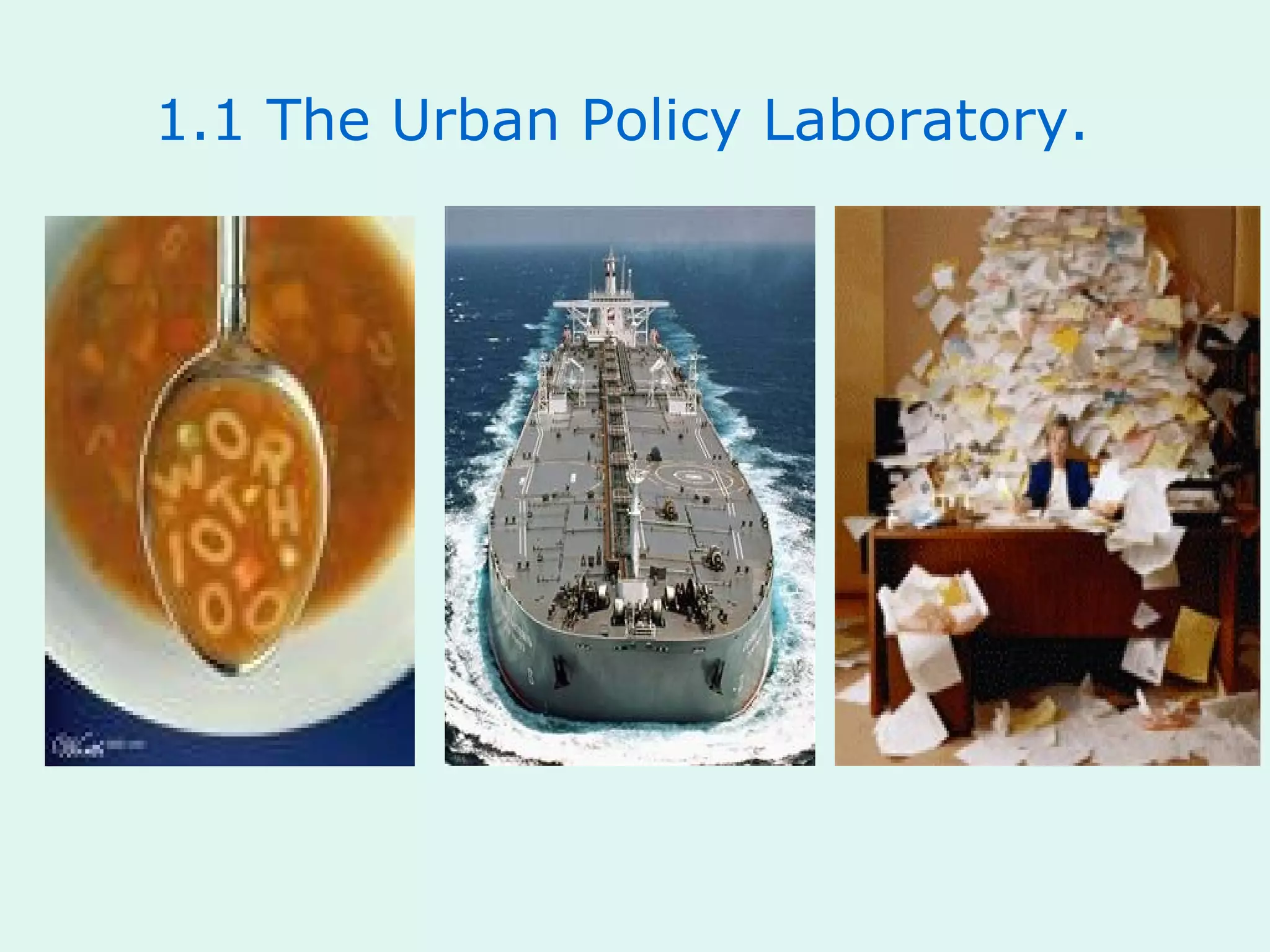
POLICY STRAND 1 Regeneration Policy [Alphabet Soup]
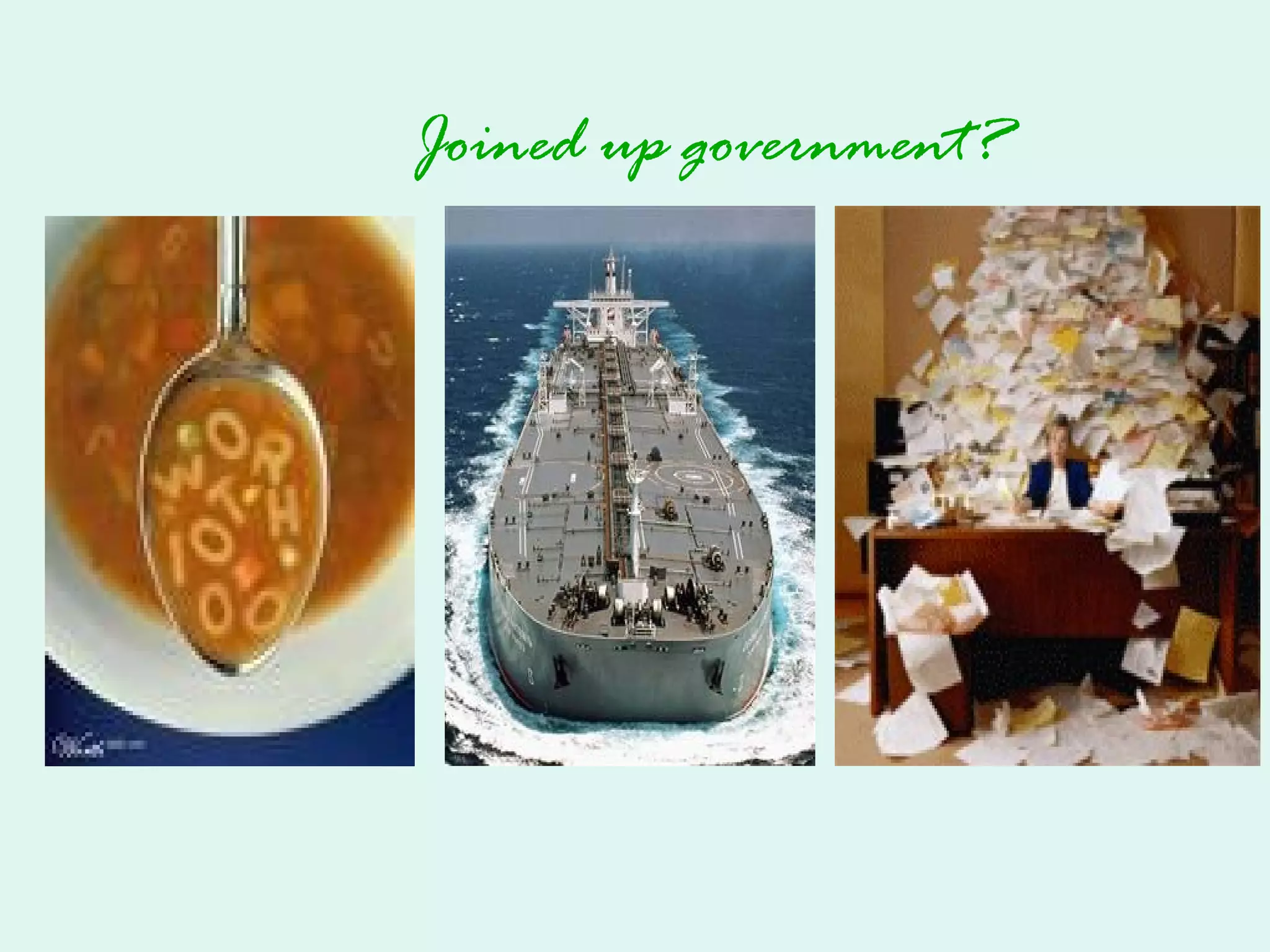
POLICY STRAND 2 The Local Government Modernisation Agenda
[turning round the tanker]
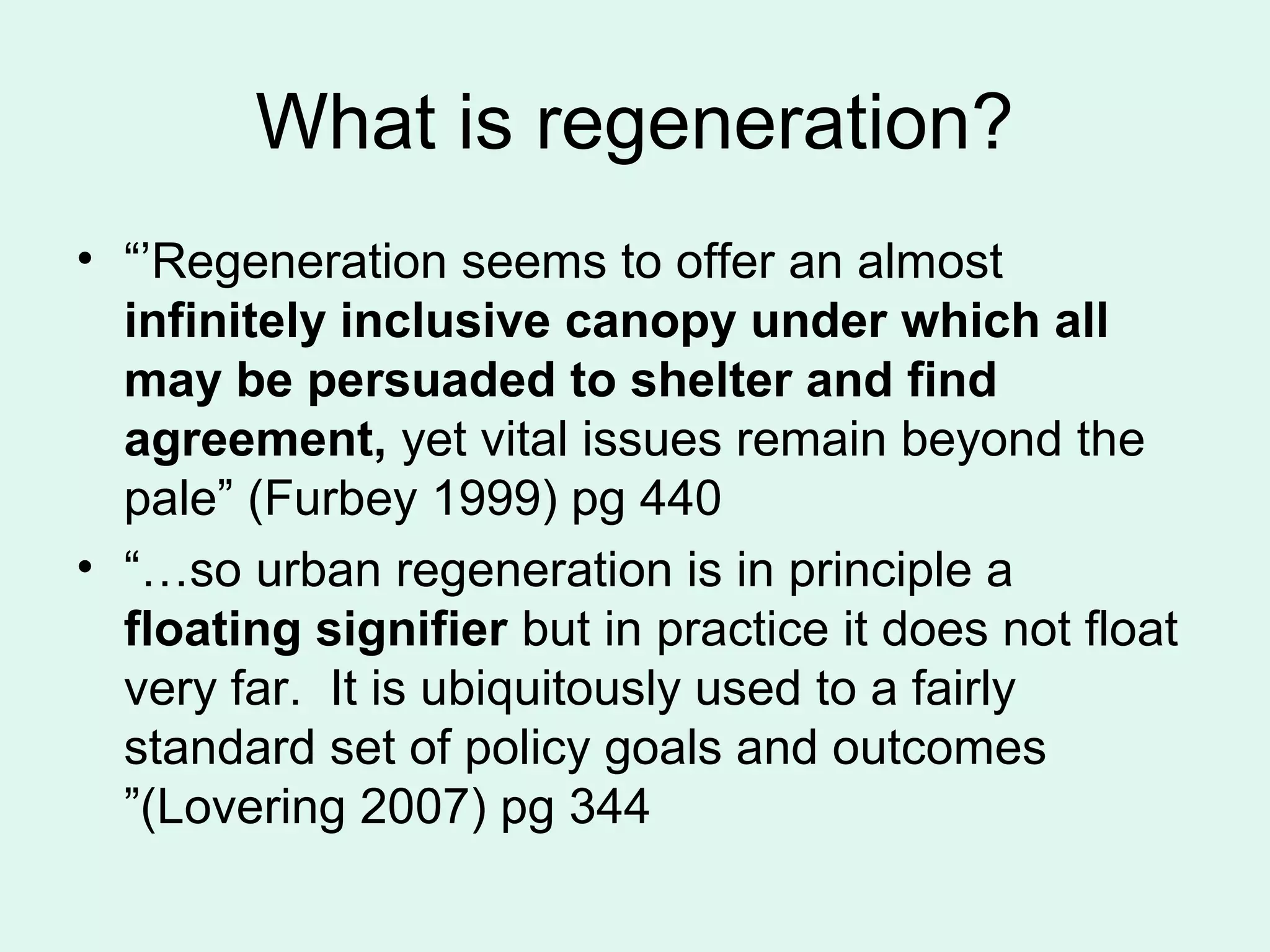
POLICY STRAND 3 Performance management measurement,
audit and inspection [drowning in documents…]
Joined up government?
POLICY STRAND 1 Regeneration Policy [Alphabet Soup]
• Multiple initiatives
• Time scale
• Funding
• Target regime
• Area of benefit
• Delivery mechanism / model
• Thematic focus
• Client group
• Governance arrangements
• Partnership requirements
• “initiativitis”
What is regeneration?
• “’Regeneration seems to offer an almost
infinitely inclusive canopy under which all
may be persuaded to shelter and find
agreement, yet vital issues remain beyond the
pale” (Furbey 1999) pg 440
• “…so urban regeneration is in principle a
floating signifier but in practice it does not float
very far. It is ubiquitously used to a fairly
standard set of policy goals and outcomes
”(Lovering 2007) pg 344
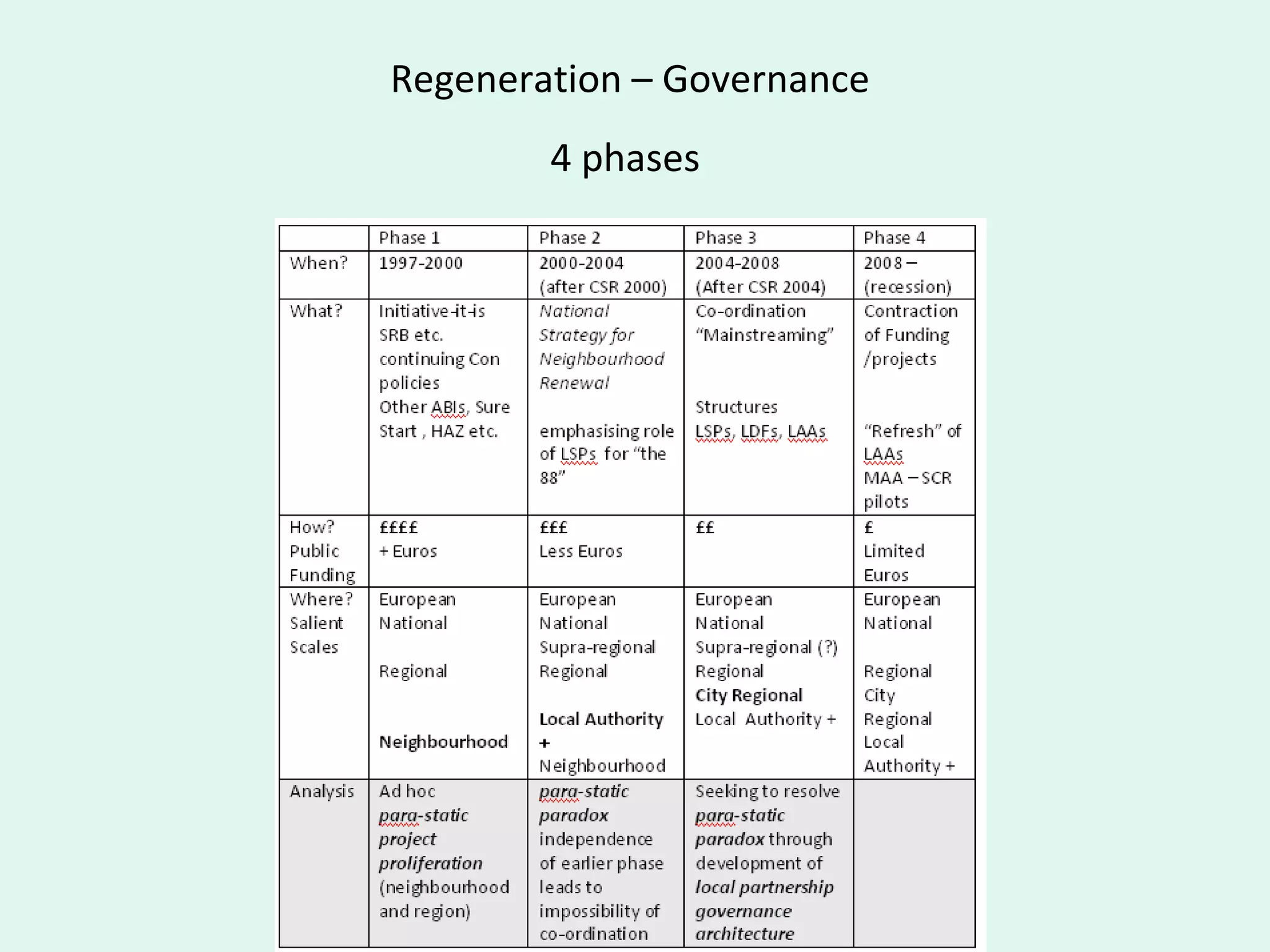
Regeneration – Governance
4 phases
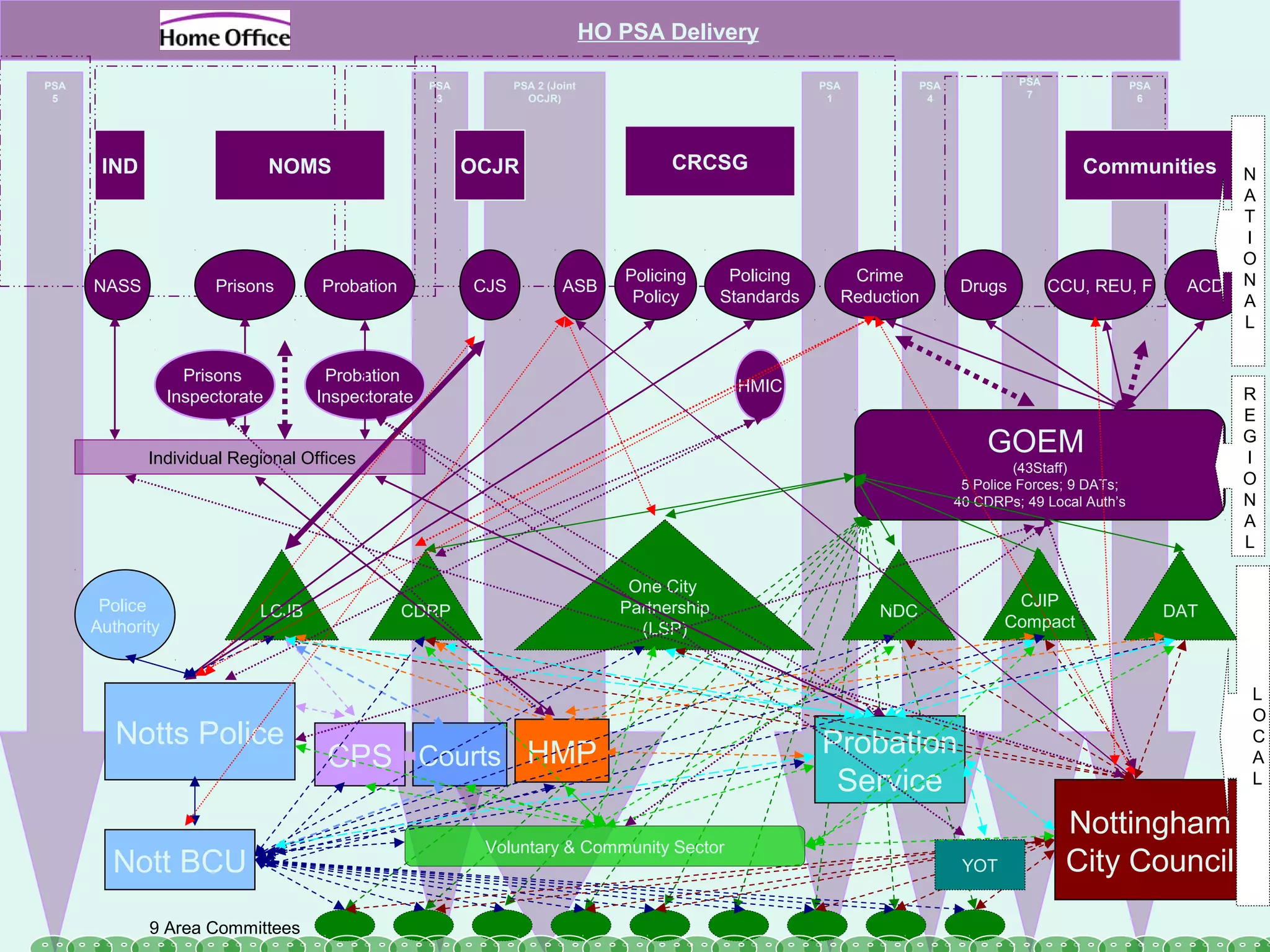
HO PSA Delivery
PSA
5
PSA
3
PSA 2 (Joint
OCJR)
PSA
1
PSA
4
PSA
7
PSA
6
One City
Partnership
(LSP)
Notts Police
GOEM
(43Staff)
5 Police Forces; 9 DATs;
40 CDRPs; 49 Local Auth’s
ProbationPrisonsNASS ASB
Policing
Policy
Policing
Standards
Crime
Reduction
Drugs ACDCCU, REU, F
NDCLCJB
9 Area Committees
NOMS
CJS
OCJR CRCSG CommunitiesIND
Nottingham
City Council
Police
Authority
Probation
Inspectorate
CDRP DAT
CJIP
Compact
CPS
HMIC
Prisons
Inspectorate
Individual Regional Offices
Nott BCU
Probation
Service
YOT
Courts
R
E
G
I
O
N
A
L
N
A
T
I
O
N
A
L
L
O
C
A
L
HMP
Voluntary & Community Sector
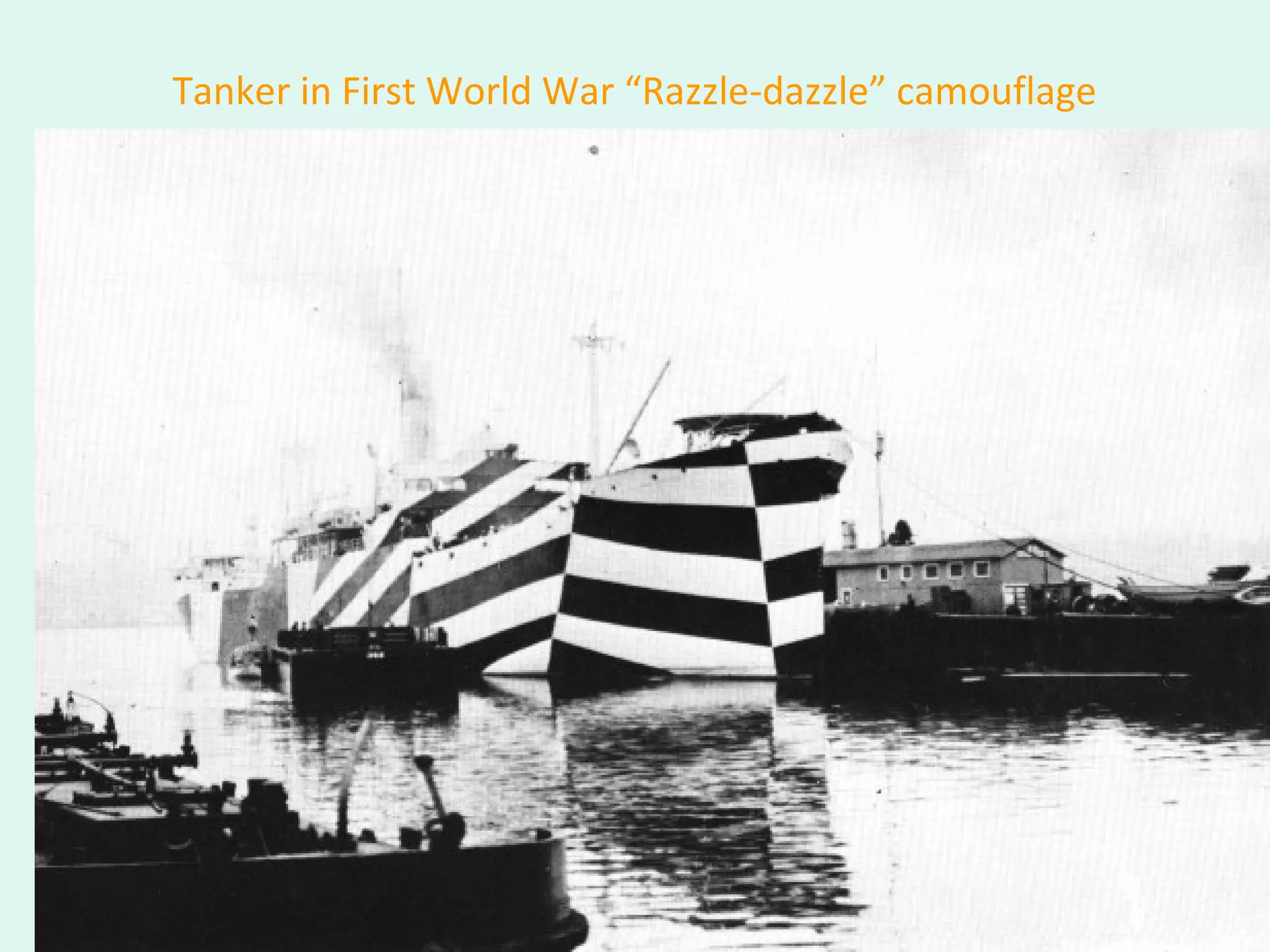
POLICY STRAND 2 The LGMA [turning round the tanker]
LGMA shorthand for
policy interventions
designed to improve
(perceived) issues
around
 Efficiency
 Accountability
 Decision making
Process
Finance
Functions
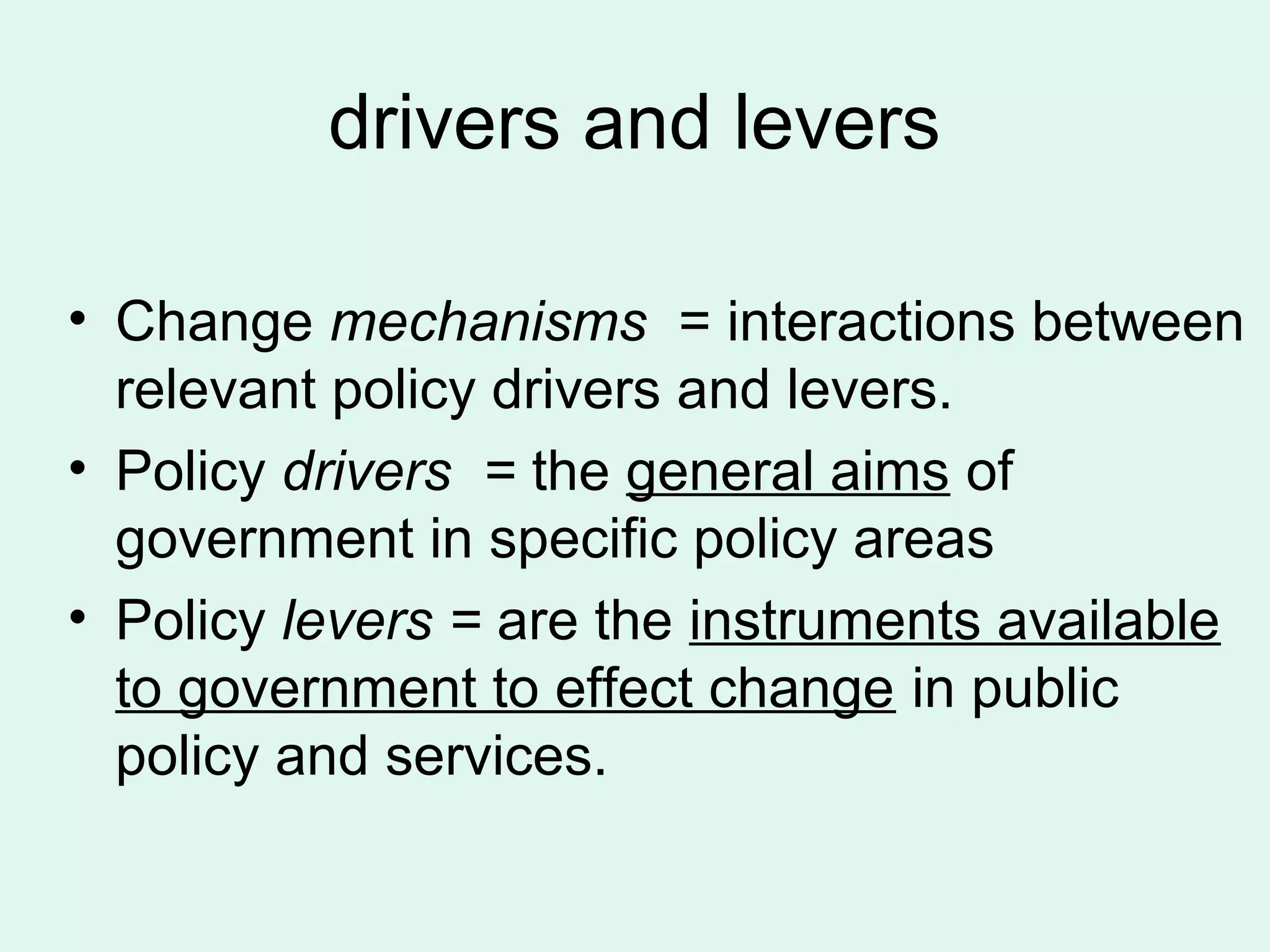
drivers and levers
• Change mechanisms = interactions between
relevant policy drivers and levers.
• Policy drivers = the general aims of
government in specific policy areas
• Policy levers = are the instruments available
to government to effect change in public
policy and services.
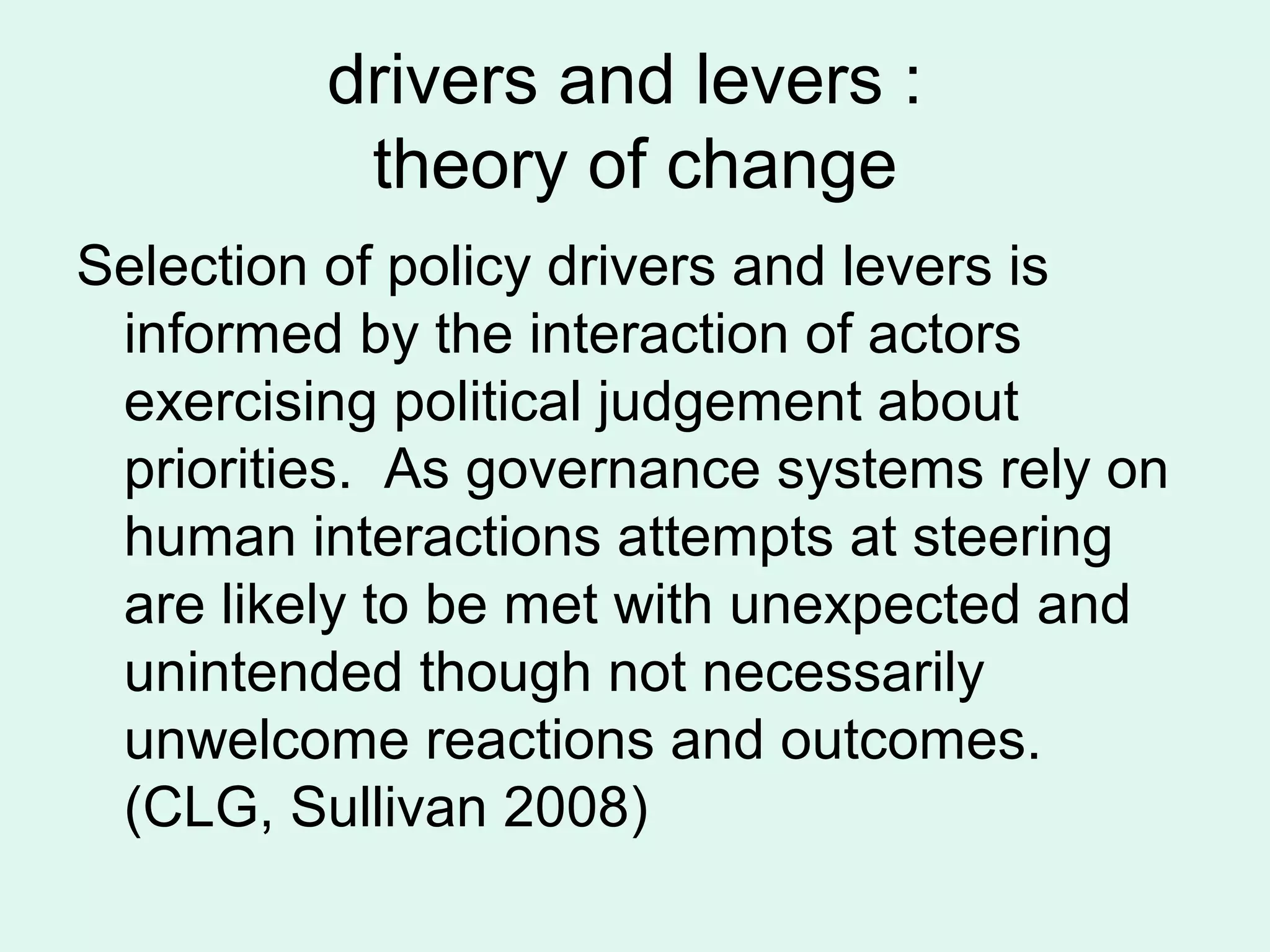
drivers and levers :
theory of change
Selection of policy drivers and levers is
informed by the interaction of actors
exercising political judgement about
priorities. As governance systems rely on
human interactions attempts at steering
are likely to be met with unexpected and
unintended though not necessarily
unwelcome reactions and outcomes.
(CLG, Sullivan 2008)
Tanker in First World War “Razzle-dazzle” camouflage
Strategic manoeuvring…
POLICY STRAND 3 Performance management measurement,
audit and inspection [drowning in documents…]
Meanwhile elsewhere in Whitehall…
The Improvement Agenda (close to LGMA but not
totally connected)
Empowered the Audit Commission
Waves of improvement
BVPI – Best Value Performance Indicators
CPA – Corporate Performance Assessment
CAA - Comprehensive Area Assessment
The PSA Regime (Public Services Agreements)
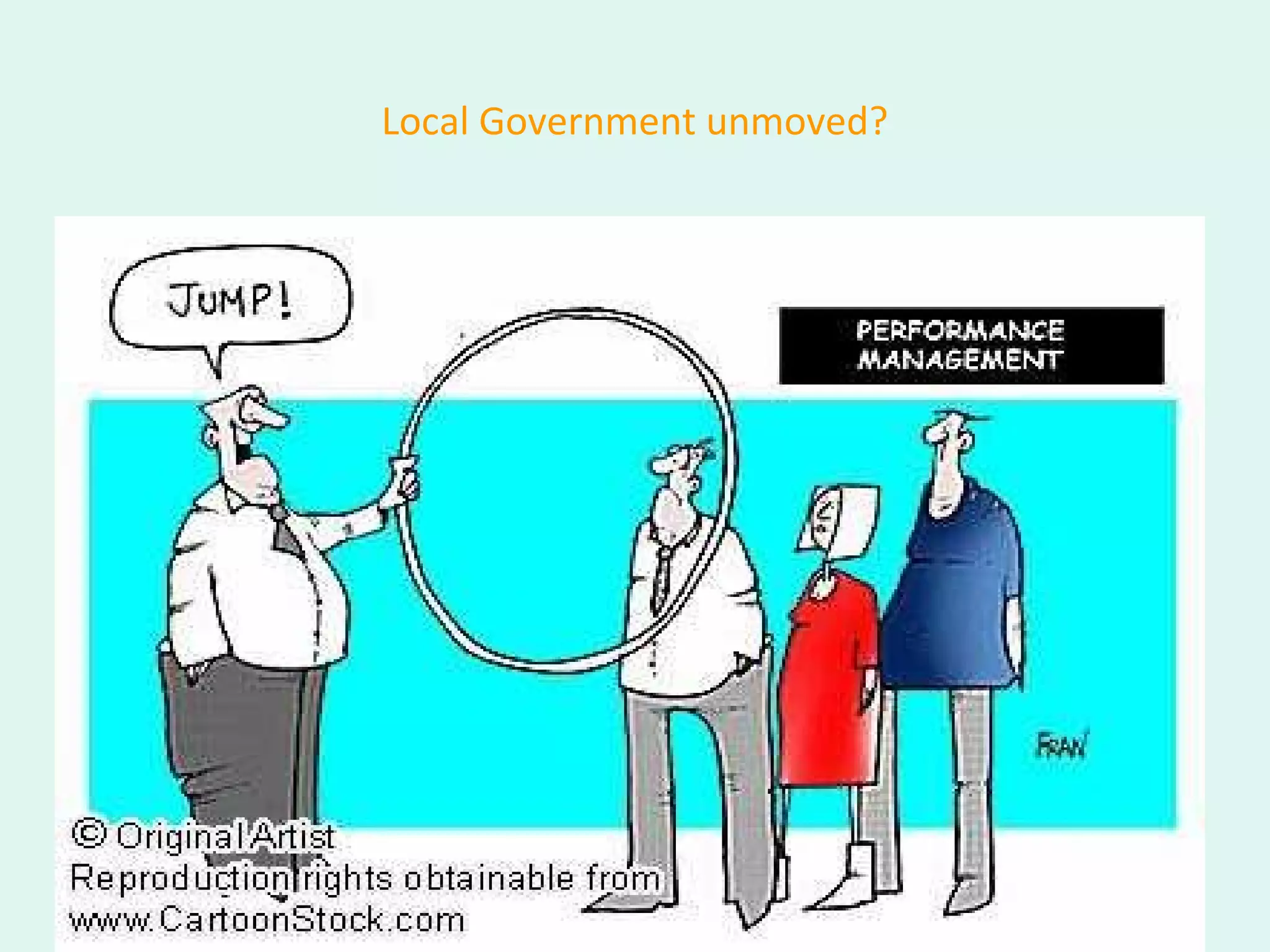
Local Government unmoved?
Gordon Brown’s Approach – PSA regime
PSA
• Connecting manifesto to delivery
mechanisms of Whitehall
• Connecting to “floor targets”
• In some ways odd to have to invent this…
• The “machinery of government” is quite
tricky…
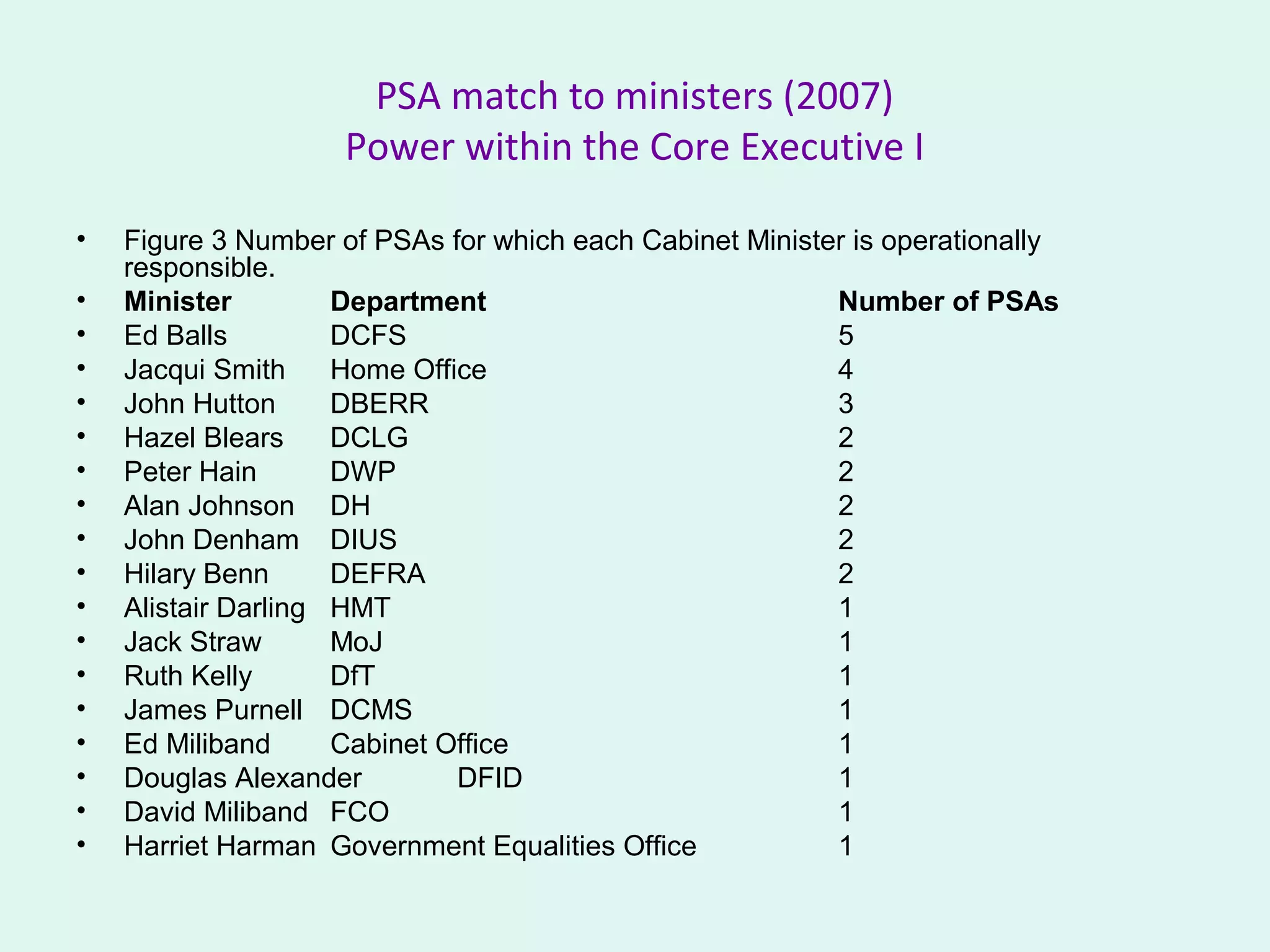
PSA match to ministers (2007)
Power within the Core Executive I
• Figure 3 Number of PSAs for which each Cabinet Minister is operationally
responsible.
• Minister Department Number of PSAs
• Ed Balls DCFS 5
• Jacqui Smith Home Office 4
• John Hutton DBERR 3
• Hazel Blears DCLG 2
• Peter Hain DWP 2
• Alan Johnson DH 2
• John Denham DIUS 2
• Hilary Benn DEFRA 2
• Alistair Darling HMT 1
• Jack Straw MoJ 1
• Ruth Kelly DfT 1
• James Purnell DCMS 1
• Ed Miliband Cabinet Office 1
• Douglas Alexander DFID 1
• David Miliband FCO 1
• Harriet Harman Government Equalities Office 1
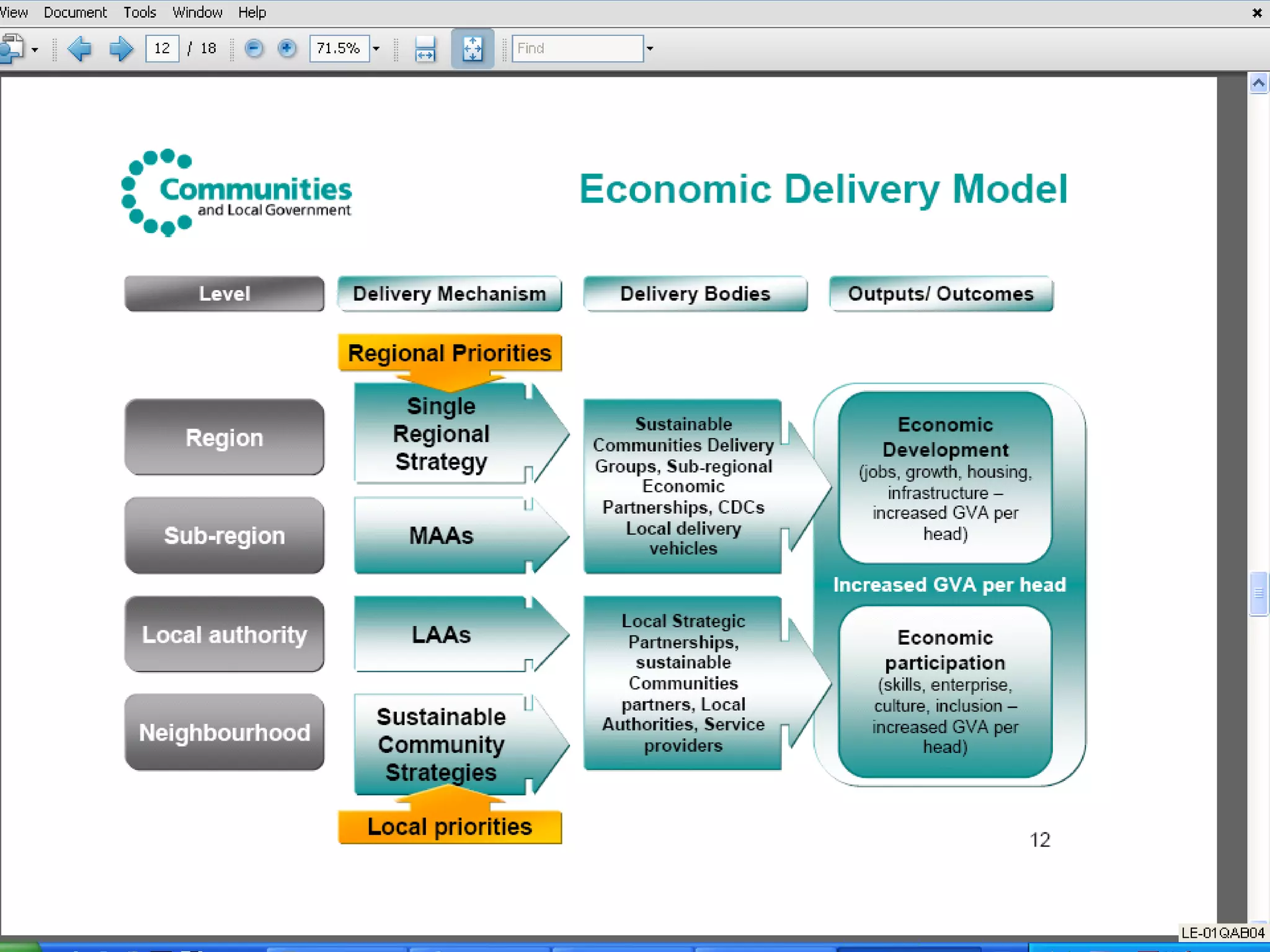
Underlying logic connecting
• PSA regime
• RIS
• MAAs/EPBs/SCR pilots
• LAA regime
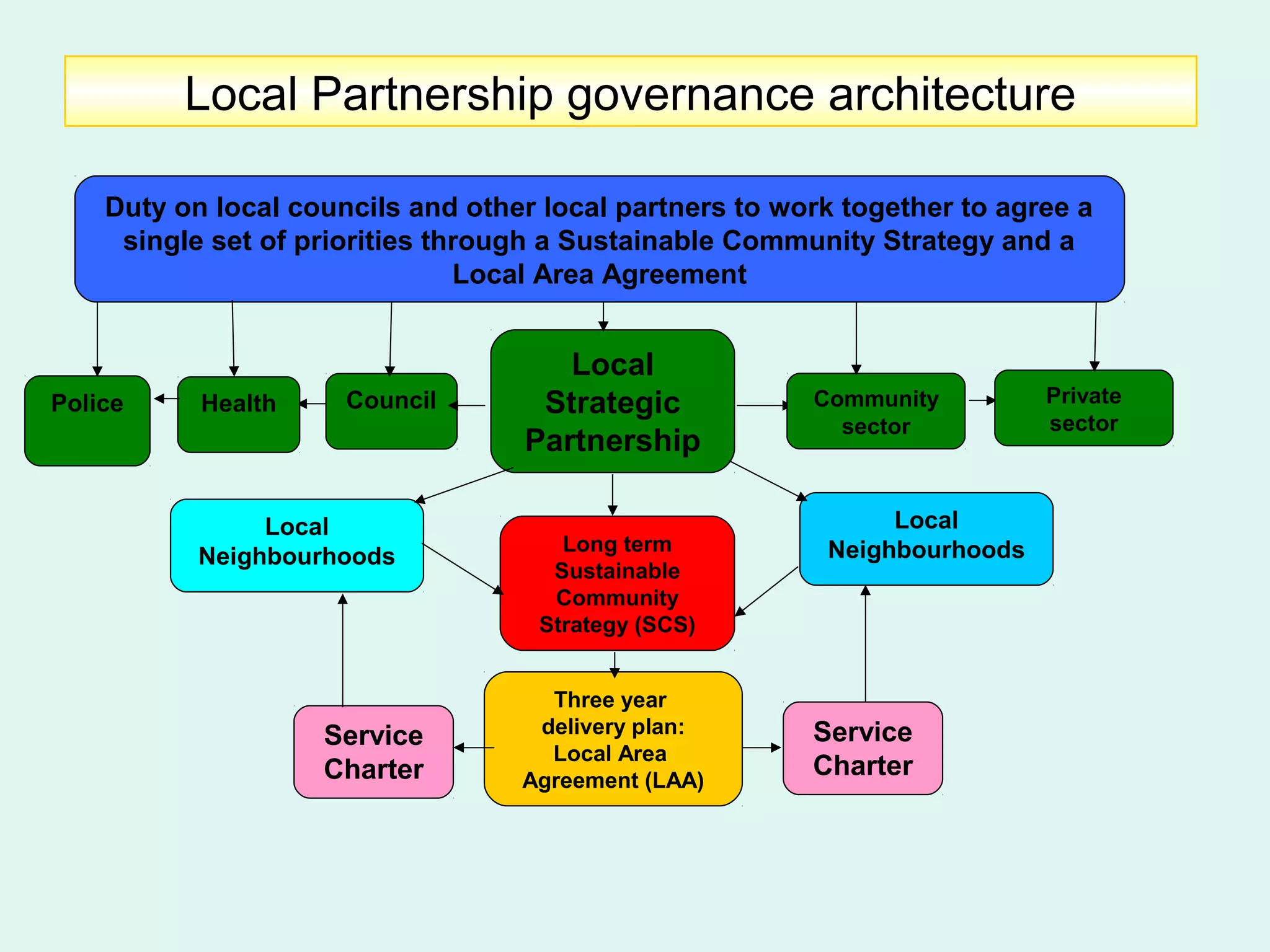
Police
Duty on local councils and other local partners to work together to agree a
single set of priorities through a Sustainable Community Strategy and a
Local Area Agreement
Three year
delivery plan:
Local Area
Agreement (LAA)
Council
Local
Neighbourhoods
Local
Strategic
Partnership
Long term
Sustainable
Community
Strategy (SCS)
Service
Charter
Service
Charter
Health Private
sector
Community
sector
Local
Neighbourhoods
Local Partnership governance architecture
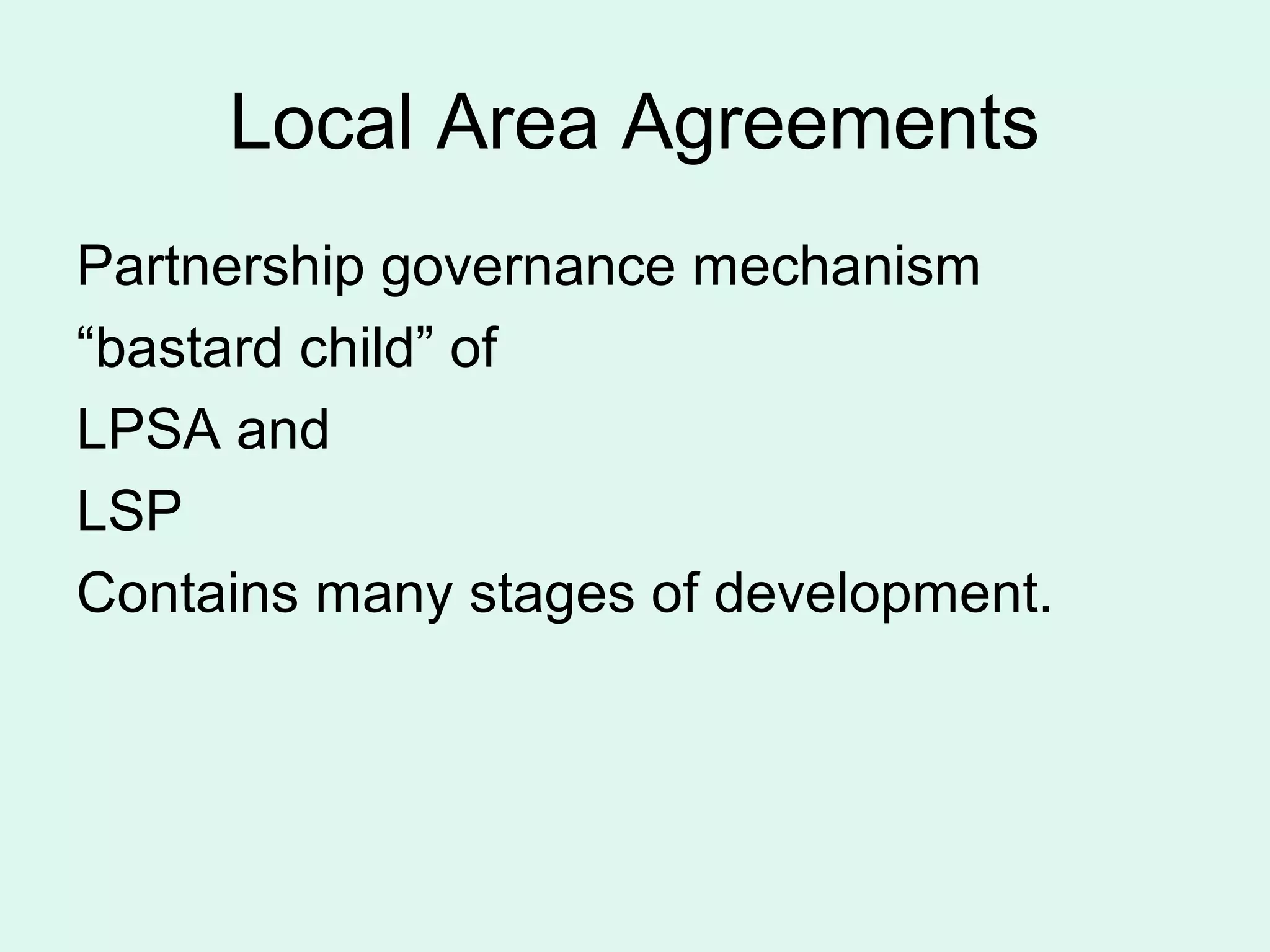
Local Area Agreements
Partnership governance mechanism
“bastard child” of
LPSA and
LSP
Contains many stages of development.
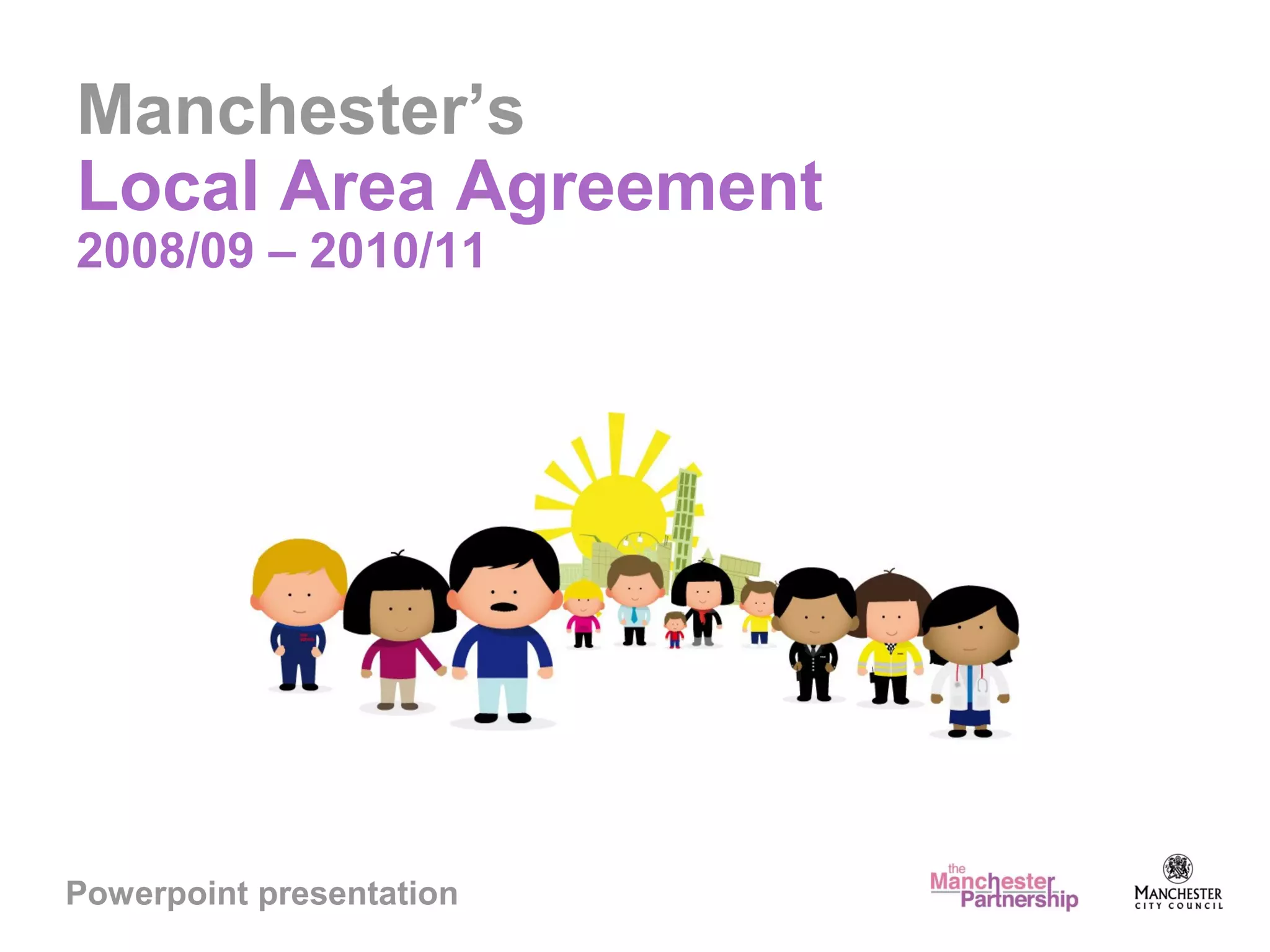
Manchester’s
Local Area Agreement
2008/09 – 2010/11
Powerpoint presentation
Manchester’s LAA
• It’s a three-year plan to deliver our Community Strategy
• It drives partners to achieve targets related to our priorities
• It stimulates innovation
• It builds accountability and stronger relationships
• It forms a constructive relationship with the Government
What’s different from
the pilot LAA?
• Statutory backing – all partners must ‘have regard’ for the
LAA targets
• Broader range of targets – some agreed with the Government
and some agreed on local basis
• Funding
• Comprehensive Area Agreement: outcome focus
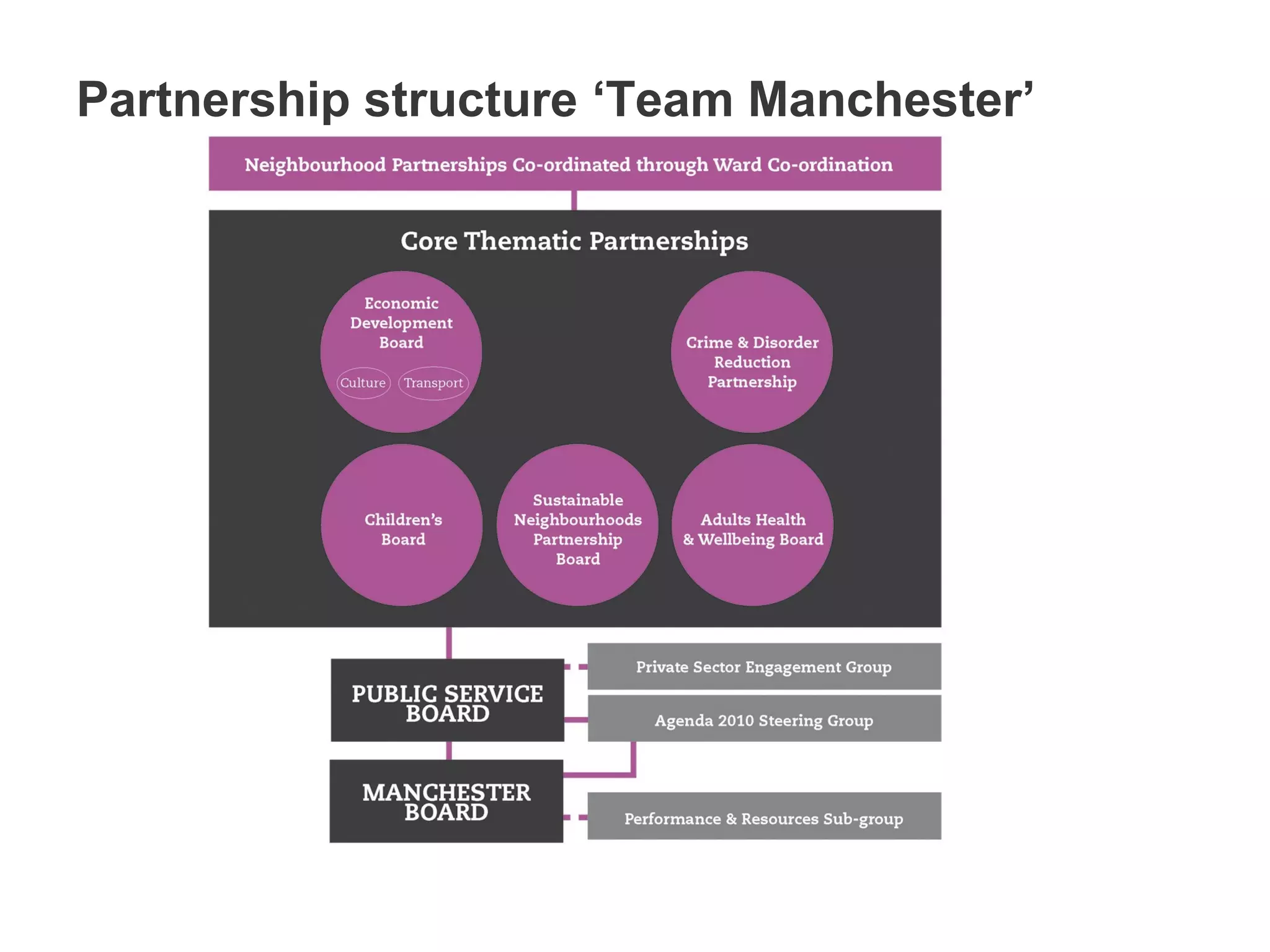
Partnership structure ‘Team Manchester’
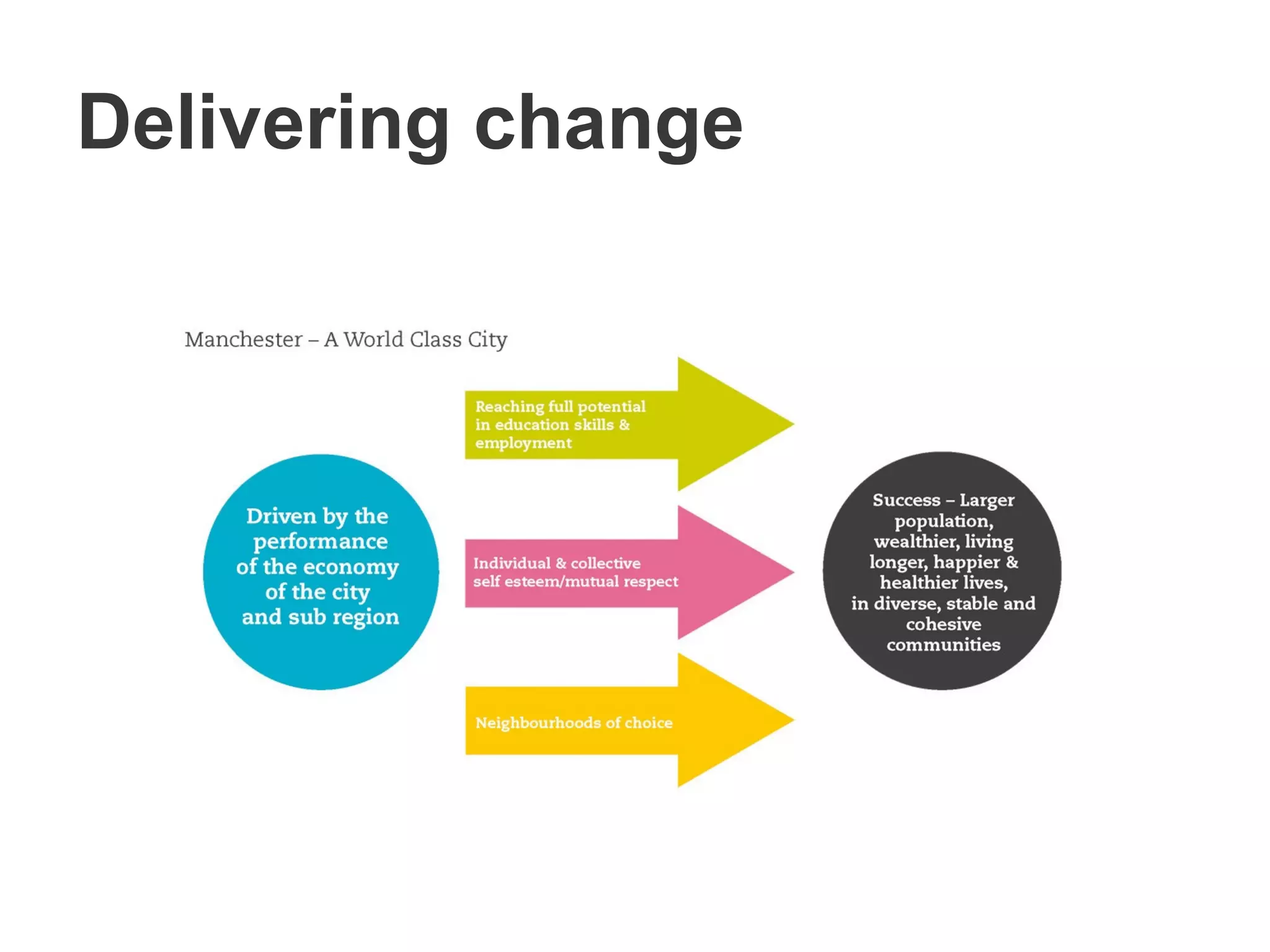
Delivering change
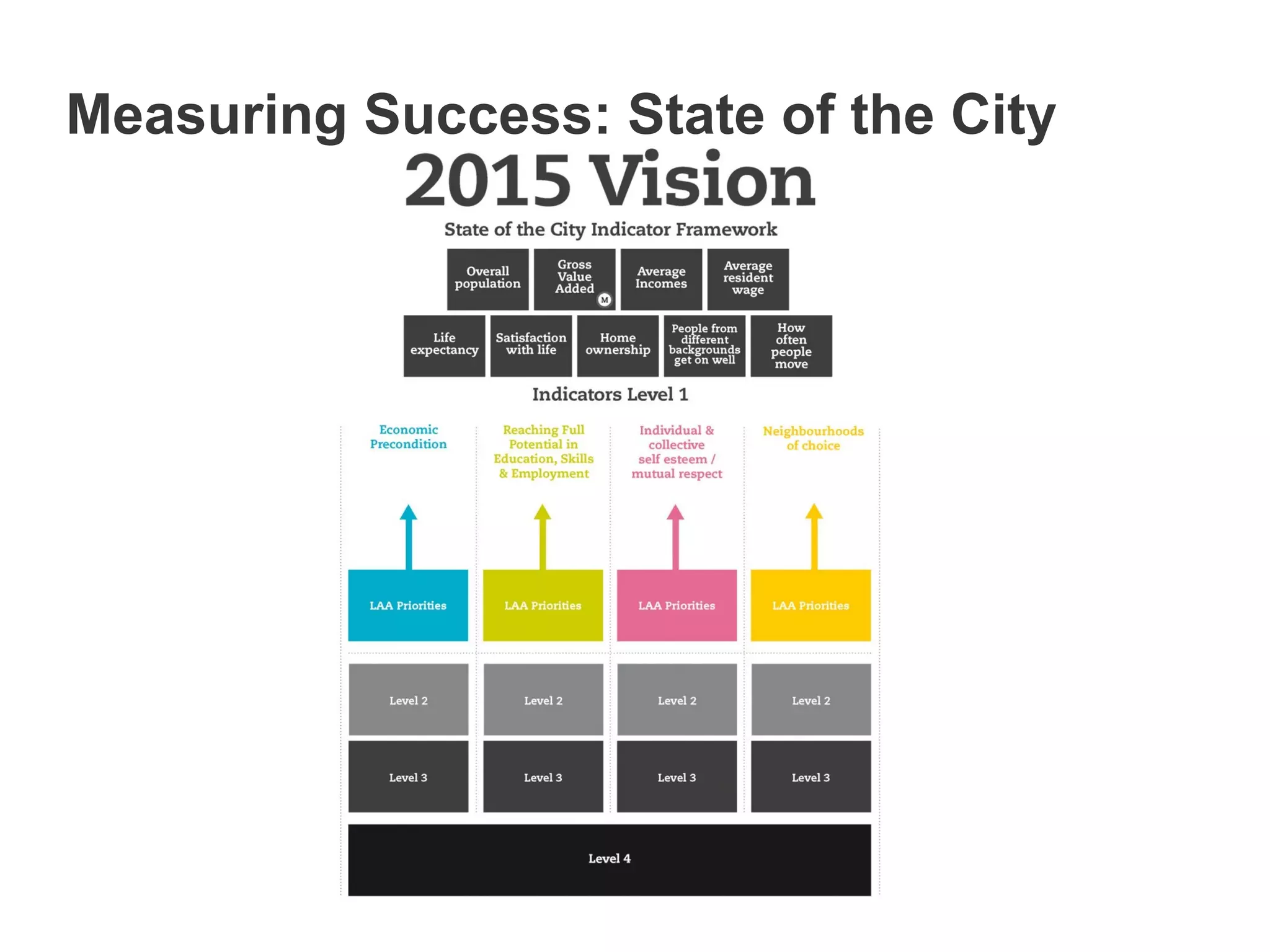
Indicators and targets
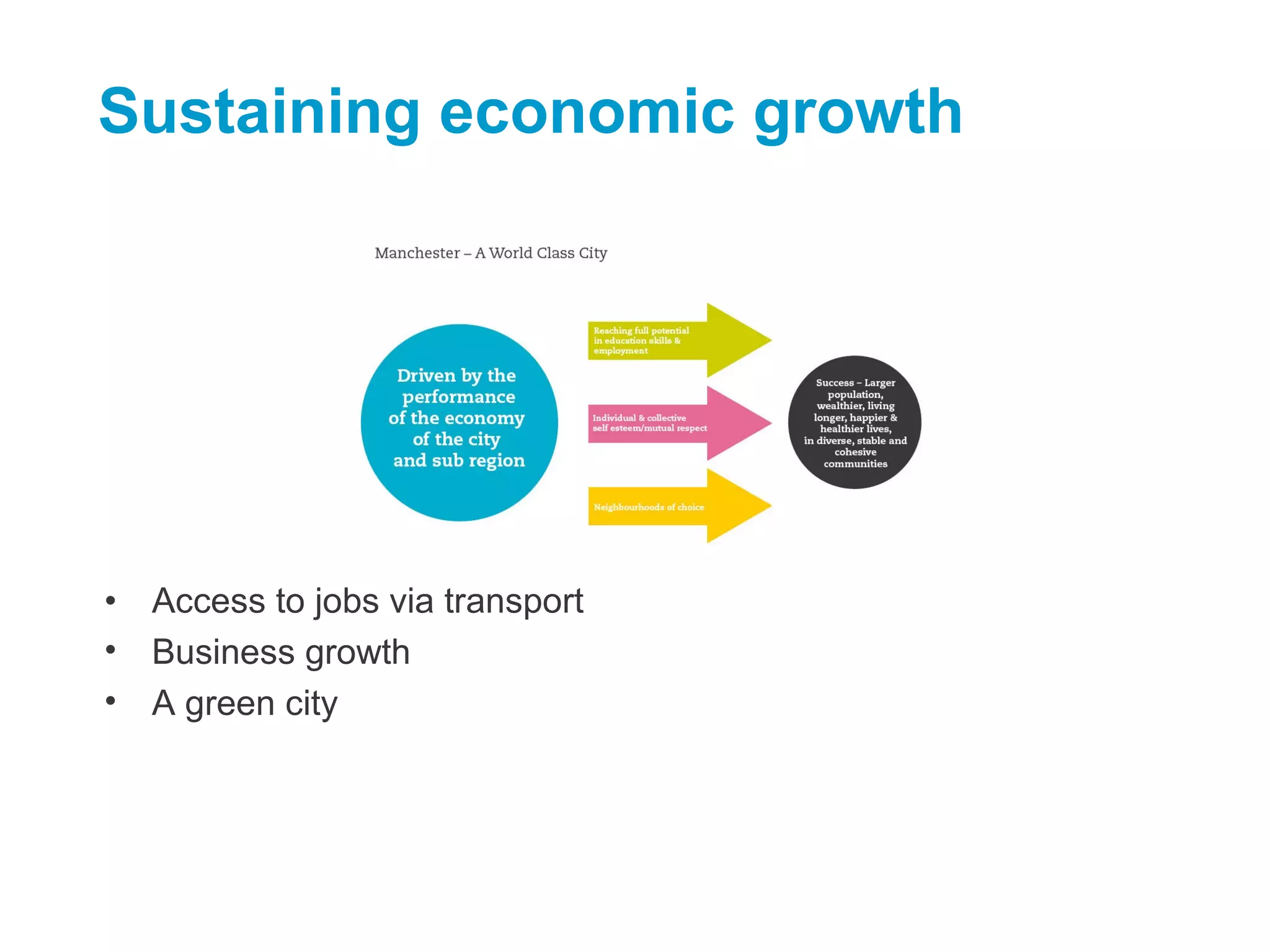
These are linked to the spines diagram
• Level 1 – high-level indicators
• Level 2 – indicators most relevant to spines
• Level 3 – partners’ key actions
• Level 4 – output and process-related actions
Sustaining economic growth
• Access to jobs via transport
• Business growth
• A green city
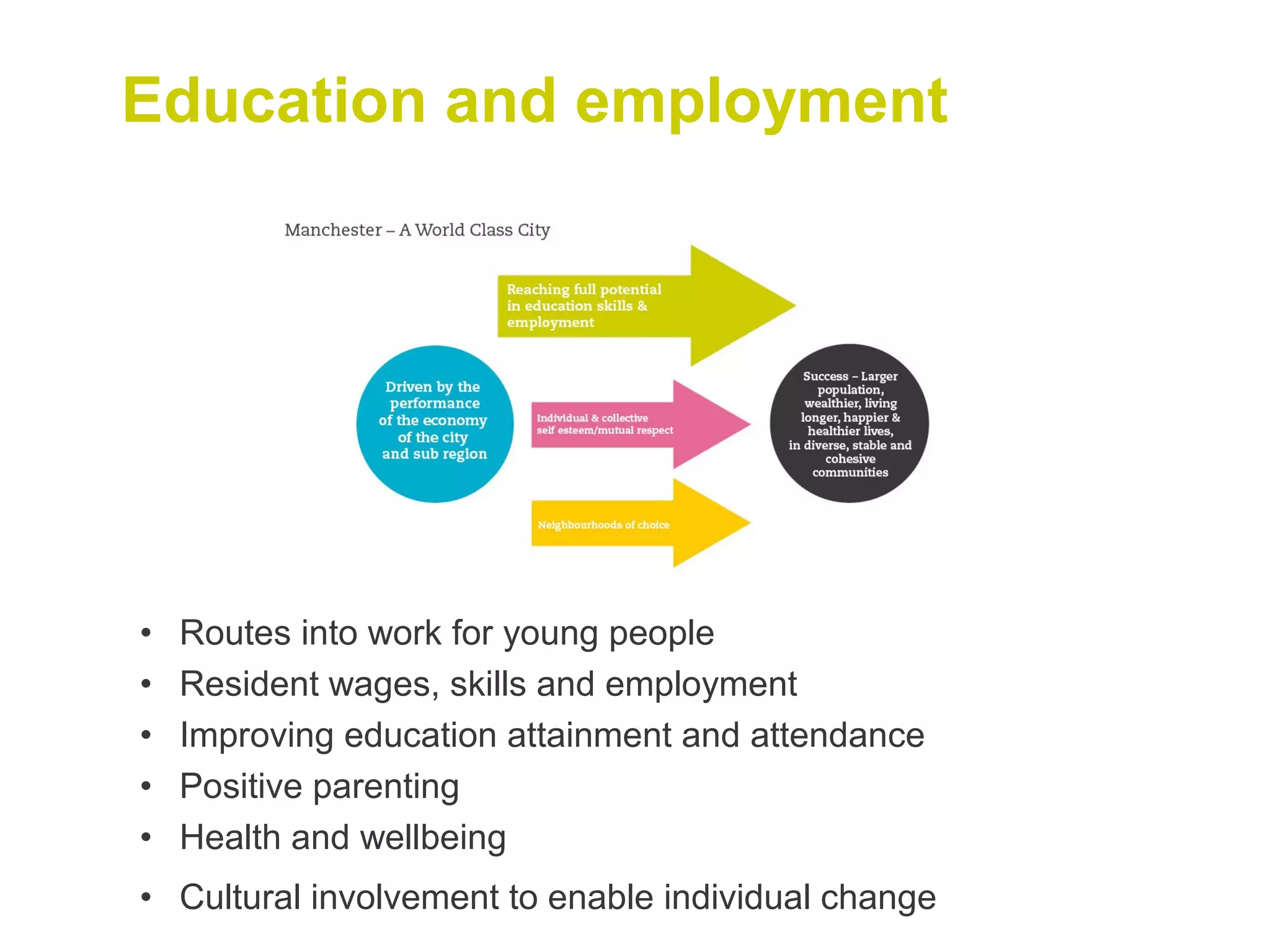
Education and employment
• Routes into work for young people
• Resident wages, skills and employment
• Improving education attainment and attendance
• Positive parenting
• Health and wellbeing
• Cultural involvement to enable individual change
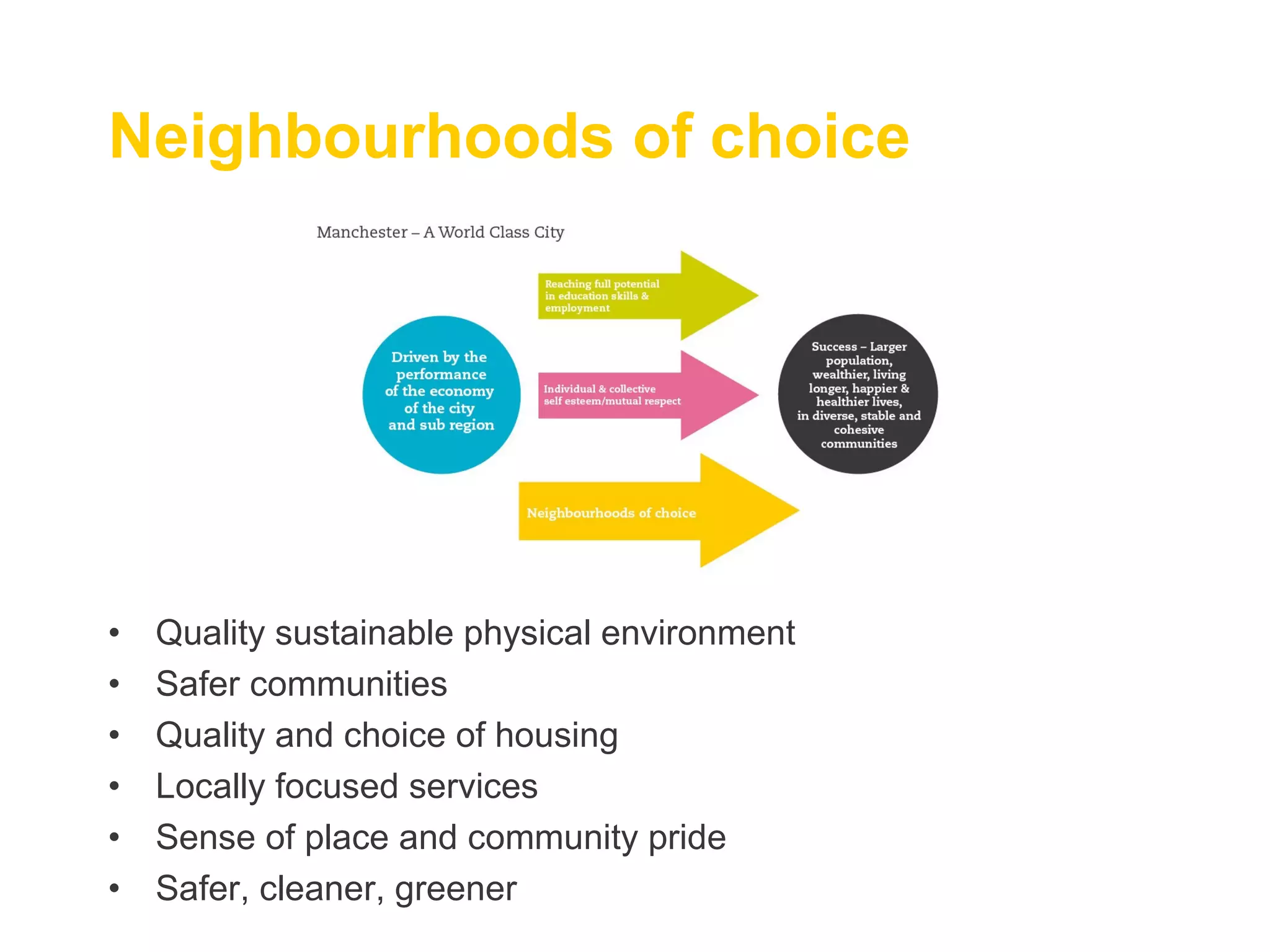
Neighbourhoods of choice
• Quality sustainable physical environment
• Safer communities
• Quality and choice of housing
• Locally focused services
• Sense of place and community pride
• Safer, cleaner, greener
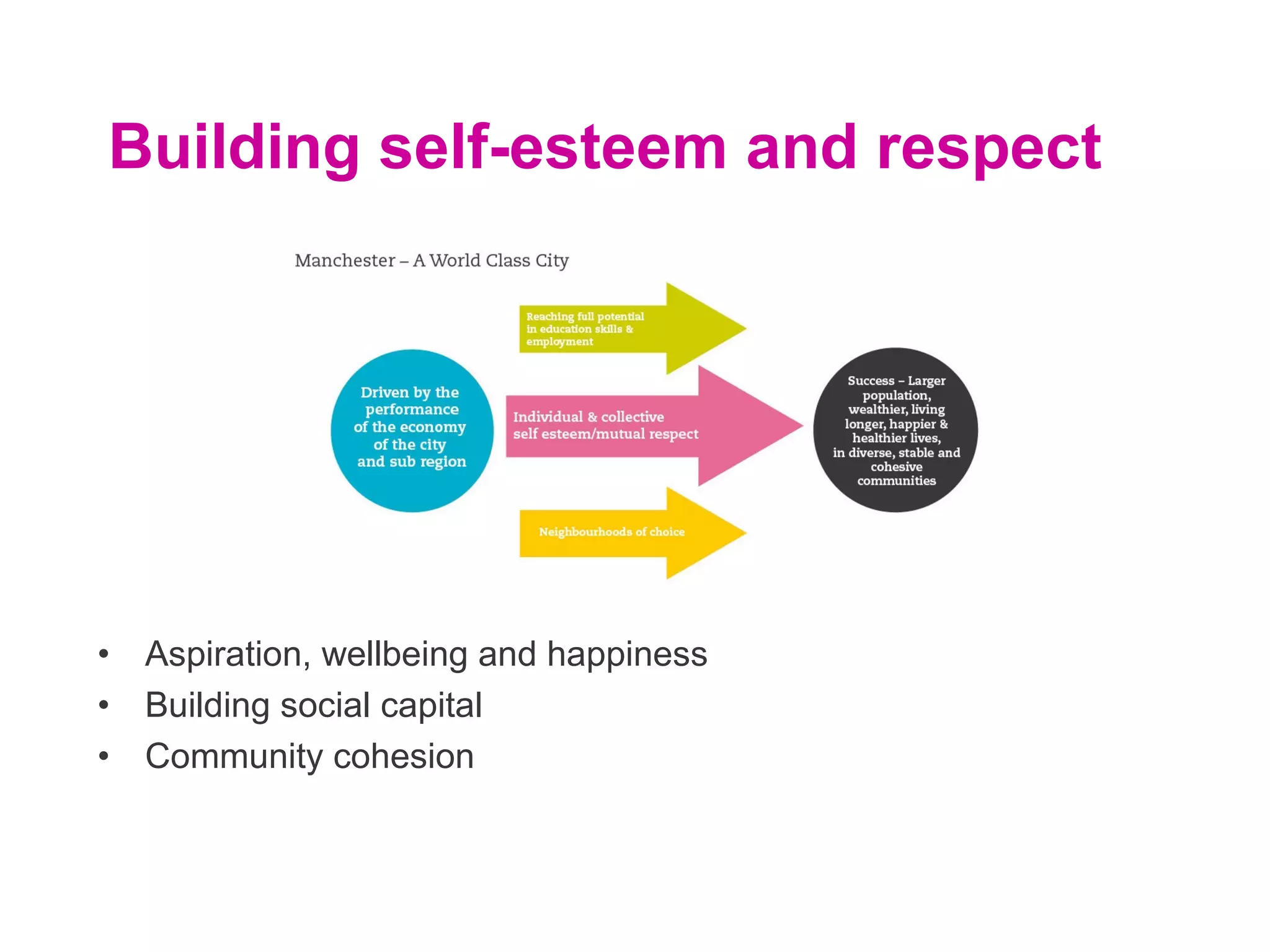
Building self-esteem and respect
• Aspiration, wellbeing and happiness
• Building social capital
• Community cohesion
Partnership delivery
• Innovation – to speed up improvement
• Resources – to make full use of all we have
• Improve partnership working to do better at:
– Commissioning
– Communication
– Value led improvement
– Partnership governance
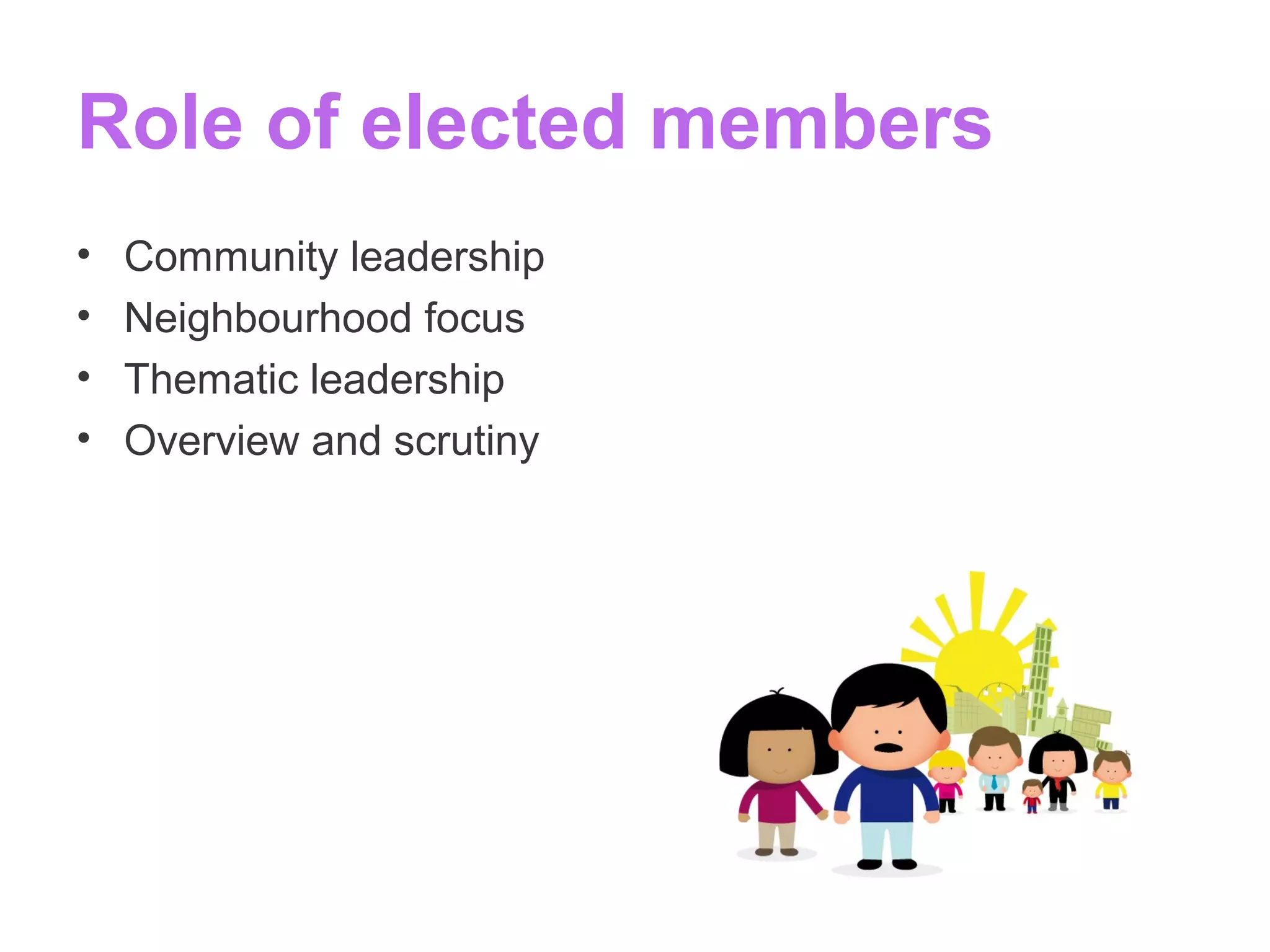
Role of elected members
• Community leadership
• Neighbourhood focus
• Thematic leadership
• Overview and scrutiny
Measuring Success: State of the City
Manchester’s LAA
2008/09 – 2010/11
www.manchesterpartnership.org.uk
Part 3: Role of localities in
the Recession
Policy
SNR
• Regeneration Framework
• Parkinson report
• CLG / BIS
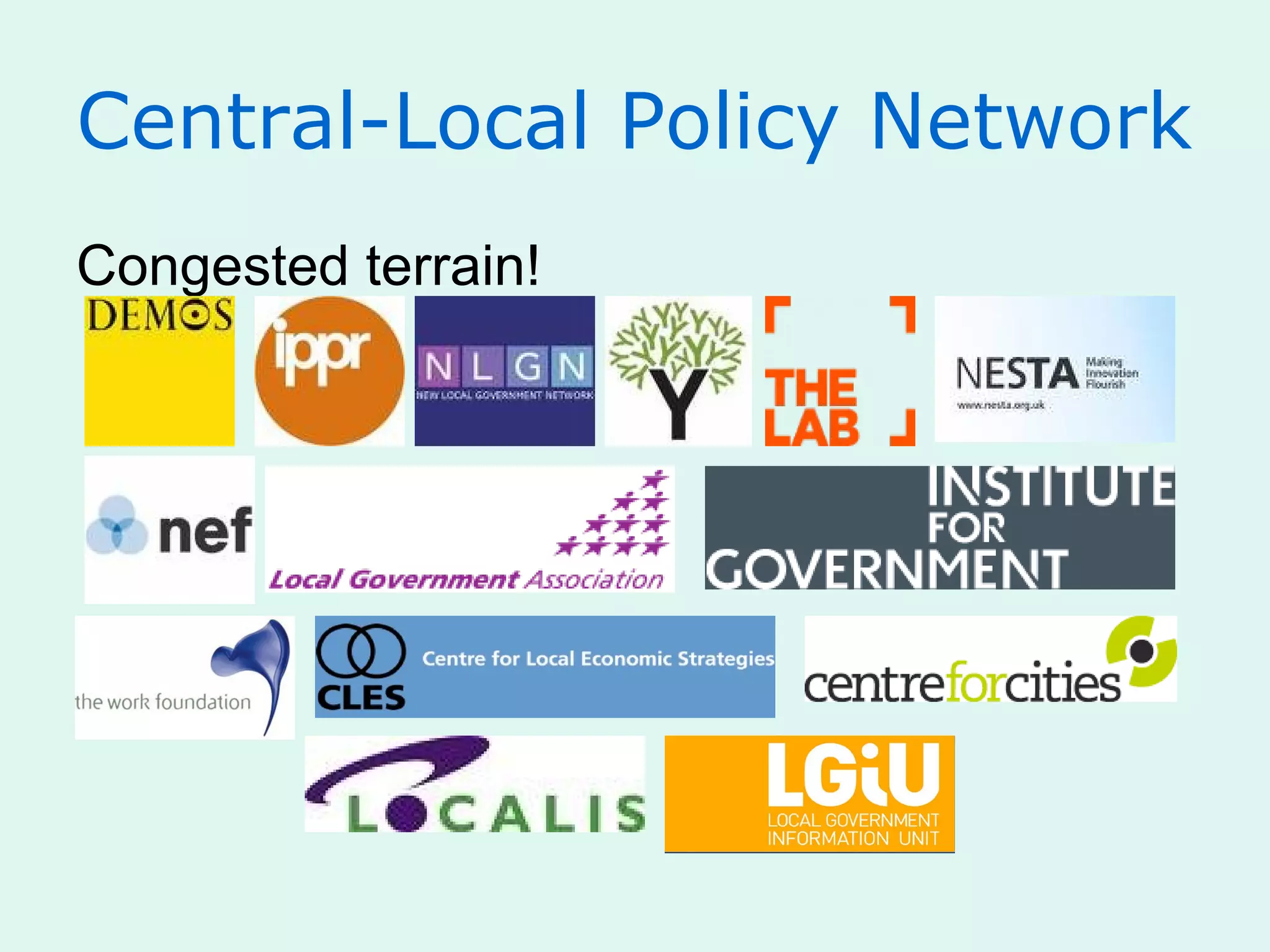
Central-Local Policy Network
Congested terrain!
Think tanks re: recession
• LGA from recession to recovery: the local
dimension
• CLES toward a new wave of local
economic activism
• Work Foundation: Recession and
Recovery: How UK cities can respond and
drive the recovery
Role of cities in a recession
Discuss in pairs/threes for 5 mins…
What is the role of a city/locality in the
recession?
None? – let the market do it’s thing?
Welfare? role of partners eg. jc+
Leadership?
Others – want 6 please
Ideopolis - Work Foundation
Barcelona Principles – The Work Foundation
i. Don’t waste the crisis, but respond with leadership and purpose.
ii. Make the case for continued public investment and public services and the
taxes and other sources of investment required.
iii. In the long-term: build local economic strategies which align with long-term
drivers and identify future sources of jobs, enterprise, and innovation.
iv. In the short-term: focus on retaining productive people, business, incomes,
jobs, and investment projects.
v. Build the tools and approaches to attract and retain external investment over
the long-term.
vi. Build genuine long-term relationships with the private sector, trade unions,
and other key partners.
vii. Take steps to ensure the sustainability and productivity of public works,
infrastructure, and major developments/events.
viii Local leaders should act purposefully to support their citizens in the face of
increased hardship.
ix. Local economies have benefitted and should continue to benefit from being
open and attractive to international populations and capital.
x. Communicate and align with national and other higher tier governments.
LGA
● London is the region most likely to underperform the national
average in a recession, and the South-West the least;
● Major cities outside London such as Newcastle, Leeds and
Manchester are likely to do better than the capital.
This research strongly suggests that the most effective way of targeting
a response to recession in the places it will make the most
difference is to continue with the policies of devolving economic
decision-making to which the government has committed itself.
In time of a recession, the need for devolution to sub-regions,
including counties, functional economic areas, local council
partnersships and individual local authorities becomes more
obvious and more urgent.
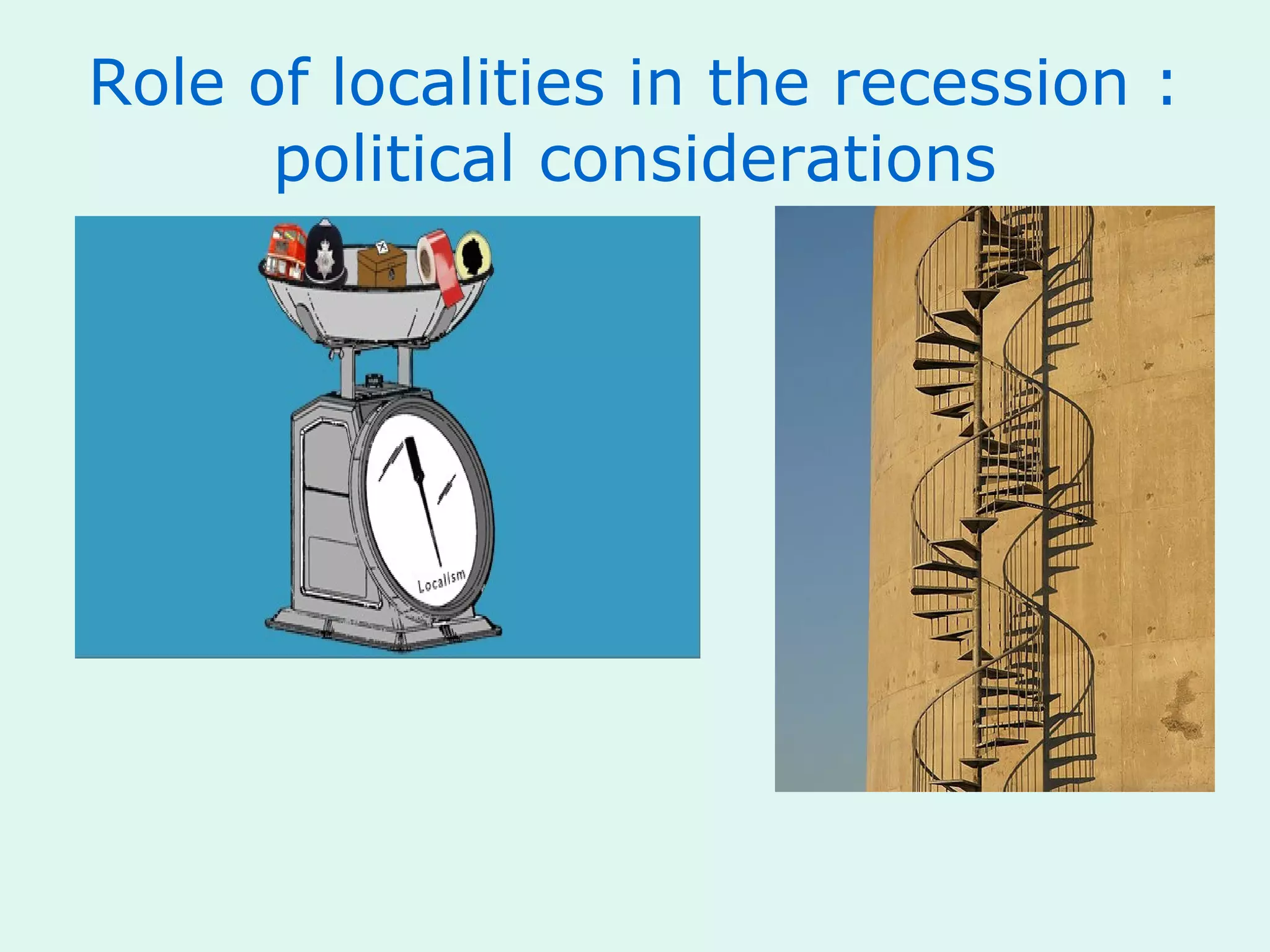
Role of localities in the recession :
political considerations
Part Five :
Mancunian
Mechanisms
Books
• Managing the city: the aims and
impacts of urban policy
Brian Turnbull Robson 1987
• Managing the city
eds Liddle, Diamond, Southern 2007
• City of Revolution eds Ward and Peck
• How Manchester is managed 1925-1939
Stories of “Mancunian ways”
• Mancunian Ways : the politics of regeneration
Robson (Chapter 3 City of Revolution)
• Metropolitan Manoeuvres : making greater
Manchester Deas and Ward (Chapter City of
Revolution)
• Greater Manchester – ‘up and going’, 2000
Hebbert and Deas
• Greater Manchester : conurbation complexity and
local government structure Barlow, 1995
• Manchester: Making it Happen Hebbert, 2009
Think tanks: Manchester
• Work Foundation : Ideopolis
• Localis : Can Localism Deliver? Lessons
from Manchester
• Policy Exchange : Cities Limited
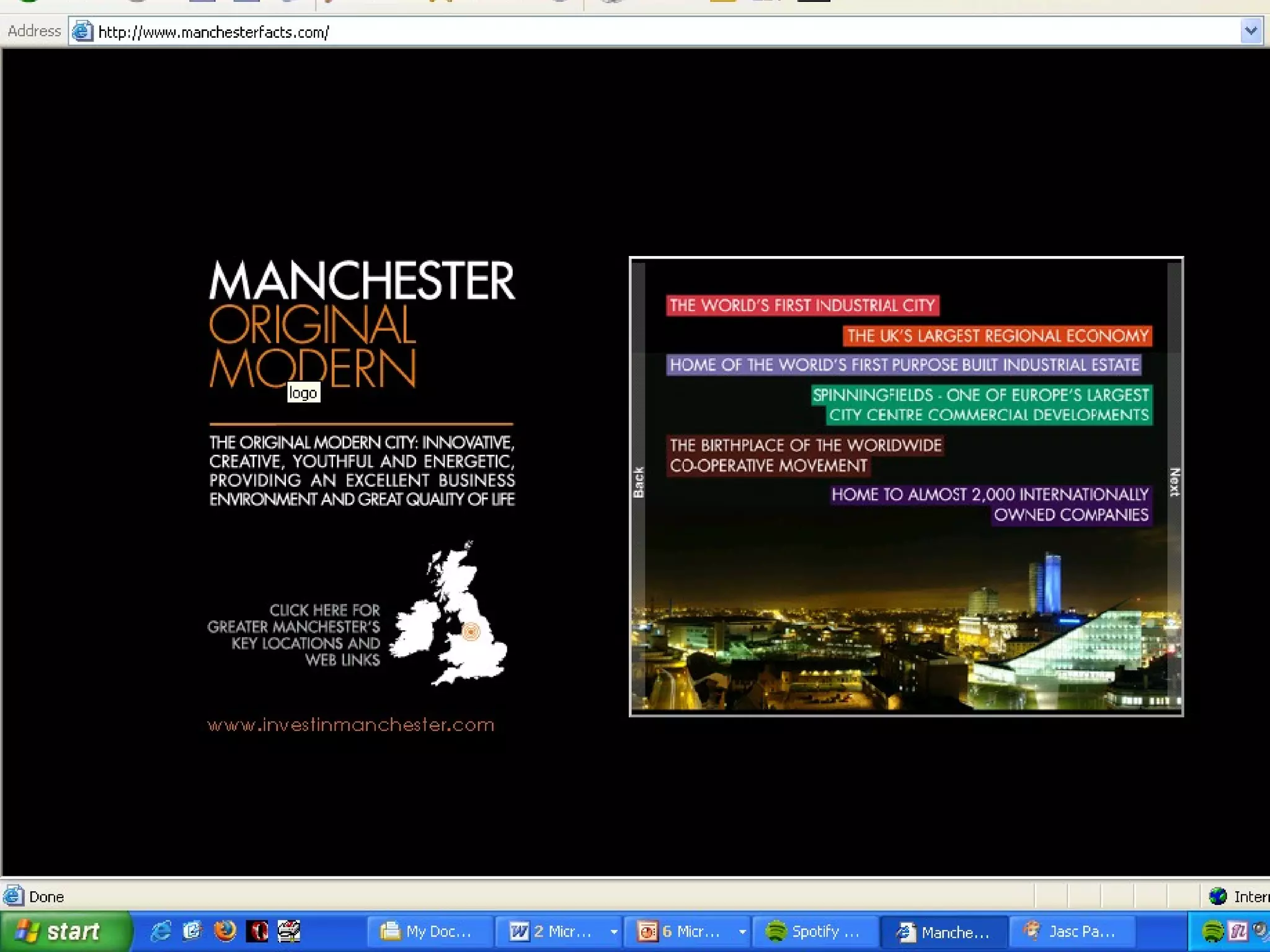
• NESTA : Original Modern : Manchester’s
journey to innovation and growth
City publications
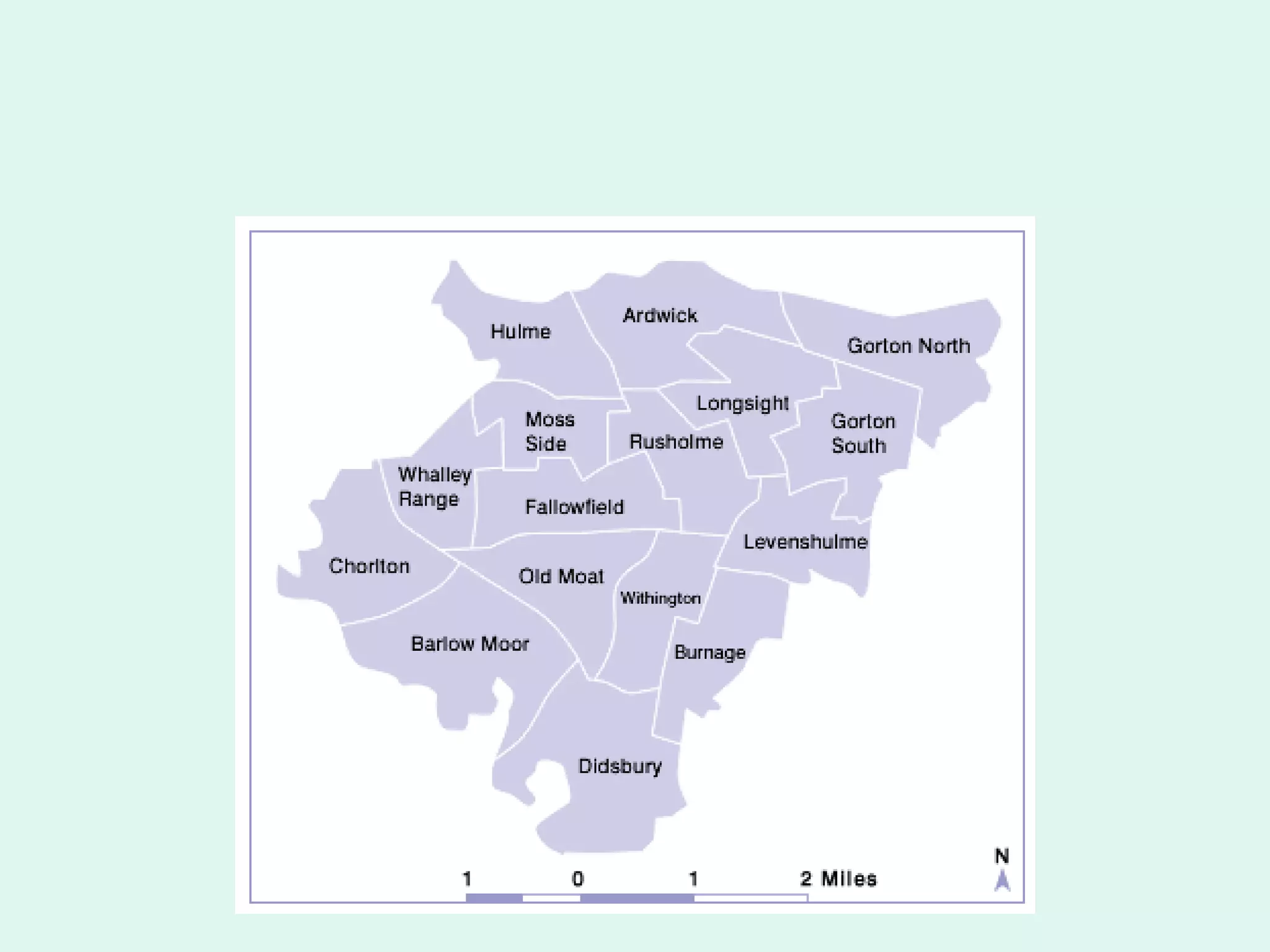
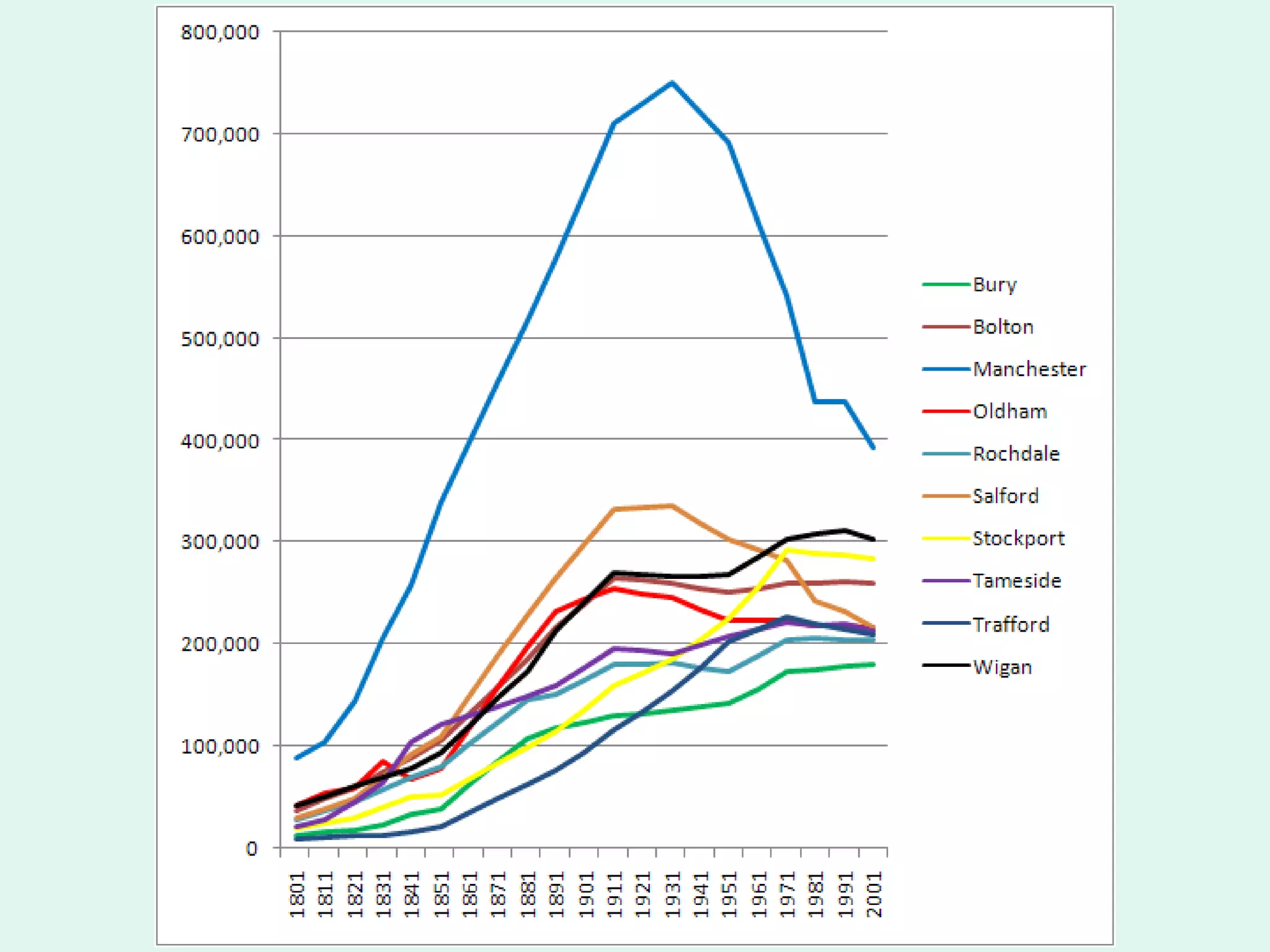
What is Manchester?
• Political
• Economic
• Statistical
• Administrative
• Cultural (music and sport)
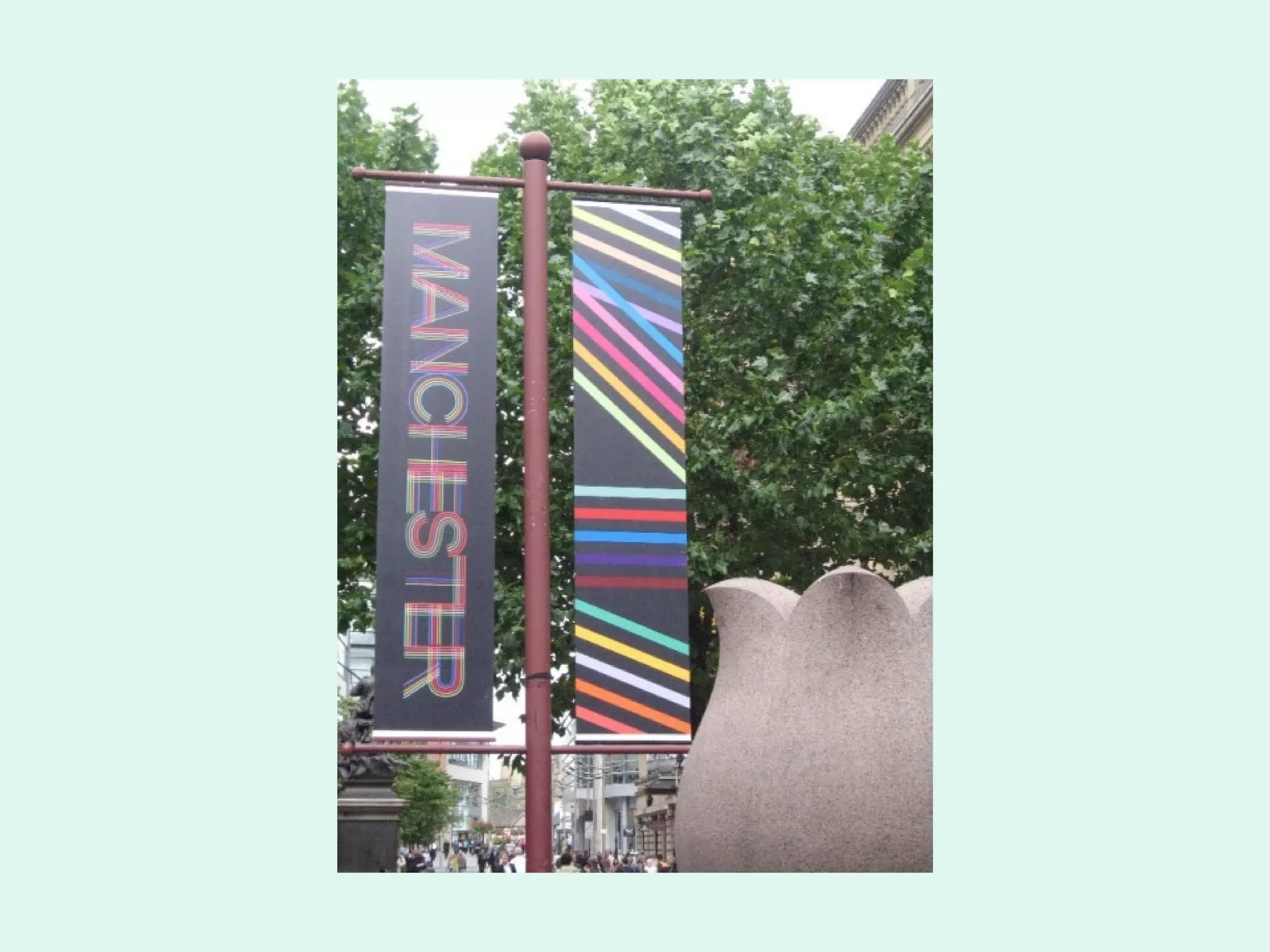
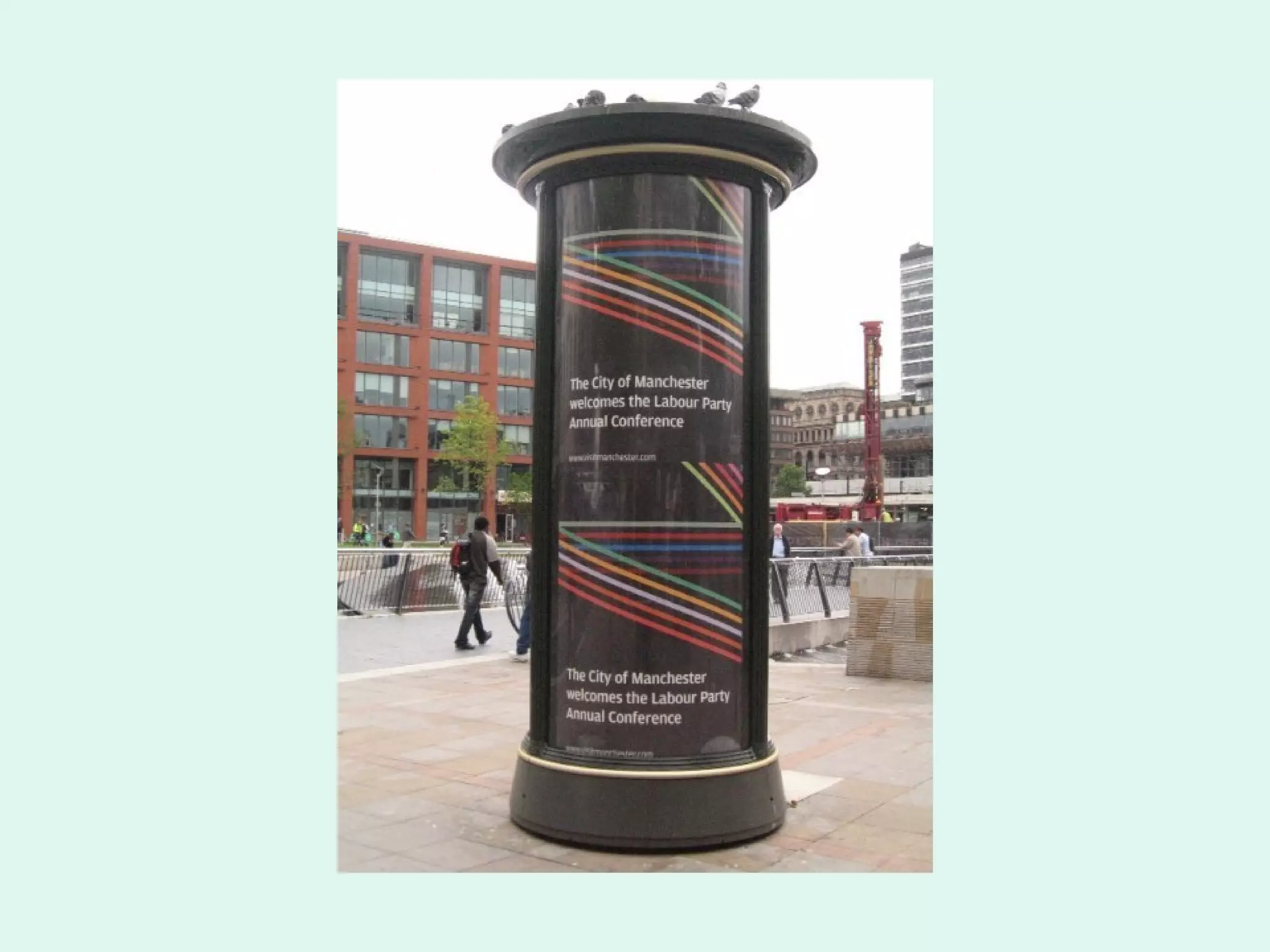
Construction
A Brand?
Scales of Political
representation
• Ward Councillor (backbench/frontline)
• City Council Executive (Labour)
• MP
• Government (Labour)
• MEP NW
Regional / City Regional political
representatives are proxies.
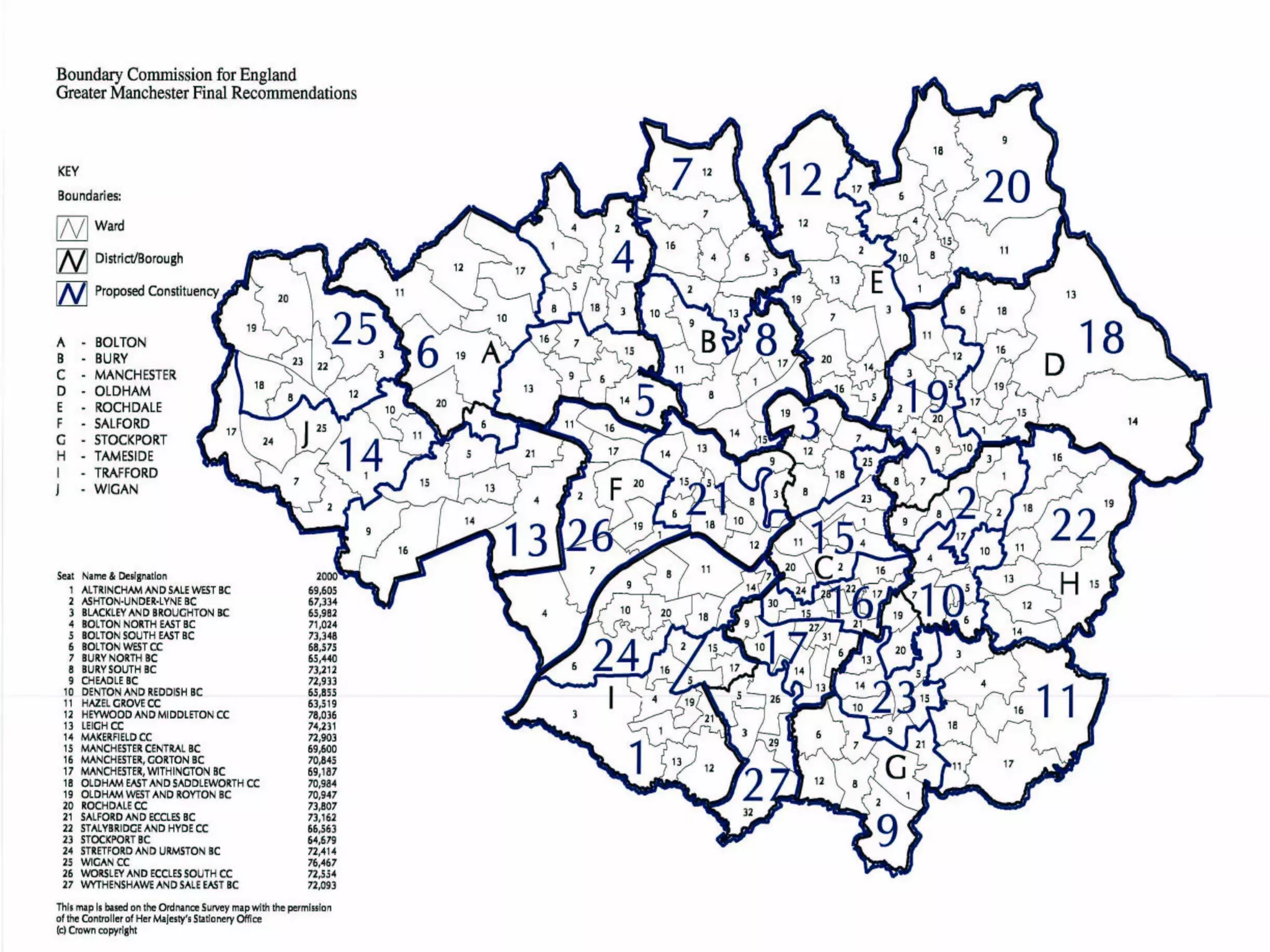
What is Manchester?
http://www.statistics.gov.uk/geography/changing_geog.asp
Our Changing Geography
The UK is said to have more administrative boundary
changes per year than the rest of the European Union
put together. This section provides further information as
follows:
Boundary Changes: Reviews the reasons for and
processes of electoral ward/division boundary changes.
Local Government Restructuring: Reviews major
changes to local government structure since the 1960s.
Includes information on the 1990s Local Government
Reorganisation (LGR) and details of possible future
changes linked to the introduction of regional
government.
City / City Regional reification
The manchester case
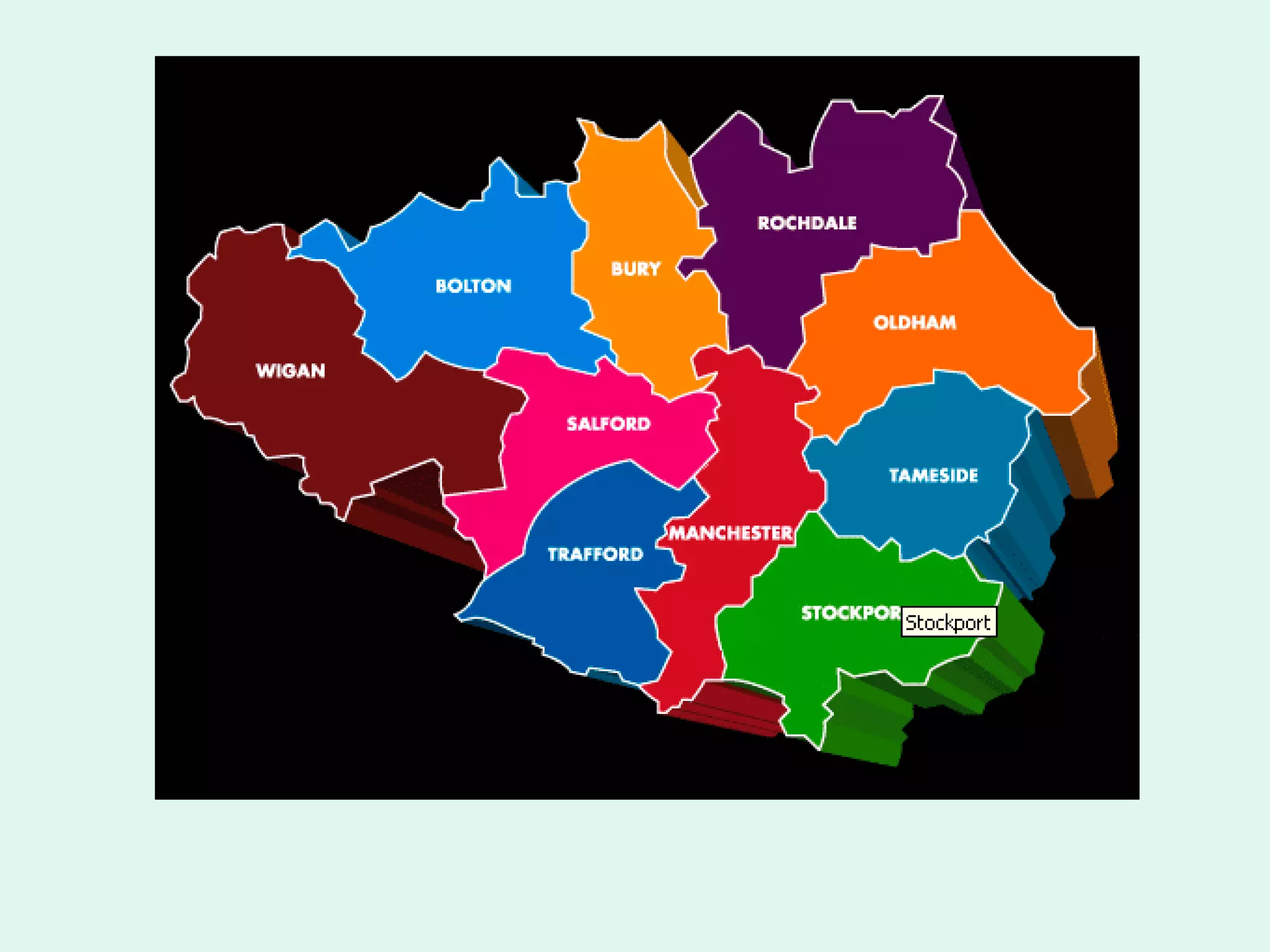
• What are the features of the local governance partnership
architecture in the Greater Manchester city region?
• How are existing institutions connected?
• What are the connections back to National policy agendas?
• What other international models are in play?
• Is it unique in the UK? If so in what way?
• Are the movers and shakers “the good guys”?
Contention; there is something about manchester ;
confidence, autonomy, stability, leadership, assertive
bargaining stance with the centre (bombast?) (Robson -
Mancunian Ways)
“we use the bits of the SNR which fit our agenda and throw
out the bits that don’t”
Features of political landscape in manchester city region
• Helpful in explaining why confident city-regional
governance may flourish in Greater Manchester
• Straightforward, horse-trading politics of this…
• Traditional Labour authorities (leader of Wigan/AGMA since
1984)
• Entrepreneurial authorities (Manchester/Salford)
• Lib-Dem oppositional authorities
• Role of non-Executive Cllrs
• Role of communities/3rd
Sector
• MPs many with LG background
“we always had better discussions around policy within Labour
Group than we do in the PLP…you have to work out how to
be effective as an MP whereas in the council your authority
is far more direct and tangible”
what have they created?
• Using an MAA bidding process (first in the
queue)
• Building on AGMA, radically reformed
• Incorporating TIF
• Linking through to LAA structures
• Stretching democratic mandate (!)
• Working with business leaders (6/7)
A “Commission” model (QMV, delegated
authority comparable to EU commission)
• 7 City Regional Thematic Commissions
• Economic one central and fully formed
others immanent (?!)
Compare and contrast with readiness in other
MAA areas ?
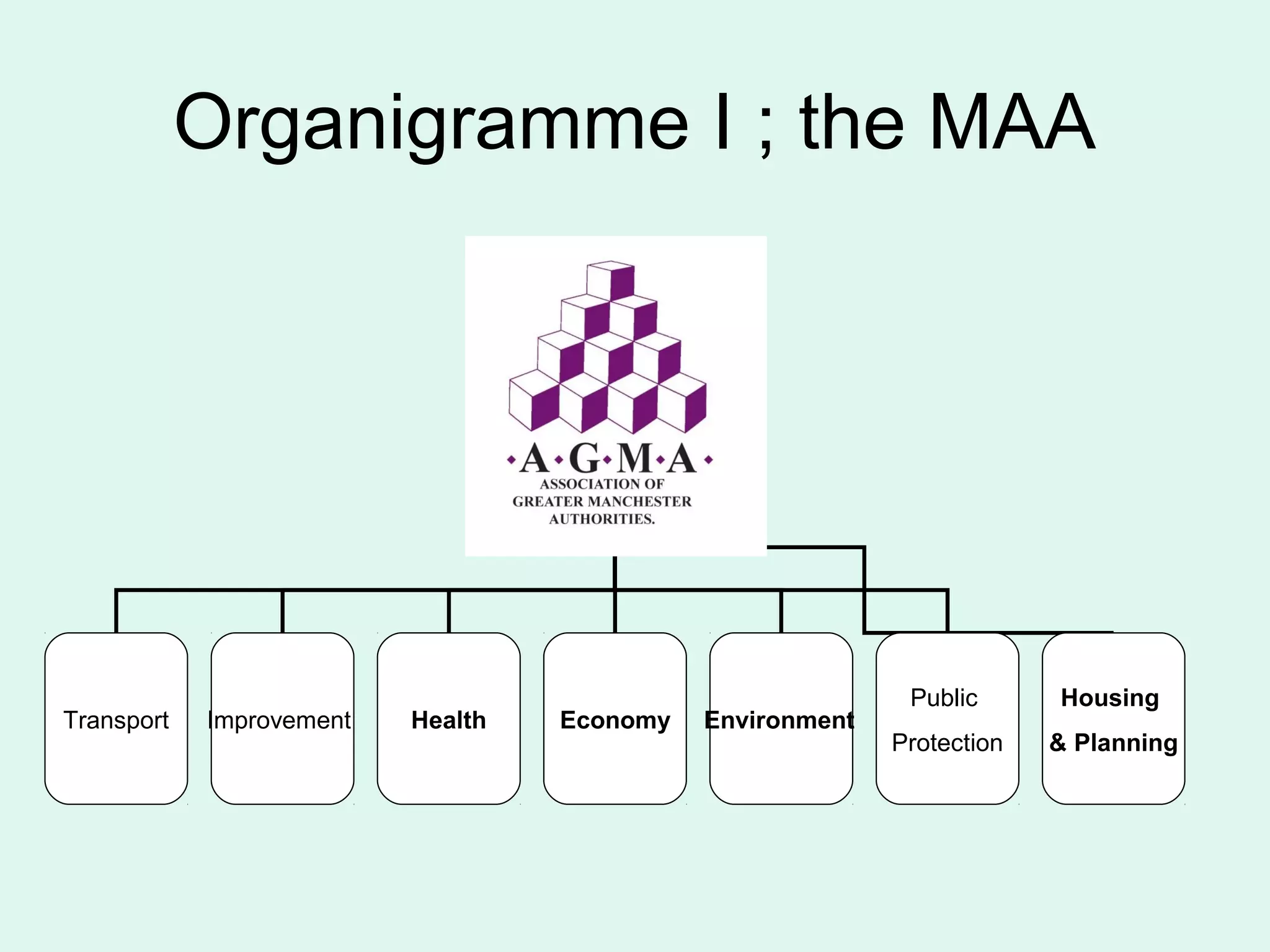
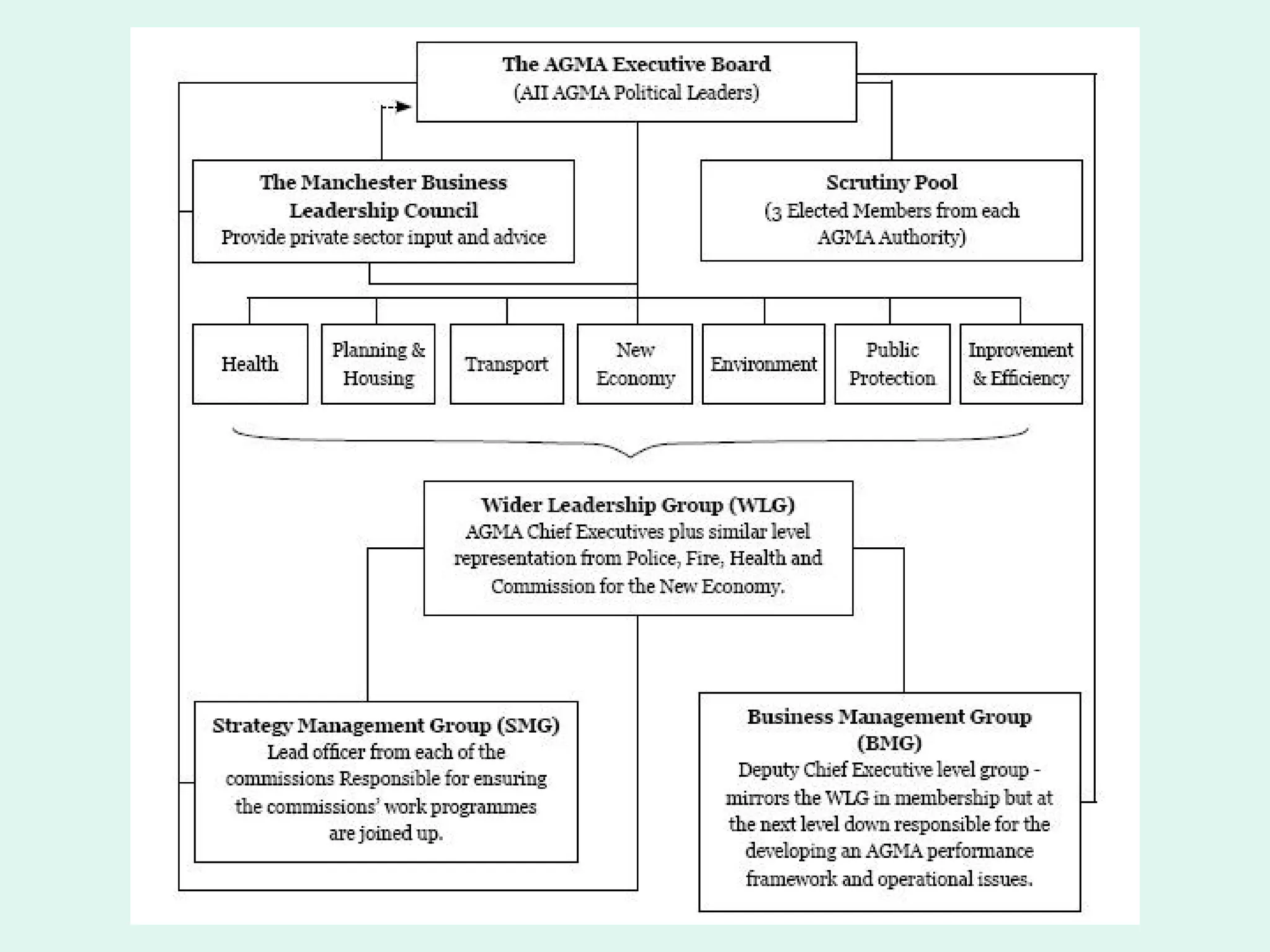
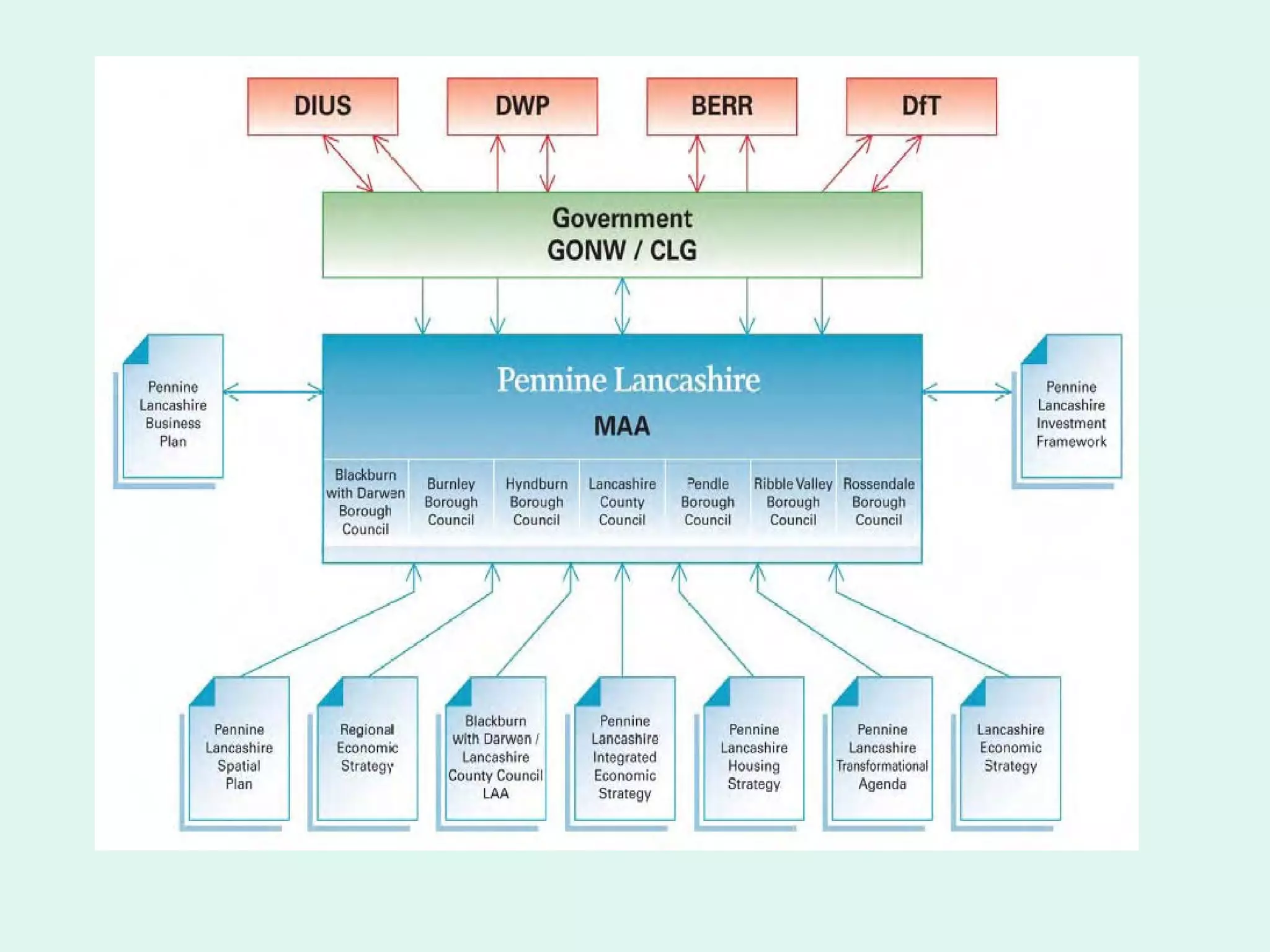
Organigramme I ; the MAA
Transport Improvement Health Economy Environment
Public
Protection
Housing
& Planning
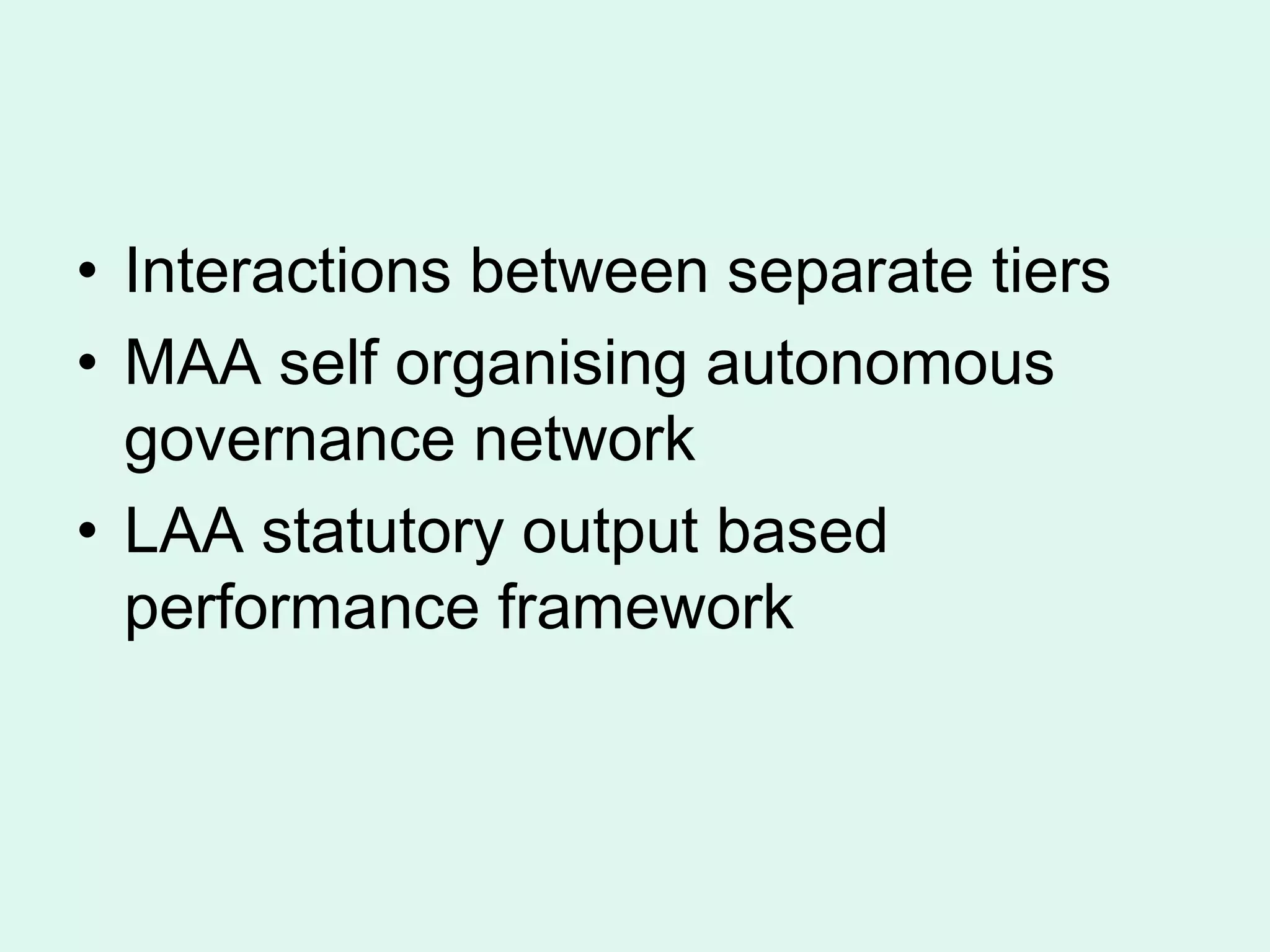
• Interactions between separate tiers
• MAA self organising autonomous
governance network
• LAA statutory output based
performance framework
How Manchester is managed, 1935
Regional Planning : The most effective planning
scheme is one which is comprehensive in
character and not limited by the artificial
boundary of a local authority’s area. It’s
success depends upon (1) securing an area
capable of economic development (2) effective
joint action with neighbouring authorities
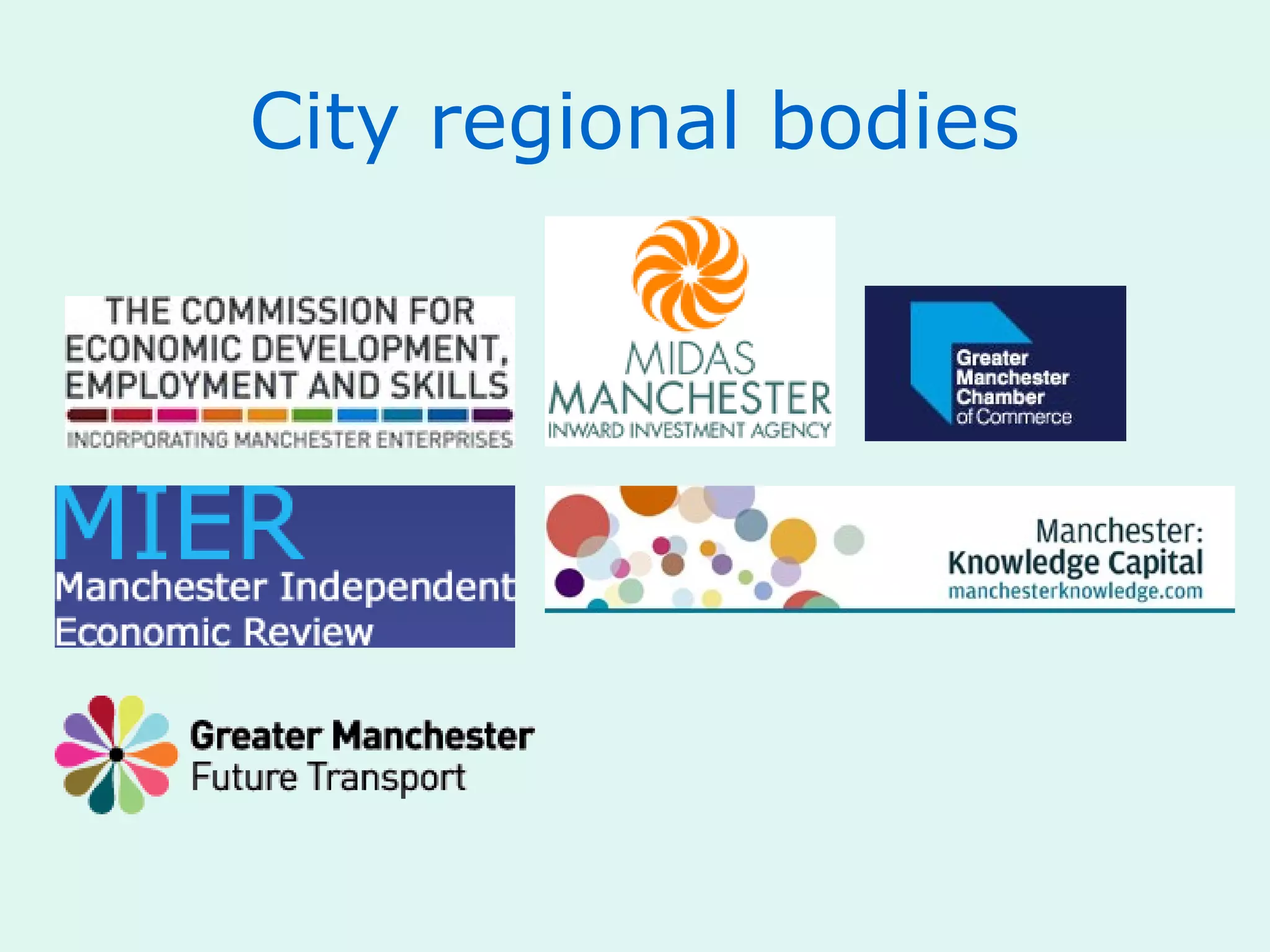
City regional bodies
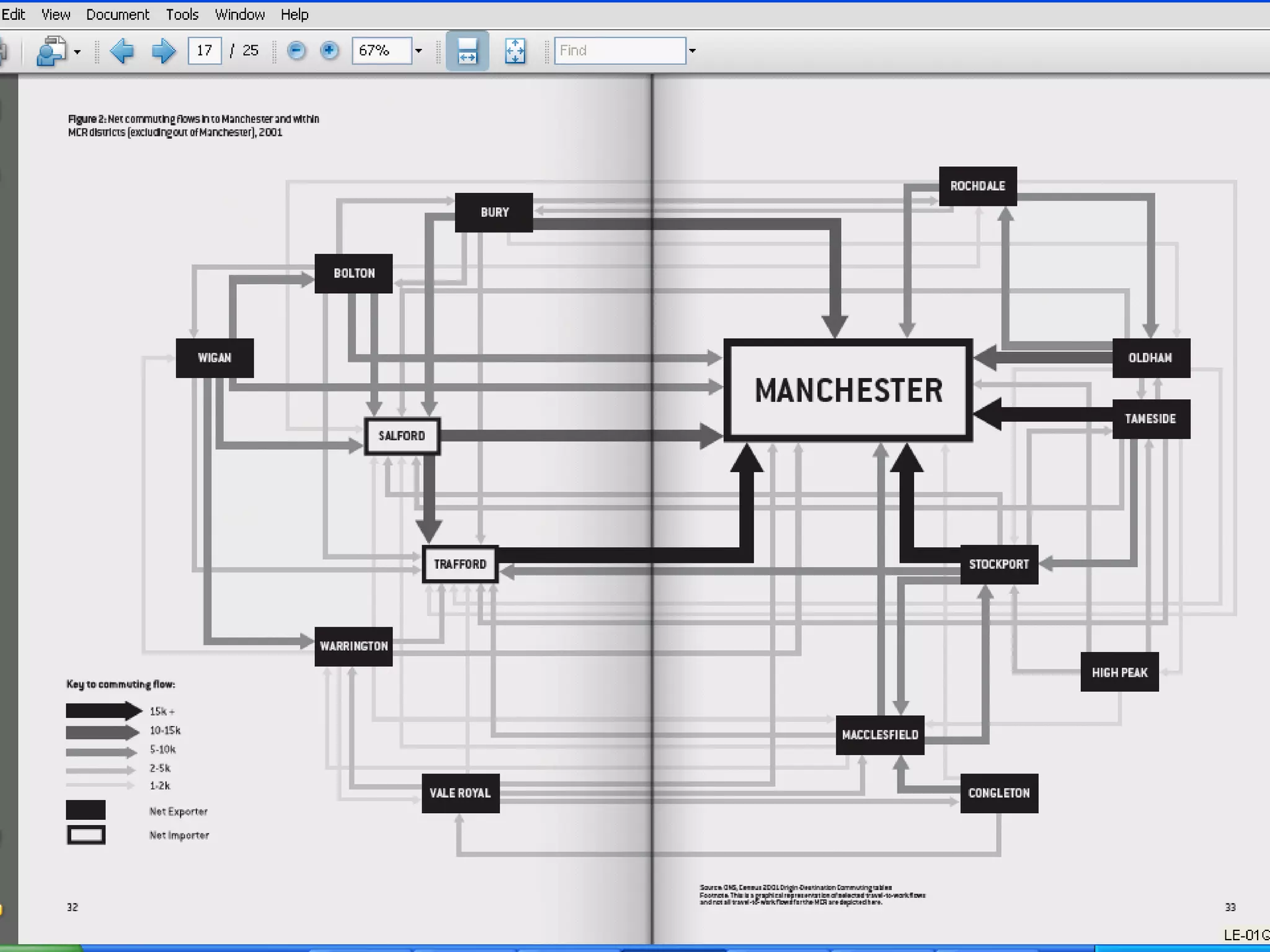
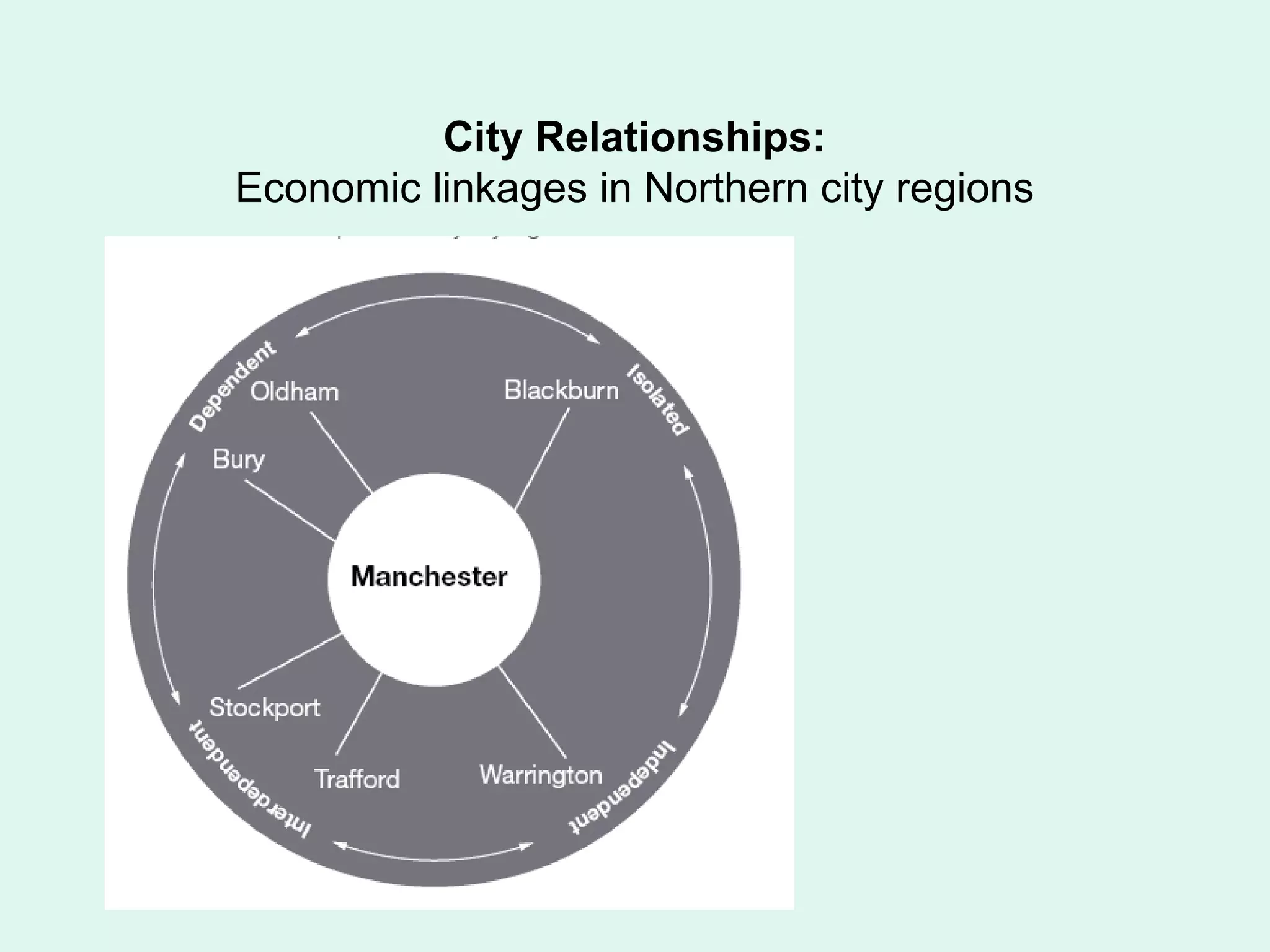
City Relationships:
Economic linkages in Northern city regions
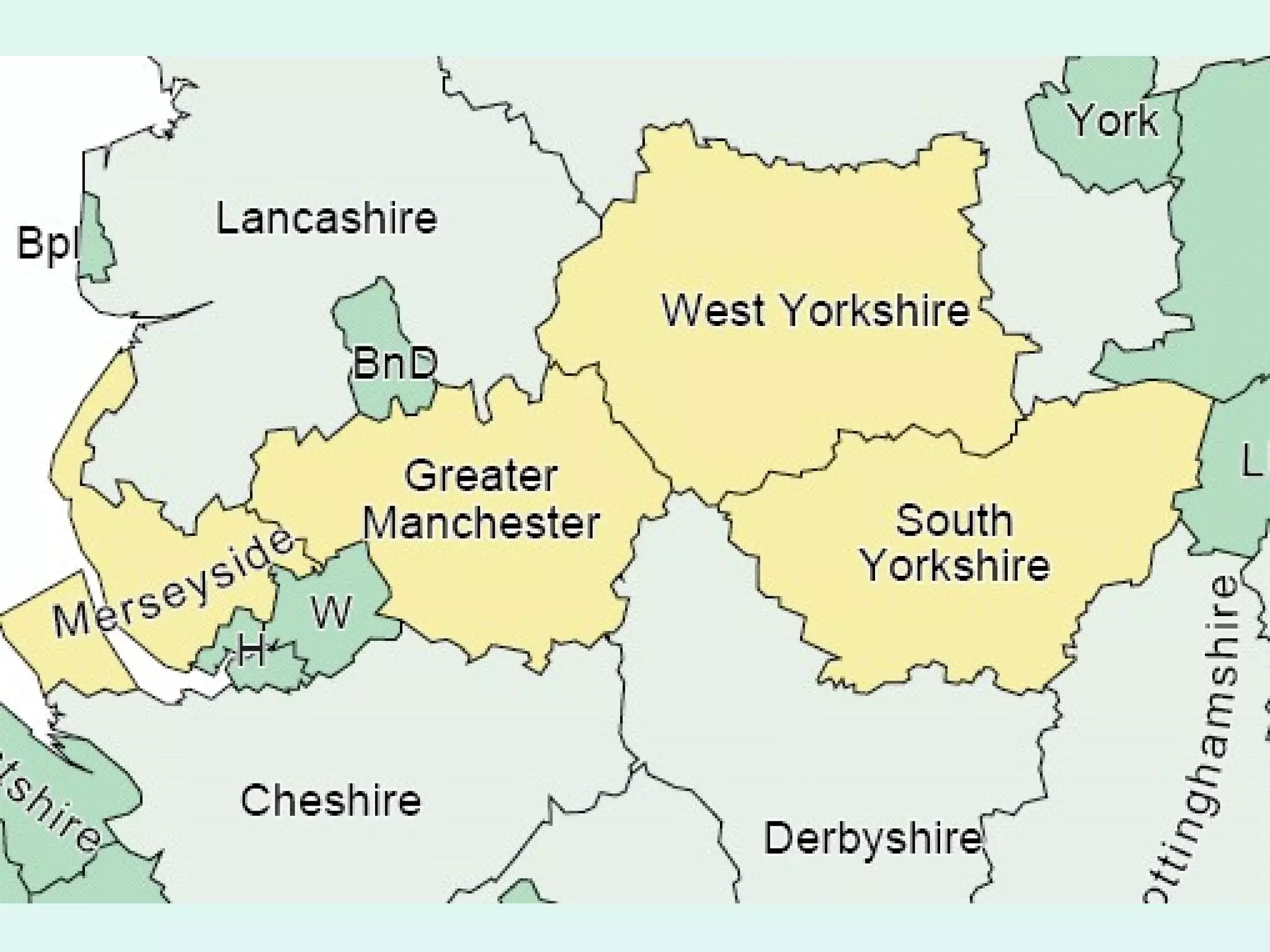
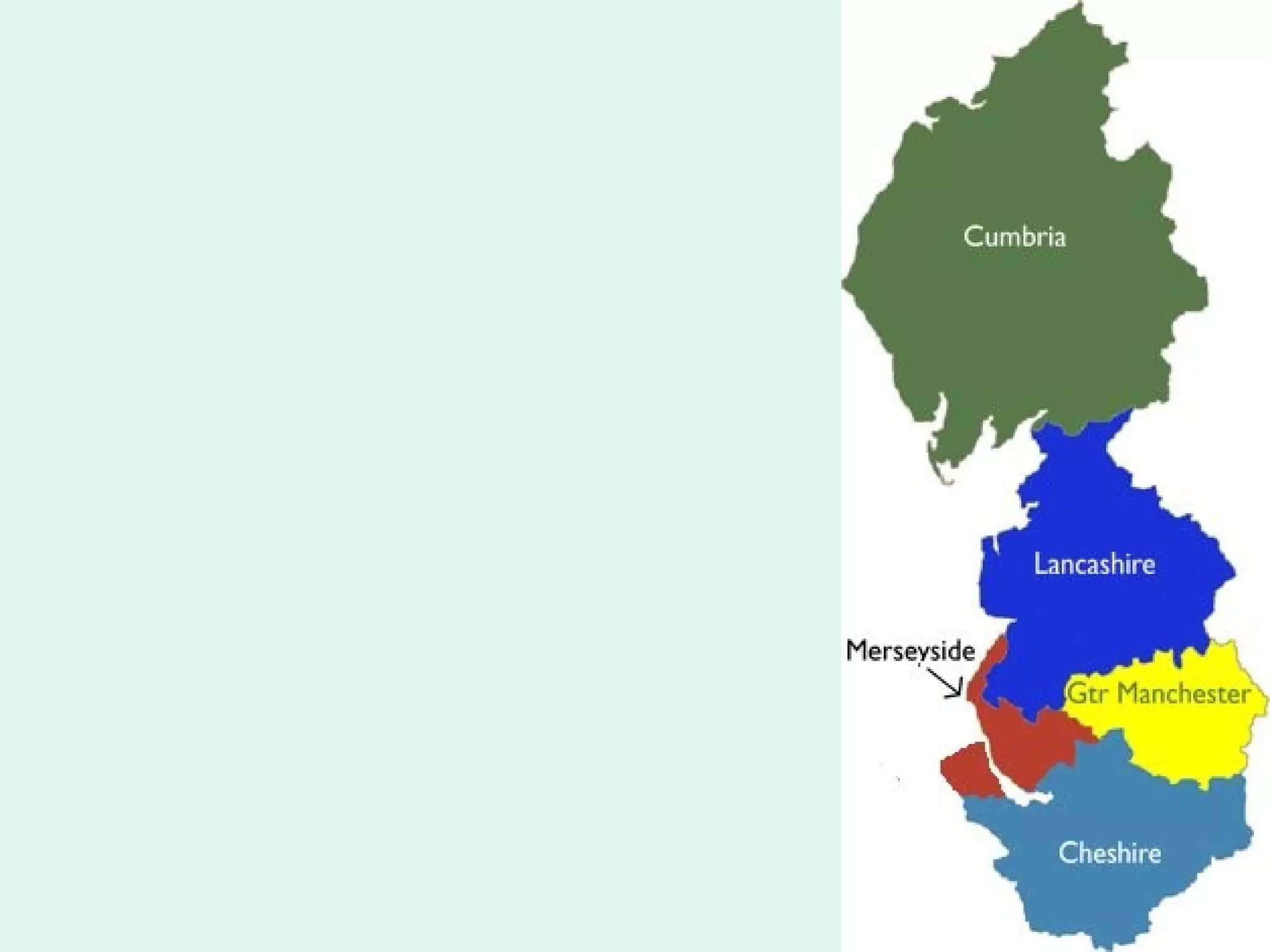
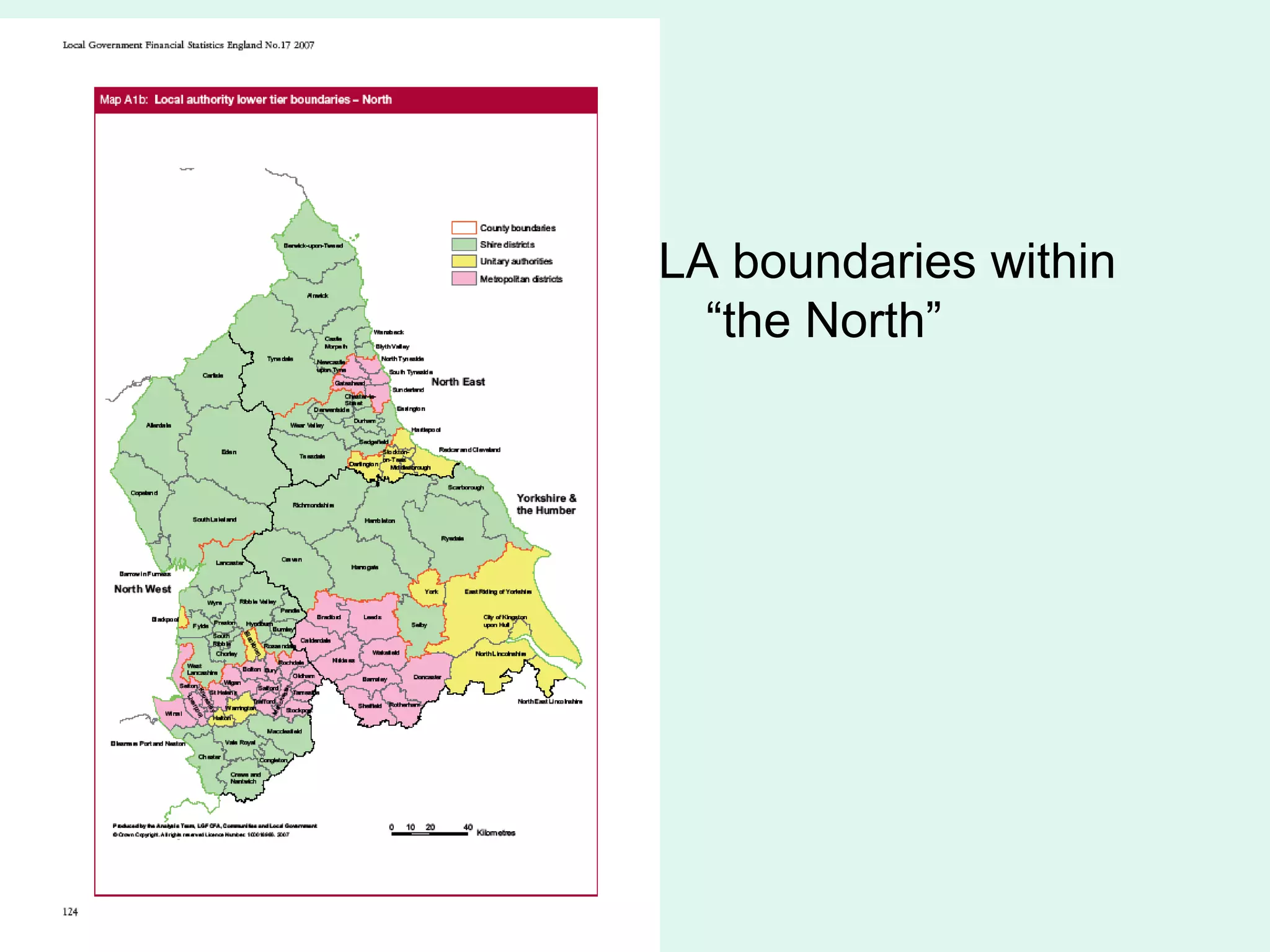
City Regions and the North
LA boundaries within
“the North”
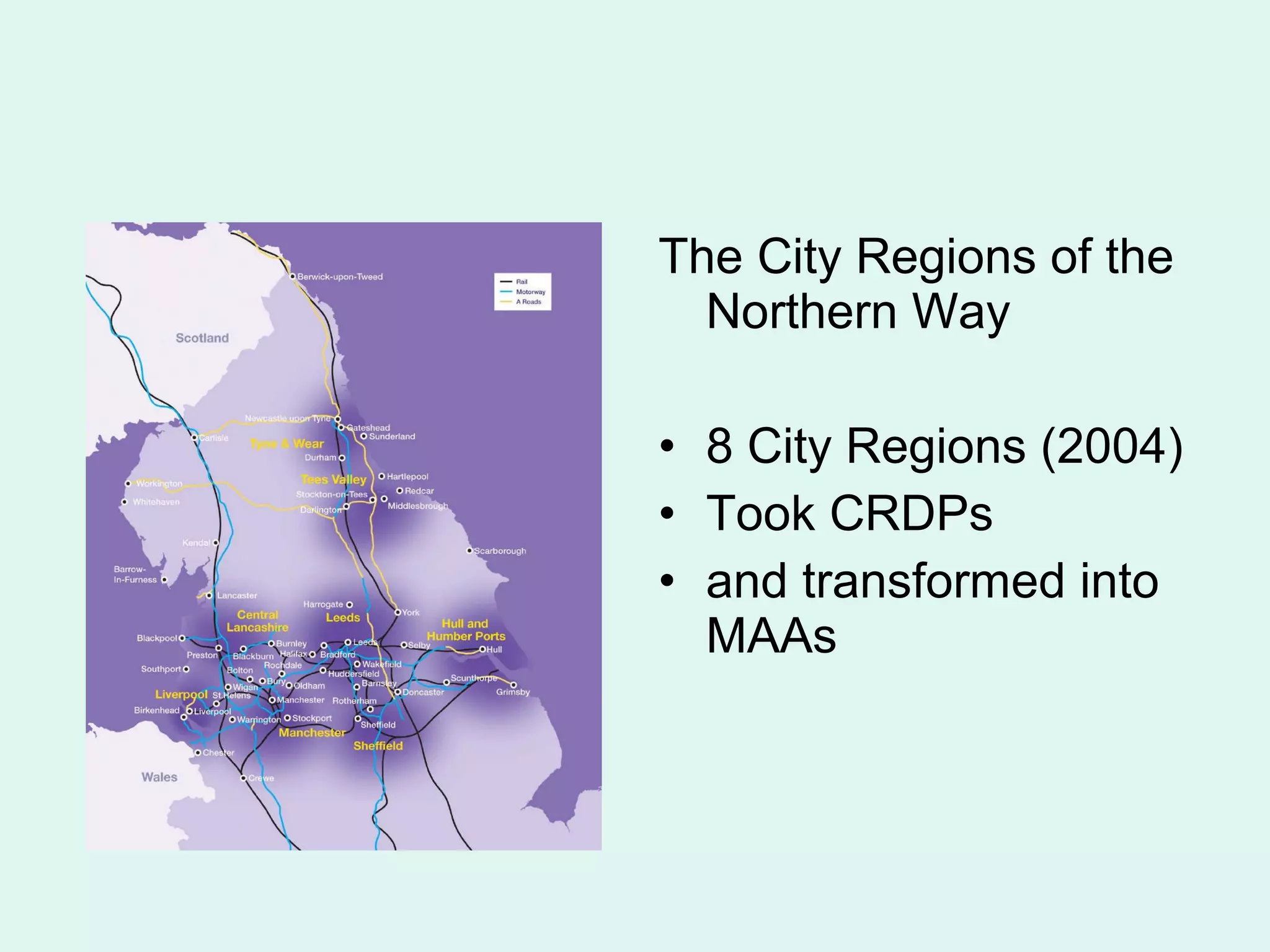
The City Regions of the
Northern Way
• 8 City Regions (2004)
• Took CRDPs
• and transformed into
MAAs
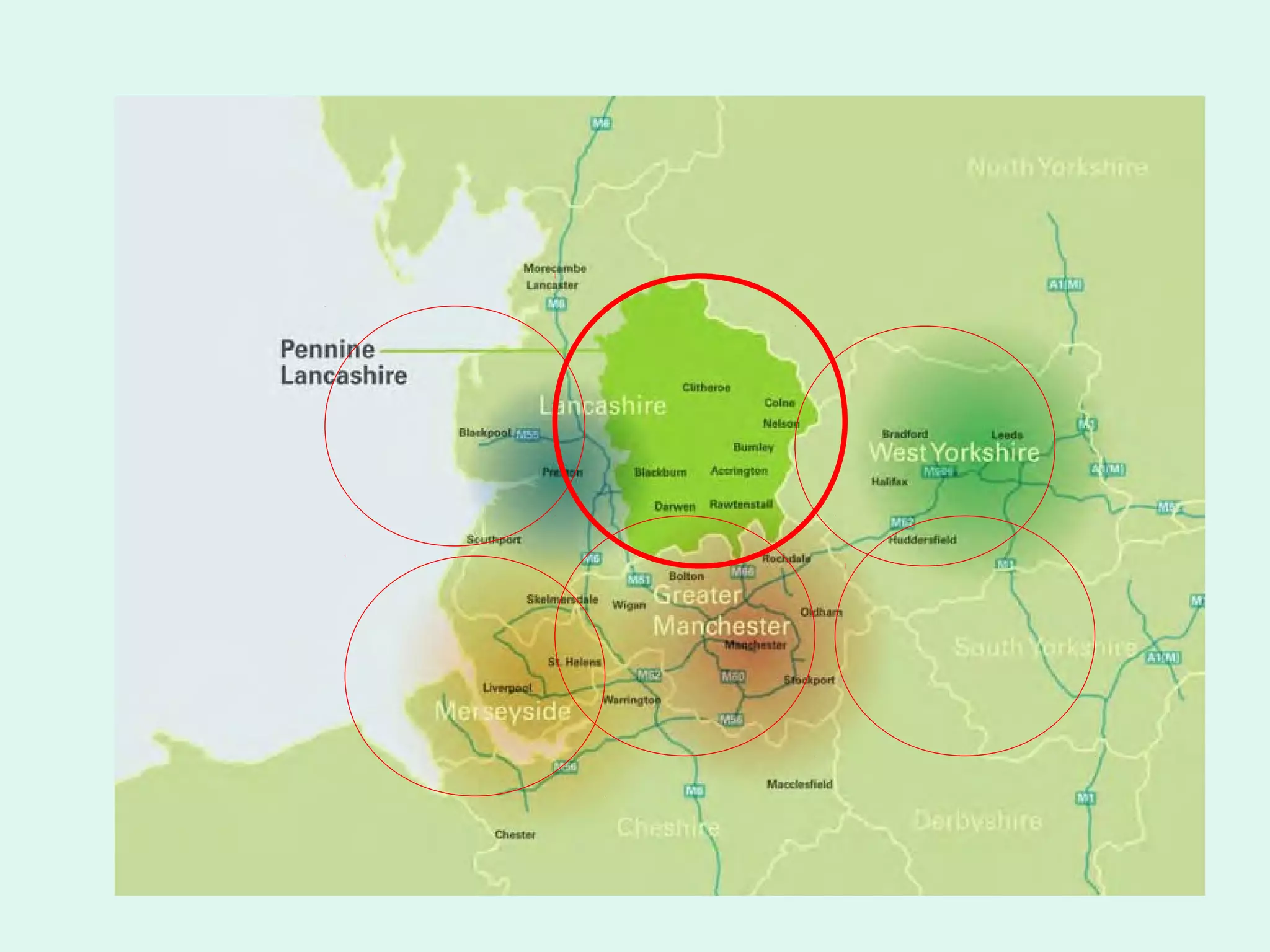
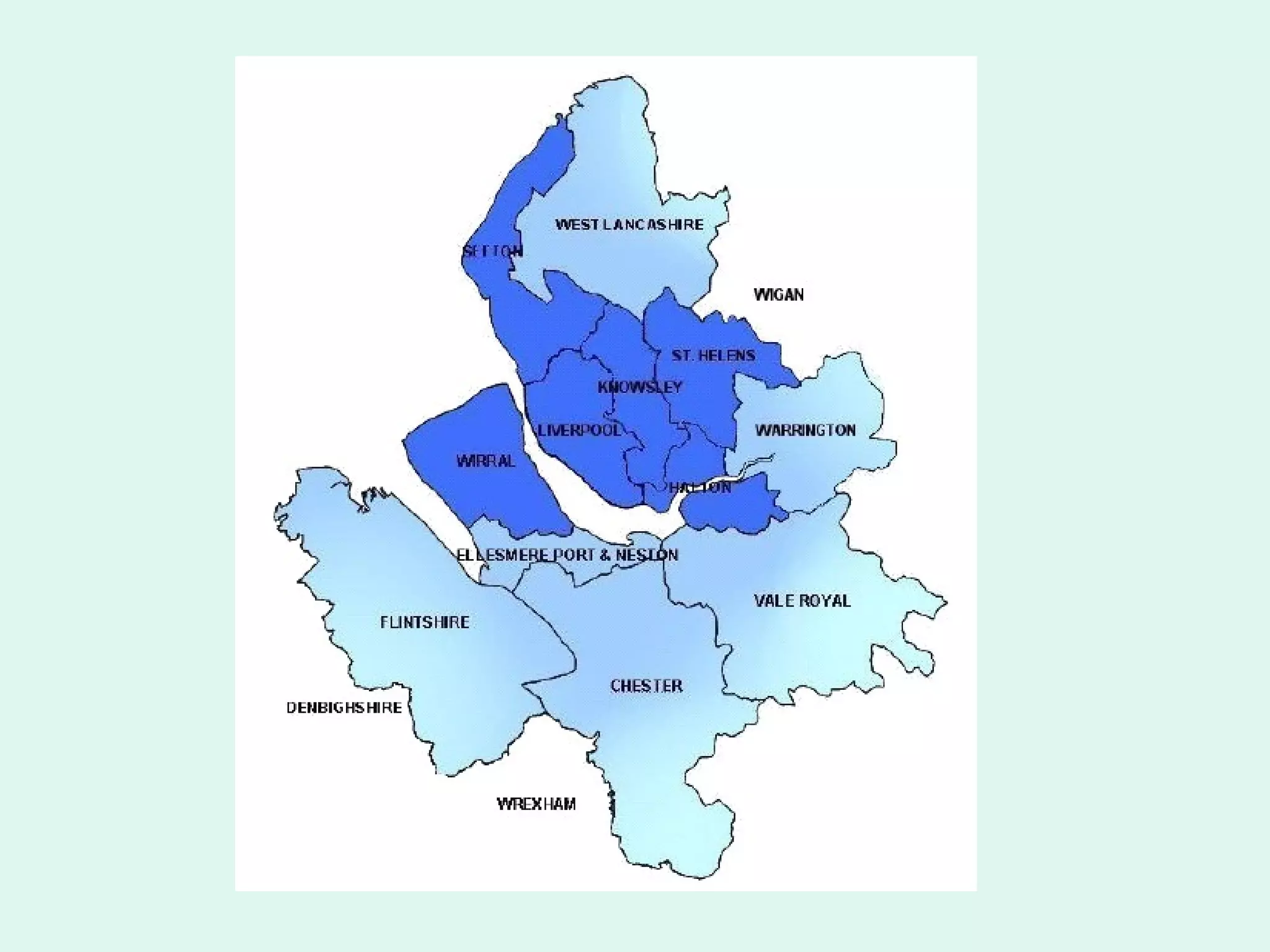
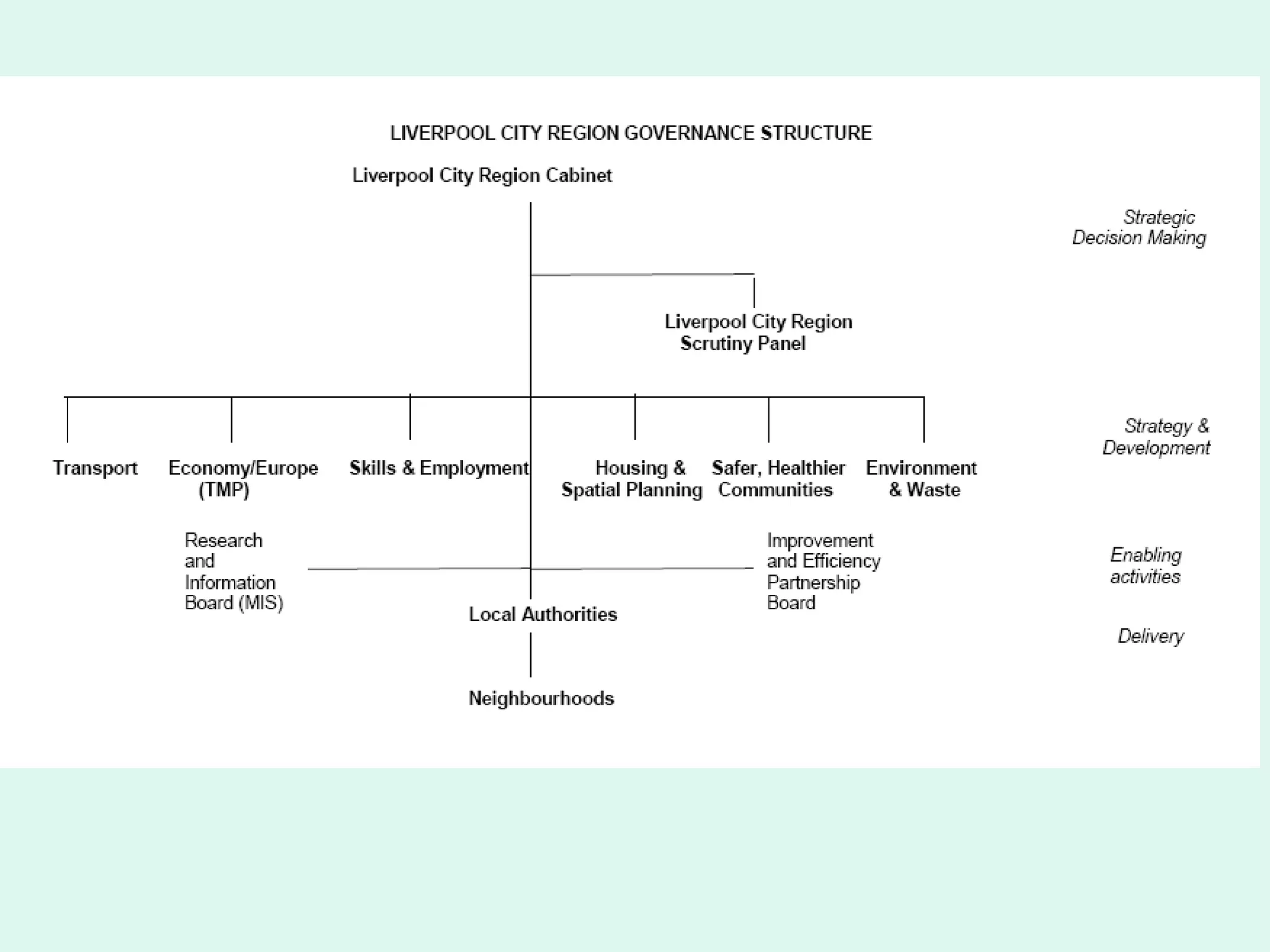
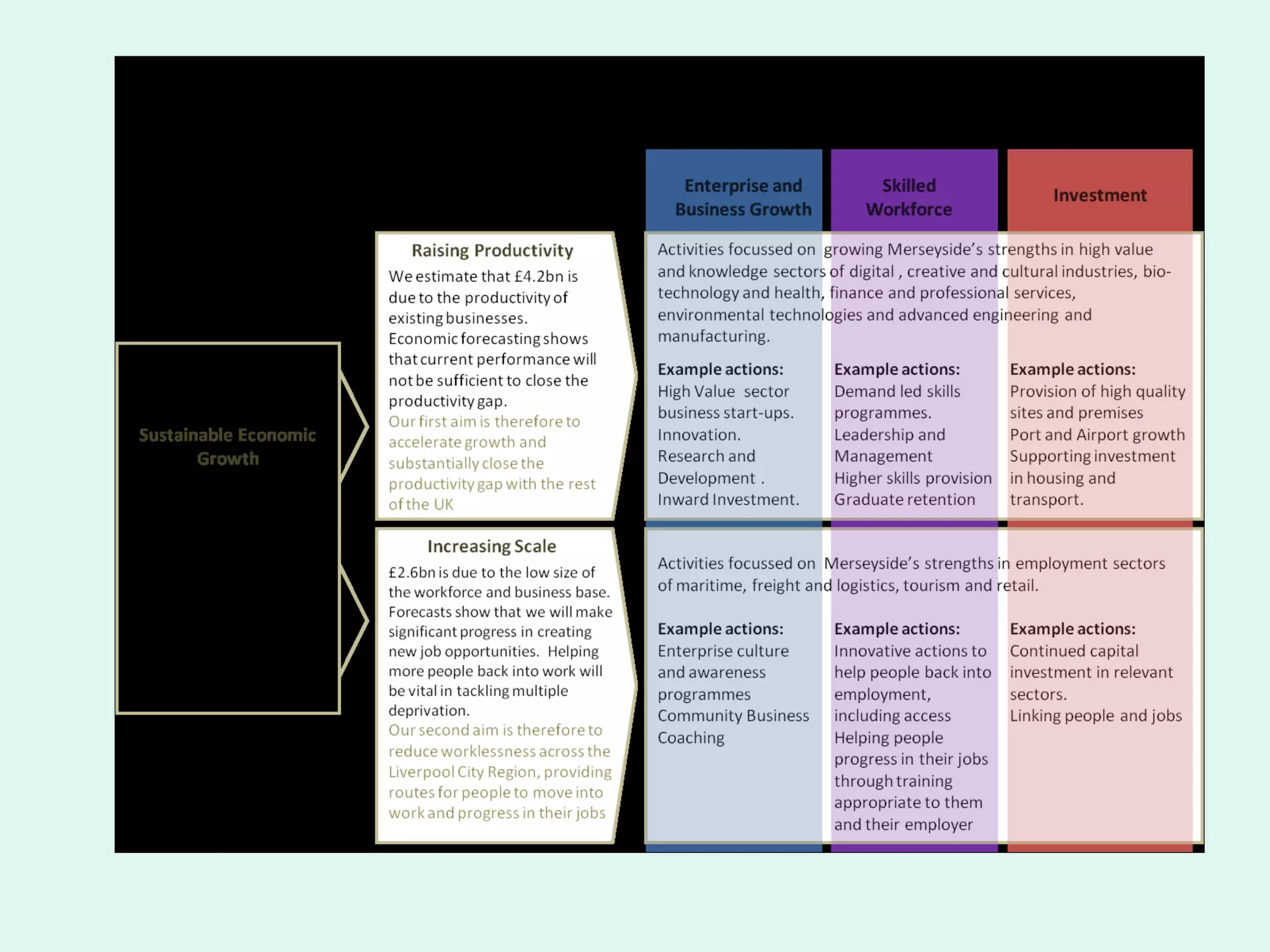
Mersey MAA
Merseyside MAA
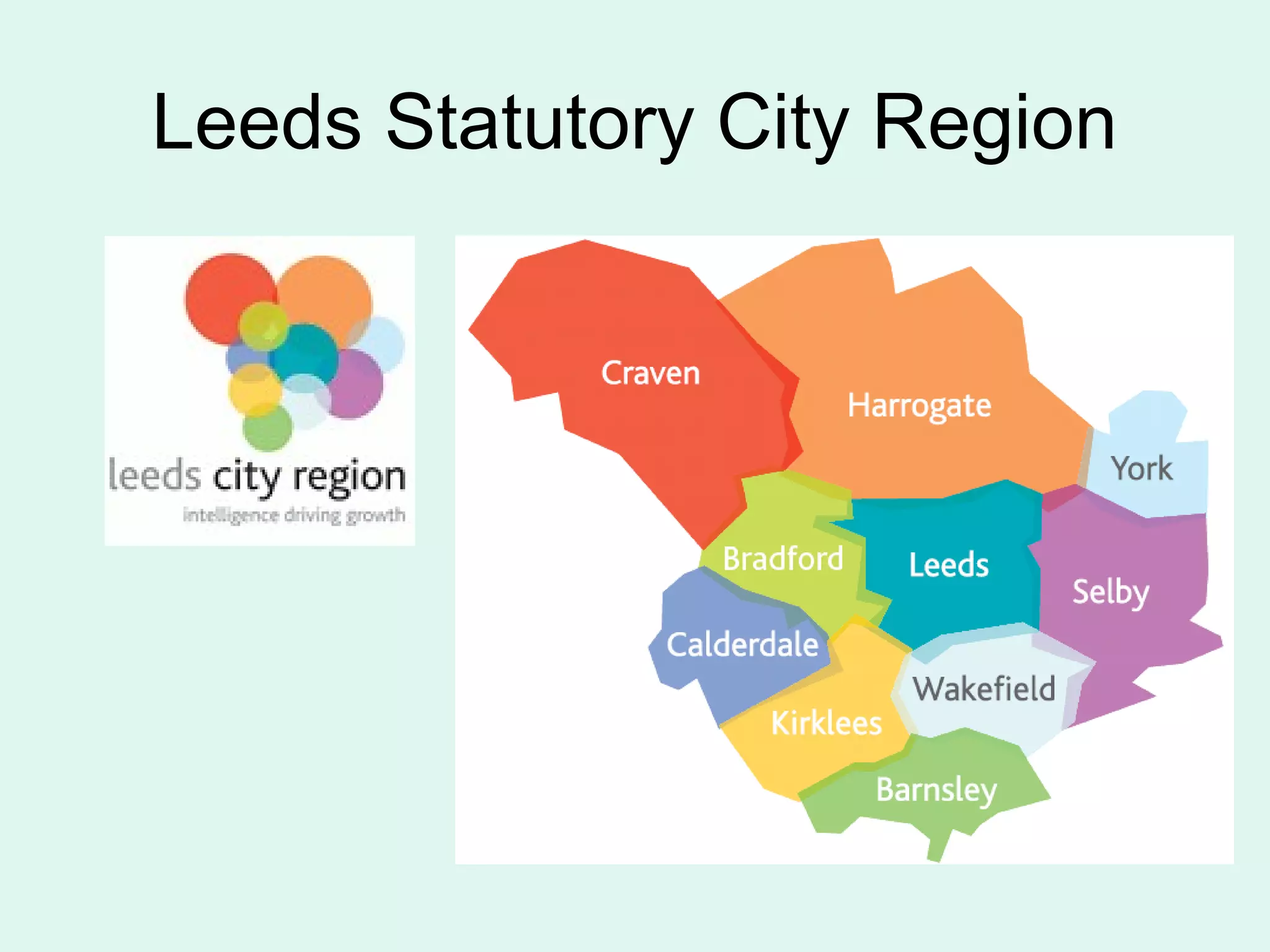
Leeds Statutory City Region
Part Five : Treating
Governance NWs as NWs
reification
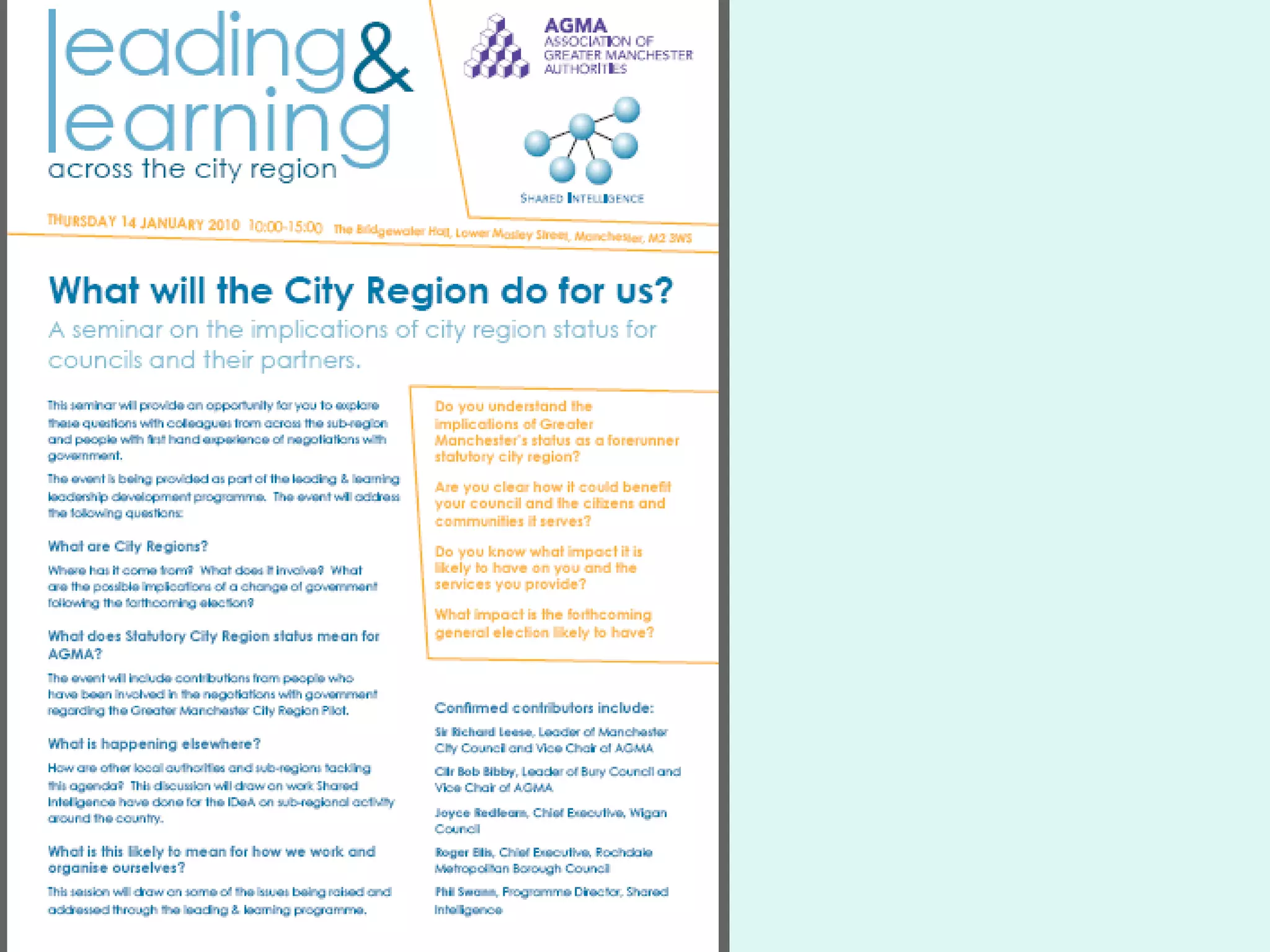
City-regional institution building in Manchester.
A social network analysis approach to the new
partnership governance architecture.
James Rees and Nicola Headlam
University of Manchester
November 2008
‘eternal mobility’ in sub-national
institutional restructuring
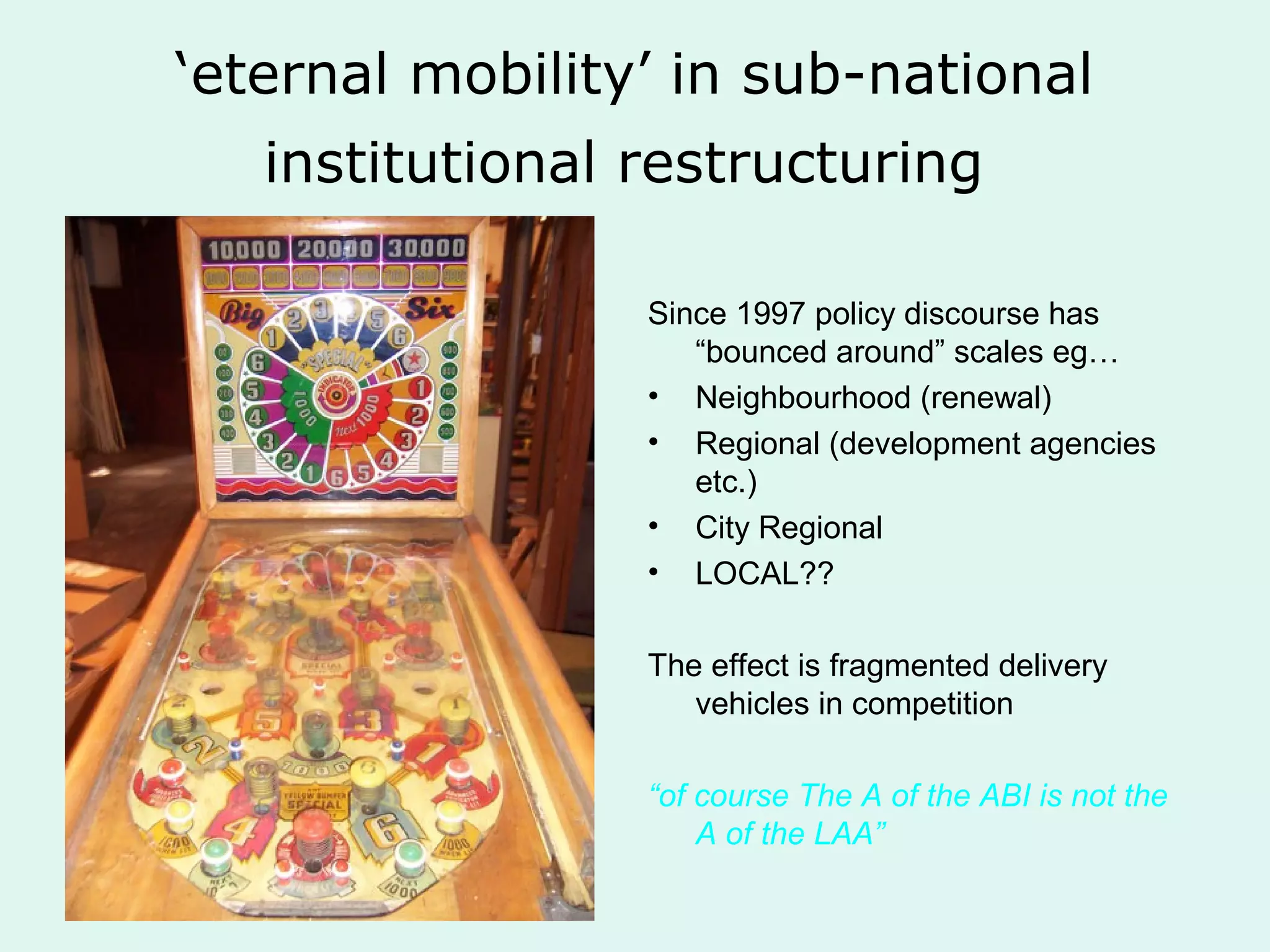
Since 1997 policy discourse has
“bounced around” scales eg…
• Neighbourhood (renewal)
• Regional (development agencies
etc.)
• City Regional
• LOCAL??
The effect is fragmented delivery
vehicles in competition
“of course The A of the ABI is not the
A of the LAA”
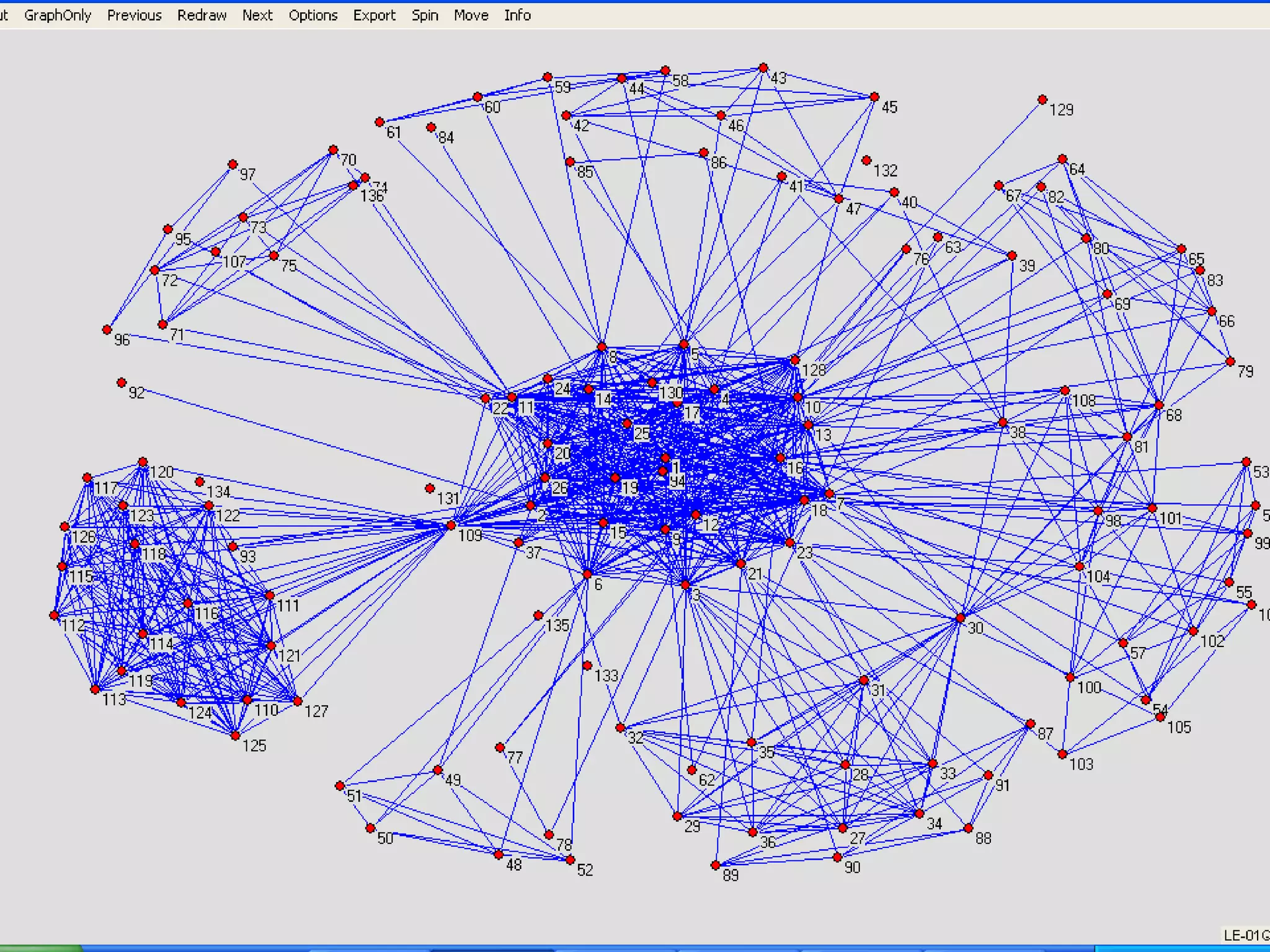
Treating complex networks as
complex networks!
• From formal network theory – own
terminology!!
• Clique governance is presented as ideal
for innovation
• The role of brokers /boundary spanners is
very important
• SNA ; ideal type clique governance via
brokers
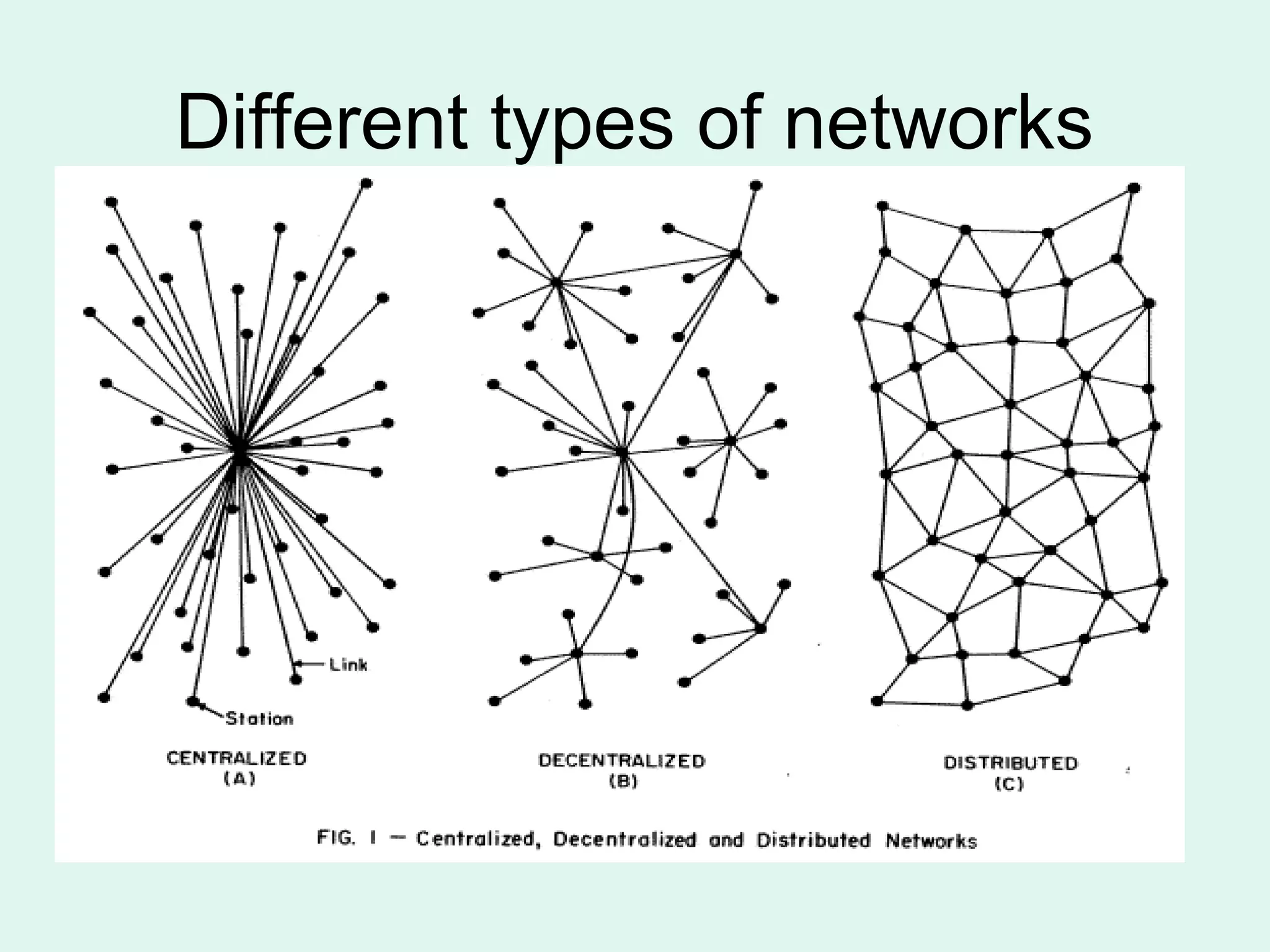
Different types of networks
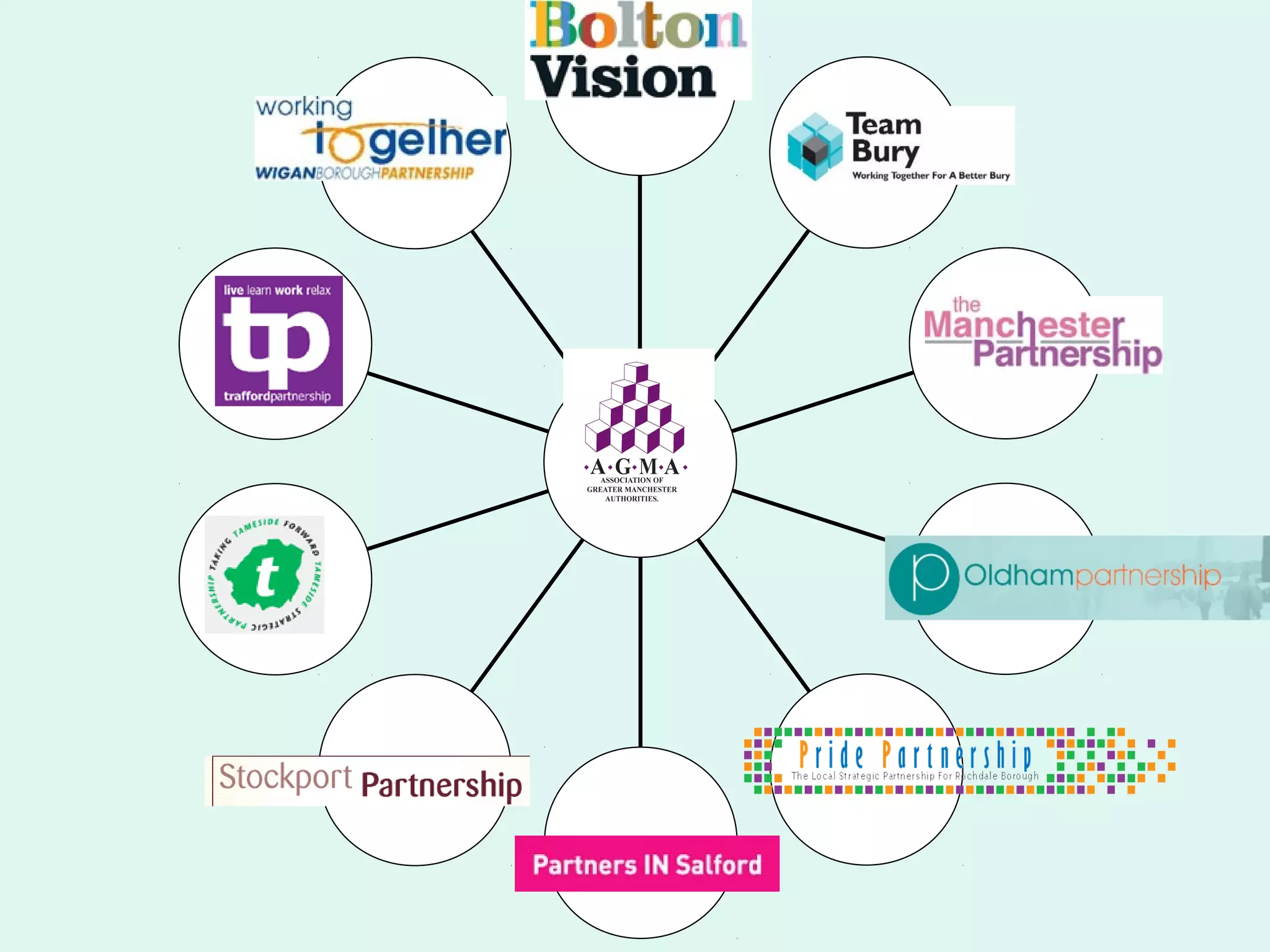
AGMA
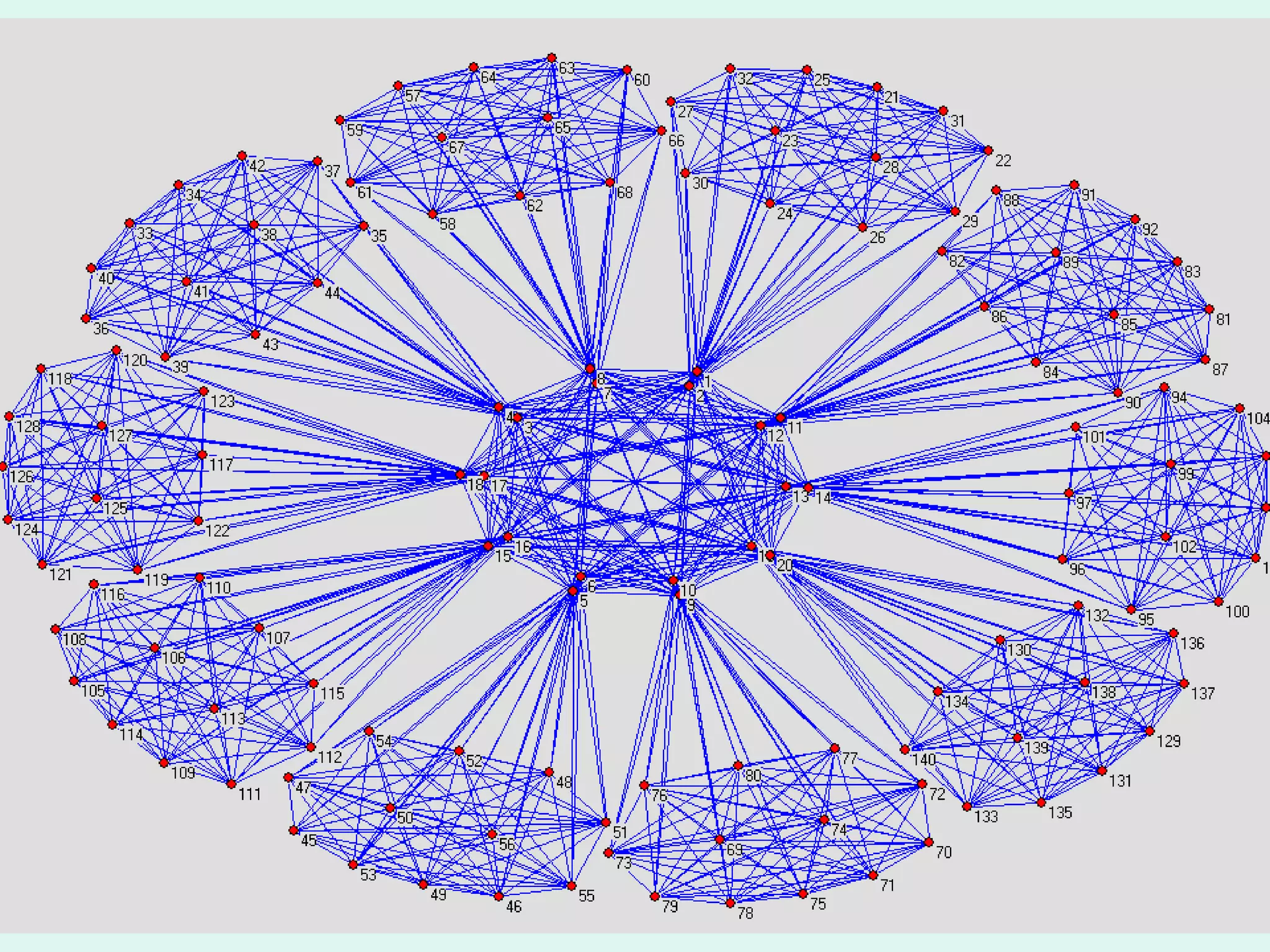
SNA Greater Manchester MAA-
LAA (accountabilty)
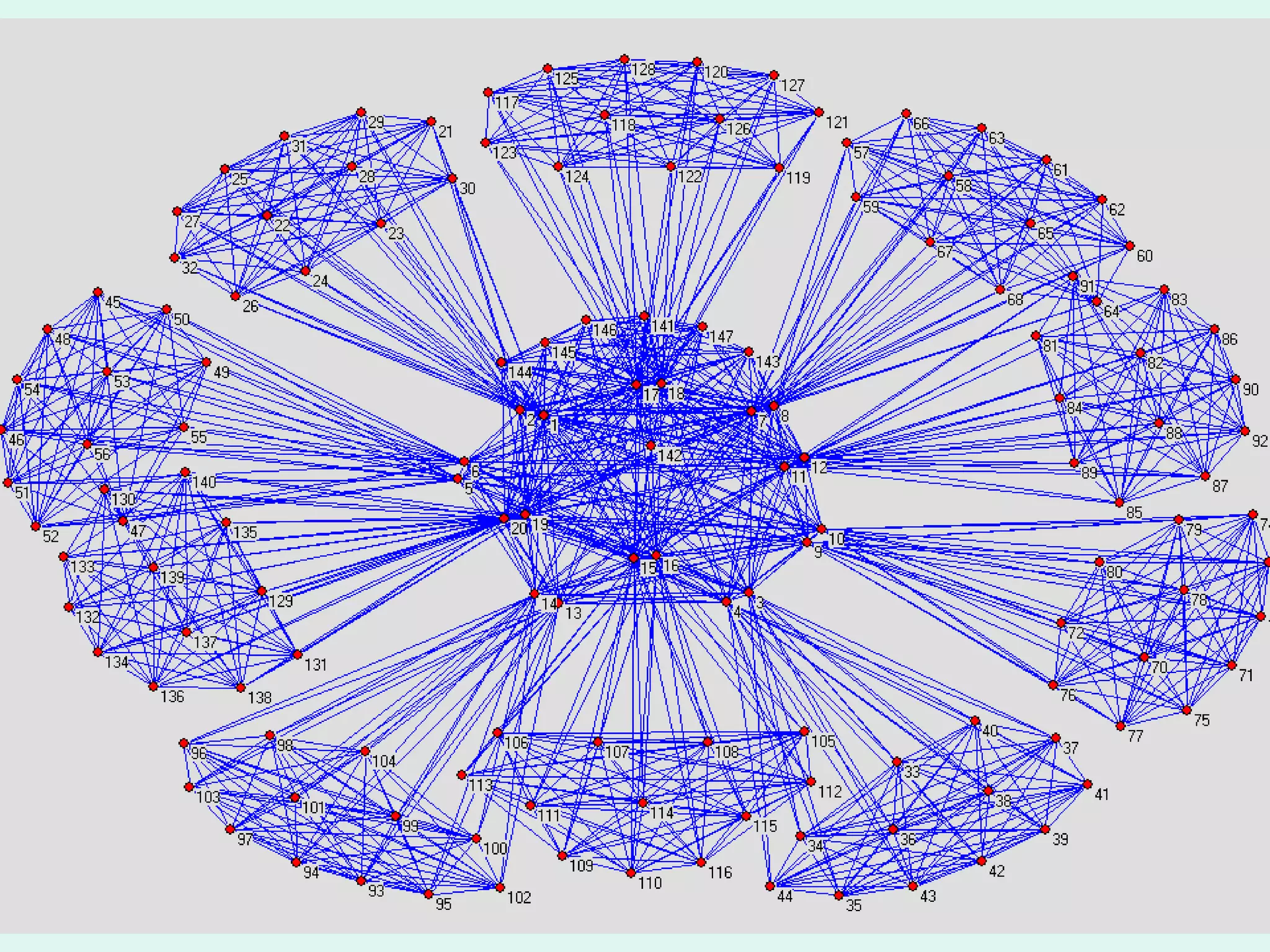
SNA with local government
decentred
Summary : Urban Policy
Urban Policy “Laboratory” fast moving and
complex
policy areas dynamic and in tension
Regeneration and economic development
Local Government Modernisation
Performance Management and
Measurement
Summary : Policy mechanisms
• Underlying logics re: fragmentation and
strategic oversight in tension with
democratic accountability, political
oversight show up in various mechanisms
• PSA regime (National)
• MAA/EPB/SCR (City Regional)
• LAA (Locality plus)
Summary : Recession
• Recession offers new challenges for city
and locality leaders
• Barcelona Principles could underpin
responses
• As could increased sub-national working
Summary : Manchester
• Manchester Governance is an atypical
case
• Current city regional interest builds on
longstanding partnership activity
• Greater Manchester City Region and the
roles of Manchester Enterprises, the
Commission and AGMA have changed
rapidly
Summary : City Regions
The rise of the City Region is connected to
“a little regional difficulty” from ERAs and
the critique of RDAs
They are the preferred sub-national spatial
fix of the moment
They look “tory-proof”
Leeds is edging ahead of Manchester in
SCR stakes
Managing the Complex Conurbation

Managing the Complex Conurbation

  • 1.
    Managing the complex conurbation Market,Hierarchy and Networks in the Greater Manchester City-Region in the recession
  • 2.
    Structure Part One (50mins) 1 Introduction : managing the complex conurbation. 2 The urban policy laboratory. 3 Manchester’s LAA 4 Localities in the recession. break Part Two (50 mins) 5 Mancunian mechanisms 6 Network Analysis for treating governance networks as networks 7 Summary
  • 3.
    Handout • Table :governance and regeneration
  • 4.
    “Fundamental questions ofconstitutional structures, centre-region relations, institutional co-ordination, and public expenditure… are addressed as the perhaps unglamorous dimensions of sub- national government and governance.” (Pike and Tomaney 2004)
  • 5.
    Part One 1.1 TheUrban Policy Laboratory 1.2 Roles for Localities in the recession
  • 6.
    1.1 The UrbanPolicy Laboratory.
  • 7.
    POLICY STRAND 1Regeneration Policy [Alphabet Soup]
  • 8.
    POLICY STRAND 2The Local Government Modernisation Agenda [turning round the tanker]
  • 9.
    POLICY STRAND 3Performance management measurement, audit and inspection [drowning in documents…]
  • 10.
  • 11.
    POLICY STRAND 1Regeneration Policy [Alphabet Soup] • Multiple initiatives • Time scale • Funding • Target regime • Area of benefit • Delivery mechanism / model • Thematic focus • Client group • Governance arrangements • Partnership requirements • “initiativitis”
  • 12.
    What is regeneration? •“’Regeneration seems to offer an almost infinitely inclusive canopy under which all may be persuaded to shelter and find agreement, yet vital issues remain beyond the pale” (Furbey 1999) pg 440 • “…so urban regeneration is in principle a floating signifier but in practice it does not float very far. It is ubiquitously used to a fairly standard set of policy goals and outcomes ”(Lovering 2007) pg 344
  • 13.
  • 14.
    HO PSA Delivery PSA 5 PSA 3 PSA2 (Joint OCJR) PSA 1 PSA 4 PSA 7 PSA 6 One City Partnership (LSP) Notts Police GOEM (43Staff) 5 Police Forces; 9 DATs; 40 CDRPs; 49 Local Auth’s ProbationPrisonsNASS ASB Policing Policy Policing Standards Crime Reduction Drugs ACDCCU, REU, F NDCLCJB 9 Area Committees NOMS CJS OCJR CRCSG CommunitiesIND Nottingham City Council Police Authority Probation Inspectorate CDRP DAT CJIP Compact CPS HMIC Prisons Inspectorate Individual Regional Offices Nott BCU Probation Service YOT Courts R E G I O N A L N A T I O N A L L O C A L HMP Voluntary & Community Sector
  • 15.
    POLICY STRAND 2The LGMA [turning round the tanker] LGMA shorthand for policy interventions designed to improve (perceived) issues around  Efficiency  Accountability  Decision making Process Finance Functions
  • 16.
    drivers and levers •Change mechanisms = interactions between relevant policy drivers and levers. • Policy drivers = the general aims of government in specific policy areas • Policy levers = are the instruments available to government to effect change in public policy and services.
  • 17.
    drivers and levers: theory of change Selection of policy drivers and levers is informed by the interaction of actors exercising political judgement about priorities. As governance systems rely on human interactions attempts at steering are likely to be met with unexpected and unintended though not necessarily unwelcome reactions and outcomes. (CLG, Sullivan 2008)
  • 18.
    Tanker in FirstWorld War “Razzle-dazzle” camouflage
  • 19.
  • 20.
    POLICY STRAND 3Performance management measurement, audit and inspection [drowning in documents…] Meanwhile elsewhere in Whitehall… The Improvement Agenda (close to LGMA but not totally connected) Empowered the Audit Commission Waves of improvement BVPI – Best Value Performance Indicators CPA – Corporate Performance Assessment CAA - Comprehensive Area Assessment The PSA Regime (Public Services Agreements)
  • 21.
  • 22.
  • 23.
    PSA • Connecting manifestoto delivery mechanisms of Whitehall • Connecting to “floor targets” • In some ways odd to have to invent this… • The “machinery of government” is quite tricky…
  • 24.
    PSA match toministers (2007) Power within the Core Executive I • Figure 3 Number of PSAs for which each Cabinet Minister is operationally responsible. • Minister Department Number of PSAs • Ed Balls DCFS 5 • Jacqui Smith Home Office 4 • John Hutton DBERR 3 • Hazel Blears DCLG 2 • Peter Hain DWP 2 • Alan Johnson DH 2 • John Denham DIUS 2 • Hilary Benn DEFRA 2 • Alistair Darling HMT 1 • Jack Straw MoJ 1 • Ruth Kelly DfT 1 • James Purnell DCMS 1 • Ed Miliband Cabinet Office 1 • Douglas Alexander DFID 1 • David Miliband FCO 1 • Harriet Harman Government Equalities Office 1
  • 26.
    Underlying logic connecting •PSA regime • RIS • MAAs/EPBs/SCR pilots • LAA regime
  • 27.
    Police Duty on localcouncils and other local partners to work together to agree a single set of priorities through a Sustainable Community Strategy and a Local Area Agreement Three year delivery plan: Local Area Agreement (LAA) Council Local Neighbourhoods Local Strategic Partnership Long term Sustainable Community Strategy (SCS) Service Charter Service Charter Health Private sector Community sector Local Neighbourhoods Local Partnership governance architecture
  • 29.
    Local Area Agreements Partnershipgovernance mechanism “bastard child” of LPSA and LSP Contains many stages of development.
  • 30.
    Manchester’s Local Area Agreement 2008/09– 2010/11 Powerpoint presentation
  • 31.
    Manchester’s LAA • It’sa three-year plan to deliver our Community Strategy • It drives partners to achieve targets related to our priorities • It stimulates innovation • It builds accountability and stronger relationships • It forms a constructive relationship with the Government
  • 32.
    What’s different from thepilot LAA? • Statutory backing – all partners must ‘have regard’ for the LAA targets • Broader range of targets – some agreed with the Government and some agreed on local basis • Funding • Comprehensive Area Agreement: outcome focus
  • 33.
  • 34.
  • 35.
    Indicators and targets Theseare linked to the spines diagram • Level 1 – high-level indicators • Level 2 – indicators most relevant to spines • Level 3 – partners’ key actions • Level 4 – output and process-related actions
  • 36.
    Sustaining economic growth •Access to jobs via transport • Business growth • A green city
  • 37.
    Education and employment •Routes into work for young people • Resident wages, skills and employment • Improving education attainment and attendance • Positive parenting • Health and wellbeing • Cultural involvement to enable individual change
  • 38.
    Neighbourhoods of choice •Quality sustainable physical environment • Safer communities • Quality and choice of housing • Locally focused services • Sense of place and community pride • Safer, cleaner, greener
  • 39.
    Building self-esteem andrespect • Aspiration, wellbeing and happiness • Building social capital • Community cohesion
  • 40.
    Partnership delivery • Innovation– to speed up improvement • Resources – to make full use of all we have • Improve partnership working to do better at: – Commissioning – Communication – Value led improvement – Partnership governance
  • 41.
    Role of electedmembers • Community leadership • Neighbourhood focus • Thematic leadership • Overview and scrutiny
  • 42.
  • 43.
    Manchester’s LAA 2008/09 –2010/11 www.manchesterpartnership.org.uk
  • 44.
    Part 3: Roleof localities in the Recession Policy SNR • Regeneration Framework • Parkinson report • CLG / BIS
  • 45.
  • 46.
    Think tanks re:recession • LGA from recession to recovery: the local dimension • CLES toward a new wave of local economic activism • Work Foundation: Recession and Recovery: How UK cities can respond and drive the recovery
  • 47.
    Role of citiesin a recession Discuss in pairs/threes for 5 mins… What is the role of a city/locality in the recession? None? – let the market do it’s thing? Welfare? role of partners eg. jc+ Leadership? Others – want 6 please
  • 48.
    Ideopolis - WorkFoundation
  • 49.
    Barcelona Principles –The Work Foundation i. Don’t waste the crisis, but respond with leadership and purpose. ii. Make the case for continued public investment and public services and the taxes and other sources of investment required. iii. In the long-term: build local economic strategies which align with long-term drivers and identify future sources of jobs, enterprise, and innovation. iv. In the short-term: focus on retaining productive people, business, incomes, jobs, and investment projects. v. Build the tools and approaches to attract and retain external investment over the long-term. vi. Build genuine long-term relationships with the private sector, trade unions, and other key partners. vii. Take steps to ensure the sustainability and productivity of public works, infrastructure, and major developments/events. viii Local leaders should act purposefully to support their citizens in the face of increased hardship. ix. Local economies have benefitted and should continue to benefit from being open and attractive to international populations and capital. x. Communicate and align with national and other higher tier governments.
  • 50.
    LGA ● London isthe region most likely to underperform the national average in a recession, and the South-West the least; ● Major cities outside London such as Newcastle, Leeds and Manchester are likely to do better than the capital. This research strongly suggests that the most effective way of targeting a response to recession in the places it will make the most difference is to continue with the policies of devolving economic decision-making to which the government has committed itself. In time of a recession, the need for devolution to sub-regions, including counties, functional economic areas, local council partnersships and individual local authorities becomes more obvious and more urgent.
  • 51.
    Role of localitiesin the recession : political considerations
  • 52.
  • 53.
    Books • Managing thecity: the aims and impacts of urban policy Brian Turnbull Robson 1987 • Managing the city eds Liddle, Diamond, Southern 2007 • City of Revolution eds Ward and Peck • How Manchester is managed 1925-1939
  • 54.
    Stories of “Mancunianways” • Mancunian Ways : the politics of regeneration Robson (Chapter 3 City of Revolution) • Metropolitan Manoeuvres : making greater Manchester Deas and Ward (Chapter City of Revolution) • Greater Manchester – ‘up and going’, 2000 Hebbert and Deas • Greater Manchester : conurbation complexity and local government structure Barlow, 1995 • Manchester: Making it Happen Hebbert, 2009
  • 55.
    Think tanks: Manchester •Work Foundation : Ideopolis • Localis : Can Localism Deliver? Lessons from Manchester • Policy Exchange : Cities Limited • NESTA : Original Modern : Manchester’s journey to innovation and growth City publications
  • 56.
    What is Manchester? •Political • Economic • Statistical • Administrative • Cultural (music and sport) Construction A Brand?
  • 58.
    Scales of Political representation •Ward Councillor (backbench/frontline) • City Council Executive (Labour) • MP • Government (Labour) • MEP NW Regional / City Regional political representatives are proxies.
  • 63.
  • 65.
    http://www.statistics.gov.uk/geography/changing_geog.asp Our Changing Geography TheUK is said to have more administrative boundary changes per year than the rest of the European Union put together. This section provides further information as follows: Boundary Changes: Reviews the reasons for and processes of electoral ward/division boundary changes. Local Government Restructuring: Reviews major changes to local government structure since the 1960s. Includes information on the 1990s Local Government Reorganisation (LGR) and details of possible future changes linked to the introduction of regional government.
  • 66.
    City / CityRegional reification
  • 68.
    The manchester case •What are the features of the local governance partnership architecture in the Greater Manchester city region? • How are existing institutions connected? • What are the connections back to National policy agendas? • What other international models are in play? • Is it unique in the UK? If so in what way? • Are the movers and shakers “the good guys”? Contention; there is something about manchester ; confidence, autonomy, stability, leadership, assertive bargaining stance with the centre (bombast?) (Robson - Mancunian Ways) “we use the bits of the SNR which fit our agenda and throw out the bits that don’t”
  • 69.
    Features of politicallandscape in manchester city region • Helpful in explaining why confident city-regional governance may flourish in Greater Manchester • Straightforward, horse-trading politics of this… • Traditional Labour authorities (leader of Wigan/AGMA since 1984) • Entrepreneurial authorities (Manchester/Salford) • Lib-Dem oppositional authorities • Role of non-Executive Cllrs • Role of communities/3rd Sector • MPs many with LG background “we always had better discussions around policy within Labour Group than we do in the PLP…you have to work out how to be effective as an MP whereas in the council your authority is far more direct and tangible”
  • 70.
    what have theycreated? • Using an MAA bidding process (first in the queue) • Building on AGMA, radically reformed • Incorporating TIF • Linking through to LAA structures • Stretching democratic mandate (!) • Working with business leaders (6/7) A “Commission” model (QMV, delegated authority comparable to EU commission) • 7 City Regional Thematic Commissions • Economic one central and fully formed others immanent (?!) Compare and contrast with readiness in other MAA areas ?
  • 71.
    Organigramme I ;the MAA Transport Improvement Health Economy Environment Public Protection Housing & Planning
  • 72.
    • Interactions betweenseparate tiers • MAA self organising autonomous governance network • LAA statutory output based performance framework
  • 73.
    How Manchester ismanaged, 1935 Regional Planning : The most effective planning scheme is one which is comprehensive in character and not limited by the artificial boundary of a local authority’s area. It’s success depends upon (1) securing an area capable of economic development (2) effective joint action with neighbouring authorities
  • 74.
  • 81.
    City Relationships: Economic linkagesin Northern city regions
  • 91.
  • 92.
  • 93.
    The City Regionsof the Northern Way • 8 City Regions (2004) • Took CRDPs • and transformed into MAAs
  • 97.
  • 98.
  • 101.
  • 102.
    Part Five :Treating Governance NWs as NWs
  • 103.
    reification City-regional institution buildingin Manchester. A social network analysis approach to the new partnership governance architecture. James Rees and Nicola Headlam University of Manchester November 2008
  • 104.
    ‘eternal mobility’ insub-national institutional restructuring Since 1997 policy discourse has “bounced around” scales eg… • Neighbourhood (renewal) • Regional (development agencies etc.) • City Regional • LOCAL?? The effect is fragmented delivery vehicles in competition “of course The A of the ABI is not the A of the LAA”
  • 105.
    Treating complex networksas complex networks! • From formal network theory – own terminology!! • Clique governance is presented as ideal for innovation • The role of brokers /boundary spanners is very important • SNA ; ideal type clique governance via brokers
  • 106.
  • 107.
  • 108.
    SNA Greater ManchesterMAA- LAA (accountabilty)
  • 109.
    SNA with localgovernment decentred
  • 111.
    Summary : UrbanPolicy Urban Policy “Laboratory” fast moving and complex policy areas dynamic and in tension Regeneration and economic development Local Government Modernisation Performance Management and Measurement
  • 112.
    Summary : Policymechanisms • Underlying logics re: fragmentation and strategic oversight in tension with democratic accountability, political oversight show up in various mechanisms • PSA regime (National) • MAA/EPB/SCR (City Regional) • LAA (Locality plus)
  • 113.
    Summary : Recession •Recession offers new challenges for city and locality leaders • Barcelona Principles could underpin responses • As could increased sub-national working
  • 114.
    Summary : Manchester •Manchester Governance is an atypical case • Current city regional interest builds on longstanding partnership activity • Greater Manchester City Region and the roles of Manchester Enterprises, the Commission and AGMA have changed rapidly
  • 115.
    Summary : CityRegions The rise of the City Region is connected to “a little regional difficulty” from ERAs and the critique of RDAs They are the preferred sub-national spatial fix of the moment They look “tory-proof” Leeds is edging ahead of Manchester in SCR stakes

Editor's Notes

  • #32 Point 1 - The three-year agreement is between Manchester City Council, its partners and government. It was developed with all agencies in the partnership and it includes priorities and actions based on what residents and local intelligence told us were the most important things that must be done if the vision is to be achieved by 2015. Point 2 - All the targets are measurable and the performance of partners in achieving those targets is reported on regularly. Transparency in delivery enables gaps to be identified at an early stage and any hurdles preventing targets being achieved can be identified. It keeps the LAA programme on track. Point 3 - Manchester’s issues are profound. We are getting better at resolving some of these, but we need to do so in new and different ways - and we achieve results faster. We need to be more innovative in the way we work and in the way we commission things. Point 4 - Statutory changes this year now mean that ALL the partners are now accountable for their contribution to the targets. This strengthens our working relationship. They way we report on performance identifies partners that are failing to achieve for whatever reason. Point 5 - Thanks to the LAA we now have an agreed consistent approach around what WE in the city think is important for Manchester.
  • #33 Point 1 - The 2006/7 pilot LAA gave us the opportunity to develop our priorities and ways of measuring. In April 2008 the ‘refreshed’ LAA came with statutory backing which helped to strengthen partner accountability and develop further joint working towards common goals. Point 2 - A broader range of targets was developed. There is now a hierarchy of targets, starting with Level 1 at very high level ( e.g. increase life expectancy) and leading to a new level - Level 4 where targets are much more closely related to what we do every day. These Level 4 ‘smaller’ actions drive the bigger outcomes. Point 3 - There is now effectively one ‘big pot’ out of which all local funding comes. This gives us more freedom and flexibility over how it is used. Point 4 - The new Comprehensive Area Assessment will look at the same set of priorities as the LAA and will measure our performance against these.
  • #34 This slide shows who is involved in the delivery of the Local Area Agreement. The Manchester Board owns the actual agreement, while the Public Service Board acts as the management group. A variety of other bodies are responsible for delivery against the targets. Manchester Partnership – the people involved The non-executive Manchester Board drives partners’ work and challenges their contribution to improving residents’ quality of life. The Public Service Board makes sure that the targets set are being met, so that the vision for 2015 is achieved. The Core Thematic Partnerships focus on specific themes and targets, but work in a cross cutting way. The Private Sector Engagement Group is in development and, at present, is included on specific topics. The Agenda 2010 Steering Group ensures improved race equality is integral to all the work of the thematic partnerships. The Performance and Resources Subgroup analyses quarterly data and makes recommendations to the Public Service Board.
  • #35 This illustration captures the concept of how change will occur in order to achieve the vision by 2015. The three arrows at the centre of the diagram are the core drivers. They show how the aspiration for economic success, described on the left, can deliver the improved outcomes for Manchester people as described on the right. The arrows are called ‘spines’ because they form the framework for our priorities and they support the actions needed to address those priorities.  Looking at these in more detail:- - The first of the three spines connects more local people to our economic success by supporting them to achieve their full potential through education, skills and employment. - Recognising that as people reach their potential they often choose to leave the city, the third spine will build green sustainable communities where people choose to live and stay because of the quality of life on offer. - The middle spine connects and supports the other two. This recognises that public services on their own cannot achieve these things – everyone has a part to play but some of people may need support so that they can play a fuller part than they currently do. In that context, partner agencies will facilitate and support individuals and communities to achieve their full potential, to raise ambitions and to develop mutual respect for themselves as individuals and their communities. The outcome we seek is a happier, healthier, wealthier population.
  • #36 Point 1 - The framework for delivery is supported with actions and outcomes which are defined as Level 1 to Level 4 indicators. For example increasing life expectancy. Point 2 - These are high level indicators relating directly to Manchester’s vision for 2015. For example increasing the number of people giving up smoking for more than two years. Point 3 - These are indicators that are most relevant to the delivery of the spines. For example increasing the number of people completing a course of smoking cessation and stopping smoking as a result. Point 4 - These are partners’ key actions related to the delivery of the spines. For example increasing the number of people attending one smoking cessation session. Point 5 - These relate to inputs and processes that will lead to the outcomes defined in levels 1, 2 and 3.
  • #37 Sustainable economic growth is a precondition to the improvements outlined in the LAA and informs a number of specific targets within it. These include: The need to ensure transport links to jobs – any transport barrier which prevents people accessing jobs could slow the city’s economy Business growth – some sectors (e.g. banking) are already very strong in the city. The Local Area Agreement aims to encourage and assist other sectors to develop and to compete in national and international markets Being green is an area where we want to be innovative, as well as meeting targets. The economic growth we hope for can mean greater CO2emissions - we want to prevent that. Doing so will bring other benefits, such as lower taxes.
  • #38 We already have growth in the city - but we know that residents are not yet properly ‘plugged into’ it. We know we want to make the transition from education into work smoother for young people We know that people who live and work in Manchester earn less on average than those who work here and who live outside the city’s boundary – local residents need better skills to access better paid jobs in the city Educational attainment and attendance has already improved but there is a great deal more to do. We want to expand the range of educational opportunities available - for example apprenticeships We now have a parenting strategy in place and we are concentrating especially on parents with whom we have difficulty engaging. This will improve the outcomes for children and young people in the long term. Although life expectancy has improved over the last 10 years, it is still low compared with the rest of the country. Preventative initiatives such as cancer screening and smoking cessation continue to play a big part in our work. A series of projects under the heading of ‘wellbeing’ are looking at practical ways in which public services can work with local people to improve their lives.
  • #39 Neighbourhoods of choice is about a number of different factors affecting people’s decision as to where they live - and stay living. Many individuals or families move to surrounding districts as they increase their wealth, or as their aspirations for better living standards increase, and we need to reverse this trend. To do so, we need cleaner streets, less crime and a more buoyant housing market which provides a choice of accommodation. We know that progress is being made within our neighbourhoods. For examples fly-tipping is down and there has been a drop in violent crime and theft. We are looking for 60% of properties in the city to be owner occupied by 2015, and for neighbourhoods to be ‘balanced’ and harmonious. To achieve this, a number of initiatives including shared ownership and flexible deposits are being looked at. Locally focused services such as medical centres, children’s centres and schools must be easily accessible to residents. ‘Sense of place’ and ‘community pride’ is about how people feel about their neighbourhood. These are linked to how much influence an individual feels they have. We want people to get involved in their neighbourhoods, to help them develop stronger links with their neighbours and their community. Safer, cleaner and greener spaces will be delivered by initiatives such as the environmental business pledge, the ‘In Bloom’ competition and 100 Days. All these give people the tools they need to encourage them do their bit for their neighbourhood, to feel involved and part of their community. We need great parks and green spaces where people can meet and relax.
  • #40 The theme of mutual respect and self-esteem is a really important one if the aims of the Local Area Agreement are to be achieved. This critical strand of the Community Strategy supports all the others. We want Manchester residents to have ambition – to expect more from their lives. We want to help them to achieve it. When we talk about happiness, it’s not about telling people to ‘cheer up’, it’s about recognising that the main goal of all public services is to help people lead content and fulfilled lives. But public services can only go so far in improving people’s lives. For lives to be successful we also need to influence people’s mindsets and ways of thinking which, in turn, influences what they do. Building social capital is about re-engaging people so that they feel connected to their local community, that they feel they have a place in it, and want to add value to it and ‘give something back’. In relation to community cohesion, our research with residents tells us that people from different backgrounds in Manchester do get on, but this isn’t something we are ever complacent about. We positively support community cohesion. At the same time, we support vulnerable residents and are doing so by developing localised and personalised services.
  • #41 The delivery of the LAA is not just about targets and outcomes. It’s also about making sure that the Partnership works better – more efficiently and effectively. We need big ideas and innovative ways of working to speed up improvement. We need to make full use of any flexibility in the LAA to allocate area based resources in alignment with LAA objectives. We need to improve commissioning of services across the Partnership to deliver the LAA outcomes. We need to tell partners, Councillors, residents what is being done and ask them to tell us what they think. We need to listen to what they say. We need neighbourhood focused improvements and customer focused improvements that lead to feelings of hope and wellbeing. We need governance systems and processes that will improve transparency and accountability of partners.
  • #42 The new LAA is based around a clear recognition of the democratic role of MCC in leading the Manchester Partnership, with important political roles for councillors in leadership, strategy development, scrutiny, and neighbourhood representation. This should make our links with elected members stronger. Point 1 - The Council’s Leader is on board with the LAA and this helps to influence the other organisations in the Partnership. Point 2 - Working with members helps to make sure the LAA is linked to ward plans and that it is having an impact in the right place. Councillors have a vital leadership role and with ward support officers supporting councillors to provide this leadership, connecting services and partnerships at neighbourhood level must be improved. Point 3 - All the thematic partnerships have executive members on them and they hold partners to account for delivering the LAA. Point 4 - Through these committees oversight of the core thematic partnerships and the Partnership as a whole is effected.
  • #43 This last slide shows how all the elements of the Local Area Agreement fit together. It shows the hierarchy of measure in place to monitor its success and the standard ways of reporting this. Each year the State of the City report is produced and is made available to partners and public through the website www.manchesterpartnership.org.uk By analysing our performance we can see where extra work needs to be done and we can identify any new trends that may affect our priorities.
  • #44 Do you have any questions…….?
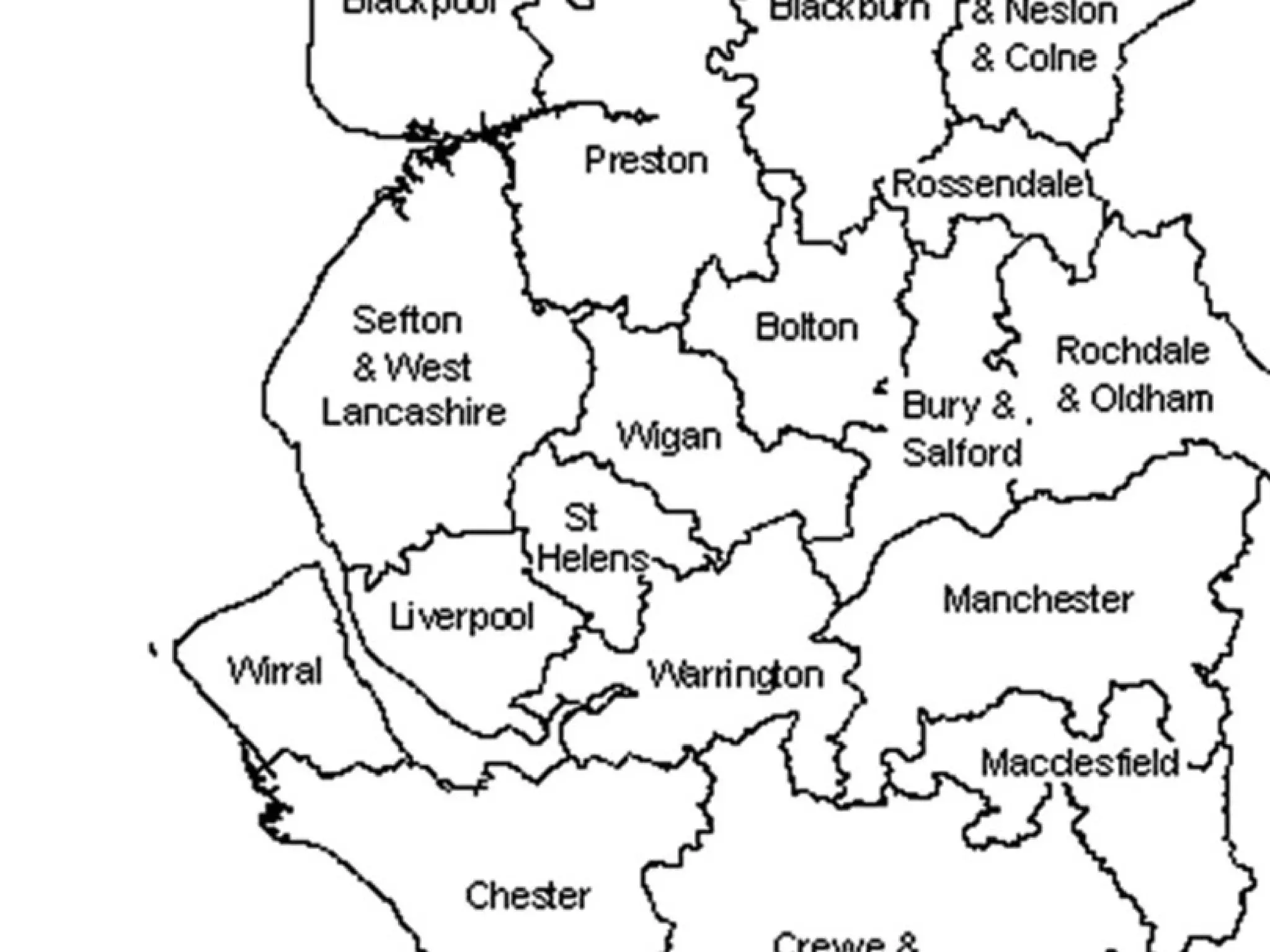
  • #79 Housing Market Areas from Hincks and Wong 2008
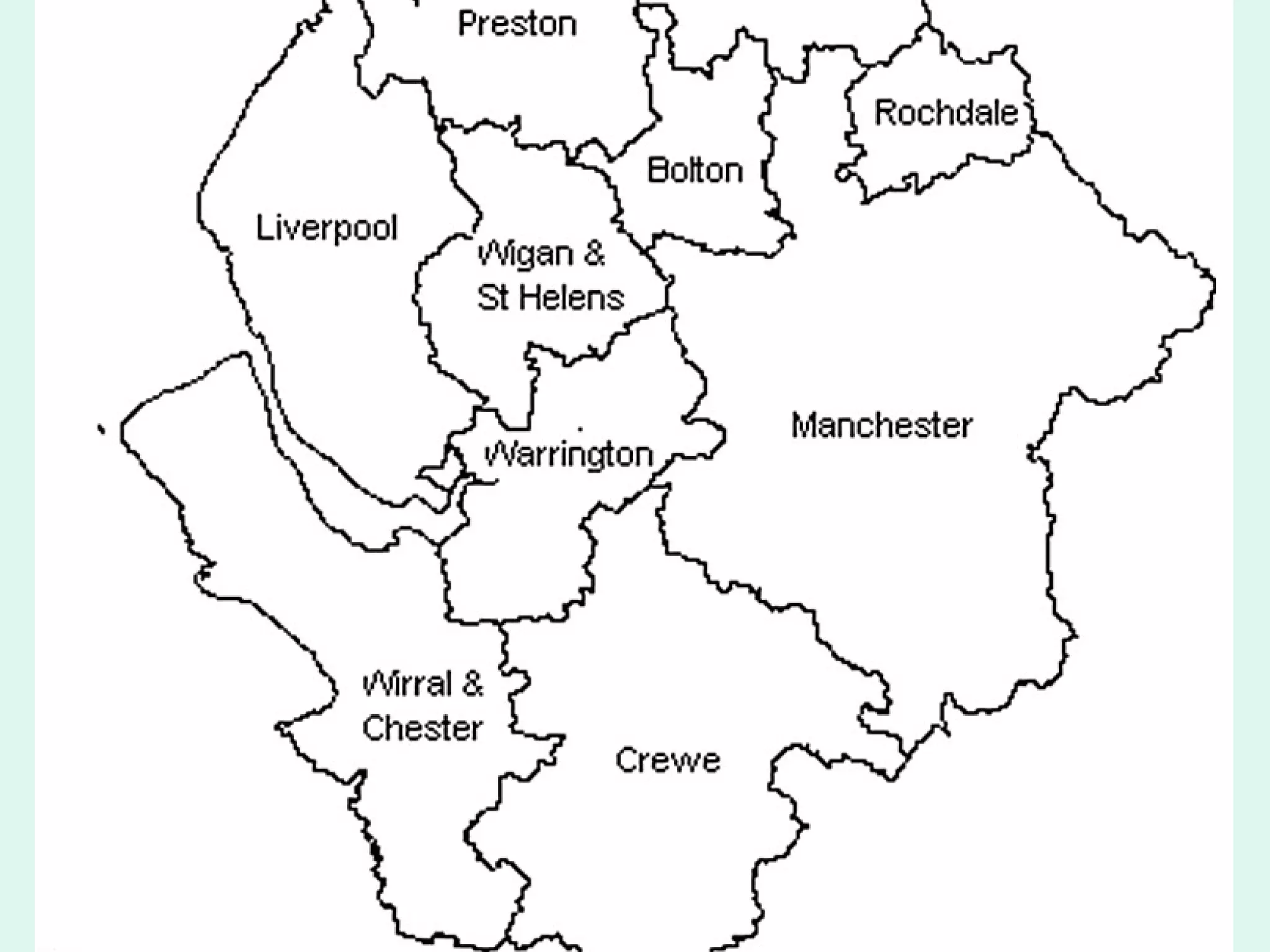
  • #81 TTWAs from Hincks and Wong