Presentation 
By 
Kate, Wisdom Deebeke 
on 
Vesicle Tethering 
Objective 
To understand the mechanism of Vesicle 
Tethering.
Vesicle Tethering, what is it? 
• Formation of physical links between v- and t-SNARES 
• Formed before TRANS SNARE complex formation 
• Aimed at promoting specificity between two membranes 
• Growing number of factors involved now identified, all 
recruited by Rab GTPase.
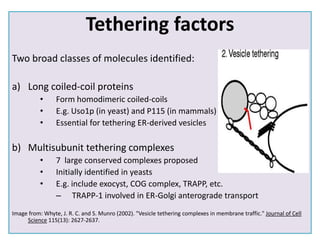
Tethering factors 
Two broad classes of molecules identified: 
a) Long coiled-coil proteins 
• Form homodimeric coiled-coils 
• E.g. Uso1p (in yeast) and P115 (in mammals) 
• Essential for tethering ER-derived vesicles 
b) Multisubunit tethering complexes 
• 7 large conserved complexes proposed 
• Initially identified in yeasts 
• E.g. include exocyst, COG complex, TRAPP, etc. 
– TRAPP-1 involved in ER-Golgi anterograde transport 
Image from: Whyte, J. R. C. and S. Munro (2002). "Vesicle tethering complexes in membrane traffic." Journal of Cell 
Science 115(13): 2627-2637.
Summary 
• Vesicle tethering important for specific localisation of 
transport vesicles on membranes 
• Many factors involved have been identified and 
characterised 
• Rab GTPase plays important role in Tethering factor 
recruitment 
References: 
1. Whyte, J. R. C. and S. Munro (2002). "Vesicle tethering complexes in 
membrane traffic." Journal of Cell Science 115(13): 2627-2637 
2. Olkkonen, V. M. and E. Ikonen (2006). "When intracellular logistics fails - 
genetic defects in membrane trafficking." Journal of Cell Science 119(24): 
5031-5045.
THANK YOU 
FOR YOUR ATTENTION 
ANY QUESTIONS...?

''VESICLE TETHERING'' Presentation By KATE, Wisdom Deebeke

  • 1.
    Presentation By Kate,Wisdom Deebeke on Vesicle Tethering Objective To understand the mechanism of Vesicle Tethering.
  • 2.
    Vesicle Tethering, whatis it? • Formation of physical links between v- and t-SNARES • Formed before TRANS SNARE complex formation • Aimed at promoting specificity between two membranes • Growing number of factors involved now identified, all recruited by Rab GTPase.
  • 3.
    Tethering factors Twobroad classes of molecules identified: a) Long coiled-coil proteins • Form homodimeric coiled-coils • E.g. Uso1p (in yeast) and P115 (in mammals) • Essential for tethering ER-derived vesicles b) Multisubunit tethering complexes • 7 large conserved complexes proposed • Initially identified in yeasts • E.g. include exocyst, COG complex, TRAPP, etc. – TRAPP-1 involved in ER-Golgi anterograde transport Image from: Whyte, J. R. C. and S. Munro (2002). "Vesicle tethering complexes in membrane traffic." Journal of Cell Science 115(13): 2627-2637.
  • 4.
    Summary • Vesicletethering important for specific localisation of transport vesicles on membranes • Many factors involved have been identified and characterised • Rab GTPase plays important role in Tethering factor recruitment References: 1. Whyte, J. R. C. and S. Munro (2002). "Vesicle tethering complexes in membrane traffic." Journal of Cell Science 115(13): 2627-2637 2. Olkkonen, V. M. and E. Ikonen (2006). "When intracellular logistics fails - genetic defects in membrane trafficking." Journal of Cell Science 119(24): 5031-5045.
  • 5.
    THANK YOU FORYOUR ATTENTION ANY QUESTIONS...?