DESIGN AND FABRICATION:
ABRAR BASHA S
DILLS JOSEPH
FRANCIS JOSE
GIGEESH P S
PROJECT GUIDE:
MR.R.KRISHNAKUMAR
M.E.,(Ass. Professor )
CONTENTS
• INTRODUCTION
• WORKING PRINCIPLE
• METHODOLOGY
• OPERATION
• POWER AND ROTATIONAL SPEED
• MATERIALS REQUIRED
• DESIGN
• BUDGET
• USES
• ADVANTAGES AND DISADVANTAGES
• FUTURE APPLICATIONS
• CONCLUSION
• REFERENCE
• QUERY
INTRODUCTION
 The objective of this project is to generate electric
power through the fabrication of Savonius wind mill.
 A wind turbine is a machine that converts the kinetic
energy in wind into mechanical energy.
 If the mechanical energy is used directly by
machinery, such as a pump or grinding stones, the
machine is usually called a windmill.
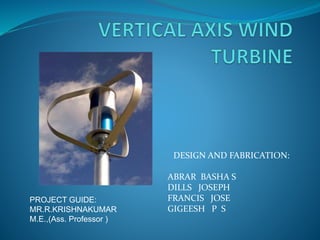
 The Savonius rotor is S-shaped .
 All of these designs turn relatively slowly, but yield a
high torque.
 They can be useful for grinding grain, pumping water,
and many other tasks; but are not good for generating
large amounts of electricity.
 One might use a gearbox, but then efficiency suffers
and the machine may not start at all easily.
 This project is designed with Wind mill arrangement,
Dynamo, and Battery.
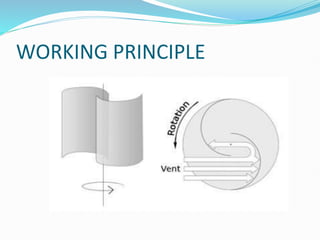
WORKING PRINCIPLE
Wind mill arrangement is the mechanical arrangements
which are easily rotated.
 The rotating speed is depends upon the wind strength.
 The wind mill arrangement is coupled with the
dynamo. So whenever the wind mill is rotated due to
wind, the dynamo also rotated.
 The electric power is generated in the dynamo.
 The generated electric power is given to battery
through the charging circuit.
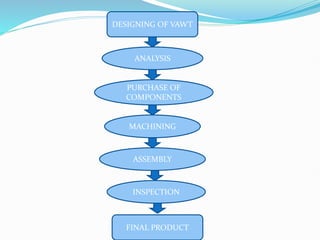
METHODOLOGY
DESIGNING OF VAWT
ASSEMBLY
MACHINING
INSPECTION
PURCHASE OF
COMPONENTS
ANALYSIS
FINAL PRODUCT
OPERATION
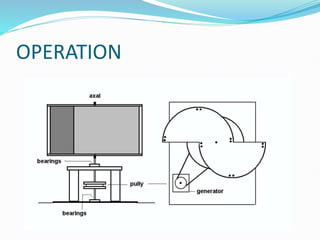
 The Savonius turbine is one of the simplest turbines.
 Aerodynamically, it is a drag-type device, consisting of two
or three scoops.
 Looking down on the rotor from above, a two-scoop
machine would look like an "S" shape in cross section.
 Because of the curvature, the scoops experience less drag
when moving against the wind than when moving with the
wind.
 The differential drag causes the Savonius turbine to spin.
 Because they are drag-type devices, Savonius turbines
extract much less of the wind's power than other
similarly-sized lift-type turbines.
 Much of the swept area of a Savonius rotor may be near
the ground, if it has a small mount without an
extended post, making the overall energy extraction
less effective due to the lower wind speeds found at
lower heights.
POWER AND ROTATIONAL SPEED
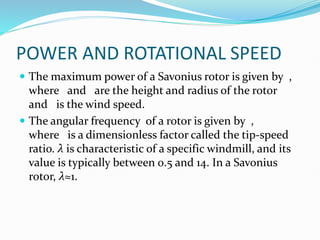
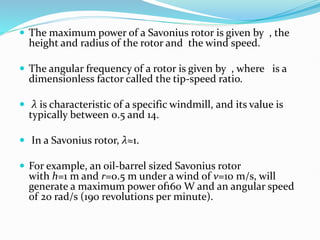
 The maximum power of a Savonius rotor is given by ,
where and are the height and radius of the rotor
and is the wind speed.
 The angular frequency of a rotor is given by ,
where is a dimensionless factor called the tip-speed
ratio. λ is characteristic of a specific windmill, and its
value is typically between 0.5 and 14. In a Savonius
rotor, λ≈1.
 The maximum power of a Savonius rotor is given by , the
height and radius of the rotor and the wind speed.
 The angular frequency of a rotor is given by , where is a
dimensionless factor called the tip-speed ratio.
 λ is characteristic of a specific windmill, and its value is
typically between 0.5 and 14.
 In a Savonius rotor, λ≈1.
 For example, an oil-barrel sized Savonius rotor
with h=1 m and r=0.5 m under a wind of v=10 m/s, will
generate a maximum power of160 W and an angular speed
of 20 rad/s (190 revolutions per minute).
MATERIALS REQUIRED
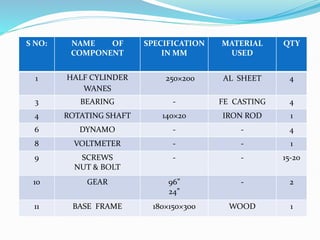
S NO: NAME OF
COMPONENT
SPECIFICATION
IN MM
MATERIAL
USED
QTY
1 HALF CYLINDER
WANES
250×200 AL SHEET 4
3 BEARING - FE CASTING 4
4 ROTATING SHAFT 140×20 IRON ROD 1
6 DYNAMO - - 4
8 VOLTMETER - - 1
9 SCREWS
NUT & BOLT
- - 15-20
10 GEAR 96”
24”
- 2
11 BASE FRAME 180×150×300 WOOD 1
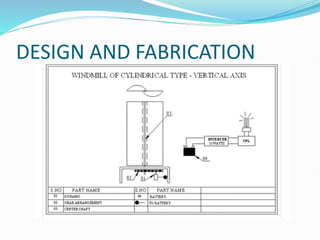
DESIGN AND FABRICATION
BUDGET
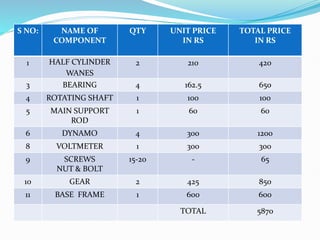
S NO: NAME OF
COMPONENT
QTY UNIT PRICE
IN RS
TOTAL PRICE
IN RS
1 HALF CYLINDER
WANES
2 210 420
3 BEARING 4 162.5 650
4 ROTATING SHAFT 1 100 100
5 MAIN SUPPORT
ROD
1 60 60
6 DYNAMO 4 300 1200
8 VOLTMETER 1 300 300
9 SCREWS
NUT & BOLT
15-20 - 65
10 GEAR 2 425 850
11 BASE FRAME 1 600 600
TOTAL 5870
USES
 Savonius turbines are used whenever cost or reliability is much
more important than efficiency.
 Most anemometers are Savonius turbines for this reason, as
efficiency is irrelevant to the application of measuring wind
speed.
 Much larger Savonius turbines have been used to
generate electric power on deep-water buoys , which need small
amounts of power and get very little maintenance.
 Design is simplified because, unlike with horizontal axis wind
turbines (HAWTs), no pointing mechanism is required to allow
for shifting wind direction and the turbine is self-starting.
 . Savonius and other vertical-axis machines are good at
pumping water and other high torque, low rpm
applications and are not usually connected to electric
power grids.
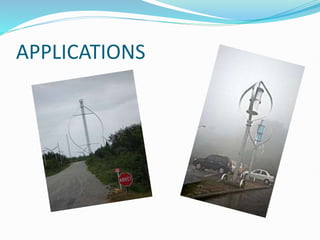
 Small Savonius wind turbines are sometimes seen used
as advertising signs where the rotation helps to draw
attention to the item advertised.
 They sometimes feature a simple two-frame animation
.
 Easy to implement and low maintenance.
 Power generate by the wind force .
 Power generated depend upon the wind force.
APPLICATIONS
FUTURE APPLICATIONS
 Everyday domestic purposes.
 In future VAWTs can be designed such that we can
increase its efficiency.
 Powering streetlamps and highways.
 Coupling VAWTs with the main electrical GRID , that
is ON GRID.
 VAWT powered motor vehicles and ships.
CONCLUSION
 The field of wind power utilization is not fully tapped
at the present time. As we are degrading our fossil fuels
at a high rate .It is important for us to look for
alternatives and certainly the VERTICAL AXIS WIND
MILL (VAWT) is a key process for harnessing this
renewable energy .
REFERENCE
 Design data book -P.S.G.Tech.
 Machine tool design handbook –Central machine tool
Institute, Bangalore.
 Strength of Materials -R.S.Kurmi
 Manufacturing Technology -M.Haslehurst.
 Design of machine elements - R.s.Kurumi
QUERY

vertical_axis_wind_turbine.pptx

  • 1.
    DESIGN AND FABRICATION: ABRARBASHA S DILLS JOSEPH FRANCIS JOSE GIGEESH P S PROJECT GUIDE: MR.R.KRISHNAKUMAR M.E.,(Ass. Professor )
  • 2.
    CONTENTS • INTRODUCTION • WORKINGPRINCIPLE • METHODOLOGY • OPERATION • POWER AND ROTATIONAL SPEED • MATERIALS REQUIRED • DESIGN • BUDGET • USES • ADVANTAGES AND DISADVANTAGES • FUTURE APPLICATIONS • CONCLUSION • REFERENCE • QUERY
  • 3.
    INTRODUCTION  The objectiveof this project is to generate electric power through the fabrication of Savonius wind mill.  A wind turbine is a machine that converts the kinetic energy in wind into mechanical energy.  If the mechanical energy is used directly by machinery, such as a pump or grinding stones, the machine is usually called a windmill.
  • 4.
     The Savoniusrotor is S-shaped .  All of these designs turn relatively slowly, but yield a high torque.  They can be useful for grinding grain, pumping water, and many other tasks; but are not good for generating large amounts of electricity.  One might use a gearbox, but then efficiency suffers and the machine may not start at all easily.  This project is designed with Wind mill arrangement, Dynamo, and Battery.
  • 5.
  • 6.
    Wind mill arrangementis the mechanical arrangements which are easily rotated.  The rotating speed is depends upon the wind strength.  The wind mill arrangement is coupled with the dynamo. So whenever the wind mill is rotated due to wind, the dynamo also rotated.  The electric power is generated in the dynamo.  The generated electric power is given to battery through the charging circuit.
  • 7.
  • 8.
  • 9.
  • 10.
     The Savoniusturbine is one of the simplest turbines.  Aerodynamically, it is a drag-type device, consisting of two or three scoops.  Looking down on the rotor from above, a two-scoop machine would look like an "S" shape in cross section.  Because of the curvature, the scoops experience less drag when moving against the wind than when moving with the wind.  The differential drag causes the Savonius turbine to spin.
  • 11.
     Because theyare drag-type devices, Savonius turbines extract much less of the wind's power than other similarly-sized lift-type turbines.  Much of the swept area of a Savonius rotor may be near the ground, if it has a small mount without an extended post, making the overall energy extraction less effective due to the lower wind speeds found at lower heights.
  • 12.
    POWER AND ROTATIONALSPEED  The maximum power of a Savonius rotor is given by , where and are the height and radius of the rotor and is the wind speed.  The angular frequency of a rotor is given by , where is a dimensionless factor called the tip-speed ratio. λ is characteristic of a specific windmill, and its value is typically between 0.5 and 14. In a Savonius rotor, λ≈1.
  • 13.
     The maximumpower of a Savonius rotor is given by , the height and radius of the rotor and the wind speed.  The angular frequency of a rotor is given by , where is a dimensionless factor called the tip-speed ratio.  λ is characteristic of a specific windmill, and its value is typically between 0.5 and 14.  In a Savonius rotor, λ≈1.  For example, an oil-barrel sized Savonius rotor with h=1 m and r=0.5 m under a wind of v=10 m/s, will generate a maximum power of160 W and an angular speed of 20 rad/s (190 revolutions per minute).
  • 14.
  • 15.
    S NO: NAMEOF COMPONENT SPECIFICATION IN MM MATERIAL USED QTY 1 HALF CYLINDER WANES 250×200 AL SHEET 4 3 BEARING - FE CASTING 4 4 ROTATING SHAFT 140×20 IRON ROD 1 6 DYNAMO - - 4 8 VOLTMETER - - 1 9 SCREWS NUT & BOLT - - 15-20 10 GEAR 96” 24” - 2 11 BASE FRAME 180×150×300 WOOD 1
  • 16.
  • 17.
  • 18.
    S NO: NAMEOF COMPONENT QTY UNIT PRICE IN RS TOTAL PRICE IN RS 1 HALF CYLINDER WANES 2 210 420 3 BEARING 4 162.5 650 4 ROTATING SHAFT 1 100 100 5 MAIN SUPPORT ROD 1 60 60 6 DYNAMO 4 300 1200 8 VOLTMETER 1 300 300 9 SCREWS NUT & BOLT 15-20 - 65 10 GEAR 2 425 850 11 BASE FRAME 1 600 600 TOTAL 5870
  • 19.
    USES  Savonius turbinesare used whenever cost or reliability is much more important than efficiency.  Most anemometers are Savonius turbines for this reason, as efficiency is irrelevant to the application of measuring wind speed.  Much larger Savonius turbines have been used to generate electric power on deep-water buoys , which need small amounts of power and get very little maintenance.  Design is simplified because, unlike with horizontal axis wind turbines (HAWTs), no pointing mechanism is required to allow for shifting wind direction and the turbine is self-starting.
  • 20.
     . Savoniusand other vertical-axis machines are good at pumping water and other high torque, low rpm applications and are not usually connected to electric power grids.  Small Savonius wind turbines are sometimes seen used as advertising signs where the rotation helps to draw attention to the item advertised.  They sometimes feature a simple two-frame animation .
  • 21.
     Easy toimplement and low maintenance.  Power generate by the wind force .  Power generated depend upon the wind force.
  • 22.
  • 23.
    FUTURE APPLICATIONS  Everydaydomestic purposes.  In future VAWTs can be designed such that we can increase its efficiency.  Powering streetlamps and highways.  Coupling VAWTs with the main electrical GRID , that is ON GRID.  VAWT powered motor vehicles and ships.
  • 24.
    CONCLUSION  The fieldof wind power utilization is not fully tapped at the present time. As we are degrading our fossil fuels at a high rate .It is important for us to look for alternatives and certainly the VERTICAL AXIS WIND MILL (VAWT) is a key process for harnessing this renewable energy .
  • 25.
    REFERENCE  Design databook -P.S.G.Tech.  Machine tool design handbook –Central machine tool Institute, Bangalore.  Strength of Materials -R.S.Kurmi  Manufacturing Technology -M.Haslehurst.  Design of machine elements - R.s.Kurumi
  • 26.