VERBS
AAMIR HUSSAIN
INTRODUCTION
• A verb is a word that tells or asserts something about
a person or thing.
• Verb comes from the Latin verbum, a word. It is so
called because it is the most important word in a
sentence.
• A Verb may tell us-
• (1) What a person or thing does; as,
Hari laughs. The clock strikes.
• (2) What is done to a person or thing ; as,
Hari is scolded. The window is broken.
• (3) What a person or thing is; as,
The cat is dead.
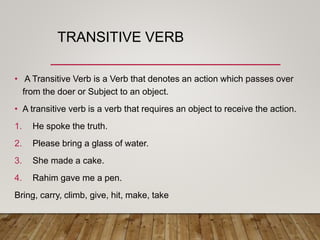
TRANSITIVE VERB
• A Transitive Verb is a Verb that denotes an action which passes over
from the doer or Subject to an object.
• A transitive verb is a verb that requires an object to receive the action.
1. He spoke the truth.
2. Please bring a glass of water.
3. She made a cake.
4. Rahim gave me a pen.
Bring, carry, climb, give, hit, make, take
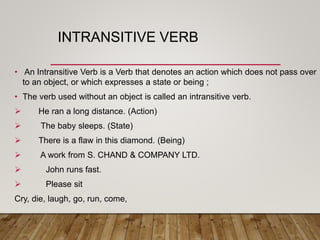
INTRANSITIVE VERB
• An Intransitive Verb is a Verb that denotes an action which does not pass over
to an object, or which expresses a state or being ;
• The verb used without an object is called an intransitive verb.
 He ran a long distance. (Action)
 The baby sleeps. (State)
 There is a flaw in this diamond. (Being)
 A work from S. CHAND & COMPANY LTD.
 John runs fast.
 Please sit
Cry, die, laugh, go, run, come,
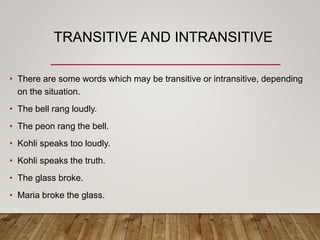
TRANSITIVE AND INTRANSITIVE
• There are some words which may be transitive or intransitive, depending
on the situation.
• The bell rang loudly.
• The peon rang the bell.
• Kohli speaks too loudly.
• Kohli speaks the truth.
• The glass broke.
• Maria broke the glass.
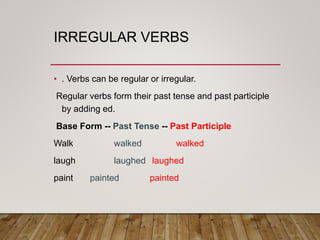
IRREGULAR VERBS
• . Verbs can be regular or irregular.
Regular verbs form their past tense and past participle
by adding ed.
Base Form -- Past Tense -- Past Participle
Walk walked walked
laugh laughed laughed
paint painted painted
IRREGULAR VERB
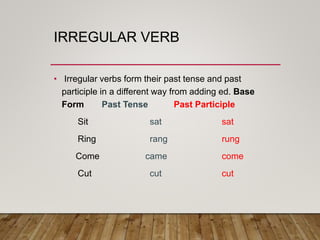
• Irregular verbs form their past tense and past
participle in a different way from adding ed. Base
Form Past Tense Past Participle
Sit sat sat
Ring rang rung
Come came come
Cut cut cut
• We distinguish three types of irregular verbs: (1) Verbs in which
all three forms are the same e.g. cut - cut – cut
Hit -hit –hit
Hurt - hurt– hurt
Let -let – let
put -- put – pu
(2) Verbs in which two of the three forms are the same (e.g. sit -
sat - sat)
• (3) Verbs in which all three forms are different (e.g. ring - rang -
rung)
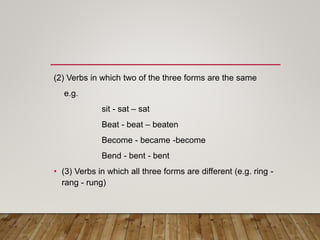
(2) Verbs in which two of the three forms are the same
e.g.
sit - sat – sat
Beat - beat – beaten
Become - became -become
Bend - bent - bent
• (3) Verbs in which all three forms are different (e.g. ring -
rang - rung)
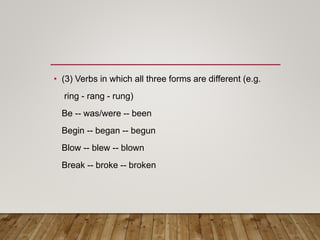
• (3) Verbs in which all three forms are different (e.g.
ring - rang - rung)
Be -- was/were -- been
Begin -- began -- begun
Blow -- blew -- blown
Break -- broke -- broken
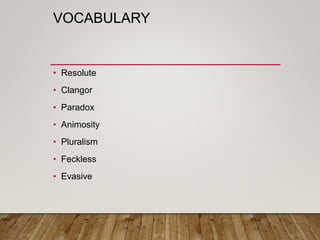
VOCABULARY
• Resolute
• Clangor
• Paradox
• Animosity
• Pluralism
• Feckless
• Evasive

VERBS.pptx

  • 1.
  • 2.
    INTRODUCTION • A verbis a word that tells or asserts something about a person or thing. • Verb comes from the Latin verbum, a word. It is so called because it is the most important word in a sentence.
  • 3.
    • A Verbmay tell us- • (1) What a person or thing does; as, Hari laughs. The clock strikes. • (2) What is done to a person or thing ; as, Hari is scolded. The window is broken. • (3) What a person or thing is; as, The cat is dead.
  • 4.
    TRANSITIVE VERB • ATransitive Verb is a Verb that denotes an action which passes over from the doer or Subject to an object. • A transitive verb is a verb that requires an object to receive the action. 1. He spoke the truth. 2. Please bring a glass of water. 3. She made a cake. 4. Rahim gave me a pen. Bring, carry, climb, give, hit, make, take
  • 5.
    INTRANSITIVE VERB • AnIntransitive Verb is a Verb that denotes an action which does not pass over to an object, or which expresses a state or being ; • The verb used without an object is called an intransitive verb.  He ran a long distance. (Action)  The baby sleeps. (State)  There is a flaw in this diamond. (Being)  A work from S. CHAND & COMPANY LTD.  John runs fast.  Please sit Cry, die, laugh, go, run, come,
  • 6.
    TRANSITIVE AND INTRANSITIVE •There are some words which may be transitive or intransitive, depending on the situation. • The bell rang loudly. • The peon rang the bell. • Kohli speaks too loudly. • Kohli speaks the truth. • The glass broke. • Maria broke the glass.
  • 7.
    IRREGULAR VERBS • .Verbs can be regular or irregular. Regular verbs form their past tense and past participle by adding ed. Base Form -- Past Tense -- Past Participle Walk walked walked laugh laughed laughed paint painted painted
  • 8.
    IRREGULAR VERB • Irregularverbs form their past tense and past participle in a different way from adding ed. Base Form Past Tense Past Participle Sit sat sat Ring rang rung Come came come Cut cut cut
  • 9.
    • We distinguishthree types of irregular verbs: (1) Verbs in which all three forms are the same e.g. cut - cut – cut Hit -hit –hit Hurt - hurt– hurt Let -let – let put -- put – pu (2) Verbs in which two of the three forms are the same (e.g. sit - sat - sat) • (3) Verbs in which all three forms are different (e.g. ring - rang - rung)
  • 10.
    (2) Verbs inwhich two of the three forms are the same e.g. sit - sat – sat Beat - beat – beaten Become - became -become Bend - bent - bent • (3) Verbs in which all three forms are different (e.g. ring - rang - rung)
  • 11.
    • (3) Verbsin which all three forms are different (e.g. ring - rang - rung) Be -- was/were -- been Begin -- began -- begun Blow -- blew -- blown Break -- broke -- broken
  • 12.
    VOCABULARY • Resolute • Clangor •Paradox • Animosity • Pluralism • Feckless • Evasive