Vehicle Routing Problems Methods and Applications Second Edition Paolo Toth
Vehicle Routing Problems Methods and Applications Second Edition Paolo Toth
Vehicle Routing Problems Methods and Applications Second Edition Paolo Toth
Vehicle Routing Problems Methods and Applications Second Edition Paolo Toth
Vehicle Routing Problems Methods and Applications Second Edition Paolo Toth
1.
Vehicle Routing ProblemsMethods and Applications
Second Edition Paolo Toth - PDF Download (2025)
https://ebookultra.com/download/vehicle-routing-problems-methods-
and-applications-second-edition-paolo-toth/
Visit ebookultra.com today to download the complete set of
ebooks or textbooks
2.
We have selectedsome products that you may be interested in
Click the link to download now or visit ebookultra.com
for more options!.
Vehicle Accident Analysis and Reconstruction Methods
Second Edition Matthew Brach
https://ebookultra.com/download/vehicle-accident-analysis-and-
reconstruction-methods-second-edition-matthew-brach/
Esterification Methods Reactions and Applications Second
Edition Junzo Otera
https://ebookultra.com/download/esterification-methods-reactions-and-
applications-second-edition-junzo-otera/
High Precision Methods in Eigenvalue Problems and Their
Applications 1st Edition Leonid D. Akulenko (Author)
https://ebookultra.com/download/high-precision-methods-in-eigenvalue-
problems-and-their-applications-1st-edition-leonid-d-akulenko-author/
AC Motor Control and Electrical Vehicle Applications 1st
Edition Kwang Hee Nam
https://ebookultra.com/download/ac-motor-control-and-electrical-
vehicle-applications-1st-edition-kwang-hee-nam/
3.
Numerical Analysis forEngineers Methods and Applications
Second Edition Bilal Ayyub (Author)
https://ebookultra.com/download/numerical-analysis-for-engineers-
methods-and-applications-second-edition-bilal-ayyub-author/
Applied Data Mining for Business and Industry Second
Edition Paolo Giudici
https://ebookultra.com/download/applied-data-mining-for-business-and-
industry-second-edition-paolo-giudici/
Practical Lipid Management Peter P. Toth
https://ebookultra.com/download/practical-lipid-management-peter-p-
toth/
Proteomics Methods Applications and Limitations Methods
Applications and Limitations 1st Edition Giselle C.
Rancourt
https://ebookultra.com/download/proteomics-methods-applications-and-
limitations-methods-applications-and-limitations-1st-edition-giselle-
c-rancourt/
Junos Enterprise Routing A Practical Guide to Junos
Routing and Certification 2nd Edition Peter Southwick
https://ebookultra.com/download/junos-enterprise-routing-a-practical-
guide-to-junos-routing-and-certification-2nd-edition-peter-southwick/
5.
Vehicle Routing ProblemsMethods and Applications
Second Edition Paolo Toth Digital Instant Download
Author(s): Paolo Toth, Daniele Vigo, (eds.)
ISBN(s): 9781611973587, 1611973589
Edition: 2
File Details: PDF, 3.59 MB
Year: 2014
Language: english
This series ispublished jointly by the Mathematical Optimization Society and the Society for Industrial
and Applied Mathematics. It includes research monographs, books on applications, textbooks at all
levels, and tutorials. Besides being of high scientific quality, books in the series must advance the
understanding and practice of optimization. They must also be written clearly and at an appropriate
level for the intended audience.
Editor-in-Chief
Katya Scheinberg
Lehigh University
Editorial Board
Series Volumes
Toth, Paolo and Vigo, Daniele, editors, Vehicle Routing: Problems, Methods, and Applications, Second
Edition
Attouch, Hedy, Buttazzo, Giuseppe, and Michaille, Gérard, Variational Analysis in Sobolev and BV Spaces:
Applications to PDEs and Optimization, Second Edition
Shapiro, Alexander, Dentcheva, Darinka, and Ruszczynski, Andrzej, Lectures on Stochastic Programming:
Modeling and Theory, Second Edition
Locatelli, Marco and Schoen, Fabio, Global Optimization: Theory, Algorithms, and Applications
De Loera, Jesús A., Hemmecke, Raymond, and Köppe, Matthias, Algebraic and Geometric Ideas in the
Theory of Discrete Optimization
Blekherman, Grigoriy, Parrilo, Pablo A., and Thomas, Rekha R., editors, Semidefinite Optimization and
Convex Algebraic Geometry
Delfour, M. C., Introduction to Optimization and Semidifferential Calculus
Ulbrich, Michael, Semismooth Newton Methods for Variational Inequalities and Constrained Optimization
Problems in Function Spaces
Biegler, Lorenz T., Nonlinear Programming: Concepts, Algorithms, and Applications to Chemical Processes
Shapiro, Alexander, Dentcheva, Darinka, and Ruszczynski, Andrzej, Lectures on Stochastic Programming:
Modeling and Theory
Conn, Andrew R., Scheinberg, Katya, and Vicente, Luis N., Introduction to Derivative-Free Optimization
Ferris, Michael C., Mangasarian, Olvi L., and Wright, Stephen J., Linear Programming with MATLAB
Attouch, Hedy, Buttazzo, Giuseppe, and Michaille, Gérard, Variational Analysis in Sobolev and BV Spaces:
Applications to PDEs and Optimization
Wallace, Stein W. and Ziemba, William T., editors, Applications of Stochastic Programming
Grötschel, Martin, editor, The Sharpest Cut: The Impact of Manfred Padberg and His Work
Renegar, James, A Mathematical View of Interior-Point Methods in Convex Optimization
Ben-Tal, Aharon and Nemirovski, Arkadi, Lectures on Modern Convex Optimization: Analysis, Algorithms,
and Engineering Applications
Conn, Andrew R., Gould, Nicholas I. M., and Toint, Phillippe L., Trust-Region Methods
MOS-SIAM Series on Optimization
´
Santanu S. Dey, Georgia Institute of Technology
Maryam Fazel, University of Washington
Andrea Lodi, University of Bologna
Arkadi Nemirovski, Georgia Institute of Technology
Stefan Ulbrich, Technische Universität Darmstadt
Luis Nunes Vicente, University of Coimbra
David Williamson, Cornell University
Stephen J. Wright, University of Wisconsin
´
MO18_Toth_VigoFM-10-20-14.indd 2 10/20/2014 9:46:05 AM
8.
Vehicle Routing
Problems, Methods,
andApplications
Second Edition
Society for Industrial and Applied Mathematics
Philadelphia
Mathematical Optimization Society
Philadelphia
Edited by
Paolo Toth
DEI, University of Bologna
Bologna, Italy
Daniele Vigo
DEI, University of Bologna
Bologna, Italy
MO18_Toth_VigoFM-10-20-14.indd 3 10/20/2014 9:46:06 AM
i
i
List of Contributors
ClaudiaArchetti
Dipartimento Metodi Quantitativi, Università
di Brescia, Italy,
archetti@eco.unibs.it
Tolga Bektaş
Southampton Management School, University
of Southampton, UK,
t.bektas@soton.ac.uk
Olli Bräysy
VU University of Amsterdam,
The Netherlands,
o.m.p.braysy@vu.nl
Marielle Christiansen
Department of Industrial Economics and
Technology Management, Norwegian
University of Science and Technology of
Trondheim, Norway,
mc@iot.ntnu.no
Jean-François Cordeau
HEC Montréal, Québec, Canada,
jean-francois.cordeau@hec.ca
Guy Desaulniers
Department of Mathematical and Industrial
Engineering, École Polytechnique de Montréal,
Québec, Canada,
guy.desaulniers@polymtl.ca
Karl F. Doerner
Department of Business Administration,
University of Vienna, Austria,
karl.doerner@univie.ac.at
Richard Eglese
Department of Management Science, Lancaster
University Management School, UK,
R.Eglese@lancaster.ac.uk
Kjetil Fagerholt
Department of Industrial Economics and
Technology Management, Norwegian
University of Science and Technology of
Trondheim, Norway,
kjetil.fagerholt@iot.ntnu.no
Michel Gendrau
Department of Mathematical and Industrial
Engineering, École Polytechnique de Montréal,
Québec, Canada,
michel.gendreau@polymtl.ca
Bruce L. Golden
Robert H. Smith School of Business,
University of Maryland, MD, USA,
bgolden@rhsmith.umd.edu
Geir Hasle
SINTEF ICT, Norway,
geir.hasle@sintef.no
Manuel Iori
Dipartimento di Scienze e Metodi
dell’Ingegneria, Università degli Studi di
Modena e Reggio Emilia, Italy,
manuel.iori@unimore.it
Stefan Irnich
Chair of Logistics Management, Gutenberg
School of Management and Economics,
Johannes Gutenberg University Mainz,
Germany,
irnich@uni-mainz.de
Ola Jabali
Department of Logistics and Operations
Management, HEC Montréal and CIRRELT,
Québec, Canada,
ola.jabali@hec.ca
v
11.
i
i
vi List ofContributors
Attila A. Kovacs
Department of Business Administration,
University of Vienna, Austria,
attila.kovacs@univie.ac.at
Gilbert Laporte
HEC Montréal, Québec, Canada,
gilbert.laporte@cirrelt.ca
Marcus Poggi
Departamento de Informática, Pontifícia
Universidade Católica de Rio de Janeiro, Brazil,
poggi@inf.puc-rio.br
Walter Rei
Dŕpartement de management et technologie,
Université du Québec a Montréal, Québec,
Canada,
rei.walter@uqam.ca
Panagiotis P. Repoussis
Stevens Institute of Technology, Hoboken, NJ,
USA,
panagiotis.repoussis@stevens.edu
Stefan Ropke
Department of Management, Engineering,
Technical University of Denmark, Kongens
Lyngby, Denmark,
ropke@dtu.dk
Juan-José Salazar-González
Departamento de Estadística, Investigación
Operativa y Computación, Universidad de La
Laguna, Tenerife, Spain,
jjsalaza@ull.es
Michael Schneider
Logistikplanung und Informationssysteme,
Technische Universität Darmstadt, Germany,
schneider@bwl.tu-darmstadt.de
Frédéric Semet
Ecole Centrale de Lille, Villeneuve d’Ascq
Cedex, France,
frederic.semet@ec-lille.fr
M. Grazia Speranza
Dipartimento di Economia e Management,
Università degli Studi di Brescia, Italy,
speranza@eco.unibs.it
Christos D. Tarantilis
Department of Management Science and
Technology, Athens University of Economics
and Business, Greece,
tarantil@aueb.gr
Paolo Toth
Department of Electrical, Electronic, and
Information Engineering “G. Marconi”,
Università di Bologna, Italy,
paolo.toth@unibo.it
Eduardo Uchoa
Departamento de Engenharia de Produção,
Universidade Federal Fluminense, Niterói, Rio
de Janeiro, Brazil,
uchoa@producao.uff.br
Thibaut Vidal
Laboratory for Information and Decision
Systems, Massachusetts Institute of
Technology, Cambridge, MA, USA,
vidalt@mit.edu
Daniele Vigo
Department of Electrical, Electronic, and
Information Engineering “G. Marconi”,
Università di Bologna, Italy,
daniele.vigo@unibo.it
Edward A. Wasil
Kogod School of Business, American
University, Washington, DC, USA,
ewasil@american.edu
i
i
Preface to theSecond Edition
The projects of reediting the Toth and Vigo book on vehicle routing and of editing
a book on arc routing germinated during the ROUTE Conference in Sitges, Spain, in
June 2011. The first edition of the vehicle routing book had been highly successful, and
it was then felt that the evolution of the field over the past 10 years justified a significantly
revamped reedition. This led Corberán and Laporte (while exploring the cellars of the
Codorníu Winery during the conference excursion) to think up a proposal for a similar
arc routing book that would be produced in parallel with the second edition of the ve-
hicle routing book, with a similar structure and the same format. Again, the last major
edited book on arc routing had been published more than 10 years before and the field had
evolved considerably since then. Both proposals were presented to SIAM in the summer
and were accepted. Today we are proud to offer to the research community two up-to-
date collections of scientific contributions written by specialists in various areas of vehicle
routing and arc routing. The two books are entitled “Vehicle Routing: Problems, Meth-
ods, and Applications, Second Edition”, Paolo Toth and Daniele Vigo, editors, and “Arc
Routing: Problems, Methods, and Applications”, Ángel Corberán and Gilbert Laporte,
editors, both published by SIAM.
The vehicle routing book contains 15 chapters. A few of these are amalgamations or
significantly revised versions of chapters published in the first edition, while most of the
others are entirely new. The first chapter offers an overview of the field of the Vehicle
Routing Problem (VRP) and its main variants. The remainder of the book is made up of
three parts: the capacitated VRP, important variants of the VRP, and applications. The
first part contains two chapters on classical and new exact algorithms, as well as a chapter
on heuristics. The second part surveys several variants: the VRP with time windows,
pickup-and-delivery problems for goods or people transportation, stochastic VRPs, and
miscellaneous variants. The third part is devoted to applications and covers the VRP with
profits, real-time and dynamic VRPs, software and emerging technologies, ship routing,
VRP applications in disaster relief, as well as green vehicle routing.
The arc routing book is new and contains 16 chapters. It opens with a chapter on
historical perspectives, followed by three main parts: arc routing problems with a single
vehicle, arc routing problems with several vehicles, and applications. The first part starts
with a chapter on complexity, which is followed by four chapters on the Chinese Postman
Problem and on the Rural Postman Problem. The second part contains four chapters on
the Capacitated Arc Routing Problem and two on arc routing problems with min-max
and profit maximization objectives. The last part covers some of the most important
arc routing applications, including meter reading, salt spreading, snow removal, garbage
collection, and newspaper delivery.
xv
21.
i
i
xvi Preface tothe Second Edition
We thank all authors for the quality of their contributions, as well as all referees who
carefully reviewed the chapters, and Claudio Gambella for his help in editing the final
manuscript of the VRP book. Thanks are also due to Dr. Thomas Liebling, Ms. Eliza-
beth Greenspan, Ms. Ann Manning Allen, and Ms. Sara J. Murphy from SIAM for their
support and encouragement.
Ángel Corberán, Universitat de Valencia
Gilbert Laporte, HEC Montréal
Paolo Toth, Università di Bologna
Daniele Vigo, Università di Bologna
May 2014
22.
i
i
Preface to theFirst Edition
The Vehicle Routing Problem (VRP) calls for the determination of the optimal set of
routes to be performed by a fleet of vehicles to serve a given set of customers, and it is one
of the most important, and studied, combinatorial optimization problems.
More than 40 years have elapsed since Dantzig and Ramser introduced the problem
in 1959. They described a real-world application concerning the delivery of gasoline to
service stations and proposed the first mathematical programming formulation and algo-
rithmic approach. A few years later, in 1964, Clarke and Wright proposed an effective
greedy heuristic that improved on the Dantzig–Ramser approach. Following these two
seminal papers, hundreds of models and algorithms were proposed for the optimal and
approximate solution of the different versions of the VRP. Dozens of packages for the so-
lution of various real-world VRPs are now available on the market. This interest in VRP
is motivated by both its practical relevance and its considerable difficulty: the largest VRP
instances that can be consistently solved by the most effective exact algorithms proposed
so far contain about 50 customers, whereas larger instances may be solved to optimality
only in particular cases.
This book covers the state of the art of both exact and heuristic methods developed
in the last decades for the VRP and some of its main variants. Moreover, a considerable
part of the book is devoted to the discussion of practical issues.
The realization of this project would have been impossible for us alone to accomplish.
We thus involved an enthusiastic group of very well known experts, whose contribu-
tions form a large part of the recent history of the VRP (as well as that of Mathematical
Programming and Combinatorial Optimization). As editors, we constantly devoted our
efforts to reducing as much as possible the overlap between chapters and to preserving
coherence and ensuring uniformity of the notation and terminology.
Although focused on a specific family of problems, this book offers a complete over-
view of the effective use of the most important techniques proposed for the solution of
hard combinatorial problems. We, however, assume that readers have a basic knowledge
of the main methods for the solution of combinatorial optimization problems (complex-
ity theory, branch-and-bound, branch-and-cut, relaxations, heuristics, metaheuristics, lo-
cal search, etc.).
The book is divided into three parts, preceded by an introductory chapter in which we
present an overview of the VRP family, define the most important variants of the prob-
lem, and introduce the main mathematical models. The first part covers the basic and
extensively studied version of the VRP, known as capacitated VRP. Three chapters exam-
ine the main exact approaches (branch-and-bound, branch-and-cut, and set-covering-based
methods), while two other chapters review traditional heuristic approaches and meta-
heuristics, respectively. For all methods extensive computational results are analyzed.
The second part covers three main variants of the VRP: the VRP with time windows,
the VRP with backhauls, and the VRP with pickup and delivery. In each chapter, both
xvii
23.
i
i
xviii Preface tothe First Edition
exact and heuristic methods are examined. Finally, in the third part, the issues arising in
real-world VRP applications, as the presence of dynamic and stochastic components, are
discussed by analyzing relevant case studies and presenting software packages.
We warmly thank all the people who contributed to this project, which occupied a
considerable amount of the past 3 years: our coauthors, whose competent, patient, and
collaborative activity made possible the completion of this volume; the referees whose
comments greatly improved the overall presentation; Peter Hammer, editor-in-chief of
SIAM Monographs on Discrete Mathematics and Applications, who since the very begin-
ning encouraged us and followed all the steps of the project; and Vickie Kearn, Deborah
Poulson, Lou Primus, Sara Triller, Marianne Will, Donna Witzleben, Sam Young, and all
the people of SIAM who greatly helped us in the preparation of the overall manuscript.
Paolo Toth
Daniele Vigo
Bologna, December 2000
24.
Chapter 1
The Familyof Vehicle
Routing Problems
Stefan Irnich
Paolo Toth
Daniele Vigo
1.1 Introduction
A generic verbal definition of the family of vehicle routing problems can be the following:
Given: A set of transportation requests and a fleet of vehicles.
The problem is then to find a plan for the following:
Task: Determine a set of vehicle routes to perform all (or some) transportation
requests with the given vehicle fleet at minimum cost; in particular, decide
which vehicle handles which requests in which sequence so that all vehicle routes
can be feasibly executed.
In this type of problem, subsumed under the term Vehicle Routing Problem (VRP),
the transportation requests to be served are generally concentrated in specific points of a
road network as opposed to the Arc Routing Problems (ARP; see the companion book by
Corberán and Laporte [35]), where the requests are dispersed along the arcs, i.e., street seg-
ments of the underlying road network. The following sections will shed light on the basic
VRP components, which are the transportation requests and how they can be performed,
the fleet of vehicles, the related costs and profits (if relevant), and the feasibility of routes.
Before going into the details, however, we discuss the economic relevance of computer-
supported vehicle routing. Indeed, the large number of real-world applications have widely
shown that the use of computerized solution methods for the solution of VRP, both at
the planning and the operational levels, yields substantial savings in the global transporta-
tion costs. The success of the utilization of optimization techniques is due not only to the
power of the current computer systems and to the full integration of the information sys-
tems into the operations and commercial processes, but it can also be attributed to the
development of rigorous mathematical models, which are able to take into account al-
1
25.
2 Chapter 1.The Family of Vehicle Routing Problems
most all the characteristics of the VRP arising in real-world applications. Furthermore,
the corresponding algorithms and their computer implementations (software tools) play
an essential role in finding high-quality feasible solutions for real-world instances within
acceptable computing times. Compared to procedures not based on optimization tech-
niques, significant cost savings and a better utilization of the vehicle fleet can be achieved.
In addition, by means of such planning software it is possible to improve the automa-
tion, standardization, and integration into the organizations’ overall planning processes,
leading to less time-consuming and more cost-efficient planning processes with respect to
manual planning. Moreover, computerized planning allows planners to compare several
different planning scenarios, and herewith to choose a best one through a careful and fast
evaluation of cost and service-related performance indicators.
In the last years, software tools integrating telematics services (electronic data trans-
mission between vehicles and planners) have been developed with the aim of enabling a
faster reaction of planners to the dynamics of the transportation system and to possible
disruptions caused by the failure of vehicles or by heavy traffic conditions on the roads.
Of course, online planning tools are indispensable for real-time applications such as the
control of automatic guided vehicles.
More than 50 years have elapsed since the 1959 paper by Dantzig and Ramser [40]
which introduced the VRP (then called the truck dispatching problem) as a real-world ap-
plication concerning the delivery of gasoline to gas stations. In this seminal paper the
authors proposed the first mathematical programming formulation and algorithmic ap-
proach for the VRP. Again, approximately 50 years separate us from the famous paper
by Clarke and Wright [33], who in 1964 proposed an effective greedy heuristic for the
approximate solution of the VRP. Following such brilliant forerunners, a huge number
of papers have been published during the past five decades in the international Opera-
tions Research and Transportation Science journals, presenting mathematical models and
proposing exact and (meta)heuristic algorithms for the optimal and approximate solution
of the different versions of the VRP. Among the journals that regularly publish papers
on the VRP, we can mention Operations Research, Transportation Science, Computers &
Operations Research, European Journal of Operational Research, EURO Journal on Trans-
portation and Logistics, Journal of the Operational Research Society, Transportation Research,
Networks, and Journal of Heuristics. Finally, in all the main international Operations Re-
search conferences there is at least one stream (often containing several sessions) with
presentations of new research and application results on the VRP.
The high interest of the international research community in the different variants of
VRP is not only motivated by their notorious difficulty as combinatorial optimization
problems but also, as previously mentioned, by their practical relevance. As a conse-
quence, researchers from both the academic and the industrial world work on the subject.
In North America, the majority of the academics and practitioners working on VRP are
members of the Transportation Science and Logistics society (TSL) within INFORMS (the
Institute for Operations Research and Management Science), while in Europe a new work-
ing group of EURO (the association of the European operational research societies), called
VeRoLog (Vehicle Routing and Logistics optimization), has recently been founded. Its
purpose consists in “favouring the development and application of Operations Research
models, methods and tools in the field of vehicle routing and logistics” and in “encour-
aging the exchange of information among practitioners, end-users and researchers in the
area of vehicle routing and logistics, stimulating the work on new and important prob-
lems with sound scientific methods”; see http://www.verolog.eu/.
It is finally worth noting that the mathematical models and the exact and metaheuris-
tic algorithms proposed for the VRP and presented in the chapters of this book constitute
influences Calvin, 383;
influencedby him, 384;
flies from Paris, iii. 124;
teaches in schools of Geneva, vi. 296;
banished, 467
Cornelis, Giovanni, sets out for Wittenberg, iv. 415;
arrested, 416
Cornou, Jean, burnt, iv. 364
Cornu, Pierre, Cordelier, ii. 135
Cortesi, Gregorio, iv. 482
Cotta, Otto Melia, joins in plot against Paleario, iv. 440, 441;
one of a deputation to archbishop of Siena, 444;
at trial of Paleario, 447
Council, General, demanded by Charles V., opposed by Clement
VII., ii. 143 sqq.;
rejected by Clement, 157;
reasons pro and con, 157;
called for by the cardinals, 254
Council, Lay, proposed by Francis I., ii. 158;
would constitute a revolution, 158;
rejected by Charles V., 160;
arrangement at council of Trent, 160
Council of Halberds, i. 287 sqq.
Courault, appointed to preach in Paris, ii. 117;
his preaching, 118;
confined by the king's order, 125;
forbidden to preach, 228, 229;
burning of, demanded by Beda, 231;
set free, 234;
opposes the placards, iii. 95;
arrested, 113;
before the king, 117;
sent to a convent, escapes to Switzerland, 125;
meets Calvin at Basel, 164;
reports the prosecution, 164;
28.
urges acceptance ofCalvin's Confession by all the Genevese,
vi. 292;
attends synod of Lausanne, 313;
forbidden to preach, 377;
preaches at St. Peter's, 381, 382;
arrested and imprisoned, 382;
a protest against his imprisonment, 383;
bail refused, 384;
banished, 403, 407;
leaves Geneva, 409;
takes refuge at Thonon, 412;
his death, 448
Courtelier, Father, sent to Geneva, iv. 246;
submits his doctrines to the council, 246;
his sermon, 247;
interview with Farel, 250;
his preaching compared with Farel's, 257;
gives evidence against Maisonneuve, 297, 298
Coverdale, Miles, iv. 2;
account of, v. 197;
his Bible, 198;
the king's sanction to it refused, 198;
accompanies Grafton to Paris, to prepare new edition of
Tyndale's Bible, viii. 177 [Grafton]
Coxe, Leonard, gets John Fryth liberated, iv. 141, 142
Cracow, Luther's doctrines introduced at, vii. 430
Cranmer, Thomas, Archbishop of Canterbury, presents to Henry
VIII. his treatise on the king's marriage, iv. 23;
ambassador to the pope at Bologna, 23;
his audience put off, goes to Rome, 28;
nominated grand almoner by the pope, 43;
sent to Nürnberg, 114;
intercourse with Osiander, 114;
marries, 116;
negotiates with Elector of Saxony, 116;
with imperial chancellor, 116;
29.
selected by theking for primate, hesitates, 117;
goes to Italy, attends meeting of the pope and the emperor,
117;
returns to England, 118;
objection to the primacy, 119;
consents, 121;
sends the pope's bulls to the king, 121;
his protest, 121;
consecrated, 122;
takes the oath, 122;
energy and weakness, 123;
papal order interred at his consecration, 124;
his letter to the king, 131;
a second, 132;
receives royal licence, 132;
his court at Dunstable, Henry VIII. and Catherine summoned,
133;
pronounces divorce of the king and queen, 134;
declares marriage of Henry and Anne Boleyn lawful, 135;
his sentence annulled by the pope, 138;
appointed one of Fryth's judges, 151;
wishes to save him, 151, 159;
detects imposture of Maid of Kent, v. 15;
leader of evangelical party, 22, 46;
his explanation of royal supremacy, 50, 51;
his character, 53, 54;
proposes translation of the Bible, 55;
a compromise, 55;
proceeds with the task, 56;
visitation of London and Winchester, 57;
his sermon at visitation of Canterbury, 85, 98, 99;
intercedes for Princess Mary, 111;
his communications with Queen Anne, 120, 130;
hears of the queen's arrest, 142;
writes to the king, 143;
his false conscience, 144;
30.
the charges laidbefore him, 145;
declares null the marriage of the king with Anne Boleyn, 160,
184, 186, 190;
signs the king's Articles of Religion, 195;
suggests remedial measures, 196;
his cowardice and submission to the king, 226;
asks permission for Tyndale's Bible to be sold, 227;
baptizes Edward (VI.), viii. 141, 146;
urges union with German Protestants, 153;
conference with German envoys, 154;
presses them to delay their return, 155;
has a conference with Lambert, 165;
condemns his views, 166;
at Lambert's trial, 170;
speaks against the Six Articles, 183;
retains his see, 184;
courted by the king, 185, 186;
a banquet, 186;
necessary to the king, 186;
difficulty of filling his place, 186;
his Bible published, 205;
writes to the king in behalf of Cromwell, 212, 213;
absents himself from parliament on the reading of bill of
attainder, 218;
consents with Convocation to divorce of Anne of Cleves, 231;
his provision for education of ministers set aside, 236;
conspiracy against him, 241;
accused to the king, 243;
interview with him, 244, 245;
receives the king's ring, 245;
summoned before the council, presents the ring, 246;
formally reconciled with the lords, 247;
embarrassed by disclosures of Lascelles against the queen,
248;
reports them to the king, 249;
sent with Norfolk to examine the queen, 250;
31.
receives her confession,250;
in favor, 256;
introduces a Bill for the Advancement of Religion, 260;
its absurdities, 260;
obtains modification of Six Articles, 261;
revises the King's Book, 261;
plot of bishops and priests against him, 263;
interview with the king, 263;
acquitted by the commission, 264;
pleads for Marbeck, 266;
interview with the king on his death-bed, 307
Crawar, Paul, burnt at St. Andrews, vi. 5
Crespin, John, goes with Juan Diaz to Geneva, viii. 101
Crocus, Cornelius, account of, vii. 532;
undertakes to write against Luther, 531;
writes against Sartorius, 533
Crome, Dr., forbidden to preach, viii. 240;
his falls and recovery, 272
Cromwell, Sir Richard, commissioner for visitation of
monasteries, v. 84
Cromwell, Thomas, iv. 37;
presents to the king Tyndale's Practice of Prelates, 53;
writes to Vaughan, 57;
suggests attempt to gain Fryth, 59;
his expedient for making the king supreme over the clergy,
61;
announces it to Convocation, 62;
demands recognition of royal supremacy, 63;
character of, 87;
advises abolition of papal power in England, 87;
in advance, 89;
sends the Maid of Kent to the Tower, v. 15;
Protestant leader, 23, 46;
visits More and Fisher in the Tower, 64;
advises abolition of the monasteries, 81;
32.
named vicegerent andvicar-general for visitation of churches
and monasteries, 82;
his commissioners, 84;
lays the Black Book before parliament, 95, 98, 139, 161, 184;
his position at Convocation, 184, 186;
invites Alesius to attend, 186, 188;
signs the king's Articles of Religion, 195;
made lord privy seal, and vicegerent in ecclesiastical matters,
197;
his instructions to the priests, 197;
his efforts in behalf of Tyndale, 219, 221, 226;
his report on birth of Edward VI., viii. 141;
presents works of Bullinger to the king, 146;
arrests Bishop Sampson, summons him before him, 162;
his interview with Lambert, 172;
extols the king, 173;
resolves to issue another edition of the Bible, 176;
orders seizure of the presses, types, &c., at Paris, 178;
his Bible completed, 178;
sanctions the Six Articles, 182;
quarrels with Norfolk, 185;
his aims, 192;
recommends Anne of Cleves to the king, 193;
conversations with the king, 196, 197;
blamed by Henry, 197;
his desire to have the Gospel preached, 201;
his measures, 206;
his speech in Parliament, 206;
his promotions, 207;
created Earle of Essex, 207;
his possessions, 207;
his fiscal measures, 208;
a note from the king, 208;
accused of treason and sent to the Tower, 209;
the charges against him, 210;
the real aim of his enemies, 211;
33.
bill of indictmentagainst him, 214;
denies alleged alliance with Pole, 215;
bill of attainder adopted, 216;
his alarm and distress, 216;
his letter to the king, 217;
the bill passed, 218;
renewed examinations, 218;
again writes to the king, 219;
anxiety for his family, 220;
his last days, 221;
his confession and prayer, 222-224;
his execution, 224;
his character, 224
Culdees, the, their influence in Scotland, vi. 4, 5
Culpeper, viii. 253;
beheaded, 254
Culverins, Prior Bonivard's, i. 47;
claimed by duke of Savoy, 48
Curione, Celio Secundo, birth and early life of, iv. 413, 414;
reads Luther, Melanchthon, and Zwinglius, 414;
sets out for Wittenberg, 415;
arrested, 416;
placed in a monastery, 416;
puts the Bible in place of relics, 417;
escapes to Milan, 418;
his philanthropy, 418;
marries, 418;
returns to Piedmont, 418;
defends Luther against Dominican preacher, 420;
again imprisoned, 420;
harshly treated, 421;
prison thoughts, 422;
escapes, 423;
teaches at Pavia, 424;
attempts to seize him baffled, 425;
escapes to Ferrara, 425
34.
Curtet, Aimé, appointedsyndic of Geneva, iv. 242
Curtet, Castellan of Chaumont, burnt at Annecy, vi. 486
Curtet, Jean Ami, attempt to murder him, iii. 459; iv. 186
Cyriaci, Martin, goes to study at Wittenberg, vii. 347;
returns to Leutschau, 355
D'Adda, Stephen, iv. 232, 233
Dalecarlians, The, demand banishment of Lutherans, vii. 277;
declare for the pretender 'Nils Sture', 278;
treat with Gustavus, 297;
revolt suppressed, 297
Danès, Pierre, ii. 51;
cited, 59;
at Council of Trent, 65;
accused by Beda, 230
Daniel, Francis, Calvin a visitor in his family, ii. 8, 9;
his sister a nun, 52, 57;
his views for Calvin, 84;
asks for Bibles, 87, 93;
Calvin's letter to, iii. 8
—, Robert, ii. 58
Daniel of Valence, at Waldensian synod, iii. 255;
refuses to sign the new confession, 259;
goes to Bohemia, 260
Danish New Testament, published by Michelsen, vii. 145, 146
Dantzic, beginning of reformation at, vii. 424, 425;
opposition, 425;
toleration established, 426;
Romish worship abolished, 427;
invites Pomeranus, 427;
Hanstein sent, 428;
Catholic deputation to King Sigismund, 428;
his severity, 429;
preaching of Klemme, 429
Darcy, Lord, head of Catholic league, v. 202;
joins insurgents of Yorkshire, 206;
35.
at Pomfret Castle,209;
on the march southward, 210, 211;
executed, 213
Dates, coincidence of, iii. 131
Dauphiny, i. 349, 359; iii. 123
'Day of the Ladders,' ii. 384
De Bresse, i. 116
De Chalans, René, Count, Marshal of Aosta, ii. 405, 406, 408;
his hostility to the Lutherans, v. 449
De Cornibus, Pierre, invited to disputation at Geneva, v. 259
De Glautinis, accompanies Farel to Granson, iii. 235;
preaches, 238;
insulted by monks, 238
De la Croix, Father Laurent, condemned as heretic at Geneva, ii.
235;
preaches in France, 236;
at Lyons, 236;
visits the prisons, 237;
escapes discovery, 237;
his Easter preaching, 240;
arrested and condemned to death, 240;
removed to Paris, 241;
before the parliament, tortured, 242;
condemned to be burnt, 243;
his degradation, 243;
martyrdom, 244
De la Fosse, (Barnabas Voré), sent to invite Melanchthon to
France, iv. 358, 362, 365;
importance of his mission, 373, 374;
visits Melanchthon, 375, 378 sqq.
De la Mare, Stephen, Genevese envoy with Hugues to Friburg, i.
140;
elected syndic, 149;
interview with the bishop of Geneva, 186, 187, 206;
at general council, opposes Swiss alliance, 307;
goes to Switzerland with Mamelukes to break it off, 313;
36.
appointed pastor atGeneva, vi. 414;
charges against him, vii. 4
De la Mouille, William, ii. 316, 362
De la Place, Pierre, iii. 14, 44, 47, 48, 50
De la Tour, Sieur, martyrdom of, with his servant, i. 414
Delorme, watches Maisonneuve at the tournament, iv. 226
Democracy, i. 320
Denia, Marquis of, keeper of Queen Joanna, viii. 128, 136, 137,
138
Denis, a Christaudin, i. 427;
his reconversion attempted by Briçonnet, 428;
burnt, 429
Denmark, beginning of the Reformation in, vii. 120 sqq.;
union of Calmar, 121;
the crown offered to Frederick, duke of Holstein, 137;
accepted by him, 142;
Michelsen's translation of New Testament introduced, 146;
assembly of the council at Copenhagen, 153;
its resolutions against Lutherans and Lutheran books, 153;
progress of the Reformation in, 160;
alarm of the bishops, 161;
agitation, Diet of Odensee, 162 sqq.;
demands of nobles and priests, 164;
the royal ordinance, 165;
submission of the prelates, 165;
Diet of Copenhagen, 171 sqq.;
progress of the Gospel, 182;
death of Frederick, 193;
interregnum, intrigues of the priests, 195;
Electorial Diet opened, 196;
demands of the bishops, 196, 197;
the compact published, 198;
the election adjourned, 199;
edict for prosecution of Lutherans, 205;
polemical publications, 206;
invasion of the Lübeckers, 208;
37.
Christian II. restored,208;
assembly of the Diet in Jutland, 209;
proclamation of Christian III., 211;
surrender of Copenhagen, 215;
arrest of the bishops, 217;
first representation of the people in the Diet, 218;
charges against the bishops, 219;
the compact signed, 220;
the bishops excluded from the Diet, the Reformation
established, 220;
the bishops liberated, 220;
constitution of evangelical church promulgated, 223;
separation of Sweden from, 265
Denny, Sir A., viii. 307
De Pesmes, Percival, iii. 366, 368, 376;
bears the banner of Geneva, 378, 379, 407, 411; iv. 207, 312;
escapes from Geneva, 316
De Prangins, Sire de Rive, Governor of Neuchâtel, v. 323;
forbids departure of auxiliaries for Geneva, 323;
orders the men to return home, 325
Derham, Francis, viii. 248, 250, 252;
hung, 253
D'Erlach, Sieur, Swiss envoy to Geneva, i. 154;
his speech, 154;
leads Swiss army to Geneva, ii. 424;
envoy with Nagueli to duke of Savoy, v. 361
Desbois, Jean, appointed to examine Berthelier, i. 192;
passes sentence of death on him, 195
Des Fosset, iii. 75
De Simieux, sent to Geneva to hunt up charge against
Maisonneuve, iv. 291
Devay, Mathias Biro, his birth and early life, vii. 367;
conversion, 367;
goes to study at Wittenberg, 367;
returns to Hungary, 372;
his sympathy with Melanchthon, his completeness, 372, 373;
38.
pastor at Buda,373;
removes to Kaschau, 374;
successful labors, 374;
denounced to King Ferdinand, 375;
seized and carried off by the bishop of Eger's agents, 375;
harshly treated in prison, 375;
cited before Bishop Faber, 376;
liberated, goes to Buda, 376, 377;
imprisoned by Zapolya, 377;
set at liberty, 378;
received by Count Nadasdy, at Sarvar, 378;
replies to Szegedy, 379;
visits Melanchthon at Wittenberg, 379;
at Basel publishes his works, 381;
returns to Hungary, 381;
his Grammar, 382;
his preaching, 382;
driven away by Turkish invasion, 391;
at Wittenberg, 391;
goes to Switzerland, 392;
becomes acquainted with Calvinism, 394;
returns to Hungary, 394;
pastor and dean at Debreczin, 397
De Veigy, canon of Geneva, his mission to duke of Savoy, ii.
351;
expelled from Geneva, 351;
examines Farel, iii. 288;
commands one of the bands against Lutherans, 378;
charged to burn out the Lutherans, 388; iv. 218
Deventer, envoys of Charles V. sent to inquire after Lutherans,
refused admission, vii. 536
De Versonay, Marin, account of, iii. 411;
incites to conflict, 412
De Versonex, F., v. 309
De Vio, Cardinal, protests against preaching of Occhino, iv. 467
Diana of Poitiers, iv. 355
39.
Diaz, Alonzo, informedof his brother Juan's heresy, viii. 106;
goes to Ratisbon, 107;
consults with Malvenda, 107;
their schemes for finding Juan, 108;
finds him, 108;
takes leave, 110;
returns, murders Juan, 111;
flies to Innspruck, 111
Diaz, Juan, account of, viii. 100;
his conversion and friendships, 101;
goes to Geneva, 101;
visits Strasburg, 101;
delegate with Bucer to conference of Ratisbon, 102;
meets with Malvenda, 102;
resists his endeavors to win him back to the Pope, 103-105;
leaves Ratisbon, 109;
at Neuburg, 109;
visited by his brother Alonzo, 109;
declines to go to Rome, 110;
murdered by Alonzo, 111
Diaz, Peter, viii. 36
Diesbach, John of, commands Swiss auxiliaries at Pavia, iv. 321;
his widow seeks intervention of Berne, 322
Diesbach, Nicholas of, avoyer of Berne, iv. 321
Diesbach, Rodolph of, envoy to Court of France, iv. 322;
account of, 322;
pleads for Maisonneuve and Janin, 322;
succeeds, 328;
delivers them up to Genevese authorities, 329;
with Nägueli, envoy to duke of Savoy, v. 361
Diesbach, Louis of, Bernese ambassador to Pays de Vaud, v.
340;
at conference of Coppet, 340, 341, 343, 345;
seized by Savoyards and released, 350;
at Geneva, 355
40.
Diesbach, Sebastian of,head of Swiss embassy to Geneva, i.
313;
again, ii. 391;
reports failure, 392;
deputy to Geneva, 445;
again, 449;
again, advocates religious liberty, iii. 428;
advises consent to episcopal citation, 453;
head of Bernese embassy to Geneva, iv. 215;
demands a disputation between Furbity and the reformers,
216;
at the tournaments, 218 sqq.;
colloquy with Furbity, 220;
demands his punishment, 221
Diplomacy, v. 339
Dispensations, papal, abolished in England, iv. 180
Dobszynski, writes in praise of Wycliffe, vii. 422
Dominicans, at Geneva, their vices, i. 44, 236; iv. 200;
compared with Franciscans, 245
Dort, beginning of Reformation at, vii. 485;
complaint of Dominicans, 486;
reply of Henry of Nassau, 486
Douglas, Gavin, competition for see of St. Andrews, vi. 10
Douglas, Sir George, guardian of James V., vi. 24;
discovers flight of the king, 73;
joins English army against the Scots, 138;
returns to Scotland, 158;
reinstated in his honors and estates, 161;
imprisoned, liberated, 184;
at the preaching of Wishart, 193
Doullon, Nicholas, martyrdom of, i. 393, 394
Du Bellay, Jean, bishop of Paris, Cardinal, ii. 50, 65, 74, 75;
appoints two evangelical monks to preach in Paris, 117;
warns the king of danger, 126, 134, 150, 152, 183;
delivers Latin address to the pope at Marseilles, 193;
ordered to persecute heretics, 196;
41.
closes the churches,228;
takes part in preparing French version of the reformers'
opinions, 284, 287; iii. 135; iv. 4, 7;
his efforts at mediation between England and the pope, 177;
awaits success, 181;
pleads with the consistory for delay, 181;
his ancestry, 356;
driven from France, 357;
at head of moderate Catholic party, 357;
advises the king to invite Melanchthon to France, 357;
created cardinal, 362;
ambassador to Rome, 365;
writes to Melanchthon, 365, 368;
interview with English envoys at Bologna, v. 4
Du Bellay, William, views of, ii. 95;
desires union of France and Germany, 95;
ambassador to Germany, 95;
at Schweinfurth, 97;
proposals to the Protestants, 99;
addresses the landgrave of Hesse, 100;
concludes agreement with Protestants, 102;
sent to England, 102;
negotiates alliance between Francis I. and Henry VIII., 103;
supports Christopher of Würtemberg, 112, 151;
his project of a lay council, 159 sqq.;
quoted, 162;
hopes of reformers fixed on him, 183;
opposes publication of bull against heretics, 194;
a friend of freedom, 215;
explains transition from Marseilles to Avignon, 216;
ambassador to Diet of Augsburg, 216;
negotiates with the Swiss Protestants, 217;
supports Christopher at Augsburg, 218 sqq.;
in Germany, 220;
negotiates with Philip, landgrave of Hesse, 222;
opposed by Luther and Melanchthon, 222;
42.
has interview withBucer at Strasburg, 246;
returns to Paris, 246;
estimate of Melanchthon, 246;
hopes, 253, 257, 260, 263, 282;
takes part in preparing French version of reformers' opinions,
284;
submits it to the Sorbonne, 285, 287;
his estimate of Bucer, iii. 67;
ambassador in England, takes gifts for Francis I., iv. 39;
his ancestry, 356;
character, 356;
advises the king to invite Melanchthon to France, 357, 362;
letter to Melanchthon, 366, 367;
envoy to Smalcalde, 394;
has audience of Elector John Frederick, 395;
received by German princes and deputies, 396;
demands a congress, 397;
a consultation held, 398 sqq.;
receives reply of the princes, 404, 405;
failure of his mission, 405
Du Bourg, John, iii. 72;
arrested, 112;
his martyrdom, 120
Du Châtel, Pierre, ii. 65;
opposes persecution, iii. 113
Duchemin, Nicholas, character of, ii. 1;
Calvin in his house, 2, 7, 9;
appointed ecclesiastical judge, v. 436
Du Crest, Nicholas, premier syndic of Geneva, iii. 364, 374;
takes part in consultation for peace, 395;
envoy to Berne, 402;
fails, 405; iv. 190, 200;
searches the bishop's palace, 235, 255;
escapes from Geneva, 316
Dumont, syndic of Geneva, deputy to the bishop, i. 460
Dumoulin, [Alexander Canus]
43.
Dunbar, Gawin, archbishopof Glasgow, chancellor of Scotland,
with the primate and other prelates placed at the head of
the government, vi. 74;
deprives the nobles of their jurisdiction and sets up a College
of Justice, 85;
presides at prosecution of Kennedy and Russel, 121;
intimidated by agents of Beatoun, condemns them, 122;
threatened by James V., 125;
becomes chancellor, 162;
opposes the law giving freedom to read the Bible, 162;
takes possession of church at Ayr, to prevent Wishart
preaching, 187
Duncan, Andrew, captured by the English at Flodden, vi. 9;
attempts rescue of Patrick Hamilton, 59;
captured by Beatoun's troops and banished, 59
Dunkeld, bishop of, counsels peace, vi. 16;
with other prelates placed at head of the Government, 74;
his interview with Thomas Forrest, 104
Dunstable, Cranmer's court at, iv. 133 sqq.
Duprat, Cardinal, i. 342, 346, 360, 400, 409;
character and position, 410;
sides with Rome, 411;
at synod of Paris instigates persecution of Lutherans, 415;
appeals to Francis I., 416;
his ambition and aggrandisement, 417;
his quarrel with the parliament of Paris, 417;
combines with the parliament against Lutherans, 417, 429; ii.
33, 67, 120;
sent to Paris to stop intrigues of the Sorbonne, 126;
arrests Le Picard, 127;
his spies, 128;
summons the priests, 128;
the doctors of the Sorbonne, 128, 212, 218; iii. 113, 115
Dutch New Testament, published, vii. 501;
Old Testament, 517;
the whole Bible, 517
44.
Duvillard, J., appointedsyndic of Geneva, iv. 242
Eck, Dr., at Diet of Ratisbon, vii. 25;
declines invitation to Denmark, 162
Edinburgh, entered by Lord Hertford and English army, vi. 184;
pillaged and burnt, 184
Edward VI., King of England, proposal for his marriage with
Mary Queen of Scots, vi. 157;
the treaty concluded, 165;
frustrated, 171;
his birth, viii. 141;
created Prince of Wales, 141;
hopes excited by his birth, 143
Egidius, John, preacher at Seville, viii. 22, 23;
his scholastic sermons, 23;
his interview with Valerio, 24;
conversion, 24, 25;
his evangelical preaching, 26;
interview with Ponce de la Fuente and Vargas, 27, 28;
division of labor with them, 29;
opposition aroused, 31;
loses his two friends, 34, 35;
schemes of his enemies, 35
Egmont, Nicholas van, inquisitor in the Netherlands, vii. 491,
493
Ehrard of Nidau, account of, v. 376
Einarsen, Gisser, vii. 228;
sent to Copenhagen, 228;
made bishop of Skalholt, 228;
his death, 229
Einarsen, Morten, elected bishop of Skalholt, taken prisoner by
Bishop Aresen, vii. 229
Eliae, Paul, vii. 125;
interpreter of Reinhard, 131;
sent to Odensee, 131;
attacks Reinhard, 132;
45.
preaches against Lutheranism,147;
attends conference at Copenhagen, 171;
remains silent, 181;
publishes apology for the mass, 182;
draws up plea for the bishops, 206
Eliot, Nicholas [Students, English]
Eliot, Sir Thomas, begs for gift of convents, v. 99
Elizabeth, Queen, birth of, iv. 166;
excitement in London, 166;
commended to care of Parker, v. 133
Elizabeth of Arnex, plots against Farel, iii. 213;
her conversion, 226
Engelbrechtsen, Olaf, archbishop of Brontheim, receives
Christian II., vii. 185;
flies to the Netherlands, 223, 224
England, laity and clergy, iv. 1;
Scriptural reformation, 2;
special character of Reformation in, 3, 4;
the Romish and political parties, 5;
the Society of Christian Brethren, 6;
Table-talk, 8;
popular excitement, 8;
petition of the Commons, 10;
reforms of the clergy, 16;
abolition of pluralism, 18, 19;
English address to the pope, 43;
the clergy predominant, 60;
royal supremacy recognized by clergy, 65, 66;
popular agitation, 67;
beginning of persecution, 76;
importance of choice of new primate, 113;
papal authority set aside by parliament, 130;
separation from France, 174;
general movement against papal supremacy, 178;
abolition of papal privileges, 179;
Romish exactions, 179;
46.
the tree lopped,180;
a critical epoch, v. 1, 2;
people and clergy against Rome, 7;
confusion, 53;
effect of execution of More and Fisher, 75, 76;
general visitation of churches and monasteries ordered, 82;
suppression of lesser monasteries, 96;
advantageous results, 100, 102, 103;
state of parties after Queen Anne's death, 171;
sarcasms against the papacy, 180;
the King's Articles of Religion published, 192;
evangelical reaction, 198;
prosecutions, 200;
insurrection in the North, 202 sqq.;
renewal of, 212;
invasion of, proposed by Paul III., vi. 109;
three parties in, viii. 140;
source and effect of the Reformation in, 140;
relations with Swiss reformers, 143;
various parties, attempt at compromise, 179 sqq.;
the Six Articles, 181 sqq.;
Cranmer's Bible and others published, 205;
Catholic policy on marriage of Henry VIII., with Catherine
Howard, 236
Enthusiasts, The, in the Netherlands, vii. 538 sqq. [Spirituals,
The]
Enzinas, Francis de [Enzinas, The], returns to Burgos, interview
with Peter de Lerma, viii. 41;
desires conversion of Spain, 42;
undertakes translation of New Testament, 43;
his acquaintance with Alasco, 43;
with Hardenberg, 43;
writes to Alasco, 44;
presents his sword to him, 45;
goes to Paris, 45;
attends death-bed of Peter de Lerma, 45;
47.
goes to Wittenberg,48;
completes his translation of the New Testament, 58;
visits Alasco and Hardenberg, reaches Louvain, 59;
at Antwerp, 59;
opinions on his New Testament, 60;
submits it to the dean of Louvain, 60;
obstacles, 61;
interview with the printer, 62;
with a Dominican, 63;
the title-page criticised, 63;
goes to Brussels, 67;
dedication of his New Testament, 67;
difficulty of access to Charles V., 68, 69;
interviews with Mendoza, 69;
presented to the emperor, 71;
the conversation, 71;
interview with De Soto, 72;
hears his sermon, 74;
interviews with him, 75 sqq.;
excitement in the convent, 78;
arrested, 79;
imprisoned, 79;
his dejection, 79;
consoled by Tielmans, 80;
his examination, 81;
reproached by friends, 82;
reads Calvin and the Psalms, 83;
his numerous visitors, 84;
failure of attempts in his behalf, 85;
resolves to fly, 88;
escapes, 89;
in danger at Mechlin, 90;
reaches Antwerp, 91;
a legend about him, 91;
another tale, 92;
his correspondence with Calvin, 93;
48.
goes to Wittenberg,intercourse with Melanchthon, 94;
counsels his brother to leave Rome, 95;
hears of his death, 97;
writes to Calvin, 98
Enzinas, James de [Enzinas, The], at Paris, viii. 46;
his character, 46;
impressed by heroism of martyrs at Paris, 46;
his Catechism, 48;
sent by his father to Rome, 95;
his dissatisfaction, 95;
resolves to leave Rome, arrested by the Inquisition, 96;
his trial, 97;
his martyrdom, 97 sqq.
Enzinas, John de [Enzinas, The], settles in Germany, viii. 48
Enzinas, The, viii. 38;
sent to Louvain, 39;
their character, 39;
religious disposition, 39;
friendship with Cassander, 40;
study the Bible and read Melanchthon, 41;
[Enzinas, Francis de, James de, and John de]
Eperies, Conference of, vii. 410
Erasmus, i. 331;
approves Berquin's propositions, 344, 378, 403;
attempts to restrain Berquin, 405;
again, 407;
his colloquies proscribed by the Sorbonne, 407;
shrinks from conflict, 408;
writes to Margaret of Angoulême, 412;
advice to Berquin, 432; ii. 1;
warns Francis I., 32, 299; iii. 155;
meeting with Calvin, 156;
breaks with him, 157, 166;
his followers, iv. 349, 454, 455, 458;
laments More, v. 75;
depicts court of Brussels, 222;
49.
the ideal ofJohn Alasco, vii. 434;
receives Alasco as his guest, 437;
his counsels, 438;
his controversy with Luther, 438;
esteem for Alasco, 440, 441;
mourns his departure, 441;
letter to Alasco, 442;
writes to King Sigismund, 448;
his coolness towards Alasco, 450;
friendship with Viglius, 476, 477;
a forerunner of reformation, 485;
assailed by theologians of Louvain, 487;
his opinion of the monks, 491, 517;
read in Spain, viii. 2;
writes to Valerio, 13, 14
Erdoed, Conference of, vii. 409
Erick, king of Sweden, the government resigned to him by
Gustavus, vii. 323;
his character, 324;
seeks the hand of the princess Elizabeth of England, 325;
his character and attainments, 325;
instructed in Calvin's principles, 326;
abolishes Catholic rites, opens Sweden to all Protestants, 327;
his madness, 328;
slays Nils Sture, 328;
his flight, 329;
slays Burrey, 329;
escapes from his guards, his wanderings, 329;
taken to Stockholm, 330;
conferences with his brother John, 330;
deprived and imprisoned, 331;
his treatment, 331;
his murder ordered by John III., 336, 337;
his death by poison, 337
Erick, St., Feast of, vii. 332
Eszeky, Emeric, preaches at Tolna, vii. 413;
50.
application of thepriests to pasha at Buda against him, 414;
declared free to preach, 414;
establishes a school, 414
Etampes, Duchess of, ii. 184
Europe, awakening of, i. 315
Evangelicals. [Lutherans, England, France, Geneva]
Evangelists, sent out by Calvin, iii. 58;
abuse of, 62
Excommunication, Calvin's view of, vi. 286, 288
Exeter, Marquis of, charged with treason and executed, viii. 152
Faber, John, bishop of Vienna, writes against Luther, vii. 375;
appointed bishop, 376;
cites Devay before him, 376
Fabri, John, Friburg envoy to Geneva, i. 154, 155
Fabri (Chr. Libertet), iii. 161;
joins Farel at Morat, 202;
sent to Neuchâtel, 203;
removes to Bole, 305;
Catholic riot in his chapel, 306;
rising of Protestant peasants, 307;
another riot, 308, 309;
with Viret at Lausanne, vi. 229;
his trials, 270
Facts and Ideas, iii. 409
Faith and Science, iii. 61, 62; vi. 32, 33
Farel, William, i. 2, 305, 317;
at Strasburg, 362 sqq.;
light of France, 370;
invited to La Marche, 372;
his qualifications as reformer, 374;
hesitation, 375;
his connection with family of Mirabeau, 375;
preaches at Gap, 376;
arrested and rescued, 376;
school-master at Aigle, 377, 381, 386; ii. 100, 263, 436;
51.
his perils, 439;
hisattention fixed on Geneva, 439;
calls Toussaint to go there, 439;
consulted by evangelicals of Paris, iii. 94;
draws up a protest, 95;
the great evangelist, 199;
development and character, 199;
scene of his labors, 201;
at Morat, joined by Fabri, 202;
preaches at Orbe, 204;
at Avenches, 212;
again at Orbe, riot at his sermon, 212;
plot of women, 213;
assaulted and rescued, 214;
his strange congregation, 216;
another, 217;
sermon on penance, 217;
care for the ministry, 219;
meets with Viret, 221;
their friendship, 224;
the Lord's Supper at Orbe, 227;
invites preachers into Switzerland, 232;
letter to Andronicus, 233 sqq.;
goes to Granson, 235;
rough reception at the convents, 237, 238;
goes to Morat, 238;
imprisoned at Granson, 239;
assailed in a church, 240;
invited to Waldensian synod, 251;
his journey, 253;
the discussions, 255, 257;
resolves to visit Geneva, 261;
reaches Geneva, 275;
consults with Olivétan, 275;
interview with Huguenot leaders, 277 sqq.;
agitation against him, 281;
52.
appears before thetown council, 282;
conspiracy against, 285;
summoned before episcopal council, 285;
the examination, 288 sqq.;
tumult, 289;
threats, 291;
assault, 291;
dangers, 292, 293;
banished, 293;
attempt to kill him, 295;
escapes, 297;
at Yvonand, 298;
invites Froment to go to Geneva, 298;
urges Olivétan to translate the Bible, 300;
sent by Bernese to Geneva, iv. 207;
his character, 208, 211;
at the tournament, 217;
disputation with Furbity, 222 sqq., 244, 247, 249;
interview with Father Courtelier, 250;
preaches in the convent at Rive, 253, 257;
domestic trials, 259;
letter to evangelicals of Paris, 259;
presides at first evangelical marriage, 278;
at first evangelical Pentecost, 282;
before the council, 306;
protests against union with popery, 353;
attempt to poison him, v. 246;
promotes a public disputation, 252;
invitations, 256;
interview with Caroli, 261 sqq.;
preaches at the Madeleine, 278;
summoned before the Council, 278;
preaches at the Cathedral, 281 sqq.;
before Council of Two Hundred, 293;
preaches to nuns of St. Claire, 302;
exhorts the council, 364, 366, 408, 409;
53.
calls for ageneral confession, 410;
asks for help, 418;
meeting with Calvin, 458;
presses him to stay at Geneva, 459 sqq.;
urges the council to retain Calvin, vi. 228;
goes to Lausanne, 229, 237;
his theses at the disputation, 237;
his opening speech, 238;
opposes protest of the canons, 238;
his closing discourse, 256, 259;
his search for pastors, 268, 269;
presents the confession of faith to the Council, 283;
his reverence for Calvin, 295;
made a citizen of Geneva, 297;
his depressed state, 312;
attends synod of Lausanne, 313;
with Calvin at the council, 347;
accompanies him to Berne, 348;
excluded by Berne from colloquies of the Vaudois, 372;
sent to synod of Lausanne, 373;
before the council, 377, 378;
protests against imprisonment of Courault, 383;
with Calvin declines to administer the Supper, 391, 392;
in defiance of prohibition preaches, 396;
a disturbance in the church, 397;
banished, 403, 407;
leaves Geneva, 409;
goes to Berne, 416;
at synod of Zurich, 420 sqq.;
returns to Berne, 426;
interview with Kunz, 427;
with Calvin before the senate, 430;
reconducted to Geneva by Bernese, 431;
banished by vote of general council, 439;
at Berne, 441;
at Basel, 441;
54.
goes to Neuchâtel,446;
his letter to the Genevese, 455;
urges Calvin to return to Geneva, vii. 22;
edict of expulsion revoked, 43;
deprived and banished from Neuchâtel, 49;
reinstated, 50;
a man of action, 114, 115
Farnese, Alexander [Paul III.]
—, Cardinal sent by the Pope to Charles V. at Ratisbon, vii. 26
Favre, Francis, Genevese deputy to Berne, ii. 307, 348;
assailed by Mamelukes, iii. 449;
envoy to Berne, iv. 309
Felix V. [Amadeus VIII.]
Feray, Claude, vii. 22, 23
Ferdinand, the Catholic, deprives his daughter Joanna of her
crown and imprisons her, viii. 127;
assumes the government of Castile, 128;
meeting with Philip, 132;
agreement between them, 132, 133;
his secret protest, 133;
his delegate left with Philip, 134
Ferdinand, of Austria, King of Bohemia and Hungary, ii. 109;
invested with duchy of Würtemberg, 109, 217;
threatened by alliance of Francis I. and Philip of Hesse,
appeals to the pope, 249, 250;
his army defeated by Philip, 253;
loses Würtemberg, 255;
attempts to maintain papal power in the duchy, 255;
opposes Zapolya and is crowned King of Hungary, vii. 364;
publishes edict against the Lutherans, 365;
supported by Charles V., 370;
annuls edict of toleration, 370;
less hostile to the Reformation, 384;
appoints a conference between the bishops and Szantai, 384;
his embarrassment, 386;
interview with the bishops, 386, 387;
55.
banishes Szantai, 387;
concludesagreement with Zapolya, 390;
issues ordinance for maintenance of Catholic faith, 399;
another, 400;
his desire for union of the two churches, 408
Ferrara, Hercules, duke of, his marriage at Fontainebleau, i. 418
Ferrara, Renée, duchess, of [Renée of France]
Ferrara, University of, declares for divorce of Henry VIII., iv. 41;
knowledge of evangelical doctrines at, 427, 489;
influence of Calvin at, v. 422 sqq.;
the Inquisition, 444
Feyt, Florentius, Jesuit, sent to Sweden, vii. 333
Fief, Peter du, conducts persecution at Louvain, vii. 554;
remonstrance of the townsmen, 556, 569
Finlason, James, one of the Perth Protestants, condemned by
Cardinal Beatoun, vi. 180, 181;
hung, 181
Fisher, John, bishop of Rochester, iv. 4, 5;
defends the church, 16;
summoned before the king, 17;
his subterfuge, 18;
rumor of attempt to poison him, 68, 141;
supports Maid of Kent, v. 10, 12;
attainted, sentenced to death, 16, 17;
refuses to take the oath of supremacy, 46;
attainted, 46;
steadfast, 46;
visited by Cromwell, 64;
made cardinal, 64;
his last moments, 66;
death, 67;
characterised, 74;
effect of his death at Rome, 76
Fitzherbert, Anthony, commissioner for suppression of lesser
monasteries, v. 100
Fitzwilliam, Sir William, lord-admiral, iv. 5
56.
Fitzwilliam, Lord, Governorof the Tower, delivers Fryth to
messengers of the primate, iv. 153
Flaminio, Marco Antonio, poet, iv. 427;
birth and early life of, 477, 478;
character, 478;
at Naples with Valdez, 479 sqq.;
at Rome, with Pole and Caraffa, 481
Florence, iv. 432
Folengo, Giovanni Battista, account of, iv. 482, 483
Fontainebleau, rejoicings at, i. 418 sqq.;
interrupted, 422
Forest, Father, defends Catherine of Aragon, iv. 103
Forman, Andrew, competitor for see of St. Andrews, vi. 10;
seizes the castle and monastery, 10
Forrest, Henry, Benedictine, imprisoned by Beatoun, vi. 92;
degraded, 93;
burnt, 93
Forrest, Thomas, Augustine, reads the writings of St. Augustine,
vi. 103;
priest of Dollar, 103;
denounced, 104;
his interview with the bishop of Dunkeld, 104;
arrested, 116;
examined before the cardinal, 116;
burnt, 118
Fouquet, [Trois-Moutiers, prior of]
Fox, Edward, high almoner, deputed with Gardiner to obtain
opinion of Cambridge University on the king's divorce, iv.
29;
with Longland, that of Oxford, 33;
summoned to Windsor, 35;
ambassador to Germany, v. 109;
concludes alliance with the princes, 110;
sent to conduct discussion with Protestants at Wittenberg,
116;
has audience of Elector of Saxony, 117;
57.
his speech atConvocation, 188
France, struggles in, i. 5;
royalty in, 285;
springs of reformation, 316;
state of, 322 sqq.;
after battle of Pavia, 323;
dismemberment of, proposed by Charles V., 325;
persecution of Lutherans in, 332;
proclamation against the Bible in French, Luther's works and
doubt, 342;
who will be the reformer of? 369, 378;
councils against heresy, 417, 418;
hopes of reformers, ii. 132;
progress of reform, 183 sqq.;
flight of evangelicals from, 212;
proposal for union with German Protestants, 214;
rival plans of reform, 256;
spirit of liberty in, 286;
evangelization of, begun by Calvin, iii. 55, 58;
progress of the Gospel, 60, 66;
'year of the placards', 92 sqq.;
importance of, iv. 361;
invasion of, by Henry VIII., viii. 267
Francis I., of France, i. 79, 234, 266, 285;
captured at Pavia, 324;
suppliant to Charles V., 325;
at Madrid, 326;
illness, 328;
recovery, 329;
patron of letters, 336;
orders persecution to be stayed, 336;
his abdication, 336;
his contradictory oaths, 337;
treaty with Charles V., 337;
inconsistency, 338;
stops proceedings against Berquin, 344;
58.
returns to France,352;
refuses permission for Count of Hohenlohe to go into France,
353, 354;
liberates Lutheran prisoners, 358, 359
consents to marriage of Henry d'Albret and Margaret, 378;
his promises to them, 379;
treaty with Charles V., 379;
his attitude towards the Reformation, 402;
arrests Beda, 405;
exasperation against the Sorbonne, 406;
hesitation between Rome and the Reformation, 410, 411;
deaf to appeal of Duprat, 415, 416;
deaf to the priests, 417;
goes to Paris, 422;
investigates case of mutilation of image of the Virgin, 424;
sanctions persecution, 426;
consents to inquiry against Berquin, 432
—, warned by Erasmus, ii. 32;
signs treaty of Cambray, 61;
his children restored, 62, 63, 65;
his marriage and coronation of his queen, Eleanor, 65 sqq.;
the Protestants accused to him, 70;
receives envoy and letter from German Protestant princes, 71;
proposes a council, 72;
hears Lécoq preach, 75;
has secret interview with him, 75;
veers towards reform, 94;
sends Du Bellay to Germany, 95;
and to England, 102;
alliance with Henry VIII., 103;
meets him, complains of the pope, 104;
treaty with Henry, 105;
sends embassy to the pope, 105;
threatens separation from the papacy, 106;
alarm in Europe, 106;
confines heads of both parties in their own houses, 124;
59.
Welcome to ourwebsite – the ideal destination for book lovers and
knowledge seekers. With a mission to inspire endlessly, we offer a
vast collection of books, ranging from classic literary works to
specialized publications, self-development books, and children's
literature. Each book is a new journey of discovery, expanding
knowledge and enriching the soul of the reade
Our website is not just a platform for buying books, but a bridge
connecting readers to the timeless values of culture and wisdom. With
an elegant, user-friendly interface and an intelligent search system,
we are committed to providing a quick and convenient shopping
experience. Additionally, our special promotions and home delivery
services ensure that you save time and fully enjoy the joy of reading.
Let us accompany you on the journey of exploring knowledge and
personal growth!
ebookultra.com



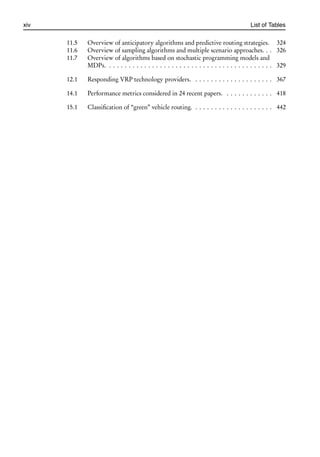
![i
i
List of Figures
4.1 Large neighborhood of Toth and Tramontani [82] . . . . . . . . . . . . . . 95
4.2 Decomposition strategies on instance P03 of Christofides, Mingozzi,
and Toth [11] with 100 customers. . . . . . . . . . . . . . . . . . . . . . . . . 96
4.3 Solution quality vs. running time for the GWKC instances. . . . . . . . . 103
5.1 Illustration of the 2-opt neighborhood. . . . . . . . . . . . . . . . . . . . . . 136
5.2 Illustration of the Or-opt neighborhood. . . . . . . . . . . . . . . . . . . . . 137
5.3 Illustration of the 2-opt* neighborhood. . . . . . . . . . . . . . . . . . . . . 137
5.4 Illustration of the cross exchange neighborhood. . . . . . . . . . . . . . . . 137
5.5 Illustration of the path relocation neighborhood. . . . . . . . . . . . . . . 138
5.6 Example of destroy/repair operation. . . . . . . . . . . . . . . . . . . . . . . 139
5.7 OX crossover example with i = 3 and j = 6. . . . . . . . . . . . . . . . . . . 144
6.1 The three types of PDPs. . . . . . . . . . . . . . . . . . . . . . . . . . . . . . . 162
6.2 Different 1-M-1 problems. . . . . . . . . . . . . . . . . . . . . . . . . . . . . . 166
11.1 The structure of the chapter. . . . . . . . . . . . . . . . . . . . . . . . . . . . . 301
11.2 Vehicle routing scenario with advance and immediate requests. . . . . . 303
11.3 Timeline of events and real-time communication between the vehicle
and the dispatcher. . . . . . . . . . . . . . . . . . . . . . . . . . . . . . . . . . . 303
11.4 Information flow of a typical GPS-based vehicle routing and monitor-
ing system. . . . . . . . . . . . . . . . . . . . . . . . . . . . . . . . . . . . . . . . 304
12.1 Typical components of vehicle routing software. . . . . . . . . . . . . . . . 354
12.2 An example of a vehicle routing software GUI. Software: R2, Procomp
Solutions Oy (www.procomp.fi). . . . . . . . . . . . . . . . . . . . . . . . . . 356
13.1 Example of multi-vehicle pickup-and-delivery problem and its solution. 383
13.2 Excerpt from a real ship routing and scheduling working sheet. . . . . . 384
13.3 Example solution without and with flexibility in cargo sizes. . . . . . . . 387
13.4 Example solution without and with load splitting. . . . . . . . . . . . . . . 389
13.5 Fuel consumption [ton/nautical mile] as a function of speed for an
LNG carrier. . . . . . . . . . . . . . . . . . . . . . . . . . . . . . . . . . . . . . . 391
13.6 Example MIRP and its solution with routes, start times (t), and (un)load
quantities (q). . . . . . . . . . . . . . . . . . . . . . . . . . . . . . . . . . . . . . . 394
13.7 Inventory levels at port 4 and port 3 during the planning horizon. . . . 395
13.8 Routes and schedules including time consumption of the various tasks. 395
14.1 Disaster relief supply chain [57]. . . . . . . . . . . . . . . . . . . . . . . . . . 410
xi](https://image.slidesharecdn.com/5603-250720001322-295f99e3/85/Vehicle-Routing-Problems-Methods-and-Applications-Second-Edition-Paolo-Toth-16-320.jpg)
![i
i
xii List of Figures
14.2 Network flow model: A square denotes a depot and a circle denotes a
demand location. Demand (d) is given next to a location. . . . . . . . . . 415
14.3 Minimizing the supply weighted arrival times [21]. . . . . . . . . . . . . . 419
14.4 Local vs. global timing priority rules (adapted from Panchamgam [46]). 420
14.5 Example of solution attractiveness in terms of risk. . . . . . . . . . . . . . 421
14.6 Team orienteering problem [54]. . . . . . . . . . . . . . . . . . . . . . . . . . 421
14.7 Daily schedule for one vehicle of the problem presented in De Angelis
et al. [12]. . . . . . . . . . . . . . . . . . . . . . . . . . . . . . . . . . . . . . . . . 422
14.8 Difference between long-and-safe routes and short-and-risky routes. . . 422
14.9 Avoid underutilization of the vehicles due to conservative planning [54]. 423
14.10 Routing and allocation problems. . . . . . . . . . . . . . . . . . . . . . . . . 423
14.11 Solutions with equal distribution and equitable distribution when sup-
ply is scarce. . . . . . . . . . . . . . . . . . . . . . . . . . . . . . . . . . . . . . . 424
14.12 Equal but inefficient delivery when demand satisfaction may be split . 425
14.13 Non-convex relation between number of vehicles and the maximum
route length. . . . . . . . . . . . . . . . . . . . . . . . . . . . . . . . . . . . . . . 428
14.14 Positive influence of edge crossing in min-sum objective [9]. . . . . . . . 430
15.1 Change of fuel consumption with speed. . . . . . . . . . . . . . . . . . . . . 441
15.2 Estimating emissions for a vehicle traveling at constant speed. . . . . . . 444](https://image.slidesharecdn.com/5603-250720001322-295f99e3/85/Vehicle-Routing-Problems-Methods-and-Applications-Second-Edition-Paolo-Toth-17-320.jpg)
![Chapter 1
The Family of Vehicle
Routing Problems
Stefan Irnich
Paolo Toth
Daniele Vigo
1.1 Introduction
A generic verbal definition of the family of vehicle routing problems can be the following:
Given: A set of transportation requests and a fleet of vehicles.
The problem is then to find a plan for the following:
Task: Determine a set of vehicle routes to perform all (or some) transportation
requests with the given vehicle fleet at minimum cost; in particular, decide
which vehicle handles which requests in which sequence so that all vehicle routes
can be feasibly executed.
In this type of problem, subsumed under the term Vehicle Routing Problem (VRP),
the transportation requests to be served are generally concentrated in specific points of a
road network as opposed to the Arc Routing Problems (ARP; see the companion book by
Corberán and Laporte [35]), where the requests are dispersed along the arcs, i.e., street seg-
ments of the underlying road network. The following sections will shed light on the basic
VRP components, which are the transportation requests and how they can be performed,
the fleet of vehicles, the related costs and profits (if relevant), and the feasibility of routes.
Before going into the details, however, we discuss the economic relevance of computer-
supported vehicle routing. Indeed, the large number of real-world applications have widely
shown that the use of computerized solution methods for the solution of VRP, both at
the planning and the operational levels, yields substantial savings in the global transporta-
tion costs. The success of the utilization of optimization techniques is due not only to the
power of the current computer systems and to the full integration of the information sys-
tems into the operations and commercial processes, but it can also be attributed to the
development of rigorous mathematical models, which are able to take into account al-
1](https://image.slidesharecdn.com/5603-250720001322-295f99e3/85/Vehicle-Routing-Problems-Methods-and-Applications-Second-Edition-Paolo-Toth-24-320.jpg)
![2 Chapter 1. The Family of Vehicle Routing Problems
most all the characteristics of the VRP arising in real-world applications. Furthermore,
the corresponding algorithms and their computer implementations (software tools) play
an essential role in finding high-quality feasible solutions for real-world instances within
acceptable computing times. Compared to procedures not based on optimization tech-
niques, significant cost savings and a better utilization of the vehicle fleet can be achieved.
In addition, by means of such planning software it is possible to improve the automa-
tion, standardization, and integration into the organizations’ overall planning processes,
leading to less time-consuming and more cost-efficient planning processes with respect to
manual planning. Moreover, computerized planning allows planners to compare several
different planning scenarios, and herewith to choose a best one through a careful and fast
evaluation of cost and service-related performance indicators.
In the last years, software tools integrating telematics services (electronic data trans-
mission between vehicles and planners) have been developed with the aim of enabling a
faster reaction of planners to the dynamics of the transportation system and to possible
disruptions caused by the failure of vehicles or by heavy traffic conditions on the roads.
Of course, online planning tools are indispensable for real-time applications such as the
control of automatic guided vehicles.
More than 50 years have elapsed since the 1959 paper by Dantzig and Ramser [40]
which introduced the VRP (then called the truck dispatching problem) as a real-world ap-
plication concerning the delivery of gasoline to gas stations. In this seminal paper the
authors proposed the first mathematical programming formulation and algorithmic ap-
proach for the VRP. Again, approximately 50 years separate us from the famous paper
by Clarke and Wright [33], who in 1964 proposed an effective greedy heuristic for the
approximate solution of the VRP. Following such brilliant forerunners, a huge number
of papers have been published during the past five decades in the international Opera-
tions Research and Transportation Science journals, presenting mathematical models and
proposing exact and (meta)heuristic algorithms for the optimal and approximate solution
of the different versions of the VRP. Among the journals that regularly publish papers
on the VRP, we can mention Operations Research, Transportation Science, Computers &
Operations Research, European Journal of Operational Research, EURO Journal on Trans-
portation and Logistics, Journal of the Operational Research Society, Transportation Research,
Networks, and Journal of Heuristics. Finally, in all the main international Operations Re-
search conferences there is at least one stream (often containing several sessions) with
presentations of new research and application results on the VRP.
The high interest of the international research community in the different variants of
VRP is not only motivated by their notorious difficulty as combinatorial optimization
problems but also, as previously mentioned, by their practical relevance. As a conse-
quence, researchers from both the academic and the industrial world work on the subject.
In North America, the majority of the academics and practitioners working on VRP are
members of the Transportation Science and Logistics society (TSL) within INFORMS (the
Institute for Operations Research and Management Science), while in Europe a new work-
ing group of EURO (the association of the European operational research societies), called
VeRoLog (Vehicle Routing and Logistics optimization), has recently been founded. Its
purpose consists in “favouring the development and application of Operations Research
models, methods and tools in the field of vehicle routing and logistics” and in “encour-
aging the exchange of information among practitioners, end-users and researchers in the
area of vehicle routing and logistics, stimulating the work on new and important prob-
lems with sound scientific methods”; see http://www.verolog.eu/.
It is finally worth noting that the mathematical models and the exact and metaheuris-
tic algorithms proposed for the VRP and presented in the chapters of this book constitute](https://image.slidesharecdn.com/5603-250720001322-295f99e3/85/Vehicle-Routing-Problems-Methods-and-Applications-Second-Edition-Paolo-Toth-25-320.jpg)

![urges acceptance of Calvin's Confession by all the Genevese,
vi. 292;
attends synod of Lausanne, 313;
forbidden to preach, 377;
preaches at St. Peter's, 381, 382;
arrested and imprisoned, 382;
a protest against his imprisonment, 383;
bail refused, 384;
banished, 403, 407;
leaves Geneva, 409;
takes refuge at Thonon, 412;
his death, 448
Courtelier, Father, sent to Geneva, iv. 246;
submits his doctrines to the council, 246;
his sermon, 247;
interview with Farel, 250;
his preaching compared with Farel's, 257;
gives evidence against Maisonneuve, 297, 298
Coverdale, Miles, iv. 2;
account of, v. 197;
his Bible, 198;
the king's sanction to it refused, 198;
accompanies Grafton to Paris, to prepare new edition of
Tyndale's Bible, viii. 177 [Grafton]
Coxe, Leonard, gets John Fryth liberated, iv. 141, 142
Cracow, Luther's doctrines introduced at, vii. 430
Cranmer, Thomas, Archbishop of Canterbury, presents to Henry
VIII. his treatise on the king's marriage, iv. 23;
ambassador to the pope at Bologna, 23;
his audience put off, goes to Rome, 28;
nominated grand almoner by the pope, 43;
sent to Nürnberg, 114;
intercourse with Osiander, 114;
marries, 116;
negotiates with Elector of Saxony, 116;
with imperial chancellor, 116;](https://image.slidesharecdn.com/5603-250720001322-295f99e3/85/Vehicle-Routing-Problems-Methods-and-Applications-Second-Edition-Paolo-Toth-28-320.jpg)
![has interview with Bucer at Strasburg, 246;
returns to Paris, 246;
estimate of Melanchthon, 246;
hopes, 253, 257, 260, 263, 282;
takes part in preparing French version of reformers' opinions,
284;
submits it to the Sorbonne, 285, 287;
his estimate of Bucer, iii. 67;
ambassador in England, takes gifts for Francis I., iv. 39;
his ancestry, 356;
character, 356;
advises the king to invite Melanchthon to France, 357, 362;
letter to Melanchthon, 366, 367;
envoy to Smalcalde, 394;
has audience of Elector John Frederick, 395;
received by German princes and deputies, 396;
demands a congress, 397;
a consultation held, 398 sqq.;
receives reply of the princes, 404, 405;
failure of his mission, 405
Du Bourg, John, iii. 72;
arrested, 112;
his martyrdom, 120
Du Châtel, Pierre, ii. 65;
opposes persecution, iii. 113
Duchemin, Nicholas, character of, ii. 1;
Calvin in his house, 2, 7, 9;
appointed ecclesiastical judge, v. 436
Du Crest, Nicholas, premier syndic of Geneva, iii. 364, 374;
takes part in consultation for peace, 395;
envoy to Berne, 402;
fails, 405; iv. 190, 200;
searches the bishop's palace, 235, 255;
escapes from Geneva, 316
Dumont, syndic of Geneva, deputy to the bishop, i. 460
Dumoulin, [Alexander Canus]](https://image.slidesharecdn.com/5603-250720001322-295f99e3/85/Vehicle-Routing-Problems-Methods-and-Applications-Second-Edition-Paolo-Toth-42-320.jpg)
![preaches against Lutheranism, 147;
attends conference at Copenhagen, 171;
remains silent, 181;
publishes apology for the mass, 182;
draws up plea for the bishops, 206
Eliot, Nicholas [Students, English]
Eliot, Sir Thomas, begs for gift of convents, v. 99
Elizabeth, Queen, birth of, iv. 166;
excitement in London, 166;
commended to care of Parker, v. 133
Elizabeth of Arnex, plots against Farel, iii. 213;
her conversion, 226
Engelbrechtsen, Olaf, archbishop of Brontheim, receives
Christian II., vii. 185;
flies to the Netherlands, 223, 224
England, laity and clergy, iv. 1;
Scriptural reformation, 2;
special character of Reformation in, 3, 4;
the Romish and political parties, 5;
the Society of Christian Brethren, 6;
Table-talk, 8;
popular excitement, 8;
petition of the Commons, 10;
reforms of the clergy, 16;
abolition of pluralism, 18, 19;
English address to the pope, 43;
the clergy predominant, 60;
royal supremacy recognized by clergy, 65, 66;
popular agitation, 67;
beginning of persecution, 76;
importance of choice of new primate, 113;
papal authority set aside by parliament, 130;
separation from France, 174;
general movement against papal supremacy, 178;
abolition of papal privileges, 179;
Romish exactions, 179;](https://image.slidesharecdn.com/5603-250720001322-295f99e3/85/Vehicle-Routing-Problems-Methods-and-Applications-Second-Edition-Paolo-Toth-45-320.jpg)
![the tree lopped, 180;
a critical epoch, v. 1, 2;
people and clergy against Rome, 7;
confusion, 53;
effect of execution of More and Fisher, 75, 76;
general visitation of churches and monasteries ordered, 82;
suppression of lesser monasteries, 96;
advantageous results, 100, 102, 103;
state of parties after Queen Anne's death, 171;
sarcasms against the papacy, 180;
the King's Articles of Religion published, 192;
evangelical reaction, 198;
prosecutions, 200;
insurrection in the North, 202 sqq.;
renewal of, 212;
invasion of, proposed by Paul III., vi. 109;
three parties in, viii. 140;
source and effect of the Reformation in, 140;
relations with Swiss reformers, 143;
various parties, attempt at compromise, 179 sqq.;
the Six Articles, 181 sqq.;
Cranmer's Bible and others published, 205;
Catholic policy on marriage of Henry VIII., with Catherine
Howard, 236
Enthusiasts, The, in the Netherlands, vii. 538 sqq. [Spirituals,
The]
Enzinas, Francis de [Enzinas, The], returns to Burgos, interview
with Peter de Lerma, viii. 41;
desires conversion of Spain, 42;
undertakes translation of New Testament, 43;
his acquaintance with Alasco, 43;
with Hardenberg, 43;
writes to Alasco, 44;
presents his sword to him, 45;
goes to Paris, 45;
attends death-bed of Peter de Lerma, 45;](https://image.slidesharecdn.com/5603-250720001322-295f99e3/85/Vehicle-Routing-Problems-Methods-and-Applications-Second-Edition-Paolo-Toth-46-320.jpg)
![goes to Wittenberg, intercourse with Melanchthon, 94;
counsels his brother to leave Rome, 95;
hears of his death, 97;
writes to Calvin, 98
Enzinas, James de [Enzinas, The], at Paris, viii. 46;
his character, 46;
impressed by heroism of martyrs at Paris, 46;
his Catechism, 48;
sent by his father to Rome, 95;
his dissatisfaction, 95;
resolves to leave Rome, arrested by the Inquisition, 96;
his trial, 97;
his martyrdom, 97 sqq.
Enzinas, John de [Enzinas, The], settles in Germany, viii. 48
Enzinas, The, viii. 38;
sent to Louvain, 39;
their character, 39;
religious disposition, 39;
friendship with Cassander, 40;
study the Bible and read Melanchthon, 41;
[Enzinas, Francis de, James de, and John de]
Eperies, Conference of, vii. 410
Erasmus, i. 331;
approves Berquin's propositions, 344, 378, 403;
attempts to restrain Berquin, 405;
again, 407;
his colloquies proscribed by the Sorbonne, 407;
shrinks from conflict, 408;
writes to Margaret of Angoulême, 412;
advice to Berquin, 432; ii. 1;
warns Francis I., 32, 299; iii. 155;
meeting with Calvin, 156;
breaks with him, 157, 166;
his followers, iv. 349, 454, 455, 458;
laments More, v. 75;
depicts court of Brussels, 222;](https://image.slidesharecdn.com/5603-250720001322-295f99e3/85/Vehicle-Routing-Problems-Methods-and-Applications-Second-Edition-Paolo-Toth-48-320.jpg)
![application of the priests to pasha at Buda against him, 414;
declared free to preach, 414;
establishes a school, 414
Etampes, Duchess of, ii. 184
Europe, awakening of, i. 315
Evangelicals. [Lutherans, England, France, Geneva]
Evangelists, sent out by Calvin, iii. 58;
abuse of, 62
Excommunication, Calvin's view of, vi. 286, 288
Exeter, Marquis of, charged with treason and executed, viii. 152
Faber, John, bishop of Vienna, writes against Luther, vii. 375;
appointed bishop, 376;
cites Devay before him, 376
Fabri, John, Friburg envoy to Geneva, i. 154, 155
Fabri (Chr. Libertet), iii. 161;
joins Farel at Morat, 202;
sent to Neuchâtel, 203;
removes to Bole, 305;
Catholic riot in his chapel, 306;
rising of Protestant peasants, 307;
another riot, 308, 309;
with Viret at Lausanne, vi. 229;
his trials, 270
Facts and Ideas, iii. 409
Faith and Science, iii. 61, 62; vi. 32, 33
Farel, William, i. 2, 305, 317;
at Strasburg, 362 sqq.;
light of France, 370;
invited to La Marche, 372;
his qualifications as reformer, 374;
hesitation, 375;
his connection with family of Mirabeau, 375;
preaches at Gap, 376;
arrested and rescued, 376;
school-master at Aigle, 377, 381, 386; ii. 100, 263, 436;](https://image.slidesharecdn.com/5603-250720001322-295f99e3/85/Vehicle-Routing-Problems-Methods-and-Applications-Second-Edition-Paolo-Toth-50-320.jpg)
![goes to Neuchâtel, 446;
his letter to the Genevese, 455;
urges Calvin to return to Geneva, vii. 22;
edict of expulsion revoked, 43;
deprived and banished from Neuchâtel, 49;
reinstated, 50;
a man of action, 114, 115
Farnese, Alexander [Paul III.]
—, Cardinal sent by the Pope to Charles V. at Ratisbon, vii. 26
Favre, Francis, Genevese deputy to Berne, ii. 307, 348;
assailed by Mamelukes, iii. 449;
envoy to Berne, iv. 309
Felix V. [Amadeus VIII.]
Feray, Claude, vii. 22, 23
Ferdinand, the Catholic, deprives his daughter Joanna of her
crown and imprisons her, viii. 127;
assumes the government of Castile, 128;
meeting with Philip, 132;
agreement between them, 132, 133;
his secret protest, 133;
his delegate left with Philip, 134
Ferdinand, of Austria, King of Bohemia and Hungary, ii. 109;
invested with duchy of Würtemberg, 109, 217;
threatened by alliance of Francis I. and Philip of Hesse,
appeals to the pope, 249, 250;
his army defeated by Philip, 253;
loses Würtemberg, 255;
attempts to maintain papal power in the duchy, 255;
opposes Zapolya and is crowned King of Hungary, vii. 364;
publishes edict against the Lutherans, 365;
supported by Charles V., 370;
annuls edict of toleration, 370;
less hostile to the Reformation, 384;
appoints a conference between the bishops and Szantai, 384;
his embarrassment, 386;
interview with the bishops, 386, 387;](https://image.slidesharecdn.com/5603-250720001322-295f99e3/85/Vehicle-Routing-Problems-Methods-and-Applications-Second-Edition-Paolo-Toth-54-320.jpg)
![banishes Szantai, 387;
concludes agreement with Zapolya, 390;
issues ordinance for maintenance of Catholic faith, 399;
another, 400;
his desire for union of the two churches, 408
Ferrara, Hercules, duke of, his marriage at Fontainebleau, i. 418
Ferrara, Renée, duchess, of [Renée of France]
Ferrara, University of, declares for divorce of Henry VIII., iv. 41;
knowledge of evangelical doctrines at, 427, 489;
influence of Calvin at, v. 422 sqq.;
the Inquisition, 444
Feyt, Florentius, Jesuit, sent to Sweden, vii. 333
Fief, Peter du, conducts persecution at Louvain, vii. 554;
remonstrance of the townsmen, 556, 569
Finlason, James, one of the Perth Protestants, condemned by
Cardinal Beatoun, vi. 180, 181;
hung, 181
Fisher, John, bishop of Rochester, iv. 4, 5;
defends the church, 16;
summoned before the king, 17;
his subterfuge, 18;
rumor of attempt to poison him, 68, 141;
supports Maid of Kent, v. 10, 12;
attainted, sentenced to death, 16, 17;
refuses to take the oath of supremacy, 46;
attainted, 46;
steadfast, 46;
visited by Cromwell, 64;
made cardinal, 64;
his last moments, 66;
death, 67;
characterised, 74;
effect of his death at Rome, 76
Fitzherbert, Anthony, commissioner for suppression of lesser
monasteries, v. 100
Fitzwilliam, Sir William, lord-admiral, iv. 5](https://image.slidesharecdn.com/5603-250720001322-295f99e3/85/Vehicle-Routing-Problems-Methods-and-Applications-Second-Edition-Paolo-Toth-55-320.jpg)
![Fitzwilliam, Lord, Governor of the Tower, delivers Fryth to
messengers of the primate, iv. 153
Flaminio, Marco Antonio, poet, iv. 427;
birth and early life of, 477, 478;
character, 478;
at Naples with Valdez, 479 sqq.;
at Rome, with Pole and Caraffa, 481
Florence, iv. 432
Folengo, Giovanni Battista, account of, iv. 482, 483
Fontainebleau, rejoicings at, i. 418 sqq.;
interrupted, 422
Forest, Father, defends Catherine of Aragon, iv. 103
Forman, Andrew, competitor for see of St. Andrews, vi. 10;
seizes the castle and monastery, 10
Forrest, Henry, Benedictine, imprisoned by Beatoun, vi. 92;
degraded, 93;
burnt, 93
Forrest, Thomas, Augustine, reads the writings of St. Augustine,
vi. 103;
priest of Dollar, 103;
denounced, 104;
his interview with the bishop of Dunkeld, 104;
arrested, 116;
examined before the cardinal, 116;
burnt, 118
Fouquet, [Trois-Moutiers, prior of]
Fox, Edward, high almoner, deputed with Gardiner to obtain
opinion of Cambridge University on the king's divorce, iv.
29;
with Longland, that of Oxford, 33;
summoned to Windsor, 35;
ambassador to Germany, v. 109;
concludes alliance with the princes, 110;
sent to conduct discussion with Protestants at Wittenberg,
116;
has audience of Elector of Saxony, 117;](https://image.slidesharecdn.com/5603-250720001322-295f99e3/85/Vehicle-Routing-Problems-Methods-and-Applications-Second-Edition-Paolo-Toth-56-320.jpg)