Data-driven Solutions to Transportation Problems 1st Edition- eBook PDF
Data-driven Solutions to Transportation Problems 1st Edition- eBook PDF
Data-driven Solutions to Transportation Problems 1st Edition- eBook PDF
Data-driven Solutions to Transportation Problems 1st Edition- eBook PDF
Data-driven Solutions to Transportation Problems 1st Edition- eBook PDF
1.
Data-driven Solutions toTransportation Problems
1st Edition- eBook PDF download
https://ebookluna.com/download/data-driven-solutions-to-
transportation-problems-ebook-pdf/
Download full version ebook from https://ebookluna.com
2.
We believe theseproducts will be a great fit for you. Click
the link to download now, or visit ebookluna.com
to discover even more!
Data Driven: Harnessing Data and AI to Reinvent Customer Engagement 1st
Edition Tom Chavez - eBook PDF
https://ebookluna.com/download/data-driven-harnessing-data-and-ai-to-
reinvent-customer-engagement-ebook-pdf/
Data Analytics for Intelligent Transportation Systems 1st Edition Edition
Mashrur Chowdhury - eBook PDF
https://ebookluna.com/download/data-analytics-for-intelligent-
transportation-systems-ebook-pdf/
Data-Driven and Model-Based Methods for Fault Detection and Diagnosis 1st
Edition - eBook PDF
https://ebookluna.com/download/data-driven-and-model-based-methods-for-
fault-detection-and-diagnosis-ebook-pdf/
Artificial Intelligence and Data Driven Optimization of Internal Combustion
Engines 1st Edition Jihad Badra (Editor) - eBook PDF
https://ebookluna.com/download/artificial-intelligence-and-data-driven-
optimization-of-internal-combustion-engines-ebook-pdf/
3.
CDPSE Certified DataPrivacy Solutions Engineer All-in-One Exam Guide 1st
Edition - eBook PDF
https://ebookluna.com/download/cdpse-certified-data-privacy-solutions-
engineer-all-in-one-exam-guide-ebook-pdf/
Trigonometry Booster with Problems and Solutions 3e Edition Rejaul Makshud
- eBook PDF
https://ebookluna.com/download/trigonometry-booster-with-problems-and-
solutions-ebook-pdf/
(eBook PDF) Student Solutions Manual and Supplemental Problems to accompany
Genetics: Analysis of Genes and Genomes 8th Edition
https://ebookluna.com/product/ebook-pdf-student-solutions-manual-and-
supplemental-problems-to-accompany-genetics-analysis-of-genes-and-
genomes-8th-edition/
Transportation Operations Management 1st edition - eBook PDF
https://ebookluna.com/download/transportation-operations-management-ebook-
pdf/
Logistics Transportation Systems 1st Edition - eBook PDF
https://ebookluna.com/download/logistics-transportation-systems-ebook-pdf/
Contributors
Numbers in Parenthesesindicate the pages on which the author’s contributions begin.
Matthew J. Barth (11), Department of Electrical and Computer Engineering; College of
Engineering-Centre for Environmental Research and Technology (CE-CERT),
University of California, Riverside, CA, United States
Kanok Boriboonsomsin (11), College of Engineering-Centre for Environmental
Research and Technology (CE-CERT), University of California, Riverside, CA,
United States
Xi Chen (175), School of Transportation Science and Engineering, Beihang University,
Beijing, People’s Republic of China
Xiqun (Michael) Chen (201), College of Civil Engineering and Architecture, Zhejiang
University, Hangzhou, People’s Republic of China
Ge Guo (247), Institute of Computing Technology, China Academy of Railway
Sciences, Beijing, People’s Republic of China; Department of Civil and
Environmental Engineering, University of Washington, Seattle, WA, United States
Meng Li (111), Department of Civil Engineering, Tsinghua University, Beijing,
People’s Republic of China
Huiping Li (111), Department of Civil Engineering, Tsinghua University, Beijing,
People’s Republic of China
Li Li (247), Institute of Computing Technology, China Academy of Railway Sciences,
Beijing, People’s Republic of China
Xiaolei Ma (175), School of Transportation Science and Engineering, Beihang
University, Beijing, People’s Republic of China
Xuewei Qi (11), Department of Electrical and Computer Engineering; College of
Engineering-Centre for Environmental Research and Technology (CE-CERT),
University of California, Riverside, CA, United States
Haiyan Shen (247), Institute of Computing Technology, China Academy of Railway
Sciences, Beijing, People’s Republic of China
Tianyun Shi (247), Institute of Computing Technology, China Academy of Railway
Sciences, Beijing, People’s Republic of China
Xiaoqian Sun (227), National Key Laboratory of CNS/ATM, School of Electronic and
Information Engineering, Beihang University, Beijing, People’s Republic of China
Peng Sun (247), Institute of Computing Technology, China Academy of Railway
Sciences, Beijing, People’s Republic of China
xi
10.
Jinjun Tang (137),School of Traffic & Transportation Engineering, Central South
University, Changsha, China
Sebastian Wandelt (227), National Key Laboratory of CNS/ATM, School of Electronic
and Information Engineering, Beihang University, Beijing, People’s Republic of
China
Yinhai Wang (1,51), Department of Civil and Environmental Engineering, University
of Washington, Seattle, WA, United States
Guoyuan Wu (11), College of Engineering-Centre for Environmental Research and
Technology (CE-CERT), University of California, Riverside, CA, United States
Yao-Jan Wu (81), Department of Civil and Architectural Engineering and Mechanics,
University of Arizona, Tucson, AZ, United States
Shu Yang (81), Department of Civil and Architectural Engineering and Mechanics,
University of Arizona, Tucson, AZ, United States
Ziqiang Zeng (1), Department of Civil and Environmental Engineering, University of
Washington, Seattle, WA, United States, Business School, Sichuan University,
Chengdu, People’s Republic of China
Guohui Zhang (51), Department of Civil and Environmental Engineering, University of
Hawaii at Manoa, Honolulu, HI, United States
Mingqiao Zou (111), Department of Civil Engineering, Tsinghua University, Beijing,
People’s Republic of China
xii Contributors
11.
List of Figures
Fig.1.1 Data-driven innovation process in transportation systems. 5
Fig. 1.2 A reader’s guide to the structure and dependencies in this book. 8
Fig. 2.1 Basic operation modes for PHEV. 15
Fig. 2.2 Basic classification of EMS for PHEV. Note: PMP, Pontraysgin’s minimum
principle; MNIP, mixed nonlinear integer programming; DP, dynamic
programming; QP, quadratic programming; RL, reinforcement learning;
ANN, artificial neural network; LUTs, look-up-tables; MPC, model
predictive control; AECMS, adaptive equivalent consumption minimization
strategy. 16
Fig. 2.3 Flow chart of the proposed on-line EMS. 18
Fig. 2.4 Time horizons of prediction and control. 18
Fig. 2.5 Example solutions of power-split control. 20
Fig. 2.6 Estimation and sampling process of EA. 21
Fig. 2.7 EDA-based on-line energy management system. 22
Fig. 2.8 SOC reference control bound examples. 24
Fig. 2.9 Example trip along I-210 in southern California used for evaluation. 27
Fig. 2.10 Population initialization from the second prediction horizon (i.e., t2). 28
Fig. 2.11 Comparison of computation time. 29
Fig. 2.12 SOC trajectories resulted from different control strategies. 30
Fig. 2.13 Box-plot of fuel savings on 30 trips. 30
Fig. 2.14 Fuel savings for trips with different duration, compared to B-I. 32
Fig. 2.15 Resultant SOC curve when trip duration is 5000 s. 32
Fig. 2.16 SOC track with known or unknown charging opportunity. (A) C-D. (B) S-A.
(C) C. (D) S-L. 33
Fig. 2.17 Taxonomy of current EMS. 35
Fig. 2.18 Graphical illustration of reinforcement learning system. 39
Fig. 2.19 Illustration of environment states along a trip. 40
Fig. 2.20 Convergence analysis (¼0.7; ¼ 0.5; ¼ 0.5). 43
Fig. 2.21 4-D slice diagram of the learned Q table. 43
Fig. 2.22 Fuel consumption in gallon (bracketed values) and SOC curves by different
exploration probabilities. 44
Fig. 2.23 (A) Linear adaptive control of ; (B) linear adaptive control of with
charging opportunity. 45
Fig. 2.24 Optimal results when available charging gain is 0.3 (Cg ¼ 0.3). 45
Fig. 2.25 Optimal results when available charging gain is 0.6 (Cg ¼ 0.6). 46
Fig. 2.26 Fuel consumption reduction compared to binary control. 46
Fig. 3.1 The architecture of the proposed ANN model. 57
Fig. 3.2 Flow chart of the ANN algorithm. 59
Fig. 3.3 Flow chart of the video-based vehicle detection and classification system. 60
Fig. 3.4 The system user interface. 60
Fig. 3.5 An example video scene and its background. (A) A snapshot of a video
scene; (B) extracted background. 62
Fig. 3.6 System configuration and components of the virtual detector. 63
xiii
12.
Fig. 3.7 Asnapshot of the VVDC system when a vehicle is detected and classified. 65
Fig. 3.8 Comparisons between observed and estimated Bin 1 volumes at 3-min level
for detector of ES-163R: _MN___2 on May 13, 1999. 67
Fig. 3.9 Comparisons between observed and estimated bin volumes at 15-min level
for detector of ES-163R: _MN___2 on May 13, 1999. 67
Fig. 3.10 Comparisons between observed and estimated bin volumes at 15-min level
for detector of ES-209D: _MN___2 on May 10, 2004. 68
Fig. 3.11 Test site situations (A) Northbound SR-99 near the NE 41st Street
(B) Southbound I-5 near the NE 92nd Street. 72
Fig. 3.12 Error investigations: (A) a truck occupying two lanes is measured twice;
(B) a misclassified truck with a color of the bed similar to the background
color. 75
Fig. 4.1 Calculating percentile given a distribution. 90
Fig. 4.2 Framework of testing hypotheses. 92
Fig. 4.3 Log-likelihoods of the three mixture models with K lying in [15, 39].
Log-likelihoods (A) Case 1 and (B) Case 2; AIC (C) Case 1 and (D) Case 2;
and BIC (E) Case 1 and (F) Case 2. 93
Fig. 4.4 Moment-based travel time reliability measure using the three mixture
models: (A) first moment, Case 1; (B) first moment, Case 2; (C) second
moment, Case 1; (D) second moment, Case 2; (E) third moment, Case 1; and
(F) third moment, Case 2; (G) coefficient of variance, Case 1; (H) coefficient
of variance, Case 2; (I) standardized skewness, Case 1; and (J) standardized
skewness, Case 2. 95
Fig. 4.5 Percentile-based travel time reliability measure using the three mixture
models: (A) 10th percentile travel time, Case 1; (B) 10th percentile travel
time, Case 2; (C) 50th percentile travel time, Case 1; (D) 50th percentile
travel time, Case 2; (E) 90th percentile travel time, Case 1; (F) 90th
percentile travel time, Case 2; (G) 95th percentile travel time, Case 1; (H)
95th percentile travel time, Case 2; (I) buffer index, Case 1; (J) buffer index,
Case 2; (K) planning time index, Case 1; and (L) planning time index,
Case 2. 96
Fig. 4.6 Framework of measuring the accuracy of travel time reliability. 98
Fig. 4.7 Origin and destination, and its shortest routes. 103
Fig. 4.8 Three preferred routes, case study. 103
Fig. 4.9 Average travel times by preferred route. 104
Fig. 5.1 Design of the stated-preference (SP) experiment. 116
Fig. 5.2 The interface of the SP experiment. 117
Fig. 5.3 Comparison of the gender ratio. 118
Fig. 5.4 Household income distribution. 118
Fig. 5.5 Departure time distribution. 118
Fig. 5.6 Mode split. 119
Fig. 5.7 Framework of the agent-based choice model. 119
Fig. 5.8 Policy and scenario analysis framework. 125
Fig. 5.9 Simulation network (2nd ring road of Beijing). 125
Fig. 5.10 Congestion charges scenarios (I). 126
Fig. 5.11 Congestion charges scenarios (II). 127
Fig. 5.12 An illustration of a VMS panel. 128
Fig. 5.13 An SBO framework for the VGSC problem. 130
Fig. 5.14 Map of THIP with land use. 131
Fig. 5.15 Road network topology of THIP. 132
Fig. 5.16 Convergence process of the genetic algorithm: (A) The evolution process,
(B) the standard deviation of population in generations, and (C) total travel
time of population along generations. 133
xiv List of Figures
13.
Fig. 6.1 Demanddistribution of taxi trips: (A) origins on weekday, (B) destinations
on weekday, (C) origins on weekend, and (D) destinations on weekend. 141
Fig. 6.2 Hourly taxi trip distribution for origins and destinations: (A) weekday and
(B) weekend. 143
Fig. 6.3 Cluster numbers under different parameters: (A) pick-up locations and
(B) drop-off locations. 144
Fig. 6.4 Clustering results with defined parameters: (A) pick-up locations and
(B) drop-off locations. 144
Fig. 6.5 A case study of a shopping center in Harbin city. 146
Fig. 6.6 Travel distance of trips. Weekday: (A) occupied trips and (B) nonoccupied
trips. Weekend: (C) occupied trips and (D) nonoccupied trips. 148
Fig. 6.7 Travel time of trips. Weekday: (A) occupied trips and (B) nonoccupied trips.
Weekend: (C) occupied trips and (D) nonoccupied trips. 151
Fig. 6.8 Average speed of trips. Weekday: (A) occupied trips and (B) nonoccupied
trips. Weekend: (C) occupied trips and (D) nonoccupied trips. 153
Fig. 6.9 Estimation results of traffic distribution using entropy-maximizing method:
(A) comparison between estimated and observed values and (B) estimation
errors. 158
Fig. 6.10 Cumulative probability distribution of degree and strength: (A) degree and
strength of occupied trips, (B) degree and strength of vacant trips,
(C) in-degree and in-strength of occupied trips, (D) in-degree and in-strength
of vacant trips, (E) out-degree and out-strength of occupied trips, and
(F) out-degree and out-strength of vacant trips. 160
Fig. 6.11 Degree-strength correlation: (A) occupied trips and (B) vacant trips. 161
Fig. 6.12 Correlation between ki
out
kj
in
and wij. 162
Fig. 6.13 Correlation between strength, clustering coefficients and betweenness:
(A) occupied trips and (B) vacant trips. 163
Fig. 6.14 Network structure of OTTN and VTTN: (A) occupied (EN¼0.8259) and
(B) vacant (EN¼ 0.8032). 166
Fig. 6.15 Regional partition based on Louvain method in main area of Harbin city:
(A) administrative divisions and (B) recognized by identification algorithms. 167
Fig. 6.16 Hourly variation of trip numbers in a week: (A) occupied trips and
(B) vacant trips. 168
Fig. 6.17 Hourly variation of normalized DV on weekdays. 169
Fig. 6.18 Threshold selection in Lorenz curves: (A) origins and (B) destinations. 170
Fig. 6.19 Identification of hotspots with two different criteria: (A) density of origins,
(B) hotspots of origins with min, (C) hotspots of origins with max,
(D) density of destinations, (E) hotspots of destinations with min, and
(F) hotspots of destinations with max. 172
Fig. 7.1 Example of public transportation smart card data. 179
Fig. 7.2 Example of original GPS data of the Beijing public transportation system. 182
Fig. 7.3 Heat map of the places of residence of Beijing public transportation
commuters in June 2015. 186
Fig. 7.4 Heat map of the places of work of Beijing public transport commuters in
June 2015. 187
Fig. 7.5 Classification of stop IDs based on the ring roads where they are located. 188
Fig. 7.6 Comparison of the true values and the predicted values that are obtained
using the RVM and SVM algorithms. 192
Fig. 7.7 Comparison of the confidence interval of the predicted values that are
obtained using the RVM algorithm and the true values. 193
Fig. 7.8 Beijing public transportation network speed map. 196
Fig. 7.9 Analysis of the ridership of route 51,300. 197
Fig. 7.10 A histogram of bus headways at a particular bus stop. 197
List of Figures xv
14.
Fig. 7.11 (A)Spatial distribution of bus travel time reliability; (B) trend analysis of
bus travel time. 198
Fig. 8.1 A systematic SBO framework for network modeling with heterogeneous
data. 205
Fig. 8.2 Simulated spatial distribution of AM peak traffic flow. 210
Fig. 8.3 Comparisons of the simulated and measured freeway traffic flow.
(A) Vt
freeway
. (B) Kt
freeway
. (C) Qt
freeway
. 212
Fig. 8.4 Simulated relationships between link-based and path-based network-wide
statistics. (A) τt vs. στ. (B) Kt vs. τt and στ. (C) Qt vs. τt. (D) Trip completion
rate vs. στ. 213
Fig. 8.5 Comparison of simulated trip travel time with historical INRIX route travel
time. 217
Fig. 8.6 Individual objective functions and empirical cumulative distribution of
desirability. 219
Fig. 8.7 Comparison of major arterial average speeds of multiple objective
functions. 220
Fig. 8.8 Comparison of multiple objective functions. (A) Network-wide average trip
travel time. (B) Vehicle throughput. (C) Toll revenue. 222
Fig. 9.1 Global air transportation network from openflights. Notes: Airports are
visualized as dots and direct flight connections with links. In total, we have
3246 airports and 18,890 connections. Please note that all flights are
visualized through the center of the figure; actual routes might be different. 233
Fig. 9.2 Visualization of the global air transportation network using the
force-directed algorithm Fruchtermann-Reingold, instead of geo-spatial
information. Notes: Distances of links are minimized for the purpose of
visualization. The figure exposes how several nodes aggregate into
well-connected clusters. Moreover, it also exposes how certain nodes act as
gatekeeper for the accessibility of other nodes to the network. 233
Fig. 9.3 Airports with Top-Degree values in global air transportation network. Notes:
All airports are located in the northern hemisphere, with a strong focus on
Western Europe and North America. 235
Fig. 9.4 Degree distribution for the global air transportation network. Notes: While
nodes with low degree occur frequently in the network, the frequency of
nodes with higher degree reduces fast. Only very few nodes have
exceptionally high degrees. This structure gives the air transportation
network its hub-and-spoke property. 236
Fig. 9.5 Airports with Top-Betweenness values in global air transportation network.
Notes: Most airports are located in the northern hemisphere. Compared to
high-degree nodes, we also find important nodes in South Asia and Oceania. 236
Fig. 9.6 Pairwise correlation of four centralities: degree, betweenness, closeness, and
pagerank. Notes: We observe a weak correlation between most pairs only.
Particularly, there is no strong correlation between degree and betweenness,
which implies that high connectivity does not necessarily imply high
throughput. 237
Fig. 9.7 Visualizing the relative size of the giant component under node removal
according to 100 random attacks. Notes: Global air transportation is resilient
against random attacks, as can be seen by the close-to-diagonal curves of
random attacks. 238
Fig. 9.8 Comparison of robustness curves, visualizing the relative size of the giant
component under node removal according to different network metrics.
Notes: Betweenness and eigenvector are the most effective attacking
strategies for global air transportation. 238
xvi List of Figures
15.
Fig. 9.9 Air-sideaccessibility of six airports in the global air transportation network.
Notes: The source airports are labeled in the center with their IATA codes.
The concentric circles report the reachability of airports with an increasing
number of hops. Highly connected nodes, e.g., AMS (Amsterdam Airport
Schiphol), are more accessible and closer to other airports than low-degree
nodes, e.g., OGD (Ogden-Hinckley Airport, Utah, USA). 240
Fig. 9.10 Communities in the global air transportation network. Notes: Each color
represents a different community. In total, we have 31 communities, where 4
communities cover approximately 60% of all airports. A clear spatially-
induced distribution of communities can be observed. 241
Fig. 9.11 Airline network of Turkish Airlines. Notes: The network covers a large
number of international airports, almost all of them are operated from a
single hub: IST (Istanbul Atatuerk Airport). A failure at IST is very likely to
disrupt the whole network of Turkish Airlines. 241
Fig. 9.12 Airline network of Ryanair. Notes: The network consists of many hub nodes
and, accordingly, a failure at a single hub can often be compensated for by
other airports. 242
Fig. 9.13 Degree distribution for the airline networks of Turkish Airlines (left) and
Ryanair (right). Notes: The left distribution has very few high-degree nodes,
while the right degree distribution reveals less concentration on a few
selected hubs. 243
Fig. 9.14 An example of Multiple Airport Region (MAR) for the Greater London area.
Notes: Seven airports serve the city, with different capacities, destinations,
and accessibility.The methodology for computing MARs is usually based on
spatial distances, often airports within 120–150 km. In Fig. 9.15, we
visualize the global MARs which have at least five airports. Please note that,
since openflights.org has no passenger data, the regions can contain airports
with very little regular passenger traffic. We can see that the majority of
MARs are found in Western Europe and North America. The air
transportation subsystem in these areas is much more resilient than in other
regions. 243
Fig. 9.15 Multiple Airport Regions (MARs) in the global airport network, with
distance less than 120 km. Notes: Only MARs with at least five airports are
shown. The majority of MARs are found in Western Europe and North
America. 243
Fig. 10.1 ISO-13374 data processing and information flows. 248
Fig. 10.2 Sensor distribution. 1: car information controlling device display screen, 2:
cab temperature sensor, 3: wireless data transmission device, 4: external
temperature sensor, 5: traction transformer oil flow device, 6: traction
converter current/voltage sensor, 7: motor temperature sensor, 8: passenger
car temperature sensor, 9: smoke and fire alarm probe, 10: net pressure
transformer, 11: ATP speed sensor, 12: brake speed sensor, 13: semi active
control acceleration sensor, 14: axis temperature sensor, 15: acceleration
sensor for bogie instability detection, 16: overvoltage/lightning protection,
17: traction transformer primary current sensor, 18: brake control device
pressure sensor, 19: car door sensor. 250
Fig. 10.3 Data sources and their fusion processing. 252
Fig. 10.5 Gearbox temperature and difference fusion result. 257
Fig. 10.4 Axis temperature and its difference. 257
Fig. 10.6 Traction motor temperature and difference fusion results. 258
Fig. 10.7 Defective degree of bearing box, gearbox, and traction motor. 259
Fig. 10.8 EMU’s health index. 261
List of Figures xvii
16.
List of Tables
Table2.1 Classification of Current Literature 17
Table 2.2 Representation of One Example Individual 22
Table 2.3 Example Fitness Evaluation by Different Fitness Functions 25
Table 2.4 Abbreviations of Different SOC Control Strategies Compared in This
Chapter 27
Table 2.5 Comparisons With Existing Models 31
Table 2.6 Increased Fuel Consumption 35
Table 3.1 Four Length-Based Vehicle Categories Used by the WSDOT 56
Table 3.2 Selected Loop Detectors for Experimental Tests 66
Table 3.3 Statistical Comparisons of Estimation Errors and Correlation
Coefficients Between Measured and Estimated Bin Volumes at the
Interval of 3 min for Different Days at Station ES-163R 69
Table 3.4 Statistical Comparisons of Estimation Errors and Correlation
Coefficients Between Measured and Estimated Bin Volumes at the
Interval of 3 min for Different Days at Station ES-209D 70
Table 3.5 Summary of Results for Both Offline and Online Tests 73
Table 4.1 Summary of Data Size Selection 86
Table 4.2 Statistics of Three Distributions 88
Table 4.3 Optimal Quantity Case Studies 99
Table 4.4 Case Study 1: 23 Weeks of Data 99
Table 4.5 Case Study 2: 23 Weeks of Data 100
Table 4.6 Case Study 3: 23 Weeks of Data 100
Table 4.7 TTR Measures and Their Accuracy 105
Table 5.1 Summary of Selected Personal Attributes 128
Table 5.2 Binary Logit Model for Drivers’ Responses to VMS 129
Table 5.3 Comparison of Minimum Values of Objective Function 132
Table 6.1 Data Sections of Taxi GPS Data in Harbin City 140
Table 6.2 Parameters Estimation Results Based on LM Method 147
Table 6.3 Fitting Parameters for Travel Distance Distribution 150
Table 6.4 Fitting Parameters for Travel Time Distribution 152
Table 6.5 Fitting Parameters for Average Speed Distribution 154
Table 6.6 Calibrated Parameters in Entropy-Maximizing Model 157
Table 6.7 Statistical Result of Two Travel Network 164
Table 6.8 Community Detection Results 167
Table 7.1 Extraction of Commuting Characteristics 185
Table 7.2 Numbers of Commuters at Places of Residence and Work on Each Ring
Road and Their Percentage of the Total 189
Table 7.3 Errors of the RVM and SVM Algorithm 192
Table 8.1 Route-by-Route Validation With Probe Vehicle Travel Time Statistics 214
Table 9.1 An Example of Airport Entity Provided by Openflights 230
xix
17.
Table 9.2 AnExample of Airline Entity Provided by Openflights 231
Table 9.3 An Example of Routes Entity Provided by Openflights 232
Table 10.1 Contribution of System 1 in System Joint 260
Table 10.2 Contribution of System 2 in System Joint 260
Table 10.3 Contribution of System 3 in System Joint 260
xx List of Tables
18.
Preface
In recent years,the increasing quantity and variety of data available for decision
support present a wealth of opportunity as well as a number of new challenges,
in both the public and private sectors. Vast quantities of data are available
through increasingly affordable and accessible data acquisition and communi-
cation technologies, including sensors, cameras, mobile location services, etc.
When these are combined with emerging computing and analytical methodol-
ogies, they can lead to more thorough scientific understandings, informed deci-
sions, and proactive management solutions. As a result, big data concepts and
methodologies are steadily moving into the mainstream in a variety of science
and engineering fields.
During the past decades, transportation research has been driven largely by
mathematical equations and has relied on relatively scarce data. With the
increasing quantity and variety of data being collected from intelligent transpor-
tation systems and other sensors and applications, the potential for solid data-
driven or data-based research is increasing rapidly. Nevertheless, today there
are few established systems for supporting general big data analytics in trans-
portation research and practical applications. Most current online data analysis
and visualization systems are designed to compute and visualize one type of
data, such as those from freeway or arterial sensors, on an online platform.
Therefore, though the scope and ubiquity of transportation data are increasing,
making these data accessible, integrated, and useable for transportation analysis
is still a remarkable challenge.
Understanding data-driven transportation science is essential for enhancing
an intelligent transportation system’s performance. Most commercial systems
are oriented toward a specific transportation problem or analysis procedure,
and approach the problem in their own (often ad hoc) way. A mature framework
for effectively utilizing data and computing resources, such that these data will
serve the needs of users, has become a pressing need in the field of transporta-
tion. The challenges associated with developing this type of framework primar-
ily stem from the need for standardized and efficient data integration and quality
control methods, computational modules for applying these data to transporta-
tion analysis, and a unified data schema for heterogeneous data.
This book consists of 10 chapters providing in-depth coverage of the state of
the art in data-driven methodologies and their applications in the E-Science of
transportation. Such methods are crucial for solving transportation problems
xxi
19.
such as energy-efficientdriving in a connected vehicle environment, traffic
sensing data analysis and quality enhancement, travel time reliability (TTR)
estimation, urban travel behavior and mobility analysis, public transportation
data mining, network modeling, and railway system prognostics and health
management (PHM).
A brief overview of chapters in this book is provided here as a quick guide
for readers. The structure and connections between different chapters are also
illustrated in a roadmap to help the readers gain a better understanding of the
content of this book.
Chapter 1 presents an overview of data-driven transportation science. A gen-
eral background on the motivation for promoting data-driven transportation sci-
ence is provided. In addition, a review of related methodologies and
applications is given as an introduction to the development history of intelligent
transportation systems.
Chapter 2 introduces two data-driven on-line energy management strategies
for plug-in hybrid electric vehicles (PHEVs), which support energy-efficient
driving control in a connected vehicle environment. The methods introduced
in this chapter are validated using real-world driving data, and the results indi-
cate that the proposed data-driven energy management system (EMS) strategies
are very promising in terms of achieving a good balance between real-time per-
formance and fuel savings when compared with some existing strategies, such
as binary mode EMS and Dynamic Programming-based EMS.
Chapter 3 describes an artificial neural network-based machine learning
method to extract classified vehicle volumes from single-loop measurements.
In addition, a set of computer vision-based algorithms is developed to extract
background images from a video sequence, detect the presence of vehicles,
identify and remove shadows, and calculate pixel-based vehicle lengths for
classification based on widely available surveillance camera signals. Machine
learning methods for predictive modeling and computer vision are advanced
computing techniques, which can revolutionize existing traffic sensing prac-
tices and theoretical foundations. The experimental results described in this
chapter indicate that such methods exhibit superior performance under various
traffic operation scenarios. This chapter summarizes current efforts in these
promising areas, and offers significant contributions to data-driven transporta-
tion science research and applications.
Chapter 4 empirically demonstrates the concept that “the same data tell you
the same story,” and that TTR measures are insensitive to probability distribu-
tion assumptions. This chapter also covers accuracy estimation for TTR mea-
sures. The bootstrap technique, a data-driven technique based on resampling
with replacement, plays an important role in accuracy estimation. The accuracy
estimates provide a more general characterization of TTR compared to point
estimation. In addition, the concept of segment-based TTR on roadways is
extended to Origin-Destination (OD)-based TTR over roadway networks.
The characteristics of OD-based TTR are discussed briefly. This chapter
xxii Preface
20.
summarizes continued effortson improving the accuracy of TTR estimation and
related extensions, contributing to data-driven transportation studies and
applications.
Chapter 5 covers some conventional methods for modeling travel behavior,
and introduces several state-of-the-art analytical methods to study travelers’
behaviors based on a data fusion method. Some traditional behavior models
are based on the max-utility theory and perfect human rationality. The most
widely used travel behavior model based on the maximization theory is the dis-
crete choice model. This is operationalized in the modeling structure by making
the choice process a function of both the alternative attributes and the charac-
teristics of the traveler. Furthermore, analytical travel behavior models are used
to predict travelers’ departure time choice and mode switch under such strate-
gies. Agent-based models for traveler mode choice and departure time are uti-
lized in this chapter.
Chapter 6 explores the urban travel mobility for understanding the property
of travel patterns based on large-scale trajectory data. By dividing the city area
into different transportation districts, the origin and destination distribution
associated to these districts in an urban area on weekdays and weekends are ana-
lyzed. The Density-Based Spatial Clustering of Applications with Noise
(DBSCAN) algorithm is used to cluster pick-up and drop-off locations. Further-
more, four spatial interaction models are calibrated and compared based on tra-
jectories in a shopping center of Harbin city to study the pick-up location
searching behavior. By extracting taxi trips from GPS data, travel distance,
time, and average speed in occupied and nonoccupied vehicles are then used
to investigate human mobility. Next, the observed OD matrix of a central area
in Harbin city is used to model the traffic distribution patterns based on the
entropy-maximizing method and to validate the performance of the proposed
methodology in a case study. Finally, a dilatation index based on the weighted
average distance among trips is applied to analyze the spatial structure of an
urban city. Furthermore, hotspots are identified from local density of locations
with different thresholds as determined by the Lorenz curve.
In Chapter 7, applications of big data in public transportation planning, oper-
ation, and management is introduced, specifically with regard to the classifica-
tion and processing of these big data and their combination with other data.
Applications of public transportation big data in areas such as bus arrival times
prediction, commuting behavior mining, and performance evaluation of public
transportation networks (E-Science public transportation big data platform) are
introduced. In addition, case studies are presented to demonstrate the value of
Beijing’s public transportation data in addressing practical problems.
Chapter 8 develops a simulation-based optimization (SBO) framework by
integrating metamodels with mesoscopic simulation-based dynamic traffic
assignment models for large-scale network modeling problems. The adopted
SBO approach reconstructs the response surface by only a few evaluations of
the objective function and is capable of handling simulation noises. This
Preface xxiii
21.
approach can resultin computational timesavings, which are achieved through
the use of metamodels to construct response surfaces for predicting optimal
solutions. This chapter provides a macroscopic understanding of urban traffic
dynamics using both a simulation-based dynamic traffic assignment model
and heterogeneous traffic detection data. The simulation is validated by a rep-
resentation of macroscopic fundamental diagrams using fixed traffic flow
detections and probe travel time measurements. The SBO approach is demon-
strated in a real-world large-scale transportation network that consists of arte-
rials and freeways.
Chapter 9 describes the design, implementation, and dissemination of an
open-source framework for analyzing the performance and resilience of air
transportation networks. First, a framework for modeling air transportation net-
works based on freely available datasets is derived. Second, an overview on
estimating the resilience of such a complex system is provided, with methods
developed in the network science community. Third, experiments on global air
transportation are performed, reporting on critical roles of its elements. The pro-
posed framework, implemented in Python, makes it easy for transportation
researchers to get started in the area of air transportation network resilience,
by having a gold standard as a reference. Moreover, since the framework
and its underlying data are freely available, this can push the state of the art
in air transportation network resilience analysis.
Chapter 10 implements the railway system electric multiple units (EMU)
health assessment from the data point of view using data fusion technology.
As one of the most important types of passenger transport equipment, EMU’s
safety insurance is vital and the use of PHM technology is a suitable method.
Because of the high speed, high geographical span, complicated operating envi-
ronment, and long continuous running time, it is difficult to consider the
influencing factors comprehensively when analyzing failure mechanism and
build model to assess the health status of EMU. EMU’s on-board monitoring
system is relatively mature; hundreds of sensors collect various data continu-
ously while EMU is running, and a huge amount of data has been accumulated,
which can support data-driven health assessment.
In summary, this book showcases recent innovative attempts in applying
data-driven methods to important problems in different transportation modes.
Methodologies employed in these studies include data fusion, data mining,
machine learning, etc. Readers may get hints on how data-driven methodologies
have been applied in transportation research and practice. Researchers, practi-
tioners, graduate students, and upper-level undergraduates with backgrounds in
transportation engineering, management science, operations research, and engi-
neering management may benefit from reading this book.
Yinhai Wang
Ziqiang Zeng
University of Washington
xxiv Preface
22.
Acronyms
AAT actual arrivetime
ABM agent-based modeling
ADP approximate dynamic programming
AFC automatic fare collection
AGC automatic gain control
AIC Akaike information criterion
ANN artificial neural network
AVL automated vehicle location
BI buffer index
BIC Bayesian information criterion
DBSCAN density-based spatial clustering of applications with noise
DfT Department for Transport
DOT Department of Transportation
DOW day of the week
DP dynamic programming
EA evolutionary algorithm
EBM equation-based modeling
ECU electronic control unit
EDA estimation distribution algorithm
EMS energy management system
FHWA Federal Highway Administration
FTP file transfer protocol
GIS geographic information system
GMT Greenwich Mean Time
HEVs hybrid electric vehicles
IAA irrelevant alternatives
ICE internal combustion engine
ILD inductive loops detector
ISODATA iterative self-organizing data analysis technique algorithm
ITS intelligent transportation systems
JPEG joint photographic experts group
KDE kernel density estimation
LHS Latin Hypercube Sampling
LVs long vehicles
xxv
23.
MARs multiple airportregions
MFD Macroscopic Fundamental Diagram
MOVES MOtor Vehicle Emission Simulator
MOY month of year
NL nested logit
NRS non-route-specific
NSF National Science Foundation
OBT outside bus time
OD origin-destination
OMT outside metro time
OTTN occupied trips based travel network
PAT preferred arrival time
PeMS performance measurement system
PHEV plug-in hybrid electric vehicle
PHM prognostics and health management
PM particulate matters
RBF radial basis function
RL reinforcement learning
RP revealed-preference
RVM relevance vector machine
SBO simulation-based optimization
SIM subscriber identity module
SOC state-of-charge
SVs short vehicles
TD temporal-difference
TOD time of day
TOPSIS technique for order of preference by similarity to ideal solution
TSB technology strategy board
TTR travel time reliability
VIPs video image processors
VOS visualization of similarities
VTTN vacant trips based travel network
VVDC video-based vehicle detection and classification
WSDOT Washington State Department of Transportation
xxvi Acronyms
science has avery wide definition. The basic definition of transportation science
is to make a transportation analysis by looking at all levels of decision-making
in planning. These are analytical-, operational-, tactical-, and strategic-level
transportation planning. The scope of this book will focus mostly on
analytical-, tactical-, and operational-level planning. In fact, the development
and improvement of our transportation systems follows two paths: a “hard path”
that consists primarily of infrastructure design and construction with related
hardware technology development, and a “soft path” that complements the for-
mer by investing in efficient traffic control, network optimization, and transport
policies. While we believe that data-driven transportation science offers sub-
stantial opportunities in both paths, this book will focus mainly on the impacts
on the soft path. Actually, governments, the academic community, and the
transportation industry have been moving quickly to address the challenges
associated with moving toward a data-driven transportation era. For the major
investments that will be needed to facilitate this shift, decision-makers must
turn to the wealth of data available and let it guide decisions as we build the
transportation systems that will carry us into the next century. In the following
subsections, we highlight some key examples of data-driven transportation
decisions from a variety of focus areas.
1.1.1 Government Investment
Agencies and researchers around the world are focusing more attention on data-
driven transportation. The United States (US) government spent approximately
$128.4 billion on transportation in 2014. In 2016, the US Department of Trans-
portation (DOT) selected Columbus, Ohio to receive $40 million to prototype
the future of urban transportation, out of 78 cities participating in its Smart City
Challenge. The city’s plan, which will also leverage over $100 million in pri-
vate resources, involves piloting a variety of new technologies. Such technol-
ogies include connected vehicles that improve traffic flow and safety, data-
driven efforts to improve public transportation access and health care outcomes,
and electric self-driving shuttles that will create new transportation options for
underserved neighborhoods [2].
Also in 2016, the Chinese government collaborated with the transportation-
related industry and data companies to establish a cloud-based big data trans-
portation platform. China’s internet giant Baidu Inc. launched an open platform
dedicated to building an intelligent transportation cloud ecology including avi-
ation, railway, and highway [3].
In the United Kingdom (UK), to maximize these opportunities, the govern-
ment has supported the UK’s data infrastructure since 2014 in order to leverage
opportunities in data-driven decision-making. Most recently, this program
invested £14 million to make data routinely collected by business and local gov-
ernment accessible for researchers, including for transportation research at
Leeds and Glasgow Universities. The government has also established a new
2 Data-Driven Solutions to Transportation Problems
26.
Transport Systems Catapult,overseen by the Technology Strategy Board
(TSB). This program has specific objectives to encourage the analysis of big
data [4], and over 5 years will receive £46.6 million from TSB and £16.9
million from the Department for Transport (DfT). These data-driven improve-
ments to transportation are not just about convenience; they also have a signi-
ficant impact on economic potential and competitiveness [5].
1.1.2 Academic Community Research Trend
In the USA, the National Science Foundation (NSF) invested over $60 million
in new smart cities-related grants in FY16 and planned new investments in
FY17, in which big data research for transportation is a prioritized area [2].
Zhang et al. [6] conducted a survey on research for data-driven ITS, and sum-
marized the research trends in different categories. Their results indicated that
while vision and learning-driven ITS have received much attention from
researchers in the ITS community, there is still room for further research
directly addressing issues in data-driven ITS, such as multimodal evaluation cri-
teria, visual analytics, and microblogs.
1.1.3 Transportation Industry Involvement
Transportation deficiencies impact all industries and citizens. Beyond impacts
on the private sector, investments in data-driven transportation systems are
needed to address the geographic population shift occurring as more and more
people move from rural to urban areas. The latest census data shows that nearly
81% of all Americans live in cities and suburbs. This ongoing movement of peo-
ple demands transportation systems capable of handling and moving a growing
number of people [5].
Many companies operating in the transportation industry are focusing on
data-driven transportation. Take the example of Bridj, a data-driven bus line
tested in Massachusetts in the cities of Brookline, Boston, and Cambridge.
The company seeks to offer a “pop-up” bus system that is tailored to where peo-
ple work and live, and can rapidly adapt to changing demand. Using the wealth
of data online, as well as consumer input, Bridj predicts areas of peak demand
and adjusts bus service to satisfy it [5].
Just as with many other industries, railroad companies have integrated big
data into many different aspects of their operations. As an example of railway
automation, one of the nation’s largest railroads just invested in a fully auto-
mated rescheduling system. This big data system manages the rescheduling
of over 8000 trains to insure on-time operation across 23 states under a variety
of planned and unplanned scenarios [7].
Freight delivery and trucking companies also have implemented big data
technologies in order to keep up with the high expectations of their cus-
tomers. One of the ways in which big data is reducing costs in the trucking
Overview of Data-Driven Solutions Chapter 1 3
27.
industry is withfuel consumption. In some cases, mathematical models are
used to optimize shipping routes. By focusing on excessive driving routes,
drivers can see a reduction of nearly 1 mile of driving every day. This
may not seem like much; however, for a company like UPS, a reduction
of 1 mile per day per driver would equal savings of as much as $50 million
a year in fuel [7].
Big data has helped transportation companies stay on track through
increased operational efficiency, improved customer experiences, reduced fuel
costs/increased profits, and enhanced service offerings [7].
1.2 DATA-DRIVEN INNOVATION IN TRANSPORTATION
SCIENCE
Data-driven innovation entails exploitation of any kind of data in the innova-
tion process to create value [8]. Emerging computing technology and analyt-
ical methods give us the ability to monitor traffic networks with greater
coverage and granularity, and promise to improve the accuracy of traffic
prediction [9].
In transportation systems, the number of data sources is increasing rap-
idly [10]. Take the City of Dublin as an example. The city’s road and traffic
department is able to combine big data streaming from an array of
sources—including bus timetables, inductive loop traffic detectors,
closed-circuit television cameras, and GPS updates that each of the city’s
1000 buses transmits every 20 s—to build a digital map of the city overlaid
with the real-time positions of Dublin’s buses using stream computing and
geospatial data. Some interventions have led to a 10%–15% reduction in
journey times [11].
Data-driven innovation in transportation science follows two primary
approaches: technology-oriented and the methodology-oriented (see Fig. 1.1).
The technology-oriented approach focuses mainly on developing new sensor,
communication, detection, and connected and autonomous vehicle related tech-
nologies. Typical examples include autonomous data driven surveillance and
rectification system by using artificial intelligence-based techniques [12] and
artificial intelligence for managing electric vehicles in the smart grid [13].
The methodology-oriented approach concentrates mostly on studying new ana-
lytical methods to get insights from the big data collected from the transportation
system. Typical examples include deep-learning architecture to forecast destina-
tions of bus passengers [14] and a deep learning-based rear-end collision predic-
tionscheme[15].Recently,manyinnovatorshavebeentryingtocombinethetwo
approachesby developing integrateddata-driven transportation decisionsupport
platforms. They use the technology-oriented approach to enhance the data
resources available to the platform, and employ the methodology-oriented
4 Data-Driven Solutions to Transportation Problems
28.
approach to improvethe software part of the platform. This combined innovation
can create great value and will likely grow in importance in the coming years.
1.3 METHODOLOGIES FOR DATA-DRIVEN
TRANSPORTATION SCIENCE
Many data-driven methodologies have been developed and employed for
addressing problems in transportation science. Chowdhury et al. summarized
the state of the art in data analytics methods for ITS [16]. In their book, data
science tools, data analytics approaches, and machine learning are introduced
and discussed for ITS applications. Due to the rapid development of knowledge
in this area, it is quite difficult to summarize all the important methodologies
within one book; thus, this book will introduce the latest frontier of the data-
driven transportation science as an update of the research area.
With the increasing size and complexity of traffic data from various sources, -
data-learning-based models have drawn increasing attention from transportation
researchers due to their ability to extract insightful information from the data
Transportation infrastructure
design and construction
Traffic data collection
technology development
Traffic data analysis
Traffic management system
Traffic communication
technology development
Enhancing hardware part Improving software part
Data-driven transportation
Decision support platform
New trend
Combination Transport policy
Soft
path
Hard
path
Technology-
oriented
Methodology-
oriented
Data-driven transportation science
FIG. 1.1 Data-driven innovation process in transportation systems.
Overview of Data-Driven Solutions Chapter 1 5
29.
[17]. Different fromtraditional physical models that attempt to build mathemat-
ical structures based on causality, data-learning methods aim to establish the cor-
relations between the inputs and outputs from field data. The principle of data-
learning models is the correlations in the data, which refers to any of a broad class
of statistical relationships involving dependence. These focus on explaining and
representing the system by the data itself. The knowledge and the data are
involved at the beginning of the modeling process. Normally, a highly represen-
tative basisfunctionis established and trainedwith the data to extract statistically
significant information fully. The domain knowledge is not specified through the
mathematical structure. Instead, the empirical features are normally injected into
the model by imposing certain constraints. Ghofrani et al. [18] summarized the
recent models of big data analytics applied in railway transportation systems,
including association models [19], clustering models [20], classification models
[21], pattern recognition models [22], time series [23], stochastic models [24],
optimization-based methods [25], and so on. Big data analytics has increasingly
attracted a strong attention of analysts, researchers, and practitioners in transpor-
tation engineering.
This book summarized several useful data-driven methodologies that focus on
addressing problems such as energy efficient driving control, traffic sensor data
analysis, travel time reliability (TTR) estimation, urban travel behavior and
mobility study, public transportation, gating control, and network modeling.
1.4 APPLICATIONS IN DATA-DRIVEN TRANSPORTATION
SCIENCE
The summary provided in Rusitschka and Curry [11] suggests that big data
applications in transportation systems can be categorized as operational effi-
ciency, customer experience, and new business models, where operational
efficiency is the main driver behind the investments for data-driven transpor-
tation science [26]. Ma and Wang [27] developed a data-driven platform for
transit performance measures using smart card and GPS data. Tak et al. [28]
developed a data-driven framework for real-time travel time prediction.
Perugu et al. [29] employed integrated data-driven modeling to estimate
PM2.5 pollution from heavy-duty truck transportation activity over a metro-
politan area. Woo et al. [30] developed a data-driven prediction methodology
for origin-destination demand in a large network for a real-time transportation
service. Khadilkar [31] employed data-enabled stochastic modeling for eval-
uating the schedule robustness of railway networks. Haider et al. [32] used a
data-driven method to develop the inventory rebalancing through pricing in
public bike-sharing systems.
From a transportation systems perspective, most of the data-driven meth-
odologies are applied in the following areas: transportation management
6 Data-Driven Solutions to Transportation Problems
30.
systems, traveler informationanalysis, vehicle control and management, pub-
lic transportation systems optimization, and urban transportation systems
optimization.
From a data science perspective, these methodologies are mainly used to
address problems such as data cleansing and imputing, data fusion, and hetero-
geneous data analysis.
1.5 OVERVIEW AND ROADMAP
The topics described in this book can be connected to two perspectives: data-
driven methodologies and the applications. Each of the chapters will focus on
the two perspectives to tell a compelling story. In Chapter 2, two data-driven
on-line energy management strategies for plug-in hybrid electric vehicle
(PHEV) energy-efficient driving control in a connected vehicle environment
are introduced. Chapter 3 describes a machine learning approach to establish
an artificial neural network to extract classified vehicle volumes from single-
loop measurements more efficiently. Chapter 4 empirically demonstrates the
concept that “the same data tells you the same story,” and that TTR measures
are insensitive to the probability distribution selection. Chapter 5 covers some
of the typical approaches to modeling travel behavior, and introduces several
state-of-the-art analytical methods to study travelers’ behaviors based on a data
fusing method. Chapter 6 analyzes the origin and destination distribution in
urban area on weekdays and weekends by dividing the city area into different
transportation districts. In Chapter 7, we introduce the application of big data in
public transportation planning, operation, and management, as well as the clas-
sification and processing of these big data and their combination with other
data. Chapter 8 develops a simulation-based optimization (SBO) framework
by integrating metamodels with mesoscopic simulation-based dynamic traffic
assignment models for large-scale network modeling problems. Chapter 9
designs, implements, and disseminates an open-source framework for the anal-
ysis of air transportation networks, their performance, and their resilience.
Chapter 10 implements the railway system EMU health assessment from the
data point of view using data fusion technology. Fig. 1.2 shows a roadmap guid-
ing the readers to provide a better understanding of the structure of this book.
Five data-driven methodologies are introduced including data-driven control
and optimization (Chapters 2 and 9), data-driven learning (Chapter 3), data-
driven estimation (Chapters 4 and 8), data fusion (Chapters 5 and 10), and data
mining and analysis (Chapters 6 and 7). These methodologies are applied to
address problems such as energy efficient driving control in a connected vehicle
environment, traffic sensing data analysis and quality enhancement, TTR esti-
mation, urban travel analysis, public transportation systems analysis, network
Overview of Data-Driven Solutions Chapter 1 7
31.
FIG. 1.2 Areader’s guide to the structure and dependencies in this book.
8
Data-Driven
Solutions
to
Transportation
Problems
32.
modeling, and prognosticsand health management. Specifically, management
science-related topics, such as vehicle routing, network optimization, and infor-
mation sharing, are also discussed in Chapters 5, 6, 8, and 10.
REFERENCES
[1] International Transport Forum, Data-Driven Transport Policy. Corporate Partnership Board
Report, May. Organisation for Economic Co-operation and Development (OECD), 2016.
[2] The White House Office of the Press Secretary, FACT SHEET: Announcing Over $80 Million
in New Federal Investment and a Doubling of Participating Communities in the White House
Smart Cities Initiative, https://obamawhitehouse.archives.gov/the-press-office/2016/09/26/
fact-sheet-announcing-over-80-million-new-federal-investment-and, 2016.
[3] O. Shijia, Baidu launches big data open platform to ease traffic, The 3rd World Internet Con-
ference, China Daily, 2016. http://www.chinadaily.com.cn/business/3rdWuzhen
WorldInternetConference/2016-11/18/content_27421197.htm.
[4] Transport Systems Catapult, Five-Year Delivery Plan to March 2018, (2013) https://ts.
catapult.org.uk/wp-content/uploads/2016/04/Transport-Systems-Catapult-Five-Year-
Delivery-Plan-to-March-2018.pdf.
[5] R. Cooper, Are We There Yet? Data-Driven Transportation on the Way, U.S. Chamber of
Commerce Foundation, 2014. https://www.uschamberfoundation.org/blog/post/are-we-
there-yet-data-driven-transportation-way/34417.
[6] J. Zhang, F. Wang, K. Wang, W. Lin, X. Xu, C. Chen, Data-driven intelligent transportation
systems: a survey, IEEE Trans. Intell. Transp. Syst. 12 (4) (2011) 1624–1638.
[7] M. Nemschoff, Why the Transportation Industry Is Getting on Board With Big Data
Hadoop, MapR Technologies, 2014. https://mapr.com/blog/why-transportation-industry-
getting-board-big-data-hadoop.
[8] D. Stone, R. Wang, Deciding With Data—How Data-Driven Innovation Is Fuelling Australia’s
Economic Growth, PricewaterhouseCoopers (PwC), Melbourne, 2014.
[9] Z. Cui, S. Zhang, K.C. Henrickson, Y. Wang, New progress of DRIVE net: an E-science trans-
portation platform for data sharing, visualization, modeling, and analysis, Smart Cities Con-
ference (ISC2), 2016 IEEE International, Trento, Italy, 2016, pp. 1–2.
[10] J. Cavanillas, E. Curry, W. Wahlster, New Horizons for a Data-Driven Economy, Springer,
Berlin, 2016.
[11] S. Tabbitt, Big Data Analytics Keeps Dublin Moving, http://www.telegraph.co.uk/sponsored/
sport/rugby-trytracker/10630406/ibm-big-dataanalytics-dublin.html, 2014.
[12] A. Khalid, T. Umer, M.K. Afzal, S. Anjum, A. Sohail, H.M. Asif, Autonomous data driven
surveillance and rectification system using in-vehicle sensors for intelligent transportation sys-
tems (ITS), Comput. Netw. 139 (2018) 109–118.
[13] E.S. Rigas, S.D. Ramchurn, N. Bassiliades, Managing electric vehicles in the smart grid using
artificial intelligence: a survey, IEEE Trans. Intell. Transp. Syst. 16 (4) (2015) 1619–1635.
[14] J. Jung, K. Sohn, Deep-learning architecture to forecast destinations of bus passengers from
entry-only smart-card data, IET Intell. Transp. Syst. 11 (6) (2017) 334–339.
[15] C. Chen, H. Xiang, T. Qiu, C. Wang, Y. Zhou, V. Chang, A rear-end collision prediction
scheme based on deep learning in the internet of vehicles, J. Parallel Distrib. Comput.
117 (2018) 192–204.
Overview of Data-Driven Solutions Chapter 1 9
33.
[16] M. Chowdhury,A. Apon, K. Dey, Data Analytics for Intelligent Transportation Systems,
Elsevier, New York, 2017.
[17] D. Wei, Data-Driven Modeling and Transportation Data Analytics, (Ph.D. dissertation)Texas
Tech University, 2014.
[18] F. Ghofrani, Q. He, R. Goverde, X. Liu, Recent applications of big data analytics in railway
transportation systems: a survey, Transp. Res. Part C Emerg. Technol. 90 (2018) 226–246.
[19] H. Ghomi, M. Bagheri, L. Fu, L.F. Miranda-Moreno, Analysing injury severity factors at high-
way railway grade crossing accidents involving vulnerable road users: a comparative study,
Traffic Inj. Prev. 17 (2016) 833–841.
[20] F. Shao, K. Li, X. Xu, Railway accidents analysis based on the improved algorithm of the max-
imal information coefficient, Intell. Data Anal. 20 (3) (2016) 597–613.
[21] J. Yin, W. Zhao, Fault diagnosis network design for vehicle on-board equipments of high-
speed railway: a deep learning approach, Eng. Appl. Artif. Intell. 56 (October) (2016)
250–259.
[22] C. Hu, X. Liu, Modeling track geometry degradation using support vector machine technique,
2016 Joint Rail Conference. American Society of Mechanical Engineers, 2016
p. V001T01A011.
[23] B. Stratman, Y. Liu, S. Mahadevan, Structural health monitoring of railroad wheels using
wheel impact load detectors, J. Fail. Anal. Prev. 7 (3) (2007) 218–225.
[24] L. Sun, Y. Lu, J.G. Jin, D.H. Lee, K.W. Axhausen, An integrated Bayesian approach for pas-
senger flow assignment in metro networks, Transp. Res. Part C Emerg. Technol. 52 (2015)
116–131.
[25] S. Sharma, Y. Cui, Q. He, Z. Li, Data-driven optimization of railway track maintenance using
Markov decision process, Proceedings of 96th Transportation Research Board Annual Meet-
ing, Washington, DC, 2017.
[26] L. Kart, Advancing Analytics, (2013) 6. Online Presentation, April. Available from: http://
meetings2.informs.org/analytics2013/Advancing%20Analytics_LKart_INFORMS%20Exec
%20Forum_April%202013_final.pdf.
[27] X.L. Ma, Y.H. Wang, Development of a data-driven platform for transit performance measures
using smart card and GPS data, J. Transp. Eng. 140 (12) (2014) 04014063.
[28] S. Tak, S. Kim, S. Oh, H. Yeo, Development of a data-driven framework for real-time travel
time prediction, Comput. Aided Civ. Inf. Eng. 31 (10) (2016) 777–793.
[29] H. Perugu, H. Wei, Z. Yao, Integrated data-driven modeling to estimate PM2.5 pollution from
heavy-duty truck transportation activity over metropolitan area, Transp. Res. Part D: Transp.
Environ. 46 (2016) 114–127.
[30] S. Woo, S. Tak, H. Yeo, Data-driven prediction methodology of origin-destination demand in
large network for real-time service, Transp. Res. Rec. 2567 (2016) 47–56.
[31] H. Khadilkar, Data-enabled stochastic modeling for evaluating schedule robustness of railway
networks, Transp. Sci. 51 (4) (2017) 1161–1176.
[32] Z. Haider, A. Nikolaev, J.E. Kang, C. Kwon, Inventory rebalancing through pricing in public
bike sharing systems, Eur. J. Oper. Res. 270 (1) (2018) 103–117.
10 Data-Driven Solutions to Transportation Problems
2.5.7 Q-Value Updateand
Action Selection 41
2.5.8 Validation and Testing 42
2.5.9 Model Without Charging
Opportunity (Trip Level) 42
2.5.10 Model With Charging
Opportunity
(Tour Level) 44
2.6 Conclusions 47
References 47
At the heart of Plug-in hybrid electric vehicles (PHEV) technologies, the energy
management system (EMS) whose functionality is to control the power streams
from both the internal combustion engine (ICE) and the battery pack based on
vehicle and engine operating conditions have been studied extensively. In the
past decade, a large variety of EMS implementations have been developed for
HEVs and PHEVs, whose control strategies may be well categorized into two
major classes:
(a) Rule-based strategies rely on a set of simple rules without a priori knowl-
edge of driving conditions. Such strategies make control decisions based on
instant conditions only and are easily implemented, but their solutions are
often far from optimal due to the lack of consideration of variations in trip
characteristics and prevailing traffic conditions.
(b) Optimization-based strategies are aimed at optimizing some predefined
cost function according to the driving conditions and vehicle’s dynamics.
The selected cost function is usually related to the fuel consumption or tail-
pipe emissions.
Based on how the optimization is implemented, such strategies can be further
divided into two groups: (1) off-line optimization which requires a full knowl-
edge of the entire trip to achieve the global optimal solution; and (2) short-term
prediction-based optimization, which takes into account the predicted driving
conditions in the near future and achieves local optimal solutions segment by
segment within an entire trip. However, major drawbacks of these strategies
include heavy dependence on the knowledge of future driving conditions and
high computational costs that are difficult to implement in real-time.
To address the aforementioned issues, we propose two data-driven on-line
energy management strategies for PHEV energy efficient driving control in
connected vehicle environment:
l Data-driven evolutionary algorithm-based self-adaptive EMS, which uti-
lizes the rolling horizon technique to update the prediction of propulsion
load as well as the power-split control. There are two major advantages over
the existing strategies: (a) computationally competitive. There is no need to
initiate a complete process for optimization while the algorithm keeps
evolving and converging to obtain an optimal solution; (b) no a priori
knowledge about the trip duration required.
l Data-driven reinforcement learning-based EMS, which is capable of simul-
taneously controlling and learning the optimal power-split operations in
real-time from the historical driving data. There are three major features:
12 Data-Driven Solutions to Transportation Problems
36.
(1) this modelcan be implemented in real-time without any prediction
efforts, since the control decisions are made only upon the current system
state. The control decisions also considered for the entire trip information
by learning the optimal or near-optimal control decisions from historical
driving behavior. Therefore, this model achieves a good balance between
real-time performance and energy saving optimality; (2) the proposed model
is a data-driven model which does not need any PHEV model information
once it is well trained, since all the decision variables can be observed and
are not calculated using any vehicle powertrain models (these details are
described in the following sections); and (3) compared to existing
RL-based EMS implementations, the proposed strategy considers charging
opportunities along the way (a key distinguishing feature of PHEVs as com-
pared with HEVs).
The validation over real-world driving data has indicated that the proposed data-
driving EMS strategies are very promising in terms of achieving a good balance
between real-time performance and fuel savings when compared with some
existing strategies, such as binary mode EMS and dynamic programming-based
EMS. In addition, there is no requirement for the (predicted) information on the
entire route.
2.1 INTRODUCTION
Air pollution and climate change impacts associated with the use of fossil fuels
have motivated the electrification of transportation systems. In the realm of
powertrain electrification, groundbreaking changes have been witnessed in
the past decade in terms of research and development of hybrid electric vehicles
(HEVs) and electric vehicles (EVs) [1]. As a combination of HEVs and EVs,
PHEVs can be plugged into the electrical grid to charge their batteries, thus
increasing the use of electricity and achieving even higher overall fuel effi-
ciency, while retaining the ICE that can be called upon when needed [2].
In comparison to conventional HEVs, the EMS in PHEVs are significantly
more complex due to their extended electric-only propulsion (or extended all-
electric range capability) and battery chargeability via external electric power
sources. Numerous efforts have been made in developing a variety of EMS for
PHEVs [3, 4]. From the control perspective, existing EMS can be roughly clas-
sified as rule-based [5] and optimization-based [6]. This is discussed in more
detail in Section 2.2.
In spite of all these efforts, most of the existing PHEV’s EMS have one or
more of the following limitations:
l Lack of adaptability to real-time information, such as traffic and road grade.
This applies to rule-based EMS (either deterministic or using fuzzy logic)
whose parameters or criteria have been pretuned to favor certain conditions
(e.g., specific driving cycles and route elevation profiles) [3]. In addition,
most EMS that are based on global optimization off-line assume that the
Data-Driven Energy Efficient Driving Control Chapter 2 13
37.
future driving conditionis known [2]. Thus far, only a few studies have
focused on the development of on-line EMS for PHEVs [7].
l Dependence on accurate (or predicted) trip information that is usually
unknown in advance. Many of the existing EMS require at a minimum
the trip duration as known or predicted information prior to the trip [8]. Fur-
thermore, it is reported that the performance of EMS is largely dependent on
the time span of the trip [8]. Very few studies analyze the impacts of trip
duration on the performance of EMS for PHEVs.
l Emphasis on a single trip level optimization without considering opportu-
nistic charging between trips. The most critical feature that differentiates
PHEVs from conventional HEVs is that PHEVs’ batteries can be charged
by plugging into an electrical outlet. Most of the existing EMS are designed
to work on a trip-by-trip basis. However, taking into account inter-trip
charging information can significantly improve the fuel economy of
PHEVs [2].
2.2 BACKGROUND AND STATE OF THE ART
2.2.1 PHEV Modeling
Typically, there are three major types of PHEV powertrain architectures:
(a) series, (b) parallel, and (c) power-split (series-parallel). This chapter focuses
on the power-split architecture where the ICE and electric motors can power the
vehicle, either alone or together, while the battery pack may be charged simul-
taneously through the ICE. Different approaches with various levels of com-
plexity have been proposed for modeling PHEV powertrains [9]. However, a
complex PHEV model with a large number of states may not be suitable for
the optimization of PHEV energy control. A simplified but sufficiently detailed
power-split powertrain model has been developed in MATLAB and used in this
chapter. For more details, please refer to [2].
2.2.2 Operation Mode and SOC Profile
During the operation of a PHEV, the state-of-charge (SOC) may vary with time,
depending on how the energy sources work together to provide the propulsion
power at each instant. The SOC profile can serve as an indicator of the “PHEV”
operating modes, i.e., charge sustaining (CS), pure electric vehicle (EV), and
charge depleting (CD) modes [3], as shown in Fig. 2.1.
The CS mode occurs when the SOC is maintained at a certain level (usually
the lower bound of SOC) by jointly using power from both the battery pack
and the ICE. The pure EV mode is when the vehicle is powered by electricity
only. The CD mode represents the state when the vehicle is operated using power
primarily from the battery pack with supplemental power from the ICE as nec-
essary. In the CD mode, the ICE is turned on if the electric motor is not able to
14 Data-Driven Solutions to Transportation Problems
38.
provide enough propulsionpower or the battery pack is being charged (even
when the SOC is much higher than the lower bound) in order to achieve better
fuel economy.
2.2.3 EMS for PHEVs
The goal of the EMS in a PHEV is to satisfy the propulsion power requirements
while maintaining the vehicle’s performance in an optimal way. A variety of
strategies have been proposed and evaluated in many previous studies [4].
A detailed literature review on EMS for PHEVs is provided in this section.
Broadly speaking, the existing EMS for PHEVs can be divided into two major
categories:
(1) Rule-based EMS are fundamental control schemes operating on a set of
predefined rules without prior knowledge of the trip. The control decisions
are made according to the current vehicle states and power demand only.
Such strategies are easily implemented, but the resultant operations may be
far from being optimal due to not considering future traffic conditions.
(2) Optimization-based EMS aim at optimizing a predefined cost function
according to the driving conditions and behaviors. The cost function
may include a variety of vehicle performance metrics, such as fuel con-
sumption and tailpipe emissions.
For rule-based EMS, deterministic and fuzzy control strategies (e.g., binary
control) have been well investigated. For optimization-based EMS, the strate-
gies can be further divided into three subgroups based on how the optimizations
are implemented:
(1) Off-line strategy which requires a full knowledge of the entire trip before-
hand to achieve the global optimal solution;
FIG. 2.1 Basic operation modes for PHEV.
Data-Driven Energy Efficient Driving Control Chapter 2 15
39.
(2) Prediction-based strategyor so-called real-time control strategy which
takes into account predicted future driving conditions (in a rolling horizon
manner) and achieves local optimal solutions segment-by-segment. This
group of strategies is quite promising due to the rapid advancement
and massive deployment of sensing and communication technologies
(e.g., GPS) in transportation systems that facilitate the traffic state
prediction; and.
(3) Learning-based strategy which is recently emerging owing to the research
progress in machine learning techniques. In such a data-driven strategy, a
dynamic model is no longer required. Based on massive historical and real-
time information, trip characteristics can be learned and the corresponding
optimal control decisions can be made through advanced data mining
schemes. This strategy fits very well for commute trips.
Fig. 2.2 presents a classification tree of EMS for PHEVs and the typical strat-
egies in each category, based on most existing studies.
In addition to the classification above, Table 2.1 highlights several impor-
tant features which help differentiate the aforementioned strategies. Example
references are also included in Table 2.1.
2.2.4 PHEVs’ SOC Control
For a power-split PHEV, the optimal energy control is, in principle, equivalent to
the optimal SOC control. Most of the existing EMS for PHEVs implicitly inte-
grate SOC into the dynamic model and regard it as a key control variable [25],
while only a few studies have explicitly described their SOC control strategies.
A SOC reference control strategy is proposed in [20] where a supervisory SOC
EMS of PHEV
Rule-based
Deterministic
Binary control Basic DP
GA
MPC
A-ECMS
LUTs
ANN
RL
Clustering
MNIP
Adaptive
Fuzzy Off-line Learning based
Prediction based
Optimization-based
FIG. 2.2 Basic classification of EMS for PHEV. Note: PMP, Pontraysgin’s minimum principle;
MNIP, mixed nonlinear integer programming; DP, dynamic programming; QP, quadratic program-
ming; RL, reinforcement learning; ANN, artificial neural network; LUTs, look-up-tables; MPC,
model predictive control; AECMS, adaptive equivalent consumption minimization strategy.
16 Data-Driven Solutions to Transportation Problems
40.
planning method isdesigned to precalculate an optimal SOC reference curve.
The proposed EMS then tries to follow this curve during the trip to achieve
the best fuel economy. Another SOC control strategy is proposed in [8], where
a probabilistic distribution of trip duration is considered. More recently, machine
learning-based SOC control strategies (e.g., [9]) have emerged, where the opti-
mal SOC curves are precalculated using historical data and stored in the form of
look-up tables for real-time implementation. A common drawback for all these
strategies is that accurate trip duration information is required in an either deter-
ministic or probabilistic way. In reality, however, such information is hard to
know ahead of time or may vary significantly due to the uncertainties in traffic
conditions. To ensure the practicality of our proposed EMS for PHEVs, we
employ a self-adaptive SOC control strategy in this chapter that does not require
any information about the trip duration (or length).
2.3 PROBLEM FORMULATION
2.3.1 Data-Driven On-Line EMS Framework for PHEVs
In this chapter, we propose an on-line EMS framework for PHEVs, using the
receding horizon control structure (see Fig. 2.3). The proposed EMS framework
consists of information acquisition (from external sources), prediction, optimi-
zation, and power-split control. With the receding horizon control, the entire
trip is divided into segments or time horizons. As shown in Fig. 2.4, the predic-
tion horizon (N sampling time steps) needs to be longer than the control horizon
(M sampling time steps). Both horizons keep moving forward (in a rolling hori-
zon style) while the system is operating. More specifically, the prediction model
is used to predict the power demand at each sampling step (i.e., each second) in
the prediction horizon. Then, the optimal ICE power supply for each second
during the prediction horizon is calculated with this predicted information.
TABLE 2.1 Classification of Current Literature
Rule-
Based
Off-Line
Optimization
Prediction-
Based
Learning-
Based
Optimality Local Global Local Local
Real-time Yes No Yes Yes
SOC control No Yes Yes No
Need trip
duration
No Yes Yes Yes
Example
references
[7,10–12] [2, 6, 13–17] [8, 18–23] [9, 18, 19,
24–26]
Data-Driven Energy Efficient Driving Control Chapter 2 17
41.
In each controlhorizon, the precalculated optimal control decisions are
inputted into the powertrain control system (e.g., electronic control unit, or
ECU) at the required sampling frequency. In this chapter, we focus on the
on-line energy optimization, assuming that the short-term prediction model
is available (which is one of our future research topics).
FIG. 2.3 Flow chart of the proposed on-line EMS.
Predicted system states
(power demand)
Computed optimal input
(ICE power supply)
Moving forward
Future
Past
Control horizon
(M sampling time steps)
Prediction horizon (N sampling time steps)
t+1 t+2 t+3 t+4 t+5 t+6 Time (s)
Power (J)
FIG. 2.4 Time horizons of prediction and control.
18 Data-Driven Solutions to Transportation Problems
42.
2.3.2 Optimal Power-SplitControl Formulation
Mathematically, the optimal (in terms of fuel economy) energy management
for PHEVs can be formulated as a nonlinear constrained optimization problem.
The objective is to minimize the total fuel consumption by ICE along the
entire trip.
min
Z T
0
h ωe, qe, t
ð Þdt
subject to :
_
SOC ¼ f SOC, ωMG1, qMG1, ωMG2, qMG2
ð Þ
ωe, qe
ð Þ ¼ g ωMG1, qMG1, ωMG2, qMG2
ð Þ
SOCmin SOC SOCmax
ωmin ωe ωmax
qmin qe qmax
8
:
(2.1)
where T is the trip duration, ωe, qe are the engine’s angular velocity and engine’s
torque, respectively, h(ωe,Tqe) is ICE fuel consumption model, ωMG1, qMG1 are
the first motor/generator’s angular velocity and torque, respectively, ωMG2,
qMG2 are the second motor/generator’s angular velocity and torque, respec-
tively, and f(SOC,ωMG1,qMG1,ωMG2,qMG2) is the battery power consumption
model. For more details about the model derivations and equations, please refer
to [2].
Such a formulation is quite suitable for traditional mathematical optimiza-
tion methods [13] with high computational complexity. In order to facilitate
on-line optimization, we herein discretize the engine power and reformulate
the optimization problem represented by Eq. (2.1) as follows:
min
XT
k¼1
XN
i¼1
x k, i
ð ÞPeng
i =ηeng
i (2.2)
subject to
Xj
k¼1
f Pk
XN
i¼1
x k, i
ð ÞPeng
i
C 8j ¼ 1,…,T (2.3)
XN
i¼1
x k, i
ð Þ ¼ 1 8k (2.4)
x k, i
ð Þ ¼ 0, 1
f g 8k,i (2.5)
where N is the number of discretized power level for the engine, k is the time
step index, i is the engine power level index, C is the gap of the battery pack’s
SOC between the initial and the minimum, Pi
eng
is the ith discretized level for
the engine power and ηi
eng
is the associated engine efficiency, and Pk is the driv-
ing power demand at time step k.
Data-Driven Energy Efficient Driving Control Chapter 2 19
43.
Furthermore, if thechange in SOC (ΔSOC) for each possible engine power
level at each time step is pre-calculated given the (predicted) power demand,
then constraint (2.3) can be replaced by
SOCini
SOCmax
Xj
k¼1
x k, i
ð ÞΔSOC k, i
ð Þ SOCini
SOCmin
8j ¼ 1,…,T (2.6)
where SOCini
is the initial SOC, and SOCmin
and SOCmax
are the minimum and
maximum SOC, respectively. Therefore, the problem is turned into a combina-
tory optimization problem whose objective is to select the optimal ICE power
level for each time step given the predicted information in order to achieve the
highest fuel efficiency for the entire trip. Fig. 2.5 gives three example ICE
power output solutions. The solution represented by the blue line (starting from
20 KW) has a lower total ICE power consumption (i.e., 40 units) than the red
line (starting from 10 KW) (i.e., 90 units), while the green line (starting from
0 KW) represents an infeasible solution due to the SOC constraint.
2.4 DATA-DRIVEN EVOLUTIONARY ALGORITHM (EA)
BASED SELF-ADAPTIVE ON-LINE OPTIMIZATION
The motivations for applying EA are:
(1) compared to the traditional derivative or gradient-based optimization
methods, EAs are easier to implement and require less complex mathemat-
ical models;
(2) EAs are very good at solving nonconvex optimization problems where
there are multiple local optima; and
(3) it is very flexible to address multiobjective optimization problems
using EAs.
30
20
10
0
Step 2
Step 1 Step 3 Step 4 Step 5 Step 6
Blue:70 Red:90 Green:40 (unfeasible)
ICE power (KW)
FIG. 2.5 Example solutions of power-split control.
20 Data-Driven Solutions to Transportation Problems
44.
Theoretically, in theproposed framework, any EAs can be used to solve the
optimization problem for each prediction horizon described in Fig. 2.4.
A typical EA is a population-based and iterative algorithm that starts searching
for the optimal solution with a random initial population. Then, the initial pop-
ulation undergoes an iterative process that includes multiple operations, such as
fitness evaluation, selection, and reproduction, until certain stopping criteria are
satisfied. The flow chart of an EA is provided in Fig. 2.6.
Among many EAs, the estimation distribution algorithm (EDA) is very
powerful in solving high-dimensional optimization problems and has been
applied successfully to many different engineering domains [27]. In this chap-
ter, we choose EDA as the major EA kernel in the proposed framework due to
the high-dimensionality nature of the PHEV energy management problem. This
selection is justified by experimental results in the following sections.
In the problem representation of EDA, each individual (encoded as a row
vector) of the population defined in the algorithm is a candidate solution.
For the PHEV energy management problem, the size of the individual (vector)
is the number of time steps within the trip segment. The value of the ith element
of the vector is the ICE power level chosen for that time step. In the example
individual in Table 2.2, the ICE power level is 3 (or 3 kW) for the first time step,
0 kW (i.e., only battery pack supplies power) for the second time step, 1 for the
third time step, and so forth.
It is very flexible to define a fitness function for EAs. Since the objective is
to minimize fuel consumption, the fitness function herein can be defined as the
summation of total ICE fuel consumption for the trip segment defined by
Eq. (2.5) and a penalty term
f s
ð Þ ¼ Cfuel + P (2.7)
where s is a candidate solution, Cfuel is fuel consumption, and P is the imposed
penalty that is the largest possible amount of energy that can be consumed in
this trip segment. The penalty is introduced to guarantee the feasibility of the
solution, satisfying constraint (2.3), which means that the SOC should always
Population
initialization
Fitness
evaluation
No
Yes
Stop?
Solution
Selection Reproduction
FIG. 2.6 Estimation and sampling process of EA.
Data-Driven Energy Efficient Driving Control Chapter 2 21
45.
fall within therequired range at each time step. Then, all the individuals in the
population are evaluated by the fitness function and ranked by their fitness
values in an ascending order since this is a minimization problem. A good eval-
uation and ranking process is crucial in guiding the evolution towards good
solutions until the global optima (or near optima) is located.
Furthermore, EDA assumes that the value of each element in a good indi-
vidual of the population follows a univariate Gaussian distribution. This
assumption has been proven to be effective in many engineering applications
[28], although there could be other options [29]. For each generation, the top
individuals (candidate solutions) with least fuel consumption values are
selected as the parents for producing the next generation by an estimation
and sampling process [30].
The flow chart of the proposed EDA-based on-line EMS is presented in
Fig. 2.7. t0 is the current time, N is the length of the prediction time horizon,
TABLE 2.2 Representation of One Example Individual
Time 1 s 2 s 3 s 4 s ……………… n 3 n 2 n 1 n
Individual 3 0 1 4 ……………… 1 2 0 5
Trip start
Predict power demand
trajectory for [t0=t0+N]
Calculate SOC constraint in
[t0=t0+N]
Control decision solution
[t0=t0+N]
t0=t0+M
Stop?
Trip end
EDA-based optimization
No
Yes
Implement [t0=t0+M] to vehicle
FIG. 2.7 EDA-based on-line energy management system.
22 Data-Driven Solutions to Transportation Problems
46.
and M islength of the control time horizon. The block highlighted by the dashed
box is the core component of the system, and more details about this block is
given in Section 2.4.
2.4.1 Optimality and Complexity
Evolutionary algorithms (EA) are stochastic search algorithms that do not guar-
antee to find the global optima. Hence, in the proposed on-line EMS, the opti-
mal power control for each trip segment is not guaranteed to be found.
Moreover, EAs are also population-based iterative algorithms that are usually
criticized due to their heavy computational loads [31], especially for real-
time applications. Theoretically, time complexity of EAs is worse than
θ(m2
∗ log (m)) where m is the size of the problem [32]. However, we apply
the receding horizon control technique in this chapter, where the entire trip
is divided into small segments. Therefore, the computational load can be signif-
icantly reduced since the EA-based optimization is applied only for each small
segment rather than the entire trip. In this sense, the proposed framework can be
implemented in “real-time,” as long as the optimization for the next prediction
horizon can be completed in the current control horizon (see Fig. 2.4). As pre-
viously discussed, the rule-based EMS can run in real-time but the results may
be far from optimal while most of the optimization-based EMS have to operate
off-line. Therefore, the proposed on-line EMS would be a well-balanced solu-
tion between the real-time performance and optimality.
2.4.2 SOC Control Strategies
An appropriate SOC control strategy is critical in achieving the optimal fuel
economy for PHEVs [33]. In the previously presented problem formulation,
the major constraint for SOC is defined by Eq. (2.6), which means that at
any time step, the SOC should be within the predefined range (e.g., between
0.2 and 0.8) to avoid damage to the battery pack. However, this constraint only
may not be enough to accelerate the search for the optimal solution. Hence,
additional constraint(s) on battery use (e.g., reference bound of SOC) should
be introduced to improve the on-line EMS. To investigate the effectiveness
of different SOC control strategies within the proposed framework, two types
of SOC control strategies—reference control and self-adaptive control—are
designed and evaluated in this chapter.
2.4.2.1 SOC Reference Control (Known Trip Duration)
When the trip duration is known, a SOC curve can be pre-calculated and used as
a reference to control the use of battery power along the trip to achieve optimal
fuel consumption. We propose three heuristic SOC references (i.e., lower
Data-Driven Energy Efficient Driving Control Chapter 2 23
47.
bounds) in thischapter (see Fig. 2.8 for example): (1) concave downward; (2)
straight line; and (3) concave upward. These SOC minimum bounds are gener-
ated based on the given trip duration information by the following equations,
respectively:
l Concave downward control (lower bound 1):
SOCmin
i ¼
SOCinit SOCmin
T i∗M
ð Þ
∗N + SOCinit
(2.8)
l Straight line control (lower bound 2):
SOCmin
i ¼
SOCmin
i SOCmin
T
i1
ð ÞM + N
ð Þ + SOCinit
(2.9)
l Concave upward control (lower bound 3):
SOCmin
i ¼
SOCend
i1 SOCmin
T i∗M
ð Þ
∗N + SOCend
i1 (2.10)
where i is the segment index; SOCi
min
is the minimum SOC at the end of ith
segment; and SOCi1
end
is the SOC at the end of last control horizon. It is
self-evident that the concave downward bound (i.e., lower bound 1) is much
more restrictive than a concave upward bound (i.e., lower bound 3) in terms
of battery energy use at the beginning of the trip.
A major drawback for these reference control strategies is that they assume
that the trip duration (i.e., T) is given, or at least can be well estimated before-
hand. As mentioned earlier, this assumption may not hold true for many real-
world applications. Therefore, a new SOC control strategy without relying on
the knowledge of trip duration would be more attractive.
FIG. 2.8 SOC reference control bound examples.
24 Data-Driven Solutions to Transportation Problems
48.
2.4.2.2 SOC Self-AdaptiveControl (Unknown Trip Duration)
In this chapter, we also propose a novel self-adaptive SOC control strategy for
real-time optimal charge-depleting control, where trip duration information is
not required. Unlike those SOC reference control strategies that control the use
of battery by explicit reference curves, the self-adaptive control strategy con-
trols the battery power utilization implicitly by adopting a new fitness function
in place of the one in Eq. (2.7):
f s
ð Þ ¼ Rfuel + Rsoc + P0
(2.11)
where Rfuel and Rsoc are the ranks (in an ascending order) of ICE fuel consump-
tion and SOC decrease, respectively, of an individual candidate solution s
in the current population; and P0
is the added penalty when the individual s vio-
lates the constraints given in Eq. (2.6). The penalty value is selected to be greater
than the population size in order to guarantee that an infeasible solution always
has a lower rank (i.e., larger fitness value) than a feasible solution in the ascend-
ing order by fitness value. Compared to the fitness function adopted for SOC ref-
erence control (see Eq. (2.7)), this new fitness function tries to achieve a good
balance between two conflicting objectives: least fuel consumption and least
SOC decrease. For a better understanding of the differences between these
two fitness functions, Table 2.3 provides an example of fitness evaluation of
the same population. In this case, the population size is 100. As we can see in
the table, Individual 2, who has a better balance between fuel consumption,
and SOC decrease, is more favorable than Individual 3 in the ranking by
Eq. (2.11) than that by Eq. (2.7).
2.4.3 EDA-Based On-Line EMS Algorithm With SOC Control
Details of the proposed EDA-based on-line EMS algorithm with SOC control
are summarized in Algorithm 1. This algorithm is implemented on each
TABLE 2.3 Example Fitness Evaluation by Different Fitness Functions
Indiv.
Index
Fuel
Con.
SOC
Decrease Rfuel Rsoc
Rank by
Eq. (2.7)
Rank by
Eq. (2.11)
1 0.001 0.005(P) 5 35 98 140
2 0.010 0.002 25 14 33 39
3 0.007 0.003 19 23 24 42
4 0.002 0.004(P) 7 32 99 139
…. …… …….. ……. …….. …….
Data-Driven Energy Efficient Driving Control Chapter 2 25
49.
prediction horizon (Ntime steps) within the framework presented in Fig. 2.8
(see the box with dashed line).
Algorithm 1: EDA-based on-line EMS with SOC control
1: Initialize a random output solution Ibest(N time steps)
2: Pcurrent ¼ Generate initial population randomly
3: While iteration_number Max_iterations, do
4: For each individual s in Pcurrent
5: Calculate fuel consume Cfuel using Eq. (2.1).
6: Calculate SOC decrease using Eq. (2.5)
7: Obtain the rank index of s: Rfuel
8: Obtain the rank index of s: Rsoc
9: If SOC reference control is adopted
10. Calculate the lower bound using Eqs. (2.8)–(2.10)
11: If individual s violates Eq. (2.6)
12: P ¼ P0;//largest fuel consumption in N steps
13: Else
14: P ¼ 0;
15: End If
16: Calculate the fitness value for s using Eq. (2.7)
17: Else If SOC self-adaptive control is adopted
18: If individual s violates Eq. (2.6)
19: P0
¼S
20: Else
21: P0
¼0;
22: End If
23: Calculate the fitness value for s using Eq. (2.11)
24: End If
25: End For
26: Rank Pcurrent in ascending order based on fitness
27: Ptop ¼ Select top α% individuals from Pcurrent
28: E ¼ Estimate a new distribution from Ptop
29: Pnew ¼ Sample N individuals from built model E
30: Evaluate each individual in Pnew using line 5–14
31: Mix Pcurrent and Pnew to form 2N individuals
32: Rank 2N individuals in ascending order by fitness
33: Pcurrent ¼ Select top N individuals
34: Update Ibest if a better one is identified.
35: Iteration_number ++
36: End While
37: Output Ibest
In the following section, we compare the performance of the proposed self-
adaptive SOC control with other SOC control strategies. For convenience, we
list the abbreviations of all the involved strategies in Table 2.4.
26 Data-Driven Solutions to Transportation Problems
CHAPTER IV.
More anxiousthoughts attacked me as I lost sight of the English
coast; but as I had not left there any strong attachment, I was soon
consoled, on arriving at Leghorn, and reviewing the charms of Italy.
I told no one my true name,[1] and took merely that of Corinne,
which the history of a Grecian poetess, the friend of Pindar, had
endeared to me.[2] My person was so changed that I was secure
against recognition. I had lived so retired in Florence, that I had a
right to anticipate my identity's remaining unknown in Rome. Lady
Edgarmond wrote me word of her having spread the report that the
physicians had prescribed a voyage to the south for my health, and
that I had died on my passage. Her letter contained no comments.
She remitted, with great exactness, my whole fortune, which was
considerable; but wrote to me no more. Five years then elapsed ere
I beheld you; during which I tasted much good fortune. My fame
increased: the fine arts and literature afforded me even more delight
in solitude than in my own success. I knew not, till I met you, the
full power of sentiment: my imagination sometimes colored and
discolored my illusions without giving me great uneasiness. I had not
yet been seized by any affection capable of overruling me.
Admiration, respect, and love had not enchained all the faculties of
my soul; I conceived more charms than I ever found, and remained
superior to my own impressions. Do not insist on me describing to
you how two men, whose passion for me is but too generally known,
successively occupied my life, before I knew you. I outrage my own
conviction in now reminding myself that any one, save you, could
ever have interested me: on this subject I feel equal grief and
repentance. I shall only tell you what you have already heard from
my friends. My free life so much pleased me, that, after long
irresolutions and painful scenes, I twice broke the ties which the
necessity of loving had made me contract, and could not resolve to
render them irrevocable. A German noble would have married and
taken me to his own country. An Italian prince offered me a most
brilliant establishment in Rome. The first pleased and inspired me
52.
with the highestesteem; but, in time, I perceived that he had few
mental resources. When we were alone together, it cost me great
trouble to sustain a conversation, and conceal from him his own
deficiencies. I dared not display myself at my best for fear of
embarrassing him. I foresaw that his regard for me must necessarily
decrease when I should cease to manage him; and it is difficult, in
such a case, to keep up one's enthusiasm: a woman's feeling for a
man any way inferior to herself is rather pity than love; and the
calculations, the reflections required by such a state, wither the
celestial nature of an involuntary sentiment. The Italian prince was
all grace and fertility of mind: he participated in my tastes, and loved
my way of life; but, on an important occasion, I remarked that he
wanted energy, and that, in any difficulties, I should have to sustain
and fortify him. There was an end of love—for women need support;
and nothing chills them more than the necessity of affording it. Thus
was I twice undeceived, not by faults or misfortunes, but by the
spirit of observation, which detected what imagination had
concealed. I believed myself destined never to love with the full
power of my soul: sometimes this idea pained me; but more
frequently I applauded my own freedom—fearing the capability of
suffering that impassioned impulse which might threaten my
happiness and my life. I always reassured myself in thinking that my
judgment was not easily captivated, and that no man could answer
my ideal of masculine mind and character. I hoped ever to escape
the absolute power of love, by perceiving some defects in those who
charmed me. I then knew not that there are faults which increase
our passion by the inquietude they cause. Oswald! the melancholy
indecision which discourages you—the severity of your opinions—
troubles my repose, without decreasing my affection. I often think
that it will never make me happy; but then it is always myself I
judge, and not you. And now you know my history—my flight from
England—my change of name—my heart's inconstancy: I have
concealed nothing. Doubtless you think that fancy hath oft misled
me; but, if society bound us not by chains from which men are free,
what were there in my life which should prevent your loving me?
Have I ever deceived? have I ever wronged any one? has my mind
53.
been seared byvulgar interests? Sincerity, good-will, and pride—
does God ask more from an orphan alone in the world? Happy the
women who, in their early youth, meet those they ought to love
forever; but do I the less deserve you for having known you too
late? Yet, I assure you, my Lord, and you may trust my frankness,
could I but pass my life near you, methinks, despite the loss of the
greatest happiness and glory I can imagine; I would not be your
wife. Perhaps such marriage were to you a sacrifice: you may one
day regret the fair Lucy, my sister to whom your father destined you.
She is twelve years my younger; her name is stainless as the first
flower of spring; we should be obliged, in England, to revive mine,
which is now as that of the dead. Lucy, I know, has a pure and
gentle spirit; if I may judge from her childhood, she may become
capable of understanding—loving you. Oswald, you are free. When
you desire it, your ring shall be restored to you. Perhaps you wish to
hear, ere you decide, what I shall suffer if you leave me. I know not:
sometimes impetuous impulses arise within me, that overrule my
reason: should I be to blame, then, if they rendered life
insupportable? It is equally true that I have a great faculty of
happiness; it interests me in everything: I converse with pleasure,
and revel in the minds of others—in the friendship they show me—in
all the wonders of art and nature, which affectation hath not stricken
dead. But would it be in my power to live when I no longer saw you?
it is for you to judge, Oswald: you know me better than I know
myself. I am not responsible for what I may experience: it is he who
plants the dagger should guess whether the wound is mortal; but if
it were so, I should forgive you. My happiness entirely depends on
the affection you have paid me for the last six months. I defy all
your delicacy to blind me, were it in the least degree impaired.
Banish from your mind all idea of duty. In love, I acknowledged no
promises no security: God alone can raise the flower which storms
have blighted. A tone, a look, will be enough to tell me that your
heart is not the same; and I shall detest all you may offer me
instead of love—your love, that heavenly ray, my only glory! Be free,
then, Nevil! now—ever—even if my husband; for, did you cease to
love, my death would free you from bonds that else would be
54.
indissoluble. When youhave read this, I would see you: my
impatience will bring me to your side, and I shall read my fate at a
glance; for grief is a rapid poison—and the heart, though weak,
never mistakes the signal of irrevocable destiny.
Adieu.
[1] Her real Christian name is never divulged even to the reader.
—TR.
[2] This name must not be confused with that of Corilla, an
Italian improvisatrice. The Grecian Corinna was famed for lyric
poetry. Pindar himself received lessons from her.
BOOK XV.
THE ADIEU TO ROME, AND JOURNEY TO
VENICE.
CHAPTER I.
It was with deep emotion that Oswald read the narrative of Corinne:
many and varied were the confused thoughts that agitated him.
Sometimes he felt hurt by the picture she drew of an English
country, and despairingly exclaimed: Such a woman could never be
happy in domestic life! then he pitied what she had suffered there,
and could not but admire the simple frankness of her recital. He was
jealous of the affection she had felt ere she met him; and the more
he sought to hide this from himself, the more it tortured him; but
above all was he afflicted by his father's part in her history. His
anguish was such that, not knowing what he did, he rushed forth
55.
beneath the noondaysun, when the streets of Naples were
deserted, and their inhabitants all secluded in the shade. He hurried
at random towards Portici: the beams which fell on his brow at once
excited and bewildered his ideas. Corinne, meanwhile, having waited
for some hours, could no longer resist her desire to see him. She
entered his room; he was not there: his absence at such a crisis,
fearfully alarmed her. She saw her papers on the table, and doubted
not that, after reading them, he had left her forever. Each moment's
attempt at patience added to her distress; she walked the chamber
hastily, then stopped, in fear of losing the least sound that might
announce his return; at last, unable to control her anxiety, she
descended to inquire if any one had seen Lord Nevil go out, and
which way he went. The master of the inn replied: Towards Portici;
adding, that his Lordship surely would not walk far at such a
dangerous period of the day. This terror, blending with so many
others, determined Corinne to follow him, though her head: was
undefended from the sun. The large white pavements of Naples,
formed of lava, redoubling the light and heat, scorched and dazzled
her as she walked. She did not intend going to Portici, yet advanced
towards it with increasing speed, meeting no one; for even the
animals now shrunk from the ardors of the clime. Clouds of dust
filled the air, with the slightest breeze, covering the fields, and
concealing all appearance of verdant life. Every instant Corinne felt
about to fall; not even a tree was near to support her. Reason reeled
in this burning desert: a few steps more, and she might reach the
royal palace, beneath whose porch she would find both shade and
water; but her strength failed—she could no longer see her way—
her head swam—a thousand flames, more vivid even than the blaze
of day, danced before her eyes—an unrefreshing darkness suddenly
succeeded them—a cruel thirst consumed her. One of the Lazzaroni,
the only human creature expected to brave these fervid horrors, now
came up; she prayed him to bring her a little water; but the man
beholding so beautiful and elegant a woman alone, on foot, at such
an hour, concluded that she must be insane, and ran from her in
dismay. Fortunately, Oswald at this moment returned: the voice of
Corinne reached his ear. He hastened towards her, as she was falling
56.
to the earthinsensible, and bore her to the palace portico, where he
called her back to life by the tenderest cares. As she recognized him,
her senses still wandered, and she wildly exclaimed: You promised
never to depart without my consent! I may now appear unworthy of
your love; but a promise, Oswald!—Corinne, he cried, the
thought of leaving you never entered my heart. I would only reflect
on our fate; and wished to recover my spirits ere I saw you
again.—Well, she said, struggling to appear calm, you have had
time, during the long hours that might have cost my life; time
enough—therefore speak! tell me what you have resolved! Oswald,
terrified at the accents, which betrayed her inmost feelings, knelt
before her, answering, Corinne, my heart is unchanged; what have
I learned that should dispel your enchantment? Only hear me; and
as she trembled still more violently, he added, with much
earnestness: Listen fearlessly to one who cannot live, and know
thou art unhappy.—Ah, she sighed, it is of my happiness you
speak; your own, then, no longer depends on me? Yet I repulse not
your pity; for, at this moment, I have need of it: but think you I will
live for that alone?—No, no, we will both live for love. I will
return.—Return! interrupted Corinne, Ah, you do go, then? What
has happened? how is all changed since yesterday! hapless wretch
that I am!—Dearest love, returned Oswald, be composed; and let
me, if I can, explain my meaning; it is better than you suppose,
much better; but it is necessary, nevertheless, that I should
ascertain my father's reasons for opposing our union seven years
since: he never mentioned the subject to me; but his most intimate
surviving friend, in England, must know his motives. If, as I believe,
they sprung from unimportant circumstances, I can pardon your
desertion of your father's land and mine; to so noble a country love
may attach you yet, and bid you prefer homefelt peace, with its
gentle and natural virtues, even to the fame of genius. I will hope
everything, do everything; if my father decides against thee,
Corinne, I will never be the husband of another, though then I
cannot be thine. A cold dew stood on his brow: the effort he had
made to speak thus cost him so much agony, that for some time
Corinne could think of nothing but the sad state in which she beheld
57.
him. At lastshe took his hand, crying, So, you return to England
without me! Oswald was silent. Cruel! she continued: you say
nothing to contradict my fears; they are just, then, though even
while saying so I cannot yet believe it.—Thanks to your cares,
answered Nevil, I have regained the life so nearly lost: it belongs to
my country during the war. If I can marry you, we part no more. I
will restore you to your rank in England. If this too happy lot should
be forbidden me, I shall return, with the peace, to Italy, stay with
you long, and change your fate in nothing save in giving you one
faithful friend the more.—Not change my fate! she repeated;
you, who have become my only interest in the world! to whom I
owe the intoxicating draught which gives happiness or death? Yet
tell me, at least, this parting, when must it be? How many days are
left me?—Beloved! he cried, pressing her to his heart, I swear,
that for three months I will not leave thee; not, perhaps, even
then.—Three months! she burst forth; am I to live so long? it is
much, I did not hope so much. Come, I feel better. Three months?—
what a futurity! she added, with a mixture of joy and sadness, that
profoundly affected Oswald, and both, in silence, entered the
carriage which took them back to Naples.
CHAPTER II.
Castel Forte awaited them at the inn. A report had been circulated of
their marriage: it greatly pained the Prince, yet he came to assure
himself of the fact; to regain, as a friend, the society of his love,
even if she were forever united to another. The state of dejection in
which he beheld her, for the first time, occasioned him much
uneasiness; but he dared not question her, as she seemed to avoid
all conversation on this subject. There are situations in which we
dread to confide in any one; a single word, that we might say or
hear, would suffice to dissipate the illusion that supports our life. The
self-deceptions of impassioned sentiment have the peculiarity of
58.
humoring the heart,as we humor a friend whom we fear to afflict by
the truth; thus, unconsciously, trust we our own griefs to the
protection of our own pity.
Next day, Corinne, who was too natural a person to attempt
producing an effect by her sorrows, strove to appear gay; believing
that the best method of retaining Oswald was to seem as attractive
as formerly. She, therefore, introduced some interesting topic; but
suddenly her abstraction returned, her eyes wandered; the woman
who had possessed the greatest possible faculty of address now
hesitated in her choice of words, and sometimes used expressions
that bore not the slightest reference to what she intended saying:
then she would laugh at herself, though through tears; and Oswald,
overwhelmed by the wreck he had made, would have sought to be
alone with her, but she carefully denied him an opportunity.
What would you learn from me? she said one day, when for an
instant, he insisted on speaking with her. I regret myself—that is all!
I had some pride in my talents. I loved success, glory. The praises,
even of indifferent persons, were objects of my ambition; now I care
for nothing; and it is not happiness that weans me from these vain
pleasures, but a vast discouragement. I accuse not you; it springs
from myself; perhaps I may yet triumph over it. Many things pass in
the depths of the soul that we can neither foresee nor direct; but I
do you justice, Oswald: I see you suffer for me. I sympathize with
you, too; why should not pity bestow her gifts on us? Alas! they
might be offered to all who breathe, without proving very
inapplicable.
Oswald, indeed, was not less wretched than Corinne. He loved her
strongly; but her history had wounded his affections, his way of
thinking. He seemed to perceive clearly that his father had
prejudged everything for him; and that he could only wed Corinne in
defiance of such warning; yet how resign her? His uncertainty was
more painful than that which he hoped to terminate by a knowledge
of her life. On her part, she had not wished that the tie of marriage
should unite her to Oswald: so she could have been certain that he
59.
would never leaveher, she would have wanted no more to render
her content; but she knew him well enough to understand, that he
could conceive no happiness save in domestic life; and would never
abjure the design of marrying her, unless in ceasing to love. His
departure for England appeared the signal for her death. She was
aware how great an influence the manners and opinions of his
country held over his mind. Vainly did he talk of passing his life with
her in Italy; she doubted not that, once returned to his home, the
thought of quitting it again would be odious to him. She felt that she
owed her power to her charms; and what is that power in absence?
What are the memories of imagination to a man encircled by all the
realities of social order, the more imperious from being founded on
pure and noble reason? Tormented by these reflections, Corinne
strove to exert some power over her fondness. She tried to speak
with Castel Forte on literature and the fine arts: but, if Oswald joined
them, the dignity of his mien, the melancholy look which seemed to
ask, Why will you renounce me? disconcerted all her attempts.
Twenty times would she have told him, that his irresolution offended
her, and that she was decided to leave him; but she saw him now
lean his head upon his hand, as if bending breathless beneath his
sorrows; now musing beside the sea, or raising his eyes to heaven,
at the sound of music; and these simple changes, whose magic was
known but to herself, suddenly overthrew her determination. A look,
an accent, a certain grace of gesture, reveals to love the nearest
secrets of the soul; and, perhaps, a countenance, so apparently cold
as Nevil's, can never be read, save by those to whom it is dearest.
Impartiality guesses nothing, judges only by what is displayed.
Corinne, in solitude, essayed a test which had succeeded when she
had but believed that she loved. She taxed her spirit of observation
(which was capable of detecting the slightest foibles) to represent
Oswald beneath less seducing colors; but there was nothing about
him less than noble, simple, and affecting. How then defeat the spell
of so perfectly natural a mind? It is only affectation which can at
once awaken the heart, astonished at ever having loved. Besides,
there existed between Oswald and Corinne a singular, all-powerful
sympathy. Their tastes were not the same; their opinions rarely
60.
accorded; yet inthe centre of each soul dwelt kindred mysteries,
drawn from one source; a secret likeness, that attests the same
nature, however differently modified by external circumstances.
Corinne, therefore, found, to her dismay, that she had but increased
her passion, by thus minutely considering Oswald anew, even in her
very struggle against his image. She invited Castel Forte to return to
Rome with them. Nevil knew she did this to avoid being alone with
him: he felt it sadly, but could not oppose. He was no longer
persuaded that what he might offer Corinne would constitute her
content; and this thought rendered him timid. She, the while, had
hoped that he would refuse the Prince's company. Their situation
was no longer honest as of old; though as yet without actual
dissimulation, restraint already troubled a regard, which for six
months had daily conferred on them a bliss almost unqualified.
Returning by Capua and Gaëta, scenes which she had so lately
visited with such delight, Corinne felt that these beauties vainly
called on her to reflect their smile. When such a sky fails to disperse
the clouds of care, its laughing contrast but augments their gloom.
They arrived at Terracina on a deliciously refreshing eve. Corinne
withdrew after supper. Oswald went forth, and his heart, like hers,
led him towards the spot where they had rested on their way to
Naples. He beheld her kneeling before the rock on which they sat;
and, as he looked on the moon, saw that she was veiled by a cloud,
as she had been two months since at that hour. Corinne, at his
approach, rose, and pointing upwards, said: Have I not reason to
believe in omens? Is there not some compassion in that heaven? It
warned me of the future; and to-night, you see, it mourns for me.
Forget not, Oswald, to remark, if such a cloud passes not over the
moon when I am dying.—Corinne, he cried, have I deserved that
you should kill me? It were easily done: speak thus again, and you
will see how easily—but for what crime? Your mode of thinking lifts
you above the world's opinion: in your country it is not severe; and if
it were, your genius could surmount it. Whatever happens, I will live
near you; whence, then, this despair? If I cannot be your husband,
without offence to the memory of one who reigns equally with
61.
yourself in mybreast—do you not love me well enough to find some
solace in the tender devotion of mine every instant? Have you not
still my ring—that sacred pledge?—I will return it,
Oswald.—Never!—Ah, yes; when you desire it, the ring itself will
tell me. An old legend says that the diamond, more true than man,
dims when the giver has betrayed our trust.[1]—Corinne, said
Oswald, dare you speak such treason? your mind is lost; it no
longer knows me.—Pardon! oh, pardon me! in love like mine, the
heart, Oswald, is gifted suddenly with most miraculous instincts; and
its own sufferings become oracles. What portends, then, the heavy
palpitation of my heart? Ah, love, I should not fear it, if it were but
my knell! She fled, precipitately, dreading to remain longer with
him. She could not dally with her grief, but sought to break from it;
yet it returned but the more violently for her repulse. The next day,
as they crossed the Pontine Marsh, Oswald's care of her was even
more scrupulous than before; she received it with the sweetest
thankfulness: but there was something in her look that said: Why
will you not let me die?
62.
[1] An oldtradition supports the imaginative prejudice which
persuaded Corinne that the diamond could forewarn its wearer of
its giver's treachery. Frequent allusions are made to this legend by
Spanish poets, in their peculiar manner. In one of Calderon's
tragedies, Ferdinand, Prince of Portugal, prefers death in chains,
before the crime of surrendering to a Moorish king the Christian
city which his brother, King Edward, offers for his ransom. The
Moor, enraged at this refusal, subjects the noble youth to the
basest ignominy. Ferdinand, in reproof, reminds him that mercy
and generosity are the truest characteristics of supreme power.
He cites all that is royal in the universe—the lion, the dolphin, the
eagle, amid animals; and seeks even among plants and stones for
traits of natural goodness, which have been attributed to those
who lord it over the rest. Thus he says, the diamond, which
resists the blow of steel, resolves itself to dust, that it may inform
its master if treason threatens him. It is impossible to know
whether this mode of considering all nature as connected with the
destiny and sentiments of man is mathematically correct; but it is
ever pleasing to imagination; and poetry, especially that of Spain,
has owed it many great beauties. Calderon is only known to me
by the German translation of Wihelm Schlegel; but this author,
one of his own country's finest poets, has the art of transporting
into his native language, with the rarest perfection, the poetic
graces of Spanish, English, and Italian—giving a lively idea of the
original, be it what it may.
NoteTR.—Had Oswald's gift been his mother's wedding-ring, that
incident would have been more affecting than so fanciful a fable.
CHAPTER III.
What a desert seems Rome, in going to it from Naples! Entering by
the gate of St. John Lateran, you traverse but long, solitary streets;
they please afresh after a little time: but, on just leaving a lively,
dissipated population, it is melancholy to be thrown upon one's self,
even were that self at ease. Besides this, Rome, towards the end of
July, is a dangerous residence. The malaria renders many quarters
uninhabitable; and the contagion often spreads through the whole
63.
city. This year,particularly, every face bore the impress of
apprehension. Corinne was met at her own door by a monk, who
asked leave to bless her house against infection: she consented; and
the priest walked through the rooms, sprinkling holy water, and
repeating Latin prayers. Lord Nevil smiled at this ceremony—
Corinne's heart melted over it. I find indefinable charms, she said,
in all that is religious, or even superstitious, while nothing hostile
nor intolerant blends with it. Divine aid is so needful, when our
thoughts stray from the common path, that the highest minds most
require superhuman care.—Doubtless such want exists, but can it
thus be satisfied?—I never refuse a prayer associated with my
own, from whomsoever it is offered me.—You are right, said
Nevil, giving his purse to the old friar, who departed with
benedictions on them both. When the friends of Corinne heard of
her return, they flocked to see her: if any wondered that she was
not Oswald's wife, none, at least, asked the reason: the pleasure of
regaining her diverted them from every other thought. Corinne
endeavored to appear unchanged; but she could not succeed. She
revisited the works of art that once afforded her such vivid pleasure;
but sorrow was the base of her every feeling now. At the Villa
Borghese, or the tomb of Cecilia Metella, she no longer enjoyed that
reverie on the instability of human blessings, which lends them a still
more touching character. A fixed, despondent pensiveness absorbed
her. Nature, who ever speaks to the heart vaguely, can do nothing
for it when oppressed by real calamities. Oswald and Corinne were
worse than unhappy; for actual misery oft causes such emotions as
relieve the laden breast; and from the storm may burst a flash
pointing the onward way: but mutual restraint, and fruitless efforts
to escape pursuing recollections, made them even discontented with
one another. Indeed, how can we suffer thus, without accusing the
being we love as the cause? True, a word, a look, suffices to efface
our displeasure; but that look, that word, may not come when most
expected, or most needful. Nothing in love can be premeditated; it is
as a power divine, that thinks and feels within us, unswayed by our
control.
64.
A fever, moremalignant than had been known in Rome for some
years, now broke out suddenly. A young woman was attacked; her
friends and family refused to fly, and perished with her. The next
house experienced the same devastation. Every hour a holy
fraternity, veiled in white, accompanied the dead to interment;
themselves appearing like the ghosts of those they followed. The
bodies, with their faces uncovered, are borne on a kind of litter. Over
their feet is thrown a pall of gold or rose-colored satin; and children
often unconsciously play with the cold hands of the corpse. This
spectacle, at once terrific and familiar, is graced but by the
monotonous murmur of a psalm, in which the accent of the human
soul can scarce be recognized. One evening, when Oswald and
Corinne were alone together, and he more depressed than usual by
her altered manner, he heard, beneath the windows, these dreary
sounds, announcing a funeral; he listened awhile in silence, and then
said: Perhaps to-morrow I may be seized by this same malady,
against which there is no defence; you will then wish that you had
said a few kind words to me on the day that may be my last.
Corinne, death threatens us both closely. Are there not miseries
enough in life, that we should thus mutually augment each other's?
Struck by the idea of his danger, she now entreated him to leave
Rome instantly; he stubbornly refused: she then proposed their
going to Venice; to this he cheerfully assented: it was for her alone
that he had trembled. Their departure was fixed for the second day
from this; but on that morning, Oswald, who had not seen Corinne
the night before, received a note, informing him that indispensable
business obliged her to visit Florence; but that she should rejoin him
at Venice in a fortnight; she begged him to take Ancona in his way,
and gave him a seemingly important commission to execute for her
there. Her style was more calm and considerate than he had found it
since they left Naples. He believed her implicitly, and prepared for
his journey; but, wishing once more to behold the dwelling of
Corinne ere he left Rome, he went thither, found it shut up, and
rapped at the door. An old woman appeared, told him that all the
other servants had gone with her mistress, and would not answer
another word to his numerous questions. He hastened to Prince
65.
Castel Forte, whowas as surprised as himself at Corinne's abrupt
retirement. Nevil, all anxiety, imagined that her agent at Tivoli must
have received some instructions as to her affairs. He mounted his
horse with a promptitude unusual to him, and, in extreme agitation,
rode to her country house; its doors were open; he entered, passed
some of the rooms without meeting any one, till he reached that of
Corinne: though darkness reigned there, he saw her on her bed,
with Thérésina alone beside her; he uttered a cry of recognition: it
recalled her to consciousness: she raised herself, saying eagerly: Do
not come near me! I forbid you! I die if you do!
Oswald felt as if his beloved were accusing him of some crime which
she had all at once suspected: believing himself hated—scorned—he
fell on his knees, with despairing submission which suggested to
Corinne the idea of profiting by this mistake, and she commanded
him to leave her forever, as if he had in truth been guilty. Speechless
with wonder, he would have obeyed, when Thérésina sobbed forth:
Oh, my Lord! will you, then, desert my dear lady? She has sent
every one away, and would fain banish me too: for she has caught
the infectious fever! These words instantly explained the affecting
stratagem of Corinne; and Oswald clasped her to his heart, with a
transport of tenderness, such as he had never before experienced.
In vain she repelled him; in vain she reproached Thérésina. Oswald
bade the good creature withdraw, and lavished his tearful kisses on
the face of his adored. Now, now, he cried, thou shalt not die
without me: if the fatal poison be in thy veins, at least, thank
Heaven, I breathe it in thine arms.—Dear, cruel Oswald! she
sighed, to what tortures you condemn me! O God! since he will not
live without me, let not my better angel perish! no, save him, save
him! Here her strength was lost, and, for eight days, she remained
in the greatest danger. In the midst of her delirium, she would cry:
Keep Oswald from me! let him not come here! never tell him where
I am! When her reason returned, she gazed on him, murmuring:
Oswald! in death as in life you are with me; we shall be reunited.
When she perceived how pale he was, a deadly terror seized her,
and she called to his aid the physicians, who had given her a strong
66.
proof of devotionin never having abandoned her. Oswald constantly
held her burning hands in his, and finished the cup of which she had
drunk; in fact, with such avidity did he share her perils, that she
herself ceased at last to combat this passionate self-sacrifice.
Leaning her head upon his arm, she resigned herself to his will. The
beings who so love that they feel the impossibility of living without
each other, may well attain the noble and tender intimacy which puts
all things in common, even death itself.[1] Happily, Lord Nevil did not
take the disease through which he so carefully nursed Corinne. She
recovered; but another malady penetrated yet deeper into her
breast. The generosity of her lover, alas! redoubled the attachment
she had borne him.
[1] M. Dubreuil, a very skilful French physician, fell ill of a fatal
distemper. His popularity filled the sick room with visitants. Calling
to his intimate friend, M. Péméja, as eminent a man as himself, he
said, Send away all these people; you know my fever is
contagious; no one but yourself ought to be with me now. Happy
the friend who ever heard such words! Péméja died fifteen days
after his heart's brother.
CHAPTER IV.
It was agreed that Neville and Corinne should visit Venice. They had
relapsed into silence on their future prospects, but spoke of their
affection more confidingly than ever: both avoided all topics that
could disturb their present mutual peace. A day passed with him was
to her such enjoyment! he seemed so to revel in her conversation;
he followed her every impulse; studied her slightest wish, with so
sustained an interest, that it appeared impossible he could bestow
so much felicity without himself being happy. Corinne drew
assurances of safety from the bliss she tasted. After some months of
such habits we believe them inseparable from our existence. Her
67.
agitation was calmedagain, and her natural heedlessness of the
future returned. Yet, on the eve of quitting Rome, she became
extremely melancholy: this time she both hoped and feared that it
was forever. The night before her departure, unable to sleep, she
heard a troop of Romans singing in the moonlight. She could not
resist her desire to follow them, and once more wander through that
beloved scene. She dressed; and bidding her servants keep the
carriage within sight of her, put on a veil, to avoid recognition, and
at some distance, pursued the musicians. They paused on the bridge
of St. Angelo, in front of Adrian's tomb: in such a spot music seems
to express the vanities and splendors of the world. One might fancy
one beheld in the air the imperial shade wondering to find no other
trace left of his power on earth except a tomb. The band continued
their walk, singing as they went, to the silent night, when the happy
ought to sleep: their pure and gentle melodies seem designed to
solace wakeful suffering. Drawn onward by this resistless spell,
Corinne, insensible to fatigue, seemed winging her way along. They
also sang before Antoninus's pillar, and then at Trajan's column: they
saluted the obelisk of St. John Lateran. The ideal language of music
worthily mates the ideal expression of works like these: enthusiasm
reigns alone, while vulgar interests slumber. At last the singers
departed, and left Corinne near the Coliseum: she wished to enter
its inclosure and bid adieu to ancient Rome.
Those who have seen this place but by day cannot judge of the
impression it may make. The sun of Italy should shine on festivals;
but the moon is the light for ruins. Sometimes, through the openings
of the amphitheatre, which seems towering to the clouds, a portion
of heaven's vault appears like a dark blue curtain. The plants that
cling to the broken walls all wear the hues of night. The soul at once
shudders and melts on finding itself alone with nature. One side of
this edifice is much more fallen than the other; the two
contemporaries make an unequal struggle against time. He fells the
weakest; the other still resists, but soon must yield.
Ye solemn scenes! cried Corinne, where, at this hour, no being
breathes beside me—where but the echoes of my own voice answer
68.
me—how are thestorms of passion calmed by nature, who thus
peacefully permits so many generations to glide by! Has not the
universe some better end than man? or are its marvels scattered
here, merely to be reflected in his mind? Oswald! why do I love with
such idolatry? why live but for the feelings of a day compared to the
infinite hopes that unite us with divinity? My God! if it be true, as I
believe, that we admire thee the more capable we are of reflection,
make my own mind my refuge against my heart! The noble being
whose gentle looks I can never forget is but a perishable mortal like
myself. Among the stars there is eternal love, alone sufficing to a
boundless heart. Corinne remained long in these ideas, and, at last,
turned slowly towards her own abode; but, ere she re-entered it,
she wished to await the dawn at St. Peter's, and from its dome take
her last leave of all beneath. Her imagination represented this edifice
as it must be, when, in its turn, a wreck—the theme of wonder for
yet unborn ages. The columns, now erect, half bedded in earth; the
porch dilapidated, with the Egyptian obelisk exulting over the decay
of novelties, wrought for an earthly immortality. From the summit of
St. Peter's Corinne beheld day rise over Rome, which, in its
uncultivated Campagna, looks like the oasis of a Libyan desert.
Devastation is around it; but the multitude of spires and cupolas,
over which St. Peter's rises, give a strange beauty to its aspect. This
city may boast one peculiar charm: we love it as an animated being:
its very ruins are as friends, from whom we cannot part without
farewell.
Corinne addressed the Pantheon, St. Angelo's, and all the sites that
once renewed the pleasures of her fancy. Adieu! she said, land of
remembrances! scenes where life depends not on events, nor on
society; where enthusiasm refreshes itself through the eyes, and
links the soul to each external object. I leave you, to follow Oswald,
not knowing to what fate he may consign me. I prefer him to the
independence which here afforded me such happy days. I may
return to more; but for a broken heart and blighted mind, ye arts
and monuments so oft invoked, while I was exiled beneath his
stormy sky, ye could do nothing to console!
69.
She wept; yetthought not, for an instant, of letting Oswald depart
without her. Resolutions springing from the heart we often justly
blame, yet hesitate not to adopt. When passion masters a superior
mind, it separates our judgment from our conduct, and need not
cloud the one in order to overrule the other.
Corinne's black curls and veil floating on the breeze gave her so
picturesque an air, that, as she left the church, the common people
recognised and followed her to her carriage with the warmest
testimonials of respect. She sighed again, at parting from a race so
ardent and so graceful in their expressions of esteem. Nor was this
all. She had to endure the regrets of her friends They devised fêtes
in order to delay her departure: their poetical tributes strove in a
thousand ways to convince her that she ought to stay; and finally
they accompanied her on horseback for twenty miles. She was
extremely affected. Oswald cast down his eyes in confusion,
reproaching himself for tearing her from so much delight, though he
knew that an offer of remaining there would be more barbarous still.
He appeared selfish in removing Corinne from Rome; yet he was not
so; for the fear of afflicting her, by setting forth alone, had more
weight with him than even the hope of retaining her presence. He
knew not what he was about to do—saw nothing beyond Venice. He
had written to inquire how soon his regiment would be actively
employed in the war, and awaited a reply. Sometimes he thought of
taking Corinne with him to England; yet instantly remembered that
he should forever ruin her reputation by so doing, unless she were
his wife; then he wished to soften the pangs of separation by a
private marriage; but a moment afterwards gave up that plan also.
We can keep no secrets from the dead, he cried: and what should
I gain by making a mystery of a union prohibited by nothing but my
worship of a tomb? His mind, so weak in all that concerned his
affections, was sadly agitated by contending sentiments. Corinne
resigned herself to him, like a victim, exulting, amid her sorrows, in
the sacrifices she made; while Oswald, responsible for the welfare of
another, bound himself to her daily by new ties, without the power
70.
of yielding tothem; and unhappy in his love as in his conscience, felt
the presence of both but in their combats with each other.
When the friends of Corinne took leave, they commended her
earnestly to his care; congratulated him on the love of so eminent a
woman; their every word sounding like mockery and upbraiding. She
felt this, and hastily concluded the trying scene; and when, after
turning from time to time to salute her, they were at last lost to her
sight, she only said to her lover: Oswald! I have now no one but
you in the world! How did he long to swear he would be hers! But
frequent disappointments teach us to mistrust our own inclinations,
and shrink even from the vows our hearts may prompt. Corinne read
his thoughts, and delicately strove to fix his attention on the country
through which they travelled.
CHAPTER V.
It was the beginning of September, and the weather super till they
neared the Apennines, where they felt the approach of winter. A soft
air is seldom united with the pleasure of looking on picturesque
mountains. One evening, a terrible hurricane arose: the thickest
darkness closed around them; and the horses, so wild there that
they are even harnessed by stratagem, set off with inconceivable
rapidity. Our lovers felt much excited by being thus hurried on
together. Ah! cried Oswald, if they could bear us from all I know
on earth—if they could climb these hills, and dash into another life,
where we should regain my father, who would receive and bless us,
would you not go with me, beloved? He pressed her vehemently to
his bosom. Corinne, enamored as himself, replied: Dispose of me as
you will; chain me like a slave to your fate: had not the slaves of
other days talents that soothed their masters? Such would I be to
thee. But, Oswald, yet respect her who thus trusts thee: condemned
by all the world, she must not blush to meet thine eye.—No, he
71.
exclaimed, I willlose all, or all obtain. I ought, I must either live thy
husband, or die in stifling the transports of my passion: but I will
hope to be thine before the world, and glory in thy tenderness. Yet
tell me, I conjure thee, have I not sunk in thine esteem by all these
struggles? Canst thou believe thyself less dear than ever? His
accents were so sincere, that, for awhile, they gave her back her
confidence, and the purest, sweetest rapture animated them both.
Meanwhile the horses stopped. Oswald alighted first. The cold sharp
wind almost made him fancy himself landing in England: this
freezing air was not like that of Italy, which bids young breasts
forget all things save love. Oswald sank back into his gloom.
Corinne, who knew the unsettled nature of his fancy, but too well
guessed the cause. On the morrow they arrived at our Lady of
Loretto, which stands upon an eminence, from whence is seen the
Adriatic. While Oswald gave some orders for their journey, Corinne
entered the church, where the image of the Virgin is inclosed in the
choir of a small chapel, adorned with bas-reliefs. The marble
pavement that surrounds the sanctuary is worn by pilgrim knees.
Corinne, moved by these marks of prayer, knelt on the stones so
often pressed by the unfortunate, and addressed the type of
heavenly truth and sensibility. Oswald here found her bathed in
tears. He did not understand how a woman of her mind could bow
to the practices of the ignorant. She guessed this by his looks, and
said: Dear Oswald, are there not many moments when we dare not
raise our hopes to the Supreme Being, or breathe to him the sorrows
of our hearts? Is it not pleasing, then, to behold a woman as
intercessor for our human weakness? She suffered on this earth, for
she lived on it; to her I blush not to pray for you, when a petition to
God himself would overawe me.—I cannot always directly
supplicate my Maker, replied Oswald. I, too, have my intercessor:
the guardian angel of children is their father: and since mine has
been in heaven, I have oft received an unexpected solace, aid, and
composure, which I can but attribute to the miraculous protection
whence I still hope to escape from my perplexities.—I comprehend
you, said Corinne, and believe there is no one who has not some
72.
mysterious idea ofhis own destiny—one event which he has always
dreaded, and which, though improbable, is sure to happen. The
punishment of some fault, though it be impossible to trace the
connection our misfortunes have with it, often strikes the
imagination. From my childhood I trembled at the idea of living in
England. Well; my inability to do so may be my worst regret; and on
that point I feel there is something unconquerable in my fate,
against which I struggle in vain. Every one conceives his life
interiorly a contrast to what it seems we have a confused sense of
some supernatural power, disguised in the form of external
circumstance, while itself alone is the source of all our actions. Dear
friend, minds capable of reasoning forever plunge into their own
abyss, but always fail to fathom it.
Oswald, as he heard her speak thus, wondered to find that, while
she was capable of such glowing sentiments, her judgment still
could hover over them, like their presiding genius. No, he
frequently said to himself, no other society on earth can satisfy the
man who has possessed such a companion as this.
They entered Ancona at night, as he wished not to be recognized: in
spite of his precautions, however, he was so; and the next morning
all the inhabitants crowded about the house in which he stayed,
awaking Corinne by shouts of Long live Lord Nevil, our benefactor!
She started, rose hastily, and mingled with the crowd, to hear their
praises of the man she loved. Oswald, informed that the people
were impatiently calling for him, was at last obliged to appear. He
believed Corinne still slept: what was his astonishment at finding her
already known and cherished by the grateful multitude, who
entreated her to be their interpretress! Corinne's imagination—by
turns her charm and her defect—delighted in extraordinary
adventures. She thanked Lord Nevil, in the name of the people, with
a grace so noble that the natives were in ectasies. Speaking for
them, she said: You preserved us—we owe you our lives! But
when she offered him the oak and laurel crown they had entwined,
an indefinite timidity beset her: the enthusiastic populace prostrated
themselves before him, and Corinne involuntarily bent her knee in
73.
tendering him thegarland. Oswald was so overwhelmed at the sight,
that he could no longer support this scene, nor the public homage of
his beloved; but drew her away with him. She wept, and thanked
the good inhabitants of Ancona, who followed them with blessings,
as Oswald, hiding himself in his carriage, murmured: Corinne at my
feet! Corinne, in whose path I ought to kneel! Have I deserved this?
Do you suspect me of such unworthy pride?—No, no, she said;
but I was suddenly seized with the respect a woman always feels
for him she loves. To us, indeed, is external deference most
directed; but in truth, in nature, it is the woman who reveres the
being capable of defending her.
Yes, I will be thy defender, to the last hour of my life! he
answered. Heaven be my witness, such a genius shall not in vain
seek a refuge in the harbor of my love!—Alas! she sighed, that
love is all I need; and what promise can secure it to me? No matter.
I feel that you love me now better than ever: let us not trouble this
return of affection.—Return! interrupted Oswald.—I cannot
retract the expression; but let us not seek to explain it; and she
made a gentle sign for Nevil to be silent.
CHAPTER VI.
For two days they proceeded on the shore of the Adriatic; but this
sea, on the Romagnan side, has not the effect of the ocean, nor
even of the Mediterranean. The high road winds close to its waves,
and grass grows on its banks: it is not thus that we would represent
the mighty realm of tempests. At Rimini and Cesena, you quit the
classic scenes of history: their latest remembrancer is the Rubicon,
which Cæsar passed to become the lord of Rome. Not far from
hence is the republic of St. Marino, the last weak vestige of liberty,
besides the spot on which was resolved the destruction of the
world's chief republic. By degrees, you now advance towards a
74.
country very oppositein aspect to the Papal State. Bologna,
Lombardy, the environs of Ferrara and Rovigo, are remarkable for
beauty and cultivation—how unlike the poetic barrenness and decay
that announce an approach to Rome, and tell of the terrible events
that have occurred there!
You then quit what Sabran calls black pines, the summer's
mourning, but the winter's bravery, and the conical cypresses that
remind one of obelisks, mountains, and the sea. Nature, like the
traveller, now parts from the southern rays. At first, the oranges are
found no longer in the open air—they are succeeded by olives,
whose pale and tender foliage might suit the bowers of the Elysian
fields. Further on, even the olive disappears.
On entering Bologna's smiling plain, the vines garland the elms
together, and the whole land is decked as for a festival. Corinne was
sensible of the contrast between her present state of mind and the
resplendent scene she now beheld.—Ah, Oswald! she sighed,
ought nature to spread such images of happiness before two
friends perhaps about to lose each other?—No, Corinne—never!
each day I feel less able to resign thee: that untiring gentleness
unites the charm of habit with the love I bear thee. One lives as
contentedly with you as if you were not the finest genius in the
world, or, rather, because you are so; for real superiority confers a
perfect goodness, that makes one's peace with one's self and all the
world. What angry thoughts can live in such a presence? They
arrived at Ferrara, one of the saddest towns in Italy, vast and
deserted. The few inhabitants found there, at distant intervals, loiter
on slowly, as if secure of time for all they have to do. It is hard to
conceive this the scene of that gay court sung both by Tasso and
Ariosto; yet still are shown their manuscripts, with that also of the
Pastor Fido. Ariosto knew how to live at ease here, amid courtiers;
but the house is yet to be seen wherein they dared confine Tasso as
a maniac. It is sad to read the various letters which he wrote, asking
the death it was so long ere he obtained. Tasso was so peculiarly
organised, that his talent became its owner's formidable foe. His
genius dissected his own heart. He could not so have read the
75.
secrets of thesoul if he had felt less sorrow. The man who has not
suffered, says a prophet, what does he know? In some respects,
Corinne resembled him. She was more cheerful and more versatile,
but her imagination required extreme government: far from
assuaging any grief, it lent each pang fresh might. Nevil deceived
himself if he believed her brilliant faculties could give her means of
happiness apart from her affections. When genius is united with true
feeling, our talents multiply our woes. We analyze, we make
discoveries, and, the heart's urn of tears being exhaustless, the
more we think the more we feel it flow.
CHAPTER VII.
They embarked for Venice on the Brenta. At each side they beheld
its palaces, grand but dilapidated, like all Italian magnificence. They
are too wildly ornamented to remind us of the antique: Venetian
architecture betrays a commerce with the East: there is a blendure
of the Gothic and Moresco that takes the eye, though it offends the
taste. The poplar, regular almost as architecture itself, borders the
canals. The sky's bright blue sets off the splendid verdure of the
country, which owes its green to the abundant waters. Nature seems
to wear these two colors in mere coquetry; and the vague beauty of
the South is found no more. Venice astonishes more than it pleases
at first sight: it looks a city under water: and one can scarce admire
the ambition which disputed this space with the sea. The
amphitheatre of Naples is built as if to welcome it; but on the flats of
Venice, steeples appear, like masts, immovable in the midst of
waves. In entering the city, one takes leave of vegetation; one sees
not even a fly there: all animals are banished; man alone remains to
battle with the waves. In a city whose streets are all canals, the
silence is profound—the dash of oars its only interruption. You
cannot fancy yourself in the country, for you see no trees; nor in a
town, for you hear no bustle; or even on board ship, for you make
76.
no way; butin a place which storms would convert into a prison—for
there are times when you cannot leave the city, nor even your own
house.
Many men in Venice never went from one quarter to another—never
beheld St. Mark's—a horse or a tree were actual miracles to them.
The black gondolas glide along like biers or cradles, the last and the
first beds of human kind. At night, their dark color renders them
invisible, and they are only traced by the reflection of the lights they
carry—one might call them phantoms, guided by faint stars. In this
abode all is mysterious—the government, the habits, love itself.
Doubtless the heart and reason find much food when they can
penetrate this secrecy, but strangers always feel the first impression
singularly sad.
Corinne, who was a believer in presentiments, and now made
presages of everything, said to Nevil: Is not the melancholy that I
feel on entering this place a proof that some great misfortune will
befall me here? As she said this, she heard three reports of cannon,
from one of the Isles of the Lagune—she started, and inquired the
cause of a gondolier—It is a woman taking the veil, he said, at
one of those convents in the midst of the sea. The custom here is,
that the moment such vow is uttered, the female throws the flowers
she wore during the ceremony behind her, as a sign of her resigning
the world, and the firing you have just heard announces this event.
Corinne shuddered. Oswald felt her hand grow cold in his, and saw a
deathlike pallor overspread her face.—My life! he cried, why give
this importance to so simple a chance?—It is not simple, she
replied. I, too, have thrown the flowers of youth behind
me.—How! when I love thee more than ever? when my whole soul
is thine?—The thunders of war, she continued, elsewhere
devoted to victory or death, here celebrate the obscure sacrifice of a
maiden—an innocent employment for the arms that shake the world
with terror: a solemn message from a resigned woman to those of
her sisters who still contend with fate.
77.
CHAPTER VIII.
The powerof the Venetian government, during its latter years, has
almost entirely consisted in the empire of habit and association of
ideas. It once was formidably daring,—it has become lenient and
timorous: hate of its past potency is easily revived, and easily
subdued, by the thoughts that its might is over. The aristocracy woo
the favour of the people, and yet by a kind of despotism, since they
rather amuse than enlighten them; an agreeable state enough, while
the common herd are afforded no pleasures that can brutify their
minds, while the government watches over its subjects like a sultan
over his harem, forbidding them to meddle with politics, or presume
to form any judgment of existing authorities, but allowing them
sufficient diversion, and not a little glory. The spoils of
Constantinople enrich the churches; the standards of Cyprus and
Candia float over the Piazza; the Corinthian horses delight the eye;
and the winged lion of St. Mark's appears the type of fame. The
situation of the city rendering agriculture and the chase impossible,
nothing is left for the Venetians but dissipation. Their dialect is soft
and light as a zephyr. One can hardly conceive how the people who
resisted the league of Cambray should speak so flexible a tongue: it
is charming while expressive of graceful pleasantry, but suits not
graver themes; verses on death, for instance, breathed in these
delicate and almost infantine accents, sound more like the
descriptions of poetic fable. The Venetians are the most intelligent
men in Italy; they think more deeply, though with less ardent fancies
than their southern countrymen; yet, for the most part, the women,
though very agreeable, have acquired a sentimentality of language,
which, without restraining their morals, merely lends their gallantry
an air of affectation. There is more vanity, as there is more society,
here, than in the rest of Italy. Where applause is quick and frequent,
conceit calculates all debts instantaneously; knows what success is
owed, and claims its due, without giving a minute's credit. Its bills
must be paid at sight. Still, much originality may be found in Venice.
Ladies of the highest rank receive visits in the cafés, and this strange
78.
confusion prevents theirsalons becoming the arenas of serious self-
love. There yet remain here some ancient usages that evince a
respect for their forefathers, and a certain youth of heart which tires
not of the past, nor shrinks from melting recollections. The sight of
the city itself is always sufficient to awaken a host of memories. The
Piazza is crowded by blue tents, beneath which rest Turks, Greeks
and Armenians, who sometimes also loll carelessly in open boats,
with stands of flowers at their feet. St. Mark's, too, looks rather like
a mosque than a Christian temple; and its vicinity gives a true idea
of the oriental indolence with which life is spent here, in drinking
sherbet, and smoking perfumed pipes.
Men and women of quality never leave their houses, except in black
mantles; while the gondolas are often winged along by rowers clad
in white, with rose-colored sashes, as if holiday array were
abandoned to the vulgar, while the nobility kept up a vow of
perpetual mourning. In most European towns, authors are obliged
carefully to avoid depicting the daily routine; for our customs, even
in luxury, are rarely poetic; but in Venice nothing appears coarse;
the canals, the boats, make pictures of the commonest events in life.
On the quay of the galleys you constantly encounter puppet shows,
mountebanks, and story-tellers; the last are worthy of remark. It is
usually some episode from Tasso or Ariosto which they relate in
prose, to the great admiration of their hearers, who sit round the
speaker half clad, and motionless with curiosity; from time to time
they purchase glasses of water, as wine is bought elsewhere, and
this refreshment is all they take for hours, so strongly are their
minds interested. The narrator uses the most animating gestures;
his voice is raised; he irritates himself; he grows pathetic; and yet
one sees, all the while, that at heart he is perfectly unmoved. One
might say to him, as did Sappho to the Circean nymph, who, in
perfect sobriety, was assuming fury: Bacchante—who art not drunk
—what wouldst thou with me? Yet the lively pantomime of the
south does not appear quite artificial: it is a singular habit handed
down from the Romans, and springing from quickness of disposition.
A people so enslaved by pleasure may soon be alarmed by the
79.
dream of powerin which the Venetian government is veiled. Never
are soldiers seen there. If even a drummer appears in their
comedies they are all astonishment; yet a state inquisitor needs but
to show himself to restore order among thirty thousand people,
assembled for a public fête. It were well if this influence was derived
from a respect for the laws; but it is fortified by terror of the secret
means which may still be used to preserve the peace. The prisons
are in the very palace of the Doge, above and below his apartments.
The Lion's Mouth, into which all denunciations are thrown, is also
here; the hall of trial is hung with black, and makes judgment
appear anticipating condemnation.
The Bridge of Sighs leads from the palace to the state prison. In
passing the canal, how oft were heard the cries of Justice! Mercy!
in voices that could be no longer recognized. When a state criminal
was sentenced, a bark removed him in the night, by a little gate that
opens on the water: he was taken some distance from the city, to a
part of the Lagune where fishing is prohibited, and there drowned:
thus secrecy is perpetuated, even after death, not leaving the
unhappy wretch a hope that his remains may inform those who
loved him that he suffered, and is no more. When Lord Nevil and
Corinne visited Venice, these executions had not taken place for
nearly a century: but sufficient mystery still existed: and, though
Oswald was the last man to interfere with the politics of foreign
lands, he felt oppressed by this arbitrary power, from which there
was no appeal, that seemed to hang over every head in Venice.
CHAPTER IX.
You must not, said Corinne, give way merely to the gloomy
impressions which these silent proceedings have created; you ought
also to observe the great qualities of this senate, which makes
Venice a republic for nobles, and formerly inspired that aristocratic
80.
energy, the resultof freedom, even though concentrated in the few.
You will find them severe on one another, at least establishing, in
their own breasts, the rights and virtues that should belong to all.
You will see them as paternal towards their subjects as they can be,
while merely considering that class of men with reference to physical
prosperity. You will detect a great pride in the country which is their
property, and an art of endearing it even to the people, whom they
allow so few actual possessions there.
Corinne and Oswald visited the hall where the great council was
then assembled. It is hung with portraits of the doges; on the space
which would have been occupied by that of Faliero, who was
beheaded as a traitor, is painted a black curtain, whereon is written
the date and manner of his death. The regal magnificence of the
other pictures adds to the effect of this ghastly pall. There is also a
representation of the Last Judgment, another of the powerful
emperor, Frederic Barbarossa, humbling himself to the Venetian
senate. It was a fine idea, thus to unite all that can exalt pride upon
earth, and bend it before Heaven.
They proceeded to the arsenal: before its gates are two Grecian
lions, brought from Athens, to become the guardians of Venetian
power. Motionless guardians, that defend but what they respect.
This repository is full of marine trophies. The famous ceremony of
the doge's marriage with the Adriatic, in fact, all the institutions,
here attest their gratitude to the sea: in this respect they resemble
the English, and Nevil strongly felt the similarity. Corinne now led
him to the tower called the Steeple of St. Mark's, though some paces
from the church. Thence is seen the whole city of the waves, and
the huge embankment which defends it from inundation. The coasts
of Istria and Dalmatia are in the distance. Behind the clouds, on this
side, lies Greece, said Corinne: is not that thought enough to stir
the heart? There, still, are men of lively, ardent characters, victims to
fate; yet destined, perhaps, some day, to resuscitate the ashes of
their sires. It is always something for a land to have been great; its
natives blush at least beneath degradation; while, in a country never
consecrated to fame, the inhabitants do not even suspect that there
81.
can be anobler doom than the obscure servility bequeathed to them
by their fathers. Dalmatia, which was of yore occupied by so warlike
a race, still preserves something of the savage. Its natives are so
little aware of the changes wrought by fifteen centuries, that they
still deem the Romans 'all-powerful;' yet they betray more modern
knowledge, by calling the English 'the heroes of the sea,' because
you have so often landed in their ports; but they know nothing
about the rest of the world. I love all realms where, in the manners,
customs, language, something original is left. Civilized life is so
monotonous; you know its secrets in so short a time; I have already
lived long enough for that.—Living with you, said Nevil, can we
ever behold the end of new thoughts and sensations?—God grant
that such may prove exhaustless! she replied, continuing: Let us
give one moment more to Dalmatia: when we descend from this
height we shall still see the uncertain lines which mark that land, as
indistinctly as a tender recollection in the memory of man. There are
improvisatores among the Dalmatians as among the savages; they
were found, too, with the Grecians, and almost always exist where
there is much imagination, and little vanity. Natural talent turns
rather to epigram, in countries where a fear of ridicule makes every
man anxious to be the first who secures that weapon; but people
thrown much with Nature feel a reverence for her that greatly
nurtures fancy. 'Caverns are sacred,' say the Dalmatians; doubtless,
thus expressing an indefinite terror of the old earth's secrets. Their
poetry, Southerns though they be, resembles Ossian's; but there are
only two ways of feeling the charms of nature. Men either animate
and deify them, as did the ancients, beneath a thousand brilliant
shapes, or, like the Scottish bards, yield to the melancholy fear
inspired by the unknown. Since I met you, Oswald, this last manner
has best pleased me. Formerly, I had vivacious hope enough to
prefer a fearless enjoyment of smiling imagery.—It is I, then, said
Nevil, who have withered the fair ideal, to which I owed the richest
pleasures of my life.—No, you are not in fault, but my own
passion. Talent requires internal freedom, such as true love
destroys.—Ah! if you mean that your genius may lose its voice,
and your heart but speak for me—— He could not proceed; the
82.
words promised moreto his mind than he dared utter. Corinne
guessed this, and would not answer, lest she should dissipate their
present hopes. She felt herself beloved, and, used to live where men
lose all for love, she was easily persuaded that Nevil could not leave
her. At once ardent and indolent, she deemed a danger past which
was no longer mentioned. She lived as many others do; who have
been long menaced by the same misfortune, and think it will never
happen, merely because it has not done so yet.
The air of Venice, and the life led there, is singularly calculated for
lulling the mind into security: the very boats, peacefully rocking to
and fro, induce a languid reverie; now and then a gondolier on the
Rialto sings a stanza from Tasso; one of his fellows answers him, by
the next verse, from the extremity of the canal. The very antique
music they employ is like church psalmody, and monotonous enough
when near; but, on the evening breeze, it floats over the waters like
the last beams of the sun; and, aided by the sentiment it expresses,
in such a scene, it cannot be heard without a gentle pensiveness.
Oswald and Corinne remained on the canals, side by side, for hours;
often without a word; holding each other's hands, and yielding to
the formless dreams inspired by love and nature.
BOOK XVI.
PARTING AND ABSENCE.
CHAPTER I.
As soon as Corinne's arrival was known in Venice, it excited the
greatest curiosity. When she went to a café in the piazza of St. Mark,
its galleries were crowded, for a moment's glimpse at her; and the
83.
best society soughther with eager haste. She had once loved to
produce this effect wherever she appeared, and naturally confessed
that admiration had many charms for her. Genius inspires this thirst
for fame: there is no blessing undesired by those to whom Heaven
gave the means of winning it. Yet in her present situation she
dreaded everything in opposition with the domestic habits so dear to
Nevil. Corinne was blind to her own welfare, in attaching herself to a
man likely rather to repress than to excite her talents; but it is easy
to conceive why a woman, occupied by literature and the arts,
should love the tastes that differed from her own. One is so often
weary of one's self, that a resemblance of that self would never
tempt affection, which requires a harmony of sentiment, but a
contrast of character; many sympathies, but not unvaried
congeniality. Nevil was supremely blessed with this double charm.
His gentle ease and gracious manner could never sate, because his
liability to clouds and storms kept up a constant interest. Although
the depth and extent of his acquirements fitted him for any life, his
political opinions and military bias inclined him rather to a career of
arms than one of letters—the thought that action might be more
poetical than even verse itself. He was superior to the success of his
own mind, and spoke of it with much indifference. Corinne strove to
please him by imitating this carelessness of literary glory; in order to
grow more like the retiring females from whom English womanhood
offers the best model. Yet the homage she received at Venice gave
Oswald none but agreeable sensations. There was so much cordial
good-breeding in the reception she met—the Venetians expressed
the pleasure her conversation afforded them with such vivacity, that
Oswald felt proud of being dear to one so universally admired. He
was no longer jealous of her celebrity, certain that she prized him far
above it; and his own love increased by every tribute she elicited. He
forgot England, and revelled in the Italian heedlessness of days to
come. Corinne perceived this change; and her imprudent heart
welcomed it, as if to last forever.
Italian is the only tongue whose dialects are almost languages of
themselves. In that of each state books might be written distinct
84.
from the standardItalian; though only the Neapolitan, Sicilian, and
Venetian dialects have yet the honor of being acknowledged; and
that of Venice as the most original, most graceful of all. Corinne
pronounced it charmingly; and the manner in which she sung some
lively barcaroles proved that she could act comedy as well as
tragedy. She was pressed to take a part in an opera which some of
her new friends intended playing the next week. Since she had loved
Oswald, she concealed this talent from him, not feeling sufficient
peace of mind for its exercise, or, at other times, fearing that any
outbreak of high spirits might be followed by misfortune; but now,
with unwonted confidence, she consented, as he, too, joined in the
request; and it was agreed that she should perform in a piece, like
most of Gozzi's, composed of the most diverting fairy extravagances.
[1] Truffaldin and Pantaloon, in these burlesques, often jostle the
greatest monarchs of the earth. The marvellous furnishes them with
jests, which, from their very order, cannot approach to low vulgarity.
The Child of the Air, or Semiramis in her Youth, is a coquette,
endowed by the celestials and infernals to subjugate the world; bred
in a desert, like a savage, cunning as a sorceress, and imperious as
a queen, she unites natural wildness with premeditated grace, and a
warrior's courage with the frivolity of a woman. The character
demands a fund of fanciful drollery, which but the inspiration of the
moment can bring to light.
[1] Among the comic Italian authors who have described their
country's manners, must be reckoned the Chevalier Rossi, a
Roman, who singularly unites observation with satire.
CHAPTER II.
Fate sometimes has its own strange, cruel sport, repulsing our
presuming familiarity. Oft, when we yield to hope, calculate on
85.
success, and triflewith our destiny, the sable thread is blending with
its tissue, and the weird sisters dash down the airy fabrics we have
reared.
It was now November; yet Corinne arose enchanted with her
prospects. For the first act she chose a very picturesque costume:
her hair, though dishevelled, was arranged with an evident design of
pleasing; her light, fantastic garb gave her noble form a most
mischievously attractive air. She reached the palace where she was
to play. Every one but Oswald had arrived. She deferred the
performance as long as possible, and began to be uneasy at his
absence; when she came on the stage, however, she perceived him,
though he sat in a remote part of the hall, and the pain of having
waited redoubled her joy. She was inspired by gayety as she had
been at the Capitol by enthusiasm. This drama blends song with
speech, and even gives opportunities for extempore dialogue, of
which Corinne availed herself to render the scene more animated.
She sung the buffa airs with peculiar elegance. Her gestures were at
once comic and dignified. She extorted laughter, without ceasing to
be imposing. Her talents, like her part, queened it over actors and
spectators, pleasantly bantering both parties. Ah! who would not
have wept over such a sight, could they have known that this bright
armor but drew down the lightning, that this triumphant mirth would
soon give place to bitter desolation? The applause was so continual,
so judicious, that the rapture of the audience infected Corinne with
that kind of delirium which pours a lethe over the past, and bids the
future seem unclouded. Oswald had seen her represent the deepest
woe, at a time when he still hoped to make her happy; he now
beheld her breathing stainless joy, just as he had received tidings
that might prove fatal to them both. Oft did he wish to take her from
this scene of daring happiness, yet felt a sad pleasure in once more
beholding that lovely countenance bedecked in smiles. At the
conclusion, she appeared arrayed as an Amazonian queen,
commanding men, almost the elements, by that reliance on her
charms which beauty may preserve, unless she loves; then, then, no
gift of nature or of fortune can reassure her spirit; but this crowned
86.
Welcome to ourwebsite – the ideal destination for book lovers and
knowledge seekers. With a mission to inspire endlessly, we offer a
vast collection of books, ranging from classic literary works to
specialized publications, self-development books, and children's
literature. Each book is a new journey of discovery, expanding
knowledge and enriching the soul of the reade
Our website is not just a platform for buying books, but a bridge
connecting readers to the timeless values of culture and wisdom. With
an elegant, user-friendly interface and an intelligent search system,
we are committed to providing a quick and convenient shopping
experience. Additionally, our special promotions and home delivery
services ensure that you save time and fully enjoy the joy of reading.
Let us accompany you on the journey of exploring knowledge and
personal growth!
ebookluna.com




![Fig. 3.7 A snapshot of the VVDC system when a vehicle is detected and classified. 65
Fig. 3.8 Comparisons between observed and estimated Bin 1 volumes at 3-min level
for detector of ES-163R: _MN___2 on May 13, 1999. 67
Fig. 3.9 Comparisons between observed and estimated bin volumes at 15-min level
for detector of ES-163R: _MN___2 on May 13, 1999. 67
Fig. 3.10 Comparisons between observed and estimated bin volumes at 15-min level
for detector of ES-209D: _MN___2 on May 10, 2004. 68
Fig. 3.11 Test site situations (A) Northbound SR-99 near the NE 41st Street
(B) Southbound I-5 near the NE 92nd Street. 72
Fig. 3.12 Error investigations: (A) a truck occupying two lanes is measured twice;
(B) a misclassified truck with a color of the bed similar to the background
color. 75
Fig. 4.1 Calculating percentile given a distribution. 90
Fig. 4.2 Framework of testing hypotheses. 92
Fig. 4.3 Log-likelihoods of the three mixture models with K lying in [15, 39].
Log-likelihoods (A) Case 1 and (B) Case 2; AIC (C) Case 1 and (D) Case 2;
and BIC (E) Case 1 and (F) Case 2. 93
Fig. 4.4 Moment-based travel time reliability measure using the three mixture
models: (A) first moment, Case 1; (B) first moment, Case 2; (C) second
moment, Case 1; (D) second moment, Case 2; (E) third moment, Case 1; and
(F) third moment, Case 2; (G) coefficient of variance, Case 1; (H) coefficient
of variance, Case 2; (I) standardized skewness, Case 1; and (J) standardized
skewness, Case 2. 95
Fig. 4.5 Percentile-based travel time reliability measure using the three mixture
models: (A) 10th percentile travel time, Case 1; (B) 10th percentile travel
time, Case 2; (C) 50th percentile travel time, Case 1; (D) 50th percentile
travel time, Case 2; (E) 90th percentile travel time, Case 1; (F) 90th
percentile travel time, Case 2; (G) 95th percentile travel time, Case 1; (H)
95th percentile travel time, Case 2; (I) buffer index, Case 1; (J) buffer index,
Case 2; (K) planning time index, Case 1; and (L) planning time index,
Case 2. 96
Fig. 4.6 Framework of measuring the accuracy of travel time reliability. 98
Fig. 4.7 Origin and destination, and its shortest routes. 103
Fig. 4.8 Three preferred routes, case study. 103
Fig. 4.9 Average travel times by preferred route. 104
Fig. 5.1 Design of the stated-preference (SP) experiment. 116
Fig. 5.2 The interface of the SP experiment. 117
Fig. 5.3 Comparison of the gender ratio. 118
Fig. 5.4 Household income distribution. 118
Fig. 5.5 Departure time distribution. 118
Fig. 5.6 Mode split. 119
Fig. 5.7 Framework of the agent-based choice model. 119
Fig. 5.8 Policy and scenario analysis framework. 125
Fig. 5.9 Simulation network (2nd ring road of Beijing). 125
Fig. 5.10 Congestion charges scenarios (I). 126
Fig. 5.11 Congestion charges scenarios (II). 127
Fig. 5.12 An illustration of a VMS panel. 128
Fig. 5.13 An SBO framework for the VGSC problem. 130
Fig. 5.14 Map of THIP with land use. 131
Fig. 5.15 Road network topology of THIP. 132
Fig. 5.16 Convergence process of the genetic algorithm: (A) The evolution process,
(B) the standard deviation of population in generations, and (C) total travel
time of population along generations. 133
xiv List of Figures](https://image.slidesharecdn.com/37614-250501132016-8446500f/85/Data-driven-Solutions-to-Transportation-Problems-1st-Edition-eBook-PDF-12-320.jpg)

![Chapter 1
Overview of Data-Driven
Solutions
Yinhai Wang* and Ziqiang Zeng*,†
*
Department of Civil and Environmental Engineering, University of Washington, Seattle, WA,
United States, †
Business School, Sichuan University, Chengdu, People’s Republic of China
Chapter Outline
1.1 General Background 1
1.1.1 Government Investment 2
1.1.2 Academic Community
Research Trend 3
1.1.3 Transportation Industry
Involvement 3
1.2 Data-Driven Innovation in
Transportation Science 4
1.3 Methodologies for Data-Driven
Transportation Science 5
1.4 Applications in Data-Driven
Transportation Science 6
1.5 Overview and Roadmap 7
References 9
1.1 GENERAL BACKGROUND
Data is essential to the planning, delivery, and management of issues related to
transportation mobility, safety, and environment [1]. Nowadays, instead of rely-
ing on conventional mathematical models and traffic theory based on relatively
scant data, transportation research is increasingly data-driven. Advances in sen-
sors, telecommunications, and connected vehicles are making vast new data
resources accessible to transportation researchers and practitioners. With the
growing quantity and variety of data being collected from intelligent transpor-
tation systems (ITS) and other technologies, data-driven transportation research
must rely on a new generation of tools to analyze and visualize those data. If all
of these data can be brought together in a unified, dynamic, and real-time flow
of information, it will revolutionize traveler decision-making and operations
management.
This emerging trend will drive significant changes, not only in the methods
of transportation research, but also in our way of thinking about and fundamen-
tal understanding of transportation systems. In this book, we define this trend as
“data-driven transportation science.” It should be noted that transportation
Data-Driven Solutions to Transportation Problems. https://doi.org/10.1016/B978-0-12-817026-7.00001-1
© 2019 Elsevier Inc. All rights reserved. 1](https://image.slidesharecdn.com/37614-250501132016-8446500f/85/Data-driven-Solutions-to-Transportation-Problems-1st-Edition-eBook-PDF-24-320.jpg)
![science has a very wide definition. The basic definition of transportation science
is to make a transportation analysis by looking at all levels of decision-making
in planning. These are analytical-, operational-, tactical-, and strategic-level
transportation planning. The scope of this book will focus mostly on
analytical-, tactical-, and operational-level planning. In fact, the development
and improvement of our transportation systems follows two paths: a “hard path”
that consists primarily of infrastructure design and construction with related
hardware technology development, and a “soft path” that complements the for-
mer by investing in efficient traffic control, network optimization, and transport
policies. While we believe that data-driven transportation science offers sub-
stantial opportunities in both paths, this book will focus mainly on the impacts
on the soft path. Actually, governments, the academic community, and the
transportation industry have been moving quickly to address the challenges
associated with moving toward a data-driven transportation era. For the major
investments that will be needed to facilitate this shift, decision-makers must
turn to the wealth of data available and let it guide decisions as we build the
transportation systems that will carry us into the next century. In the following
subsections, we highlight some key examples of data-driven transportation
decisions from a variety of focus areas.
1.1.1 Government Investment
Agencies and researchers around the world are focusing more attention on data-
driven transportation. The United States (US) government spent approximately
$128.4 billion on transportation in 2014. In 2016, the US Department of Trans-
portation (DOT) selected Columbus, Ohio to receive $40 million to prototype
the future of urban transportation, out of 78 cities participating in its Smart City
Challenge. The city’s plan, which will also leverage over $100 million in pri-
vate resources, involves piloting a variety of new technologies. Such technol-
ogies include connected vehicles that improve traffic flow and safety, data-
driven efforts to improve public transportation access and health care outcomes,
and electric self-driving shuttles that will create new transportation options for
underserved neighborhoods [2].
Also in 2016, the Chinese government collaborated with the transportation-
related industry and data companies to establish a cloud-based big data trans-
portation platform. China’s internet giant Baidu Inc. launched an open platform
dedicated to building an intelligent transportation cloud ecology including avi-
ation, railway, and highway [3].
In the United Kingdom (UK), to maximize these opportunities, the govern-
ment has supported the UK’s data infrastructure since 2014 in order to leverage
opportunities in data-driven decision-making. Most recently, this program
invested £14 million to make data routinely collected by business and local gov-
ernment accessible for researchers, including for transportation research at
Leeds and Glasgow Universities. The government has also established a new
2 Data-Driven Solutions to Transportation Problems](https://image.slidesharecdn.com/37614-250501132016-8446500f/85/Data-driven-Solutions-to-Transportation-Problems-1st-Edition-eBook-PDF-25-320.jpg)
![Transport Systems Catapult, overseen by the Technology Strategy Board
(TSB). This program has specific objectives to encourage the analysis of big
data [4], and over 5 years will receive £46.6 million from TSB and £16.9
million from the Department for Transport (DfT). These data-driven improve-
ments to transportation are not just about convenience; they also have a signi-
ficant impact on economic potential and competitiveness [5].
1.1.2 Academic Community Research Trend
In the USA, the National Science Foundation (NSF) invested over $60 million
in new smart cities-related grants in FY16 and planned new investments in
FY17, in which big data research for transportation is a prioritized area [2].
Zhang et al. [6] conducted a survey on research for data-driven ITS, and sum-
marized the research trends in different categories. Their results indicated that
while vision and learning-driven ITS have received much attention from
researchers in the ITS community, there is still room for further research
directly addressing issues in data-driven ITS, such as multimodal evaluation cri-
teria, visual analytics, and microblogs.
1.1.3 Transportation Industry Involvement
Transportation deficiencies impact all industries and citizens. Beyond impacts
on the private sector, investments in data-driven transportation systems are
needed to address the geographic population shift occurring as more and more
people move from rural to urban areas. The latest census data shows that nearly
81% of all Americans live in cities and suburbs. This ongoing movement of peo-
ple demands transportation systems capable of handling and moving a growing
number of people [5].
Many companies operating in the transportation industry are focusing on
data-driven transportation. Take the example of Bridj, a data-driven bus line
tested in Massachusetts in the cities of Brookline, Boston, and Cambridge.
The company seeks to offer a “pop-up” bus system that is tailored to where peo-
ple work and live, and can rapidly adapt to changing demand. Using the wealth
of data online, as well as consumer input, Bridj predicts areas of peak demand
and adjusts bus service to satisfy it [5].
Just as with many other industries, railroad companies have integrated big
data into many different aspects of their operations. As an example of railway
automation, one of the nation’s largest railroads just invested in a fully auto-
mated rescheduling system. This big data system manages the rescheduling
of over 8000 trains to insure on-time operation across 23 states under a variety
of planned and unplanned scenarios [7].
Freight delivery and trucking companies also have implemented big data
technologies in order to keep up with the high expectations of their cus-
tomers. One of the ways in which big data is reducing costs in the trucking
Overview of Data-Driven Solutions Chapter 1 3](https://image.slidesharecdn.com/37614-250501132016-8446500f/85/Data-driven-Solutions-to-Transportation-Problems-1st-Edition-eBook-PDF-26-320.jpg)
![industry is with fuel consumption. In some cases, mathematical models are
used to optimize shipping routes. By focusing on excessive driving routes,
drivers can see a reduction of nearly 1 mile of driving every day. This
may not seem like much; however, for a company like UPS, a reduction
of 1 mile per day per driver would equal savings of as much as $50 million
a year in fuel [7].
Big data has helped transportation companies stay on track through
increased operational efficiency, improved customer experiences, reduced fuel
costs/increased profits, and enhanced service offerings [7].
1.2 DATA-DRIVEN INNOVATION IN TRANSPORTATION
SCIENCE
Data-driven innovation entails exploitation of any kind of data in the innova-
tion process to create value [8]. Emerging computing technology and analyt-
ical methods give us the ability to monitor traffic networks with greater
coverage and granularity, and promise to improve the accuracy of traffic
prediction [9].
In transportation systems, the number of data sources is increasing rap-
idly [10]. Take the City of Dublin as an example. The city’s road and traffic
department is able to combine big data streaming from an array of
sources—including bus timetables, inductive loop traffic detectors,
closed-circuit television cameras, and GPS updates that each of the city’s
1000 buses transmits every 20 s—to build a digital map of the city overlaid
with the real-time positions of Dublin’s buses using stream computing and
geospatial data. Some interventions have led to a 10%–15% reduction in
journey times [11].
Data-driven innovation in transportation science follows two primary
approaches: technology-oriented and the methodology-oriented (see Fig. 1.1).
The technology-oriented approach focuses mainly on developing new sensor,
communication, detection, and connected and autonomous vehicle related tech-
nologies. Typical examples include autonomous data driven surveillance and
rectification system by using artificial intelligence-based techniques [12] and
artificial intelligence for managing electric vehicles in the smart grid [13].
The methodology-oriented approach concentrates mostly on studying new ana-
lytical methods to get insights from the big data collected from the transportation
system. Typical examples include deep-learning architecture to forecast destina-
tions of bus passengers [14] and a deep learning-based rear-end collision predic-
tionscheme[15].Recently,manyinnovatorshavebeentryingtocombinethetwo
approachesby developing integrateddata-driven transportation decisionsupport
platforms. They use the technology-oriented approach to enhance the data
resources available to the platform, and employ the methodology-oriented
4 Data-Driven Solutions to Transportation Problems](https://image.slidesharecdn.com/37614-250501132016-8446500f/85/Data-driven-Solutions-to-Transportation-Problems-1st-Edition-eBook-PDF-27-320.jpg)
![approach to improve the software part of the platform. This combined innovation
can create great value and will likely grow in importance in the coming years.
1.3 METHODOLOGIES FOR DATA-DRIVEN
TRANSPORTATION SCIENCE
Many data-driven methodologies have been developed and employed for
addressing problems in transportation science. Chowdhury et al. summarized
the state of the art in data analytics methods for ITS [16]. In their book, data
science tools, data analytics approaches, and machine learning are introduced
and discussed for ITS applications. Due to the rapid development of knowledge
in this area, it is quite difficult to summarize all the important methodologies
within one book; thus, this book will introduce the latest frontier of the data-
driven transportation science as an update of the research area.
With the increasing size and complexity of traffic data from various sources, -
data-learning-based models have drawn increasing attention from transportation
researchers due to their ability to extract insightful information from the data
Transportation infrastructure
design and construction
Traffic data collection
technology development
Traffic data analysis
Traffic management system
Traffic communication
technology development
Enhancing hardware part Improving software part
Data-driven transportation
Decision support platform
New trend
Combination Transport policy
Soft
path
Hard
path
Technology-
oriented
Methodology-
oriented
Data-driven transportation science
FIG. 1.1 Data-driven innovation process in transportation systems.
Overview of Data-Driven Solutions Chapter 1 5](https://image.slidesharecdn.com/37614-250501132016-8446500f/85/Data-driven-Solutions-to-Transportation-Problems-1st-Edition-eBook-PDF-28-320.jpg)
![[17]. Different from traditional physical models that attempt to build mathemat-
ical structures based on causality, data-learning methods aim to establish the cor-
relations between the inputs and outputs from field data. The principle of data-
learning models is the correlations in the data, which refers to any of a broad class
of statistical relationships involving dependence. These focus on explaining and
representing the system by the data itself. The knowledge and the data are
involved at the beginning of the modeling process. Normally, a highly represen-
tative basisfunctionis established and trainedwith the data to extract statistically
significant information fully. The domain knowledge is not specified through the
mathematical structure. Instead, the empirical features are normally injected into
the model by imposing certain constraints. Ghofrani et al. [18] summarized the
recent models of big data analytics applied in railway transportation systems,
including association models [19], clustering models [20], classification models
[21], pattern recognition models [22], time series [23], stochastic models [24],
optimization-based methods [25], and so on. Big data analytics has increasingly
attracted a strong attention of analysts, researchers, and practitioners in transpor-
tation engineering.
This book summarized several useful data-driven methodologies that focus on
addressing problems such as energy efficient driving control, traffic sensor data
analysis, travel time reliability (TTR) estimation, urban travel behavior and
mobility study, public transportation, gating control, and network modeling.
1.4 APPLICATIONS IN DATA-DRIVEN TRANSPORTATION
SCIENCE
The summary provided in Rusitschka and Curry [11] suggests that big data
applications in transportation systems can be categorized as operational effi-
ciency, customer experience, and new business models, where operational
efficiency is the main driver behind the investments for data-driven transpor-
tation science [26]. Ma and Wang [27] developed a data-driven platform for
transit performance measures using smart card and GPS data. Tak et al. [28]
developed a data-driven framework for real-time travel time prediction.
Perugu et al. [29] employed integrated data-driven modeling to estimate
PM2.5 pollution from heavy-duty truck transportation activity over a metro-
politan area. Woo et al. [30] developed a data-driven prediction methodology
for origin-destination demand in a large network for a real-time transportation
service. Khadilkar [31] employed data-enabled stochastic modeling for eval-
uating the schedule robustness of railway networks. Haider et al. [32] used a
data-driven method to develop the inventory rebalancing through pricing in
public bike-sharing systems.
From a transportation systems perspective, most of the data-driven meth-
odologies are applied in the following areas: transportation management
6 Data-Driven Solutions to Transportation Problems](https://image.slidesharecdn.com/37614-250501132016-8446500f/85/Data-driven-Solutions-to-Transportation-Problems-1st-Edition-eBook-PDF-29-320.jpg)
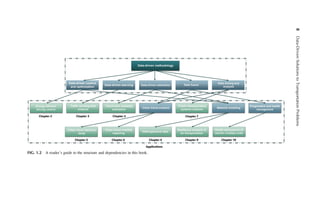
![modeling, and prognostics and health management. Specifically, management
science-related topics, such as vehicle routing, network optimization, and infor-
mation sharing, are also discussed in Chapters 5, 6, 8, and 10.
REFERENCES
[1] International Transport Forum, Data-Driven Transport Policy. Corporate Partnership Board
Report, May. Organisation for Economic Co-operation and Development (OECD), 2016.
[2] The White House Office of the Press Secretary, FACT SHEET: Announcing Over $80 Million
in New Federal Investment and a Doubling of Participating Communities in the White House
Smart Cities Initiative, https://obamawhitehouse.archives.gov/the-press-office/2016/09/26/
fact-sheet-announcing-over-80-million-new-federal-investment-and, 2016.
[3] O. Shijia, Baidu launches big data open platform to ease traffic, The 3rd World Internet Con-
ference, China Daily, 2016. http://www.chinadaily.com.cn/business/3rdWuzhen
WorldInternetConference/2016-11/18/content_27421197.htm.
[4] Transport Systems Catapult, Five-Year Delivery Plan to March 2018, (2013) https://ts.
catapult.org.uk/wp-content/uploads/2016/04/Transport-Systems-Catapult-Five-Year-
Delivery-Plan-to-March-2018.pdf.
[5] R. Cooper, Are We There Yet? Data-Driven Transportation on the Way, U.S. Chamber of
Commerce Foundation, 2014. https://www.uschamberfoundation.org/blog/post/are-we-
there-yet-data-driven-transportation-way/34417.
[6] J. Zhang, F. Wang, K. Wang, W. Lin, X. Xu, C. Chen, Data-driven intelligent transportation
systems: a survey, IEEE Trans. Intell. Transp. Syst. 12 (4) (2011) 1624–1638.
[7] M. Nemschoff, Why the Transportation Industry Is Getting on Board With Big Data
Hadoop, MapR Technologies, 2014. https://mapr.com/blog/why-transportation-industry-
getting-board-big-data-hadoop.
[8] D. Stone, R. Wang, Deciding With Data—How Data-Driven Innovation Is Fuelling Australia’s
Economic Growth, PricewaterhouseCoopers (PwC), Melbourne, 2014.
[9] Z. Cui, S. Zhang, K.C. Henrickson, Y. Wang, New progress of DRIVE net: an E-science trans-
portation platform for data sharing, visualization, modeling, and analysis, Smart Cities Con-
ference (ISC2), 2016 IEEE International, Trento, Italy, 2016, pp. 1–2.
[10] J. Cavanillas, E. Curry, W. Wahlster, New Horizons for a Data-Driven Economy, Springer,
Berlin, 2016.
[11] S. Tabbitt, Big Data Analytics Keeps Dublin Moving, http://www.telegraph.co.uk/sponsored/
sport/rugby-trytracker/10630406/ibm-big-dataanalytics-dublin.html, 2014.
[12] A. Khalid, T. Umer, M.K. Afzal, S. Anjum, A. Sohail, H.M. Asif, Autonomous data driven
surveillance and rectification system using in-vehicle sensors for intelligent transportation sys-
tems (ITS), Comput. Netw. 139 (2018) 109–118.
[13] E.S. Rigas, S.D. Ramchurn, N. Bassiliades, Managing electric vehicles in the smart grid using
artificial intelligence: a survey, IEEE Trans. Intell. Transp. Syst. 16 (4) (2015) 1619–1635.
[14] J. Jung, K. Sohn, Deep-learning architecture to forecast destinations of bus passengers from
entry-only smart-card data, IET Intell. Transp. Syst. 11 (6) (2017) 334–339.
[15] C. Chen, H. Xiang, T. Qiu, C. Wang, Y. Zhou, V. Chang, A rear-end collision prediction
scheme based on deep learning in the internet of vehicles, J. Parallel Distrib. Comput.
117 (2018) 192–204.
Overview of Data-Driven Solutions Chapter 1 9](https://image.slidesharecdn.com/37614-250501132016-8446500f/85/Data-driven-Solutions-to-Transportation-Problems-1st-Edition-eBook-PDF-32-320.jpg)
![[16] M. Chowdhury, A. Apon, K. Dey, Data Analytics for Intelligent Transportation Systems,
Elsevier, New York, 2017.
[17] D. Wei, Data-Driven Modeling and Transportation Data Analytics, (Ph.D. dissertation)Texas
Tech University, 2014.
[18] F. Ghofrani, Q. He, R. Goverde, X. Liu, Recent applications of big data analytics in railway
transportation systems: a survey, Transp. Res. Part C Emerg. Technol. 90 (2018) 226–246.
[19] H. Ghomi, M. Bagheri, L. Fu, L.F. Miranda-Moreno, Analysing injury severity factors at high-
way railway grade crossing accidents involving vulnerable road users: a comparative study,
Traffic Inj. Prev. 17 (2016) 833–841.
[20] F. Shao, K. Li, X. Xu, Railway accidents analysis based on the improved algorithm of the max-
imal information coefficient, Intell. Data Anal. 20 (3) (2016) 597–613.
[21] J. Yin, W. Zhao, Fault diagnosis network design for vehicle on-board equipments of high-
speed railway: a deep learning approach, Eng. Appl. Artif. Intell. 56 (October) (2016)
250–259.
[22] C. Hu, X. Liu, Modeling track geometry degradation using support vector machine technique,
2016 Joint Rail Conference. American Society of Mechanical Engineers, 2016
p. V001T01A011.
[23] B. Stratman, Y. Liu, S. Mahadevan, Structural health monitoring of railroad wheels using
wheel impact load detectors, J. Fail. Anal. Prev. 7 (3) (2007) 218–225.
[24] L. Sun, Y. Lu, J.G. Jin, D.H. Lee, K.W. Axhausen, An integrated Bayesian approach for pas-
senger flow assignment in metro networks, Transp. Res. Part C Emerg. Technol. 52 (2015)
116–131.
[25] S. Sharma, Y. Cui, Q. He, Z. Li, Data-driven optimization of railway track maintenance using
Markov decision process, Proceedings of 96th Transportation Research Board Annual Meet-
ing, Washington, DC, 2017.
[26] L. Kart, Advancing Analytics, (2013) 6. Online Presentation, April. Available from: http://
meetings2.informs.org/analytics2013/Advancing%20Analytics_LKart_INFORMS%20Exec
%20Forum_April%202013_final.pdf.
[27] X.L. Ma, Y.H. Wang, Development of a data-driven platform for transit performance measures
using smart card and GPS data, J. Transp. Eng. 140 (12) (2014) 04014063.
[28] S. Tak, S. Kim, S. Oh, H. Yeo, Development of a data-driven framework for real-time travel
time prediction, Comput. Aided Civ. Inf. Eng. 31 (10) (2016) 777–793.
[29] H. Perugu, H. Wei, Z. Yao, Integrated data-driven modeling to estimate PM2.5 pollution from
heavy-duty truck transportation activity over metropolitan area, Transp. Res. Part D: Transp.
Environ. 46 (2016) 114–127.
[30] S. Woo, S. Tak, H. Yeo, Data-driven prediction methodology of origin-destination demand in
large network for real-time service, Transp. Res. Rec. 2567 (2016) 47–56.
[31] H. Khadilkar, Data-enabled stochastic modeling for evaluating schedule robustness of railway
networks, Transp. Sci. 51 (4) (2017) 1161–1176.
[32] Z. Haider, A. Nikolaev, J.E. Kang, C. Kwon, Inventory rebalancing through pricing in public
bike sharing systems, Eur. J. Oper. Res. 270 (1) (2018) 103–117.
10 Data-Driven Solutions to Transportation Problems](https://image.slidesharecdn.com/37614-250501132016-8446500f/85/Data-driven-Solutions-to-Transportation-Problems-1st-Edition-eBook-PDF-33-320.jpg)
![(1) this model can be implemented in real-time without any prediction
efforts, since the control decisions are made only upon the current system
state. The control decisions also considered for the entire trip information
by learning the optimal or near-optimal control decisions from historical
driving behavior. Therefore, this model achieves a good balance between
real-time performance and energy saving optimality; (2) the proposed model
is a data-driven model which does not need any PHEV model information
once it is well trained, since all the decision variables can be observed and
are not calculated using any vehicle powertrain models (these details are
described in the following sections); and (3) compared to existing
RL-based EMS implementations, the proposed strategy considers charging
opportunities along the way (a key distinguishing feature of PHEVs as com-
pared with HEVs).
The validation over real-world driving data has indicated that the proposed data-
driving EMS strategies are very promising in terms of achieving a good balance
between real-time performance and fuel savings when compared with some
existing strategies, such as binary mode EMS and dynamic programming-based
EMS. In addition, there is no requirement for the (predicted) information on the
entire route.
2.1 INTRODUCTION
Air pollution and climate change impacts associated with the use of fossil fuels
have motivated the electrification of transportation systems. In the realm of
powertrain electrification, groundbreaking changes have been witnessed in
the past decade in terms of research and development of hybrid electric vehicles
(HEVs) and electric vehicles (EVs) [1]. As a combination of HEVs and EVs,
PHEVs can be plugged into the electrical grid to charge their batteries, thus
increasing the use of electricity and achieving even higher overall fuel effi-
ciency, while retaining the ICE that can be called upon when needed [2].
In comparison to conventional HEVs, the EMS in PHEVs are significantly
more complex due to their extended electric-only propulsion (or extended all-
electric range capability) and battery chargeability via external electric power
sources. Numerous efforts have been made in developing a variety of EMS for
PHEVs [3, 4]. From the control perspective, existing EMS can be roughly clas-
sified as rule-based [5] and optimization-based [6]. This is discussed in more
detail in Section 2.2.
In spite of all these efforts, most of the existing PHEV’s EMS have one or
more of the following limitations:
l Lack of adaptability to real-time information, such as traffic and road grade.
This applies to rule-based EMS (either deterministic or using fuzzy logic)
whose parameters or criteria have been pretuned to favor certain conditions
(e.g., specific driving cycles and route elevation profiles) [3]. In addition,
most EMS that are based on global optimization off-line assume that the
Data-Driven Energy Efficient Driving Control Chapter 2 13](https://image.slidesharecdn.com/37614-250501132016-8446500f/85/Data-driven-Solutions-to-Transportation-Problems-1st-Edition-eBook-PDF-36-320.jpg)
![future driving condition is known [2]. Thus far, only a few studies have
focused on the development of on-line EMS for PHEVs [7].
l Dependence on accurate (or predicted) trip information that is usually
unknown in advance. Many of the existing EMS require at a minimum
the trip duration as known or predicted information prior to the trip [8]. Fur-
thermore, it is reported that the performance of EMS is largely dependent on
the time span of the trip [8]. Very few studies analyze the impacts of trip
duration on the performance of EMS for PHEVs.
l Emphasis on a single trip level optimization without considering opportu-
nistic charging between trips. The most critical feature that differentiates
PHEVs from conventional HEVs is that PHEVs’ batteries can be charged
by plugging into an electrical outlet. Most of the existing EMS are designed
to work on a trip-by-trip basis. However, taking into account inter-trip
charging information can significantly improve the fuel economy of
PHEVs [2].
2.2 BACKGROUND AND STATE OF THE ART
2.2.1 PHEV Modeling
Typically, there are three major types of PHEV powertrain architectures:
(a) series, (b) parallel, and (c) power-split (series-parallel). This chapter focuses
on the power-split architecture where the ICE and electric motors can power the
vehicle, either alone or together, while the battery pack may be charged simul-
taneously through the ICE. Different approaches with various levels of com-
plexity have been proposed for modeling PHEV powertrains [9]. However, a
complex PHEV model with a large number of states may not be suitable for
the optimization of PHEV energy control. A simplified but sufficiently detailed
power-split powertrain model has been developed in MATLAB and used in this
chapter. For more details, please refer to [2].
2.2.2 Operation Mode and SOC Profile
During the operation of a PHEV, the state-of-charge (SOC) may vary with time,
depending on how the energy sources work together to provide the propulsion
power at each instant. The SOC profile can serve as an indicator of the “PHEV”
operating modes, i.e., charge sustaining (CS), pure electric vehicle (EV), and
charge depleting (CD) modes [3], as shown in Fig. 2.1.
The CS mode occurs when the SOC is maintained at a certain level (usually
the lower bound of SOC) by jointly using power from both the battery pack
and the ICE. The pure EV mode is when the vehicle is powered by electricity
only. The CD mode represents the state when the vehicle is operated using power
primarily from the battery pack with supplemental power from the ICE as nec-
essary. In the CD mode, the ICE is turned on if the electric motor is not able to
14 Data-Driven Solutions to Transportation Problems](https://image.slidesharecdn.com/37614-250501132016-8446500f/85/Data-driven-Solutions-to-Transportation-Problems-1st-Edition-eBook-PDF-37-320.jpg)
![provide enough propulsion power or the battery pack is being charged (even
when the SOC is much higher than the lower bound) in order to achieve better
fuel economy.
2.2.3 EMS for PHEVs
The goal of the EMS in a PHEV is to satisfy the propulsion power requirements
while maintaining the vehicle’s performance in an optimal way. A variety of
strategies have been proposed and evaluated in many previous studies [4].
A detailed literature review on EMS for PHEVs is provided in this section.
Broadly speaking, the existing EMS for PHEVs can be divided into two major
categories:
(1) Rule-based EMS are fundamental control schemes operating on a set of
predefined rules without prior knowledge of the trip. The control decisions
are made according to the current vehicle states and power demand only.
Such strategies are easily implemented, but the resultant operations may be
far from being optimal due to not considering future traffic conditions.
(2) Optimization-based EMS aim at optimizing a predefined cost function
according to the driving conditions and behaviors. The cost function
may include a variety of vehicle performance metrics, such as fuel con-
sumption and tailpipe emissions.
For rule-based EMS, deterministic and fuzzy control strategies (e.g., binary
control) have been well investigated. For optimization-based EMS, the strate-
gies can be further divided into three subgroups based on how the optimizations
are implemented:
(1) Off-line strategy which requires a full knowledge of the entire trip before-
hand to achieve the global optimal solution;
FIG. 2.1 Basic operation modes for PHEV.
Data-Driven Energy Efficient Driving Control Chapter 2 15](https://image.slidesharecdn.com/37614-250501132016-8446500f/85/Data-driven-Solutions-to-Transportation-Problems-1st-Edition-eBook-PDF-38-320.jpg)
![(2) Prediction-based strategy or so-called real-time control strategy which
takes into account predicted future driving conditions (in a rolling horizon
manner) and achieves local optimal solutions segment-by-segment. This
group of strategies is quite promising due to the rapid advancement
and massive deployment of sensing and communication technologies
(e.g., GPS) in transportation systems that facilitate the traffic state
prediction; and.
(3) Learning-based strategy which is recently emerging owing to the research
progress in machine learning techniques. In such a data-driven strategy, a
dynamic model is no longer required. Based on massive historical and real-
time information, trip characteristics can be learned and the corresponding
optimal control decisions can be made through advanced data mining
schemes. This strategy fits very well for commute trips.
Fig. 2.2 presents a classification tree of EMS for PHEVs and the typical strat-
egies in each category, based on most existing studies.
In addition to the classification above, Table 2.1 highlights several impor-
tant features which help differentiate the aforementioned strategies. Example
references are also included in Table 2.1.
2.2.4 PHEVs’ SOC Control
For a power-split PHEV, the optimal energy control is, in principle, equivalent to
the optimal SOC control. Most of the existing EMS for PHEVs implicitly inte-
grate SOC into the dynamic model and regard it as a key control variable [25],
while only a few studies have explicitly described their SOC control strategies.
A SOC reference control strategy is proposed in [20] where a supervisory SOC
EMS of PHEV
Rule-based
Deterministic
Binary control Basic DP
GA
MPC
A-ECMS
LUTs
ANN
RL
Clustering
MNIP
Adaptive
Fuzzy Off-line Learning based
Prediction based
Optimization-based
FIG. 2.2 Basic classification of EMS for PHEV. Note: PMP, Pontraysgin’s minimum principle;
MNIP, mixed nonlinear integer programming; DP, dynamic programming; QP, quadratic program-
ming; RL, reinforcement learning; ANN, artificial neural network; LUTs, look-up-tables; MPC,
model predictive control; AECMS, adaptive equivalent consumption minimization strategy.
16 Data-Driven Solutions to Transportation Problems](https://image.slidesharecdn.com/37614-250501132016-8446500f/85/Data-driven-Solutions-to-Transportation-Problems-1st-Edition-eBook-PDF-39-320.jpg)
![planning method is designed to precalculate an optimal SOC reference curve.
The proposed EMS then tries to follow this curve during the trip to achieve
the best fuel economy. Another SOC control strategy is proposed in [8], where
a probabilistic distribution of trip duration is considered. More recently, machine
learning-based SOC control strategies (e.g., [9]) have emerged, where the opti-
mal SOC curves are precalculated using historical data and stored in the form of
look-up tables for real-time implementation. A common drawback for all these
strategies is that accurate trip duration information is required in an either deter-
ministic or probabilistic way. In reality, however, such information is hard to
know ahead of time or may vary significantly due to the uncertainties in traffic
conditions. To ensure the practicality of our proposed EMS for PHEVs, we
employ a self-adaptive SOC control strategy in this chapter that does not require
any information about the trip duration (or length).
2.3 PROBLEM FORMULATION
2.3.1 Data-Driven On-Line EMS Framework for PHEVs
In this chapter, we propose an on-line EMS framework for PHEVs, using the
receding horizon control structure (see Fig. 2.3). The proposed EMS framework
consists of information acquisition (from external sources), prediction, optimi-
zation, and power-split control. With the receding horizon control, the entire
trip is divided into segments or time horizons. As shown in Fig. 2.4, the predic-
tion horizon (N sampling time steps) needs to be longer than the control horizon
(M sampling time steps). Both horizons keep moving forward (in a rolling hori-
zon style) while the system is operating. More specifically, the prediction model
is used to predict the power demand at each sampling step (i.e., each second) in
the prediction horizon. Then, the optimal ICE power supply for each second
during the prediction horizon is calculated with this predicted information.
TABLE 2.1 Classification of Current Literature
Rule-
Based
Off-Line
Optimization
Prediction-
Based
Learning-
Based
Optimality Local Global Local Local
Real-time Yes No Yes Yes
SOC control No Yes Yes No
Need trip
duration
No Yes Yes Yes
Example
references
[7,10–12] [2, 6, 13–17] [8, 18–23] [9, 18, 19,
24–26]
Data-Driven Energy Efficient Driving Control Chapter 2 17](https://image.slidesharecdn.com/37614-250501132016-8446500f/85/Data-driven-Solutions-to-Transportation-Problems-1st-Edition-eBook-PDF-40-320.jpg)
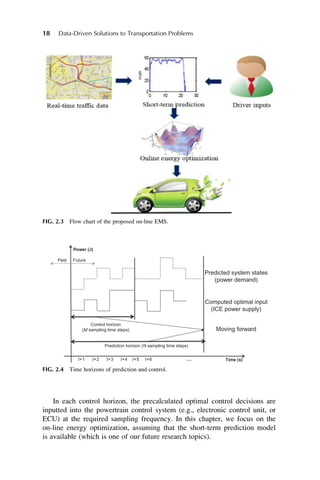
![2.3.2 Optimal Power-Split Control Formulation
Mathematically, the optimal (in terms of fuel economy) energy management
for PHEVs can be formulated as a nonlinear constrained optimization problem.
The objective is to minimize the total fuel consumption by ICE along the
entire trip.
min
Z T
0
h ωe, qe, t
ð Þdt
subject to :
_
SOC ¼ f SOC, ωMG1, qMG1, ωMG2, qMG2
ð Þ
ωe, qe
ð Þ ¼ g ωMG1, qMG1, ωMG2, qMG2
ð Þ
SOCmin SOC SOCmax
ωmin ωe ωmax
qmin qe qmax
8
:
(2.1)
where T is the trip duration, ωe, qe are the engine’s angular velocity and engine’s
torque, respectively, h(ωe,Tqe) is ICE fuel consumption model, ωMG1, qMG1 are
the first motor/generator’s angular velocity and torque, respectively, ωMG2,
qMG2 are the second motor/generator’s angular velocity and torque, respec-
tively, and f(SOC,ωMG1,qMG1,ωMG2,qMG2) is the battery power consumption
model. For more details about the model derivations and equations, please refer
to [2].
Such a formulation is quite suitable for traditional mathematical optimiza-
tion methods [13] with high computational complexity. In order to facilitate
on-line optimization, we herein discretize the engine power and reformulate
the optimization problem represented by Eq. (2.1) as follows:
min
XT
k¼1
XN
i¼1
x k, i
ð ÞPeng
i =ηeng
i (2.2)
subject to
Xj
k¼1
f Pk
XN
i¼1
x k, i
ð ÞPeng
i
C 8j ¼ 1,…,T (2.3)
XN
i¼1
x k, i
ð Þ ¼ 1 8k (2.4)
x k, i
ð Þ ¼ 0, 1
f g 8k,i (2.5)
where N is the number of discretized power level for the engine, k is the time
step index, i is the engine power level index, C is the gap of the battery pack’s
SOC between the initial and the minimum, Pi
eng
is the ith discretized level for
the engine power and ηi
eng
is the associated engine efficiency, and Pk is the driv-
ing power demand at time step k.
Data-Driven Energy Efficient Driving Control Chapter 2 19](https://image.slidesharecdn.com/37614-250501132016-8446500f/85/Data-driven-Solutions-to-Transportation-Problems-1st-Edition-eBook-PDF-42-320.jpg)
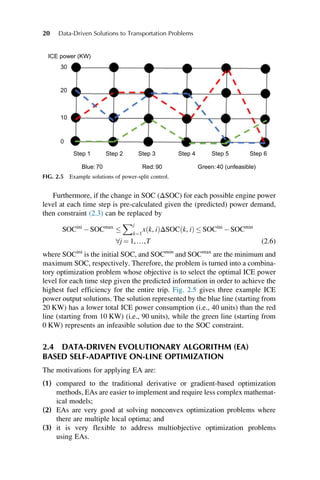
![Theoretically, in the proposed framework, any EAs can be used to solve the
optimization problem for each prediction horizon described in Fig. 2.4.
A typical EA is a population-based and iterative algorithm that starts searching
for the optimal solution with a random initial population. Then, the initial pop-
ulation undergoes an iterative process that includes multiple operations, such as
fitness evaluation, selection, and reproduction, until certain stopping criteria are
satisfied. The flow chart of an EA is provided in Fig. 2.6.
Among many EAs, the estimation distribution algorithm (EDA) is very
powerful in solving high-dimensional optimization problems and has been
applied successfully to many different engineering domains [27]. In this chap-
ter, we choose EDA as the major EA kernel in the proposed framework due to
the high-dimensionality nature of the PHEV energy management problem. This
selection is justified by experimental results in the following sections.
In the problem representation of EDA, each individual (encoded as a row
vector) of the population defined in the algorithm is a candidate solution.
For the PHEV energy management problem, the size of the individual (vector)
is the number of time steps within the trip segment. The value of the ith element
of the vector is the ICE power level chosen for that time step. In the example
individual in Table 2.2, the ICE power level is 3 (or 3 kW) for the first time step,
0 kW (i.e., only battery pack supplies power) for the second time step, 1 for the
third time step, and so forth.
It is very flexible to define a fitness function for EAs. Since the objective is
to minimize fuel consumption, the fitness function herein can be defined as the
summation of total ICE fuel consumption for the trip segment defined by
Eq. (2.5) and a penalty term
f s
ð Þ ¼ Cfuel + P (2.7)
where s is a candidate solution, Cfuel is fuel consumption, and P is the imposed
penalty that is the largest possible amount of energy that can be consumed in
this trip segment. The penalty is introduced to guarantee the feasibility of the
solution, satisfying constraint (2.3), which means that the SOC should always
Population
initialization
Fitness
evaluation
No
Yes
Stop?
Solution
Selection Reproduction
FIG. 2.6 Estimation and sampling process of EA.
Data-Driven Energy Efficient Driving Control Chapter 2 21](https://image.slidesharecdn.com/37614-250501132016-8446500f/85/Data-driven-Solutions-to-Transportation-Problems-1st-Edition-eBook-PDF-44-320.jpg)
![fall within the required range at each time step. Then, all the individuals in the
population are evaluated by the fitness function and ranked by their fitness
values in an ascending order since this is a minimization problem. A good eval-
uation and ranking process is crucial in guiding the evolution towards good
solutions until the global optima (or near optima) is located.
Furthermore, EDA assumes that the value of each element in a good indi-
vidual of the population follows a univariate Gaussian distribution. This
assumption has been proven to be effective in many engineering applications
[28], although there could be other options [29]. For each generation, the top
individuals (candidate solutions) with least fuel consumption values are
selected as the parents for producing the next generation by an estimation
and sampling process [30].
The flow chart of the proposed EDA-based on-line EMS is presented in
Fig. 2.7. t0 is the current time, N is the length of the prediction time horizon,
TABLE 2.2 Representation of One Example Individual
Time 1 s 2 s 3 s 4 s ……………… n 3 n 2 n 1 n
Individual 3 0 1 4 ……………… 1 2 0 5
Trip start
Predict power demand
trajectory for [t0=t0+N]
Calculate SOC constraint in
[t0=t0+N]
Control decision solution
[t0=t0+N]
t0=t0+M
Stop?
Trip end
EDA-based optimization
No
Yes
Implement [t0=t0+M] to vehicle
FIG. 2.7 EDA-based on-line energy management system.
22 Data-Driven Solutions to Transportation Problems](https://image.slidesharecdn.com/37614-250501132016-8446500f/85/Data-driven-Solutions-to-Transportation-Problems-1st-Edition-eBook-PDF-45-320.jpg)
![and M is length of the control time horizon. The block highlighted by the dashed
box is the core component of the system, and more details about this block is
given in Section 2.4.
2.4.1 Optimality and Complexity
Evolutionary algorithms (EA) are stochastic search algorithms that do not guar-
antee to find the global optima. Hence, in the proposed on-line EMS, the opti-
mal power control for each trip segment is not guaranteed to be found.
Moreover, EAs are also population-based iterative algorithms that are usually
criticized due to their heavy computational loads [31], especially for real-
time applications. Theoretically, time complexity of EAs is worse than
θ(m2
∗ log (m)) where m is the size of the problem [32]. However, we apply
the receding horizon control technique in this chapter, where the entire trip
is divided into small segments. Therefore, the computational load can be signif-
icantly reduced since the EA-based optimization is applied only for each small
segment rather than the entire trip. In this sense, the proposed framework can be
implemented in “real-time,” as long as the optimization for the next prediction
horizon can be completed in the current control horizon (see Fig. 2.4). As pre-
viously discussed, the rule-based EMS can run in real-time but the results may
be far from optimal while most of the optimization-based EMS have to operate
off-line. Therefore, the proposed on-line EMS would be a well-balanced solu-
tion between the real-time performance and optimality.
2.4.2 SOC Control Strategies
An appropriate SOC control strategy is critical in achieving the optimal fuel
economy for PHEVs [33]. In the previously presented problem formulation,
the major constraint for SOC is defined by Eq. (2.6), which means that at
any time step, the SOC should be within the predefined range (e.g., between
0.2 and 0.8) to avoid damage to the battery pack. However, this constraint only
may not be enough to accelerate the search for the optimal solution. Hence,
additional constraint(s) on battery use (e.g., reference bound of SOC) should
be introduced to improve the on-line EMS. To investigate the effectiveness
of different SOC control strategies within the proposed framework, two types
of SOC control strategies—reference control and self-adaptive control—are
designed and evaluated in this chapter.
2.4.2.1 SOC Reference Control (Known Trip Duration)
When the trip duration is known, a SOC curve can be pre-calculated and used as
a reference to control the use of battery power along the trip to achieve optimal
fuel consumption. We propose three heuristic SOC references (i.e., lower
Data-Driven Energy Efficient Driving Control Chapter 2 23](https://image.slidesharecdn.com/37614-250501132016-8446500f/85/Data-driven-Solutions-to-Transportation-Problems-1st-Edition-eBook-PDF-46-320.jpg)
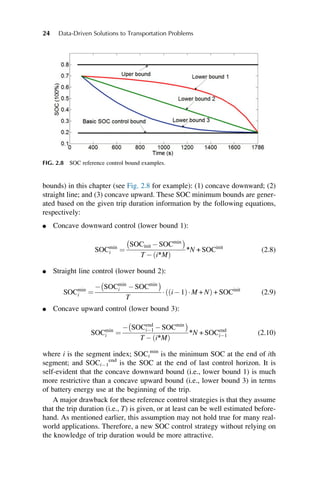
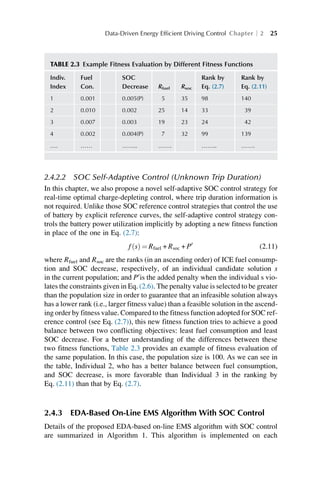
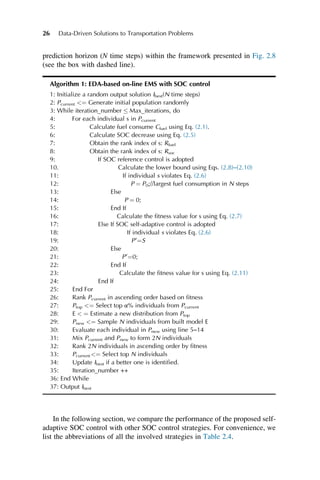

![CHAPTER IV.
More anxious thoughts attacked me as I lost sight of the English
coast; but as I had not left there any strong attachment, I was soon
consoled, on arriving at Leghorn, and reviewing the charms of Italy.
I told no one my true name,[1] and took merely that of Corinne,
which the history of a Grecian poetess, the friend of Pindar, had
endeared to me.[2] My person was so changed that I was secure
against recognition. I had lived so retired in Florence, that I had a
right to anticipate my identity's remaining unknown in Rome. Lady
Edgarmond wrote me word of her having spread the report that the
physicians had prescribed a voyage to the south for my health, and
that I had died on my passage. Her letter contained no comments.
She remitted, with great exactness, my whole fortune, which was
considerable; but wrote to me no more. Five years then elapsed ere
I beheld you; during which I tasted much good fortune. My fame
increased: the fine arts and literature afforded me even more delight
in solitude than in my own success. I knew not, till I met you, the
full power of sentiment: my imagination sometimes colored and
discolored my illusions without giving me great uneasiness. I had not
yet been seized by any affection capable of overruling me.
Admiration, respect, and love had not enchained all the faculties of
my soul; I conceived more charms than I ever found, and remained
superior to my own impressions. Do not insist on me describing to
you how two men, whose passion for me is but too generally known,
successively occupied my life, before I knew you. I outrage my own
conviction in now reminding myself that any one, save you, could
ever have interested me: on this subject I feel equal grief and
repentance. I shall only tell you what you have already heard from
my friends. My free life so much pleased me, that, after long
irresolutions and painful scenes, I twice broke the ties which the
necessity of loving had made me contract, and could not resolve to
render them irrevocable. A German noble would have married and
taken me to his own country. An Italian prince offered me a most
brilliant establishment in Rome. The first pleased and inspired me](https://image.slidesharecdn.com/37614-250501132016-8446500f/85/Data-driven-Solutions-to-Transportation-Problems-1st-Edition-eBook-PDF-51-320.jpg)


![indissoluble. When you have read this, I would see you: my
impatience will bring me to your side, and I shall read my fate at a
glance; for grief is a rapid poison—and the heart, though weak,
never mistakes the signal of irrevocable destiny.
Adieu.
[1] Her real Christian name is never divulged even to the reader.
—TR.
[2] This name must not be confused with that of Corilla, an
Italian improvisatrice. The Grecian Corinna was famed for lyric
poetry. Pindar himself received lessons from her.
BOOK XV.
THE ADIEU TO ROME, AND JOURNEY TO
VENICE.
CHAPTER I.
It was with deep emotion that Oswald read the narrative of Corinne:
many and varied were the confused thoughts that agitated him.
Sometimes he felt hurt by the picture she drew of an English
country, and despairingly exclaimed: Such a woman could never be
happy in domestic life! then he pitied what she had suffered there,
and could not but admire the simple frankness of her recital. He was
jealous of the affection she had felt ere she met him; and the more
he sought to hide this from himself, the more it tortured him; but
above all was he afflicted by his father's part in her history. His
anguish was such that, not knowing what he did, he rushed forth](https://image.slidesharecdn.com/37614-250501132016-8446500f/85/Data-driven-Solutions-to-Transportation-Problems-1st-Edition-eBook-PDF-54-320.jpg)




![yourself in my breast—do you not love me well enough to find some
solace in the tender devotion of mine every instant? Have you not
still my ring—that sacred pledge?—I will return it,
Oswald.—Never!—Ah, yes; when you desire it, the ring itself will
tell me. An old legend says that the diamond, more true than man,
dims when the giver has betrayed our trust.[1]—Corinne, said
Oswald, dare you speak such treason? your mind is lost; it no
longer knows me.—Pardon! oh, pardon me! in love like mine, the
heart, Oswald, is gifted suddenly with most miraculous instincts; and
its own sufferings become oracles. What portends, then, the heavy
palpitation of my heart? Ah, love, I should not fear it, if it were but
my knell! She fled, precipitately, dreading to remain longer with
him. She could not dally with her grief, but sought to break from it;
yet it returned but the more violently for her repulse. The next day,
as they crossed the Pontine Marsh, Oswald's care of her was even
more scrupulous than before; she received it with the sweetest
thankfulness: but there was something in her look that said: Why
will you not let me die?](https://image.slidesharecdn.com/37614-250501132016-8446500f/85/Data-driven-Solutions-to-Transportation-Problems-1st-Edition-eBook-PDF-61-320.jpg)
![[1] An old tradition supports the imaginative prejudice which
persuaded Corinne that the diamond could forewarn its wearer of
its giver's treachery. Frequent allusions are made to this legend by
Spanish poets, in their peculiar manner. In one of Calderon's
tragedies, Ferdinand, Prince of Portugal, prefers death in chains,
before the crime of surrendering to a Moorish king the Christian
city which his brother, King Edward, offers for his ransom. The
Moor, enraged at this refusal, subjects the noble youth to the
basest ignominy. Ferdinand, in reproof, reminds him that mercy
and generosity are the truest characteristics of supreme power.
He cites all that is royal in the universe—the lion, the dolphin, the
eagle, amid animals; and seeks even among plants and stones for
traits of natural goodness, which have been attributed to those
who lord it over the rest. Thus he says, the diamond, which
resists the blow of steel, resolves itself to dust, that it may inform
its master if treason threatens him. It is impossible to know
whether this mode of considering all nature as connected with the
destiny and sentiments of man is mathematically correct; but it is
ever pleasing to imagination; and poetry, especially that of Spain,
has owed it many great beauties. Calderon is only known to me
by the German translation of Wihelm Schlegel; but this author,
one of his own country's finest poets, has the art of transporting
into his native language, with the rarest perfection, the poetic
graces of Spanish, English, and Italian—giving a lively idea of the
original, be it what it may.
NoteTR.—Had Oswald's gift been his mother's wedding-ring, that
incident would have been more affecting than so fanciful a fable.
CHAPTER III.
What a desert seems Rome, in going to it from Naples! Entering by
the gate of St. John Lateran, you traverse but long, solitary streets;
they please afresh after a little time: but, on just leaving a lively,
dissipated population, it is melancholy to be thrown upon one's self,
even were that self at ease. Besides this, Rome, towards the end of
July, is a dangerous residence. The malaria renders many quarters
uninhabitable; and the contagion often spreads through the whole](https://image.slidesharecdn.com/37614-250501132016-8446500f/85/Data-driven-Solutions-to-Transportation-Problems-1st-Edition-eBook-PDF-62-320.jpg)


![proof of devotion in never having abandoned her. Oswald constantly
held her burning hands in his, and finished the cup of which she had
drunk; in fact, with such avidity did he share her perils, that she
herself ceased at last to combat this passionate self-sacrifice.
Leaning her head upon his arm, she resigned herself to his will. The
beings who so love that they feel the impossibility of living without
each other, may well attain the noble and tender intimacy which puts
all things in common, even death itself.[1] Happily, Lord Nevil did not
take the disease through which he so carefully nursed Corinne. She
recovered; but another malady penetrated yet deeper into her
breast. The generosity of her lover, alas! redoubled the attachment
she had borne him.
[1] M. Dubreuil, a very skilful French physician, fell ill of a fatal
distemper. His popularity filled the sick room with visitants. Calling
to his intimate friend, M. Péméja, as eminent a man as himself, he
said, Send away all these people; you know my fever is
contagious; no one but yourself ought to be with me now. Happy
the friend who ever heard such words! Péméja died fifteen days
after his heart's brother.
CHAPTER IV.
It was agreed that Neville and Corinne should visit Venice. They had
relapsed into silence on their future prospects, but spoke of their
affection more confidingly than ever: both avoided all topics that
could disturb their present mutual peace. A day passed with him was
to her such enjoyment! he seemed so to revel in her conversation;
he followed her every impulse; studied her slightest wish, with so
sustained an interest, that it appeared impossible he could bestow
so much felicity without himself being happy. Corinne drew
assurances of safety from the bliss she tasted. After some months of
such habits we believe them inseparable from our existence. Her](https://image.slidesharecdn.com/37614-250501132016-8446500f/85/Data-driven-Solutions-to-Transportation-Problems-1st-Edition-eBook-PDF-66-320.jpg)









![from the standard Italian; though only the Neapolitan, Sicilian, and
Venetian dialects have yet the honor of being acknowledged; and
that of Venice as the most original, most graceful of all. Corinne
pronounced it charmingly; and the manner in which she sung some
lively barcaroles proved that she could act comedy as well as
tragedy. She was pressed to take a part in an opera which some of
her new friends intended playing the next week. Since she had loved
Oswald, she concealed this talent from him, not feeling sufficient
peace of mind for its exercise, or, at other times, fearing that any
outbreak of high spirits might be followed by misfortune; but now,
with unwonted confidence, she consented, as he, too, joined in the
request; and it was agreed that she should perform in a piece, like
most of Gozzi's, composed of the most diverting fairy extravagances.
[1] Truffaldin and Pantaloon, in these burlesques, often jostle the
greatest monarchs of the earth. The marvellous furnishes them with
jests, which, from their very order, cannot approach to low vulgarity.
The Child of the Air, or Semiramis in her Youth, is a coquette,
endowed by the celestials and infernals to subjugate the world; bred
in a desert, like a savage, cunning as a sorceress, and imperious as
a queen, she unites natural wildness with premeditated grace, and a
warrior's courage with the frivolity of a woman. The character
demands a fund of fanciful drollery, which but the inspiration of the
moment can bring to light.
[1] Among the comic Italian authors who have described their
country's manners, must be reckoned the Chevalier Rossi, a
Roman, who singularly unites observation with satire.
CHAPTER II.
Fate sometimes has its own strange, cruel sport, repulsing our
presuming familiarity. Oft, when we yield to hope, calculate on](https://image.slidesharecdn.com/37614-250501132016-8446500f/85/Data-driven-Solutions-to-Transportation-Problems-1st-Edition-eBook-PDF-84-320.jpg)