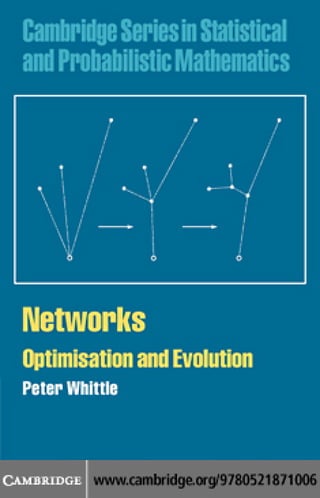
Networks Optimisation and Evolution 1st Edition
Peter Whittle - PDF Download (2025)
https://ebookultra.com/download/networks-optimisation-and-
evolution-1st-edition-peter-whittle/
Visit ebookultra.com today to download the complete set of
ebooks or textbooks
Here are some recommended products for you. Click the link to
download, or explore more at ebookultra.com
Future Evolution 1st Edition Peter Ward
https://ebookultra.com/download/future-evolution-1st-edition-peter-
ward/
Multiobjective Optimisation and Control 1st Edition G. P.
Liu
https://ebookultra.com/download/multiobjective-optimisation-and-
control-1st-edition-g-p-liu/
Human Diet Its Origin and Evolution 1st Edition Peter S.
Ungar
https://ebookultra.com/download/human-diet-its-origin-and-
evolution-1st-edition-peter-s-ungar/
Evolution of the Human Diet Peter S. Ungar
https://ebookultra.com/download/evolution-of-the-human-diet-peter-s-
ungar/
Understanding Wind Power Technology Theory Deployment and
Optimisation 1st Edition Alois Schaffarczyk
https://ebookultra.com/download/understanding-wind-power-technology-
theory-deployment-and-optimisation-1st-edition-alois-schaffarczyk/
Radio Network Planning and Optimisation for UMTS Second
Edition Jaana Laiho
https://ebookultra.com/download/radio-network-planning-and-
optimisation-for-umts-second-edition-jaana-laiho/
Nature s Magic Synergy in Evolution and the Fate of
Humankind First Edition. Edition Peter Corning
https://ebookultra.com/download/nature-s-magic-synergy-in-evolution-
and-the-fate-of-humankind-first-edition-edition-peter-corning/
The English language press networks of East Asia 1918 45
1. publ. Edition Peter O'Connor
https://ebookultra.com/download/the-english-language-press-networks-
of-east-asia-1918-45-1-publ-edition-peter-oconnor/
Evolution and Christianity 1st Edition James Iverach
https://ebookultra.com/download/evolution-and-christianity-1st-
edition-james-iverach/
Networks Optimisation and Evolution 1st Edition Peter
Whittle Digital Instant Download
Author(s): Peter Whittle
ISBN(s): 9780521871006, 0511275595
Edition: 1
File Details: PDF, 2.08 MB
Year: 2007
Language: english
This page intentionally left blank
Networks: Optimisation and Evolution
Point-to-point vs hub-and-spoke. Questions of network design are real and involve many
billions of dollars. Yet little is known about the optimisation of design – nearly all work
concerns the optimisation of flow for a given design. This foundational book tackles
the optimisation of network structure itself, deriving comprehensible and realistic design
principles.
With fixed material cost rates, a natural class of models implies the optimality of direct
source–destination connections. However, considerations of variable load and environ-
mental intrusion then enforce trunking in the optimal design, producing an arterial or
hierarchical net. Its determination requires a continuum formulation, which can however
be simplified once a discrete structure begins to emerge. Connections are made with
the masterly work of Bendsøe and Sigmund on optimal mechanical structures and also
with neural, processing and communication networks, including those of the Internet and
the Worldwide Web. Technical appendices are provided on random graphs and polymer
models and on the Klimov index.
Peter Whittle is a Professor Emeritus at the University of Cambridge. He is a Fellow
of the Royal Society and the winner of several international prizes. This is his 11th book.
CAMBRIDGE SERIES IN STATISTICAL AND
PROBABILISTIC MATHEMATICS
Editorial Board
R. Gill (Department of Mathematics, Utrecht University)
B. D. Ripley (Department of Statistics, University of Oxford)
S. Ross (Department of Industrial & Systems Engineering, University of Southern
California)
B. W. Silverman (St. Peter’s College, Oxford)
M. Stein (Department of Statistics, University of Chicago)
This series of high-quality upper-division textbooks and expository monographs covers
all aspects of stochastic applicable mathematics. The topics range from pure and applied
statistics to probability theory, operations research, optimization, and mathematical
programming. The books contain clear presentations of new developments in the field
and also of the state of the art in classical methods. While emphasizing rigorous treat-
ment of theoretical methods, the books also contain applications and discussions of new
techniques made possible by advances in computational practice.
Already published
1. Bootstrap Methods and Their Application, by A. C. Davison and D. V. Hinkley
2. Markov Chains, by J. Norris
3. Asymptotic Statistics, by A. W. van der Vaart
4. Wavelet Methods for Time Series Analysis, by Donald B. Percival and Andrew T.
Walden
5. Bayesian Methods, by Thomas Leonard and John S. J. Hsu
6. Empirical Processes in M-Estimation, by Sara van de Geer
7. Numerical Methods of Statistics, by John F. Monahan
8. A User’s Guide to Measure Theoretic Probability, by David Pollard
9. The Estimation and Tracking of Frequency, by B. G. Quinn and E. J. Hannan
10. Data Analysis and Graphics using R, second edition, by John Maindonald and
John Braun
11. Statistical Models, by A. C. Davison
12. Semiparametric Regression, by D. Ruppert, M. P. Wand, R. J. Carroll
13. Exercises in Probability, by Loic Chaumont and Marc Yor
14. Statistical Analysis of Stochastic Processes in Time, by J. K. Lindsey
15. Measure Theory and Filtering, by Lakhdar Aggoun and Robert Elliott
16. Essentials of Statistical Inference, by G. A. Young and R. L. Smith
17. Elements of Distribution Theory, by Thomas A. Severini
18. Statistical Mechanics of Disordered Systems, by Anton Bovier
19. The Coordinate-Free Approach to Linear Models, by Michael J. Wichura
20. Random Graph Dynamics, by Rick Durrett
Networks: Optimisation and Evolution
Peter Whittle
Statistical Laboratory, University of Cambridge
CAMBRIDGE UNIVERSITY PRESS
Cambridge, New York, Melbourne, Madrid, Cape Town, Singapore, São Paulo
Cambridge University Press
The Edinburgh Building, Cambridge CB2 8RU, UK
First published in print format
ISBN-13 978-0-521-87100-6
ISBN-13 978-0-511-27559-3
© P. Whittle 2007
2007
Information on this title: www.cambridge.org/9780521871006
This publication is in copyright. Subject to statutory exception and to the provision of
relevant collective licensing agreements, no reproduction of any part may take place
without the written permission of Cambridge University Press.
ISBN-10 0-511-27559-5
ISBN-10 0-521-87100-X
Cambridge University Press has no responsibility for the persistence or accuracy of urls
for external or third-party internet websites referred to in this publication, and does not
guarantee that any content on such websites is, or will remain, accurate or appropriate.
Published in the United States of America by Cambridge University Press, New York
www.cambridge.org
hardback
eBook (NetLibrary)
eBook (NetLibrary)
hardback
To Käthe
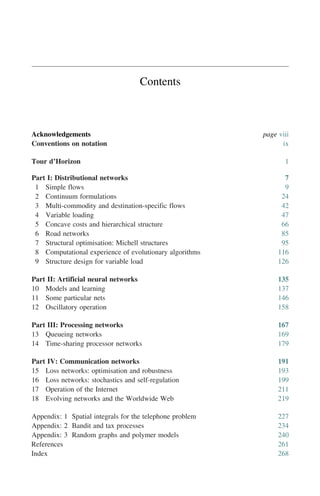
Contents
Acknowledgements page viii
Conventions on notation ix
Tour d’Horizon 1
Part I: Distributional networks 7
1 Simple flows 9
2 Continuum formulations 24
3 Multi-commodity and destination-specific flows 42
4 Variable loading 47
5 Concave costs and hierarchical structure 66
6 Road networks 85
7 Structural optimisation: Michell structures 95
8 Computational experience of evolutionary algorithms 116
9 Structure design for variable load 126
Part II: Artificial neural networks 135
10 Models and learning 137
11 Some particular nets 146
12 Oscillatory operation 158
Part III: Processing networks 167
13 Queueing networks 169
14 Time-sharing processor networks 179
Part IV: Communication networks 191
15 Loss networks: optimisation and robustness 193
16 Loss networks: stochastics and self-regulation 199
17 Operation of the Internet 211
18 Evolving networks and the Worldwide Web 219
Appendix: 1 Spatial integrals for the telephone problem 227
Appendix: 2 Bandit and tax processes 234
Appendix: 3 Random graphs and polymer models 240
References 261
Index 268
Acknowledgements
I am grateful to Frank Kelly for generous orientation in some of the more recent commu-
nication literature. My references to his own work are limited and shaped by the theme
of this text, a text totally different in aspiration and coverage from that which I have long
encouraged him to write, and which we await.
I am also grateful to Michael Bell for piloting me through the post-Lighthill literature
on traffic flow models.
Lastly, I might well not have been able to finish this work had I not, after retirement,
kindly been granted continued enjoyment of the facilities and activities of the Statis-
tical Laboratory, University of Cambridge. The advantage is all the greater, in that the
Laboratory is now housed with the rest of the Faculty in the resplendent new Centre for
Mathematical Sciences.
References to the literature can be regarded as a continuing stream of formal acknowl-
edgement, as well as of association. If I make no reference on a given piece of work, then
this is an indication that I regard it as either standard or new, with the greater likelihood
of misapprehension in the second case.
Conventions on notation
The fact that we cover a wide range of topics, each with its own established notation,
makes it difficult to hold to uniform conventions, and we do not do so entirely. We do
consistently use x to denote the state variable of a system, but this will be the set of flows
in Part I and the set of node occupation numbers in Part III, for example. We are forced
then to use  to denote Cartesian co-ordinates. In general we follow the mathematical
programming literature in using y to denote the variable dual to x, but in Part II bow to
the conventions of control theory and use  to denote this dual variable, releasing y to
denote the observations (i.e. the information input).
The treatment is in general mathematical, although scarcely rising above the sophis-
tication of ‘mathematical methods’. The use of the theorem/proof presentation is then
simply the tidiest and most explicit way of summarising current conclusions, implying
neither profundity nor the pretence of it. The three appendices collect the material that is
densest technically.
Equations, theorems and figures are numbered consecutively through a chapter, and
also carry a chapter label. Equation (5.4) is thus the fourth equation of the fifth chapter.
Tour d’Horizon
Whither? Why?
The contents list gives a fair impression of the coverage attempted. Networks, both
deterministic and stochastic, have emerged as objects of intense interest over recent
decades. They occur in communication, traffic, computer, manufacturing and operational
research contexts, and as models in almost any of the natural, economic and social
sciences. Even engineering frame structures can be seen as networks that communicate
stress from load to foundation.
We are concerned in this book with the characterisation of networks that are optimal
for their purpose. This is a very natural ambition; so many structures in nature have
been optimised by long adaptation, a suggestive mechanism in itself. It is an ambition
with an inbuilt hurdle, however: one cannot consider optimisation of design without first
considering optimisation of function, of the rules by which the network is to be operated.
On the other hand, optimisation of function should find a more natural setting if it is
coupled with the optimisation of design.
The mention of communication and computer networks raises examples of areas where
theory barely keeps breathless pace with advancing technology. That is a degree of
topicality we do not attempt, beyond setting up some basic links in the final chapters.
It is well recognised that networks of commodity flow, electrical flow, traffic flow and
even mechanical frame structures and biological bone structures have unifying features,
and Part I is devoted to this important subclass of cases.
In Chapter 1 we consider a rather general model of commodity distribution for which
flow is determined by an extremal principle. This may be a natural physical principle (e.g.
the minimal dissipation principle of electrical flow) or an imposed economic principle (e.g.
cost minimisation in the classic transport problem). The principle minimises a convex cost
function, subject to balance constraints; classic Lagrangian methods are then applicable.
These lead to the concept of a potential, and find their most pleasing development in
the Michell theory of optimal structures, for which the optimal design is characterised
beautifully in terms of the relevant potential field.
All this material is classic and well known, at least as far as flow determination is
concerned – design optimisation may be another matter. However, we do find one class
of cases for which the analysis proceeds particularly naturally. These are the models
with scale-seminvariant costs, for which the cost of operating a link is the volume of
the link (its length times some notion of a cross-sectional area) times a convex function
of the flow density. The corresponding dual cost is volume times the dual function of
2 Tour d’Horizon
potential gradient. Let us refer to these simply as ‘seminvariant-cost models’ or, even
more briefly, as ‘SC models’. They constitute quite a general class of cases, which indeed
includes most of the standard examples. However, they turn out to have a property that
is disconcertingly dramatic.
The SC models for simple flow all reduce under a free design optimisation to the net
that solves the classic transport problem: an array of direct straight-line links from sources
to sinks. If the commodity is not destination-specific, then these routes will never cross
in the plane, and there is a corresponding property in higher dimensions.
This is a gratifying reduction, and one that is acceptable in some cases. In Chapter 2
we solve a continuum problem by these means, and the corresponding solutions of the
structural problems in Chapters 7–9 are less naive. However, in most cases this simple
solution is totally unrealistic. A practical road net could never be of that pattern, and to
formalise the reasons why is an instructive exercise. One would expect ‘trunking’: that
traffic of different types should share a common route over some distance, as manifested
by local traffic’s feeding into major arteries and then leaving them as the destination is
approached.
If the network is subject to a variable load, then this indeed has the effect of inducing
some trunking in the optimal design; see Chapter 4. The reason is that there is then
an incentive for links to pay their way by carrying as steady a load as possible. Links
will then be installed which can carry traffic under a variety of loads, usually making
route-compromises in order to do so. However, once this steadiness of flow has been
achieved, there is no incentive for further trunking.
The real incentive to trunking must be that a link of whatever capacity carries a base
cost. By its simple existence it has harmed some amenity, and incurred an environmental
cost. More generally, one can say that environmental invasion implies that the installation
cost of a link is a concave rather than a linear function of its capacity. For SC models it
turns out then that the capacity-optimised sum of installation and operating costs is itself
now a concave rather than a convex function of the flow rate. Otherwise expressed, the
effect is that a single high-capacity link over a route section is to be preferred to a bundle
of low-capacity links. The criterion then favours trunking, and indeed has a dramatic
effect; see Chapter 5. The optimal network is inclined to a tree pattern, with traffic from
neighbouring source nodes converging together to what is indeed a trunk; this trunk then
branching successively as it approaches a cluster of sink nodes.
Trunking can be seen as inducing a hierarchical structure, in which local traffic is
carried locally; traffic to distant but clustered destinations is gathered together on to a
trunk route, and there can be such gatherings at several levels. Such a structure can be
seen at its clearest in telephone networks, in which there can be exchanges at several
levels, and a call will be taken up to just that level of exchange from which there is a
route down to the receiver. This hierarchical structure, differing radically from the array
of direct connections derived on a naive criterion, is the pattern for optimal nets under
an environmentally conscious criterion. In Chapter 5 we consider the optimal choice of
exchange levels in an isotropic environment. It turns out that ideally the trunking rate
should be constant up to a certain level, although the continuous gradation of trunking
implied by this assertion is not practical. The investigation throws up some questions in
what is essentially geometric probability, treated in Appendix 1.
Whither? Why? 3
Road networks (Chapter 6) also aim to be hierarchical, but labour under the difficulty
that roads actually do take a great deal more physical space than do telephone links,
for example. They are particularly constrained by the fact that they are largely confined
to the two-dimensional plane, from which they can depart only at great expense. They
suffer also from the statistical effect of congestion, and it is a moot point whether or not
this is trunk-inducing. Congestion in queueing networks is relatively well understood;
congestion on the continuum of a multi-lane highway is a much subtler matter, discussed
briefly in Chapter 6.
The study of engineering structures in Chapters 7–9 takes us back to the ‘naive’
case, when the cost of building to a certain capacity is proportional to that capacity.
However, solution for the optimal structure is now considerably less naive, because of
the vector nature of the potential. The theory of Michell structures is not only one of
the most beautiful examples of optimisation but, published in 1904, one of the earliest.
It generalises to the SC case, as we demonstrate. Evolutionary methods really do make
a computational appearance here, as the only way of performing the optimisation in all
but the simplest cases. We review the striking results of Bendsøe and Sigmund in this
context, also of Xie and Stevens.
However, natural evolutionary optimisation (on the scale of years) is evident in a
continuum version of the problem: the formation of bone. Bone is continually subject
to a general wasting, but also to reinforcement in those locations and directions where
there is stress. The effect is then to achieve a structure optimal for the conditions. Load-
bearing elements, such as the femur (thighbone), demonstrate not only a shape but also
an anisotropic structure of the form that the Michell theory would predict. Moreover,
they demonstrate their response to variability of load in the replacement of interior solid
bone by cancellous (spongy) bone; see Chapter 9.
Stochastic variation plays a greater role in succeeding chapters. Part II is devoted
to the topic of artificial neural networks (ANNs), whose study constitutes the most
concerted attempt yet to both mimic and understand the logical performance of natural
neural networks, and to perhaps approach it by adaptive rules. By comparison with
the distributional nets of Part I, adaptability to variable loading is of the essence; it
is required of the net that it should make an appropriate response to each of a great
variety of significant inputs. In contrast to the models of Part I, the nodes of the network
now incorporate a nonlinear response element, a partial analogue of the animal neuron,
seemingly necessary for the degree of versatility demanded. Lagrangian methods survive
in the technique of ‘back propagation’ for the iterative improvement of input/output
response.
The ANN literature is now an enormous and diffuse one, and we treat only a few
specific cases that make definite structural points. In a reversal of the historical view,
many standard statistical procedures can be seen as a consequence of ANN evolution.
In a back-reversal, statistical analysis demonstrates that a simple neuronal assembly (a
McCulloch–Pitts net) is insufficient for the functions demanded; the net has also to
be able to rescale signals and to choose between competing alternatives. To achieve a
dynamic version of the Hamming net, in fact. When such a net is elaborated to deal with
compound signals one begins to see structures identifiable (and in no facile sense) with
natural neural systems.
4 Tour d’Horizon
Actual biological systems have to operate over a very wide range of input intensities,
and absolute levels of signals mean very little. Such systems achieve internal communica-
tion by oscillatory patterns, and W. Freeman has clarified the basic neuronal oscillator by
which these are generated and sensed. When one couples the oscillator with the normal-
ising mechanism for signal strength one finds an explanation for ‘neuronal bursting’; the
regular bursts of oscillation which are so pronounced an observational feature.
The treatment of processing networks in Part III does not in fact have a large network
content, as manufacturing requirements generally specify the sequence of operations to
be performed fairly closely. There can be allocation problems, however, when congestion
occurs and different job streams are competing for attention. The classic Jackson network,
which serves so well under appropriate conditions, does not address this point, and it
is now realised that the introduction of local precedence rules into queueing networks
can do more harm than good to performance. We then leap straight from the exact and
amenable treatment of the Jackson network to the exact and fairly amenable treatment
of the Klimov index. This certainly solves the problem in principle when processing
resources can be freely redeployed, and gives indications of how to proceed when they
cannot. Appendix 2 gives some background treatment of the Klimov index and related
matters.
When we come to communication networks in Part IV we mostly take for granted that
networks will be hierarchical, and that the aim is to extract as much performance from the
net as possible under varying load, which can take the form of both short-term statistical
variation and longer-term secular variation. The treatment of loss networks owes a great
deal to F. P. Kelly, who passed through this topic on his long trek through evolving
technology and methodology. In Chapter 15 we consider the fluid limit, for which the
relationships of the various shadow prices are evident and the optimal admission/routing
policy easily derivable. These features survive in a first stochasticisation of the problem.
Chapter 16 considers also the second stochasticisation: that in which one uses state
feedback to regulate the system. As Kelly has shown, the ideal instrument for real-time
control of admissions and routing is that of trunk reservation. By this, reaction to small-
scale features (the numbers of free circuits) achieves effective control of the large-scale
features (the make-up of the traffic that occupies the busy circuits).
However, control rules of this type have their limits when there may be sources of
congestion deep in the system that are subject neither to direct observation nor to direct
control. This is the case for the Internet, which also by its nature operates in a very
decentralised fashion. Some account is given in Chapter 17 of the protocols which have
proved so successful in controlling this remarkable giant organism, and of the more
relaxed optimality concepts which have guided thinking.
While the state of the net for either the Internet or the Worldwide Web may be
inaccessible to observation at a given time, the nature of the network that develops can
be discerned, and has awoken much interest. One particular feature remarked is that the
distribution of node degree (the number of immediate links made with a given Web
page) follows an inverse power law. This is often spoken of as the network’s having a
‘scale-free’ character (not to be confused with the scale seminvariance of costs defined
earlier). Such a law could just be explained on the classical theory of random graphs,
although not particularly naturally. A more plausible mechanism has been suggested by
Whither? Why? 5
Barabási and Albert: that of ‘preferential attachment’. However, any conjecture that the
mechanism, whatever it is, might prove self-optimising is weakened by evidence that
nets generated by a random mechanism show extremely poor performance by comparison
with a properly designed hierarchical system. These matters are discussed in Chapter 18.
The supplementary Appendix 3 describes some aspects of random graph theory of which
people working in the Web context seem to be unaware.
I
Distributional networks
By ‘distributional networks’ we mean networks that carry the flow of some commodity or
entity, using a routing rule that is intended to be effective and even optimal. The chapter
titles give examples. Operational research abounds in such problems (see Ball et al.,
1995a,b and Bertsekas, 1998), but the versions we consider are both easier and harder
than these. In operational research problems one is usually optimising flow or operations
upon a given network, whereas we aim also to optimise the network itself. Even the
Bertsekas text, although entitled Network Optimization, is concerned with operation rather
than design. The design problem is more difficult, if for no other reason than that it
cannot be settled until the operational rules are clarified. On the other hand, there may be
a simplification, in that the optimal network is not arbitrary, but has special properties in
its class.
The ‘flow’ may not be a material one – see the Michell structures of Chapters 7–9, for
which the entity that is communicated through the network is stress. The communication
networks of Part IV are also distributional networks, but ones that have their own particular
dynamic and stochastic structure.
Other documents randomly have
different content
“While I was on the team,” pursued Frank, “my mouth was closed
—to a large extent.”
“You got it open once too often.”
“On the contrary, I hope I opened it just when it will do the most
good.”
“It threw you off the team.”
“I can stand that if the team can. I shall be satisfied if that,
together with this little talk, brings about a reform. See here,
Lorrimer, I want you to understand how earnest I am about this
thing. I want Yale to win—she must win!”
“By that, I suppose you mean that you want to get back on the
eleven?”
“Nothing of the sort. By that I mean that I hope you will get your
eyes open and take care that these coachers do not hammer the
men into such wretched shape that they will be slow and heavy as
cart-horses. Put Birch at full-back, and give Jack Ready a trial in the
line. Let up on them in time for them to rest and come out fresh as
daisies for the game, even though it may seem that they are not
perfect in their work. Freshness, spirit, and enthusiasm will count
more than absolute perfection coupled with that tired feeling.”
“How much do you charge for all this advice?”
“I shall be well paid if it brings about a result.”
“Well, have you finished?”
“I believe that’s about all I have to say.”
“Then how about this demonstration on the campus?”
“I told you that I knew nothing about it.”
“You know now.”
“Yes.”
“What are you gong to do?”
“Nothing.”
“Do you fancy it will be a good thing for you?”
“I do not fancy anything about it.”
“Well, it will be the worst thing that can happen. It will do you no
good, for the management will not be driven into taking you back.”
“Isn’t it about time for you to get it through your head that I do
not care a rap whether I get back or not so long as Yale wins?”
demanded Frank, with a slight show of impatience.
It was “about time,” but Lorrimer had come there with the idea
that Merriwell was behind the indignation-meeting movement, and it
had to be beaten out of his head. He had thought that Frank was
fighting hard to force the management to restore him to his old
position, and he disliked to give up the belief.
“Then,” said Steve, “you will stop this indignation meeting, will
you?”
“No.”
“You won’t?”
“No.”
“That being the case, you must be in favor of it?”
“I shall have nothing to do with it. If my friends wish to get up
such a meeting without my knowledge, I shall let them do as they
like. It will show what they think of the manner in which I was
treated yesterday.”
“And ruin your chance of getting back onto the team.”
“I believe I told you that I was not counting on getting back, that
I do not care a cent whether I get back or not, that my only interest
is to see Yale win.”
Frank got up and took the key out of his pocket. Then he walked
over and unlocked the door.
“I have had my little say,” he grimly observed, satisfaction in his
manner; “now you are at liberty to go when you like, Mr. Lorrimer.”
Lorrimer jumped up.
“You’re the limit!” he exclaimed. “You ought to run the whole
team!”
He strode toward the door.
“Thank you,” laughed Frank, sitting down and picking up a book.
“Think over what I’ve said. It won’t hurt you, and I sincerely hope it
may do you some good.”
Lorrimer yanked open the door.
“Good day,” said Frank.
Lorrimer strode out and slammed the door, without answering.
And Frank resumed his plugging at the point where he had been
interrupted.
CHAPTER XVII.
FRANK IS HURT.
The indignation meeting did not take place. Directly after noon
Frank Merriwell was waited on by several members of the football
committee, who expressed regret at what had taken place, and
invited and urged him to come out for practise that afternoon, as
usual.
Merry did not show exultation over this turn of affairs, but he
agreed to be on the field. Therefore, there was no little
astonishment when he went out to practise, as usual. His enemies
started in by stating he had nerve to show up, but they were
silenced by the information that he had been urged to do so by the
committee. But, instead of being used on the regulars, Frank was
placed on the first scrub, which was very significant.
He played with all his usual skill and enthusiasm. Two brief halves
were played, and he was captain of the scrub in the last half. While
the scrub did not score in this half, neither did the regulars, and four
times was the goal of the regulars in danger, while not once was the
fighting carried far into the territory of the scrub team. This was in
great contrast to the first half, when the regulars had scored twenty-
four points with ease.
“It’s all through the way Merriwell handled the team,” declared
more than one. “Give him command of the regulars, and he’d drive
Harvard into the earth.”
But there was no certainty that Merriwell would even play on the
regulars. His friends scented trickery. It is probable that Frank also
tumbled to the little game, but he said nothing.
Back at college after practise, when Merry had taken a bath, a
rub, and donned his clothes, a number of his friends came pouring
into his room, headed by Hodge.
“Welcome, fellows!” cried Frank.
“Look here, Merriwell,” said Bart, “we’ve come to see about it.”
“About what?”
“Well, if you’re not onto the dirty trick, it’s time you dug your eyes
open!” grated Bart, in language that was expressive, though not very
elegant.
“What trick?” asked Frank.
“Don’t you see that you have been fooled?”
“How?”
“Why, about this football business.”
“Sit down, Hodge, and explain.”
“I won’t sit down! I can’t sit down! I’m too mad to sit down!”
“Then stand up and explain it.”
“I hear,” said Bart, “that Lorrimer was seen coming here to-day.”
“Well?”
“Did he come to see you?”
“Yes.”
“About what?”
“He came to see if I’d object to the indignation meeting which he
informed me my friends were to hold this evening.”
“Well, that’s what I call pure, unadulterated gall!” snarled Bart.
“I considered it rather crusty,” smiled Frank.
“What did you tell him?”
“I told him some things I have longed to tell him for several days,
and I informed him that I should raise no objection to the
indignation meeting unless my friends sought to induce me to take
part in it.”
“Good! good! good!” cried the others.
“That’s all right,” said Hodge; “but you were fooled later on.”
“In what way?”
“The committee came and invited you out to practise.”
“Yes.”
“You went.”
“Yes.”
“That’s where you were fooled, Merriwell—fooled bad.”
“How?”
“They did not agree to put you back onto the regular team?”
“I did not ask them.”
“You should. You should have informed them that you were ready
for practise any time they were ready to give you your old position.”
“That’s what you should have done,” nodded Diamond.
“Sure thing,” grunted Browning.
“This getting you out to practise was nothing but a trick. It was
done to prevent the meeting from taking place. Now we can’t hold
it. You have gone onto the field, and that ruins our plan. If you had
stayed away, we’d shown those chumps something to-night that
would have opened their eyes.”
“You let your knife—I mean, you bet your life!” exclaimed
Rattleton.
“They would have been forced to take you back. Now they can do
just as they darn please, and they’ll use you dirty! You have been
fooled, Merriwell!”
“Well,” said Frank quietly, “it may be that you are right, Hodge;
but I do not like to think there is a personal feeling against me by
the men who are handling the team.”
“Oh, you don’t like to think anything bad against anybody!”
“I’d rather not.”
“Bah! Come out of it! You were not given a chance on the
regulars to-day, and that shows how you are to be treated right
along. Quit it! Don’t go near the field again. That’s the right thing to
do.”
“On the contrary, it is the wrong thing to do. If I were to do that,
the blame of the whole affair might be thrown on me. It might be
said that I was used on the scrub just to give a substitute a fair trial
on the regulars. It might be said that they intended to take me back
immediately. If I were to stay away, and Yale should lose the game,
I might blame myself.”
“All right!” said Hodge. “I’ve said my say, now you may do as you
like. But you have been fooled!”
Then he went out, for he was too angry to stay there longer.
Frank appeared on the field the following afternoon, and again he
was placed on the first scrub, which confirmed the belief of his
friends that he was not to be given a fair show. Practise began.
Merriwell had charge of the scrub, and he seemed to fill the men
with such ginger as they had never before shown. Every man of the
scrub seemed to feel that Frank had not been treated square. It
seemed that they fancied the test which was to settle the question
of his restoration to the regulars was the manner in which the scrub
showed up under his command.
It is certain that deep down in his heart Frank was hurt, but he
kept it hidden. However, never before on the practise field had he
done such work. Within two minutes after play began the scrub
scored a touch-down through the masterly manner in which the men
were handled, and Frank touched a goal.
This was pretty rough on the regulars, for the report would
appear in the papers the next day, and it would be claimed that the
work of the scrub had plainly demonstrated the weakness of the
regulars, so, when the ball was put into play again, the regulars
started to redeem themselves. To their astonishment, the scrub was
like a stone wall. The play was fast and furious, but the scrub
refused to be tricked or beaten down. Merriwell seemed to anticipate
every play his opponents made, and he massed the strength of his
team to check and defeat it.
Lorrimer looked on with a frown on his face.
“This kind of work is as bad as a regular game,” he said. “It is
certain to break up the men, but the boys must get the best of the
scrub, or it will take the courage out of them.”
So the regulars were hurled against the scrub again and again.
They tried to break the line, they tried to turn the ends, they
resorted to all sorts of stratagems, and then kicking was fallen back
on. For some time there was a beautiful duel between Captain Birch
and Merriwell, and Merriwell had the best of it in the end.
Frank had friends enough among those who were watching the
contest, and they cheered. Of course, Lorrimer was displeased by
the work of the regulars, and Birch was no less dissatisfied.
Then the scrub took the offensive again, and it seemed that they
were going to add another touch-down to their record before the
half closed. Merriwell seemed like a man of iron. He found
opportunities to hurl himself against the regulars, and almost always
with the result of gaining ground.
At the fifteen-yard line of the regulars there was a terrific
struggle. Somebody was down, and then men piled up in a mass.
When this knot untangled, Merriwell was lying on the field.
“He’s hurt!” was the cry.
A doctor was present, and he hurried to the side of the
motionless athlete. As he bent down, Merriwell was seen to stir and
partly sit up, but he fell back with a groan. Then the doctor made a
hasty examination, while players and spectators breathlessly awaited
what he had to say.
“What is it, doctor?” asked Birch. “How much is he hurt?”
“He has a broken rib!” answered the doctor.
“That ends him so far as football is concerned this year!”
muttered Buck Badger.
Frank Merriwell had a broken rib! Imagine how the news traveled
and the excitement it created. He was carried to the hospital.
And the regulars scored thirty-six points against the scrub in the
second half of the same practise game.
“That shows who was backbone of the scrub,” said Pink Pooler
bitterly. “Poor old Merry!”
The anger of Frank’s friends was fierce and terrible. They
denounced Lorrimer and the entire management of the eleven.
Some of them went to extremes in their fury over the matter. Bart
Hodge was outspoken, and he did not fear any one. There was
excitement at the fence that evening, and Hodge was in the midst of
it.
“Merriwell has been sacrified on the altar of human cussedness!”
Hodge declared. “He is the best man who ever wore a Yale uniform!
By kicking him off the eleven, Yale has thrown away her last chance
for beating Harvard.”
For once, Harry Rattleton was not doing much talking, but he was
almost in tears. Browning whittled a stick and chewed savagely at a
shaving. Diamond was flushed and seething inwardly. No man felt
the accident more than Jim Hooker.
“Merriwell has a heart as large as his whole body!” declared
Hooker. “Look what he did for me! If I could take his place now——”
“What would be the good?” sneered Hodge. “If you could take his
place, the freaks who are running the eleven would not put him back
onto the team.”
“I shall stay away from the Harvard game,” said Ben Halliday. “I
can’t afford to have my feelings harrowed up by seeing the
Cambridge gang walk all over Yale.”
“I have an idea that there will be an unusually small showing of
Yale men at the game,” said Parker.
“What does Lorrimer have to say about it?” asked somebody.
“Not a word!” cried Halliday. “What can he say? He knows he is to
blame for it all.”
Hock Mason came up.
“Say, fellows,” he called, “heard the latest?”
“No! What is it?”
“Merriwell is in his room!”
“WHAT?”
Fifty men shouted the word.
“Yes, sah!” cried Mason; “he’s there. Walked upstairs alone, too.”
With a whoop, the men rushed for Merriwell’s room. They
stormed up the stairs and came bursting in. They found Frank
bolstered up on a couch.
“Don’t mind the door,” he said, with a faint smile, as they
slammed it open and came crowding in. “Kick it down if it’s in your
way, gentlemen.”
“Merriwell!” shouted Rattleton, catching hold of his hand. “We
didn’t expect to——”
“Ouch!” exclaimed Frank, with a wry face. “Drop that paw! You
gave me a yank that hurt my side then.”
“Then it is——”
“Hurt? Rather.”
“But your rib,” said Hodge breathlessly--“the doctor said it was
broken.”
“That was what he thought, but you know his examination was
rather hasty.”
“Then it isn’t broken?”
“No.”
“Hurrah! hurrah!”
“That’s splendid! It gives me great satisfaction, but I have to tell
you that the doctors at the hospital informed me the injury was
about as bad as a broken rib.”
Hodge’s face fell, and the others looked disappointed and
concerned.
“Then you can’t play football?” asked Rattleton.
“They tell me that I can’t.”
“That’s tough!”
“But what’s the odds,” smiled Merry, “as long as they were going
to keep me in reserve. There are other men who will fill my place.”
“There’s no other man living who can fill your place!” exclaimed
Bart.
“Thank you, old man. That’s what you think. It’s plain there are
others who do not think that way.”
“They’re fools! We’re done for, Merriwell! We can’t beat Harvard
without you! I’ve had my say, and they can do what they like about
it so far as I am concerned. I don’t want to play.”
“Don’t talk that way, old man! You must help Yale win! Think how
I shall wait for news of the game! If Yale is defeated again this year
I’ll be the sorest man on the campus. I’ll be sorer than I am now!”
“That’s being loyal!” muttered Jack Diamond. “Talk about
patriotism—that’s it!”
“It shows the kind of a heart he carries round in his bosom,” said
Rattleton, in an aside.
“Doctors told me I must keep still,” said Frank. “Asked ’em if I
couldn’t get out to go to the game, and they shook their heads. It
will be a tough Thanksgiving for me this year.”
“It’ll be tough for Yale,” grunted Browning.
They talked with Frank awhile, and then, one by one and in little
groups, they drifted out. The report went abroad that Merriwell’s rib
was not broken, but that he was hurt so bad that he could not leave
his room for a week.
“I don’t believe it,” declared Gene Skelding, at the fence. “He is
playing a game for sympathy.”
“You’re a liar!” said Hock Mason promptly.
Once Mason had been the bully of the freshman class. Of late, he
was so quiet that no one could have dreamed that he had ever been
a terror. Skelding knew little about Mason.
“What do you say?” he snarled. “Do you call me a——”
“A liar, sah,” said the man from South Carolina. “Is that plain
enough for you to understand, sah?”
“It is!” returned Skelding. “Take that for your insult!”
Slap! he struck Mason with his cane.
It was a stinging blow, and the Southerner was staggered. He
came back with remarkable suddenness, and——
Crack! His fist landed between Skelding’s eyes, knocking the
fellow clean over the fence.
“Any time, sah,” said Mason, as Gene picked himself up--“any
time that you wish to pursue this little matter farther, I shall be
pleased to accommodate you, sah.”
CHAPTER XVIII.
OFF TO THE STRUGGLE.
It was the morning of the day before Thanksgiving, and gloom
brooded heavily at Yale. The report of Merriwell’s injury had gone
abroad, and the odds being offered that Harvard would defeat Yale
were amazing. But what was still worse, there seemed no Yale
money afloat. The backers of the blue did not have courage to
accept odds of three or four to one. Never in the history of the
college had there been such an absolute lack of confidence. Of
course, there were plenty of men who pretended to believe that Yale
would win, but they did not seem sincere, and they were not taking
any chances.
Lorrimer declared that the eleven was the best Yale had put onto
the field in ten years. But the astonishing record of the eternally
triumphant Harvard team stared them in the face, and they knew to
a man that they were going against the hardest proposition they had
ever tackled.
Hodge had not held a secure position on the team, and, on
account of his free talk after Merriwell’s injury, he had been dropped
back with the substitutes. It is a wonder he was not told his services
could be dispensed with entirely. Frank knew the men were
preparing to take the train for Boston. He had expected to be with
them, and he had pictured in his mind the rollicking Thanksgiving he
would have. Now he was thinking it would be the most dismal for
years.
There were steps outside, and then Steve Lorrimer came
hurriedly in, his face flushed and his eyes downcast.
“How do you do, Mr. Lorrimer?” said Merry pleasantly. “I hope
you’ll excuse me for not rising.”
Lorrimer closed the door carefully.
“Merriwell,” he said, “I’ve come to beg your pardon.”
“What?” cried Frank, astounded.
“Yea,” said Lorrimer, “I want to beg your pardon for dropping you
the way I did. I want to tell you something, too. I never meant to
drop you entirely; I did that to teach you a lesson. It was my
intention to take you back onto the eleven for the game to-morrow.”
“Well,” said Frank, with a faint smile, “as it has happened, your
intentions cannot be carried out.”
“Will you accept my apology?” asked Lorrimer. “I’ll make it public
if you like.”
“It is not necessary,” said Frank. “I accept it.”
“I’ve tried to work the men just right so that they would be in
condition, without overworking them,” Lorrimer went on. “I have
held the coachers in check. I believe the men are all right physically;
but they are all wrong mentally.”
“How is that?”
“They lack courage.”
“That’s bad.”
“Bad! It’s going to defeat us!”
Merriwell looked anxious.
“I’m afraid you are right,” he said, “unless you can screw their
courage up. A team should not be too confident when it goes into a
game, but an absolute lack of confidence means ruin in a game like
this. It’s a shame. What’s the matter?”
“You!”
“I?”
“Yes.”
“How?”
“The team needs you to brace it up and give it courage. I never
realized before how much it depended on you.”
“Well, Lorrimer, I am awful sorry I can’t brace it up.”
“Can’t you?”
“Why, no! How can I?”
“Can’t you go to Boston with us?”
“The doctor——”
“I know, but victory for Yale may depend on it. If you could go
with the men—if you could appear on the field in a uniform, I
believe we’d have an even chance for victory.”
“Do you?”
“Sure thing.”
Frank sat bolt upright now, his eyes gleaming and a flush in his
cheeks.
“Lorrimer,” he said, “I’ll go!”
The manager felt like uttering a shout, but he did not. Instead, he
held out his hand, which Frank took, saying:
“Wiggle it carefully, old man.”
“There’s a chance for us, Merriwell!” cried Steve. “The sight of
you will put spirit into the men. You will give them heart, and that is
what they need.”
Frank got up.
“I’ll be ready as soon as I can get into my clothes,” he said. “Will
you see that I have a cab to take me to the station?”
“You bet I will!”
“All right. You can depend on me, Lorrimer. If I knew I could help
the team win this game, I’d go to Boston if I had to be carried there
on a stretcher!”
Lorrimer hurried down-stairs, and within thirty minutes it seemed
that the whole college knew Merriwell was going to Boston with the
eleven. It created a perfect tumult of excitement. Men who, an hour
before, had declared they were not going to see the game made a
scramble to get ready and catch the train. Of a sudden it seemed
that the aspect of things had brightened in a most wonderful
manner.
“What is he going to do?”
That was the question hundreds asked.
“Is he going to play?”
Scores asked that question.
The time approached for Merry to start for the train. He came
down from his room, escorted by his most intimate friends.
Browning was helping him downstairs. They saw a crowd was
waiting outside.
“Let me alone, Bruce!” cried Frank, who had tried to discourage
the giant from offering assistance. “This is what I’m on my feet for.
Give me a chance to make my bluff.”
So he walked out at the head of the party, straight as an Indian,
stepping off with a brisk pace, apparently as well as ever. His
appearance created unbounded astonishment, for it had been
believed that he was entirely “done up.”
“What’s the matter with him, anyhow?”
“He’s a healthy-looking sick man!”
“He’s as well as ever!”
“Somebody has been playing a slick game!”
These were the exclamations. One fellow cried:
“Fellows, the cat is out! Merriwell wasn’t hurt at all! The whole
business was a fake to fool Harvard! He’s fooled her, too, and Yale
will win to-day!”
Frank laughed outright. Everything was moving finely.
“Talk about your clever tricks!” shouted a voice. “This beats ’em
all! Hurrah for Frank Merriwell!”
They cheered, and Frank walked steadily through their midst to
the cab, which he entered, his grip and overcoat being tossed in
after him. Diamond, Browning, and Rattleton followed, and the cab
rolled away.
“If we can keep it up,” said Frank, “we may change the
complexion of things.”
All Boston seemed football crazy, for the time, at least. Blue and
crimson were the colors everywhere. At noon people began turning
toward Soldiers’ Field, that colossal rectangle where the battle was
to take place. The work of the ticket-takers began as the spectators
came dribbling in. It was a tiny rivulet at first, then a brook, then a
stream, then a river, then a rushing, roaring flood.
Inside the seats of the stadium gradually became covered with all
sorts of wraps and all colors of ribbons. There were pretty girls in
crimson sweaters, and just as pretty ones wearing Yale blue. There
were men with flags and with their colors pinned to their coats. By
one-thirty it seemed that the great stand was filled, but there was
not the slightest decrease in the steady flow of people rolling inward
from the four corners of the field.
The college men poured in and gathered in compact masses, Yale
on the east and Harvard on the west. They were exuberant and
overflowing with life, and they were armed with megaphones.
It was near two o’clock, when, of a sudden, the Harvard men sent
up a long, roaring yell, that sounded like the call of a lion to battle.
In an instant, from the opposite side of the arena, the Yale
bloodhounds began to bay. The dull tramping of the oncoming host
could be heard no longer. In the midst of the uproar came the lilt of
far-away songs. The pulsing beat of a drum was borne to the ear.
The megaphones blared and roared and lapsed to silence at times.
In those brief intervals the strong wind could be heard playing amid
the sea of waving pennons with a sound like the humming bow-
strings on a battle-field of old. The blood throbbed and leaped in the
veins, and the excitement and expectancy of the hour was
intoxicating.
In front of this vast and heaving concourse was the level field of
battle, marked with white lines, like the ribs of a skeleton.
It was exactly five minutes past two when the roaring suddenly
broke forth with fury it had not hitherto attained, and onto the field
suddenly came the gladiators who were to struggle for the
supremacy. Shaggy and lion-maned, they were armored and
prepared for the terrible battle that was impending. And all eyes
were turned upon them, while the college men stood up and waved
their colors and roared and roared again. That great mass of human
beings broke out into a flutter of crimson and blue color. Amid those
men who came out thus upon the field was one for whom the eyes
of two-thirds of the college men and football cranks within that
enclosure searched. The cheering lulled, and a Yale man shrieked:
“There he is! There’s Frank Merriwell!”
What a sound followed, coming from the throats of that gathering
of Yale students. It was a note of greeting, exultation, and joy! The
man on whom it seemed that their hopes centered had trotted onto
the field with the others. There was no longer a doubt but it was a
trick, all this business of Merriwell having been severely injured. The
preliminary practise began. Men fell to chasing the ball about and
falling on it. There was some signal-practise, and then:
“The game is going to begin!”
The two captains were seen to walk aside from the others,
together with the referee, who took a coin from his pocket and spun
it in the air. The toss fell to Yale. Birch did not hesitate. He gave
Harvard the ball and took advantage of the wind. Then the battle
lines were formed in the center, and the substitutes came down
along the ropes.
Frank Merriwell was with the substitutes. Hundreds of Yale men
were puzzled by this. They had expected to see him go onto the
field, and now, for the first time, they began to get an inkling of the
real truth—they began to suspect that he was not in condition to
play.
“What’s the matter with Merriwell?”
“Why doesn’t he go on?”
“What are they doing with him, anyhow?”
“If he can play, they ought to play him!”
“There is something wrong about this.”
Amid the uproar could be heard these remarks coming from Yale
men.
“Hollender is going to kick off!”
There was a hush. The Harvard full-back stepped off from the ball
lying on the turf and sized it up. He balanced himself carefully, while
the rest of the twenty-one young panthers waited with every nerve
and muscle taut. Then, with a rapid forward movement, Hollender
swung his foot against the ball, and away it sailed over the Yale
forwards like a flying bird.
There was a rumbling rush of feet on the hard turf. Under the ball
stood Richmond, on Yale’s twenty-five yard line. He caught it fairly,
but barely had he done so when he was slapped to the ground, and
two tons of Harvard beef piled upon him. The game was fairly on,
and all present, players and spectators, felt that it was to be the
greatest game in history to date.
Harvard, with all the experience of the past year and the record
of wonderful work thus far this season, was confident that she would
give Yale the worst trouncing she had ever received. On the other
hand, Yale was desperate and determined to win back her lost
laurels. It was amazing how those men had been cheered and
encouraged by Frank Merriwell. He had put stiffening into the back-
bones of all of them, and he had made them feel that the game
belonged to them by decrees of fate if they were willing to work for
it.
There was an untangling, and then the human tigers stood there
glaring into each other’s eyes.
Yale’s first play was to give the ball to Badger for a plunge against
Harvard’s right wing. The stocky Western man made a gallant
attempt, but the gain was slight, for the Harvard end closed in about
him and swamped him. Ready, quivering, alert, the Harvard men
were on their mettle at the outset, and it was plain that Yale was up
against a hard proposition.
Birch decided to try a kick from close behind the line, but one of
the rushers was called out, as if he was to run with the ball. He
kicked, but it seemed that his toe hardly touched the pigskin when
those Harvard wildcats were upon him. A big Harvard athlete partly
blocked the ball, and Jack Ready, who was well in the play,
succeeded in recovering it for Yale at the Harvard fifty-yard line.
Neither Badger’s plunge nor the attempted kick had proved a
success, and the Harvard rooters were whooping their joy.
But Yale was undaunted, and again a kick was tried from behind
the line. Again the man was beaten down, but this time the Harvard
gladiators were too late, and the ball sailed through the air, came to
earth, and rolled out of bounds at Harvard’s fifteen-yard line. But
Harvard got possession of the leather, and there she lined up for her
first assault on the Yale line.
Across the field rolled a great chorus of voices singing a song to
inspire the defenders of the crimson. There was scarcely a moment
of delay, and then a Harvard man was sent against Yale’s left wing,
which was regarded as weak. But Jack Ready was there, and he
distinguished himself by bringing the man with the ball to the
ground without a foot of gain.
It was beginning to look brighter for Yale.
“Frank Merriwell did it!” screamed Diamond in the ear of Bruce
Browning. “He put the needed courage into the men. We’re going to
win this game!”
Browning nodded. His confidence had been restored and he was
feeling better.
“It would have been a cinch if Merriwell had played,” he shouted
back.
But their enthusiasm and confidence received a setback when a
Harvard man was sent against the right wing of the Yale line, and,
aided by splendid interference, cut his way through and took the ball
up the field fifteen yards. It was Badger who tackled and brought
the runner to earth, the interference being unable to stop the rush
of the determined Westerner.
Immediately following this a round-the-end play was tried, but it
resulted in no gain for Harvard. The left wing was bucked again, but
the needed five yards were not obtained on the second down.
“We’ll hold ’em!” cried Diamond.
Browning nodded.
And then, by a new and surprising play, Harvard seemed to try to
send the ball round the end, but shifted with the suddenness of a
flash of lightning and hurled herself in one compact mass against
Yale’s center. It was a surprise. Yale seemed split and overwhelmed
in a twinkling. The man with the ball came through, his interferers
protecting him finely. Down the field he sped toward the Yale goal,
and the great throng of Harvard students rose up and thundered like
the bursting of a mighty storm in the tropics.
Behind the Harvard runner came defenders of the blue. The men
before him were swept aside by the interference. It looked like a
great, sensational run for a touch-down. Yale spectators were
gasping for breath, while the Harvard crowd roared its applause and
delight. Bruce Browning was speechless; Jack Diamond was
shivering as if struck by a chill; Harry Rattleton was white as chalk.
They realized that a run through Yale’s center at this early stage of
the game might totally demoralize the Yale eleven. And the run was
being made!
If Frank Merriwell were in the game! That was the thought of
many of Merry’s particular friends and admirers. But he was not in
the game, and his best friends knew he was in no condition to go
into it.
The ball was in Yale’s territory, and it was being carried straight
and sure for her goal-line. Two men were after the runner. They
were closing in from opposite sides. One was Buck Badger and the
other was Richmond, Yale’s quarter-back.
“Badger will do it! Badger will stop him!”
Somebody cried out the words. Then they saw Badger blocked off
and baffled by Harvard interference.
Yale’s thirty-yard line was reached.
Five yards farther on the interferer who was giving his attention
to Richmond stumbled a moment. Before he could recover, the
active little Yale quarter-back went past him and flung himself like a
wildcat at the Harvard man with the ball. The tackle was accurate
and well made. The man with the ball went down, and Harvard had
not scored, although a most brilliant play had been made—a play
that would be talked about for weeks to come.
Then it was the turn for the Yale crowd to yell, and they nearly
split their throats. There was a pile-up and an entanglement. The
Harvard man was hurt. He tried to get up and stay in the game, but
when he stood straight on his feet he reeled and fell into the arms of
his friends. Then they carried him from the field, covered with glory,
but done for, and another man took his place.
Harvard was on her mettle now. She had broken through Yale’s
center, and the feat of the brave fellow just carried from the field
was something to put iron into the blood of his companions.
The moment the game was on again Harvard drove hard at Yale’s
center, without resorting to strategy. It seemed that this repetition of
her recent move was unexpected, and it succeeded, for the ball was
taken to Yale’s fifteen-yard line.
The goal was near, and Harvard was working for her life. In past
years she had produced great defensive teams, but it was plain that
her team could take the offensive this year. Yale was desperate. The
advance must be checked right here. Hard-faced and desperate, the
defenders of the blue lined up. Twice Harvard flung herself against
the line, and twice she failed to gain an inch.
“Hold them, boys—hold them!” muttered Jack Diamond, as if his
words could reach the ears of those dirt-covered gladiators on the
gridiron.
Then a pass was tried by Harvard, and right there she fumbled. It
was Jack Ready who fell on the ball, and Yale breathed once more.
Now the lost ground must be recovered. Yale tried to send a man
round Harvard’s right end, but no gain was made. Then Derford,
Yale’s left end, was literally hurled out of a formation play for a gain
of four yards, and that was some encouragement.
Right there three downs followed, and, as a last resort, a
desperate one, Birch kicked. The wind helped him, and he got the
ball off in splendid shape before a hand touched him. Hollender
received the ball and sent it back on the instant. This was a mistake,
for Harvard lost ground, having the wind against her, and the Yale
crowd breathed a trifle easier. But the fight was entirely in Yale
territory now, and Yale could not get the ball past center. Twice she
came near succeeding, only to slip up when success seemed within
her grasp.
Harvard was cheering her men on.
The half was drawing to a close, and neither side had scored.
Harvard did not propose to lose her advantage. The captain called
on his men to rally, and they answered. Having the ball in their
possession, they began a series of terrific hammering at the Yale
line. To the despair of the Yale rooters the defenders of the blue
seemed weakening. Harvard made steady gains, and the ball was
pushed to Yale’s thirty-yard line once more, where there was another
fearful scrimmage, and when it was over Buck Badger was carried
from the field with a wrenched knee.
“That settles it!” groaned Browning. “I’ve never liked that fellow,
but he’s been our mainstay to-day. We’re in the soup!”
“I am afraid so,” said Diamond huskily. “Oh, if Frank Merriwell
could take his place!”
A freshman by the name of Deland came out from the reserves
and took Badger’s place. The game went on, with Harvard
hammering her way forward sure as fate. Yale’s twenty-yard line was
reached. Then the crimson beat out three yards, a yard, four yards,
two yards, and the ball was “down” ten yards from Yale’s goal-line.
“For the love of Heaven, hold it there two minutes!” prayed Jack
Diamond, looking at his watch.
Harvard had found she could gain by driving with all her might
into Yale’s line. It was brutal sort of work, but it counted, and those
Cambridge men were there to win if it cost blood and limbs. Yale
was making a “last-ditch stand.” There did not seem to be a man on
the team who was not willing to shed any amount of gore if he could
aid in the checking of those human battering-rams.
Slam! Harvard drove into Yale’s right end, and the “down” had not
gained a foot. Bang! Harvard rammed Yale’s center, and four yards
were made.
Then there was a quick change of men, and two substitutes
appeared in Yale’s line. They were fresh, and they held Harvard in
her next center attack.
“It’ll be all over in a moment!” groaned Browning. “Harvard will
put the ball over the line on her next attempt!”
Then the referee’s whistle blew, and Yale was saved for the time,
as the first half was ended.
CHAPTER XIX.
THE LION HEART.
In the Yale dressing-rooms there was excitement. The men were
being hastily rubbed down. They were sore and dispirited. Some
men had come down from the pine seats. Browning and Diamond
were there.
“Our best men are crippled,” confessed Birch to Bruce. “We’ll fight
to the last gasp, and that’s all we can do.”
“If we had Merriwell to put in now, he might brace the team up,”
said Lorrimer, in a low tone.
Frank Merriwell was there. Browning fell on him, figuratively
speaking.
“Merriwell,” he said, “can’t you go in? The crowd was yelling for
you. Listen! Hear ’em!”
They listened, and to their ears came a great shout from the Yale
side:
“Where is Merriwell? We want Merriwell!”
Lorrimer walked up to Frank.
“Merriwell,” he said, “if you could go into this game, you might
save the day for us. You are our only hope. Can’t you possibly do it?”
Then, to the astonishment of every one, Frank answered:
“Yes!”
“You will?” gasped Lorrimer.
“Yes!”
Browning gave a roar of delight. He would have grasped Frank in
his arms, but Merry prevented, saying:
“Don’t do it, old man! I can’t stand that!”
“Well, how are you going to stand it on the field?” asked Jack
Diamond.
“I’ll have to stand it there,” was the grim answer.
The word was passed round that Merriwell would go in, and it
was astonishing how those men brightened up.
“We’ll beat Harvard now!” they exclaimed joyously. “We can beat
her with Merriwell, even if he has to play on one leg!”
“We want Merriwell!” roared the Yale crowd, while the Harvard
men taunted and jeered at them.
Then the two teams came out to line-up for the second half, and
Frank Merriwell was with Yale. He was seen—he was recognized. It
seemed that every Yale men leaped to his feet.
“There he is!”
Never did a human being receive a greater ovation on the
football-field. The Yale men let the spectators in general know why
they were yelling and cheering like a lot of lunatics, and the great
throng of human beings took up the mad cheering. Everywhere the
blue was fluttering—everywhere except to the west.
When the teams lined up, it was seen that Frank Merriwell had
been placed at full-back, while Birch was playing half in Badger’s
place. Merriwell’s intimate friends wondered that Frank dared do
such a thing. They knew it was strictly against the orders of his
physician. But there he was, ready for the fray, and it was his kick-
off. This time Yale must fight against the wind, and, judging by her
record with the wind in her favor, she was liable to fall an easy victim
to Harvard’s gladiators.
Frank went at the ball and drove it into the air. There was a rush,
but the sphere curved out of bounds, and it was brought back for
another try. Those who witnessed the kick said it was not much like
Merriwell’s work when he was at his best. On the next attempt,
however, Frank drove off splendidly. Hollender returned the ball, and
there was some sharp volleying for a few seconds, but, with the
wind against him, Merry did not keep it up. Every time he kicked it
seemed that he was tearing a piece out of his side, but his teeth
were set, and no sound came from his lips.
Then Yale’s left end was sent into Harvard’s center with the ball,
but the gain was slight. A double pass was tried, and it gained five
yards for the blue. Then Yale was held right there on “downs” till the
ball went to Harvard.
Harvard immediately returned to the play that had been so
successful in the first half, bucking Yale’s center. To her surprise, the
Yale line seemed to be a wall of stone, and three downs came one
after another. Then Hollender punted to Merriwell, who made a
beautiful catch, tucked the ball under his arm and went past
Harvard’s left end like a shot. It was his first effective play, and the
Yale crowd on the benches rose and howled. He was getting up fine
speed when two men struck him on Harvard’s thirty-five-yard line
and brought him down with a terrible shock.
Merry was hurt. He writhed in pain, seeming unable to catch his
breath.
“By the gods! he’s knocked out so quick!” groaned Browning.
“Wait,” advised Diamond. “It takes considerable to knock Frank
Merriwell out. He’ll play if he can stand.”
At last Frank got up. He was seen to stagger, but recovered
himself and remained in the game. That caused the Yale men to
cheer him wildly.
Yale was unable to make any further gain, and Frank punted out
of bounds. Then a Harvard man went round Yale’s left end for four
yards. Harvard’s left guard was injured in interfering for the runner,
and another man was substituted. In the anxiety of Yale’s right
guard to stop his fresh opponent in the line, he went past him
before the ball was put into play, and Yale was punished by having
to give five yards to Harvard. Things were beginning to come
Harvard’s way again, for all of Merriwell’s play, and she beat Yale
back into her territory yard by yard.
It looked like Harvard’s day, for she was keeping Yale on the
defensive at least two-thirds of the time. To be sure, Yale was
making a stronger defense than she did in the first half, but the
persistent bulldog work of the crimson was bound to tell.
Hodge had not found a single opportunity to show what he could
do. Now he was able to stop two successive attacks of the Harvard
men by his own individual efforts, and he heard a word of praise
from Merriwell. Then the ball came to Yale on a fumble, and Hodge
was tried on the line. He won seven yards and was wildly cheered by
the New Haven crowd.
Again Harvard held Yale. The “downs” came thick and fast, and
the ball went to the crimson once more.
Hollender punted beautifully. Merriwell took the ball and shot
forward, as if to go round Harvard’s left end in the same style as
before. As he went by Birch, he passed the ball. Birch turned and
shot toward Harvard’s right end, but the ball left his hands and
passed into those of Hodge. And Bart Hodge went into the center of
Harvard’s line with Yale interferers all around him. This had been
done so quickly that Harvard was bewildered for a moment, and
again Hodge was forced forward for a gain of about seven yards.
“Keep it up,” said Merriwell, “and you’ll go over the line with the
ball.”
Yale was brightening up. The spectators were wild. It was a
struggle of giants, and the man who could pick the winner was a
wonder. How those megaphones roared! But Harvard made a stand,
and baffled Yale again till she could secure possession of the ball.
Hollender once more resorted to a punt, and this time Merriwell
sent it back. A Harvard man had it like a flash and went at Yale’s
right end, cutting through like a knife. How it happened no one
seemed able to tell, but he escaped tackler after tackler and raced
down the field to Yale’s twenty-five-yard line before he was stopped
by Frank Merriwell, who threw him like a log.
Merry got up spitting blood himself, having cut his lips. He did not
say a word, and nobody asked him questions. There was a line-up,
and the battle went on in Yale’s territory. At times Harvard was
driven back to center, and then she would sweep Yale into her
territory again.
“It looks as if we might keep her from scoring!” breathed Jack
Diamond, with intense satisfaction. “If we can do that, I’ll be happy.”
Indeed, it looked as if neither side could score. Was it to be a
drawn game?
Harvard had the ball, and there was a scrimmage. In the midst of
it somebody scrambled, and the ball came whirling out of the mass
of human beings. Frank Merriwell had it in a twinkling, and he was
off down the field before the Harvard men knew what had
happened. Every breath Frank drew cut him like a keen knife, but he
kept on at wonderful speed. The hounds were after him, and he
knew it. He bowled one man over, dodged another, and then rushed
onward.
All Yale rose and thundered. For the first time that day it seemed
certain that Yale would make a goal. Bruce Browning shouted like a
maniac, his face turning purple as the blood rushed to his head.
“Merriwell has done it!” he roared. “That wins this game!”
Jack Diamond’s face was pale, save where two spots of red
glowed in his cheeks. His lips were pressed together, and he was
shaking again. Frank felt a fearful pain running through him. It
seemed to stop his wind, but it did not stop him.
“I must do it!” he thought.
He became blind, but still he managed to keep on his feet, and he
ran on. Had Frank been at his best he would have crossed the
Harvard line without again being touched; but he was not at his
best, and Hollender came down on him. Ten yards from Harvard’s
line, Hollender tackled Merry.
Frank felt himself clutched, but he refused to be dragged down.
He felt hands clinging to him, and, with all the fierceness he could
summon, he strove to break away and go on. His lips were covered
with a bloody foam, and there was a frightful glare in his eyes. He
strained and strove to get a little farther, and he actually dragged
Hollender along the ground till he broke the fellow’s hold. Then he
reeled across Harvard’s line and fell.
It was a touch-down in the last seconds of the game. There was
not even time to kick a goal, but Yale had won by a score of four to
nothing!
He was carried from the field by his friends, who took him to a
hotel and put him to bed. A doctor came to see him and prescribed
for him. They came round his bed and told him what a noble fellow
he was.
“Don’t boys!” he begged. “You make me tired! And I’m so happy!
We won, fellows—we won the game!”
“You won it!” cried Jack Diamond fiercely. “They can’t rob you of
that glory! They’ve tried to rob you of enough!”
“No, no! We all did it. Think how the boys fought! It was splendid!
And that was the best eleven Harvard ever put on the field. Oh,
what a glorious Thanksgiving!”
“But you are knocked out,” said Rattleton. “It’s too bad you can’t
enjoy it with the rest of the fellows! They own Boston to-night!”
“Enjoy it!” exclaimed Frank, with a faint laugh. “I am enjoying it!
Never in my life have I enjoyed a Thanksgiving so much!”
“Old man,” said Browning, “your heart is in the right place. It was
your heart that won the game to-day. If it had had one weak spot,
we could not have won.”
“It is the heart of a lion,” said Bart Hodge.
“Now, you’re not going to escape without some of this flattery!”
smiled Frank. “You did as much as any man on the field.”
“I didn’t make a touch-down.”
“Boys,” said Frank, “I’m so glad—and I’m so tired! The pain in my
side does not hurt so much since the doctor gave me the medicine. I
feel sleepy. I believe I’ll sleep awhile. Oh, what a glorious
Thanksgiving!”
Even as he murmured the words, he seemed to fall asleep. They
stole out of the room and left him there, with Bart Hodge watching
at the bedside, like a faithful dog.
THE END.
MEDAL LIBRARY
A weekly publication devoted to good literature.
June 25, 1906. NO. 365
“Just the Thing”
The Bound
to Win
Library
All boys who read the stories
published in this famous library
agree that they are “Just the
Thing.”
There are tales of the
adventures of plucky lads
in all parts of the world, from the sunny south to the
frozen north, and in every imaginable situation.
If you want stories that just teem with interest,
boys, here is your opportunity to get them. There
are over 150 different titles to chose from, and not a
dull book among them.
PRICE, TEN CENTS PER COPY
For Sale by all newsdealers or sent upon receipt of price
and four cents added to cover postage.
STREET  SMITH, NEW
YORK
Welcome to our website – the ideal destination for book lovers and
knowledge seekers. With a mission to inspire endlessly, we offer a
vast collection of books, ranging from classic literary works to
specialized publications, self-development books, and children's
literature. Each book is a new journey of discovery, expanding
knowledge and enriching the soul of the reade
Our website is not just a platform for buying books, but a bridge
connecting readers to the timeless values of culture and wisdom. With
an elegant, user-friendly interface and an intelligent search system,
we are committed to providing a quick and convenient shopping
experience. Additionally, our special promotions and home delivery
services ensure that you save time and fully enjoy the joy of reading.
Let us accompany you on the journey of exploring knowledge and
personal growth!
ebookultra.com

Networks Optimisation and Evolution 1st Edition Peter Whittle

  • 1.
    Networks Optimisation andEvolution 1st Edition Peter Whittle - PDF Download (2025) https://ebookultra.com/download/networks-optimisation-and- evolution-1st-edition-peter-whittle/ Visit ebookultra.com today to download the complete set of ebooks or textbooks
  • 2.
    Here are somerecommended products for you. Click the link to download, or explore more at ebookultra.com Future Evolution 1st Edition Peter Ward https://ebookultra.com/download/future-evolution-1st-edition-peter- ward/ Multiobjective Optimisation and Control 1st Edition G. P. Liu https://ebookultra.com/download/multiobjective-optimisation-and- control-1st-edition-g-p-liu/ Human Diet Its Origin and Evolution 1st Edition Peter S. Ungar https://ebookultra.com/download/human-diet-its-origin-and- evolution-1st-edition-peter-s-ungar/ Evolution of the Human Diet Peter S. Ungar https://ebookultra.com/download/evolution-of-the-human-diet-peter-s- ungar/

  • 3.
    Understanding Wind PowerTechnology Theory Deployment and Optimisation 1st Edition Alois Schaffarczyk https://ebookultra.com/download/understanding-wind-power-technology- theory-deployment-and-optimisation-1st-edition-alois-schaffarczyk/ Radio Network Planning and Optimisation for UMTS Second Edition Jaana Laiho https://ebookultra.com/download/radio-network-planning-and- optimisation-for-umts-second-edition-jaana-laiho/ Nature s Magic Synergy in Evolution and the Fate of Humankind First Edition. Edition Peter Corning https://ebookultra.com/download/nature-s-magic-synergy-in-evolution- and-the-fate-of-humankind-first-edition-edition-peter-corning/ The English language press networks of East Asia 1918 45 1. publ. Edition Peter O'Connor https://ebookultra.com/download/the-english-language-press-networks- of-east-asia-1918-45-1-publ-edition-peter-oconnor/ Evolution and Christianity 1st Edition James Iverach https://ebookultra.com/download/evolution-and-christianity-1st- edition-james-iverach/
  • 5.
    Networks Optimisation andEvolution 1st Edition Peter Whittle Digital Instant Download Author(s): Peter Whittle ISBN(s): 9780521871006, 0511275595 Edition: 1 File Details: PDF, 2.08 MB Year: 2007 Language: english
  • 7.
  • 8.
    Networks: Optimisation andEvolution Point-to-point vs hub-and-spoke. Questions of network design are real and involve many billions of dollars. Yet little is known about the optimisation of design – nearly all work concerns the optimisation of flow for a given design. This foundational book tackles the optimisation of network structure itself, deriving comprehensible and realistic design principles. With fixed material cost rates, a natural class of models implies the optimality of direct source–destination connections. However, considerations of variable load and environ- mental intrusion then enforce trunking in the optimal design, producing an arterial or hierarchical net. Its determination requires a continuum formulation, which can however be simplified once a discrete structure begins to emerge. Connections are made with the masterly work of Bendsøe and Sigmund on optimal mechanical structures and also with neural, processing and communication networks, including those of the Internet and the Worldwide Web. Technical appendices are provided on random graphs and polymer models and on the Klimov index. Peter Whittle is a Professor Emeritus at the University of Cambridge. He is a Fellow of the Royal Society and the winner of several international prizes. This is his 11th book.
  • 9.
    CAMBRIDGE SERIES INSTATISTICAL AND PROBABILISTIC MATHEMATICS Editorial Board R. Gill (Department of Mathematics, Utrecht University) B. D. Ripley (Department of Statistics, University of Oxford) S. Ross (Department of Industrial & Systems Engineering, University of Southern California) B. W. Silverman (St. Peter’s College, Oxford) M. Stein (Department of Statistics, University of Chicago) This series of high-quality upper-division textbooks and expository monographs covers all aspects of stochastic applicable mathematics. The topics range from pure and applied statistics to probability theory, operations research, optimization, and mathematical programming. The books contain clear presentations of new developments in the field and also of the state of the art in classical methods. While emphasizing rigorous treat- ment of theoretical methods, the books also contain applications and discussions of new techniques made possible by advances in computational practice. Already published 1. Bootstrap Methods and Their Application, by A. C. Davison and D. V. Hinkley 2. Markov Chains, by J. Norris 3. Asymptotic Statistics, by A. W. van der Vaart 4. Wavelet Methods for Time Series Analysis, by Donald B. Percival and Andrew T. Walden 5. Bayesian Methods, by Thomas Leonard and John S. J. Hsu 6. Empirical Processes in M-Estimation, by Sara van de Geer 7. Numerical Methods of Statistics, by John F. Monahan 8. A User’s Guide to Measure Theoretic Probability, by David Pollard 9. The Estimation and Tracking of Frequency, by B. G. Quinn and E. J. Hannan 10. Data Analysis and Graphics using R, second edition, by John Maindonald and John Braun 11. Statistical Models, by A. C. Davison 12. Semiparametric Regression, by D. Ruppert, M. P. Wand, R. J. Carroll 13. Exercises in Probability, by Loic Chaumont and Marc Yor 14. Statistical Analysis of Stochastic Processes in Time, by J. K. Lindsey 15. Measure Theory and Filtering, by Lakhdar Aggoun and Robert Elliott 16. Essentials of Statistical Inference, by G. A. Young and R. L. Smith 17. Elements of Distribution Theory, by Thomas A. Severini 18. Statistical Mechanics of Disordered Systems, by Anton Bovier 19. The Coordinate-Free Approach to Linear Models, by Michael J. Wichura 20. Random Graph Dynamics, by Rick Durrett
  • 10.
    Networks: Optimisation andEvolution Peter Whittle Statistical Laboratory, University of Cambridge
  • 11.
    CAMBRIDGE UNIVERSITY PRESS Cambridge,New York, Melbourne, Madrid, Cape Town, Singapore, São Paulo Cambridge University Press The Edinburgh Building, Cambridge CB2 8RU, UK First published in print format ISBN-13 978-0-521-87100-6 ISBN-13 978-0-511-27559-3 © P. Whittle 2007 2007 Information on this title: www.cambridge.org/9780521871006 This publication is in copyright. Subject to statutory exception and to the provision of relevant collective licensing agreements, no reproduction of any part may take place without the written permission of Cambridge University Press. ISBN-10 0-511-27559-5 ISBN-10 0-521-87100-X Cambridge University Press has no responsibility for the persistence or accuracy of urls for external or third-party internet websites referred to in this publication, and does not guarantee that any content on such websites is, or will remain, accurate or appropriate. Published in the United States of America by Cambridge University Press, New York www.cambridge.org hardback eBook (NetLibrary) eBook (NetLibrary) hardback
  • 12.
  • 14.
    Contents Acknowledgements page viii Conventionson notation ix Tour d’Horizon 1 Part I: Distributional networks 7 1 Simple flows 9 2 Continuum formulations 24 3 Multi-commodity and destination-specific flows 42 4 Variable loading 47 5 Concave costs and hierarchical structure 66 6 Road networks 85 7 Structural optimisation: Michell structures 95 8 Computational experience of evolutionary algorithms 116 9 Structure design for variable load 126 Part II: Artificial neural networks 135 10 Models and learning 137 11 Some particular nets 146 12 Oscillatory operation 158 Part III: Processing networks 167 13 Queueing networks 169 14 Time-sharing processor networks 179 Part IV: Communication networks 191 15 Loss networks: optimisation and robustness 193 16 Loss networks: stochastics and self-regulation 199 17 Operation of the Internet 211 18 Evolving networks and the Worldwide Web 219 Appendix: 1 Spatial integrals for the telephone problem 227 Appendix: 2 Bandit and tax processes 234 Appendix: 3 Random graphs and polymer models 240 References 261 Index 268
  • 15.
    Acknowledgements I am gratefulto Frank Kelly for generous orientation in some of the more recent commu- nication literature. My references to his own work are limited and shaped by the theme of this text, a text totally different in aspiration and coverage from that which I have long encouraged him to write, and which we await. I am also grateful to Michael Bell for piloting me through the post-Lighthill literature on traffic flow models. Lastly, I might well not have been able to finish this work had I not, after retirement, kindly been granted continued enjoyment of the facilities and activities of the Statis- tical Laboratory, University of Cambridge. The advantage is all the greater, in that the Laboratory is now housed with the rest of the Faculty in the resplendent new Centre for Mathematical Sciences. References to the literature can be regarded as a continuing stream of formal acknowl- edgement, as well as of association. If I make no reference on a given piece of work, then this is an indication that I regard it as either standard or new, with the greater likelihood of misapprehension in the second case.
  • 16.
    Conventions on notation Thefact that we cover a wide range of topics, each with its own established notation, makes it difficult to hold to uniform conventions, and we do not do so entirely. We do consistently use x to denote the state variable of a system, but this will be the set of flows in Part I and the set of node occupation numbers in Part III, for example. We are forced then to use to denote Cartesian co-ordinates. In general we follow the mathematical programming literature in using y to denote the variable dual to x, but in Part II bow to the conventions of control theory and use to denote this dual variable, releasing y to denote the observations (i.e. the information input). The treatment is in general mathematical, although scarcely rising above the sophis- tication of ‘mathematical methods’. The use of the theorem/proof presentation is then simply the tidiest and most explicit way of summarising current conclusions, implying neither profundity nor the pretence of it. The three appendices collect the material that is densest technically. Equations, theorems and figures are numbered consecutively through a chapter, and also carry a chapter label. Equation (5.4) is thus the fourth equation of the fifth chapter.
  • 18.
    Tour d’Horizon Whither? Why? Thecontents list gives a fair impression of the coverage attempted. Networks, both deterministic and stochastic, have emerged as objects of intense interest over recent decades. They occur in communication, traffic, computer, manufacturing and operational research contexts, and as models in almost any of the natural, economic and social sciences. Even engineering frame structures can be seen as networks that communicate stress from load to foundation. We are concerned in this book with the characterisation of networks that are optimal for their purpose. This is a very natural ambition; so many structures in nature have been optimised by long adaptation, a suggestive mechanism in itself. It is an ambition with an inbuilt hurdle, however: one cannot consider optimisation of design without first considering optimisation of function, of the rules by which the network is to be operated. On the other hand, optimisation of function should find a more natural setting if it is coupled with the optimisation of design. The mention of communication and computer networks raises examples of areas where theory barely keeps breathless pace with advancing technology. That is a degree of topicality we do not attempt, beyond setting up some basic links in the final chapters. It is well recognised that networks of commodity flow, electrical flow, traffic flow and even mechanical frame structures and biological bone structures have unifying features, and Part I is devoted to this important subclass of cases. In Chapter 1 we consider a rather general model of commodity distribution for which flow is determined by an extremal principle. This may be a natural physical principle (e.g. the minimal dissipation principle of electrical flow) or an imposed economic principle (e.g. cost minimisation in the classic transport problem). The principle minimises a convex cost function, subject to balance constraints; classic Lagrangian methods are then applicable. These lead to the concept of a potential, and find their most pleasing development in the Michell theory of optimal structures, for which the optimal design is characterised beautifully in terms of the relevant potential field. All this material is classic and well known, at least as far as flow determination is concerned – design optimisation may be another matter. However, we do find one class of cases for which the analysis proceeds particularly naturally. These are the models with scale-seminvariant costs, for which the cost of operating a link is the volume of the link (its length times some notion of a cross-sectional area) times a convex function of the flow density. The corresponding dual cost is volume times the dual function of
  • 19.
    2 Tour d’Horizon potentialgradient. Let us refer to these simply as ‘seminvariant-cost models’ or, even more briefly, as ‘SC models’. They constitute quite a general class of cases, which indeed includes most of the standard examples. However, they turn out to have a property that is disconcertingly dramatic. The SC models for simple flow all reduce under a free design optimisation to the net that solves the classic transport problem: an array of direct straight-line links from sources to sinks. If the commodity is not destination-specific, then these routes will never cross in the plane, and there is a corresponding property in higher dimensions. This is a gratifying reduction, and one that is acceptable in some cases. In Chapter 2 we solve a continuum problem by these means, and the corresponding solutions of the structural problems in Chapters 7–9 are less naive. However, in most cases this simple solution is totally unrealistic. A practical road net could never be of that pattern, and to formalise the reasons why is an instructive exercise. One would expect ‘trunking’: that traffic of different types should share a common route over some distance, as manifested by local traffic’s feeding into major arteries and then leaving them as the destination is approached. If the network is subject to a variable load, then this indeed has the effect of inducing some trunking in the optimal design; see Chapter 4. The reason is that there is then an incentive for links to pay their way by carrying as steady a load as possible. Links will then be installed which can carry traffic under a variety of loads, usually making route-compromises in order to do so. However, once this steadiness of flow has been achieved, there is no incentive for further trunking. The real incentive to trunking must be that a link of whatever capacity carries a base cost. By its simple existence it has harmed some amenity, and incurred an environmental cost. More generally, one can say that environmental invasion implies that the installation cost of a link is a concave rather than a linear function of its capacity. For SC models it turns out then that the capacity-optimised sum of installation and operating costs is itself now a concave rather than a convex function of the flow rate. Otherwise expressed, the effect is that a single high-capacity link over a route section is to be preferred to a bundle of low-capacity links. The criterion then favours trunking, and indeed has a dramatic effect; see Chapter 5. The optimal network is inclined to a tree pattern, with traffic from neighbouring source nodes converging together to what is indeed a trunk; this trunk then branching successively as it approaches a cluster of sink nodes. Trunking can be seen as inducing a hierarchical structure, in which local traffic is carried locally; traffic to distant but clustered destinations is gathered together on to a trunk route, and there can be such gatherings at several levels. Such a structure can be seen at its clearest in telephone networks, in which there can be exchanges at several levels, and a call will be taken up to just that level of exchange from which there is a route down to the receiver. This hierarchical structure, differing radically from the array of direct connections derived on a naive criterion, is the pattern for optimal nets under an environmentally conscious criterion. In Chapter 5 we consider the optimal choice of exchange levels in an isotropic environment. It turns out that ideally the trunking rate should be constant up to a certain level, although the continuous gradation of trunking implied by this assertion is not practical. The investigation throws up some questions in what is essentially geometric probability, treated in Appendix 1.
  • 20.
    Whither? Why? 3 Roadnetworks (Chapter 6) also aim to be hierarchical, but labour under the difficulty that roads actually do take a great deal more physical space than do telephone links, for example. They are particularly constrained by the fact that they are largely confined to the two-dimensional plane, from which they can depart only at great expense. They suffer also from the statistical effect of congestion, and it is a moot point whether or not this is trunk-inducing. Congestion in queueing networks is relatively well understood; congestion on the continuum of a multi-lane highway is a much subtler matter, discussed briefly in Chapter 6. The study of engineering structures in Chapters 7–9 takes us back to the ‘naive’ case, when the cost of building to a certain capacity is proportional to that capacity. However, solution for the optimal structure is now considerably less naive, because of the vector nature of the potential. The theory of Michell structures is not only one of the most beautiful examples of optimisation but, published in 1904, one of the earliest. It generalises to the SC case, as we demonstrate. Evolutionary methods really do make a computational appearance here, as the only way of performing the optimisation in all but the simplest cases. We review the striking results of Bendsøe and Sigmund in this context, also of Xie and Stevens. However, natural evolutionary optimisation (on the scale of years) is evident in a continuum version of the problem: the formation of bone. Bone is continually subject to a general wasting, but also to reinforcement in those locations and directions where there is stress. The effect is then to achieve a structure optimal for the conditions. Load- bearing elements, such as the femur (thighbone), demonstrate not only a shape but also an anisotropic structure of the form that the Michell theory would predict. Moreover, they demonstrate their response to variability of load in the replacement of interior solid bone by cancellous (spongy) bone; see Chapter 9. Stochastic variation plays a greater role in succeeding chapters. Part II is devoted to the topic of artificial neural networks (ANNs), whose study constitutes the most concerted attempt yet to both mimic and understand the logical performance of natural neural networks, and to perhaps approach it by adaptive rules. By comparison with the distributional nets of Part I, adaptability to variable loading is of the essence; it is required of the net that it should make an appropriate response to each of a great variety of significant inputs. In contrast to the models of Part I, the nodes of the network now incorporate a nonlinear response element, a partial analogue of the animal neuron, seemingly necessary for the degree of versatility demanded. Lagrangian methods survive in the technique of ‘back propagation’ for the iterative improvement of input/output response. The ANN literature is now an enormous and diffuse one, and we treat only a few specific cases that make definite structural points. In a reversal of the historical view, many standard statistical procedures can be seen as a consequence of ANN evolution. In a back-reversal, statistical analysis demonstrates that a simple neuronal assembly (a McCulloch–Pitts net) is insufficient for the functions demanded; the net has also to be able to rescale signals and to choose between competing alternatives. To achieve a dynamic version of the Hamming net, in fact. When such a net is elaborated to deal with compound signals one begins to see structures identifiable (and in no facile sense) with natural neural systems.
  • 21.
    4 Tour d’Horizon Actualbiological systems have to operate over a very wide range of input intensities, and absolute levels of signals mean very little. Such systems achieve internal communica- tion by oscillatory patterns, and W. Freeman has clarified the basic neuronal oscillator by which these are generated and sensed. When one couples the oscillator with the normal- ising mechanism for signal strength one finds an explanation for ‘neuronal bursting’; the regular bursts of oscillation which are so pronounced an observational feature. The treatment of processing networks in Part III does not in fact have a large network content, as manufacturing requirements generally specify the sequence of operations to be performed fairly closely. There can be allocation problems, however, when congestion occurs and different job streams are competing for attention. The classic Jackson network, which serves so well under appropriate conditions, does not address this point, and it is now realised that the introduction of local precedence rules into queueing networks can do more harm than good to performance. We then leap straight from the exact and amenable treatment of the Jackson network to the exact and fairly amenable treatment of the Klimov index. This certainly solves the problem in principle when processing resources can be freely redeployed, and gives indications of how to proceed when they cannot. Appendix 2 gives some background treatment of the Klimov index and related matters. When we come to communication networks in Part IV we mostly take for granted that networks will be hierarchical, and that the aim is to extract as much performance from the net as possible under varying load, which can take the form of both short-term statistical variation and longer-term secular variation. The treatment of loss networks owes a great deal to F. P. Kelly, who passed through this topic on his long trek through evolving technology and methodology. In Chapter 15 we consider the fluid limit, for which the relationships of the various shadow prices are evident and the optimal admission/routing policy easily derivable. These features survive in a first stochasticisation of the problem. Chapter 16 considers also the second stochasticisation: that in which one uses state feedback to regulate the system. As Kelly has shown, the ideal instrument for real-time control of admissions and routing is that of trunk reservation. By this, reaction to small- scale features (the numbers of free circuits) achieves effective control of the large-scale features (the make-up of the traffic that occupies the busy circuits). However, control rules of this type have their limits when there may be sources of congestion deep in the system that are subject neither to direct observation nor to direct control. This is the case for the Internet, which also by its nature operates in a very decentralised fashion. Some account is given in Chapter 17 of the protocols which have proved so successful in controlling this remarkable giant organism, and of the more relaxed optimality concepts which have guided thinking. While the state of the net for either the Internet or the Worldwide Web may be inaccessible to observation at a given time, the nature of the network that develops can be discerned, and has awoken much interest. One particular feature remarked is that the distribution of node degree (the number of immediate links made with a given Web page) follows an inverse power law. This is often spoken of as the network’s having a ‘scale-free’ character (not to be confused with the scale seminvariance of costs defined earlier). Such a law could just be explained on the classical theory of random graphs, although not particularly naturally. A more plausible mechanism has been suggested by
  • 22.
    Whither? Why? 5 Barabásiand Albert: that of ‘preferential attachment’. However, any conjecture that the mechanism, whatever it is, might prove self-optimising is weakened by evidence that nets generated by a random mechanism show extremely poor performance by comparison with a properly designed hierarchical system. These matters are discussed in Chapter 18. The supplementary Appendix 3 describes some aspects of random graph theory of which people working in the Web context seem to be unaware.
  • 24.
    I Distributional networks By ‘distributionalnetworks’ we mean networks that carry the flow of some commodity or entity, using a routing rule that is intended to be effective and even optimal. The chapter titles give examples. Operational research abounds in such problems (see Ball et al., 1995a,b and Bertsekas, 1998), but the versions we consider are both easier and harder than these. In operational research problems one is usually optimising flow or operations upon a given network, whereas we aim also to optimise the network itself. Even the Bertsekas text, although entitled Network Optimization, is concerned with operation rather than design. The design problem is more difficult, if for no other reason than that it cannot be settled until the operational rules are clarified. On the other hand, there may be a simplification, in that the optimal network is not arbitrary, but has special properties in its class. The ‘flow’ may not be a material one – see the Michell structures of Chapters 7–9, for which the entity that is communicated through the network is stress. The communication networks of Part IV are also distributional networks, but ones that have their own particular dynamic and stochastic structure.
  • 26.
    Other documents randomlyhave different content
  • 27.
    “While I wason the team,” pursued Frank, “my mouth was closed —to a large extent.” “You got it open once too often.” “On the contrary, I hope I opened it just when it will do the most good.” “It threw you off the team.” “I can stand that if the team can. I shall be satisfied if that, together with this little talk, brings about a reform. See here, Lorrimer, I want you to understand how earnest I am about this thing. I want Yale to win—she must win!” “By that, I suppose you mean that you want to get back on the eleven?” “Nothing of the sort. By that I mean that I hope you will get your eyes open and take care that these coachers do not hammer the men into such wretched shape that they will be slow and heavy as cart-horses. Put Birch at full-back, and give Jack Ready a trial in the line. Let up on them in time for them to rest and come out fresh as daisies for the game, even though it may seem that they are not perfect in their work. Freshness, spirit, and enthusiasm will count more than absolute perfection coupled with that tired feeling.” “How much do you charge for all this advice?” “I shall be well paid if it brings about a result.” “Well, have you finished?” “I believe that’s about all I have to say.” “Then how about this demonstration on the campus?” “I told you that I knew nothing about it.” “You know now.”
  • 28.
    “Yes.” “What are yougong to do?” “Nothing.” “Do you fancy it will be a good thing for you?” “I do not fancy anything about it.” “Well, it will be the worst thing that can happen. It will do you no good, for the management will not be driven into taking you back.” “Isn’t it about time for you to get it through your head that I do not care a rap whether I get back or not so long as Yale wins?” demanded Frank, with a slight show of impatience. It was “about time,” but Lorrimer had come there with the idea that Merriwell was behind the indignation-meeting movement, and it had to be beaten out of his head. He had thought that Frank was fighting hard to force the management to restore him to his old position, and he disliked to give up the belief. “Then,” said Steve, “you will stop this indignation meeting, will you?” “No.” “You won’t?” “No.” “That being the case, you must be in favor of it?” “I shall have nothing to do with it. If my friends wish to get up such a meeting without my knowledge, I shall let them do as they like. It will show what they think of the manner in which I was treated yesterday.” “And ruin your chance of getting back onto the team.”
  • 29.
    “I believe Itold you that I was not counting on getting back, that I do not care a cent whether I get back or not, that my only interest is to see Yale win.” Frank got up and took the key out of his pocket. Then he walked over and unlocked the door. “I have had my little say,” he grimly observed, satisfaction in his manner; “now you are at liberty to go when you like, Mr. Lorrimer.” Lorrimer jumped up. “You’re the limit!” he exclaimed. “You ought to run the whole team!” He strode toward the door. “Thank you,” laughed Frank, sitting down and picking up a book. “Think over what I’ve said. It won’t hurt you, and I sincerely hope it may do you some good.” Lorrimer yanked open the door. “Good day,” said Frank. Lorrimer strode out and slammed the door, without answering. And Frank resumed his plugging at the point where he had been interrupted.
  • 30.
    CHAPTER XVII. FRANK ISHURT. The indignation meeting did not take place. Directly after noon Frank Merriwell was waited on by several members of the football committee, who expressed regret at what had taken place, and invited and urged him to come out for practise that afternoon, as usual. Merry did not show exultation over this turn of affairs, but he agreed to be on the field. Therefore, there was no little astonishment when he went out to practise, as usual. His enemies started in by stating he had nerve to show up, but they were silenced by the information that he had been urged to do so by the committee. But, instead of being used on the regulars, Frank was placed on the first scrub, which was very significant. He played with all his usual skill and enthusiasm. Two brief halves were played, and he was captain of the scrub in the last half. While the scrub did not score in this half, neither did the regulars, and four times was the goal of the regulars in danger, while not once was the fighting carried far into the territory of the scrub team. This was in great contrast to the first half, when the regulars had scored twenty- four points with ease. “It’s all through the way Merriwell handled the team,” declared more than one. “Give him command of the regulars, and he’d drive Harvard into the earth.”
  • 31.
    But there wasno certainty that Merriwell would even play on the regulars. His friends scented trickery. It is probable that Frank also tumbled to the little game, but he said nothing. Back at college after practise, when Merry had taken a bath, a rub, and donned his clothes, a number of his friends came pouring into his room, headed by Hodge. “Welcome, fellows!” cried Frank. “Look here, Merriwell,” said Bart, “we’ve come to see about it.” “About what?” “Well, if you’re not onto the dirty trick, it’s time you dug your eyes open!” grated Bart, in language that was expressive, though not very elegant. “What trick?” asked Frank. “Don’t you see that you have been fooled?” “How?” “Why, about this football business.” “Sit down, Hodge, and explain.” “I won’t sit down! I can’t sit down! I’m too mad to sit down!” “Then stand up and explain it.” “I hear,” said Bart, “that Lorrimer was seen coming here to-day.” “Well?” “Did he come to see you?” “Yes.” “About what?”
  • 32.
    “He came tosee if I’d object to the indignation meeting which he informed me my friends were to hold this evening.” “Well, that’s what I call pure, unadulterated gall!” snarled Bart. “I considered it rather crusty,” smiled Frank. “What did you tell him?” “I told him some things I have longed to tell him for several days, and I informed him that I should raise no objection to the indignation meeting unless my friends sought to induce me to take part in it.” “Good! good! good!” cried the others. “That’s all right,” said Hodge; “but you were fooled later on.” “In what way?” “The committee came and invited you out to practise.” “Yes.” “You went.” “Yes.” “That’s where you were fooled, Merriwell—fooled bad.” “How?” “They did not agree to put you back onto the regular team?” “I did not ask them.” “You should. You should have informed them that you were ready for practise any time they were ready to give you your old position.” “That’s what you should have done,” nodded Diamond. “Sure thing,” grunted Browning.
  • 33.
    “This getting youout to practise was nothing but a trick. It was done to prevent the meeting from taking place. Now we can’t hold it. You have gone onto the field, and that ruins our plan. If you had stayed away, we’d shown those chumps something to-night that would have opened their eyes.” “You let your knife—I mean, you bet your life!” exclaimed Rattleton. “They would have been forced to take you back. Now they can do just as they darn please, and they’ll use you dirty! You have been fooled, Merriwell!” “Well,” said Frank quietly, “it may be that you are right, Hodge; but I do not like to think there is a personal feeling against me by the men who are handling the team.” “Oh, you don’t like to think anything bad against anybody!” “I’d rather not.” “Bah! Come out of it! You were not given a chance on the regulars to-day, and that shows how you are to be treated right along. Quit it! Don’t go near the field again. That’s the right thing to do.” “On the contrary, it is the wrong thing to do. If I were to do that, the blame of the whole affair might be thrown on me. It might be said that I was used on the scrub just to give a substitute a fair trial on the regulars. It might be said that they intended to take me back immediately. If I were to stay away, and Yale should lose the game, I might blame myself.” “All right!” said Hodge. “I’ve said my say, now you may do as you like. But you have been fooled!” Then he went out, for he was too angry to stay there longer.
  • 34.
    Frank appeared onthe field the following afternoon, and again he was placed on the first scrub, which confirmed the belief of his friends that he was not to be given a fair show. Practise began. Merriwell had charge of the scrub, and he seemed to fill the men with such ginger as they had never before shown. Every man of the scrub seemed to feel that Frank had not been treated square. It seemed that they fancied the test which was to settle the question of his restoration to the regulars was the manner in which the scrub showed up under his command. It is certain that deep down in his heart Frank was hurt, but he kept it hidden. However, never before on the practise field had he done such work. Within two minutes after play began the scrub scored a touch-down through the masterly manner in which the men were handled, and Frank touched a goal. This was pretty rough on the regulars, for the report would appear in the papers the next day, and it would be claimed that the work of the scrub had plainly demonstrated the weakness of the regulars, so, when the ball was put into play again, the regulars started to redeem themselves. To their astonishment, the scrub was like a stone wall. The play was fast and furious, but the scrub refused to be tricked or beaten down. Merriwell seemed to anticipate every play his opponents made, and he massed the strength of his team to check and defeat it. Lorrimer looked on with a frown on his face. “This kind of work is as bad as a regular game,” he said. “It is certain to break up the men, but the boys must get the best of the scrub, or it will take the courage out of them.” So the regulars were hurled against the scrub again and again. They tried to break the line, they tried to turn the ends, they resorted to all sorts of stratagems, and then kicking was fallen back on. For some time there was a beautiful duel between Captain Birch and Merriwell, and Merriwell had the best of it in the end.
  • 35.
    Frank had friendsenough among those who were watching the contest, and they cheered. Of course, Lorrimer was displeased by the work of the regulars, and Birch was no less dissatisfied. Then the scrub took the offensive again, and it seemed that they were going to add another touch-down to their record before the half closed. Merriwell seemed like a man of iron. He found opportunities to hurl himself against the regulars, and almost always with the result of gaining ground. At the fifteen-yard line of the regulars there was a terrific struggle. Somebody was down, and then men piled up in a mass. When this knot untangled, Merriwell was lying on the field. “He’s hurt!” was the cry. A doctor was present, and he hurried to the side of the motionless athlete. As he bent down, Merriwell was seen to stir and partly sit up, but he fell back with a groan. Then the doctor made a hasty examination, while players and spectators breathlessly awaited what he had to say. “What is it, doctor?” asked Birch. “How much is he hurt?” “He has a broken rib!” answered the doctor. “That ends him so far as football is concerned this year!” muttered Buck Badger. Frank Merriwell had a broken rib! Imagine how the news traveled and the excitement it created. He was carried to the hospital. And the regulars scored thirty-six points against the scrub in the second half of the same practise game. “That shows who was backbone of the scrub,” said Pink Pooler bitterly. “Poor old Merry!” The anger of Frank’s friends was fierce and terrible. They denounced Lorrimer and the entire management of the eleven.
  • 36.
    Some of themwent to extremes in their fury over the matter. Bart Hodge was outspoken, and he did not fear any one. There was excitement at the fence that evening, and Hodge was in the midst of it. “Merriwell has been sacrified on the altar of human cussedness!” Hodge declared. “He is the best man who ever wore a Yale uniform! By kicking him off the eleven, Yale has thrown away her last chance for beating Harvard.” For once, Harry Rattleton was not doing much talking, but he was almost in tears. Browning whittled a stick and chewed savagely at a shaving. Diamond was flushed and seething inwardly. No man felt the accident more than Jim Hooker. “Merriwell has a heart as large as his whole body!” declared Hooker. “Look what he did for me! If I could take his place now——” “What would be the good?” sneered Hodge. “If you could take his place, the freaks who are running the eleven would not put him back onto the team.” “I shall stay away from the Harvard game,” said Ben Halliday. “I can’t afford to have my feelings harrowed up by seeing the Cambridge gang walk all over Yale.” “I have an idea that there will be an unusually small showing of Yale men at the game,” said Parker. “What does Lorrimer have to say about it?” asked somebody. “Not a word!” cried Halliday. “What can he say? He knows he is to blame for it all.” Hock Mason came up. “Say, fellows,” he called, “heard the latest?” “No! What is it?”
  • 37.
    “Merriwell is inhis room!” “WHAT?” Fifty men shouted the word. “Yes, sah!” cried Mason; “he’s there. Walked upstairs alone, too.” With a whoop, the men rushed for Merriwell’s room. They stormed up the stairs and came bursting in. They found Frank bolstered up on a couch. “Don’t mind the door,” he said, with a faint smile, as they slammed it open and came crowding in. “Kick it down if it’s in your way, gentlemen.” “Merriwell!” shouted Rattleton, catching hold of his hand. “We didn’t expect to——” “Ouch!” exclaimed Frank, with a wry face. “Drop that paw! You gave me a yank that hurt my side then.” “Then it is——” “Hurt? Rather.” “But your rib,” said Hodge breathlessly--“the doctor said it was broken.” “That was what he thought, but you know his examination was rather hasty.” “Then it isn’t broken?” “No.” “Hurrah! hurrah!” “That’s splendid! It gives me great satisfaction, but I have to tell you that the doctors at the hospital informed me the injury was about as bad as a broken rib.”
  • 38.
    Hodge’s face fell,and the others looked disappointed and concerned. “Then you can’t play football?” asked Rattleton. “They tell me that I can’t.” “That’s tough!” “But what’s the odds,” smiled Merry, “as long as they were going to keep me in reserve. There are other men who will fill my place.” “There’s no other man living who can fill your place!” exclaimed Bart. “Thank you, old man. That’s what you think. It’s plain there are others who do not think that way.” “They’re fools! We’re done for, Merriwell! We can’t beat Harvard without you! I’ve had my say, and they can do what they like about it so far as I am concerned. I don’t want to play.” “Don’t talk that way, old man! You must help Yale win! Think how I shall wait for news of the game! If Yale is defeated again this year I’ll be the sorest man on the campus. I’ll be sorer than I am now!” “That’s being loyal!” muttered Jack Diamond. “Talk about patriotism—that’s it!” “It shows the kind of a heart he carries round in his bosom,” said Rattleton, in an aside. “Doctors told me I must keep still,” said Frank. “Asked ’em if I couldn’t get out to go to the game, and they shook their heads. It will be a tough Thanksgiving for me this year.” “It’ll be tough for Yale,” grunted Browning. They talked with Frank awhile, and then, one by one and in little groups, they drifted out. The report went abroad that Merriwell’s rib
  • 39.
    was not broken,but that he was hurt so bad that he could not leave his room for a week. “I don’t believe it,” declared Gene Skelding, at the fence. “He is playing a game for sympathy.” “You’re a liar!” said Hock Mason promptly. Once Mason had been the bully of the freshman class. Of late, he was so quiet that no one could have dreamed that he had ever been a terror. Skelding knew little about Mason. “What do you say?” he snarled. “Do you call me a——” “A liar, sah,” said the man from South Carolina. “Is that plain enough for you to understand, sah?” “It is!” returned Skelding. “Take that for your insult!” Slap! he struck Mason with his cane. It was a stinging blow, and the Southerner was staggered. He came back with remarkable suddenness, and—— Crack! His fist landed between Skelding’s eyes, knocking the fellow clean over the fence. “Any time, sah,” said Mason, as Gene picked himself up--“any time that you wish to pursue this little matter farther, I shall be pleased to accommodate you, sah.”
  • 40.
    CHAPTER XVIII. OFF TOTHE STRUGGLE. It was the morning of the day before Thanksgiving, and gloom brooded heavily at Yale. The report of Merriwell’s injury had gone abroad, and the odds being offered that Harvard would defeat Yale were amazing. But what was still worse, there seemed no Yale money afloat. The backers of the blue did not have courage to accept odds of three or four to one. Never in the history of the college had there been such an absolute lack of confidence. Of course, there were plenty of men who pretended to believe that Yale would win, but they did not seem sincere, and they were not taking any chances. Lorrimer declared that the eleven was the best Yale had put onto the field in ten years. But the astonishing record of the eternally triumphant Harvard team stared them in the face, and they knew to a man that they were going against the hardest proposition they had ever tackled. Hodge had not held a secure position on the team, and, on account of his free talk after Merriwell’s injury, he had been dropped back with the substitutes. It is a wonder he was not told his services could be dispensed with entirely. Frank knew the men were preparing to take the train for Boston. He had expected to be with them, and he had pictured in his mind the rollicking Thanksgiving he would have. Now he was thinking it would be the most dismal for years.
  • 41.
    There were stepsoutside, and then Steve Lorrimer came hurriedly in, his face flushed and his eyes downcast. “How do you do, Mr. Lorrimer?” said Merry pleasantly. “I hope you’ll excuse me for not rising.” Lorrimer closed the door carefully. “Merriwell,” he said, “I’ve come to beg your pardon.” “What?” cried Frank, astounded. “Yea,” said Lorrimer, “I want to beg your pardon for dropping you the way I did. I want to tell you something, too. I never meant to drop you entirely; I did that to teach you a lesson. It was my intention to take you back onto the eleven for the game to-morrow.” “Well,” said Frank, with a faint smile, “as it has happened, your intentions cannot be carried out.” “Will you accept my apology?” asked Lorrimer. “I’ll make it public if you like.” “It is not necessary,” said Frank. “I accept it.” “I’ve tried to work the men just right so that they would be in condition, without overworking them,” Lorrimer went on. “I have held the coachers in check. I believe the men are all right physically; but they are all wrong mentally.” “How is that?” “They lack courage.” “That’s bad.” “Bad! It’s going to defeat us!” Merriwell looked anxious.
  • 42.
    “I’m afraid youare right,” he said, “unless you can screw their courage up. A team should not be too confident when it goes into a game, but an absolute lack of confidence means ruin in a game like this. It’s a shame. What’s the matter?” “You!” “I?” “Yes.” “How?” “The team needs you to brace it up and give it courage. I never realized before how much it depended on you.” “Well, Lorrimer, I am awful sorry I can’t brace it up.” “Can’t you?” “Why, no! How can I?” “Can’t you go to Boston with us?” “The doctor——” “I know, but victory for Yale may depend on it. If you could go with the men—if you could appear on the field in a uniform, I believe we’d have an even chance for victory.” “Do you?” “Sure thing.” Frank sat bolt upright now, his eyes gleaming and a flush in his cheeks. “Lorrimer,” he said, “I’ll go!” The manager felt like uttering a shout, but he did not. Instead, he held out his hand, which Frank took, saying:
  • 43.
    “Wiggle it carefully,old man.” “There’s a chance for us, Merriwell!” cried Steve. “The sight of you will put spirit into the men. You will give them heart, and that is what they need.” Frank got up. “I’ll be ready as soon as I can get into my clothes,” he said. “Will you see that I have a cab to take me to the station?” “You bet I will!” “All right. You can depend on me, Lorrimer. If I knew I could help the team win this game, I’d go to Boston if I had to be carried there on a stretcher!” Lorrimer hurried down-stairs, and within thirty minutes it seemed that the whole college knew Merriwell was going to Boston with the eleven. It created a perfect tumult of excitement. Men who, an hour before, had declared they were not going to see the game made a scramble to get ready and catch the train. Of a sudden it seemed that the aspect of things had brightened in a most wonderful manner. “What is he going to do?” That was the question hundreds asked. “Is he going to play?” Scores asked that question. The time approached for Merry to start for the train. He came down from his room, escorted by his most intimate friends. Browning was helping him downstairs. They saw a crowd was waiting outside. “Let me alone, Bruce!” cried Frank, who had tried to discourage the giant from offering assistance. “This is what I’m on my feet for.
  • 44.
    Give me achance to make my bluff.” So he walked out at the head of the party, straight as an Indian, stepping off with a brisk pace, apparently as well as ever. His appearance created unbounded astonishment, for it had been believed that he was entirely “done up.” “What’s the matter with him, anyhow?” “He’s a healthy-looking sick man!” “He’s as well as ever!” “Somebody has been playing a slick game!” These were the exclamations. One fellow cried: “Fellows, the cat is out! Merriwell wasn’t hurt at all! The whole business was a fake to fool Harvard! He’s fooled her, too, and Yale will win to-day!” Frank laughed outright. Everything was moving finely. “Talk about your clever tricks!” shouted a voice. “This beats ’em all! Hurrah for Frank Merriwell!” They cheered, and Frank walked steadily through their midst to the cab, which he entered, his grip and overcoat being tossed in after him. Diamond, Browning, and Rattleton followed, and the cab rolled away. “If we can keep it up,” said Frank, “we may change the complexion of things.” All Boston seemed football crazy, for the time, at least. Blue and crimson were the colors everywhere. At noon people began turning toward Soldiers’ Field, that colossal rectangle where the battle was to take place. The work of the ticket-takers began as the spectators came dribbling in. It was a tiny rivulet at first, then a brook, then a stream, then a river, then a rushing, roaring flood.
  • 45.
    Inside the seatsof the stadium gradually became covered with all sorts of wraps and all colors of ribbons. There were pretty girls in crimson sweaters, and just as pretty ones wearing Yale blue. There were men with flags and with their colors pinned to their coats. By one-thirty it seemed that the great stand was filled, but there was not the slightest decrease in the steady flow of people rolling inward from the four corners of the field. The college men poured in and gathered in compact masses, Yale on the east and Harvard on the west. They were exuberant and overflowing with life, and they were armed with megaphones. It was near two o’clock, when, of a sudden, the Harvard men sent up a long, roaring yell, that sounded like the call of a lion to battle. In an instant, from the opposite side of the arena, the Yale bloodhounds began to bay. The dull tramping of the oncoming host could be heard no longer. In the midst of the uproar came the lilt of far-away songs. The pulsing beat of a drum was borne to the ear. The megaphones blared and roared and lapsed to silence at times. In those brief intervals the strong wind could be heard playing amid the sea of waving pennons with a sound like the humming bow- strings on a battle-field of old. The blood throbbed and leaped in the veins, and the excitement and expectancy of the hour was intoxicating. In front of this vast and heaving concourse was the level field of battle, marked with white lines, like the ribs of a skeleton. It was exactly five minutes past two when the roaring suddenly broke forth with fury it had not hitherto attained, and onto the field suddenly came the gladiators who were to struggle for the supremacy. Shaggy and lion-maned, they were armored and prepared for the terrible battle that was impending. And all eyes were turned upon them, while the college men stood up and waved their colors and roared and roared again. That great mass of human beings broke out into a flutter of crimson and blue color. Amid those men who came out thus upon the field was one for whom the eyes
  • 46.
    of two-thirds ofthe college men and football cranks within that enclosure searched. The cheering lulled, and a Yale man shrieked: “There he is! There’s Frank Merriwell!” What a sound followed, coming from the throats of that gathering of Yale students. It was a note of greeting, exultation, and joy! The man on whom it seemed that their hopes centered had trotted onto the field with the others. There was no longer a doubt but it was a trick, all this business of Merriwell having been severely injured. The preliminary practise began. Men fell to chasing the ball about and falling on it. There was some signal-practise, and then: “The game is going to begin!” The two captains were seen to walk aside from the others, together with the referee, who took a coin from his pocket and spun it in the air. The toss fell to Yale. Birch did not hesitate. He gave Harvard the ball and took advantage of the wind. Then the battle lines were formed in the center, and the substitutes came down along the ropes. Frank Merriwell was with the substitutes. Hundreds of Yale men were puzzled by this. They had expected to see him go onto the field, and now, for the first time, they began to get an inkling of the real truth—they began to suspect that he was not in condition to play. “What’s the matter with Merriwell?” “Why doesn’t he go on?” “What are they doing with him, anyhow?” “If he can play, they ought to play him!” “There is something wrong about this.” Amid the uproar could be heard these remarks coming from Yale men.
  • 47.
    “Hollender is goingto kick off!” There was a hush. The Harvard full-back stepped off from the ball lying on the turf and sized it up. He balanced himself carefully, while the rest of the twenty-one young panthers waited with every nerve and muscle taut. Then, with a rapid forward movement, Hollender swung his foot against the ball, and away it sailed over the Yale forwards like a flying bird. There was a rumbling rush of feet on the hard turf. Under the ball stood Richmond, on Yale’s twenty-five yard line. He caught it fairly, but barely had he done so when he was slapped to the ground, and two tons of Harvard beef piled upon him. The game was fairly on, and all present, players and spectators, felt that it was to be the greatest game in history to date. Harvard, with all the experience of the past year and the record of wonderful work thus far this season, was confident that she would give Yale the worst trouncing she had ever received. On the other hand, Yale was desperate and determined to win back her lost laurels. It was amazing how those men had been cheered and encouraged by Frank Merriwell. He had put stiffening into the back- bones of all of them, and he had made them feel that the game belonged to them by decrees of fate if they were willing to work for it. There was an untangling, and then the human tigers stood there glaring into each other’s eyes. Yale’s first play was to give the ball to Badger for a plunge against Harvard’s right wing. The stocky Western man made a gallant attempt, but the gain was slight, for the Harvard end closed in about him and swamped him. Ready, quivering, alert, the Harvard men were on their mettle at the outset, and it was plain that Yale was up against a hard proposition. Birch decided to try a kick from close behind the line, but one of the rushers was called out, as if he was to run with the ball. He
  • 48.
    kicked, but itseemed that his toe hardly touched the pigskin when those Harvard wildcats were upon him. A big Harvard athlete partly blocked the ball, and Jack Ready, who was well in the play, succeeded in recovering it for Yale at the Harvard fifty-yard line. Neither Badger’s plunge nor the attempted kick had proved a success, and the Harvard rooters were whooping their joy. But Yale was undaunted, and again a kick was tried from behind the line. Again the man was beaten down, but this time the Harvard gladiators were too late, and the ball sailed through the air, came to earth, and rolled out of bounds at Harvard’s fifteen-yard line. But Harvard got possession of the leather, and there she lined up for her first assault on the Yale line. Across the field rolled a great chorus of voices singing a song to inspire the defenders of the crimson. There was scarcely a moment of delay, and then a Harvard man was sent against Yale’s left wing, which was regarded as weak. But Jack Ready was there, and he distinguished himself by bringing the man with the ball to the ground without a foot of gain. It was beginning to look brighter for Yale. “Frank Merriwell did it!” screamed Diamond in the ear of Bruce Browning. “He put the needed courage into the men. We’re going to win this game!” Browning nodded. His confidence had been restored and he was feeling better. “It would have been a cinch if Merriwell had played,” he shouted back. But their enthusiasm and confidence received a setback when a Harvard man was sent against the right wing of the Yale line, and, aided by splendid interference, cut his way through and took the ball up the field fifteen yards. It was Badger who tackled and brought
  • 49.
    the runner toearth, the interference being unable to stop the rush of the determined Westerner. Immediately following this a round-the-end play was tried, but it resulted in no gain for Harvard. The left wing was bucked again, but the needed five yards were not obtained on the second down. “We’ll hold ’em!” cried Diamond. Browning nodded. And then, by a new and surprising play, Harvard seemed to try to send the ball round the end, but shifted with the suddenness of a flash of lightning and hurled herself in one compact mass against Yale’s center. It was a surprise. Yale seemed split and overwhelmed in a twinkling. The man with the ball came through, his interferers protecting him finely. Down the field he sped toward the Yale goal, and the great throng of Harvard students rose up and thundered like the bursting of a mighty storm in the tropics. Behind the Harvard runner came defenders of the blue. The men before him were swept aside by the interference. It looked like a great, sensational run for a touch-down. Yale spectators were gasping for breath, while the Harvard crowd roared its applause and delight. Bruce Browning was speechless; Jack Diamond was shivering as if struck by a chill; Harry Rattleton was white as chalk. They realized that a run through Yale’s center at this early stage of the game might totally demoralize the Yale eleven. And the run was being made! If Frank Merriwell were in the game! That was the thought of many of Merry’s particular friends and admirers. But he was not in the game, and his best friends knew he was in no condition to go into it. The ball was in Yale’s territory, and it was being carried straight and sure for her goal-line. Two men were after the runner. They
  • 50.
    were closing infrom opposite sides. One was Buck Badger and the other was Richmond, Yale’s quarter-back. “Badger will do it! Badger will stop him!” Somebody cried out the words. Then they saw Badger blocked off and baffled by Harvard interference. Yale’s thirty-yard line was reached. Five yards farther on the interferer who was giving his attention to Richmond stumbled a moment. Before he could recover, the active little Yale quarter-back went past him and flung himself like a wildcat at the Harvard man with the ball. The tackle was accurate and well made. The man with the ball went down, and Harvard had not scored, although a most brilliant play had been made—a play that would be talked about for weeks to come. Then it was the turn for the Yale crowd to yell, and they nearly split their throats. There was a pile-up and an entanglement. The Harvard man was hurt. He tried to get up and stay in the game, but when he stood straight on his feet he reeled and fell into the arms of his friends. Then they carried him from the field, covered with glory, but done for, and another man took his place. Harvard was on her mettle now. She had broken through Yale’s center, and the feat of the brave fellow just carried from the field was something to put iron into the blood of his companions. The moment the game was on again Harvard drove hard at Yale’s center, without resorting to strategy. It seemed that this repetition of her recent move was unexpected, and it succeeded, for the ball was taken to Yale’s fifteen-yard line. The goal was near, and Harvard was working for her life. In past years she had produced great defensive teams, but it was plain that her team could take the offensive this year. Yale was desperate. The advance must be checked right here. Hard-faced and desperate, the
  • 51.
    defenders of theblue lined up. Twice Harvard flung herself against the line, and twice she failed to gain an inch. “Hold them, boys—hold them!” muttered Jack Diamond, as if his words could reach the ears of those dirt-covered gladiators on the gridiron. Then a pass was tried by Harvard, and right there she fumbled. It was Jack Ready who fell on the ball, and Yale breathed once more. Now the lost ground must be recovered. Yale tried to send a man round Harvard’s right end, but no gain was made. Then Derford, Yale’s left end, was literally hurled out of a formation play for a gain of four yards, and that was some encouragement. Right there three downs followed, and, as a last resort, a desperate one, Birch kicked. The wind helped him, and he got the ball off in splendid shape before a hand touched him. Hollender received the ball and sent it back on the instant. This was a mistake, for Harvard lost ground, having the wind against her, and the Yale crowd breathed a trifle easier. But the fight was entirely in Yale territory now, and Yale could not get the ball past center. Twice she came near succeeding, only to slip up when success seemed within her grasp. Harvard was cheering her men on. The half was drawing to a close, and neither side had scored. Harvard did not propose to lose her advantage. The captain called on his men to rally, and they answered. Having the ball in their possession, they began a series of terrific hammering at the Yale line. To the despair of the Yale rooters the defenders of the blue seemed weakening. Harvard made steady gains, and the ball was pushed to Yale’s thirty-yard line once more, where there was another fearful scrimmage, and when it was over Buck Badger was carried from the field with a wrenched knee. “That settles it!” groaned Browning. “I’ve never liked that fellow, but he’s been our mainstay to-day. We’re in the soup!”
  • 52.
    “I am afraidso,” said Diamond huskily. “Oh, if Frank Merriwell could take his place!” A freshman by the name of Deland came out from the reserves and took Badger’s place. The game went on, with Harvard hammering her way forward sure as fate. Yale’s twenty-yard line was reached. Then the crimson beat out three yards, a yard, four yards, two yards, and the ball was “down” ten yards from Yale’s goal-line. “For the love of Heaven, hold it there two minutes!” prayed Jack Diamond, looking at his watch. Harvard had found she could gain by driving with all her might into Yale’s line. It was brutal sort of work, but it counted, and those Cambridge men were there to win if it cost blood and limbs. Yale was making a “last-ditch stand.” There did not seem to be a man on the team who was not willing to shed any amount of gore if he could aid in the checking of those human battering-rams. Slam! Harvard drove into Yale’s right end, and the “down” had not gained a foot. Bang! Harvard rammed Yale’s center, and four yards were made. Then there was a quick change of men, and two substitutes appeared in Yale’s line. They were fresh, and they held Harvard in her next center attack. “It’ll be all over in a moment!” groaned Browning. “Harvard will put the ball over the line on her next attempt!” Then the referee’s whistle blew, and Yale was saved for the time, as the first half was ended.
  • 53.
    CHAPTER XIX. THE LIONHEART. In the Yale dressing-rooms there was excitement. The men were being hastily rubbed down. They were sore and dispirited. Some men had come down from the pine seats. Browning and Diamond were there. “Our best men are crippled,” confessed Birch to Bruce. “We’ll fight to the last gasp, and that’s all we can do.” “If we had Merriwell to put in now, he might brace the team up,” said Lorrimer, in a low tone. Frank Merriwell was there. Browning fell on him, figuratively speaking. “Merriwell,” he said, “can’t you go in? The crowd was yelling for you. Listen! Hear ’em!” They listened, and to their ears came a great shout from the Yale side: “Where is Merriwell? We want Merriwell!” Lorrimer walked up to Frank. “Merriwell,” he said, “if you could go into this game, you might save the day for us. You are our only hope. Can’t you possibly do it?” Then, to the astonishment of every one, Frank answered: “Yes!”
  • 54.
    “You will?” gaspedLorrimer. “Yes!” Browning gave a roar of delight. He would have grasped Frank in his arms, but Merry prevented, saying: “Don’t do it, old man! I can’t stand that!” “Well, how are you going to stand it on the field?” asked Jack Diamond. “I’ll have to stand it there,” was the grim answer. The word was passed round that Merriwell would go in, and it was astonishing how those men brightened up. “We’ll beat Harvard now!” they exclaimed joyously. “We can beat her with Merriwell, even if he has to play on one leg!” “We want Merriwell!” roared the Yale crowd, while the Harvard men taunted and jeered at them. Then the two teams came out to line-up for the second half, and Frank Merriwell was with Yale. He was seen—he was recognized. It seemed that every Yale men leaped to his feet. “There he is!” Never did a human being receive a greater ovation on the football-field. The Yale men let the spectators in general know why they were yelling and cheering like a lot of lunatics, and the great throng of human beings took up the mad cheering. Everywhere the blue was fluttering—everywhere except to the west. When the teams lined up, it was seen that Frank Merriwell had been placed at full-back, while Birch was playing half in Badger’s place. Merriwell’s intimate friends wondered that Frank dared do such a thing. They knew it was strictly against the orders of his physician. But there he was, ready for the fray, and it was his kick-
  • 55.
    off. This timeYale must fight against the wind, and, judging by her record with the wind in her favor, she was liable to fall an easy victim to Harvard’s gladiators. Frank went at the ball and drove it into the air. There was a rush, but the sphere curved out of bounds, and it was brought back for another try. Those who witnessed the kick said it was not much like Merriwell’s work when he was at his best. On the next attempt, however, Frank drove off splendidly. Hollender returned the ball, and there was some sharp volleying for a few seconds, but, with the wind against him, Merry did not keep it up. Every time he kicked it seemed that he was tearing a piece out of his side, but his teeth were set, and no sound came from his lips. Then Yale’s left end was sent into Harvard’s center with the ball, but the gain was slight. A double pass was tried, and it gained five yards for the blue. Then Yale was held right there on “downs” till the ball went to Harvard. Harvard immediately returned to the play that had been so successful in the first half, bucking Yale’s center. To her surprise, the Yale line seemed to be a wall of stone, and three downs came one after another. Then Hollender punted to Merriwell, who made a beautiful catch, tucked the ball under his arm and went past Harvard’s left end like a shot. It was his first effective play, and the Yale crowd on the benches rose and howled. He was getting up fine speed when two men struck him on Harvard’s thirty-five-yard line and brought him down with a terrible shock. Merry was hurt. He writhed in pain, seeming unable to catch his breath. “By the gods! he’s knocked out so quick!” groaned Browning. “Wait,” advised Diamond. “It takes considerable to knock Frank Merriwell out. He’ll play if he can stand.”
  • 56.
    At last Frankgot up. He was seen to stagger, but recovered himself and remained in the game. That caused the Yale men to cheer him wildly. Yale was unable to make any further gain, and Frank punted out of bounds. Then a Harvard man went round Yale’s left end for four yards. Harvard’s left guard was injured in interfering for the runner, and another man was substituted. In the anxiety of Yale’s right guard to stop his fresh opponent in the line, he went past him before the ball was put into play, and Yale was punished by having to give five yards to Harvard. Things were beginning to come Harvard’s way again, for all of Merriwell’s play, and she beat Yale back into her territory yard by yard. It looked like Harvard’s day, for she was keeping Yale on the defensive at least two-thirds of the time. To be sure, Yale was making a stronger defense than she did in the first half, but the persistent bulldog work of the crimson was bound to tell. Hodge had not found a single opportunity to show what he could do. Now he was able to stop two successive attacks of the Harvard men by his own individual efforts, and he heard a word of praise from Merriwell. Then the ball came to Yale on a fumble, and Hodge was tried on the line. He won seven yards and was wildly cheered by the New Haven crowd. Again Harvard held Yale. The “downs” came thick and fast, and the ball went to the crimson once more. Hollender punted beautifully. Merriwell took the ball and shot forward, as if to go round Harvard’s left end in the same style as before. As he went by Birch, he passed the ball. Birch turned and shot toward Harvard’s right end, but the ball left his hands and passed into those of Hodge. And Bart Hodge went into the center of Harvard’s line with Yale interferers all around him. This had been done so quickly that Harvard was bewildered for a moment, and again Hodge was forced forward for a gain of about seven yards.
  • 57.
    “Keep it up,”said Merriwell, “and you’ll go over the line with the ball.” Yale was brightening up. The spectators were wild. It was a struggle of giants, and the man who could pick the winner was a wonder. How those megaphones roared! But Harvard made a stand, and baffled Yale again till she could secure possession of the ball. Hollender once more resorted to a punt, and this time Merriwell sent it back. A Harvard man had it like a flash and went at Yale’s right end, cutting through like a knife. How it happened no one seemed able to tell, but he escaped tackler after tackler and raced down the field to Yale’s twenty-five-yard line before he was stopped by Frank Merriwell, who threw him like a log. Merry got up spitting blood himself, having cut his lips. He did not say a word, and nobody asked him questions. There was a line-up, and the battle went on in Yale’s territory. At times Harvard was driven back to center, and then she would sweep Yale into her territory again. “It looks as if we might keep her from scoring!” breathed Jack Diamond, with intense satisfaction. “If we can do that, I’ll be happy.” Indeed, it looked as if neither side could score. Was it to be a drawn game? Harvard had the ball, and there was a scrimmage. In the midst of it somebody scrambled, and the ball came whirling out of the mass of human beings. Frank Merriwell had it in a twinkling, and he was off down the field before the Harvard men knew what had happened. Every breath Frank drew cut him like a keen knife, but he kept on at wonderful speed. The hounds were after him, and he knew it. He bowled one man over, dodged another, and then rushed onward. All Yale rose and thundered. For the first time that day it seemed certain that Yale would make a goal. Bruce Browning shouted like a
  • 58.
    maniac, his faceturning purple as the blood rushed to his head. “Merriwell has done it!” he roared. “That wins this game!” Jack Diamond’s face was pale, save where two spots of red glowed in his cheeks. His lips were pressed together, and he was shaking again. Frank felt a fearful pain running through him. It seemed to stop his wind, but it did not stop him. “I must do it!” he thought. He became blind, but still he managed to keep on his feet, and he ran on. Had Frank been at his best he would have crossed the Harvard line without again being touched; but he was not at his best, and Hollender came down on him. Ten yards from Harvard’s line, Hollender tackled Merry. Frank felt himself clutched, but he refused to be dragged down. He felt hands clinging to him, and, with all the fierceness he could summon, he strove to break away and go on. His lips were covered with a bloody foam, and there was a frightful glare in his eyes. He strained and strove to get a little farther, and he actually dragged Hollender along the ground till he broke the fellow’s hold. Then he reeled across Harvard’s line and fell. It was a touch-down in the last seconds of the game. There was not even time to kick a goal, but Yale had won by a score of four to nothing! He was carried from the field by his friends, who took him to a hotel and put him to bed. A doctor came to see him and prescribed for him. They came round his bed and told him what a noble fellow he was. “Don’t boys!” he begged. “You make me tired! And I’m so happy! We won, fellows—we won the game!” “You won it!” cried Jack Diamond fiercely. “They can’t rob you of that glory! They’ve tried to rob you of enough!”
  • 59.
    “No, no! Weall did it. Think how the boys fought! It was splendid! And that was the best eleven Harvard ever put on the field. Oh, what a glorious Thanksgiving!” “But you are knocked out,” said Rattleton. “It’s too bad you can’t enjoy it with the rest of the fellows! They own Boston to-night!” “Enjoy it!” exclaimed Frank, with a faint laugh. “I am enjoying it! Never in my life have I enjoyed a Thanksgiving so much!” “Old man,” said Browning, “your heart is in the right place. It was your heart that won the game to-day. If it had had one weak spot, we could not have won.” “It is the heart of a lion,” said Bart Hodge. “Now, you’re not going to escape without some of this flattery!” smiled Frank. “You did as much as any man on the field.” “I didn’t make a touch-down.” “Boys,” said Frank, “I’m so glad—and I’m so tired! The pain in my side does not hurt so much since the doctor gave me the medicine. I feel sleepy. I believe I’ll sleep awhile. Oh, what a glorious Thanksgiving!” Even as he murmured the words, he seemed to fall asleep. They stole out of the room and left him there, with Bart Hodge watching at the bedside, like a faithful dog. THE END.
  • 60.
    MEDAL LIBRARY A weeklypublication devoted to good literature. June 25, 1906. NO. 365 “Just the Thing” The Bound to Win Library All boys who read the stories published in this famous library agree that they are “Just the Thing.” There are tales of the adventures of plucky lads in all parts of the world, from the sunny south to the frozen north, and in every imaginable situation. If you want stories that just teem with interest, boys, here is your opportunity to get them. There are over 150 different titles to chose from, and not a dull book among them. PRICE, TEN CENTS PER COPY For Sale by all newsdealers or sent upon receipt of price and four cents added to cover postage.
  • 61.
    STREET SMITH,NEW YORK
  • 62.
    Welcome to ourwebsite – the ideal destination for book lovers and knowledge seekers. With a mission to inspire endlessly, we offer a vast collection of books, ranging from classic literary works to specialized publications, self-development books, and children's literature. Each book is a new journey of discovery, expanding knowledge and enriching the soul of the reade Our website is not just a platform for buying books, but a bridge connecting readers to the timeless values of culture and wisdom. With an elegant, user-friendly interface and an intelligent search system, we are committed to providing a quick and convenient shopping experience. Additionally, our special promotions and home delivery services ensure that you save time and fully enjoy the joy of reading. Let us accompany you on the journey of exploring knowledge and personal growth! ebookultra.com