Optimization Software Class Libraries 1st Edition Stefan Voß
Optimization Software Class Libraries 1st Edition Stefan Voß
Optimization Software Class Libraries 1st Edition Stefan Voß
Optimization Software Class Libraries 1st Edition Stefan Voß
Optimization Software Class Libraries 1st Edition Stefan Voß
1.
Visit ebookfinal.com todownload the full version and
explore more ebooks or textbooks
Optimization Software Class Libraries 1st Edition
Stefan Voß
_____ Click the link below to download _____
https://ebookfinal.com/download/optimization-software-class-
libraries-1st-edition-stefan-vos/
Explore and download more ebooks or textbook at ebookfinal.com
2.
Here are somerecommended products that we believe you will be
interested in. You can click the link to download.
Pro iOS Apps Performance Optimization 1st Edition Khang Vo
(Auth.)
https://ebookfinal.com/download/pro-ios-apps-performance-
optimization-1st-edition-khang-vo-auth/
Annual Reports on NMR Spectroscopy Volume 83 1st Edition
Webb
https://ebookfinal.com/download/annual-reports-on-nmr-spectroscopy-
volume-83-1st-edition-webb/
The Sniper Play 1 g6 Bg7 and c5 First Edition Charlie
Storey
https://ebookfinal.com/download/the-sniper-play-1-g6-bg7-and-c5-first-
edition-charlie-storey/
Using the TI 83 Plus TI 84 Plus Christopher R. Mitchell
https://ebookfinal.com/download/using-the-ti-83-plus-ti-84-plus-
christopher-r-mitchell/
3.
Lithography 1st EditionStefan Landis
https://ebookfinal.com/download/lithography-1st-edition-stefan-landis/
Leviticus Stefan Schorch
https://ebookfinal.com/download/leviticus-stefan-schorch/
Software Metrics and Software Metrology 1st Edition Alain
Abran
https://ebookfinal.com/download/software-metrics-and-software-
metrology-1st-edition-alain-abran/
Nanotechnology in Biology and Medicine Methods Devices and
Applications 1st Edition Tuan Vo-Dinh
https://ebookfinal.com/download/nanotechnology-in-biology-and-
medicine-methods-devices-and-applications-1st-edition-tuan-vo-dinh/
Weblogs and Libraries 1st Edition Laurel Clyde (Auth.)
https://ebookfinal.com/download/weblogs-and-libraries-1st-edition-
laurel-clyde-auth/
5.
Optimization Software ClassLibraries 1st Edition Stefan
Voß Digital Instant Download
Author(s): Stefan Voß, David L. Woodruff
ISBN(s): 9780306481260, 1402070020
Edition: 1
File Details: PDF, 6.35 MB
Year: 2002
Language: english
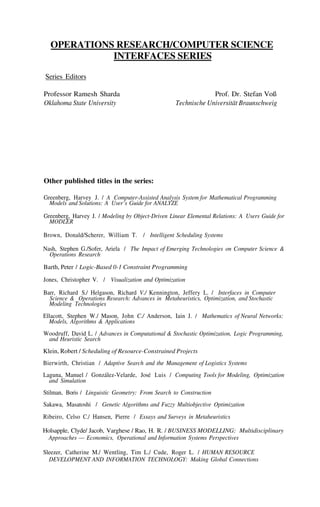
OPERATIONS RESEARCH/COMPUTER SCIENCE
INTERFACESSERIES
Series Editors
Professor Ramesh Sharda
Oklahoma State University
Prof. Dr. Stefan Voß
Technische Universität Braunschweig
Other published titles in the series:
Greenberg, Harvey J. / A Computer-Assisted Analysis System for Mathematical Programming
Models and Solutions: A User’s Guide for ANALYZE
Greenberg, Harvey J. / Modeling by Object-Driven Linear Elemental Relations: A Users Guide for
MODLER
Brown, Donald/Scherer, William T. / Intelligent Scheduling Systems
Nash, Stephen G./Sofer, Ariela / The Impact of Emerging Technologies on Computer Science &
Operations Research
Barth, Peter / Logic-Based 0-1 Constraint Programming
Jones, Christopher V. / Visualization and Optimization
Barr, Richard S./ Helgason, Richard V./ Kennington, Jeffery L. / Interfaces in Computer
Science & Operations Research: Advances in Metaheuristics, Optimization, and Stochastic
Modeling Technologies
Ellacott, Stephen W./ Mason, John C./ Anderson, Iain J. / Mathematics of Neural Networks:
Models, Algorithms & Applications
Woodruff, David L. / Advances in Computational & Stochastic Optimization, Logic Programming,
and Heuristic Search
Klein, Robert / Scheduling of Resource-Constrained Projects
Bierwirth, Christian / Adaptive Search and the Management of Logistics Systems
Laguna, Manuel / González-Velarde, José Luis / Computing Tools for Modeling, Optimization
and Simulation
Stilman, Boris / Linguistic Geometry: From Search to Construction
Sakawa, Masatoshi / Genetic Algorithms and Fuzzy Multiobjective Optimization
Ribeiro, Celso C./ Hansen, Pierre / Essays and Surveys in Metaheuristics
Holsapple, Clyde/ Jacob, Varghese / Rao, H. R. / BUSINESS MODELLING: Multidisciplinary
Approaches — Economics, Operational and Information Systems Perspectives
Sleezer, Catherine M./ Wentling, Tim L./ Cude, Roger L. / HUMAN RESOURCE
DEVELOPMENT AND INFORMATION TECHNOLOGY: Making Global Connections
9.
Optimization Software ClassLibraries
Edited by
Stefan Voß
Braunschweig University of Technology, Germany
David L. Woodruff
University of California, Davis, USA
KLUWER ACADEMIC PUBLISHERS
NEW YORK, BOSTON, DORDRECHT, LONDON, MOSCOW
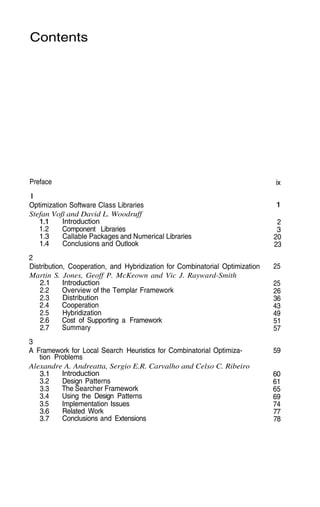
Contents
Preface
1
ix
1
2
3
20
23
25
25
26
36
43
49
51
57
59
60
61
65
69
74
77
78
Optimization Software ClassLibraries
Stefan Voß and David L. Woodruff
1.1
1.2
1.3
1.4
Introduction
Component Libraries
Callable Packages and Numerical Libraries
Conclusions and Outlook
2
Distribution, Cooperation, and Hybridization for Combinatorial Optimization
Martin S. Jones, Geoff P. McKeown and Vic J. Rayward-Smith
2.1
2.2
2.3
2.4
2.5
2.6
2.7
Introduction
Overview of the Templar Framework
Distribution
Cooperation
Hybridization
Cost of Supporting a Framework
Summary
3
A Framework for Local Search Heuristics for Combinatorial Optimiza-
tion Problems
Alexandre A. Andreatta, Sergio E.R. Carvalho and Celso C. Ribeiro
3.1
3.2
3.3
3.4
3.5
3.6
3.7
Introduction
Design Patterns
The Searcher Framework
Using the Design Patterns
Implementation Issues
Related Work
Conclusions and Extensions
12.
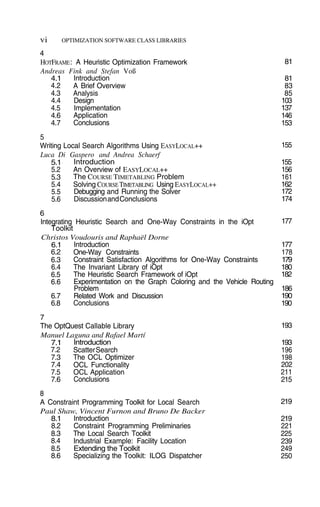
vi OPTIMIZATION SOFTWARECLASS LIBRARIES
81
81
83
85
103
137
146
153
155
177
177
178
179
180
182
186
190
190
193
193
196
198
202
211
215
219
219
221
225
239
249
250
4
HOTFRAME: A Heuristic Optimization Framework
Andreas Fink and Stefan Voß
4.1
4.2
4.3
4.4
4.5
4.6
4.7
Introduction
A Brief Overview
Analysis
Design
Implementation
Application
Conclusions
5
Writing Local Search Algorithms Using EASYLOCAL++
Luca Di Gaspero and Andrea Schaerf
5.1
5.2
5.3
5.4
5.5
5.6
Introduction
An Overview of EASYLOCAL++
The COURSE TIMETABLING Problem
Solving COURSE TIMETABLING Using EASYLOCAL++
Debugging and Running the Solver
DiscussionandConclusions
6
Integrating Heuristic Search and One-Way Constraints in the iOpt
Toolkit
Christos Voudouris and Raphaël Dorne
Introduction
One-Way Constraints
Constraint Satisfaction Algorithms for One-Way Constraints
The Invariant Library of iOpt
The Heuristic Search Framework of iOpt
Experimentation on the Graph Coloring and the Vehicle Routing
Problem
Related Work and Discussion
Conclusions
6.1
6.2
6.3
6.4
6.5
6.6
6.7
6.8
7
The OptQuest Callable Library
Manuel Laguna and Rafael Martí
7.1
7.2
7.3
7.4
7.5
7.6
Introduction
ScatterSearch
The OCL Optimizer
OCL Functionality
OCL Application
Conclusions
8
A Constraint Programming Toolkit for Local Search
Paul Shaw, Vincent Furnon and Bruno De Backer
8.1
8.2
8.3
8.4
8.5
8.6
Introduction
Constraint Programming Preliminaries
The Local Search Toolkit
Industrial Example: Facility Location
Extending the Toolkit
Specializing the Toolkit: ILOG Dispatcher
155
156
161
162
172
174
13.
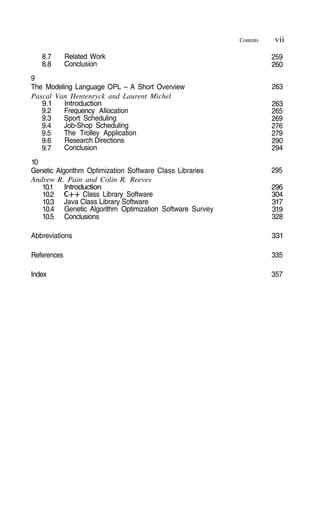
Contents vii
259
260
263
263
265
269
276
279
290
294
295
296
304
317
319
328
331
335
357
8.7
8.8
Related Work
Conclusion
9
TheModeling Language OPL – A Short Overview
Pascal Van Hentenryck and Laurent Michel
9.1
9.2
9.3
9.4
9.5
9.6
9.7
Introduction
Frequency Allocation
Sport Scheduling
Job-Shop Scheduling
The Trolley Application
Research Directions
Conclusion
10
Genetic Algorithm Optimization Software Class Libraries
Andrew R. Pain and Colin R. Reeves
10.1
10.2
10.3
10.4
10.5
Introduction
Class Library Software
Java Class Library Software
Genetic Algorithm Optimization Software Survey
Conclusions
Abbreviations
References
Index
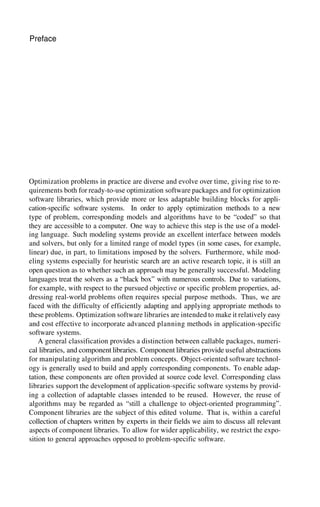
Preface
Optimization problems inpractice are diverse and evolve over time, giving rise to re-
quirements both for ready-to-use optimization software packages and for optimization
software libraries, which provide more or less adaptable building blocks for appli-
cation-specific software systems. In order to apply optimization methods to a new
type of problem, corresponding models and algorithms have to be “coded” so that
they are accessible to a computer. One way to achieve this step is the use of a model-
ing language. Such modeling systems provide an excellent interface between models
and solvers, but only for a limited range of model types (in some cases, for example,
linear) due, in part, to limitations imposed by the solvers. Furthermore, while mod-
eling systems especially for heuristic search are an active research topic, it is still an
open question as to whether such an approach may be generally successful. Modeling
languages treat the solvers as a “black box” with numerous controls. Due to variations,
for example, with respect to the pursued objective or specific problem properties, ad-
dressing real-world problems often requires special purpose methods. Thus, we are
faced with the difficulty of efficiently adapting and applying appropriate methods to
these problems. Optimization software libraries are intended to make it relatively easy
and cost effective to incorporate advanced planning methods in application-specific
software systems.
A general classification provides a distinction between callable packages, numeri-
cal libraries, and component libraries. Component libraries provide useful abstractions
for manipulating algorithm and problem concepts. Object-oriented software technol-
ogy is generally used to build and apply corresponding components. To enable adap-
tation, these components are often provided at source code level. Corresponding class
libraries support the development of application-specific software systems by provid-
ing a collection of adaptable classes intended to be reused. However, the reuse of
algorithms may be regarded as “still a challenge to object-oriented programming”.
Component libraries are the subject of this edited volume. That is, within a careful
collection of chapters written by experts in their fields we aim to discuss all relevant
aspects of component libraries. To allow for wider applicability, we restrict the expo-
sition to general approaches opposed to problem-specific software.
16.
x OPTIMIZATION SOFTWARECLASS LIBRARIES
Acknowledgements
Of course such an ambitious project like publishing a high quality book would not
have been possible without the most valuable input of a large number of individuals.
First of all, we wish to thank all the authors for their contributions, their patience and
fruitful discussion. We are grateful to the whole team at the University of Technology
Braunschweig, who helped in putting this book together, and to Gary Folven at Kluwer
Academic Publishers for his help and encouragement.
The Editors:
Stefan Voß
David L. Woodruff
17.
1 OPTIMIZATION SOFTWARECLASS
LIBRARIES
Stefan Voß1
and David L. Woodruff2
1
Technische Universität Braunschweig
Institut für Wirtschaftswissenschaften
Abt-Jerusalem-Straße 7, D-38106 Braunschweig, Germany
stefan.voss@tu—bs.de
2
Graduate School of Management
University of California at Davis
Davis, California 95616, USA
dlwoodruff@ucdavis.edu
Abstract: Many decision problems in business and engineering may be formulated as
optimization problems. Optimization problems in practice are diverse, often complex and
evolve over time, so one requires both ready-to-use optimization software packages and
optimization software libraries, which provide more or less adaptable building blocks for
application-specific software systems.
To provide a context for the other chapters in the book, it is useful to briefly survey
optimization software. A general classification provides a distinction between callable
packages, numerical libraries, and component libraries. In this introductory chapter, we
discuss some general aspects of corresponding libraries and give an overview of avail-
able libraries, which provide reusable functionality with respect to different optimization
methodologies. To allow for wider applicability we devote little attention to problem-
specific software so we can focus the exposition on general approaches.
18.
OPTIMIZATION SOFTWARE CLASSLIBRARIES
1.1 INTRODUCTION
New information technologies continuously transform decision processes for man-
agers and engineers. This book is the result of the confluence of recent developments
in optimization techniques for complicated problems and developments in software
development technologies. The confluence of these technologies is making it possible
for optimization methods to be embedded in a host of applications.
Many decision problems in business and engineering may be formulated as opti-
mization problems. Optimization problems in practice are diverse, often complex and
evolve over time, so one requires both ready-to-use optimization software packages
and optimization software libraries, which provide more or less adaptable building
blocks for application-specific software systems. To provide a context for the other
chapters in the book, it is useful to briefly survey optimization software.
In order to apply optimization methods to a new type of problem, corresponding
models and algorithms have to be “coded” so that they are accessible to a computer
program that can search for a solution. Software that can take a problem in canonical
form and find optimal or near optimal solutions is referred to as a solver. The transla-
tion of the problem from its physical or managerial form into a form usable by a solver
is a critical step.
One way to achieve this step is the use of a modeling language. Such modeling
systems provide an excellent interface between models and solvers, but only for a
limited range of model types (in some extreme cases, e.g., linear). This is partly due
to limitations imposed by the solvers. Furthermore, while modeling systems are an
active research topic, it is still an open question whether such an approach may be
successful for complex problems. Modeling languages treat the solvers as a “black
box” with numerous controls.
Due to variations, for example, with respect to the pursued objective or specific
problem properties, addressing real-world problems often requires special purpose
methods. Thus, we are faced with the difficulty of efficiently adapting and applying
appropriate methods to these problems. Optimization software libraries are intended
to make it relatively easy and cost effective to incorporate advanced planning methods
in application-specific software systems.
Callablepackages allow users to embed optimization functionality in applications,
and are designed primarily to allow the user’s software to prepare the model and feed
it to the package. Such systems typically also include routines that allow manipulation
of the model and access to the solver’s parameters. As with the modeling language
approach, the solver is treated essentially as an opaque object, which provides a clas-
sical functional interface, using procedural programming languages such as C. While
there are only restricted means to adapt the corresponding coarse-grained functional-
ity, the packages do often offer callbacks that facilitate execution of user code during
the solution process.
Numerical libraries provide similar functionality, except that the model data is
treated using lower levels of abstraction. For example, while modeling languages
and callable packages may allow the user to provide names for sets of variables and
indexes into the sets, numerical libraries facilitate only the manipulation of vectors
and matrices as numerical entities. Well-known solution techniques can be called as
2
19.
OPTIMIZATION SOFTWARE CLASSLIBRARIES 3
subroutines, or can be built from primitive operations on vectors and matrices. These
libraries provide support for linear algebra, numerical computation of gradients, and
support for other operations of value, particularly for continuous optimization.
Component libraries provide useful abstractions for manipulating algorithm and
problem concepts. Object-oriented software technology is generally used to build
and deploy components. To enable adaptation these components are often provided
at source code level. Class libraries support the development of application-specific
software systems by providing a collection of adaptable classes intended to be reused.
Nevertheless, the reuse of algorithms may be regarded as “still a challenge to object-
oriented programming” (Weihe (1997)). As we point out later, there is no clear di-
viding line between class libraries and frameworks. Whereas class libraries may be
more flexible, frameworks often impose a broader structure on the whole system. Here
we use the term component library or componentware that should embrace both class
libraries and frameworks, but also other concepts that build on the idea of creating
software systems by selecting, possibly adapting, and combining appropriate modules
from a huge set of existing modules.
In the following sections we provide a briefsurvey on callable packages and numer-
ical libraries (Section 1.3) as well as component libraries (Section 1.2). Our survey
in this chapter must necessarily be cursory and incomplete; it is not intended to be
judgmental and in some cases one has to rely on descriptions provided by software
vendors. Therefore, we include several references (literature and WWW) that provide
further information; cf. Fink et al. (2001).
As our main interest lies in optimization software class libraries and frameworks
for heuristic search, we provide a somewhat more in depth treatment of heuristics and
metaheuristics within the section on component libraries to let the reader visualize the
preliminaries of this rapidly evolving area; cf. Voß (2001).
1.2 COMPONENT LIBRARIES
Class libraries support the development of application-specific software systems by
providing a collection of (possibly semi-finished) classes intended to be reused. The
approach to build software by using class libraries corresponds to the basic idea of
object-oriented software construction, which may be defined as building software sys-
tems as “structured collections of possibly partial abstract data type implementations”
(Meyer (1997)). The basic object-oriented paradigm is to encapsulate abstractions of
all relevant concepts ofthe considered domain in classes. To be truly reusable, all these
classes have to be applicable in different settings. This requires them to be polymor-
phic to a certain degree, i.e., to behave in an adaptable way. Accordingly, there have
to be mechanisms to adapt these classes to the specific application. Class libraries
are mostly based on dynamic polymorphism by factoring out common behavior in
general classes and providing the specialized functionality needed by subclassing (in-
heritance). Genericity, which enables one to leave certain types and values unspecified
until the code is actually instantiated and used (compiled) is another way - applicable
orthogonal to inheritance - to define polymorphic classes.
One approach primarily devoted to the goal to achieve a higher degree of reuse is
the framework approach; see, e.g., Bosch et al. (1999), Fayad and Schmidt (1997b)
20.
Most discrete optimizationproblems are nearly impossible to solve to optimality.
Many can be formally classified as (Garey and Johnson (1979)). Moreover,
the modeling of the problem is often an approximate one, and the data are often impre-
cise. Consequently, heuristics are a primary way to tackle these problems. The use of
appropriate metaheuristics generally meets the needs of decision makers to efficiently
generate solutions that are satisfactory, although perhaps not optimal. The common
incorporation of advanced metaheuristics in application systems requires a way to
reuse much of such software and to redo as little as possible each time. However, in
1.2.1 Libraries for Heuristic Optimization
and Johnson and Foote (1988). Taking into account that for the development of ap-
plication systems for given domains quite similar software is needed, it is reasonable
to implement such common aspects by a generic design and embedded reusable soft-
ware components. Here, one assumes that reuse on a large scale cannot only be based
on individual components, but there has to be to a certain extent a reuse of design.
Thus, the components have to be embedded in a corresponding architecture, which
defines the collaboration between the components. Such a framework may be defined
as a set of classes that embody an abstract design for solutions to a family of related
problems (e.g., heuristics for discrete optimization problems), and thus provides us
with abstract applications in a particular domain, which may be tailored for individual
applications. A framework defines in some way a definition ofa reference application
architecture (“skeleton”), providing not only reusable software elements but also some
type of reuse of architecture and design patterns (Buschmann et al. (1996b), Gamma
et al. (1995)), which may simplify software development considerably. (Patterns, such
as frameworks and components, may be classified as object-oriented reuse techniques.
Simply put a pattern describes a problem to be solved, a solution as well as the context
in which the solution applies.) Thus, frameworks represent implementation-oriented
generic models for specific domains.
There is no clear dividing line between class libraries and frameworks. Whereas
class libraries may be more flexible, frameworks often impose a broader structure
on the whole system. Frameworks, sometimes termed as component libraries, may
be subtly differentiated from class libraries by the “activeness” of components, i.e.,
components of the framework define application logic and call application-specific
code. This generally results in a bi-directional flow of control.
In the following, we will use the term component library or componentware that
should embrace both class libraries and frameworks, but also other concepts that build
on the idea of creating software systems by selecting, possibly adapting, and com-
bining appropriate modules from a large set of existing modules. The flexibility of
a component library is dependent on the specific possibilities for adaptation. As cer-
tain aspects of the component library application cannot be anticipated, these aspects
have to be kept flexible, which implies a deliberate incompleteness of generic software
components.
Based on these considerations we chose the title optimization software class li-
braries. In the sequel we distinguish between libraries for heuristic search (Sec-
tion 1.2.1) and constraint programming (Section 1.2.2).
OPTIMIZATION SOFTWARE CLASS LIBRARIES
4
21.
OPTIMIZATION SOFTWARE CLASSLIBRARIES 5
comparison to the exact optimization field, there is less support by corresponding soft-
ware libraries that meet practical demands with respect to, for example, robustness and
ease-of-use. What are the difficulties in developing reusable and adaptable software
components for heuristic search? Compared to the field of mathematical program-
ming, which relies on well-defined, problem-independent representation schemes for
problems and solutions on which algorithms may operate, metaheuristics are based
on abstract definitions of solution spaces and neighborhood structures. Moreover,
for example, memory-based tabu search approaches are generally based on abstract
problem-specific concepts such as solution and move attributes.
The crucial problem of local search based metaheuristics libraries is a generic im-
plementation of heuristic approaches as reusable software components, which must
operate on arbitrary solution spaces and neighborhood structures. The drawback is
that the user must, in general, provide some kind of a problem/solution definition and
a neighborhood structure, which is usually done using sophisticated computer lan-
guages such as
An early class library for heuristic optimization by Woodruff (1997) included
both local search based methods and genetic algorithms. This library raised issues that
illustrate both the promise and the drawbacks to the adaptable component approach.
From a research perspective such libraries can be thought of as providing a concrete
taxonomy for heuristic search. So concrete, in fact, that they can be compiled into
machine code. This taxonomy sheds some light on the relationships between heuristic
search methods for optimization and on ways in which they can be combined. Fur-
thermore, the library facilitates such combinations as the classes in the library can be
extended and/or combined to produce new search strategies.
From a practical and empirical perspective, these types of libraries provide a vehicle
for using and testing heuristic search optimization. A user of the library must provide
the definition of the problem specific abstractions and may systematically vary and
exchange heuristic strategies and corresponding components.
In the sequel, we provide a brief survey on the state-of-the-art of heuristic search
and metaheuristics before we discuss several heuristic optimization libraries. These
libraries differ, e.g., in the design concept, the chosen balance between “ease-of-use”
and flexibility and efficiency, and the overall scope. All of these approaches are based
on the concepts of object-oriented programming and will be described in much more
detail in later chapters of this book.
1.2.1.1 Heuristics: Patient Rules of Thumb and Beyond. Many op-
timization problems are too difficult to be solved exactly within a reasonable amount
of time and heuristics become the methods of choice. In cases where simply obtaining
a feasible solution is not satisfactory, but where the quality of solution is critical, it
becomes important to investigate efficient procedures to obtain the best possible so-
lutions within time limits deemed practical. Due to the complexity of many of these
optimization problems, particularly those of large sizes encountered in most practi-
cal settings, exact algorithms often perform very poorly (in some cases taking days
or more to find moderately decent, let alone optimal, solutions even to fairly small
22.
instances). As aresult, heuristic algorithms are conspicuously preferable in practical
applications.
The basic concept of heuristic search as an aid to problem solving was first intro-
duced by Polya (1945). A heuristic is a technique (consisting of a rule or a set ofrules)
which seeks (and eventually finds) good solutions at a reasonable computational cost.
A heuristic is approximate in the sense that it provides (hopefully) a good solution
for relatively little effort, but it does not guarantee optimality. Moreover, the usual
distinction refers to finding initial feasible solutions and improving them.
Heuristics provide simple means of indicating which among several alternatives
seems to be the best. And basically they are based on intuition. That is, “heuristics are
criteria, methods, orprinciplesfordeciding which among several alternative courses of
action promises to be the most effective in order to achieve some goal. They represent
compromises between two requirements: the need to make such criteria simple and,
at the same time, the desire to see them discriminate correctly between good and bad
choices. A heuristic may be a rule ofthumb that is used to guide one’s action.” (Pearl
(1984))
Greedy heuristics are simple heuristics available for any kind of combinatorial op-
timization problem. They are iterative and a good characterization is their myopic
behavior. A greedy heuristic starts with a given feasible or infeasible solution. In each
iteration there is a number of alternative choices (moves) that can be made to trans-
form the solution. From these alternatives which consist in fixing (or changing) one or
more variables, a greedy choice is made, i.e., the best alternative according to a given
evaluation measure is chosen until no such transformations are possible any longer.
Among the most studied heuristics are those based on applying some sort of greed-
iness or applying priority based procedures such as insertion and dispatching rules. As
an extension of these, a large number of local search approaches has been developed to
improve given feasible solutions. The basic principle of local search is that solutions
are successively changed by performing moves which alter solutions locally. Valid
transformations are defined by neighborhoods which give all neighboring solutions
that can be reached by one move from a given solution. (Formally, we consider an in-
stance of a combinatorial optimization problem with a solution space S of feasible (or
even infeasible) solutions. To maintain information about solutions, there may be one
or more solution information functions I on S, which are termed exact, if I is injec-
tive, and approximate otherwise. With this information, one may store a search history
(trajectory). For each S there are one or more neighborhood structures N that define
for each solution an ordered set of neighbors
To each neighbor corresponds a move that captures the transitional in-
formation from to For a general survey on local search see the collection of
Aarts and Lenstra (1997) and the references in Aarts and Verhoeven (1997).
Moves must be evaluated by some heuristic measure to guide the search. Often one
uses the implied change of the objective function value, which may provide reason-
able information about the (local) advantage of moves. Following a greedy strategy,
steepest descent (SD) corresponds to selecting and performing in each iteration the
best move until the search stops at a local optimum.
6 OPTIMIZATION SOFTWARE CLASS LIBRARIES
23.
OPTIMIZATION SOFTWARE CLASSLIBRARIES 7
As the solution quality of the local optima thus encountered may be unsatisfactory,
we need mechanisms which guide the search to overcome local optimality. A simple
strategy called iterated local search is to iterate/restart the local search process after a
local optimum has been obtained, which requires some perturbation scheme to gen-
erate a new initial solution (e.g., performing some random moves). Of course, more
structured ways to overcome local optimality might be advantageous.
Starting with Lin and Kernighan (1973), a variable way of handling neighborhoods
is a topic within local search. Consider an arbitrary neighborhood structure N , which
defines for any solution a set of neighbor solutions as a neighborhood of
depth In a straightforward way, a neighborhood of depth is
defined as the set In general, a large
might be unreasonable, as the neighborhood size may grow exponentially. However,
depths of two or three may be appropriate. Furthermore, temporarily increasing the
neighborhood depth has been found to be a reasonable mechanism to overcome basins
of attraction, e.g., when a large number of neighbors with equal quality exist.
The main drawback of local search approaches – their inability to continue the
search upon becoming trapped in a local optimum – leads to consideration of tech-
niques for guiding known heuristics to overcome local optimality. Following this
theme, one may investigate the application of intelligent search methods like the tabu
search metaheuristic for solving optimization problems. Moreover, the basic concepts
of various strategies like simulated annealing, scatter search and genetic algorithms
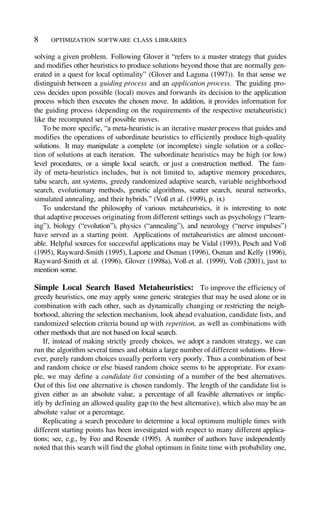
come to mind. This is based on a simplified view of a possible inheritance tree for
heuristic search methods, illustrating the relationships between some of the most im-
portant methods discussed below, as shown in Figure 1.1.
1.2.1.2 Metaheuristics Concepts. The formal definition of metaheuristics
is based on a variety ofdefinitions from different authors going back to Glover (1986).
Basically, a metaheuristic is a top-level strategy that guides an underlying heuristic
24.
Simple Local SearchBased Metaheuristics: To improve the efficiency of
greedy heuristics, one may apply some generic strategies that may be used alone or in
combination with each other, such as dynamically changing or restricting the neigh-
borhood, altering the selection mechanism, look ahead evaluation, candidate lists, and
randomized selection criteria bound up with repetition, as well as combinations with
other methods that are not based on local search.
If, instead of making strictly greedy choices, we adopt a random strategy, we can
run the algorithm several times and obtain a large number of different solutions. How-
ever, purely random choices usually perform very poorly. Thus a combination of best
and random choice or else biased random choice seems to be appropriate. For exam-
ple, we may define a candidate list consisting of a number of the best alternatives.
Out of this list one alternative is chosen randomly. The length of the candidate list is
given either as an absolute value, a percentage of all feasible alternatives or implic-
itly by defining an allowed quality gap (to the best alternative), which also may be an
absolute value or a percentage.
Replicating a search procedure to determine a local optimum multiple times with
different starting points has been investigated with respect to many different applica-
tions; see, e.g., by Feo and Resende (1995). A number of authors have independently
noted that this search will find the global optimum in finite time with probability one,
solving a given problem. Following Glover it “refers to a master strategy that guides
and modifies other heuristics to produce solutions beyond those that are normally gen-
erated in a quest for local optimality” (Glover and Laguna (1997)). In that sense we
distinguish between a guiding process and an application process. The guiding pro-
cess decides upon possible (local) moves and forwards its decision to the application
process which then executes the chosen move. In addition, it provides information for
the guiding process (depending on the requirements of the respective metaheuristic)
like the recomputed set of possible moves.
To be more specific, “a meta-heuristic is an iterative master process that guides and
modifies the operations of subordinate heuristics to efficiently produce high-quality
solutions. It may manipulate a complete (or incomplete) single solution or a collec-
tion of solutions at each iteration. The subordinate heuristics may be high (or low)
level procedures, or a simple local search, or just a construction method. The fam-
ily of meta-heuristics includes, but is not limited to, adaptive memory procedures,
tabu search, ant systems, greedy randomized adaptive search, variable neighborhood
search, evolutionary methods, genetic algorithms, scatter search, neural networks,
simulated annealing, and their hybrids.” (Voß et al. (1999), p. ix)
To understand the philosophy of various metaheuristics, it is interesting to note
that adaptive processes originating from different settings such as psychology (“learn-
ing”), biology (“evolution”), physics (“annealing”), and neurology (“nerve impulses”)
have served as a starting point. Applications of metaheuristics are almost uncount-
able. Helpful sources for successful applications may be Vidal (1993), Pesch and Voß
(1995), Rayward-Smith (1995), Laporte and Osman (1996), Osman and Kelly (1996),
Rayward-Smith et al. (1996), Glover (1998a), Voß et al. (1999), Voß (2001), just to
mention some.
OPTIMIZATION SOFTWARE CLASS LIBRARIES
8
25.
OPTIMIZATION SOFTWARE CLASSLIBRARIES 9
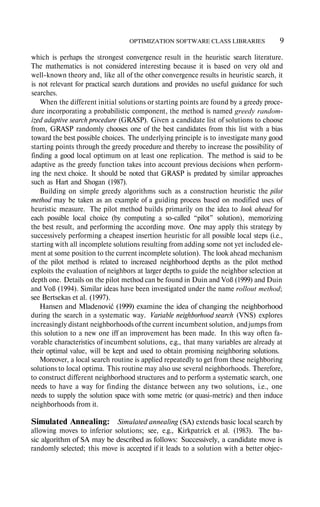
which is perhaps the strongest convergence result in the heuristic search literature.
The mathematics is not considered interesting because it is based on very old and
wellknown theory and, like all of the other convergence results in heuristic search, it
is not relevant for practical search durations and provides no useful guidance for such
searches.
When the different initial solutions or starting points are found by a greedy proce
dure incorporating a probabilistic component, the method is named greedy random-
ized adaptive search procedure (GRASP). Given a candidate list of solutions to choose
from, GRASP randomly chooses one of the best candidates from this list with a bias
toward the best possible choices. The underlying principle is to investigate many good
starting points through the greedy procedure and thereby to increase the possibility of
finding a good local optimum on at least one replication. The method is said to be
adaptive as the greedy function takes into account previous decisions when perform
ing the next choice. It should be noted that GRASP is predated by similar approaches
such as Hart and Shogan (1987).
Building on simple greedy algorithms such as a construction heuristic the pilot
method may be taken as an example of a guiding process based on modified uses of
heuristic measure. The pilot method builds primarily on the idea to look ahead for
each possible local choice (by computing a socalled “pilot” solution), memorizing
the best result, and performing the according move. One may apply this strategy by
successively performing a cheapest insertion heuristic for all possible local steps (i.e.,
starting with all incomplete solutions resulting from adding some not yet included ele
ment at some position to the current incomplete solution). The look ahead mechanism
of the pilot method is related to increased neighborhood depths as the pilot method
exploits the evaluation of neighbors at larger depths to guide the neighbor selection at
depth one. Details on the pilot method can be found in Duin and Voß (1999) and Duin
and Voß (1994). Similar ideas have been investigated under the name rollout method;
see Bertsekas et al. (1997).
Hansen and Mladenović (1999) examine the idea of changing the neighborhood
during the search in a systematic way. Variable neighborhood search (VNS) explores
increasingly distant neighborhoods ofthe current incumbent solution, andjumps from
this solution to a new one iff an improvement has been made. In this way often fa
vorable characteristics of incumbent solutions, e.g., that many variables are already at
their optimal value, will be kept and used to obtain promising neighboring solutions.
Moreover, a local search routine is applied repeatedly to get from these neighboring
solutions to local optima. This routine may also use several neighborhoods. Therefore,
to construct different neighborhood structures and to perform a systematic search, one
needs to have a way for finding the distance between any two solutions, i.e., one
needs to supply the solution space with some metric (or quasimetric) and then induce
neighborhoods from it.
Simulated Annealing: Simulated annealing (SA) extends basic local search by
allowing moves to inferior solutions; see, e.g., Kirkpatrick et al. (1983). The ba
sic algorithm of SA may be described as follows: Successively, a candidate move is
randomly selected; this move is accepted if it leads to a solution with a better objec
This ebook isfor the use of anyone anywhere in the United
States and most other parts of the world at no cost and with
almost no restrictions whatsoever. You may copy it, give it away
or re-use it under the terms of the Project Gutenberg License
included with this ebook or online at www.gutenberg.org. If you
are not located in the United States, you will have to check the
laws of the country where you are located before using this
eBook.
Title: An open verdict
a novel, volume 3 (of 3)
Author: M. E. Braddon
Release date: May 10, 2022 [eBook #68040]
Language: English
Original publication: United Kingdom: John Maxwell and Co,
1879
Credits: David Edwards, Eleni Christofaki and the Online
Distributed Proofreading Team at https://www.pgdp.net
(This file was produced from images generously made
available by The Internet Archive)
*** START OF THE PROJECT GUTENBERG EBOOK AN OPEN
VERDICT ***
31.
Transcriber’s note
Variable spellingand hyphenation have been retained. Minor punctuation
inconsistencies have been silently repaired. A list of the changes made can be found at
the end of the book.
AN OPEN VERDICT
VOL. III.
32.
AN OPEN VERDICT
ANovel
by the author of
‘LADY AUDLEY’S SECRET’
etc. etc. etc.
IN THREE VOLUMES
VOL. III.
LONDON:
JOHN MAXWELL AND CO.
4, SHOE LANE, FLEET STREET,
1878
[All rights reserved]
33.
CONTENTS TO VOL.III.
chap. PAGE
i. Paternal Diplomacy 1
ii. Mr. Piper is accepted 18
iii. A Wedding March 30
iv. Kenrick’s Return 49
v. Mr. Scratchell goes to London 60
vi. The Second Mrs. Piper 74
vii. In the Churchyard 88
viii. Kenrick’s Wedding Day 112
ix. Jilted 122
x. Mrs. Piper’s Day 132
xi. Captain Standish 154
xii. At her Chariot Wheels 168
xiii. Playing with Fire 183
xiv. A Turn of Fortune’s Wheel 202
xv. Mr. Piper asserts himself 216
xvi. Captain Standish chooses a Horse 230
xvii. Vanessa’s Visit 244
xviii. Opening his Eyes 257
xix. A Short Reckoning 274
xx. Let Silence be about her Name 289
xxi. ‘But prove me what it is I would not do’ 308
xxii. Fair still, but Fair for no one saving me 321
Epilogue 343
CHAPTER I.
paternal diplomacy.
‘What!’roared Mr. Scratchell, scarlet of visage, ‘you are asked to
marry a man with fifteen thousand a year, and you refuse? Did
anybody ever hear of such lunacy?’
Bella sat shivering at the paternal wrath. Mrs. Scratchell was
weeping dumbly. All the younger Scratchells were ready to lift up
their voices in a chorus of condemnation. Bella’s folly in refusing Mr.
Piper was, in their eyes, a personal injury.
‘You would not ask me to marry a man I cannot love, would you,
father?’ faltered Bella; ‘a man I can hardly respect.’
‘You cannot respect fifteen thousand a year?’ cried Mr. Scratchell.
‘Then, in the name of all that’s reasonable, what can you respect?’
‘He is so rough-mannered and dictatorial,’ urged Bella, ‘so stout
and puffy. And it is really dreadful to hear him murder the Queen’s
English.’
Mr. Scratchell looked round at his assembled family with a wrathful
glare, as if he were calling upon them all to behold this ridiculous
daughter of his.
‘That ever I should have bred and reared such foolishness!’ he
exclaimed. ‘What’s that fairy tale you were reading the little ones,
mother, about the Princess and the seven feather beds? She had
seven feather beds to sleep upon, one atop of the other, and couldn’t
rest because there was a parched pea under the bottom one.
There’s your proud Princess for you!’ pointing at his tearful daughter.
‘She turns up her nose at fifteen thousand a year because the owner
of it doesn’t arrange his words according to Lindley Murray. Why, I
never had much opinion of Lindley Murray myself, and, what’s more,
I never could understand him.’
36.
‘Father, it isn’ta question of bad grammar. If I loved Mr. Piper, or
felt that I could teach myself to love him, I shouldn’t care how badly
he talked. But I cannot love him.’
‘Who asks you to love him?’ cried Mr. Scratchell, folding and
unfolding his newspaper violently, in a whirlwind of indignation.
‘Nobody has made mention of love—not Piper himself, I warrant.
He’s too sensible a man. You are only asked to marry him, and to do
your duty in that state of life to which it has pleased God to call you.
And very grateful you ought to be for having been called to fifteen
thousand a year. Think what you can do for your brothers and
sisters, and your poor harassed mother! There’s a privilege for you.
And if Piper should take to buying property hereabouts, and give me
the collection of his rents, there’d be a lift for me.’
Then Mrs. Scratchell feebly, and with numerous gasps and
choking sobs, uplifted her maternal voice, and made her moan.
‘I should be the last to press any child of mine to marry against her
inclination,’ she said, ‘but I should like to see one of my daughters a
lady. Bella has been a lady in all her little ways from the time she
could run alone, and I am sure she would become the highest
position—yes, even such a station as Mr. Piper, with his fortune,
could give her. If there was anything better or brighter before her—
any chance of her getting a young good-looking husband able to
support her comfortably—I wouldn’t say marry Mr. Piper. But I’m sure
I can’t see how any girl is to get well married in Little Yafford, where
the young men——’
‘Haven’t one sixpence to rub against another,’ interrupted Mr.
Scratchell, impatiently.
‘And I know what life is for those that have to study the outlay of
every penny, and to keep their brains always on the rack in order just
barely to pay their way,’ continued Mrs. Scratchell.
Bella gave a deep, despondent sigh. It was all true that these
worldly-minded parents were saying. She was no romantic girl to
believe in an impossible future. She knew that for women of the
Scratchell breed life was hard and dry, like the crusts of the stale
37.
loaves which sheso often encountered at the family breakfast-table.
What was there before her if she persisted in refusing this high
fortune that was ready to be poured into her lap? Another rebellious
family to teach—an unending procession of verbs, and pianoforte
exercises, dreary fantasias, with all the old familiar airs turned upside
down, and twisted this way and that, and drawn out to uttermost
attenuation, like a string of Indian-rubber. If nothing else killed her,
Bella thought, she must assuredly die of those hateful fantasias, the
ever-lasting triplets, the scampering arpeggios, stumbling and
halting, like the canter of a lame horse.
Mr. Scratchell heard that long sigh and guessed its meaning. He
checked his loud indignation, all of a sudden, and had recourse to
diplomacy. The girl’s own sense was beginning to argue against her
foolishness.
‘Well, my dear,’ he said, quite amiably, ‘if you’ve made up your
mind there’s no use in our saying any more about it. Your mother
and I would have been proud to see you settled in such a splendid
way—the envy of all the neighbourhood—holding your head as high
as the best of ’em. But let that pass. You’d better look out for another
situation. With so many mouths as I’ve got to feed, I can’t afford to
encourage idleness. There must be no twiddling of thumbs in this
family. The Yorkshire Times comes out on Saturday. There’ll be just
time for us to get an advertisement in.’
Bella gave another sigh, an angry one this time.
‘You’re very sharp with me, father,’ she said. ‘I should have
thought you’d have been glad to have me at home for a little while,
with my time disengaged.’
‘What?’ ejaculated Mr. Scratchell. ‘Haven’t you had your
afternoons for idleness? Your time disengaged, indeed! Do you think
I want a daughter of mine to be as useless as a chimney ornament,
good for nothing but to look at?’
And then Mr. Scratchell took out a sheet of paper, dipped his pen
in the ink, and wrinkled his brow in the effort of composition.
38.
‘Governess, residential orotherwise,’ he began, pronouncing the
words aloud as he wrote, ‘competent to impart a sound English
education, French, Italian, German, music, drawing and painting,
and fancy needlework. Able to prepare boys for a public school. Has
had the entire charge of a gentleman’s family. First-rate references.’
‘There,’ exclaimed Mr. Scratchell. ‘That will cost a lot of money, but
I think it is comprehensive.’
‘I don’t know about drawing and painting,’ objected Bella, with a
weary air. ‘I never had much taste that way. I learnt a little with
Beatrix, but——’
‘Then you can teach,’ said Mr. Scratchell, decisively. ‘If you’ve
learnt you know all the technical words and rules, and you’re quite
competent to teach. When your pupil goes wrong you can tell her
how to go right. That’s quite enough. Nobody expects you to be a
Michael Angelo.’
‘I’m afraid I shall look like an impostor if I attempt to teach
drawing,’ remonstrated Bella.
‘Would not object to a school,’ wrote Mr. Scratchell, adding to the
advertisement.
‘But I would very, very, very much object, papa,’ cried Bella. ‘I will
not go into a school to please anybody.’
‘My dear, you have got to earn your bread, and if you can’t earn it
in a private family you must earn it in a school,’ explained her father.
‘I want the advertisement to be comprehensive, and to bring as
many answers as possible. You are not obliged to take a situation in
a school simply because you get one offered you—but if your only
offer is of that kind you must accept it. Hobson’s choice, you know.’
Bella began to cry.
‘The little Pipers are very hateful,’ she sobbed, ‘but I dare say
strange children would be worse.’
‘If the little Pipers were your step-children you could do what you
liked with them,’ said Mr. Scratchell.
39.
‘Oh, father,’ remonstratedhis wife, ‘she would be bound to be kind
to them.’
‘Of course,’ replied Mr. Scratchell. ‘Within certain limits. It would be
kindness to get them under strict discipline. She could pack them off
to school, and needn’t have them home for the holidays unless she
liked. Come, I think the advertisement will do. It will cost three or four
shillings, so it ought to answer. Herbert can take it with him to-
morrow when he goes to his office.’
‘Father,’ cried Bella, desperately, ‘you needn’t waste your money
upon that advertisement. I won’t take another situation.’
‘Won’t you?’ cried Mr. Scratchell. ‘Then I’m afraid you’ll have to go
to the workhouse, which would be rather disgraceful at your age. I
won’t keep you in idleness.’
‘I’d sooner marry Mr. Piper than go on teaching odious children.’
‘You’ll have to wait till Mr. Piper asks you again,’ replied her father,
delighted at having gained his point, but too diplomatic to show his
satisfaction. ‘You’ve refused him once. He may not care to humiliate
himself by risking a second refusal. However, the advertisement can
stand over for a day or two, since you’ve come to your senses.’
Mr. Scratchell went off to his official den presently, and Mrs.
Scratchell came over to Bella and hugged her.
‘Oh, my darling, it would be the making of us all,’ she exclaimed.
‘I don’t see what good that would be to me, mother, if I was
miserable,’ Bella responded, sulkily.
‘But you couldn’t be miserable in such a home as Yafford Park,
and with such a good man as Mr. Piper. It isn’t as if you had ever
cared for anybody else, dear.’
‘No, of course not,’ said Bella, full of bitterness. ‘That makes a
difference.’
‘And think what a lady you would be, and how high you could hold
your head.’
40.
‘Yes, I wouldhold my head high enough, mother. You may be sure
of that. I would have something out of life. Beatrix Harefield should
see what use I could make of money.’
‘Of course, dear. You have such aristocratic ideas. You could take
the lead in Little Yafford society.’
Bella gave a scornful shrug. The society in Little Yafford was
hardly worth leading; but Bella was of the temper that deems it better
to reign in a village than to serve in Rome. She put on her bonnet
and went to call upon Mrs. Dulcimer. That lady was in the garden,
her complexion protected by a muslin sun-bonnet, washing the
green flies off her roses. To her sympathetic ear Bella imparted the
story of Mr. Piper’s wooing and the paternal wrath.
‘My dear, I don’t wonder that your father was angry,’ cried the
Vicar’s wife. ‘Why, Mr. Piper is the very man for you. The idea
occurred to me soon after Mrs. Piper’s death. But I didn’t mention it,
for fear of alarming your delicacy. Such a good homely creature—an
excellent husband to his first wife—and so wealthy. Why, you would
be quite a little queen. How lucky I was mistaken about Cyril! What a
chance you would have lost if you had married him!’
Bella shuddered.
‘Yes, it would have been a pity,’ she said.
And then she thought how if Cyril had loved and married her, she
—who was just wise enough to know herself full of faults—might
have grown into a good woman—how, looking up at that image of
perfect manhood, she might have learned to shape herself into ideal
womanhood. Yes, it would have all been possible if he had only
loved her. His love would have been a liberal education.
Love had been denied her; but wealth, and all the advantages
wealth could give, might be hers.
‘I really begin to think that I was very foolish to refuse Mr. Piper,’
she said.
‘My love, excuse me, but you were simply idiotic. However, he is
sure to renew his offer. I shall call and see those dear children of his
41.
to-morrow. And whenhe asks you again, you will give him a kinder
answer?’
‘Yes,’ said Bella, with a long-drawn sigh, ‘since everybody thinks it
would be best.’
Everybody did not include Beatrix Harefield. Bella had not
consulted—nor did she mean to consult—her old friend and
playfellow. She knew quite well that Beatrix would have advised her
against a mercenary marriage, and in spite of all her sighs and
hesitations, Bella’s sordid little soul languished for the possession of
Mr. Piper’s wealth.
Mrs. Dulcimer was delighted at the notion of conducting a new
courtship to a triumphant issue. She put on her best bonnet early in
the afternoon, and went to pay her visit to the Park, feeling that it
behoved her to bring matters to a crisis.
Mr. Piper was at home, seated on a garden chair on his well-kept
lawn, basking in the sunshine, after a heavy dinner which went by
the name of luncheon. He had a sleek, well-fed look at this stage of
his existence, which did not encourage sentimental ideas: but Mrs.
Dulcimer looked at the big white house with its Doric portico, the
stone vases full of bright scarlet geraniums, the velvet lawn and
gaudy flower-beds, the belt of fine old timber, the deer-park across
the ha-ha, and thought what a happy woman Bella would be as the
mistress of such a domain. She hardly gave one thought to poor Mr.
Piper. He was only a something that went with the Park; like a bit of
outlying land, which nobody cares about, tacked on to a large estate.
‘I hope your dear children are all well and strong,’ said Mrs.
Dulcimer, after she had shaken hands with Mr. Piper, and they had
confided to each other their opinions about the weather. ‘I came on
purpose to see them.’
‘You shall see them all presently, mum,’ replied Mr. Piper. ‘The
schoolroom maid is cleaning ’em up a bit. They’ve been regular
Turks all this blessed morning. They’ve lost their gov’ness.’
‘Why, how is that?’ cried the hypocritical Mrs. Dulcimer. ‘Bella is so
fond of them. She is always talking of her clever little pupils.’
42.
‘She’s left ’emto shift for themselves, for all her fondness,’ said
Mr. Piper; and then, being of a candid nature, he freely confided his
trouble to the Vicar’s wife.
He told her that he had asked Bella to marry him, and she had
said no, and upon that they had parted.
‘It was better for her to go,’ he said. ‘I couldn’t abear the sight of
her about the place under the circumstances. I should feel like the
fox with the grapes. I should be always hardening my heart against
her.’
‘Dear, dear,’ sighed Mrs. Dulcimer. ‘I’m afraid you were too
sudden. A woman is so sensitive about such matters. I dare say you
took that poor child by surprise.’
‘Well, mum, perhaps I may. I’d been thinking of making her an
offer for a long time, but it may have come on her like a thunderclap.’
‘Of course it did. And, being shy and sensitive, she naturally said
no.’
‘Don’t you think she meant no?’ asked Mr. Piper, swinging himself
suddenly round in his garden chair, and looking very warm and
eager.
‘Indeed, I do not. She was with me yesterday afternoon, and I
thought her looking ill and unhappy. I felt sure there was something
wrong.
‘Now you look here, Mrs. Dulcimer,’ said the widower. ‘I’m not
going to offer myself to that young woman a second time, for the
sake of getting a second refusal; but if you are sure she won’t say no
I don’t mind giving her another chance. I’m not a proud man, but I’ve
got a proper respect for myself, and I don’t want to be humiliated. I
shan’t ask her again unless I’m very sure of my ground.’
‘Come and take tea with us to-morrow evening,’ said Mrs.
Dulcimer. ‘I’ll get Bella to come too, and you’ll be able to judge for
yourself. Bring some of your dear children.’
‘Thank you, mum, you’re very kind; but I think until some of the
Turk has been flogged out of them I’d rather not take them into
43.
company. But I’llcome myself with pleasure, and if you like to ask
Bella Scratchell I’ve no objection to meet her.’
Mr. Piper’s olive branches now appeared, newly washed and
combed, and in their Sunday clothes. Thus attired they looked a little
more vulgar than in their every-day garments. They were all angles
and sharp lines, and looked embarrassed by their finery, which, from
the corkscrew curls at the top of their heads to the tight new shoes
upon their afflicted feet, was more or less calculated to give them
pain.
Naturally Mrs. Dulcimer pretended to be enraptured with them.
She discovered in one an extraordinary likeness to his papa, in
another a striking—yes, a painfully striking resemblance to her poor
dear mamma. She asked them questions about their studies and
recreations, and having completely exhausted herself in less than
ten minutes’ performance of these civilities, she rose to wish Mr.
Piper and his young family good-bye.
‘At seven to-morrow, remember,’ she said.
‘I shall be there, mum,’ answered Mr. Piper.
44.
CHAPTER II.
mr. piperis accepted.
Mrs. Dulcimer’s tea party was a success. Bella appeared in her
prettiest muslin gown—an embroidered Indian muslin that Beatrix
had given her, with a great deal besides, when she went into
mourning. She wore blue ribbons, and was bright with all the colour
and freshness of her young beauty. Mr. Piper felt himself very far
gone as he sat opposite her at tea. He hardly knew what he was
eating, though he was a man who usually considered his meals a
serious part of life, and though Rebecca had surpassed herself in the
preparation of a chicken salad.
The evening was lovely, the sunset a study for Turner, and after
tea Mrs. Dulcimer took Mr. Piper into the garden to show him her
famous roses. Once there the worthy manufacturer was trapped.
Bella was in faithful attendance upon the Vicar’s wife, and presently
Rebecca came, flushed and breathless, to say that her mistress was
wanted; whereupon, with many apologies, Mrs. Dulcimer left Mr.
Piper and Miss Scratchell together.
‘Bella can show you the rest of the garden,’ she said as she
hurried off.
‘Take me down by the gooseberry bushes, Bella,’ said Mr. Piper.
‘It’s shadier and more retired there.’
And in that shady and retired spot, with the rugged old plum trees
and pear trees on the crumbly red wall looking at them, and the
happy snails taking their evening promenades under the thorny
gooseberry bushes, and the luxuriant scarlet runners making a
curtain between these two lovers and the outside world, Mr. Piper—
in fewest and plainest words—repeated his offer, and this time was
not refused.
45.
‘Bella,’ he exclaimed,with a little gush of emotion, putting his
betrothed’s small hand under his elephantine arm, ‘I’ll make you the
happiest woman in the three Ridings. You shall have everything that
heart can wish. Poor Maggie never could cotton to her position. My
good fortune came too late for her. She had got into a groove when I
was a struggling man, and in that groove she stuck. She tried hard to
play the lady; but she couldn’t manage it, poor soul. She was always
the anxious hard-working housewife at bottom. There’s no rubbing
the spots out of the leopard’s hide, or whitening the Ethiopian, you
see, Bella. Now you were born a lady.’
Bella simpered and blushed.
‘I shall try not to disgrace your fortune,’ she said, meekly.
‘Disgrace it! Why, you’ll set it off by your prettiness and your nice
little ways. I mean to get you into county society, Bella. I never tried it
on with Mrs. P., for I felt she wasn’t up to it; but I shall take you slap
in among the county folks.’
Bella shuddered. The little she had seen and heard of county
people led her to believe that they were very slow to open their doors
to such men as Mr. Piper.
‘Mrs. P. never had but one hoss and a broom,’ said the widower,
walking his chosen one briskly up and down behind the curtain of
scarlet runners. ‘You shall have a pair. I think you was made for a
carriage and pair. Shall it be a landau or a b’rouche?’
Bella opined, with all modesty, that she would prefer a barouche.
‘You’re right,’ exclaimed Mr. Piper, ‘a woman looks more queenly
in a barouche. And you can have poor Mrs. P.’s brougham done up
for night work. And you shall have a chaise and the prettiest pair of
ponies that can be bought for money, and then you can drive me
about on fine afternoons. I’m getting of an age when a man likes to
take his ease, and there’s nothing nicer to my fancy than sitting
behind a handsome pair of ponies driven by a pretty woman. Can
you drive?’
‘I dare say I could if I tried,’ answered Bella.
46.
‘Ah, I’ll haveyou taught. You’ll have a good deal to learn when you
are Mrs. Piper, but you’re young enough to take kindly to a change in
your circumstances. Poor Moggie wasn’t. Her mind was always in
the bread-pan or the butcher’s book.’
In this practical manner were matters settled between Mr. Piper
and his betrothed. The widower called upon Mr. Scratchell next day,
and obtained that gentleman’s consent to his nuptials. The consent
was granted with a certain air of reluctance which enhanced the
favour.
‘As far as my personal respect for you goes, there is no man living
I’d sooner have for a son-in-law,’ said Mr. Scratchell, ‘but you’ll allow
that there is a great disparity of age between you and my daughter.’
Mr. Piper was quite willing to allow this.
‘If I couldn’t marry a pretty girl I wouldn’t marry at all,’ he said. ‘I
don’t want a housekeeper. I want some one bright and pleasant to
look at when I come home to dinner. As for the disparity, well, I
shan’t forget that in the settlement I mean to make upon Bella.’
This was exactly what Mr. Scratchell wanted. After this everything
was speedily arranged. Mr. Piper was an impetuous man, and would
brook no delay. He would like to have been married immediately, but
he was persuaded, for decency’s sake, to wait till October. Even this
would be very soon after the late Mrs. Piper’s death; but the
indulgent Mrs. Dulcimer argued that a man in Mr. Piper’s forlorn
position, with a young family running to seed in the custody of
servants, might be excused if he hastened matters.
So Bella set to work to prepare her trousseau which was by far the
most interesting part of the business, especially after Mr. Piper had
slipped a little bundle of bank-notes into her hand one evening at
parting, which bundle was found to amount to five hundred pounds.
Bella spent long afternoons shopping at Great Yafford, attended by
her mother and sisters, who all treated her with a new deference,
and were delighted to hang upon her steps and look on while she
made her purchases. She had already begun to taste the sweets of
wealth. Her betrothed showered gifts upon her, and positively
47.
Welcome to ourwebsite – the ideal destination for book lovers and
knowledge seekers. With a mission to inspire endlessly, we offer a
vast collection of books, ranging from classic literary works to
specialized publications, self-development books, and children's
literature. Each book is a new journey of discovery, expanding
knowledge and enriching the soul of the reade
Our website is not just a platform for buying books, but a bridge
connecting readers to the timeless values of culture and wisdom. With
an elegant, user-friendly interface and an intelligent search system,
we are committed to providing a quick and convenient shopping
experience. Additionally, our special promotions and home delivery
services ensure that you save time and fully enjoy the joy of reading.
Let us accompany you on the journey of exploring knowledge and
personal growth!
ebookfinal.com












![This ebook is for the use of anyone anywhere in the United
States and most other parts of the world at no cost and with
almost no restrictions whatsoever. You may copy it, give it away
or re-use it under the terms of the Project Gutenberg License
included with this ebook or online at www.gutenberg.org. If you
are not located in the United States, you will have to check the
laws of the country where you are located before using this
eBook.
Title: An open verdict
a novel, volume 3 (of 3)
Author: M. E. Braddon
Release date: May 10, 2022 [eBook #68040]
Language: English
Original publication: United Kingdom: John Maxwell and Co,
1879
Credits: David Edwards, Eleni Christofaki and the Online
Distributed Proofreading Team at https://www.pgdp.net
(This file was produced from images generously made
available by The Internet Archive)
*** START OF THE PROJECT GUTENBERG EBOOK AN OPEN
VERDICT ***](https://image.slidesharecdn.com/43561-250320024936-608f8858/85/Optimization-Software-Class-Libraries-1st-Edition-Stefan-Voss-30-320.jpg)

![AN OPEN VERDICT
A Novel
by the author of
‘LADY AUDLEY’S SECRET’
etc. etc. etc.
IN THREE VOLUMES
VOL. III.
LONDON:
JOHN MAXWELL AND CO.
4, SHOE LANE, FLEET STREET,
1878
[All rights reserved]](https://image.slidesharecdn.com/43561-250320024936-608f8858/85/Optimization-Software-Class-Libraries-1st-Edition-Stefan-Voss-32-320.jpg)