VEHICLE AND PEDESTRIAN DETECTION
SYSTEM
G V Harsha Vardhan
22BAI1409
LOGO
ABSTRACT
• The "Real-Time Vehicle and Pedestrian Detection System" is
designed to enhance driving safety by leveraging advanced
computer vision techniques. Utilizing the YOLOv9 object detection
model, the system accurately identifies vehicles and pedestrians in
real-time. It also estimates their distance from the vehicle and
triggers alerts when potential collisions are detected. This system is
intended to operate seamlessly in real-time, providing drivers with
critical information to avoid accidents and improve overall road
safety. The integration of this technology aims to contribute to the
development of safer, smarter transportation systems.
LITERATURE REVIEWS
"VISION BASED VEHICLE-PEDESTRIAN DETECTION
AND WARNING SYSTEM"
INTRODUCTION
• The paper addresses the development of a vision-based system for
detecting vehicles and pedestrians, aiming to enhance road safety by
issuing real-time warnings. This system is particularly relevant for
urban environments where pedestrian-vehicle interactions are
frequent.
METHODOLOGY
 Detection Techniques: The system utilizes deep learning-based
Convolutional Neural Networks (CNNs) for object detection, leveraging
pre-trained models like YOLO or SSD for real-time processing.
 System Architecture: The architecture likely includes an RGB camera for
image acquisition, a processing unit (e.g., GPU) for running detection
algorithms, and a warning interface for real-time alerts.
 Data and Training: The model is trained on annotated datasets, potentially
including urban scenes with diverse lighting and weather conditions.
RESULTS
 Accuracy and Performance: The system demonstrates high
accuracy in detecting both vehicles and pedestrians, with metrics
such as precision and recall indicating reliable performance in
various conditions.
 Real-time Capability: The paper likely emphasizes the system’s
ability to process and detect objects in real-time, meeting the
necessary speed requirements for practical deployment.
DISCUSSION
 Strengths: The vision-based approach offers detailed object
recognition, outperforming some traditional methods in accuracy
and adaptability to different environments.
 Challenges: Potential limitations include difficulties in low-light or
occluded scenarios, where detection accuracy might decrease.
CONCLUSION
• The paper concludes that the vision-based detection
system effectively enhances road safety by providing
timely warnings. Future work might focus on improving
detection robustness in challenging conditions and
integrating additional sensors for better accuracy.
“DEEP LEARNING APPROACHES FOR VEHICLE AND
PEDESTRIAN DETECTION IN ADVERSE WEATHER”
INTRODUCTION
• The paper focuses on the challenges and solutions for vehicle and
pedestrian detection using deep learning in adverse weather
conditions, such as rain, fog, snow, and low-light environments.
These conditions significantly impact the performance of
detection systems, making this research crucial for ensuring safety
and reliability in real-world scenarios.
METHODOLOGY
 Deep Learning Models: The paper likely discusses the use of advanced
Convolutional Neural Networks (CNNs) and potentially other architectures like
Generative Adversarial Networks (GANs) for improving detection accuracy in
adverse weather. Techniques such as data augmentation, domain adaptation, and
transfer learning might be employed to enhance model robustness.
 Data Acquisition and Preprocessing: The research might involve collecting or
utilizing existing datasets that include diverse weather conditions. Preprocessing
techniques like image enhancement, noise reduction, and normalization are crucial
for improving detection performance under challenging conditions.
 Weather-specific Approaches: The study may explore specialized models or
modifications to standard detection algorithms to better handle specific weather
phenomena, such as fog removal techniques, image dehazing, or thermal imaging
integration.
RESULTS
 Performance Metrics: The paper likely evaluates the models using metrics
like precision, recall, F1-score, and mean Average Precision (mAP) under
various weather conditions. The results may show that while deep
learning models are generally effective, performance can vary significantly
depending on the severity of the weather.
 Adverse Weather Handling: It might be demonstrated that certain
models, possibly those using enhanced preprocessing or weather-specific
tuning, perform better in conditions like fog or heavy rain. However,
challenges remain, particularly in extreme conditions.
DISCUSSION
 Strengths and Limitations: The paper probably highlights that deep learning
models, especially those enhanced with specific preprocessing techniques,
offer significant improvements over traditional methods in detecting vehicles
and pedestrians in adverse weather. However, limitations persist, particularly
in maintaining high accuracy across all types of adverse weather.
• Comparison with Traditional Methods: The deep learning approaches are
likely shown to outperform traditional methods such as handcrafted feature-
based techniques, which often struggle with the variability introduced by
adverse weather.
CONCLUSION
• The paper concludes that while deep learning has advanced vehicle
and pedestrian detection in adverse weather, ongoing research is
needed to address remaining challenges. Future work could explore
further enhancements in model architecture, data preprocessing,
and the integration of multimodal sensors to improve performance.
NIGHTTIME PEDESTRIAN AND VEHICLE
DETECTION BASED ON A FAST SALIENCY AND
MULTIFEATURED FUSION ALGORITHM FOR
INFRARED IMAGES
INTRODUCTION
• The paper proposes an infrared-based detection system
for nighttime pedestrian and vehicle detection using a
fast saliency and multifeature fusion algorithm to
improve accuracy in low-visibility conditions.
METHODOLOGY
 Infrared Imaging: Utilizes IR sensors to detect heat signatures in
the dark.
 Fast Saliency Detection: Quickly identifies potential areas of
interest in IR images.
 Multifeatured Fusion: Combines texture, edge, and heat
information to enhance detection accuracy.
RESULTS
 High Accuracy: Achieves reliable detection of
pedestrians and vehicles in night conditions.
 Real-time Processing: The algorithm is efficient,
suitable for real-time application.
DISCUSSION
 Strengths: Robust detection in low-light, leveraging IR
and feature fusion.
 Limitations: Challenges with sensor quality and
differentiating heat sources.
CONCLUSION
• The approach significantly improves nighttime
detection, with potential for further optimization in
efficiency and sensor integration.
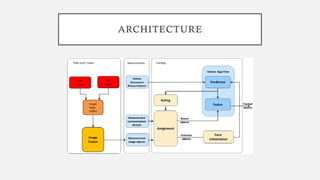
ARCHITECTURE
FEATURES
 Real-Time Object Detection: Utilizes
the YOLOv9 model to detect vehicles
and pedestrians in video frames.
 Distance Estimation: Implements
depth estimation algorithms to
calculate the distance between the
vehicle and detected objects.
 Alert System: Triggers visual and
auditory alerts when pedestrians are
detected within a critical distance
threshold.
 Responsive Frontend: User interface
developed using HTML, CSS, and
JavaScript, allowing users to upload
videos, view live camera feeds, and
monitor real-time detection statistics.
 Backend Integration: Built with
Flask, the backend handles video
processing, object detection, and alert
generation.
DEVELOPMENT
Frontend:
 Video and Photo Upload: Allows users to upload media files for
analysis.
 Live Camera Feed: Displays real-time video from the camera.
 Statistics Display: Shows real-time detection statistics and alerts.
 Technology Stack: HTML, CSS, JavaScript.
BACKEND
 Flask Server: Handles server-side logic, including video processing and object
detection.
 YOLOv9 Integration: Detects vehicles and pedestrians in video frames.
 Alert System: Generates notifications when objects are within a critical distance.
 Technology Stack: Python, Flask, OpenCV, YOLOv9.
• Real-Time Processing
 Frame Capture: Captures frames from the camera feed using OpenCV.
 Object Detection: Analyzes each frame with YOLOv9.
 Distance Estimation: Uses bounding box dimensions to estimate object distance.
REFERENCES
 B. Loungani, J. Agrawal and L. Jacob, "Vision Based Vehicle-Pedestrian Detection
and Warning System," 2022 4th International Conference on Advances in Computing,
Communication Control and Networking (ICAC3N), Greater Noida, India, 2022, pp.
712-717, doi: 10.1109/ICAC3N56670.2022.10074566.
 M. Zaman, S. Saha, N. Zohrabi and S. Abdelwahed, "Deep Learning Approaches
for Vehicle and Pedestrian Detection in Adverse Weather," 2023 IEEE Transportation
Electrification Conference & Expo (ITEC), Detroit, MI, USA, 2023, pp. 1-6, doi:
10.1109/ITEC55900.2023.10187020.
 T. Xue, Z. Zhang, W. Ma, Y. Li, A. Yang and T. Ji, "Nighttime Pedestrian and
Vehicle Detection Based on a Fast Saliency and Multifeature Fusion Algorithm for
Infrared Images," in IEEE Transactions on Intelligent Transportation Systems, vol. 23,
no. 9, pp. 16741-16751, Sept. 2022, doi: 10.1109/TITS.2022.3193086.
•

Vehicle and Pedestrian Detection System.pptx

  • 1.
    VEHICLE AND PEDESTRIANDETECTION SYSTEM G V Harsha Vardhan 22BAI1409
  • 2.
  • 3.
    ABSTRACT • The "Real-TimeVehicle and Pedestrian Detection System" is designed to enhance driving safety by leveraging advanced computer vision techniques. Utilizing the YOLOv9 object detection model, the system accurately identifies vehicles and pedestrians in real-time. It also estimates their distance from the vehicle and triggers alerts when potential collisions are detected. This system is intended to operate seamlessly in real-time, providing drivers with critical information to avoid accidents and improve overall road safety. The integration of this technology aims to contribute to the development of safer, smarter transportation systems.
  • 4.
    LITERATURE REVIEWS "VISION BASEDVEHICLE-PEDESTRIAN DETECTION AND WARNING SYSTEM"
  • 5.
    INTRODUCTION • The paperaddresses the development of a vision-based system for detecting vehicles and pedestrians, aiming to enhance road safety by issuing real-time warnings. This system is particularly relevant for urban environments where pedestrian-vehicle interactions are frequent.
  • 6.
    METHODOLOGY  Detection Techniques:The system utilizes deep learning-based Convolutional Neural Networks (CNNs) for object detection, leveraging pre-trained models like YOLO or SSD for real-time processing.  System Architecture: The architecture likely includes an RGB camera for image acquisition, a processing unit (e.g., GPU) for running detection algorithms, and a warning interface for real-time alerts.  Data and Training: The model is trained on annotated datasets, potentially including urban scenes with diverse lighting and weather conditions.
  • 7.
    RESULTS  Accuracy andPerformance: The system demonstrates high accuracy in detecting both vehicles and pedestrians, with metrics such as precision and recall indicating reliable performance in various conditions.  Real-time Capability: The paper likely emphasizes the system’s ability to process and detect objects in real-time, meeting the necessary speed requirements for practical deployment.
  • 8.
    DISCUSSION  Strengths: Thevision-based approach offers detailed object recognition, outperforming some traditional methods in accuracy and adaptability to different environments.  Challenges: Potential limitations include difficulties in low-light or occluded scenarios, where detection accuracy might decrease.
  • 9.
    CONCLUSION • The paperconcludes that the vision-based detection system effectively enhances road safety by providing timely warnings. Future work might focus on improving detection robustness in challenging conditions and integrating additional sensors for better accuracy.
  • 10.
    “DEEP LEARNING APPROACHESFOR VEHICLE AND PEDESTRIAN DETECTION IN ADVERSE WEATHER”
  • 11.
    INTRODUCTION • The paperfocuses on the challenges and solutions for vehicle and pedestrian detection using deep learning in adverse weather conditions, such as rain, fog, snow, and low-light environments. These conditions significantly impact the performance of detection systems, making this research crucial for ensuring safety and reliability in real-world scenarios.
  • 12.
    METHODOLOGY  Deep LearningModels: The paper likely discusses the use of advanced Convolutional Neural Networks (CNNs) and potentially other architectures like Generative Adversarial Networks (GANs) for improving detection accuracy in adverse weather. Techniques such as data augmentation, domain adaptation, and transfer learning might be employed to enhance model robustness.  Data Acquisition and Preprocessing: The research might involve collecting or utilizing existing datasets that include diverse weather conditions. Preprocessing techniques like image enhancement, noise reduction, and normalization are crucial for improving detection performance under challenging conditions.  Weather-specific Approaches: The study may explore specialized models or modifications to standard detection algorithms to better handle specific weather phenomena, such as fog removal techniques, image dehazing, or thermal imaging integration.
  • 13.
    RESULTS  Performance Metrics:The paper likely evaluates the models using metrics like precision, recall, F1-score, and mean Average Precision (mAP) under various weather conditions. The results may show that while deep learning models are generally effective, performance can vary significantly depending on the severity of the weather.  Adverse Weather Handling: It might be demonstrated that certain models, possibly those using enhanced preprocessing or weather-specific tuning, perform better in conditions like fog or heavy rain. However, challenges remain, particularly in extreme conditions.
  • 14.
    DISCUSSION  Strengths andLimitations: The paper probably highlights that deep learning models, especially those enhanced with specific preprocessing techniques, offer significant improvements over traditional methods in detecting vehicles and pedestrians in adverse weather. However, limitations persist, particularly in maintaining high accuracy across all types of adverse weather. • Comparison with Traditional Methods: The deep learning approaches are likely shown to outperform traditional methods such as handcrafted feature- based techniques, which often struggle with the variability introduced by adverse weather.
  • 15.
    CONCLUSION • The paperconcludes that while deep learning has advanced vehicle and pedestrian detection in adverse weather, ongoing research is needed to address remaining challenges. Future work could explore further enhancements in model architecture, data preprocessing, and the integration of multimodal sensors to improve performance.
  • 16.
    NIGHTTIME PEDESTRIAN ANDVEHICLE DETECTION BASED ON A FAST SALIENCY AND MULTIFEATURED FUSION ALGORITHM FOR INFRARED IMAGES
  • 17.
    INTRODUCTION • The paperproposes an infrared-based detection system for nighttime pedestrian and vehicle detection using a fast saliency and multifeature fusion algorithm to improve accuracy in low-visibility conditions.
  • 18.
    METHODOLOGY  Infrared Imaging:Utilizes IR sensors to detect heat signatures in the dark.  Fast Saliency Detection: Quickly identifies potential areas of interest in IR images.  Multifeatured Fusion: Combines texture, edge, and heat information to enhance detection accuracy.
  • 19.
    RESULTS  High Accuracy:Achieves reliable detection of pedestrians and vehicles in night conditions.  Real-time Processing: The algorithm is efficient, suitable for real-time application.
  • 20.
    DISCUSSION  Strengths: Robustdetection in low-light, leveraging IR and feature fusion.  Limitations: Challenges with sensor quality and differentiating heat sources.
  • 21.
    CONCLUSION • The approachsignificantly improves nighttime detection, with potential for further optimization in efficiency and sensor integration.
  • 22.
  • 23.
    FEATURES  Real-Time ObjectDetection: Utilizes the YOLOv9 model to detect vehicles and pedestrians in video frames.  Distance Estimation: Implements depth estimation algorithms to calculate the distance between the vehicle and detected objects.  Alert System: Triggers visual and auditory alerts when pedestrians are detected within a critical distance threshold.  Responsive Frontend: User interface developed using HTML, CSS, and JavaScript, allowing users to upload videos, view live camera feeds, and monitor real-time detection statistics.  Backend Integration: Built with Flask, the backend handles video processing, object detection, and alert generation.
  • 24.
    DEVELOPMENT Frontend:  Video andPhoto Upload: Allows users to upload media files for analysis.  Live Camera Feed: Displays real-time video from the camera.  Statistics Display: Shows real-time detection statistics and alerts.  Technology Stack: HTML, CSS, JavaScript.
  • 25.
    BACKEND  Flask Server:Handles server-side logic, including video processing and object detection.  YOLOv9 Integration: Detects vehicles and pedestrians in video frames.  Alert System: Generates notifications when objects are within a critical distance.  Technology Stack: Python, Flask, OpenCV, YOLOv9. • Real-Time Processing  Frame Capture: Captures frames from the camera feed using OpenCV.  Object Detection: Analyzes each frame with YOLOv9.  Distance Estimation: Uses bounding box dimensions to estimate object distance.
  • 26.
    REFERENCES  B. Loungani,J. Agrawal and L. Jacob, "Vision Based Vehicle-Pedestrian Detection and Warning System," 2022 4th International Conference on Advances in Computing, Communication Control and Networking (ICAC3N), Greater Noida, India, 2022, pp. 712-717, doi: 10.1109/ICAC3N56670.2022.10074566.  M. Zaman, S. Saha, N. Zohrabi and S. Abdelwahed, "Deep Learning Approaches for Vehicle and Pedestrian Detection in Adverse Weather," 2023 IEEE Transportation Electrification Conference & Expo (ITEC), Detroit, MI, USA, 2023, pp. 1-6, doi: 10.1109/ITEC55900.2023.10187020.  T. Xue, Z. Zhang, W. Ma, Y. Li, A. Yang and T. Ji, "Nighttime Pedestrian and Vehicle Detection Based on a Fast Saliency and Multifeature Fusion Algorithm for Infrared Images," in IEEE Transactions on Intelligent Transportation Systems, vol. 23, no. 9, pp. 16741-16751, Sept. 2022, doi: 10.1109/TITS.2022.3193086. •