Name ; vidyasagar Nadageri
Class : 6th semester
About Veeragase
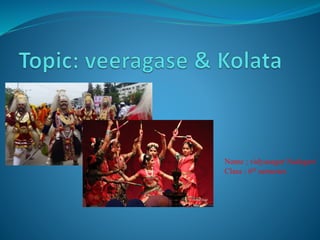
Veeragase is a dance form prevalent in the state
of Karnataka, India. It is a vigorous dance based
on Hindu mythology and involves very intense energy-
sapping dance movements. Veeragase is one of the
dances demonstrated in the Dasara procession held
in Mysore. This dance is performed during festivals
and mainly in the Hindu months of Shravana and
Karthika. It is performed at all important functions
of Lingayat household.
Lingayatism and Veeragaase
 The basic tenets of Veeragase are drawn from Veeragama(One of
the 28 key Shaiva Agamas) and usually Veeragaase performers
during their acts will convey some stories from the main six
Shaiva puranas like Shiva/Linga/Skanda/Agni/Matsya/Kurma -
Puranas, and some Kannada Veerashaiva puranas like Girija
Kalyana/Prabhulingaleele/Basava purana/Chennabasaveshwara
charite...etc. Most popularly conveyed story is of Daksha-yajna.
 The custom of bringing Devagange (Gange taruvud - ಗಂಗೆ
ತರುವುದು/Devaru taruvudu - ದೆೇವರು ತರುವುದು) into homes from
nearby water-sources(usually from wells) is a tradition
in Lingayat household for every important functions held (like
Marriage, House-warming, Naming, Lingadhaarana<Lingayat-
Baptism>...etc.), some Vokkaligas in Karantaka also perform this
custom - in this custom Veerabhadra is taken to please mother
Ganga, Veeragaase is performed while bringing her home - in
Veeraagama Ganga is considered to be the mother of
Veerabhadra as he was sprouted out of Shiva's hairs and Ganga
has taken residence on Shiva's head.
Daksha Yajna
Veeragase gets its name from the Hindu legendary warrior lord -
Veerabhadra Ajaata putra (Non biological child - who didn't take birth
formally) of lord Shiva. According to Puranas, the Hindu supreme deity
Lord Shrimanmahaa Shankara bhagavaan (Shiva) was married to
Sati(who is also known as Daakshayini - since she was the favouritest
child of Daksha - He got maata Aadishakti incarnated as his child after
doing long penance to her). Daksha(the prajapati - one of the
eight manasputras of Brahma and a stauch Vaishnavite - Vishnu
happens to be his<Daksha's> grandfather in vasthu roopa) was against
this marriage because Shiva had beheaded Brahma(Daksha's father) and
being Moola-purusha Shiva actually didn't follow any rules(As he was
nirguNi) designed by Daksha which made him not to belong to any of
the class-categories classified by Daksha(being a Prajaapati, it was his
duty to classify everybody from Lord Vishnu - to smallest organism)) and
hence bore enmity with Lord Shiva He married his favouritest daughter
Sati to Lord Shiva after multiple insistence from his
aaraadhya(celebrated) Lord Vishnu and his father Brahma
Kolata
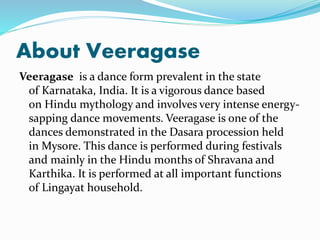
 Kolata is the traditional folk dance of the state of Karnataka, located in
Southern India on the western coast. Unlike its North Indian
counterpart Dandiya Ras, it comes in two forms. First, it is performed
with coloured sticks and usually involves both men and women dancing
together. Second, very rigorous play of sticks only by men dancing to
folk songs. Sticks here are thick and hard to sustain strong play.
 'Cheluvayya Cheluvo Tani tandana', 'Kolu kolanna kolu kole' are very
popular music for the soft kolata dance of Karnataka. Kolata of men
uses 'Indara Gandhi kondavanna', 'Belisalagonda kare beeja' etc. sung
vocally along with the dance.
 Cheluvayya Cheluvo Tani tandana kolata is performed by Kannada
Kootas around the world for their Ugadi and Kannada Rajyotsava
programmes.
 It also is a family name with its roots in Eastern Germany and Poland.
People with this family name are for example the writer Gina Kolata, the
artist Jan Kolata[1] and the writer Katharina Kolata-Gerlach.[2]
 There are many types of Kolata, like jade ( ja - day) kolata which means
plait Kolata. People here jumble themselves holding long scarves. This
jumbling forms a plait.there are many types of jade Kolata including
fishtail.

Veeragase &amp; kolata ppt

  • 1.
    Name ; vidyasagarNadageri Class : 6th semester
  • 2.
    About Veeragase Veeragase isa dance form prevalent in the state of Karnataka, India. It is a vigorous dance based on Hindu mythology and involves very intense energy- sapping dance movements. Veeragase is one of the dances demonstrated in the Dasara procession held in Mysore. This dance is performed during festivals and mainly in the Hindu months of Shravana and Karthika. It is performed at all important functions of Lingayat household.
  • 3.
    Lingayatism and Veeragaase The basic tenets of Veeragase are drawn from Veeragama(One of the 28 key Shaiva Agamas) and usually Veeragaase performers during their acts will convey some stories from the main six Shaiva puranas like Shiva/Linga/Skanda/Agni/Matsya/Kurma - Puranas, and some Kannada Veerashaiva puranas like Girija Kalyana/Prabhulingaleele/Basava purana/Chennabasaveshwara charite...etc. Most popularly conveyed story is of Daksha-yajna.  The custom of bringing Devagange (Gange taruvud - ಗಂಗೆ ತರುವುದು/Devaru taruvudu - ದೆೇವರು ತರುವುದು) into homes from nearby water-sources(usually from wells) is a tradition in Lingayat household for every important functions held (like Marriage, House-warming, Naming, Lingadhaarana<Lingayat- Baptism>...etc.), some Vokkaligas in Karantaka also perform this custom - in this custom Veerabhadra is taken to please mother Ganga, Veeragaase is performed while bringing her home - in Veeraagama Ganga is considered to be the mother of Veerabhadra as he was sprouted out of Shiva's hairs and Ganga has taken residence on Shiva's head.
  • 4.
    Daksha Yajna Veeragase getsits name from the Hindu legendary warrior lord - Veerabhadra Ajaata putra (Non biological child - who didn't take birth formally) of lord Shiva. According to Puranas, the Hindu supreme deity Lord Shrimanmahaa Shankara bhagavaan (Shiva) was married to Sati(who is also known as Daakshayini - since she was the favouritest child of Daksha - He got maata Aadishakti incarnated as his child after doing long penance to her). Daksha(the prajapati - one of the eight manasputras of Brahma and a stauch Vaishnavite - Vishnu happens to be his<Daksha's> grandfather in vasthu roopa) was against this marriage because Shiva had beheaded Brahma(Daksha's father) and being Moola-purusha Shiva actually didn't follow any rules(As he was nirguNi) designed by Daksha which made him not to belong to any of the class-categories classified by Daksha(being a Prajaapati, it was his duty to classify everybody from Lord Vishnu - to smallest organism)) and hence bore enmity with Lord Shiva He married his favouritest daughter Sati to Lord Shiva after multiple insistence from his aaraadhya(celebrated) Lord Vishnu and his father Brahma
  • 5.
    Kolata  Kolata isthe traditional folk dance of the state of Karnataka, located in Southern India on the western coast. Unlike its North Indian counterpart Dandiya Ras, it comes in two forms. First, it is performed with coloured sticks and usually involves both men and women dancing together. Second, very rigorous play of sticks only by men dancing to folk songs. Sticks here are thick and hard to sustain strong play.  'Cheluvayya Cheluvo Tani tandana', 'Kolu kolanna kolu kole' are very popular music for the soft kolata dance of Karnataka. Kolata of men uses 'Indara Gandhi kondavanna', 'Belisalagonda kare beeja' etc. sung vocally along with the dance.  Cheluvayya Cheluvo Tani tandana kolata is performed by Kannada Kootas around the world for their Ugadi and Kannada Rajyotsava programmes.  It also is a family name with its roots in Eastern Germany and Poland. People with this family name are for example the writer Gina Kolata, the artist Jan Kolata[1] and the writer Katharina Kolata-Gerlach.[2]  There are many types of Kolata, like jade ( ja - day) kolata which means plait Kolata. People here jumble themselves holding long scarves. This jumbling forms a plait.there are many types of jade Kolata including fishtail.