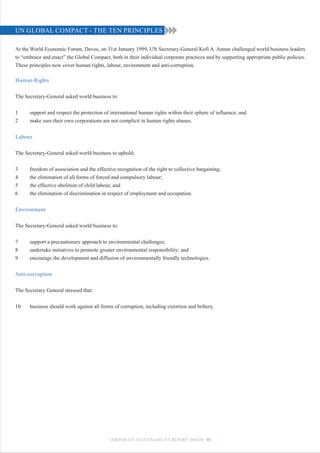
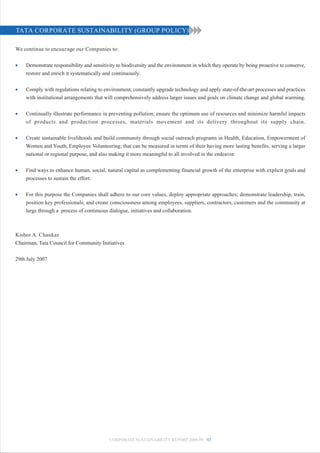
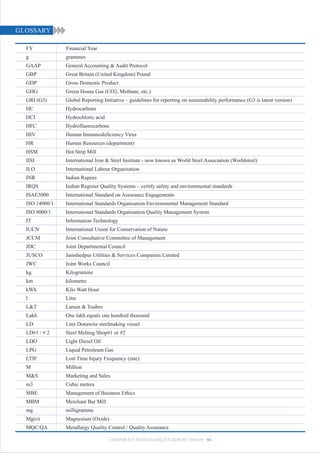
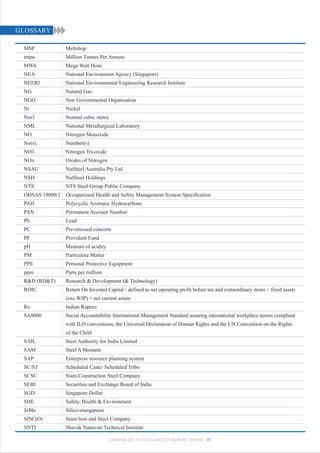
CONTENTS
MANAGING DIRECTOR’S STATEMENT                                  VALUING OUR WORKFORCE
                                                               -     Safety
ORGANISATIONAL PROFILE                                         -     Employment


REPORT PROFILE                                                 LABOUR HARMONY AND DECENT WORK
-    Materiality
                                                               CARING FOR LOCAL COMMUNITIES
STRATEGY AND ANALYSIS
-    Sustainability at Tata Steel                              PRODUCTS AND SERVICES
-    Risk Management and Opportunities
                                                               HUMAN RIGHTS
GOVERNANCE COMMITMENTS AND ENGAGEMENTS
                                                               ANNEXES
STAKEHOLDER ENGAGEMENT
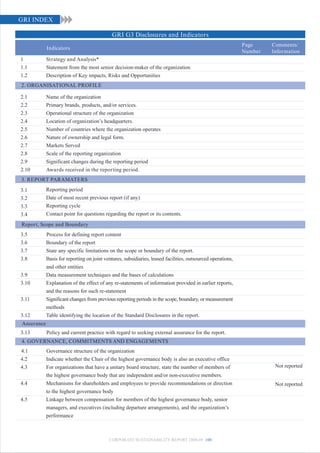
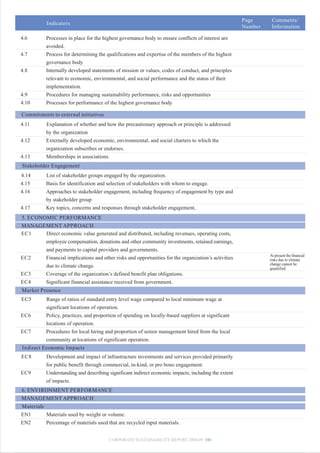
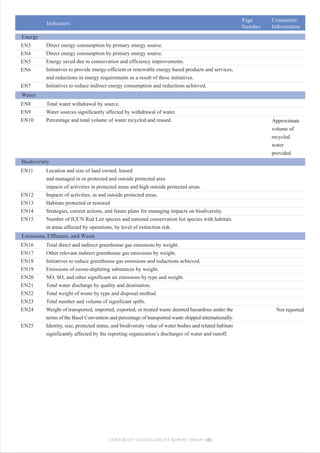
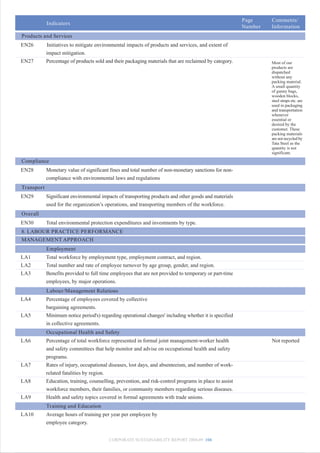
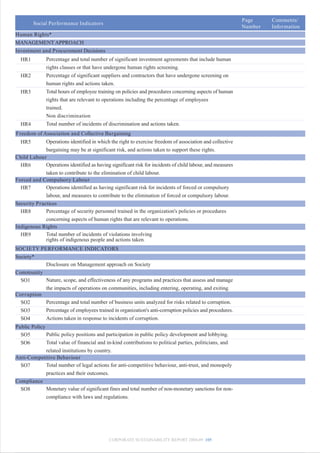
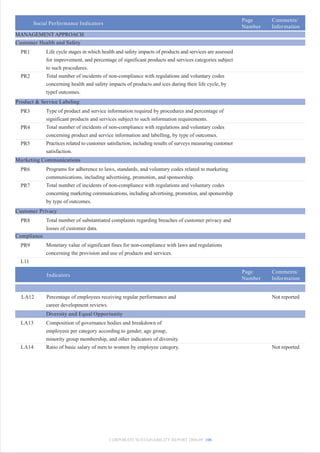
                                                               GRI INFORMATION
CREATING VALUE                                                 -      Assurance Statement
                                                               -      GRI Application Level
TOWARDS ENVIRONMENT SUSTAINABILITY                             -      GRI Index


                              CORPORATE SUSTAINABILITY REPORT 2008-09 02
MANAGING DIRECTOR’S STATEMENT


Dear Stakeholders,

The financial crisis in 2008-09 has renewed the emphasis for focused attention on sustainability. The world has seen unprecedented
economic upheaval caused by unsustainable business practices. This crisis has also demonstrated decisively to all of us that our actions
are inter-related. We must consider the wider and long-term impact of the risks arising from the activities undertaken by us.


From its earliest days, Tata Steel has taken responsibility for the impact of its activities on all the stakeholders. It has been a pioneer in
employee welfare measures, social and community initiatives. It has led the way in business ethics. It has broken new ground in social
and community initiatives to help build our nation. And just as importantly it has ensured sound financial management, acting always
as a trustee of its shareholders’ wealth. Tata Steel has withstood critical times in the past and is standing strong through the current
economic crisis.


The difficult times we are facing will not force us to change our approach to business. We continue to promote the ethos of our founding
father, Jamsetji Tata, who believed that the real purpose of business is to improve the quality of life of the people. Therefore we further
strengthen our efforts to create value through our business. Presently climate change and depletion of the world’s natural resources are
recognised as key challenges, the Company is seeking to go beyond its legal mandate, to be a responsible environmental citizen and
conserve precious global resources.


Tata Steel Group Vision sets out our ambition to be the world benchmark in value creation and corporate citizenship. Our Vision is
supported by four ambitious goals to be achieved by 2012: on safety, carbon dioxide emissions, value creation and becoming an employer
of choice. Our performance on these priority issues is already encouraging. The Company’s continuing focus on safety resulted in a
10% reduction in Lost Time Injury Frequency (LTIF) rate in the Steel Works and 80% reduction in the Raw Material Divisions in India
as compared to the previous year. The Fatality Risk Control Programme was rolled out successfully across all the divisions during the
year. More than 1168 fatality potential conditions were identified and corrected with irreversible engineering solutions.


We continued to concentrate on safety and corporate social responsibility with special focus on climate change initiatives. Tata Steel
along with Tata Power is setting up a captive power plant in IJmuiden, Netherlands using waste gases as input fuel in place of fossil
fuel. This will reduce the carbon footprint of the Group significantly. Similarly, in India, recently commissioned efficient ‘H’ Blast
furnace operation will reduce specific CO2 emissions in a significant way. These are just two of the many initiatives that were accomplished
during the year. Tata Steel reduced its specific CO2 emission by 36% in last decade. In 2008-09, direct specific CO2 emission reached
to a level of 2.05 t/tls by improving energy efficiency, by-product gas utilization and waste utilization.


Our ROIC (pre tax) increased to 21% in 2008-09 from 20% in 2007-08. The strategic focus of the Company has been to increase the
steel making capacity in excess of 50 million tonnes by 2015 through organic and inorganic growth. One of the key enablers identified
to achieve the strategic goals and to build a sustainable value creating culture is being an employer of choice. Across the Group, we
will work hard in the coming years to achieve the challenging targets we have set for ourselves.


 Another peak for Tata Steel during the year, was winning the Deming Application Prize, which is the highest award for quality in the
world. Tata Steel thus became the first steel company in the world outside Japan to have ever won the Deming Prize. The Deming Prize
is a recognition of Tata Steel’s commitment and exceptional contribution to its customers, employees, business partners and to the society
at large. Tata Steel’s longevity bears testimony to its long-term approach and its ability to embrace change with ease.


Our performance in 2008-09 remained strong despite the global economic crisis. Whilst demand for steel reduced globally, our reputation
and branded product solutions remained in demand amongst loyal customers. It was an exceptional year in which we witnessed the best
of times and the worst of times. After setting records of every kind in the first half, the year witnessed a dramatic reversal in the second
half.

                                              CORPORATE SUSTAINABILITY REPORT 2008-09 03
In September 2008, Tata Steel entered into a Memorandum of Agreement with New Millennium Capital Corp, Canada to develop iron
ore projects in northern Quebec, Canada. The Company has acquired a 19.9% stake in it. Further, SAIL and Tata Steel formed a 50:50
Joint Venture company, S&T Mining Co. in September, 2008 with its registered office in Kolkata. These strategic initiatives will make
us more sustainable by ensuring raw material security.


In 2008-09 the Company made a contribution of Rs 76.99 Crore in India towards development of the communities around the vicinity
of its operations.


In line with changes in the times, and the globalization of the Tata Group, the Tata Code of Conduct was updated, in consultation with
Tata Steel Group companies around the world. The revised Code of Conduct was adopted by Tata Steel Ltd Board of Directors in October
2008. The revised Tata Code of Conduct 2008 addresses contemporary issues of concern for global business, with more focused direction
for example on integrity, fraud, bribery, corruption, conflict of interest, competition and excellence. The importance of implementing
a sustainability protocol is addressed for the first time. All employees have a clear responsibility to implement the Code. Additionally
the Code now extends to contractors and vendors, who must agree to respect the Code.


While cyclicality is a phenomenon of the steel industry, what caught us and everyone by surprise was the speed and intensity of the
downturn. Nations across the world responded to the crisis by introducing bail out and stimulus packages. Looking into the long-term
future, we see continued demand for steel as a principal base material for most industrial products. On the outlook for the steel industry
and of the economy as a whole, I believe the worst is behind us. The fact that we have reached the bottom of the cycle is itself a cause
for satisfaction, as things will only improve from here. The buoyancy in the global economic activity was driven by trends of urbanization
and industrialization in the Asian economies, mainly of China and India.


The Indian economy remained largely on course even during this crisis, the revival of Chinese economy will be the turning point that
will bring us back to the economic activity of the years 2007 and 2008.


I am delighted to present the Corporate Sustainability Report of Tata Steel for the year 2008-09. This has been prepared according to
GRI G3 guidelines. Tata Steel was one of the first Indian companies to adopt the stringent guidelines under the Global Reporting
Initiatives and this is our eighth consecutive report. The notion of social stewardship, integral to our business, together with our continual
improvement philosophy has been driving our excellence orientation for over a hundred years of our existence. From the onset, more
than a century ago, Tata Steel has been governed by principles put into practice through policies and systems that later became the law
of the land. Our commitment to workforce issues is evident from the vision of the Founder which guides us. These pursuits encourage
us to seek partnerships such as the United Nations Global Compact (UNGC) and together we work to improve compliance to corporate
governance aspects. The UNGC commitment to labor standards, environment and anti-corruption aspects is covered and implemented
through cross-functional initiatives of the company. Working conditions for employees and supply chains are primarily managed through
compliance to SA8000, which is based on principles and conventions such as the Universal Declaration of Human Rights and International
Labour Organization Conventions.


We have made every effort to report effectively to our stakeholders about our economic, environmental and social performance and
we welcome your feedback on this report.


Date:    2009                                                                                           B Muthuraman
Place:   Jamshedpur                                                                                     Managing Director


                                              CORPORATE SUSTAINABILITY REPORT 2008-09 04
ORGANIZATIONAL PROFILE


MAJOR OPERATIONS

Tata Steel Limited (Tata Steel) began             Through the acquisition of Corus- the second   company outside Japan to have won the
operations in Jamshedpur, more than 100           largest steel company in Europe - and          Deming Application Prize for Excellence
years ago. Among Asia’s first integrated          investments in NatSteel Holdings,              in Total Quality Management.
steel manufacturers, the Tata Steel Group         Singapore- the top steel maker in the Asia
has grown to be a global corporation with         Pacific region and Tata Steel Thailand         The Tata Steel Group recorded a turnover
a crude steel production capacity of about        (formerly called Millennium Steel) - the       of Rs 1, 47, 329 crore (US$ 28,962 mn) for
30 million tonnes per annum (mtpa).               largest long steel producer in Thailand, the   the financial year 2008-09 generated by a
                                                  Company has created a manufacturing and        spectrum of brands, which feed markets in
Tata Steel has its registered headquarters in     marketing network in Europe, South East        nine principle segments covering
Mumbai. It now is the world`s second most         Asia and the Pacific-rim countries.            construction, automotive, engineering and
geographically diversified steel producer                                                        agriculture.
and a Fortune 500 Company.                        Tata Steel is the first integrated steel


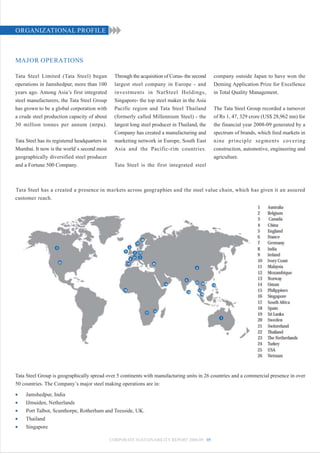
Tata Steel has a created a presence in markets across geographies and the steel value chain, which has given it an assured
customer reach.


Tata Steel Group is geographically spread over 5 continents with manufacturing units in 26 countries and a commercial presence in over
50 countries. The Company’s major steel making operations are in:
•    Jamshedpur, India
•    IJmuiden, Netherlands
•    Port Talbot, Scunthorpe, Rotherham and Teesside, UK.
•    Thailand
•    Singapore

                                                CORPORATE SUSTAINABILITY REPORT 2008-09 05
ORGANIZATIONAL PROFILE


Tata Steel produces steel using an integrated steel-making concept, utilising raw materials like iron ore,
coal, limestone etc. to produce hot metal (liquid iron). This hot metal is converted into steel through a steel-
making process. The liquid steel is then cast and rolled into a variety of products.


Tata Steel`s Jamshedpur (India) Works has          will be among the most energy efficient          striving towards raw materials security
a crude steel production capacity of 6.8           furnace in the world.                            through joint ventures in Thailand, Australia,
mtpa. The Company also has proposed three                                                           Mozambique, Ivory Coast (West Africa)
Greenfield steel projects in the states of         In addition to Steel Works, the Group has        and Oman. Tata Steel has signed an
Jharkhand, Orissa and Chhattisgarh in India        significant operations to support its            agreement with Steel Authority of India
with and a Greenfield project in Vietnam.          steelmaking activities, including mines and      Limited to establish a 50:50 joint venture
                                                   collieries. It has in-market steel processing    company for coal mining in India. Also,
The Steel Works in India is in the process         facilities and distribution and transportation   Tata Steel has bought 19.9% stake in New
of expanding its capacity to reach 10 mtpa         operations, as well as a sophisticated           Millennium Capital Corporation, Canada
by 2011. On November 3, 2008 the ground            Research, Development and Technology             for iron ore mining.
breaking ceremony for ‘I’ Blast Furnace of         Centre in Rotherham, UK.
Tata Steel took place; which will enhanced                                                          Tata Steel is also developing joint ventures
its crude steel making capacity by 3.05 mtpa.      The iron ore mines and collieries in India       as part of its collaborative growth strategy.
The furnace is expected to be commissioned         give the Company a distinct advantage in
in FY’11. The state of the art I-Blast Furnace     raw material sourcing. Tata Steel is also


Major Operational Divisions in India


•    Steel Works, Jamshedpur (Jharkhand)
•    Tubes Division, Jamshedpur (Jharkhand)
•    Tata Growth Shop, Jamshedpur (Jharkhand)
•    Agrico Division, Jamshedpur (Jharkhand)
•    West Bokaro Division, West Bokaro (Jharkhand)
•    Jharia Division, Dhanbad (Jharkhand)
•    Ore Mines & Quarries Division, Noamundi (Jharkhand) and Joda (Orissa)
•    Ferro Alloys & Mineral Division, Joda, Sukinda and Bamnipal (Orissa)
•    Bearings Division, Kharagpur ( West Bengal)
•    Wire Division, Mumbai (Maharashtra)
•    CRC (West), Tarapur (Maharashtra)


Brief details of other significant operations of Tata Steel Group are provided below. More
information on these operations and a full list of subsidiary companies, associates and joint
ventures is supplied in Tata Steel Annual Report 2008-09, available to download from the
investor relations section of http://www.tatasteel.com/investors/performance/annual-report.asp


                                                 CORPORATE SUSTAINABILITY REPORT 2008-09 06
PRINCIPAL SUBSIDIARY COMPANIES:


CORUS
Corus is Europe’s second largest steel producer with production of around 20 million tonnes per annum (mtpa) and annual revenues in
2008-09 of around £12 billion. Corus’ main steel making operations are located in the UK and the Netherlands with other plants located
in Germany, France, Norway and Belgium. Corus produces carbon steel by the basic oxygen steel making method at three integrated
Steel Works in the UK at Port Talbot, Scunthorpe and Teesside, and at one in the Netherlands at IJmuiden. Engineering steels are
produced in the UK at Rotherham using the electric arc furnace method. Corus has three divisions; Strip Products, Long Products and
Distribution & Building Systems.


The Company has commercial operations across the world and supplies demanding global markets including construction, automotive,
packaging, mechanical and electrical engineering, metal goods and oil & gas.


NATSTEEL HOLDINGS
NatSteel Holdings Pte. Ltd. (NSH) is a leading long-product player in the Asia Pacific region with an approximate capacity of 2 mtpa.
It has operations and joint ventures in Singapore, Malaysia, Thailand, China, Australia, Philippines and Vietnam. Its Singapore based
operations serve as a hub for the NSH group, providing engineering, logistics, sourcing information technology and other support
services.


NSH Singapore has upstream facilities for billet making, rolling bars and wire rods. The group produces construction grade steel which
includes rebars, cut-and-bend, mesh, precage, bore pile, PC wire & PC strand. In Xiamen, China, the group has rolling operations, while
in Australia manufacturing activities are focused on downstream production (cut & bend, mesh). In Thailand and China, the group has
manufacturing facilities for wire drawing.


TATA STEEL (THAILAND)
Tata Steel (Thailand) Public Company Limited (TSTH), the largest long steel producer in Thailand, with an installed capacity of 1.7
million tonnes per annum. The company was established in 2002 as a holding company consisting of NTS Steel Group (NTS), The Siam
Iron and Steel Company (SISC) and The Siam Construction Steel Company (SCSC). The company produces long products, which
include rebars, wire rods, small sections, special bars and cut and bend products.


PRINCIPAL JOINT VENTURES

TATA BLUESCOPE STEEL
The 50:50 Joint Venture agreement with BlueScope Steel Limited to form Tata BlueScope Steel Limited became effective from May
30, 2006. The Building Solutions facilities at Pune, Bhiwadi and Chennai have been operational since 2006-07. The construction of
the Coated Steel manufacturing facility at Jamshedpur is in progress and expected to open in 2010. The Company offers a comprehensive
range of branded steel products for building and construction applications.


DHAMRA PORT COMPANY
The Dhamra Port project is a Joint Venture with Larsen & Toubro Limited, building an all weather modern deep-water port in the state
of Orissa on the Eastern Coast of India. The bulk cargo berths are being designed to accommodate up to 180,000 DWT vessels. A 62.7
km (route distance) rail link connecting the Port to the nearest railway station at Bhadrak on Chennai-Howrah line is included in the
project scope.


                                           CORPORATE SUSTAINABILITY REPORT 2008-09 07
TATA NYK SHIPPING
In a joint venture with Nippon Yusen Kabushiki Kaisha (NYK Line), the Company has commenced shipping activities for Tata Group
companies and other clients with five ships. Tata NYK handled around 2.4 million tonnes of dry cargo and projects, to service more
than 20 million tonnes per year within five years through a fleet of owned and chartered ships.


VIETNAM STEEL PROJECT
Tata Steel signed a Joint Venture Agreement on August 13, 2008 with Vietnam Steel Corporation (Vietnam’s largest steel company)
and Vietnam Cement Industries Corporation (Vicem) for a 4.5 million tonne per year steel complex to be set up in Ha Tinh Province.
The first phase of the complex will be a Cold Rolling Mill. Tata Steel will have a stake of 65% in the Steel project.


IRON ORE PROJECT IN IVORY COAST
Tata Steel and SODEMI entered into an agreement in December 2007 for the development of Mount Nimba iron ore deposits.


COKING COAL PROJECT IN MOZAMBIQUE
Tata Steel entered into a Joint Venture (JV) with Riversdale Mining Limited, Australia in 2007 for a 35% stake in two coal tenements
in Mozambique at Benga and Tete. The agreement gives the Company off-take rights to 40% of the coking coal produced from these
mines.


OMAN LIMESTONE PROJECT
In January 2008 a joint venture was agreed with members of the Al Bahja Group for mining limestone in Salalah province of Oman.


CARBOROUGH DOWNS COAL MINE, AUSTRALIA
This is a joint project with Vale and other partners, for expanding a coking coal mine in Central Queensland.


TATA STEEL – STEEL AUTHORITY OF INDIA (SAIL)
Four medium coking coal blocks in Jharkhand are under assessment for coal mining. On allotment of the blocks, the Joint Venture will
develop and carry out mining operations for captive use by both SAIL and Tata Steel.


SCALE OF THE ORGANISATION - FACTS AND FIGURES
u   In 2008-09, Tata Steel produced 6.8 million tonnes of crude steel in India at Jamshedpur.
u   In March 2009, 34,918 people were employed by Tata Steel (India.)
u   In 2008-09 consolidated net sales revenues stood at Rs. 147,329.26 crore.

      Financial Performance (Tata Steel India)
      Item                  2008-09              2007-08
                            (Rupees Million)     (Rupees Million)
      Gross revenue         271,520.0            224,323.5
      Profit before taxes   73,156.1             70,663.6
      Profit after taxes    52,017.4             46,870.3
      Capital employed      581,650.4            469,204.1
      Net worth             295,995.3            271,456.2
      Borrowings            269,461.8            180,216.9
                            As on 31.3.09        As on 31.3.08
                            (Rupees Million)     (Rupees Million)
      Total assets          587,417.7            470,755.2
                            Ratio 2008-09        Ratio 2007-08
      Net debt : Equity     0.78                 0.81
     Note: 1 USD = 50.87 INR as at 31.3.09

                                             CORPORATE SUSTAINABILITY REPORT 2008-09 08
NATURE OF OWNERSHIP AND LEGAL FORM

Tata Steel is a Public Limited Company.            in philanthropic activities to benefit society,   65410589 Ordinary shares).
The Company had 857,041 different                  through the Sir Dorabji Tata Trust, Sir Ratan
shareholders as at 31st March 2009, with           Tata Trust and other trusts.                      The Cumulative Convertible Preference
the vast majority being individuals. Tata                                                            Shares (CCPS) were also converted during
Sons Limited is the largest single shareholder     During the year, Tata Steel raised US $500        the year into 91211136 Ordinary shares as
with just under 29.27% shareholding.               Mn through a Global Depository Receipt            per the provisions of Rights Issue made in
                                                   (GDR) issue. The GDRs have been listed            FY07-08. For more details on the distribution
Around 66% of all profits received by Tata         in the London Stock exchange (The GDR             of shares and the changes in category of
Sons through its shareholding are invested         issue size was equivalent to issue of             shareholders, please refer to Page 211 of
                                                                                                     the Annual Report 2008-09.

MARKETS SERVED AND PRIMARY PRODUCTS & SERVICES

Tata Steel is a global steel producer with         balance of approximately 67% and 33% of           operations.
a balanced presence in developed                   production, respectively. Whilst the focus
European and fast growing Asian                    of business is steel making, the Company          The de-commoditisation of steel and the
markets. In India, Tata Steel mainly               also seeks to maintain control of downstream      development of specialised and differentiated
serves the domestic market. The                    and upstream operations and control its           products through branding have been
production is segmented into two main              business environment, with raw material           important elements of business strategy in
categories - Flat and Long Products - at a         production, transportation and processing         recent years.


  MARKETS, PRODUCTS & SERVICES IN INDIA
  Products                 Descriptions                             Market segment                         Key customers
  Long Products            Rebars                                   Large construction projects,           L&T, AFCONS, DLF, Gammon,
                                                                    Individual houses                      HCC, individual house builders
                           High and Low Carbon Wire Rods            Wire drawing industries for            Wire Division, Bansal, ESAB, Miki
                                                                    applications like fasteners, tyre      Wires
                                                                    beads, construction, electrodes,
                                                                    springs etc
  Flat Products            Hot & Cold Rolled Sheets, Hot &          Auto, Construction industries,         Tata Motors, Ashok Leyland,
                           Cold Rolled Coils, Galvanized            General Engineering, Appliances,       Toyota, Honda, Ford, Maruti,
                           Coils & Sheets, Hot Rolled Plates         Industry and housing applications     Hyundai, Bajaj, TVS
  Semi Finished Steel      Billets, Slabs
  Products
  Tubes                    Standard Pipes, Precision Tubes, Closed Structural
  Bearings, Wires          Rolled Rings, Forged Rings, Machines Rings, Bearings Plain and Coated Steel Wires
  Minerals                 Coal & Coke, Iron Ore, Dolomite, Chrome Ore & Chrome Concentrate
  Others                   Ferro Alloys, Agriculture Implements, Services like project studies, design & engineering, personnel and
                           technical training, automation, Information Technology, power and water.
  Branded Products         Tata Shaktee GC Sheets, Tata Steelium Cold Rolled Steel, Tata Tiscon construction rods, Tata Pipes, Tata
                           Bearings, Tata Wiron and Tata Agrico, Tata Structura

The Flat Product business in India is              and individual house builders. Tata Steel’s       has established itself as a national leader in
dominated by five big companies. Tata Steel        market share in this target segment is the        addressing the needs of customers with
ranks second in terms of size with about           highest at 23%.                                   cutting edge technology in auto and
18% market share. The Long Product                                                                   construction industries, it also penetrates
business, in contrast, is highly fragmented.       Tata Steel constantly strives to provide high     deep into rural India, with over ten million
In this market, Tata Steel has positioned          quality products to the high-end market           customers for galvanised corrugated sheets
itself to meet the needs of quality conscious,     segment. It also differentiates its offer by      across the country. The Company believes
discerning customers. They comprise large          tailoring the product and service to meet the     in building relationships with its customers
reputed infrastructure project companies           exact needs of customers. While Tata Steel        and over 70% of its sales are through long-
                                                                                                     term contracts.

                                                 CORPORATE SUSTAINABILITY REPORT 2008-09 09
KEY BRANDS IN INDIA


SIGNIFICANT CHANGES SINCE PREVIOUS REPORTS

NEW FACILITIES

In line with its growth and development               new H Blast Furnace which was formally      mtpa. The ‘H’ blast furnace, despite the
strategy, the Jamshedpur Steel Works in               blown in on May 31, 2008 was a major step   delayed startup, surpassed its FY’ 09 target
India is increasing its capacity from its earlier     in this expansion process, increasing       by 0.3 million tonnes in its very first year
5mtpa to 10 mtpa by the end of 2011. The              production capacity at Jamshedpur to 6.8    of operation.


The following major facilities were commissioned under the 1.8 MTPA Expansion Project:-

         Major Facilities                                       Amount (Rs.Crores)           Month/Year of Commissioning
         H Blast Furnace                                        1438.00                      May, 2008
         Sinter Plant #4                                        388.00                       May, 2008
         Power Distribution System                              261.00                       June, 2008
         Widening of Roads (Town)                               34.00                        June, 2008
         Augmentation of LD shops 335.00 July'08                335.00                       July, 2008
         (LD#1 & LD#2)                                          280.00                       November, 2008
         CC#3                                                   61.00                        September 2008
         7th Lime Kiln                                          109.00                       September 2008
         Utilities                                              32.00                        July 2008
         Water system                                           214.00                       July 2008
         RMHS


                                                    CORPORATE SUSTAINABILITY REPORT 2008-09 10
AWARDS AND RECOGNITION IN 2008-09

•   From September 22, 2008 Tata Steel is one of only two Indian companies (along with Tata Consultancy Services) to feature on
    the composite Dow Jones Sustainability World Index (DJSI World). DJSI World comprises leaders in sustainability - the top
    performing 10% of companies, selected on the basis of long-term economic, environmental and social criteria, from the largest
    2500 companies in the world. A systematic corporate sustainability assessment identifies the sustainability leaders in 57 separate
    industry groups. The analysis considers general as well as industry-specific sustainability trends and evaluates companies based
    on a variety of criteria, including climate change strategies, energy consumption, human resources development, knowledge
    management, stakeholder relations and corporate governance.

•   Tata Steel India was awarded the Deming Application Prize 2008 for excellence in Total Quality Management. It is the first integrated
    steel company in the world outside Japan to receive this award.

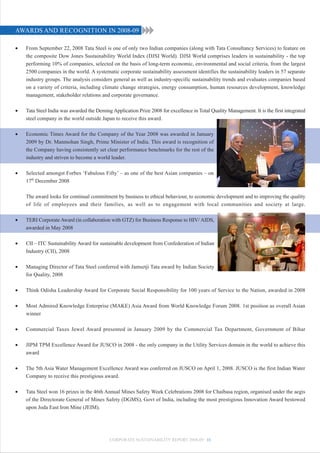
•   Economic Times Award for the Company of the Year 2008 was awarded in January
    2009 by Dr. Manmohan Singh, Prime Minister of India. This award is recognition of
    the Company having consistently set clear performance benchmarks for the rest of the
    industry and striven to become a world leader.

•   Selected amongst Forbes ‘Fabulous Fifty’ – as one of the best Asian companies – on
    17th December 2008

    The award looks for continual commitment by business to ethical behaviour, to economic development and to improving the quality
    of life of employees and their families, as well as to engagement with local communities and society at large.

•   TERI Corporate Award (in collaboration with GTZ) for Business Response to HIV/ AIDS,
    awarded in May 2008

•   CII – ITC Sustainability Award for sustainable development from Confederation of Indian
    Industry (CII), 2008

•   Managing Director of Tata Steel conferred with Jamsetji Tata award by Indian Society
    for Quality, 2008

•   Think Odisha Leadership Award for Corporate Social Responsibility for 100 years of Service to the Nation, awarded in 2008

•   Most Admired Knowledge Enterprise (MAKE) Asia Award from World Knowledge Forum 2008. 1st position as overall Asian
    winner

•   Commercial Taxes Jewel Award presented in January 2009 by the Commercial Tax Department, Government of Bihar

•   JIPM TPM Excellence Award for JUSCO in 2008 - the only company in the Utility Services domain in the world to achieve this
    award

•   The 5th Asia Water Management Excellence Award was conferred on JUSCO on April 1, 2008. JUSCO is the first Indian Water
    Company to receive this prestigious award.

•   Tata Steel won 16 prizes in the 46th Annual Mines Safety Week Celebrations 2008 for Chaibasa region, organised under the aegis
    of the Directorate General of Mines Safety (DGMS), Govt of India, including the most prestigious Innovation Award bestowed
    upon Joda East Iron Mine (JEIM).


                                           CORPORATE SUSTAINABILITY REPORT 2008-09 11
REPORT PROFILE


Tata Steel’s Sustainability Reports are produced annually and this report covers the Company’s financial year 1st April 2008 –
31st March 2009. The last Corporate Sustainability Report was published for the year 2007-08.


The report is produced to communicate to stakeholders:
     •   Tata Steel’s approach to corporate sustainability
     •   Its management of sustainability issues
     •   Performance on Global Reporting Initiative G3 indicators and on reaching Company goals


We hope that this report meets the needs of the majority of our stakeholders. Many of our stakeholders such as employees and local
communities receive communication on relevant issues primarily through other sources.

                                                                                         Mr. Sanjay Choudhry
Contact Person                                                                           Chief, Corporate Affairs and Communications
                                                                                         TATA STEEL Limited
The Company is delighted to hear stakeholders’ views on this report,                     Jamshedpur, INDIA
the Company’s approach to sustainability and its performance. Please                     Telephone: +91 657 2431142
email sustainability@tatasteel.com or contact:                                           Fax:        +91 657 2425182
                                                                                         email: sanjay.choudhry@tatasteel.com

Tata Steel seeks to develop and improve its reporting process and will be considering all feedback received to ensure that the report
meets stakeholder needs.


Additional information               Report Scope & Boundary                         Report Content


Additional information on            In 2009, we reviewed our sustainability         This report uses the Global Reporting Initiative (GRI) G3
economic, environmental              reporting process in line with our assessment   guidelines. The information has been compiled through a
and social performance of            of stakeholder requirements and the growth      dedicated committee with representatives from different
the organisation can be              of the Tata Steel Group to encompass varied     departments within Tata Steel.
made available on request            international operations. For this purpose,
from the contact person              it was decided to report globally through a     As far as possible, all relevant disclosures and performance
indicated above. This                Corporate Citizenship Report which will be      indicators set out in the GRI G3 guidelines are supplied,
report will also be made             published separately.                           with additional reference to Company goals and targets
available on Tata Steel’s                                                            where appropriate. While prioritisation of materiality issues
Internet website                     This report boundary is limited to the          was undertaken in this reporting period, we endeavour to
w w w. t a t a s t e e l . c o m .   operations of Tata Steel India.                 employ a more formal methodology in the coming year’s
                                                                                     Sustainability Report.

Boundary of the Report


      •      The intent of this report is to cover all major operational divisions of Tata Steel India in a progressive manner.
      •      The disclosures are largely limited to the Jamshedpur Works as the major operations of steel-making are carried out from this
             location.
      •      Subsidiary activities of companies in Europe, South East Asia and elsewhere are not included in this report
      •      All other associated companies, subsidiaries, ancillary industries, have been excluded
      •      Most of the community development initiatives are implemented through wholly owned subsidiaries/ societies/ trusts promoted
             by Tata Steel. Since they are relevant, they are reported in some of the sections of this report.


                                                   CORPORATE SUSTAINABILITY REPORT 2008-09 12
Significant Changes in Boundary

As compared to the previous year’s CS          disclosures related to NatSteel Holdings and    Holdings and Tata Steel (Thailand) and
Report (FY’08), we have limited the            Tata Steel (Thailand). The 2007-08 report       hence will not impact the trending of the
boundary as above and it does not contain      included separate sections on NatSteel          performance data reported this year.

DATA MEASUREMENT TECHNIQUES

There has been no change in the data           1 USD = 50.87 INR (Indian Rupee; Rs.)           Tata Steel follows the norms and procedures
measurement techniques from last year’s                                                        prescribed for workplace Safety and
reporting.                                     Monitoring, measurement and calibration         Environment by Ministry of Environment,
                                               is carried out as per relevant Indian           Ministry of Labour & Welfare (Factories
Financial & Economic data are reported as      standards. Documentation and                    Act). In 2008 the LTIF measure was brought
per the guidelines provided in the Company     communication are undertaken as per the         into line with global industry guidelines to
Law of India and Indian GAAP Standards.        requirement of ISO 9001 & ISO 14001,            become more stringent than Indian Factories
USD (US dollar) conversion rates used are,     OHSAS 18001 & SA8000.                           Act requirements. The calculation
as at noon 31st March 2009:                                                                    methodologies are explained in their relevant
                                                                                               sections.

INDEPENDENT ASSURANCE

Tata Steel continues to seek independent       appointed Det Norske Veritas AS (DNV),          against their VeriSustain protocol. Their
assurance for its Corporate Sustainability     as the independent assurance provider. DNV      independent assurance statement has been
Report. Accordingly in 2008, Tata Steel        has conducted a moderate level of assurance     included at the end of this report.


AUDITING PROCESSES

Economic Performance Assurance          Environment, Health &        Society
                                        Safety
The Quarterly, Half Yearly and Annual                                Social audits are conducted once every 10 years by a bench of
books of account are audited by         The independent third        external, independent auditors comprising eminent individuals from
internal and external auditors. The     party audits are conducted   the judiciary, social organisations and financial institutions, appointed
2008-09 accounts were audited by        by M/s. IRQS for             by Tata Steel’s Board of Directors. The last audit was conducted in
Deloitte Haskins & Sells, Chartered     Divisions certified to       2004.
Accountants, Mumbai. The scope of       Environmental
external audit includes assessing the   Management System,           The Steel Works at Jamshedpur and Sukinda Chromite Mines were
accounting principles used and          ISO 14001:2004 and           certified to SA8000 in 2004. M/s. Det Norske Veritas conducted the
significant estimates made by           Occupational Health and      external audit of the system in 2008-09 for the Jamshedpur Steel
management, as well as evaluating       Safety Management            Works.
the overall financial statement         System, OHSAS
presentation. The audit is undertaken   18001:1999 once a year.      Tata Steel’s Resettlement and Rehabilitation programme ‘Parivar’
in accordance with auditing standards                                is to be independently audited to provide an objective assessment
in India.                                                            of how families displaced by the Company’s greenfield projects -
                                                                     and therefore assisted by the Parivar programme - are affected over
                                                                     the years.


                                             CORPORATE SUSTAINABILITY REPORT 2008-09 13
STAKEHOLDER ENGAGEMENT


“In a free enterprise, the community is not just another stakeholder in our business, but in fact,
the very purpose of its existence.”
                                                                                                             - Jamsetji Nusserwanji Tata


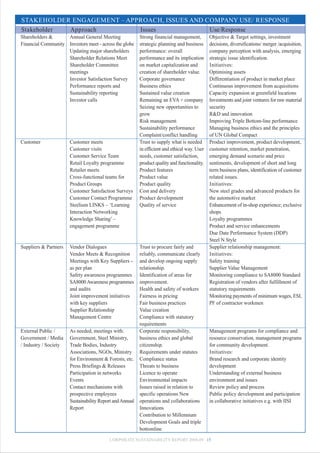
Our stakeholder engagement process                planning and business practices.               investor and brand surveys, customer
emanates from the above belief of our                                                            satisfaction surveys, employee satisfaction
Founder, Jamsetji Nusserwanji Tata. This          Stakeholder engagement at Tata Steel           surveys, community need analyses, social
belief is the guiding principle for all           happens at various levels and functions. The   audits, media reviews, press meets etc.
companies in the Tata Group and Tata Steel        engagement process is undertaken through       Informal feedback is gathered through
follows it in letter and spirit. The same has     both formal and informal modes. Some of        interactions and dialogues across multi-
also been incorporated in all our strategic       the formal processes employed by us are-       stakeholders.


STAKEHOLDER ENGAGEMENT STRATEGY

The identification of stakeholders, whom to engage with, is primarily determined of if they belong to the following:
     •    Those who are affected by our activities
     •    Those who have influence or control over our activities
     •    Those who have an interest in the Company’s success or failure and help in defining its value proposition

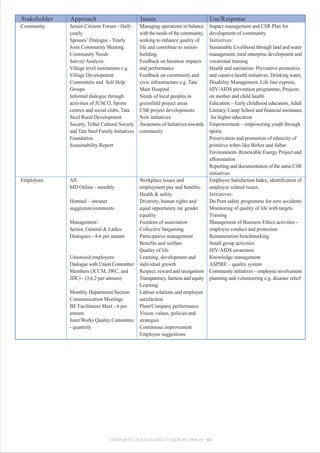
The level of interaction with the stakeholders is derived out of the Power- Interest Grid, as depicted below:

                                                 POWER-INTEREST GRID
                       HIGH                 KEEP SATISFIED                           MANAGE CLOSELY

                                    Put enough work on these people to        These are the people who you must
                                    keep them satisfied,but not so much       fully engage and make the greatest
                                    that they get disenchanted with your      effort to satisfy.
                                    message.


                                                  MONITOR                              KEEP INFORMED

                                   Monitor these people, do not disenchant    Keep these people adequately informed,
                                   them with excess communication.            talk to them to ensure that no major
                                                                              issues are arising. They can often be
                                                                              very helpful with the detail of the
                                                                              project.
                        LOW
                                    LOW                                                                       HIGH


                                                CORPORATE SUSTAINABILITY REPORT 2008-09 14
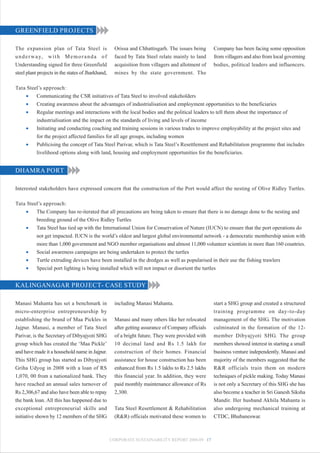
STAKEHOLDER ENGAGEMENT – APPROACH, ISSUES AND COMPANY USE/ RESPONSE
Stakeholder Approach        Issues             Use/Response
Shareholders &      Annual General Meeting                Strong financial management,         Objective & Target settings, investment
Financial Community Investors meet - across the globe     strategic planning and business      decisions, diversifications/ merger /acquisition,
                    Updating major shareholders           performance: overall                 company perception with analysis, emerging
                    Shareholder Relations Meet            performance and its implication      strategic issue identification.
                    Shareholder Committee                 on market capitalization and         Initiatives:
                    meetings                              creation of shareholder value.       Optimising assets
                    Investor Satisfaction Survey          Corporate governance                 Differentiation of product in market place
                    Performance reports and               Business ethics                      Continuous improvement from acquisitions
                    Sustainability reporting              Sustained value creation             Capacity expansion at greenfield locations
                    Investor calls                        Remaining an EVA + company           Investments and joint ventures for raw material
                                                          Seizing new opportunities to         security
                                                          grow                                 R&D and innovation
                                                          Risk management                      Improving Triple Bottom-line performance
                                                          Sustainability performance           Managing business ethics and the principles
                                                          Complaint/conflict handling          of UN Global Compact
Customer               Customer meets                     Trust to supply what is needed       Product improvement, product development,
                       Customer visits                    in efficient and ethical way. User   customer retention, market penetration,
                       Customer Service Team              needs, customer satisfaction,        emerging demand scenario and price
                       Retail Loyalty programme           product quality and functionality.   sentiments, development of short and long
                       Retailer meets                     Product features                     term business plans, identification of customer
                       Cross-functional teams for         Product value                        related issues.
                       Product Groups                     Product quality                      Initiatives:
                       Customer Satisfaction Surveys      Cost and delivery                    New steel grades and advanced products for
                       Customer Contact Programme         Product development                  the automotive market
                       Steelium LINKS – ‘Learning         Quality of service                   Enhancement of in-shop experience; exclusive
                       Interaction Networking                                                  shops
                       Knowledge Sharing’ –                                                    Loyalty programmes
                       engagement programme                                                    Product and service enhancements
                                                                                               Due Date Performance System (DDP)
                                                                                               Steel N Style
Suppliers & Partners   Vendor Dialogues                   Trust to procure fairly and          Supplier relationship management:
                       Vendor Meets & Recognition         reliably, communicate clearly        Initiatives:
                       Meetings with Key Suppliers -      and develop ongoing supply           Safety training
                       as per plan                        relationship.                        Supplier Value Management
                       Safety awareness programmes        Identification of areas for          Monitoring compliance to SA8000 Standard
                       SA8000 Awareness programmes        improvement.                         Registration of vendors after fulfillment of
                       and audits                         Health and safety of workers         statutory requirements
                       Joint improvement initiatives      Fairness in pricing                  Monitoring payments of minimum wages, ESI,
                       with key suppliers                 Fair business practices              PF of contractor workmen
                       Supplier Relationship              Value creation
                       Management Centre                  Compliance with statutory
                                                          requirements
External Public /      As needed, meetings with:          Corporate responsibility,            Management programs for compliance and
Government / Media     Government, Steel Ministry,        business ethics and global           resource conservation, management programs
/ Industry / Society   Trade Bodies, Industry             citizenship.                         for community development.
                       Associations, NGOs, Ministry       Requirements under statutes          Initiatives:
                       for Environment & Forests, etc.    Compliance status                    Brand research and corporate identity
                       Press Briefings & Releases         Threats to business                  development
                       Participation in networks          Licence to operate                   Understanding of external business
                       Events                             Environmental impacts                environment and issues
                       Contact mechanisms with            Issues raised in relation to         Review policy and process
                       prospective employees              specific operations New              Public policy development and participation
                       Sustainability Report and Annual   operations and collaborations        in collaborative initiatives e.g. with IISI
                       Report                             Innovations
                                                          Contribution to Millennium
                                                          Development Goals and triple
                                                          bottomline
                                          CORPORATE SUSTAINABILITY REPORT 2008-09 15
Stakeholder   Approach                            Issues                              Use/Response
Community     Senior Citizens Forum - Half-       Managing operations in balance      Impact management and CSR Plan for
              yearly                              with the needs of the community,    development of community.
              Spouses’ Dialogue - Yearly          seeking to enhance quality of       Initiatives:
              Joint Community Meeting             life and contribute to nation-      Sustainable Livelihood through land and water
              Community Needs                     building.                           management, rural enterprise development and
              Survey/Analysis                     Feedback on business impacts        vocational training
              Village level institutions e.g.     and performance                     Health and sanitation- Preventive promotive
              Village Development                 Feedback on community and           and curative health initiatives. Drinking water,
              Committees and Self Help            civic infrastructure e.g. Tata      Disability Management, Life line express,
              Groups                              Main Hospital                       HIV/AIDS prevention programme, Projects
              Informal dialogue through           Needs of local peoples in           on mother and child health
              activities of JUSCO, Sports         greenfield project areas            Education – Early childhood education, Adult
              centres and social clubs, Tata      CSR project developments            Literacy, Camp School and financial assistance
              Steel Rural Development             New initiatives                      for higher education
              Society, Tribal Cultural Society    Awareness of Initiatives towards    Empowerment – empowering youth through
              and Tata Steel Family Initiatives   community                           sports
              Foundation.                                                             Preservation and promotion of ethnicity of
              Sustainability Report                                                   primitive tribes like Birhor and Sabar
                                                                                      Environment- Renewable Energy Project and
                                                                                      afforestation
                                                                                      Reporting and documentation of the same CSR
                                                                                      initiatives
Employees     All:                                Workplace issues and                Employee Satisfaction Index, identification of
              MD Online - monthly                 employment pay and benefits.        employee related issues.
                                                  Health & safety                     Initiatives:
              Hotmail – intranet                  Diversity, human rights and         Du Pont safety programme for zero accidents
              suggestion/comments                 equal opportunity inc gender        Monitoring of quality of life with targets
                                                  equality                            Training
              Management:                         Freedom of association              Management of Business Ethics activities -
              Senior, General & Ladies            Collective bargaining               employee conduct and protection
              Dialogues - 4-6 per annum           Participative management            Remuneration benchmarking
                                                  Benefits and welfare                Small group activities
                                                  Quality of life                     HIV/AIDS awareness
              Unionised employees:                Learning, development and           Knowledge management
              Dialogue with Union Committee       individual growth                   ASPIRE – quality system
              Members (JCCM, JWC, and             Respect, reward and recognition     Community initiatives – employee involvement
              JDC) - (3,6,2 per annum)            Transparency, fairness and equity   planning and volunteering e.g. disaster relief
                                                  Learning
              Monthly Department/Section          Labour relations and employee
              Communication Meetings              satisfaction
              BE Facilitators Meet - 6 per        Plant/Company performance
              annum                               Vision, values, policies and
              Joint Works Quality Committee       strategies
              - quarterly                         Continuous improvement
                                                  Employee suggestions


                                  CORPORATE SUSTAINABILITY REPORT 2008-09 16
GREENFIELD PROJECTS

The expansion plan of Tata Steel is                  Orissa and Chhattisgarh. The issues being      Company has been facing some opposition
u n d e r w a y, w i t h M e m o r a n d a o f       faced by Tata Steel relate mainly to land      from villagers and also from local governing
Understanding signed for three Greenfield            acquisition from villagers and allotment of    bodies, political leaders and influencers.
steel plant projects in the states of Jharkhand,     mines by the state government. The

Tata Steel’s approach:
    •    Communicating the CSR initiatives of Tata Steel to involved stakeholders
    •    Creating awareness about the advantages of industrialisation and employment opportunities to the beneficiaries
    •    Regular meetings and interactions with the local bodies and the political leaders to tell them about the importance of
         industrialisation and the impact on the standards of living and levels of income
    •    Initiating and conducting coaching and training sessions in various trades to improve employability at the project sites and
         for the project affected families for all age groups, including women
    •    Publicising the concept of Tata Steel Parivar, which is Tata Steel’s Resettlement and Rehabilitation programme that includes
         livelihood options along with land, housing and employment opportunities for the beneficiaries.


DHAMRA PORT

Interested stakeholders have expressed concern that the construction of the Port would affect the nesting of Olive Ridley Turtles.

Tata Steel’s approach:
    •    The Company has re-iterated that all precautions are being taken to ensure that there is no damage done to the nesting and
         breeding ground of the Olive Ridley Turtles
    •    Tata Steel has tied up with the International Union for Conservation of Nature (IUCN) to ensure that the port operations do
         not get impacted. IUCN is the world’s oldest and largest global environmental network - a democratic membership union with
         more than 1,000 government and NGO member organisations and almost 11,000 volunteer scientists in more than 160 countries.
    •    Social awareness campaigns are being undertaken to protect the turtles
    •    Turtle extruding devices have been installed in the dredges as well as popularised in their use the fishing trawlers
    •    Special port lighting is being installed which will not impact or disorient the turtles


KALINGANAGAR PROJECT- CASE STUDY

Manasi Mahanta has set a benchmark in                including Manasi Mahanta.                      start a SHG group and created a structured
micro-enterprise entrepreneurship by                                                                training programme on day-to-day
establishing the brand of Maa Pickles in             Manasi and many others like her relocated      management of the SHG. The motivation
Jajpur. Manasi, a member of Tata Steel               after getting assurance of Company officials   culminated in the formation of the 12-
Parivar, is the Secretary of Dibyajyoti SHG          of a bright future. They were provided with    member Dibyajyoti SHG. The group
group which has created the ‘Maa Pickle’             10 decimal land and Rs 1.5 lakh for            members showed interest in starting a small
and have made it a household name in Jajpur.         construction of their homes. Financial         business venture independently. Manasi and
This SHG group has started as Dibyajyoti             assistance for house construction has been     majority of the members suggested that the
Griha Udyog in 2008 with a loan of RS                enhanced from Rs 1.5 lakhs to Rs 2.5 lakhs     R&R officials train them on modern
1,070, 00 from a nationalized bank. They             this financial year. In addition, they were    techniques of pickle making. Today Manasi
have reached an annual sales turnover of             paid monthly maintenance allowance of Rs       is not only a Secretary of this SHG she has
Rs 2,306,67 and also have been able to repay         2,300.                                         also become a teacher in Sri Ganesh Siksha
the bank loan. All this has happened due to                                                         Mandir. Her husband Akhila Mahanta is
exceptional entrepreneurial skills and               Tata Steel Resettlement & Rehabilitation       also undergoing mechanical training at
initiative shown by 12 members of the SHG            (R&R) officials motivated these women to       CTDC, Bhubaneswar.


                                                   CORPORATE SUSTAINABILITY REPORT 2008-09 17
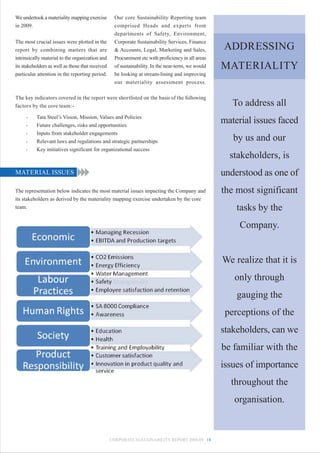
We undertook a materiality mapping exercise         Our core Sustainability Reporting team
in 2009.                                            comprised Heads and experts from
                                                    departments of Safety, Environment,
The most crucial issues were plotted in the         Corporate Sustainability Services, Finance
report by combining matters that are                & Accounts, Legal, Marketing and Sales,         ADDRESSING
intrinsically material to the organization and      Procurement etc with proficiency in all areas
its stakeholders as well as those that received     of sustainability. In the near-term, we would   MATERIALITY
particular attention in the reporting period.       be looking at stream-lining and improving
                                                    our materiality assessment process.

The key indicators covered in the report were shortlisted on the basis of the following
factors by the core team:-                                                                             To address all
     -    Tata Steel’s Vision, Mission, Values and Policies
     -    Future challenges, risks and opportunities
                                                                                                    material issues faced
     -    Inputs from stakeholder engagements
     -    Relevant laws and regulations and strategic partnerships                                     by us and our
     -    Key initiatives significant for organizational success
                                                                                                      stakeholders, is
MATERIAL ISSUES                                                                                     understood as one of
The representation below indicates the most material issues impacting the Company and               the most significant
its stakeholders as derived by the materiality mapping exercise undertaken by the core
team.                                                                                                   tasks by the
                                                                                                         Company.


                                                                                                    We realize that it is
                                                                                                       only through
                                                                                                        gauging the
                                                                                                     perceptions of the
                                                                                                    stakeholders, can we
                                                                                                    be familiar with the
                                                                                                    issues of importance
                                                                                                      throughout the
                                                                                                       organisation.


                                                  CORPORATE SUSTAINABILITY REPORT 2008-09 18
STRATEGY AND ANALYSIS

TATA STEEL GROUP VISION, GOALS AND PERFORMANCE CULTURE


                                     TATA STEEL GROUP VISION
     “We aspire to be the global steel industry benchmark for Value Creation and Corporate Citizenship”


 The two fundamental ideas of Value Creation and Corporate Citizenship make up the
Vision for the Group. The Vision which was agreed upon in early 2008 emphasises upon
    the Triple Bottom-line approach- integrating economic, social and environmental
                         performance with corporate citizenship.


Value Creation will help the Group thrive commercially in a testing and competitive climate,
 enhance customer relations, and contribute to economic development in the areas of
                                         operation.


Corporate Citizenship is innate in the character and the way we run our business. It is
anchored in our , our Tata Code of Conduct and, ultimately, it is reflected in the actions
 of our people. From being an ‘Employer of Choice’ to our environmental stewardship,
Tata Steel strives to make a difference in the long-term prosperity and quality of life of
                       people and communities around the world.

                                  CORPORATE SUSTAINABILITY REPORT 2008-09 19
RISK MANAGEMENT AND OPPORTUNITIES

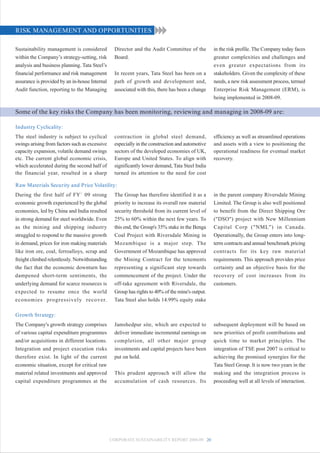
Sustainability management is considered           Director and the Audit Committee of the         in the risk profile. The Company today faces
within the Company’s strategy-setting, risk       Board.                                          greater complexities and challenges and
analysis and business planning. Tata Steel’s                                                      even greater expectations from its
financial performance and risk management         In recent years, Tata Steel has been on a       stakeholders. Given the complexity of these
assurance is provided by an in-house Internal     path of growth and development and,             needs, a new risk assessment process, termed
Audit function, reporting to the Managing         associated with this, there has been a change   Enterprise Risk Management (ERM), is
                                                                                                  being implemented in 2008-09.

Some of the key risks the Company has been monitoring, reviewing and managing in 2008-09 are:

Industry Cyclicality:
The steel industry is subject to cyclical         contraction in global steel demand,             efficiency as well as streamlined operations
swings arising from factors such as excessive     especially in the construction and automotive   and assets with a view to positioning the
capacity expansion, volatile demand swings        sectors of the developed economies of UK,       operational readiness for eventual market
etc. The current global economic crisis,          Europe and United States. To align with         recovery.
which accelerated during the second half of       significantly lower demand, Tata Steel India
the financial year, resulted in a sharp           turned its attention to the need for cost

Raw Materials Security and Price Volatility:
During the first half of FY` 09 strong            The Group has therefore identified it as a      in the parent company Riversdale Mining
economic growth experienced by the global         priority to increase its overall raw material   Limited. The Group is also well positioned
economies, led by China and India resulted        security threshold from its current level of    to benefit from the Direct Shipping Ore
in strong demand for steel worldwide. Even        25% to 60% within the next few years. To        ("DSO") project with New Millennium
as the mining and shipping industry               this end, the Group's 35% stake in the Benga    Capital Corp ("NML") in Canada.
struggled to respond to the massive growth        Coal Project with Riversdale Mining in          Operationally, the Group enters into long-
in demand, prices for iron making materials       Mozambique is a major step. The                 term contracts and annual benchmark pricing
like iron ore, coal, ferroalloys, scrap and       Government of Mozambique has approved           contracts for its key raw material
freight climbed relentlessly. Notwithstanding     the Mining Contract for the tenements           requirements. This approach provides price
the fact that the economic downturn has           representing a significant step towards         certainty and an objective basis for the
dampened short-term sentiments, the               commencement of the project. Under the          recovery of cost increases from its
underlying demand for scarce resources is         off-take agreement with Riversdale, the         customers.
expected to resume once the world                 Group has rights to 40% of the mine's output.
economies progressively recover.                  Tata Steel also holds 14.99% equity stake

Growth Strategy:
The Company's growth strategy comprises           Jamshedpur site, which are expected to          subsequent deployment will be based on
of various capital expenditure programmes         deliver immediate incremental earnings on       new priorities of profit contributions and
and/or acquisitions in different locations.       completion, all other major group               quick time to market principles. The
Integration and project execution risks           investments and capital projects have been      integration of TSE post 2007 is critical to
therefore exist. In light of the current          put on hold.                                    achieving the promised synergies for the
economic situation, except for critical raw                                                       Tata Steel Group. It is now two years in the
material related investments and approved         This prudent approach will allow the            making and the integration process is
capital expenditure programmes at the             accumulation of cash resources. Its             proceeding well at all levels of interaction.


                                                CORPORATE SUSTAINABILITY REPORT 2008-09 20
Health, Safety & Environmental Risks:
The manufacture of steel involves steps that       it operates. These rules are becoming more        For the sustainability of its operations, the
are potentially hazardous and which are            stringent.                                        “Process Safety & Risk Management”
likely to cause disruptions to normal                                                                (PSRM) programme has been started for
operations if not executed with due care.          The Group has set specific goals to be            the high hazard operations and processes,
The Company’s businesses are subject to            achieved by 2012 in the areas of CO2              in order to ensure freedom from high
numerous laws, regulations and contractual         emissions (1.5 tonnes per tonne of liquid         consequence, low frequency process
commitments relating to health, safety and         steel) and LTIF (below 0.4).                      incidents. PSRM will be implemented in all
the environment in the countries in which                                                            facilities by FY` 12.

Technology Risks:
One of the biggest risks before the Group          competitiveness and R & D leadership. For         the same and continues to enhance and
is to ensure that its plants are equipped with     this purpose, the Group has not cut back the      deploy R & D capabilities.
upto date technologies that can give it cost       necessary capital investments in relation to

Regulatory & Compliance Risks:
Global operations require compliance with          changes can expose the Group’s businesses         political, business and legal frameworks in
multiple and complex laws and regulations.         to uncertainties.                                 place. There is an established due process
In countries where the political systems are                                                         to independently evaluate country risk
still evolving, frequent changes in economic       The Group operations are primarily in             exposures for investments in emerging
policy are common, investment guarantees           countries where investment flows are more         economies.
and property rights are secured, unforeseen        unrestricted and where there are established

Financing:
The Company funded the acquisition of              put a strain on its ability to meet the current   Unless the current economic crisis does not
Corus with a significant level of debt that        scheduled debt repayment obligations under        get protracted, these reset criteria are
was assumed at the acquired company level.         the existing Senior Facility Agreement.           expected to provide TSE with the necessary
Sharp decline in steel demand and prices                                                             space and time to work towards returning
particularly during the second half of the         The Group has successfully renegotiated           to sustainable profit levels.
financial year has adversely affected the          specific terms relating to debt repayments
cash flow generation of TSE and potentially        and financial covenant measurements.

Forex, Credit, Liquidity and Counterparty Risks:
Through its global operations, the Group           positions but the long-term economic              protect its trading and manufacturing
operates in several currency areas. The major      competitive position vis-à-vis imports. The       margins against rapid and significant
currencies used in its sales and procurement       current economic crisis has also raised credit    movements in its major trading currencies.
activities are the US Dollar, Euro and             and counterparty risks, especially with the       The Group does not enter into leveraged
Sterling Pound. Any major fluctuations or          withdrawal of credit insurance.                   derivative instruments.
change in currency trends can greatly affect
not only the Group’s short-term trading            The Group has a hedging policy in place to


                                                 CORPORATE SUSTAINABILITY REPORT 2008-09 21
BUSINESS ETHICS

Tata Steel does not tolerate corrupt or              set out originally by J.N. Tata, Founder of       which have been adopted by all Tata
fraudulent practices and expects honesty,            the Tata Group, who believed that business        companies In 2008, in line with changes in
integrity and transparency in all aspects of         must operate in an ethical way that respects      the times, and the globalisation of the Tata
its business, from employees, contractors            the rights of its stakeholders and creates a      Group, the Code was updated, in
and other business counterparts.                     total sum benefit for society.                    consultation with Tata Steel Group
                                                                                                       companies around the world. The revised
Ethics are central to its business. Tata Steel's     Since 1998 these ethical principles have          Code of Conduct was adopted by the Tata
ethical philosophy forms part of its legacy,         been articulated in the Tata Code of Conduct,     Steel Group Board in October 2008.


TATA CODE OF CONDUCT 2008

The revised Tata Code of Conduct 2008                Code now extends to contractors and               various employee communication media
addresses contemporary issues of concern             vendors, who must agree to respect the            and an interactive learning programme about
for global business, with more focused               Code.                                             the clauses of the Code.
direction for example on integrity, fraud,
bribery, corruption, conflict of interest,           Tata Steel's businesses across the world have     All Tata Steel Joint Ventures will have a
competition and excellence. The importance           adopted the new Code of Conduct and 2008-         Code of Conduct based on the business
of implementing a sustainability protocol            09 was an important year for rolling out the      principles enunciated in the Tata Code of
has been addressed for the first time.               Code in some of the recently acquired             Conduct. For example one of the elements
                                                     businesses. Formal adoption was                   of the Joint Venture Memorandum of
All employees have a clear responsibility            accompanied by an awareness raising               Agreement with partners in Vietnam includes
to implement the Code. Additionally the              programme including information through           adoption and implementation of the Code.


PRIORITY SUSTAINABILITY BUSINESS RISKS AND PERFORMANCE 2009

 Priority                  Business Risk                 Key stakeholder           Performance Indicator                         2007-08 2008-09
 Economic                 Recession/ Financial           Employees Shareholders    EBITDA                                        8,257        9,442
                          Stability
 Environment              CO2 Emissions                  Community Government      Specific CO2 emission excluding               2.14         2.09
                                                         Customers                 imported Elect + Mobile + HFC (t/tcs)
                                                         NGOs
                          Energy Efficiency              NGOs                 The specific energy consumption of the             27.86        27.58
                                                         Community Government integrated iron and steel works at
                                                                              Jamshedpur in GJoule/tonne of crude steel
                          Water Management               NGOs                 Water Consumption in Million m3 /                  35.01        37.13
                                                         Community Government Annum
                          Waste Management               NGOs                 % of generation indicating the quantity of         85.35        89.61
                                                         Community Government the waste generated that was utilised
 Labour Practices         Safety                         Employees            LTIFR                                              1.7          0.8
                                                                              No. of fatal accidents                             8            6
                                                                              (Employees+ Contractors)

                          Employee Satisfaction and      Employees                 Attrition Rate %                              3.96         -34.98
                          Retention
 Human Rights             SA 8000 Compliance             Employees Contractor-
                                                                                        Re-certified for compliance to SA 8000 standard in 2007
                                                         Workers Community
  Social                  Community Development          Community Employees       Community Investments in Rs/ Million          960          770
                                                         Suppliers
 Product                  Customer Satisfaction          Customers                 Overall Customer Satisfaction index - 1.13              1.06
 Responsibility                                          Suppliers                 relative score of the Company’s overall (Flat Products) (Flat Products)
                                                         Dealers & Retailers       score over the nearest competitor. 1.04Products) 1.07Products)
                                                                                                                           (Long           (Long
                                                                                   (AC Nielson, TNS)
                          Innovation in product quality Employees Customers
                          and services                  Suppliers                                New innovations described on page **
                                                        Dealers & Retailers


                                                   CORPORATE SUSTAINABILITY REPORT 2008-09 22
GOVERNANCE, COMMITMENTS AND ENGAGEMENTS

GOVERNANCE

The Company’s Corporate Governance Philosophy

Tata Steel follows global good practice in        to deliver its responsibilities for creating    corporate responsibility are inherent in all
governing business. It has always prioritised     and safeguarding shareholder wealth. During     activities.
sound corporate governance and aspires to         the year under review, the Board pursued
                                                                                                  The Company is committed to full
go well beyond legal requirements to be an        these objectives through monitoring major
                                                                                                  transparency and accountability in all
exemplar of good governance.                      risks to the Company's business, prudent        transactions, in order to protect the interests
                                                  business planning, implementing appropriate     of its stakeholders. A detailed Corporate
The Board considers itself a Trustee of its       corporate strategies, monitoring for            Governance Report is provided in the Annual
shareholders and has robust systems in place      compliance and ensuring that integrity and      Report 2008-09.


BOARD OF DIRECTORS

                                                  Independent Directors are those who, apart      number of Non-Executive Directors was
  Board of Directors (March 31, 2009)
                                                  from receiving director’s remuneration, do      more than 50% of the total number of
   Mr. Ratan N. Tata - Chairman                   not have any material or pecuniary              Directors.
   Mr. James Leng - Deputy Chairman               relationship or transaction with the
   Mr. Nusli N. Wadia                             Company, its promoters, its management or       Tata Steel has adopted the Tata Code of
   Mr. S. M. Palia                                its subsidiaries, which may affect the          Conduct for Executive Directors, Senior
   Mr. Suresh Krishna                             independence of the Director’s judgment.        Management Personnel and other Executives
   Mr. Ishaat Hussain                             A financial institution nominee is considered   of the Company. It has also adopted the Tata
   Dr. Jamshed J. Irani                           to be an Independent Director in all cases.     Code of Conduct for Non-Executive Directors
   Mr. Subodh Bhargava                                                                            of the Company. Confirmation of compliance
   Mr. Jacobus Schraven                           The Company was in compliance with the          with the Codes during this year was received
   Dr. Anthony Hayward                            recent amendment of Clause 49 of the            from the Executive Directors, Senior
   Mr. Andrew Robb                                Listing Agreement pertaining to                 Management Personnel and Non-Executive
   Dr. T. Mukherjee                               compositions of Directors. None of the          Directors. Both the Codes are posted on the
   Mr. Philippe Varin                             Directors on the Board was a member of          Company’s website.
   Mr. B. Muthuraman                              more than ten committees and Chairman of
                                                  more than five committees across all            The Board periodically reviews compliance
On March 31, 2009, the Company had                companies in which he is a Director. The        reports of all laws applicable to the Company.
fourteen Directors on its Board, of which         necessary disclosures regarding committee       Steps are taken by the Company to rectify
eight Directors were independent. The             positions were made by the Directors. The       instances of non-compliance, if any.


COMMITTEES OF THE BOARD

Audit Committee
The Audit Committee reviews compliance with internal control systems and the results of internal audits, reviews the financial results
of the Company before submission to the Board and makes recommendations to the Board on audit procedures and any matter relating
to the financial management of the Company.


Remuneration Committee
The Remuneration Committee reviews the performance of the Managing Director and the Whole-time Directors, after considering the
Company’s performance, and recommends remuneration and benefits.


                                                CORPORATE SUSTAINABILITY REPORT 2008-09 23
Shareholders’ Committee
An Investors’ Grievance Committee was constituted in 2000 to examine investors’ complaints like transfer of shares, non-receipt of
balance sheet and non-receipt of declared dividend, etc.


Executive Committee of the Board
The Executive Committee of the Board approves capital expenditure schemes and donations, within the stipulated limits, and recommends
to the Board capital budgets and other major capital schemes. It considers new businesses, acquisitions, divestments, changes in
organisational structure and periodically reviews the Company’s business plans and future strategies.


Nomination Committee
The Nomination Committee was constituted in 2006 with the objective of identifying Independent Directors and taking steps to review
and refresh the constitution of the Board periodically.


Committee of Directors
The Committee of Directors authorises certain routine matters such as the Opening and Closing of Bank Accounts of the Company,
granting limited Powers of Attorney to Officers of the Company, appointing proxies to attend general meetings on behalf of the Company,
etc. The Circular Resolutions of the Committee are placed before the Board at its next meeting.


Ethics and Compliance Committee
In accordance with the Securities and Exchange Board of India (Prohibition of Insider Trading) Regulations, 1992, the Board of Directors
of the Company adopted the revised Tata Code of Conduct for Prevention of Insider Trading and the Code of Corporate Disclosure
Practices (the Code) to be followed by Directors, officers and other employees. The Code is based on the principle that Directors,
officers and employees of a Tata Company owe a fiduciary duty to, among others, the shareholders of the Company, to place the interest
of the shareholders above their own and conduct their personal securities transactions in a manner that does not create any conflict of
interest situation.


The Board appointed the Group Chief Financial Officer as the Compliance Officer to ensure compliance and effective implementation
of the Regulations and the Code across the Company.


General Body Meetings
An Annual General Meeting is held each year and occasional Extraordinary General Meetings are held when necessary. The last Annual
General Meeting was held on 28th August 2008.


Linking compensation with achievement
The Non-Executive Directors (NEDs) are paid remuneration by way of Commission and Sitting Fees. Commission was paid at a rate
not exceeding 1% per annum of the profits of the Company (computed in accordance with the Companies Act, 1956). The distribution
of Commission amongst the NEDs is placed before the Board. Sitting fees are paid at agreed set rates for attending meetings of the
Board and its various committees.


The Company pays remuneration by way of salary, perquisites, fixed allowances and variable commission to Managing and Whole-
time Directors. Specific amounts payable to such directors are based on the performance criteria laid down by the Board, which takes
into account the performance of the Company and annual profits earned. Such payments are made based on the recommendations of
the Remuneration Committee, within the range approved by the Shareholders and the ceiling fixed by the Board, which is compliant
with stipulations of the Companies Act, 1956.


The annual variable pay of senior managers is linked to the performance of the Company in general and their individual performance
for the year, measured against specific Key Result Areas, which are aligned to the Company’s objectives and the Vision goals. Thus
compensation is linked to performance on issues of concern such as Safety.


                                            CORPORATE SUSTAINABILITY REPORT 2008-09 24
Managing conflicts of interest
The Tata Code of Conduct adopted by all Directors, Senior Management and Employees of Tata Steel ensures that personal interests
do not conflict with the interest of the Company. The Code explains clearly when such a conflict may occur and stipulates that any
such conflicts or potential conflicts must be disclosed in writing to higher management for guidance and appropriate action. Disciplinary
action will be taken if management becomes aware of a conflict of interest which has not been disclosed.


Financial transactions in which Directors are interested, if any, are required to be placed before the Board for approval. The Company
has a policy of prevention of insider trading in securities of the Company. Purchase or sales of shares of the Company by employees /
senior management / Directors who are likely to have price sensitive information about the Company are subject to various restrictions.
 Such designated persons are required to make disclosures on shares purchased/sold by them or their dependents. In 2008-09 there were
no materially significant related party transactions which had conflict with the interest of the Company.


Selection of Board Members
The Board of Directors is guided by the organisation’s Vision and Values. The composition of the Board of Directors is a mix of full
time executives and non-executives representing business houses and financial institutions, with requisite experience in handling
economic, environmental and social issues. There are guidelines for the selection of Board Members, with criteria covering the individual
skills that add to the composite perspective of the Board, as well as ensuring capacity for full participation. The Nomination Committee
of the Board is responsible for identifying Independent Directors to be included on the Board.


Mechanism for providing recommendations to the Board
The mechanism for shareholders to provide recommendations to the Board is primarily through the Annual General Meeting and
communication with the Shareholders Committee, as well as via Investor Satisfaction Surveys, meetings with investors and the Company
website. The suggestions, comments and feedback provided by the shareholders during the Annual General Meetings are carefully
recorded and discussed in the Board Meetings. After reviewing the various points raised by shareholders, the Board directs the management
to integrate the results in its business decisions.


Employee suggestions can be made to the Board via the Managing Director. Employees have the opportunity to communicate directly
with the Managing Director through a monthly interactive webcast ‘MD Online’ and an online suggestion box and indirectly through
Joint Council mechanisms, regular dialogues and employee suggestion schemes.


Internally developed Vision and Values, Code of Conduct and Guiding Policies
Tata Steel has for many years planned its operations and development in consultation with its stakeholders and produced clear statements
of Vision, guiding principles and policy.


Tata Steel has five core values: Trusteeship, Integrity, Respect for Individual, Credibility and Excellence. These values guide and drive
business decisions, building on the Tata Group’s beliefs and ethos from the Company’s earliest days. The Tata Group’s commitment to
ethical business and corporate citizenship have earned the Group the trust of many millions of stakeholders in a measure few business
houses anywhere in the world can match.


Tata Steel’s recognition of its wider responsibility towards society is demonstrated through its Articles of Association and its Social
Accountability, Environmental and Corporate Social Responsibility policies. Specific guidelines on conduct are supplied through the
TCOC, which applies to both the Company and the behaviour of individual employees. The Code sets a standard of behaviour on a
range of salient issues including National Interest; Competition; Equal Opportunity; Health, Safety and Environment; Quality of Products
and Services; Ethical Conduct; Regulatory Compliance etc. The Code of Conduct applies to all Tata Steel operations in India and during
2008-09 the Code was rolled out to other global operations of the Tata Steel Group. Many further policies guide activity on specific
issues and these are referenced throughout this report as appropriate.


The policies and Code of Conduct are well publicised to all stakeholders. Full details of the Code of Conduct and these guiding policies
are provided in the annexes, along with further relevant policies such as the Human Resource Policy, Affirmative Action Policy, Safety
and Occupational Health Policy, HIV and AIDS Control Policy, Alcohol and Drugs Policy, Energy Policy and Research Policy.


                                            CORPORATE SUSTAINABILITY REPORT 2008-09 25
In 2008 Tata Steel Group demonstrated its commitment to sustainability issues with the Vision for 2012 - to be the world steel industry
benchmark for value creation and corporate citizenship - and the associated goals. These are integrated into operational business plans
to ensure the Vision and Goals are implemented appropriately across the various operations.


Procedures for managing economic, environmental and social performance
Economic, environmental and social performance is managed through integrated performance improvement planning and monitoring
systems throughout Tata Steel. A Total Quality Model, involving Policy Management and Daily Management, guides a planning process
which cascades strategy through the organisation and embeds the associated goals and targets into business processes.


The economic, environmental and social performance of the Company is overseen by the Board. A status report on economic, environment
and social performance, along with relevant Board papers, is sent in advance to all the Board Members before Board meetings for review,
comments and suggestions during the meeting. The Board monitors both compliance with regulations and performance on achieving
the targets the Company has set itself. Feedback from the Board members is analysed by the top management and considered for business
decision-making.


COMMITMENTS TO EXTERNAL INITIATIVES

PRECAUTIONARY APPROACH

The Tata Code of Conduct addresses the             spirit of every policy or guideline formulated   impact assessments are carried out for all
fundamental importance to the Tata Group           at Tata Steel. The Company assess whether        projects to be implemented and necessary
companies of ensuring Health, Safety and           its policies and actions might cause severe      environmental management plans are
Environment (Clause 8) and Company                 or irreversible harm to the public or to the     integrated in the project to internalise the
policies, including the Environmental Policy       environment and adopts a cautious approach       cost. Life Cycle Assessment has been carried
and Corporate Social Responsibility Policy,        and take steps to protect from harm where        out for the integrated iron and steel making
reflect the ethos of prioritising quality of       scientific evidence suggests there may be a      route. The outputs on emissions, discharges,
life and the protection of the environment.        risk, even where this is not certain.            resource usage and global warming are
                                                                                                    analysed; targets are taken for continual
The Company is a signatory to the Global           The merit of every proposed activity, project    improvement under the Environmental
Compact which stipulates a precautionary           or process is evaluated for financial            Health and Safety Management system.
approach to environmental challenges. The          performance, environmental and social            Only those proposals which ensure
precautionary approach is the underlying           performance before adoption. Environmental       compliance with these policies are pursued.

ADOPTION OF EXTERNAL CHARTERS AND PRINCIPLES

Tata Steel is a founding member of the             Tata Steel also respects the Tata Corporate      Steel such as ISO 14001, ISO 9001, OSHAS
United Nations Global Compact and abides           Sustainability (Group) Policy agreed on          18001, SA8000, Total Quality Management
by its principles. The ten principles of the       29th July 2007.                                  and the annual business planning process.
UN Global Compact address Human Rights,                                                             Thus the principles are embedded into the
Labour Rights, the Environment and Anti-           The commitments to such external charters,       way things are done. The systems are
corruption). The Managing Director of Tata         principles, policies, etc are implemented by     meticulously reviewed on a regular basis
Steel is a Board Member of the UN Global           integrating the requirements into the various    and corrective actions are taken to meet the
Compact, helping to lead this global strategic     management systems implemented by Tata           requirements.
policy initiative.


                                                 CORPORATE SUSTAINABILITY REPORT 2008-09 26
PARTICIPATION IN ASSOCIATIONS, AND PARTNERSHIP COMMITMENTS

Tata Steel considers it vital to work together     of India, Ministry of Steel.                   cultural activities. A few examples of recent
with other organisations to learn, share and                                                      partnership initiatives are with:
work collaboratively towards common goals.         Tata Steel is one of the founder members        •    United Nations Development
The Company is an active member of many            of the Global Business Coalition on AIDS,            Programme, Ministry of New and
reputed professional bodies such as the            and a member of the CII-Social                       Renewable Energy and Confederation
World Steel Association (previously known          Development Community Affairs                        of Indian Industry – Renewable
as the International Iron and Steel Institute      Committee. It is an active member of the             Energy Project
(IISI)), Confederation of Indian Industry          TERI Business Council for Sustainable           •    Agriculture Consultancy and
(CII), Indian Institute of Metal, etc., with       Development, India (a regional partner of            Management Foundation, Chennai –
Tata Steel’s executives occupying significant      the World Business Council for Sustainable           project to improve agricultural
positions in the Technical and Executive           Development).                                        productivity
committees.                                                                                        •    International Crop Research Institute
                                                   The Company has increasingly been                    for Semi Arid Tropic, Hyderabad –
Tata Steel has been keen to participate in         undertaking partnership projects in                  project to improve dry land farming
initiatives which seek to address climate          collaboration with NGOs, Industry               •    Orissa State AIDS Control Society –
change and has been a participant in the           Associations and National / International            providing HIV/AIDS treatment and
Steel Task Force initiatives of Asia Pacific       advocacy organisations. Social organisations         counselling
Partnership on Clean Development and               established by Tata Steel are working with      •    Jharkhand Education Project – camp
Climate under the aegis of the Government          a variety of partners on health, social and          school for girls


                                                 CORPORATE SUSTAINABILITY REPORT 2008-09 27
CREATING VALUE

MANAGEMENT APPROACH

Whilst Tata Steel is ever conscious of its role as trustee of the wealth of all shareholders, particularly in the times of economic crisis
faced during the second half of this year, the Company is also at mindful of the wider issues and risks that affect and which, in turn,
may affect operations. The Company believes in managing business keeping in view both the long term and short-term objectives.
Two critical elements in creating value for customers and other stakeholders are the commitment to business excellence and innovative
approach. Tata Steel does this by:

           •    producing high quality products and services in ways that demonstrate effectiveness, efficiency and continuous
                improvement
           •    developing cutting-edge solutions in technology, processes and products

The Company's Quality and Research and            from current operations by optimising assets,   As the Company develops its operations it
Development Policies guide Tata Steel in          differentiating its offer in the marketplace    is ever mindful of the need for inclusive
its approach and such that quality principles     and achieving synergies. Tata Steel's plans     growth. It has adopted a responsible and
and practices are applied throughout the          for strategic growth include ongoing capacity   caring approach to business planning and
business using ISO 9001, the global quality       expansion projects and further integration      practice, with pro-active measures to ensure
and customer relationship standard.               upstream in raw material sources, with an       that benefits from its operations are extended
                                                  ambition to achieve higher level of raw         to all stakeholders, including employees,
The Company seeks to increase earnings            material security in India.                     local communities and society at large.


ECONOMIC IMPACTS

FINANCIAL HIGHLIGHTS 2008-09


NB 1 crore = 10 million

                                                CORPORATE SUSTAINABILITY REPORT 2008-09 28
ECONOMIC VALUE GENERATED AND DISTRIBUTED
NB following re-groupings of 2008-09 figures, some 2007-08 data sets have been adjusted accordingly and so differ slightly from those reported in 2008

SUMMARY

                                            2008-09      2007-08
 Revenues                                   271,520      224,324
 Operating Costs                            133,760      98,074
 Employee Wages and benefit                 23,058       18,160
 Payment to providers of Capital            24,311       19,776
 Payment to Government                      64,660       55,246
 Community Investments                      770          960
 Economic Value Retained                    37,092       32,935


PAYMENTS AND PROVISIONS TO EMPLOYEES

At the end of March 2009, Tata Steel in              the best in steel industry category. This is         The staff cost increased to Rs. 23,058.1
India employed 34,918 people as permanent            monitored by an internal benchmarking                million, as compared to Rs. 18,159.50
employees. The Company also provide                  exercise conducted annually.                         million in the previous year, mostly on
indirect economic benefits to many                                                                        account of payment of wage arrears and
thousands more through contractors and               Tata Steel also ensure that the contractors          also owing to the normal increase in annual
suppliers.                                           it engages, pay living wages as per SA 8000          increments, dearness allowance and a
                                                     to their labourers, which is beyond the              consequential increase in provisions for
Tata Steel pays pay fairly and entry level           minimum wages norm as laid out in                    gratuity and leave salaries.
positions receive wages which are amongst            government legislations.

                                                       Payments to Employees (Rs. Million)
                                                                         2008-09               2007-08               Change                Change %
  Payments to and provisions for employees                               20834.8               15897.7               1349.4                   24
  Employee separation Scheme (ESS) compensation                           2223.3                2261.8                740.8                   33

Defined Benefit:

The Company has the following defined benefit plans                     Other benefits to employees through defined contribution plans are
•      Post retirement gratuity                                         •       Provident fund
•      Post retirement medical benefits                                 •       Superannuation fund for non unionized employees
•      Pensions to directors                                            •       Employees pension scheme/Coal mines pension scheme
•      Farewell Gifts                                                   •       TISCO employees pension scheme
•      Packing and transportation costs on retirement

Of the benefit plans, post retirement gratuity       2009 were Rs 8,099 million and the liability         shortfall observed in funding on the date of
plan is funded and the others are not                was Rs 10,536 million. The difference of             annual valuation as at 31st March of the
                                                     Rs 2,437 million was recognized as a liability       year is made up in the subsequent year.
Obligation under unfunded defined benefit            as at that date and discharged subsequently.
plans as at 31st March 2009 was Rs 5,787             Asset values are at fair value and liability         Employees contribute towards Provident
million                                              is as per actuarial valuation                        fund and TISCO employees’ pension scheme
                                                                                                          as per statute/ scheme.
Assets of gratuity fund as at 31st March             Gratuity Scheme is fully funded. Any


                                                  CORPORATE SUSTAINABILITY REPORT 2008-09 29
Level of participation

All employees are members of PF & Retiring Gratuity Schemes. Employees are also the members of the other plans as provided under
the respective plan.

Donations to community, civil society and other groups

During 2008-09 Tata Steel distributed a total     Community donations and grants were made       Spend on Municipal Services were also
of Rs 769.9 million in payments for               to the value of Rs 35.9 Million lower by       lower by around Rs.41.80 Million mainly
municipal, community and medical services,        Rs.77.90 Million over previous year. The       on account of reduction in Horticulture and
grants for rural activities and other grants      main reason being an one time donation of      Town related expenditures. Similarly around
as against Rs. 963.7 Million in 2007-08.          Rs. 70 Million to a Cancer Hospital Kolkata.   Rs.51 Million less was spent on Roads,
                                                                                                 Housing and other town related projects.
 SERVICE            Rs. Million                 Rs. Million
                    Actuals 2008-09             Actuals 2007-08
 Municipal Services 339.1                       380.9
 Community Services 236.3                       274.5
 Medical Services   77.7                        97.0
 TSRDS Grants       80.9                        97.5
 Grants & Donations 35.9                        113.8
 TOTALS             769.9                       963.7

Taxes paid to the Government

The total amount of taxes by way of sales tax, excise duty, wealth tax, etc. paid during 2008-09 was Rs. 64,660 Million, against Rs.
55,246 Million during 2007-08.

Financial Assistance Received from Government

No significant financial assistance was received from the Government for Operational or Community Development initiatives.

Return on Invested Capital (ROIC)

           Return on Invested Capital        Performance on ROIC has been strong                 improved working capital levels also assist
 Particulars                2008-09 2007-08 for Tata Steel’s Indian operations. One              ROIC performance. ROIC is a prime
 Return on Invested Capital 110%      106%   significant contributory factor is that             measure for value creation across the Tata
                                             the Company is fully integrated in its              Steel Group and is a key performance
ROIC is Net Operating Profit Before Tax operations, with control of raw materials                indicator for its financial performance
and Extraordinary Items ÷ Fixed Assets contributing to better operating margins.                 towards the Company’s Vision goals for
(exc. WIP) + Net Current Assets The Company's low capital base and                               2012.

Dividend

The Board of Directors of the Company
recommended a dividend @ 160% (Rs. 16
per share) for the year ended 31st March
2009. The dividend cash-outgo (including
tax on dividend) was Rs. 14.93 Billions.
The dividend payout as % of Net Profit
maintained at 30% as it was in the last year.


                                                CORPORATE SUSTAINABILITY REPORT 2008-09 30
Local Hiring

Whilst Tata Steel has a policy of hiring the     benefit from the economic opportunities      to ensure that scheduled castes and tribal
best available talent in the country for its     that its activities offer. Therefore local   communities are given equal opportunity in
jobs, and sourcing globally according to         candidates for employment are considered     employment and supply chain opportunities.
knowledge-based and value-driven buying          favourably if they possess the required      Up-skilling programmes help local
principles, the Company is also mindful          qualification, skills and talent. The        communities to increase their employability.
about ensuring that local people are able to     Company's Affirmative Action Policy helps

Local Material Procurement

One of the important business drivers is procurement of supplies and services from local vendors. The proportion of spending on locally
based vendors (ie vendors with an address in Jharkhand state) during 2008-09 was approximately 25% of Tata Steel’s domestic buy
volume.


SOCIAL RESPONSIBILITY INITIATIVES IN PROCUREMENT


          In accordance with its Affirmative Action Policy, Tata Steel encourages
           business entrepreneurs from socially disadvantaged communities and
               includes them in its supply chain on the basis of equal merit.


          As a social responsibility initiative, social organisations and small-scale
          local industries are given preference when placing orders, whenever they
          are able to supply the Company to a standard which otherwise would be
          serviced by larger units. For example, many items are sourced from local
           NGOs such as AIWC, Seva Sadan, School of Hope and Bal Vihar. In
            order to assist social organisations and small-scale industry units to
           supply the Company, raw materials are issued on a ‘conversion’ basis
          for the supply of finished goods, spares, and consumables. This reduces
             the burden of ‘working capital’ management of these small units.


          Only local vendors are engaged for the delivery
            of services, except for the tasks requiring a
          higher degree of specialisation and sophistication
           and a skill set which is not available locally.

                                               CORPORATE SUSTAINABILITY REPORT 2008-09 31
QUALITY

CONTINUOUS IMPROVEMENT
Quality is vital to the success of Tata Steel’s business. Quality principles and
practices applied throughout the business are aligned to ISO 9001.

DEMING PRIZE FOR QUALITY
In 2008 Tata Steel in India was the first integrated steel company in the world, outside Japan, to be awarded the prestigious Deming
Application Prize for excellence in Total Quality Management. The prize recognises the important work done not just to build value
for customers, employees and business partners, but also for social causes and the community in its areas of operation.


Over the years Tata Steel has placed a          benchmarks in all areas. As part of the      Steel Group, leverage synergies and
continuous emphasis on improving                integration process of Tata Steel Group,     accelerate improvement through learning
processes, with a view to consistently          Performance Improvement Teams and a          and sharing.
increasing efficiencies, enhancing quality,     central committee have been established to
and thereby achieving better performance        systemise Process Improvement in the Tata

Tata Steel has a strong improvement framework known as ASPIRE T3, which is an integration of three models:
    •    Theory of Constraints (TOC): develop a competitive edge based on reliable delivery service, thereby creating value for
         customers
    •    Total Quality Management (TQM): a structure for customer and quality focussed continuous improvements comprising the
         following key elements – Policy Management, Daily Management, Problem Solving & Task Achieving
    •    Technology: foster a technology mindset amongst a cross section of employees through a Knowledge Management Programme

The ASPIRE framework has helped the Company to improve its performance in many areas, including economic and environmental
performance. Tata Steel has worked extensively on applying TQM the Deming way, implementing the management/improvement cycle
of ‘Plan, Do, Check, Act’ (PDCA) through departments, leading to distinct performance improvements.

Focus on Customer and Cost has helped Tata Steel shift from:-


                                              CORPORATE SUSTAINABILITY REPORT 2008-09 32
INDIRECT ECONOMIC IMPACTS

IMPACT OF COMMUNITY INFRASTRUCTURE DEVELOPMENT AND SERVICES
The prospering community around the Company's operations is a testament to Tata Steel's corporate sustainability
initiatives. Some highlights of the Company's contribution to local community infrastructure development and
services over a period of time are provided below:

   u    Municipal Services
        •    Provided to Jamshedpur Township through Tata Steel's subsidiary JUSCO (Jamshedpur Utilities & Services Company)
             - leading to a clean and green city with a substantially better quality of life. Services provided to the population of around
             1 million people include water, electricity, roads and transport infrastructure, public spaces and horticulture. Jamshedpur
             has reliability of water and power services amongst the highest in India; Jamshedpur's tap water quality exceeds World
             Health Organisation norms for drinking water.
   u    Educational infrastructure and services
        •    Tata Steel runs three primary schools, six high schools, and one college and supports nearly 500 further schools
   u    Health facilities
        •    The 890 bed Tata Main Hospital provides quality health services to employees and citizens of Jamshedpur
        •    Outside Jamshedpur, medical services are extended through a - 66-bed Tata Steel Hospital at Noamundi, whose ultra
             modern Intensive Care Unit was inaugurated in April 2008; and a 47-bed Hospital at Joda.
        •    Two super dispensaries and nine dispensaries
        •    Sneh Kendra HIV/AIDS support centre
        •    TSFIF resource centre – which has the goal of improving reproductive health through integrated capacity building and
             development programmes
        •    Community health projects such as Kavach HIV/AIDS project at Jamshedpur
   u    Sports Facilities
        •    The JRD Tata Sports Complex, an international standard stadium with an eight-lane polyurethane track and football field,
             was inaugurated in 1991. The complex also houses facilities for handball, tennis, volleyball, hockey, basketball, boxing,
             table tennis, swimming and a modern gymnasium. The Sports Hostel offers accommodation to cadets and visiting sports
             people. The Keenan Stadium hosts international cricket matches
        •    The Tata Archery Academy provides a platform for young archers to excel at the international level
        •    India’s first football academy, the Tata Football Academy established in 1987, imparts world-class training to budding
             footballers
        •    The Tata Athletic Academy trains athletes for international events
        •    The Tata Steel Adventure Foundation engages employees, their families and residents of Jamshedpur in adventure sports,
             as well as offer manpower development programmes
   u    Cultural facilities
        •    Centre of Excellence – town and company heritage centre
        •    Tribal Cultural Centre - showcases tribal culture and heritage in addition to providing facilities for tribal groups. This
             centre was refurbished in 2008 and inaugurated on 6th February 2009 as a centre of excellence for tribal culture, helping
             to provide greater equality of opportunity to local tribal people
   u    Environment
        •    TSRDS has been instrumental in the protection of over 2000 hectares of regenerated forests
        •    Dimna Lake, a large manmade reservoir promotes rainwater harvesting
        •    Parks, gardens and green spaces
        •    Zoo in Jamshedpur and several Botanical Parks in locations of operations
   u    Infrastructure for disaster relief
        •    At times of natural calamities, the Company has rushed immediate relief and offered long-term assistance to affected
             areas.


                                           CORPORATE SUSTAINABILITY REPORT 2008-09 33
INDIRECT ECONOMIC IMPACTS OF BUSINESS

Tata Steel has not valued its indirect              There are many institutions and organisations     benefited by the Company’s products and
economic impact, but by virtue of the nature        in and around Tata Steel – including clubs,       services.
of its operations and its extensive social          health services, schools, sports groups, Credit
initiatives, it makes an enormous indirect          Societies, Tata Steel Zoological Society          Tata Steel’s CSR programme develops local
economic contribution to society. In addition       (TSZS), Tata Steel Rural Development              economies through initiatives which enhance
to the economic opportunities offered               Society (TSRDS), Tribal Cultural Society          the health, knowledge, skills and aspirations
directly by the business, the Company’s             (TCS), RD Tata Technical Institute etc -          of local communities and increases their
activities in and around its areas of operation     which are supported by the Company                ability to achieve sustainable livelihoods.
have promoted the economic wellbeing of             financially and through the contribution of       The success of participating individuals
people through indirect employment and              skilled manpower (employees volunteering          creates further community wealth and
business opportunities. In India, Jamshedpur        as members, executives and directors), as         wellbeing, beyond the immediate family,
has among the highest per capita income             well as through sourcing of goods and             though the ‘trickle-down’ effects of local
and the highest per capita expenditure by           services. The thousands of stakeholders           spending and of shared learning.
consumers.                                          comprising these organisations are indirectly


RESEARCH & DEVELOPMENT: TECHNOLOGY AND INNOVATION

Research and Development is a vital element of the Company’s plans for creating value for all stakeholders through its innovative
approach. In 2008-09 Tata Steel continued to invest in R&D, focusing on major projects designed to improve efficiency and enhance
product quality.

In 2008-09 a variety of initiatives were underway to develop:
•    Economic mineral beneficiation–identify ways to maximise use of the raw materials available to the Company from captive sources


•    Stretch the raw materials envelope – lower phosphorus content in the converter during steel making


•    Heavy end of the future – initiatives to increase production whilst maximising efficiency of raw materials and energy used, and
     minimising the carbon footprint.


•    New generation high strength steels – develop new metallurgical options to meet future demand


•    Advanced coatings development – develop the benefits of coatings whilst minimising costs


•    Producing ferro-chrome with less energy – trials to assess feasibility of a new process which reduces specific power and coke
     consumption.


•    Hydrogen harvesting – test the potential for generating low cost hydrogen, using the heat of molten slag, which can save energy
     and reduce consumption of fossil fuels


•    Photovoltaic coating systems – developing state-of-the-art thin film photovoltaic systems that are suitable for integration into the
     Company’s products


•    Energy efficient fluids – developing efficient coolants and lubricants for rolling steel


                                                  CORPORATE SUSTAINABILITY REPORT 2008-09 34
Further information on these areas of       •      Hydrogen Harvesting – Integrated steel plants are major consumers of primary energy
development work can be found in the               and some of that energy is released as waste heat in slag, which requires cooling. The
2008-09 Annual Report. Many of these               Company’s labs have developed a new process, H2H, which is able to process the heat
projects involve shared working and                of molten slag to generate hydrogen rich gas. This replaces the less environmentally
will enhance knowledge and production              friendly forms of cooling and the gas created can be used as an energy replacement for
across industry. Others will provide               fossil fuels.
specific competitive advantage to Tata
                                            •      Energy Efficient Fluids - Coolants are required in the steel plant for rolling the steel.
Steel, and will also benefit stakeholders
                                                   Tata Steel has developed a completely new technology, using nano particles suspended
in the form of improved life and
                                                   in an aqueous medium, to create an efficient coolant with a much higher heat transfer
qualities of the product, reduced energy
                                                   rate than water. The Company is using this nano-fluid in its wire rod mill in Jamshedpur
and materials use (i.e. saving natural
                                                   and has identified many other uses for the product, both within its own operations and
resources), reduced emissions, lower
                                                   in other group companies. Tata Steel anticipates significant cost, energy and CO2 savings
cost etc. Some examples include:
                                                   as a result of this technology.

Expenditure on Research & Development (Rs. Million)

                                                          2008-09      2007-08
 Capital                                                     18.9         58.3
 Recurring                                                  397.0        363.7
 Total                                                      415.9        422.0
 Total R&D expenditure as a % of total turnover              0.17         0.21


Intellectual Property Rights (IPR)

An innovative business creates valuable new products and services. The Tata Steel Group patent portfolio currently comprises over 850
patent applications at various stages between filing and grant and more than 850 valid patents granting national exclusive rights owned
by the respective Group companies. The Group IPR portfolio also comprises some 250 pending trade mark applications and over 1500
registered trademarks for premium products such as Tata Shaktee®, Magizinc® and Colorcoat®.


                                                CORPORATE SUSTAINABILITY REPORT 2008-09 35
TOWARDS ENVIRONMENT SUSTAINABILITY


MANAGEMENT APPROACH

Tata Steel’s approach to environmental                 Management System to achieve excellence         launched its climate change strategy,
management has been guided by the Tata                 in environmental performance and ensure         recognising that the steel industry, as a
Code of Conduct (Clause 8: Health, Safety              continual improvement. The divisional           sector, contributes 4-5% of all man-made
& E n v i r o n m e n t ) , t h e Ta t a S t e e l     /departmental heads are responsible for         CO2 emissions (as estimated by the World
Environmental Policy and the UN Global                 implementation of the Environmental             Steel Association). The Group's Vision 2012
Compact Principles. The Company is                     Management System in their respective           challenges it to reduce CO2 emission from
absolutely committed to providing a healthy            areas. Top Management reviews the               operations drastically to less than 1.7 tonnes
working environment and to complying with              performance periodically and provides           of CO2 per tonne of liquid steel, reflecting
all relevant environmental regulations in its          necessary guidance and resources for the        the Company's commitment to play its part
operations; seeking to improve                         implementation of improvement initiatives.      in responding to the global concern for
environmental performance well beyond                  Training and awareness is an integral part      climate change. Tata Steel Group is working
norms and statutory duties wherever                    of the system and covers all the employees,     on setting up the longer-term target for 2015,
possible.                                              contractors and others concerned. Tata Steel    with additional targets for individual units.
                                                       is certified to ISO 14001:2004 by M/s. IRQS.    The Carbon accounting methodology across
To ensure that policy is put into practice,            Surveillance audits are conducted by IRQS       the Group is being reviewed and a common
key performance parameters have been                   annually to ensure compliance to the            methodology is likely to be adopted in the
identified, and are monitored and reported             prescribed standard.                            financial year 2009-2010. Tata Steel will
to various stakeholders in a transparent                                                               also develop opportunities for the future in
manner, addressing the requirements of GRI             Tata Steel recognises that climate change is    energy conservation and carbon trading and
and UN Global Compact. Tata Seel has                   one of the most important issues facing the     is actively exploring these options through
adopted an ISO 14001 based Environmental               world today. In 2008, the Tata Steel Group      its climate change strategy.

EMISSIONS, EFFLUENTS AND WASTES

Reducing emissions is a top priority. Operational investments, such as the new H Blast Furnace in Jamshedpur, seek to employ state-
of-the-art equipment which improves efficiency and reduces pollution.


CLIMATE CHANGE

RISKS AND OPPORTUNITIES DUE TO CLIMATE CHANGE

Guided by its climate change strategy, Tata            legislation addresses the problem and           Development Mechanism (CDM) under the
Steel is adopting a responsible and proactive          stakeholders demand low CO2 products and        Kyoto Protocol. CDM has opened up new
precautionary approach to managing its                 services, with consequent financial             opportunities for achieving revenue from
operations, in order to reduce operational             implications. However, at present the           carbon trading and Tata Steel is pursuing
impacts which could contribute to this                 financial risks due to climate change are not   these opportunities vigorously. The
problem.                                               being quantified.                               Company has registered its first CDM
                                                                                                       Project at the UNFCCC for TRT at G Blast
The consequences of climate change will                As India is a Non Annex I Country, it           Furnace and is also actively pursuing other
impact economies and people, as well as                currently has no Green House Gas (GHG)          CDM Projects in order to achieve carbon
the environment. Tata Steel's own operations           emission reduction targets in the first Kyoto   credits. These projects are at various stages
could be affected through the practical                commitment period up to 2012. However,          of approval and implementation.
impacts of climate change and there are                being a part of UNFCCC, India has taken
growing political and commercial risks, as             the initiative to participate in Clean


                                                     CORPORATE SUSTAINABILITY REPORT 2008-09 36
CARBON REPORTING

Tata Steel reports our CO2 emissions by employing our Tata Steel methodology which is mainly based on carbon balance. In order to
bring in similarity in reporting CO2 emission, a taskforce within Tata Steel Group is working and will come out with the recommendations.
In the subsequent reports, it will provide a clearer picture to all stakeholders.

GREEN HOUSE GASES
Carbon Dioxide (CO2) emissions were reduced by 2.34% on a like-to-like basis in 2008-09, to 2.09 t/tcs.

                                             CO2 emissions as per GHG protocol
               Emissions                         Unit           2005-06                2006-07             2007-08               2008-09
Process +Stationary Combustion                     t          12,685,398           12,748,927           11,630,970           12,859,606
Mobile Emissions                                   t             18,722               21,092              20,179                21,716
HFC Emissions                                      t              1358                 1436                2441                  2845
Total Emissions                                    t          12,705,479           12,771,455           11,153,590           12,884,177
Crude Steel production                             t           4,730,592            5,045,795           5,014,005             5,645,755
Specific CO2 emission                            t/tcs            2.68                 2.53                2.32                  2.28
Slag Credit                                        t            922,970             1,130,104           1,256,848             1,614,424
Emission excluding slag credit                     t          11,782,509           11,641,351           10396,742            11,269,753
Specific CO2 emission excluding                  t/tcs            2.49                 2.31                2.07                  1.99
slag credit
Total emissions (imported Elect. + Mobile          t          1,001,586             936,688              941,796             1,130,217
+ HFC)
Total emissions excluding (Imported                t          11,703,891           10,727,190           10,711,794           10,139,536
Electricity + Mobile + HFC)
Specific CO2 emission excluding                  t/tcs           2.28                 2.13                 2.14                 2.09
imported Elect + Mobile + HFC
*CO 2 emission figures of 2007-08 revised based on like-to-like calculations, due to revision of calculation methodology


Tata Steel participated last year in the Tata Group’s initiatives for Carbon Foot Print Exercise with the help of M/s. McKenzie and M/s.
Ernst &Young. Tata Steel has also participated enthusiastically in the Steel Task Force initiatives of Asia Pacific Partnership on Clean
Development and Climate (APPCDC) under the aegis of the Ministry of Steel, Government of India.

Tata Steel is consistently focussing on minimising its environmental footprint through a multi-pronged approach which incorporates:
• resource conservation
• waste utilisation
• pollution prevention
• increasing the environmental awareness of the workforce

 Recent initiatives reducing Green House Gas emissions
 Our capacity expansion at Jamshedpur Steel Works will significantly reduce, the carbon footprint of the Company’s Indian operations.
 Efficiency savings will be gained by replacing multiple small blast furnaces with fewer high capacity furnaces, thereby taking
 advantage of economies of scale. Technological advancements have also been exploited for further carbon savings, through higher
 rates of coal injection, blast furnace top gas recovery for electricity generation, and the recovery of waste heat to minimise fuel usage.
 In May 2008, Phase I was completed with the ‘blow-in’ of the 1.8 million tonne capacity ‘H’ blast furnace – India’s largest blast
 furnace. Phase II will see steel capacity increased to 10 million tonnes crude steel production by 2011.
                                             CORPORATE SUSTAINABILITY REPORT 2008-09 37
Indirect GHG emissions
Currently Tata Steel’s indirect GHG emissions are not specifically calculated or reported.

Ozone-Depleting Substances
The Steel Works used 4.697 tonnes of refrigerant during the reporting period compared to 3.741 tonnes of refrigerant used during
previous year. The organisation uses R134 and vapour absorption systems.

Other significant emissions
The Company has undertaken several initiatives in recent years which have resulted in a considerable reduction in stack emissions.
These measures are ongoing and will be developed further to improve performance and ensure absolute compliance with norms. Specific
Stack emissions (PM) from the Steel Works exhibits reducing trend as indicated below. Also indicated are the Particulate Matter, Sulphur
Di-oxide and Oxides of Nitrogen in absolute terms.


                          Total Emission load from Steel Works at Jamshedpur (Tonnes)
                  Parameter (tpa)              2005-06             2006-07             2007-08             2008-09
                  Particulate Matter*           5570                4666                4318                4703
                  Sulphur Dioxide               7287                6639                4669                5333
                  Oxides of Nitrogen            6215                8264                5994                5603
                 *The Emission loads do not include fugitive emissions.


TOTAL WATER DISCHARGE
Tata Steel discharges treated effluent from the Steel Works.
Wastewaters from process were treated with the best available physio-chemical methods and recycled in process. Wastewater from the
coke plant is treated biologically where organic pollutants are oxidised and decomposed by micro-organisms. The absolute effluent
quantities and pollution loads from the Steel Works are as follows:

                                 Effluents & Pollutants discharged from Steel Works
                     Parameter               Unit        2005-06          2006-07            2007-08       2008-09
                  Effluent Quantity       Million m3       11.20            13.56              14.38         14.87
                  TSS                      Tonnes         726.20           690.60             709.18        611.21
                  Oil & Grease             Tonnes          23.98            19.28              18.91         22.10
                  Ammonia                  Tonnes         103.98            64.59              70.53         88.23
                  Cyanide                  Tonnes           1.20             1.33               1.25          1.35
                  Phenol                   Tonnes           1.24             1.38               1.00          1.27


Treated domestic sewage from the township of Jamshedpur join the rivers Subarnarekha and Kharkai. Two Sewage Treatment Plants
provided in the township of Jamshedpur have adequate capacity to treat the entire sewage of the town.


Studies carried out by NEERI in the years 1993 and 2000 at Jamshedpur to assess any impact on eco-systems/habitats of rivers, found
no significant impact on the aquatic eco-system.


Noamundi and Joda Iron Mines and West Bokaro and Jharia Collieries do not discharge any overflow from the Slime/Tailing Dams.


                                            CORPORATE SUSTAINABILITY REPORT 2008-09 38
SOLID WASTE MANAGEMENT

Integrated steel plants generate considerable solid by-products such as slags, dusts and sludges, which can impact the environment.
Utilisation of solid by-products, either by upstream processes or by alternate uses is, therefore, an important performance indicator for
the Comany. Tata Steel generates around 634 kg of various kinds of solid wastes (excluding fly ash) for every one tonne of crude steel
produced. About 89% of these wastes are utilised, either through recycling and reuse in its own processes, or sold as input materials to
other industries. Remaining wastes are sent for safe land-filling.


The detail of various types of wastes and its utilisation are shown below.

             Major Hazardous and non-Hazardous Waste Utilisation at Steel Works, Jamshedpur*
                                        2006-07                  2007-08                2008-09
Item                  Usage Details          Tonnes            % of          Tonnes           % of          Tonnes            % of
                                            Utilisation    generation**     Utilisation   generation**     Utilisation    generation**
B F Slag              Cement making          1307719          84.92          1453921         94.27          1716925          96.38
L D Slag              Sinter making          1046073          77.18           912587         74.13           923015          78.49
B F Sludge            Domestic fuel            46465           90.6            47240         84.32            51903          71.95
L D Sludge            Sinter making           184927          136.8           107737         69.09           151965          82.90
Mill Scale            Sinter making            65106          96.41            67743         92.38            70619           109
Flue Dust             Sinter & dom. fuel       76536          81.36            75883         83.46            84747          87-85
Lime Fines            Sinter making           101747           100            125800          100            150768           102
Dolo Dust             Sinter making             9947           100              4301          100             18388           100
Ref. Waste            Sale                      8326           100              4348          100             21710           100
Tar Sludge            Coke making               4507           100              4633          100              2995           100
BOD Sludge            Coke making                248           100                -            -                148           100
U/S Lime Stone        Sinter making            12730           100             10392          100              5117           100
Mill Sludge           Sinter making            11193           100              9329         96.34             9160           100
TOTAL                                        2875524          84.77          2823914         85.35          3207460          89.61

* These major waste types are typically generated and utilised at Steel Works, Jamshedpur. Some of this waste is also utilised by non-
                                                         Tata Steel entities.

                  ** % of generation indicates the quantity of the waste generated that was utilised in the given year.


Hazardous wastes generated at the mines and collieries were auctioned to registered recyclers and oily waste/sludge is buried
in secured landfills.


Improving the utilisation of LD slag remains a challenge; this accounts for a major portion of the non-utilised solid wastes. LD slag
use in sinter base mix stood at an all-time high of 26.9kg per tonne of sinter in 2008-09, which made a significant contribution to the
overall improvement in waste utilisation.


Significant spills
There was no reported incidence of any oil spill or chemical spillage in the organisation during the reporting period.


                                            CORPORATE SUSTAINABILITY REPORT 2008-09 39
Water bodies and related habitats significantly affected by discharges of water and run-off
There are no significant impacts on water bodies and nearby habitats from Company operations. The impacts have been assessed in
the Environmental Impact Assessments undertaken by independent consultants and water quality is regularly monitored by the Company.

MAKING MINING MORE SUSTAINABLE
MAXIMUM USAGE OF FINITE RESOURCES
Many of the input materials for Tata Steel's steelmaking are sourced from captive mines and collieries. The Company follows 'scientific
mining' methods in order to maximise the output of these operations, using a variety of technologies and process improvements to
achieve optimum yields and minimum waste.

Five key environmental principles deployed are:
•    Continuously stretching the life of the reserves available
•    Water conservation and management
•    Waste utilisation and energy conservation
•    Pollution control
•    Land reclamation
Some examples of these principles in action:
Tata Steel collieries use Surpac, a state-of-the-art mine planning software that estimates the volume of coal in every seam. This is coupled
with qualitative detailing that focuses on output consistency. To maximise productivity and utilisation, a voice and data equipped Global
Positioning System is used, which helps to supervise mining activity for machine movement and engine status.

Beneficiation -
•    To reduce the ash content of coal in order to achieve better usage, coal of various grades is beneficiated, stretching the reserves.
     Going beyond standard washing processes, Tata Steel’s Research, Development and Technology department is working on methods
     to reduce the ash content in coal to levels of 8% and below.
•    A chemical beneficiation process is used to beneficiate the concentrate from physical beneficiation of low grade iron ore and plant
     rejects in order to reduce alumina to a level of 1.5%.

Water -
Closed loop systems are deployed to recover water and avoid the need to discharge wastewater.
Pollution control -
Coal at the Company's Jharia Division in conveyed underground to minimise air pollution. Air quality is monitored at all mines and
collieries and measures to suppress dust are deployed, such as water spraying, dust extraction systems, etc.

Land reclamation and afforestation -
The Noamundi iron mine reuses displaced topsoil. Land has been reclaimed in areas such as Hills no. 1 and 2 and the Western Pit. The
Company has planted more than 18 lakh (1.8 million) saplings within its mining leasehold since 1986. It have also afforested areas
beyond its mining leasehold and created an in-house nursery to meet the plantation needs in and around the area, which raises 43 species
of plant and 1 lakh (100,000) saplings per year.


INPUT MATERIALS

MATERIALS USED
The Indian activities of Tata Steel use a variety of materials for producing steel and other related products. The major materials consumed
are indicated in the table below:


2 2005-06, M/s. M N Dastur & Co. EIA Jamshedpur; 2006-07 & 2008-09, M/s. Minmec Consultants EIA Noamundi and Joda Iron
  Ore Mines; 2006-07, M/s. CMPDIL EIA West Bokaro.


                                             CORPORATE SUSTAINABILITY REPORT 2008-09 40
Major Input Materials across India operations
          Materials consumed (Tonnes)                                      2006-07              2007-08             2008-09
          Iron Ore                                                         8,724,458            8,681,492           9545665
          Coal (used to manufacture coke)                                    713,982              706,076            751972
          Coke                                                             3,133,450            3,088,582           3315206
          Limestone & Dolomite                                             1,729,070            1,865,223           1949523
          Ferro Manganese                                                     15,824               16,165             18895
          Input materials (for manufacturing ferro-manganese)                195,765              234,830           2282034
          Zinc and Zinc Alloys                                                19,299               17,903             22137
          Spelter, sulphur, and other materials                              784,802            1,161,517           1200105
          Total                                                           15,316,650           15,771,788          19085537
          Crude Steel Production-tpa                                       5,046,000            5,014,000           5645755


RECYCLED INPUT MATERIALS
Steel is a recyclable material and iron/steel scraps are used in Steel Melting Shops as an input material. During the year 2008-2009,
approximately 8% of iron/steel scrap from internal sources was used in production. No scrap was purchased from external sources.
In addition to iron/steel scrap, other wastes such as slag, sludge, fines, flux dust, etc. are reused in the Steel Works, details of which
are provided in the `Solid Waste Management’ section of this chapter.


ENERGY
DIRECT AND INDIRECT ENERGY CONSUMPTION
Tata Steel is committed through its Energy Policy to conserving scarce energy resources. Details of energy consumed in Tata Steel are
disclosed in the Annual Report of the Company. The direct and indirect energy consumption values are provided below:

                                          Energy consumption at Tata Steel, India
     Particulars                                    2006-07                          2007-08                          2008-09
 Power and Fuel Consumption              Quantity      Joules (10^15 )     Quantity      Joules (10^15 )    Quantity      Joules (10^15)
Electricity (M KWH)
Purchased Units                             1980              7.128           2031             7.312           2195             7.902
Own Generation                               978               3.52           1011              3.64           1082              3.90
Coal
Coking Coal (Million tonnes)                3.15              90.65          3.37              96.41          4.75              135.89
Injection Coal (Million tonnes)             0.42              12.31          0.39              11.43          0.52               15.24
Middling Coal (Million tonnes) *            0.34               6.34           0.2               3.73          0.14                2.61
Furnace Oil (Kilo litres)                 12079.17            0.473        12701.73            0.497        12520.19             0.490
Others
LDO (Kilo litres)                         9238.63             0.335         7920.11            0.287         6221.55            0.225
LPG (Tonnes)                               3835.4             0.494         4292.69            0.553         3837.75            0.494
NG (Tonnes)                               2814.56             0.106          2217.4            0.084         2204.84            0.840
                               * Middling coal is predominantly used for power generation at Steel Works

The specific energy consumption of the integrated iron and steel works at Jamshedpur was 27.58 GJoule/tonne of crude steel during
2008-09, down from 27.86 the previous year. The specific energy consumption has been calculated as per the World Steel Association’s
balanced energy model, which takes into account all forms of energy brought within the Steel Works boundary.


                                             CORPORATE SUSTAINABILITY REPORT 2008-09 41
Energy saved due to conservation and efficiency improvements
Tata Steel is continually developing and implementing conservation and efficiency measures. Energy
conservation achievements in 2008-09 include:


•    Highest ever LD gas recovery (38131 Nm3/hr in 2007-08 to 38595 Nm3/hr in 2008-09)
•    Lowest ever BF fuel rate (577 kg/thm in 2007-08 to 575 kg/thm in 2008-09)
•    Higher by-product gas utilisation for power generation (94.03%)
•    Reduction in specific power consumption (by approximately 1%)
•    Higher combined boiler efficiency (83.77% in 2007-08 to 84.76% in 2008-09)
•    Top Recovery Turbine at H Blast Furnace (14.5 MW)
•    Application of fuel catalyst in diesel locomotives has resulted in a saving of high speed diesel to
     the level of 13-15%


Initiatives implemented to reduce energy consumption this year include:
•     Top Recovery Turbine commissioned for H Blast Furnace, able to recover waste energy of approx
      13-14MW. Installation of Top Recovery Turbine at G Blast Furnace (ongoing).
•     Recovery of sensible heat of coke by installation of Coke Dry Quenching system in Batteries 5, 6
      & 7 at Coke Plant (under implementation)
•     BF Gas fired re-heating furnace at Hot Strip Mill
•     120 MW electrical power unit based on by-product gases, ie BF gas, Coke Oven gas and LD gas,
      installed and commissioned to improve the by-product gas utilisation
•     Old and inefficient Blast Furnaces phased out to reduce coke consumption
•     Modifications in logics implemented to enhance BOF gas recovery
•     Enhancement of waste heat recovery at Sinter Plants (planned)

Producing ferro chrome with less energy

Tata Steel has developed a new process technology which reduces the specific power and coke consumption in either the direct production
of stainless steel or the production of ferro chrome in submerged arc furnaces (SAF). In 2008 scale-up trials were carried out to establish
the technical and economical feasibility of the process.

Two variants of this process are being developed for the production of pre-reduced chrome for use in production of ferro chrome in
the existing SAF process and chrome nuggets that are used as alloying addition in stainless and alloy steelmaking. The novel process
uses non-coking coal as a reducing agent and energy source, thus reducing the need for low ash, low phosphorus (imported) coke.

Hydrogen Harvesting

Integrated steel plants are significant consumers of primary energy (coal and electricity generated by coal-fired plants) and part of that
energy is released as waste heat. A novel H2H technology has been developed at our Research, Development and Technology department,
which overcomes the barriers to recover thermal energy from steelmaking waste. The technology generates hydrogen rich gas by utilising
the waste heat of molten steelmaking (LD) slag.


This is a step towards cleaner steelmaking. As an environmentally friendly resource, hydrogen is considered an alternative source of
energy. Whilst most methods of generating hydrogen use fossil fuels, Tata Steel’s technology will produce the gas by ‘recycling’ existing
waste energy.

RENEWABLE ENERGY
In the main steel making process, use of renewable energy is highly limited due to techno-commercial non viability. However, the
Company actively encourages and promotes the use of renewable energy in the form of solar electricity, biogas, etc in the social activities
that it undertakes in the communities around its operations.


                                             CORPORATE SUSTAINABILITY REPORT 2008-09 42
Conscious of the link between human           Industry (CII). The project provides villagers   been replicated in ten more villages of
  development and energy access, in 2006        with easy access to cheap clean fuel which       the district covering 843 households. In
  we launched a two year pilot project on       will not harm the environment and will           the year 2008-09, 130 biogas plants have
  Renewable Energy for Rural Livelihoods        enable farmers to switch from fertilisers to     been constructed in three villages.
  (RERL) in five villages of Saraikela          biogas manure. 240 biogas plants and five
  Kharswan District of Jharkhand, India, in     woody biomass gasifiers have been                The project also establishes photovoltaic
  collaboration with the United Nations         established, preventing wood burning and,        panels for lighting: 255 solar home lights
  Development Programme (UNDP);                 it is estimated, thereby reducing CO 2           and 21 street lights had been set up by the
  Ministry of New and Renewable Energy          emissions by more than 385 tonnes . After        end of 2008-09.
  (MNRE) and Confederation of Indian            successful implementation, the project has

Product energy efficiency initiatives
Tata Steel considers energy sourcing and energy efficiency very carefully in its product development. The Company is are developing
and producing a range of high specification product solutions with attractive, more sustainable qualities – for example products which
are lighter, stronger and more durable. These products meet customer needs and will allow them to develop better, cheaper and more
environmentally friendly products for the end user. Stronger and more durable products will facilitate more advanced uses and less
frequent replacement (reducing further impacts of production) whilst other features, such as lighter weight, can mean the end product
is more energy-efficient or effective. For example light-weight steel designed for cars allows the automotive customer to produce a
lighter-weight vehicle, which will have greater fuel efficiency and will be less polluting throughout its life.


Some examples of products with specific sustainability benefits can be found in the ‘Creating Value’ section of this report.


WATER
Water withdrawal by source
Water for industrial and domestic usage at Jamshedpur and other units is mainly drawn from surface water resources as indicated in
table below. The other source of water at Jamshedpur is a captive reservoir at Dimna having a capacity of 34.224 million m3, covering
92.6 sq. km. It is situated on the North-Eastern end of the Jamshedpur at a distance of about 10 kms and is meant for emergency water
supply during the lean season.

                                                     Details of Water Sources
         Name of location                                   Water source                                          Purpose
         Steel Works Jamshedpur                      Subarnarekha river/ Dimna                             Industrial & Domestic
         Noamundi                                    Baitarni River                                        Industrial
                                                     Jojo Nalla                                            Domestic
         Joda                                        Kundra Nalla                                          Industrial & Domestic
         Gomardih                                    Nakati Nalla                                          Domestic
                                                     Mine Drainage                                         Industrial
         Jharia                                      Damodar River                                         Industrial & Domestic
         Sukinda                                     Mines Drainage                                        Industrial & Domestic
         West Bokaro                                 Mines drainage + Raw River                            Industrial & Domestic

The total water withdrawal during the period was 37.13 Million m3 for Jamshedpur Steel Works, which also includes water used for
expansion activities. Water re-circulation and conservation efforts are in place at process units and the new processes that will come
online in the coming years are likely to reduce specific water consumption.


                                              CORPORATE SUSTAINABILITY REPORT 2008-09 43
In addition, the entire domestic consumption of the city of Jamshedpur, that is 63.05 million m3/annum of water (63.15 million m3
/annum in 2007-08), is supplied and managed by JUSCO (a 100% subsidiary of Tata Steel).

Reducing water use
Tata Steel’s Research, Development and Technology department has developed a new technology known as ‘Coolfast’, which suspends
nano-particles in a fluid to create a coolant which is more efficient than water. Its superior cooling qualities will allow the Company
to reduce water consumption in the Steel Works. This new technology has a wide range of potential applications, saving money and
energy and reducing Carbon Dioxide emissions, and is currently being deployed for cooling in the Wire Rod Mill and Hot Strip Mill.

Water sources affected
As indicated above in the table, the main water source for the Steel Works is the Subarnarekha river, a perennial surface water source
at Jamshedpur. As per the REIA report by NEERI, water abstraction is not known to have any significant adverse impact on the eco-
system.


RECYCLING & REUSE OF WATER
Approx 900,000 cum/day of water remain in circulation in the steel manufacturing processes through the closed circuit system provided
at the various units in the steel plant and cooling ponds.


BIO-DIVERSITY
NATURE OF LAND OWNED, LEASED OR MANAGED
The Steel Works is situated at Jamshedpur in the state of Jharkhand, India. The lease areas for various units and the details of forest
and non-forest land are provided below.

                                                Land owned, leased or managed
    Units                Lease area (hectare)             Forest area in lease (hectare)             Non-forest area in lease (hectare)
 Jamshedpur                     5094                                   Nil                                         5094
 West Bokaro                    1740                                   910                                          830
 Jharia                         2230                                   Nil                                         2230
 Noamundi                       1160                                   762                                          398
 Joda East                       671                                   522                                          149
 Gomardih                        373                                   Nil                                          373
 Khondbond                       978                                   837                                          141
 Katamati                        403                                   199                                          204
 Sukinda                         331                                    74                                          257
 CRC West                         10                                     2                                            4
 WIRE Div                         32                                     -                                           32

There are no World Heritage sites, sensitive areas or Biosphere Reserves or Protected areas within the operational areas of the company.
 No sensitive areas, as defined by the Environment Protection Act 1986 in India, fall within a 10 km radius of the Company’s operations.
However, the mine leases are in unprotected areas rich in biodiversity and Dalma Wildlife Sanctuary, which is a protected area, is situated
relatively close to Jamshedpur (at a distance of 10km). The Regional Environmental Impact Assessment (EIA) and carrying capacity
study conducted by NEERI in May 1995 and 2000 and EIA studies conducted in 2005-06 and 2007-08 indicate that there is no significant
environmental impact on Dalma Wild Life Sanctuary.

Impact on protected and sensitive areas and habitats of protected species
Noamundi and Joda mining lease areas contain habitats for the following species from Schedule-I and II of the Wildlife Protection Act
1972:
Schedule-1 – Sloth Bear
Schedule-2 – Indian Python
Some occasions of incidents of elephants passing by at Noamundi and Joda mining areas have been reported. At this point Tata Steel
has not formally ascertained the actual presence of IUCN Red list species at our sites.

                                             CORPORATE SUSTAINABILITY REPORT 2008-09 44
When undertaking significant new activities or expanding operations, the Company undertakes Environmental Impact Assessment
studies, conducted by independent consultants. These have reported no significant changes to the natural habitats of protected species
resulting from its activities.

Managing impacts on biodiversity
Through its Environmental Policy, Tata Steel is committed to:
•   Identifying, assessing and managing environmental impacts
•   Developing and rehabilitating abandoned sites through afforestation and landscaping
•   Protecting and preserving biodiversity in the areas of operation


Bio-diversity is assessed during the preparation of Environmental Impact Assessment Reports and forms part of the Environmental
Clearance Process. Recent studies have assessed the impact of plans for development and expansion at Jamshedpur and Noamundi, Joda
and West Bokaro mine3.

The recommendations given in EIA Reports are implemented during the construction and operation of projects.
Tata Steel takes measures to minimise any           developments. More than 240 hectares of         in many of the company's operational areas
eventual damage to nearby habitats resulting        mined out areas have been reclaimed with        in India, including Joda, Noamundi,
from activities like mining. A reclamation          plantations so far. The Company has             Bamnipal and Sukinda, with local people
and afforestation programme ensures that            developed a total capacity of raising 400,000   helping to plant the trees. Tata Steel also
habitats are restored and improved with             saplings every year across various locations,   conducted awareness raising campaigns
extensive tree plantation. Where appropriate        with an 85% survival rate. 135,000 saplings     alongside the planting projects to increase
new reclamation and afforestation                   were planted at various locations during        the understanding of local people about
programmes are implemented at greenfield            2008-09. Mass plantations were organised        environmental issues


RAISING ENVIRONMENTAL AWARENESS

Tata Steel Rural Development Society has            Amongst its employees and in local              over the last few years. These parks house
created and supported many 'Save Forest             communities promotes Tata Steel respect         ornamental plants, fruit trees, rare flowering
Groups' in Noamundi and Joda, to safeguard          for the environment and a love of nature.       plants, rock gardens, spices, condiments and
existing forests and encourage local people         The Company established and runs a zoo at       medicinal plants along with more than 300
to protect the forest as a valuable sustainable     Jamshedpur to protect animals and to create     varieties of cacti, and 100 varieties of roses.
resource. The Company has trained groups            awareness about wildlife among the citizens
of local people on the development of               of Jamshedpur and the surrounding               Many of its employees and their families
orchids, saplings and other forest products         community. To showcase and protect flora,       are keen environmentalists and Tata Steel
to encourage sustainable use of the forest          Sir Dorabji Botanical Parks have been           encourages this interest, for example
as a source of livelihood, and thereby protect      developed by the Company at Jamshedpur,         supporting the first Annual Flower Show at
the habitat.                                        West Bokaro, Dhanbad, Noamundi and Joda         West Bokaro Division in January 2009.


Celebrating World Environment Day
In June Tata Steel celebrated World Environment Day involving employees and the local communities. This is an occasion to celebrate
the environment, carry out mass sapling plantations and consider how everyone can help to respect and protect the environment.
Awareness raising takes place through quizzes and competitions involving many local schools.

PRODUCTS & SERVICES

Initiatives to mitigate environmental impacts
As a product, steel does not have any adverse environmental impacts. Steel products are 100% recyclable in their life cycle and this
quality is promoted. Tata Steel recycles all scrap steel generated in the plant.


3. 2005-06, M/s. M N Dastur & Co. EIA Jamshedpur; 2006-07 and 2007-08, M/s. Minmec Consultants EIA Noamundi and Joda Iron
   Ore Mines; 2006-07, M/s. CMPDIL EIA West Bokaro.

                                                  CORPORATE SUSTAINABILITY REPORT 2008-09 45
Life Cycle Assessment
An exercise in Life Cycle Assessment some years ago which considered the potential impacts of all stages of manufacture4, allowing
Tata Steel to benchmark several issues related to raw material consumption, energy consumption, solid waste utilisation and green house
gas emissions. The implementation of the recommendations from this life cycle study has led to improvements in performance on
various parameters disclosed in this report.


Percentage of products sold and their packaging materials that are reclaimed
Most of the Company’s products are dispatched without any packing material. A small quantity of gunny bags, wooden blocks, steel
straps etc. are used in packaging and transportation whenever essential or desired by the customer. These packing materials are not
recycled by Tata Steel as the quantity is not significant.


TRANSPORT

Significant environmental impacts of transporting products and other goods
Diesel and Petrol consumed for transport of raw materials and by in-house vehicles are accounted for in the calculation of CO2 emissions
as per the GHG protocol. The Company is promoting the use of fuel-efficient vehicles and contractors are encouraged to use fuel efficient
and safe vehicles.


Company vehicles including locomotives are monitored for vehicular emission (CO, HC for Petrol and smoke density for Diesel vehicles)
every six months. All the contractors’ and suppliers’ vehicles are checked for Pollution Under Control Certificates at the Factory’s entry
gate.


ENVIRONMENTAL PROTECTION EXPENDITURE

Capital Investment on Pollution Abatement
Under different phases of modernisation several state-of-the art pollution control systems have been installed to prevent and control
pollution. Expenditure during the reporting year on pollution abatement includes facilities provided under the 6.8 mtpa development
at Jamshedpur Works.


ENVIRONMENTAL COMPLIANCE
During the reporting period no monetary penalty, fines or non-monetary sanctions were imposed for non-compliance with environmental
laws and regulations.


4 The study was limited to the factory gate and did not cover product use and end-of-life as this can be extremely difficult to track
  with a product such as steel.

                                            CORPORATE SUSTAINABILITY REPORT 2008-09 46
VALUING OUR WORKFORCE

MANAGEMENT APPROACH

Tata Steel people are its biggest strength. With this approach the Company             The Company has been successful in retaining and
endeavours to hire and retain the best talent in the industry.                         binding together its employees over the years:

Tata Steel aims to achieve transparency, fairness and equity in all its interactions   •   By demonstrating its commitment to health and
with employees, to create an enthused and happy workforce. The Company                     safety
treats all its employees with dignity and respect and take care of their wellbeing.    •   By maintaining a level of apprentice and graduate
These principles are set out in its Human Resource Policy. Tata Steel is certified         recruitment
to ISO-14001 and OHSAS-18001 standards, in order to ensure continual                   •   By demonstrating the value of its culture of
improvement in safety, health and environment in the work place.                           innovation and improvement by delivering value
                                                                                           creation and cost reductions
Even, in these times of recession, the Company's Indian operations were able           •   By working towards an enviable Union-
to make the necessary adjustments without significant lay-offs and reductions              Management relationship for the best working
in working hours, and by the end of March 2009, there were encouraging signs               symphony possible
that the Indian economy was beginning to recover.                                      •   By enhancing its employee mind-bank through
                                                                                           relevant training and development initiatives

SAFETY

               “At Tata Steel, nothing is more important than Safety’’
                                                                                                   - B Muthuraman, MD Tata Steel, 2006

The Company Belief:
1. Safety is Line management Responsibility
2. All Injuries can be prevented

Tata Steel's Goal is to achieve a Loss Time Injury Frequency rate to 0.4 (excluding First aid cases) with zero fatality by 2012.


                                              CORPORATE SUSTAINABILITY REPORT 2008-09 47
Tata Steel recognises its people as the           help in delivering customer value and              abilities of managers and workers. The
primary source of its competitiveness and         superior financial results. In this way the        department ensures that the full potential of
makes every effort to help them excel in          Human Resource function plays a strategic          Tata Steel's workforce is realised by
their performance and unleash their true          partnership role in business sustainability.       designing work systems and processes which
potential. This is facilitated by a robust        It focuses on constantly updating and              are conducive to achievement orientation,
management system which encourages free           challenging intellectual capabilities to enable    providing opportunities to employees for
thought and creativity, as well as through        employees to excel in their performance.           development and career growth and by
leveraging technology. The Company                Special efforts are made to enhance the            motivating its people through recognition
believes that a motivated workforce will          strategic thinking skills and analytical           and reward.


Performance

The Company is continuously striving to           aid cases and an improved health and safety        Jamshedpur and one was due to a roof fall
reach the world benchmark in safety               awareness amongst employees.                       at the Jamadoba colliery. Each of these
performance by institutionalising world-                                                             incidents has been thoroughly investigated
class systems and processes and promoting         With six fatalities this year, fatalities remain   and every possible measure is being and
safe behaviour. Its efforts have led to a         a significant concern for the Company. Five        will be taken to prevent similar tragedies
significant reduction in the Lost Time Injury     fatalities occurred this year from separate        from occurring in the future.
Frequency (LTIF) rate, a reduction in first       incidents at the integrated Steel Works at

The figures for Lost Time Injury Frequency rate, Fatalities and Man Days Lost are shown in the charts below.

       Loss Time Injury Frequency rate
 Divisions            FY’07      FY’08          FY’09
 Flat Product          2.80       1.39           1.11
 Long Product          1.54       0.75           1.89
 Coke Sinter Iron      2.28       1.72           2.33
 Raw Material          0.89       1.97           0.51
 Shared Services       1.08        1.8           1.01
 Engg Project          1.29       0.88            0.2
 General Group         1.01       0.39           0.80
 Tata Steel             2.1        1.7            0.8


                                                CORPORATE SUSTAINABILITY REPORT 2008-09 48
(Including fatal man days lost: for one fatality 6000 man days lost is considered as per
American National Standards Institute (ANSI) System.

Safety Initiatives

Tata Steel aims to achieve safety excellence with the ongoing guidance of DuPont, a world-class leader in safety. The safety programmes
which began at the Steel Works have been rolled out across all locations, including the mines. These initiatives have led to a perceptible
change in the behaviour of employees - including that of contractors - within and outside the place of work.

The following key initiatives in 2008-09 are helping the Company to improve safety:
•    Skill development training in areas like Mechanical Fitter, Electrical Fitter, Welder, Rigger etc was imparted to contractors’
     employees, with more than 1500 contractor employees up-skilled.


•    A comprehensive campaign to identify and eliminate Commonly Accepted Unsafe Practices (CAUP) was run throughout the
     organisation. It was an eye-opener for senior executives who were made aware of these unsafe practices. The campaign triggers
     the process to develop safe alternative practices.


•    Fatality Risk Control Programme: this initiative has been rolled out to all the divisions, in phases. The programme identifies
     and corrects potential conditions for fatalities with irreversible engineering solutions. In 2008-09, 1348 such conditions have been
     rectified through this initiative.
                                         Procedure for FRCP identification and elimination


                                            CORPORATE SUSTAINABILITY REPORT 2008-09 49
•   Process Safety and Risk Management (PSRM): this has been implemented in phases with a continued focus for this year.
    §   PSRM training was provided to 21 executives at IIT Kharagpur.
    §   Basic PSRM Awareness was provided to more than 800 line managers and supervisors.
    §   Process Safety Information collection commenced in all departments.
    §   Process Hazard Analysis was undertaken for WRM, LD2 & Slab Caster, and FMD for their critical process.


                                          Process Safety Risk Management Cycle


Systematic improvements were brought about in road safety through the introduction of a free bus service, the implementation of
helper-Less driving and by strengthening consequence management for road safety violations. For example, we are currently running
16 free bus services (including those provided by contractors) per day for contractors' employees to enable them to reach their place
of work on-site safely.


•   “Centenary Safety Park” was developed to impart safety induction training and supply personal protective equipment to visitors.
    The Safety Standard Park, an integral part of Centenary Safety Park, provides the practical training on safety standards to employees.
    So far this centre has assisted 2667 visitors and trained 1876 employee on safety standards.


                                            CORPORATE SUSTAINABILITY REPORT 2008-09 50
•   Safety Awareness Mass Meetings have been initiated, organised jointly by top management and union representatives, focusing
    on potential hazards like road, gas, working at height and energy isolation. So far, more than 12 such mass meeting have been
    organised, covering high hazard departments like LD1, FMD, CP, LD2, PS etc.


Tata Steel is committed to reducing the severity as well as the frequency of accidents and this is addressed in the Safety Management
System.


Safety Structure of Tata steel


Apex Safety Council--Our workforce is represented in the Apex Safety Council. The Chief
Operating Officer of the Company is the Chairman of the Council and Members include
management representatives and five representatives from Tata Workers' Union.

The Apex Safety Council is assisted by eight apex level safety sub-committees focusing on different thrust areas:


1. Apex Rail & Road Safety sub-committee
2. Apex Occupational Health sub-committee
3. Apex Contractor Management sub-committee
4. Apex Safety Audit and Observation sub-committee
5. Apex Safety Training & Communication sub-committee
6. Apex Incidence Analysis sub-committee
7. Apex Safety Standards sub-committee
8. Apex Process safety sub-committee


The committees are responsible for
1. Setting strategic decisions for the Company.
2. Arranging resources for implementation of the
    plans through the various functioning bodies.


                                           CORPORATE SUSTAINABILITY REPORT 2008-09 51
•    Safety Awareness Mass Meetings have been initiated, organised jointly by top management and union representatives, focusing
     on potential hazards like road, gas, working at height and energy isolation. So far, more than 12 such mass meeting have been
     organised, covering high hazard departments like LD1, FMD, CP, LD2, PS etc.


OCCUPATIONAL HEALTH

Tata Steel aims to promote the highest degree     place employees in work commensurate            promoted through awareness-raising,
of physical, mental and social well-being         with their physical and emotional capacities.   individual and group counselling and other
amongst its workers. The Occupational             For specific health issues, such as HIV/AIDS    preventive health measures, including fitness
Health Services protect the health of workers     and Alcohol and Drugs, the company has          and wellness programmes and regular health
against potential health hazards, including       developed policies to guide its approach.       check-ups.
stress, within the work environment and           The health of the company workers is


Education, Training, Counselling & Prevention
Health education and awareness is one of the major preventive tools used for improving the occupational health of the Company’s
employees.


                                                CORPORATE SUSTAINABILITY REPORT 2008-09 52
Health Awareness & Training 2008-09
 Topic                                Sessions    Employees
                                      taken       Covered
CPR and First Aid                     138         5606
CPR and First Aid (Contract emp.)     54          2121
Health and Healthy lifestyle          31          803
AIDS awareness                        02          64
Counselling                           27          516
Noise Hazards                         12          175
Cardiac Risk Reduction                02          58
Stress Management                     03          141
Gas Hazards                           12          241
Ergonomics                            02          56
OHSAS 18001                           08          122
Heat stress                           39          641
EHSMS                                 25          392
Life Style Management                 10          259
Total                                 365         11195


HIV/AIDS
Tata Steel is committed to contributing to the global effort towards halting and reversing the course of
HIV/AIDS. In accordance with its HIV/AIDS Policy the Company:
      •    Seeks to prevent the spread of HIV and AIDS by actively disseminating information and education, both within the workplace
           and amongst local communities
      •    Ensure a safe working environment, confidentiality and non-discrimination of affected employees
      •    Provide appropriate medical facilities for affected employees and their families, both for physical and emotional wellbeing

Tata Steel’s HIV/AIDS programme extends beyond direct employees to wider stakeholders. The programme covers the local community
and suppliers and contractors, for example truck drivers, who were identified as a high-risk community in terms of contracting and
spreading the disease in operational areas. Tata Steel has voluntered to take on the responsibility of promoting AIDS awareness in the
district of East and West Singhbhum as part of the UN Business Coalition against HIV/AIDS.


RISK CONTROL PROGRAMMES

Occupational Health Surveillance
Employees undergo routine clinical examination and medical investigations like lung function tests, chest X-rays and blood tests for
haemoglobin, blood sugar, white blood cell count and cholesterol levels.

Hearing Conservation
      •    Audiometric examination of employees is conducted with a state-of-the-art Madsen computerised audiometer. 3,876 employees
           exposed to high noise level were examined, counselled and motivated to wear PPE.
      •    Impedance Audiometry (Tympanometry) has been introduced for early identification and segregation of non-occupational,
           treatable hearing / ear problems
      •    The Noise Dosimeter survey has been introduced to monitor and control individual noise exposure
      •    Software on ‘Hearing Conservation’ has been developed with the help of ITS for effective monitoring, analysis and follow-
           up.
      •    Workplace visits performed by OHS team to control Noise Hazard and raise awareness.
      •    12 sessions on ‘Noise Hazard Prevention and Hearing Conservation’


                                           CORPORATE SUSTAINABILITY REPORT 2008-09 53
Preventive Health Screening of Food Handlers
There was 100% coverage of 261 Food handlers of the Works and Tube Division canteen for Special Medical examination.


Proactive Health Screening
Proactive Cardiac risk assessment by Cardio Profiler, which measures the atherosclerotic process in blood vessels, was undertaken for
1360 officers and employees. They were counselled and educated on lifestyle to prevent the most common killer diseases, heart disease
and stroke.


High Tech Health Screening
An epidemiological study of Oven-top workers and control group of Coke Plant, consisting of bio-toxicological analysis, was conducted
to assess the impact of hazards.


Counselling
Individual and group counselling was undertaken for employees who were detected as diabetic and hypertensive during routine health
surveillance, to ensure proper medication and lifestyle modification.


New Initiatives in 2008-09

Various new initiatives commenced this year including:

      •    2008 Theme: Healthy Heart, Healthy Life
      •    Wellness Clinic for contract employees providing on-the-spot checking and monitoring of diabetes and hypertension,
           covering 2,240 contract employees
      •    Special Medical Examination of 4,477 persons working at height
      •    Epidemiological study of Oven Top workers by estimation of 1 – OHP (Bio-marker)
      •    Audiometry for contract employees exposed to high noise
      •    Workplace monitoring by Apex OHS team
      •    Special Projects to reduce / control occupational hazards
      •    Health checks of 32,104 contract employees exposed to occupational hazards
      •    Ten sessions of Life Style Management Programme for executives, employees and spouses, covering works departments
           and out-locations


EMPLOYMENT

Workforce

On 31st March 2009, Tata Steel had 34,917 permanent employees on roll in the Company, compared to 35,870 on 31st March 2008.
The trend of manpower over the last three years and its distribution and make-up is provided below. The majority of the Company’s
workforce in India is located in the states of Jharkhand and Orissa.


                                            CORPORATE SUSTAINABILITY REPORT 2008-09 54
Tata Steel Workforce, India (1st April 2009)
 Location                                                       Officers     Non-Officers       Total Number
 Jamshedpur (including Tubes)                                    2491           15969              18,552
 Noamundi (Iron Mines)                                            293            1629                1922
 Jamadoba (Collieries)                                            210            6282                6492
 West Bokaro (Collieries)                                         183            3368                3551
 Kolkata (M&S)                                                    327             493                 820
 Mumbai (Head Office)                                              48              22                  70
 CRC West & Wire Division                                         203            1086                1289
 Adityapur                                                         75             498                 573
 Kharagpur                                                         41             483                 524
 FAMD                                                             102             991                1093
 CRE Offices- Delhi, Bhubaneshwar, Ranchi & Raipur                 72              12                  84
 Greenfield Projects                                               38               1                  39
 TOTAL                                                           4083           30834               34917


Special benefits provided to Employees

Tata Steel provides many special benefits to its employees to ensure that they and their families are well looked after:

Medical facilities                : Free medical facilities for the employee and their family, which continues for employee and spouse
                                    after retirement.


Housing facilities                : Subsidised electricity, water and housing facilities to all employees.


Higher studies                    : Monetary incentives to employees acquiring higher qualifications in a related field. The Company
                                    also provides study leave, scholarships etc.


Holiday Homes                     : Tata Steel has four holiday homes for the benefit of workers, supervisors and their families. These
                                    holiday homes are located in Puri, Haridwar, Gangtok, Jamshedpur and now also in Goa.


Tata Steel Officers’ Beach Club : All officers of Tata Steel are eligible to be members of the Beach Club. The Club offers holidays in
                                  selected Taj Hotels, ITDC Hotels, Sterling Resorts and other branded hotels across the country. The
                                  Beach Club also provides a horse riding school and water sports facilities at Jamshedpur.


Family Benefit Scheme             : In the tragic case of a fatality in the Works, a monthly pension equal to the amount of the last drawn
                                    salary of the deceased is given to the legal heir until the time the deceased would have attained the
                                    age of 60.


                                            CORPORATE SUSTAINABILITY REPORT 2008-09 55
DEVELOPING PEOPLE

Tata Steel's people are a major asset and the Company is committed to their development, both in order to benefit the individual and
to benefit the Company through increased knowledge and skills. The Company is aware that it must leverage the maximum potential
of its human resource in order to achieve its business objectives. Tata Steel also recognise that developing its people will help it to retain
a motivated workforce in a competitive environment.


Managing Training and Development

Managers have responsibility for the development needs of those they supervise.


Tata Steel’s management of training and development is now centred on needs and outcomes, with a focus on technical and managerial
competency building. Tata Steel recently adopted the Toyota concept of the ‘Four Quadrant Method’ across the organisation. In this
process, the critical skills required to perform a job are identified and the employees are mapped against those skills by the Positional
Training Facilitators, mentors or immediate supervisors. Based on the gap between the desired skill level and the existing skill level of
employees, training needs are identified and training is imparted accordingly. The process also provides a managerial tool for reviewing
training effectiveness. An illustrative example of documentation on 4Q method may be seen below:


Identifying needs

The training and development needs of the workforce are assessed regularly, for officers with a Personal Development Plan (PDP) and
for non-officers with a Training Needs Survey (TNS). The development needs of individuals are classified under behavioural and
functional or technical headings and the key inputs needed to improve the worker’s effectiveness and to help them perform better in
future are agreed upon.

Implementing training and development

The process for addressing training and development needs follows this method:


•    70% - On-the-job inputs
•    20% - Conversations, Mentoring and Coaching
•    10% - Classroom training


                                              CORPORATE SUSTAINABILITY REPORT 2008-09 56
These ratios have been designed for maximum effectiveness and efficiency. Tata Steel has learned that the most effective method to
learn is with inputs “on the job”. The best developmental input is regular interaction, guidance and feedback from one’s immediate
superior. It is therefore not necessary to identify classroom training for all workers.


Tata Steel has in-house training facilities both for technical and managerial training, through the Technical Training Institute and Tata
Management Development Centre (TMDC), respectively. Advanced level training requirements, both technical and managerial, are met
through external programmes.


The table below provides data on employee training in Tata Steel in the last two years:


* Average MOR = 35394. The average MOR is calculated by averaging the number of people employed on 1st April 2008 (35870) and the number
of people employed on 31st March 2009 (34917)

** Training Man-hours = Man-days X 6.25 (Since one day programme means 6.15Hrs of active training)


For the last two years the focus in the area of training has changed. Instead of focusing on total man-days trained, the focus was on the
quality of programs delivered. For this new programs were prepared after interacting with the customers, in the case the plant operation
people, which would have had impact the KPI of the department. This required extra effort by the trainers. The Company hopes the
man-days figure will increase again in the coming year.

Skills development for non-officer employees

Skills enhancement for the Company’s non-officer employees is a continuous process. Skills training begins at the time of an employee
joining the Company and continues throughout his or her career. Employees work in clusters of multi-skilled workers and move across
and within clusters on improving their skills levels. The Technical Training Institute imparts vocational and basic skills; the departments
impart on-the-job training.


In order to promote self-directed learning, the Company has introduced e-Learning whereby employees can access electronic courses
from their departmental e-Learning centres.


                                             CORPORATE SUSTAINABILITY REPORT 2008-09 57
Skills development for officers
Tata Steel Management Development Centre conducts a number of managerial and functional competency based programmes for officers
and supervisors. The objective of these programmes is:

      •     to build individual capability by enhancing managerial and functional competencies which are critical to operations, service
            and support functions
      •     to build a leadership pipeline in the organisation to prepare its people to meet the challenges of growth, globalisation and
            change

Directed Learning was introduced in July 2008 in order to bridge any functional skill gaps of officers and to identify candidates for
focused learning in line with the current and future needs of the Company. Directed Learning programmes could include, for example,
workshops, project work under the tutelage of an expert, modular and doctoral programmes.


Salary, allowances and benefits are maintained whilst officers selected by the Company undertake courses under Directed Learning
Initiatives. In addition, the Company pays for tuition and other charges as applicable.

Monitoring Training Effectiveness

Training effectiveness measurement is institutionalised for all training programmes to suit the ISO 9001: 2000 requirement. The training
effectiveness process has been evaluated and improved over the years from man-days to skill ratio and now the Four Quadrant scores.

Towards greater expertise in steel making technology
The one year full time Post Graduate Diploma in Steelmaking Technology, developed in collaboration with IIT Kharagpur, was an
important step towards making Tata Steel self reliant in Technology. The programme was developed so that the Company would no
longer need to rely on external technical expertise in steelmaking. It was introduced in 2005.


In 2008-09, the Company focussed its communications on the positive benefits of the programme, as collected from the feedback received
from previous students. 38 applications were received this year, many more than in the previous year.


PERFORMANCE AND CAREER DEVELOPMENT

Performance management
Tata Steel's Performance Management System is deployed throughout the organisation with the following aims:
      •     Align the activities and behaviour of the workforce with Company values and objectives
      •     Assess the performance of individuals comprehensively and fairly
      •     Develop the capabilities of employees to enhance performance
      •     Develop corporate culture
      •     Enhance line management relationships
The system comprises an annual cycle of performance management, commencing with the development of personal Key Result Areas
and specific targets linked to business planning, safety and quality initiatives. Each worker has a mid year review and annual evaluation
which provides feedback on his or her performance.

Meeting the career aspirations of non-officer employees
The qualified talent in the non-officer category sought further growth opportunities in line with the industry growth. The Company is
concerned that, whilst attrition is currently negligible at this level, with more industries being set up in the region, it might start to lose
this talent if proactive measures were not initiated. To address this issue Tata Steel decided to create a new Officer's level (IL-6) to which
its employees could progress. This new level handles transactional jobs where the majority of the responsibility is routine in nature and
so can be performed by Diploma holders who have some experience in the organisation.


In order to strengthen the managerial capability of selected candidates, each of them undergoes a two week training programme at TMDC
before being placed in respective departments.


                                              CORPORATE SUSTAINABILITY REPORT 2008-09 58
Career breaks

In order to help officers to achieve personal work/life balance, Tata Steel introduced sabbaticals in February 2009. Officers can take
sabbatical leave of up to one year in total and if required, this can be taken in two instalments. The sabbatical, which is composed of
paid and unpaid leave, allows officers to take time out to complete projects and personal activities, whilst remaining in its employment.


ATTRACTING TALENT

The Company makes sure its jobs are attractive and fairly paid through its
Talent Acquisition teams who carefully prepare detailed job descriptions
using a compensation fact sheet so that compensation is appropriately fixed.
All candidates are communicated the status of their application and any
doubts are clarified.


The formation of campus relationship teams and selections through the Pre
Placement Offer route has ensured increasing numbers of young professionals
joining the Company.

In previous years recruitment was through press advertisement, which was expensive and time consuming. In the last couple of years
Tata Steel started to attract applications through its website, through internet employment portals and via telephone interviews.


It also helps to attract and develop talent through the Company's work with students. The HR function helps students, especially in
engineering and management streams, to undertake summer training at Tata Steel's premises through two training institutes, SNTI and
TMDC.

RETAINING TALENT

Over recent years, employee turnover has slowly increased, however the rate
of turnover is less than 10% and is therefore not of significant concern. Turnover
is highest among officers and although that is on a decreasing trend, Tata Steel
continues with its efforts to manage attrition and retain its valued workforce.
The attrition rate for the non-officer category is monitored regularly and is found
to be not significant.


Tata believes that the factors which help it to retain talent include good job
content, development opportunities, comparable compensation and benefits
and a decent work environment and, as described previously, the Company
has initiatives in place to make sure that it offer these to its employees.


In addition it is important to have effective channels of communication and
these are well established at Tata Steel. Employees can voice their opinion through facilities such as hotmail, personal interviews with
superiors, dialogue sessions with the top Management and use of the Tata Steel blog. It also conduct exit interviews, both in cases of
resignation and superannuation, to discover any issues which the Company can address to improve its practices.


                                              CORPORATE SUSTAINABILITY REPORT 2008-09 59
DIVERSITY & EQUAL OPPORTUNITY

We believe that employees from different backgrounds and of different genders, ages etc, bring unique sets of capabilities for improved
performance of the team and encourage the formation of a diverse and cosmopolitan workforce. The tables below show the age and
ethnic mix of employees:
 •     Age                      •    0>30                         •    30>40                         •    40>50                     •    50>62
 •     Officers                 •    548                          •    1192                          •    1243                      •    1100
 •     Non-officers             •    1885                         •    7533                          •    11692                     •    9724
 •     TOTAL                    •    2433                         •    8725                          •    12935                     •    10824
 •     Ethnic origin            •    Scheduled caste              •    Scheduled tribe               •    Other                     •    Not known
 •     Officers                 •    29                           •    36                            •    3267                      •    751
 •     Non-officers             •    2632 (9%)                    •    2876 (9%)                     •    25,326 (82%)              •     -
 •     TOTAL                    •    2661                         •    2912                          •    28,593                    •    751

Equal opportunity practices

Tata Steel is an equal opportunity employer          and practices are administered in an equal          equal opportunities as set out in the Tata
and does not discriminate on the basis of            and fair manner and its decisions are merit         Code of Conduct, the Company’s HR Policy
race, caste, religion, colour, ancestry, marital     based. Tata Steel aims to have a                    and Affirmative Action Policy are monitored
status, sex, age or nationality. The Company         discrimination-free workplace so that the           by the Ethics Counsellor and may be
has an Affirmative Action Policy which               Company’s employees can thrive and                  addressed through the Grievance Redressal
promotes equal access to employment and              therefore, it has established measures to           mechanism.
supply opportunities. The Company’s policy           address workplace harassment. Respect for

Addressing gender issues

A small percentage of Tata Steel’s workforce         Tejaswini is one such programme aimed at            have the power to change their lives.
is female at 5%. This rate is higher among           empowering female employees and
officers. The Company does not differentiate         providing development opportunities to              Today Tejaswinis are working shoulder to
between male and female employees in                 them. Women employees who were would                shoulder with their male counterparts in the
terms of remuneration: for the same work             have been declared surplus due to                   areas of maintenance and mobile equipment
or work of similar nature, male and female           Automation have been trained in skills such         operations; for example, locomotives are
employees are paid equally. Remuneration             as mobile equipment operation and                   now driven by female operators, a women
is linked to responsibility levels and               maintenance, welding and gas cutting, fitting       operator manages one of the heaviest
performance.                                         and rigging and other maintenance related           bulldozers to move raw materials to the steel
                                                     jobs. To enable the women expand their              plant, etc. This empowerment has lifted the
The Company, thus encourages its female                                                                  women from the unskilled levels of the
employees to advance their careers with                                                                  organisation to the core working group of
dedicated initiatives both to promote the                                                                skilled workers.
personal development and career
advancement of female employees and to                                                                   Three Tejaswinis have been recognized by
facilitate the combination of career with                                                                the Government of India, with the Prime
family. For example, 15 days of additional                                                               Minister’s ‘Shram Veerangana” and “Shram
leave is given to female executives with                                                                 Devi” awards.
children aged under five, to enable them to
take care of their children in case of sickness.                                                         Another innovative scheme undertaken by
                                                                                                         Tata Steel in the past few years is the
The Women Empowerment Cell (WEC) was                                                                     introduction of a Female Trade Apprentice
founded in 2006 in order to examine and                                                                  course. Selected candidates are trained in
address the issues and concerns of female            mindset and behaviour, they participate in          various trades such as fitter, machinist (metal
employees. WEC strives to ensure that                adventure programmes with Bachendri Pal,            cutting) and electrician. On successfully
female employees in the Company do not               the first Indian woman to climb Mount               completing the course, these young women
miss out on growth opportunities available           Everest. Continuous support and guidance            are deputed to the various departments in
in today’s global scenario.                          from executives and the Union has gradually         the Works in Cluster-C, which is equivalent
                                                     brought the realisation in these women that         to a Junior Technician post.


                                                   CORPORATE SUSTAINABILITY REPORT 2008-09 60
LABOUR HARMONY AND DECENT WORK

Labour-Management Relations

Tata Steel has an impeccable record of industrial harmony: in 2008 the Company celebrated 80 years of industrial harmony and mutual
co-operation, coordination and understanding between the Management and the Union.

Freedom of Association and Collective Bargaining

Tata Steel respects the employees’ right to       Collective bargaining issues are discussed       measures are identified, discussed and
exercise freedom of association and               with the recognised unions at the various        implemented at joint working committees.
collective bargaining and provides                locations on a regular basis. The issues for     Worker representatives are respected and
appropriate support for this. There is                                                                   involved in discussions and
an established system of joint working                                                                   consultations on various issues
and collective bargaining, which                                                                         concerning production, productivity
ensures that every employee is able                                                                      and welfare.
to exercise this right without any fear.
                                                                                                         Collaborative relationships and strong
The Company believes that a healthy                                                                      employee engagement have been
Union is an asset for it. Trade Unions                                                                   integrated into Tata Steel’s culture
are therefore present and encouraged                                                                     and the performance culture
at all locations. All the non-officers                                                                   specifically encourages independent
(~88% of the total workforce) are                                                                        expression and fearless debate.
represented by independent Trade
Unions.                                           collective bargaining with the Union are         During 2008-09 industrial relations remained
                                                  clearly identified and many other welfare        normal at all locations.


Joint Consultation

Tata Steel is a pioneer of Joint Consultation     system employees discuss various issues          The Joint Consultation system has matured
in India: a system of Joint Consultation has      related to production, productivity, quality,    over the years to align with the current
been in place in Tata Steel for more than 50      safety, welfare, training etc. (excluding        business imperatives. It has graduated from
years. This is a unique system in which both      issues of collective bargaining and individual   a consultative mode to a partnership mode
management and employee representatives           grievances). The three-tier system is made       where participants collectively strive to
consult each other at all levels on matters       up of the Joint Consultative Council of          achieve the desired business results as
relating to the progress and prosperity of        Management, Joint Works Council and Joint        explained below.
the organisation. It is a three-tier system,      Departmental Councils, supported by various
which fulfills the need for self-expression       sub-committees as shown in the figure.
of the Company’s employees. Through this


                                                CORPORATE SUSTAINABILITY REPORT 2008-09 61
Minimum notice period(s) regarding operational changes

The organisational changes are in line with the policies of the Company, agreements with the various Unions and Works Standing Orders.
In all cases, minimum notice periods are provided as specified. The Company has a ‘No- retrenchment’ policy. The manpower declared
surplus due to technological and work-practice changes are retrained and redeployed in other suitable jobs in the expansion units of
the Company. Due to such change in status of an employee, no reduction in the benefits or incentives is done at any point of time. All
such changes in the status are suitable communicated / notified to the employees either directly or through the Union within the specified
time.


Contributing to Society
MANAGEMENT APPROACH

    “No success or achievement in material terms is worthwhile unless
      it serves the needs or interests of the country and its people”
                                                                                                                                     - JRD Tata


Tata Steel’s goal of Corporate Citizenship          Clause 1) and is guided by international        section.
extends beyond the responsibility for its           frameworks such as the UN Millennium
own business operations, towards a larger           Development Goals (see) which are               The Company endeavours to comply with
commitment to Inclusive Growth, to nation           advanced through its social initiatives. Many   all laws and regulations in its areas of
building and to addressing global socio-            of these are conducted in partnership with      operation, and its internal standards and
economic and environmental issues. To this          government and non-governmental agencies.       goals often require Tata Steel to go well
end, the Company is always mindful of the           These programmes are discussed in more          beyond mere compliance.
national interest in all that it does (TCOC         detail in the Caring for Our Communities

Compliance

Tata Steel is committed to complying with           all the statutory requirements, a declaration   for the prevention of insider trading, ensures
all applicable laws and regulations and insists     regarding compliance with the provisions        compliance with the Tata Guidelines on
that Company employees follow these, both           of the various statutes is made by the          Insider Trading.
in letter and in spirit, through its Code of        Managing Director at each Board Meeting.
Conduct (Clause 18).                                The Company Secretary ensures compliance        In 2008-09 there were no legal actions for
                                                    with SEBI regulations and provisions of the     anti-competitive behaviour, anti-trust, and
On obtaining confirmation from the various          Listing Agreement. The Group Chief              monopoly practices.
units of the Company of compliance with             Financial Officer, as the Compliance Officer

Compliance with the Tata Code of Conduct

During the year, a total of 105 concerns were received by the Ethics Office, out of which, after investigation, 36 were found to be valid,
a rate of approximately 35%.


                                                  CORPORATE SUSTAINABILITY REPORT 2008-09 62
Valid concerns received against TCOC Clauses
                                                                                                            Concerns
  Clause No.                TCOC Clause                                               2006-07                2007-08                 2008-09
      4                     Equal Opportunity Employer                                   3                      3                       3
      5                     Gift & Donation (Bribery & Corruption)                       -                      -                       -
      8                     Health, Safety and Environment                               -                      -                       1
     13                     Third Party Representation                                  20                     12                       7
     17                     Ethical Conduct                                              9                      5                      23
     18                     Regulatory Compliance                                        -                      1                       -
     19                     Concurrent Employment                                        -                      -                       -
     20                     Conflict of Interest                                         -                      -                       -
     22                     Protecting Companies Assets                                  -                      2                       2
    Others                  Other clauses (1,2,3,14,16,19,21,24,25)                      -                      2                       -
                            TOTAL                                                       32                     25                      36


Integrity

Integrity is a core value of the Company. Tata Steel has put in place a number of mechanisms to ensure that the Company demonstrates
integrity throughout its business. In particular the Company focuses on measures to address corruption.

Corruption

There are 84 Departmental Ethics Co-              All business units have been analysed for       to their managers or the Ethics Counsellor.
ordinators, who promote the TCOC and              risks related to corruption and the Company's   The concerns raised are investigated and
monitor compliance in their own department.       anti corruption measures as indicated in Tata   appropriate actions are taken for any found
They are active across the value chain from       Code of Conduct, are applicable to 100%         to be valid. In 2008-09 a new initiative, the
the Raw Materials to the Marketing                business units. All employees have been         Whistleblower Reward Policy was
departments, as well as in support services       trained in anti corruption policies and         established, which will enable the
such as Corporate Sustainability Services.        procedures as described in Tata Code of         management to reward employees for ethical
The Ethics Counsellor monitors the                Conduct. The training on the same is            behaviour.
performance of the departmental co-               included in the joining of the employee
ordinators.                                       through Induction sessions.                     Tata Steel takes a very serious view of any
                                                                                                  involvement of its employees and associates
As set out in the TCOC, the Company and           Some forms of nominal gifts are allowed         in bribery, fraud and corruption. Concerns
its employees have responsibilities to avoid      and Tata Steel has established a detailed       raised are thoroughly investigated and
and expose bribery, fraud and corruption.         Gift Policy, which clearly articulates to       punitive action is taken in cases of such
They must neither receive nor offer or make,      employees the gifts which are permitted,        conduct. The Vigilance Group deals with
directly or indirectly, any illegal payments,     their values and the required procedures.       bribery and corruption issues. In 2008-09
remuneration, gifts, donations or comparable                                                      strict actions were taken against 12 vendors
benefits, which are intended to or perceived      The Company’s Whistle Blower Policy             and 13 employees, with actions including
to obtain business or un-competitive favours      exhorts employees, suppliers and partners       termination of service and black-listing for
for the conduct of its business. Employees        to report any misconduct they observe,          the most serious offences.
must report any cases in which they suspect       without any fear of retribution. The identity
such rules have been broken. The Company          of whistle-blowers is protected to encourage    The table attached indicates the action taken
undertakes to participate in the efforts of       them to come forward, with a third party        against the employees and vendors for
governmental authorities to eliminate such        ethics helpline and intranet based reporting    different corrupt practices as well as violation
forms of bribery, fraud and corruption.           system if they do not wish to take concerns     of Code of Conduct.


                                                CORPORATE SUSTAINABILITY REPORT 2008-09 63
Cases and Action taken against Employees
  Against Employees:                                                            Action Taken
  S.No.          Types of Misconduct                Clause of TCOC              Termination            Reduction in Salary
  1              Fraud                              17, 19, 20, 22, 24          3                      3
  2              Illegal Gratification              2, 5, 17                    5                      Nil
  3              Theft                              5, 13, 17, 24               1                      1
                 Sub Total                                                      9                      4
                 Grand Total                                                                                                            13

Cases and Action taken against Vendors
  Against Vendors                                                           Action Taken
  S.No.          Types of Misconduct                      Clause of          Suspension          Contract              Black
                                                          TCOC                                   Termination           Listing
  1              Theft                                    13, 17            1                    Nil                   3
  2              Profiteering                             13, 17            Nil                  Nil                   2
  3              Non-compliance of labour laws            13, 17            1                    Nil                   Nil
  4              Fraud                                    13, 17            Nil                  Nil                   1
  5              Collaboration with employee              13, 17            3                    Nil                   Nil
                 to take advantage from the
                 Company
  6              Illegal gratification by an out-         5, 13, 17         Nil                  1                     Nil
                 sourced agency employee
                 Total                                                      5                    1                     6
                 Grand Total                                                                                                            12


FAIR AND RESPONSIBLE TRADING

Competition

Tata Steel fully supports the development and operation of competitive open markets and promotes the liberalisation of trade and
investment in each country and market in which it operates. It does not engage in practices or activities that generate or support the
formation of monopolies, dominant market positions, cartels or other similar unfair trade practices (TCOC Clause 3).


There is no case pending in any Court pertaining to anti-competitive behaviour or violation of anti-trust and monopoly regulations.

Marketing Communications

The Company markets its products and           and is obtained only through legally             the Company used subscribe to the ethical
services on their merits and does not make     permitted sources and means.                     standards advocated by the Advertising
unfair or misleading statements about                                                           Standard Council of India (ASCI). No breach
competitors’ products and services. Any        Tata Steel advertised to promote its corporate   of advertising and marketing regulations
collection of competitive information is       image and undertook product promotion            was brought to the notice of Tata Steel during
made only in the normal course of business     during this year. The advertising agencies       the reporting period.


                                             CORPORATE SUSTAINABILITY REPORT 2008-09 64
Customer Privacy

The Company values the rights of its               developed for customers, is protected           disclosure agreements with the customer.
customers and takes all appropriate steps to       through confidentiality agreements.             There was no substantiated complaint
protect their data and ensure their privacy.       Customer information confidentiality,           regarding breach of consumer privacy
Confidentiality of consumer information,           especially in cases of ‘Early Vendor            against Tata Steel in 2008-09.
such as the specifications of special products     Involvement’, is ensured through non-

Product Information and Labelling

Tata Steel provides appropriate labelling on       product Tata Shaktee, at the point of           queries. It operates Monday to Friday from
product packaging.                                 purchase.                                       8:30 am to 9:00 pm with a call register
                                                                                                   facility available beyond the operating hours,
Flat Products sold to retail consumers have        Information about Long Steel Products is        for follow-up the next day.
standard labelling, packaging and                  provided through the product brochures,
information, whilst the products sold to           point of sales materials etc. For enhanced      Packaging materials and product branding
institutions and original equipment                and new products, multiple channel/ touch       also help to distinguish the product and its
manufacturers have customised labelling,           points are used. The Long Products team         features. Long Products manufacture
packaging and information, according to            ensures that distributors, dealers and area     different categories of rebars, which are
requirements. For example, a standard              sales officers are well equipped to             embossed on each item so that the customer
booklet containing the proper handling,            communicate product features. The               can easily identify the product even at
storage and maintenance methods is                 Company has set up a customer helpdesk          congested sites, thereby minimising the
provided to the consumer of the branded            to address product and service related          chance of using the wrong product.


CUSTOMER HEALTH & SAFETY

Steel products are environment friendly and do not pose any health or safety hazard as a result of their use. There were no instances of
non-compliance with regulations related to health and safety of products and there were no complaints on this issue during the reporting
period.

Galvano ™
Tata Steel’s new brand of zero spangled, galvanised, plain sheet steel, Galvano™, is produced through lead-free coating chemistry,
making it an eco-friendly steel. Unlike ordinary galvanised steel, it does not need additional lead in its bath chemistry, so it is a safer
product and ROHS compliant.


To enhance health and safety awareness             importance of safety to employees of key        In 2008-09, Suraksha programmes were
amongst Tata Steel’s customers, the                customers. The safety experts, accompanied      conducted in eight distributor locations,
Company’s Flat Products department has             by Tata Steel officials, visit customers’       covering around 300 customers altogether.
established a unique Safety Excellence             premises the following day and assess the       The programme was extended in early 2009
Programme called "Suraksha" for the key            safety situation on the ground. Besides         to cover Kolkata, Hyderabad and Ludhiana.
customers of TATA Steelium brand. The              distributing safety equipment such as hand
objectives of this programme are two-fold:         gloves on that day, Tata Steelium team also     Longs Products partnered with the National
to prevent the occurrence of accidents and         prepares a safety work plan for its customers   Institute of Disaster Management to promote
injuries at customers’ premises, which would       and monitors subsequent compliance. The         safe construction practices in high seismic
lead to loss of productivity and profit and        success of Suraksha lies in instilling the      zones. The Company conducted joint
to strengthen customer relationships.              business value of safety – particularly the     seminars for Engineers and Architects on
Through this programme, one day                    consequent savings in time, money and           best construction practices and materials,
workshops are organised where trained              human resource.                                 including Tata Steel’s earthquake resistant
safety experts brief and explain the                                                               rebars.


                                                 CORPORATE SUSTAINABILITY REPORT 2008-09 65
ENGAGEMENT IN POLITICS AND PUBLIC POLICY

Tata Steel, in accordance with the TCOC             body. However, in accordance with the             engages with governments and with trade
(Clause 7), does not support directly or            Group initiative, Tata Steel contributed to       associations and other bodies, including
indirectly any specific political party or          the Tata Group Trust, which makes                 social service groups, which seek to
candidate for political office and does not         contributions to political parties.               influence public policy. On a case-by-case
make donations to specific political parties,                                                         basis, the Company provides appropriate
candidates or campaigns. The Company                Tata Steel, as a responsible corporate citizen,   technical input into governmental policy
specifically avoids any conduct or activity         holds views on public policy. Where there         development in the national interest.
that could be interpreted as mutual                 is a link with business interests and no
dependence or favour with any political             conflict of interest, the Company sometimes


INDIGENOUS COMMUNITIES

The Company respects the rights of                  It is Tata Steel’s policy to respect and          stakeholder engagement systems such as
indigenous people and seeks to ensure that          promote Adivasi communities. In order to          the Senior Citizens Forum, Spouses
its operations do not negatively impact these       help it do so, it has established an              Dialogue, Joint Community Meetings and
communities. In India indigenous people             independent Tribal Cultural Society and a         Community Needs Analysis. The concerns
are officially referred to as "Scheduled            Rural Development Society, to address the         of members of society are discussed,
Tribes" and more commonly known as                  needs of the local communities in and around      prioritised and addressed appropriately.
Adivasi; this Sanskrit word means "original         rural sites of operations.
people". There are more than 30 distinct                                                              There were no significant issues relating to
Adivasi communities listed as "Scheduled            These organisations have established              violations of the rights of indigenous people
Tribes" living in Jharkhand and many more           community grievance management systems.           in 2008-09.
in the areas of the Company’s Greenfield            Local representatives from the community
operations.                                         are involved and consulted though various


Affirmative Action
In areas of existing operations, Tata Steel’s policy of Affirmative Action helps address inequalities and ensure that people from Scheduled
Castes and Scheduled Tribes in India are treated fairly and equally, particularly in relation to employment rights within the Company.


In greenfield projects, the needs of                of individuals from communities who               seek to protect tribal culture, whilst
indigenous communities are integral to the          currently lack good access to facilities and      encouraging appropriate economic
planning and development of the project.            opportunities, as part of its philosophy of       development and opportunities for a
From the early stages of planning the               ‘Inclusive Growth’.                               sustainable future. More information can
Company engages with local communities                                                                be found in the community section of this
in appropriate ways to discuss their situations     The Company actively promotes and                 report and from the Tribal Cultural Society:
and needs. Where it is required, the                enhances the wellbeing of tribal peoples          www.tribalculturalsociety.org
Company has developed programmes to                 through carefully developed business
improve healthcare and the employability            planning and community initiatives which

Respecting and promoting the cultures of tribal peoples in India through Tata Steel’s Tribal Cultural Society
The Company undertakes a number of social initiatives with a particular focus on tribal communities, such as healthcare, sports, livelihood
development and education, in order to foster aspirations, promote ability and create opportunity.


In 2008, four tribal hamlets of the Birhor and Savar tribes in Singhbhum (East and West) and Saraikela Kharsawan have benefited from
special targeted socio-economic development programmes.


                                                  CORPORATE SUSTAINABILITY REPORT 2008-09 66
Identity and Empowerment

•   Tribal Cultural Centre
    Recently Tata Steel’s Tribal Cultural Centre in Sonari, near Jamshedpur, was renovated. The centre was re-opened in February 2009
    by the Managing Director of Tata Steel. The Heritage Hall in the centre showcases the cultures of local tribal peoples the centre
    also provides facilities for cultural and development activities to these groups. The Company hosts regular cultural events and
    promotes tribal sport, dancing, art and languages; for example in 2008-09 Tata Steel celebrated many anniversaries and special
    events for tribal peoples, such as Sarhul Milan Samaroh and World Indigenous Day.


•   Santali language
    A learning package for learning the Santali language was launched on 27th December 2008. The software, produced in conjunction
    with the Santali Engineers’ Welfare Association, aims to improve communication between the Santali people and representatives
    of development agencies, both governmental and non-governmental.


•   Sports
    The Company encourages SC / ST cadets in all its academies. The number of SC / ST sportspersons trained has risen from 50 in
    2007 to more than 150 in 2009. More medals are being won by these sportspeople, serving to encourage not only the individual
    but also their community. More than 20 of these sportspeople were also successful in finding employment through the sports training
    provided to them.

Education

•   Literacy
    The Sakshar Samaj programme is designed to improve literacy for people aged 16+. In 2008-09, Tata Steel completed two courses
    in more than 100 centres in Savar and Birhor tribal villages, the urban slums of Jamshedpur and villages of Rajnagar Block. Over
    the year it has assisted a total of 3830 adults to achieve functional literacy.


•   Coaching
    The Company assists students from Scheduled Castes and Tribes with coaching for competitive exams and for entrance examinations
    to professional courses, to help them access quality employment opportunities. In 2008-09, 23 students received six months’
    coaching for competitive exams and 27 youths received coaching for professional course entrances. [Of these, by Spring 2009,
    six had qualified for the written test in the exams for government services, three had secured employment and nine were placed
    into professional streams, including trade apprenticeships and polytechnic courses.]


    The students included Chandan Ram, who wished to continue with his studies and secure a good job, although his family did not
    have the necessary resources to support him in realising his dreams. As a consequence of the coaching he received last year, Chandan
    Ram successfully took the selection exam for Trade Apprenticeship of Tata Steel and is now a Trade Apprenticeship in the Automobile
    Trade in Jamshedpur.


•   Employability Training
    21 women completed training and 45 are undergoing training as Community Health Providers, through a one year course. Eight
    women went on to undertake an additional one year course to become Operation Theatre Assistants. 40 candidates trained in Tally
    and 33 undertook advanced computer training. Another 17 people trained in skills such as Pathology Lab Assistants, Automobile
    Mechanics and Electrical Technicians.


    Kajal Kumari Verma, from a large rural family, first trained as a Community Health Provider and then completed her Operation
    Theatre Assistant training in January 2009. She was subsequently recruited by Apollo Cancer Research Hospital in Ranchi.


                                           CORPORATE SUSTAINABILITY REPORT 2008-09 67
Crafts and Livelihood

•   Self Help Groups
    At present 20 active Self Help Groups are being facilitated by TCS, with a total membership of 216. In 2008-09 Tata Steel ran four
    training programmes to develop skills in the groups, including a new training programme for 15 women in sanitary napkin production.
    The groups are involved in entrepreneurial activities which include stone carving, decorative candles, jute crafts, as well as making
    sanitary and paper products.


•   Gramshree Mela
    To promote indigenous crafts and provide a platform to link rural craftsmen and women with potential markets and customers,
    Tata Steel hosted the 17th Gramshree Mela in March 2009 in collaboration with the Council for Advancement of People’s Action
    and Rural Technology (CAPART).


    A total of 209 stalls displayed artefacts created by artisans from 20 states of India and the total sales amounted to more than Rs.
    800,000.


                                           CORPORATE SUSTAINABILITY REPORT 2008-09 68
SPORTS
Confident that sport leads to a healthy mind    JRD Sports Complex and Keenan Stadium            Archery Academy have already made a
and body, and that it promotes self-esteem      in Jamshedpur, within which are located          mark in international archery and cadets
and interpersonal skills, Tata Steel Group      facilities for a wide range of sporting          from Tata Football Academy go on to play
companies have actively encouraged and          activities. There is an 8 Lane Polyurethane      for top league clubs.
supported sport in multiple ways, from          Track; separate playing fields for cricket,      Tata Steel’s Sports Department and out
corporate sponsorship of promising              football, hockey; archery range, two courts      locations also run sports programmes to
sportspersons, to making available sporting     each for basketball and tennis; an Olympic       encourage the community to take part in
facilities to people across socio-economic      size swimming pool and a badminton               sport, particularly those from disadvantaged
groups.                                         stadium. The Company has created centres         communities so that this involvement may
                                                of Sporting Excellence - its academics for       enable them to achieve sporting success.
The Company provides a range of excellent       Football, Archery and Athletics. It also hosts
sports facilities which benefit employees       important sporting events. Jayant Talukdar,
and the local community. These include the      V Pranitha and many others from the

Catch them young
Coaching/talent hunt camps are held regularly and training centres have been established to help promising youngsters to excel in sports
at the international/national level in athletics, basketball, boxing, chess, cricket, tennis, handball, golf, archery, football and volleyball.
Tata Steel Feeder Centre (TSFC) was set up in April 2008 to harness and train young sports talents in Orissa. It provides both basic
and advanced training in football and archery. Graduates of TSFC are often sent to Tata Football Academy and Tata Archery Academy
in Jamshedpur for better exposure.

Overcoming challenges
Tata Steel encourages people who face challenges and barriers to realise their potential through sports. Recently the Company sponsored
Dilip Mahato, a promising cyclist who comes from Badpose in Manoharpur. Village boy Dilip had been participating in district and
state level competition with ordinary cycles. However, after recognising his potential and talent, Jharkhand Steel Project team of Tata
Steel presented him with a world-class sporting bicycle to enable him to compete at national/international level competitions.


Sponsorships and services help people with disabilities to take part in sport and develop their talents as well as their personal success.
Achal Gaurav and Alpana Kumari of Special Olympics Jharkhand Chapter, supported by Tata Steel, were selected to represent India
in Floor Hockey at the Special Olympics World Winter Games held in Idaho, USA in February 2009. Their teams were successful in
winning the Gold and Silver medals, respectively.

Adventure Foundation
Tata Steel Adventure Foundation aims to develop the spirit of adventure and enterprise among children, young people, corporate
employees and senior citizens - men and women of all age groups and from all walks of life, including deprived rural groups, people
with sensory impairments and with mental health disabilities.


In 2008-09 TSAF led expeditions to Mount Kilimanjaro, and Mount Rudragaira in the Himalayas, engaging with 27 participants in total,
including nine women who successfully climbed Mt Kilimanjaro. It also conducts programmes such as the Outdoor Leadership Course
for corporate groups. About 400 individuals from 14 different companies took part. TSAF also ran outbound programme for nearly 400
management students and conducted 19 tailor-made wilderness adventure programmes at camp sites near Jamshedpur for nearly 600
participants. A further 250+ people took part in water sports activities such as water surfing and 235 people participated in parasailing.

SPONSORSHIP
As part of Corporate Citizenship, Tata Steel Group companies support cultural, social, educational and sporting activities in the local
community, which contribute to the wellbeing of local people and society in general.

It responds to local requests for support and provides assistance for events such as conferences and training programmes, camps and
sporting and cultural events. In addition to providing financial support the Company often assists the local communities by providing
volunteers and lending its expertise and resources.

                                               CORPORATE SUSTAINABILITY REPORT 2008-09 69
The Tata Crucible Quiz
The Company has been running this successful Corporate Quiz in various regions of India for five years. The Tata Crucible Quiz covers
the entire gamut of the world of Indian and international business, and pushes the contestants’ knowledge to the limits in a fun and
competitive atmosphere.


Professor of Metallurgy at Cambridge University
The Chair of Professor of Metallurgy was inaugurated in Cambridge in November 2008. The holder will be known as the Tata Steel
Professor of Metallurgy. Based in the Department of Materials Science & Metallurgy, the first Tata Steel Professor of Metallurgy is
Dr Harry Bhadeshia, a world renowned expert on the physical metallurgy of steels. The endowment recognises the commitment of the
Tata Steel Group and the University to world-leading research in the field, particularly in steels, as well as Professor Bhadeshia’s
distinguished work in the subject.


CARING FOR LOCAL COMMUNITIES
MANAGEMENT APPROACH
Tata Steel believes that its operations must positively impact the communities in which it operates and therefore, the Company strives
to make a positive contribution. It’s philosophy is based on that of the Founder of the Group, J.N. Tata, and subsequent leaders who
believed that the Company has an important role to play within the local community.

                                             This commitment is set out in the Corporate     Today, the Company’s social activities
       “In a free                            Social Responsibility Policy. CSR is an         encompass the Steel Works, iron ore mines
                                             integral component of business strategy and     and collieries, the city of Jamshedpur, its

    enterprise the                           supports the Group’s Corporate Citizenship
                                             goals. The Company works to create a
                                                                                             peri-urban areas and over 800 villages in
                                                                                             the states of Jharkhand, Orissa and
                                             favourable and conducive social                 Chhattisgarh. Tata Steel works in partnership
    community is                             environment by improving the health,            with the government, national, international
                                             education and economic status of the            development organisations, local NGOs and

        not just                             communities in its areas of operation. In
                                             addition to complying with regulations, the
                                                                                             the community to ensure sustainable socio-
                                                                                             economic development of the communities.
                                             Company’s plans and monitors activities to      It implements its social initiatives primarily
        another                              ensure that any negative impacts on             through the Corporate Sustainability
                                             communities are addressed. It goes even         Services Division and three independent

     stakeholder                             further, by proactively engaging with local
                                             communities to identify their needs and
                                                                                             not-for-profit organisations established by
                                                                                             it: Tata Steel Rural Development Society
                                             develop initiatives to enhance community        (TSRDS), Tribal Cultural Society (TCS)
         in the                              wellbeing and strengthen society for the        and Tata Steel Family Initiatives Foundation
                                             future. Tata Steel assesses the need for its    (TSFIF). Many other departments of Tata

    business, but                            intervention based on factors including local
                                             Human Development Index scores,
                                                                                             Steel, such as Sports and Medical Services
                                                                                             Division, are also involved in Company
                                             contribution to Millennium Development          initiatives to benefit local communities. The
     is in fact the                          Goals, the expressed needs of local             many and varied activities address the broad
                                             communities and the priorities of the           range of needs that have been identified in

    very purpose                             Company. From 2008 Tata Steel is focussing
                                             its activities on sustainable livelihoods,
                                                                                             collaboration with local communities, and
                                                                                             enhance the economic, environmental and
                                             health and education.                           social well-being of the communities.
          of its
      existence”
                               - JN Tata


                                           CORPORATE SUSTAINABILITY REPORT 2008-09 70
COMMUNITY IMPACTS

Tata Steel considers the effects of its activities when entering, operating within and leaving communities, and makes plans to manage
associated risks and any adverse impacts. In changing and developing its operations, the Company considers the impacts on the local
community as well as employees and their families.


GREENFIELD DEVELOPMENT
In areas of new operations Tata Steels seeks to ensure that it acts in the national interest and also brings benefits to the local community.
 Often these areas are poor and have low levels of infrastructure and services. The Company, therefore focussed its efforts in two main
areas:
•    Resettlement and rehabilitation: resettling and rehabilitating local residents affected by the project; providing a fair compensation
     package and support; and monitoring to check that Company activities really do bring genuine long-term economic benefits.
•    Environment: ensuring that the environment is not adversely affected by the new operations.


The Company does its best, within the limits of business requirements and applicable laws, to ensure that local people are able to
participate in its new operations, for example through employment or supply opportunities. As part of its policy of Inclusive Growth,
where it is needed, the Company takes proactive steps to build the capacity of local communities so as to be enable them to benefit from
industrial development.


During the year under review there was development on several capacity expansion plans in greenfield sites. Many of the communities
living near these sites are tribal communities. To address the sentiments and concerns of the people living in the vicinity of these sites
and the families that may get displaced by the projects, and to ensure that negative impacts are minimised and positive impacts created,
the Company is implementing the progressive Tata Steel Parivar programme.

     Tata Steel Parivar
     4 Rs:
     •   Reassuring communication
     •   Resettling the displaced population with care
     •   Rehabilitation – ensuring better quality of life, income and happiness
     •   Recheck implementation through self and independent social audits


This Rehabilitation & Resettlement programme is one of India’s most pragmatic. The programme is designed to help increase income
levels and create opportunities for sustainable livelihood, improving people’s quality of life while preserving and promoting their culture.
The focus of the programme is on creating ‘a better tomorrow’ and reassuring relocated families that life will not only be the same, but
much better. Parivar members can benefit from training, self help group membership and loans, as well as improved housing and better
facilities in their new neighbourhoods. Tata Steel Parivar also necessitated tracking of each affected family to monitor their income and
quality of life for at least five years.

Activities under the Parivar programme include:
•    fair and just compensation packages in lieu of land given for the Project
•    managed move to rehabilitation colonies which have been developed in collaboration with villagers - with basic civic amenities,
     drinking water, power, street lights, sewerage, schools, dispensaries, access to education, community areas and places of religious
     worship
•    psychological and emotional impact management
•    self-help groups
•    employment opportunities for one nominee of each displaced family in the Company plant or associate companies
•    tailor-made training programmes to improve the employability of local youths
•    micro-credit and micro-enterprise projects, especially for women
•    basic health and hygiene services
•    cultural preservation schemes and educational scholarships


                                              CORPORATE SUSTAINABILITY REPORT 2008-09 71
Independent social audits will be conducted       BBSR treated around 1400 patients with         were also enrolled for skills development
annually in affected communities to monitor       various ailments and provided free medicine.   programmes such as beautician training,
and report developments in the socio-             TSRDS ran a three day residential training     screen printing and stitching classes to create
economic status achieved through Tata Steel       programme on safe birth practices in           an avenue for self-employment.
Parivar.                                          Chhattisgarh, training 25 Traditional Birth
                                                  Attendants to provide safe delivery support    Medical camps were held at 12 coastal
Under the programme in 2008-09 the                to mothers.                                    villages around Dhamra Port through which
Company provided health services to                                                              more than 100 patients were treated. A
approximately 22,000 patients in the Kalinga      During the year 670 young people were          computer centre established at Kharinasi,
Nagar area through clinics and mobile health      trained in Kalinga Nagar, of which 316 have    in collaboration with Microsoft Corporation,
units at the resettlement areas and peripheral    found employment. In Chhattisgarh 110          will train unemployed youths in basic
villages. Another 1500 schoolchildren were        youths were trained in at the Company’s        computer skills. Three tourist boats were
treated at monthly health check-up camps          Employability Training Programme. Of           constructed to improve tourism in Hookitola
in the four tribal residential schools. Five      these, 63 have been employed in fields such    island and provide a livelihood for nine local
Sanjeevani Health Camps were organised            as Customer Relations, IT, Hospitality and     families.
where doctors from Hi Tech Medical College        Automobile Industries. Around 60 women

Individual Case Studies:
-        Mangal Bage
As a member of Tata Steel Parivar, Mangal Bage was trained in Welding Technology under the ‘Prerana’ programme specifically launched
to boost employability opportunities for displaced families. Now Mangal has found employment in the fabrication yard of Tata Steel
at Duburi.

Previously at his village in Champa Koila, Mangal had been earning less than Rs. 1500 per month. With this small income he was living
in dire poverty and was unable to educate his children. He did not have any landed property of his own and the family was living in a
thatched house on a small piece of encroached Government land. Now Mangal is the proud owner of a house in Trijanga resettlement
colony of Tata Steel and with his enhanced income he can afford to educate his children.

-        Pandu Gagarai
The Gagarai family were living on encroached land, subsisting on income from a small agricultural plot in Sanachandia Village, Chandia
Mouza. Under the Parivar programme their household was designated as two families, one headed by Widow Turi Gagarai aged 40 and
one by son Pandu Gagarai, aged 27. They received a total of Rs. 57,500/- as compensation for the land and housing, as well as two plots
of 10 decimal each and other benefits.

Pandu, who was working as a labourer and driver, trained as a mason with the help of Tata Steel and is now working with a construction
partner. With his wife Chandu, he has also established a poultry farm, using training and a Self Help Group loan from Tata Steel. His
mother has also started a poultry farm. The family's livelihood is now much more secure and they are living happily in Trijanga Colony.
The children are enjoying good school education and expect a bright and secure future.

The entire income of the Gagarai family pre-displacement was Rs. 22,600 per year. Post displacement the family has an annual income
of Rs. 1,50,000. Tata Steel incurred a one off expense of a total of Rs. 7,21,600, for temporary accommodation, infrastructure development,
technical and Self Help Group training, and annual costs of medical services, to help the family achieve a more prosperous and sustainable
future.

-        Jamuda family
The Jamuda family was among several tribal families displaced by the development of the steel plant at Kalinganagar Industrial Complex.
Through Tata Steel, Ramachandra Jamuda undertook ITES training in Bangalore, improved his language skills, and subseqently gained
employment with TBSS, a voice based BPO in Hyderabad as a ‘call services attendant’. This BPO handles the calls addressed to Tata
Sky, Tata Indicom and other leading companies.

Other members of the family are also enjoying new opportunities, with younger brother Laxman Jamuda securing employment at Tata
Growth Shop in Jamshedpur and mother Sabita Jamuda becoming self-sufficient, running a sewing unit at Danagadi in Jajpur district.
Tata Steel had successfully gained the confidence of local tribal ladies and encouraged them to become independent. The Company
provided training and sewing machines and now the women are supplying school uniforms to several residential schools in Jajpur district.

                                                 CORPORATE SUSTAINABILITY REPORT 2008-09 72
COMMUNITY INVESTMENT

Where the Company has identified need, Tata Steel companies invest in society and in the local community. It does not consider it a
philanthropic gesture, but believes that as a corporate citizen, it has a duty to do so. In turn, the Company’s investment in the community
helps it to develop positive relationships and to build trust in the locations around its operations, strengthening its business.

Sustainable livelihoods
In developing and developed economies, demand for unskilled and semi-skilled labour is reducing. Even where agriculture is the main
economic activity, trends such as globalisation mean that simple subsistence farming is becoming less viable and social problems arise
from migration caused by the inability of agriculture to support a large workforce.


To address these problems Tata Steel works with local people in rural and urban areas to harness resources and skills that are available
to develop opportunities for sustainable livelihoods.

Case studies:
•    Agricultural productivity
Tata Steel focussed many of its efforts on agricultural productivity. This year two major pilot projects were initiated:
− In the first collaborative project with Agriculture Consultancy and Management Foundation (ACMF), Chennai, interventions in
    approximately 20 acres resulted in increased productivity of 2.25 tons per acre.
− The second pilot project on dry land farming with International Crop Research Institute for Semi Arid Tropics (ICRISAT) Hyderabad,
    developed nearly 22 acres of land, resulting in increased yields. In addition, 2800 acres of wasteland has been developed. Second
    and third Cropping in about 3300 acres of land was facilitated through 65 water harvesting structures.


The Company also initiated a project in Ganjam district of Orissa. In the first year of the project, Tata Steel Rural Development Society
commenced the revival of 29 non functional lift irrigation systems of which 22 were completed by April 2009, covering over 720 acres
of land and benefiting 1400 families.

•    Motor Driving Training for Rural Women at Joda
31 women from rural areas near Joda were trained free of cost to drive. The training is intended to provide them with the means of
earning a good income and thereby empowering them and assisting their families. Four of these women are now employed as professional
drivers in one of the mining companies operational in the area.

•    Vocational Skills
Many young people have been trained in different kinds of vocations, to build skills such as Community Health Providers; Training
on Tally; Advanced Computers; Pathological Laboratory Assistant; Automobile Mechanic, and Electrical Technician. Of 3000 youths
trained, many have gone on to secure further training opportunities and employment. Of the 80 people trained under the Urban Services
initiative, 31 have found employment so far.

•    Raimati Hansdah – awarded Bhanumathi Neelakanthan Award for “Woman Entrepreneur”
Raimati Hansdah of Karandih Dharamtola comes from a very poor tribal family and is the eldest of five children. Her mother had died
and her father Jadu Handha, a daily wage worker, struggled to make ends meet. In order to help support her family, Raimati started
working as an agricultural labourer, also on a daily wage basis. Despite working, she managed to complete her school education and
hopes to continue her studies and get a better job.


With the guidance of Tata Steel’s Tribal Cultural Society, Raimati formed a Self Help Group in her area. She became a TCS member
and received training in different marketable skills, including six months of training in tailoring and nine months training in making
jute artefacts at the Tribal Cultural Centre.


Following her training, Raimati started taking tailoring orders from local people and then subsequently trained others in her skills. She
mobilised 15 women to form a Self Help Group in Karandih and has trained them in jute-work.


Today Raimati is earning a good living. She plans to set up her own tailoring and jute artefacts training centre along with a sales outlet.

                                             CORPORATE SUSTAINABILITY REPORT 2008-09 73
Promoting good health
Where community health is poor and local facilities are lacking, Tata Steel extends much needed preventive and curative healthcare
facilities in its areas of operation.


In 2008-09 through its basic health services in India, Tata Steel immunised 7750 children, carried out approximately 8400 antenatal
check-ups, conducted over 1640 cataract operations and assisted more than 2600 people with disabilities, providing certificates, aids
and appliances.

•    Sexual health and family planning
The Company has worked with approximately 24,000 youths through project ‘RISHTA’ to raise awareness and promote sexual health
in young people aged 15 to 24. Young people in this age category, who form 33% of India’s population and a significant 29 % of the
world’s youth, are at risk of teenage pregnancy, sexual disease and abuse.


Over 7000 younger couples were protected in 2008-09 through permanent methods of family planning, which included Laparoscopic
Tubectomy in females and Non Scalpel Vasectomy in males. Encouraging and facilitating male participation in Family Planning - which
has traditionally been viewed as a woman’s responsibility - during the year, resulted in over 640 men undergoing non scalpel vasectomy.


•    Smile!
 The cleft lip and palate is a congenital deformity which has been neglected in India because of the social stigma is attached to the
condition. Cleft lip/palate deformity is a relatively common problem, with nearly 1 in 700 births or 35,000 children every year born
with this deformity.


Tata Steel extended its medical infrastructure facilities to support initiatives to transform this conditions since 2002 when it first
collaborated with the Smile Train. It now works in partnership with US charity Operation Smile. As a result more than 3000 children
have undergone surgical procedures to rectify their condition. In 2008-09, 284 children benefited from corrective treatment.


•    HIV/AIDS:
In India 2.5 million people are living with HIV/AIDS. Jharkhand state has a prevalence of HIV/AIDS infection which, whilst currently
lower than the national average, is unlike the rest of the country on an upward trend. As a economic and industrial hub, Jamshedpur
and also other locations of Tata Steel in Jharkhand and Orissa, have a large floating population. This puts these locations at risk with
the danger of the disease spreading via migrant workers and transport workers such as lorry drivers.


Tata Steel recognised the importance of undertaking a HIV/AIDS intervention in the 1990s and since then a complementary spectrum
of activities has been designed to address the problems faced in these locations. Its preventive, promotive and curative measures to
prevent infection and development of the disease have been recognised with several awards. In addition to general awareness programmes
for employees and the local communities, Project Kavach holds awareness events, treatment clinics and offers counselling to minimize
the risk of HIV/AIDS among truckers. Sneh Kendra a counselling cente at Jamshedpur, has helped over 1440 people ‘at risk’ in 2008-
09. Project ‘Sathi’, a residential community care centre located in Ganjam, a partnership project with Orissa State AIDS Control Society,
Bhubaneshwar, has provided treatment and counselling to 376 people this year.

Investing in education
Education is a basic human right, vital to personal and societal development and well being. All children deserve quality education given
a rights-based approach and rooted in the concept of equality, including gender equality. Tata Steel supports the right to free and
compulsory education for all children up to the age of fourteen years and supports initiatives to improve literacy levels amongst adults.


The Company also wishes to promote the study of science, to promote understanding of its product and help to develop qualified people
for industry in the future.


                                            CORPORATE SUSTAINABILITY REPORT 2008-09 74
Case studies:
•    Elementary education in India
The Government of India aims to achieve universal primary education by 2007 and universal elementary education by 2010. This means
achieving access, enrolment, retention and quality of education universally.


A number of Tata Steel’s activities are designed to support these goals:


    -    Early Childhood Education: Interventions in early childhood education are vital preparatory grounds to formal schooling in
         both rural and urban areas. In the urban areas, out of about 570 students who were enrolled in 12 centres, Tata Steel successfully
         integrated more than 380 students into formal schools. In rural areas the Company had a 100% success rate last year with 550
         children from 22 centres moving into formal education.


    -    Camp School: To help underprivileged girls enter the mainstream, Tata Steel initiated a camp school programme with the help
         of Jharkhand Education Project. The nine-month intensive learning course is offered to students aged 9-14 to complete their
         education up to 5th standard and allow them to qualify for admission to class VI. In 2008-09, 200 girls enrolled in the two
         camp schools.


    -    Schools: The Company supports many schools in its areas of operation. For example twelve primary schools have been identified
         for support near Dhamra Port in 2008-09. Twenty-four teachers will provide academic support to 480 students.


•    Scholarships
In May 2008 Tata Steel offered annual scholarships to promote the talent and knowledge of students from Scheduled Castes and Scheduled
Tribes. These awards encourage students, often from families who have not previously had access to education beyond elementary
levels, and who would not otherwise be able to afford to study further.


The Jyoti Fellowship was instituted in 1990 and the total value of fellowships awarded this year was Rs. 2.5 M per annum. It reached
out to 550 students (246 at school level and 304 at college/university level). The Moodie Endowment encourages youths pursuing studies
in pure science in various districts of Jharkhand and West Bengal. The total grant is Rs. 1.1 M annually for 110 awards.


BUILDING COMMUNITIES
Developing infrastructure
Tata Steel understands that economic development is not only about working with people; there are practical barriers which cause
deprivation and prevent people from taking up economic opportunities – for example lack of access to water and electricity, poor roads
and communications, inadequate health and educational facilities, etc. Tata Steel worked with local communities to identify appropriate
areas to develop infrastructure and services which benefit local people.


Case studies:

Community infrastructure in Orissa


In Orissa, where the Company is developing new operations, it has worked with local communities to create
many much-needed facilities. For example:
•    44 tubewells were installed in 2008-09 to provide drinking water
•    Irrigation was provided to villages such as Kalarangi and Kakudia villages enabling the farmers to achieve
     harvests three times a year
•    A bridge at Mutuda and drains at Bichakundi villages were built to enable access all year round
•    Electricity and bio-gas plants have been supplied in a number of villages


                                             CORPORATE SUSTAINABILITY REPORT 2008-09 75
Tata Steel’s model villages’ are illustrative of the kind of initiatives the Company regularly undertakes:

Sitalbasha
This village was experiencing a number of problems due to poor infrastructure. Villagers did not have good water hygiene; they lacked
proper toilet facilities and used water from a nearby canal and pond for drinking, as there was no other source of fresh water. Consequently
water-borne diseases were a common problem during the rainy season. Tata Steel constructed 35 low cost toilets and raised awareness
amongst villagers on the need for hygiene and sanitation. It also constructed a hand pump and a ring well for the villagers to provide
safe access to drinking water.
A school building was also built by the Company at the request of villagers to enable the children to where attend school adequate
facilities are available. Six electric fans, as well as a ring well and hand pump, were also provided to the school, as were cashew nut
trees for a plantation on-site.
Three Self Help Groups have been established in the village with the help of the Company undertake activities such as pisciculture,
vegetable farming and providing mid-day meals.
Individuals such as Sharat Nayak have constructed bio-gas plants by their homes with the Company’s assistance. This has provided
him with fuel for illuminating his home and cooking, a necessity he did not have before as the area has no electricity. All 90 families
in the village now have their own bio-gas units to cook food, illuminate their houses at night and produce bio-fertilisers for cultivation
purposes.

Chingudiapal
This village near Sukinda Chromite Mines lacked several important facilities including drinking water and electricity. There were also
access problems for the children travelling to school when the path became water logged during the rainy season. Consequently the
villagers experienced problems with water borne diseases, were restricted to day-time activities and the children were prevented from
studying.
Five hand pumps were provided by the Company so that villagers could have safe drinking water. It has also built the Damshala Bridge
so that the students could access Sourik High School and Sebashram School during the rainy season. A sub-station for electricity was
provided enabling children to study at night and adults to continue to work beyond daylight.

EMPLOYEE VOLUNTEERING
Tata Steel’s philosophy of contributing to society is shared by the Company’s employees and many individuals choose to contribute
their time and efforts to help strengthen the local communities in which it operates.


Many of Tata Steel’s employees assist Tata Relief Committee’s disaster responses. Tata Steel is also developing a volunteering programme
for employees. Now in its early stages, the Company already has a few volunteers working in dedicated activities in its community
programmes.


TATA RELIEF COMMITTEE
Whilst most of Tata Steel’s community activities are geographically focused in its areas of operation, as part of its Corporate Citizenship,
the Company is also committed to providing assistance in the event of natural disasters wherever they occur in India. The Company
spearheads the work undertaken by Tata Relief Committee (East)
• Disaster relief:                               Minister of Bihar, the Company supplied           for temporary shelters and 1960 pieces of
The Tata Relief Committee provides               441.52 M.T. of Tata MS pipes in various           Tata Shaktee roofing for new housing. When
donations and volunteer support in the event     sizes, free of cost, for building temporary       flooding affected Jamshedpur in June 2008
of disasters, to help those affected get back    shelters and constructed 27 Flood centres.        Tata Steel moved 3000 people to safety
on their feet and to rebuild local               Tata Steel also took on the responsibility of     using 15 life boats and rafts. It set up 10
infrastructure.                                  assisting in the relief and rehabilitation work   relief camps and dispatched emergency
                                                 in the villages on an ongoing basis and           supplies and medical teams to affected areas.
In 2008 the floods in Bihar left many            supplied additional materials for the re-         Tata Steel is justifiably proud of its extensive
hundreds of thousands of people homeless         construction effort at concessionary rates.       community programmes and welcomes
and devastated. Tata Relief Committee sent       Tata Relief Committee has built 44                opportunities for collaborative working to
volunteers to assist in the relief work,         earthquake resistant houses for poor              develop activities in the future. More
including a team of doctors. These special       villagers, with another 100 planned.              information on the extensive range of
efforts were co-ordinated by a dedicated                                                           activities and achievements can be found in
committee led by a senior manager.               The Company also assisted in the floods in        the annual reports of TSRDS, TCS and
Following consultation with the Chief            Orissa in 2008, supplying 27,550 tarpaulins       TSFIF.

                                                CORPORATE SUSTAINABILITY REPORT 2008-09 76
PRODUCTS AND SERVICES
MANAGEMENT APPROACH
Tata Steel competes in the open marketplace      The Company is absolutely committed to          and services meet the required national
on the basis of the benefits and quality of      providing products and services complying       standards and the Company endeavours to
its products. Its reputation and passion for     with all the relevant customer health and       match world-class standards. Its
innovation and customer service are what         safety regulations prescribed under law. It     manufacturing processes are designed in a
make the difference and enable it to gain        also tries to improve its product and service   robust manner to deliver consistent quality
the trust of consumers and loyalty of            performance well beyond the prescribed          products that meet the required
customers.                                       norms and statutes, wherever possible. Tata     specifications. Customer complaints with
                                                 Steel has developed products like Super-        regard to product quality are properly
Tata Steel’s approach towards product and        Ductile Rebars, being sold in Seismic zones     investigated in the shortest possible time
service management has been guided by the        of India, for better Earth-quake protection     and are resolved to the customer’s
Tata Code of Conduct (Clause 8: Health,          and lead-free coating on Galvano™,              satisfaction.
Safety & Environment, Clause 9: Quality          manifesting them into health and
of products and services), the Tata Steel        environment friendly products.                  All prime products (more than 95% of sales)
Environmental Policy and the UN Global                                                           are labelled for identification. Products are
Compact Principles.                              The quality standards of Tata Steel’s goods     also delivered with Test Certificates. Brand
                                                                                                 embossment/ labels are done for product
                                                                                                 differentiation for Retail consumers.
CUSTOMER SATISFACTION
The key processes for determining customer satisfaction and building relationships for retention are undertaken through the “Manage
Customer Accounts” and “Measure Customer Satisfaction” processes.


The determination of customer satisfaction is established by conducting annual surveys, using a segment-wise approach, with
products/service attributes as parameters. The surveys are conducted by external agencies (M/s A C Nielsen, TNS for Year 2008). The
overall customer satisfaction is captured through a designed questionnaire - both quantitative and qualitative - during the field survey.
The satisfaction index is a relative score of the Company’s overall score over the nearest competitor.


                * Flat Products CSI score is the overall OE score
                *The Target for CSI Index is 1.06 for both long and flat products


In 2008, the CSI Index got impacted due to lower score in Delivery attributes. Due to the downturn, customers were more frequently
revising their monthly indent and in turn the Company had to re-schedule its despatch plans more often. Owing to this, the overall
delivery performance took a hit. In contrast, the score was higher in earlier years when due to higher demand, availability was an issue
at the market place and Tata Steel held its prices. Further on, corrective action was taken by launching SFS initiative with important
customers for improving the delivery compliance.


                                               CORPORATE SUSTAINABILITY REPORT 2008-09 77
Theory of Constraints: Tata Steel applies the Theory of Constraints as part of the ASPIRE improvement programme, to develop a
competitive edge based on reliable delivery, creating value for customers. So far, Tata Steel has rolled out the following offers under
TOC:


•     Stabilisation in Steel Division with Solution for Sales (SFS) offers- Based on the Theory of Constraints (TOC) concept, the
      replenishment module of this offer was extended to cover 100% of the retail channel of TATA TISCON, achieved 90% coverage
      in TATA SHAKTEE and 60% in TATA Steelium. This resulted in a reduction of stock outs in retail shops and more significantly,
      a reduction in channel stocks.
•     Supply Chain Improvement Initiative- For the Construction Projects segment, an S-DBR (Simplified Drum Buffer Rope) mechanism
      was implemented which improved the availability of rebars at the warehouses, thereby reducing instances of delays and loss of
      orders.
•     Reliability Solutions- The solutions were extended to direct customers in the Steelium distribution.


HUMAN RIGHTS

MANAGEMENT APPROACH
Tata Steel is proud of the reputation it enjoys as a fair and caring employer. It is indeed an upshot of the respect and apt initiatives
towards human rights both within and outside the workplace. Working conditions for employees and supply chains are primarily managed
through the standard Social Accountability (SA 8000), which is based on the Universal Declaration of Human Rights and International
Labour Organisation conventions. The Company works in collaboration with Social Accountability International, the human rights
organisation and the guardian of the SA8000 standard, to manage ethical workplace conditions throughout its supply chains. Tata Steel’s
Works attained SA8000 certification in 2005 (and was re-certified in 2007). The Company’s Sukinda unit is the first mine world-wide
to be SA8000 certified.


A study by Center for International Private Enterprise (CIPE) and Social Accountability International (SAI) published in February 2009,
which examined Tata Steel’s application of the SA8000 standard, concluded that significant gains have been realised in the areas of
contract work and supply chain social compliance.


    “Tata Steel has long been India’s front-runner in good corporate citizenship, making the concerns of
    workers and of the community an integral part of its business operations. Given its history, size, and
    reputation, Tata Steel has significant potential to demonstrate the beneficial influence of adopting
    SA8000 in India and beyond. Improvements to its vendor management system, as well as contract
    workers’ safety, health, and training prompted by implementation of SA8000, offer examples and
    guidance for other companies seeking effective approaches to meeting workplace standards.”
                                   Tata Steel implementation case featured in SA8000: The First Decade (Greenleaf: London, 2009).


The standard is applied to both the Company’s employees and to contracted labour. For example, in 2008-09 more than 18,000 contract
labourers were provided initial health check ups at the time of starting work and routine annual check-ups.


Systems in place to ensure that human rights are upheld include the Employee Grievance Redressal System, through which employees
can safely register issues relating to their employment, and the Whistle Blower Policy, through which they can raise concerns over other
people’s conduct. Both systems encourage and protect the individual.


                                            CORPORATE SUSTAINABILITY REPORT 2008-09 78
Human Rights in Investment and Procurement Practices
The Company’s commitment to human rights extends to all its significant investment decisions. Major capital expenditure, for example
machinery and technology, is sourced from reputed suppliers who follow internationally accepted norms and standards on human rights.

The Procurement Division of Tata Steel has designed and deployed a robust process for ensuring human rights by suppliers and contractors,
using the SA8000 standard. Amongst other measures:

•    Suppliers and contractors must accept Tata Steel’s Code of Conduct
•    Vendors must comply with various clauses of SA8000
•    At vendor registration, a Vendor Assessment Form©, developed by Procurement to check the vendor,
     contractor or subcontractor for mandatory legal clearances, also includes a checklist for system review
     for SA8000
•    An independent vigilance report may be obtained before registration to verify the credentials of the
     vendor
•    Sample audits are undertaken at vendors’ premises to check compliance

The Company regularly conducts refresher training on SA8000 for contractors, meets with vendors to discuss issues and holds sessions
of the Supplier Value Management programme. The Ethics Counsellor and Procurement Division closely monitor adherence to the Tata
Code of Conduct by suppliers and take appropriate action in cases of non-compliance.


In 2005-06 the Company initiated third-party audits on SA8000 clauses for its principle vendors and suppliers. Audit of over 100 major
vendors has resulted in coverage of 75% of the contract workers engaged through them at the Steel Works. In 2008-09 twelve third party
vendor audits were conducted, incorporating feedback aimed at enhancing working conditions for the Company’s employees and its
supply chains.


The Procurement Division has created a “single window” system to address any vendor concerns.

No Child Labour

Tata Steel does not employ child labour. The minimum age required for employment in Tata Steel is 18 years and proof of age must be
supplied at recruitment.


The Company also makes it very clear to its business partners that, as stipulated by its SA8000 system, no persons below the age of 18
years may be engaged by contractors, suppliers or vendors at any point, within or outside the Company premises. To help ensure that
no child labour is engaged, in 2007 a process was created at the Rotary affiliated Labour Training Centre for age certification of contract
labour, which specifies the required documentation for proof of age.


In the event of discovery of any child labour being used by contractors, liabilities for the education of the child until completion of high
school would accrue to the defaulting party. Additionally state penalties under the Child Labour Abolition and Control Act of 1986
would be enforced.


No Forced or Compulsory Labour
Tata Steel does not permit any form of forced or compulsory labour in its operations.
The Grievance Redressal Committee and Ethics Counsellor monitor this requirement.


Non-Discrimination
No cases of Discrimination were received by the Ethics Counsellor ’s Office during this reporting period.


                                             CORPORATE SUSTAINABILITY REPORT 2008-09 79
Indigenous Communities
The aim of Tata Steel is to respect and protect the rights of indigenous communities at its business locations. This is often particularly
relevant for new operations and in developing countries. In addition to respecting the legal rights of indigenous communities, it also
considers social, cultural and economic rights. The Company’s Affirmative Action policy and philosophy of Inclusive Growth attempt
to help indigenous communities - Scheduled Castes and Scheduled Tribes in India - to reach the standards of human development which
will help them to benefit from economic opportunities, whilst respecting and promoting the social norms and cultural practices which
are important to their communities. Tata Steel Rural Development Society and Tribal Cultural Society help the Company to achieve
this through various activities in India. Further information about these activities is supplied in the Communities chapter.

Employee training on relevant aspects of human rights
All new recruits in Tata Steel sign the Tata Code of Conduct and SA8000 training forms part of their induction programme. In 2008-
09 more than 300 new recruits were trained on human rights.


Security workers are trained on human rights relevant to security procedures, such as Right of Search, Right of Arrest, Safety, Weapon
Handling, Rescue, etc. Additionally workers are trained in SA8000, OHSAS, Works Standing Orders, customer orientation, motivation
and positive attitude.


Human rights training also formed part of regular staff training sessions on ethics conducted on a departmental basis.


                                             CORPORATE SUSTAINABILITY REPORT 2008-09 80
DESCRIPTION


Tata Code of Conduct & Code for Non-Executive Directors
Tata Steel Policies
United Nations Global Compact Principles
Tata Corporate Sustainability (Group Policy)
Glossary


                               CORPORATE SUSTAINABILITY REPORT 2008-09 81
TATA CODE OF CONDUCT 2008


Clause 1: National Interest
The Tata Group is committed to benefit the          localities and communities served to the           the culture, customs and traditions of each
economic development of the countries in            extent possible and affordable, and shall be       country and region in which it operates. It
which it operates. No Tata Company shall            in accordance with the laws and economic           shall conform to international trade
undertake any project or activity to the            development policies of the government of          procedures, including licensing,
detriment of the wider interests of the             each country.                                      documentation, and other necessary
communities in which it operates. A Tata                                                               formalities as applicable.
Company’s management practices and                  A Tata Company, in the course of its
business conduct must benefit the country,          international business activities, shall respect

Clause 2: Financial Reporting and Records
A Tata Company shall prepare and maintain           company’s business transactions and                bank account and funds.
its accounts fairly and accurately in               disposition of assets, and shall have internal
accordance with the accounting and financial        controls to provide assurance to the               Any willful, material misrepresentation of
reporting standards which represent the             Company’s Board and shareholders that the          and / or misinformation on the financial
generally accepted guidelines, principles,          transactions are accurate and legitimate. All      accounts and reports shall be regarded as a
standards, laws and regulations of the              required information shall be accessible to        violation of the Code apart from inviting
country in which the company conducts its           company auditors and other authorized              appropriate civil or criminal action under
business affairs.                                   parties and government agencies. There             the relevant laws. No employee shall make,
                                                    shall be no willful omissions of any company       authorize or collude in an improper payment,
Internal accounting and audit procedures            transactions from the books and records, no        commission or bribe.
shall reflect, fairly and accurately, all of the    advance income recognition and no hidden

Clause 3: Competition
A Tata Company shall fully support the              activities that generate or support the            make unfair and misleading statements about
development and operation of competitive            formation of monopolies, dominant market           competitors’ products and services. Any
open markets and shall promote the                  positions, cartels and similar unfair trade        collection of competitive information shall
liberalization of trade and investment in           practices.                                         be made only in the normal course of
each country and market it operates in.                                                                business and shall be obtained only through
Specifically, a Tata Company shall not              A Tata Company shall market its products           legally permitted sources and means.
engage in restrictive trade practices and           and services on its own merits and shall not

Clause 4: Equal-Opportunities Employer
A Tata Company shall provide equal                  Human Resource policies should promote             maintain a work environment free of sexual
opportunities to all its employees and all          diversity and equity in the workplace, as          harassment, whether physical, verbal or
qualified applicants for employment without         well as comply with all labour laws and            psychological. Employee policies and
regard to their race, caste, religion, colour,      international best practices. Employees of         practices shall be administered in a manner
ancestry, marital status, sex, age, nationality,    a Tata Company shall be treated with dignity       that would ensure that in all matters equal
disability and veteran status.                      and in accordance with the Tata policy to          opportunity is provided to those eligible and
                                                                                                       the decisions are merit-based.
                                                   CORPORATE SUSTAINABILITY REPORT 2008-09 82
Clause 5: Gifts and Donations
A Tata Company and its employees shall neither receive nor offer or make, directly or indirectly, any illegal payments, remuneration,
gifts, donations, or comparable benefits, which are intended to or perceived to obtain business or un-competitive favours for the conduct
of its business and shall participate in efforts to eliminate such forms of bribery, fraud and corruption. However, a Tata Company and
its employees may accept and offer nominal gifts which are customarily given and are of commemorative nature for special events.

Clause 6: Government Agencies
A Tata Company and its employees shall not offer or give any company funds or property as donation to any government agencies or
their representatives, directly or through intermediaries, in order to obtain any favourable performance of official duties. A Tata Company
shall comply with government procurement regulations, and shall be transparent in all its dealings with government agencies as applicable.


Clause 7: Political Non-Alignment
A Tata Company shall be committed to and support functioning democratic constitutions and systems with transparent and fair electoral
systems. A Tata Company shall not support directly or indirectly any specific political party or candidate for political office. The
Company’s conduct shall preclude any activity that could be interpreted as mutual dependence / favour with any political body and shall
not offer or give any company funds or property as donations, directly or indirectly, to any specific political party, candidate or campaign.


Clause 8: Health, Safety and Environment
A Tata Company shall strive to provide a          practice in minimizing its impact on the          a disaster management system to address
safe, healthy and ergonomic working               environment, prevent the wasteful use of          any natural calamities or business
environment for its people. It shall comply       natural resources, and properly and safely        contingencies that may arise.
with all health, safety and environmental         control any hazardous aspects of its business.
regulations in each jurisdiction, in which it                                                       A Tata Company, in the process of
operates.                                         A Tata Company shall have policies and            production and sale of its products and
                                                  processes in place to address issues of safety,   services, shall strive for economic, social
A Tata Company shall be committed to best         health and environment, and shall also have       and environmental sustainability.


Clause 9: Quality of Products and Services
A Tata Company shall be committed to supply goods and services of the highest quality standards backed by efficient after-sales service
consistent with the requirements of customers to ensure their total satisfaction. The quality standards of the Company’s goods and
services should meet the required national standards and the Company should endeavour to become world-class.


A Tata Company shall illustrate adequate labels, caveats and other necessary health and safety information on its product packaging.


Clause 10: Corporate Citizenship
A Tata Company shall be committed to be           initiatives in the field of community health      strive to incorporate them as an integral part
a good corporate citizen not only in              and family welfare, water management,             of its business plan. The Company would
compliance with all relevant laws and             vocational training, education and literacy       also encourage volunteering amongst its
regulations but also by actively assisting in     and encourage application of modern               employees and collaboration with
the improvement of the quality of life of the     scientific and managerial techniques and          community groups. Tata Companies are
people in the communities, in which it            expertise. This will be reviewed periodically     encouraged to develop social accounting
operates with the objective of making them        in consonance with national and regional          systems, carry out social audit of their
self reliant. Such social responsibility would    priorities. The Company would also not            operations, and support public policies that
comprise, to initiate and support community       treat these activities as optional but would      promote social and economic development.


Clause 11: Cooperation of Tata Companies
A Tata Company shall cooperate with other Tata Companies by sharing knowledge, physical, human and management resources as long
as this does not adversely affect its business interests and shareholder value. In the procurement of products and services, a Tata Company
shall give preference to another Tata Company, as long as it can provide these on competitive terms, relative to third parties.

                                                 CORPORATE SUSTAINABILITY REPORT 2008-09 83
Clause 12: Public Representation of the Company and the Group
The Tata Group honours the information requirements of the public and its stakeholders. In all its public appearance with respect to
disclosing company and business information to public constituencies such as the media, the financial community, employees and
shareholders, a Tata Company or the Tata Group shall be represented only by specifically authorized directors and employees. It will
be the sole responsibility of these authorized representatives to disclose information on the Company.


Clause 13: Third Party Representation
Parties which have business dealings with the Tata Group but are not members of the Group such as consultants, agents, sales
representatives, distributors, contractors, suppliers, etc shall not be authorized to represent a Tata Company, if their business conduct
and ethics are known to be inconsistent with the Tata Code. The third parties are expected to abide by the Code in their interaction with
the company.


Clause 14: Use of the Tata Brand
The use of the Tata name and trademark owned by Tata Sons shall be governed by manuals, codes and agreements to be issued by Tata
Sons. The use of the Tata Brand is defined in and regulated by the Tata Brand Equity and Business Promotion Agreement. No third party
is expected to use the Tata brand to further its interests without specific authorization.


Clause 15: Group Policies
A Tata Company shall recommend to its Board of Directors the adoption of policies and guidelines periodically formulated by Tata Sons.


Clause 16: Shareholders
A Tata Company shall be committed to enhance shareholder value and comply with all regulations and laws that govern shareholders’
rights. The Board of Directors of a Tata Company shall duly and fairly inform its shareholders about all relevant aspects of the Company’s
business and disclose such information, in accordance with the respective regulations and agreements.


Clause 17: Ethical Conduct
Every employee of a Tata Company, which         transparent and be perceived to be as such      Every employee shall be responsible for the
shall include whole-time directors and the      by third parties.                               implementation of and compliance with the
chief executive, shall deal on behalf of the                                                    Code in his / her professional environment.
Company with professionalism, honesty,          Every employee of a Tata Company shall          Failure to adhere to the Code could attract
integrity as well as high moral and ethical     preserve the human rights of every individual   the most severe consequences including
standards. Such conduct shall be fair and       and shall strive to honour commitments.         termination of employment.


Clause 18: Regulatory Compliance
Every employee of a Tata Company, in his / her business conduct, shall comply with all applicable laws and regulations, both in letter
and in spirit, in all territories in which he or she operates. If the ethical and professional standards set out in the applicable laws and
regulations fall short of the Code, then the standards of the Code shall prevail.


Clause 19: Concurrent Employment
An employee of a Tata Company shall not, without the prior approval of the chief executive of the Company accept employment or a
position of responsibility (such as a consultant or a director) with any other company, nor provide “free-lance” services to anyone. In
the case of a whole-time director or the chief executive such prior approval must be obtained from the Board of Directors of the Company.


Clause 20: Conflict of Interest
An employee or director of a Tata Company shall not accept a position of power / responsibility / board nomination in any other non
Tata Company or not for profit organization.


                                               CORPORATE SUSTAINABILITY REPORT 2008-09 84
The above will not apply to-
•   Nominations to the Boards of Tata Companies, joint ventures or associate companies
•   Memberships / positions of responsibility in professional bodies wherein such association will benefit
    the employee / Tata Company.
•   Nominations / memberships in Government committees / bodies or organizations.
•   Exceptional circumstances as determined by the competent authority.

Competent authority in case of an employee         engage in any business, relationship or        employee is in a position to derive a personal
shall be the chief executive who in turn shall     activity which might detrimentally conflict    benefit or a benefit to any of his / her
report all such exceptional cases to the Board     with the interest of his / her Company or      relatives by making or influencing decisions
of Directors on a quarterly basis. In case of      the Group. A conflict of interest, actual or   relating to any transaction, and (c) an
the chief executive and directors, the Group       potential, may arise where, directly or        independent judgment of the Company’s or
Corporate Center shall be the competent            indirectly, (a) an employee of a Tata          Group’s best interest cannot be exercised.
authority.                                         Company engages in a business, relationship
                                                   or activity with anyone who is party to a
An employee of a Tata Company shall not            transaction with his / her Company, (b) an


The main areas of such actual or potential conflicts of interest would include the following:


•    Financial interest of an employee of a Tata Company or his / her relatives including the holding of an investment in the subscribed
     share capital of any company or a share in any firm which is an actual or potential competitor, supplier, customer, distributor, joint
     venture or other alliance partner of the Tata company. (The ownership of up to 1 per cent of the subscribed share capital of a publicly
     held company shall not ordinarily constitute a financial interest for this purpose.)


•    An employee of a Tata Company conducting business on behalf of his / her Company or being in a position to influence a decision
     with regard to his / her Company’s business with a supplier or customer of which his / her relative is a principal officer or
     representative resulting in a benefit to him / her or his / her relative


•    Award of benefits such as increase in salary or other remuneration, posting, promotion or recruitment of a relative of an employee
     of a Tata Company where such an individual is in a position to influence the decision with regard to such benefits.


•    Acceptance of gifts, donations, hospitality and / or entertainment beyond the customary level from existing or potential suppliers,
     customers or other third parties which have business dealings with the Company.

Notwithstanding that such or other instances       business dealings with his / her Company.      required to take necessary action as advised
of conflict of interest exist due to any                                                          to resolve / avoid the conflict.
historical reasons, adequate and full              Every employee who is required to make a
disclosure by the interested employees             disclosure as mentioned above shall do so,     If an employee fails to make a disclosure
should be made to the company’s                    in writing, to his / her immediate superior    as required therein and the management of
management. It is also incumbent upon              who shall forward the information along        its own accord becomes aware of an instance
every employee to make a full disclosure           with his / her comments to the person          of conflict of interest that ought to have
of any interest which the employee or the          designated for this purpose by the chief       been disclosed by the employee, the
employee’s immediate family, which would           executive and / or the Board of Directors /    management would take a serious view of
include parents, spouse and children, may          executive committee appointed by the Board     the matter and consider suitable disciplinary
have in a company or firm which is a               and, upon a decision being taken in the        action against the employee.
supplier, customer, distributor of or has other    matter, the employee concerned will be


                                                  CORPORATE SUSTAINABILITY REPORT 2008-09 85
Clause 21: Securities Transactions and Confidential Information
An employee of a Tata Company and his / her immediate family shall not derive any benefit or assist others to derive any benefit from
the access to and possession of information about the company, Group or client which is not in the public domain and thus constitutes
insider information.


An employee of a Tata Company shall not use or proliferate information which is not available to the investing public and therefore
constitutes insider information for making or giving advice on investment decisions on the securities of the respective Tata Company
on which such insider information has been obtained.
Such insider information might include the following:·
•   Acquisition and divestiture of businesses or business units
•   Financial information such as profits, earnings and dividends
•   Announcement of new product introductions or developments
•   Asset revaluations
•   Investment decisions / plans
•   Restructuring plans
•   Major supply and delivery agreements
•   Raising finances

An employee of a Tata Company shall also respect and observe the confidentiality of information pertaining to other companies, their
patents, intellectual property rights, trademarks and inventions; and strictly observe a practice of non-disclosure.


Clause 22: Protecting Company Assets
The assets of a Tata Company should not be misused but employed primarily for the purpose of conducting the business for which they
are duly authorized. These include tangible assets such as equipment and machinery, systems, facilities, materials, resources as well as
intangible assets such as information technology and systems, proprietary information, intellectual property rights, relationships with
customers and suppliers, etc.


Clause 23: Citizenship
An employee of a Tata Company shall in his / her private life be free to pursue an active role in civic or political affairs as long as it
does not adversely affect the business or interests of the Company or the Group.

Clause 24: Integrity of Data Furnished
Every employee of a Tata Company shall ensure at all times, the integrity of data or information furnished by him to the Company.


Clause 25: Reporting Concerns
Every employee of a Tata Company shall promptly report to the Management when she / he becomes aware of any actual or possible
violation of the Code or an event of misconduct, act of misdemeanour or act not in Company’s interest, which could affect the business
or reputation of his / her or any other Tata Company.

Any employee can make a protected disclosure under the Whistle Blower Policy. The Protected Disclosure should be forwarded under
a covering letter, which shall bear the identity of the Whistle Blower.

 Code of Conduct for Non Executive Directors
 Non-Executive Directors of a Company will always act in the interest of the Company and ensure that any other business or personal
 association which they may have, does not involve any conflict of interest with the operations of the Company and his role therein.

 Non-Executive Directors will comply with all applicable laws and regulations of all the relevant regulatory and other authorities
 as may be applicable to such Directors in their individual capacities.

 Non-Executive Directors will safeguard the confidentiality of all information received by them by virtue of their position.

 This Code was approved by the Board of Directors on 23rd January 2006.

                                             CORPORATE SUSTAINABILITY REPORT 2008-09 86
TATA STEEL POLICIES


                            TATA STEEL SOCIAL ACCOUNTABILITY POLICY

      Tata Steel, in accordance with its founding principles, will continue to improve the quality of life of its employees
      and the communities it serves.

      Tata Steel will conduct its business ever mindful of its social accountability, respecting applicable laws and with
      regard for human dignity.

      Tata Steel will positively impact and influence its partners in fostering a sense of social commitment for their
      stakeholders.

      December 20, 2003


                  TATA STEEL CORPORATE SOCIAL RESPONSIBILITY POLICY

      Tata Steel believes that the primary purpose of a business is to improve the quality of life of people.

      Tata Steel will volunteer its resources, to the extent it can reasonably afford, to sustain and improve a healthy and
      prosperous environment and to improve the quality of life of the people of the areas in which it operates.

      February 1, 2003


                                  TATA STEEL ENVIRONMENTAL POLICY

      Tata Steel’s Environmental responsibilities are driven by our commitment to preserve the environment and are
      integral to the way we do business.

      1.   We are committed to the efficient use of natural resources & energy; reducing and preventing pollution;
           promoting waste avoidance and recycling measures and product stewardship.
      •    We will identify, assess and manage our environmental impact.
      •    We will regularly monitor, review & report publicly our environmental performance.
      •    We shall develop & rehabilitate abandoned sites through afforestation, landscaping and shall protect & preserve
           the biodiversity in the areas of our operations.
      •    We will enhance awareness, skill and competence of our employees and contractors so as to enable them to
           demonstrate their involvement, responsibility and accountability for sound environmental performance.

      2.   We are committed to continual improvement in our environmental performance.
      •    We will set objectives-targets, develop, implement and maintain management standards and systems, and go
           beyond compliance with relevant industry standards, legal and other requirements.

      3.   We will truly succeed when we sustain our environmental achievement and are valued by the communities
           in which we work.

      May 21, 2005


                                        CORPORATE SUSTAINABILITY REPORT 2008-09 87
TATA STEEL SAFETY & OCCUPATIONAL HEALTH POLICY

Tata Steel’s safety and occupational health responsibilities are driven by our desire to ensure zero harm to people
we work with and society at large and is integral to the way we do business.

1.   Our fundamental belief is that all injuries can be prevented. This responsibility starts with each one of us.
•    We will identify, assess and manage our Safety & OH hazard/risks.
•    We will regularly monitor, review the progress and report.
•    We will ensure WILL & SKILL buildup among employees/ contractors partner to demonstrate their involvement,
     responsibility and accountability to achieve sound Safety & OH performance.

2.   We are committed to continual improvement in our Safety & OH performance.
•    We will set objectives – targets, develop, implement and maintain management standards and systems, and
     go beyond compliance with relevant industry standards, legal and other requirements.

3.   We will truly succeed when we achieve our Safety & OH goals and are valued by the communities in which
     we work.

May 21, 2005


                           TATA STEEL HUMAN RESOURCE POLICY

Tata Steel recognizes that its people are the primary source of its competitiveness.

It is committed to equal employment opportunities for attracting the best available talent and ensuring a cosmopolitan
workforce.

It will pursue management practices designed to enrich the quality of life of its employees, develop their potential
and maximize their productivity.

It will aim at ensuring transparency, fairness and equity in all its dealings with its employees.
Tata Steel will strive continuously to foster a climate of openness, mutual trust and teamwork.

October 1, 2001


                       TATA STEEL HIV (+) & AIDS CONTROL POLICY

Tata Steel is committed to contribute to the global effort towards halting and reversing the course of HIV/AIDS.
The Company would take measures to actively disseminate information and education regarding HIV/AIDS within
our workplace and surrounding communities, with the objective to reduce its transmission.

The Company would ensure a safe working environment, confidentiality and non-discrimination of affected
employees, if any.

The Company would provide appropriate medical management for all affected employees and their families.

September 1, 2005


                                  CORPORATE SUSTAINABILITY REPORT 2008-09 88
TATA STEEL ALCOHOL AND DRUGS POLICY

Tata Steel believes that the loyalty and commitment of its employees depend upon the quality of life they are offered
at work and at home.

We recognize that indiscriminate use of alcohol and drugs is injurious to the well being of individuals, their families
and the community as a whole. We acknowledge that the misuse of these psychoactive substances is a major health
and safety hazard. Tata Steel, is therefore, committed to creating an alcohol and drug-free environment at the work
place. This would be achieved through the involvement of all employees and the Joint Departmental Councils in
spearheading appropriate initiatives. The initiatives would include:

•    Raising awareness, through the dissemination of information, education and training and by promoting healthy
     life styles among our employees and their families.

•    Motivating those employees who have an alcohol/drug problem, to seek assistance, while maintaining
     confidentiality about such cases..

October 1, 2001


                         TATA STEEL AFFIRMATIVE ACTION POLICY

Tata Steel recognizes that diversity in the workplace positively impacts business. The Company will ensure equal
employment opportunities and provide training to develop the socially disadvantaged.

Tata Steel will volunteer its training resources to the extent possible to improve employability of disadvantaged
sections of society. The Company will encourage business entrepreneurs from socially disadvantaged communities
through monitoring and inclusion in supply chain on the basis of equal merit.

Tata Steel will assist in upward mobility of talented youth from marginalized communities by increasing their
access to quality higher education.

Tata Steel will report Affirmative Action initiatives in its annual sustainability report.

November 21, 2006


                                    TATA STEEL ENERGY POLICY

Tata Steel reaffirms its commitment to conserve scarce energy resources and shall endeavour to

•    Comply with national and international regulations.
•    Adopt best available technology for energy efficiency.
•    Implement world-class operating practices.
•    Conduct regular Energy Audit for continual improvement.
•    Promote energy efficiency through mass awareness.

April 1, 2004


                                   CORPORATE SUSTAINABILITY REPORT 2008-09 89
TATA STEEL RESEARCH POLICY

Tata Steel believes that research provides the foundation for sustained, long-term, stakeholder delight. Tata Steel
shall nurture and encourage innovative research in a creative ambience to ensure that the competitive advantage
in its overall business is retained and surpassed. Towards this goal, the Company commits itself to providing all
necessary resources and facilities for use by motivated researchers of the highest caliber. Research in Tata Steel
shall be aligned to the technological initiatives necessary to evolve and fulfill the overall business objectives of
the Company.

January 1, 2002


                                   TATA STEEL QUALITY POLICY

Consistent with the Group purpose, Tata Steel shall constantly strive to improve the quality of life of the communities
it serves through excellence in all facets of its activities.

We are committed to creating value for all our stakeholders by continually improving our systems and processes
through innovation, involving all our employees.

This policy shall form the basis of establishing and reviewing the Quality Objectives and shall be communicated
across the organization. The policy will be reviewed to align with business direction and to comply with all the
requirements of the Quality Management Standard.

April 17, 2002


                                  CORPORATE SUSTAINABILITY REPORT 2008-09 90
UN GLOBAL COMPACT - THE TEN PRINCIPLES

At the World Economic Forum, Davos, on 31st January 1999, UN Secretary-General Kofi A. Annan challenged world business leaders
to “embrace and enact” the Global Compact, both in their individual corporate practices and by supporting appropriate public policies.
These principles now cover human rights, labour, environment and anti-corruption.

Human Rights


The Secretary-General asked world business to:


1     support and respect the protection of international human rights within their sphere of influence; and
2     make sure their own corporations are not complicit in human rights abuses.


Labour


The Secretary-General asked world business to uphold;


3     freedom of association and the effective recognition of the right to collective bargaining;
4     the elimination of all forms of forced and compulsory labour;
5     the effective abolition of child labour, and
6     the elimination of discrimination in respect of employment and occupation.


Environment


The Secretary-General asked world business to:


7     support a precautionary approach to environmental challenges;
8     undertake initiatives to promote greater environmental responsibility; and
9     encourage the development and diffusion of environmentally friendly technologies.


Anti-corruption


The Secretary General stressed that:


10    business should work against all forms of corruption, including extortion and bribery.


                                           CORPORATE SUSTAINABILITY REPORT 2008-09 91
TATA CORPORATE SUSTAINABILITY (GROUP POLICY)

We continue to encourage our Companies to:


•   Demonstrate responsibility and sensitivity to biodiversity and the environment in which they operate by being proactive to conserve,
    restore and enrich it systematically and continuously.


•   Comply with regulations relating to environment, constantly upgrade technology and apply state-of-the-art processes and practices
    with institutional arrangements that will comprehensively address larger issues and goals on climate change and global warming.


•   Continually illustrate performance in preventing pollution, ensure the optimum use of resources and minimize harmful impacts
    of products and production processes, materials movement and its delivery throughout its supply chain.


•   Create sustainable livelihoods and build community through social outreach programs in Health, Education, Empowerment of
    Women and Youth, Employee Volunteering; that can be measured in terms of their having more lasting benefits, serving a larger
    national or regional purpose, and also making it more meaningful to all involved in the endeavor.


•   Find ways to enhance human, social, natural capital as complementing financial growth of the enterprise with explicit goals and
    processes to sustain the effort.


•   For this purpose the Companies shall adhere to our core values, deploy appropriate approaches; demonstrate leadership, train,
    position key professionals; and create consciousness among employees, suppliers, contractors, customers and the community at
    large through a process of continuous dialogue, initiatives and collaboration.


Kishor A. Chaukar
Chairman, Tata Council for Community Initiatives


29th July 2007


                                           CORPORATE SUSTAINABILITY REPORT 2008-09 92
GLOSSARY

  AFCONS    Afcons Infrastructure Limited
  AGM       Annual General Meeting (of Shareholders)
  AIDS      Acquired Immune Deficiency Syndrome
  AIWC      All Indian Women’s Conference
  ASEAN     Association of South East Asian Nations
  BaP       Benzo[a]pyrene – the most toxic of the PAHs
  BE        Business Excellence
  BF        Blast Furnace
  BMI       Body Mass Index
  BOD       Biological Oxygen Demand
  CAB       Cut And Bend
  CaO       Calcium Oxide (lime)
  CARES     Certification Authority for Reinforcing Steel
  CCPS      Cumulative Convertible Preference Shares
  Cd        Cadmium
  CDM       Clean Development Mechanism
  CEO       Chief Executive Officer
  CII       Confederation of Indian Industry
  CO        Carbon Monoxide
  CO2       Carbon Dioxide
  CPR       Cardio Pulmonary Resuscitation
  Cr        Chromium
  CRC (W)   Cold Rolling Complex (West)
  CRE       Chief Residential Executive
  Crore     One crore equals ten million
  CRPC      Criminal Procedure Code (India)
  CSR       Corporate Social Responsibility
  Cu        Copper
  DLF       Delhi Land & Finance
  DO        Dissolved Oxygen (in water, mg/l)
  DWT       Dead Weight Tonnage
  EAF       Electric Arc Furnace
  EBITDA    Earnings Before Interest, Taxes, Depreciation and Amortisation
  EIA       Environmental Impact Assessment
  ERM       Enterprise Risk Management
  ERW       Electric Resistance Weld
  ESH       Environment Safety & Health
  ESI       Employees’ State Insurance
  ESS       Employee Separation Scheme
  EU        European Union
  EVA       Economic Value Added - defined as the excess of Return On Invested Capital (ROIC) over weighted average
            cost of capital
  FAMD      Ferro Alloys & Minerals Division
  Fe        Iron
  FeSi      Ferro-silicon

                                CORPORATE SUSTAINABILITY REPORT 2008-09 93
GLOSSARY

  FY            Financial Year
  g             grammes
  GAAP          General Accounting & Audit Protocol
  GBP           Great Britain (United Kingdom) Pound
  GDP           Gross Domestic Product
  GHG           Green House Gas (CO2, Methane, etc.)
  GRI (G3)      Global Reporting Initiative – guidelines for reporting on sustainability performance (G3 is latest version)
  HC            Hydrocarbons
  HCI           Hydrochloric acid
  HFC           Hydrofluorocarbons
  HIV           Human Immunodeficiency Virus
  HR            Human Resources (department)
  HSM           Hot Strip Mill
  IISI          International Iron & Steel Institute - now known as World Steel Association (Worldsteel)
  ILO           International Labour Organisation
  INR           Indian Rupees
  IRQS          Indian Register Quality Systems – certify safety and environmental standards
  ISAE3000      International Standard on Assurance Engagements
  ISO 14000/1   International Standards Organisation Environmental Management Standard
  ISO 9000/1    International Standards Organisation Quality Management System
  IT            Information Technology
  IUCN          International Union for Conservation of Nature
  JCCM          Joint Consultative Committee of Management
  JDC           Joint Departmental Council
  JUSCO         Jamshedpur Utilities & Services Companies Limited
  JWC           Joint Works Council
  kg            Kilogramme
  km            kilometre
  kWh           Kilo Watt Hour
  l             Litre
  L&T           Larsen & Toubro
  Lakh          One lakh equals one hundred thousand
  LD            Linz Donawitz steelmaking vessel
  LD#1 / # 2    Steel Melting Shop#1 or #2
  LDO           Light Diesel Oil
  LPG           Liquid Petroleum Gas
  LTIF          Lost Time Injury Frequency (rate)
  M             Million
  M&S           Marketing and Sales
  m3            Cubic metres
  MBE           Management of Business Ethics
  MBM           Merchant Bar Mill
  mg            milligramme
  Mg(o)         Magnesium (Oxide)
  MQC/QA        Metallurgy Quality Control / Quality Assurance

                                     CORPORATE SUSTAINABILITY REPORT 2008-09 94
GLOSSARY

 MSP              Meltshop
 mtpa             Million Tonnes Per Annum
 MWh              Mega Watt Hour
 NEA              National Environment Agency (Singapore)
 NEERI            National Environmental Engineering Research Institute
 NG               Natural Gas
 NGO              Non Governmental Organisation
 Ni               Nickel
 Nm3              Normal cubic metre
 NML              National Metallurgical Laboratory
 NO               Nitrogen Monoxide
 No(s).           Number(s)
 NO3              Nitrogen Tri-oxide
 NOx              Oxides of Nitrogen
 NSAU             NatSteel Australia Pty Ltd
 NSH              NatSteel Holdings
 NTS              NTS Steel Group Public Company
 OHSAS 18000/1 Occupational Health and Safety Management System Specification
 PAH              Polycyclic Aromatic Hydrocarbons
 PAN              Permanent Account Number
 Pb               Lead
 PC               Pre-stressed concrete
 PF               Provident Fund
 pH               Measure of acidity
 PM               Particulate Matter
 PPE              Personal Protective Equipment
 ppm              Parts per million
 R&D (RD&T)       Research & Development (& Technology)
 ROIC             Return On Invested Capital - defined as net operating profit before tax and extraordinary items ÷ fixed assets
                  (exc WIP) + net current assets
 Rs.              Indian Rupees
 SA8000           Social Accountability International Management Standard assuring international workplace norms compliant
                  with ILO conventions, the Universal Declaration of Human Rights and the UN Convention on the Rights
                  of the Child
 SAIL             Steel Authority for India Limited
 SAM              Steel A Moment
 SAP              Enterprise resource planning system
 SC/ST            Scheduled Caste/ Scheduled Tribe
 SCSC             Siam Construction Steel Company
 SEBI             Securities and Exchange Board of India
 SGD              Singapore Dollar
 SHE              Safety, Health & Environment
 SiMn             Silico-manganese
 SISC(O)          Siam Iron and Steel Company
 SNTI             Shavak Nanavati Technical Institute

                                       CORPORATE SUSTAINABILITY REPORT 2008-09 95
GLOSSARY

 SO2       Sulphur Dioxide
 SODEMI    State Owned Company for Mineral Development
 SPM       Suspended Particulate Matter
 SSMS      Siam Steel Mill Services
 t         Tonnes
 TCOC      Tata Code of Conduct
 tcs       Tonne of Crude Steel
 TCS       Tribal Cultural Society
 TERI      The Energy and Resources Institute (previously Tata Energy Research Institute)
 TISI      Thai Industrial Standards Institute
 tls       Tonnes of Liquid Steel
 TMDC      Tata Management Development Centre
 TOP       Total Operational Performance
 tpa       tonnes per annum
 TQM       Total Quality Management
 TSFIF     Tata Steel Family Initiatives Foundation
 TSG       Tata Steel Group
 TSRDS     Tata Steel Rural Development Society
 tss       Tonnes of Saleable Steel
 TSS       Total Suspended Solids
 TSTH      Tata Steel (Thailand) Public Company Limited
 U/S       Undersized
 UK        United Kingdom
 UN        United Nations
 UNFCCC    United Nations Framework Convention on Climate Change
 UOM       Unit Of Measure
 USD       United States Dollar
 VLB       Virtual Lancing Burner
 WBCSD     World Business Council for Sustainable Development
 Zn        Zinc


                               CORPORATE SUSTAINABILITY REPORT 2008-09 96
Global Reporting Initiative
                                      G3 Application Level
                                                                                                       A+


                                                                                                        Report Externally Assured by Det Norske Veritas AS
                                         Defining Quality
Defining Report Content
                                             Balance
       Materiality                                                            Boundary Setting
                                          Comparability
Stake Holder Inclusiveness                                                          Control
                                             Accuracy
  Sustainability Context                                                     Significant Influence
                                            Timeliness
      Completeness
                                              Clarity
                                            Reliability


                                   Standard Disclosures


        Profile                       Management Approach                       Performance

Reported in Tata Steel as             Management Approach                 Responded to each
per G3 guidelines                     disclosed for each aspect           indicator, as per G3
                                      in performance chapters as          guidelines, in performance
                                      per G3 guidelines                   chapters and GRI Index


                             CORPORATE SUSTAINABILITY REPORT 2008-09 97
INDEPENDENT ASSURANCE STATEMENT

Introduction


Det Norske Veritas AS (‘DNV AS’) has            Guidelines Version 3.0 (GRI G3) and DNV         the management of Tata Steel only and in
been commissioned by the management of          Protocol for Verification of Sustainability     accordance with terms of reference agreed
Tata Steel Limited (‘Tata Steel’ or ‘the        Reporting (VeriSustain)*.                       with the Company. The assurance
Company’) to carry out an assurance                                                             engagement is based on the assumption that
engagement on the Company’s 2008-09             Tata Steel is responsible for the collection,   the data and information provided to us is
Sustainability Report (‘the Report’) in its     analysis, aggregation and presentation of       complete and true.
printed format against the Global Reporting     information within the Report. Our
Initiative 2006 Sustainability Reporting        responsibility in performing this work is to

Scope of Assurance


The scope of work agreed upon with Tata Steel included the verification of the content, focus and quality of the information presented
in the Report, against the requirements in VeriSustain, covering the period April 2008 to March 2009. In particular, this assurance
engagement included:
       •    Review of the policies, initiatives and practices described in the Report as well as references made in the Report to the
            Annual Report and corporate website;
       •    Review of the Report against Global Reporting Initiative Sustainability Reporting Guidelines Version 3.0 (GRI G3) and
            confirmation of the Application Level;
       •    Review of the processes for defining the focus and content of the Report;
       •    Verification of the reliability of information and performance data presented in the Report;
       •    Site visits to the Tata Steel Jamshedpur Steel Works, West Bokaro Colliery and Marketing and Sales Office, Kolkata.

Verification Methodology


This engagement was carried out between         people interviewed during the assignment.       During the assurance engagement, DNV
September and November 2010 by a                During the assurance process, we did not        has taken a risk-based approach, meaning
multidisciplinary team of qualified and         come across limitations to the scope of the     that we concentrated our verification efforts
experienced DNV sustainability report           assurance engagement.                           on the issues of high material relevance to
assurance professionals. DNV states its                                                         Tata Steel’s business and stakeholders. As
independence and impartiality with regards      The Report has been evaluated against the       part of the engagement we have challenged
to this engagement. DNV confirms that           principles of Materiality, Stakeholder          the sustainability-related statements and
throughout the reporting period there were      Inclusiveness, Completeness,                    claims made in the Report and assessed the
no services provided which could impair         Responsiveness, Reliability and Neutrality,     robustness of the underlying data
our independence and objectivity. DNV also      as set out in VeriSustain, and the GRI G3       management system, information flow and
maintained complete impartiality towards        Application Levels.                             controls. For example, we have:

       •    Examined and reviewed documents, data and other information made available to DNV by Tata Steel;
       •    Visited the manufacturing facility at Jamshedpur Steel Works, West Bokaro Colliery and Marketing and Sales Office at
            Kolkata, for the purpose of verification of qualitative and quantitative information presented in this Report;
       •    Conducted In-person and On-line interviews with Senior Management at Tata Steel Jamshedpur Works, West Bokaro Colliery
            and Kolkata Marketing and Sales Office, including data owners and decision-makers from different divisions and functions
            of the Company;
       •    www.dnv.com/services/assessment/corporate_responsibility/services_solutions/sustainabilityreporting/order/
       •    Performed sample-based reviews of the mechanisms for implementing the Company’s own sustainability-related policies,
            as described in the Report, and for determining material issues to be included in the Report;
       •    Performed sample-based checks of the processes for generating, gathering and managing the quantitative and qualitative
            data included in the Report;
       •    Reviewed the process of acquiring information and economic-financial data from the 2009-10 certified consolidated balance
            sheet.
                                              CORPORATE SUSTAINABILITY REPORT 2008-09 98
Conclusions


In DNV’s opinion, the Report is a fair representation of the Company’s sustainability-related strategies, management systems and
performance. The Report meets the general content and quality requirements of the GRI G3, and DNV confirms that the GRI requirements
for Application Level ‘A’ have been met. We have evaluated the Report’s adherence to the following principles on a scale of ‘Good’,
‘Acceptable’ and ‘Needs Improvement’:


Materiality: Acceptable. The process developed internally has not missed out any significant, known material issues, but the process
should be validated with more specific inputs for each business area to bring out material issues that reflect short, medium and long
term impacts.


Completeness: Acceptable. The Report covers performance against the GRI G3 core and additional indicators that are material within
the Company’s reporting boundary. The Report gives explanation to the limitations in scope and boundary. The Company may consider
increasing the scope and boundary progressively in future reports.


Neutrality: Good. The Company has reported sustainability related issues in a balanced manner, in terms of content and tone.


Reliability: Acceptable. No systematic or material errors have been detected for data and information verified within the scope and
boundary as set out in the Report. The minor discrepancies identified were corrected.


Responsiveness: Needs Improvement. The Company has responded to stakeholder concerns through its policies and management
systems, and this is reflected in the Report. However, the reporting process need to be strengthened so that the Report is published in
regular schedules and is available in time for stakeholders to make informed decisions.


Stakeholder Inclusiveness: Acceptable. The Company demonstrates an active commitment towards stakeholders and has also demonstrated
the engagement through various channels. The engagement process may be further strengthened by formally documenting the expectations
on sustainability expressed by stakeholders through these different engagement channels.


Opportunities for Improvement


The following is an excerpt from the observations and opportunities reported back to the management of Tata Steel. However, these
do not affect our conclusions on the Report, and they are indeed generally consistent with the management objectives already in place.

       •    To address the overall sustainability goals of the organisation, more performance indicators specific to the individual business
            areas should be identified based on the materiality assessment of each different business area;
       •    Implementation of systematic internal review and auditing of internal data management system will help further improve
            the reporting process by increasing the reliability of reported data.

For Det Norske Veritas AS,


Prasun Kundu                                                            Dr Helena Barton
Lead Verifier                                                           Global Manager, Corporate Responsibility Services
Det Norske Veritas AS, India                                            Det Norske Veritas AS, Norway
                                                                        29th November 2010, Kolkata, India


                                            CORPORATE SUSTAINABILITY REPORT 2008-09 99
GRI INDEX

                                             GRI G3 Disclosures and Indicators
                                                                                                             Page     Comments/
            Indicators
                                                                                                             Number   Information
1           Strategy and Analysis*
1.1         Statement from the most senior decision-maker of the organization
1.2         Description of Key impacts, Risks and Opportunities
2. ORGANISATIONAL PROFILE

2.1         Name of the organization
2.2         Primary brands, products, and/or services.
2.3         Operational structure of the organization
2.4         Location of organization’s headquarters.
2.5         Number of countries where the organization operates
2.6         Nature of ownership and legal form.
2.7         Markets Served
2.8         Scale of the reporting organization
2.9         Significant changes during the reporting period
2.10        Awards received in the reporting period.
3. REPORT PARAMATERS
3.1         Reporting period
3.2         Date of most recent previous report (if any)
3.3         Reporting cycle
3.4         Contact point for questions regarding the report or its contents.
Report, Scope and Boundary
3.5         Process for defining report content
3.6         Boundary of the report
3.7         State any specific limitations on the scope or boundary of the report.
3.8         Basis for reporting on joint ventures, subsidiaries, leased facilities, outsourced operations,
            and other entities
3.9         Data measurement techniques and the bases of calculations
3.10        Explanation of the effect of any re-statements of information provided in earlier reports,
            and the reasons for such re-statement
3.11        Significant changes from previous reporting periods in the scope, boundary, or measurement
            methods
3.12        Table identifying the location of the Standard Disclosures in the report.
Assurance
3.13        Policy and current practice with regard to seeking external assurance for the report.
4. GOVERNANCE, COMMITMENTS AND ENGAGEMENTS
4.1         Governance structure of the organization
4.2         Indicate whether the Chair of the highest governance body is also an executive office
4.3         For organizations that have a unitary board structure, state the number of members of                      Not reported
            the highest governance body that are independent and/or non-executive members.
4.4         Mechanisms for shareholders and employees to provide recommendations or direction                          Not reported
            to the highest governance body
4.5         Linkage between compensation for members of the highest governance body, senior
            managers, and executives (including departure arrangements), and the organization’s
            performance


                                           CORPORATE SUSTAINABILITY REPORT 2008-09 100
Page      Comments/
           Indicators
                                                                                                      Number    Information

4.6        Processes in place for the highest governance body to ensure conflicts of interest are
           avoided.
4.7        Process for determining the qualifications and expertise of the members of the highest
           governance body
4.8        Internally developed statements of mission or values, codes of conduct, and principles
           relevant to economic, environmental, and social performance and the status of their
           implementation.
4.9        Procedures for managing sustainability performance, risks and opportunities
4.10       Processes for performance of the highest governance body

Commitments to external initiatives
4.11       Explanation of whether and how the precautionary approach or principle is addressed
           by the organization
4.12       Externally developed economic, environmental, and social charters to which the
           organization subscribes or endorses.
4.13       Memberships in associations
Stakeholder Engagement
4.14       List of stakeholder groups engaged by the organization.
4.15       Basis for identification and selection of stakeholders with whom to engage.
4.16       Approaches to stakeholder engagement, including frequency of engagement by type and
           by stakeholder group
4.17       Key topics, concerns and responses through stakeholder engagement,
5. ECONOMIC PERFORMANCE
MANAGEMENT APPROACH
EC1     Direct economic value generated and distributed, including revenues, operating costs,
        employee compensation, donations and other community investments, retained earnings,
        and payments to capital providers and governments.
                                                                                                               At present the financial
EC2     Financial implications and other risks and opportunities for the organization’s activities             risks due to climate
        due to climate change.                                                                                 change cannot be
                                                                                                               quantified
EC3     Coverage of the organization’s defined benefit plan obligations.
EC4     Significant financial assistance received from government.
Market Presence
EC5        Range of ratios of standard entry level wage compared to local minimum wage at
           significant locations of operation.
EC6        Policy, practices, and proportion of spending on locally-based suppliers at significant
           locations of operation.
EC7        Procedures for local hiring and proportion of senior management hired from the local
           community at locations of significant operation.
Indirect Economic Impacts
EC8        Development and impact of infrastructure investments and services provided primarily
           for public benefit through commercial, in-kind, or pro bono engagement.
EC9        Understanding and describing significant indirect economic impacts, including the extent
           of impacts.
6. ENVIRONMENT PERFORMANCE
MANAGEMENT APPROACH
Materials
EN1        Materials used by weight or volume.
EN2        Percentage of materials used that are recycled input materials.


                                        CORPORATE SUSTAINABILITY REPORT 2008-09 101
Page     Comments/
          Indicators
                                                                                                          Number   Information
Energy
EN3       Direct energy consumption by primary energy source.
EN4       Direct energy consumption by primary energy source.
EN5       Energy saved due to conservation and efficiency improvements.
EN6       Initiatives to provide energy-efficient or renewable energy based products and services,
          and reductions in energy requirements as a result of these initiatives.
EN7       Initiatives to reduce indirect energy consumption and reductions achieved.
Water
EN8       Total water withdrawal by source.
EN9       Water sources significantly affected by withdrawal of water.
EN10      Percentage and total volume of water recycled and reused.                                                Approximate
                                                                                                                   volume of
                                                                                                                   recycled
                                                                                                                   water
                                                                                                                   provided
Biodiversity
EN11      Location and size of land owned, leased
          and managed in or protected and outside protected area
          impacts of activities in protected areas and high outside protected areas.
EN12      Impacts of activities, in and outside protected areas.
EN13      Habitats protected or restored
EN14      Strategies, current actions, and future plans for managing impacts on biodiversity.
EN15      Number of IUCN Red List species and national conservation list species with habitats
          in areas affected by operations, by level of extinction risk.
Emissions, Effluents, and Waste
EN16      Total direct and indirect greenhouse gas emissions by weight.
EN17      Other relevant indirect greenhouse gas emissions by weight.
EN18      Initiatives to reduce greenhouse gas emissions and reductions achieved.
EN19      Emissions of ozone-depleting substances by weight.
EN20      NO, SO, and other significant air emissions by type and weight.
EN21      Total water discharge by quality and destination.
EN22      Total weight of waste by type and disposal method.
EN23      Total number and volume of significant spills.
EN24      Weight of transported, imported, exported, or treated waste deemed hazardous under the                    Not reported
          terms of the Basel Convention and percentage of transported waste shipped internationally.
EN25      Identity, size, protected status, and biodiversity value of water bodies and related habitats
          significantly affected by the reporting organization’s discharges of water and runoff.


                                         CORPORATE SUSTAINABILITY REPORT 2008-09 102
Page     Comments/
            Indicators
                                                                                                         Number   Information
Products and Services
EN26        Initiatives to mitigate environmental impacts of products and services, and extent of
            impact mitigation.
EN27        Percentage of products sold and their packaging materials that are reclaimed by category.             Most of our
                                                                                                                  products are
                                                                                                                  dispatched
                                                                                                                  without any
                                                                                                                  packing material.
                                                                                                                  A small quantity
                                                                                                                  of gunny bags,
                                                                                                                  wooden blocks,
                                                                                                                  steel straps etc. are
                                                                                                                  used in packaging
                                                                                                                  and transportation
                                                                                                                  whenever
                                                                                                                  essential or
                                                                                                                  desired by the
                                                                                                                  customer. These
                                                                                                                  packing materials
                                                                                                                  are not recycled by
                                                                                                                  Tata Steel as the
                                                                                                                  quantity is not
                                                                                                                  significant.
Compliance
EN28        Monetary value of significant fines and total number of non-monetary sanctions for non-
            compliance with environmental laws and regulations
Transport
EN29        Significant environmental impacts of transporting products and other goods and materials
            used for the organization’s operations, and transporting members of the workforce.
Overall
EN30        Total environmental protection expenditures and investments by type.
8. LABOUR PRACTICE PERFORMANCE
MANAGEMENT APPROACH
            Employment
LA1         Total workforce by employment type, employment contract, and region.
LA2         Total number and rate of employee turnover by age group, gender, and region.
LA3         Benefits provided to full time employees that are not provided to temporary or part-time
            employees, by major operations.
            Labour/Management Relations
LA4         Percentage of employees covered by collective
            bargaining agreements.
LA5         Minimum notice period's) regarding operational changes' including whether it is specified
            in collective agreements.
            Occupational Health and Safety
LA6         Percentage of total workforce represented in formal joint management-worker health                    Not reported
            and safety committees that help monitor and advise on occupational health and safety
            programs.
LA7         Rates of injury, occupational diseases, lost days, and absenteeism, and number of work-
            related fatalities by region.
LA8         Education, training, counselling, prevention, and risk-control programs in place to assist
            workforce members, their families, or community members regarding serious diseases.
LA9         Health and safety topics covered in formal agreements with trade unions.
            Training and Education
LA10        Average hours of training per year per employee by
            employee category.


                                          CORPORATE SUSTAINABILITY REPORT 2008-09 104
Page     Comments/
        Social Performance Indicators
                                                                                                            Number   Information
Human Rights*
MANAGEMENT APPROACH
Investment and Procurement Decisions
  HR1         Percentage and total number of significant investment agreements that include human
              rights clauses or that have undergone human rights screening.
  HR2         Percentage of significant suppliers and contractors that have undergone screening on
              human rights and actions taken.
  HR3         Total hours of employee training on policies and procedures concerning aspects of human
              rights that are relevant to operations including the percentage of employees
              trained.
              Non discrimination
  HR4         Total number of incidents of discrimination and actions taken.
Freedom of Association and Collective Bargaining
  HR5        Operations identified in which the right to exercise freedom of association and collective
             bargaining may be at significant risk, and actions taken to support these rights.
Child Labour
  HR6        Operations identified as having significant risk for incidents of child labour, and measures
             taken to contribute to the elimination of child labour.
Forced and Compulsory Labour
  HR7        Operations identified as having significant risk for incidents of forced or compulsory
             labour, and measures to contribute to the elimination of forced or compulsory labour.
Security Practices
  HR8        Percentage of security personnel trained in the organization's policies or procedures
             concerning aspects of human rights that are relevant to operations.
Indigenous Rights
  HR9        Total number of incidents of violations involving
             rights of indigenous people and actions taken.
SOCIETY PERFORMANCE INDICATORS
Society*
           Disclosure on Management approach on Society
Community
  SO1      Nature, scope, and effectiveness of any programs and practices that assess and manage
           the impacts of operations on communities, including entering, operating, and exiting.
Corruption
  SO2      Percentage and total number of business units analyzed for risks related to corruption.
  SO3      Percentage of employees trained in organization's anti-corruption policies and procedures.
  SO4      Actions taken in response to incidents of corruption.
Public Policy
  SO5         Public policy positions and participation in public policy development and lobbying.
  SO6         Total value of financial and in-kind contributions to political parties, politicians, and
              related institutions by country.
Anti-Competitive Behaviour
  SO7         Total number of legal actions for anti-competitive behaviour, anti-trust, and monopoly
              practices and their outcomes.
Compliance
  SO8         Monetary value of significant fines and total number of non-monetary sanctions for non-
              compliance with laws and regulations.


                                             CORPORATE SUSTAINABILITY REPORT 2008-09 105
Page     Comments/
        Social Performance Indicators
                                                                                                           Number   Information
MANAGEMENT APPROACH
Customer Health and Safety
  PR1        Life cycle stages in which health and safety impacts of products and services are assessed
             for improvement, and percentage of significant products and services categories subject
             to such procedures.
  PR2        Total number of incidents of non-compliance with regulations and voluntary codes
             concerning health and safety impacts of products and ices during their life cycle, by
             typef outcomes.
Product & Service Labeling
  PR3        Type of product and service information required by procedures and percentage of
             significant products and services subject to such information requirements.
  PR4        Total number of incidents of non-compliance with regulations and voluntary codes
             concerning product and service information and labelling, by type of outcomes.
  PR5        Practices related to customer satisfaction, including results of surveys measuring customer
             satisfaction.
Marketing Communications
  PR6        Programs for adherence to laws, standards, and voluntary codes related to marketing
             communications, including advertising, promotion, and sponsorship.
  PR7        Total number of incidents of non-compliance with regulations and voluntary codes
             concerning marketing communications, including advertising, promotion, and sponsorship
             by type of outcomes.
Customer Privacy
  PR8        Total number of substantiated complaints regarding breaches of customer privacy and
             losses of customer data.
Compliance
  PR9        Monetary value of significant fines for non-compliance with laws and regulations
             concerning the provision and use of products and services.
  L11
                                                                                                           Page     Comments/
             Indicators
                                                                                                           Number   Information


  LA12       Percentage of employees receiving regular performance and                                              Not reported
             career development reviews.
             Diversity and Equal Opportunity
  LA13       Composition of governance bodies and breakdown of
             employees per category according to gender, age group,
             minority group membership, and other indicators of diversity.
  LA14       Ratio of basic salary of men to women by employee category.                                            Not reported


                                           CORPORATE SUSTAINABILITY REPORT 2008-09 106

Csr 08-09

  • 2.
    CONTENTS MANAGING DIRECTOR’S STATEMENT VALUING OUR WORKFORCE - Safety ORGANISATIONAL PROFILE - Employment REPORT PROFILE LABOUR HARMONY AND DECENT WORK - Materiality CARING FOR LOCAL COMMUNITIES STRATEGY AND ANALYSIS - Sustainability at Tata Steel PRODUCTS AND SERVICES - Risk Management and Opportunities HUMAN RIGHTS GOVERNANCE COMMITMENTS AND ENGAGEMENTS ANNEXES STAKEHOLDER ENGAGEMENT GRI INFORMATION CREATING VALUE - Assurance Statement - GRI Application Level TOWARDS ENVIRONMENT SUSTAINABILITY - GRI Index CORPORATE SUSTAINABILITY REPORT 2008-09 02
  • 3.
    MANAGING DIRECTOR’S STATEMENT DearStakeholders, The financial crisis in 2008-09 has renewed the emphasis for focused attention on sustainability. The world has seen unprecedented economic upheaval caused by unsustainable business practices. This crisis has also demonstrated decisively to all of us that our actions are inter-related. We must consider the wider and long-term impact of the risks arising from the activities undertaken by us. From its earliest days, Tata Steel has taken responsibility for the impact of its activities on all the stakeholders. It has been a pioneer in employee welfare measures, social and community initiatives. It has led the way in business ethics. It has broken new ground in social and community initiatives to help build our nation. And just as importantly it has ensured sound financial management, acting always as a trustee of its shareholders’ wealth. Tata Steel has withstood critical times in the past and is standing strong through the current economic crisis. The difficult times we are facing will not force us to change our approach to business. We continue to promote the ethos of our founding father, Jamsetji Tata, who believed that the real purpose of business is to improve the quality of life of the people. Therefore we further strengthen our efforts to create value through our business. Presently climate change and depletion of the world’s natural resources are recognised as key challenges, the Company is seeking to go beyond its legal mandate, to be a responsible environmental citizen and conserve precious global resources. Tata Steel Group Vision sets out our ambition to be the world benchmark in value creation and corporate citizenship. Our Vision is supported by four ambitious goals to be achieved by 2012: on safety, carbon dioxide emissions, value creation and becoming an employer of choice. Our performance on these priority issues is already encouraging. The Company’s continuing focus on safety resulted in a 10% reduction in Lost Time Injury Frequency (LTIF) rate in the Steel Works and 80% reduction in the Raw Material Divisions in India as compared to the previous year. The Fatality Risk Control Programme was rolled out successfully across all the divisions during the year. More than 1168 fatality potential conditions were identified and corrected with irreversible engineering solutions. We continued to concentrate on safety and corporate social responsibility with special focus on climate change initiatives. Tata Steel along with Tata Power is setting up a captive power plant in IJmuiden, Netherlands using waste gases as input fuel in place of fossil fuel. This will reduce the carbon footprint of the Group significantly. Similarly, in India, recently commissioned efficient ‘H’ Blast furnace operation will reduce specific CO2 emissions in a significant way. These are just two of the many initiatives that were accomplished during the year. Tata Steel reduced its specific CO2 emission by 36% in last decade. In 2008-09, direct specific CO2 emission reached to a level of 2.05 t/tls by improving energy efficiency, by-product gas utilization and waste utilization. Our ROIC (pre tax) increased to 21% in 2008-09 from 20% in 2007-08. The strategic focus of the Company has been to increase the steel making capacity in excess of 50 million tonnes by 2015 through organic and inorganic growth. One of the key enablers identified to achieve the strategic goals and to build a sustainable value creating culture is being an employer of choice. Across the Group, we will work hard in the coming years to achieve the challenging targets we have set for ourselves. Another peak for Tata Steel during the year, was winning the Deming Application Prize, which is the highest award for quality in the world. Tata Steel thus became the first steel company in the world outside Japan to have ever won the Deming Prize. The Deming Prize is a recognition of Tata Steel’s commitment and exceptional contribution to its customers, employees, business partners and to the society at large. Tata Steel’s longevity bears testimony to its long-term approach and its ability to embrace change with ease. Our performance in 2008-09 remained strong despite the global economic crisis. Whilst demand for steel reduced globally, our reputation and branded product solutions remained in demand amongst loyal customers. It was an exceptional year in which we witnessed the best of times and the worst of times. After setting records of every kind in the first half, the year witnessed a dramatic reversal in the second half. CORPORATE SUSTAINABILITY REPORT 2008-09 03
  • 4.
    In September 2008,Tata Steel entered into a Memorandum of Agreement with New Millennium Capital Corp, Canada to develop iron ore projects in northern Quebec, Canada. The Company has acquired a 19.9% stake in it. Further, SAIL and Tata Steel formed a 50:50 Joint Venture company, S&T Mining Co. in September, 2008 with its registered office in Kolkata. These strategic initiatives will make us more sustainable by ensuring raw material security. In 2008-09 the Company made a contribution of Rs 76.99 Crore in India towards development of the communities around the vicinity of its operations. In line with changes in the times, and the globalization of the Tata Group, the Tata Code of Conduct was updated, in consultation with Tata Steel Group companies around the world. The revised Code of Conduct was adopted by Tata Steel Ltd Board of Directors in October 2008. The revised Tata Code of Conduct 2008 addresses contemporary issues of concern for global business, with more focused direction for example on integrity, fraud, bribery, corruption, conflict of interest, competition and excellence. The importance of implementing a sustainability protocol is addressed for the first time. All employees have a clear responsibility to implement the Code. Additionally the Code now extends to contractors and vendors, who must agree to respect the Code. While cyclicality is a phenomenon of the steel industry, what caught us and everyone by surprise was the speed and intensity of the downturn. Nations across the world responded to the crisis by introducing bail out and stimulus packages. Looking into the long-term future, we see continued demand for steel as a principal base material for most industrial products. On the outlook for the steel industry and of the economy as a whole, I believe the worst is behind us. The fact that we have reached the bottom of the cycle is itself a cause for satisfaction, as things will only improve from here. The buoyancy in the global economic activity was driven by trends of urbanization and industrialization in the Asian economies, mainly of China and India. The Indian economy remained largely on course even during this crisis, the revival of Chinese economy will be the turning point that will bring us back to the economic activity of the years 2007 and 2008. I am delighted to present the Corporate Sustainability Report of Tata Steel for the year 2008-09. This has been prepared according to GRI G3 guidelines. Tata Steel was one of the first Indian companies to adopt the stringent guidelines under the Global Reporting Initiatives and this is our eighth consecutive report. The notion of social stewardship, integral to our business, together with our continual improvement philosophy has been driving our excellence orientation for over a hundred years of our existence. From the onset, more than a century ago, Tata Steel has been governed by principles put into practice through policies and systems that later became the law of the land. Our commitment to workforce issues is evident from the vision of the Founder which guides us. These pursuits encourage us to seek partnerships such as the United Nations Global Compact (UNGC) and together we work to improve compliance to corporate governance aspects. The UNGC commitment to labor standards, environment and anti-corruption aspects is covered and implemented through cross-functional initiatives of the company. Working conditions for employees and supply chains are primarily managed through compliance to SA8000, which is based on principles and conventions such as the Universal Declaration of Human Rights and International Labour Organization Conventions. We have made every effort to report effectively to our stakeholders about our economic, environmental and social performance and we welcome your feedback on this report. Date: 2009 B Muthuraman Place: Jamshedpur Managing Director CORPORATE SUSTAINABILITY REPORT 2008-09 04
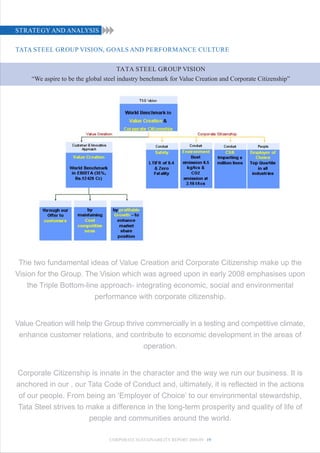
  • 5.
    ORGANIZATIONAL PROFILE MAJOR OPERATIONS TataSteel Limited (Tata Steel) began Through the acquisition of Corus- the second company outside Japan to have won the operations in Jamshedpur, more than 100 largest steel company in Europe - and Deming Application Prize for Excellence years ago. Among Asia’s first integrated investments in NatSteel Holdings, in Total Quality Management. steel manufacturers, the Tata Steel Group Singapore- the top steel maker in the Asia has grown to be a global corporation with Pacific region and Tata Steel Thailand The Tata Steel Group recorded a turnover a crude steel production capacity of about (formerly called Millennium Steel) - the of Rs 1, 47, 329 crore (US$ 28,962 mn) for 30 million tonnes per annum (mtpa). largest long steel producer in Thailand, the the financial year 2008-09 generated by a Company has created a manufacturing and spectrum of brands, which feed markets in Tata Steel has its registered headquarters in marketing network in Europe, South East nine principle segments covering Mumbai. It now is the world`s second most Asia and the Pacific-rim countries. construction, automotive, engineering and geographically diversified steel producer agriculture. and a Fortune 500 Company. Tata Steel is the first integrated steel Tata Steel has a created a presence in markets across geographies and the steel value chain, which has given it an assured customer reach. Tata Steel Group is geographically spread over 5 continents with manufacturing units in 26 countries and a commercial presence in over 50 countries. The Company’s major steel making operations are in: • Jamshedpur, India • IJmuiden, Netherlands • Port Talbot, Scunthorpe, Rotherham and Teesside, UK. • Thailand • Singapore CORPORATE SUSTAINABILITY REPORT 2008-09 05
  • 6.
    ORGANIZATIONAL PROFILE Tata Steelproduces steel using an integrated steel-making concept, utilising raw materials like iron ore, coal, limestone etc. to produce hot metal (liquid iron). This hot metal is converted into steel through a steel- making process. The liquid steel is then cast and rolled into a variety of products. Tata Steel`s Jamshedpur (India) Works has will be among the most energy efficient striving towards raw materials security a crude steel production capacity of 6.8 furnace in the world. through joint ventures in Thailand, Australia, mtpa. The Company also has proposed three Mozambique, Ivory Coast (West Africa) Greenfield steel projects in the states of In addition to Steel Works, the Group has and Oman. Tata Steel has signed an Jharkhand, Orissa and Chhattisgarh in India significant operations to support its agreement with Steel Authority of India with and a Greenfield project in Vietnam. steelmaking activities, including mines and Limited to establish a 50:50 joint venture collieries. It has in-market steel processing company for coal mining in India. Also, The Steel Works in India is in the process facilities and distribution and transportation Tata Steel has bought 19.9% stake in New of expanding its capacity to reach 10 mtpa operations, as well as a sophisticated Millennium Capital Corporation, Canada by 2011. On November 3, 2008 the ground Research, Development and Technology for iron ore mining. breaking ceremony for ‘I’ Blast Furnace of Centre in Rotherham, UK. Tata Steel took place; which will enhanced Tata Steel is also developing joint ventures its crude steel making capacity by 3.05 mtpa. The iron ore mines and collieries in India as part of its collaborative growth strategy. The furnace is expected to be commissioned give the Company a distinct advantage in in FY’11. The state of the art I-Blast Furnace raw material sourcing. Tata Steel is also Major Operational Divisions in India • Steel Works, Jamshedpur (Jharkhand) • Tubes Division, Jamshedpur (Jharkhand) • Tata Growth Shop, Jamshedpur (Jharkhand) • Agrico Division, Jamshedpur (Jharkhand) • West Bokaro Division, West Bokaro (Jharkhand) • Jharia Division, Dhanbad (Jharkhand) • Ore Mines & Quarries Division, Noamundi (Jharkhand) and Joda (Orissa) • Ferro Alloys & Mineral Division, Joda, Sukinda and Bamnipal (Orissa) • Bearings Division, Kharagpur ( West Bengal) • Wire Division, Mumbai (Maharashtra) • CRC (West), Tarapur (Maharashtra) Brief details of other significant operations of Tata Steel Group are provided below. More information on these operations and a full list of subsidiary companies, associates and joint ventures is supplied in Tata Steel Annual Report 2008-09, available to download from the investor relations section of http://www.tatasteel.com/investors/performance/annual-report.asp CORPORATE SUSTAINABILITY REPORT 2008-09 06
  • 7.
    PRINCIPAL SUBSIDIARY COMPANIES: CORUS Corusis Europe’s second largest steel producer with production of around 20 million tonnes per annum (mtpa) and annual revenues in 2008-09 of around £12 billion. Corus’ main steel making operations are located in the UK and the Netherlands with other plants located in Germany, France, Norway and Belgium. Corus produces carbon steel by the basic oxygen steel making method at three integrated Steel Works in the UK at Port Talbot, Scunthorpe and Teesside, and at one in the Netherlands at IJmuiden. Engineering steels are produced in the UK at Rotherham using the electric arc furnace method. Corus has three divisions; Strip Products, Long Products and Distribution & Building Systems. The Company has commercial operations across the world and supplies demanding global markets including construction, automotive, packaging, mechanical and electrical engineering, metal goods and oil & gas. NATSTEEL HOLDINGS NatSteel Holdings Pte. Ltd. (NSH) is a leading long-product player in the Asia Pacific region with an approximate capacity of 2 mtpa. It has operations and joint ventures in Singapore, Malaysia, Thailand, China, Australia, Philippines and Vietnam. Its Singapore based operations serve as a hub for the NSH group, providing engineering, logistics, sourcing information technology and other support services. NSH Singapore has upstream facilities for billet making, rolling bars and wire rods. The group produces construction grade steel which includes rebars, cut-and-bend, mesh, precage, bore pile, PC wire & PC strand. In Xiamen, China, the group has rolling operations, while in Australia manufacturing activities are focused on downstream production (cut & bend, mesh). In Thailand and China, the group has manufacturing facilities for wire drawing. TATA STEEL (THAILAND) Tata Steel (Thailand) Public Company Limited (TSTH), the largest long steel producer in Thailand, with an installed capacity of 1.7 million tonnes per annum. The company was established in 2002 as a holding company consisting of NTS Steel Group (NTS), The Siam Iron and Steel Company (SISC) and The Siam Construction Steel Company (SCSC). The company produces long products, which include rebars, wire rods, small sections, special bars and cut and bend products. PRINCIPAL JOINT VENTURES TATA BLUESCOPE STEEL The 50:50 Joint Venture agreement with BlueScope Steel Limited to form Tata BlueScope Steel Limited became effective from May 30, 2006. The Building Solutions facilities at Pune, Bhiwadi and Chennai have been operational since 2006-07. The construction of the Coated Steel manufacturing facility at Jamshedpur is in progress and expected to open in 2010. The Company offers a comprehensive range of branded steel products for building and construction applications. DHAMRA PORT COMPANY The Dhamra Port project is a Joint Venture with Larsen & Toubro Limited, building an all weather modern deep-water port in the state of Orissa on the Eastern Coast of India. The bulk cargo berths are being designed to accommodate up to 180,000 DWT vessels. A 62.7 km (route distance) rail link connecting the Port to the nearest railway station at Bhadrak on Chennai-Howrah line is included in the project scope. CORPORATE SUSTAINABILITY REPORT 2008-09 07
  • 8.
    TATA NYK SHIPPING Ina joint venture with Nippon Yusen Kabushiki Kaisha (NYK Line), the Company has commenced shipping activities for Tata Group companies and other clients with five ships. Tata NYK handled around 2.4 million tonnes of dry cargo and projects, to service more than 20 million tonnes per year within five years through a fleet of owned and chartered ships. VIETNAM STEEL PROJECT Tata Steel signed a Joint Venture Agreement on August 13, 2008 with Vietnam Steel Corporation (Vietnam’s largest steel company) and Vietnam Cement Industries Corporation (Vicem) for a 4.5 million tonne per year steel complex to be set up in Ha Tinh Province. The first phase of the complex will be a Cold Rolling Mill. Tata Steel will have a stake of 65% in the Steel project. IRON ORE PROJECT IN IVORY COAST Tata Steel and SODEMI entered into an agreement in December 2007 for the development of Mount Nimba iron ore deposits. COKING COAL PROJECT IN MOZAMBIQUE Tata Steel entered into a Joint Venture (JV) with Riversdale Mining Limited, Australia in 2007 for a 35% stake in two coal tenements in Mozambique at Benga and Tete. The agreement gives the Company off-take rights to 40% of the coking coal produced from these mines. OMAN LIMESTONE PROJECT In January 2008 a joint venture was agreed with members of the Al Bahja Group for mining limestone in Salalah province of Oman. CARBOROUGH DOWNS COAL MINE, AUSTRALIA This is a joint project with Vale and other partners, for expanding a coking coal mine in Central Queensland. TATA STEEL – STEEL AUTHORITY OF INDIA (SAIL) Four medium coking coal blocks in Jharkhand are under assessment for coal mining. On allotment of the blocks, the Joint Venture will develop and carry out mining operations for captive use by both SAIL and Tata Steel. SCALE OF THE ORGANISATION - FACTS AND FIGURES u In 2008-09, Tata Steel produced 6.8 million tonnes of crude steel in India at Jamshedpur. u In March 2009, 34,918 people were employed by Tata Steel (India.) u In 2008-09 consolidated net sales revenues stood at Rs. 147,329.26 crore. Financial Performance (Tata Steel India) Item 2008-09 2007-08 (Rupees Million) (Rupees Million) Gross revenue 271,520.0 224,323.5 Profit before taxes 73,156.1 70,663.6 Profit after taxes 52,017.4 46,870.3 Capital employed 581,650.4 469,204.1 Net worth 295,995.3 271,456.2 Borrowings 269,461.8 180,216.9 As on 31.3.09 As on 31.3.08 (Rupees Million) (Rupees Million) Total assets 587,417.7 470,755.2 Ratio 2008-09 Ratio 2007-08 Net debt : Equity 0.78 0.81 Note: 1 USD = 50.87 INR as at 31.3.09 CORPORATE SUSTAINABILITY REPORT 2008-09 08
  • 9.
    NATURE OF OWNERSHIPAND LEGAL FORM Tata Steel is a Public Limited Company. in philanthropic activities to benefit society, 65410589 Ordinary shares). The Company had 857,041 different through the Sir Dorabji Tata Trust, Sir Ratan shareholders as at 31st March 2009, with Tata Trust and other trusts. The Cumulative Convertible Preference the vast majority being individuals. Tata Shares (CCPS) were also converted during Sons Limited is the largest single shareholder During the year, Tata Steel raised US $500 the year into 91211136 Ordinary shares as with just under 29.27% shareholding. Mn through a Global Depository Receipt per the provisions of Rights Issue made in (GDR) issue. The GDRs have been listed FY07-08. For more details on the distribution Around 66% of all profits received by Tata in the London Stock exchange (The GDR of shares and the changes in category of Sons through its shareholding are invested issue size was equivalent to issue of shareholders, please refer to Page 211 of the Annual Report 2008-09. MARKETS SERVED AND PRIMARY PRODUCTS & SERVICES Tata Steel is a global steel producer with balance of approximately 67% and 33% of operations. a balanced presence in developed production, respectively. Whilst the focus European and fast growing Asian of business is steel making, the Company The de-commoditisation of steel and the markets. In India, Tata Steel mainly also seeks to maintain control of downstream development of specialised and differentiated serves the domestic market. The and upstream operations and control its products through branding have been production is segmented into two main business environment, with raw material important elements of business strategy in categories - Flat and Long Products - at a production, transportation and processing recent years. MARKETS, PRODUCTS & SERVICES IN INDIA Products Descriptions Market segment Key customers Long Products Rebars Large construction projects, L&T, AFCONS, DLF, Gammon, Individual houses HCC, individual house builders High and Low Carbon Wire Rods Wire drawing industries for Wire Division, Bansal, ESAB, Miki applications like fasteners, tyre Wires beads, construction, electrodes, springs etc Flat Products Hot & Cold Rolled Sheets, Hot & Auto, Construction industries, Tata Motors, Ashok Leyland, Cold Rolled Coils, Galvanized General Engineering, Appliances, Toyota, Honda, Ford, Maruti, Coils & Sheets, Hot Rolled Plates Industry and housing applications Hyundai, Bajaj, TVS Semi Finished Steel Billets, Slabs Products Tubes Standard Pipes, Precision Tubes, Closed Structural Bearings, Wires Rolled Rings, Forged Rings, Machines Rings, Bearings Plain and Coated Steel Wires Minerals Coal & Coke, Iron Ore, Dolomite, Chrome Ore & Chrome Concentrate Others Ferro Alloys, Agriculture Implements, Services like project studies, design & engineering, personnel and technical training, automation, Information Technology, power and water. Branded Products Tata Shaktee GC Sheets, Tata Steelium Cold Rolled Steel, Tata Tiscon construction rods, Tata Pipes, Tata Bearings, Tata Wiron and Tata Agrico, Tata Structura The Flat Product business in India is and individual house builders. Tata Steel’s has established itself as a national leader in dominated by five big companies. Tata Steel market share in this target segment is the addressing the needs of customers with ranks second in terms of size with about highest at 23%. cutting edge technology in auto and 18% market share. The Long Product construction industries, it also penetrates business, in contrast, is highly fragmented. Tata Steel constantly strives to provide high deep into rural India, with over ten million In this market, Tata Steel has positioned quality products to the high-end market customers for galvanised corrugated sheets itself to meet the needs of quality conscious, segment. It also differentiates its offer by across the country. The Company believes discerning customers. They comprise large tailoring the product and service to meet the in building relationships with its customers reputed infrastructure project companies exact needs of customers. While Tata Steel and over 70% of its sales are through long- term contracts. CORPORATE SUSTAINABILITY REPORT 2008-09 09
  • 10.
    KEY BRANDS ININDIA SIGNIFICANT CHANGES SINCE PREVIOUS REPORTS NEW FACILITIES In line with its growth and development new H Blast Furnace which was formally mtpa. The ‘H’ blast furnace, despite the strategy, the Jamshedpur Steel Works in blown in on May 31, 2008 was a major step delayed startup, surpassed its FY’ 09 target India is increasing its capacity from its earlier in this expansion process, increasing by 0.3 million tonnes in its very first year 5mtpa to 10 mtpa by the end of 2011. The production capacity at Jamshedpur to 6.8 of operation. The following major facilities were commissioned under the 1.8 MTPA Expansion Project:- Major Facilities Amount (Rs.Crores) Month/Year of Commissioning H Blast Furnace 1438.00 May, 2008 Sinter Plant #4 388.00 May, 2008 Power Distribution System 261.00 June, 2008 Widening of Roads (Town) 34.00 June, 2008 Augmentation of LD shops 335.00 July'08 335.00 July, 2008 (LD#1 & LD#2) 280.00 November, 2008 CC#3 61.00 September 2008 7th Lime Kiln 109.00 September 2008 Utilities 32.00 July 2008 Water system 214.00 July 2008 RMHS CORPORATE SUSTAINABILITY REPORT 2008-09 10
  • 11.
    AWARDS AND RECOGNITIONIN 2008-09 • From September 22, 2008 Tata Steel is one of only two Indian companies (along with Tata Consultancy Services) to feature on the composite Dow Jones Sustainability World Index (DJSI World). DJSI World comprises leaders in sustainability - the top performing 10% of companies, selected on the basis of long-term economic, environmental and social criteria, from the largest 2500 companies in the world. A systematic corporate sustainability assessment identifies the sustainability leaders in 57 separate industry groups. The analysis considers general as well as industry-specific sustainability trends and evaluates companies based on a variety of criteria, including climate change strategies, energy consumption, human resources development, knowledge management, stakeholder relations and corporate governance. • Tata Steel India was awarded the Deming Application Prize 2008 for excellence in Total Quality Management. It is the first integrated steel company in the world outside Japan to receive this award. • Economic Times Award for the Company of the Year 2008 was awarded in January 2009 by Dr. Manmohan Singh, Prime Minister of India. This award is recognition of the Company having consistently set clear performance benchmarks for the rest of the industry and striven to become a world leader. • Selected amongst Forbes ‘Fabulous Fifty’ – as one of the best Asian companies – on 17th December 2008 The award looks for continual commitment by business to ethical behaviour, to economic development and to improving the quality of life of employees and their families, as well as to engagement with local communities and society at large. • TERI Corporate Award (in collaboration with GTZ) for Business Response to HIV/ AIDS, awarded in May 2008 • CII – ITC Sustainability Award for sustainable development from Confederation of Indian Industry (CII), 2008 • Managing Director of Tata Steel conferred with Jamsetji Tata award by Indian Society for Quality, 2008 • Think Odisha Leadership Award for Corporate Social Responsibility for 100 years of Service to the Nation, awarded in 2008 • Most Admired Knowledge Enterprise (MAKE) Asia Award from World Knowledge Forum 2008. 1st position as overall Asian winner • Commercial Taxes Jewel Award presented in January 2009 by the Commercial Tax Department, Government of Bihar • JIPM TPM Excellence Award for JUSCO in 2008 - the only company in the Utility Services domain in the world to achieve this award • The 5th Asia Water Management Excellence Award was conferred on JUSCO on April 1, 2008. JUSCO is the first Indian Water Company to receive this prestigious award. • Tata Steel won 16 prizes in the 46th Annual Mines Safety Week Celebrations 2008 for Chaibasa region, organised under the aegis of the Directorate General of Mines Safety (DGMS), Govt of India, including the most prestigious Innovation Award bestowed upon Joda East Iron Mine (JEIM). CORPORATE SUSTAINABILITY REPORT 2008-09 11
  • 12.
    REPORT PROFILE Tata Steel’sSustainability Reports are produced annually and this report covers the Company’s financial year 1st April 2008 – 31st March 2009. The last Corporate Sustainability Report was published for the year 2007-08. The report is produced to communicate to stakeholders: • Tata Steel’s approach to corporate sustainability • Its management of sustainability issues • Performance on Global Reporting Initiative G3 indicators and on reaching Company goals We hope that this report meets the needs of the majority of our stakeholders. Many of our stakeholders such as employees and local communities receive communication on relevant issues primarily through other sources. Mr. Sanjay Choudhry Contact Person Chief, Corporate Affairs and Communications TATA STEEL Limited The Company is delighted to hear stakeholders’ views on this report, Jamshedpur, INDIA the Company’s approach to sustainability and its performance. Please Telephone: +91 657 2431142 email sustainability@tatasteel.com or contact: Fax: +91 657 2425182 email: sanjay.choudhry@tatasteel.com Tata Steel seeks to develop and improve its reporting process and will be considering all feedback received to ensure that the report meets stakeholder needs. Additional information Report Scope & Boundary Report Content Additional information on In 2009, we reviewed our sustainability This report uses the Global Reporting Initiative (GRI) G3 economic, environmental reporting process in line with our assessment guidelines. The information has been compiled through a and social performance of of stakeholder requirements and the growth dedicated committee with representatives from different the organisation can be of the Tata Steel Group to encompass varied departments within Tata Steel. made available on request international operations. For this purpose, from the contact person it was decided to report globally through a As far as possible, all relevant disclosures and performance indicated above. This Corporate Citizenship Report which will be indicators set out in the GRI G3 guidelines are supplied, report will also be made published separately. with additional reference to Company goals and targets available on Tata Steel’s where appropriate. While prioritisation of materiality issues Internet website This report boundary is limited to the was undertaken in this reporting period, we endeavour to w w w. t a t a s t e e l . c o m . operations of Tata Steel India. employ a more formal methodology in the coming year’s Sustainability Report. Boundary of the Report • The intent of this report is to cover all major operational divisions of Tata Steel India in a progressive manner. • The disclosures are largely limited to the Jamshedpur Works as the major operations of steel-making are carried out from this location. • Subsidiary activities of companies in Europe, South East Asia and elsewhere are not included in this report • All other associated companies, subsidiaries, ancillary industries, have been excluded • Most of the community development initiatives are implemented through wholly owned subsidiaries/ societies/ trusts promoted by Tata Steel. Since they are relevant, they are reported in some of the sections of this report. CORPORATE SUSTAINABILITY REPORT 2008-09 12
  • 13.
    Significant Changes inBoundary As compared to the previous year’s CS disclosures related to NatSteel Holdings and Holdings and Tata Steel (Thailand) and Report (FY’08), we have limited the Tata Steel (Thailand). The 2007-08 report hence will not impact the trending of the boundary as above and it does not contain included separate sections on NatSteel performance data reported this year. DATA MEASUREMENT TECHNIQUES There has been no change in the data 1 USD = 50.87 INR (Indian Rupee; Rs.) Tata Steel follows the norms and procedures measurement techniques from last year’s prescribed for workplace Safety and reporting. Monitoring, measurement and calibration Environment by Ministry of Environment, is carried out as per relevant Indian Ministry of Labour & Welfare (Factories Financial & Economic data are reported as standards. Documentation and Act). In 2008 the LTIF measure was brought per the guidelines provided in the Company communication are undertaken as per the into line with global industry guidelines to Law of India and Indian GAAP Standards. requirement of ISO 9001 & ISO 14001, become more stringent than Indian Factories USD (US dollar) conversion rates used are, OHSAS 18001 & SA8000. Act requirements. The calculation as at noon 31st March 2009: methodologies are explained in their relevant sections. INDEPENDENT ASSURANCE Tata Steel continues to seek independent appointed Det Norske Veritas AS (DNV), against their VeriSustain protocol. Their assurance for its Corporate Sustainability as the independent assurance provider. DNV independent assurance statement has been Report. Accordingly in 2008, Tata Steel has conducted a moderate level of assurance included at the end of this report. AUDITING PROCESSES Economic Performance Assurance Environment, Health & Society Safety The Quarterly, Half Yearly and Annual Social audits are conducted once every 10 years by a bench of books of account are audited by The independent third external, independent auditors comprising eminent individuals from internal and external auditors. The party audits are conducted the judiciary, social organisations and financial institutions, appointed 2008-09 accounts were audited by by M/s. IRQS for by Tata Steel’s Board of Directors. The last audit was conducted in Deloitte Haskins & Sells, Chartered Divisions certified to 2004. Accountants, Mumbai. The scope of Environmental external audit includes assessing the Management System, The Steel Works at Jamshedpur and Sukinda Chromite Mines were accounting principles used and ISO 14001:2004 and certified to SA8000 in 2004. M/s. Det Norske Veritas conducted the significant estimates made by Occupational Health and external audit of the system in 2008-09 for the Jamshedpur Steel management, as well as evaluating Safety Management Works. the overall financial statement System, OHSAS presentation. The audit is undertaken 18001:1999 once a year. Tata Steel’s Resettlement and Rehabilitation programme ‘Parivar’ in accordance with auditing standards is to be independently audited to provide an objective assessment in India. of how families displaced by the Company’s greenfield projects - and therefore assisted by the Parivar programme - are affected over the years. CORPORATE SUSTAINABILITY REPORT 2008-09 13
  • 14.
    STAKEHOLDER ENGAGEMENT “In afree enterprise, the community is not just another stakeholder in our business, but in fact, the very purpose of its existence.” - Jamsetji Nusserwanji Tata Our stakeholder engagement process planning and business practices. investor and brand surveys, customer emanates from the above belief of our satisfaction surveys, employee satisfaction Founder, Jamsetji Nusserwanji Tata. This Stakeholder engagement at Tata Steel surveys, community need analyses, social belief is the guiding principle for all happens at various levels and functions. The audits, media reviews, press meets etc. companies in the Tata Group and Tata Steel engagement process is undertaken through Informal feedback is gathered through follows it in letter and spirit. The same has both formal and informal modes. Some of interactions and dialogues across multi- also been incorporated in all our strategic the formal processes employed by us are- stakeholders. STAKEHOLDER ENGAGEMENT STRATEGY The identification of stakeholders, whom to engage with, is primarily determined of if they belong to the following: • Those who are affected by our activities • Those who have influence or control over our activities • Those who have an interest in the Company’s success or failure and help in defining its value proposition The level of interaction with the stakeholders is derived out of the Power- Interest Grid, as depicted below: POWER-INTEREST GRID HIGH KEEP SATISFIED MANAGE CLOSELY Put enough work on these people to These are the people who you must keep them satisfied,but not so much fully engage and make the greatest that they get disenchanted with your effort to satisfy. message. MONITOR KEEP INFORMED Monitor these people, do not disenchant Keep these people adequately informed, them with excess communication. talk to them to ensure that no major issues are arising. They can often be very helpful with the detail of the project. LOW LOW HIGH CORPORATE SUSTAINABILITY REPORT 2008-09 14
  • 15.
    STAKEHOLDER ENGAGEMENT –APPROACH, ISSUES AND COMPANY USE/ RESPONSE Stakeholder Approach Issues Use/Response Shareholders & Annual General Meeting Strong financial management, Objective & Target settings, investment Financial Community Investors meet - across the globe strategic planning and business decisions, diversifications/ merger /acquisition, Updating major shareholders performance: overall company perception with analysis, emerging Shareholder Relations Meet performance and its implication strategic issue identification. Shareholder Committee on market capitalization and Initiatives: meetings creation of shareholder value. Optimising assets Investor Satisfaction Survey Corporate governance Differentiation of product in market place Performance reports and Business ethics Continuous improvement from acquisitions Sustainability reporting Sustained value creation Capacity expansion at greenfield locations Investor calls Remaining an EVA + company Investments and joint ventures for raw material Seizing new opportunities to security grow R&D and innovation Risk management Improving Triple Bottom-line performance Sustainability performance Managing business ethics and the principles Complaint/conflict handling of UN Global Compact Customer Customer meets Trust to supply what is needed Product improvement, product development, Customer visits in efficient and ethical way. User customer retention, market penetration, Customer Service Team needs, customer satisfaction, emerging demand scenario and price Retail Loyalty programme product quality and functionality. sentiments, development of short and long Retailer meets Product features term business plans, identification of customer Cross-functional teams for Product value related issues. Product Groups Product quality Initiatives: Customer Satisfaction Surveys Cost and delivery New steel grades and advanced products for Customer Contact Programme Product development the automotive market Steelium LINKS – ‘Learning Quality of service Enhancement of in-shop experience; exclusive Interaction Networking shops Knowledge Sharing’ – Loyalty programmes engagement programme Product and service enhancements Due Date Performance System (DDP) Steel N Style Suppliers & Partners Vendor Dialogues Trust to procure fairly and Supplier relationship management: Vendor Meets & Recognition reliably, communicate clearly Initiatives: Meetings with Key Suppliers - and develop ongoing supply Safety training as per plan relationship. Supplier Value Management Safety awareness programmes Identification of areas for Monitoring compliance to SA8000 Standard SA8000 Awareness programmes improvement. Registration of vendors after fulfillment of and audits Health and safety of workers statutory requirements Joint improvement initiatives Fairness in pricing Monitoring payments of minimum wages, ESI, with key suppliers Fair business practices PF of contractor workmen Supplier Relationship Value creation Management Centre Compliance with statutory requirements External Public / As needed, meetings with: Corporate responsibility, Management programs for compliance and Government / Media Government, Steel Ministry, business ethics and global resource conservation, management programs / Industry / Society Trade Bodies, Industry citizenship. for community development. Associations, NGOs, Ministry Requirements under statutes Initiatives: for Environment & Forests, etc. Compliance status Brand research and corporate identity Press Briefings & Releases Threats to business development Participation in networks Licence to operate Understanding of external business Events Environmental impacts environment and issues Contact mechanisms with Issues raised in relation to Review policy and process prospective employees specific operations New Public policy development and participation Sustainability Report and Annual operations and collaborations in collaborative initiatives e.g. with IISI Report Innovations Contribution to Millennium Development Goals and triple bottomline CORPORATE SUSTAINABILITY REPORT 2008-09 15
  • 16.
    Stakeholder Approach Issues Use/Response Community Senior Citizens Forum - Half- Managing operations in balance Impact management and CSR Plan for yearly with the needs of the community, development of community. Spouses’ Dialogue - Yearly seeking to enhance quality of Initiatives: Joint Community Meeting life and contribute to nation- Sustainable Livelihood through land and water Community Needs building. management, rural enterprise development and Survey/Analysis Feedback on business impacts vocational training Village level institutions e.g. and performance Health and sanitation- Preventive promotive Village Development Feedback on community and and curative health initiatives. Drinking water, Committees and Self Help civic infrastructure e.g. Tata Disability Management, Life line express, Groups Main Hospital HIV/AIDS prevention programme, Projects Informal dialogue through Needs of local peoples in on mother and child health activities of JUSCO, Sports greenfield project areas Education – Early childhood education, Adult centres and social clubs, Tata CSR project developments Literacy, Camp School and financial assistance Steel Rural Development New initiatives for higher education Society, Tribal Cultural Society Awareness of Initiatives towards Empowerment – empowering youth through and Tata Steel Family Initiatives community sports Foundation. Preservation and promotion of ethnicity of Sustainability Report primitive tribes like Birhor and Sabar Environment- Renewable Energy Project and afforestation Reporting and documentation of the same CSR initiatives Employees All: Workplace issues and Employee Satisfaction Index, identification of MD Online - monthly employment pay and benefits. employee related issues. Health & safety Initiatives: Hotmail – intranet Diversity, human rights and Du Pont safety programme for zero accidents suggestion/comments equal opportunity inc gender Monitoring of quality of life with targets equality Training Management: Freedom of association Management of Business Ethics activities - Senior, General & Ladies Collective bargaining employee conduct and protection Dialogues - 4-6 per annum Participative management Remuneration benchmarking Benefits and welfare Small group activities Quality of life HIV/AIDS awareness Unionised employees: Learning, development and Knowledge management Dialogue with Union Committee individual growth ASPIRE – quality system Members (JCCM, JWC, and Respect, reward and recognition Community initiatives – employee involvement JDC) - (3,6,2 per annum) Transparency, fairness and equity planning and volunteering e.g. disaster relief Learning Monthly Department/Section Labour relations and employee Communication Meetings satisfaction BE Facilitators Meet - 6 per Plant/Company performance annum Vision, values, policies and Joint Works Quality Committee strategies - quarterly Continuous improvement Employee suggestions CORPORATE SUSTAINABILITY REPORT 2008-09 16
  • 17.
    GREENFIELD PROJECTS The expansionplan of Tata Steel is Orissa and Chhattisgarh. The issues being Company has been facing some opposition u n d e r w a y, w i t h M e m o r a n d a o f faced by Tata Steel relate mainly to land from villagers and also from local governing Understanding signed for three Greenfield acquisition from villagers and allotment of bodies, political leaders and influencers. steel plant projects in the states of Jharkhand, mines by the state government. The Tata Steel’s approach: • Communicating the CSR initiatives of Tata Steel to involved stakeholders • Creating awareness about the advantages of industrialisation and employment opportunities to the beneficiaries • Regular meetings and interactions with the local bodies and the political leaders to tell them about the importance of industrialisation and the impact on the standards of living and levels of income • Initiating and conducting coaching and training sessions in various trades to improve employability at the project sites and for the project affected families for all age groups, including women • Publicising the concept of Tata Steel Parivar, which is Tata Steel’s Resettlement and Rehabilitation programme that includes livelihood options along with land, housing and employment opportunities for the beneficiaries. DHAMRA PORT Interested stakeholders have expressed concern that the construction of the Port would affect the nesting of Olive Ridley Turtles. Tata Steel’s approach: • The Company has re-iterated that all precautions are being taken to ensure that there is no damage done to the nesting and breeding ground of the Olive Ridley Turtles • Tata Steel has tied up with the International Union for Conservation of Nature (IUCN) to ensure that the port operations do not get impacted. IUCN is the world’s oldest and largest global environmental network - a democratic membership union with more than 1,000 government and NGO member organisations and almost 11,000 volunteer scientists in more than 160 countries. • Social awareness campaigns are being undertaken to protect the turtles • Turtle extruding devices have been installed in the dredges as well as popularised in their use the fishing trawlers • Special port lighting is being installed which will not impact or disorient the turtles KALINGANAGAR PROJECT- CASE STUDY Manasi Mahanta has set a benchmark in including Manasi Mahanta. start a SHG group and created a structured micro-enterprise entrepreneurship by training programme on day-to-day establishing the brand of Maa Pickles in Manasi and many others like her relocated management of the SHG. The motivation Jajpur. Manasi, a member of Tata Steel after getting assurance of Company officials culminated in the formation of the 12- Parivar, is the Secretary of Dibyajyoti SHG of a bright future. They were provided with member Dibyajyoti SHG. The group group which has created the ‘Maa Pickle’ 10 decimal land and Rs 1.5 lakh for members showed interest in starting a small and have made it a household name in Jajpur. construction of their homes. Financial business venture independently. Manasi and This SHG group has started as Dibyajyoti assistance for house construction has been majority of the members suggested that the Griha Udyog in 2008 with a loan of RS enhanced from Rs 1.5 lakhs to Rs 2.5 lakhs R&R officials train them on modern 1,070, 00 from a nationalized bank. They this financial year. In addition, they were techniques of pickle making. Today Manasi have reached an annual sales turnover of paid monthly maintenance allowance of Rs is not only a Secretary of this SHG she has Rs 2,306,67 and also have been able to repay 2,300. also become a teacher in Sri Ganesh Siksha the bank loan. All this has happened due to Mandir. Her husband Akhila Mahanta is exceptional entrepreneurial skills and Tata Steel Resettlement & Rehabilitation also undergoing mechanical training at initiative shown by 12 members of the SHG (R&R) officials motivated these women to CTDC, Bhubaneswar. CORPORATE SUSTAINABILITY REPORT 2008-09 17
  • 18.
    We undertook amateriality mapping exercise Our core Sustainability Reporting team in 2009. comprised Heads and experts from departments of Safety, Environment, The most crucial issues were plotted in the Corporate Sustainability Services, Finance report by combining matters that are & Accounts, Legal, Marketing and Sales, ADDRESSING intrinsically material to the organization and Procurement etc with proficiency in all areas its stakeholders as well as those that received of sustainability. In the near-term, we would MATERIALITY particular attention in the reporting period. be looking at stream-lining and improving our materiality assessment process. The key indicators covered in the report were shortlisted on the basis of the following factors by the core team:- To address all - Tata Steel’s Vision, Mission, Values and Policies - Future challenges, risks and opportunities material issues faced - Inputs from stakeholder engagements - Relevant laws and regulations and strategic partnerships by us and our - Key initiatives significant for organizational success stakeholders, is MATERIAL ISSUES understood as one of The representation below indicates the most material issues impacting the Company and the most significant its stakeholders as derived by the materiality mapping exercise undertaken by the core team. tasks by the Company. We realize that it is only through gauging the perceptions of the stakeholders, can we be familiar with the issues of importance throughout the organisation. CORPORATE SUSTAINABILITY REPORT 2008-09 18
  • 19.
    STRATEGY AND ANALYSIS TATASTEEL GROUP VISION, GOALS AND PERFORMANCE CULTURE TATA STEEL GROUP VISION “We aspire to be the global steel industry benchmark for Value Creation and Corporate Citizenship” The two fundamental ideas of Value Creation and Corporate Citizenship make up the Vision for the Group. The Vision which was agreed upon in early 2008 emphasises upon the Triple Bottom-line approach- integrating economic, social and environmental performance with corporate citizenship. Value Creation will help the Group thrive commercially in a testing and competitive climate, enhance customer relations, and contribute to economic development in the areas of operation. Corporate Citizenship is innate in the character and the way we run our business. It is anchored in our , our Tata Code of Conduct and, ultimately, it is reflected in the actions of our people. From being an ‘Employer of Choice’ to our environmental stewardship, Tata Steel strives to make a difference in the long-term prosperity and quality of life of people and communities around the world. CORPORATE SUSTAINABILITY REPORT 2008-09 19
  • 20.
    RISK MANAGEMENT ANDOPPORTUNITIES Sustainability management is considered Director and the Audit Committee of the in the risk profile. The Company today faces within the Company’s strategy-setting, risk Board. greater complexities and challenges and analysis and business planning. Tata Steel’s even greater expectations from its financial performance and risk management In recent years, Tata Steel has been on a stakeholders. Given the complexity of these assurance is provided by an in-house Internal path of growth and development and, needs, a new risk assessment process, termed Audit function, reporting to the Managing associated with this, there has been a change Enterprise Risk Management (ERM), is being implemented in 2008-09. Some of the key risks the Company has been monitoring, reviewing and managing in 2008-09 are: Industry Cyclicality: The steel industry is subject to cyclical contraction in global steel demand, efficiency as well as streamlined operations swings arising from factors such as excessive especially in the construction and automotive and assets with a view to positioning the capacity expansion, volatile demand swings sectors of the developed economies of UK, operational readiness for eventual market etc. The current global economic crisis, Europe and United States. To align with recovery. which accelerated during the second half of significantly lower demand, Tata Steel India the financial year, resulted in a sharp turned its attention to the need for cost Raw Materials Security and Price Volatility: During the first half of FY` 09 strong The Group has therefore identified it as a in the parent company Riversdale Mining economic growth experienced by the global priority to increase its overall raw material Limited. The Group is also well positioned economies, led by China and India resulted security threshold from its current level of to benefit from the Direct Shipping Ore in strong demand for steel worldwide. Even 25% to 60% within the next few years. To ("DSO") project with New Millennium as the mining and shipping industry this end, the Group's 35% stake in the Benga Capital Corp ("NML") in Canada. struggled to respond to the massive growth Coal Project with Riversdale Mining in Operationally, the Group enters into long- in demand, prices for iron making materials Mozambique is a major step. The term contracts and annual benchmark pricing like iron ore, coal, ferroalloys, scrap and Government of Mozambique has approved contracts for its key raw material freight climbed relentlessly. Notwithstanding the Mining Contract for the tenements requirements. This approach provides price the fact that the economic downturn has representing a significant step towards certainty and an objective basis for the dampened short-term sentiments, the commencement of the project. Under the recovery of cost increases from its underlying demand for scarce resources is off-take agreement with Riversdale, the customers. expected to resume once the world Group has rights to 40% of the mine's output. economies progressively recover. Tata Steel also holds 14.99% equity stake Growth Strategy: The Company's growth strategy comprises Jamshedpur site, which are expected to subsequent deployment will be based on of various capital expenditure programmes deliver immediate incremental earnings on new priorities of profit contributions and and/or acquisitions in different locations. completion, all other major group quick time to market principles. The Integration and project execution risks investments and capital projects have been integration of TSE post 2007 is critical to therefore exist. In light of the current put on hold. achieving the promised synergies for the economic situation, except for critical raw Tata Steel Group. It is now two years in the material related investments and approved This prudent approach will allow the making and the integration process is capital expenditure programmes at the accumulation of cash resources. Its proceeding well at all levels of interaction. CORPORATE SUSTAINABILITY REPORT 2008-09 20
  • 21.
    Health, Safety &Environmental Risks: The manufacture of steel involves steps that it operates. These rules are becoming more For the sustainability of its operations, the are potentially hazardous and which are stringent. “Process Safety & Risk Management” likely to cause disruptions to normal (PSRM) programme has been started for operations if not executed with due care. The Group has set specific goals to be the high hazard operations and processes, The Company’s businesses are subject to achieved by 2012 in the areas of CO2 in order to ensure freedom from high numerous laws, regulations and contractual emissions (1.5 tonnes per tonne of liquid consequence, low frequency process commitments relating to health, safety and steel) and LTIF (below 0.4). incidents. PSRM will be implemented in all the environment in the countries in which facilities by FY` 12. Technology Risks: One of the biggest risks before the Group competitiveness and R & D leadership. For the same and continues to enhance and is to ensure that its plants are equipped with this purpose, the Group has not cut back the deploy R & D capabilities. upto date technologies that can give it cost necessary capital investments in relation to Regulatory & Compliance Risks: Global operations require compliance with changes can expose the Group’s businesses political, business and legal frameworks in multiple and complex laws and regulations. to uncertainties. place. There is an established due process In countries where the political systems are to independently evaluate country risk still evolving, frequent changes in economic The Group operations are primarily in exposures for investments in emerging policy are common, investment guarantees countries where investment flows are more economies. and property rights are secured, unforeseen unrestricted and where there are established Financing: The Company funded the acquisition of put a strain on its ability to meet the current Unless the current economic crisis does not Corus with a significant level of debt that scheduled debt repayment obligations under get protracted, these reset criteria are was assumed at the acquired company level. the existing Senior Facility Agreement. expected to provide TSE with the necessary Sharp decline in steel demand and prices space and time to work towards returning particularly during the second half of the The Group has successfully renegotiated to sustainable profit levels. financial year has adversely affected the specific terms relating to debt repayments cash flow generation of TSE and potentially and financial covenant measurements. Forex, Credit, Liquidity and Counterparty Risks: Through its global operations, the Group positions but the long-term economic protect its trading and manufacturing operates in several currency areas. The major competitive position vis-à-vis imports. The margins against rapid and significant currencies used in its sales and procurement current economic crisis has also raised credit movements in its major trading currencies. activities are the US Dollar, Euro and and counterparty risks, especially with the The Group does not enter into leveraged Sterling Pound. Any major fluctuations or withdrawal of credit insurance. derivative instruments. change in currency trends can greatly affect not only the Group’s short-term trading The Group has a hedging policy in place to CORPORATE SUSTAINABILITY REPORT 2008-09 21
  • 22.
    BUSINESS ETHICS Tata Steeldoes not tolerate corrupt or set out originally by J.N. Tata, Founder of which have been adopted by all Tata fraudulent practices and expects honesty, the Tata Group, who believed that business companies In 2008, in line with changes in integrity and transparency in all aspects of must operate in an ethical way that respects the times, and the globalisation of the Tata its business, from employees, contractors the rights of its stakeholders and creates a Group, the Code was updated, in and other business counterparts. total sum benefit for society. consultation with Tata Steel Group companies around the world. The revised Ethics are central to its business. Tata Steel's Since 1998 these ethical principles have Code of Conduct was adopted by the Tata ethical philosophy forms part of its legacy, been articulated in the Tata Code of Conduct, Steel Group Board in October 2008. TATA CODE OF CONDUCT 2008 The revised Tata Code of Conduct 2008 Code now extends to contractors and various employee communication media addresses contemporary issues of concern vendors, who must agree to respect the and an interactive learning programme about for global business, with more focused Code. the clauses of the Code. direction for example on integrity, fraud, bribery, corruption, conflict of interest, Tata Steel's businesses across the world have All Tata Steel Joint Ventures will have a competition and excellence. The importance adopted the new Code of Conduct and 2008- Code of Conduct based on the business of implementing a sustainability protocol 09 was an important year for rolling out the principles enunciated in the Tata Code of has been addressed for the first time. Code in some of the recently acquired Conduct. For example one of the elements businesses. Formal adoption was of the Joint Venture Memorandum of All employees have a clear responsibility accompanied by an awareness raising Agreement with partners in Vietnam includes to implement the Code. Additionally the programme including information through adoption and implementation of the Code. PRIORITY SUSTAINABILITY BUSINESS RISKS AND PERFORMANCE 2009 Priority Business Risk Key stakeholder Performance Indicator 2007-08 2008-09 Economic Recession/ Financial Employees Shareholders EBITDA 8,257 9,442 Stability Environment CO2 Emissions Community Government Specific CO2 emission excluding 2.14 2.09 Customers imported Elect + Mobile + HFC (t/tcs) NGOs Energy Efficiency NGOs The specific energy consumption of the 27.86 27.58 Community Government integrated iron and steel works at Jamshedpur in GJoule/tonne of crude steel Water Management NGOs Water Consumption in Million m3 / 35.01 37.13 Community Government Annum Waste Management NGOs % of generation indicating the quantity of 85.35 89.61 Community Government the waste generated that was utilised Labour Practices Safety Employees LTIFR 1.7 0.8 No. of fatal accidents 8 6 (Employees+ Contractors) Employee Satisfaction and Employees Attrition Rate % 3.96 -34.98 Retention Human Rights SA 8000 Compliance Employees Contractor- Re-certified for compliance to SA 8000 standard in 2007 Workers Community Social Community Development Community Employees Community Investments in Rs/ Million 960 770 Suppliers Product Customer Satisfaction Customers Overall Customer Satisfaction index - 1.13 1.06 Responsibility Suppliers relative score of the Company’s overall (Flat Products) (Flat Products) Dealers & Retailers score over the nearest competitor. 1.04Products) 1.07Products) (Long (Long (AC Nielson, TNS) Innovation in product quality Employees Customers and services Suppliers New innovations described on page ** Dealers & Retailers CORPORATE SUSTAINABILITY REPORT 2008-09 22
  • 23.
    GOVERNANCE, COMMITMENTS ANDENGAGEMENTS GOVERNANCE The Company’s Corporate Governance Philosophy Tata Steel follows global good practice in to deliver its responsibilities for creating corporate responsibility are inherent in all governing business. It has always prioritised and safeguarding shareholder wealth. During activities. sound corporate governance and aspires to the year under review, the Board pursued The Company is committed to full go well beyond legal requirements to be an these objectives through monitoring major transparency and accountability in all exemplar of good governance. risks to the Company's business, prudent transactions, in order to protect the interests business planning, implementing appropriate of its stakeholders. A detailed Corporate The Board considers itself a Trustee of its corporate strategies, monitoring for Governance Report is provided in the Annual shareholders and has robust systems in place compliance and ensuring that integrity and Report 2008-09. BOARD OF DIRECTORS Independent Directors are those who, apart number of Non-Executive Directors was Board of Directors (March 31, 2009) from receiving director’s remuneration, do more than 50% of the total number of Mr. Ratan N. Tata - Chairman not have any material or pecuniary Directors. Mr. James Leng - Deputy Chairman relationship or transaction with the Mr. Nusli N. Wadia Company, its promoters, its management or Tata Steel has adopted the Tata Code of Mr. S. M. Palia its subsidiaries, which may affect the Conduct for Executive Directors, Senior Mr. Suresh Krishna independence of the Director’s judgment. Management Personnel and other Executives Mr. Ishaat Hussain A financial institution nominee is considered of the Company. It has also adopted the Tata Dr. Jamshed J. Irani to be an Independent Director in all cases. Code of Conduct for Non-Executive Directors Mr. Subodh Bhargava of the Company. Confirmation of compliance Mr. Jacobus Schraven The Company was in compliance with the with the Codes during this year was received Dr. Anthony Hayward recent amendment of Clause 49 of the from the Executive Directors, Senior Mr. Andrew Robb Listing Agreement pertaining to Management Personnel and Non-Executive Dr. T. Mukherjee compositions of Directors. None of the Directors. Both the Codes are posted on the Mr. Philippe Varin Directors on the Board was a member of Company’s website. Mr. B. Muthuraman more than ten committees and Chairman of more than five committees across all The Board periodically reviews compliance On March 31, 2009, the Company had companies in which he is a Director. The reports of all laws applicable to the Company. fourteen Directors on its Board, of which necessary disclosures regarding committee Steps are taken by the Company to rectify eight Directors were independent. The positions were made by the Directors. The instances of non-compliance, if any. COMMITTEES OF THE BOARD Audit Committee The Audit Committee reviews compliance with internal control systems and the results of internal audits, reviews the financial results of the Company before submission to the Board and makes recommendations to the Board on audit procedures and any matter relating to the financial management of the Company. Remuneration Committee The Remuneration Committee reviews the performance of the Managing Director and the Whole-time Directors, after considering the Company’s performance, and recommends remuneration and benefits. CORPORATE SUSTAINABILITY REPORT 2008-09 23
  • 24.
    Shareholders’ Committee An Investors’Grievance Committee was constituted in 2000 to examine investors’ complaints like transfer of shares, non-receipt of balance sheet and non-receipt of declared dividend, etc. Executive Committee of the Board The Executive Committee of the Board approves capital expenditure schemes and donations, within the stipulated limits, and recommends to the Board capital budgets and other major capital schemes. It considers new businesses, acquisitions, divestments, changes in organisational structure and periodically reviews the Company’s business plans and future strategies. Nomination Committee The Nomination Committee was constituted in 2006 with the objective of identifying Independent Directors and taking steps to review and refresh the constitution of the Board periodically. Committee of Directors The Committee of Directors authorises certain routine matters such as the Opening and Closing of Bank Accounts of the Company, granting limited Powers of Attorney to Officers of the Company, appointing proxies to attend general meetings on behalf of the Company, etc. The Circular Resolutions of the Committee are placed before the Board at its next meeting. Ethics and Compliance Committee In accordance with the Securities and Exchange Board of India (Prohibition of Insider Trading) Regulations, 1992, the Board of Directors of the Company adopted the revised Tata Code of Conduct for Prevention of Insider Trading and the Code of Corporate Disclosure Practices (the Code) to be followed by Directors, officers and other employees. The Code is based on the principle that Directors, officers and employees of a Tata Company owe a fiduciary duty to, among others, the shareholders of the Company, to place the interest of the shareholders above their own and conduct their personal securities transactions in a manner that does not create any conflict of interest situation. The Board appointed the Group Chief Financial Officer as the Compliance Officer to ensure compliance and effective implementation of the Regulations and the Code across the Company. General Body Meetings An Annual General Meeting is held each year and occasional Extraordinary General Meetings are held when necessary. The last Annual General Meeting was held on 28th August 2008. Linking compensation with achievement The Non-Executive Directors (NEDs) are paid remuneration by way of Commission and Sitting Fees. Commission was paid at a rate not exceeding 1% per annum of the profits of the Company (computed in accordance with the Companies Act, 1956). The distribution of Commission amongst the NEDs is placed before the Board. Sitting fees are paid at agreed set rates for attending meetings of the Board and its various committees. The Company pays remuneration by way of salary, perquisites, fixed allowances and variable commission to Managing and Whole- time Directors. Specific amounts payable to such directors are based on the performance criteria laid down by the Board, which takes into account the performance of the Company and annual profits earned. Such payments are made based on the recommendations of the Remuneration Committee, within the range approved by the Shareholders and the ceiling fixed by the Board, which is compliant with stipulations of the Companies Act, 1956. The annual variable pay of senior managers is linked to the performance of the Company in general and their individual performance for the year, measured against specific Key Result Areas, which are aligned to the Company’s objectives and the Vision goals. Thus compensation is linked to performance on issues of concern such as Safety. CORPORATE SUSTAINABILITY REPORT 2008-09 24
  • 25.
    Managing conflicts ofinterest The Tata Code of Conduct adopted by all Directors, Senior Management and Employees of Tata Steel ensures that personal interests do not conflict with the interest of the Company. The Code explains clearly when such a conflict may occur and stipulates that any such conflicts or potential conflicts must be disclosed in writing to higher management for guidance and appropriate action. Disciplinary action will be taken if management becomes aware of a conflict of interest which has not been disclosed. Financial transactions in which Directors are interested, if any, are required to be placed before the Board for approval. The Company has a policy of prevention of insider trading in securities of the Company. Purchase or sales of shares of the Company by employees / senior management / Directors who are likely to have price sensitive information about the Company are subject to various restrictions. Such designated persons are required to make disclosures on shares purchased/sold by them or their dependents. In 2008-09 there were no materially significant related party transactions which had conflict with the interest of the Company. Selection of Board Members The Board of Directors is guided by the organisation’s Vision and Values. The composition of the Board of Directors is a mix of full time executives and non-executives representing business houses and financial institutions, with requisite experience in handling economic, environmental and social issues. There are guidelines for the selection of Board Members, with criteria covering the individual skills that add to the composite perspective of the Board, as well as ensuring capacity for full participation. The Nomination Committee of the Board is responsible for identifying Independent Directors to be included on the Board. Mechanism for providing recommendations to the Board The mechanism for shareholders to provide recommendations to the Board is primarily through the Annual General Meeting and communication with the Shareholders Committee, as well as via Investor Satisfaction Surveys, meetings with investors and the Company website. The suggestions, comments and feedback provided by the shareholders during the Annual General Meetings are carefully recorded and discussed in the Board Meetings. After reviewing the various points raised by shareholders, the Board directs the management to integrate the results in its business decisions. Employee suggestions can be made to the Board via the Managing Director. Employees have the opportunity to communicate directly with the Managing Director through a monthly interactive webcast ‘MD Online’ and an online suggestion box and indirectly through Joint Council mechanisms, regular dialogues and employee suggestion schemes. Internally developed Vision and Values, Code of Conduct and Guiding Policies Tata Steel has for many years planned its operations and development in consultation with its stakeholders and produced clear statements of Vision, guiding principles and policy. Tata Steel has five core values: Trusteeship, Integrity, Respect for Individual, Credibility and Excellence. These values guide and drive business decisions, building on the Tata Group’s beliefs and ethos from the Company’s earliest days. The Tata Group’s commitment to ethical business and corporate citizenship have earned the Group the trust of many millions of stakeholders in a measure few business houses anywhere in the world can match. Tata Steel’s recognition of its wider responsibility towards society is demonstrated through its Articles of Association and its Social Accountability, Environmental and Corporate Social Responsibility policies. Specific guidelines on conduct are supplied through the TCOC, which applies to both the Company and the behaviour of individual employees. The Code sets a standard of behaviour on a range of salient issues including National Interest; Competition; Equal Opportunity; Health, Safety and Environment; Quality of Products and Services; Ethical Conduct; Regulatory Compliance etc. The Code of Conduct applies to all Tata Steel operations in India and during 2008-09 the Code was rolled out to other global operations of the Tata Steel Group. Many further policies guide activity on specific issues and these are referenced throughout this report as appropriate. The policies and Code of Conduct are well publicised to all stakeholders. Full details of the Code of Conduct and these guiding policies are provided in the annexes, along with further relevant policies such as the Human Resource Policy, Affirmative Action Policy, Safety and Occupational Health Policy, HIV and AIDS Control Policy, Alcohol and Drugs Policy, Energy Policy and Research Policy. CORPORATE SUSTAINABILITY REPORT 2008-09 25
  • 26.
    In 2008 TataSteel Group demonstrated its commitment to sustainability issues with the Vision for 2012 - to be the world steel industry benchmark for value creation and corporate citizenship - and the associated goals. These are integrated into operational business plans to ensure the Vision and Goals are implemented appropriately across the various operations. Procedures for managing economic, environmental and social performance Economic, environmental and social performance is managed through integrated performance improvement planning and monitoring systems throughout Tata Steel. A Total Quality Model, involving Policy Management and Daily Management, guides a planning process which cascades strategy through the organisation and embeds the associated goals and targets into business processes. The economic, environmental and social performance of the Company is overseen by the Board. A status report on economic, environment and social performance, along with relevant Board papers, is sent in advance to all the Board Members before Board meetings for review, comments and suggestions during the meeting. The Board monitors both compliance with regulations and performance on achieving the targets the Company has set itself. Feedback from the Board members is analysed by the top management and considered for business decision-making. COMMITMENTS TO EXTERNAL INITIATIVES PRECAUTIONARY APPROACH The Tata Code of Conduct addresses the spirit of every policy or guideline formulated impact assessments are carried out for all fundamental importance to the Tata Group at Tata Steel. The Company assess whether projects to be implemented and necessary companies of ensuring Health, Safety and its policies and actions might cause severe environmental management plans are Environment (Clause 8) and Company or irreversible harm to the public or to the integrated in the project to internalise the policies, including the Environmental Policy environment and adopts a cautious approach cost. Life Cycle Assessment has been carried and Corporate Social Responsibility Policy, and take steps to protect from harm where out for the integrated iron and steel making reflect the ethos of prioritising quality of scientific evidence suggests there may be a route. The outputs on emissions, discharges, life and the protection of the environment. risk, even where this is not certain. resource usage and global warming are analysed; targets are taken for continual The Company is a signatory to the Global The merit of every proposed activity, project improvement under the Environmental Compact which stipulates a precautionary or process is evaluated for financial Health and Safety Management system. approach to environmental challenges. The performance, environmental and social Only those proposals which ensure precautionary approach is the underlying performance before adoption. Environmental compliance with these policies are pursued. ADOPTION OF EXTERNAL CHARTERS AND PRINCIPLES Tata Steel is a founding member of the Tata Steel also respects the Tata Corporate Steel such as ISO 14001, ISO 9001, OSHAS United Nations Global Compact and abides Sustainability (Group) Policy agreed on 18001, SA8000, Total Quality Management by its principles. The ten principles of the 29th July 2007. and the annual business planning process. UN Global Compact address Human Rights, Thus the principles are embedded into the Labour Rights, the Environment and Anti- The commitments to such external charters, way things are done. The systems are corruption). The Managing Director of Tata principles, policies, etc are implemented by meticulously reviewed on a regular basis Steel is a Board Member of the UN Global integrating the requirements into the various and corrective actions are taken to meet the Compact, helping to lead this global strategic management systems implemented by Tata requirements. policy initiative. CORPORATE SUSTAINABILITY REPORT 2008-09 26
  • 27.
    PARTICIPATION IN ASSOCIATIONS,AND PARTNERSHIP COMMITMENTS Tata Steel considers it vital to work together of India, Ministry of Steel. cultural activities. A few examples of recent with other organisations to learn, share and partnership initiatives are with: work collaboratively towards common goals. Tata Steel is one of the founder members • United Nations Development The Company is an active member of many of the Global Business Coalition on AIDS, Programme, Ministry of New and reputed professional bodies such as the and a member of the CII-Social Renewable Energy and Confederation World Steel Association (previously known Development Community Affairs of Indian Industry – Renewable as the International Iron and Steel Institute Committee. It is an active member of the Energy Project (IISI)), Confederation of Indian Industry TERI Business Council for Sustainable • Agriculture Consultancy and (CII), Indian Institute of Metal, etc., with Development, India (a regional partner of Management Foundation, Chennai – Tata Steel’s executives occupying significant the World Business Council for Sustainable project to improve agricultural positions in the Technical and Executive Development). productivity committees. • International Crop Research Institute The Company has increasingly been for Semi Arid Tropic, Hyderabad – Tata Steel has been keen to participate in undertaking partnership projects in project to improve dry land farming initiatives which seek to address climate collaboration with NGOs, Industry • Orissa State AIDS Control Society – change and has been a participant in the Associations and National / International providing HIV/AIDS treatment and Steel Task Force initiatives of Asia Pacific advocacy organisations. Social organisations counselling Partnership on Clean Development and established by Tata Steel are working with • Jharkhand Education Project – camp Climate under the aegis of the Government a variety of partners on health, social and school for girls CORPORATE SUSTAINABILITY REPORT 2008-09 27
  • 28.
    CREATING VALUE MANAGEMENT APPROACH WhilstTata Steel is ever conscious of its role as trustee of the wealth of all shareholders, particularly in the times of economic crisis faced during the second half of this year, the Company is also at mindful of the wider issues and risks that affect and which, in turn, may affect operations. The Company believes in managing business keeping in view both the long term and short-term objectives. Two critical elements in creating value for customers and other stakeholders are the commitment to business excellence and innovative approach. Tata Steel does this by: • producing high quality products and services in ways that demonstrate effectiveness, efficiency and continuous improvement • developing cutting-edge solutions in technology, processes and products The Company's Quality and Research and from current operations by optimising assets, As the Company develops its operations it Development Policies guide Tata Steel in differentiating its offer in the marketplace is ever mindful of the need for inclusive its approach and such that quality principles and achieving synergies. Tata Steel's plans growth. It has adopted a responsible and and practices are applied throughout the for strategic growth include ongoing capacity caring approach to business planning and business using ISO 9001, the global quality expansion projects and further integration practice, with pro-active measures to ensure and customer relationship standard. upstream in raw material sources, with an that benefits from its operations are extended ambition to achieve higher level of raw to all stakeholders, including employees, The Company seeks to increase earnings material security in India. local communities and society at large. ECONOMIC IMPACTS FINANCIAL HIGHLIGHTS 2008-09 NB 1 crore = 10 million CORPORATE SUSTAINABILITY REPORT 2008-09 28
  • 29.
    ECONOMIC VALUE GENERATEDAND DISTRIBUTED NB following re-groupings of 2008-09 figures, some 2007-08 data sets have been adjusted accordingly and so differ slightly from those reported in 2008 SUMMARY 2008-09 2007-08 Revenues 271,520 224,324 Operating Costs 133,760 98,074 Employee Wages and benefit 23,058 18,160 Payment to providers of Capital 24,311 19,776 Payment to Government 64,660 55,246 Community Investments 770 960 Economic Value Retained 37,092 32,935 PAYMENTS AND PROVISIONS TO EMPLOYEES At the end of March 2009, Tata Steel in the best in steel industry category. This is The staff cost increased to Rs. 23,058.1 India employed 34,918 people as permanent monitored by an internal benchmarking million, as compared to Rs. 18,159.50 employees. The Company also provide exercise conducted annually. million in the previous year, mostly on indirect economic benefits to many account of payment of wage arrears and thousands more through contractors and Tata Steel also ensure that the contractors also owing to the normal increase in annual suppliers. it engages, pay living wages as per SA 8000 increments, dearness allowance and a to their labourers, which is beyond the consequential increase in provisions for Tata Steel pays pay fairly and entry level minimum wages norm as laid out in gratuity and leave salaries. positions receive wages which are amongst government legislations. Payments to Employees (Rs. Million) 2008-09 2007-08 Change Change % Payments to and provisions for employees 20834.8 15897.7 1349.4 24 Employee separation Scheme (ESS) compensation 2223.3 2261.8 740.8 33 Defined Benefit: The Company has the following defined benefit plans Other benefits to employees through defined contribution plans are • Post retirement gratuity • Provident fund • Post retirement medical benefits • Superannuation fund for non unionized employees • Pensions to directors • Employees pension scheme/Coal mines pension scheme • Farewell Gifts • TISCO employees pension scheme • Packing and transportation costs on retirement Of the benefit plans, post retirement gratuity 2009 were Rs 8,099 million and the liability shortfall observed in funding on the date of plan is funded and the others are not was Rs 10,536 million. The difference of annual valuation as at 31st March of the Rs 2,437 million was recognized as a liability year is made up in the subsequent year. Obligation under unfunded defined benefit as at that date and discharged subsequently. plans as at 31st March 2009 was Rs 5,787 Asset values are at fair value and liability Employees contribute towards Provident million is as per actuarial valuation fund and TISCO employees’ pension scheme as per statute/ scheme. Assets of gratuity fund as at 31st March Gratuity Scheme is fully funded. Any CORPORATE SUSTAINABILITY REPORT 2008-09 29
  • 30.
    Level of participation Allemployees are members of PF & Retiring Gratuity Schemes. Employees are also the members of the other plans as provided under the respective plan. Donations to community, civil society and other groups During 2008-09 Tata Steel distributed a total Community donations and grants were made Spend on Municipal Services were also of Rs 769.9 million in payments for to the value of Rs 35.9 Million lower by lower by around Rs.41.80 Million mainly municipal, community and medical services, Rs.77.90 Million over previous year. The on account of reduction in Horticulture and grants for rural activities and other grants main reason being an one time donation of Town related expenditures. Similarly around as against Rs. 963.7 Million in 2007-08. Rs. 70 Million to a Cancer Hospital Kolkata. Rs.51 Million less was spent on Roads, Housing and other town related projects. SERVICE Rs. Million Rs. Million Actuals 2008-09 Actuals 2007-08 Municipal Services 339.1 380.9 Community Services 236.3 274.5 Medical Services 77.7 97.0 TSRDS Grants 80.9 97.5 Grants & Donations 35.9 113.8 TOTALS 769.9 963.7 Taxes paid to the Government The total amount of taxes by way of sales tax, excise duty, wealth tax, etc. paid during 2008-09 was Rs. 64,660 Million, against Rs. 55,246 Million during 2007-08. Financial Assistance Received from Government No significant financial assistance was received from the Government for Operational or Community Development initiatives. Return on Invested Capital (ROIC) Return on Invested Capital Performance on ROIC has been strong improved working capital levels also assist Particulars 2008-09 2007-08 for Tata Steel’s Indian operations. One ROIC performance. ROIC is a prime Return on Invested Capital 110% 106% significant contributory factor is that measure for value creation across the Tata the Company is fully integrated in its Steel Group and is a key performance ROIC is Net Operating Profit Before Tax operations, with control of raw materials indicator for its financial performance and Extraordinary Items ÷ Fixed Assets contributing to better operating margins. towards the Company’s Vision goals for (exc. WIP) + Net Current Assets The Company's low capital base and 2012. Dividend The Board of Directors of the Company recommended a dividend @ 160% (Rs. 16 per share) for the year ended 31st March 2009. The dividend cash-outgo (including tax on dividend) was Rs. 14.93 Billions. The dividend payout as % of Net Profit maintained at 30% as it was in the last year. CORPORATE SUSTAINABILITY REPORT 2008-09 30
  • 31.
    Local Hiring Whilst TataSteel has a policy of hiring the benefit from the economic opportunities to ensure that scheduled castes and tribal best available talent in the country for its that its activities offer. Therefore local communities are given equal opportunity in jobs, and sourcing globally according to candidates for employment are considered employment and supply chain opportunities. knowledge-based and value-driven buying favourably if they possess the required Up-skilling programmes help local principles, the Company is also mindful qualification, skills and talent. The communities to increase their employability. about ensuring that local people are able to Company's Affirmative Action Policy helps Local Material Procurement One of the important business drivers is procurement of supplies and services from local vendors. The proportion of spending on locally based vendors (ie vendors with an address in Jharkhand state) during 2008-09 was approximately 25% of Tata Steel’s domestic buy volume. SOCIAL RESPONSIBILITY INITIATIVES IN PROCUREMENT In accordance with its Affirmative Action Policy, Tata Steel encourages business entrepreneurs from socially disadvantaged communities and includes them in its supply chain on the basis of equal merit. As a social responsibility initiative, social organisations and small-scale local industries are given preference when placing orders, whenever they are able to supply the Company to a standard which otherwise would be serviced by larger units. For example, many items are sourced from local NGOs such as AIWC, Seva Sadan, School of Hope and Bal Vihar. In order to assist social organisations and small-scale industry units to supply the Company, raw materials are issued on a ‘conversion’ basis for the supply of finished goods, spares, and consumables. This reduces the burden of ‘working capital’ management of these small units. Only local vendors are engaged for the delivery of services, except for the tasks requiring a higher degree of specialisation and sophistication and a skill set which is not available locally. CORPORATE SUSTAINABILITY REPORT 2008-09 31
  • 32.
    QUALITY CONTINUOUS IMPROVEMENT Quality isvital to the success of Tata Steel’s business. Quality principles and practices applied throughout the business are aligned to ISO 9001. DEMING PRIZE FOR QUALITY In 2008 Tata Steel in India was the first integrated steel company in the world, outside Japan, to be awarded the prestigious Deming Application Prize for excellence in Total Quality Management. The prize recognises the important work done not just to build value for customers, employees and business partners, but also for social causes and the community in its areas of operation. Over the years Tata Steel has placed a benchmarks in all areas. As part of the Steel Group, leverage synergies and continuous emphasis on improving integration process of Tata Steel Group, accelerate improvement through learning processes, with a view to consistently Performance Improvement Teams and a and sharing. increasing efficiencies, enhancing quality, central committee have been established to and thereby achieving better performance systemise Process Improvement in the Tata Tata Steel has a strong improvement framework known as ASPIRE T3, which is an integration of three models: • Theory of Constraints (TOC): develop a competitive edge based on reliable delivery service, thereby creating value for customers • Total Quality Management (TQM): a structure for customer and quality focussed continuous improvements comprising the following key elements – Policy Management, Daily Management, Problem Solving & Task Achieving • Technology: foster a technology mindset amongst a cross section of employees through a Knowledge Management Programme The ASPIRE framework has helped the Company to improve its performance in many areas, including economic and environmental performance. Tata Steel has worked extensively on applying TQM the Deming way, implementing the management/improvement cycle of ‘Plan, Do, Check, Act’ (PDCA) through departments, leading to distinct performance improvements. Focus on Customer and Cost has helped Tata Steel shift from:- CORPORATE SUSTAINABILITY REPORT 2008-09 32
  • 33.
    INDIRECT ECONOMIC IMPACTS IMPACTOF COMMUNITY INFRASTRUCTURE DEVELOPMENT AND SERVICES The prospering community around the Company's operations is a testament to Tata Steel's corporate sustainability initiatives. Some highlights of the Company's contribution to local community infrastructure development and services over a period of time are provided below: u Municipal Services • Provided to Jamshedpur Township through Tata Steel's subsidiary JUSCO (Jamshedpur Utilities & Services Company) - leading to a clean and green city with a substantially better quality of life. Services provided to the population of around 1 million people include water, electricity, roads and transport infrastructure, public spaces and horticulture. Jamshedpur has reliability of water and power services amongst the highest in India; Jamshedpur's tap water quality exceeds World Health Organisation norms for drinking water. u Educational infrastructure and services • Tata Steel runs three primary schools, six high schools, and one college and supports nearly 500 further schools u Health facilities • The 890 bed Tata Main Hospital provides quality health services to employees and citizens of Jamshedpur • Outside Jamshedpur, medical services are extended through a - 66-bed Tata Steel Hospital at Noamundi, whose ultra modern Intensive Care Unit was inaugurated in April 2008; and a 47-bed Hospital at Joda. • Two super dispensaries and nine dispensaries • Sneh Kendra HIV/AIDS support centre • TSFIF resource centre – which has the goal of improving reproductive health through integrated capacity building and development programmes • Community health projects such as Kavach HIV/AIDS project at Jamshedpur u Sports Facilities • The JRD Tata Sports Complex, an international standard stadium with an eight-lane polyurethane track and football field, was inaugurated in 1991. The complex also houses facilities for handball, tennis, volleyball, hockey, basketball, boxing, table tennis, swimming and a modern gymnasium. The Sports Hostel offers accommodation to cadets and visiting sports people. The Keenan Stadium hosts international cricket matches • The Tata Archery Academy provides a platform for young archers to excel at the international level • India’s first football academy, the Tata Football Academy established in 1987, imparts world-class training to budding footballers • The Tata Athletic Academy trains athletes for international events • The Tata Steel Adventure Foundation engages employees, their families and residents of Jamshedpur in adventure sports, as well as offer manpower development programmes u Cultural facilities • Centre of Excellence – town and company heritage centre • Tribal Cultural Centre - showcases tribal culture and heritage in addition to providing facilities for tribal groups. This centre was refurbished in 2008 and inaugurated on 6th February 2009 as a centre of excellence for tribal culture, helping to provide greater equality of opportunity to local tribal people u Environment • TSRDS has been instrumental in the protection of over 2000 hectares of regenerated forests • Dimna Lake, a large manmade reservoir promotes rainwater harvesting • Parks, gardens and green spaces • Zoo in Jamshedpur and several Botanical Parks in locations of operations u Infrastructure for disaster relief • At times of natural calamities, the Company has rushed immediate relief and offered long-term assistance to affected areas. CORPORATE SUSTAINABILITY REPORT 2008-09 33
  • 34.
    INDIRECT ECONOMIC IMPACTSOF BUSINESS Tata Steel has not valued its indirect There are many institutions and organisations benefited by the Company’s products and economic impact, but by virtue of the nature in and around Tata Steel – including clubs, services. of its operations and its extensive social health services, schools, sports groups, Credit initiatives, it makes an enormous indirect Societies, Tata Steel Zoological Society Tata Steel’s CSR programme develops local economic contribution to society. In addition (TSZS), Tata Steel Rural Development economies through initiatives which enhance to the economic opportunities offered Society (TSRDS), Tribal Cultural Society the health, knowledge, skills and aspirations directly by the business, the Company’s (TCS), RD Tata Technical Institute etc - of local communities and increases their activities in and around its areas of operation which are supported by the Company ability to achieve sustainable livelihoods. have promoted the economic wellbeing of financially and through the contribution of The success of participating individuals people through indirect employment and skilled manpower (employees volunteering creates further community wealth and business opportunities. In India, Jamshedpur as members, executives and directors), as wellbeing, beyond the immediate family, has among the highest per capita income well as through sourcing of goods and though the ‘trickle-down’ effects of local and the highest per capita expenditure by services. The thousands of stakeholders spending and of shared learning. consumers. comprising these organisations are indirectly RESEARCH & DEVELOPMENT: TECHNOLOGY AND INNOVATION Research and Development is a vital element of the Company’s plans for creating value for all stakeholders through its innovative approach. In 2008-09 Tata Steel continued to invest in R&D, focusing on major projects designed to improve efficiency and enhance product quality. In 2008-09 a variety of initiatives were underway to develop: • Economic mineral beneficiation–identify ways to maximise use of the raw materials available to the Company from captive sources • Stretch the raw materials envelope – lower phosphorus content in the converter during steel making • Heavy end of the future – initiatives to increase production whilst maximising efficiency of raw materials and energy used, and minimising the carbon footprint. • New generation high strength steels – develop new metallurgical options to meet future demand • Advanced coatings development – develop the benefits of coatings whilst minimising costs • Producing ferro-chrome with less energy – trials to assess feasibility of a new process which reduces specific power and coke consumption. • Hydrogen harvesting – test the potential for generating low cost hydrogen, using the heat of molten slag, which can save energy and reduce consumption of fossil fuels • Photovoltaic coating systems – developing state-of-the-art thin film photovoltaic systems that are suitable for integration into the Company’s products • Energy efficient fluids – developing efficient coolants and lubricants for rolling steel CORPORATE SUSTAINABILITY REPORT 2008-09 34
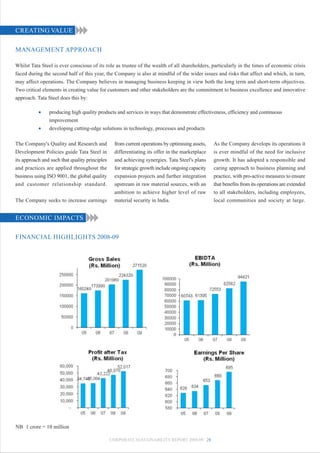
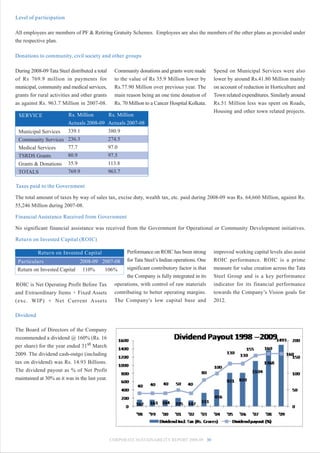
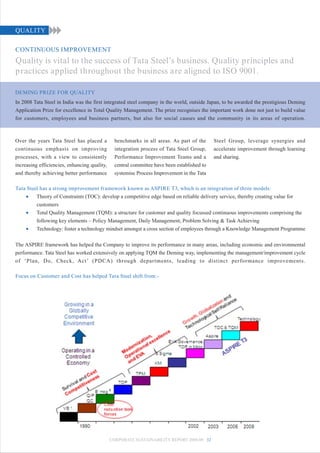
  • 35.
    Further information onthese areas of • Hydrogen Harvesting – Integrated steel plants are major consumers of primary energy development work can be found in the and some of that energy is released as waste heat in slag, which requires cooling. The 2008-09 Annual Report. Many of these Company’s labs have developed a new process, H2H, which is able to process the heat projects involve shared working and of molten slag to generate hydrogen rich gas. This replaces the less environmentally will enhance knowledge and production friendly forms of cooling and the gas created can be used as an energy replacement for across industry. Others will provide fossil fuels. specific competitive advantage to Tata • Energy Efficient Fluids - Coolants are required in the steel plant for rolling the steel. Steel, and will also benefit stakeholders Tata Steel has developed a completely new technology, using nano particles suspended in the form of improved life and in an aqueous medium, to create an efficient coolant with a much higher heat transfer qualities of the product, reduced energy rate than water. The Company is using this nano-fluid in its wire rod mill in Jamshedpur and materials use (i.e. saving natural and has identified many other uses for the product, both within its own operations and resources), reduced emissions, lower in other group companies. Tata Steel anticipates significant cost, energy and CO2 savings cost etc. Some examples include: as a result of this technology. Expenditure on Research & Development (Rs. Million) 2008-09 2007-08 Capital 18.9 58.3 Recurring 397.0 363.7 Total 415.9 422.0 Total R&D expenditure as a % of total turnover 0.17 0.21 Intellectual Property Rights (IPR) An innovative business creates valuable new products and services. The Tata Steel Group patent portfolio currently comprises over 850 patent applications at various stages between filing and grant and more than 850 valid patents granting national exclusive rights owned by the respective Group companies. The Group IPR portfolio also comprises some 250 pending trade mark applications and over 1500 registered trademarks for premium products such as Tata Shaktee®, Magizinc® and Colorcoat®. CORPORATE SUSTAINABILITY REPORT 2008-09 35
  • 36.
    TOWARDS ENVIRONMENT SUSTAINABILITY MANAGEMENTAPPROACH Tata Steel’s approach to environmental Management System to achieve excellence launched its climate change strategy, management has been guided by the Tata in environmental performance and ensure recognising that the steel industry, as a Code of Conduct (Clause 8: Health, Safety continual improvement. The divisional sector, contributes 4-5% of all man-made & E n v i r o n m e n t ) , t h e Ta t a S t e e l /departmental heads are responsible for CO2 emissions (as estimated by the World Environmental Policy and the UN Global implementation of the Environmental Steel Association). The Group's Vision 2012 Compact Principles. The Company is Management System in their respective challenges it to reduce CO2 emission from absolutely committed to providing a healthy areas. Top Management reviews the operations drastically to less than 1.7 tonnes working environment and to complying with performance periodically and provides of CO2 per tonne of liquid steel, reflecting all relevant environmental regulations in its necessary guidance and resources for the the Company's commitment to play its part operations; seeking to improve implementation of improvement initiatives. in responding to the global concern for environmental performance well beyond Training and awareness is an integral part climate change. Tata Steel Group is working norms and statutory duties wherever of the system and covers all the employees, on setting up the longer-term target for 2015, possible. contractors and others concerned. Tata Steel with additional targets for individual units. is certified to ISO 14001:2004 by M/s. IRQS. The Carbon accounting methodology across To ensure that policy is put into practice, Surveillance audits are conducted by IRQS the Group is being reviewed and a common key performance parameters have been annually to ensure compliance to the methodology is likely to be adopted in the identified, and are monitored and reported prescribed standard. financial year 2009-2010. Tata Steel will to various stakeholders in a transparent also develop opportunities for the future in manner, addressing the requirements of GRI Tata Steel recognises that climate change is energy conservation and carbon trading and and UN Global Compact. Tata Seel has one of the most important issues facing the is actively exploring these options through adopted an ISO 14001 based Environmental world today. In 2008, the Tata Steel Group its climate change strategy. EMISSIONS, EFFLUENTS AND WASTES Reducing emissions is a top priority. Operational investments, such as the new H Blast Furnace in Jamshedpur, seek to employ state- of-the-art equipment which improves efficiency and reduces pollution. CLIMATE CHANGE RISKS AND OPPORTUNITIES DUE TO CLIMATE CHANGE Guided by its climate change strategy, Tata legislation addresses the problem and Development Mechanism (CDM) under the Steel is adopting a responsible and proactive stakeholders demand low CO2 products and Kyoto Protocol. CDM has opened up new precautionary approach to managing its services, with consequent financial opportunities for achieving revenue from operations, in order to reduce operational implications. However, at present the carbon trading and Tata Steel is pursuing impacts which could contribute to this financial risks due to climate change are not these opportunities vigorously. The problem. being quantified. Company has registered its first CDM Project at the UNFCCC for TRT at G Blast The consequences of climate change will As India is a Non Annex I Country, it Furnace and is also actively pursuing other impact economies and people, as well as currently has no Green House Gas (GHG) CDM Projects in order to achieve carbon the environment. Tata Steel's own operations emission reduction targets in the first Kyoto credits. These projects are at various stages could be affected through the practical commitment period up to 2012. However, of approval and implementation. impacts of climate change and there are being a part of UNFCCC, India has taken growing political and commercial risks, as the initiative to participate in Clean CORPORATE SUSTAINABILITY REPORT 2008-09 36
  • 37.
    CARBON REPORTING Tata Steelreports our CO2 emissions by employing our Tata Steel methodology which is mainly based on carbon balance. In order to bring in similarity in reporting CO2 emission, a taskforce within Tata Steel Group is working and will come out with the recommendations. In the subsequent reports, it will provide a clearer picture to all stakeholders. GREEN HOUSE GASES Carbon Dioxide (CO2) emissions were reduced by 2.34% on a like-to-like basis in 2008-09, to 2.09 t/tcs. CO2 emissions as per GHG protocol Emissions Unit 2005-06 2006-07 2007-08 2008-09 Process +Stationary Combustion t 12,685,398 12,748,927 11,630,970 12,859,606 Mobile Emissions t 18,722 21,092 20,179 21,716 HFC Emissions t 1358 1436 2441 2845 Total Emissions t 12,705,479 12,771,455 11,153,590 12,884,177 Crude Steel production t 4,730,592 5,045,795 5,014,005 5,645,755 Specific CO2 emission t/tcs 2.68 2.53 2.32 2.28 Slag Credit t 922,970 1,130,104 1,256,848 1,614,424 Emission excluding slag credit t 11,782,509 11,641,351 10396,742 11,269,753 Specific CO2 emission excluding t/tcs 2.49 2.31 2.07 1.99 slag credit Total emissions (imported Elect. + Mobile t 1,001,586 936,688 941,796 1,130,217 + HFC) Total emissions excluding (Imported t 11,703,891 10,727,190 10,711,794 10,139,536 Electricity + Mobile + HFC) Specific CO2 emission excluding t/tcs 2.28 2.13 2.14 2.09 imported Elect + Mobile + HFC *CO 2 emission figures of 2007-08 revised based on like-to-like calculations, due to revision of calculation methodology Tata Steel participated last year in the Tata Group’s initiatives for Carbon Foot Print Exercise with the help of M/s. McKenzie and M/s. Ernst &Young. Tata Steel has also participated enthusiastically in the Steel Task Force initiatives of Asia Pacific Partnership on Clean Development and Climate (APPCDC) under the aegis of the Ministry of Steel, Government of India. Tata Steel is consistently focussing on minimising its environmental footprint through a multi-pronged approach which incorporates: • resource conservation • waste utilisation • pollution prevention • increasing the environmental awareness of the workforce Recent initiatives reducing Green House Gas emissions Our capacity expansion at Jamshedpur Steel Works will significantly reduce, the carbon footprint of the Company’s Indian operations. Efficiency savings will be gained by replacing multiple small blast furnaces with fewer high capacity furnaces, thereby taking advantage of economies of scale. Technological advancements have also been exploited for further carbon savings, through higher rates of coal injection, blast furnace top gas recovery for electricity generation, and the recovery of waste heat to minimise fuel usage. In May 2008, Phase I was completed with the ‘blow-in’ of the 1.8 million tonne capacity ‘H’ blast furnace – India’s largest blast furnace. Phase II will see steel capacity increased to 10 million tonnes crude steel production by 2011. CORPORATE SUSTAINABILITY REPORT 2008-09 37
  • 38.
    Indirect GHG emissions CurrentlyTata Steel’s indirect GHG emissions are not specifically calculated or reported. Ozone-Depleting Substances The Steel Works used 4.697 tonnes of refrigerant during the reporting period compared to 3.741 tonnes of refrigerant used during previous year. The organisation uses R134 and vapour absorption systems. Other significant emissions The Company has undertaken several initiatives in recent years which have resulted in a considerable reduction in stack emissions. These measures are ongoing and will be developed further to improve performance and ensure absolute compliance with norms. Specific Stack emissions (PM) from the Steel Works exhibits reducing trend as indicated below. Also indicated are the Particulate Matter, Sulphur Di-oxide and Oxides of Nitrogen in absolute terms. Total Emission load from Steel Works at Jamshedpur (Tonnes) Parameter (tpa) 2005-06 2006-07 2007-08 2008-09 Particulate Matter* 5570 4666 4318 4703 Sulphur Dioxide 7287 6639 4669 5333 Oxides of Nitrogen 6215 8264 5994 5603 *The Emission loads do not include fugitive emissions. TOTAL WATER DISCHARGE Tata Steel discharges treated effluent from the Steel Works. Wastewaters from process were treated with the best available physio-chemical methods and recycled in process. Wastewater from the coke plant is treated biologically where organic pollutants are oxidised and decomposed by micro-organisms. The absolute effluent quantities and pollution loads from the Steel Works are as follows: Effluents & Pollutants discharged from Steel Works Parameter Unit 2005-06 2006-07 2007-08 2008-09 Effluent Quantity Million m3 11.20 13.56 14.38 14.87 TSS Tonnes 726.20 690.60 709.18 611.21 Oil & Grease Tonnes 23.98 19.28 18.91 22.10 Ammonia Tonnes 103.98 64.59 70.53 88.23 Cyanide Tonnes 1.20 1.33 1.25 1.35 Phenol Tonnes 1.24 1.38 1.00 1.27 Treated domestic sewage from the township of Jamshedpur join the rivers Subarnarekha and Kharkai. Two Sewage Treatment Plants provided in the township of Jamshedpur have adequate capacity to treat the entire sewage of the town. Studies carried out by NEERI in the years 1993 and 2000 at Jamshedpur to assess any impact on eco-systems/habitats of rivers, found no significant impact on the aquatic eco-system. Noamundi and Joda Iron Mines and West Bokaro and Jharia Collieries do not discharge any overflow from the Slime/Tailing Dams. CORPORATE SUSTAINABILITY REPORT 2008-09 38
  • 39.
    SOLID WASTE MANAGEMENT Integratedsteel plants generate considerable solid by-products such as slags, dusts and sludges, which can impact the environment. Utilisation of solid by-products, either by upstream processes or by alternate uses is, therefore, an important performance indicator for the Comany. Tata Steel generates around 634 kg of various kinds of solid wastes (excluding fly ash) for every one tonne of crude steel produced. About 89% of these wastes are utilised, either through recycling and reuse in its own processes, or sold as input materials to other industries. Remaining wastes are sent for safe land-filling. The detail of various types of wastes and its utilisation are shown below. Major Hazardous and non-Hazardous Waste Utilisation at Steel Works, Jamshedpur* 2006-07 2007-08 2008-09 Item Usage Details Tonnes % of Tonnes % of Tonnes % of Utilisation generation** Utilisation generation** Utilisation generation** B F Slag Cement making 1307719 84.92 1453921 94.27 1716925 96.38 L D Slag Sinter making 1046073 77.18 912587 74.13 923015 78.49 B F Sludge Domestic fuel 46465 90.6 47240 84.32 51903 71.95 L D Sludge Sinter making 184927 136.8 107737 69.09 151965 82.90 Mill Scale Sinter making 65106 96.41 67743 92.38 70619 109 Flue Dust Sinter & dom. fuel 76536 81.36 75883 83.46 84747 87-85 Lime Fines Sinter making 101747 100 125800 100 150768 102 Dolo Dust Sinter making 9947 100 4301 100 18388 100 Ref. Waste Sale 8326 100 4348 100 21710 100 Tar Sludge Coke making 4507 100 4633 100 2995 100 BOD Sludge Coke making 248 100 - - 148 100 U/S Lime Stone Sinter making 12730 100 10392 100 5117 100 Mill Sludge Sinter making 11193 100 9329 96.34 9160 100 TOTAL 2875524 84.77 2823914 85.35 3207460 89.61 * These major waste types are typically generated and utilised at Steel Works, Jamshedpur. Some of this waste is also utilised by non- Tata Steel entities. ** % of generation indicates the quantity of the waste generated that was utilised in the given year. Hazardous wastes generated at the mines and collieries were auctioned to registered recyclers and oily waste/sludge is buried in secured landfills. Improving the utilisation of LD slag remains a challenge; this accounts for a major portion of the non-utilised solid wastes. LD slag use in sinter base mix stood at an all-time high of 26.9kg per tonne of sinter in 2008-09, which made a significant contribution to the overall improvement in waste utilisation. Significant spills There was no reported incidence of any oil spill or chemical spillage in the organisation during the reporting period. CORPORATE SUSTAINABILITY REPORT 2008-09 39
  • 40.
    Water bodies andrelated habitats significantly affected by discharges of water and run-off There are no significant impacts on water bodies and nearby habitats from Company operations. The impacts have been assessed in the Environmental Impact Assessments undertaken by independent consultants and water quality is regularly monitored by the Company. MAKING MINING MORE SUSTAINABLE MAXIMUM USAGE OF FINITE RESOURCES Many of the input materials for Tata Steel's steelmaking are sourced from captive mines and collieries. The Company follows 'scientific mining' methods in order to maximise the output of these operations, using a variety of technologies and process improvements to achieve optimum yields and minimum waste. Five key environmental principles deployed are: • Continuously stretching the life of the reserves available • Water conservation and management • Waste utilisation and energy conservation • Pollution control • Land reclamation Some examples of these principles in action: Tata Steel collieries use Surpac, a state-of-the-art mine planning software that estimates the volume of coal in every seam. This is coupled with qualitative detailing that focuses on output consistency. To maximise productivity and utilisation, a voice and data equipped Global Positioning System is used, which helps to supervise mining activity for machine movement and engine status. Beneficiation - • To reduce the ash content of coal in order to achieve better usage, coal of various grades is beneficiated, stretching the reserves. Going beyond standard washing processes, Tata Steel’s Research, Development and Technology department is working on methods to reduce the ash content in coal to levels of 8% and below. • A chemical beneficiation process is used to beneficiate the concentrate from physical beneficiation of low grade iron ore and plant rejects in order to reduce alumina to a level of 1.5%. Water - Closed loop systems are deployed to recover water and avoid the need to discharge wastewater. Pollution control - Coal at the Company's Jharia Division in conveyed underground to minimise air pollution. Air quality is monitored at all mines and collieries and measures to suppress dust are deployed, such as water spraying, dust extraction systems, etc. Land reclamation and afforestation - The Noamundi iron mine reuses displaced topsoil. Land has been reclaimed in areas such as Hills no. 1 and 2 and the Western Pit. The Company has planted more than 18 lakh (1.8 million) saplings within its mining leasehold since 1986. It have also afforested areas beyond its mining leasehold and created an in-house nursery to meet the plantation needs in and around the area, which raises 43 species of plant and 1 lakh (100,000) saplings per year. INPUT MATERIALS MATERIALS USED The Indian activities of Tata Steel use a variety of materials for producing steel and other related products. The major materials consumed are indicated in the table below: 2 2005-06, M/s. M N Dastur & Co. EIA Jamshedpur; 2006-07 & 2008-09, M/s. Minmec Consultants EIA Noamundi and Joda Iron Ore Mines; 2006-07, M/s. CMPDIL EIA West Bokaro. CORPORATE SUSTAINABILITY REPORT 2008-09 40
  • 41.
    Major Input Materialsacross India operations Materials consumed (Tonnes) 2006-07 2007-08 2008-09 Iron Ore 8,724,458 8,681,492 9545665 Coal (used to manufacture coke) 713,982 706,076 751972 Coke 3,133,450 3,088,582 3315206 Limestone & Dolomite 1,729,070 1,865,223 1949523 Ferro Manganese 15,824 16,165 18895 Input materials (for manufacturing ferro-manganese) 195,765 234,830 2282034 Zinc and Zinc Alloys 19,299 17,903 22137 Spelter, sulphur, and other materials 784,802 1,161,517 1200105 Total 15,316,650 15,771,788 19085537 Crude Steel Production-tpa 5,046,000 5,014,000 5645755 RECYCLED INPUT MATERIALS Steel is a recyclable material and iron/steel scraps are used in Steel Melting Shops as an input material. During the year 2008-2009, approximately 8% of iron/steel scrap from internal sources was used in production. No scrap was purchased from external sources. In addition to iron/steel scrap, other wastes such as slag, sludge, fines, flux dust, etc. are reused in the Steel Works, details of which are provided in the `Solid Waste Management’ section of this chapter. ENERGY DIRECT AND INDIRECT ENERGY CONSUMPTION Tata Steel is committed through its Energy Policy to conserving scarce energy resources. Details of energy consumed in Tata Steel are disclosed in the Annual Report of the Company. The direct and indirect energy consumption values are provided below: Energy consumption at Tata Steel, India Particulars 2006-07 2007-08 2008-09 Power and Fuel Consumption Quantity Joules (10^15 ) Quantity Joules (10^15 ) Quantity Joules (10^15) Electricity (M KWH) Purchased Units 1980 7.128 2031 7.312 2195 7.902 Own Generation 978 3.52 1011 3.64 1082 3.90 Coal Coking Coal (Million tonnes) 3.15 90.65 3.37 96.41 4.75 135.89 Injection Coal (Million tonnes) 0.42 12.31 0.39 11.43 0.52 15.24 Middling Coal (Million tonnes) * 0.34 6.34 0.2 3.73 0.14 2.61 Furnace Oil (Kilo litres) 12079.17 0.473 12701.73 0.497 12520.19 0.490 Others LDO (Kilo litres) 9238.63 0.335 7920.11 0.287 6221.55 0.225 LPG (Tonnes) 3835.4 0.494 4292.69 0.553 3837.75 0.494 NG (Tonnes) 2814.56 0.106 2217.4 0.084 2204.84 0.840 * Middling coal is predominantly used for power generation at Steel Works The specific energy consumption of the integrated iron and steel works at Jamshedpur was 27.58 GJoule/tonne of crude steel during 2008-09, down from 27.86 the previous year. The specific energy consumption has been calculated as per the World Steel Association’s balanced energy model, which takes into account all forms of energy brought within the Steel Works boundary. CORPORATE SUSTAINABILITY REPORT 2008-09 41
  • 42.
    Energy saved dueto conservation and efficiency improvements Tata Steel is continually developing and implementing conservation and efficiency measures. Energy conservation achievements in 2008-09 include: • Highest ever LD gas recovery (38131 Nm3/hr in 2007-08 to 38595 Nm3/hr in 2008-09) • Lowest ever BF fuel rate (577 kg/thm in 2007-08 to 575 kg/thm in 2008-09) • Higher by-product gas utilisation for power generation (94.03%) • Reduction in specific power consumption (by approximately 1%) • Higher combined boiler efficiency (83.77% in 2007-08 to 84.76% in 2008-09) • Top Recovery Turbine at H Blast Furnace (14.5 MW) • Application of fuel catalyst in diesel locomotives has resulted in a saving of high speed diesel to the level of 13-15% Initiatives implemented to reduce energy consumption this year include: • Top Recovery Turbine commissioned for H Blast Furnace, able to recover waste energy of approx 13-14MW. Installation of Top Recovery Turbine at G Blast Furnace (ongoing). • Recovery of sensible heat of coke by installation of Coke Dry Quenching system in Batteries 5, 6 & 7 at Coke Plant (under implementation) • BF Gas fired re-heating furnace at Hot Strip Mill • 120 MW electrical power unit based on by-product gases, ie BF gas, Coke Oven gas and LD gas, installed and commissioned to improve the by-product gas utilisation • Old and inefficient Blast Furnaces phased out to reduce coke consumption • Modifications in logics implemented to enhance BOF gas recovery • Enhancement of waste heat recovery at Sinter Plants (planned) Producing ferro chrome with less energy Tata Steel has developed a new process technology which reduces the specific power and coke consumption in either the direct production of stainless steel or the production of ferro chrome in submerged arc furnaces (SAF). In 2008 scale-up trials were carried out to establish the technical and economical feasibility of the process. Two variants of this process are being developed for the production of pre-reduced chrome for use in production of ferro chrome in the existing SAF process and chrome nuggets that are used as alloying addition in stainless and alloy steelmaking. The novel process uses non-coking coal as a reducing agent and energy source, thus reducing the need for low ash, low phosphorus (imported) coke. Hydrogen Harvesting Integrated steel plants are significant consumers of primary energy (coal and electricity generated by coal-fired plants) and part of that energy is released as waste heat. A novel H2H technology has been developed at our Research, Development and Technology department, which overcomes the barriers to recover thermal energy from steelmaking waste. The technology generates hydrogen rich gas by utilising the waste heat of molten steelmaking (LD) slag. This is a step towards cleaner steelmaking. As an environmentally friendly resource, hydrogen is considered an alternative source of energy. Whilst most methods of generating hydrogen use fossil fuels, Tata Steel’s technology will produce the gas by ‘recycling’ existing waste energy. RENEWABLE ENERGY In the main steel making process, use of renewable energy is highly limited due to techno-commercial non viability. However, the Company actively encourages and promotes the use of renewable energy in the form of solar electricity, biogas, etc in the social activities that it undertakes in the communities around its operations. CORPORATE SUSTAINABILITY REPORT 2008-09 42
  • 43.
    Conscious of thelink between human Industry (CII). The project provides villagers been replicated in ten more villages of development and energy access, in 2006 with easy access to cheap clean fuel which the district covering 843 households. In we launched a two year pilot project on will not harm the environment and will the year 2008-09, 130 biogas plants have Renewable Energy for Rural Livelihoods enable farmers to switch from fertilisers to been constructed in three villages. (RERL) in five villages of Saraikela biogas manure. 240 biogas plants and five Kharswan District of Jharkhand, India, in woody biomass gasifiers have been The project also establishes photovoltaic collaboration with the United Nations established, preventing wood burning and, panels for lighting: 255 solar home lights Development Programme (UNDP); it is estimated, thereby reducing CO 2 and 21 street lights had been set up by the Ministry of New and Renewable Energy emissions by more than 385 tonnes . After end of 2008-09. (MNRE) and Confederation of Indian successful implementation, the project has Product energy efficiency initiatives Tata Steel considers energy sourcing and energy efficiency very carefully in its product development. The Company is are developing and producing a range of high specification product solutions with attractive, more sustainable qualities – for example products which are lighter, stronger and more durable. These products meet customer needs and will allow them to develop better, cheaper and more environmentally friendly products for the end user. Stronger and more durable products will facilitate more advanced uses and less frequent replacement (reducing further impacts of production) whilst other features, such as lighter weight, can mean the end product is more energy-efficient or effective. For example light-weight steel designed for cars allows the automotive customer to produce a lighter-weight vehicle, which will have greater fuel efficiency and will be less polluting throughout its life. Some examples of products with specific sustainability benefits can be found in the ‘Creating Value’ section of this report. WATER Water withdrawal by source Water for industrial and domestic usage at Jamshedpur and other units is mainly drawn from surface water resources as indicated in table below. The other source of water at Jamshedpur is a captive reservoir at Dimna having a capacity of 34.224 million m3, covering 92.6 sq. km. It is situated on the North-Eastern end of the Jamshedpur at a distance of about 10 kms and is meant for emergency water supply during the lean season. Details of Water Sources Name of location Water source Purpose Steel Works Jamshedpur Subarnarekha river/ Dimna Industrial & Domestic Noamundi Baitarni River Industrial Jojo Nalla Domestic Joda Kundra Nalla Industrial & Domestic Gomardih Nakati Nalla Domestic Mine Drainage Industrial Jharia Damodar River Industrial & Domestic Sukinda Mines Drainage Industrial & Domestic West Bokaro Mines drainage + Raw River Industrial & Domestic The total water withdrawal during the period was 37.13 Million m3 for Jamshedpur Steel Works, which also includes water used for expansion activities. Water re-circulation and conservation efforts are in place at process units and the new processes that will come online in the coming years are likely to reduce specific water consumption. CORPORATE SUSTAINABILITY REPORT 2008-09 43
  • 44.
    In addition, theentire domestic consumption of the city of Jamshedpur, that is 63.05 million m3/annum of water (63.15 million m3 /annum in 2007-08), is supplied and managed by JUSCO (a 100% subsidiary of Tata Steel). Reducing water use Tata Steel’s Research, Development and Technology department has developed a new technology known as ‘Coolfast’, which suspends nano-particles in a fluid to create a coolant which is more efficient than water. Its superior cooling qualities will allow the Company to reduce water consumption in the Steel Works. This new technology has a wide range of potential applications, saving money and energy and reducing Carbon Dioxide emissions, and is currently being deployed for cooling in the Wire Rod Mill and Hot Strip Mill. Water sources affected As indicated above in the table, the main water source for the Steel Works is the Subarnarekha river, a perennial surface water source at Jamshedpur. As per the REIA report by NEERI, water abstraction is not known to have any significant adverse impact on the eco- system. RECYCLING & REUSE OF WATER Approx 900,000 cum/day of water remain in circulation in the steel manufacturing processes through the closed circuit system provided at the various units in the steel plant and cooling ponds. BIO-DIVERSITY NATURE OF LAND OWNED, LEASED OR MANAGED The Steel Works is situated at Jamshedpur in the state of Jharkhand, India. The lease areas for various units and the details of forest and non-forest land are provided below. Land owned, leased or managed Units Lease area (hectare) Forest area in lease (hectare) Non-forest area in lease (hectare) Jamshedpur 5094 Nil 5094 West Bokaro 1740 910 830 Jharia 2230 Nil 2230 Noamundi 1160 762 398 Joda East 671 522 149 Gomardih 373 Nil 373 Khondbond 978 837 141 Katamati 403 199 204 Sukinda 331 74 257 CRC West 10 2 4 WIRE Div 32 - 32 There are no World Heritage sites, sensitive areas or Biosphere Reserves or Protected areas within the operational areas of the company. No sensitive areas, as defined by the Environment Protection Act 1986 in India, fall within a 10 km radius of the Company’s operations. However, the mine leases are in unprotected areas rich in biodiversity and Dalma Wildlife Sanctuary, which is a protected area, is situated relatively close to Jamshedpur (at a distance of 10km). The Regional Environmental Impact Assessment (EIA) and carrying capacity study conducted by NEERI in May 1995 and 2000 and EIA studies conducted in 2005-06 and 2007-08 indicate that there is no significant environmental impact on Dalma Wild Life Sanctuary. Impact on protected and sensitive areas and habitats of protected species Noamundi and Joda mining lease areas contain habitats for the following species from Schedule-I and II of the Wildlife Protection Act 1972: Schedule-1 – Sloth Bear Schedule-2 – Indian Python Some occasions of incidents of elephants passing by at Noamundi and Joda mining areas have been reported. At this point Tata Steel has not formally ascertained the actual presence of IUCN Red list species at our sites. CORPORATE SUSTAINABILITY REPORT 2008-09 44
  • 45.
    When undertaking significantnew activities or expanding operations, the Company undertakes Environmental Impact Assessment studies, conducted by independent consultants. These have reported no significant changes to the natural habitats of protected species resulting from its activities. Managing impacts on biodiversity Through its Environmental Policy, Tata Steel is committed to: • Identifying, assessing and managing environmental impacts • Developing and rehabilitating abandoned sites through afforestation and landscaping • Protecting and preserving biodiversity in the areas of operation Bio-diversity is assessed during the preparation of Environmental Impact Assessment Reports and forms part of the Environmental Clearance Process. Recent studies have assessed the impact of plans for development and expansion at Jamshedpur and Noamundi, Joda and West Bokaro mine3. The recommendations given in EIA Reports are implemented during the construction and operation of projects. Tata Steel takes measures to minimise any developments. More than 240 hectares of in many of the company's operational areas eventual damage to nearby habitats resulting mined out areas have been reclaimed with in India, including Joda, Noamundi, from activities like mining. A reclamation plantations so far. The Company has Bamnipal and Sukinda, with local people and afforestation programme ensures that developed a total capacity of raising 400,000 helping to plant the trees. Tata Steel also habitats are restored and improved with saplings every year across various locations, conducted awareness raising campaigns extensive tree plantation. Where appropriate with an 85% survival rate. 135,000 saplings alongside the planting projects to increase new reclamation and afforestation were planted at various locations during the understanding of local people about programmes are implemented at greenfield 2008-09. Mass plantations were organised environmental issues RAISING ENVIRONMENTAL AWARENESS Tata Steel Rural Development Society has Amongst its employees and in local over the last few years. These parks house created and supported many 'Save Forest communities promotes Tata Steel respect ornamental plants, fruit trees, rare flowering Groups' in Noamundi and Joda, to safeguard for the environment and a love of nature. plants, rock gardens, spices, condiments and existing forests and encourage local people The Company established and runs a zoo at medicinal plants along with more than 300 to protect the forest as a valuable sustainable Jamshedpur to protect animals and to create varieties of cacti, and 100 varieties of roses. resource. The Company has trained groups awareness about wildlife among the citizens of local people on the development of of Jamshedpur and the surrounding Many of its employees and their families orchids, saplings and other forest products community. To showcase and protect flora, are keen environmentalists and Tata Steel to encourage sustainable use of the forest Sir Dorabji Botanical Parks have been encourages this interest, for example as a source of livelihood, and thereby protect developed by the Company at Jamshedpur, supporting the first Annual Flower Show at the habitat. West Bokaro, Dhanbad, Noamundi and Joda West Bokaro Division in January 2009. Celebrating World Environment Day In June Tata Steel celebrated World Environment Day involving employees and the local communities. This is an occasion to celebrate the environment, carry out mass sapling plantations and consider how everyone can help to respect and protect the environment. Awareness raising takes place through quizzes and competitions involving many local schools. PRODUCTS & SERVICES Initiatives to mitigate environmental impacts As a product, steel does not have any adverse environmental impacts. Steel products are 100% recyclable in their life cycle and this quality is promoted. Tata Steel recycles all scrap steel generated in the plant. 3. 2005-06, M/s. M N Dastur & Co. EIA Jamshedpur; 2006-07 and 2007-08, M/s. Minmec Consultants EIA Noamundi and Joda Iron Ore Mines; 2006-07, M/s. CMPDIL EIA West Bokaro. CORPORATE SUSTAINABILITY REPORT 2008-09 45
  • 46.
    Life Cycle Assessment Anexercise in Life Cycle Assessment some years ago which considered the potential impacts of all stages of manufacture4, allowing Tata Steel to benchmark several issues related to raw material consumption, energy consumption, solid waste utilisation and green house gas emissions. The implementation of the recommendations from this life cycle study has led to improvements in performance on various parameters disclosed in this report. Percentage of products sold and their packaging materials that are reclaimed Most of the Company’s products are dispatched without any packing material. A small quantity of gunny bags, wooden blocks, steel straps etc. are used in packaging and transportation whenever essential or desired by the customer. These packing materials are not recycled by Tata Steel as the quantity is not significant. TRANSPORT Significant environmental impacts of transporting products and other goods Diesel and Petrol consumed for transport of raw materials and by in-house vehicles are accounted for in the calculation of CO2 emissions as per the GHG protocol. The Company is promoting the use of fuel-efficient vehicles and contractors are encouraged to use fuel efficient and safe vehicles. Company vehicles including locomotives are monitored for vehicular emission (CO, HC for Petrol and smoke density for Diesel vehicles) every six months. All the contractors’ and suppliers’ vehicles are checked for Pollution Under Control Certificates at the Factory’s entry gate. ENVIRONMENTAL PROTECTION EXPENDITURE Capital Investment on Pollution Abatement Under different phases of modernisation several state-of-the art pollution control systems have been installed to prevent and control pollution. Expenditure during the reporting year on pollution abatement includes facilities provided under the 6.8 mtpa development at Jamshedpur Works. ENVIRONMENTAL COMPLIANCE During the reporting period no monetary penalty, fines or non-monetary sanctions were imposed for non-compliance with environmental laws and regulations. 4 The study was limited to the factory gate and did not cover product use and end-of-life as this can be extremely difficult to track with a product such as steel. CORPORATE SUSTAINABILITY REPORT 2008-09 46
  • 47.
    VALUING OUR WORKFORCE MANAGEMENTAPPROACH Tata Steel people are its biggest strength. With this approach the Company The Company has been successful in retaining and endeavours to hire and retain the best talent in the industry. binding together its employees over the years: Tata Steel aims to achieve transparency, fairness and equity in all its interactions • By demonstrating its commitment to health and with employees, to create an enthused and happy workforce. The Company safety treats all its employees with dignity and respect and take care of their wellbeing. • By maintaining a level of apprentice and graduate These principles are set out in its Human Resource Policy. Tata Steel is certified recruitment to ISO-14001 and OHSAS-18001 standards, in order to ensure continual • By demonstrating the value of its culture of improvement in safety, health and environment in the work place. innovation and improvement by delivering value creation and cost reductions Even, in these times of recession, the Company's Indian operations were able • By working towards an enviable Union- to make the necessary adjustments without significant lay-offs and reductions Management relationship for the best working in working hours, and by the end of March 2009, there were encouraging signs symphony possible that the Indian economy was beginning to recover. • By enhancing its employee mind-bank through relevant training and development initiatives SAFETY “At Tata Steel, nothing is more important than Safety’’ - B Muthuraman, MD Tata Steel, 2006 The Company Belief: 1. Safety is Line management Responsibility 2. All Injuries can be prevented Tata Steel's Goal is to achieve a Loss Time Injury Frequency rate to 0.4 (excluding First aid cases) with zero fatality by 2012. CORPORATE SUSTAINABILITY REPORT 2008-09 47
  • 48.
    Tata Steel recognisesits people as the help in delivering customer value and abilities of managers and workers. The primary source of its competitiveness and superior financial results. In this way the department ensures that the full potential of makes every effort to help them excel in Human Resource function plays a strategic Tata Steel's workforce is realised by their performance and unleash their true partnership role in business sustainability. designing work systems and processes which potential. This is facilitated by a robust It focuses on constantly updating and are conducive to achievement orientation, management system which encourages free challenging intellectual capabilities to enable providing opportunities to employees for thought and creativity, as well as through employees to excel in their performance. development and career growth and by leveraging technology. The Company Special efforts are made to enhance the motivating its people through recognition believes that a motivated workforce will strategic thinking skills and analytical and reward. Performance The Company is continuously striving to aid cases and an improved health and safety Jamshedpur and one was due to a roof fall reach the world benchmark in safety awareness amongst employees. at the Jamadoba colliery. Each of these performance by institutionalising world- incidents has been thoroughly investigated class systems and processes and promoting With six fatalities this year, fatalities remain and every possible measure is being and safe behaviour. Its efforts have led to a a significant concern for the Company. Five will be taken to prevent similar tragedies significant reduction in the Lost Time Injury fatalities occurred this year from separate from occurring in the future. Frequency (LTIF) rate, a reduction in first incidents at the integrated Steel Works at The figures for Lost Time Injury Frequency rate, Fatalities and Man Days Lost are shown in the charts below. Loss Time Injury Frequency rate Divisions FY’07 FY’08 FY’09 Flat Product 2.80 1.39 1.11 Long Product 1.54 0.75 1.89 Coke Sinter Iron 2.28 1.72 2.33 Raw Material 0.89 1.97 0.51 Shared Services 1.08 1.8 1.01 Engg Project 1.29 0.88 0.2 General Group 1.01 0.39 0.80 Tata Steel 2.1 1.7 0.8 CORPORATE SUSTAINABILITY REPORT 2008-09 48
  • 49.
    (Including fatal mandays lost: for one fatality 6000 man days lost is considered as per American National Standards Institute (ANSI) System. Safety Initiatives Tata Steel aims to achieve safety excellence with the ongoing guidance of DuPont, a world-class leader in safety. The safety programmes which began at the Steel Works have been rolled out across all locations, including the mines. These initiatives have led to a perceptible change in the behaviour of employees - including that of contractors - within and outside the place of work. The following key initiatives in 2008-09 are helping the Company to improve safety: • Skill development training in areas like Mechanical Fitter, Electrical Fitter, Welder, Rigger etc was imparted to contractors’ employees, with more than 1500 contractor employees up-skilled. • A comprehensive campaign to identify and eliminate Commonly Accepted Unsafe Practices (CAUP) was run throughout the organisation. It was an eye-opener for senior executives who were made aware of these unsafe practices. The campaign triggers the process to develop safe alternative practices. • Fatality Risk Control Programme: this initiative has been rolled out to all the divisions, in phases. The programme identifies and corrects potential conditions for fatalities with irreversible engineering solutions. In 2008-09, 1348 such conditions have been rectified through this initiative. Procedure for FRCP identification and elimination CORPORATE SUSTAINABILITY REPORT 2008-09 49
  • 50.
    Process Safety and Risk Management (PSRM): this has been implemented in phases with a continued focus for this year. § PSRM training was provided to 21 executives at IIT Kharagpur. § Basic PSRM Awareness was provided to more than 800 line managers and supervisors. § Process Safety Information collection commenced in all departments. § Process Hazard Analysis was undertaken for WRM, LD2 & Slab Caster, and FMD for their critical process. Process Safety Risk Management Cycle Systematic improvements were brought about in road safety through the introduction of a free bus service, the implementation of helper-Less driving and by strengthening consequence management for road safety violations. For example, we are currently running 16 free bus services (including those provided by contractors) per day for contractors' employees to enable them to reach their place of work on-site safely. • “Centenary Safety Park” was developed to impart safety induction training and supply personal protective equipment to visitors. The Safety Standard Park, an integral part of Centenary Safety Park, provides the practical training on safety standards to employees. So far this centre has assisted 2667 visitors and trained 1876 employee on safety standards. CORPORATE SUSTAINABILITY REPORT 2008-09 50
  • 51.
    Safety Awareness Mass Meetings have been initiated, organised jointly by top management and union representatives, focusing on potential hazards like road, gas, working at height and energy isolation. So far, more than 12 such mass meeting have been organised, covering high hazard departments like LD1, FMD, CP, LD2, PS etc. Tata Steel is committed to reducing the severity as well as the frequency of accidents and this is addressed in the Safety Management System. Safety Structure of Tata steel Apex Safety Council--Our workforce is represented in the Apex Safety Council. The Chief Operating Officer of the Company is the Chairman of the Council and Members include management representatives and five representatives from Tata Workers' Union. The Apex Safety Council is assisted by eight apex level safety sub-committees focusing on different thrust areas: 1. Apex Rail & Road Safety sub-committee 2. Apex Occupational Health sub-committee 3. Apex Contractor Management sub-committee 4. Apex Safety Audit and Observation sub-committee 5. Apex Safety Training & Communication sub-committee 6. Apex Incidence Analysis sub-committee 7. Apex Safety Standards sub-committee 8. Apex Process safety sub-committee The committees are responsible for 1. Setting strategic decisions for the Company. 2. Arranging resources for implementation of the plans through the various functioning bodies. CORPORATE SUSTAINABILITY REPORT 2008-09 51
  • 52.
    Safety Awareness Mass Meetings have been initiated, organised jointly by top management and union representatives, focusing on potential hazards like road, gas, working at height and energy isolation. So far, more than 12 such mass meeting have been organised, covering high hazard departments like LD1, FMD, CP, LD2, PS etc. OCCUPATIONAL HEALTH Tata Steel aims to promote the highest degree place employees in work commensurate promoted through awareness-raising, of physical, mental and social well-being with their physical and emotional capacities. individual and group counselling and other amongst its workers. The Occupational For specific health issues, such as HIV/AIDS preventive health measures, including fitness Health Services protect the health of workers and Alcohol and Drugs, the company has and wellness programmes and regular health against potential health hazards, including developed policies to guide its approach. check-ups. stress, within the work environment and The health of the company workers is Education, Training, Counselling & Prevention Health education and awareness is one of the major preventive tools used for improving the occupational health of the Company’s employees. CORPORATE SUSTAINABILITY REPORT 2008-09 52
  • 53.
    Health Awareness &Training 2008-09 Topic Sessions Employees taken Covered CPR and First Aid 138 5606 CPR and First Aid (Contract emp.) 54 2121 Health and Healthy lifestyle 31 803 AIDS awareness 02 64 Counselling 27 516 Noise Hazards 12 175 Cardiac Risk Reduction 02 58 Stress Management 03 141 Gas Hazards 12 241 Ergonomics 02 56 OHSAS 18001 08 122 Heat stress 39 641 EHSMS 25 392 Life Style Management 10 259 Total 365 11195 HIV/AIDS Tata Steel is committed to contributing to the global effort towards halting and reversing the course of HIV/AIDS. In accordance with its HIV/AIDS Policy the Company: • Seeks to prevent the spread of HIV and AIDS by actively disseminating information and education, both within the workplace and amongst local communities • Ensure a safe working environment, confidentiality and non-discrimination of affected employees • Provide appropriate medical facilities for affected employees and their families, both for physical and emotional wellbeing Tata Steel’s HIV/AIDS programme extends beyond direct employees to wider stakeholders. The programme covers the local community and suppliers and contractors, for example truck drivers, who were identified as a high-risk community in terms of contracting and spreading the disease in operational areas. Tata Steel has voluntered to take on the responsibility of promoting AIDS awareness in the district of East and West Singhbhum as part of the UN Business Coalition against HIV/AIDS. RISK CONTROL PROGRAMMES Occupational Health Surveillance Employees undergo routine clinical examination and medical investigations like lung function tests, chest X-rays and blood tests for haemoglobin, blood sugar, white blood cell count and cholesterol levels. Hearing Conservation • Audiometric examination of employees is conducted with a state-of-the-art Madsen computerised audiometer. 3,876 employees exposed to high noise level were examined, counselled and motivated to wear PPE. • Impedance Audiometry (Tympanometry) has been introduced for early identification and segregation of non-occupational, treatable hearing / ear problems • The Noise Dosimeter survey has been introduced to monitor and control individual noise exposure • Software on ‘Hearing Conservation’ has been developed with the help of ITS for effective monitoring, analysis and follow- up. • Workplace visits performed by OHS team to control Noise Hazard and raise awareness. • 12 sessions on ‘Noise Hazard Prevention and Hearing Conservation’ CORPORATE SUSTAINABILITY REPORT 2008-09 53
  • 54.
    Preventive Health Screeningof Food Handlers There was 100% coverage of 261 Food handlers of the Works and Tube Division canteen for Special Medical examination. Proactive Health Screening Proactive Cardiac risk assessment by Cardio Profiler, which measures the atherosclerotic process in blood vessels, was undertaken for 1360 officers and employees. They were counselled and educated on lifestyle to prevent the most common killer diseases, heart disease and stroke. High Tech Health Screening An epidemiological study of Oven-top workers and control group of Coke Plant, consisting of bio-toxicological analysis, was conducted to assess the impact of hazards. Counselling Individual and group counselling was undertaken for employees who were detected as diabetic and hypertensive during routine health surveillance, to ensure proper medication and lifestyle modification. New Initiatives in 2008-09 Various new initiatives commenced this year including: • 2008 Theme: Healthy Heart, Healthy Life • Wellness Clinic for contract employees providing on-the-spot checking and monitoring of diabetes and hypertension, covering 2,240 contract employees • Special Medical Examination of 4,477 persons working at height • Epidemiological study of Oven Top workers by estimation of 1 – OHP (Bio-marker) • Audiometry for contract employees exposed to high noise • Workplace monitoring by Apex OHS team • Special Projects to reduce / control occupational hazards • Health checks of 32,104 contract employees exposed to occupational hazards • Ten sessions of Life Style Management Programme for executives, employees and spouses, covering works departments and out-locations EMPLOYMENT Workforce On 31st March 2009, Tata Steel had 34,917 permanent employees on roll in the Company, compared to 35,870 on 31st March 2008. The trend of manpower over the last three years and its distribution and make-up is provided below. The majority of the Company’s workforce in India is located in the states of Jharkhand and Orissa. CORPORATE SUSTAINABILITY REPORT 2008-09 54
  • 55.
    Tata Steel Workforce,India (1st April 2009) Location Officers Non-Officers Total Number Jamshedpur (including Tubes) 2491 15969 18,552 Noamundi (Iron Mines) 293 1629 1922 Jamadoba (Collieries) 210 6282 6492 West Bokaro (Collieries) 183 3368 3551 Kolkata (M&S) 327 493 820 Mumbai (Head Office) 48 22 70 CRC West & Wire Division 203 1086 1289 Adityapur 75 498 573 Kharagpur 41 483 524 FAMD 102 991 1093 CRE Offices- Delhi, Bhubaneshwar, Ranchi & Raipur 72 12 84 Greenfield Projects 38 1 39 TOTAL 4083 30834 34917 Special benefits provided to Employees Tata Steel provides many special benefits to its employees to ensure that they and their families are well looked after: Medical facilities : Free medical facilities for the employee and their family, which continues for employee and spouse after retirement. Housing facilities : Subsidised electricity, water and housing facilities to all employees. Higher studies : Monetary incentives to employees acquiring higher qualifications in a related field. The Company also provides study leave, scholarships etc. Holiday Homes : Tata Steel has four holiday homes for the benefit of workers, supervisors and their families. These holiday homes are located in Puri, Haridwar, Gangtok, Jamshedpur and now also in Goa. Tata Steel Officers’ Beach Club : All officers of Tata Steel are eligible to be members of the Beach Club. The Club offers holidays in selected Taj Hotels, ITDC Hotels, Sterling Resorts and other branded hotels across the country. The Beach Club also provides a horse riding school and water sports facilities at Jamshedpur. Family Benefit Scheme : In the tragic case of a fatality in the Works, a monthly pension equal to the amount of the last drawn salary of the deceased is given to the legal heir until the time the deceased would have attained the age of 60. CORPORATE SUSTAINABILITY REPORT 2008-09 55
  • 56.
    DEVELOPING PEOPLE Tata Steel'speople are a major asset and the Company is committed to their development, both in order to benefit the individual and to benefit the Company through increased knowledge and skills. The Company is aware that it must leverage the maximum potential of its human resource in order to achieve its business objectives. Tata Steel also recognise that developing its people will help it to retain a motivated workforce in a competitive environment. Managing Training and Development Managers have responsibility for the development needs of those they supervise. Tata Steel’s management of training and development is now centred on needs and outcomes, with a focus on technical and managerial competency building. Tata Steel recently adopted the Toyota concept of the ‘Four Quadrant Method’ across the organisation. In this process, the critical skills required to perform a job are identified and the employees are mapped against those skills by the Positional Training Facilitators, mentors or immediate supervisors. Based on the gap between the desired skill level and the existing skill level of employees, training needs are identified and training is imparted accordingly. The process also provides a managerial tool for reviewing training effectiveness. An illustrative example of documentation on 4Q method may be seen below: Identifying needs The training and development needs of the workforce are assessed regularly, for officers with a Personal Development Plan (PDP) and for non-officers with a Training Needs Survey (TNS). The development needs of individuals are classified under behavioural and functional or technical headings and the key inputs needed to improve the worker’s effectiveness and to help them perform better in future are agreed upon. Implementing training and development The process for addressing training and development needs follows this method: • 70% - On-the-job inputs • 20% - Conversations, Mentoring and Coaching • 10% - Classroom training CORPORATE SUSTAINABILITY REPORT 2008-09 56
  • 57.
    These ratios havebeen designed for maximum effectiveness and efficiency. Tata Steel has learned that the most effective method to learn is with inputs “on the job”. The best developmental input is regular interaction, guidance and feedback from one’s immediate superior. It is therefore not necessary to identify classroom training for all workers. Tata Steel has in-house training facilities both for technical and managerial training, through the Technical Training Institute and Tata Management Development Centre (TMDC), respectively. Advanced level training requirements, both technical and managerial, are met through external programmes. The table below provides data on employee training in Tata Steel in the last two years: * Average MOR = 35394. The average MOR is calculated by averaging the number of people employed on 1st April 2008 (35870) and the number of people employed on 31st March 2009 (34917) ** Training Man-hours = Man-days X 6.25 (Since one day programme means 6.15Hrs of active training) For the last two years the focus in the area of training has changed. Instead of focusing on total man-days trained, the focus was on the quality of programs delivered. For this new programs were prepared after interacting with the customers, in the case the plant operation people, which would have had impact the KPI of the department. This required extra effort by the trainers. The Company hopes the man-days figure will increase again in the coming year. Skills development for non-officer employees Skills enhancement for the Company’s non-officer employees is a continuous process. Skills training begins at the time of an employee joining the Company and continues throughout his or her career. Employees work in clusters of multi-skilled workers and move across and within clusters on improving their skills levels. The Technical Training Institute imparts vocational and basic skills; the departments impart on-the-job training. In order to promote self-directed learning, the Company has introduced e-Learning whereby employees can access electronic courses from their departmental e-Learning centres. CORPORATE SUSTAINABILITY REPORT 2008-09 57
  • 58.
    Skills development forofficers Tata Steel Management Development Centre conducts a number of managerial and functional competency based programmes for officers and supervisors. The objective of these programmes is: • to build individual capability by enhancing managerial and functional competencies which are critical to operations, service and support functions • to build a leadership pipeline in the organisation to prepare its people to meet the challenges of growth, globalisation and change Directed Learning was introduced in July 2008 in order to bridge any functional skill gaps of officers and to identify candidates for focused learning in line with the current and future needs of the Company. Directed Learning programmes could include, for example, workshops, project work under the tutelage of an expert, modular and doctoral programmes. Salary, allowances and benefits are maintained whilst officers selected by the Company undertake courses under Directed Learning Initiatives. In addition, the Company pays for tuition and other charges as applicable. Monitoring Training Effectiveness Training effectiveness measurement is institutionalised for all training programmes to suit the ISO 9001: 2000 requirement. The training effectiveness process has been evaluated and improved over the years from man-days to skill ratio and now the Four Quadrant scores. Towards greater expertise in steel making technology The one year full time Post Graduate Diploma in Steelmaking Technology, developed in collaboration with IIT Kharagpur, was an important step towards making Tata Steel self reliant in Technology. The programme was developed so that the Company would no longer need to rely on external technical expertise in steelmaking. It was introduced in 2005. In 2008-09, the Company focussed its communications on the positive benefits of the programme, as collected from the feedback received from previous students. 38 applications were received this year, many more than in the previous year. PERFORMANCE AND CAREER DEVELOPMENT Performance management Tata Steel's Performance Management System is deployed throughout the organisation with the following aims: • Align the activities and behaviour of the workforce with Company values and objectives • Assess the performance of individuals comprehensively and fairly • Develop the capabilities of employees to enhance performance • Develop corporate culture • Enhance line management relationships The system comprises an annual cycle of performance management, commencing with the development of personal Key Result Areas and specific targets linked to business planning, safety and quality initiatives. Each worker has a mid year review and annual evaluation which provides feedback on his or her performance. Meeting the career aspirations of non-officer employees The qualified talent in the non-officer category sought further growth opportunities in line with the industry growth. The Company is concerned that, whilst attrition is currently negligible at this level, with more industries being set up in the region, it might start to lose this talent if proactive measures were not initiated. To address this issue Tata Steel decided to create a new Officer's level (IL-6) to which its employees could progress. This new level handles transactional jobs where the majority of the responsibility is routine in nature and so can be performed by Diploma holders who have some experience in the organisation. In order to strengthen the managerial capability of selected candidates, each of them undergoes a two week training programme at TMDC before being placed in respective departments. CORPORATE SUSTAINABILITY REPORT 2008-09 58
  • 59.
    Career breaks In orderto help officers to achieve personal work/life balance, Tata Steel introduced sabbaticals in February 2009. Officers can take sabbatical leave of up to one year in total and if required, this can be taken in two instalments. The sabbatical, which is composed of paid and unpaid leave, allows officers to take time out to complete projects and personal activities, whilst remaining in its employment. ATTRACTING TALENT The Company makes sure its jobs are attractive and fairly paid through its Talent Acquisition teams who carefully prepare detailed job descriptions using a compensation fact sheet so that compensation is appropriately fixed. All candidates are communicated the status of their application and any doubts are clarified. The formation of campus relationship teams and selections through the Pre Placement Offer route has ensured increasing numbers of young professionals joining the Company. In previous years recruitment was through press advertisement, which was expensive and time consuming. In the last couple of years Tata Steel started to attract applications through its website, through internet employment portals and via telephone interviews. It also helps to attract and develop talent through the Company's work with students. The HR function helps students, especially in engineering and management streams, to undertake summer training at Tata Steel's premises through two training institutes, SNTI and TMDC. RETAINING TALENT Over recent years, employee turnover has slowly increased, however the rate of turnover is less than 10% and is therefore not of significant concern. Turnover is highest among officers and although that is on a decreasing trend, Tata Steel continues with its efforts to manage attrition and retain its valued workforce. The attrition rate for the non-officer category is monitored regularly and is found to be not significant. Tata believes that the factors which help it to retain talent include good job content, development opportunities, comparable compensation and benefits and a decent work environment and, as described previously, the Company has initiatives in place to make sure that it offer these to its employees. In addition it is important to have effective channels of communication and these are well established at Tata Steel. Employees can voice their opinion through facilities such as hotmail, personal interviews with superiors, dialogue sessions with the top Management and use of the Tata Steel blog. It also conduct exit interviews, both in cases of resignation and superannuation, to discover any issues which the Company can address to improve its practices. CORPORATE SUSTAINABILITY REPORT 2008-09 59
  • 60.
    DIVERSITY & EQUALOPPORTUNITY We believe that employees from different backgrounds and of different genders, ages etc, bring unique sets of capabilities for improved performance of the team and encourage the formation of a diverse and cosmopolitan workforce. The tables below show the age and ethnic mix of employees: • Age • 0>30 • 30>40 • 40>50 • 50>62 • Officers • 548 • 1192 • 1243 • 1100 • Non-officers • 1885 • 7533 • 11692 • 9724 • TOTAL • 2433 • 8725 • 12935 • 10824 • Ethnic origin • Scheduled caste • Scheduled tribe • Other • Not known • Officers • 29 • 36 • 3267 • 751 • Non-officers • 2632 (9%) • 2876 (9%) • 25,326 (82%) • - • TOTAL • 2661 • 2912 • 28,593 • 751 Equal opportunity practices Tata Steel is an equal opportunity employer and practices are administered in an equal equal opportunities as set out in the Tata and does not discriminate on the basis of and fair manner and its decisions are merit Code of Conduct, the Company’s HR Policy race, caste, religion, colour, ancestry, marital based. Tata Steel aims to have a and Affirmative Action Policy are monitored status, sex, age or nationality. The Company discrimination-free workplace so that the by the Ethics Counsellor and may be has an Affirmative Action Policy which Company’s employees can thrive and addressed through the Grievance Redressal promotes equal access to employment and therefore, it has established measures to mechanism. supply opportunities. The Company’s policy address workplace harassment. Respect for Addressing gender issues A small percentage of Tata Steel’s workforce Tejaswini is one such programme aimed at have the power to change their lives. is female at 5%. This rate is higher among empowering female employees and officers. The Company does not differentiate providing development opportunities to Today Tejaswinis are working shoulder to between male and female employees in them. Women employees who were would shoulder with their male counterparts in the terms of remuneration: for the same work have been declared surplus due to areas of maintenance and mobile equipment or work of similar nature, male and female Automation have been trained in skills such operations; for example, locomotives are employees are paid equally. Remuneration as mobile equipment operation and now driven by female operators, a women is linked to responsibility levels and maintenance, welding and gas cutting, fitting operator manages one of the heaviest performance. and rigging and other maintenance related bulldozers to move raw materials to the steel jobs. To enable the women expand their plant, etc. This empowerment has lifted the The Company, thus encourages its female women from the unskilled levels of the employees to advance their careers with organisation to the core working group of dedicated initiatives both to promote the skilled workers. personal development and career advancement of female employees and to Three Tejaswinis have been recognized by facilitate the combination of career with the Government of India, with the Prime family. For example, 15 days of additional Minister’s ‘Shram Veerangana” and “Shram leave is given to female executives with Devi” awards. children aged under five, to enable them to take care of their children in case of sickness. Another innovative scheme undertaken by Tata Steel in the past few years is the The Women Empowerment Cell (WEC) was introduction of a Female Trade Apprentice founded in 2006 in order to examine and course. Selected candidates are trained in address the issues and concerns of female mindset and behaviour, they participate in various trades such as fitter, machinist (metal employees. WEC strives to ensure that adventure programmes with Bachendri Pal, cutting) and electrician. On successfully female employees in the Company do not the first Indian woman to climb Mount completing the course, these young women miss out on growth opportunities available Everest. Continuous support and guidance are deputed to the various departments in in today’s global scenario. from executives and the Union has gradually the Works in Cluster-C, which is equivalent brought the realisation in these women that to a Junior Technician post. CORPORATE SUSTAINABILITY REPORT 2008-09 60
  • 61.
    LABOUR HARMONY ANDDECENT WORK Labour-Management Relations Tata Steel has an impeccable record of industrial harmony: in 2008 the Company celebrated 80 years of industrial harmony and mutual co-operation, coordination and understanding between the Management and the Union. Freedom of Association and Collective Bargaining Tata Steel respects the employees’ right to Collective bargaining issues are discussed measures are identified, discussed and exercise freedom of association and with the recognised unions at the various implemented at joint working committees. collective bargaining and provides locations on a regular basis. The issues for Worker representatives are respected and appropriate support for this. There is involved in discussions and an established system of joint working consultations on various issues and collective bargaining, which concerning production, productivity ensures that every employee is able and welfare. to exercise this right without any fear. Collaborative relationships and strong The Company believes that a healthy employee engagement have been Union is an asset for it. Trade Unions integrated into Tata Steel’s culture are therefore present and encouraged and the performance culture at all locations. All the non-officers specifically encourages independent (~88% of the total workforce) are expression and fearless debate. represented by independent Trade Unions. collective bargaining with the Union are During 2008-09 industrial relations remained clearly identified and many other welfare normal at all locations. Joint Consultation Tata Steel is a pioneer of Joint Consultation system employees discuss various issues The Joint Consultation system has matured in India: a system of Joint Consultation has related to production, productivity, quality, over the years to align with the current been in place in Tata Steel for more than 50 safety, welfare, training etc. (excluding business imperatives. It has graduated from years. This is a unique system in which both issues of collective bargaining and individual a consultative mode to a partnership mode management and employee representatives grievances). The three-tier system is made where participants collectively strive to consult each other at all levels on matters up of the Joint Consultative Council of achieve the desired business results as relating to the progress and prosperity of Management, Joint Works Council and Joint explained below. the organisation. It is a three-tier system, Departmental Councils, supported by various which fulfills the need for self-expression sub-committees as shown in the figure. of the Company’s employees. Through this CORPORATE SUSTAINABILITY REPORT 2008-09 61
  • 62.
    Minimum notice period(s)regarding operational changes The organisational changes are in line with the policies of the Company, agreements with the various Unions and Works Standing Orders. In all cases, minimum notice periods are provided as specified. The Company has a ‘No- retrenchment’ policy. The manpower declared surplus due to technological and work-practice changes are retrained and redeployed in other suitable jobs in the expansion units of the Company. Due to such change in status of an employee, no reduction in the benefits or incentives is done at any point of time. All such changes in the status are suitable communicated / notified to the employees either directly or through the Union within the specified time. Contributing to Society MANAGEMENT APPROACH “No success or achievement in material terms is worthwhile unless it serves the needs or interests of the country and its people” - JRD Tata Tata Steel’s goal of Corporate Citizenship Clause 1) and is guided by international section. extends beyond the responsibility for its frameworks such as the UN Millennium own business operations, towards a larger Development Goals (see) which are The Company endeavours to comply with commitment to Inclusive Growth, to nation advanced through its social initiatives. Many all laws and regulations in its areas of building and to addressing global socio- of these are conducted in partnership with operation, and its internal standards and economic and environmental issues. To this government and non-governmental agencies. goals often require Tata Steel to go well end, the Company is always mindful of the These programmes are discussed in more beyond mere compliance. national interest in all that it does (TCOC detail in the Caring for Our Communities Compliance Tata Steel is committed to complying with all the statutory requirements, a declaration for the prevention of insider trading, ensures all applicable laws and regulations and insists regarding compliance with the provisions compliance with the Tata Guidelines on that Company employees follow these, both of the various statutes is made by the Insider Trading. in letter and in spirit, through its Code of Managing Director at each Board Meeting. Conduct (Clause 18). The Company Secretary ensures compliance In 2008-09 there were no legal actions for with SEBI regulations and provisions of the anti-competitive behaviour, anti-trust, and On obtaining confirmation from the various Listing Agreement. The Group Chief monopoly practices. units of the Company of compliance with Financial Officer, as the Compliance Officer Compliance with the Tata Code of Conduct During the year, a total of 105 concerns were received by the Ethics Office, out of which, after investigation, 36 were found to be valid, a rate of approximately 35%. CORPORATE SUSTAINABILITY REPORT 2008-09 62
  • 63.
    Valid concerns receivedagainst TCOC Clauses Concerns Clause No. TCOC Clause 2006-07 2007-08 2008-09 4 Equal Opportunity Employer 3 3 3 5 Gift & Donation (Bribery & Corruption) - - - 8 Health, Safety and Environment - - 1 13 Third Party Representation 20 12 7 17 Ethical Conduct 9 5 23 18 Regulatory Compliance - 1 - 19 Concurrent Employment - - - 20 Conflict of Interest - - - 22 Protecting Companies Assets - 2 2 Others Other clauses (1,2,3,14,16,19,21,24,25) - 2 - TOTAL 32 25 36 Integrity Integrity is a core value of the Company. Tata Steel has put in place a number of mechanisms to ensure that the Company demonstrates integrity throughout its business. In particular the Company focuses on measures to address corruption. Corruption There are 84 Departmental Ethics Co- All business units have been analysed for to their managers or the Ethics Counsellor. ordinators, who promote the TCOC and risks related to corruption and the Company's The concerns raised are investigated and monitor compliance in their own department. anti corruption measures as indicated in Tata appropriate actions are taken for any found They are active across the value chain from Code of Conduct, are applicable to 100% to be valid. In 2008-09 a new initiative, the the Raw Materials to the Marketing business units. All employees have been Whistleblower Reward Policy was departments, as well as in support services trained in anti corruption policies and established, which will enable the such as Corporate Sustainability Services. procedures as described in Tata Code of management to reward employees for ethical The Ethics Counsellor monitors the Conduct. The training on the same is behaviour. performance of the departmental co- included in the joining of the employee ordinators. through Induction sessions. Tata Steel takes a very serious view of any involvement of its employees and associates As set out in the TCOC, the Company and Some forms of nominal gifts are allowed in bribery, fraud and corruption. Concerns its employees have responsibilities to avoid and Tata Steel has established a detailed raised are thoroughly investigated and and expose bribery, fraud and corruption. Gift Policy, which clearly articulates to punitive action is taken in cases of such They must neither receive nor offer or make, employees the gifts which are permitted, conduct. The Vigilance Group deals with directly or indirectly, any illegal payments, their values and the required procedures. bribery and corruption issues. In 2008-09 remuneration, gifts, donations or comparable strict actions were taken against 12 vendors benefits, which are intended to or perceived The Company’s Whistle Blower Policy and 13 employees, with actions including to obtain business or un-competitive favours exhorts employees, suppliers and partners termination of service and black-listing for for the conduct of its business. Employees to report any misconduct they observe, the most serious offences. must report any cases in which they suspect without any fear of retribution. The identity such rules have been broken. The Company of whistle-blowers is protected to encourage The table attached indicates the action taken undertakes to participate in the efforts of them to come forward, with a third party against the employees and vendors for governmental authorities to eliminate such ethics helpline and intranet based reporting different corrupt practices as well as violation forms of bribery, fraud and corruption. system if they do not wish to take concerns of Code of Conduct. CORPORATE SUSTAINABILITY REPORT 2008-09 63
  • 64.
    Cases and Actiontaken against Employees Against Employees: Action Taken S.No. Types of Misconduct Clause of TCOC Termination Reduction in Salary 1 Fraud 17, 19, 20, 22, 24 3 3 2 Illegal Gratification 2, 5, 17 5 Nil 3 Theft 5, 13, 17, 24 1 1 Sub Total 9 4 Grand Total 13 Cases and Action taken against Vendors Against Vendors Action Taken S.No. Types of Misconduct Clause of Suspension Contract Black TCOC Termination Listing 1 Theft 13, 17 1 Nil 3 2 Profiteering 13, 17 Nil Nil 2 3 Non-compliance of labour laws 13, 17 1 Nil Nil 4 Fraud 13, 17 Nil Nil 1 5 Collaboration with employee 13, 17 3 Nil Nil to take advantage from the Company 6 Illegal gratification by an out- 5, 13, 17 Nil 1 Nil sourced agency employee Total 5 1 6 Grand Total 12 FAIR AND RESPONSIBLE TRADING Competition Tata Steel fully supports the development and operation of competitive open markets and promotes the liberalisation of trade and investment in each country and market in which it operates. It does not engage in practices or activities that generate or support the formation of monopolies, dominant market positions, cartels or other similar unfair trade practices (TCOC Clause 3). There is no case pending in any Court pertaining to anti-competitive behaviour or violation of anti-trust and monopoly regulations. Marketing Communications The Company markets its products and and is obtained only through legally the Company used subscribe to the ethical services on their merits and does not make permitted sources and means. standards advocated by the Advertising unfair or misleading statements about Standard Council of India (ASCI). No breach competitors’ products and services. Any Tata Steel advertised to promote its corporate of advertising and marketing regulations collection of competitive information is image and undertook product promotion was brought to the notice of Tata Steel during made only in the normal course of business during this year. The advertising agencies the reporting period. CORPORATE SUSTAINABILITY REPORT 2008-09 64
  • 65.
    Customer Privacy The Companyvalues the rights of its developed for customers, is protected disclosure agreements with the customer. customers and takes all appropriate steps to through confidentiality agreements. There was no substantiated complaint protect their data and ensure their privacy. Customer information confidentiality, regarding breach of consumer privacy Confidentiality of consumer information, especially in cases of ‘Early Vendor against Tata Steel in 2008-09. such as the specifications of special products Involvement’, is ensured through non- Product Information and Labelling Tata Steel provides appropriate labelling on product Tata Shaktee, at the point of queries. It operates Monday to Friday from product packaging. purchase. 8:30 am to 9:00 pm with a call register facility available beyond the operating hours, Flat Products sold to retail consumers have Information about Long Steel Products is for follow-up the next day. standard labelling, packaging and provided through the product brochures, information, whilst the products sold to point of sales materials etc. For enhanced Packaging materials and product branding institutions and original equipment and new products, multiple channel/ touch also help to distinguish the product and its manufacturers have customised labelling, points are used. The Long Products team features. Long Products manufacture packaging and information, according to ensures that distributors, dealers and area different categories of rebars, which are requirements. For example, a standard sales officers are well equipped to embossed on each item so that the customer booklet containing the proper handling, communicate product features. The can easily identify the product even at storage and maintenance methods is Company has set up a customer helpdesk congested sites, thereby minimising the provided to the consumer of the branded to address product and service related chance of using the wrong product. CUSTOMER HEALTH & SAFETY Steel products are environment friendly and do not pose any health or safety hazard as a result of their use. There were no instances of non-compliance with regulations related to health and safety of products and there were no complaints on this issue during the reporting period. Galvano ™ Tata Steel’s new brand of zero spangled, galvanised, plain sheet steel, Galvano™, is produced through lead-free coating chemistry, making it an eco-friendly steel. Unlike ordinary galvanised steel, it does not need additional lead in its bath chemistry, so it is a safer product and ROHS compliant. To enhance health and safety awareness importance of safety to employees of key In 2008-09, Suraksha programmes were amongst Tata Steel’s customers, the customers. The safety experts, accompanied conducted in eight distributor locations, Company’s Flat Products department has by Tata Steel officials, visit customers’ covering around 300 customers altogether. established a unique Safety Excellence premises the following day and assess the The programme was extended in early 2009 Programme called "Suraksha" for the key safety situation on the ground. Besides to cover Kolkata, Hyderabad and Ludhiana. customers of TATA Steelium brand. The distributing safety equipment such as hand objectives of this programme are two-fold: gloves on that day, Tata Steelium team also Longs Products partnered with the National to prevent the occurrence of accidents and prepares a safety work plan for its customers Institute of Disaster Management to promote injuries at customers’ premises, which would and monitors subsequent compliance. The safe construction practices in high seismic lead to loss of productivity and profit and success of Suraksha lies in instilling the zones. The Company conducted joint to strengthen customer relationships. business value of safety – particularly the seminars for Engineers and Architects on Through this programme, one day consequent savings in time, money and best construction practices and materials, workshops are organised where trained human resource. including Tata Steel’s earthquake resistant safety experts brief and explain the rebars. CORPORATE SUSTAINABILITY REPORT 2008-09 65
  • 66.
    ENGAGEMENT IN POLITICSAND PUBLIC POLICY Tata Steel, in accordance with the TCOC body. However, in accordance with the engages with governments and with trade (Clause 7), does not support directly or Group initiative, Tata Steel contributed to associations and other bodies, including indirectly any specific political party or the Tata Group Trust, which makes social service groups, which seek to candidate for political office and does not contributions to political parties. influence public policy. On a case-by-case make donations to specific political parties, basis, the Company provides appropriate candidates or campaigns. The Company Tata Steel, as a responsible corporate citizen, technical input into governmental policy specifically avoids any conduct or activity holds views on public policy. Where there development in the national interest. that could be interpreted as mutual is a link with business interests and no dependence or favour with any political conflict of interest, the Company sometimes INDIGENOUS COMMUNITIES The Company respects the rights of It is Tata Steel’s policy to respect and stakeholder engagement systems such as indigenous people and seeks to ensure that promote Adivasi communities. In order to the Senior Citizens Forum, Spouses its operations do not negatively impact these help it do so, it has established an Dialogue, Joint Community Meetings and communities. In India indigenous people independent Tribal Cultural Society and a Community Needs Analysis. The concerns are officially referred to as "Scheduled Rural Development Society, to address the of members of society are discussed, Tribes" and more commonly known as needs of the local communities in and around prioritised and addressed appropriately. Adivasi; this Sanskrit word means "original rural sites of operations. people". There are more than 30 distinct There were no significant issues relating to Adivasi communities listed as "Scheduled These organisations have established violations of the rights of indigenous people Tribes" living in Jharkhand and many more community grievance management systems. in 2008-09. in the areas of the Company’s Greenfield Local representatives from the community operations. are involved and consulted though various Affirmative Action In areas of existing operations, Tata Steel’s policy of Affirmative Action helps address inequalities and ensure that people from Scheduled Castes and Scheduled Tribes in India are treated fairly and equally, particularly in relation to employment rights within the Company. In greenfield projects, the needs of of individuals from communities who seek to protect tribal culture, whilst indigenous communities are integral to the currently lack good access to facilities and encouraging appropriate economic planning and development of the project. opportunities, as part of its philosophy of development and opportunities for a From the early stages of planning the ‘Inclusive Growth’. sustainable future. More information can Company engages with local communities be found in the community section of this in appropriate ways to discuss their situations The Company actively promotes and report and from the Tribal Cultural Society: and needs. Where it is required, the enhances the wellbeing of tribal peoples www.tribalculturalsociety.org Company has developed programmes to through carefully developed business improve healthcare and the employability planning and community initiatives which Respecting and promoting the cultures of tribal peoples in India through Tata Steel’s Tribal Cultural Society The Company undertakes a number of social initiatives with a particular focus on tribal communities, such as healthcare, sports, livelihood development and education, in order to foster aspirations, promote ability and create opportunity. In 2008, four tribal hamlets of the Birhor and Savar tribes in Singhbhum (East and West) and Saraikela Kharsawan have benefited from special targeted socio-economic development programmes. CORPORATE SUSTAINABILITY REPORT 2008-09 66
  • 67.
    Identity and Empowerment • Tribal Cultural Centre Recently Tata Steel’s Tribal Cultural Centre in Sonari, near Jamshedpur, was renovated. The centre was re-opened in February 2009 by the Managing Director of Tata Steel. The Heritage Hall in the centre showcases the cultures of local tribal peoples the centre also provides facilities for cultural and development activities to these groups. The Company hosts regular cultural events and promotes tribal sport, dancing, art and languages; for example in 2008-09 Tata Steel celebrated many anniversaries and special events for tribal peoples, such as Sarhul Milan Samaroh and World Indigenous Day. • Santali language A learning package for learning the Santali language was launched on 27th December 2008. The software, produced in conjunction with the Santali Engineers’ Welfare Association, aims to improve communication between the Santali people and representatives of development agencies, both governmental and non-governmental. • Sports The Company encourages SC / ST cadets in all its academies. The number of SC / ST sportspersons trained has risen from 50 in 2007 to more than 150 in 2009. More medals are being won by these sportspeople, serving to encourage not only the individual but also their community. More than 20 of these sportspeople were also successful in finding employment through the sports training provided to them. Education • Literacy The Sakshar Samaj programme is designed to improve literacy for people aged 16+. In 2008-09, Tata Steel completed two courses in more than 100 centres in Savar and Birhor tribal villages, the urban slums of Jamshedpur and villages of Rajnagar Block. Over the year it has assisted a total of 3830 adults to achieve functional literacy. • Coaching The Company assists students from Scheduled Castes and Tribes with coaching for competitive exams and for entrance examinations to professional courses, to help them access quality employment opportunities. In 2008-09, 23 students received six months’ coaching for competitive exams and 27 youths received coaching for professional course entrances. [Of these, by Spring 2009, six had qualified for the written test in the exams for government services, three had secured employment and nine were placed into professional streams, including trade apprenticeships and polytechnic courses.] The students included Chandan Ram, who wished to continue with his studies and secure a good job, although his family did not have the necessary resources to support him in realising his dreams. As a consequence of the coaching he received last year, Chandan Ram successfully took the selection exam for Trade Apprenticeship of Tata Steel and is now a Trade Apprenticeship in the Automobile Trade in Jamshedpur. • Employability Training 21 women completed training and 45 are undergoing training as Community Health Providers, through a one year course. Eight women went on to undertake an additional one year course to become Operation Theatre Assistants. 40 candidates trained in Tally and 33 undertook advanced computer training. Another 17 people trained in skills such as Pathology Lab Assistants, Automobile Mechanics and Electrical Technicians. Kajal Kumari Verma, from a large rural family, first trained as a Community Health Provider and then completed her Operation Theatre Assistant training in January 2009. She was subsequently recruited by Apollo Cancer Research Hospital in Ranchi. CORPORATE SUSTAINABILITY REPORT 2008-09 67
  • 68.
    Crafts and Livelihood • Self Help Groups At present 20 active Self Help Groups are being facilitated by TCS, with a total membership of 216. In 2008-09 Tata Steel ran four training programmes to develop skills in the groups, including a new training programme for 15 women in sanitary napkin production. The groups are involved in entrepreneurial activities which include stone carving, decorative candles, jute crafts, as well as making sanitary and paper products. • Gramshree Mela To promote indigenous crafts and provide a platform to link rural craftsmen and women with potential markets and customers, Tata Steel hosted the 17th Gramshree Mela in March 2009 in collaboration with the Council for Advancement of People’s Action and Rural Technology (CAPART). A total of 209 stalls displayed artefacts created by artisans from 20 states of India and the total sales amounted to more than Rs. 800,000. CORPORATE SUSTAINABILITY REPORT 2008-09 68
  • 69.
    SPORTS Confident that sportleads to a healthy mind JRD Sports Complex and Keenan Stadium Archery Academy have already made a and body, and that it promotes self-esteem in Jamshedpur, within which are located mark in international archery and cadets and interpersonal skills, Tata Steel Group facilities for a wide range of sporting from Tata Football Academy go on to play companies have actively encouraged and activities. There is an 8 Lane Polyurethane for top league clubs. supported sport in multiple ways, from Track; separate playing fields for cricket, Tata Steel’s Sports Department and out corporate sponsorship of promising football, hockey; archery range, two courts locations also run sports programmes to sportspersons, to making available sporting each for basketball and tennis; an Olympic encourage the community to take part in facilities to people across socio-economic size swimming pool and a badminton sport, particularly those from disadvantaged groups. stadium. The Company has created centres communities so that this involvement may of Sporting Excellence - its academics for enable them to achieve sporting success. The Company provides a range of excellent Football, Archery and Athletics. It also hosts sports facilities which benefit employees important sporting events. Jayant Talukdar, and the local community. These include the V Pranitha and many others from the Catch them young Coaching/talent hunt camps are held regularly and training centres have been established to help promising youngsters to excel in sports at the international/national level in athletics, basketball, boxing, chess, cricket, tennis, handball, golf, archery, football and volleyball. Tata Steel Feeder Centre (TSFC) was set up in April 2008 to harness and train young sports talents in Orissa. It provides both basic and advanced training in football and archery. Graduates of TSFC are often sent to Tata Football Academy and Tata Archery Academy in Jamshedpur for better exposure. Overcoming challenges Tata Steel encourages people who face challenges and barriers to realise their potential through sports. Recently the Company sponsored Dilip Mahato, a promising cyclist who comes from Badpose in Manoharpur. Village boy Dilip had been participating in district and state level competition with ordinary cycles. However, after recognising his potential and talent, Jharkhand Steel Project team of Tata Steel presented him with a world-class sporting bicycle to enable him to compete at national/international level competitions. Sponsorships and services help people with disabilities to take part in sport and develop their talents as well as their personal success. Achal Gaurav and Alpana Kumari of Special Olympics Jharkhand Chapter, supported by Tata Steel, were selected to represent India in Floor Hockey at the Special Olympics World Winter Games held in Idaho, USA in February 2009. Their teams were successful in winning the Gold and Silver medals, respectively. Adventure Foundation Tata Steel Adventure Foundation aims to develop the spirit of adventure and enterprise among children, young people, corporate employees and senior citizens - men and women of all age groups and from all walks of life, including deprived rural groups, people with sensory impairments and with mental health disabilities. In 2008-09 TSAF led expeditions to Mount Kilimanjaro, and Mount Rudragaira in the Himalayas, engaging with 27 participants in total, including nine women who successfully climbed Mt Kilimanjaro. It also conducts programmes such as the Outdoor Leadership Course for corporate groups. About 400 individuals from 14 different companies took part. TSAF also ran outbound programme for nearly 400 management students and conducted 19 tailor-made wilderness adventure programmes at camp sites near Jamshedpur for nearly 600 participants. A further 250+ people took part in water sports activities such as water surfing and 235 people participated in parasailing. SPONSORSHIP As part of Corporate Citizenship, Tata Steel Group companies support cultural, social, educational and sporting activities in the local community, which contribute to the wellbeing of local people and society in general. It responds to local requests for support and provides assistance for events such as conferences and training programmes, camps and sporting and cultural events. In addition to providing financial support the Company often assists the local communities by providing volunteers and lending its expertise and resources. CORPORATE SUSTAINABILITY REPORT 2008-09 69
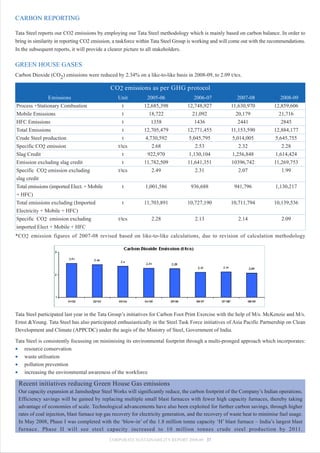
  • 70.
    The Tata CrucibleQuiz The Company has been running this successful Corporate Quiz in various regions of India for five years. The Tata Crucible Quiz covers the entire gamut of the world of Indian and international business, and pushes the contestants’ knowledge to the limits in a fun and competitive atmosphere. Professor of Metallurgy at Cambridge University The Chair of Professor of Metallurgy was inaugurated in Cambridge in November 2008. The holder will be known as the Tata Steel Professor of Metallurgy. Based in the Department of Materials Science & Metallurgy, the first Tata Steel Professor of Metallurgy is Dr Harry Bhadeshia, a world renowned expert on the physical metallurgy of steels. The endowment recognises the commitment of the Tata Steel Group and the University to world-leading research in the field, particularly in steels, as well as Professor Bhadeshia’s distinguished work in the subject. CARING FOR LOCAL COMMUNITIES MANAGEMENT APPROACH Tata Steel believes that its operations must positively impact the communities in which it operates and therefore, the Company strives to make a positive contribution. It’s philosophy is based on that of the Founder of the Group, J.N. Tata, and subsequent leaders who believed that the Company has an important role to play within the local community. This commitment is set out in the Corporate Today, the Company’s social activities “In a free Social Responsibility Policy. CSR is an encompass the Steel Works, iron ore mines integral component of business strategy and and collieries, the city of Jamshedpur, its enterprise the supports the Group’s Corporate Citizenship goals. The Company works to create a peri-urban areas and over 800 villages in the states of Jharkhand, Orissa and favourable and conducive social Chhattisgarh. Tata Steel works in partnership community is environment by improving the health, with the government, national, international education and economic status of the development organisations, local NGOs and not just communities in its areas of operation. In addition to complying with regulations, the the community to ensure sustainable socio- economic development of the communities. Company’s plans and monitors activities to It implements its social initiatives primarily another ensure that any negative impacts on through the Corporate Sustainability communities are addressed. It goes even Services Division and three independent stakeholder further, by proactively engaging with local communities to identify their needs and not-for-profit organisations established by it: Tata Steel Rural Development Society develop initiatives to enhance community (TSRDS), Tribal Cultural Society (TCS) in the wellbeing and strengthen society for the and Tata Steel Family Initiatives Foundation future. Tata Steel assesses the need for its (TSFIF). Many other departments of Tata business, but intervention based on factors including local Human Development Index scores, Steel, such as Sports and Medical Services Division, are also involved in Company contribution to Millennium Development initiatives to benefit local communities. The is in fact the Goals, the expressed needs of local many and varied activities address the broad communities and the priorities of the range of needs that have been identified in very purpose Company. From 2008 Tata Steel is focussing its activities on sustainable livelihoods, collaboration with local communities, and enhance the economic, environmental and health and education. social well-being of the communities. of its existence” - JN Tata CORPORATE SUSTAINABILITY REPORT 2008-09 70
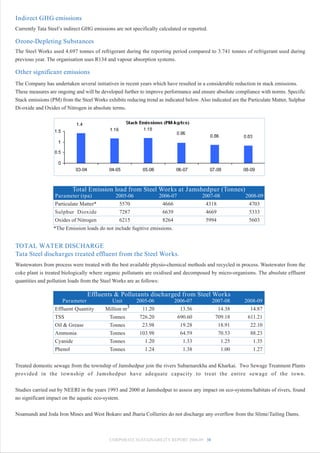
  • 71.
    COMMUNITY IMPACTS Tata Steelconsiders the effects of its activities when entering, operating within and leaving communities, and makes plans to manage associated risks and any adverse impacts. In changing and developing its operations, the Company considers the impacts on the local community as well as employees and their families. GREENFIELD DEVELOPMENT In areas of new operations Tata Steels seeks to ensure that it acts in the national interest and also brings benefits to the local community. Often these areas are poor and have low levels of infrastructure and services. The Company, therefore focussed its efforts in two main areas: • Resettlement and rehabilitation: resettling and rehabilitating local residents affected by the project; providing a fair compensation package and support; and monitoring to check that Company activities really do bring genuine long-term economic benefits. • Environment: ensuring that the environment is not adversely affected by the new operations. The Company does its best, within the limits of business requirements and applicable laws, to ensure that local people are able to participate in its new operations, for example through employment or supply opportunities. As part of its policy of Inclusive Growth, where it is needed, the Company takes proactive steps to build the capacity of local communities so as to be enable them to benefit from industrial development. During the year under review there was development on several capacity expansion plans in greenfield sites. Many of the communities living near these sites are tribal communities. To address the sentiments and concerns of the people living in the vicinity of these sites and the families that may get displaced by the projects, and to ensure that negative impacts are minimised and positive impacts created, the Company is implementing the progressive Tata Steel Parivar programme. Tata Steel Parivar 4 Rs: • Reassuring communication • Resettling the displaced population with care • Rehabilitation – ensuring better quality of life, income and happiness • Recheck implementation through self and independent social audits This Rehabilitation & Resettlement programme is one of India’s most pragmatic. The programme is designed to help increase income levels and create opportunities for sustainable livelihood, improving people’s quality of life while preserving and promoting their culture. The focus of the programme is on creating ‘a better tomorrow’ and reassuring relocated families that life will not only be the same, but much better. Parivar members can benefit from training, self help group membership and loans, as well as improved housing and better facilities in their new neighbourhoods. Tata Steel Parivar also necessitated tracking of each affected family to monitor their income and quality of life for at least five years. Activities under the Parivar programme include: • fair and just compensation packages in lieu of land given for the Project • managed move to rehabilitation colonies which have been developed in collaboration with villagers - with basic civic amenities, drinking water, power, street lights, sewerage, schools, dispensaries, access to education, community areas and places of religious worship • psychological and emotional impact management • self-help groups • employment opportunities for one nominee of each displaced family in the Company plant or associate companies • tailor-made training programmes to improve the employability of local youths • micro-credit and micro-enterprise projects, especially for women • basic health and hygiene services • cultural preservation schemes and educational scholarships CORPORATE SUSTAINABILITY REPORT 2008-09 71
  • 72.
    Independent social auditswill be conducted BBSR treated around 1400 patients with were also enrolled for skills development annually in affected communities to monitor various ailments and provided free medicine. programmes such as beautician training, and report developments in the socio- TSRDS ran a three day residential training screen printing and stitching classes to create economic status achieved through Tata Steel programme on safe birth practices in an avenue for self-employment. Parivar. Chhattisgarh, training 25 Traditional Birth Attendants to provide safe delivery support Medical camps were held at 12 coastal Under the programme in 2008-09 the to mothers. villages around Dhamra Port through which Company provided health services to more than 100 patients were treated. A approximately 22,000 patients in the Kalinga During the year 670 young people were computer centre established at Kharinasi, Nagar area through clinics and mobile health trained in Kalinga Nagar, of which 316 have in collaboration with Microsoft Corporation, units at the resettlement areas and peripheral found employment. In Chhattisgarh 110 will train unemployed youths in basic villages. Another 1500 schoolchildren were youths were trained in at the Company’s computer skills. Three tourist boats were treated at monthly health check-up camps Employability Training Programme. Of constructed to improve tourism in Hookitola in the four tribal residential schools. Five these, 63 have been employed in fields such island and provide a livelihood for nine local Sanjeevani Health Camps were organised as Customer Relations, IT, Hospitality and families. where doctors from Hi Tech Medical College Automobile Industries. Around 60 women Individual Case Studies: - Mangal Bage As a member of Tata Steel Parivar, Mangal Bage was trained in Welding Technology under the ‘Prerana’ programme specifically launched to boost employability opportunities for displaced families. Now Mangal has found employment in the fabrication yard of Tata Steel at Duburi. Previously at his village in Champa Koila, Mangal had been earning less than Rs. 1500 per month. With this small income he was living in dire poverty and was unable to educate his children. He did not have any landed property of his own and the family was living in a thatched house on a small piece of encroached Government land. Now Mangal is the proud owner of a house in Trijanga resettlement colony of Tata Steel and with his enhanced income he can afford to educate his children. - Pandu Gagarai The Gagarai family were living on encroached land, subsisting on income from a small agricultural plot in Sanachandia Village, Chandia Mouza. Under the Parivar programme their household was designated as two families, one headed by Widow Turi Gagarai aged 40 and one by son Pandu Gagarai, aged 27. They received a total of Rs. 57,500/- as compensation for the land and housing, as well as two plots of 10 decimal each and other benefits. Pandu, who was working as a labourer and driver, trained as a mason with the help of Tata Steel and is now working with a construction partner. With his wife Chandu, he has also established a poultry farm, using training and a Self Help Group loan from Tata Steel. His mother has also started a poultry farm. The family's livelihood is now much more secure and they are living happily in Trijanga Colony. The children are enjoying good school education and expect a bright and secure future. The entire income of the Gagarai family pre-displacement was Rs. 22,600 per year. Post displacement the family has an annual income of Rs. 1,50,000. Tata Steel incurred a one off expense of a total of Rs. 7,21,600, for temporary accommodation, infrastructure development, technical and Self Help Group training, and annual costs of medical services, to help the family achieve a more prosperous and sustainable future. - Jamuda family The Jamuda family was among several tribal families displaced by the development of the steel plant at Kalinganagar Industrial Complex. Through Tata Steel, Ramachandra Jamuda undertook ITES training in Bangalore, improved his language skills, and subseqently gained employment with TBSS, a voice based BPO in Hyderabad as a ‘call services attendant’. This BPO handles the calls addressed to Tata Sky, Tata Indicom and other leading companies. Other members of the family are also enjoying new opportunities, with younger brother Laxman Jamuda securing employment at Tata Growth Shop in Jamshedpur and mother Sabita Jamuda becoming self-sufficient, running a sewing unit at Danagadi in Jajpur district. Tata Steel had successfully gained the confidence of local tribal ladies and encouraged them to become independent. The Company provided training and sewing machines and now the women are supplying school uniforms to several residential schools in Jajpur district. CORPORATE SUSTAINABILITY REPORT 2008-09 72
  • 73.
    COMMUNITY INVESTMENT Where theCompany has identified need, Tata Steel companies invest in society and in the local community. It does not consider it a philanthropic gesture, but believes that as a corporate citizen, it has a duty to do so. In turn, the Company’s investment in the community helps it to develop positive relationships and to build trust in the locations around its operations, strengthening its business. Sustainable livelihoods In developing and developed economies, demand for unskilled and semi-skilled labour is reducing. Even where agriculture is the main economic activity, trends such as globalisation mean that simple subsistence farming is becoming less viable and social problems arise from migration caused by the inability of agriculture to support a large workforce. To address these problems Tata Steel works with local people in rural and urban areas to harness resources and skills that are available to develop opportunities for sustainable livelihoods. Case studies: • Agricultural productivity Tata Steel focussed many of its efforts on agricultural productivity. This year two major pilot projects were initiated: − In the first collaborative project with Agriculture Consultancy and Management Foundation (ACMF), Chennai, interventions in approximately 20 acres resulted in increased productivity of 2.25 tons per acre. − The second pilot project on dry land farming with International Crop Research Institute for Semi Arid Tropics (ICRISAT) Hyderabad, developed nearly 22 acres of land, resulting in increased yields. In addition, 2800 acres of wasteland has been developed. Second and third Cropping in about 3300 acres of land was facilitated through 65 water harvesting structures. The Company also initiated a project in Ganjam district of Orissa. In the first year of the project, Tata Steel Rural Development Society commenced the revival of 29 non functional lift irrigation systems of which 22 were completed by April 2009, covering over 720 acres of land and benefiting 1400 families. • Motor Driving Training for Rural Women at Joda 31 women from rural areas near Joda were trained free of cost to drive. The training is intended to provide them with the means of earning a good income and thereby empowering them and assisting their families. Four of these women are now employed as professional drivers in one of the mining companies operational in the area. • Vocational Skills Many young people have been trained in different kinds of vocations, to build skills such as Community Health Providers; Training on Tally; Advanced Computers; Pathological Laboratory Assistant; Automobile Mechanic, and Electrical Technician. Of 3000 youths trained, many have gone on to secure further training opportunities and employment. Of the 80 people trained under the Urban Services initiative, 31 have found employment so far. • Raimati Hansdah – awarded Bhanumathi Neelakanthan Award for “Woman Entrepreneur” Raimati Hansdah of Karandih Dharamtola comes from a very poor tribal family and is the eldest of five children. Her mother had died and her father Jadu Handha, a daily wage worker, struggled to make ends meet. In order to help support her family, Raimati started working as an agricultural labourer, also on a daily wage basis. Despite working, she managed to complete her school education and hopes to continue her studies and get a better job. With the guidance of Tata Steel’s Tribal Cultural Society, Raimati formed a Self Help Group in her area. She became a TCS member and received training in different marketable skills, including six months of training in tailoring and nine months training in making jute artefacts at the Tribal Cultural Centre. Following her training, Raimati started taking tailoring orders from local people and then subsequently trained others in her skills. She mobilised 15 women to form a Self Help Group in Karandih and has trained them in jute-work. Today Raimati is earning a good living. She plans to set up her own tailoring and jute artefacts training centre along with a sales outlet. CORPORATE SUSTAINABILITY REPORT 2008-09 73
  • 74.
    Promoting good health Wherecommunity health is poor and local facilities are lacking, Tata Steel extends much needed preventive and curative healthcare facilities in its areas of operation. In 2008-09 through its basic health services in India, Tata Steel immunised 7750 children, carried out approximately 8400 antenatal check-ups, conducted over 1640 cataract operations and assisted more than 2600 people with disabilities, providing certificates, aids and appliances. • Sexual health and family planning The Company has worked with approximately 24,000 youths through project ‘RISHTA’ to raise awareness and promote sexual health in young people aged 15 to 24. Young people in this age category, who form 33% of India’s population and a significant 29 % of the world’s youth, are at risk of teenage pregnancy, sexual disease and abuse. Over 7000 younger couples were protected in 2008-09 through permanent methods of family planning, which included Laparoscopic Tubectomy in females and Non Scalpel Vasectomy in males. Encouraging and facilitating male participation in Family Planning - which has traditionally been viewed as a woman’s responsibility - during the year, resulted in over 640 men undergoing non scalpel vasectomy. • Smile! The cleft lip and palate is a congenital deformity which has been neglected in India because of the social stigma is attached to the condition. Cleft lip/palate deformity is a relatively common problem, with nearly 1 in 700 births or 35,000 children every year born with this deformity. Tata Steel extended its medical infrastructure facilities to support initiatives to transform this conditions since 2002 when it first collaborated with the Smile Train. It now works in partnership with US charity Operation Smile. As a result more than 3000 children have undergone surgical procedures to rectify their condition. In 2008-09, 284 children benefited from corrective treatment. • HIV/AIDS: In India 2.5 million people are living with HIV/AIDS. Jharkhand state has a prevalence of HIV/AIDS infection which, whilst currently lower than the national average, is unlike the rest of the country on an upward trend. As a economic and industrial hub, Jamshedpur and also other locations of Tata Steel in Jharkhand and Orissa, have a large floating population. This puts these locations at risk with the danger of the disease spreading via migrant workers and transport workers such as lorry drivers. Tata Steel recognised the importance of undertaking a HIV/AIDS intervention in the 1990s and since then a complementary spectrum of activities has been designed to address the problems faced in these locations. Its preventive, promotive and curative measures to prevent infection and development of the disease have been recognised with several awards. In addition to general awareness programmes for employees and the local communities, Project Kavach holds awareness events, treatment clinics and offers counselling to minimize the risk of HIV/AIDS among truckers. Sneh Kendra a counselling cente at Jamshedpur, has helped over 1440 people ‘at risk’ in 2008- 09. Project ‘Sathi’, a residential community care centre located in Ganjam, a partnership project with Orissa State AIDS Control Society, Bhubaneshwar, has provided treatment and counselling to 376 people this year. Investing in education Education is a basic human right, vital to personal and societal development and well being. All children deserve quality education given a rights-based approach and rooted in the concept of equality, including gender equality. Tata Steel supports the right to free and compulsory education for all children up to the age of fourteen years and supports initiatives to improve literacy levels amongst adults. The Company also wishes to promote the study of science, to promote understanding of its product and help to develop qualified people for industry in the future. CORPORATE SUSTAINABILITY REPORT 2008-09 74
  • 75.
    Case studies: • Elementary education in India The Government of India aims to achieve universal primary education by 2007 and universal elementary education by 2010. This means achieving access, enrolment, retention and quality of education universally. A number of Tata Steel’s activities are designed to support these goals: - Early Childhood Education: Interventions in early childhood education are vital preparatory grounds to formal schooling in both rural and urban areas. In the urban areas, out of about 570 students who were enrolled in 12 centres, Tata Steel successfully integrated more than 380 students into formal schools. In rural areas the Company had a 100% success rate last year with 550 children from 22 centres moving into formal education. - Camp School: To help underprivileged girls enter the mainstream, Tata Steel initiated a camp school programme with the help of Jharkhand Education Project. The nine-month intensive learning course is offered to students aged 9-14 to complete their education up to 5th standard and allow them to qualify for admission to class VI. In 2008-09, 200 girls enrolled in the two camp schools. - Schools: The Company supports many schools in its areas of operation. For example twelve primary schools have been identified for support near Dhamra Port in 2008-09. Twenty-four teachers will provide academic support to 480 students. • Scholarships In May 2008 Tata Steel offered annual scholarships to promote the talent and knowledge of students from Scheduled Castes and Scheduled Tribes. These awards encourage students, often from families who have not previously had access to education beyond elementary levels, and who would not otherwise be able to afford to study further. The Jyoti Fellowship was instituted in 1990 and the total value of fellowships awarded this year was Rs. 2.5 M per annum. It reached out to 550 students (246 at school level and 304 at college/university level). The Moodie Endowment encourages youths pursuing studies in pure science in various districts of Jharkhand and West Bengal. The total grant is Rs. 1.1 M annually for 110 awards. BUILDING COMMUNITIES Developing infrastructure Tata Steel understands that economic development is not only about working with people; there are practical barriers which cause deprivation and prevent people from taking up economic opportunities – for example lack of access to water and electricity, poor roads and communications, inadequate health and educational facilities, etc. Tata Steel worked with local communities to identify appropriate areas to develop infrastructure and services which benefit local people. Case studies: Community infrastructure in Orissa In Orissa, where the Company is developing new operations, it has worked with local communities to create many much-needed facilities. For example: • 44 tubewells were installed in 2008-09 to provide drinking water • Irrigation was provided to villages such as Kalarangi and Kakudia villages enabling the farmers to achieve harvests three times a year • A bridge at Mutuda and drains at Bichakundi villages were built to enable access all year round • Electricity and bio-gas plants have been supplied in a number of villages CORPORATE SUSTAINABILITY REPORT 2008-09 75
  • 76.
    Tata Steel’s modelvillages’ are illustrative of the kind of initiatives the Company regularly undertakes: Sitalbasha This village was experiencing a number of problems due to poor infrastructure. Villagers did not have good water hygiene; they lacked proper toilet facilities and used water from a nearby canal and pond for drinking, as there was no other source of fresh water. Consequently water-borne diseases were a common problem during the rainy season. Tata Steel constructed 35 low cost toilets and raised awareness amongst villagers on the need for hygiene and sanitation. It also constructed a hand pump and a ring well for the villagers to provide safe access to drinking water. A school building was also built by the Company at the request of villagers to enable the children to where attend school adequate facilities are available. Six electric fans, as well as a ring well and hand pump, were also provided to the school, as were cashew nut trees for a plantation on-site. Three Self Help Groups have been established in the village with the help of the Company undertake activities such as pisciculture, vegetable farming and providing mid-day meals. Individuals such as Sharat Nayak have constructed bio-gas plants by their homes with the Company’s assistance. This has provided him with fuel for illuminating his home and cooking, a necessity he did not have before as the area has no electricity. All 90 families in the village now have their own bio-gas units to cook food, illuminate their houses at night and produce bio-fertilisers for cultivation purposes. Chingudiapal This village near Sukinda Chromite Mines lacked several important facilities including drinking water and electricity. There were also access problems for the children travelling to school when the path became water logged during the rainy season. Consequently the villagers experienced problems with water borne diseases, were restricted to day-time activities and the children were prevented from studying. Five hand pumps were provided by the Company so that villagers could have safe drinking water. It has also built the Damshala Bridge so that the students could access Sourik High School and Sebashram School during the rainy season. A sub-station for electricity was provided enabling children to study at night and adults to continue to work beyond daylight. EMPLOYEE VOLUNTEERING Tata Steel’s philosophy of contributing to society is shared by the Company’s employees and many individuals choose to contribute their time and efforts to help strengthen the local communities in which it operates. Many of Tata Steel’s employees assist Tata Relief Committee’s disaster responses. Tata Steel is also developing a volunteering programme for employees. Now in its early stages, the Company already has a few volunteers working in dedicated activities in its community programmes. TATA RELIEF COMMITTEE Whilst most of Tata Steel’s community activities are geographically focused in its areas of operation, as part of its Corporate Citizenship, the Company is also committed to providing assistance in the event of natural disasters wherever they occur in India. The Company spearheads the work undertaken by Tata Relief Committee (East) • Disaster relief: Minister of Bihar, the Company supplied for temporary shelters and 1960 pieces of The Tata Relief Committee provides 441.52 M.T. of Tata MS pipes in various Tata Shaktee roofing for new housing. When donations and volunteer support in the event sizes, free of cost, for building temporary flooding affected Jamshedpur in June 2008 of disasters, to help those affected get back shelters and constructed 27 Flood centres. Tata Steel moved 3000 people to safety on their feet and to rebuild local Tata Steel also took on the responsibility of using 15 life boats and rafts. It set up 10 infrastructure. assisting in the relief and rehabilitation work relief camps and dispatched emergency in the villages on an ongoing basis and supplies and medical teams to affected areas. In 2008 the floods in Bihar left many supplied additional materials for the re- Tata Steel is justifiably proud of its extensive hundreds of thousands of people homeless construction effort at concessionary rates. community programmes and welcomes and devastated. Tata Relief Committee sent Tata Relief Committee has built 44 opportunities for collaborative working to volunteers to assist in the relief work, earthquake resistant houses for poor develop activities in the future. More including a team of doctors. These special villagers, with another 100 planned. information on the extensive range of efforts were co-ordinated by a dedicated activities and achievements can be found in committee led by a senior manager. The Company also assisted in the floods in the annual reports of TSRDS, TCS and Following consultation with the Chief Orissa in 2008, supplying 27,550 tarpaulins TSFIF. CORPORATE SUSTAINABILITY REPORT 2008-09 76
  • 77.
    PRODUCTS AND SERVICES MANAGEMENTAPPROACH Tata Steel competes in the open marketplace The Company is absolutely committed to and services meet the required national on the basis of the benefits and quality of providing products and services complying standards and the Company endeavours to its products. Its reputation and passion for with all the relevant customer health and match world-class standards. Its innovation and customer service are what safety regulations prescribed under law. It manufacturing processes are designed in a make the difference and enable it to gain also tries to improve its product and service robust manner to deliver consistent quality the trust of consumers and loyalty of performance well beyond the prescribed products that meet the required customers. norms and statutes, wherever possible. Tata specifications. Customer complaints with Steel has developed products like Super- regard to product quality are properly Tata Steel’s approach towards product and Ductile Rebars, being sold in Seismic zones investigated in the shortest possible time service management has been guided by the of India, for better Earth-quake protection and are resolved to the customer’s Tata Code of Conduct (Clause 8: Health, and lead-free coating on Galvano™, satisfaction. Safety & Environment, Clause 9: Quality manifesting them into health and of products and services), the Tata Steel environment friendly products. All prime products (more than 95% of sales) Environmental Policy and the UN Global are labelled for identification. Products are Compact Principles. The quality standards of Tata Steel’s goods also delivered with Test Certificates. Brand embossment/ labels are done for product differentiation for Retail consumers. CUSTOMER SATISFACTION The key processes for determining customer satisfaction and building relationships for retention are undertaken through the “Manage Customer Accounts” and “Measure Customer Satisfaction” processes. The determination of customer satisfaction is established by conducting annual surveys, using a segment-wise approach, with products/service attributes as parameters. The surveys are conducted by external agencies (M/s A C Nielsen, TNS for Year 2008). The overall customer satisfaction is captured through a designed questionnaire - both quantitative and qualitative - during the field survey. The satisfaction index is a relative score of the Company’s overall score over the nearest competitor. * Flat Products CSI score is the overall OE score *The Target for CSI Index is 1.06 for both long and flat products In 2008, the CSI Index got impacted due to lower score in Delivery attributes. Due to the downturn, customers were more frequently revising their monthly indent and in turn the Company had to re-schedule its despatch plans more often. Owing to this, the overall delivery performance took a hit. In contrast, the score was higher in earlier years when due to higher demand, availability was an issue at the market place and Tata Steel held its prices. Further on, corrective action was taken by launching SFS initiative with important customers for improving the delivery compliance. CORPORATE SUSTAINABILITY REPORT 2008-09 77
  • 78.
    Theory of Constraints:Tata Steel applies the Theory of Constraints as part of the ASPIRE improvement programme, to develop a competitive edge based on reliable delivery, creating value for customers. So far, Tata Steel has rolled out the following offers under TOC: • Stabilisation in Steel Division with Solution for Sales (SFS) offers- Based on the Theory of Constraints (TOC) concept, the replenishment module of this offer was extended to cover 100% of the retail channel of TATA TISCON, achieved 90% coverage in TATA SHAKTEE and 60% in TATA Steelium. This resulted in a reduction of stock outs in retail shops and more significantly, a reduction in channel stocks. • Supply Chain Improvement Initiative- For the Construction Projects segment, an S-DBR (Simplified Drum Buffer Rope) mechanism was implemented which improved the availability of rebars at the warehouses, thereby reducing instances of delays and loss of orders. • Reliability Solutions- The solutions were extended to direct customers in the Steelium distribution. HUMAN RIGHTS MANAGEMENT APPROACH Tata Steel is proud of the reputation it enjoys as a fair and caring employer. It is indeed an upshot of the respect and apt initiatives towards human rights both within and outside the workplace. Working conditions for employees and supply chains are primarily managed through the standard Social Accountability (SA 8000), which is based on the Universal Declaration of Human Rights and International Labour Organisation conventions. The Company works in collaboration with Social Accountability International, the human rights organisation and the guardian of the SA8000 standard, to manage ethical workplace conditions throughout its supply chains. Tata Steel’s Works attained SA8000 certification in 2005 (and was re-certified in 2007). The Company’s Sukinda unit is the first mine world-wide to be SA8000 certified. A study by Center for International Private Enterprise (CIPE) and Social Accountability International (SAI) published in February 2009, which examined Tata Steel’s application of the SA8000 standard, concluded that significant gains have been realised in the areas of contract work and supply chain social compliance. “Tata Steel has long been India’s front-runner in good corporate citizenship, making the concerns of workers and of the community an integral part of its business operations. Given its history, size, and reputation, Tata Steel has significant potential to demonstrate the beneficial influence of adopting SA8000 in India and beyond. Improvements to its vendor management system, as well as contract workers’ safety, health, and training prompted by implementation of SA8000, offer examples and guidance for other companies seeking effective approaches to meeting workplace standards.” Tata Steel implementation case featured in SA8000: The First Decade (Greenleaf: London, 2009). The standard is applied to both the Company’s employees and to contracted labour. For example, in 2008-09 more than 18,000 contract labourers were provided initial health check ups at the time of starting work and routine annual check-ups. Systems in place to ensure that human rights are upheld include the Employee Grievance Redressal System, through which employees can safely register issues relating to their employment, and the Whistle Blower Policy, through which they can raise concerns over other people’s conduct. Both systems encourage and protect the individual. CORPORATE SUSTAINABILITY REPORT 2008-09 78
  • 79.
    Human Rights inInvestment and Procurement Practices The Company’s commitment to human rights extends to all its significant investment decisions. Major capital expenditure, for example machinery and technology, is sourced from reputed suppliers who follow internationally accepted norms and standards on human rights. The Procurement Division of Tata Steel has designed and deployed a robust process for ensuring human rights by suppliers and contractors, using the SA8000 standard. Amongst other measures: • Suppliers and contractors must accept Tata Steel’s Code of Conduct • Vendors must comply with various clauses of SA8000 • At vendor registration, a Vendor Assessment Form©, developed by Procurement to check the vendor, contractor or subcontractor for mandatory legal clearances, also includes a checklist for system review for SA8000 • An independent vigilance report may be obtained before registration to verify the credentials of the vendor • Sample audits are undertaken at vendors’ premises to check compliance The Company regularly conducts refresher training on SA8000 for contractors, meets with vendors to discuss issues and holds sessions of the Supplier Value Management programme. The Ethics Counsellor and Procurement Division closely monitor adherence to the Tata Code of Conduct by suppliers and take appropriate action in cases of non-compliance. In 2005-06 the Company initiated third-party audits on SA8000 clauses for its principle vendors and suppliers. Audit of over 100 major vendors has resulted in coverage of 75% of the contract workers engaged through them at the Steel Works. In 2008-09 twelve third party vendor audits were conducted, incorporating feedback aimed at enhancing working conditions for the Company’s employees and its supply chains. The Procurement Division has created a “single window” system to address any vendor concerns. No Child Labour Tata Steel does not employ child labour. The minimum age required for employment in Tata Steel is 18 years and proof of age must be supplied at recruitment. The Company also makes it very clear to its business partners that, as stipulated by its SA8000 system, no persons below the age of 18 years may be engaged by contractors, suppliers or vendors at any point, within or outside the Company premises. To help ensure that no child labour is engaged, in 2007 a process was created at the Rotary affiliated Labour Training Centre for age certification of contract labour, which specifies the required documentation for proof of age. In the event of discovery of any child labour being used by contractors, liabilities for the education of the child until completion of high school would accrue to the defaulting party. Additionally state penalties under the Child Labour Abolition and Control Act of 1986 would be enforced. No Forced or Compulsory Labour Tata Steel does not permit any form of forced or compulsory labour in its operations. The Grievance Redressal Committee and Ethics Counsellor monitor this requirement. Non-Discrimination No cases of Discrimination were received by the Ethics Counsellor ’s Office during this reporting period. CORPORATE SUSTAINABILITY REPORT 2008-09 79
  • 80.
    Indigenous Communities The aimof Tata Steel is to respect and protect the rights of indigenous communities at its business locations. This is often particularly relevant for new operations and in developing countries. In addition to respecting the legal rights of indigenous communities, it also considers social, cultural and economic rights. The Company’s Affirmative Action policy and philosophy of Inclusive Growth attempt to help indigenous communities - Scheduled Castes and Scheduled Tribes in India - to reach the standards of human development which will help them to benefit from economic opportunities, whilst respecting and promoting the social norms and cultural practices which are important to their communities. Tata Steel Rural Development Society and Tribal Cultural Society help the Company to achieve this through various activities in India. Further information about these activities is supplied in the Communities chapter. Employee training on relevant aspects of human rights All new recruits in Tata Steel sign the Tata Code of Conduct and SA8000 training forms part of their induction programme. In 2008- 09 more than 300 new recruits were trained on human rights. Security workers are trained on human rights relevant to security procedures, such as Right of Search, Right of Arrest, Safety, Weapon Handling, Rescue, etc. Additionally workers are trained in SA8000, OHSAS, Works Standing Orders, customer orientation, motivation and positive attitude. Human rights training also formed part of regular staff training sessions on ethics conducted on a departmental basis. CORPORATE SUSTAINABILITY REPORT 2008-09 80
  • 81.
    DESCRIPTION Tata Code ofConduct & Code for Non-Executive Directors Tata Steel Policies United Nations Global Compact Principles Tata Corporate Sustainability (Group Policy) Glossary CORPORATE SUSTAINABILITY REPORT 2008-09 81
  • 82.
    TATA CODE OFCONDUCT 2008 Clause 1: National Interest The Tata Group is committed to benefit the localities and communities served to the the culture, customs and traditions of each economic development of the countries in extent possible and affordable, and shall be country and region in which it operates. It which it operates. No Tata Company shall in accordance with the laws and economic shall conform to international trade undertake any project or activity to the development policies of the government of procedures, including licensing, detriment of the wider interests of the each country. documentation, and other necessary communities in which it operates. A Tata formalities as applicable. Company’s management practices and A Tata Company, in the course of its business conduct must benefit the country, international business activities, shall respect Clause 2: Financial Reporting and Records A Tata Company shall prepare and maintain company’s business transactions and bank account and funds. its accounts fairly and accurately in disposition of assets, and shall have internal accordance with the accounting and financial controls to provide assurance to the Any willful, material misrepresentation of reporting standards which represent the Company’s Board and shareholders that the and / or misinformation on the financial generally accepted guidelines, principles, transactions are accurate and legitimate. All accounts and reports shall be regarded as a standards, laws and regulations of the required information shall be accessible to violation of the Code apart from inviting country in which the company conducts its company auditors and other authorized appropriate civil or criminal action under business affairs. parties and government agencies. There the relevant laws. No employee shall make, shall be no willful omissions of any company authorize or collude in an improper payment, Internal accounting and audit procedures transactions from the books and records, no commission or bribe. shall reflect, fairly and accurately, all of the advance income recognition and no hidden Clause 3: Competition A Tata Company shall fully support the activities that generate or support the make unfair and misleading statements about development and operation of competitive formation of monopolies, dominant market competitors’ products and services. Any open markets and shall promote the positions, cartels and similar unfair trade collection of competitive information shall liberalization of trade and investment in practices. be made only in the normal course of each country and market it operates in. business and shall be obtained only through Specifically, a Tata Company shall not A Tata Company shall market its products legally permitted sources and means. engage in restrictive trade practices and and services on its own merits and shall not Clause 4: Equal-Opportunities Employer A Tata Company shall provide equal Human Resource policies should promote maintain a work environment free of sexual opportunities to all its employees and all diversity and equity in the workplace, as harassment, whether physical, verbal or qualified applicants for employment without well as comply with all labour laws and psychological. Employee policies and regard to their race, caste, religion, colour, international best practices. Employees of practices shall be administered in a manner ancestry, marital status, sex, age, nationality, a Tata Company shall be treated with dignity that would ensure that in all matters equal disability and veteran status. and in accordance with the Tata policy to opportunity is provided to those eligible and the decisions are merit-based. CORPORATE SUSTAINABILITY REPORT 2008-09 82
  • 83.
    Clause 5: Giftsand Donations A Tata Company and its employees shall neither receive nor offer or make, directly or indirectly, any illegal payments, remuneration, gifts, donations, or comparable benefits, which are intended to or perceived to obtain business or un-competitive favours for the conduct of its business and shall participate in efforts to eliminate such forms of bribery, fraud and corruption. However, a Tata Company and its employees may accept and offer nominal gifts which are customarily given and are of commemorative nature for special events. Clause 6: Government Agencies A Tata Company and its employees shall not offer or give any company funds or property as donation to any government agencies or their representatives, directly or through intermediaries, in order to obtain any favourable performance of official duties. A Tata Company shall comply with government procurement regulations, and shall be transparent in all its dealings with government agencies as applicable. Clause 7: Political Non-Alignment A Tata Company shall be committed to and support functioning democratic constitutions and systems with transparent and fair electoral systems. A Tata Company shall not support directly or indirectly any specific political party or candidate for political office. The Company’s conduct shall preclude any activity that could be interpreted as mutual dependence / favour with any political body and shall not offer or give any company funds or property as donations, directly or indirectly, to any specific political party, candidate or campaign. Clause 8: Health, Safety and Environment A Tata Company shall strive to provide a practice in minimizing its impact on the a disaster management system to address safe, healthy and ergonomic working environment, prevent the wasteful use of any natural calamities or business environment for its people. It shall comply natural resources, and properly and safely contingencies that may arise. with all health, safety and environmental control any hazardous aspects of its business. regulations in each jurisdiction, in which it A Tata Company, in the process of operates. A Tata Company shall have policies and production and sale of its products and processes in place to address issues of safety, services, shall strive for economic, social A Tata Company shall be committed to best health and environment, and shall also have and environmental sustainability. Clause 9: Quality of Products and Services A Tata Company shall be committed to supply goods and services of the highest quality standards backed by efficient after-sales service consistent with the requirements of customers to ensure their total satisfaction. The quality standards of the Company’s goods and services should meet the required national standards and the Company should endeavour to become world-class. A Tata Company shall illustrate adequate labels, caveats and other necessary health and safety information on its product packaging. Clause 10: Corporate Citizenship A Tata Company shall be committed to be initiatives in the field of community health strive to incorporate them as an integral part a good corporate citizen not only in and family welfare, water management, of its business plan. The Company would compliance with all relevant laws and vocational training, education and literacy also encourage volunteering amongst its regulations but also by actively assisting in and encourage application of modern employees and collaboration with the improvement of the quality of life of the scientific and managerial techniques and community groups. Tata Companies are people in the communities, in which it expertise. This will be reviewed periodically encouraged to develop social accounting operates with the objective of making them in consonance with national and regional systems, carry out social audit of their self reliant. Such social responsibility would priorities. The Company would also not operations, and support public policies that comprise, to initiate and support community treat these activities as optional but would promote social and economic development. Clause 11: Cooperation of Tata Companies A Tata Company shall cooperate with other Tata Companies by sharing knowledge, physical, human and management resources as long as this does not adversely affect its business interests and shareholder value. In the procurement of products and services, a Tata Company shall give preference to another Tata Company, as long as it can provide these on competitive terms, relative to third parties. CORPORATE SUSTAINABILITY REPORT 2008-09 83
  • 84.
    Clause 12: PublicRepresentation of the Company and the Group The Tata Group honours the information requirements of the public and its stakeholders. In all its public appearance with respect to disclosing company and business information to public constituencies such as the media, the financial community, employees and shareholders, a Tata Company or the Tata Group shall be represented only by specifically authorized directors and employees. It will be the sole responsibility of these authorized representatives to disclose information on the Company. Clause 13: Third Party Representation Parties which have business dealings with the Tata Group but are not members of the Group such as consultants, agents, sales representatives, distributors, contractors, suppliers, etc shall not be authorized to represent a Tata Company, if their business conduct and ethics are known to be inconsistent with the Tata Code. The third parties are expected to abide by the Code in their interaction with the company. Clause 14: Use of the Tata Brand The use of the Tata name and trademark owned by Tata Sons shall be governed by manuals, codes and agreements to be issued by Tata Sons. The use of the Tata Brand is defined in and regulated by the Tata Brand Equity and Business Promotion Agreement. No third party is expected to use the Tata brand to further its interests without specific authorization. Clause 15: Group Policies A Tata Company shall recommend to its Board of Directors the adoption of policies and guidelines periodically formulated by Tata Sons. Clause 16: Shareholders A Tata Company shall be committed to enhance shareholder value and comply with all regulations and laws that govern shareholders’ rights. The Board of Directors of a Tata Company shall duly and fairly inform its shareholders about all relevant aspects of the Company’s business and disclose such information, in accordance with the respective regulations and agreements. Clause 17: Ethical Conduct Every employee of a Tata Company, which transparent and be perceived to be as such Every employee shall be responsible for the shall include whole-time directors and the by third parties. implementation of and compliance with the chief executive, shall deal on behalf of the Code in his / her professional environment. Company with professionalism, honesty, Every employee of a Tata Company shall Failure to adhere to the Code could attract integrity as well as high moral and ethical preserve the human rights of every individual the most severe consequences including standards. Such conduct shall be fair and and shall strive to honour commitments. termination of employment. Clause 18: Regulatory Compliance Every employee of a Tata Company, in his / her business conduct, shall comply with all applicable laws and regulations, both in letter and in spirit, in all territories in which he or she operates. If the ethical and professional standards set out in the applicable laws and regulations fall short of the Code, then the standards of the Code shall prevail. Clause 19: Concurrent Employment An employee of a Tata Company shall not, without the prior approval of the chief executive of the Company accept employment or a position of responsibility (such as a consultant or a director) with any other company, nor provide “free-lance” services to anyone. In the case of a whole-time director or the chief executive such prior approval must be obtained from the Board of Directors of the Company. Clause 20: Conflict of Interest An employee or director of a Tata Company shall not accept a position of power / responsibility / board nomination in any other non Tata Company or not for profit organization. CORPORATE SUSTAINABILITY REPORT 2008-09 84
  • 85.
    The above willnot apply to- • Nominations to the Boards of Tata Companies, joint ventures or associate companies • Memberships / positions of responsibility in professional bodies wherein such association will benefit the employee / Tata Company. • Nominations / memberships in Government committees / bodies or organizations. • Exceptional circumstances as determined by the competent authority. Competent authority in case of an employee engage in any business, relationship or employee is in a position to derive a personal shall be the chief executive who in turn shall activity which might detrimentally conflict benefit or a benefit to any of his / her report all such exceptional cases to the Board with the interest of his / her Company or relatives by making or influencing decisions of Directors on a quarterly basis. In case of the Group. A conflict of interest, actual or relating to any transaction, and (c) an the chief executive and directors, the Group potential, may arise where, directly or independent judgment of the Company’s or Corporate Center shall be the competent indirectly, (a) an employee of a Tata Group’s best interest cannot be exercised. authority. Company engages in a business, relationship or activity with anyone who is party to a An employee of a Tata Company shall not transaction with his / her Company, (b) an The main areas of such actual or potential conflicts of interest would include the following: • Financial interest of an employee of a Tata Company or his / her relatives including the holding of an investment in the subscribed share capital of any company or a share in any firm which is an actual or potential competitor, supplier, customer, distributor, joint venture or other alliance partner of the Tata company. (The ownership of up to 1 per cent of the subscribed share capital of a publicly held company shall not ordinarily constitute a financial interest for this purpose.) • An employee of a Tata Company conducting business on behalf of his / her Company or being in a position to influence a decision with regard to his / her Company’s business with a supplier or customer of which his / her relative is a principal officer or representative resulting in a benefit to him / her or his / her relative • Award of benefits such as increase in salary or other remuneration, posting, promotion or recruitment of a relative of an employee of a Tata Company where such an individual is in a position to influence the decision with regard to such benefits. • Acceptance of gifts, donations, hospitality and / or entertainment beyond the customary level from existing or potential suppliers, customers or other third parties which have business dealings with the Company. Notwithstanding that such or other instances business dealings with his / her Company. required to take necessary action as advised of conflict of interest exist due to any to resolve / avoid the conflict. historical reasons, adequate and full Every employee who is required to make a disclosure by the interested employees disclosure as mentioned above shall do so, If an employee fails to make a disclosure should be made to the company’s in writing, to his / her immediate superior as required therein and the management of management. It is also incumbent upon who shall forward the information along its own accord becomes aware of an instance every employee to make a full disclosure with his / her comments to the person of conflict of interest that ought to have of any interest which the employee or the designated for this purpose by the chief been disclosed by the employee, the employee’s immediate family, which would executive and / or the Board of Directors / management would take a serious view of include parents, spouse and children, may executive committee appointed by the Board the matter and consider suitable disciplinary have in a company or firm which is a and, upon a decision being taken in the action against the employee. supplier, customer, distributor of or has other matter, the employee concerned will be CORPORATE SUSTAINABILITY REPORT 2008-09 85
  • 86.
    Clause 21: SecuritiesTransactions and Confidential Information An employee of a Tata Company and his / her immediate family shall not derive any benefit or assist others to derive any benefit from the access to and possession of information about the company, Group or client which is not in the public domain and thus constitutes insider information. An employee of a Tata Company shall not use or proliferate information which is not available to the investing public and therefore constitutes insider information for making or giving advice on investment decisions on the securities of the respective Tata Company on which such insider information has been obtained. Such insider information might include the following:· • Acquisition and divestiture of businesses or business units • Financial information such as profits, earnings and dividends • Announcement of new product introductions or developments • Asset revaluations • Investment decisions / plans • Restructuring plans • Major supply and delivery agreements • Raising finances An employee of a Tata Company shall also respect and observe the confidentiality of information pertaining to other companies, their patents, intellectual property rights, trademarks and inventions; and strictly observe a practice of non-disclosure. Clause 22: Protecting Company Assets The assets of a Tata Company should not be misused but employed primarily for the purpose of conducting the business for which they are duly authorized. These include tangible assets such as equipment and machinery, systems, facilities, materials, resources as well as intangible assets such as information technology and systems, proprietary information, intellectual property rights, relationships with customers and suppliers, etc. Clause 23: Citizenship An employee of a Tata Company shall in his / her private life be free to pursue an active role in civic or political affairs as long as it does not adversely affect the business or interests of the Company or the Group. Clause 24: Integrity of Data Furnished Every employee of a Tata Company shall ensure at all times, the integrity of data or information furnished by him to the Company. Clause 25: Reporting Concerns Every employee of a Tata Company shall promptly report to the Management when she / he becomes aware of any actual or possible violation of the Code or an event of misconduct, act of misdemeanour or act not in Company’s interest, which could affect the business or reputation of his / her or any other Tata Company. Any employee can make a protected disclosure under the Whistle Blower Policy. The Protected Disclosure should be forwarded under a covering letter, which shall bear the identity of the Whistle Blower. Code of Conduct for Non Executive Directors Non-Executive Directors of a Company will always act in the interest of the Company and ensure that any other business or personal association which they may have, does not involve any conflict of interest with the operations of the Company and his role therein. Non-Executive Directors will comply with all applicable laws and regulations of all the relevant regulatory and other authorities as may be applicable to such Directors in their individual capacities. Non-Executive Directors will safeguard the confidentiality of all information received by them by virtue of their position. This Code was approved by the Board of Directors on 23rd January 2006. CORPORATE SUSTAINABILITY REPORT 2008-09 86
  • 87.
    TATA STEEL POLICIES TATA STEEL SOCIAL ACCOUNTABILITY POLICY Tata Steel, in accordance with its founding principles, will continue to improve the quality of life of its employees and the communities it serves. Tata Steel will conduct its business ever mindful of its social accountability, respecting applicable laws and with regard for human dignity. Tata Steel will positively impact and influence its partners in fostering a sense of social commitment for their stakeholders. December 20, 2003 TATA STEEL CORPORATE SOCIAL RESPONSIBILITY POLICY Tata Steel believes that the primary purpose of a business is to improve the quality of life of people. Tata Steel will volunteer its resources, to the extent it can reasonably afford, to sustain and improve a healthy and prosperous environment and to improve the quality of life of the people of the areas in which it operates. February 1, 2003 TATA STEEL ENVIRONMENTAL POLICY Tata Steel’s Environmental responsibilities are driven by our commitment to preserve the environment and are integral to the way we do business. 1. We are committed to the efficient use of natural resources & energy; reducing and preventing pollution; promoting waste avoidance and recycling measures and product stewardship. • We will identify, assess and manage our environmental impact. • We will regularly monitor, review & report publicly our environmental performance. • We shall develop & rehabilitate abandoned sites through afforestation, landscaping and shall protect & preserve the biodiversity in the areas of our operations. • We will enhance awareness, skill and competence of our employees and contractors so as to enable them to demonstrate their involvement, responsibility and accountability for sound environmental performance. 2. We are committed to continual improvement in our environmental performance. • We will set objectives-targets, develop, implement and maintain management standards and systems, and go beyond compliance with relevant industry standards, legal and other requirements. 3. We will truly succeed when we sustain our environmental achievement and are valued by the communities in which we work. May 21, 2005 CORPORATE SUSTAINABILITY REPORT 2008-09 87
  • 88.
    TATA STEEL SAFETY& OCCUPATIONAL HEALTH POLICY Tata Steel’s safety and occupational health responsibilities are driven by our desire to ensure zero harm to people we work with and society at large and is integral to the way we do business. 1. Our fundamental belief is that all injuries can be prevented. This responsibility starts with each one of us. • We will identify, assess and manage our Safety & OH hazard/risks. • We will regularly monitor, review the progress and report. • We will ensure WILL & SKILL buildup among employees/ contractors partner to demonstrate their involvement, responsibility and accountability to achieve sound Safety & OH performance. 2. We are committed to continual improvement in our Safety & OH performance. • We will set objectives – targets, develop, implement and maintain management standards and systems, and go beyond compliance with relevant industry standards, legal and other requirements. 3. We will truly succeed when we achieve our Safety & OH goals and are valued by the communities in which we work. May 21, 2005 TATA STEEL HUMAN RESOURCE POLICY Tata Steel recognizes that its people are the primary source of its competitiveness. It is committed to equal employment opportunities for attracting the best available talent and ensuring a cosmopolitan workforce. It will pursue management practices designed to enrich the quality of life of its employees, develop their potential and maximize their productivity. It will aim at ensuring transparency, fairness and equity in all its dealings with its employees. Tata Steel will strive continuously to foster a climate of openness, mutual trust and teamwork. October 1, 2001 TATA STEEL HIV (+) & AIDS CONTROL POLICY Tata Steel is committed to contribute to the global effort towards halting and reversing the course of HIV/AIDS. The Company would take measures to actively disseminate information and education regarding HIV/AIDS within our workplace and surrounding communities, with the objective to reduce its transmission. The Company would ensure a safe working environment, confidentiality and non-discrimination of affected employees, if any. The Company would provide appropriate medical management for all affected employees and their families. September 1, 2005 CORPORATE SUSTAINABILITY REPORT 2008-09 88
  • 89.
    TATA STEEL ALCOHOLAND DRUGS POLICY Tata Steel believes that the loyalty and commitment of its employees depend upon the quality of life they are offered at work and at home. We recognize that indiscriminate use of alcohol and drugs is injurious to the well being of individuals, their families and the community as a whole. We acknowledge that the misuse of these psychoactive substances is a major health and safety hazard. Tata Steel, is therefore, committed to creating an alcohol and drug-free environment at the work place. This would be achieved through the involvement of all employees and the Joint Departmental Councils in spearheading appropriate initiatives. The initiatives would include: • Raising awareness, through the dissemination of information, education and training and by promoting healthy life styles among our employees and their families. • Motivating those employees who have an alcohol/drug problem, to seek assistance, while maintaining confidentiality about such cases.. October 1, 2001 TATA STEEL AFFIRMATIVE ACTION POLICY Tata Steel recognizes that diversity in the workplace positively impacts business. The Company will ensure equal employment opportunities and provide training to develop the socially disadvantaged. Tata Steel will volunteer its training resources to the extent possible to improve employability of disadvantaged sections of society. The Company will encourage business entrepreneurs from socially disadvantaged communities through monitoring and inclusion in supply chain on the basis of equal merit. Tata Steel will assist in upward mobility of talented youth from marginalized communities by increasing their access to quality higher education. Tata Steel will report Affirmative Action initiatives in its annual sustainability report. November 21, 2006 TATA STEEL ENERGY POLICY Tata Steel reaffirms its commitment to conserve scarce energy resources and shall endeavour to • Comply with national and international regulations. • Adopt best available technology for energy efficiency. • Implement world-class operating practices. • Conduct regular Energy Audit for continual improvement. • Promote energy efficiency through mass awareness. April 1, 2004 CORPORATE SUSTAINABILITY REPORT 2008-09 89
  • 90.
    TATA STEEL RESEARCHPOLICY Tata Steel believes that research provides the foundation for sustained, long-term, stakeholder delight. Tata Steel shall nurture and encourage innovative research in a creative ambience to ensure that the competitive advantage in its overall business is retained and surpassed. Towards this goal, the Company commits itself to providing all necessary resources and facilities for use by motivated researchers of the highest caliber. Research in Tata Steel shall be aligned to the technological initiatives necessary to evolve and fulfill the overall business objectives of the Company. January 1, 2002 TATA STEEL QUALITY POLICY Consistent with the Group purpose, Tata Steel shall constantly strive to improve the quality of life of the communities it serves through excellence in all facets of its activities. We are committed to creating value for all our stakeholders by continually improving our systems and processes through innovation, involving all our employees. This policy shall form the basis of establishing and reviewing the Quality Objectives and shall be communicated across the organization. The policy will be reviewed to align with business direction and to comply with all the requirements of the Quality Management Standard. April 17, 2002 CORPORATE SUSTAINABILITY REPORT 2008-09 90
  • 91.
    UN GLOBAL COMPACT- THE TEN PRINCIPLES At the World Economic Forum, Davos, on 31st January 1999, UN Secretary-General Kofi A. Annan challenged world business leaders to “embrace and enact” the Global Compact, both in their individual corporate practices and by supporting appropriate public policies. These principles now cover human rights, labour, environment and anti-corruption. Human Rights The Secretary-General asked world business to: 1 support and respect the protection of international human rights within their sphere of influence; and 2 make sure their own corporations are not complicit in human rights abuses. Labour The Secretary-General asked world business to uphold; 3 freedom of association and the effective recognition of the right to collective bargaining; 4 the elimination of all forms of forced and compulsory labour; 5 the effective abolition of child labour, and 6 the elimination of discrimination in respect of employment and occupation. Environment The Secretary-General asked world business to: 7 support a precautionary approach to environmental challenges; 8 undertake initiatives to promote greater environmental responsibility; and 9 encourage the development and diffusion of environmentally friendly technologies. Anti-corruption The Secretary General stressed that: 10 business should work against all forms of corruption, including extortion and bribery. CORPORATE SUSTAINABILITY REPORT 2008-09 91
  • 92.
    TATA CORPORATE SUSTAINABILITY(GROUP POLICY) We continue to encourage our Companies to: • Demonstrate responsibility and sensitivity to biodiversity and the environment in which they operate by being proactive to conserve, restore and enrich it systematically and continuously. • Comply with regulations relating to environment, constantly upgrade technology and apply state-of-the-art processes and practices with institutional arrangements that will comprehensively address larger issues and goals on climate change and global warming. • Continually illustrate performance in preventing pollution, ensure the optimum use of resources and minimize harmful impacts of products and production processes, materials movement and its delivery throughout its supply chain. • Create sustainable livelihoods and build community through social outreach programs in Health, Education, Empowerment of Women and Youth, Employee Volunteering; that can be measured in terms of their having more lasting benefits, serving a larger national or regional purpose, and also making it more meaningful to all involved in the endeavor. • Find ways to enhance human, social, natural capital as complementing financial growth of the enterprise with explicit goals and processes to sustain the effort. • For this purpose the Companies shall adhere to our core values, deploy appropriate approaches; demonstrate leadership, train, position key professionals; and create consciousness among employees, suppliers, contractors, customers and the community at large through a process of continuous dialogue, initiatives and collaboration. Kishor A. Chaukar Chairman, Tata Council for Community Initiatives 29th July 2007 CORPORATE SUSTAINABILITY REPORT 2008-09 92
  • 93.
    GLOSSARY AFCONS Afcons Infrastructure Limited AGM Annual General Meeting (of Shareholders) AIDS Acquired Immune Deficiency Syndrome AIWC All Indian Women’s Conference ASEAN Association of South East Asian Nations BaP Benzo[a]pyrene – the most toxic of the PAHs BE Business Excellence BF Blast Furnace BMI Body Mass Index BOD Biological Oxygen Demand CAB Cut And Bend CaO Calcium Oxide (lime) CARES Certification Authority for Reinforcing Steel CCPS Cumulative Convertible Preference Shares Cd Cadmium CDM Clean Development Mechanism CEO Chief Executive Officer CII Confederation of Indian Industry CO Carbon Monoxide CO2 Carbon Dioxide CPR Cardio Pulmonary Resuscitation Cr Chromium CRC (W) Cold Rolling Complex (West) CRE Chief Residential Executive Crore One crore equals ten million CRPC Criminal Procedure Code (India) CSR Corporate Social Responsibility Cu Copper DLF Delhi Land & Finance DO Dissolved Oxygen (in water, mg/l) DWT Dead Weight Tonnage EAF Electric Arc Furnace EBITDA Earnings Before Interest, Taxes, Depreciation and Amortisation EIA Environmental Impact Assessment ERM Enterprise Risk Management ERW Electric Resistance Weld ESH Environment Safety & Health ESI Employees’ State Insurance ESS Employee Separation Scheme EU European Union EVA Economic Value Added - defined as the excess of Return On Invested Capital (ROIC) over weighted average cost of capital FAMD Ferro Alloys & Minerals Division Fe Iron FeSi Ferro-silicon CORPORATE SUSTAINABILITY REPORT 2008-09 93
  • 94.
    GLOSSARY FY Financial Year g grammes GAAP General Accounting & Audit Protocol GBP Great Britain (United Kingdom) Pound GDP Gross Domestic Product GHG Green House Gas (CO2, Methane, etc.) GRI (G3) Global Reporting Initiative – guidelines for reporting on sustainability performance (G3 is latest version) HC Hydrocarbons HCI Hydrochloric acid HFC Hydrofluorocarbons HIV Human Immunodeficiency Virus HR Human Resources (department) HSM Hot Strip Mill IISI International Iron & Steel Institute - now known as World Steel Association (Worldsteel) ILO International Labour Organisation INR Indian Rupees IRQS Indian Register Quality Systems – certify safety and environmental standards ISAE3000 International Standard on Assurance Engagements ISO 14000/1 International Standards Organisation Environmental Management Standard ISO 9000/1 International Standards Organisation Quality Management System IT Information Technology IUCN International Union for Conservation of Nature JCCM Joint Consultative Committee of Management JDC Joint Departmental Council JUSCO Jamshedpur Utilities & Services Companies Limited JWC Joint Works Council kg Kilogramme km kilometre kWh Kilo Watt Hour l Litre L&T Larsen & Toubro Lakh One lakh equals one hundred thousand LD Linz Donawitz steelmaking vessel LD#1 / # 2 Steel Melting Shop#1 or #2 LDO Light Diesel Oil LPG Liquid Petroleum Gas LTIF Lost Time Injury Frequency (rate) M Million M&S Marketing and Sales m3 Cubic metres MBE Management of Business Ethics MBM Merchant Bar Mill mg milligramme Mg(o) Magnesium (Oxide) MQC/QA Metallurgy Quality Control / Quality Assurance CORPORATE SUSTAINABILITY REPORT 2008-09 94
  • 95.
    GLOSSARY MSP Meltshop mtpa Million Tonnes Per Annum MWh Mega Watt Hour NEA National Environment Agency (Singapore) NEERI National Environmental Engineering Research Institute NG Natural Gas NGO Non Governmental Organisation Ni Nickel Nm3 Normal cubic metre NML National Metallurgical Laboratory NO Nitrogen Monoxide No(s). Number(s) NO3 Nitrogen Tri-oxide NOx Oxides of Nitrogen NSAU NatSteel Australia Pty Ltd NSH NatSteel Holdings NTS NTS Steel Group Public Company OHSAS 18000/1 Occupational Health and Safety Management System Specification PAH Polycyclic Aromatic Hydrocarbons PAN Permanent Account Number Pb Lead PC Pre-stressed concrete PF Provident Fund pH Measure of acidity PM Particulate Matter PPE Personal Protective Equipment ppm Parts per million R&D (RD&T) Research & Development (& Technology) ROIC Return On Invested Capital - defined as net operating profit before tax and extraordinary items ÷ fixed assets (exc WIP) + net current assets Rs. Indian Rupees SA8000 Social Accountability International Management Standard assuring international workplace norms compliant with ILO conventions, the Universal Declaration of Human Rights and the UN Convention on the Rights of the Child SAIL Steel Authority for India Limited SAM Steel A Moment SAP Enterprise resource planning system SC/ST Scheduled Caste/ Scheduled Tribe SCSC Siam Construction Steel Company SEBI Securities and Exchange Board of India SGD Singapore Dollar SHE Safety, Health & Environment SiMn Silico-manganese SISC(O) Siam Iron and Steel Company SNTI Shavak Nanavati Technical Institute CORPORATE SUSTAINABILITY REPORT 2008-09 95
  • 96.
    GLOSSARY SO2 Sulphur Dioxide SODEMI State Owned Company for Mineral Development SPM Suspended Particulate Matter SSMS Siam Steel Mill Services t Tonnes TCOC Tata Code of Conduct tcs Tonne of Crude Steel TCS Tribal Cultural Society TERI The Energy and Resources Institute (previously Tata Energy Research Institute) TISI Thai Industrial Standards Institute tls Tonnes of Liquid Steel TMDC Tata Management Development Centre TOP Total Operational Performance tpa tonnes per annum TQM Total Quality Management TSFIF Tata Steel Family Initiatives Foundation TSG Tata Steel Group TSRDS Tata Steel Rural Development Society tss Tonnes of Saleable Steel TSS Total Suspended Solids TSTH Tata Steel (Thailand) Public Company Limited U/S Undersized UK United Kingdom UN United Nations UNFCCC United Nations Framework Convention on Climate Change UOM Unit Of Measure USD United States Dollar VLB Virtual Lancing Burner WBCSD World Business Council for Sustainable Development Zn Zinc CORPORATE SUSTAINABILITY REPORT 2008-09 96
  • 97.
    Global Reporting Initiative G3 Application Level A+ Report Externally Assured by Det Norske Veritas AS Defining Quality Defining Report Content Balance Materiality Boundary Setting Comparability Stake Holder Inclusiveness Control Accuracy Sustainability Context Significant Influence Timeliness Completeness Clarity Reliability Standard Disclosures Profile Management Approach Performance Reported in Tata Steel as Management Approach Responded to each per G3 guidelines disclosed for each aspect indicator, as per G3 in performance chapters as guidelines, in performance per G3 guidelines chapters and GRI Index CORPORATE SUSTAINABILITY REPORT 2008-09 97
  • 98.
    INDEPENDENT ASSURANCE STATEMENT Introduction DetNorske Veritas AS (‘DNV AS’) has Guidelines Version 3.0 (GRI G3) and DNV the management of Tata Steel only and in been commissioned by the management of Protocol for Verification of Sustainability accordance with terms of reference agreed Tata Steel Limited (‘Tata Steel’ or ‘the Reporting (VeriSustain)*. with the Company. The assurance Company’) to carry out an assurance engagement is based on the assumption that engagement on the Company’s 2008-09 Tata Steel is responsible for the collection, the data and information provided to us is Sustainability Report (‘the Report’) in its analysis, aggregation and presentation of complete and true. printed format against the Global Reporting information within the Report. Our Initiative 2006 Sustainability Reporting responsibility in performing this work is to Scope of Assurance The scope of work agreed upon with Tata Steel included the verification of the content, focus and quality of the information presented in the Report, against the requirements in VeriSustain, covering the period April 2008 to March 2009. In particular, this assurance engagement included: • Review of the policies, initiatives and practices described in the Report as well as references made in the Report to the Annual Report and corporate website; • Review of the Report against Global Reporting Initiative Sustainability Reporting Guidelines Version 3.0 (GRI G3) and confirmation of the Application Level; • Review of the processes for defining the focus and content of the Report; • Verification of the reliability of information and performance data presented in the Report; • Site visits to the Tata Steel Jamshedpur Steel Works, West Bokaro Colliery and Marketing and Sales Office, Kolkata. Verification Methodology This engagement was carried out between people interviewed during the assignment. During the assurance engagement, DNV September and November 2010 by a During the assurance process, we did not has taken a risk-based approach, meaning multidisciplinary team of qualified and come across limitations to the scope of the that we concentrated our verification efforts experienced DNV sustainability report assurance engagement. on the issues of high material relevance to assurance professionals. DNV states its Tata Steel’s business and stakeholders. As independence and impartiality with regards The Report has been evaluated against the part of the engagement we have challenged to this engagement. DNV confirms that principles of Materiality, Stakeholder the sustainability-related statements and throughout the reporting period there were Inclusiveness, Completeness, claims made in the Report and assessed the no services provided which could impair Responsiveness, Reliability and Neutrality, robustness of the underlying data our independence and objectivity. DNV also as set out in VeriSustain, and the GRI G3 management system, information flow and maintained complete impartiality towards Application Levels. controls. For example, we have: • Examined and reviewed documents, data and other information made available to DNV by Tata Steel; • Visited the manufacturing facility at Jamshedpur Steel Works, West Bokaro Colliery and Marketing and Sales Office at Kolkata, for the purpose of verification of qualitative and quantitative information presented in this Report; • Conducted In-person and On-line interviews with Senior Management at Tata Steel Jamshedpur Works, West Bokaro Colliery and Kolkata Marketing and Sales Office, including data owners and decision-makers from different divisions and functions of the Company; • www.dnv.com/services/assessment/corporate_responsibility/services_solutions/sustainabilityreporting/order/ • Performed sample-based reviews of the mechanisms for implementing the Company’s own sustainability-related policies, as described in the Report, and for determining material issues to be included in the Report; • Performed sample-based checks of the processes for generating, gathering and managing the quantitative and qualitative data included in the Report; • Reviewed the process of acquiring information and economic-financial data from the 2009-10 certified consolidated balance sheet. CORPORATE SUSTAINABILITY REPORT 2008-09 98
  • 99.
    Conclusions In DNV’s opinion,the Report is a fair representation of the Company’s sustainability-related strategies, management systems and performance. The Report meets the general content and quality requirements of the GRI G3, and DNV confirms that the GRI requirements for Application Level ‘A’ have been met. We have evaluated the Report’s adherence to the following principles on a scale of ‘Good’, ‘Acceptable’ and ‘Needs Improvement’: Materiality: Acceptable. The process developed internally has not missed out any significant, known material issues, but the process should be validated with more specific inputs for each business area to bring out material issues that reflect short, medium and long term impacts. Completeness: Acceptable. The Report covers performance against the GRI G3 core and additional indicators that are material within the Company’s reporting boundary. The Report gives explanation to the limitations in scope and boundary. The Company may consider increasing the scope and boundary progressively in future reports. Neutrality: Good. The Company has reported sustainability related issues in a balanced manner, in terms of content and tone. Reliability: Acceptable. No systematic or material errors have been detected for data and information verified within the scope and boundary as set out in the Report. The minor discrepancies identified were corrected. Responsiveness: Needs Improvement. The Company has responded to stakeholder concerns through its policies and management systems, and this is reflected in the Report. However, the reporting process need to be strengthened so that the Report is published in regular schedules and is available in time for stakeholders to make informed decisions. Stakeholder Inclusiveness: Acceptable. The Company demonstrates an active commitment towards stakeholders and has also demonstrated the engagement through various channels. The engagement process may be further strengthened by formally documenting the expectations on sustainability expressed by stakeholders through these different engagement channels. Opportunities for Improvement The following is an excerpt from the observations and opportunities reported back to the management of Tata Steel. However, these do not affect our conclusions on the Report, and they are indeed generally consistent with the management objectives already in place. • To address the overall sustainability goals of the organisation, more performance indicators specific to the individual business areas should be identified based on the materiality assessment of each different business area; • Implementation of systematic internal review and auditing of internal data management system will help further improve the reporting process by increasing the reliability of reported data. For Det Norske Veritas AS, Prasun Kundu Dr Helena Barton Lead Verifier Global Manager, Corporate Responsibility Services Det Norske Veritas AS, India Det Norske Veritas AS, Norway 29th November 2010, Kolkata, India CORPORATE SUSTAINABILITY REPORT 2008-09 99
  • 100.
    GRI INDEX GRI G3 Disclosures and Indicators Page Comments/ Indicators Number Information 1 Strategy and Analysis* 1.1 Statement from the most senior decision-maker of the organization 1.2 Description of Key impacts, Risks and Opportunities 2. ORGANISATIONAL PROFILE 2.1 Name of the organization 2.2 Primary brands, products, and/or services. 2.3 Operational structure of the organization 2.4 Location of organization’s headquarters. 2.5 Number of countries where the organization operates 2.6 Nature of ownership and legal form. 2.7 Markets Served 2.8 Scale of the reporting organization 2.9 Significant changes during the reporting period 2.10 Awards received in the reporting period. 3. REPORT PARAMATERS 3.1 Reporting period 3.2 Date of most recent previous report (if any) 3.3 Reporting cycle 3.4 Contact point for questions regarding the report or its contents. Report, Scope and Boundary 3.5 Process for defining report content 3.6 Boundary of the report 3.7 State any specific limitations on the scope or boundary of the report. 3.8 Basis for reporting on joint ventures, subsidiaries, leased facilities, outsourced operations, and other entities 3.9 Data measurement techniques and the bases of calculations 3.10 Explanation of the effect of any re-statements of information provided in earlier reports, and the reasons for such re-statement 3.11 Significant changes from previous reporting periods in the scope, boundary, or measurement methods 3.12 Table identifying the location of the Standard Disclosures in the report. Assurance 3.13 Policy and current practice with regard to seeking external assurance for the report. 4. GOVERNANCE, COMMITMENTS AND ENGAGEMENTS 4.1 Governance structure of the organization 4.2 Indicate whether the Chair of the highest governance body is also an executive office 4.3 For organizations that have a unitary board structure, state the number of members of Not reported the highest governance body that are independent and/or non-executive members. 4.4 Mechanisms for shareholders and employees to provide recommendations or direction Not reported to the highest governance body 4.5 Linkage between compensation for members of the highest governance body, senior managers, and executives (including departure arrangements), and the organization’s performance CORPORATE SUSTAINABILITY REPORT 2008-09 100
  • 101.
    Page Comments/ Indicators Number Information 4.6 Processes in place for the highest governance body to ensure conflicts of interest are avoided. 4.7 Process for determining the qualifications and expertise of the members of the highest governance body 4.8 Internally developed statements of mission or values, codes of conduct, and principles relevant to economic, environmental, and social performance and the status of their implementation. 4.9 Procedures for managing sustainability performance, risks and opportunities 4.10 Processes for performance of the highest governance body Commitments to external initiatives 4.11 Explanation of whether and how the precautionary approach or principle is addressed by the organization 4.12 Externally developed economic, environmental, and social charters to which the organization subscribes or endorses. 4.13 Memberships in associations Stakeholder Engagement 4.14 List of stakeholder groups engaged by the organization. 4.15 Basis for identification and selection of stakeholders with whom to engage. 4.16 Approaches to stakeholder engagement, including frequency of engagement by type and by stakeholder group 4.17 Key topics, concerns and responses through stakeholder engagement, 5. ECONOMIC PERFORMANCE MANAGEMENT APPROACH EC1 Direct economic value generated and distributed, including revenues, operating costs, employee compensation, donations and other community investments, retained earnings, and payments to capital providers and governments. At present the financial EC2 Financial implications and other risks and opportunities for the organization’s activities risks due to climate due to climate change. change cannot be quantified EC3 Coverage of the organization’s defined benefit plan obligations. EC4 Significant financial assistance received from government. Market Presence EC5 Range of ratios of standard entry level wage compared to local minimum wage at significant locations of operation. EC6 Policy, practices, and proportion of spending on locally-based suppliers at significant locations of operation. EC7 Procedures for local hiring and proportion of senior management hired from the local community at locations of significant operation. Indirect Economic Impacts EC8 Development and impact of infrastructure investments and services provided primarily for public benefit through commercial, in-kind, or pro bono engagement. EC9 Understanding and describing significant indirect economic impacts, including the extent of impacts. 6. ENVIRONMENT PERFORMANCE MANAGEMENT APPROACH Materials EN1 Materials used by weight or volume. EN2 Percentage of materials used that are recycled input materials. CORPORATE SUSTAINABILITY REPORT 2008-09 101
  • 102.
    Page Comments/ Indicators Number Information Energy EN3 Direct energy consumption by primary energy source. EN4 Direct energy consumption by primary energy source. EN5 Energy saved due to conservation and efficiency improvements. EN6 Initiatives to provide energy-efficient or renewable energy based products and services, and reductions in energy requirements as a result of these initiatives. EN7 Initiatives to reduce indirect energy consumption and reductions achieved. Water EN8 Total water withdrawal by source. EN9 Water sources significantly affected by withdrawal of water. EN10 Percentage and total volume of water recycled and reused. Approximate volume of recycled water provided Biodiversity EN11 Location and size of land owned, leased and managed in or protected and outside protected area impacts of activities in protected areas and high outside protected areas. EN12 Impacts of activities, in and outside protected areas. EN13 Habitats protected or restored EN14 Strategies, current actions, and future plans for managing impacts on biodiversity. EN15 Number of IUCN Red List species and national conservation list species with habitats in areas affected by operations, by level of extinction risk. Emissions, Effluents, and Waste EN16 Total direct and indirect greenhouse gas emissions by weight. EN17 Other relevant indirect greenhouse gas emissions by weight. EN18 Initiatives to reduce greenhouse gas emissions and reductions achieved. EN19 Emissions of ozone-depleting substances by weight. EN20 NO, SO, and other significant air emissions by type and weight. EN21 Total water discharge by quality and destination. EN22 Total weight of waste by type and disposal method. EN23 Total number and volume of significant spills. EN24 Weight of transported, imported, exported, or treated waste deemed hazardous under the Not reported terms of the Basel Convention and percentage of transported waste shipped internationally. EN25 Identity, size, protected status, and biodiversity value of water bodies and related habitats significantly affected by the reporting organization’s discharges of water and runoff. CORPORATE SUSTAINABILITY REPORT 2008-09 102
  • 103.
    Page Comments/ Indicators Number Information Products and Services EN26 Initiatives to mitigate environmental impacts of products and services, and extent of impact mitigation. EN27 Percentage of products sold and their packaging materials that are reclaimed by category. Most of our products are dispatched without any packing material. A small quantity of gunny bags, wooden blocks, steel straps etc. are used in packaging and transportation whenever essential or desired by the customer. These packing materials are not recycled by Tata Steel as the quantity is not significant. Compliance EN28 Monetary value of significant fines and total number of non-monetary sanctions for non- compliance with environmental laws and regulations Transport EN29 Significant environmental impacts of transporting products and other goods and materials used for the organization’s operations, and transporting members of the workforce. Overall EN30 Total environmental protection expenditures and investments by type. 8. LABOUR PRACTICE PERFORMANCE MANAGEMENT APPROACH Employment LA1 Total workforce by employment type, employment contract, and region. LA2 Total number and rate of employee turnover by age group, gender, and region. LA3 Benefits provided to full time employees that are not provided to temporary or part-time employees, by major operations. Labour/Management Relations LA4 Percentage of employees covered by collective bargaining agreements. LA5 Minimum notice period's) regarding operational changes' including whether it is specified in collective agreements. Occupational Health and Safety LA6 Percentage of total workforce represented in formal joint management-worker health Not reported and safety committees that help monitor and advise on occupational health and safety programs. LA7 Rates of injury, occupational diseases, lost days, and absenteeism, and number of work- related fatalities by region. LA8 Education, training, counselling, prevention, and risk-control programs in place to assist workforce members, their families, or community members regarding serious diseases. LA9 Health and safety topics covered in formal agreements with trade unions. Training and Education LA10 Average hours of training per year per employee by employee category. CORPORATE SUSTAINABILITY REPORT 2008-09 104
  • 104.
    Page Comments/ Social Performance Indicators Number Information Human Rights* MANAGEMENT APPROACH Investment and Procurement Decisions HR1 Percentage and total number of significant investment agreements that include human rights clauses or that have undergone human rights screening. HR2 Percentage of significant suppliers and contractors that have undergone screening on human rights and actions taken. HR3 Total hours of employee training on policies and procedures concerning aspects of human rights that are relevant to operations including the percentage of employees trained. Non discrimination HR4 Total number of incidents of discrimination and actions taken. Freedom of Association and Collective Bargaining HR5 Operations identified in which the right to exercise freedom of association and collective bargaining may be at significant risk, and actions taken to support these rights. Child Labour HR6 Operations identified as having significant risk for incidents of child labour, and measures taken to contribute to the elimination of child labour. Forced and Compulsory Labour HR7 Operations identified as having significant risk for incidents of forced or compulsory labour, and measures to contribute to the elimination of forced or compulsory labour. Security Practices HR8 Percentage of security personnel trained in the organization's policies or procedures concerning aspects of human rights that are relevant to operations. Indigenous Rights HR9 Total number of incidents of violations involving rights of indigenous people and actions taken. SOCIETY PERFORMANCE INDICATORS Society* Disclosure on Management approach on Society Community SO1 Nature, scope, and effectiveness of any programs and practices that assess and manage the impacts of operations on communities, including entering, operating, and exiting. Corruption SO2 Percentage and total number of business units analyzed for risks related to corruption. SO3 Percentage of employees trained in organization's anti-corruption policies and procedures. SO4 Actions taken in response to incidents of corruption. Public Policy SO5 Public policy positions and participation in public policy development and lobbying. SO6 Total value of financial and in-kind contributions to political parties, politicians, and related institutions by country. Anti-Competitive Behaviour SO7 Total number of legal actions for anti-competitive behaviour, anti-trust, and monopoly practices and their outcomes. Compliance SO8 Monetary value of significant fines and total number of non-monetary sanctions for non- compliance with laws and regulations. CORPORATE SUSTAINABILITY REPORT 2008-09 105
  • 105.
    Page Comments/ Social Performance Indicators Number Information MANAGEMENT APPROACH Customer Health and Safety PR1 Life cycle stages in which health and safety impacts of products and services are assessed for improvement, and percentage of significant products and services categories subject to such procedures. PR2 Total number of incidents of non-compliance with regulations and voluntary codes concerning health and safety impacts of products and ices during their life cycle, by typef outcomes. Product & Service Labeling PR3 Type of product and service information required by procedures and percentage of significant products and services subject to such information requirements. PR4 Total number of incidents of non-compliance with regulations and voluntary codes concerning product and service information and labelling, by type of outcomes. PR5 Practices related to customer satisfaction, including results of surveys measuring customer satisfaction. Marketing Communications PR6 Programs for adherence to laws, standards, and voluntary codes related to marketing communications, including advertising, promotion, and sponsorship. PR7 Total number of incidents of non-compliance with regulations and voluntary codes concerning marketing communications, including advertising, promotion, and sponsorship by type of outcomes. Customer Privacy PR8 Total number of substantiated complaints regarding breaches of customer privacy and losses of customer data. Compliance PR9 Monetary value of significant fines for non-compliance with laws and regulations concerning the provision and use of products and services. L11 Page Comments/ Indicators Number Information LA12 Percentage of employees receiving regular performance and Not reported career development reviews. Diversity and Equal Opportunity LA13 Composition of governance bodies and breakdown of employees per category according to gender, age group, minority group membership, and other indicators of diversity. LA14 Ratio of basic salary of men to women by employee category. Not reported CORPORATE SUSTAINABILITY REPORT 2008-09 106