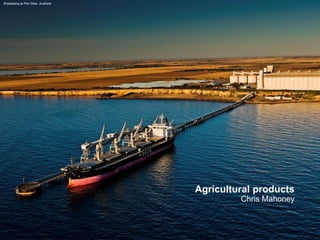
11 
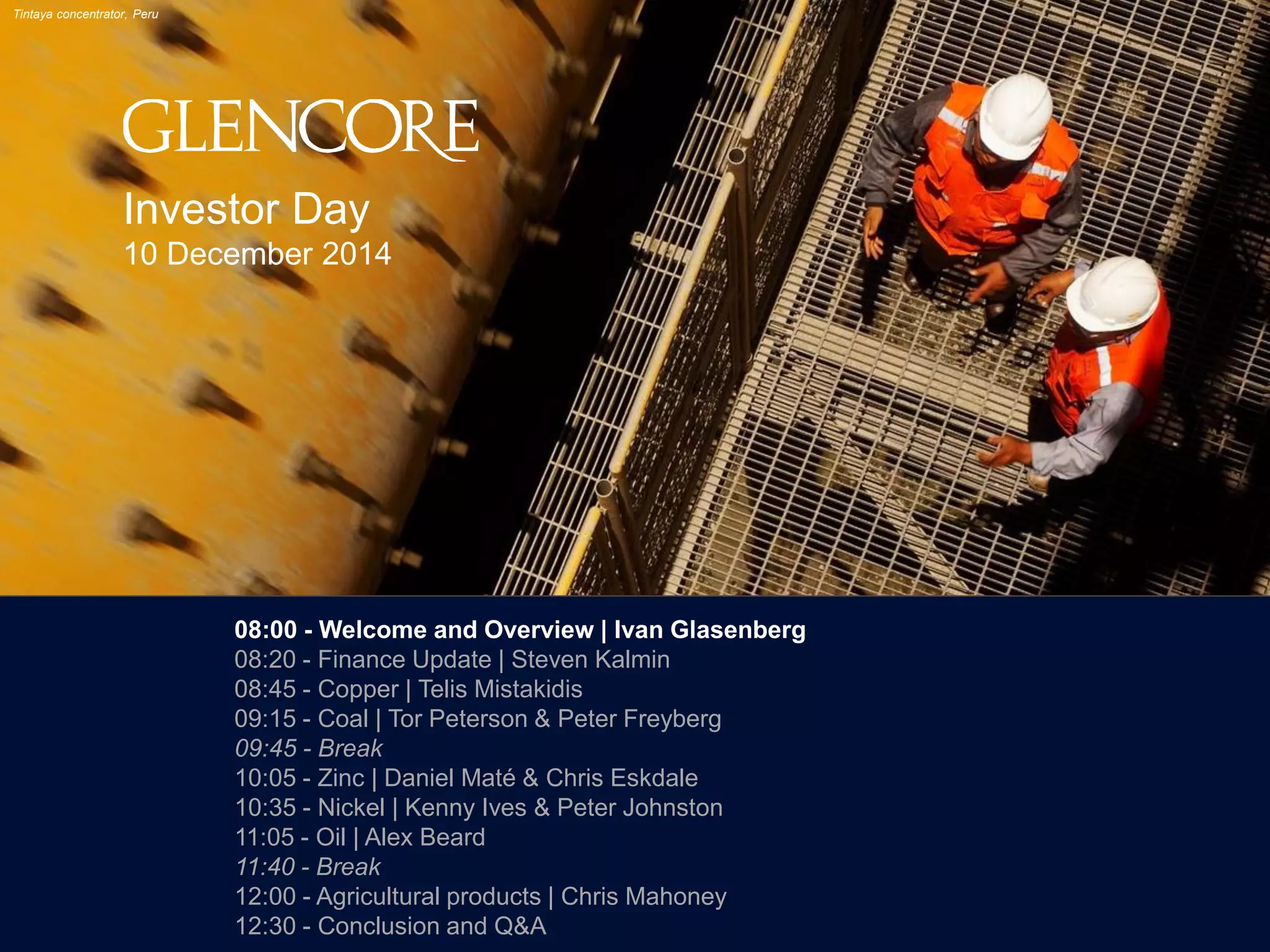
Tintaya concentrator, Peru 
08:00 - Welcome and Overview | Ivan Glasenberg 
08:20 - Finance Update | Steven Kalmin 
08:45 - Copper | Telis Mistakidis 
09:15 - Coal | Tor Peterson & Peter Freyberg 
09:45 - Break 
10:05 - Zinc | Daniel Maté & Chris Eskdale 
10:35 - Nickel | Kenny Ives & Peter Johnston 
11:05 - Oil | Alex Beard 
11:40 - Break 
12:00 - Agricultural products | Chris Mahoney 
12:30 - Conclusion and Q&A 
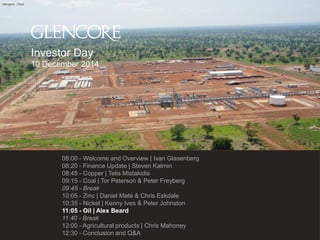
Investor Day 
10 December 2014
Forward looking statements 
This document contains statements that are, or may be deemed to be, “forward looking statements” which are prospective in nature. These forward looking statements may be identified by the use of forward looking terminology, or the negative thereof such as "plans", "expects" or "does not expect", "is expected", "continues", "assumes", "is subject to", "budget", "scheduled", "estimates", "aims", "forecasts", "risks", "intends", "positioned", "predicts", "anticipates" or "does not anticipate", or "believes", or variations of such words or comparable terminology and phrases or statements that certain actions, events or results "may", "could", "should", “shall”, "would", "might" or "will" be taken, occur or be achieved. Such statements are qualified in their entirety by the inherent risks and uncertainties surrounding future expectations. Forward-looking statements are not based on historical facts, but rather on current predictions, expectations, beliefs, opinions, plans, objectives, goals, intentions and projections about future events, results of operations, prospects, financial condition and discussions of strategy. 
By their nature, forward looking statements involve known and unknown risks and uncertainties, many of which are beyond Glencore’s control. Forward looking statements are not guarantees of future performance and may and often do differ materially from actual results. Important factors that could cause these uncertainties include, but are not limited to, those discussed under “Principal risks and uncertainties” of Glencore’s Annual Report 2013 and “Risks and uncertainties” in Glencore’s 2014 Half-Year Report. 
Neither Glencore nor any of its associates or directors, officers or advisers, provides any representation, assurance or guarantee that the occurrence of the events expressed or implied in any forward-looking statements in this document will actually occur. You are cautioned not to place undue reliance on these forward-looking statements which only speak as of the date of this document. Other than in accordance with its legal or regulatory obligations (including under the UK Listing Rules and the Disclosure and Transparency Rules of the Financial Conduct Authority and the Rules Governing the Listing of Securities on the Stock Exchange of Hong Kong Limited and the Listing Requirements of the Johannesburg Stock Exchange Limited), Glencore is not under any obligation and Glencore and its affiliates expressly disclaim any intention, obligation or undertaking to update or revise any forward looking statements, whether as a result of new information, future events or otherwise. This document shall not, under any circumstances, create any implication that there has been no change in the business or affairs of Glencore since the date of this document or that the information contained herein is correct as at any time subsequent to its date. 
No statement in this document is intended as a profit forecast or a profit estimate and no statement in this document should be interpreted to mean that earnings per Glencore share for the current or future financial years would necessarily match or exceed the historical published earnings per Glencore share. 
This document does not constitute or form part of any offer or invitation to sell or issue, or any solicitation of any offer to purchase or subscribe for any securities. The making of this document does not constitute a recommendation regarding any securities. 
2
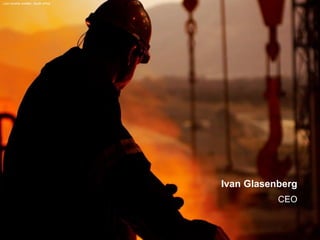
Ivan Glasenberg 
CEO 
Lion chrome smelter, South Africa
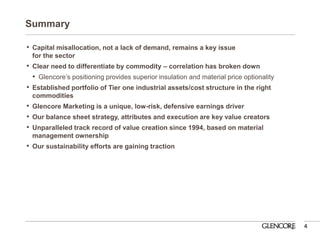
Summary 
•Capital misallocation, not a lack of demand, remains a key issue for the sector 
•Clear need to differentiate by commodity – correlation has broken down 
•Glencore’s positioning provides superior insulation and material price optionality 
•Established portfolio of Tier one industrial assets/cost structure in the right commodities 
•Glencore Marketing is a unique, low-risk, defensive earnings driver 
•Our balance sheet strategy, attributes and execution are key value creators 
•Unparalleled track record of value creation since 1994, based on material management ownership 
•Our sustainability efforts are gaining traction 
4
Capital allocation is a key issue for the sector 
Electronic scrap recycling, Horne copper smelter, Canada
0% 
2% 
4% 
6% 
8% 
10% 
12% 
Copper 
Zinc 
Al 
Ni 
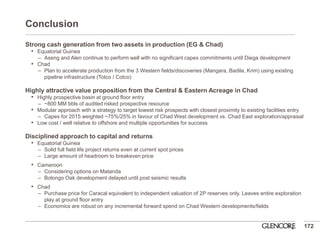
Thermal Coal 
Iron Ore 
Oil 
Previous 5 year average 
2014 
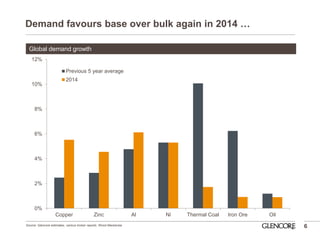
Demand favours base over bulk again in 2014 … 
6 
Source: Glencore estimates, various broker reports, Wood Mackenzie. 
Global demand growth
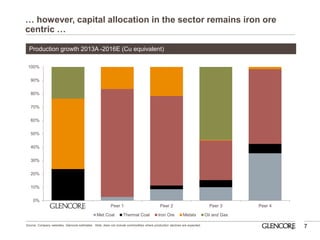
… however, capital allocation in the sector remains iron ore centric … 
7 
0% 
10% 
20% 
30% 
40% 
50% 
60% 
70% 
80% 
90% 
100% 
Glencore 
Peer 1 
Peer 2 
Peer 3 
Peer 4 
Met Coal 
Thermal Coal 
Iron Ore 
Metals 
Oil and Gas 
Production growth 2013A -2016E (Cu equivalent) 
Source: Company websites, Glencore estimates. Note, does not include commodities where production declines are expected.
-60% 
-50% 
-40% 
-30% 
-20% 
-10% 
0% 
10% 
20% 
30% 
Copper 
Zinc 
Aluminium 
Nickel 
Coal 
Iron ore 
Oil 
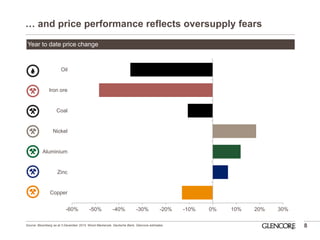
… and price performance reflects oversupply fears 
8 
Year to date price change 
Source: Bloomberg as at 3 December 2014, Wood Mackenzie, Deutsche Bank, Glencore estimates.
Differentiation by commodity is critical 
Wheat crop in Bute, Australia
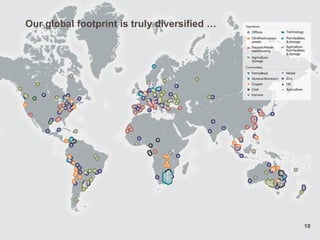
Our global footprint is truly diversified … 
10
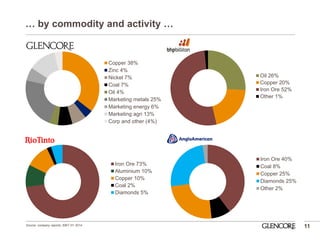
… by commodity and activity … 
11 
Oil 26% 
Copper 20% 
Iron Ore 52% 
Other 1% 
Iron Ore 73% 
Aluminium 10% 
Copper 10% 
Coal 2% 
Diamonds 5% 
Iron Ore 40% 
Coal 8% 
Copper 25% 
Diamonds 25% 
Other 2% 
BHP: 
Copper 38% 
Zinc 4% 
Nickel 7% 
Coal 7% 
Oil 4% 
Marketing metals 25% 
Marketing energy 6% 
Marketing agri 13% 
Corp and other (4%) 
Source: company reports, EBIT H1 2014.
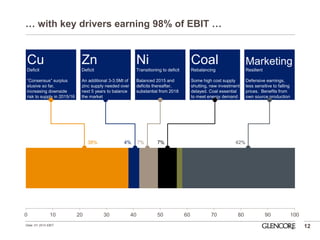
… with key drivers earning 98% of EBIT … 
12 
0 
10 
20 
30 
40 
50 
60 
70 
80 
90 
100 
38% 
4% 
7% 
7% 
42% 
Cu 
Deficit 
“Consensus” surplus elusive so far, increasing downside risk to supply in 2015/16 
Zn 
Deficit 
An additional 3-3.5Mt of zinc supply needed over next 5 years to balance the market 
Marketing 
Resilient Defensive earnings, less sensitive to falling prices. Benefits from own source production 
Coal 
Rebalancing 
Some high cost supply shutting, new investment delayed. Coal essential to meet energy demand 
Ni 
Transitioning to deficit 
Balanced 2015 and deficits thereafter, substantial from 2018 
Data: H1 2014 EBIT.
70 
80 
90 
100 
110 
120 
130 
140 
2013 
2014 
2015 
2016 
2017 
2018 
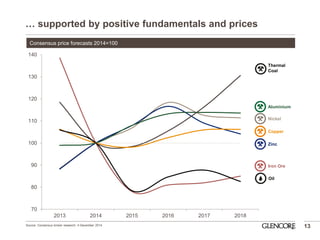
… supported by positive fundamentals and prices 
13 
Consensus price forecasts 2014=100 
Source: Consensus broker research, 4 December 2014. 
Nickel 
Aluminium 
Zinc 
Copper 
Iron Ore 
Oil 
Thermal Coal
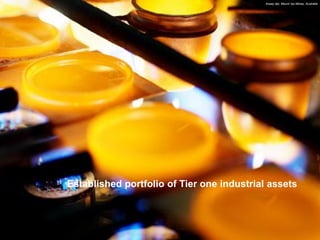
Established portfolio of Tier one industrial assets 
Assay lab, Mount Isa Mines, Australia
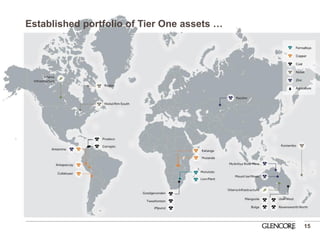
Established portfolio of Tier One assets … 
15
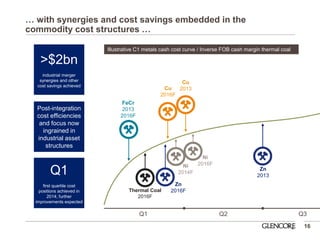
… with synergies and cost savings embedded in the commodity cost structures … 
16 
Cu 
2016F 
>$2bn 
industrial merger synergies and other cost savings achieved 
Post-integration cost efficiencies and focus now ingrained in industrial asset structures 
Q1 
first quartile cost positions achieved in 2014; further improvements expected 
Q1 
Q2 
Q3 
FeCr 
2013 
2016F 
Ni 
2016F 
Thermal Coal 
2016F 
Illustrative C1 metals cash cost curve / Inverse FOB cash margin thermal coal 
Zn 
2016F 
Cu 
2013 
Zn 
2013 
Ni 
2014F
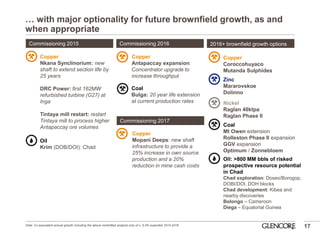
… with major optionality for future brownfield growth, as and when appropriate 
17 
2016+ brownfield growth options 
Copper 
Coroccohuyaco 
Mutanda Sulphides 
Zinc 
Mararovskoe 
Dolinno 
Nickel 
Raglan 40ktpa 
Raglan Phase II 
Coal 
Mt Owen extension 
Rolleston Phase II expansion 
GGV expansion 
Optimum / Zonnebloem 
Commissioning 2015 
Copper 
Nkana Synclinorium: new shaft to extend section life by 25 years 
DRC Power: first 162MW refurbished turbine (G27) at Inga 
Tintaya mill restart: restart Tintaya mill to process higher Antapaccay ore volumes 
Commissioning 2016 
Copper 
Antapaccay expansion: Concentrator upgrade to increase throughput 
Oil: >800 MM bbls of risked prospective resource potential in Chad 
Chad exploration: Doseo/Borogop, DOBI/DOI, DOH blocks 
Chad development: Kibea and nearby discoveries 
Bolongo – Cameroon 
Diega – Equatorial Guinea 
Oil 
Krim (DOB/DOI): Chad 
Note: Cu equivalent annual growth including the above committed projects only of c. 5.4% expected 2014-2018. 
Coal 
Bulga: 20 year life extension at current production rates 
Commissioning 2017 
Copper 
Mopani Deeps: new shaft infrastructure to provide a 25% increase in own source production and a 20% reduction in mine cash costs
Marketing – a defensive earnings driver 
Chemoil terminal, Singapore
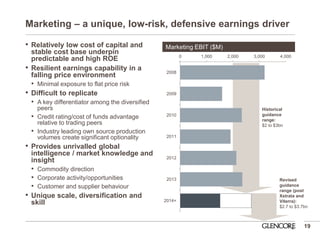
Marketing – a unique, low-risk, defensive earnings driver 
19 
•Relatively low cost of capital and stable cost base underpin predictable and high ROE 
•Resilient earnings capability in a falling price environment 
•Minimal exposure to flat price risk 
•Difficult to replicate 
•A key differentiator among the diversified peers 
•Credit rating/cost of funds advantage relative to trading peers 
•Industry leading own source production volumes create significant optionality 
•Provides unrivalled global intelligence / market knowledge and insight 
•Commodity direction 
•Corporate activity/opportunities 
•Customer and supplier behaviour 
•Unique scale, diversification and skill 
Marketing EBIT ($M) 
0 
1,000 
2,000 
3,000 
4,000 
2008 
2009 
2010 
2011 
2012 
2013 
2014+ 
Historical guidance range: 
$2 to $3bn 
Revised guidance range (post Xstrata and Viterra): 
$2.7 to $3.7bn
Sustainability gaining traction 
Espinar farmer near Antapaccay/Tintaya copper mines, Peru
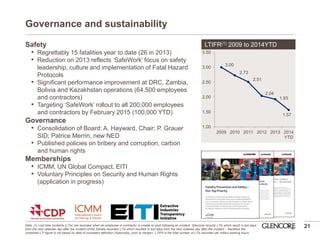
Governance and sustainability 
Safety 
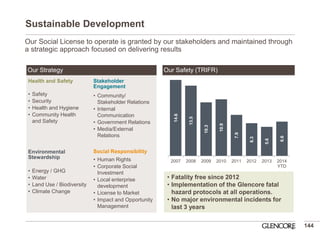
•Regrettably 15 fatalities year to date (26 in 2013) 
•Reduction on 2013 reflects ‘SafeWork’ focus on safety leadership, culture and implementation of Fatal Hazard Protocols 
•Significant performance improvement at DRC, Zambia, Bolivia and Kazakhstan operations (64,500 employees and contractors) 
•Targeting ‘SafeWork’ rollout to all 200,000 employees and contractors by February 2015 (100,000 YTD) 
Governance 
•Consolidation of Board: A. Hayward, Chair; P. Grauer SID; Patrice Merrin, new NED 
•Published policies on bribery and corruption, carbon and human rights 
Memberships 
•ICMM, UN Global Compact, EITI 
•Voluntary Principles on Security and Human Rights (application in progress) 
21 
LTIFR(1) 2009 to 2014YTD 
3.00 
2.73 
2.51 
2.04 
1.93 
1.57 
1.00 
1.50 
2.00 
2.50 
3.00 
3.50 
2009 
2010 
2011 
2012 
2013 
2014 
YTD 
Note: (1) Lost time incidents (LTIs) are recorded when an employee or contractor is unable to work following an incident. Glencore records LTIs which result in lost days from the next calendar day after the incident whilst Xstrata recorded LTIs which resulted in lost days from the next rostered day after the incident – therefore the combined LTI figure is not based on data of consistent definition (historically, prior to merger). LTIFR is the total number of LTIs recorded per million working hours.
Our priorities for 2015 
Zinc balls, Nordenham, Germany
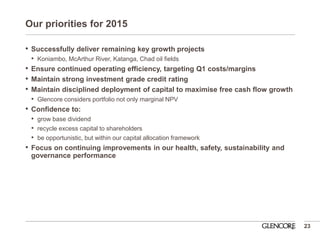
Our priorities for 2015 
23 
•Successfully deliver remaining key growth projects 
•Koniambo, McArthur River, Katanga, Chad oil fields 
•Ensure continued operating efficiency, targeting Q1 costs/margins 
•Maintain strong investment grade credit rating 
•Maintain disciplined deployment of capital to maximise free cash flow growth 
•Glencore considers portfolio not only marginal NPV 
•Confidence to: 
•grow base dividend 
•recycle excess capital to shareholders 
•be opportunistic, but within our capital allocation framework 
•Focus on continuing improvements in our health, safety, sustainability and governance performance
2244 
Thermal coal, Rolleston mine, Australia 
Investor Day 
10 December 2014 
08:00 - Welcome and Overview | Ivan Glasenberg 
08:20 - Finance Update | Steven Kalmin 
08:45 - Copper | Telis Mistakidis 
09:15 - Coal | Tor Peterson & Peter Freyberg 
09:45 - Break 
10:05 - Zinc | Daniel Maté & Chris Eskdale 
10:35 - Nickel | Kenny Ives & Peter Johnston 
11:05 - Oil | Alex Beard 
11:40 - Break 
12:00 - Agricultural products | Chris Mahoney 
12:30 - Conclusion and Q&A
25 
Forward looking statements 
This document contains statements that are, or may be deemed to be, “forward looking statements” which are prospective in nature. These forward looking statements may be identified by the use of forward looking terminology, or the negative thereof such as "plans", "expects" or "does not expect", "is expected", "continues", "assumes", "is subject to", "budget", "scheduled", "estimates", "aims", "forecasts", "risks", "intends", "positioned", "predicts", "anticipates" or "does not anticipate", or "believes", or variations of such words or comparable terminology and phrases or statements that certain actions, events or results "may", "could", "should", “shall”, "would", "might" or "will" be taken, occur or be achieved. Such statements are qualified in their entirety by the inherent risks and uncertainties surrounding future expectations. Forward-looking statements are not based on historical facts, but rather on current predictions, expectations, beliefs, opinions, plans, objectives, goals, intentions and projections about future events, results of operations, prospects, financial condition and discussions of strategy. 
By their nature, forward looking statements involve known and unknown risks and uncertainties, many of which are beyond Glencore’s control. Forward looking statements are not guarantees of future performance and may and often do differ materially from actual results. Important factors that could cause these uncertainties include, but are not limited to, those discussed under “Principal risks and uncertainties” of Glencore’s Annual Report 2013 and “Risks and uncertainties” in Glencore’s 2014 Half-Year Report. 
Neither Glencore nor any of its associates or directors, officers or advisers, provides any representation, assurance or guarantee that the occurrence of the events expressed or implied in any forward-looking statements in this document will actually occur. You are cautioned not to place undue reliance on these forward-looking statements which only speak as of the date of this document. Other than in accordance with its legal or regulatory obligations (including under the UK Listing Rules and the Disclosure and Transparency Rules of the Financial Conduct Authority and the Rules Governing the Listing of Securities on the Stock Exchange of Hong Kong Limited and the Listing Requirements of the Johannesburg Stock Exchange Limited), Glencore is not under any obligation and Glencore and its affiliates expressly disclaim any intention, obligation or undertaking to update or revise any forward looking statements, whether as a result of new information, future events or otherwise. This document shall not, under any circumstances, create any implication that there has been no change in the business or affairs of Glencore since the date of this document or that the information contained herein is correct as at any time subsequent to its date. 
No statement in this document is intended as a profit forecast or a profit estimate and no statement in this document should be interpreted to mean that earnings per Glencore share for the current or future financial years would necessarily match or exceed the historical published earnings per Glencore share. 
This document does not constitute or form part of any offer or invitation to sell or issue, or any solicitation of any offer to purchase or subscribe for any securities. The making of this document does not constitute a recommendation regarding any securities.
Steven Kalmin 
CFO 
La Jagua Mine, Prodeco, Colombia
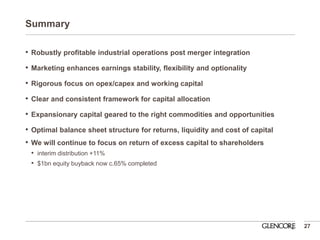
Summary 
•Robustly profitable industrial operations post merger integration 
•Marketing enhances earnings stability, flexibility and optionality 
•Rigorous focus on opex/capex and working capital 
•Clear and consistent framework for capital allocation 
•Expansionary capital geared to the right commodities and opportunities 
•Optimal balance sheet structure for returns, liquidity and cost of capital 
•We will continue to focus on return of excess capital to shareholders 
•interim distribution +11% 
•$1bn equity buyback now c.65% completed 
27
Robustly profitable industrial operations 
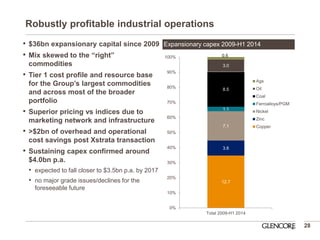
•$36bn expansionary capital since 2009 
•Mix skewed to the “right” commodities 
•Tier 1 cost profile and resource base for the Group’s largest commodities and across most of the broader portfolio 
•Superior pricing vs indices due to marketing network and infrastructure 
•>$2bn of overhead and operational cost savings post Xstrata transaction 
•Sustaining capex confirmed around $4.0bn p.a. 
•expected to fall closer to $3.5bn p.a. by 2017 
•no major grade issues/declines for the foreseeable future 
28 
12.7 
3.6 
7.1 
1.1 
8.5 
3.0 
0.5 
0% 
10% 
20% 
30% 
40% 
50% 
60% 
70% 
80% 
90% 
100% 
Total 2009-H1 2014 
Ags 
Oil 
Coal 
Ferroalloys/PGM 
Nickel 
Zinc 
Copper 
Expansionary capex 2009-H1 2014
Marketing enhances earnings/cashflow stability, flexibility and optionality 
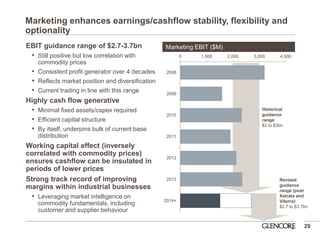
EBIT guidance range of $2.7-3.7bn 
•Still positive but low correlation with commodity prices 
•Consistent profit generator over 4 decades 
•Reflects market position and diversification 
•Current trading in line with this range 
Highly cash flow generative 
•Minimal fixed assets/capex required 
•Efficient capital structure 
•By itself, underpins bulk of current base distribution 
Working capital effect (inversely correlated with commodity prices) ensures cashflow can be insulated in periods of lower prices 
Strong track record of improving margins within industrial businesses 
•Leveraging market intelligence on commodity fundamentals, including customer and supplier behaviour 
29 
Marketing EBIT ($M) 
Historical guidance range: 
$2 to $3bn 
Revised guidance range (post Xstrata and Viterra): 
$2.7 to $3.7bn 
0 
1,000 
2,000 
3,000 
4,000 
2008 
2009 
2010 
2011 
2012 
2013 
2014+
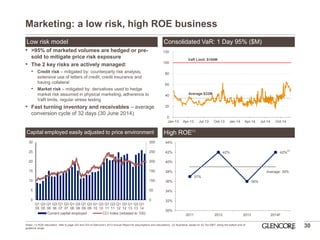
Marketing: a low risk, high ROE business 
30 
0 
20 
40 
60 
80 
100 
120 
Jan-13 
Apr-13 
Jul-13 
Oct-13 
Jan-14 
Apr-14 
Jul-14 
Oct-14 
Low risk model 
Consolidated VaR: 1 Day 95% ($M) 
37% 
42% 
36% 
42% 
30% 
32% 
34% 
36% 
38% 
40% 
42% 
44% 
2011 
2012 
2013 
2014F 
Average: 39% 
Capital employed easily adjusted to price environment 
High ROE(1) 
•>95% of marketed volumes are hedged or pre- sold to mitigate price risk exposure 
•The 2 key risks are actively managed: 
•Credit risk – mitigated by: counterparty risk analysis, extensive use of letters of credit, credit insurance and having collateral 
•Market risk – mitigated by: derivatives used to hedge market risk assumed in physical marketing, adherence to VaR limits, regular stress testing 
•Fast turning inventory and receivables – average conversion cycle of 32 days (30 June 2014) 
Average:$33M 
VaR Limit: $100M 
Notes: (1) ROE calculation: refer to page 202 and 203 of Glencore’s 2013 Annual Report for assumptions and calculations. (2) Illustrative, based on $2.7bn EBIT, being the bottom end of guidance range. 
(2) 
0 
50 
100 
150 
200 
250 
300 
0 
5 
10 
15 
20 
25 
30 
Q1 
05 
Q3 
05 
Q1 
06 
Q3 
06 
Q1 
07 
Q3 
07 
Q1 
08 
Q3 
08 
Q1 
09 
Q3 
09 
Q1 
10 
Q3 
10 
Q1 
11 
Q3 
11 
Q1 
12 
Q3 
12 
Q1 
13 
Q3 
13 
Q1 
14 
Current capital employed 
CCI Index (rebased to 100)
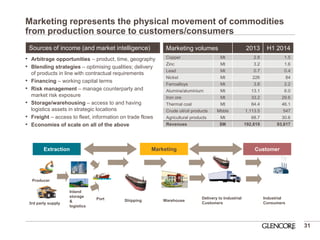
Marketing represents the physical movement of commodities 
from production source to customers/consumers 
Sources of income (and market intelligence) 
• Arbitrage opportunities – product, time, geography 
• Blending strategies – optimising qualities; delivery 
of products in line with contractual requirements 
• Financing – working capital terms 
• Risk management – manage counterparty and 
market risk exposure 
• Storage/warehousing – access to and having 
logistics assets in strategic locations 
• Freight – access to fleet, information on trade flows 
• Economies of scale on all of the above 
Marketing volumes 2013 H1 2014 
Copper Mt 2.8 1.5 
Zinc Mt 3.2 1.6 
Lead Mt 0.7 0.4 
Nickel Mt 226 84 
Ferroalloys Mt 3.8 2.2 
Alumina/aluminium Mt 13.1 6.0 
Iron ore Mt 33.2 29.6 
Thermal coal Mt 84.4 46.1 
Crude oil/oil products Mbbls 1,113.5 547 
Agricultural products Mt 68.7 30.6 
Revenues $M 192,819 93,617 
31 
Producer 
Port Shipping Warehouse 
Delivery to Industrial 
Customers 
Industrial 
Consumers 
Extraction Marketing Customer 
Inland 
storage 
& 
logistics 
3rd party supply
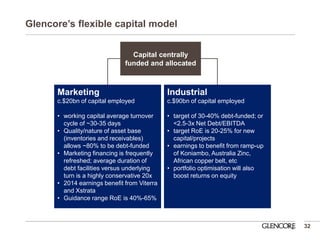
Glencore’s flexible capital model 
32 
Capital centrally funded and allocated 
Marketing c.$20bn of capital employed 
•working capital average turnover cycle of ~30-35 days 
•Quality/nature of asset base (inventories and receivables) allows ~80% to be debt-funded 
•Marketing financing is frequently refreshed; average duration of debt facilities versus underlying turn is a highly conservative 20x 
•2014 earnings benefit from Viterra and Xstrata 
•Guidance range RoE is 40%-65% 
Industrial c.$90bn of capital employed 
•target of 30-40% debt-funded; or <2.5-3x Net Debt/EBITDA 
•target RoE is 20-25% for new capital/projects 
•earnings to benefit from ramp-up of Koniambo, Australia Zinc, African copper belt, etc 
•portfolio optimisation will also boost returns on equity
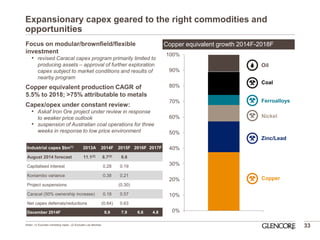
Expansionary capex geared to the right commodities and opportunities 
33 
Focus on modular/brownfield/flexible investment 
•revised Caracal capex program primarily limited to producing assets – approval of further exploration capex subject to market conditions and results of nearby program 
Copper equivalent production CAGR of 5.5% to 2018; >75% attributable to metals 
Capex/opex under constant review: 
•Askaf Iron Ore project under review in response to weaker price outlook 
•suspension of Australian coal operations for three weeks in response to low price environment 
Copper equivalent growth 2014F-2018F 
0% 
10% 
20% 
30% 
40% 
50% 
60% 
70% 
80% 
90% 
100% 
Oil 
Coal 
Ferroalloys 
Nickel 
Zinc/Lead 
Copper 
Industrial capex $bn(1) 
2013A 
2014F 
2015F 
2016F 
2017F 
August 2014 forecast 
11.1(2) 
8.7(2) 
6.6 
Capitalised interest 
0.28 
0.19 
Koniambo variance 
0.38 
0.21 
Project suspensions 
(0.30) 
Caracal (50% ownership increase) 
0.18 
0.57 
Net capex deferrals/reductions 
(0.64) 
0.63 
December 2014F 
8.9 
7.9 
6.6 
4.8 
Notes: (1) Excludes marketing capex. (2) Excludes Las Bambas
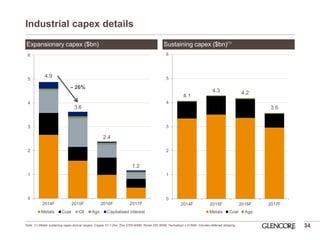
Industrial capex details 
34 
0 
1 
2 
3 
4 
5 
6 
2014F 
2015F 
2016F 
2017F 
Metals 
Coal 
Oil 
Ags 
Capitalised interest 
Expansionary capex ($bn) 
Sustaining capex ($bn)(1) 
0 
1 
2 
3 
4 
5 
6 
2014F 
2015F 
2016F 
2017F 
Metals 
Coal 
Ags 
4.9 
3.6 
2.4 
1.2 
4.1 
4.3 
4.2 
3.6 
– 26% 
Note: (1) Metals sustaining capex annual ranges: Copper $1.7-2bn, Zinc $700-900M, Nickel 250-300M, Ferroalloys c.$150M. Includes deferred stripping.
Our balance sheet advantage 
Asturiana de Zinc, electrolysis plant, Spain
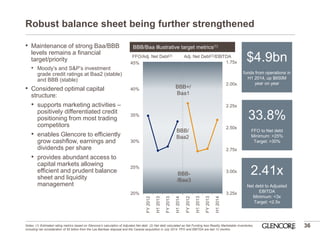
•Maintenance of strong Baa/BBB levels remains a financial target/priority 
•Moody’s and S&P’s investment grade credit ratings at Baa2 (stable) and BBB (stable) 
•Considered optimal capital structure: 
•supports marketing activities – positively differentiated credit positioning from most trading competitors 
•enables Glencore to efficiently grow cashflow, earnings and dividends per share 
•provides abundant access to capital markets allowing efficient and prudent balance sheet and liquidity management 
Robust balance sheet being further strengthened 
36 
$4.9bn funds from operations in H1 2014, up $650M year on year 
33.8% 
FFO to Net debt 
Minimum: >25% 
Target: >30% 
2.41x 
Net debt to Adjusted EBITDA 
Minimum: <3x Target: <2.5x 
BBB/Baa illustrative target metrics(1) 
FFO/Adj. Net Debt(2) 
Adj. Net Debt(2)/EBITDA 
Notes: (1) Estimated rating metrics based on Glencore’s calculation of Adjusted Net debt. (2) Net debt calculated as Net Funding less Readily Marketable Inventories, including net consideration of $5 billion from the Las Bambas disposal and the Caracal acquisition in July 2014. FFO and EBITDA are last 12 months. 
20% 
25% 
30% 
35% 
40% 
45% 
FY 2012 
H1 2013 
FY 2013 
H1 2014 
1.75x 
2.00x 
2.25x 
2.50x 
2.75x 
3.00x 
3.25x 
FY 2012 
H1 2013 
FY 2013 
H1 2014 
BBB+/ 
Baa1 
BBB- /Baa3 
BBB/ Baa2
75 
85 
95 
105 
115 
125 
135 
145 
2013 
2014 
2015 
2016 
2017 
2018 
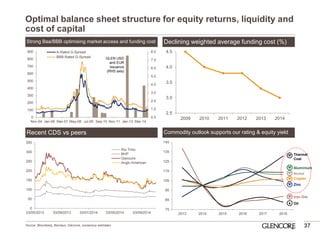
Optimal balance sheet structure for equity returns, liquidity and cost of capital 
37 
Strong Baa/BBB optimising market access and funding cost 
Declining weighted average funding cost (%) 
Recent CDS vs peers 
Commodity outlook supports our rating & equity yield 
Nickel 
Aluminium 
Zinc 
Copper 
Iron Ore 
Oil 
Thermal Coal 
0.0 
1.0 
2.0 
3.0 
4.0 
5.0 
6.0 
7.0 
8.0 
0 
100 
200 
300 
400 
500 
600 
700 
800 
900 
Nov-04 
Jan-06 
Mar-07 
May-08 
Jul-09 
Sep-10 
Nov-11 
Jan-13 
Mar-14 
A-Rated G-Spread 
BBB-Rated G-Spread 
GLEN USD and EUR Issuance (RHS axis) 
0 
50 
100 
150 
200 
250 
300 
350 
03/05/2013 
03/09/2013 
03/01/2014 
03/05/2014 
03/09/2014 
Rio Tinto 
BHP 
Glencore 
Anglo American 
Source: Bloomberg, Barclays, Glencore, consensus estimates. 
2.5 
3.0 
3.5 
4.0 
4.5 
2009 
2010 
2011 
2012 
2013 
2014
We will continue to focus on return of excess capital to shareholders 
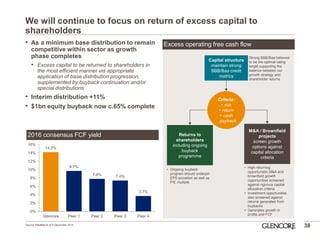
•As a minimum base distribution to remain competitive within sector as growth phase completes 
•Excess capital to be returned to shareholders in the most efficient manner via appropriate application of base distribution progression, supplemented by buyback continuation and/or special distributions 
•Interim distribution +11% 
•$1bn equity buyback now c.65% complete 
38 
Excess operating free cash flow 
Source: Factset as of 5 December 2014. 
14.2% 
9.7% 
7.8% 
7.4% 
3.7% 
0% 
2% 
4% 
6% 
8% 
10% 
12% 
14% 
16% 
Glencore 
Peer 1 
Peer 2 
Peer 3 
Peer 4 
2016 consensus FCF yield 
Capital structure 
maintain strong BBB/Baa credit metrics 
M&A / Brownfield projects 
screen growth options against capital allocation criteria 
Returns to shareholders 
including ongoing buyback programme 
Criteria: 
•risk 
•return 
•cash payback 
Strong BBB/Baa believed to be the optimal rating target supporting the balance between our growth strategy and shareholder returns 
•High-returning opportunistic M&A and brownfield growth opportunities screened against rigorous capital allocation criteria 
•Investment opportunities also screened against returns generated from buybacks 
•Generates growth in profits and FCF 
•Ongoing buyback program should underpin EPS accretion as well as P/E multiple
Q&A 
Lion chrome smelter, South Africa
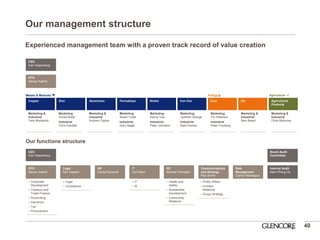
Our management structure 
40 
Nickel 
Our functions structure 
CEO Ivan Glasenberg 
CFO Steven Kalmin 
Metals & Minerals 
Energy 
Agriculture 
Ferroalloys 
Marketing Stuart Cutler Industrial Gary Nagle 
Marketing 
Kenny Ives 
Industrial 
Peter Johnston 
Iron Ore 
Marketing Jyothish George Industrial Mark Eames 
Zinc 
Marketing 
Daniel Maté 
Industrial 
Chris Eskdale 
Copper 
Marketing & Industrial 
Telis Mistakidis 
Aluminium 
Marketing & Industrial 
Andrew Caplan 
Coal 
Marketing Tor Peterson Industrial Peter Freyberg 
Oil 
Marketing & Industrial 
Alex Beard 
Agricultural Products 
Marketing & Industrial 
Chris Mahoney 
CEO Ivan Glasenberg 
CFO 
Steven Kalmin 
Legal Ken Klassen 
– Corporate Development – Treasury and Trade Finance – Accounting – Insurance – Tax – Procurement 
– Legal 
– Compliance 
– IT 
– IS 
– Health and Safety 
– Sustainable Development 
– Community Relations 
– Public Affairs 
– Investor Relations 
– Group Strategy 
HR Gerda Schwindt 
IT 
Cyril Reol 
SD Michael Fahrbach 
Risk Management Carlos Perezagua 
Communications and Strategy 
Paul Smith 
Internal Audit 
Nam Phong Ho 
Board Audit Committee 
Experienced management team with a proven track record of value creation
Ernest Henry copper concentrator, Australia 
Investor Day 
10 December 2014 
08:00 - Welcome and Overview | Ivan Glasenberg 
08:20 - Finance Update | Steven Kalmin 
08:45 - Copper | Telis Mistakidis 
09:15 - Coal | Tor Peterson & Peter Freyberg 
09:45 - Break 
10:05 - Zinc | Daniel Maté & Chris Eskdale 
10:35 - Nickel | Kenny Ives & Peter Johnston 
11:05 - Oil | Alex Beard 
11:45 - Break 
12:00 - Agricultural products | Chris Mahoney 
12:30 - Conclusion and Q&A 
| Telis Mistakidis 
40 products | Chris Mahoney
42 
Forward looking statements 
This document contains statements that are, or may be deemed to be, “forward looking statements” which are prospective in nature. These forward looking statements may be identified by the use of forward looking terminology, or the negative thereof such as "plans", "expects" or "does not expect", "is expected", "continues", "assumes", "is subject to", "budget", "scheduled", "estimates", "aims", "forecasts", "risks", "intends", "positioned", "predicts", "anticipates" or "does not anticipate", or "believes", or variations of such words or comparable terminology and phrases or statements that certain actions, events or results "may", "could", "should", “shall”, "would", "might" or "will" be taken, occur or be achieved. Such statements are qualified in their entirety by the inherent risks and uncertainties surrounding future expectations. Forward-looking statements are not based on historical facts, but rather on current predictions, expectations, beliefs, opinions, plans, objectives, goals, intentions and projections about future events, results of operations, prospects, financial condition and discussions of strategy. 
By their nature, forward looking statements involve known and unknown risks and uncertainties, many of which are beyond Glencore’s control. Forward looking statements are not guarantees of future performance and may and often do differ materially from actual results. Important factors that could cause these uncertainties include, but are not limited to, those discussed under “Principal risks and uncertainties” of Glencore’s Annual Report 2013 and “Risks and uncertainties” in Glencore’s 2014 Half-Year Report. 
Neither Glencore nor any of its associates or directors, officers or advisers, provides any representation, assurance or guarantee that the occurrence of the events expressed or implied in any forward-looking statements in this document will actually occur. You are cautioned not to place undue reliance on these forward-looking statements which only speak as of the date of this document. Other than in accordance with its legal or regulatory obligations (including under the UK Listing Rules and the Disclosure and Transparency Rules of the Financial Conduct Authority and the Rules Governing the Listing of Securities on the Stock Exchange of Hong Kong Limited and the Listing Requirements of the Johannesburg Stock Exchange Limited), Glencore is not under any obligation and Glencore and its affiliates expressly disclaim any intention, obligation or undertaking to update or revise any forward looking statements, whether as a result of new information, future events or otherwise. This document shall not, under any circumstances, create any implication that there has been no change in the business or affairs of Glencore since the date of this document or that the information contained herein is correct as at any time subsequent to its date. 
No statement in this document is intended as a profit forecast or a profit estimate and no statement in this document should be interpreted to mean that earnings per Glencore share for the current or future financial years would necessarily match or exceed the historical published earnings per Glencore share. 
This document does not constitute or form part of any offer or invitation to sell or issue, or any solicitation of any offer to purchase or subscribe for any securities. The making of this document does not constitute a recommendation regarding any securities.
Copper 
Telis Mistakidis 
Alumbrera copper concentrator, Argentina
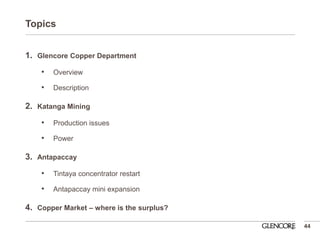
Topics 
1.Glencore Copper Department 
•Overview 
•Description 
2.Katanga Mining 
•Production issues 
•Power 
3.Antapaccay 
•Tintaya concentrator restart 
•Antapaccay mini expansion 
4.Copper Market – where is the surplus? 
44
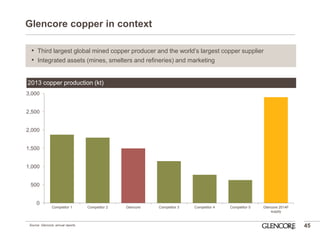
Glencore copper in context 
•Third largest global mined copper producer and the world’s largest copper supplier 
•Integrated assets (mines, smelters and refineries) and marketing 
45 
2013 copper production (kt) 
0 
500 
1,000 
1,500 
2,000 
2,500 
3,000 
Competitor 1 
Competitor 2 
Glencore 
Competitor 3 
Competitor 4 
Competitor 5 
Glencore 2014F 
supply 
Source: Glencore, annual reports.
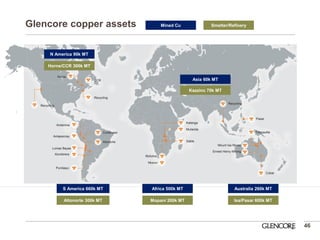
Glencore copper assets 
46 
Mined Cu 
N America 90k MT 
Asia 60k MT 
Australia 260k MT 
Africa 500k MT 
S America 660k MT 
Horne/CCR 300k MT 
Isa/Pasar 600k MT 
Mopani 200k MT 
Altonorte 300k MT 
Kazzinc 70k MT 
Smelter/Refinery
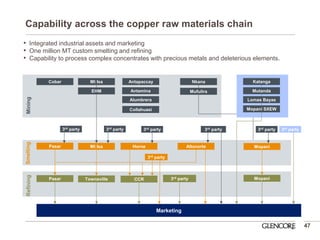
Capability across the copper raw materials chain 
Mt Isa 
Cobar 
Antapaccay 
Katanga 
Nkana 
Townsville 
Altonorte 
Horne 
Pasar 
Mopani 
Mt Isa 
CCR 
Pasar 
Mopani 
EHM 
Marketing 
3rd party 
3rd party 
3rd party 
Alumbrera 
Collahuasi 
Antamina 
3rd party 
3rd party 
3rd party 
Lomas Bayas 
3rd party 
Mopani SXEW 
3rd party 
Mutanda 
Mufulira 
•Integrated industrial assets and marketing 
•One million MT custom smelting and refining 
•Capability to process complex concentrates with precious metals and deleterious elements. 
Mining 
Smelting 
Refining 
47
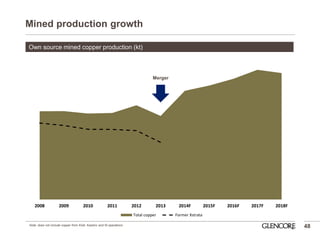
Mined production growth 
48 
Own source mined copper production (kt) 
Note: does not include copper from Kidd, Kazzinc and Ni operations 
Merger 
2008 
2009 
2010 
2011 
2012 
2013 
2014F 
2015F 
2016F 
2017F 
2018F 
Total copper 
Former Xstrata
0 
200 
400 
600 
800 
1,000 
1,200 
1,400 
1,600 
1,800 
2012A 
2013A 
2014F 
2015F 
2016F 
2017F 
African Copper 
Collahuasi 
Antamina 
Other South America 
Australia 
By-product 
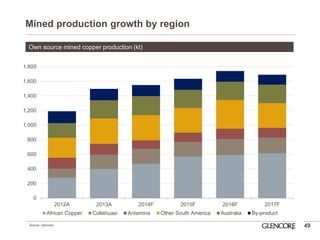
Mined production growth by region 
49 
Own source mined copper production (kt) 
Source: Glencore
210 
165F 
16 
16 
2 
8 
2 
120 
130 
140 
150 
160 
170 
180 
190 
200 
210 
220 
Cu prodution 
budget 
Power direct 
Power (indirect) 
& Mechanical 
Electrical 
Projects delays 
Reduced 
sulphide / ASCu 
Cu production 
actual 
Cu Cathode (‘000) 
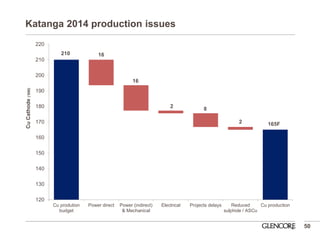
Katanga 2014 production issues 
50
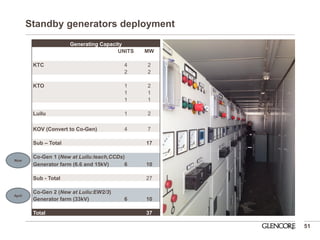
Standby generators deployment 
51 
Generating Capacity 
UNITS 
MW 
KTC 
4 
2 
2 
2 
KTO 
1 
2 
1 
1 
1 
1 
Luilu 
1 
2 
KOV (Convert to Co-Gen) 
4 
7 
Sub – Total 
17 
Co-Gen 1 (New at Luilu:leach,CCDs) 
Generator farm (6.6 and 15kV) 
6 
10 
Sub - Total 
27 
Co-Gen 2 (New at Luilu:EW2/3) 
Generator farm (33kV) 
6 
10 
Total 
37 
Now 
April
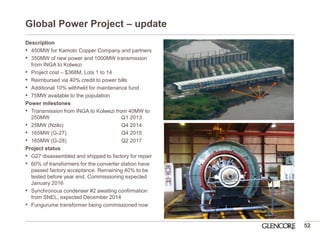
Global Power Project – update 
52 
Description 
•450MW for Kamoto Copper Company and partners 
•350MW of new power and 1000MW transmission from INGA to Kolwezi 
•Project cost – $368M, Lots 1 to 14 
•Reimbursed via 40% credit to power bills 
•Additional 10% withheld for maintenance fund 
•75MW available to the population 
Power milestones 
•Transmission from INGA to Kolwezi from 40MW to 250MW Q1 2013 
•25MW (Nzilo) Q4 2014 
•165MW (G-27) Q4 2015 
•165MW (G-28) Q2 2017 
Project status 
•G27 disassembled and shipped to factory for repair 
•60% of transformers for the converter station have passed factory acceptance. Remaining 40% to be tested before year end. Commissioning expected January 2016 
•Synchronous condenser #2 awaiting confirmation from SNEL, expected December 2014 
•Fungurume transformer being commissioned now
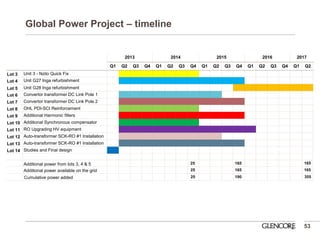
Global Power Project – timeline 
53 
Q1 
Q2 
Q3 
Q4 
Q1 
Q2 
Q3 
Q4 
Q1 
Q2 
Q3 
Q4 
Q1 
Q2 
Q3 
Q4 
Q1 
Q2 
Lot 3 
Unit 3 - Nzilo Quick Fix 
Lot 4 
Unit G27 Inga refurbishment 
Lot 5 
Unit G28 Inga refurbishment 
Lot 6 
Convertor transformer DC Link Pole 1 
Lot 7 
Convertor transformer DC Link Pole 2 
Lot 8 
OHL PDI-SCI Reinforcement 
Lot 9 
Additional Harmonic filters 
Lot 10 
Additional Synchronous compensator 
Lot 11 
RO Upgrading HV equipment 
Lot 12 
Auto-transformer SCK-RO #1 Installation 
Lot 13 
Auto-transformer SCK-RO #1 Installation 
Lot 14 
Studies and Final design 
Additional power from lots 3, 4 & 5 
Additional power available on the grid 
25 
Cumulative power added 
25 
2013 
2014 
2015 
2016 
2017 
25 
165 
165 
190 
165 
165 
355
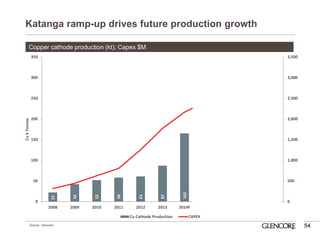
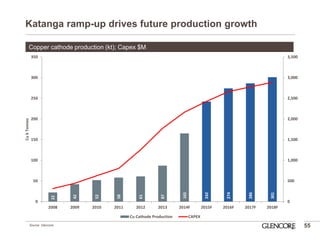
Katanga ramp-up drives future production growth 
54 
Copper cathode production (kt); Capex $M 
Source: Glencore 
22 
42 
52 
58 
61 
87 
165 
242 
274 
286 
301 
0 
500 
1,000 
1,500 
2,000 
2,500 
3,000 
3,500 
0 
50 
100 
150 
200 
250 
300 
350 
2008 
2009 
2010 
2011 
2012 
2013 
2014F 
2015F 
2016F 
2017F 
2018F 
Cu k Tonnes 
Cu Cathode Production 
CAPEX
Katanga ramp-up drives future production growth 
55 
Copper cathode production (kt); Capex $M 
Source: Glencore 
22 
42 
52 
58 
61 
87 
165 
242 
274 
286 
301 
0 
500 
1,000 
1,500 
2,000 
2,500 
3,000 
3,500 
0 
50 
100 
150 
200 
250 
300 
350 
2008 
2009 
2010 
2011 
2012 
2013 
2014F 
2015F 
2016F 
2017F 
2018F 
Cu k Tonnes 
Cu Cathode Production 
CAPEX
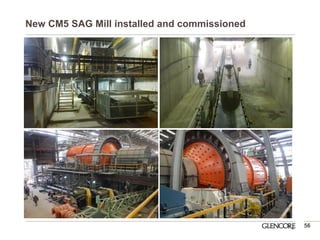
New CM5 SAG Mill installed and commissioned 
56
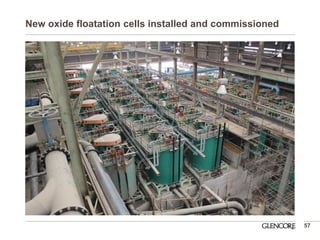
New oxide floatation cells installed and commissioned 
57
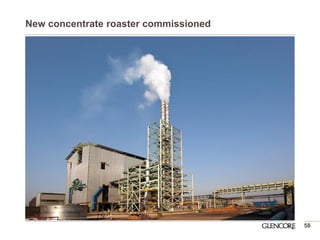
New concentrate roaster commissioned 
58
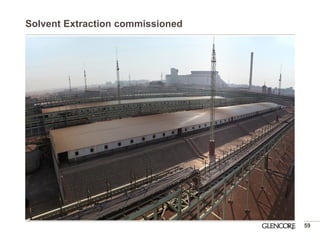
Solvent Extraction commissioned 
59
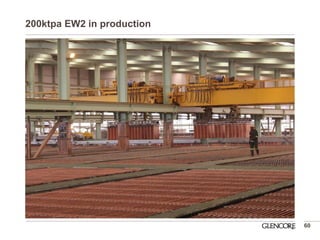
200ktpa EW2 in production 
60
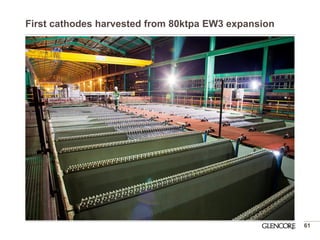
First cathodes harvested from 80ktpa EW3 expansion 
61
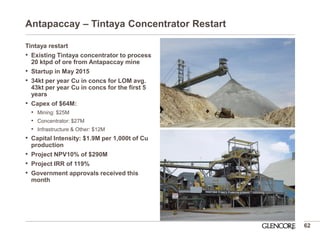
Antapaccay – Tintaya Concentrator Restart 
Tintaya restart 
•Existing Tintaya concentrator to process 20 ktpd of ore from Antapaccay mine 
•Startup in May 2015 
•34kt per year Cu in concs for LOM avg. 43kt per year Cu in concs for the first 5 years 
•Capex of $64M: 
•Mining: $25M 
•Concentrator: $27M 
•Infrastructure & Other: $12M 
•Capital Intensity: $1.9M per 1,000t of Cu production 
•Project NPV10% of $290M 
•Project IRR of 119% 
•Government approvals received this month 
62
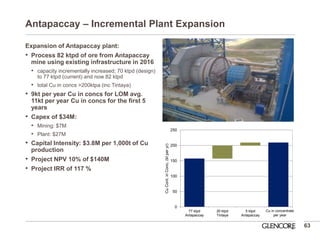
Antapaccay – Incremental Plant Expansion 
Expansion of Antapaccay plant: 
•Process 82 ktpd of ore from Antapaccay mine using existing infrastructure in 2016 
•capacity incrementally increased; 70 ktpd (design) to 77 ktpd (current) and now 82 ktpd 
•total Cu in concs >200ktpa (inc Tintaya) 
•9kt per year Cu in concs for LOM avg. 11kt per year Cu in concs for the first 5 years 
•Capex of $34M: 
•Mining: $7M 
•Plant: $27M 
•Capital Intensity: $3.8M per 1,000t of Cu production 
•Project NPV 10% of $140M 
•Project IRR of 117 % 
63 
42 
10 
157 
209 
0 
50 
100 
150 
200 
250 
77 ktpd 
Antapaccay 
20 ktpd 
Tintaya 
5 ktpd 
Antapaccay 
Cu Cont. in Conc. (kt per yr) 
Cu in concentrate per year
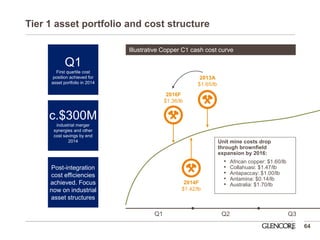
Tier 1 asset portfolio and cost structure 
64 
Q1 
First quartile cost position achieved for asset portfolio in 2014 
Post-integration cost efficiencies achieved. Focus now on industrial asset structures 
Q1 
Q2 
Q3 
Illustrative Copper C1 cash cost curve 
2013A 
$1.65/lb 
Unit mine costs drop through brownfield expansion by 2016: 
•African copper: $1.60/lb 
•Collahuasi: $1.47/lb 
•Antapaccay: $1.00/lb 
•Antamina: $0.14/lb 
•Australia: $1.70/lb 
2014F $1.42/lb 
2016F 
$1.36/lb 
c.$300M industrial merger synergies and other cost savings by end 2014
Copper market 
Altonorte anodes, Antofagasta Port, Chile
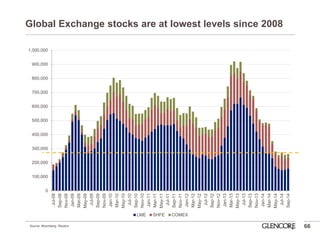
0 
100,000 
200,000 
300,000 
400,000 
500,000 
600,000 
700,000 
800,000 
900,000 
1,000,000 
Jul-08 
Sep-08 
Nov-08 
Jan-09 
Mar-09 
May-09 
Jul-09 
Sep-09 
Nov-09 
Jan-10 
Mar-10 
May-10 
Jul-10 
Sep-10 
Nov-10 
Jan-11 
Mar-11 
May-11 
Jul-11 
Sep-11 
Nov-11 
Jan-12 
Mar-12 
May-12 
Jul-12 
Sep-12 
Nov-12 
Jan-13 
Mar-13 
May-13 
Jul-13 
Sep-13 
Nov-13 
Jan-14 
Mar-14 
May-14 
Jul-14 
Sep-14 
LME 
SHFE 
COMEX 
Global Exchange stocks are at lowest levels since 2008 
66 
Source: Bloomberg, Reuters
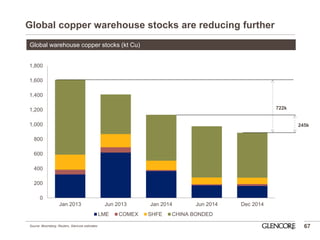
Global copper warehouse stocks are reducing further 
67 
722k 
245k 
0 
200 
400 
600 
800 
1,000 
1,200 
1,400 
1,600 
1,800 
Jan 2013 
Jun 2013 
Jan 2014 
Jun 2014 
Dec 2014 
LME 
COMEX 
SHFE 
CHINA BONDED 
Global warehouse copper stocks (kt Cu) 
Source: Bloomberg, Reuters, Glencore estimates
0 
500 
1,000 
1,500 
2,000 
2,500 
3,000 
2006 
2007 
2008 
2009 
2010 
2011 
2012 
2013 
2014 
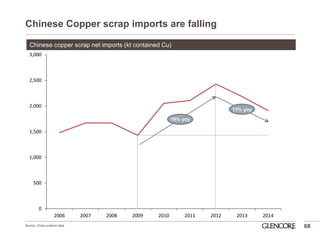
Chinese Copper scrap imports are falling 
68 
19% yoy 
13% yoy 
Chinese copper scrap net imports (kt contained Cu) 
Source: China customs data
2011 
2012 
2013 
2013 vs 2012 
2013 Jan- Oct 
2014 Jan- Oct 
YoY Chg 
2014E 
YoY Chg 
Copper Cathode 
Imports 
2'825 
3'396 
3'198 
(5.8%) 
2'557 
2'948 
15.3% 
3'538 
10.6% 
Exports 
156 
274 
293 
7.1% 
246 
220 
(10.7%) 
264 
(10.0%) 
Net Imports 
2'669 
3'122 
2'905 
(7.0%) 
2'311 
2'728 
18.1% 
3'274 
12.7% 
Domestic Production 
5'197 
5'824 
6'840 
17.4% 
5'763 
6'420 
11.4% 
7'704 
12.6% 
Primary 
3'386 
3'939 
4'686 
19.0% 
3'755 
4'316 
14.9% 
5'179 
10.5% 
Secondary 
1'811 
1'885 
2'153 
14.3% 
2'008 
2'104 
4.8% 
2'525 
17.2% 
Apparent Consumption 
7'865 
8'946 
9'745 
8.9% 
8'074 
9'148 
13.3% 
10'978 
12.7% 
Copper Scrap 
Imports - gross weight 
4'687 
4'859 
4'373 
(10.0%) 
3'549 
3'187 
(10.2%) 
3'824 
(12.5%) 
Content 
45.0% 
50.0% 
50.0% 
50.0% 
50.0% 
Adjusted Imports - mtu 
2'109 
2'430 
2'186 
(10.0%) 
1'774 
1'594 
(10.2%) 
1'912 
(12.5%) 
Exports 
2 
1.5 
1 
(48.4%) 
1 
1 
1 
58.3% 
Net Imports 
2'108 
2'428 
2'186 
(10.0%) 
1'774 
1'593 
(10.2%) 
1'911 
(12.6%) 
Domestic Production 
924 
1'064 
1'226 
15.2% 
1'022 
1'179 
15.4% 
1'415 
15.4% 
Apparent Consumption 
3'032 
3'492 
3'412 
(2.3%) 
2'796 
2'772 
(0.9%) 
3'326 
(2.5%) 
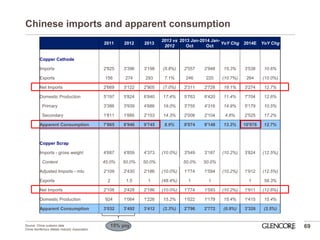
Chinese imports and apparent consumption 
69 
15% yoy 
Source: China customs data China Nonferrous Metals Industry Association
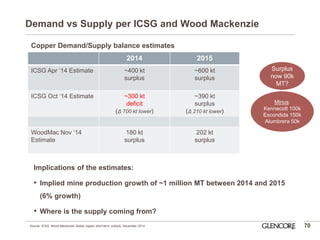
Minus: 
Kennecott 100k 
Escondida 150k 
Alumbrera 50k 
Surplus now 90k MT? 
Demand vs Supply per ICSG and Wood Mackenzie 
70 
Source: ICSG, Wood Mackenzie Global copper short-term outlook, November 2014 
Implications of the estimates: 
•Implied mine production growth of ~1 million MT between 2014 and 2015 (6% growth) 
•Where is the supply coming from? 
2014 
2015 
ICSG Apr ‘14 Estimate 
~400 kt 
surplus 
~600 kt 
surplus 
ICSG Oct ‘14 Estimate 
~300 kt 
deficit 
(Δ 700 kt lower) 
~390 kt 
surplus 
(Δ 210 kt lower) 
WoodMac Nov ‘14 Estimate 
180 kt 
surplus 
202 kt surplus 
Copper Demand/Supply balance estimates
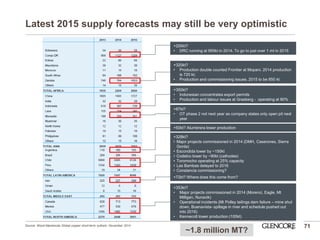
Latest 2015 supply forecasts may still be very optimistic 
Source: Wood Mackenzie Global copper short-term outlook, November 2014 71 
+320kt? 
• Production double counted Frontier at Mopani. 2014 production 
is 720 kt; 
• Production and commissioning issues. 2015 to be 850 kt 
+87kt? 
• OT phase 2 not next year as company states only open pit next 
year 
+72kt? Where does this come from? 
+328kt? 
• Major projects commissioned in 2014 (DMH, Caserones, Sierra 
Gorda) 
• Escondida lower by ~150kt 
• Codelco lower by ~90kt (cathodes) 
• Toromocho operating at 25% capacity 
• Las Bambas delayed to 2016 
• Constancia commissioning? 
+353kt? 
• Major projects commissioned in 2014 (Morenci, Eagle, Mt 
Milligan, Nunavik) 
• Operational incidents (Mt Polley tailings dam failure – mine shut 
down, Buenavista- spillage in river and schedule pushed out 
into 2016) 
• Kennecott lower production (100kt) 
+350kt? 
• Indonesian concentrates export permits 
• Production and labour issues at Grasberg - operating at 80% 
+50kt? Alumbrera lower production 
+200kt? 
• DRC running at 950kt in 2014. To go to just over 1 mt in 2015 
~1.8 million MT?
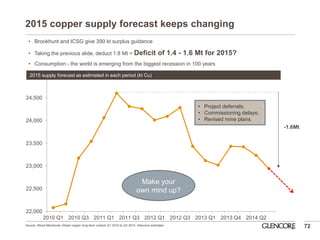
2015 copper supply forecast keeps changing 
22,000 
22,500 
23,000 
23,500 
24,000 
24,500 
25,000 
2010 Q1 
2010 Q3 
2011 Q1 
2011 Q3 
2012 Q1 
2012 Q3 
2013 Q1 
2013 Q4 
2014 Q2 
72 
2015 supply forecast as estimated in each period (kt Cu) 
Source: Wood Mackenzie Global copper long-term outlook Q1 2010 to Q3 2014, Glencore estimates 
-1.6Mt 
•Project deferrals; 
•Commissioning delays; 
•Revised mine plans. 
•Brookhunt and ICSG give 390 kt surplus guidance 
•Taking the previous slide, deduct 1.8 Mt = Deficit of 1.4 - 1.6 Mt for 2015? 
•Consumption - the world is emerging from the biggest recession in 100 years 
Make your own mind up?
Thank you 
73
Appendix: Copper asset update 
Kantanga Phase V, EW3 under commissioning, DRC
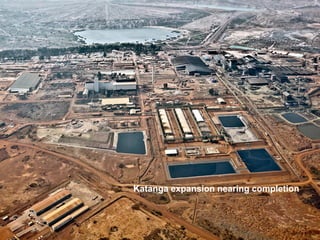
Katanga expansion nearing completion
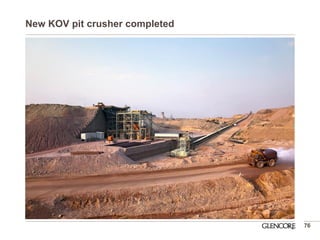
New KOV pit crusher completed 
76
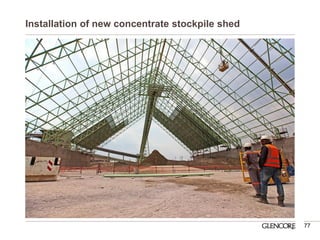
Installation of new concentrate stockpile shed 
77
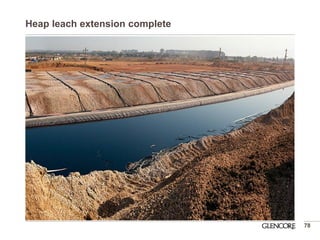
Heap leach extension complete 
78
79 
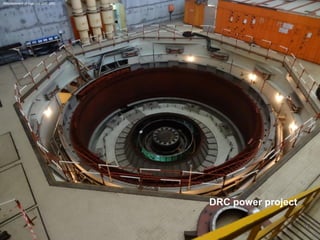
DRC power project 
Refurbishment of Inga Unit G27, DRC
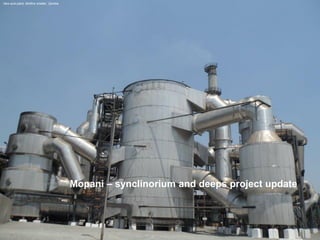
Mopani – synclinorium and deeps project update 
New acid plant, Mufilira smelter, Zambia
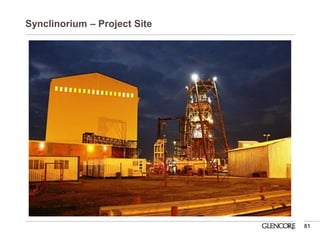
Synclinorium – Project Site 
81
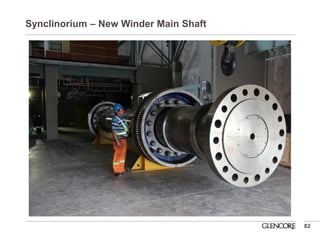
Synclinorium – New Winder Main Shaft 
82
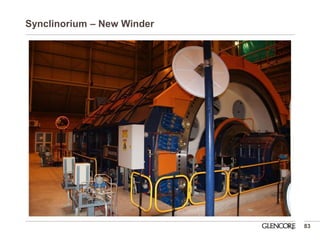
Synclinorium – New Winder 
83
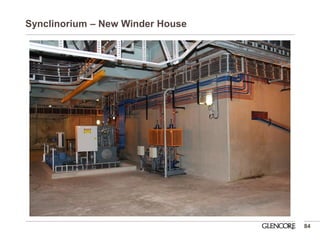
Synclinorium – New Winder House 
84
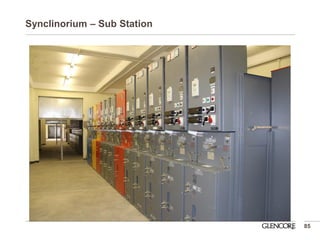
Synclinorium – Sub Station 
85
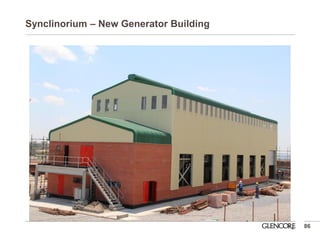
Synclinorium – New Generator Building 
86
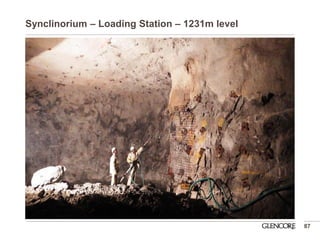
Synclinorium – Loading Station – 1231m level 
87
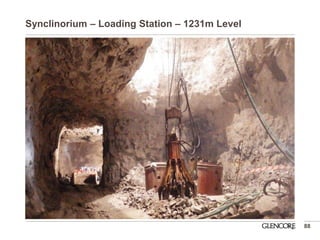
Synclinorium – Loading Station – 1231m Level 
88
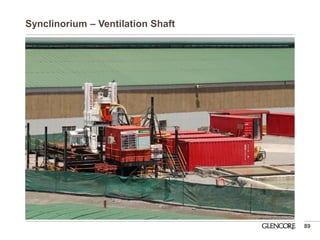
Synclinorium – Ventilation Shaft 
89
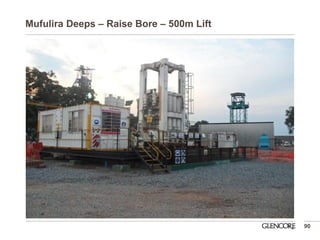
Mufulira Deeps – Raise Bore – 500m Lift 
90
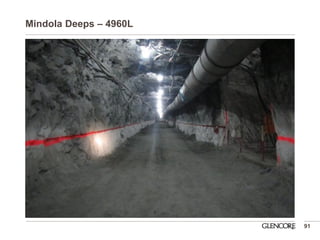
Mindola Deeps – 4960L 
91
92 
Newlands CHPP, Australia 
Draft schedule 
08:00 - Welcome and Overview | Ivan Glasenberg 
08:20 - Finance Update | Steven Kalmin 
08:45 - Copper | Telis Mistakidis 
09:15 - Coal | Tor Peterson & Peter Freyberg 
09:45 - Break 
10:05 - Zinc | Daniel Maté & Chris Eskdale 
10:35 - Nickel | Kenny Ives & Peter Johnston 
11:05 - Oil | Alex Beard 
11:40 - Break 
12:00 - Agricultural products | Chris Mahoney 
12:30 - Conclusion and Q&A 
Investor Day 10 December 2014
93 
Forward looking statements 
This document contains statements that are, or may be deemed to be, “forward looking statements” which are prospective in nature. These forward looking statements may be identified by the use of forward looking terminology, or the negative thereof such as "plans", "expects" or "does not expect", "is expected", "continues", "assumes", "is subject to", "budget", "scheduled", "estimates", "aims", "forecasts", "risks", "intends", "positioned", "predicts", "anticipates" or "does not anticipate", or "believes", or variations of such words or comparable terminology and phrases or statements that certain actions, events or results "may", "could", "should", “shall”, "would", "might" or "will" be taken, occur or be achieved. Such statements are qualified in their entirety by the inherent risks and uncertainties surrounding future expectations. Forward-looking statements are not based on historical facts, but rather on current predictions, expectations, beliefs, opinions, plans, objectives, goals, intentions and projections about future events, results of operations, prospects, financial condition and discussions of strategy. 
By their nature, forward looking statements involve known and unknown risks and uncertainties, many of which are beyond Glencore’s control. Forward looking statements are not guarantees of future performance and may and often do differ materially from actual results. Important factors that could cause these uncertainties include, but are not limited to, those discussed under “Principal risks and uncertainties” of Glencore’s Annual Report 2013 and “Risks and uncertainties” in Glencore’s 2014 Half-Year Report. 
Neither Glencore nor any of its associates or directors, officers or advisers, provides any representation, assurance or guarantee that the occurrence of the events expressed or implied in any forward-looking statements in this document will actually occur. You are cautioned not to place undue reliance on these forward-looking statements which only speak as of the date of this document. Other than in accordance with its legal or regulatory obligations (including under the UK Listing Rules and the Disclosure and Transparency Rules of the Financial Conduct Authority and the Rules Governing the Listing of Securities on the Stock Exchange of Hong Kong Limited and the Listing Requirements of the Johannesburg Stock Exchange Limited), Glencore is not under any obligation and Glencore and its affiliates expressly disclaim any intention, obligation or undertaking to update or revise any forward looking statements, whether as a result of new information, future events or otherwise. This document shall not, under any circumstances, create any implication that there has been no change in the business or affairs of Glencore since the date of this document or that the information contained herein is correct as at any time subsequent to its date. 
No statement in this document is intended as a profit forecast or a profit estimate and no statement in this document should be interpreted to mean that earnings per Glencore share for the current or future financial years would necessarily match or exceed the historical published earnings per Glencore share. 
This document does not constitute or form part of any offer or invitation to sell or issue, or any solicitation of any offer to purchase or subscribe for any securities. The making of this document does not constitute a recommendation regarding any securities.
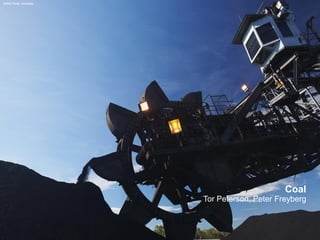
Coal 
Tor Peterson, Peter Freyberg 
Abbot Point, Australia
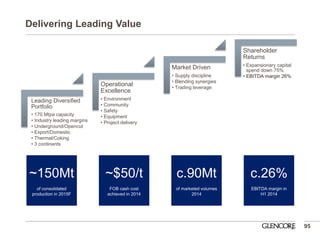
Delivering Leading Value 
Leading Diversified Portfolio 
•170 Mtpa capacity 
•Industry leading margins 
•Underground/Opencut 
•Export/Domestic 
•Thermal/Coking 
•3 continents 
Operational Excellence 
•Environment 
•Community 
•Safety 
•Equipment 
•Project delivery 
Market Driven 
•Supply discipline 
•Blending synergies 
•Trading leverage 
Shareholder Returns 
•Expansionary capital spend down 75% 
•EBITDA margin 26% 
95 
~$50/t FOB cash cost achieved in 2014 
~150Mt of consolidated production in 2015F 
c.26% 
EBITDA margin in H1 2014 
c.90Mt of marketed volumes 2014
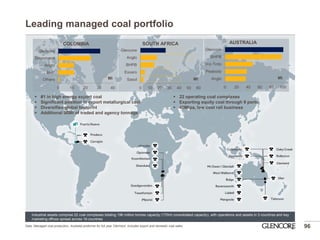
Leading managed coal portfolio 
96 
Industrial assets comprise 22 coal complexes totaling 196 million tonnes capacity (170mt consolidated capacity), with operations and assets in 3 countries and key marketing offices spread across 19 countries 
0 
10 
20 
30 
40 
Others 
BHP 
Anglo 
Drummond 
Glencore 
Mt 
COLOMBIA 
0 
10 
20 
30 
40 
50 
60 
Sasol 
Exxaro 
BHPB 
Anglo 
Glencore 
Mt 
SOUTH AFRICA 
0 
20 
40 
60 
80 
100 
Anglo 
Peabody 
Rio Tinto 
BHPB 
Glencore 
Mt 
AUSTRALIA 
#1 in high energy export coal 
Significant position in export metallurgical coal 
Diversified global footprint 
Additional 90Mt of traded and agency tonnage 
Data: Managed coal production, Australia proforma for full year Clermont. Includes export and domestic coal sales 
22 operating coal complexes 
Exporting equity coal through 9 ports 
40Mtpa, low cost rail business 
Clermont
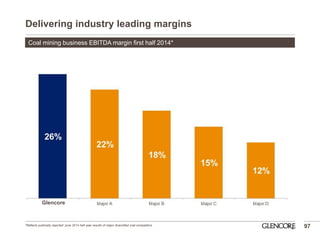
Delivering industry leading margins 
97 
*Reflects publically reported June 2014 half year results of major diversified coal competitors 
Glencore 
Coal mining business EBITDA margin first half 2014*
Coal markets update 
Thermal coal, Rolleston mine, Australia
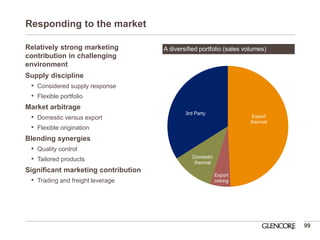
Export thermal 
Export coking 
Domestic thermal 
3rd Party 
Responding to the market 
Relatively strong marketing contribution in challenging environment 
Supply discipline 
•Considered supply response 
•Flexible portfolio 
Market arbitrage 
•Domestic versus export 
•Flexible origination 
Blending synergies 
•Quality control 
•Tailored products 
Significant marketing contribution 
•Trading and freight leverage 
99 
A diversified portfolio (sales volumes)
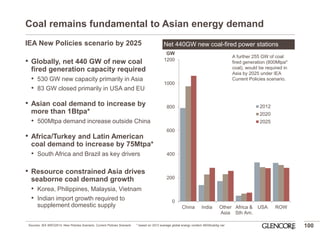
Coal remains fundamental to Asian energy demand 
IEA New Policies scenario by 2025 
•Globally, net 440 GW of new coal fired generation capacity required 
•530 GW new capacity primarily in Asia 
•83 GW closed primarily in USA and EU 
•Asian coal demand to increase by more than 1Btpa* 
•500Mtpa demand increase outside China 
•Africa/Turkey and Latin American coal demand to increase by 75Mtpa* 
•South Africa and Brazil as key drivers 
•Resource constrained Asia drives seaborne coal demand growth 
•Korea, Philippines, Malaysia, Vietnam 
•Indian import growth required to supplement domestic supply 
100 
0 
200 
400 
600 
800 
1000 
1200 
China 
India 
Other 
Asia 
Africa & 
Sth Am. 
USA 
ROW 
GW 
2012 
2020 
2025 
Net 440GW new coal-fired power stations 
Sources: IEA WEO2014, New Policies Scenario, Current Policies Scenario * based on 2012 average global energy content 4920kcal/kg nar 
A further 255 GW of coal fired generation (800Mtpa* coal), would be required in Asia by 2025 under IEA Current Policies scenario.
0 
200 
400 
600 
800 
1000 
USD/t 
Million Tonnes 
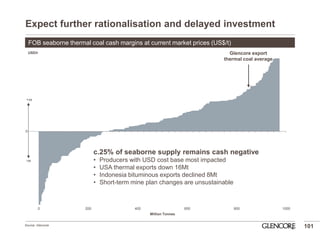
Expect further rationalisation and delayed investment 
101 
Source: Glencore 
FOB seaborne thermal coal cash margins at current market prices (US$/t) 
c.25% of seaborne supply remains cash negative 
•Producers with USD cost base most impacted 
•USA thermal exports down 16Mt 
•Indonesia bituminous exports declined 8Mt 
•Short-term mine plan changes are unsustainable 
Glencore export thermal coal average 
+ve 
-ve 
0
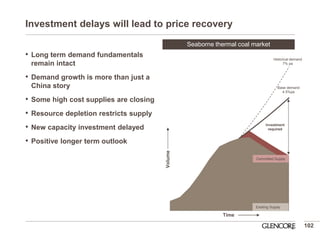
Investment delays will lead to price recovery 
•Long term demand fundamentals remain intact 
•Demand growth is more than just a China story 
•Some high cost supplies are closing 
•Resource depletion restricts supply 
•New capacity investment delayed 
•Positive longer term outlook 
102 
Volume 
Time 
Seaborne thermal coal market 
Historical demand 
7% pa 
Base demand 
4.5%pa 
Existing Supply 
Committed Supply 
Investment 
required
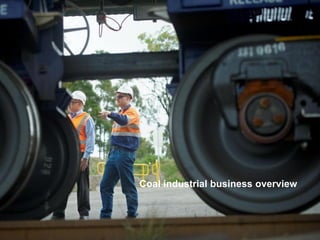
Coal industrial business overview
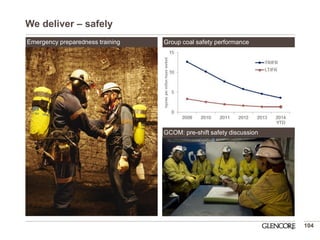
We deliver – safely 
104 
Group coal safety performance 
GCOM: pre-shift safety discussion 
Emergency preparedness training
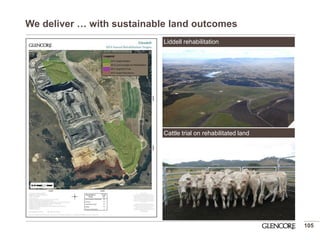
We deliver … with sustainable land outcomes 
105 
Liddell rehabilitation 
Cattle trial on rehabilitated land
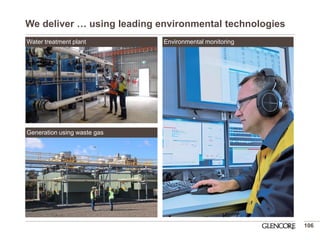
We deliver … using leading environmental technologies 
106 
Water treatment plant 
Environmental monitoring 
Generation using waste gas
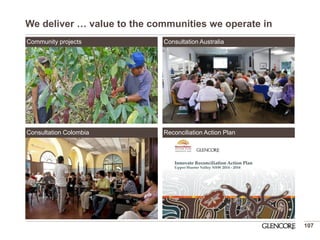
We deliver … value to the communities we operate in 
107 
Community projects 
Consultation Australia 
Consultation Colombia 
Reconciliation Action Plan
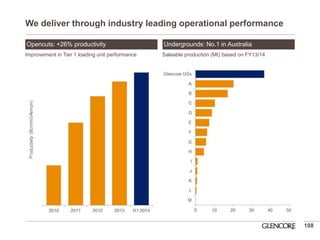
We deliver through industry leading operational performance 
108 
Opencuts: +26% productivity 
Undergrounds: No.1 in Australia 
Improvement in Tier 1 loading unit performance 
Saleable production (Mt) based on FY13/14
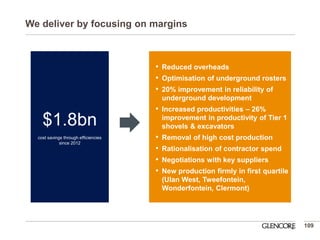
We deliver by focusing on margins 
•Reduced overheads 
•Optimisation of underground rosters 
•20% improvement in reliability of underground development 
•Increased productivities – 26% improvement in productivity of Tier 1 shovels & excavators 
•Removal of high cost production 
•Rationalisation of contractor spend 
•Negotiations with key suppliers 
•New production firmly in first quartile (Ulan West, Tweefontein, Wonderfontein, Clermont) 
109 
$1.8bn 
cost savings through efficiencies 
since 2012
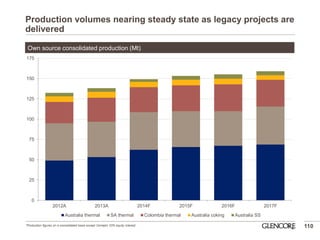
Production volumes nearing steady state as legacy projects are delivered 
110 
*Production figures on a consolidated basis except Cerrejón 33% equity interest 
Own source consolidated production (Mt) 
0 
25 
50 
75 
100 
125 
150 
175 
2012A 
2013A 
2014F 
2015F 
2016F 
2017F 
Australia thermal 
SA thermal 
Colombia thermal 
Australia coking 
Australia SS
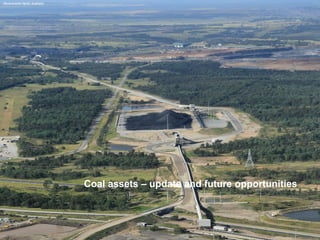
Coal assets – update and future opportunities 
Ravensworth North, Australia
112 
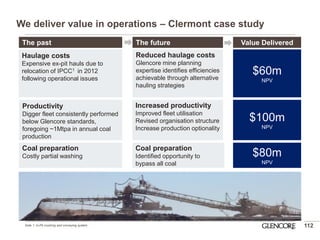
We deliver value in operations – Clermont case study 
The past 
The future 
Note 1: In-Pit crushing and conveying system 
Value Delivered 
$60m 
NPV 
Reduced haulage costs 
Glencore mine planning expertise identifies efficiencies achievable through alternative hauling strategies 
Productivity 
Digger fleet consistently performed below Glencore standards, foregoing ~1Mtpa in annual coal production 
Increased productivity 
Improved fleet utilisation 
Revised organisation structure 
Increase production optionality 
$100m 
NPV 
Coal preparation 
Costly partial washing 
Coal preparation 
Identified opportunity to bypass all coal 
$80m 
NPV 
Haulage costs 
Expensive ex-pit hauls due to relocation of IPCC1 in 2012 following operational issues
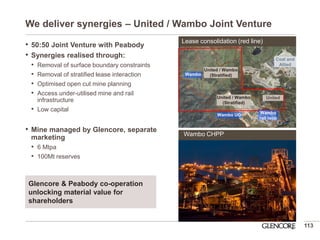
•50:50 Joint Venture with Peabody 
•Synergies realised through: 
•Removal of surface boundary constraints 
•Removal of stratified lease interaction 
•Optimised open cut mine planning 
•Access under-utilised mine and rail infrastructure 
•Low capital 
•Mine managed by Glencore, separate marketing 
•6 Mtpa 
•100Mt reserves 
113 
We deliver synergies – United / Wambo Joint Venture 
Lease consolidation (red line) 
Wambo CHPP 
United 
Coal and Allied 
Wambo 
rail loop 
Wambo UG 
United / Wambo 
(Stratified) 
Wambo 
United / Wambo (Stratified) 
Glencore & Peabody co-operation unlocking material value for shareholders
Open Cut Development 
Eastern Emplacement 
Noise and visual bund 
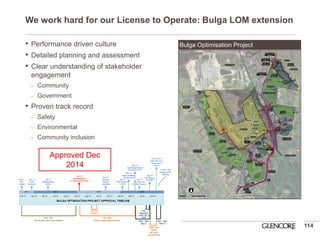
We work hard for our License to Operate: Bulga LOM extension 
•Performance driven culture 
•Detailed planning and assessment 
•Clear understanding of stakeholder engagement 
-Community 
-Government 
•Proven track record 
-Safety 
-Environmental 
-Community inclusion 
114 
Bulga Optimisation Project 
Approved Dec 2014
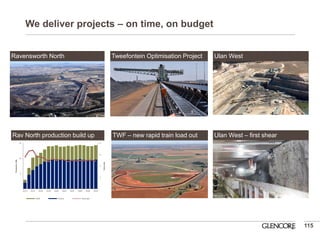
We deliver projects – on time, on budget 
115 
- 
2 
4 
6 
8 
- 
5 
10 
15 
2012 
2014 
2016 
2018 
2020 
2022 
2024 
2026 
2028 
2030 
Strip ratio 
Production (Mt) 
ROM 
Product 
Strip ratio 
Ravensworth North 
Tweefontein Optimisation Project 
Ulan West 
Rav North production build up 
TWF – new rapid train load out 
Ulan West – first shear
Conclusion 
116 
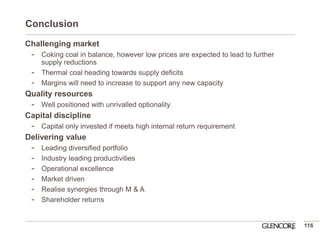
Challenging market 
-Coking coal in balance, however low prices are expected to lead to further supply reductions 
-Thermal coal heading towards supply deficits 
-Margins will need to increase to support any new capacity 
Quality resources 
-Well positioned with unrivalled optionality 
Capital discipline 
-Capital only invested if meets high internal return requirement 
Delivering value 
-Leading diversified portfolio 
-Industry leading productivities 
-Operational excellence 
-Market driven 
-Realise synergies through M & A 
-Shareholder returns
Q&A
Appendix 
118
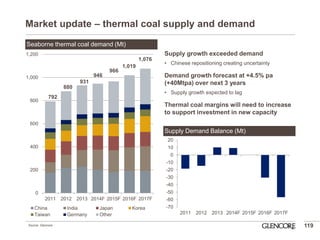
Supply growth exceeded demand 
•Chinese repositioning creating uncertainty Demand growth forecast at +4.5% pa (+40Mtpa) over next 3 years 
•Supply growth expected to lag Thermal coal margins will need to increase to support investment in new capacity 
Market update – thermal coal supply and demand 
119 
0 
200 
400 
600 
800 
1,000 
1,200 
2011 
2012 
2013 
2014F 
2015F 
2016F 
2017F 
China 
India 
Japan 
Korea 
Taiwan 
Germany 
Other 
-70 
-60 
-50 
-40 
-30 
-20 
-10 
0 
10 
20 
2011 
2012 
2013 
2014F 
2015F 
2016F 
2017F 
Seaborne thermal coal demand (Mt) 
Supply Demand Balance (Mt) 
1,076 
792 
880 
931 
946 
966 
1,019 
Source: Glencore
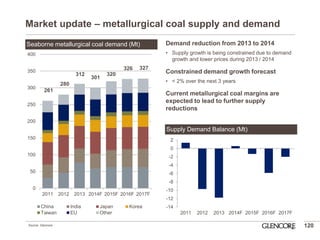
Demand reduction from 2013 to 2014 
•Supply growth is being constrained due to demand growth and lower prices during 2013 / 2014 Constrained demand growth forecast 
•< 2% over the next 3 years Current metallurgical coal margins are expected to lead to further supply reductions 
Market update – metallurgical coal supply and demand 
120 
0 
50 
100 
150 
200 
250 
300 
350 
400 
2011 
2012 
2013 
2014F 
2015F 
2016F 
2017F 
China 
India 
Japan 
Korea 
Taiwan 
EU 
Other 
-14 
-12 
-10 
-8 
-6 
-4 
-2 
0 
2 
2011 
2012 
2013 
2014F 
2015F 
2016F 
2017F 
Seaborne metallurgical coal demand (Mt) 
Supply Demand Balance (Mt) 
261 
280 
312 
301 
320 
326 
327 
Source: Glencore
Investor Day 
10 December 2014 
Zinc ingot, Asturiana de Zinc, Spain 
08:00 - Welcome and Overview | Ivan Glasenberg 
08:20 - Finance Update | Steven Kalmin 
08:45 - Copper | Telis Mistakidis 
09:15 - Coal | Tor Peterson & Peter Freyberg 
09:45 - Break 
10:05 - Zinc | Daniel Maté & Chris Eskdale 
10:35 - Nickel | Kenny Ives & Peter Johnston 
11:05 - Oil | Alex Beard 
11:40 - Break 
12:00 - Agricultural products | Chris Mahoney 
12:30 - Conclusion and Q&A
122 
Forward looking statements 
This document contains statements that are, or may be deemed to be, “forward looking statements” which are prospective in nature. These forward looking statements may be identified by the use of forward looking terminology, or the negative thereof such as "plans", "expects" or "does not expect", "is expected", "continues", "assumes", "is subject to", "budget", "scheduled", "estimates", "aims", "forecasts", "risks", "intends", "positioned", "predicts", "anticipates" or "does not anticipate", or "believes", or variations of such words or comparable terminology and phrases or statements that certain actions, events or results "may", "could", "should", “shall”, "would", "might" or "will" be taken, occur or be achieved. Such statements are qualified in their entirety by the inherent risks and uncertainties surrounding future expectations. Forward-looking statements are not based on historical facts, but rather on current predictions, expectations, beliefs, opinions, plans, objectives, goals, intentions and projections about future events, results of operations, prospects, financial condition and discussions of strategy. 
By their nature, forward looking statements involve known and unknown risks and uncertainties, many of which are beyond Glencore’s control. Forward looking statements are not guarantees of future performance and may and often do differ materially from actual results. Important factors that could cause these uncertainties include, but are not limited to, those discussed under “Principal risks and uncertainties” of Glencore’s Annual Report 2013 and “Risks and uncertainties” in Glencore’s 2014 Half-Year Report. 
Neither Glencore nor any of its associates or directors, officers or advisers, provides any representation, assurance or guarantee that the occurrence of the events expressed or implied in any forward-looking statements in this document will actually occur. You are cautioned not to place undue reliance on these forward-looking statements which only speak as of the date of this document. Other than in accordance with its legal or regulatory obligations (including under the UK Listing Rules and the Disclosure and Transparency Rules of the Financial Conduct Authority and the Rules Governing the Listing of Securities on the Stock Exchange of Hong Kong Limited and the Listing Requirements of the Johannesburg Stock Exchange Limited), Glencore is not under any obligation and Glencore and its affiliates expressly disclaim any intention, obligation or undertaking to update or revise any forward looking statements, whether as a result of new information, future events or otherwise. This document shall not, under any circumstances, create any implication that there has been no change in the business or affairs of Glencore since the date of this document or that the information contained herein is correct as at any time subsequent to its date. 
No statement in this document is intended as a profit forecast or a profit estimate and no statement in this document should be interpreted to mean that earnings per Glencore share for the current or future financial years would necessarily match or exceed the historical published earnings per Glencore share. 
This document does not constitute or form part of any offer or invitation to sell or issue, or any solicitation of any offer to purchase or subscribe for any securities. The making of this document does not constitute a recommendation regarding any securities.
Zinc 
Daniel Maté, Chris Eskdale 
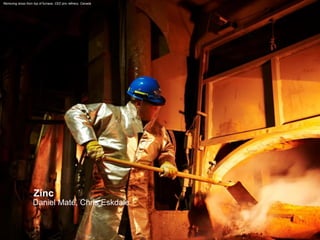
Removing dross from top of furnace, CEZ zinc refinery, Canada
Zinc summary 
Zinc market fundamentals remain strong and continue to improve 
Our industry leading zinc business combines world class zinc assets with our marketing reach and expertise 
Unique combination of mines and smelters in a single company 
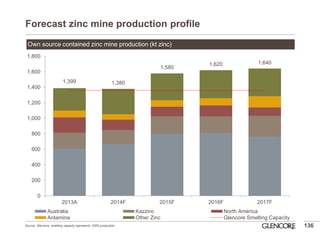
•mined production of 1.4Mt in 2013 rising to 1.6Mt by 2016 – #1 globally 
•smelter production of ~1.36Mt – #1 globally. Brings additional exposure to ~250kt zinc units through over-recovery / escalator capture 
•resource base provides weighted average mine lives >40 years on current Measured and Indicated resource 
•key growth projects provide additional zinc and cost/capital efficiencies at an attractive stage of the price cycle 
Industrial assets and marketing flows managed under one roof, two-way information flow 
•one global concentrates/metal book and one pool of knowledge. 
•market input guides assets to produce the economically optimal product mix 
•sharing of best practices across global zinc assets 
•mine output and 3rd party tonnage flowing to destination of optimal economic return 
124
Global zinc market 
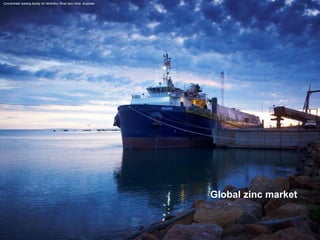
Concentrate loading facility for McArthur River zinc mine, Australia
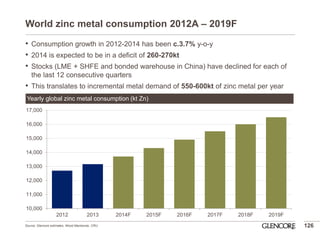
World zinc metal consumption 2012A – 2019F 
•Consumption growth in 2012-2014 has been c.3.7% y-o-y 
•2014 is expected to be in a deficit of 260-270kt 
•Stocks (LME + SHFE and bonded warehouse in China) have declined for each of the last 12 consecutive quarters 
•This translates to incremental metal demand of 550-600kt of zinc metal per year 
126 
Yearly global zinc metal consumption (kt Zn) 
10,000 
11,000 
12,000 
13,000 
14,000 
15,000 
16,000 
17,000 
2012 
2013 
2014F 
2015F 
2016F 
2017F 
2018F 
2019F 
Source: Glencore estimates, Wood Mackenzie, CRU.
127 
Where will these units come from?
Concentrates requirement, production and deficit outlook 
128 
0 
1,000 
2,000 
3,000 
4,000 
5,000 
6,000 
7,000 
8,000 
9,000 
10,000 
2015 
2016 
2017 
2018 
2019 
Non-China mined Zn concs production (kt Zn) 
368 
758 
506 
360 
293 
0 
100 
200 
300 
400 
500 
600 
700 
800 
900 
1000 
2015 
2016 
2017 
2018 
2019 
Additional Zn concs required (kt Zn) 
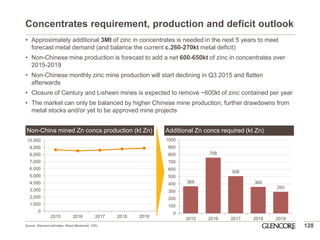
•Approximately additional 3Mt of zinc in concentrates is needed in the next 5 years to meet forecast metal demand (and balance the current c.260-270kt metal deficit) 
•Non-Chinese mine production is forecast to add a net 600-650kt of zinc in concentrates over 2015-2019 
•Non-Chinese monthly zinc mine production will start declining in Q3 2015 and flatten afterwards 
•Closure of Century and Lisheen mines is expected to remove ~600kt of zinc contained per year 
•The market can only be balanced by higher Chinese mine production, further drawdowns from metal stocks and/or yet to be approved mine projects 
Source: Glencore estimates, Wood Mackenzie, CRU.
270 
235 
335 
-55 
185 
315 
310 
308 
205 
183 
368 
758 
506 
360 
293 
$1,382 
$3,275 
$3,242 
$1,875 
$1,655 
$2,161 
$2,194 
$1,948 
$1,910 
$2,161 
0 
500 
1,000 
1,500 
2,000 
2,500 
3,000 
3,500 
-100 
0 
100 
200 
300 
400 
500 
600 
700 
800 
2005 
2007 
2009 
2011 
2013 
2015F 
2017F 
2019F 
Chinese mine production 
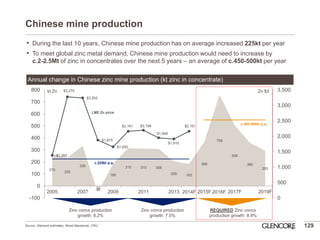
•During the last 10 years, Chinese mine production has on average increased 225kt per year 
•To meet global zinc metal demand, Chinese mine production would need to increase by c.2-2.5Mt of zinc in concentrates over the next 5 years – an average of c.450-500kt per year 
129 
Annual change in Chinese zinc mine production (kt zinc in concentrate) 
Zinc concs production growth: 8.2% 
Zinc concs production growth: 7.5% 
REQUIRED Zinc concs production growth: 8.9% 
c.450-500kt p.a. 
c.225kt p.a. 
LME Zn price 
Zn $/t 
kt Zn 
Source: Glencore estimates, Wood Mackenzie, CRU. 
2014F 
2016F
Mine deficit can only partially be covered by available stock 
130 
155 
545 
293 
147 
80 
368 
758 
506 
360 
293 
0 
100 
200 
300 
400 
500 
600 
700 
800 
2015 
2016 
2017 
2018 
2019 
Concentrate deficit 
Chinese production increase 
based on 3 year average 
Gap between Chinese concs required and forecast (kt Zn) 
0 
200 
400 
600 
800 
1000 
1200 
1400 
1600 
1800 
2012 
2013 
2014 
2015 
2016 
2017 
2018 
2019 
Forecast zinc metal stocks* (kt Zn) 
•Assuming Chinese mine production increases c.210-220kt per year, there will be a global deficit of c.1.0-1.5Mt of zinc in concentrates over the forecast period 
•Deficit of concentrates will result in drawdown of metal stocks 
•2014 forecast inventory drawdown of 263kt 
1’200 
1’100 
Source: Glencore estimates, Wood Mackenzie, CRU. 
*Reported Exchange Stocks + GIAG estimate of BWHSE stocks. 
c.213kt p.a.
Price is closely correlated to available stock levels 
•Historically, zinc prices have responded to the upside as the “stocks:consumption” ratio approaches 3 weeks of zinc metal consumption 
131 
$779 
$828 
$1,048 
$1,382 
$3,275 
$3,242 
$1,875 
$1,655 
$2,161 
$2,193 
$1,948 
$1,910 
$2,161 
3.6 
4 
3.2 
1.9 
0.4 
0.7 
1.5 
3.4 
4.4 
5 
6.5 
5.6 
4.4 
0 
1 
2 
3 
4 
5 
6 
7 
0 
500 
1,000 
1,500 
2,000 
2,500 
3,000 
3,500 
2002 
2003 
2004 
2005 
2006 
2007 
2008 
2009 
2010 
2011 
2012 
2013 
2014F 
LME Zn price 
Stocks consumption ratio 
LME zinc price ($/t) vs stocks to consumption ratio (weeks) 
Inverse weeks stocks:consumption ratio 
LME Zn price $/t 
Source: Glencore estimates, Wood Mackenzie, Bloomberg, CRU.
Zinc metal stocks outlook 
•Stocks are forecast to fall below the critical “stocks:consumption” inflection point of 3 weeks consumption 
132 
-3 
-2 
-1 
0 
1 
2 
3 
4 
5 
Downside (2.8% zinc demand growth) 
Base (3.8% zinc demand growth) 
Upside (4.8% zinc demand growth) 
Sensitivity of zinc metal stocks to global zinc demand 
Feb 2016 
Apr 2016 
Oct 2016 
Inflection point 
Weeks consumption 
Source: Glencore estimates, Wood Mackenzie, CRU. 
2014F 
2015F 
2016F 
2017F 
2019F 
2018F
Zinc industrial overview 
McArthur River zinc mine metallurgical plant, Australia
Glencore zinc assets 
134 
Industrial assets comprise: 24 mines, 7 zinc smelters, 6 lead smelters/refineries with operations and assets in 12 countries and key marketing offices spread across 5 continents, ~50k employees
A large long-life, low-cost, optimised asset base 
Expansions – delivery of 3 Australian projects 
•capex spend on budget 
•Lady Loretta project ahead of schedule 
“Steady State” operations 
•benchmarking and subsequent cost reduction/turnaround projects – savings of ~$50 million 
•smelters – commercial and technical integration 
•cost synergies of >$100 million achieved vs. initial integration assessment of $70 million 
•zinc sustaining capex declining to normalised levels of around $700-900 million from 2016 
135 
Illustrative Zinc C1 cash cost curve 
Q1 
Q2 
Q3 
Q4 
Zn: 2013 
61 c/lb 
Zn: 2016 43 c/lb 
Australian expansions underpin a sustainable reduction in C1 cash costs 
1.6Mt 
low-cost zinc production by 2016 
+40 yrs 
mine life, based on current M+I resource of c.52Mt 
Note: Glencore estimated C1 cash cost in real terms.
Forecast zinc mine production profile 
136 
1,399 
1,380 
1,580 
1,620 
1,640 
0 
200 
400 
600 
800 
1,000 
1,200 
1,400 
1,600 
1,800 
2013A 
2014F 
2015F 
2016F 
2017F 
Australia 
Kazzinc 
North America 
Antamina 
Other Zinc 
Glencore Smelting Capacity 
Own source contained zinc mine production (kt zinc) 
Source: Glencore, smelting capacity represents 100% production.
Australian expansion projects update 
Mt Isa Operations: 
•Capital cost of US$245M for new hoisting shaft and associated infrastructure 
•Nov 2014 run-rate of 4.3Mtpa ore mined 
•Hoist commissioning anticipated in Q1 2015 
•Sustainable 4.5Mtpa ore mined run rate by Q2 2015 
Lady Loretta: 
•Capital cost of ~US$350M 
•Project on budget with production ramping up to 1.6Mtpa by H2 2015 
•0.6Mt ore mined in 2013 
•Current run-rate of 1Mtpa ore mined 
McArthur River: 
•Handed over to operations and commenced commissioning in H1 2014 
•Ramp-up challenges encountered during H2 2014, particularly in relation to flotation and dewatering circuits 
•Residual issues well understood and being addressed 
•Expecting annualised zinc production of 330kt contained metal by end Dec 2014, representing >90% of design capacity 
MRM Processing Plant 
Rock bolting, Lady Loretta mine 
137
Conclusion 
•Zinc market fundamentals remain strong and continue to improve 
•Our industry leading zinc business combines world class zinc assets with our marketing reach and expertise 
•unique combination of mines and smelters in a single company 
•industrial assets fully integrated into global marketing flows 
•Glencore’s key growth projects provide additional zinc and cost / capital efficiencies at an attractive stage of the price cycle 
•cost position of c.61 c/lb in 2013, falling to c.43 c/lb in 2016 
•zinc sustaining capex declining to normalized levels of around $700-900 million from 2016 
138
Q&A 
George Fisher underground mine shift change, Australia
140 
Investor Day 
10 December 2014 
Granulated nickel matte, Sudbury, Canada 
08:00 - Welcome and Overview | Ivan Glasenberg 
08:20 - Finance Update | Steven Kalmin 
08:45 - Copper | Telis Mistakidis 
09:15 - Coal | Tor Peterson & Peter Freyberg 
09:45 - Break 
10:05 - Zinc | Daniel Maté & Chris Eskdale 
10:35 - Nickel | Kenny Ives & Peter Johnston 
11:05 - Oil | Alex Beard 
11:40 - Break 
12:00 - Agricultural products | Chris Mahoney 
12:30 - Conclusion and Q&A
141 
Forward looking statements 
This document contains statements that are, or may be deemed to be, “forward looking statements” which are prospective in nature. These forward looking statements may be identified by the use of forward looking terminology, or the negative thereof such as "plans", "expects" or "does not expect", "is expected", "continues", "assumes", "is subject to", "budget", "scheduled", "estimates", "aims", "forecasts", "risks", "intends", "positioned", "predicts", "anticipates" or "does not anticipate", or "believes", or variations of such words or comparable terminology and phrases or statements that certain actions, events or results "may", "could", "should", “shall”, "would", "might" or "will" be taken, occur or be achieved. Such statements are qualified in their entirety by the inherent risks and uncertainties surrounding future expectations. Forward-looking statements are not based on historical facts, but rather on current predictions, expectations, beliefs, opinions, plans, objectives, goals, intentions and projections about future events, results of operations, prospects, financial condition and discussions of strategy. 
By their nature, forward looking statements involve known and unknown risks and uncertainties, many of which are beyond Glencore’s control. Forward looking statements are not guarantees of future performance and may and often do differ materially from actual results. Important factors that could cause these uncertainties include, but are not limited to, those discussed under “Principal risks and uncertainties” of Glencore’s Annual Report 2013 and “Risks and uncertainties” in Glencore’s 2014 Half-Year Report. 
Neither Glencore nor any of its associates or directors, officers or advisers, provides any representation, assurance or guarantee that the occurrence of the events expressed or implied in any forward-looking statements in this document will actually occur. You are cautioned not to place undue reliance on these forward-looking statements which only speak as of the date of this document. Other than in accordance with its legal or regulatory obligations (including under the UK Listing Rules and the Disclosure and Transparency Rules of the Financial Conduct Authority and the Rules Governing the Listing of Securities on the Stock Exchange of Hong Kong Limited and the Listing Requirements of the Johannesburg Stock Exchange Limited), Glencore is not under any obligation and Glencore and its affiliates expressly disclaim any intention, obligation or undertaking to update or revise any forward looking statements, whether as a result of new information, future events or otherwise. This document shall not, under any circumstances, create any implication that there has been no change in the business or affairs of Glencore since the date of this document or that the information contained herein is correct as at any time subsequent to its date. 
No statement in this document is intended as a profit forecast or a profit estimate and no statement in this document should be interpreted to mean that earnings per Glencore share for the current or future financial years would necessarily match or exceed the historical published earnings per Glencore share. 
This document does not constitute or form part of any offer or invitation to sell or issue, or any solicitation of any offer to purchase or subscribe for any securities. The making of this document does not constitute a recommendation regarding any securities.
Nickel 
Kenny Ives, Peter Johnston 
Exploration drilling, Raglan, Canada
Nickel highlights 
Nickel market transitioning to deficit; balanced 2015 and deficits thereafter 
•nickel demand growth conservatively projected at c.4.5% p.a. 
•substantial deficits forecast over the outlook period 
Top 3 integrated nickel producer 
•2013 own source production of 98.4kt, rising to 140-150kt by 2016 
•delivery of additional volumes into a growing deficit, underpinned by Koniambo ramp-up 
–first quartile C1 cost position of around $3.10/lb in 2014, 2016 cost position of c.$4.00/lb 
•total nickel capex declining from a peak of c.$1.9 billion in 2012 to a normalised level of c.$300-400 million from 2016(1) 
•SAFENICKEL rolled out across business 
Full integration of marketing and industrial assets guides investment decisions, M&A activity and product sales 
•marketed c.200kt of nickel in 2013 and 2014 
•focus on profitability vs. units traded 
•industry leading intelligence and unparalleled global coverage 
143 
Note: (1) Excludes any unapproved expansionary capital
Sustainable Development 
144 
Our Social License to operate is granted by our stakeholders and maintained through a strategic approach focused on delivering results 
Our Strategy 
Our Safety (TRIFR) 
14.6 
13.5 
10.3 
10.9 
7.9 
6.3 
5.6 
6.6 
2007 
2008 
2009 
2010 
2011 
2012 
2013 
2014 
YTD 
Health and Safety 
•Safety 
•Security 
•Health and Hygiene 
•Community Health and Safety 
Stakeholder Engagement 
•Community/ Stakeholder Relations 
•Internal Communication 
•Government Relations 
•Media/External Relations 
Environmental Stewardship 
•Energy / GHG 
•Water 
•Land Use / Biodiversity 
•Climate Change 
Social Responsibility 
•Human Rights 
•Corporate Social Investment 
•Local enterprise development 
•License to Market 
•Impact and Opportunity Management 
•Fatality free since 2012 
•Implementation of the Glencore fatal hazard protocols at all operations. 
•No major environmental incidents for last 3 years
Nickel industrial overview 
Sudbury environmental lab, Canada
Nickel assets overview 
146
Operations 
Raglan (Nunavik, Northern Québec, Canada) 
•4 Mines, Mill, Power plant, Concentrator 
•Primary metals are nickel and copper 
•Palladium/platinum, cobalt are also produced 
•Employs approximately 950 people 
Sudbury (Ontario, Canada) 
•2 mines, Mill and Smelter 
•Primary metals are nickel, copper and cobalt 
•Palladium/platinum are also produced 
•Employs approximately 1,400 people 
147
Operations 
Murrin Murrin (Western Australia) 
•Fully integrated hydro metallurgical facility producing LME grade nickel and cobalt 
•Only Surviving Gen 1 HPAL plant – technology intended primarily for the treatment of Limonitic type ores 
•Mines, mill, refinery, power plant 
•Employs approximately 1,100 people 
Nikkelverk (Kristiansand, Norway) 
•Refinery 
•Primary metals refined are nickel, copper, cobalt and precious metals 
•Capacity to produce 92,000 tonnes of nickel per year 
•Employs approximately 500 people 
148
A large, long-life, low-cost optimised asset base 
149 
$140M of merger cost synergies realised by end 2014 
$4.00/lb C1 to be achieved in 2016F 
70% 
reduction in capex in 2015 
Q1 
Q2 
Illustrative Nickel C1 metals cash cost curve 
2016F $4.00/lb 
2014F $3.10/lb 
140- 150kt low-cost nickel production by 2016 
+20yrs mine life, based on current resource of c.13.5Mt
0 
20 
40 
60 
80 
100 
120 
140 
160 
2012A 
2013A 
2014F 
2015F 
2016F 
2017F 
Australia 
Canada 
New Caledonia 
Dominican Republic 
Koniambo guidance 
2014: 10 to 18kt Ni 
2015: 25 to 40kt Ni 
2016: > 50kt Ni to nameplate capacity 
Koniambo ramp-up drives future production growth 
150 
Own source contained nickel production (kt) 
Source: Glencore 
102.5 
98 
+100 
120-135 
150-160 
150-160
3.9 
5.3 
5.5 
5.5 
0.8 
1.7 
3.0 
4.0 
5.0 
6.0 
7.0 
X Board 
approval 2007 
X Board 
revision 2011 
G Forecast 
Sep 2013 
G Forecast 
Dec 2014 
Project execution 
Commissioning & ramp up 
Koniambo construction complete 
151 
Construction cost ($ billion) 
6.3 
7.2 
Key milestones 
Commercial production line 1 
September 2013 
Commercial production line 2 
February 2014 
Power station line 1 synchronisation 
April 2014 
Power station line 2 synchronisation 
September 2014 
Commercial production 
Estimated June 2015 
•Koniambo construction completed in November 2013; production ramp-up now underway 
•Power station commissioning issues are expected to be corrected by the end of H1 2015 – no power constraints to production in the interim 
•Ramp-up of metallurgical production is progressing well; confidence that technology will deliver nominal capacity
Integrated site – metallurgical plant (construction complete) 
152
Smelting (new smelting technology) 
•The metallurgical plant has been operating for over 12 months 
•both lines have operated at 90% of nominal throughput 
•furnace power demonstrated at 80MW (100% of design) on both lines 
•fluid bed reducing process performing well 
•achieving overall metallurgical expectations 
•Confidence in overall technology is high 
153 
Hammer Mill Flash Dryer 
Calciner 
Fluid Bed Reducer 
DC Furnace
Sufficient power is now available to support production 
•At full nominal smelting rates, the site will demand 215MW of net power, the equivalent of all power consumed on the island of New Caledonia. The site is designed to have a total installed capacity of 404MW (including auxiliary sources) 
•2 x STG (135MW x 2), 2 x CTG (52MW x 2), Enercal (30MW) and temporary diesel turbines (3 x 20MW) 
•During commissioning of the steam fired power station in late 2013, significant cracking was identified in boiler tube welds in the heat exchange section of the waste heat boilers. The piping has required remanufacturing 
•Boiler tube replacement and installation schedule is on track for both units to be operational at full capacity in Q2 2015 
154 
Production start up has relied heavily on 2 x 52 MW Rolls Royce Combustion Turbines 
3 x 20 MW temporary diesel turbines were added in May 2014
Further divestment opportunities 
155 
Araguaia 
•Laterite nickel/cobalt project located in Brazil 
•Measured and indicated resource of 105Mt @ 1.33% Ni and an additional 18Mt of inferred resources @ 1.3% Ni 
Sipilou 
•Laterite nickel/cobalt project located in Ivory Coast 
•Joint venture with SODEMI; current Glencore stake of 94%, diluting to 85% upon issuance of mining license 
Cosmos 
•Consists of two underground mines (Prospero and Cosmos) and a concentrator in Western Australia 
•Cosmos is currently on care and maintenance
Nickel market transitioning to deficit 
Offloading Sudbury nickel matte at Nikkelverk, Norway
Market remains in surplus with LME stocks increasing 
157 
LME Ni inventory and price 
Nickel market balance (kt) 
•LME nickel price rallied to $21,200/t in May, up 52% from the start of the year. Prices subsequently settled in an $18,000-$20,000/t range, then declined rapidly from Sep, along with commodities in general. Market recently recovered most Sep/Oct losses 
•The increase in price was primarily driven by the Indonesian ban on nickel ore exports and the anticipation of reduced nickel output 
•Yet, continuous increases in LME inventory, Chinese metal exports, higher Philippine ore exports, macro- economic downgrades and liquidity issues in China have all impacted sentiment and nickel prices 
Source: Glencore, LME. China Customs 
12,000 
14,000 
16,000 
18,000 
20,000 
22,000 
24,000 
26,000 
28,000 
30,000 
80 
130 
180 
230 
280 
330 
380 
430 
Jan-10 
Jan-11 
Jan-12 
Jan-13 
Jan-14 
Inventory (kt) 
Price (US$/t) 
-50 
0 
50 
100 
150 
200 
250 
300 
350 
400 
450 
2010 
2011 
2012 
2013 
2014F 
Nickel market balance 
Cumulative balance 
2014 Chinese metal exports (kt) 
0 
2 
4 
6 
8 
10 
12 
14 
16 
18 
20 
Jan 
Feb 
Mar 
Apr 
May 
Jun 
Jul 
Aug 
Sep 
Oct
Nickel pig iron output supported by high grade ore stocks 
158 
Quarterly nickel pig iron production (kt) 
High and Mid grade Chinese nickel ore inventory (kt) 
•Significant stockpiles of Indonesian high grade ore (>1.8% Ni) were built in China prior to the export ban (27Mt HG/MG ore) 
•These stockpiles, blended with Philippine ore, have supported continued high levels of Chinese nickel pig iron (NPI) production in 2014 (c.480Kt Ni) albeit with production decreasing Q on Q 
•Estimated at over 20Mt at the start of the year, stockpiles of high grade ore in China are currently below 10Mt and trending towards critical levels 
•Philippine shipments will decrease in the coming months due to the monsoon season. Shipments will not pick back up materially until April when Surigao area exports resume 
•HG stocks will be at critical levels by April 2015 and seasonality will become a major factor going forward 
Source: Glencore. 
0 
40 
80 
120 
160 
Q1 
Q2 
Q3 
Q4 
Q1 
Q2 
Q3 
Q4F 
2013 
2014 
0 
10 
20 
30 
Jan-14 
Mar-14 
May-14 
Jul-14 
Sep-14 
Nov-14 
Mid grade (MG) 
High grade (HG)
Philippine ore supplies determine Chinese NPI outlook 
159 
Philippine ore exports to China (Mt) 
Chinese nickel pig iron production (kt) 
•With the Indonesian ban on ore exports sustained (also confirmed by recent Constitutional Court ruling), Chinese inventory of Indonesian high grade ore will ultimately deplete and NPI production will depend on ore exports from the Philippines 
•2014 Philippine exports to China are forecast at c.52Mt wet ore and constitute LG >50%, MG >30% with the balance HG. Lower average grade ores increase NPI production costs, all things being equal 
•No game changers elsewhere: New Caledonia may supply 1-2Mtpa additional ore to market while Guatemala may supply up to 30kt Ni contained in higher grade ore to European FeNi plants 
•Based on our projection of volume and composition of Philippine ore supply, China’s NPI production is forecast to fall from 480kt Ni in 2014 to 400kt Ni in 20151 and 350- 400kt Ni over the outlook period 
Source: Glencore, Note: (1) Function of HG ore carry out. 
0 
25 
50 
2013 
2014F 
2015F 
LG <0.8% Ni 
LG >0.8% Ni 
MG 
HG 
0 
100 
200 
300 
400 
500 
600 
2013 
2014F 
2015F 
2016F 
2017F 
2018F 
2019F
0 
500 
1000 
1500 
2000 
2013 
2014F 
2015F 
2016F 
2017F 
2018F 
2019F 
Chinese NPI 
New projects 
Existing producers 
Supply outlook – limited growth amid ore ban 
160 
•Global nickel supply in 2014 is forecast to be relatively unchanged on 2013 as decreased output from existing producers and Chinese NPI is offset by increased production from new projects 
•Longer term, Chinese NPI production is forecast at 350-400kt vs. 510kt in 2013. However, increased supply from new projects (all going well) should offset projected losses and overall supply growth is forecast at c.1% p.a. to 2019 
•China’s NPI dependence on lower grade ore from the Philippines will increase production costs 
•Ramp up performances highlight the need for a cautious outlook, with the majority of new projects delayed due to technical, environmental, permitting and social challenges 
•We assume limited growth in actual Indonesian NPI output. While capacity will be built in a higher price environment, the extent and pace of commissioning is likely to be challenged for a variety of reasons 
•We forecast less than 100kt Ni in Indonesian NPI by 2019 
Source: Glencore 
Forecast nickel supply (kt) 
Forecast supply from new projects (kt)
Demand outlook – solid growth in key markets 
161 
•“While the days of double-digit growth in China are over, the greater size of the economy means lower growth still translates into strong absolute demand… It’s slower not lower.” Julian Kettle, Wood Mackenzie 
•Primary nickel demand in stainless steel is projected to increase c.5% in 2014, reflecting growth in China, North America, Japan and India. Longer term, we forecast global nickel demand in stainless to increase at a rate >4.5% p.a., predominantly driven by China (Global CAGR 2008-2013: 9.6% p.a.) 
•Activity in non-stainless applications is also robust with nickel usage projected to increase >8% in 2014. Going forward, non-stainless demand growth is forecast >4% p.a., with strong contributions from China, US and India 
•Overall, we project solid nickel demand growth of c.4.5% p.a. between 2014 and 2019 (CAGR 2008-2013: 7.1% p.a.) 
•Put simply, we conservatively expect demand will increase by 75-100Kt Ni per year 
Source: Glencore 
Forecast nickel demand by sector (kt) 
Forecast nickel demand by region (kt) 
0 
500 
1,000 
1,500 
2,000 
2,500 
2013 
2014F 
2015F 
2016F 
2017F 
2018F 
2019F 
Primary nickel in non-stainless 
Primary nickel in stainless 
0 
500 
1,000 
1,500 
2,000 
2,500 
2013 
2014F 
2015F 
2016F 
2017F 
2018F 
2019F 
China 
Non China
Expanding deficits to emerge 
162 
•Assuming the Indonesian ban on ore exports is sustained, market deficits will emerge 
•Increased supply from new projects (all going well) supports global production growth of c.1% p.a. to 2019 
•With nickel demand growth projected at a conservative c.4.5% p.a., the market is expected to transition to deficit, with substantial deficits forecast from 2018 
•Long run nickel pricing will largely be determined by the cost of bringing on marginal (low grade) limonite ore processing capacity 
•We do not see any new low cost technologies that will alter the outlook 
Source: Glencore 
Forecast nickel supply/demand (kt) 
Forecast nickel market balance (kt) 
1,600 
1,800 
2,000 
2,200 
2,400 
2013 
2014F 
2015F 
2016F 
2017F 
2018F 
2019F 
Supply 
Demand 
-300 
-200 
-100 
0 
100 
200 
2013 
2014F 
2015F 
2016F 
2017F 
2018F 
2019F
Q&A 
Murrin Murrin metallurgical plant, Australia
Investor Day 
10 December 2014 
08:00 - Welcome and Overview | Ivan Glasenberg 
08:20 - Finance Update | Steven Kalmin 
08:45 - Copper | Telis Mistakidis 
09:15 - Coal | Tor Peterson & Peter Freyberg 
09:45 - Break 
10:05 - Zinc | Daniel Maté & Chris Eskdale 
10:35 - Nickel | Kenny Ives & Peter Johnston 
11:05 - Oil | Alex Beard 
11:40 - Break 
12:00 - Agricultural products | Chris Mahoney 
12:30 - Conclusion and Q&A 
Mangara, Chad
165 
Forward looking statements 
This document contains statements that are, or may be deemed to be, “forward looking statements” which are prospective in nature. These forward looking statements may be identified by the use of forward looking terminology, or the negative thereof such as "plans", "expects" or "does not expect", "is expected", "continues", "assumes", "is subject to", "budget", "scheduled", "estimates", "aims", "forecasts", "risks", "intends", "positioned", "predicts", "anticipates" or "does not anticipate", or "believes", or variations of such words or comparable terminology and phrases or statements that certain actions, events or results "may", "could", "should", “shall”, "would", "might" or "will" be taken, occur or be achieved. Such statements are qualified in their entirety by the inherent risks and uncertainties surrounding future expectations. Forward-looking statements are not based on historical facts, but rather on current predictions, expectations, beliefs, opinions, plans, objectives, goals, intentions and projections about future events, results of operations, prospects, financial condition and discussions of strategy. 
By their nature, forward looking statements involve known and unknown risks and uncertainties, many of which are beyond Glencore’s control. Forward looking statements are not guarantees of future performance and may and often do differ materially from actual results. Important factors that could cause these uncertainties include, but are not limited to, those discussed under “Principal risks and uncertainties” of Glencore’s Annual Report 2013 and “Risks and uncertainties” in Glencore’s 2014 Half-Year Report. 
Neither Glencore nor any of its associates or directors, officers or advisers, provides any representation, assurance or guarantee that the occurrence of the events expressed or implied in any forward-looking statements in this document will actually occur. You are cautioned not to place undue reliance on these forward-looking statements which only speak as of the date of this document. Other than in accordance with its legal or regulatory obligations (including under the UK Listing Rules and the Disclosure and Transparency Rules of the Financial Conduct Authority and the Rules Governing the Listing of Securities on the Stock Exchange of Hong Kong Limited and the Listing Requirements of the Johannesburg Stock Exchange Limited), Glencore is not under any obligation and Glencore and its affiliates expressly disclaim any intention, obligation or undertaking to update or revise any forward looking statements, whether as a result of new information, future events or otherwise. This document shall not, under any circumstances, create any implication that there has been no change in the business or affairs of Glencore since the date of this document or that the information contained herein is correct as at any time subsequent to its date. 
No statement in this document is intended as a profit forecast or a profit estimate and no statement in this document should be interpreted to mean that earnings per Glencore share for the current or future financial years would necessarily match or exceed the historical published earnings per Glencore share. 
This document does not constitute or form part of any offer or invitation to sell or issue, or any solicitation of any offer to purchase or subscribe for any securities. The making of this document does not constitute a recommendation regarding any securities.
E&P portfolio overview 
166 
Asset Participation 
Note: * Glencore operated 
Equatorial Guinea 
Participating Interest 
Block I 
23.75% 
Block O 
25.00% 
Block X 
37.50% 
Block V * 
80.00% 
Block EG 05 * 
60.00% 
Cameroon 
Participating Interest 
Matanda * 
90.00% 
Bolongo * 
100.00% 
Tilapia 
23.33% 
Chad 
Participating Interest 
DOB/DOI * 
100.00% 
-Mangara Field* 
85.00% 
-Badila Field* 
85.00% 
DOH * 
100.00% 
Doseo/Borogop* 
100.00% 
Morocco / Western Sahara 
Participating Interest 
Boujdour Offshore * 
38.25% 
Foum Ognit 
18.75% 
E&P portfolio location
•3D seismic acquisition completed to further refine development approach 
•Diega development planning well advanced 
•Partnership in discussion with the EG Govt regarding timing for a development 
Equatorial Guinea Continued production from Aseng & Alen and future development potential in Diega 
167 
Aseng (Block I) 
Note: * Alen field is located 95% in Block O and 5% in Block I 
Alen (Block O) * 
Diega (Block I / O) 
•Active production management and strong reservoir performance at the Aseng oil field 
—Plant reliability remains world class at 99% uptime 
—Field has outperformed original forecast for the year 
—2014 year end production range of 37-38 kbpd 
•2014 focus has been on further optimising the Alen facility and successfully sidetracking one of the Alen producing wells 
—2014 year end production range of 27-29 kbpd 
—Plateau production target of c. 31-32 kbpd (expected in Q1 2015) 
2015 Outlook & Guidance 
Aseng 
Alen 
Gross Production (Ave) 
~33,000 bbls/day 
30,000 – 31,000 bbls/day 
Combined full cycle unlevered IRR from both blocks in excess of 15% at current curve pricing
•Drilled an appraisal well (NM-3x) on a previous discovery (1980 Gulf oil) 
•Pre-drill intention was to pursue a gas reinjection scheme and extract liquids in phase 1 
•Well flowed very rich gas condensate (greater than anticipated) 
•Well testing indicated a complex reservoir system with need for further appraisal to identify true upside potential 
Considering options and will be looking to farm out/down to players who could develop this large, but complicated, resource base 
Expect to book an impairment in 2014 
•Oak discovery made by Glencore in 2012 
1st operated well drilled by the Company 
•Three appraisal wells drilled to determine resource potential / commercial development opportunity 
Peak flow rate of 1,500 bopd from Oak South appraisal well 
•Currently shooting 3D seismic over potential development area and performing preliminary development engineering studies 
Considering potential partnerships for development 
168 
•Non-operated - (Noble Energy - operator) 
•Reduced interest during the year from 33% to 23% to Woodside 
•One exploration well planned for 2015 - Cheetah prospect 
Cameroon – appraisal programme completed 
Matanda 
Bolongo 
Tilapia
•First Glencore rainy season well executed in the Doseo Basin 
•Flowed at rates up to 2,880 bopd. Estimated 6,000 bopd unrestricted natural flow 
•Reserves in the process of being updated based on new well and seismic data 
•Validated resource base 
Chad – key milestones achieved since Sep 2013 update 
169 
Badila Field 
Kibea Appraisal 
Krim Discovery 
Mangara Field 
•Discovery well drilled in Q4 2013. EXA application submitted and expecting Government approval shortly 
•First oil planned for Q2/Q3 2015 with a phased development scheme: 
•Phase 1: Truck oil to Mangara (~ 7 km) and produce through Mangara CPF (separate Krim train) 
•Phase 2: Construct separate Krim production facility to expand capacity 
•Badila 40,000 bfpd CPF Facility completed and commissioned in November 2014 
•Total water injectivity capacity at 23,000 – 30,000 bwpd by year end 
•Current production at ~ 15,000 bopd 
•Mangara 15,000 bopd CPF is now completed and ready to be commissioned 
•First production expected in December 2014 / January 2015 
Facility expansion achieved 
First oil imminent 
Fast track development planned 
Successful appraisal well drilled
Total Chad West - Outlook & Guidance 
2015 
Gross Production (Ave) 
30 – 37 kbopd 
Near term development & production in Western Acreage 
•Focussing on near term cash flow from these three fields 
•In ~18 months since the initial Glencore farm-in, two fields will have been brought online 
•Third field to follow in Q2 2015 
•At current pricing, economics are robust on any incremental forward spend on these fields 
•Underlying field IRR’s >20% on a full cycle basis 
•Provides an indication of future value creation potential from exploration play 
170 
Mangara Field 
Krim Field 
Outlook & Guidance 
First oil date 
Dec 14 / Jan 15 
Reserves (audited) 
70 MM bbls 
Outlook & Guidance 
First oil date 
Q2/Q3 2015 
Reserves (audited) 
19 MM bbls 
Outlook & Guidance 
First oil date 
Sep.13 
Reserves (audited) 
45 MM bbls 
Badila Field
Capturing value from the exploration opportunity & existing discoveries in the East 
Discovered resource represents only ~ 25% of total audited risked resource potential 
•Leaves entire exploration play at ground floor entry 
•~800 MM bbls of audited risked prospective resource 
•Existing discoveries (Kibea, Maku, Tega, Sako) with resource potential of >100 MM bbls 
Modular approach to exploration 
•Strategy to target lowest risk prospects with greatest impact to existing facilities and strategic investment decisions (e.g. Pipeline) 
•Responded to current pricing environment with a reduced exploration capex budget 
»Capex for 2015 weighted ~75%/25% in favour of Chad West development vs. Chad East exploration/appraisal 
•Low cost drilling relative to offshore and greater chance of success with exploration dollars being spread across multiple targets 
•2D & 3D seismic campaigns underway to better define targets and uncover new prospects 
Currently drilling first exploration wells since acquisition 
•Beche B, Lore, Sourma 
171 
Summary of Prospective Resources (Pmean) 
Block 
Gross Resources (mmbbl) 
Unrisked 
Risked 
DOB/DOI (PSC 2) 
328 
107 
DOH (PSC 3) 
309 
65 
Doseo/Borogop (PSC 1) 
3,074 
648 
Total 
3,711 
820
Conclusion 
Strong cash generation from two assets in production (EG & Chad) 
•Equatorial Guinea 
–Aseng and Alen continue to perform well with no significant capex commitments until Diega development 
•Chad 
–Plan to accelerate production from the 3 Western fields/discoveries (Mangara, Badila, Krim) using existing pipeline infrastructure (Totco / Cotco) 
Highly attractive value proposition from the Central & Eastern Acreage in Chad 
•Highly prospective basin at ground floor entry 
–~800 MM bbls of audited risked prospective resource 
•Modular approach with a strategy to target lowest risk prospects with closest proximity to existing facilities entry 
–Capex for 2015 weighted ~75%/25% in favour of Chad West development vs. Chad East exploration/appraisal 
•Low cost / well relative to offshore and multiple opportunities for success 
Disciplined approach to capital and returns 
•Equatorial Guinea 
–Solid full field life project returns even at current spot prices 
–Large amount of headroom to breakeven price 
•Cameroon 
–Considering options on Matanda 
–Bolongo Oak development delayed until post seismic results 
•Chad 
–Purchase price for Caracal equivalent to independent valuation of 2P reserves only. Leaves entire exploration play at ground floor entry 
–Economics are robust on any incremental forward spend on Chad Western developments/fields 
172
Oil drill rig, Chad 
Q&A
Harvester at Balaklava, Australia 
08:00 - Welcome and Overview | Ivan Glasenberg 
08:20 - Finance Update | Steven Kalmin 
08:45 - Copper | Telis Mistakidis 
09:15 - Coal | Tor Peterson & Peter Freyberg 
09:45 - Break 
10:05 - Zinc | Daniel Maté & Chris Eskdale 
10:35 - Nickel | Kenny Ives & Peter Johnston 
11:05 - Oil | Alex Beard 
11:40 - Break 
12:00 - Agricultural products | Chris Mahoney 
12:30 - Conclusion and Q&A 
Investor Day 
10 December 2014
175 
Forward looking statements 
This document contains statements that are, or may be deemed to be, “forward looking statements” which are prospective in nature. These forward looking statements may be identified by the use of forward looking terminology, or the negative thereof such as "plans", "expects" or "does not expect", "is expected", "continues", "assumes", "is subject to", "budget", "scheduled", "estimates", "aims", "forecasts", "risks", "intends", "positioned", "predicts", "anticipates" or "does not anticipate", or "believes", or variations of such words or comparable terminology and phrases or statements that certain actions, events or results "may", "could", "should", “shall”, "would", "might" or "will" be taken, occur or be achieved. Such statements are qualified in their entirety by the inherent risks and uncertainties surrounding future expectations. Forward-looking statements are not based on historical facts, but rather on current predictions, expectations, beliefs, opinions, plans, objectives, goals, intentions and projections about future events, results of operations, prospects, financial condition and discussions of strategy. 
By their nature, forward looking statements involve known and unknown risks and uncertainties, many of which are beyond Glencore’s control. Forward looking statements are not guarantees of future performance and may and often do differ materially from actual results. Important factors that could cause these uncertainties include, but are not limited to, those discussed under “Principal risks and uncertainties” of Glencore’s Annual Report 2013 and “Risks and uncertainties” in Glencore’s 2014 Half-Year Report. 
Neither Glencore nor any of its associates or directors, officers or advisers, provides any representation, assurance or guarantee that the occurrence of the events expressed or implied in any forward-looking statements in this document will actually occur. You are cautioned not to place undue reliance on these forward-looking statements which only speak as of the date of this document. Other than in accordance with its legal or regulatory obligations (including under the UK Listing Rules and the Disclosure and Transparency Rules of the Financial Conduct Authority and the Rules Governing the Listing of Securities on the Stock Exchange of Hong Kong Limited and the Listing Requirements of the Johannesburg Stock Exchange Limited), Glencore is not under any obligation and Glencore and its affiliates expressly disclaim any intention, obligation or undertaking to update or revise any forward looking statements, whether as a result of new information, future events or otherwise. This document shall not, under any circumstances, create any implication that there has been no change in the business or affairs of Glencore since the date of this document or that the information contained herein is correct as at any time subsequent to its date. 
No statement in this document is intended as a profit forecast or a profit estimate and no statement in this document should be interpreted to mean that earnings per Glencore share for the current or future financial years would necessarily match or exceed the historical published earnings per Glencore share. 
This document does not constitute or form part of any offer or invitation to sell or issue, or any solicitation of any offer to purchase or subscribe for any securities. The making of this document does not constitute a recommendation regarding any securities.
Agricultural products 
Chris Mahoney 
Shiploading at Port Giles, Australia
Agricultural products summary 
•A global grain and oilseed origination, processing, storage, handling and marketing business 
•11,700 employees 
•operating in 4 regions with marketing offices in 27 countries 
–marketing c.67Mt/year, 
•comprising c.300 facilities including silos, ports, mills, oilseed and biofuel processing facilities etc 
–processing c.10.4Mt/year 
•Our business focus, supported by logistics and processing assets, is being in the countries of origin, particularly those with large production and exportable surpluses 
•Viterra fully integrated with significant cost savings realised 
177
Glencore’s logistics infrastructure (1/2) 
Illychevsk 
3Mt 
220kt 
Tilbury 
500kt 
19kt 
Szczecin 1.25Mt 25kt 
Muuga 
4.0Mt 
300kt 
Dunaújváros 300kt 7kt 
Taman 
3.5Mt 
84kt 
Rostov 
1.25Mt 
60K 
Bahia Blanca 
3.0Mt 
210kt 
Cascadia 
6Mt 
280kt 
Prince Rupert 
6Mt 
230kt 
Thunderbay 2Mt 500kt 
Montréal 
3Mt 
250kt 
Port Lincoln 1.9Mt 395kt 
Port Giles 
800kt 
296kt 
Pt Adelaide OH 
1.9Mt 
65kt 
Pt Adelaide IH 
850kt 
338kt 
Wallaroo 
750kt 
765kt 
100% ownership 
Leased 
Viterra 
JV 
Name of port 
• normalized annual throughput 
• storage capacity 
Thevenard 
600kt 
347kt 
Newcastle 
1.5Mt 
150kt 
Timbúes 
2.7Mt 
450kt 
Pacific 
2Mt 
180kt 
Grain port facilities 
Note: In total 21 port facilities with cumulative 5.2Mt storage capacity. Normalized annual throughput of circa 44Mt. 
Source: Company data 
178
Glencore’s logistics infrastructure (2/2) 
Ukraine 26 facilities 1,26Mt 
Bulgaria 2 facilities 64kt 
Romania 
10 facilities 
337kt 
Russia 
11 facilities 
710kt 
Hungary 
4 facilities 
240kt 
Kazakhstan 
3 facilities 
233kt 
Poland 5 facilities 180kt 
Argentina 
8 facilities 
372kt 
Uruguay 2 facilities 100kt 
Canada 63 facilities 1.9Mt 
Australia 
109 facilities 
7.8Mt 
Country 
•number of storage facilities 
•storage capacity 
Viterra 
Note: In total 243 storage facilities with cumulative 13.2Mt storage capacity. 
Storage facilities 
Source: Company data 
179
Farming and processing assets 
Facillities 
Commodity 
Production capacity 
Ownership 
Country 
Crushing 
Moreno 
3 
Sun / Soya 
1.29Mt 
100% 
Argentina 
Ponta Pora 
1 
Soya 
329kt 
100% 
Brazil 
Fokto 
1 
Multi 
508kt 
100% 
Hungary 
Usti 
1 
Sun / Rape 
462kt/586kt/60kt 
100% 
Czech 
Kharkov 
1 
Sun 
320kt 
80-100% 
Ukraine 
Lubmin 
1 
Rape 
165kt 
100% 
Germany 
Bodaczew 
1 
Rape / Soya 
600kt/660kt 
100% 
Poland 
Ste. Agathe 
1 
Canola 
280kt 
100% 
Canada 
Timbúes 
1 
Soya 
6Mt 
50% 
Argentina 
Fangchenggang 
1 
Rapeseed 
680kt 
49% 
China 
Total crushing assets 
12 plants 
8.6Mt 
Biofuels 
Biopetrol 
3 
Multi 
850kt 
100% 
Germany / Netherlands 
Advanced Organic Materials 
1 
Soya 
50kt 
50% 
Argentina 
Renova 
2 
Soya 
500kt 
33.3% 
Argentina 
Total biofuels assets 
6 plants 
1.1Mt 
Rio Vermelho 
1 
Sugar 
3Mt 
~90% 
Brazil 
Mills 
Mills 
6 
Wheat 
1.2Mt 
50-100% 
Brazil 
Mills 
4 
Rice 
400kt 
100% 
Argentina, Brazil and Uruguay 
Total mills assets 
10 
1.6Mt 
Farming 
Farming 
Multi 
180k hct 
50-100% 
Australia, Argentina, Kazakhstan, Paraguay, Russia and Ukraine 
180
Distinct but interdependent businesses 
•Earnings are not reliant on prices or positioning 
•average VaR year to date 2014 - $8.3M, maximum $16M 
•Natural ‘hedge’ within the business: 
•big crops are positive for handling and oilseed processing 
•crop problems/dislocation can support marketing/trading 
•Lower prices = lower working capital 
•working capital cycle is 49 days 
•Healthy ROCE in 2014 YTD 
•Sustaining capex is low; 55% current of annual depreciation 
181 
Global storage / handling (inc. Viterra) 
Farming 
Softseed processing / biodiesel Europe 
Soyabean processing / biodiesel Argentina 
Milling South America 
Trading/Marketing
Agricultural products – key strengths 
•In top three grain /oilseed exporters from Russia, EU, Canada and Australia 
•In top three global marketers (seaborne trade) of wheat, durum wheat, barley, peas/pulses, canola and sunflower seed/oil/meal 
•First class, large scale assets in Canada, Australia, Argentina (Timbues), Russia (Taman) and Ukraine (Illychevsk) 
•Focused on retaining a strong/flexible trading culture 
•Low overhead per tonne vs. peers 
182 
Wheat in Bute, South Australia
Marketing and handling update 
•Prices at post financial crisis lows 
•record 2013/14 US crops, good EU and FSU production and a re-building of PRC corn stocks due to three years of good production 
•however, some new crop production issues developing (Russia) 
•Record 2013 Canadian crop (76Mt) followed by an average 2014 crop 
•September harvest lower at 60Mt, but record carry over stocks means total availability in 2014/15 will be similar to 2013/14 
•quality is very variable and may provide blending opportunities. Rail situation has improved 
•2014 Australian crop (November harvest) will be average, down slightly on 2013 
•government is advocating open access to ports 
•Port capacity additions by competitors occurring in Australia, Ukraine, USA and Brazil 
•so far no indication of new port building in Canada, but some country elevator additions 
183 
Viterra Weyburn grain silo, Australia
Farming and processing update 
•Oilseed crush margins in Europe, FSU and Argentina have been reasonable 
•no significant additions to crush capacity in these regions with the exception of the Ukraine 
•conflict in Ukraine has forced the closure of a competitor’s plant 
•EU biodiesel margins have stabilised due to capacity rationalisation 
•Wheat milling margins in Brazil remain good and historically consistent 
•Farming results will suffer due to lower prices in 2015 – this was mitigated in 2014 due to hedging early in the year 
184 
Tailem Bend bunker stack, Australia
Population demographics underpin a positive outlook 
•Global demand growth supports the business with 10 year CAGR of: 
–Corn: 3.5 % 
–Beans: 3.3 % 
–Wheat: 1.8 % 
•Growth in seaborne trade exceeds demand growth: 
–Corn: 4 % 
–Beans: 6 % 
–Wheat: 2.9 % 
•20-25% more food to be moved in five years time 
•New handling infrastructure and processing capacity will be required 
•Existing facilities should earn attractive returns based on replacement values 
185 
Ship loading Port Adelaide, Australia
Q&A 
Viterra Balgonie, Regina, Canada
Appendix
Oilseed processing, logistics and marketing are integrated 
Represents earnings streams 
Origination elevators / silos 
Port 
elevators / silos 
Marketing/ freight 
Break bulk 
distribution 
Rice milling 
Oilseed crushing 
Wheat flour milling 
Biodiesel production 
•Provides supply of commodity at farm cost price. Long term flat price long position 
•Economies of scale to ensure best practices, machinery and logistics sharing, low cost producer 
•Ability to hedge single and multi year in related futures markets 
•First hand source of information on local conditions 
•Elevators and port facilities have their own earnings stream (storage and through put fees) 
•Supportive of the procurement business enabling purchases directly from farmers 
•Up country storage capacity critical to the purchase of grain/oilseeds at harvest 
•Crucial to ensure timely delivery to load ports particularly in an environment of high capacity utilization or export bans/quotas 
•Logistics delays to the last 10% of the cargo/program delay its entirety, cannot rely on third parties for 100% 
•Processing margin provides an earnings stream 
•Supports raw material procurement, commodity may be diverted for export 
•Products feed into marketing book (oilseeds, rice) 
•Production margin locking and unlocking (oilseed crush, biodiesel) 
•Milling assets provide an outlet for wheat 
•Procurement margin and carry trades 
•Intra/origin commodity arbitrage (wheat, corn, barley, softseed) 
•Inter commodity arbitrage (feed compound raw materials, oil complex). 
•Production economics arbitrage (oilseed crush, biofuels) 
•Time spreads 
•Freight arbitrage (between vessel types) and optionality trades 
•Some flat price positions taken based on real physical market insight 
Procurement / marketing assets 
Processing assets 
Farming 
Origination and port elevators 
Processing assets 
Marketing 
Farming 
Marketing/ freight 
Marketing activities (no assets) 
188
3.7 
5.7 
6.8 
7.8 
2010 
2011 
2012 
2013 
YTD Q3 2014 
Crushing & Sugar Cane prod. 
Biodiesel 
Rice milling 
Wheat milling 
Operating track record 
189 
Volumes – Farming (kt) 
Volumes – Processing (Mt) 
675 
657 
587 
827 
674 
883 
571 
2008 
2009 
2010 
2011 
2012 
2013 
YTD Q3 
2014 
Wheat 
Barley 
Corn 
Rapeseeds 
Sunflower Seeds 
Soybeans 
Rice 
Peas 
30 
29 
31 
37 
46 
68 
50 
2008 
2009 
2010 
2011 
2012 
2013 
YTD Q3 
2014 
Grains 
Oil/Oilseed 
Sugar 
Cotton 
Volumes marketed (Mt) 
Source: Company data 
Note: (1) Includes sugarcane processing volumes of 0.4Mt in 2008, 0.9Mt in 2009, 1.12Mt in 2010 and 0.9Mt in 2011 
(1) 
8.4
119900 
Tintaya concentrator, Peru 
08:00 - Welcome and Overview | Ivan Glasenberg 
08:20 - Finance Update | Steven Kalmin 
08:45 - Copper | Telis Mistakidis 
09:15 - Coal | Tor Peterson & Peter Freyberg 
09:45 - Break 
10:05 - Zinc | Daniel Maté & Chris Eskdale 
10:35 - Nickel | Kenny Ives & Peter Johnston 
11:05 - Oil | Alex Beard 
11:40 - Break 
12:00 - Agricultural products | Chris Mahoney 
12:30 - Conclusion and Q&A 
Investor Day 
10 December 2014
Ivan Glasenberg 
CEO 
Lion chrome smelter, South Africa
Our priorities for 2015 
•Successfully deliver remaining key growth projects 
•Koniambo, McArthur River, Katanga, Chad oil fields 
•Ensure continued operating efficiency, targeting Q1 costs/margins 
•Maintain strong investment grade credit rating 
•Maintain disciplined deployment of capital to maximise free cash flow growth 
•Glencore considers portfolio not only marginal NPV 
•Confidence to: 
•grow base dividend 
•recycle excess capital to shareholders 
•be opportunistic, but within our capital allocation framework 
•Focus on continuing improvements in our health, safety, sustainability and governance performance 
192
Q&A 
Tintaya concentrator, Peru 
DVM

Glen investor-day-2014-print

  • 1.
    11 Tintaya concentrator,Peru 08:00 - Welcome and Overview | Ivan Glasenberg 08:20 - Finance Update | Steven Kalmin 08:45 - Copper | Telis Mistakidis 09:15 - Coal | Tor Peterson & Peter Freyberg 09:45 - Break 10:05 - Zinc | Daniel Maté & Chris Eskdale 10:35 - Nickel | Kenny Ives & Peter Johnston 11:05 - Oil | Alex Beard 11:40 - Break 12:00 - Agricultural products | Chris Mahoney 12:30 - Conclusion and Q&A Investor Day 10 December 2014
  • 2.
    Forward looking statements This document contains statements that are, or may be deemed to be, “forward looking statements” which are prospective in nature. These forward looking statements may be identified by the use of forward looking terminology, or the negative thereof such as "plans", "expects" or "does not expect", "is expected", "continues", "assumes", "is subject to", "budget", "scheduled", "estimates", "aims", "forecasts", "risks", "intends", "positioned", "predicts", "anticipates" or "does not anticipate", or "believes", or variations of such words or comparable terminology and phrases or statements that certain actions, events or results "may", "could", "should", “shall”, "would", "might" or "will" be taken, occur or be achieved. Such statements are qualified in their entirety by the inherent risks and uncertainties surrounding future expectations. Forward-looking statements are not based on historical facts, but rather on current predictions, expectations, beliefs, opinions, plans, objectives, goals, intentions and projections about future events, results of operations, prospects, financial condition and discussions of strategy. By their nature, forward looking statements involve known and unknown risks and uncertainties, many of which are beyond Glencore’s control. Forward looking statements are not guarantees of future performance and may and often do differ materially from actual results. Important factors that could cause these uncertainties include, but are not limited to, those discussed under “Principal risks and uncertainties” of Glencore’s Annual Report 2013 and “Risks and uncertainties” in Glencore’s 2014 Half-Year Report. Neither Glencore nor any of its associates or directors, officers or advisers, provides any representation, assurance or guarantee that the occurrence of the events expressed or implied in any forward-looking statements in this document will actually occur. You are cautioned not to place undue reliance on these forward-looking statements which only speak as of the date of this document. Other than in accordance with its legal or regulatory obligations (including under the UK Listing Rules and the Disclosure and Transparency Rules of the Financial Conduct Authority and the Rules Governing the Listing of Securities on the Stock Exchange of Hong Kong Limited and the Listing Requirements of the Johannesburg Stock Exchange Limited), Glencore is not under any obligation and Glencore and its affiliates expressly disclaim any intention, obligation or undertaking to update or revise any forward looking statements, whether as a result of new information, future events or otherwise. This document shall not, under any circumstances, create any implication that there has been no change in the business or affairs of Glencore since the date of this document or that the information contained herein is correct as at any time subsequent to its date. No statement in this document is intended as a profit forecast or a profit estimate and no statement in this document should be interpreted to mean that earnings per Glencore share for the current or future financial years would necessarily match or exceed the historical published earnings per Glencore share. This document does not constitute or form part of any offer or invitation to sell or issue, or any solicitation of any offer to purchase or subscribe for any securities. The making of this document does not constitute a recommendation regarding any securities. 2
  • 3.
    Ivan Glasenberg CEO Lion chrome smelter, South Africa
  • 4.
    Summary •Capital misallocation,not a lack of demand, remains a key issue for the sector •Clear need to differentiate by commodity – correlation has broken down •Glencore’s positioning provides superior insulation and material price optionality •Established portfolio of Tier one industrial assets/cost structure in the right commodities •Glencore Marketing is a unique, low-risk, defensive earnings driver •Our balance sheet strategy, attributes and execution are key value creators •Unparalleled track record of value creation since 1994, based on material management ownership •Our sustainability efforts are gaining traction 4
  • 5.
    Capital allocation isa key issue for the sector Electronic scrap recycling, Horne copper smelter, Canada
  • 6.
    0% 2% 4% 6% 8% 10% 12% Copper Zinc Al Ni Thermal Coal Iron Ore Oil Previous 5 year average 2014 Demand favours base over bulk again in 2014 … 6 Source: Glencore estimates, various broker reports, Wood Mackenzie. Global demand growth
  • 7.
    … however, capitalallocation in the sector remains iron ore centric … 7 0% 10% 20% 30% 40% 50% 60% 70% 80% 90% 100% Glencore Peer 1 Peer 2 Peer 3 Peer 4 Met Coal Thermal Coal Iron Ore Metals Oil and Gas Production growth 2013A -2016E (Cu equivalent) Source: Company websites, Glencore estimates. Note, does not include commodities where production declines are expected.
  • 8.
    -60% -50% -40% -30% -20% -10% 0% 10% 20% 30% Copper Zinc Aluminium Nickel Coal Iron ore Oil … and price performance reflects oversupply fears 8 Year to date price change Source: Bloomberg as at 3 December 2014, Wood Mackenzie, Deutsche Bank, Glencore estimates.
  • 9.
    Differentiation by commodityis critical Wheat crop in Bute, Australia
  • 10.
    Our global footprintis truly diversified … 10
  • 11.
    … by commodityand activity … 11 Oil 26% Copper 20% Iron Ore 52% Other 1% Iron Ore 73% Aluminium 10% Copper 10% Coal 2% Diamonds 5% Iron Ore 40% Coal 8% Copper 25% Diamonds 25% Other 2% BHP: Copper 38% Zinc 4% Nickel 7% Coal 7% Oil 4% Marketing metals 25% Marketing energy 6% Marketing agri 13% Corp and other (4%) Source: company reports, EBIT H1 2014.
  • 12.
    … with keydrivers earning 98% of EBIT … 12 0 10 20 30 40 50 60 70 80 90 100 38% 4% 7% 7% 42% Cu Deficit “Consensus” surplus elusive so far, increasing downside risk to supply in 2015/16 Zn Deficit An additional 3-3.5Mt of zinc supply needed over next 5 years to balance the market Marketing Resilient Defensive earnings, less sensitive to falling prices. Benefits from own source production Coal Rebalancing Some high cost supply shutting, new investment delayed. Coal essential to meet energy demand Ni Transitioning to deficit Balanced 2015 and deficits thereafter, substantial from 2018 Data: H1 2014 EBIT.
  • 13.
    70 80 90 100 110 120 130 140 2013 2014 2015 2016 2017 2018 … supported by positive fundamentals and prices 13 Consensus price forecasts 2014=100 Source: Consensus broker research, 4 December 2014. Nickel Aluminium Zinc Copper Iron Ore Oil Thermal Coal
  • 14.
    Established portfolio ofTier one industrial assets Assay lab, Mount Isa Mines, Australia
  • 15.
    Established portfolio ofTier One assets … 15
  • 16.
    … with synergiesand cost savings embedded in the commodity cost structures … 16 Cu 2016F >$2bn industrial merger synergies and other cost savings achieved Post-integration cost efficiencies and focus now ingrained in industrial asset structures Q1 first quartile cost positions achieved in 2014; further improvements expected Q1 Q2 Q3 FeCr 2013 2016F Ni 2016F Thermal Coal 2016F Illustrative C1 metals cash cost curve / Inverse FOB cash margin thermal coal Zn 2016F Cu 2013 Zn 2013 Ni 2014F
  • 17.
    … with majoroptionality for future brownfield growth, as and when appropriate 17 2016+ brownfield growth options Copper Coroccohuyaco Mutanda Sulphides Zinc Mararovskoe Dolinno Nickel Raglan 40ktpa Raglan Phase II Coal Mt Owen extension Rolleston Phase II expansion GGV expansion Optimum / Zonnebloem Commissioning 2015 Copper Nkana Synclinorium: new shaft to extend section life by 25 years DRC Power: first 162MW refurbished turbine (G27) at Inga Tintaya mill restart: restart Tintaya mill to process higher Antapaccay ore volumes Commissioning 2016 Copper Antapaccay expansion: Concentrator upgrade to increase throughput Oil: >800 MM bbls of risked prospective resource potential in Chad Chad exploration: Doseo/Borogop, DOBI/DOI, DOH blocks Chad development: Kibea and nearby discoveries Bolongo – Cameroon Diega – Equatorial Guinea Oil Krim (DOB/DOI): Chad Note: Cu equivalent annual growth including the above committed projects only of c. 5.4% expected 2014-2018. Coal Bulga: 20 year life extension at current production rates Commissioning 2017 Copper Mopani Deeps: new shaft infrastructure to provide a 25% increase in own source production and a 20% reduction in mine cash costs
  • 18.
    Marketing – adefensive earnings driver Chemoil terminal, Singapore
  • 19.
    Marketing – aunique, low-risk, defensive earnings driver 19 •Relatively low cost of capital and stable cost base underpin predictable and high ROE •Resilient earnings capability in a falling price environment •Minimal exposure to flat price risk •Difficult to replicate •A key differentiator among the diversified peers •Credit rating/cost of funds advantage relative to trading peers •Industry leading own source production volumes create significant optionality •Provides unrivalled global intelligence / market knowledge and insight •Commodity direction •Corporate activity/opportunities •Customer and supplier behaviour •Unique scale, diversification and skill Marketing EBIT ($M) 0 1,000 2,000 3,000 4,000 2008 2009 2010 2011 2012 2013 2014+ Historical guidance range: $2 to $3bn Revised guidance range (post Xstrata and Viterra): $2.7 to $3.7bn
  • 20.
    Sustainability gaining traction Espinar farmer near Antapaccay/Tintaya copper mines, Peru
  • 21.
    Governance and sustainability Safety •Regrettably 15 fatalities year to date (26 in 2013) •Reduction on 2013 reflects ‘SafeWork’ focus on safety leadership, culture and implementation of Fatal Hazard Protocols •Significant performance improvement at DRC, Zambia, Bolivia and Kazakhstan operations (64,500 employees and contractors) •Targeting ‘SafeWork’ rollout to all 200,000 employees and contractors by February 2015 (100,000 YTD) Governance •Consolidation of Board: A. Hayward, Chair; P. Grauer SID; Patrice Merrin, new NED •Published policies on bribery and corruption, carbon and human rights Memberships •ICMM, UN Global Compact, EITI •Voluntary Principles on Security and Human Rights (application in progress) 21 LTIFR(1) 2009 to 2014YTD 3.00 2.73 2.51 2.04 1.93 1.57 1.00 1.50 2.00 2.50 3.00 3.50 2009 2010 2011 2012 2013 2014 YTD Note: (1) Lost time incidents (LTIs) are recorded when an employee or contractor is unable to work following an incident. Glencore records LTIs which result in lost days from the next calendar day after the incident whilst Xstrata recorded LTIs which resulted in lost days from the next rostered day after the incident – therefore the combined LTI figure is not based on data of consistent definition (historically, prior to merger). LTIFR is the total number of LTIs recorded per million working hours.
  • 22.
    Our priorities for2015 Zinc balls, Nordenham, Germany
  • 23.
    Our priorities for2015 23 •Successfully deliver remaining key growth projects •Koniambo, McArthur River, Katanga, Chad oil fields •Ensure continued operating efficiency, targeting Q1 costs/margins •Maintain strong investment grade credit rating •Maintain disciplined deployment of capital to maximise free cash flow growth •Glencore considers portfolio not only marginal NPV •Confidence to: •grow base dividend •recycle excess capital to shareholders •be opportunistic, but within our capital allocation framework •Focus on continuing improvements in our health, safety, sustainability and governance performance
  • 24.
    2244 Thermal coal,Rolleston mine, Australia Investor Day 10 December 2014 08:00 - Welcome and Overview | Ivan Glasenberg 08:20 - Finance Update | Steven Kalmin 08:45 - Copper | Telis Mistakidis 09:15 - Coal | Tor Peterson & Peter Freyberg 09:45 - Break 10:05 - Zinc | Daniel Maté & Chris Eskdale 10:35 - Nickel | Kenny Ives & Peter Johnston 11:05 - Oil | Alex Beard 11:40 - Break 12:00 - Agricultural products | Chris Mahoney 12:30 - Conclusion and Q&A
  • 25.
    25 Forward lookingstatements This document contains statements that are, or may be deemed to be, “forward looking statements” which are prospective in nature. These forward looking statements may be identified by the use of forward looking terminology, or the negative thereof such as "plans", "expects" or "does not expect", "is expected", "continues", "assumes", "is subject to", "budget", "scheduled", "estimates", "aims", "forecasts", "risks", "intends", "positioned", "predicts", "anticipates" or "does not anticipate", or "believes", or variations of such words or comparable terminology and phrases or statements that certain actions, events or results "may", "could", "should", “shall”, "would", "might" or "will" be taken, occur or be achieved. Such statements are qualified in their entirety by the inherent risks and uncertainties surrounding future expectations. Forward-looking statements are not based on historical facts, but rather on current predictions, expectations, beliefs, opinions, plans, objectives, goals, intentions and projections about future events, results of operations, prospects, financial condition and discussions of strategy. By their nature, forward looking statements involve known and unknown risks and uncertainties, many of which are beyond Glencore’s control. Forward looking statements are not guarantees of future performance and may and often do differ materially from actual results. Important factors that could cause these uncertainties include, but are not limited to, those discussed under “Principal risks and uncertainties” of Glencore’s Annual Report 2013 and “Risks and uncertainties” in Glencore’s 2014 Half-Year Report. Neither Glencore nor any of its associates or directors, officers or advisers, provides any representation, assurance or guarantee that the occurrence of the events expressed or implied in any forward-looking statements in this document will actually occur. You are cautioned not to place undue reliance on these forward-looking statements which only speak as of the date of this document. Other than in accordance with its legal or regulatory obligations (including under the UK Listing Rules and the Disclosure and Transparency Rules of the Financial Conduct Authority and the Rules Governing the Listing of Securities on the Stock Exchange of Hong Kong Limited and the Listing Requirements of the Johannesburg Stock Exchange Limited), Glencore is not under any obligation and Glencore and its affiliates expressly disclaim any intention, obligation or undertaking to update or revise any forward looking statements, whether as a result of new information, future events or otherwise. This document shall not, under any circumstances, create any implication that there has been no change in the business or affairs of Glencore since the date of this document or that the information contained herein is correct as at any time subsequent to its date. No statement in this document is intended as a profit forecast or a profit estimate and no statement in this document should be interpreted to mean that earnings per Glencore share for the current or future financial years would necessarily match or exceed the historical published earnings per Glencore share. This document does not constitute or form part of any offer or invitation to sell or issue, or any solicitation of any offer to purchase or subscribe for any securities. The making of this document does not constitute a recommendation regarding any securities.
  • 26.
    Steven Kalmin CFO La Jagua Mine, Prodeco, Colombia
  • 27.
    Summary •Robustly profitableindustrial operations post merger integration •Marketing enhances earnings stability, flexibility and optionality •Rigorous focus on opex/capex and working capital •Clear and consistent framework for capital allocation •Expansionary capital geared to the right commodities and opportunities •Optimal balance sheet structure for returns, liquidity and cost of capital •We will continue to focus on return of excess capital to shareholders •interim distribution +11% •$1bn equity buyback now c.65% completed 27
  • 28.
    Robustly profitable industrialoperations •$36bn expansionary capital since 2009 •Mix skewed to the “right” commodities •Tier 1 cost profile and resource base for the Group’s largest commodities and across most of the broader portfolio •Superior pricing vs indices due to marketing network and infrastructure •>$2bn of overhead and operational cost savings post Xstrata transaction •Sustaining capex confirmed around $4.0bn p.a. •expected to fall closer to $3.5bn p.a. by 2017 •no major grade issues/declines for the foreseeable future 28 12.7 3.6 7.1 1.1 8.5 3.0 0.5 0% 10% 20% 30% 40% 50% 60% 70% 80% 90% 100% Total 2009-H1 2014 Ags Oil Coal Ferroalloys/PGM Nickel Zinc Copper Expansionary capex 2009-H1 2014
  • 29.
    Marketing enhances earnings/cashflowstability, flexibility and optionality EBIT guidance range of $2.7-3.7bn •Still positive but low correlation with commodity prices •Consistent profit generator over 4 decades •Reflects market position and diversification •Current trading in line with this range Highly cash flow generative •Minimal fixed assets/capex required •Efficient capital structure •By itself, underpins bulk of current base distribution Working capital effect (inversely correlated with commodity prices) ensures cashflow can be insulated in periods of lower prices Strong track record of improving margins within industrial businesses •Leveraging market intelligence on commodity fundamentals, including customer and supplier behaviour 29 Marketing EBIT ($M) Historical guidance range: $2 to $3bn Revised guidance range (post Xstrata and Viterra): $2.7 to $3.7bn 0 1,000 2,000 3,000 4,000 2008 2009 2010 2011 2012 2013 2014+
  • 30.
    Marketing: a lowrisk, high ROE business 30 0 20 40 60 80 100 120 Jan-13 Apr-13 Jul-13 Oct-13 Jan-14 Apr-14 Jul-14 Oct-14 Low risk model Consolidated VaR: 1 Day 95% ($M) 37% 42% 36% 42% 30% 32% 34% 36% 38% 40% 42% 44% 2011 2012 2013 2014F Average: 39% Capital employed easily adjusted to price environment High ROE(1) •>95% of marketed volumes are hedged or pre- sold to mitigate price risk exposure •The 2 key risks are actively managed: •Credit risk – mitigated by: counterparty risk analysis, extensive use of letters of credit, credit insurance and having collateral •Market risk – mitigated by: derivatives used to hedge market risk assumed in physical marketing, adherence to VaR limits, regular stress testing •Fast turning inventory and receivables – average conversion cycle of 32 days (30 June 2014) Average:$33M VaR Limit: $100M Notes: (1) ROE calculation: refer to page 202 and 203 of Glencore’s 2013 Annual Report for assumptions and calculations. (2) Illustrative, based on $2.7bn EBIT, being the bottom end of guidance range. (2) 0 50 100 150 200 250 300 0 5 10 15 20 25 30 Q1 05 Q3 05 Q1 06 Q3 06 Q1 07 Q3 07 Q1 08 Q3 08 Q1 09 Q3 09 Q1 10 Q3 10 Q1 11 Q3 11 Q1 12 Q3 12 Q1 13 Q3 13 Q1 14 Current capital employed CCI Index (rebased to 100)
  • 31.
    Marketing represents thephysical movement of commodities from production source to customers/consumers Sources of income (and market intelligence) • Arbitrage opportunities – product, time, geography • Blending strategies – optimising qualities; delivery of products in line with contractual requirements • Financing – working capital terms • Risk management – manage counterparty and market risk exposure • Storage/warehousing – access to and having logistics assets in strategic locations • Freight – access to fleet, information on trade flows • Economies of scale on all of the above Marketing volumes 2013 H1 2014 Copper Mt 2.8 1.5 Zinc Mt 3.2 1.6 Lead Mt 0.7 0.4 Nickel Mt 226 84 Ferroalloys Mt 3.8 2.2 Alumina/aluminium Mt 13.1 6.0 Iron ore Mt 33.2 29.6 Thermal coal Mt 84.4 46.1 Crude oil/oil products Mbbls 1,113.5 547 Agricultural products Mt 68.7 30.6 Revenues $M 192,819 93,617 31 Producer Port Shipping Warehouse Delivery to Industrial Customers Industrial Consumers Extraction Marketing Customer Inland storage & logistics 3rd party supply
  • 32.
    Glencore’s flexible capitalmodel 32 Capital centrally funded and allocated Marketing c.$20bn of capital employed •working capital average turnover cycle of ~30-35 days •Quality/nature of asset base (inventories and receivables) allows ~80% to be debt-funded •Marketing financing is frequently refreshed; average duration of debt facilities versus underlying turn is a highly conservative 20x •2014 earnings benefit from Viterra and Xstrata •Guidance range RoE is 40%-65% Industrial c.$90bn of capital employed •target of 30-40% debt-funded; or <2.5-3x Net Debt/EBITDA •target RoE is 20-25% for new capital/projects •earnings to benefit from ramp-up of Koniambo, Australia Zinc, African copper belt, etc •portfolio optimisation will also boost returns on equity
  • 33.
    Expansionary capex gearedto the right commodities and opportunities 33 Focus on modular/brownfield/flexible investment •revised Caracal capex program primarily limited to producing assets – approval of further exploration capex subject to market conditions and results of nearby program Copper equivalent production CAGR of 5.5% to 2018; >75% attributable to metals Capex/opex under constant review: •Askaf Iron Ore project under review in response to weaker price outlook •suspension of Australian coal operations for three weeks in response to low price environment Copper equivalent growth 2014F-2018F 0% 10% 20% 30% 40% 50% 60% 70% 80% 90% 100% Oil Coal Ferroalloys Nickel Zinc/Lead Copper Industrial capex $bn(1) 2013A 2014F 2015F 2016F 2017F August 2014 forecast 11.1(2) 8.7(2) 6.6 Capitalised interest 0.28 0.19 Koniambo variance 0.38 0.21 Project suspensions (0.30) Caracal (50% ownership increase) 0.18 0.57 Net capex deferrals/reductions (0.64) 0.63 December 2014F 8.9 7.9 6.6 4.8 Notes: (1) Excludes marketing capex. (2) Excludes Las Bambas
  • 34.
    Industrial capex details 34 0 1 2 3 4 5 6 2014F 2015F 2016F 2017F Metals Coal Oil Ags Capitalised interest Expansionary capex ($bn) Sustaining capex ($bn)(1) 0 1 2 3 4 5 6 2014F 2015F 2016F 2017F Metals Coal Ags 4.9 3.6 2.4 1.2 4.1 4.3 4.2 3.6 – 26% Note: (1) Metals sustaining capex annual ranges: Copper $1.7-2bn, Zinc $700-900M, Nickel 250-300M, Ferroalloys c.$150M. Includes deferred stripping.
  • 35.
    Our balance sheetadvantage Asturiana de Zinc, electrolysis plant, Spain
  • 36.
    •Maintenance of strongBaa/BBB levels remains a financial target/priority •Moody’s and S&P’s investment grade credit ratings at Baa2 (stable) and BBB (stable) •Considered optimal capital structure: •supports marketing activities – positively differentiated credit positioning from most trading competitors •enables Glencore to efficiently grow cashflow, earnings and dividends per share •provides abundant access to capital markets allowing efficient and prudent balance sheet and liquidity management Robust balance sheet being further strengthened 36 $4.9bn funds from operations in H1 2014, up $650M year on year 33.8% FFO to Net debt Minimum: >25% Target: >30% 2.41x Net debt to Adjusted EBITDA Minimum: <3x Target: <2.5x BBB/Baa illustrative target metrics(1) FFO/Adj. Net Debt(2) Adj. Net Debt(2)/EBITDA Notes: (1) Estimated rating metrics based on Glencore’s calculation of Adjusted Net debt. (2) Net debt calculated as Net Funding less Readily Marketable Inventories, including net consideration of $5 billion from the Las Bambas disposal and the Caracal acquisition in July 2014. FFO and EBITDA are last 12 months. 20% 25% 30% 35% 40% 45% FY 2012 H1 2013 FY 2013 H1 2014 1.75x 2.00x 2.25x 2.50x 2.75x 3.00x 3.25x FY 2012 H1 2013 FY 2013 H1 2014 BBB+/ Baa1 BBB- /Baa3 BBB/ Baa2
  • 37.
    75 85 95 105 115 125 135 145 2013 2014 2015 2016 2017 2018 Optimal balance sheet structure for equity returns, liquidity and cost of capital 37 Strong Baa/BBB optimising market access and funding cost Declining weighted average funding cost (%) Recent CDS vs peers Commodity outlook supports our rating & equity yield Nickel Aluminium Zinc Copper Iron Ore Oil Thermal Coal 0.0 1.0 2.0 3.0 4.0 5.0 6.0 7.0 8.0 0 100 200 300 400 500 600 700 800 900 Nov-04 Jan-06 Mar-07 May-08 Jul-09 Sep-10 Nov-11 Jan-13 Mar-14 A-Rated G-Spread BBB-Rated G-Spread GLEN USD and EUR Issuance (RHS axis) 0 50 100 150 200 250 300 350 03/05/2013 03/09/2013 03/01/2014 03/05/2014 03/09/2014 Rio Tinto BHP Glencore Anglo American Source: Bloomberg, Barclays, Glencore, consensus estimates. 2.5 3.0 3.5 4.0 4.5 2009 2010 2011 2012 2013 2014
  • 38.
    We will continueto focus on return of excess capital to shareholders •As a minimum base distribution to remain competitive within sector as growth phase completes •Excess capital to be returned to shareholders in the most efficient manner via appropriate application of base distribution progression, supplemented by buyback continuation and/or special distributions •Interim distribution +11% •$1bn equity buyback now c.65% complete 38 Excess operating free cash flow Source: Factset as of 5 December 2014. 14.2% 9.7% 7.8% 7.4% 3.7% 0% 2% 4% 6% 8% 10% 12% 14% 16% Glencore Peer 1 Peer 2 Peer 3 Peer 4 2016 consensus FCF yield Capital structure maintain strong BBB/Baa credit metrics M&A / Brownfield projects screen growth options against capital allocation criteria Returns to shareholders including ongoing buyback programme Criteria: •risk •return •cash payback Strong BBB/Baa believed to be the optimal rating target supporting the balance between our growth strategy and shareholder returns •High-returning opportunistic M&A and brownfield growth opportunities screened against rigorous capital allocation criteria •Investment opportunities also screened against returns generated from buybacks •Generates growth in profits and FCF •Ongoing buyback program should underpin EPS accretion as well as P/E multiple
  • 39.
    Q&A Lion chromesmelter, South Africa
  • 40.
    Our management structure 40 Nickel Our functions structure CEO Ivan Glasenberg CFO Steven Kalmin Metals & Minerals Energy Agriculture Ferroalloys Marketing Stuart Cutler Industrial Gary Nagle Marketing Kenny Ives Industrial Peter Johnston Iron Ore Marketing Jyothish George Industrial Mark Eames Zinc Marketing Daniel Maté Industrial Chris Eskdale Copper Marketing & Industrial Telis Mistakidis Aluminium Marketing & Industrial Andrew Caplan Coal Marketing Tor Peterson Industrial Peter Freyberg Oil Marketing & Industrial Alex Beard Agricultural Products Marketing & Industrial Chris Mahoney CEO Ivan Glasenberg CFO Steven Kalmin Legal Ken Klassen – Corporate Development – Treasury and Trade Finance – Accounting – Insurance – Tax – Procurement – Legal – Compliance – IT – IS – Health and Safety – Sustainable Development – Community Relations – Public Affairs – Investor Relations – Group Strategy HR Gerda Schwindt IT Cyril Reol SD Michael Fahrbach Risk Management Carlos Perezagua Communications and Strategy Paul Smith Internal Audit Nam Phong Ho Board Audit Committee Experienced management team with a proven track record of value creation
  • 41.
    Ernest Henry copperconcentrator, Australia Investor Day 10 December 2014 08:00 - Welcome and Overview | Ivan Glasenberg 08:20 - Finance Update | Steven Kalmin 08:45 - Copper | Telis Mistakidis 09:15 - Coal | Tor Peterson & Peter Freyberg 09:45 - Break 10:05 - Zinc | Daniel Maté & Chris Eskdale 10:35 - Nickel | Kenny Ives & Peter Johnston 11:05 - Oil | Alex Beard 11:45 - Break 12:00 - Agricultural products | Chris Mahoney 12:30 - Conclusion and Q&A | Telis Mistakidis 40 products | Chris Mahoney
  • 42.
    42 Forward lookingstatements This document contains statements that are, or may be deemed to be, “forward looking statements” which are prospective in nature. These forward looking statements may be identified by the use of forward looking terminology, or the negative thereof such as "plans", "expects" or "does not expect", "is expected", "continues", "assumes", "is subject to", "budget", "scheduled", "estimates", "aims", "forecasts", "risks", "intends", "positioned", "predicts", "anticipates" or "does not anticipate", or "believes", or variations of such words or comparable terminology and phrases or statements that certain actions, events or results "may", "could", "should", “shall”, "would", "might" or "will" be taken, occur or be achieved. Such statements are qualified in their entirety by the inherent risks and uncertainties surrounding future expectations. Forward-looking statements are not based on historical facts, but rather on current predictions, expectations, beliefs, opinions, plans, objectives, goals, intentions and projections about future events, results of operations, prospects, financial condition and discussions of strategy. By their nature, forward looking statements involve known and unknown risks and uncertainties, many of which are beyond Glencore’s control. Forward looking statements are not guarantees of future performance and may and often do differ materially from actual results. Important factors that could cause these uncertainties include, but are not limited to, those discussed under “Principal risks and uncertainties” of Glencore’s Annual Report 2013 and “Risks and uncertainties” in Glencore’s 2014 Half-Year Report. Neither Glencore nor any of its associates or directors, officers or advisers, provides any representation, assurance or guarantee that the occurrence of the events expressed or implied in any forward-looking statements in this document will actually occur. You are cautioned not to place undue reliance on these forward-looking statements which only speak as of the date of this document. Other than in accordance with its legal or regulatory obligations (including under the UK Listing Rules and the Disclosure and Transparency Rules of the Financial Conduct Authority and the Rules Governing the Listing of Securities on the Stock Exchange of Hong Kong Limited and the Listing Requirements of the Johannesburg Stock Exchange Limited), Glencore is not under any obligation and Glencore and its affiliates expressly disclaim any intention, obligation or undertaking to update or revise any forward looking statements, whether as a result of new information, future events or otherwise. This document shall not, under any circumstances, create any implication that there has been no change in the business or affairs of Glencore since the date of this document or that the information contained herein is correct as at any time subsequent to its date. No statement in this document is intended as a profit forecast or a profit estimate and no statement in this document should be interpreted to mean that earnings per Glencore share for the current or future financial years would necessarily match or exceed the historical published earnings per Glencore share. This document does not constitute or form part of any offer or invitation to sell or issue, or any solicitation of any offer to purchase or subscribe for any securities. The making of this document does not constitute a recommendation regarding any securities.
  • 43.
    Copper Telis Mistakidis Alumbrera copper concentrator, Argentina
  • 44.
    Topics 1.Glencore CopperDepartment •Overview •Description 2.Katanga Mining •Production issues •Power 3.Antapaccay •Tintaya concentrator restart •Antapaccay mini expansion 4.Copper Market – where is the surplus? 44
  • 45.
    Glencore copper incontext •Third largest global mined copper producer and the world’s largest copper supplier •Integrated assets (mines, smelters and refineries) and marketing 45 2013 copper production (kt) 0 500 1,000 1,500 2,000 2,500 3,000 Competitor 1 Competitor 2 Glencore Competitor 3 Competitor 4 Competitor 5 Glencore 2014F supply Source: Glencore, annual reports.
  • 46.
    Glencore copper assets 46 Mined Cu N America 90k MT Asia 60k MT Australia 260k MT Africa 500k MT S America 660k MT Horne/CCR 300k MT Isa/Pasar 600k MT Mopani 200k MT Altonorte 300k MT Kazzinc 70k MT Smelter/Refinery
  • 47.
    Capability across thecopper raw materials chain Mt Isa Cobar Antapaccay Katanga Nkana Townsville Altonorte Horne Pasar Mopani Mt Isa CCR Pasar Mopani EHM Marketing 3rd party 3rd party 3rd party Alumbrera Collahuasi Antamina 3rd party 3rd party 3rd party Lomas Bayas 3rd party Mopani SXEW 3rd party Mutanda Mufulira •Integrated industrial assets and marketing •One million MT custom smelting and refining •Capability to process complex concentrates with precious metals and deleterious elements. Mining Smelting Refining 47
  • 48.
    Mined production growth 48 Own source mined copper production (kt) Note: does not include copper from Kidd, Kazzinc and Ni operations Merger 2008 2009 2010 2011 2012 2013 2014F 2015F 2016F 2017F 2018F Total copper Former Xstrata
  • 49.
    0 200 400 600 800 1,000 1,200 1,400 1,600 1,800 2012A 2013A 2014F 2015F 2016F 2017F African Copper Collahuasi Antamina Other South America Australia By-product Mined production growth by region 49 Own source mined copper production (kt) Source: Glencore
  • 50.
    210 165F 16 16 2 8 2 120 130 140 150 160 170 180 190 200 210 220 Cu prodution budget Power direct Power (indirect) & Mechanical Electrical Projects delays Reduced sulphide / ASCu Cu production actual Cu Cathode (‘000) Katanga 2014 production issues 50
  • 51.
    Standby generators deployment 51 Generating Capacity UNITS MW KTC 4 2 2 2 KTO 1 2 1 1 1 1 Luilu 1 2 KOV (Convert to Co-Gen) 4 7 Sub – Total 17 Co-Gen 1 (New at Luilu:leach,CCDs) Generator farm (6.6 and 15kV) 6 10 Sub - Total 27 Co-Gen 2 (New at Luilu:EW2/3) Generator farm (33kV) 6 10 Total 37 Now April
  • 52.
    Global Power Project– update 52 Description •450MW for Kamoto Copper Company and partners •350MW of new power and 1000MW transmission from INGA to Kolwezi •Project cost – $368M, Lots 1 to 14 •Reimbursed via 40% credit to power bills •Additional 10% withheld for maintenance fund •75MW available to the population Power milestones •Transmission from INGA to Kolwezi from 40MW to 250MW Q1 2013 •25MW (Nzilo) Q4 2014 •165MW (G-27) Q4 2015 •165MW (G-28) Q2 2017 Project status •G27 disassembled and shipped to factory for repair •60% of transformers for the converter station have passed factory acceptance. Remaining 40% to be tested before year end. Commissioning expected January 2016 •Synchronous condenser #2 awaiting confirmation from SNEL, expected December 2014 •Fungurume transformer being commissioned now
  • 53.
    Global Power Project– timeline 53 Q1 Q2 Q3 Q4 Q1 Q2 Q3 Q4 Q1 Q2 Q3 Q4 Q1 Q2 Q3 Q4 Q1 Q2 Lot 3 Unit 3 - Nzilo Quick Fix Lot 4 Unit G27 Inga refurbishment Lot 5 Unit G28 Inga refurbishment Lot 6 Convertor transformer DC Link Pole 1 Lot 7 Convertor transformer DC Link Pole 2 Lot 8 OHL PDI-SCI Reinforcement Lot 9 Additional Harmonic filters Lot 10 Additional Synchronous compensator Lot 11 RO Upgrading HV equipment Lot 12 Auto-transformer SCK-RO #1 Installation Lot 13 Auto-transformer SCK-RO #1 Installation Lot 14 Studies and Final design Additional power from lots 3, 4 & 5 Additional power available on the grid 25 Cumulative power added 25 2013 2014 2015 2016 2017 25 165 165 190 165 165 355
  • 54.
    Katanga ramp-up drivesfuture production growth 54 Copper cathode production (kt); Capex $M Source: Glencore 22 42 52 58 61 87 165 242 274 286 301 0 500 1,000 1,500 2,000 2,500 3,000 3,500 0 50 100 150 200 250 300 350 2008 2009 2010 2011 2012 2013 2014F 2015F 2016F 2017F 2018F Cu k Tonnes Cu Cathode Production CAPEX
  • 55.
    Katanga ramp-up drivesfuture production growth 55 Copper cathode production (kt); Capex $M Source: Glencore 22 42 52 58 61 87 165 242 274 286 301 0 500 1,000 1,500 2,000 2,500 3,000 3,500 0 50 100 150 200 250 300 350 2008 2009 2010 2011 2012 2013 2014F 2015F 2016F 2017F 2018F Cu k Tonnes Cu Cathode Production CAPEX
  • 56.
    New CM5 SAGMill installed and commissioned 56
  • 57.
    New oxide floatationcells installed and commissioned 57
  • 58.
    New concentrate roastercommissioned 58
  • 59.
  • 60.
    200ktpa EW2 inproduction 60
  • 61.
    First cathodes harvestedfrom 80ktpa EW3 expansion 61
  • 62.
    Antapaccay – TintayaConcentrator Restart Tintaya restart •Existing Tintaya concentrator to process 20 ktpd of ore from Antapaccay mine •Startup in May 2015 •34kt per year Cu in concs for LOM avg. 43kt per year Cu in concs for the first 5 years •Capex of $64M: •Mining: $25M •Concentrator: $27M •Infrastructure & Other: $12M •Capital Intensity: $1.9M per 1,000t of Cu production •Project NPV10% of $290M •Project IRR of 119% •Government approvals received this month 62
  • 63.
    Antapaccay – IncrementalPlant Expansion Expansion of Antapaccay plant: •Process 82 ktpd of ore from Antapaccay mine using existing infrastructure in 2016 •capacity incrementally increased; 70 ktpd (design) to 77 ktpd (current) and now 82 ktpd •total Cu in concs >200ktpa (inc Tintaya) •9kt per year Cu in concs for LOM avg. 11kt per year Cu in concs for the first 5 years •Capex of $34M: •Mining: $7M •Plant: $27M •Capital Intensity: $3.8M per 1,000t of Cu production •Project NPV 10% of $140M •Project IRR of 117 % 63 42 10 157 209 0 50 100 150 200 250 77 ktpd Antapaccay 20 ktpd Tintaya 5 ktpd Antapaccay Cu Cont. in Conc. (kt per yr) Cu in concentrate per year
  • 64.
    Tier 1 assetportfolio and cost structure 64 Q1 First quartile cost position achieved for asset portfolio in 2014 Post-integration cost efficiencies achieved. Focus now on industrial asset structures Q1 Q2 Q3 Illustrative Copper C1 cash cost curve 2013A $1.65/lb Unit mine costs drop through brownfield expansion by 2016: •African copper: $1.60/lb •Collahuasi: $1.47/lb •Antapaccay: $1.00/lb •Antamina: $0.14/lb •Australia: $1.70/lb 2014F $1.42/lb 2016F $1.36/lb c.$300M industrial merger synergies and other cost savings by end 2014
  • 65.
    Copper market Altonorteanodes, Antofagasta Port, Chile
  • 66.
    0 100,000 200,000 300,000 400,000 500,000 600,000 700,000 800,000 900,000 1,000,000 Jul-08 Sep-08 Nov-08 Jan-09 Mar-09 May-09 Jul-09 Sep-09 Nov-09 Jan-10 Mar-10 May-10 Jul-10 Sep-10 Nov-10 Jan-11 Mar-11 May-11 Jul-11 Sep-11 Nov-11 Jan-12 Mar-12 May-12 Jul-12 Sep-12 Nov-12 Jan-13 Mar-13 May-13 Jul-13 Sep-13 Nov-13 Jan-14 Mar-14 May-14 Jul-14 Sep-14 LME SHFE COMEX Global Exchange stocks are at lowest levels since 2008 66 Source: Bloomberg, Reuters
  • 67.
    Global copper warehousestocks are reducing further 67 722k 245k 0 200 400 600 800 1,000 1,200 1,400 1,600 1,800 Jan 2013 Jun 2013 Jan 2014 Jun 2014 Dec 2014 LME COMEX SHFE CHINA BONDED Global warehouse copper stocks (kt Cu) Source: Bloomberg, Reuters, Glencore estimates
  • 68.
    0 500 1,000 1,500 2,000 2,500 3,000 2006 2007 2008 2009 2010 2011 2012 2013 2014 Chinese Copper scrap imports are falling 68 19% yoy 13% yoy Chinese copper scrap net imports (kt contained Cu) Source: China customs data
  • 69.
    2011 2012 2013 2013 vs 2012 2013 Jan- Oct 2014 Jan- Oct YoY Chg 2014E YoY Chg Copper Cathode Imports 2'825 3'396 3'198 (5.8%) 2'557 2'948 15.3% 3'538 10.6% Exports 156 274 293 7.1% 246 220 (10.7%) 264 (10.0%) Net Imports 2'669 3'122 2'905 (7.0%) 2'311 2'728 18.1% 3'274 12.7% Domestic Production 5'197 5'824 6'840 17.4% 5'763 6'420 11.4% 7'704 12.6% Primary 3'386 3'939 4'686 19.0% 3'755 4'316 14.9% 5'179 10.5% Secondary 1'811 1'885 2'153 14.3% 2'008 2'104 4.8% 2'525 17.2% Apparent Consumption 7'865 8'946 9'745 8.9% 8'074 9'148 13.3% 10'978 12.7% Copper Scrap Imports - gross weight 4'687 4'859 4'373 (10.0%) 3'549 3'187 (10.2%) 3'824 (12.5%) Content 45.0% 50.0% 50.0% 50.0% 50.0% Adjusted Imports - mtu 2'109 2'430 2'186 (10.0%) 1'774 1'594 (10.2%) 1'912 (12.5%) Exports 2 1.5 1 (48.4%) 1 1 1 58.3% Net Imports 2'108 2'428 2'186 (10.0%) 1'774 1'593 (10.2%) 1'911 (12.6%) Domestic Production 924 1'064 1'226 15.2% 1'022 1'179 15.4% 1'415 15.4% Apparent Consumption 3'032 3'492 3'412 (2.3%) 2'796 2'772 (0.9%) 3'326 (2.5%) Chinese imports and apparent consumption 69 15% yoy Source: China customs data China Nonferrous Metals Industry Association
  • 70.
    Minus: Kennecott 100k Escondida 150k Alumbrera 50k Surplus now 90k MT? Demand vs Supply per ICSG and Wood Mackenzie 70 Source: ICSG, Wood Mackenzie Global copper short-term outlook, November 2014 Implications of the estimates: •Implied mine production growth of ~1 million MT between 2014 and 2015 (6% growth) •Where is the supply coming from? 2014 2015 ICSG Apr ‘14 Estimate ~400 kt surplus ~600 kt surplus ICSG Oct ‘14 Estimate ~300 kt deficit (Δ 700 kt lower) ~390 kt surplus (Δ 210 kt lower) WoodMac Nov ‘14 Estimate 180 kt surplus 202 kt surplus Copper Demand/Supply balance estimates
  • 71.
    Latest 2015 supplyforecasts may still be very optimistic Source: Wood Mackenzie Global copper short-term outlook, November 2014 71 +320kt? • Production double counted Frontier at Mopani. 2014 production is 720 kt; • Production and commissioning issues. 2015 to be 850 kt +87kt? • OT phase 2 not next year as company states only open pit next year +72kt? Where does this come from? +328kt? • Major projects commissioned in 2014 (DMH, Caserones, Sierra Gorda) • Escondida lower by ~150kt • Codelco lower by ~90kt (cathodes) • Toromocho operating at 25% capacity • Las Bambas delayed to 2016 • Constancia commissioning? +353kt? • Major projects commissioned in 2014 (Morenci, Eagle, Mt Milligan, Nunavik) • Operational incidents (Mt Polley tailings dam failure – mine shut down, Buenavista- spillage in river and schedule pushed out into 2016) • Kennecott lower production (100kt) +350kt? • Indonesian concentrates export permits • Production and labour issues at Grasberg - operating at 80% +50kt? Alumbrera lower production +200kt? • DRC running at 950kt in 2014. To go to just over 1 mt in 2015 ~1.8 million MT?
  • 72.
    2015 copper supplyforecast keeps changing 22,000 22,500 23,000 23,500 24,000 24,500 25,000 2010 Q1 2010 Q3 2011 Q1 2011 Q3 2012 Q1 2012 Q3 2013 Q1 2013 Q4 2014 Q2 72 2015 supply forecast as estimated in each period (kt Cu) Source: Wood Mackenzie Global copper long-term outlook Q1 2010 to Q3 2014, Glencore estimates -1.6Mt •Project deferrals; •Commissioning delays; •Revised mine plans. •Brookhunt and ICSG give 390 kt surplus guidance •Taking the previous slide, deduct 1.8 Mt = Deficit of 1.4 - 1.6 Mt for 2015? •Consumption - the world is emerging from the biggest recession in 100 years Make your own mind up?
  • 73.
  • 74.
    Appendix: Copper assetupdate Kantanga Phase V, EW3 under commissioning, DRC
  • 75.
  • 76.
    New KOV pitcrusher completed 76
  • 77.
    Installation of newconcentrate stockpile shed 77
  • 78.
  • 79.
    79 DRC powerproject Refurbishment of Inga Unit G27, DRC
  • 80.
    Mopani – synclinoriumand deeps project update New acid plant, Mufilira smelter, Zambia
  • 81.
  • 82.
    Synclinorium – NewWinder Main Shaft 82
  • 83.
  • 84.
    Synclinorium – NewWinder House 84
  • 85.
  • 86.
    Synclinorium – NewGenerator Building 86
  • 87.
    Synclinorium – LoadingStation – 1231m level 87
  • 88.
    Synclinorium – LoadingStation – 1231m Level 88
  • 89.
  • 90.
    Mufulira Deeps –Raise Bore – 500m Lift 90
  • 91.
  • 92.
    92 Newlands CHPP,Australia Draft schedule 08:00 - Welcome and Overview | Ivan Glasenberg 08:20 - Finance Update | Steven Kalmin 08:45 - Copper | Telis Mistakidis 09:15 - Coal | Tor Peterson & Peter Freyberg 09:45 - Break 10:05 - Zinc | Daniel Maté & Chris Eskdale 10:35 - Nickel | Kenny Ives & Peter Johnston 11:05 - Oil | Alex Beard 11:40 - Break 12:00 - Agricultural products | Chris Mahoney 12:30 - Conclusion and Q&A Investor Day 10 December 2014
  • 93.
    93 Forward lookingstatements This document contains statements that are, or may be deemed to be, “forward looking statements” which are prospective in nature. These forward looking statements may be identified by the use of forward looking terminology, or the negative thereof such as "plans", "expects" or "does not expect", "is expected", "continues", "assumes", "is subject to", "budget", "scheduled", "estimates", "aims", "forecasts", "risks", "intends", "positioned", "predicts", "anticipates" or "does not anticipate", or "believes", or variations of such words or comparable terminology and phrases or statements that certain actions, events or results "may", "could", "should", “shall”, "would", "might" or "will" be taken, occur or be achieved. Such statements are qualified in their entirety by the inherent risks and uncertainties surrounding future expectations. Forward-looking statements are not based on historical facts, but rather on current predictions, expectations, beliefs, opinions, plans, objectives, goals, intentions and projections about future events, results of operations, prospects, financial condition and discussions of strategy. By their nature, forward looking statements involve known and unknown risks and uncertainties, many of which are beyond Glencore’s control. Forward looking statements are not guarantees of future performance and may and often do differ materially from actual results. Important factors that could cause these uncertainties include, but are not limited to, those discussed under “Principal risks and uncertainties” of Glencore’s Annual Report 2013 and “Risks and uncertainties” in Glencore’s 2014 Half-Year Report. Neither Glencore nor any of its associates or directors, officers or advisers, provides any representation, assurance or guarantee that the occurrence of the events expressed or implied in any forward-looking statements in this document will actually occur. You are cautioned not to place undue reliance on these forward-looking statements which only speak as of the date of this document. Other than in accordance with its legal or regulatory obligations (including under the UK Listing Rules and the Disclosure and Transparency Rules of the Financial Conduct Authority and the Rules Governing the Listing of Securities on the Stock Exchange of Hong Kong Limited and the Listing Requirements of the Johannesburg Stock Exchange Limited), Glencore is not under any obligation and Glencore and its affiliates expressly disclaim any intention, obligation or undertaking to update or revise any forward looking statements, whether as a result of new information, future events or otherwise. This document shall not, under any circumstances, create any implication that there has been no change in the business or affairs of Glencore since the date of this document or that the information contained herein is correct as at any time subsequent to its date. No statement in this document is intended as a profit forecast or a profit estimate and no statement in this document should be interpreted to mean that earnings per Glencore share for the current or future financial years would necessarily match or exceed the historical published earnings per Glencore share. This document does not constitute or form part of any offer or invitation to sell or issue, or any solicitation of any offer to purchase or subscribe for any securities. The making of this document does not constitute a recommendation regarding any securities.
  • 94.
    Coal Tor Peterson,Peter Freyberg Abbot Point, Australia
  • 95.
    Delivering Leading Value Leading Diversified Portfolio •170 Mtpa capacity •Industry leading margins •Underground/Opencut •Export/Domestic •Thermal/Coking •3 continents Operational Excellence •Environment •Community •Safety •Equipment •Project delivery Market Driven •Supply discipline •Blending synergies •Trading leverage Shareholder Returns •Expansionary capital spend down 75% •EBITDA margin 26% 95 ~$50/t FOB cash cost achieved in 2014 ~150Mt of consolidated production in 2015F c.26% EBITDA margin in H1 2014 c.90Mt of marketed volumes 2014
  • 96.
    Leading managed coalportfolio 96 Industrial assets comprise 22 coal complexes totaling 196 million tonnes capacity (170mt consolidated capacity), with operations and assets in 3 countries and key marketing offices spread across 19 countries 0 10 20 30 40 Others BHP Anglo Drummond Glencore Mt COLOMBIA 0 10 20 30 40 50 60 Sasol Exxaro BHPB Anglo Glencore Mt SOUTH AFRICA 0 20 40 60 80 100 Anglo Peabody Rio Tinto BHPB Glencore Mt AUSTRALIA #1 in high energy export coal Significant position in export metallurgical coal Diversified global footprint Additional 90Mt of traded and agency tonnage Data: Managed coal production, Australia proforma for full year Clermont. Includes export and domestic coal sales 22 operating coal complexes Exporting equity coal through 9 ports 40Mtpa, low cost rail business Clermont
  • 97.
    Delivering industry leadingmargins 97 *Reflects publically reported June 2014 half year results of major diversified coal competitors Glencore Coal mining business EBITDA margin first half 2014*
  • 98.
    Coal markets update Thermal coal, Rolleston mine, Australia
  • 99.
    Export thermal Exportcoking Domestic thermal 3rd Party Responding to the market Relatively strong marketing contribution in challenging environment Supply discipline •Considered supply response •Flexible portfolio Market arbitrage •Domestic versus export •Flexible origination Blending synergies •Quality control •Tailored products Significant marketing contribution •Trading and freight leverage 99 A diversified portfolio (sales volumes)
  • 100.
    Coal remains fundamentalto Asian energy demand IEA New Policies scenario by 2025 •Globally, net 440 GW of new coal fired generation capacity required •530 GW new capacity primarily in Asia •83 GW closed primarily in USA and EU •Asian coal demand to increase by more than 1Btpa* •500Mtpa demand increase outside China •Africa/Turkey and Latin American coal demand to increase by 75Mtpa* •South Africa and Brazil as key drivers •Resource constrained Asia drives seaborne coal demand growth •Korea, Philippines, Malaysia, Vietnam •Indian import growth required to supplement domestic supply 100 0 200 400 600 800 1000 1200 China India Other Asia Africa & Sth Am. USA ROW GW 2012 2020 2025 Net 440GW new coal-fired power stations Sources: IEA WEO2014, New Policies Scenario, Current Policies Scenario * based on 2012 average global energy content 4920kcal/kg nar A further 255 GW of coal fired generation (800Mtpa* coal), would be required in Asia by 2025 under IEA Current Policies scenario.
  • 101.
    0 200 400 600 800 1000 USD/t Million Tonnes Expect further rationalisation and delayed investment 101 Source: Glencore FOB seaborne thermal coal cash margins at current market prices (US$/t) c.25% of seaborne supply remains cash negative •Producers with USD cost base most impacted •USA thermal exports down 16Mt •Indonesia bituminous exports declined 8Mt •Short-term mine plan changes are unsustainable Glencore export thermal coal average +ve -ve 0
  • 102.
    Investment delays willlead to price recovery •Long term demand fundamentals remain intact •Demand growth is more than just a China story •Some high cost supplies are closing •Resource depletion restricts supply •New capacity investment delayed •Positive longer term outlook 102 Volume Time Seaborne thermal coal market Historical demand 7% pa Base demand 4.5%pa Existing Supply Committed Supply Investment required
  • 103.
  • 104.
    We deliver –safely 104 Group coal safety performance GCOM: pre-shift safety discussion Emergency preparedness training
  • 105.
    We deliver …with sustainable land outcomes 105 Liddell rehabilitation Cattle trial on rehabilitated land
  • 106.
    We deliver …using leading environmental technologies 106 Water treatment plant Environmental monitoring Generation using waste gas
  • 107.
    We deliver …value to the communities we operate in 107 Community projects Consultation Australia Consultation Colombia Reconciliation Action Plan
  • 108.
    We deliver throughindustry leading operational performance 108 Opencuts: +26% productivity Undergrounds: No.1 in Australia Improvement in Tier 1 loading unit performance Saleable production (Mt) based on FY13/14
  • 109.
    We deliver byfocusing on margins •Reduced overheads •Optimisation of underground rosters •20% improvement in reliability of underground development •Increased productivities – 26% improvement in productivity of Tier 1 shovels & excavators •Removal of high cost production •Rationalisation of contractor spend •Negotiations with key suppliers •New production firmly in first quartile (Ulan West, Tweefontein, Wonderfontein, Clermont) 109 $1.8bn cost savings through efficiencies since 2012
  • 110.
    Production volumes nearingsteady state as legacy projects are delivered 110 *Production figures on a consolidated basis except Cerrejón 33% equity interest Own source consolidated production (Mt) 0 25 50 75 100 125 150 175 2012A 2013A 2014F 2015F 2016F 2017F Australia thermal SA thermal Colombia thermal Australia coking Australia SS
  • 111.
    Coal assets –update and future opportunities Ravensworth North, Australia
  • 112.
    112 We delivervalue in operations – Clermont case study The past The future Note 1: In-Pit crushing and conveying system Value Delivered $60m NPV Reduced haulage costs Glencore mine planning expertise identifies efficiencies achievable through alternative hauling strategies Productivity Digger fleet consistently performed below Glencore standards, foregoing ~1Mtpa in annual coal production Increased productivity Improved fleet utilisation Revised organisation structure Increase production optionality $100m NPV Coal preparation Costly partial washing Coal preparation Identified opportunity to bypass all coal $80m NPV Haulage costs Expensive ex-pit hauls due to relocation of IPCC1 in 2012 following operational issues
  • 113.
    •50:50 Joint Venturewith Peabody •Synergies realised through: •Removal of surface boundary constraints •Removal of stratified lease interaction •Optimised open cut mine planning •Access under-utilised mine and rail infrastructure •Low capital •Mine managed by Glencore, separate marketing •6 Mtpa •100Mt reserves 113 We deliver synergies – United / Wambo Joint Venture Lease consolidation (red line) Wambo CHPP United Coal and Allied Wambo rail loop Wambo UG United / Wambo (Stratified) Wambo United / Wambo (Stratified) Glencore & Peabody co-operation unlocking material value for shareholders
  • 114.
    Open Cut Development Eastern Emplacement Noise and visual bund We work hard for our License to Operate: Bulga LOM extension •Performance driven culture •Detailed planning and assessment •Clear understanding of stakeholder engagement -Community -Government •Proven track record -Safety -Environmental -Community inclusion 114 Bulga Optimisation Project Approved Dec 2014
  • 115.
    We deliver projects– on time, on budget 115 - 2 4 6 8 - 5 10 15 2012 2014 2016 2018 2020 2022 2024 2026 2028 2030 Strip ratio Production (Mt) ROM Product Strip ratio Ravensworth North Tweefontein Optimisation Project Ulan West Rav North production build up TWF – new rapid train load out Ulan West – first shear
  • 116.
    Conclusion 116 Challengingmarket -Coking coal in balance, however low prices are expected to lead to further supply reductions -Thermal coal heading towards supply deficits -Margins will need to increase to support any new capacity Quality resources -Well positioned with unrivalled optionality Capital discipline -Capital only invested if meets high internal return requirement Delivering value -Leading diversified portfolio -Industry leading productivities -Operational excellence -Market driven -Realise synergies through M & A -Shareholder returns
  • 117.
  • 118.
  • 119.
    Supply growth exceededdemand •Chinese repositioning creating uncertainty Demand growth forecast at +4.5% pa (+40Mtpa) over next 3 years •Supply growth expected to lag Thermal coal margins will need to increase to support investment in new capacity Market update – thermal coal supply and demand 119 0 200 400 600 800 1,000 1,200 2011 2012 2013 2014F 2015F 2016F 2017F China India Japan Korea Taiwan Germany Other -70 -60 -50 -40 -30 -20 -10 0 10 20 2011 2012 2013 2014F 2015F 2016F 2017F Seaborne thermal coal demand (Mt) Supply Demand Balance (Mt) 1,076 792 880 931 946 966 1,019 Source: Glencore
  • 120.
    Demand reduction from2013 to 2014 •Supply growth is being constrained due to demand growth and lower prices during 2013 / 2014 Constrained demand growth forecast •< 2% over the next 3 years Current metallurgical coal margins are expected to lead to further supply reductions Market update – metallurgical coal supply and demand 120 0 50 100 150 200 250 300 350 400 2011 2012 2013 2014F 2015F 2016F 2017F China India Japan Korea Taiwan EU Other -14 -12 -10 -8 -6 -4 -2 0 2 2011 2012 2013 2014F 2015F 2016F 2017F Seaborne metallurgical coal demand (Mt) Supply Demand Balance (Mt) 261 280 312 301 320 326 327 Source: Glencore
  • 121.
    Investor Day 10December 2014 Zinc ingot, Asturiana de Zinc, Spain 08:00 - Welcome and Overview | Ivan Glasenberg 08:20 - Finance Update | Steven Kalmin 08:45 - Copper | Telis Mistakidis 09:15 - Coal | Tor Peterson & Peter Freyberg 09:45 - Break 10:05 - Zinc | Daniel Maté & Chris Eskdale 10:35 - Nickel | Kenny Ives & Peter Johnston 11:05 - Oil | Alex Beard 11:40 - Break 12:00 - Agricultural products | Chris Mahoney 12:30 - Conclusion and Q&A
  • 122.
    122 Forward lookingstatements This document contains statements that are, or may be deemed to be, “forward looking statements” which are prospective in nature. These forward looking statements may be identified by the use of forward looking terminology, or the negative thereof such as "plans", "expects" or "does not expect", "is expected", "continues", "assumes", "is subject to", "budget", "scheduled", "estimates", "aims", "forecasts", "risks", "intends", "positioned", "predicts", "anticipates" or "does not anticipate", or "believes", or variations of such words or comparable terminology and phrases or statements that certain actions, events or results "may", "could", "should", “shall”, "would", "might" or "will" be taken, occur or be achieved. Such statements are qualified in their entirety by the inherent risks and uncertainties surrounding future expectations. Forward-looking statements are not based on historical facts, but rather on current predictions, expectations, beliefs, opinions, plans, objectives, goals, intentions and projections about future events, results of operations, prospects, financial condition and discussions of strategy. By their nature, forward looking statements involve known and unknown risks and uncertainties, many of which are beyond Glencore’s control. Forward looking statements are not guarantees of future performance and may and often do differ materially from actual results. Important factors that could cause these uncertainties include, but are not limited to, those discussed under “Principal risks and uncertainties” of Glencore’s Annual Report 2013 and “Risks and uncertainties” in Glencore’s 2014 Half-Year Report. Neither Glencore nor any of its associates or directors, officers or advisers, provides any representation, assurance or guarantee that the occurrence of the events expressed or implied in any forward-looking statements in this document will actually occur. You are cautioned not to place undue reliance on these forward-looking statements which only speak as of the date of this document. Other than in accordance with its legal or regulatory obligations (including under the UK Listing Rules and the Disclosure and Transparency Rules of the Financial Conduct Authority and the Rules Governing the Listing of Securities on the Stock Exchange of Hong Kong Limited and the Listing Requirements of the Johannesburg Stock Exchange Limited), Glencore is not under any obligation and Glencore and its affiliates expressly disclaim any intention, obligation or undertaking to update or revise any forward looking statements, whether as a result of new information, future events or otherwise. This document shall not, under any circumstances, create any implication that there has been no change in the business or affairs of Glencore since the date of this document or that the information contained herein is correct as at any time subsequent to its date. No statement in this document is intended as a profit forecast or a profit estimate and no statement in this document should be interpreted to mean that earnings per Glencore share for the current or future financial years would necessarily match or exceed the historical published earnings per Glencore share. This document does not constitute or form part of any offer or invitation to sell or issue, or any solicitation of any offer to purchase or subscribe for any securities. The making of this document does not constitute a recommendation regarding any securities.
  • 123.
    Zinc Daniel Maté,Chris Eskdale Removing dross from top of furnace, CEZ zinc refinery, Canada
  • 124.
    Zinc summary Zincmarket fundamentals remain strong and continue to improve Our industry leading zinc business combines world class zinc assets with our marketing reach and expertise Unique combination of mines and smelters in a single company •mined production of 1.4Mt in 2013 rising to 1.6Mt by 2016 – #1 globally •smelter production of ~1.36Mt – #1 globally. Brings additional exposure to ~250kt zinc units through over-recovery / escalator capture •resource base provides weighted average mine lives >40 years on current Measured and Indicated resource •key growth projects provide additional zinc and cost/capital efficiencies at an attractive stage of the price cycle Industrial assets and marketing flows managed under one roof, two-way information flow •one global concentrates/metal book and one pool of knowledge. •market input guides assets to produce the economically optimal product mix •sharing of best practices across global zinc assets •mine output and 3rd party tonnage flowing to destination of optimal economic return 124
  • 125.
    Global zinc market Concentrate loading facility for McArthur River zinc mine, Australia
  • 126.
    World zinc metalconsumption 2012A – 2019F •Consumption growth in 2012-2014 has been c.3.7% y-o-y •2014 is expected to be in a deficit of 260-270kt •Stocks (LME + SHFE and bonded warehouse in China) have declined for each of the last 12 consecutive quarters •This translates to incremental metal demand of 550-600kt of zinc metal per year 126 Yearly global zinc metal consumption (kt Zn) 10,000 11,000 12,000 13,000 14,000 15,000 16,000 17,000 2012 2013 2014F 2015F 2016F 2017F 2018F 2019F Source: Glencore estimates, Wood Mackenzie, CRU.
  • 127.
    127 Where willthese units come from?
  • 128.
    Concentrates requirement, productionand deficit outlook 128 0 1,000 2,000 3,000 4,000 5,000 6,000 7,000 8,000 9,000 10,000 2015 2016 2017 2018 2019 Non-China mined Zn concs production (kt Zn) 368 758 506 360 293 0 100 200 300 400 500 600 700 800 900 1000 2015 2016 2017 2018 2019 Additional Zn concs required (kt Zn) •Approximately additional 3Mt of zinc in concentrates is needed in the next 5 years to meet forecast metal demand (and balance the current c.260-270kt metal deficit) •Non-Chinese mine production is forecast to add a net 600-650kt of zinc in concentrates over 2015-2019 •Non-Chinese monthly zinc mine production will start declining in Q3 2015 and flatten afterwards •Closure of Century and Lisheen mines is expected to remove ~600kt of zinc contained per year •The market can only be balanced by higher Chinese mine production, further drawdowns from metal stocks and/or yet to be approved mine projects Source: Glencore estimates, Wood Mackenzie, CRU.
  • 129.
    270 235 335 -55 185 315 310 308 205 183 368 758 506 360 293 $1,382 $3,275 $3,242 $1,875 $1,655 $2,161 $2,194 $1,948 $1,910 $2,161 0 500 1,000 1,500 2,000 2,500 3,000 3,500 -100 0 100 200 300 400 500 600 700 800 2005 2007 2009 2011 2013 2015F 2017F 2019F Chinese mine production •During the last 10 years, Chinese mine production has on average increased 225kt per year •To meet global zinc metal demand, Chinese mine production would need to increase by c.2-2.5Mt of zinc in concentrates over the next 5 years – an average of c.450-500kt per year 129 Annual change in Chinese zinc mine production (kt zinc in concentrate) Zinc concs production growth: 8.2% Zinc concs production growth: 7.5% REQUIRED Zinc concs production growth: 8.9% c.450-500kt p.a. c.225kt p.a. LME Zn price Zn $/t kt Zn Source: Glencore estimates, Wood Mackenzie, CRU. 2014F 2016F
  • 130.
    Mine deficit canonly partially be covered by available stock 130 155 545 293 147 80 368 758 506 360 293 0 100 200 300 400 500 600 700 800 2015 2016 2017 2018 2019 Concentrate deficit Chinese production increase based on 3 year average Gap between Chinese concs required and forecast (kt Zn) 0 200 400 600 800 1000 1200 1400 1600 1800 2012 2013 2014 2015 2016 2017 2018 2019 Forecast zinc metal stocks* (kt Zn) •Assuming Chinese mine production increases c.210-220kt per year, there will be a global deficit of c.1.0-1.5Mt of zinc in concentrates over the forecast period •Deficit of concentrates will result in drawdown of metal stocks •2014 forecast inventory drawdown of 263kt 1’200 1’100 Source: Glencore estimates, Wood Mackenzie, CRU. *Reported Exchange Stocks + GIAG estimate of BWHSE stocks. c.213kt p.a.
  • 131.
    Price is closelycorrelated to available stock levels •Historically, zinc prices have responded to the upside as the “stocks:consumption” ratio approaches 3 weeks of zinc metal consumption 131 $779 $828 $1,048 $1,382 $3,275 $3,242 $1,875 $1,655 $2,161 $2,193 $1,948 $1,910 $2,161 3.6 4 3.2 1.9 0.4 0.7 1.5 3.4 4.4 5 6.5 5.6 4.4 0 1 2 3 4 5 6 7 0 500 1,000 1,500 2,000 2,500 3,000 3,500 2002 2003 2004 2005 2006 2007 2008 2009 2010 2011 2012 2013 2014F LME Zn price Stocks consumption ratio LME zinc price ($/t) vs stocks to consumption ratio (weeks) Inverse weeks stocks:consumption ratio LME Zn price $/t Source: Glencore estimates, Wood Mackenzie, Bloomberg, CRU.
  • 132.
    Zinc metal stocksoutlook •Stocks are forecast to fall below the critical “stocks:consumption” inflection point of 3 weeks consumption 132 -3 -2 -1 0 1 2 3 4 5 Downside (2.8% zinc demand growth) Base (3.8% zinc demand growth) Upside (4.8% zinc demand growth) Sensitivity of zinc metal stocks to global zinc demand Feb 2016 Apr 2016 Oct 2016 Inflection point Weeks consumption Source: Glencore estimates, Wood Mackenzie, CRU. 2014F 2015F 2016F 2017F 2019F 2018F
  • 133.
    Zinc industrial overview McArthur River zinc mine metallurgical plant, Australia
  • 134.
    Glencore zinc assets 134 Industrial assets comprise: 24 mines, 7 zinc smelters, 6 lead smelters/refineries with operations and assets in 12 countries and key marketing offices spread across 5 continents, ~50k employees
  • 135.
    A large long-life,low-cost, optimised asset base Expansions – delivery of 3 Australian projects •capex spend on budget •Lady Loretta project ahead of schedule “Steady State” operations •benchmarking and subsequent cost reduction/turnaround projects – savings of ~$50 million •smelters – commercial and technical integration •cost synergies of >$100 million achieved vs. initial integration assessment of $70 million •zinc sustaining capex declining to normalised levels of around $700-900 million from 2016 135 Illustrative Zinc C1 cash cost curve Q1 Q2 Q3 Q4 Zn: 2013 61 c/lb Zn: 2016 43 c/lb Australian expansions underpin a sustainable reduction in C1 cash costs 1.6Mt low-cost zinc production by 2016 +40 yrs mine life, based on current M+I resource of c.52Mt Note: Glencore estimated C1 cash cost in real terms.
  • 136.
    Forecast zinc mineproduction profile 136 1,399 1,380 1,580 1,620 1,640 0 200 400 600 800 1,000 1,200 1,400 1,600 1,800 2013A 2014F 2015F 2016F 2017F Australia Kazzinc North America Antamina Other Zinc Glencore Smelting Capacity Own source contained zinc mine production (kt zinc) Source: Glencore, smelting capacity represents 100% production.
  • 137.
    Australian expansion projectsupdate Mt Isa Operations: •Capital cost of US$245M for new hoisting shaft and associated infrastructure •Nov 2014 run-rate of 4.3Mtpa ore mined •Hoist commissioning anticipated in Q1 2015 •Sustainable 4.5Mtpa ore mined run rate by Q2 2015 Lady Loretta: •Capital cost of ~US$350M •Project on budget with production ramping up to 1.6Mtpa by H2 2015 •0.6Mt ore mined in 2013 •Current run-rate of 1Mtpa ore mined McArthur River: •Handed over to operations and commenced commissioning in H1 2014 •Ramp-up challenges encountered during H2 2014, particularly in relation to flotation and dewatering circuits •Residual issues well understood and being addressed •Expecting annualised zinc production of 330kt contained metal by end Dec 2014, representing >90% of design capacity MRM Processing Plant Rock bolting, Lady Loretta mine 137
  • 138.
    Conclusion •Zinc marketfundamentals remain strong and continue to improve •Our industry leading zinc business combines world class zinc assets with our marketing reach and expertise •unique combination of mines and smelters in a single company •industrial assets fully integrated into global marketing flows •Glencore’s key growth projects provide additional zinc and cost / capital efficiencies at an attractive stage of the price cycle •cost position of c.61 c/lb in 2013, falling to c.43 c/lb in 2016 •zinc sustaining capex declining to normalized levels of around $700-900 million from 2016 138
  • 139.
    Q&A George Fisherunderground mine shift change, Australia
  • 140.
    140 Investor Day 10 December 2014 Granulated nickel matte, Sudbury, Canada 08:00 - Welcome and Overview | Ivan Glasenberg 08:20 - Finance Update | Steven Kalmin 08:45 - Copper | Telis Mistakidis 09:15 - Coal | Tor Peterson & Peter Freyberg 09:45 - Break 10:05 - Zinc | Daniel Maté & Chris Eskdale 10:35 - Nickel | Kenny Ives & Peter Johnston 11:05 - Oil | Alex Beard 11:40 - Break 12:00 - Agricultural products | Chris Mahoney 12:30 - Conclusion and Q&A
  • 141.
    141 Forward lookingstatements This document contains statements that are, or may be deemed to be, “forward looking statements” which are prospective in nature. These forward looking statements may be identified by the use of forward looking terminology, or the negative thereof such as "plans", "expects" or "does not expect", "is expected", "continues", "assumes", "is subject to", "budget", "scheduled", "estimates", "aims", "forecasts", "risks", "intends", "positioned", "predicts", "anticipates" or "does not anticipate", or "believes", or variations of such words or comparable terminology and phrases or statements that certain actions, events or results "may", "could", "should", “shall”, "would", "might" or "will" be taken, occur or be achieved. Such statements are qualified in their entirety by the inherent risks and uncertainties surrounding future expectations. Forward-looking statements are not based on historical facts, but rather on current predictions, expectations, beliefs, opinions, plans, objectives, goals, intentions and projections about future events, results of operations, prospects, financial condition and discussions of strategy. By their nature, forward looking statements involve known and unknown risks and uncertainties, many of which are beyond Glencore’s control. Forward looking statements are not guarantees of future performance and may and often do differ materially from actual results. Important factors that could cause these uncertainties include, but are not limited to, those discussed under “Principal risks and uncertainties” of Glencore’s Annual Report 2013 and “Risks and uncertainties” in Glencore’s 2014 Half-Year Report. Neither Glencore nor any of its associates or directors, officers or advisers, provides any representation, assurance or guarantee that the occurrence of the events expressed or implied in any forward-looking statements in this document will actually occur. You are cautioned not to place undue reliance on these forward-looking statements which only speak as of the date of this document. Other than in accordance with its legal or regulatory obligations (including under the UK Listing Rules and the Disclosure and Transparency Rules of the Financial Conduct Authority and the Rules Governing the Listing of Securities on the Stock Exchange of Hong Kong Limited and the Listing Requirements of the Johannesburg Stock Exchange Limited), Glencore is not under any obligation and Glencore and its affiliates expressly disclaim any intention, obligation or undertaking to update or revise any forward looking statements, whether as a result of new information, future events or otherwise. This document shall not, under any circumstances, create any implication that there has been no change in the business or affairs of Glencore since the date of this document or that the information contained herein is correct as at any time subsequent to its date. No statement in this document is intended as a profit forecast or a profit estimate and no statement in this document should be interpreted to mean that earnings per Glencore share for the current or future financial years would necessarily match or exceed the historical published earnings per Glencore share. This document does not constitute or form part of any offer or invitation to sell or issue, or any solicitation of any offer to purchase or subscribe for any securities. The making of this document does not constitute a recommendation regarding any securities.
  • 142.
    Nickel Kenny Ives,Peter Johnston Exploration drilling, Raglan, Canada
  • 143.
    Nickel highlights Nickelmarket transitioning to deficit; balanced 2015 and deficits thereafter •nickel demand growth conservatively projected at c.4.5% p.a. •substantial deficits forecast over the outlook period Top 3 integrated nickel producer •2013 own source production of 98.4kt, rising to 140-150kt by 2016 •delivery of additional volumes into a growing deficit, underpinned by Koniambo ramp-up –first quartile C1 cost position of around $3.10/lb in 2014, 2016 cost position of c.$4.00/lb •total nickel capex declining from a peak of c.$1.9 billion in 2012 to a normalised level of c.$300-400 million from 2016(1) •SAFENICKEL rolled out across business Full integration of marketing and industrial assets guides investment decisions, M&A activity and product sales •marketed c.200kt of nickel in 2013 and 2014 •focus on profitability vs. units traded •industry leading intelligence and unparalleled global coverage 143 Note: (1) Excludes any unapproved expansionary capital
  • 144.
    Sustainable Development 144 Our Social License to operate is granted by our stakeholders and maintained through a strategic approach focused on delivering results Our Strategy Our Safety (TRIFR) 14.6 13.5 10.3 10.9 7.9 6.3 5.6 6.6 2007 2008 2009 2010 2011 2012 2013 2014 YTD Health and Safety •Safety •Security •Health and Hygiene •Community Health and Safety Stakeholder Engagement •Community/ Stakeholder Relations •Internal Communication •Government Relations •Media/External Relations Environmental Stewardship •Energy / GHG •Water •Land Use / Biodiversity •Climate Change Social Responsibility •Human Rights •Corporate Social Investment •Local enterprise development •License to Market •Impact and Opportunity Management •Fatality free since 2012 •Implementation of the Glencore fatal hazard protocols at all operations. •No major environmental incidents for last 3 years
  • 145.
    Nickel industrial overview Sudbury environmental lab, Canada
  • 146.
  • 147.
    Operations Raglan (Nunavik,Northern Québec, Canada) •4 Mines, Mill, Power plant, Concentrator •Primary metals are nickel and copper •Palladium/platinum, cobalt are also produced •Employs approximately 950 people Sudbury (Ontario, Canada) •2 mines, Mill and Smelter •Primary metals are nickel, copper and cobalt •Palladium/platinum are also produced •Employs approximately 1,400 people 147
  • 148.
    Operations Murrin Murrin(Western Australia) •Fully integrated hydro metallurgical facility producing LME grade nickel and cobalt •Only Surviving Gen 1 HPAL plant – technology intended primarily for the treatment of Limonitic type ores •Mines, mill, refinery, power plant •Employs approximately 1,100 people Nikkelverk (Kristiansand, Norway) •Refinery •Primary metals refined are nickel, copper, cobalt and precious metals •Capacity to produce 92,000 tonnes of nickel per year •Employs approximately 500 people 148
  • 149.
    A large, long-life,low-cost optimised asset base 149 $140M of merger cost synergies realised by end 2014 $4.00/lb C1 to be achieved in 2016F 70% reduction in capex in 2015 Q1 Q2 Illustrative Nickel C1 metals cash cost curve 2016F $4.00/lb 2014F $3.10/lb 140- 150kt low-cost nickel production by 2016 +20yrs mine life, based on current resource of c.13.5Mt
  • 150.
    0 20 40 60 80 100 120 140 160 2012A 2013A 2014F 2015F 2016F 2017F Australia Canada New Caledonia Dominican Republic Koniambo guidance 2014: 10 to 18kt Ni 2015: 25 to 40kt Ni 2016: > 50kt Ni to nameplate capacity Koniambo ramp-up drives future production growth 150 Own source contained nickel production (kt) Source: Glencore 102.5 98 +100 120-135 150-160 150-160
  • 151.
    3.9 5.3 5.5 5.5 0.8 1.7 3.0 4.0 5.0 6.0 7.0 X Board approval 2007 X Board revision 2011 G Forecast Sep 2013 G Forecast Dec 2014 Project execution Commissioning & ramp up Koniambo construction complete 151 Construction cost ($ billion) 6.3 7.2 Key milestones Commercial production line 1 September 2013 Commercial production line 2 February 2014 Power station line 1 synchronisation April 2014 Power station line 2 synchronisation September 2014 Commercial production Estimated June 2015 •Koniambo construction completed in November 2013; production ramp-up now underway •Power station commissioning issues are expected to be corrected by the end of H1 2015 – no power constraints to production in the interim •Ramp-up of metallurgical production is progressing well; confidence that technology will deliver nominal capacity
  • 152.
    Integrated site –metallurgical plant (construction complete) 152
  • 153.
    Smelting (new smeltingtechnology) •The metallurgical plant has been operating for over 12 months •both lines have operated at 90% of nominal throughput •furnace power demonstrated at 80MW (100% of design) on both lines •fluid bed reducing process performing well •achieving overall metallurgical expectations •Confidence in overall technology is high 153 Hammer Mill Flash Dryer Calciner Fluid Bed Reducer DC Furnace
  • 154.
    Sufficient power isnow available to support production •At full nominal smelting rates, the site will demand 215MW of net power, the equivalent of all power consumed on the island of New Caledonia. The site is designed to have a total installed capacity of 404MW (including auxiliary sources) •2 x STG (135MW x 2), 2 x CTG (52MW x 2), Enercal (30MW) and temporary diesel turbines (3 x 20MW) •During commissioning of the steam fired power station in late 2013, significant cracking was identified in boiler tube welds in the heat exchange section of the waste heat boilers. The piping has required remanufacturing •Boiler tube replacement and installation schedule is on track for both units to be operational at full capacity in Q2 2015 154 Production start up has relied heavily on 2 x 52 MW Rolls Royce Combustion Turbines 3 x 20 MW temporary diesel turbines were added in May 2014
  • 155.
    Further divestment opportunities 155 Araguaia •Laterite nickel/cobalt project located in Brazil •Measured and indicated resource of 105Mt @ 1.33% Ni and an additional 18Mt of inferred resources @ 1.3% Ni Sipilou •Laterite nickel/cobalt project located in Ivory Coast •Joint venture with SODEMI; current Glencore stake of 94%, diluting to 85% upon issuance of mining license Cosmos •Consists of two underground mines (Prospero and Cosmos) and a concentrator in Western Australia •Cosmos is currently on care and maintenance
  • 156.
    Nickel market transitioningto deficit Offloading Sudbury nickel matte at Nikkelverk, Norway
  • 157.
    Market remains insurplus with LME stocks increasing 157 LME Ni inventory and price Nickel market balance (kt) •LME nickel price rallied to $21,200/t in May, up 52% from the start of the year. Prices subsequently settled in an $18,000-$20,000/t range, then declined rapidly from Sep, along with commodities in general. Market recently recovered most Sep/Oct losses •The increase in price was primarily driven by the Indonesian ban on nickel ore exports and the anticipation of reduced nickel output •Yet, continuous increases in LME inventory, Chinese metal exports, higher Philippine ore exports, macro- economic downgrades and liquidity issues in China have all impacted sentiment and nickel prices Source: Glencore, LME. China Customs 12,000 14,000 16,000 18,000 20,000 22,000 24,000 26,000 28,000 30,000 80 130 180 230 280 330 380 430 Jan-10 Jan-11 Jan-12 Jan-13 Jan-14 Inventory (kt) Price (US$/t) -50 0 50 100 150 200 250 300 350 400 450 2010 2011 2012 2013 2014F Nickel market balance Cumulative balance 2014 Chinese metal exports (kt) 0 2 4 6 8 10 12 14 16 18 20 Jan Feb Mar Apr May Jun Jul Aug Sep Oct
  • 158.
    Nickel pig ironoutput supported by high grade ore stocks 158 Quarterly nickel pig iron production (kt) High and Mid grade Chinese nickel ore inventory (kt) •Significant stockpiles of Indonesian high grade ore (>1.8% Ni) were built in China prior to the export ban (27Mt HG/MG ore) •These stockpiles, blended with Philippine ore, have supported continued high levels of Chinese nickel pig iron (NPI) production in 2014 (c.480Kt Ni) albeit with production decreasing Q on Q •Estimated at over 20Mt at the start of the year, stockpiles of high grade ore in China are currently below 10Mt and trending towards critical levels •Philippine shipments will decrease in the coming months due to the monsoon season. Shipments will not pick back up materially until April when Surigao area exports resume •HG stocks will be at critical levels by April 2015 and seasonality will become a major factor going forward Source: Glencore. 0 40 80 120 160 Q1 Q2 Q3 Q4 Q1 Q2 Q3 Q4F 2013 2014 0 10 20 30 Jan-14 Mar-14 May-14 Jul-14 Sep-14 Nov-14 Mid grade (MG) High grade (HG)
  • 159.
    Philippine ore suppliesdetermine Chinese NPI outlook 159 Philippine ore exports to China (Mt) Chinese nickel pig iron production (kt) •With the Indonesian ban on ore exports sustained (also confirmed by recent Constitutional Court ruling), Chinese inventory of Indonesian high grade ore will ultimately deplete and NPI production will depend on ore exports from the Philippines •2014 Philippine exports to China are forecast at c.52Mt wet ore and constitute LG >50%, MG >30% with the balance HG. Lower average grade ores increase NPI production costs, all things being equal •No game changers elsewhere: New Caledonia may supply 1-2Mtpa additional ore to market while Guatemala may supply up to 30kt Ni contained in higher grade ore to European FeNi plants •Based on our projection of volume and composition of Philippine ore supply, China’s NPI production is forecast to fall from 480kt Ni in 2014 to 400kt Ni in 20151 and 350- 400kt Ni over the outlook period Source: Glencore, Note: (1) Function of HG ore carry out. 0 25 50 2013 2014F 2015F LG <0.8% Ni LG >0.8% Ni MG HG 0 100 200 300 400 500 600 2013 2014F 2015F 2016F 2017F 2018F 2019F
  • 160.
    0 500 1000 1500 2000 2013 2014F 2015F 2016F 2017F 2018F 2019F Chinese NPI New projects Existing producers Supply outlook – limited growth amid ore ban 160 •Global nickel supply in 2014 is forecast to be relatively unchanged on 2013 as decreased output from existing producers and Chinese NPI is offset by increased production from new projects •Longer term, Chinese NPI production is forecast at 350-400kt vs. 510kt in 2013. However, increased supply from new projects (all going well) should offset projected losses and overall supply growth is forecast at c.1% p.a. to 2019 •China’s NPI dependence on lower grade ore from the Philippines will increase production costs •Ramp up performances highlight the need for a cautious outlook, with the majority of new projects delayed due to technical, environmental, permitting and social challenges •We assume limited growth in actual Indonesian NPI output. While capacity will be built in a higher price environment, the extent and pace of commissioning is likely to be challenged for a variety of reasons •We forecast less than 100kt Ni in Indonesian NPI by 2019 Source: Glencore Forecast nickel supply (kt) Forecast supply from new projects (kt)
  • 161.
    Demand outlook –solid growth in key markets 161 •“While the days of double-digit growth in China are over, the greater size of the economy means lower growth still translates into strong absolute demand… It’s slower not lower.” Julian Kettle, Wood Mackenzie •Primary nickel demand in stainless steel is projected to increase c.5% in 2014, reflecting growth in China, North America, Japan and India. Longer term, we forecast global nickel demand in stainless to increase at a rate >4.5% p.a., predominantly driven by China (Global CAGR 2008-2013: 9.6% p.a.) •Activity in non-stainless applications is also robust with nickel usage projected to increase >8% in 2014. Going forward, non-stainless demand growth is forecast >4% p.a., with strong contributions from China, US and India •Overall, we project solid nickel demand growth of c.4.5% p.a. between 2014 and 2019 (CAGR 2008-2013: 7.1% p.a.) •Put simply, we conservatively expect demand will increase by 75-100Kt Ni per year Source: Glencore Forecast nickel demand by sector (kt) Forecast nickel demand by region (kt) 0 500 1,000 1,500 2,000 2,500 2013 2014F 2015F 2016F 2017F 2018F 2019F Primary nickel in non-stainless Primary nickel in stainless 0 500 1,000 1,500 2,000 2,500 2013 2014F 2015F 2016F 2017F 2018F 2019F China Non China
  • 162.
    Expanding deficits toemerge 162 •Assuming the Indonesian ban on ore exports is sustained, market deficits will emerge •Increased supply from new projects (all going well) supports global production growth of c.1% p.a. to 2019 •With nickel demand growth projected at a conservative c.4.5% p.a., the market is expected to transition to deficit, with substantial deficits forecast from 2018 •Long run nickel pricing will largely be determined by the cost of bringing on marginal (low grade) limonite ore processing capacity •We do not see any new low cost technologies that will alter the outlook Source: Glencore Forecast nickel supply/demand (kt) Forecast nickel market balance (kt) 1,600 1,800 2,000 2,200 2,400 2013 2014F 2015F 2016F 2017F 2018F 2019F Supply Demand -300 -200 -100 0 100 200 2013 2014F 2015F 2016F 2017F 2018F 2019F
  • 163.
    Q&A Murrin Murrinmetallurgical plant, Australia
  • 164.
    Investor Day 10December 2014 08:00 - Welcome and Overview | Ivan Glasenberg 08:20 - Finance Update | Steven Kalmin 08:45 - Copper | Telis Mistakidis 09:15 - Coal | Tor Peterson & Peter Freyberg 09:45 - Break 10:05 - Zinc | Daniel Maté & Chris Eskdale 10:35 - Nickel | Kenny Ives & Peter Johnston 11:05 - Oil | Alex Beard 11:40 - Break 12:00 - Agricultural products | Chris Mahoney 12:30 - Conclusion and Q&A Mangara, Chad
  • 165.
    165 Forward lookingstatements This document contains statements that are, or may be deemed to be, “forward looking statements” which are prospective in nature. These forward looking statements may be identified by the use of forward looking terminology, or the negative thereof such as "plans", "expects" or "does not expect", "is expected", "continues", "assumes", "is subject to", "budget", "scheduled", "estimates", "aims", "forecasts", "risks", "intends", "positioned", "predicts", "anticipates" or "does not anticipate", or "believes", or variations of such words or comparable terminology and phrases or statements that certain actions, events or results "may", "could", "should", “shall”, "would", "might" or "will" be taken, occur or be achieved. Such statements are qualified in their entirety by the inherent risks and uncertainties surrounding future expectations. Forward-looking statements are not based on historical facts, but rather on current predictions, expectations, beliefs, opinions, plans, objectives, goals, intentions and projections about future events, results of operations, prospects, financial condition and discussions of strategy. By their nature, forward looking statements involve known and unknown risks and uncertainties, many of which are beyond Glencore’s control. Forward looking statements are not guarantees of future performance and may and often do differ materially from actual results. Important factors that could cause these uncertainties include, but are not limited to, those discussed under “Principal risks and uncertainties” of Glencore’s Annual Report 2013 and “Risks and uncertainties” in Glencore’s 2014 Half-Year Report. Neither Glencore nor any of its associates or directors, officers or advisers, provides any representation, assurance or guarantee that the occurrence of the events expressed or implied in any forward-looking statements in this document will actually occur. You are cautioned not to place undue reliance on these forward-looking statements which only speak as of the date of this document. Other than in accordance with its legal or regulatory obligations (including under the UK Listing Rules and the Disclosure and Transparency Rules of the Financial Conduct Authority and the Rules Governing the Listing of Securities on the Stock Exchange of Hong Kong Limited and the Listing Requirements of the Johannesburg Stock Exchange Limited), Glencore is not under any obligation and Glencore and its affiliates expressly disclaim any intention, obligation or undertaking to update or revise any forward looking statements, whether as a result of new information, future events or otherwise. This document shall not, under any circumstances, create any implication that there has been no change in the business or affairs of Glencore since the date of this document or that the information contained herein is correct as at any time subsequent to its date. No statement in this document is intended as a profit forecast or a profit estimate and no statement in this document should be interpreted to mean that earnings per Glencore share for the current or future financial years would necessarily match or exceed the historical published earnings per Glencore share. This document does not constitute or form part of any offer or invitation to sell or issue, or any solicitation of any offer to purchase or subscribe for any securities. The making of this document does not constitute a recommendation regarding any securities.
  • 166.
    E&P portfolio overview 166 Asset Participation Note: * Glencore operated Equatorial Guinea Participating Interest Block I 23.75% Block O 25.00% Block X 37.50% Block V * 80.00% Block EG 05 * 60.00% Cameroon Participating Interest Matanda * 90.00% Bolongo * 100.00% Tilapia 23.33% Chad Participating Interest DOB/DOI * 100.00% -Mangara Field* 85.00% -Badila Field* 85.00% DOH * 100.00% Doseo/Borogop* 100.00% Morocco / Western Sahara Participating Interest Boujdour Offshore * 38.25% Foum Ognit 18.75% E&P portfolio location
  • 167.
    •3D seismic acquisitioncompleted to further refine development approach •Diega development planning well advanced •Partnership in discussion with the EG Govt regarding timing for a development Equatorial Guinea Continued production from Aseng & Alen and future development potential in Diega 167 Aseng (Block I) Note: * Alen field is located 95% in Block O and 5% in Block I Alen (Block O) * Diega (Block I / O) •Active production management and strong reservoir performance at the Aseng oil field —Plant reliability remains world class at 99% uptime —Field has outperformed original forecast for the year —2014 year end production range of 37-38 kbpd •2014 focus has been on further optimising the Alen facility and successfully sidetracking one of the Alen producing wells —2014 year end production range of 27-29 kbpd —Plateau production target of c. 31-32 kbpd (expected in Q1 2015) 2015 Outlook & Guidance Aseng Alen Gross Production (Ave) ~33,000 bbls/day 30,000 – 31,000 bbls/day Combined full cycle unlevered IRR from both blocks in excess of 15% at current curve pricing
  • 168.
    •Drilled an appraisalwell (NM-3x) on a previous discovery (1980 Gulf oil) •Pre-drill intention was to pursue a gas reinjection scheme and extract liquids in phase 1 •Well flowed very rich gas condensate (greater than anticipated) •Well testing indicated a complex reservoir system with need for further appraisal to identify true upside potential Considering options and will be looking to farm out/down to players who could develop this large, but complicated, resource base Expect to book an impairment in 2014 •Oak discovery made by Glencore in 2012 1st operated well drilled by the Company •Three appraisal wells drilled to determine resource potential / commercial development opportunity Peak flow rate of 1,500 bopd from Oak South appraisal well •Currently shooting 3D seismic over potential development area and performing preliminary development engineering studies Considering potential partnerships for development 168 •Non-operated - (Noble Energy - operator) •Reduced interest during the year from 33% to 23% to Woodside •One exploration well planned for 2015 - Cheetah prospect Cameroon – appraisal programme completed Matanda Bolongo Tilapia
  • 169.
    •First Glencore rainyseason well executed in the Doseo Basin •Flowed at rates up to 2,880 bopd. Estimated 6,000 bopd unrestricted natural flow •Reserves in the process of being updated based on new well and seismic data •Validated resource base Chad – key milestones achieved since Sep 2013 update 169 Badila Field Kibea Appraisal Krim Discovery Mangara Field •Discovery well drilled in Q4 2013. EXA application submitted and expecting Government approval shortly •First oil planned for Q2/Q3 2015 with a phased development scheme: •Phase 1: Truck oil to Mangara (~ 7 km) and produce through Mangara CPF (separate Krim train) •Phase 2: Construct separate Krim production facility to expand capacity •Badila 40,000 bfpd CPF Facility completed and commissioned in November 2014 •Total water injectivity capacity at 23,000 – 30,000 bwpd by year end •Current production at ~ 15,000 bopd •Mangara 15,000 bopd CPF is now completed and ready to be commissioned •First production expected in December 2014 / January 2015 Facility expansion achieved First oil imminent Fast track development planned Successful appraisal well drilled
  • 170.
    Total Chad West- Outlook & Guidance 2015 Gross Production (Ave) 30 – 37 kbopd Near term development & production in Western Acreage •Focussing on near term cash flow from these three fields •In ~18 months since the initial Glencore farm-in, two fields will have been brought online •Third field to follow in Q2 2015 •At current pricing, economics are robust on any incremental forward spend on these fields •Underlying field IRR’s >20% on a full cycle basis •Provides an indication of future value creation potential from exploration play 170 Mangara Field Krim Field Outlook & Guidance First oil date Dec 14 / Jan 15 Reserves (audited) 70 MM bbls Outlook & Guidance First oil date Q2/Q3 2015 Reserves (audited) 19 MM bbls Outlook & Guidance First oil date Sep.13 Reserves (audited) 45 MM bbls Badila Field
  • 171.
    Capturing value fromthe exploration opportunity & existing discoveries in the East Discovered resource represents only ~ 25% of total audited risked resource potential •Leaves entire exploration play at ground floor entry •~800 MM bbls of audited risked prospective resource •Existing discoveries (Kibea, Maku, Tega, Sako) with resource potential of >100 MM bbls Modular approach to exploration •Strategy to target lowest risk prospects with greatest impact to existing facilities and strategic investment decisions (e.g. Pipeline) •Responded to current pricing environment with a reduced exploration capex budget »Capex for 2015 weighted ~75%/25% in favour of Chad West development vs. Chad East exploration/appraisal •Low cost drilling relative to offshore and greater chance of success with exploration dollars being spread across multiple targets •2D & 3D seismic campaigns underway to better define targets and uncover new prospects Currently drilling first exploration wells since acquisition •Beche B, Lore, Sourma 171 Summary of Prospective Resources (Pmean) Block Gross Resources (mmbbl) Unrisked Risked DOB/DOI (PSC 2) 328 107 DOH (PSC 3) 309 65 Doseo/Borogop (PSC 1) 3,074 648 Total 3,711 820
  • 172.
    Conclusion Strong cashgeneration from two assets in production (EG & Chad) •Equatorial Guinea –Aseng and Alen continue to perform well with no significant capex commitments until Diega development •Chad –Plan to accelerate production from the 3 Western fields/discoveries (Mangara, Badila, Krim) using existing pipeline infrastructure (Totco / Cotco) Highly attractive value proposition from the Central & Eastern Acreage in Chad •Highly prospective basin at ground floor entry –~800 MM bbls of audited risked prospective resource •Modular approach with a strategy to target lowest risk prospects with closest proximity to existing facilities entry –Capex for 2015 weighted ~75%/25% in favour of Chad West development vs. Chad East exploration/appraisal •Low cost / well relative to offshore and multiple opportunities for success Disciplined approach to capital and returns •Equatorial Guinea –Solid full field life project returns even at current spot prices –Large amount of headroom to breakeven price •Cameroon –Considering options on Matanda –Bolongo Oak development delayed until post seismic results •Chad –Purchase price for Caracal equivalent to independent valuation of 2P reserves only. Leaves entire exploration play at ground floor entry –Economics are robust on any incremental forward spend on Chad Western developments/fields 172
  • 173.
  • 174.
    Harvester at Balaklava,Australia 08:00 - Welcome and Overview | Ivan Glasenberg 08:20 - Finance Update | Steven Kalmin 08:45 - Copper | Telis Mistakidis 09:15 - Coal | Tor Peterson & Peter Freyberg 09:45 - Break 10:05 - Zinc | Daniel Maté & Chris Eskdale 10:35 - Nickel | Kenny Ives & Peter Johnston 11:05 - Oil | Alex Beard 11:40 - Break 12:00 - Agricultural products | Chris Mahoney 12:30 - Conclusion and Q&A Investor Day 10 December 2014
  • 175.
    175 Forward lookingstatements This document contains statements that are, or may be deemed to be, “forward looking statements” which are prospective in nature. These forward looking statements may be identified by the use of forward looking terminology, or the negative thereof such as "plans", "expects" or "does not expect", "is expected", "continues", "assumes", "is subject to", "budget", "scheduled", "estimates", "aims", "forecasts", "risks", "intends", "positioned", "predicts", "anticipates" or "does not anticipate", or "believes", or variations of such words or comparable terminology and phrases or statements that certain actions, events or results "may", "could", "should", “shall”, "would", "might" or "will" be taken, occur or be achieved. Such statements are qualified in their entirety by the inherent risks and uncertainties surrounding future expectations. Forward-looking statements are not based on historical facts, but rather on current predictions, expectations, beliefs, opinions, plans, objectives, goals, intentions and projections about future events, results of operations, prospects, financial condition and discussions of strategy. By their nature, forward looking statements involve known and unknown risks and uncertainties, many of which are beyond Glencore’s control. Forward looking statements are not guarantees of future performance and may and often do differ materially from actual results. Important factors that could cause these uncertainties include, but are not limited to, those discussed under “Principal risks and uncertainties” of Glencore’s Annual Report 2013 and “Risks and uncertainties” in Glencore’s 2014 Half-Year Report. Neither Glencore nor any of its associates or directors, officers or advisers, provides any representation, assurance or guarantee that the occurrence of the events expressed or implied in any forward-looking statements in this document will actually occur. You are cautioned not to place undue reliance on these forward-looking statements which only speak as of the date of this document. Other than in accordance with its legal or regulatory obligations (including under the UK Listing Rules and the Disclosure and Transparency Rules of the Financial Conduct Authority and the Rules Governing the Listing of Securities on the Stock Exchange of Hong Kong Limited and the Listing Requirements of the Johannesburg Stock Exchange Limited), Glencore is not under any obligation and Glencore and its affiliates expressly disclaim any intention, obligation or undertaking to update or revise any forward looking statements, whether as a result of new information, future events or otherwise. This document shall not, under any circumstances, create any implication that there has been no change in the business or affairs of Glencore since the date of this document or that the information contained herein is correct as at any time subsequent to its date. No statement in this document is intended as a profit forecast or a profit estimate and no statement in this document should be interpreted to mean that earnings per Glencore share for the current or future financial years would necessarily match or exceed the historical published earnings per Glencore share. This document does not constitute or form part of any offer or invitation to sell or issue, or any solicitation of any offer to purchase or subscribe for any securities. The making of this document does not constitute a recommendation regarding any securities.
  • 176.
    Agricultural products ChrisMahoney Shiploading at Port Giles, Australia
  • 177.
    Agricultural products summary •A global grain and oilseed origination, processing, storage, handling and marketing business •11,700 employees •operating in 4 regions with marketing offices in 27 countries –marketing c.67Mt/year, •comprising c.300 facilities including silos, ports, mills, oilseed and biofuel processing facilities etc –processing c.10.4Mt/year •Our business focus, supported by logistics and processing assets, is being in the countries of origin, particularly those with large production and exportable surpluses •Viterra fully integrated with significant cost savings realised 177
  • 178.
    Glencore’s logistics infrastructure(1/2) Illychevsk 3Mt 220kt Tilbury 500kt 19kt Szczecin 1.25Mt 25kt Muuga 4.0Mt 300kt Dunaújváros 300kt 7kt Taman 3.5Mt 84kt Rostov 1.25Mt 60K Bahia Blanca 3.0Mt 210kt Cascadia 6Mt 280kt Prince Rupert 6Mt 230kt Thunderbay 2Mt 500kt Montréal 3Mt 250kt Port Lincoln 1.9Mt 395kt Port Giles 800kt 296kt Pt Adelaide OH 1.9Mt 65kt Pt Adelaide IH 850kt 338kt Wallaroo 750kt 765kt 100% ownership Leased Viterra JV Name of port • normalized annual throughput • storage capacity Thevenard 600kt 347kt Newcastle 1.5Mt 150kt Timbúes 2.7Mt 450kt Pacific 2Mt 180kt Grain port facilities Note: In total 21 port facilities with cumulative 5.2Mt storage capacity. Normalized annual throughput of circa 44Mt. Source: Company data 178
  • 179.
    Glencore’s logistics infrastructure(2/2) Ukraine 26 facilities 1,26Mt Bulgaria 2 facilities 64kt Romania 10 facilities 337kt Russia 11 facilities 710kt Hungary 4 facilities 240kt Kazakhstan 3 facilities 233kt Poland 5 facilities 180kt Argentina 8 facilities 372kt Uruguay 2 facilities 100kt Canada 63 facilities 1.9Mt Australia 109 facilities 7.8Mt Country •number of storage facilities •storage capacity Viterra Note: In total 243 storage facilities with cumulative 13.2Mt storage capacity. Storage facilities Source: Company data 179
  • 180.
    Farming and processingassets Facillities Commodity Production capacity Ownership Country Crushing Moreno 3 Sun / Soya 1.29Mt 100% Argentina Ponta Pora 1 Soya 329kt 100% Brazil Fokto 1 Multi 508kt 100% Hungary Usti 1 Sun / Rape 462kt/586kt/60kt 100% Czech Kharkov 1 Sun 320kt 80-100% Ukraine Lubmin 1 Rape 165kt 100% Germany Bodaczew 1 Rape / Soya 600kt/660kt 100% Poland Ste. Agathe 1 Canola 280kt 100% Canada Timbúes 1 Soya 6Mt 50% Argentina Fangchenggang 1 Rapeseed 680kt 49% China Total crushing assets 12 plants 8.6Mt Biofuels Biopetrol 3 Multi 850kt 100% Germany / Netherlands Advanced Organic Materials 1 Soya 50kt 50% Argentina Renova 2 Soya 500kt 33.3% Argentina Total biofuels assets 6 plants 1.1Mt Rio Vermelho 1 Sugar 3Mt ~90% Brazil Mills Mills 6 Wheat 1.2Mt 50-100% Brazil Mills 4 Rice 400kt 100% Argentina, Brazil and Uruguay Total mills assets 10 1.6Mt Farming Farming Multi 180k hct 50-100% Australia, Argentina, Kazakhstan, Paraguay, Russia and Ukraine 180
  • 181.
    Distinct but interdependentbusinesses •Earnings are not reliant on prices or positioning •average VaR year to date 2014 - $8.3M, maximum $16M •Natural ‘hedge’ within the business: •big crops are positive for handling and oilseed processing •crop problems/dislocation can support marketing/trading •Lower prices = lower working capital •working capital cycle is 49 days •Healthy ROCE in 2014 YTD •Sustaining capex is low; 55% current of annual depreciation 181 Global storage / handling (inc. Viterra) Farming Softseed processing / biodiesel Europe Soyabean processing / biodiesel Argentina Milling South America Trading/Marketing
  • 182.
    Agricultural products –key strengths •In top three grain /oilseed exporters from Russia, EU, Canada and Australia •In top three global marketers (seaborne trade) of wheat, durum wheat, barley, peas/pulses, canola and sunflower seed/oil/meal •First class, large scale assets in Canada, Australia, Argentina (Timbues), Russia (Taman) and Ukraine (Illychevsk) •Focused on retaining a strong/flexible trading culture •Low overhead per tonne vs. peers 182 Wheat in Bute, South Australia
  • 183.
    Marketing and handlingupdate •Prices at post financial crisis lows •record 2013/14 US crops, good EU and FSU production and a re-building of PRC corn stocks due to three years of good production •however, some new crop production issues developing (Russia) •Record 2013 Canadian crop (76Mt) followed by an average 2014 crop •September harvest lower at 60Mt, but record carry over stocks means total availability in 2014/15 will be similar to 2013/14 •quality is very variable and may provide blending opportunities. Rail situation has improved •2014 Australian crop (November harvest) will be average, down slightly on 2013 •government is advocating open access to ports •Port capacity additions by competitors occurring in Australia, Ukraine, USA and Brazil •so far no indication of new port building in Canada, but some country elevator additions 183 Viterra Weyburn grain silo, Australia
  • 184.
    Farming and processingupdate •Oilseed crush margins in Europe, FSU and Argentina have been reasonable •no significant additions to crush capacity in these regions with the exception of the Ukraine •conflict in Ukraine has forced the closure of a competitor’s plant •EU biodiesel margins have stabilised due to capacity rationalisation •Wheat milling margins in Brazil remain good and historically consistent •Farming results will suffer due to lower prices in 2015 – this was mitigated in 2014 due to hedging early in the year 184 Tailem Bend bunker stack, Australia
  • 185.
    Population demographics underpina positive outlook •Global demand growth supports the business with 10 year CAGR of: –Corn: 3.5 % –Beans: 3.3 % –Wheat: 1.8 % •Growth in seaborne trade exceeds demand growth: –Corn: 4 % –Beans: 6 % –Wheat: 2.9 % •20-25% more food to be moved in five years time •New handling infrastructure and processing capacity will be required •Existing facilities should earn attractive returns based on replacement values 185 Ship loading Port Adelaide, Australia
  • 186.
    Q&A Viterra Balgonie,Regina, Canada
  • 187.
  • 188.
    Oilseed processing, logisticsand marketing are integrated Represents earnings streams Origination elevators / silos Port elevators / silos Marketing/ freight Break bulk distribution Rice milling Oilseed crushing Wheat flour milling Biodiesel production •Provides supply of commodity at farm cost price. Long term flat price long position •Economies of scale to ensure best practices, machinery and logistics sharing, low cost producer •Ability to hedge single and multi year in related futures markets •First hand source of information on local conditions •Elevators and port facilities have their own earnings stream (storage and through put fees) •Supportive of the procurement business enabling purchases directly from farmers •Up country storage capacity critical to the purchase of grain/oilseeds at harvest •Crucial to ensure timely delivery to load ports particularly in an environment of high capacity utilization or export bans/quotas •Logistics delays to the last 10% of the cargo/program delay its entirety, cannot rely on third parties for 100% •Processing margin provides an earnings stream •Supports raw material procurement, commodity may be diverted for export •Products feed into marketing book (oilseeds, rice) •Production margin locking and unlocking (oilseed crush, biodiesel) •Milling assets provide an outlet for wheat •Procurement margin and carry trades •Intra/origin commodity arbitrage (wheat, corn, barley, softseed) •Inter commodity arbitrage (feed compound raw materials, oil complex). •Production economics arbitrage (oilseed crush, biofuels) •Time spreads •Freight arbitrage (between vessel types) and optionality trades •Some flat price positions taken based on real physical market insight Procurement / marketing assets Processing assets Farming Origination and port elevators Processing assets Marketing Farming Marketing/ freight Marketing activities (no assets) 188
  • 189.
    3.7 5.7 6.8 7.8 2010 2011 2012 2013 YTD Q3 2014 Crushing & Sugar Cane prod. Biodiesel Rice milling Wheat milling Operating track record 189 Volumes – Farming (kt) Volumes – Processing (Mt) 675 657 587 827 674 883 571 2008 2009 2010 2011 2012 2013 YTD Q3 2014 Wheat Barley Corn Rapeseeds Sunflower Seeds Soybeans Rice Peas 30 29 31 37 46 68 50 2008 2009 2010 2011 2012 2013 YTD Q3 2014 Grains Oil/Oilseed Sugar Cotton Volumes marketed (Mt) Source: Company data Note: (1) Includes sugarcane processing volumes of 0.4Mt in 2008, 0.9Mt in 2009, 1.12Mt in 2010 and 0.9Mt in 2011 (1) 8.4
  • 190.
    119900 Tintaya concentrator,Peru 08:00 - Welcome and Overview | Ivan Glasenberg 08:20 - Finance Update | Steven Kalmin 08:45 - Copper | Telis Mistakidis 09:15 - Coal | Tor Peterson & Peter Freyberg 09:45 - Break 10:05 - Zinc | Daniel Maté & Chris Eskdale 10:35 - Nickel | Kenny Ives & Peter Johnston 11:05 - Oil | Alex Beard 11:40 - Break 12:00 - Agricultural products | Chris Mahoney 12:30 - Conclusion and Q&A Investor Day 10 December 2014
  • 191.
    Ivan Glasenberg CEO Lion chrome smelter, South Africa
  • 192.
    Our priorities for2015 •Successfully deliver remaining key growth projects •Koniambo, McArthur River, Katanga, Chad oil fields •Ensure continued operating efficiency, targeting Q1 costs/margins •Maintain strong investment grade credit rating •Maintain disciplined deployment of capital to maximise free cash flow growth •Glencore considers portfolio not only marginal NPV •Confidence to: •grow base dividend •recycle excess capital to shareholders •be opportunistic, but within our capital allocation framework •Focus on continuing improvements in our health, safety, sustainability and governance performance 192
  • 193.