Data Structures and
Algorithms in C++
Michael T. Goodrich Roberto Tamassia David M. Mount
Chapter 2
Object-Oriented Design
Contents
• 2.1 Goals and Principles
• 2.2 Inheritance and Polymorphism
• 2.3 Templates
• 2.4 Exceptions
• 2.5 Recursion and Other Design Patterns
• 2.6 Exercises
2.1 Goals and Principles
• Goals
Robustness
Adaptability
Reusability
• Principles
Abstraction
Encapsulation
Modularity
2.2 Inheritance and Polymorphism
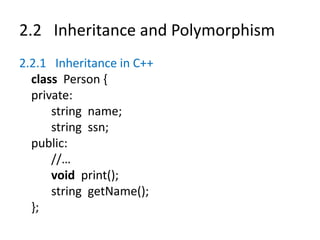
2.2.1 Inheritance in C++
class Person {
private:
string name;
string ssn;
public:
//…
void print();
string getName();
};
2.2 Inheritance and Polymorphism
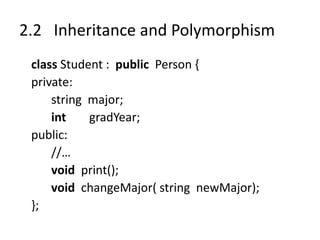
class Student : public Person {
private:
string major;
int gradYear;
public:
//…
void print();
void changeMajor( string newMajor);
};
2.2 Inheritance and Polymorphism
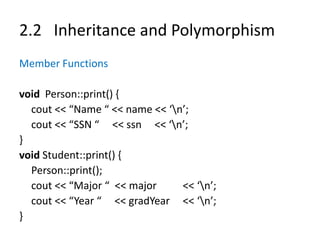
Member Functions
void Person::print() {
cout << “Name “ << name << ‘n’;
cout << “SSN “ << ssn << ‘n’;
}
void Student::print() {
Person::print();
cout << “Major “ << major << ‘n’;
cout << “Year “ << gradYear << ‘n’;
}
2.2 Inheritance and Polymorphism
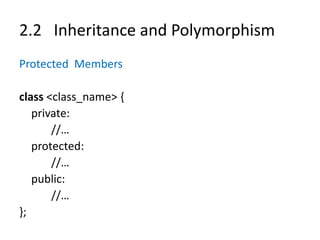
Protected Members
class <class_name> {
private:
//…
protected:
//…
public:
//…
};
2.2 Inheritance and Polymorphism
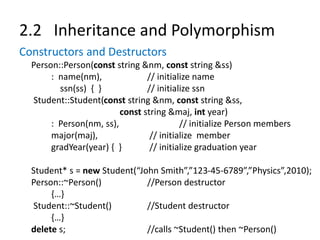
Constructors and Destructors
Person::Person(const string &nm, const string &ss)
: name(nm), // initialize name
ssn(ss) { } // initialize ssn
Student::Student(const string &nm, const string &ss,
const string &maj, int year)
: Person(nm, ss), // initialize Person members
major(maj), // initialize member
gradYear(year) { } // initialize graduation year
Student* s = new Student(“John Smith”,”123-45-6789”,”Physics”,2010);
Person::~Person() //Person destructor
{…}
Student::~Student() //Student destructor
{…}
delete s; //calls ~Student() then ~Person()
2.2 Inheritance and Polymorphism
Static Binding
Person* pp[100];
pp[0] = new Person(…);
pp[1] = new Student(…);
cout << pp[1] ->getName() <<‘n’; //okay
pp[0] ->print();
pp[1] ->print();
pp[1] ->changeMajor(“English”); //ERROR!
2.2 Inheritance and Polymorphism
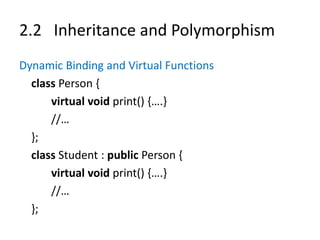
Dynamic Binding and Virtual Functions
class Person {
virtual void print() {….}
//…
};
class Student : public Person {
virtual void print() {….}
//…
};
2.2 Inheritance and Polymorphism
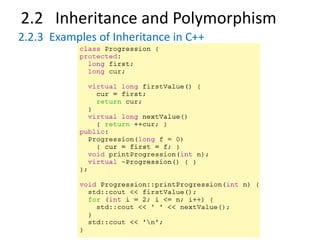
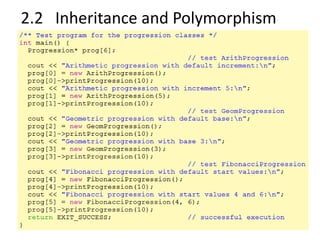
2.2.3 Examples of Inheritance in C++
2.2 Inheritance and Polymorphism
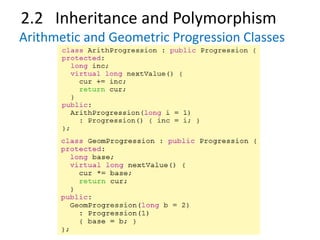
Arithmetic and Geometric Progression Classes
2.2 Inheritance and Polymorphism
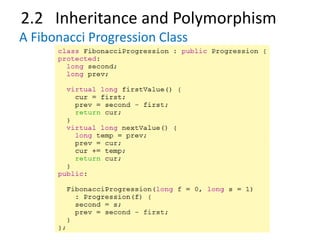
A Fibonacci Progression Class
2.2 Inheritance and Polymorphism
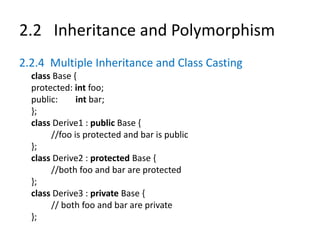
2.2.4 Multiple Inheritance and Class Casting
class Base {
protected: int foo;
public: int bar;
};
class Derive1 : public Base {
//foo is protected and bar is public
};
class Derive2 : protected Base {
//both foo and bar are protected
};
class Derive3 : private Base {
// both foo and bar are private
};
2.2 Inheritance and Polymorphism
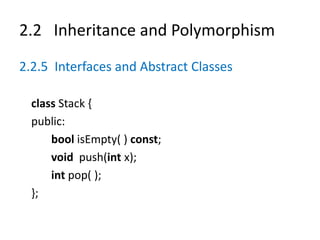
2.2.5 Interfaces and Abstract Classes
class Stack {
public:
bool isEmpty( ) const;
void push(int x);
int pop( );
};
2.2 Inheritance and Polymorphism
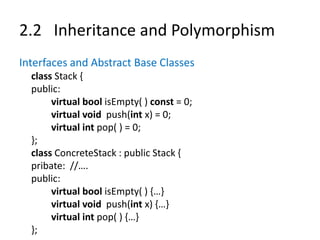
Interfaces and Abstract Base Classes
class Stack {
public:
virtual bool isEmpty( ) const = 0;
virtual void push(int x) = 0;
virtual int pop( ) = 0;
};
class ConcreteStack : public Stack {
pribate: //….
public:
virtual bool isEmpty( ) {…}
virtual void push(int x) {…}
virtual int pop( ) {…}
};
2.3 Templates
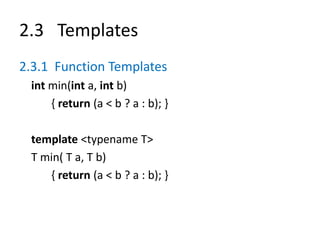
2.3.1 Function Templates
int min(int a, int b)
{ return (a < b ? a : b); }
template <typename T>
T min( T a, T b)
{ return (a < b ? a : b); }
2.3 Templates
2.3.2 Class Templates
template <typename Object>
class BasicVector {
Object* a;
int capacity;
public:
BasicVector(int capac = 10) {
capacity = capac;
a = new Object[ capacity ];
}
Object& elemAtRank(int r)
{ return a[r]; }
//…
};
2.3 Templates
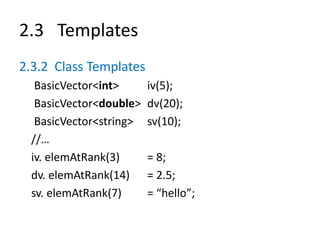
2.3.2 Class Templates
BasicVector<int> iv(5);
BasicVector<double> dv(20);
BasicVector<string> sv(10);
//…
iv. elemAtRank(3) = 8;
dv. elemAtRank(14) = 2.5;
sv. elemAtRank(7) = “hello”;
2.3 Templates
Templated Arguments
BasicVector<BasicVector<int> > xv(5);
//…
xv. elemAtRank(2). elemAtRank(8) = 15;
Templated Members
template <typename Object>
Object& BasicVector<Object>::elemAtRank(int r) {
return a[r];
}
2.4 Exceptions
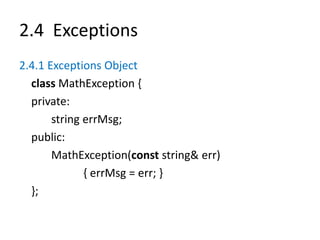
2.4.1 Exceptions Object
class MathException {
private:
string errMsg;
public:
MathException(const string& err)
{ errMsg = err; }
};
2.4 Exceptions
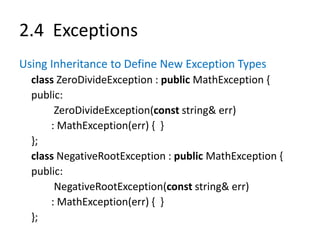
Using Inheritance to Define New Exception Types
class ZeroDivideException : public MathException {
public:
ZeroDivideException(const string& err)
: MathException(err) { }
};
class NegativeRootException : public MathException {
public:
NegativeRootException(const string& err)
: MathException(err) { }
};
2.4 Exceptions
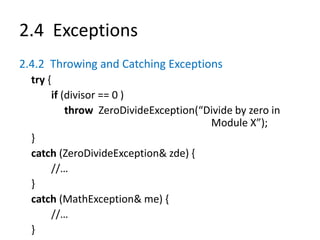
2.4.2 Throwing and Catching Exceptions
try {
if (divisor == 0 )
throw ZeroDivideException(“Divide by zero in
Module X”);
}
catch (ZeroDivideException& zde) {
//…
}
catch (MathException& me) {
//…
}
2.4 Exceptions
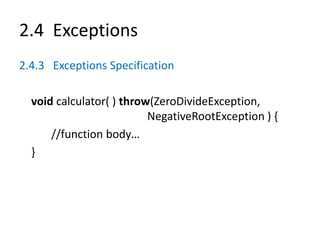
2.4.3 Exceptions Specification
void calculator( ) throw(ZeroDivideException,
NegativeRootException ) {
//function body…
}
2.4 Exceptions
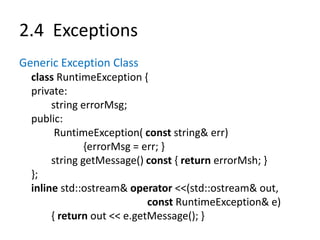
Generic Exception Class
class RuntimeException {
private:
string errorMsg;
public:
RuntimeException( const string& err)
{errorMsg = err; }
string getMessage() const { return errorMsh; }
};
inline std::ostream& operator <<(std::ostream& out,
const RuntimeException& e)
{ return out << e.getMessage(); }
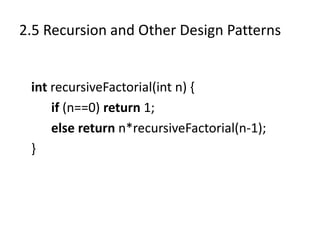
2.5 Recursion and Other Design Patterns
int recursiveFactorial(int n) {
if (n==0) return 1;
else return n*recursiveFactorial(n-1);
}
2.6 Exercises
• R-2.11
• R-2.12

vdocument.in_data-structures-and-algorithms-in-c-michael-t-goodrich-roberto-tamassia-5689cfa959a68.ppt

  • 1.
    Data Structures and Algorithmsin C++ Michael T. Goodrich Roberto Tamassia David M. Mount Chapter 2 Object-Oriented Design
  • 2.
    Contents • 2.1 Goalsand Principles • 2.2 Inheritance and Polymorphism • 2.3 Templates • 2.4 Exceptions • 2.5 Recursion and Other Design Patterns • 2.6 Exercises
  • 3.
    2.1 Goals andPrinciples • Goals Robustness Adaptability Reusability • Principles Abstraction Encapsulation Modularity
  • 4.
    2.2 Inheritance andPolymorphism 2.2.1 Inheritance in C++ class Person { private: string name; string ssn; public: //… void print(); string getName(); };
  • 5.
    2.2 Inheritance andPolymorphism class Student : public Person { private: string major; int gradYear; public: //… void print(); void changeMajor( string newMajor); };
  • 6.
    2.2 Inheritance andPolymorphism Member Functions void Person::print() { cout << “Name “ << name << ‘n’; cout << “SSN “ << ssn << ‘n’; } void Student::print() { Person::print(); cout << “Major “ << major << ‘n’; cout << “Year “ << gradYear << ‘n’; }
  • 7.
    2.2 Inheritance andPolymorphism Protected Members class <class_name> { private: //… protected: //… public: //… };
  • 8.
    2.2 Inheritance andPolymorphism Constructors and Destructors Person::Person(const string &nm, const string &ss) : name(nm), // initialize name ssn(ss) { } // initialize ssn Student::Student(const string &nm, const string &ss, const string &maj, int year) : Person(nm, ss), // initialize Person members major(maj), // initialize member gradYear(year) { } // initialize graduation year Student* s = new Student(“John Smith”,”123-45-6789”,”Physics”,2010); Person::~Person() //Person destructor {…} Student::~Student() //Student destructor {…} delete s; //calls ~Student() then ~Person()
  • 9.
    2.2 Inheritance andPolymorphism Static Binding Person* pp[100]; pp[0] = new Person(…); pp[1] = new Student(…); cout << pp[1] ->getName() <<‘n’; //okay pp[0] ->print(); pp[1] ->print(); pp[1] ->changeMajor(“English”); //ERROR!
  • 10.
    2.2 Inheritance andPolymorphism Dynamic Binding and Virtual Functions class Person { virtual void print() {….} //… }; class Student : public Person { virtual void print() {….} //… };
  • 11.
    2.2 Inheritance andPolymorphism 2.2.3 Examples of Inheritance in C++
  • 12.
    2.2 Inheritance andPolymorphism Arithmetic and Geometric Progression Classes
  • 13.
    2.2 Inheritance andPolymorphism A Fibonacci Progression Class
  • 14.
    2.2 Inheritance andPolymorphism
  • 15.
    2.2 Inheritance andPolymorphism 2.2.4 Multiple Inheritance and Class Casting class Base { protected: int foo; public: int bar; }; class Derive1 : public Base { //foo is protected and bar is public }; class Derive2 : protected Base { //both foo and bar are protected }; class Derive3 : private Base { // both foo and bar are private };
  • 16.
    2.2 Inheritance andPolymorphism 2.2.5 Interfaces and Abstract Classes class Stack { public: bool isEmpty( ) const; void push(int x); int pop( ); };
  • 17.
    2.2 Inheritance andPolymorphism Interfaces and Abstract Base Classes class Stack { public: virtual bool isEmpty( ) const = 0; virtual void push(int x) = 0; virtual int pop( ) = 0; }; class ConcreteStack : public Stack { pribate: //…. public: virtual bool isEmpty( ) {…} virtual void push(int x) {…} virtual int pop( ) {…} };
  • 18.
    2.3 Templates 2.3.1 FunctionTemplates int min(int a, int b) { return (a < b ? a : b); } template <typename T> T min( T a, T b) { return (a < b ? a : b); }
  • 19.
    2.3 Templates 2.3.2 ClassTemplates template <typename Object> class BasicVector { Object* a; int capacity; public: BasicVector(int capac = 10) { capacity = capac; a = new Object[ capacity ]; } Object& elemAtRank(int r) { return a[r]; } //… };
  • 20.
    2.3 Templates 2.3.2 ClassTemplates BasicVector<int> iv(5); BasicVector<double> dv(20); BasicVector<string> sv(10); //… iv. elemAtRank(3) = 8; dv. elemAtRank(14) = 2.5; sv. elemAtRank(7) = “hello”;
  • 21.
    2.3 Templates Templated Arguments BasicVector<BasicVector<int>> xv(5); //… xv. elemAtRank(2). elemAtRank(8) = 15; Templated Members template <typename Object> Object& BasicVector<Object>::elemAtRank(int r) { return a[r]; }
  • 22.
    2.4 Exceptions 2.4.1 ExceptionsObject class MathException { private: string errMsg; public: MathException(const string& err) { errMsg = err; } };
  • 23.
    2.4 Exceptions Using Inheritanceto Define New Exception Types class ZeroDivideException : public MathException { public: ZeroDivideException(const string& err) : MathException(err) { } }; class NegativeRootException : public MathException { public: NegativeRootException(const string& err) : MathException(err) { } };
  • 24.
    2.4 Exceptions 2.4.2 Throwingand Catching Exceptions try { if (divisor == 0 ) throw ZeroDivideException(“Divide by zero in Module X”); } catch (ZeroDivideException& zde) { //… } catch (MathException& me) { //… }
  • 25.
    2.4 Exceptions 2.4.3 ExceptionsSpecification void calculator( ) throw(ZeroDivideException, NegativeRootException ) { //function body… }
  • 26.
    2.4 Exceptions Generic ExceptionClass class RuntimeException { private: string errorMsg; public: RuntimeException( const string& err) {errorMsg = err; } string getMessage() const { return errorMsh; } }; inline std::ostream& operator <<(std::ostream& out, const RuntimeException& e) { return out << e.getMessage(); }
  • 27.
    2.5 Recursion andOther Design Patterns int recursiveFactorial(int n) { if (n==0) return 1; else return n*recursiveFactorial(n-1); }
  • 28.