Varnish Cache Plus 
Random notes for wise web developers 
Carlos Abalde, Roberto Moreda 
{cabalde, moreda}@allenta.com 
October 2014
Agenda 
1. Introduction 
2. Varnish 101 
3. Invalidations 
4. HTTP headers 
5. Content composition 
6. VAC 
7. VCS 
8. Device detection 
9. Varnish Plus 4.x 
10. Q&A
1. Introduction
Disclaimer 
๏ General understanding of ‘The Varnish Book’ is assumed 
‣ This is not the official Varnish Cache training 
‣ This is not a Varnish Cache internals course 
‣ This is not a Varnish module development course 
‣ This is a collection of random notes for web developers 
willing to make the most of Varnish Cache Plus 
๏ OSS Varnish Cache vs. Varnish Cache Plus 
‣ 3.x vs. 4.x
Varnish Cache 3.x 
What everybody should know 
๏ The Varnish Book 
‣ https://www.varnish-software.com/static/book/ 
๏ The Varnish Reference Manual 
‣ https://www.varnish-cache.org/docs/.../index.html 
๏ Default VCL 
‣ https://www.varnish-cache.org/trac/.../default.vcl
Varnish Cache Plus 3.x 
Components I 
๏ Support, advise & training 
๏ Varnish Enhanced Cache Invalidation 
‣ Hash Two, Hash Ninja… 
๏ Varnish Administration Console (VAC) 
๏ Varnish Custom Statistics (VCS) 
๏ Device detection
Varnish Cache Plus 3.x 
Components II 
๏ Varnish Tuner 
๏ Enhanced HTTP streaming 
๏ Packaged binary VMODs 
๏ Varnish Paywall 
๏ … and more to come shortly!
Varnish Cache Plus 3.x 
Supported platforms 
๏ 64 bits 
๏ Distributions 
‣ RedHat Enterprise Linux 5 & 6 
‣ Ubuntu Linux 12.04 LTS (precise) 
‣ Ubuntu Linux 14.04 LTS (trusty) 
‣ Debian Linux 7 (wheezy)
2. Varnish 101
Caching policy 
๏ Varnish Cache Plus would require zero configuration 
in a perfect world with perfect HTTP citizens 
‣ Correct HTTP caching headers 
‣ Vary HTTP header used wisely 
‣ HTTP cookies used conservatively 
๏ By default Varnish Cache Plus will not cache 
anything marked as private, carrying a cookie or 
including a '*' 
Vary HTTP header
VCL 
Overview 
๏ Varnish Configuration Language 
‣ Domain specific state engine 
‣ No loops, variables, functions… 
‣ Command line configuration & Tunable parameters 
๏ Translated to C code 
๏ Loaded as a dynamically generated shared library 
‣ Zero downtime & Blazingly fast
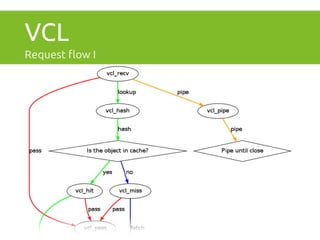
VCL 
vcl_recv I 
๏ Normalize client-input 
๏ Pick a backend / director 
๏ Re-write / extend client-input 
๏ Decide caching policy based on client-input 
๏ Access control 
๏ Security barriers
VCL 
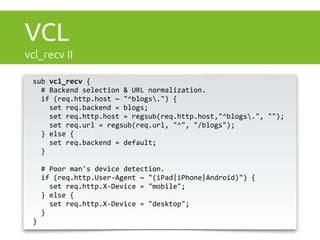
vcl_recv II 
sub 
vcl_recv 
{ 
# 
Backend 
selection 
& 
URL 
normalization. 
if 
(req.http.host 
~ 
"^blogs.") 
{ 
set 
req.backend 
= 
blogs; 
set 
req.http.host 
= 
regsub(req.http.host,"^blogs.", 
""); 
set 
req.url 
= 
regsub(req.url, 
"^", 
"/blogs"); 
} 
else 
{ 
set 
req.backend 
= 
default; 
} 
# 
Poor 
man's 
device 
detection. 
if 
(req.http.User-­‐Agent 
~ 
"(iPad|iPhone|Android)") 
{ 
set 
req.http.X-­‐Device 
= 
"mobile"; 
} 
else 
{ 
set 
req.http.X-­‐Device 
= 
"desktop"; 
} 
}
VCL 
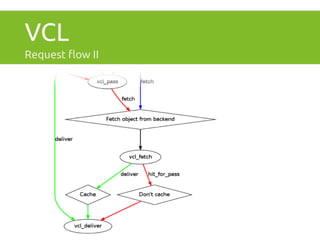
vcl_fetch I 
๏ Sanitize / extend backend response 
๏ Override cache duration 
‣ beresp.ttl 
- s-­‐maxage & maxage in Cache-­‐Control HTTP header 
- Expires HTTP header 
- Default TTL 
‣ Beware with TTL of hitpass objects
VCL 
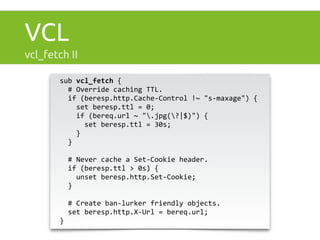
vcl_fetch II 
sub 
vcl_fetch 
{ 
# 
Override 
caching 
TTL. 
if 
(beresp.http.Cache-­‐Control 
!~ 
"s-­‐maxage") 
{ 
set 
beresp.ttl 
= 
0; 
if 
(bereq.url 
~ 
".jpg(?|$)") 
{ 
set 
beresp.ttl 
= 
30s; 
} 
} 
# 
Never 
cache 
a 
Set-­‐Cookie 
header. 
if 
(beresp.ttl 
> 
0s) 
{ 
unset 
beresp.http.Set-­‐Cookie; 
} 
# 
Create 
ban-­‐lurker 
friendly 
objects. 
set 
beresp.http.X-­‐Url 
= 
bereq.url; 
}
VCL 
Request flow I
VCL 
Request flow II
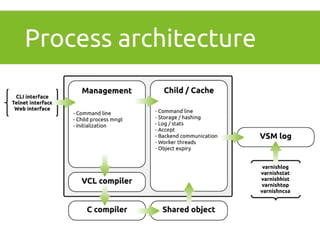
Process architecture
VMODs 
๏ Shared libraries extending the VCL core 
‣ std VMOD 
- std.toupper(), std.log(), std.fileread()… 
‣ ABI (Application Binary Interface) mismatches 
๏ cookie, header, var, curl, digest, geoip, boltsort, 
memcached, redis, dns… 
๏ https://www.varnish-cache.org/vmods
Backends 
๏ Multiple backends 
‣ Selected at request time based on any request property 
๏ Probes 
‣ Per-backend periodic health checks 
- Interval, timeout, expected response… 
๏ Directors 
‣ Load balanced backend groups
Error handling 
Saint mode 
๏ Some backend may be sick for a particular object 
‣ Other objects from the same backend can still be accessed 
- Unless more than a set amount of objects are added to 
the saint mode blacklist for a specific backend 
๏ Do not request again the object to that backend for a 
period of time 
‣ Grace mode is used when all possible backends for the 
requested object have been blacklisted 
๏ Complement backend probes
Error handling 
Grace mode 
๏ A graced object is an object that has expired, but is still 
kept in cache 
‣ beresp.ttl vs. beresp.grace 
๏ Graced objects are used to 
‣ Serve outdated content if the backend is down 
- Probes or saint mode is required for this 
‣ Serve sightly staled content while fresh versions are 
fetched
Beyond caching policy 
๏ Why restricting VCL / VMODs to implement the 
caching policy? 
๏ Any logic modeled in VCL / VMODs is compiled, 
embedded & executed in the caching edger layer 
‣ 1000x times faster than typical Java / PHP apps 
- Strong restrictions 
‣ Accounting, paywalling, A/B testing…
varnishtest 
๏ Powerful Varnish-specific testing tool 
‣ Mocked clients & backends executing / 
processing HTTP requests against real Varnish 
Cache Plus instances 
‣ http://www.clock.co.uk/...varnishtest 
๏ Essential when implementing complex VCL logic 
๏ Easily integrable in any CI infrastructure
FAQ 
๏ When SSL support will be implemented? 
‣ "[...] huge waste of time and effort to even think about it." 
๏ When SPDY support will be implemented? 
‣ "[...] Varnish is not speedy, Varnish is fast! [...]" 
๏ What is the recommended value for this bizarre kernel / 
varnishd parameter I found in some random blog? 
‣ Use Varnish Tuner + Fine tune based on necessity 
‣ Pay attention to workspaces & syslog messages
3. Invalidations
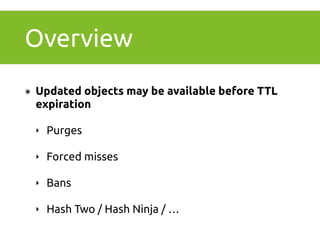
Overview 
๏ Updated objects may be available before TTL 
expiration 
‣ Purges 
‣ Forced misses 
‣ Bans 
‣ Hash Two / Hash Ninja / …
Purges 
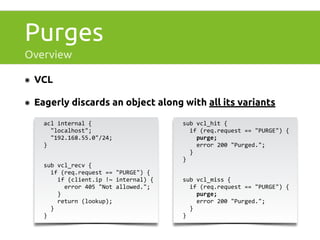
Overview 
๏ VCL 
๏ Eagerly discards an object along with all its variants 
acl 
internal 
{ 
"localhost"; 
"192.168.55.0"/24; 
} 
sub 
vcl_recv 
{ 
if 
(req.request 
== 
"PURGE") 
{ 
if 
(client.ip 
!~ 
internal) 
{ 
error 
405 
"Not 
allowed."; 
} 
return 
(lookup); 
} 
} 
sub 
vcl_hit 
{ 
if 
(req.request 
== 
"PURGE") 
{ 
purge; 
error 
200 
"Purged."; 
} 
} 
sub 
vcl_miss 
{ 
if 
(req.request 
== 
"PURGE") 
{ 
purge; 
error 
200 
"Purged."; 
} 
}
Purges 
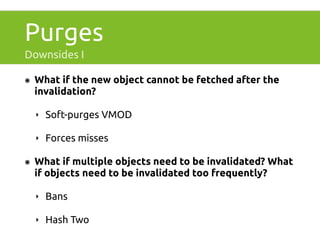
Downsides I 
๏ What if the new object cannot be fetched after the 
invalidation? 
‣ Soft-purges VMOD 
‣ Forces misses 
๏ What if multiple objects need to be invalidated? What 
if objects need to be invalidated too frequently? 
‣ Bans 
‣ Hash Two
Purges 
Downsides II 
๏ How to invalidate hitpass objects? 
‣ Not possible in Varnish Cache Plus 3.x 
- Redesigned in Varnish Cache Plus 4.x 
- https://www.varnish-cache.org/trac/.../1033 
‣ return(pass); during vcl_recv is preferred 
when possible
Forced misses 
Overview 
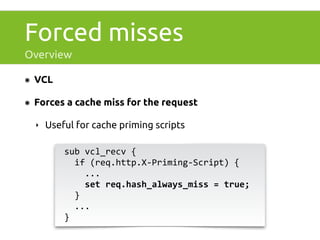
๏ VCL 
๏ Forces a cache miss for the request 
‣ Useful for cache priming scripts 
sub 
vcl_recv 
{ 
if 
(req.http.X-­‐Priming-­‐Script) 
{ 
... 
set 
req.hash_always_miss 
= 
true; 
} 
... 
}
Forced misses 
Behavior 
๏ Object will always be (re)fetched from the backend 
๏ New object is put into cache and used from that point 
onward 
‣ Old object is not evicted until it’s safe to do so 
‣ Controls who takes the penalty of waiting for an 
updated object 
๏ Old objects are not freed up until expiration 
‣ This is considered a flaw and a fix is expected
Bans 
Overview 
๏ VCL or CLI 
๏ Lazily discards multiple objects matching an expression 
‣ Logical operators + Object attributes + Regular expressions 
‣ Only works on objects already in the cache 
๏ Ban lurker 
‣ Frees up memory + Keeps the ban list at a manageable size 
‣ obj.* based expressions
Bans 
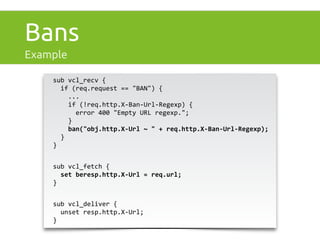
Example 
sub 
vcl_recv 
{ 
if 
(req.request 
== 
"BAN") 
{ 
... 
if 
(!req.http.X-­‐Ban-­‐Url-­‐Regexp) 
{ 
error 
400 
"Empty 
URL 
regexp."; 
} 
ban("obj.http.X-­‐Url 
~ 
" 
+ 
req.http.X-­‐Ban-­‐Url-­‐Regexp); 
} 
} 
sub 
vcl_fetch 
{ 
set 
beresp.http.X-­‐Url 
= 
req.url; 
} 
sub 
vcl_deliver 
{ 
unset 
resp.http.X-­‐Url; 
}
Hash Two 
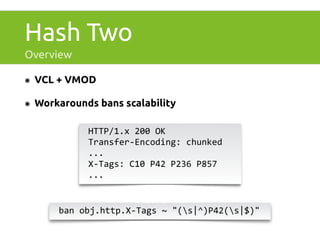
Overview 
๏ VCL + VMOD 
๏ Workarounds bans scalability 
HTTP/1.x 
200 
OK 
Transfer-­‐Encoding: 
chunked 
... 
X-­‐Tags: 
C10 
P42 
P236 
P857 
... 
ban 
obj.http.X-­‐Tags 
~ 
"(s|^)P42(s|$)"
Hash Two 
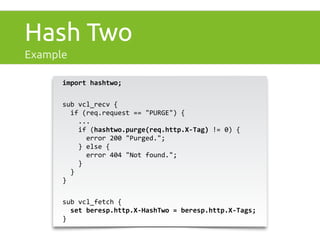
Example 
import 
hashtwo; 
sub 
vcl_recv 
{ 
if 
(req.request 
== 
"PURGE") 
{ 
... 
if 
(hashtwo.purge(req.http.X-­‐Tag) 

!= 
0) 
{ 
error 
200 
"Purged."; 
} 
else 
{ 
error 
404 
"Not 
found."; 
} 
} 
} 
sub 
vcl_fetch 
{ 
set 
beresp.http.X-­‐HashTwo 
= 
beresp.http.X-­‐Tags; 
}
4. HTTP headers
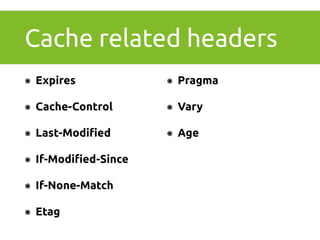
Cache related headers 
๏ Expires 
๏ Cache-Control 
๏ Last-Modified 
๏ If-Modified-Since 
๏ If-None-Match 
๏ Etag 
๏ Pragma 
๏ Vary 
๏ Age
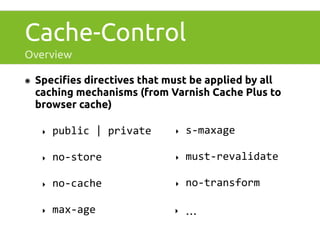
Cache-Control 
Overview 
๏ Specifies directives that must be applied by all 
caching mechanisms (from Varnish Cache Plus to 
browser cache) 
‣ public 
| 
private 
‣ no-­‐store 
‣ no-­‐cache 
‣ max-­‐age 
‣ s-­‐maxage 
‣ must-­‐revalidate 
‣ no-­‐transform 
‣ …
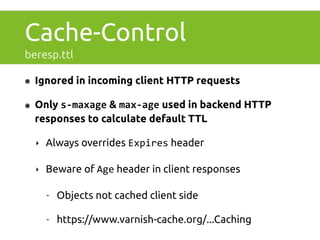
Cache-Control 
beresp.ttl 
๏ Ignored in incoming client HTTP requests 
๏ Only s-­‐maxage & max-­‐age used in backend HTTP 
responses to calculate default TTL 
‣ Always overrides Expires header 
‣ Beware of Age header in client responses 
- Objects not cached client side 
- https://www.varnish-cache.org/...Caching
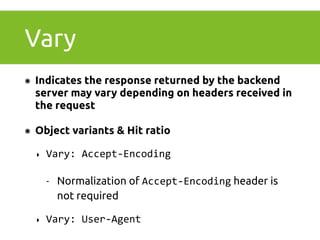
Vary 
๏ Indicates the response returned by the backend 
server may vary depending on headers received in 
the request 
๏ Object variants & Hit ratio 
‣ Vary: 
Accept-­‐Encoding 
- Normalization of Accept-­‐Encoding header is 
not required 
‣ Vary: 
User-­‐Agent
5. Content 
composition
Overview 
๏ Break objects into smaller fragments 
‣ Separate cache policy for each fragment 
‣ Increase hit ratio 
๏ Tools 
‣ Edge Side Includes (ESI) 
‣ AJAX 
- Beware of RTT & Cross domain policy
Edge Side Includes 
๏ Subset of ESI Language Specification 1.0 
‣ <esi:include 
src="<URL> 
" 
/> 
‣ <esi:remove>...</esi:remove> 
‣ <!-­‐-­‐esi 
...—> 
๏ set 
beresp.do_esi 
= 
true; 
‣ Separate Varnish requests 
๏ Testing ESI in dev environment
6. VAC
Overview 
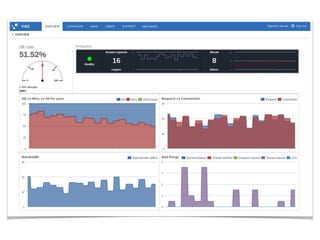
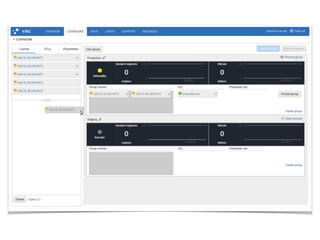
๏ Central control of Varnish Cache Plus servers 
‣ Web UI + RESTful API 
- Super Fast Purger 
๏ Cache group management 
‣ Real time statistics, VCL editor, ban submission… 
๏ Varnish Agent 2
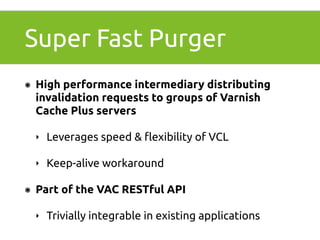
Super Fast Purger 
๏ High performance intermediary distributing 
invalidation requests to groups of Varnish 
Cache Plus servers 
‣ Leverages speed & flexibility of VCL 
‣ Keep-alive workaround 
๏ Part of the VAC RESTful API 
‣ Trivially integrable in existing applications
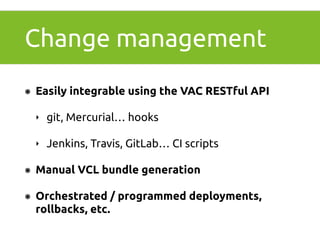
Change management 
๏ Easily integrable using the VAC RESTful API 
‣ git, Mercurial… hooks 
‣ Jenkins, Travis, GitLab… CI scripts 
๏ Manual VCL bundle generation 
๏ Orchestrated / programmed deployments, 
rollbacks, etc.
7. VCS
Overview 
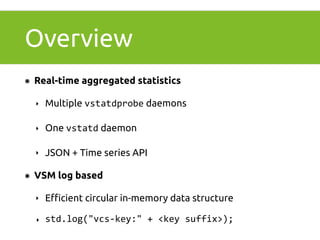
๏ Real-time aggregated statistics 
‣ Multiple vstatdprobe daemons 
‣ One vstatd daemon 
‣ JSON + Time series API 
๏ VSM log based 
‣ Efficient circular in-memory data structure 
‣ std.log("vcs-­‐key:" 
+ 
<key 
suffix>);
Some ideas 
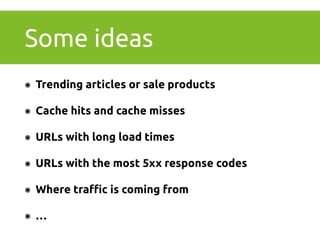
๏ Trending articles or sale products 
๏ Cache hits and cache misses 
๏ URLs with long load times 
๏ URLs with the most 5xx response codes 
๏ Where traffic is coming from 
๏ …
Example 
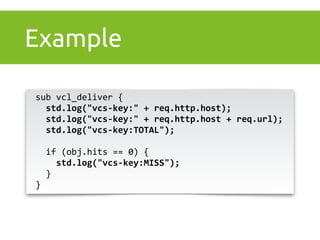
sub 
vcl_deliver 
{ 
std.log("vcs-­‐key:" 
+ 
req.http.host); 
std.log("vcs-­‐key:" 
+ 
req.http.host 
+ 
req.url); 
std.log("vcs-­‐key:TOTAL"); 
if 
(obj.hits 
== 
0) 
{ 
std.log("vcs-­‐key:MISS"); 
} 
}
API I 
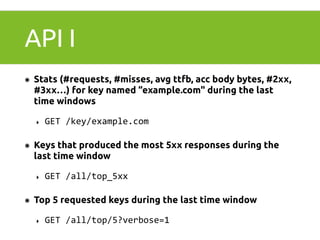
๏ Stats (#requests, #misses, avg ttfb, acc body bytes, #2xx, 
#3xx…) for key named “example.com" during the last 
time windows 
‣ GET 
/key/example.com 
๏ Keys that produced the most 5xx responses during the 
last time window 
‣ GET 
/all/top_5xx 
๏ Top 5 requested keys during the last time window 
‣ GET 
/all/top/5?verbose=1
API II 
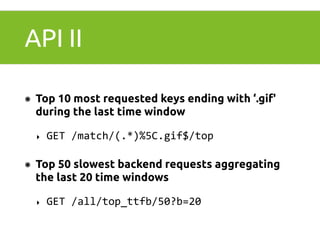
๏ Top 10 most requested keys ending with ‘.gif' 
during the last time window 
‣ GET 
/match/(.*)%5C.gif$/top 
๏ Top 50 slowest backend requests aggregating 
the last 20 time windows 
‣ GET 
/all/top_ttfb/50?b=20
8. Device detection
Overview 
๏ VMOD 
๏ DeviceAtlas 
‣ https://deviceatlas.com 
‣ Database locally deployed & Daily updated 
๏ OSS alternatives 
‣ https://github.com/serbanghita/Mobile-Detect 
‣ …
Example 
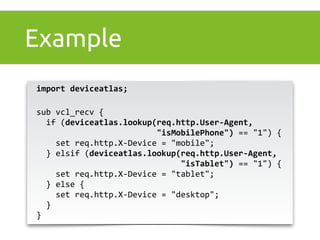
import 
deviceatlas; 
sub 
vcl_recv 
{ 
if 
(deviceatlas.lookup(req.http.User-­‐Agent, 
"isMobilePhone") 
== 
"1") 
{ 
set 
req.http.X-­‐Device 
= 
"mobile"; 
} 
elsif 
(deviceatlas.lookup(req.http.User-­‐Agent, 
"isTablet") 
== 
"1") 
{ 
set 
req.http.X-­‐Device 
= 
"tablet"; 
} 
else 
{ 
set 
req.http.X-­‐Device 
= 
"desktop"; 
} 
}
Some ideas 
๏ Redirections based on device properties 
๏ Backend selection based on device properties 
๏ Normalization of the UA header 
‣ Caching different versions (i.e. Vary header) of 
the same object based on normalized UAs 
๏ …
9. Varnish Plus 4.x
Highlights 
๏ Client / backend thread split 
‣ Background content refreshing 
๏ Redesigned purges 
‣ return(purge); during vcl_recv 
๏ Directors implemented as VMODs 
‣ Consistent hashing director 
๏ Distinction between error & synthetic responses
10. Q&A

Varnish Cache Plus. Random notes for wise web developers

  • 1.
    Varnish Cache Plus Random notes for wise web developers Carlos Abalde, Roberto Moreda {cabalde, moreda}@allenta.com October 2014
  • 2.
    Agenda 1. Introduction 2. Varnish 101 3. Invalidations 4. HTTP headers 5. Content composition 6. VAC 7. VCS 8. Device detection 9. Varnish Plus 4.x 10. Q&A
  • 3.
  • 4.
    Disclaimer ๏ Generalunderstanding of ‘The Varnish Book’ is assumed ‣ This is not the official Varnish Cache training ‣ This is not a Varnish Cache internals course ‣ This is not a Varnish module development course ‣ This is a collection of random notes for web developers willing to make the most of Varnish Cache Plus ๏ OSS Varnish Cache vs. Varnish Cache Plus ‣ 3.x vs. 4.x
  • 5.
    Varnish Cache 3.x What everybody should know ๏ The Varnish Book ‣ https://www.varnish-software.com/static/book/ ๏ The Varnish Reference Manual ‣ https://www.varnish-cache.org/docs/.../index.html ๏ Default VCL ‣ https://www.varnish-cache.org/trac/.../default.vcl
  • 6.
    Varnish Cache Plus3.x Components I ๏ Support, advise & training ๏ Varnish Enhanced Cache Invalidation ‣ Hash Two, Hash Ninja… ๏ Varnish Administration Console (VAC) ๏ Varnish Custom Statistics (VCS) ๏ Device detection
  • 7.
    Varnish Cache Plus3.x Components II ๏ Varnish Tuner ๏ Enhanced HTTP streaming ๏ Packaged binary VMODs ๏ Varnish Paywall ๏ … and more to come shortly!
  • 8.
    Varnish Cache Plus3.x Supported platforms ๏ 64 bits ๏ Distributions ‣ RedHat Enterprise Linux 5 & 6 ‣ Ubuntu Linux 12.04 LTS (precise) ‣ Ubuntu Linux 14.04 LTS (trusty) ‣ Debian Linux 7 (wheezy)
  • 9.
  • 10.
    Caching policy ๏Varnish Cache Plus would require zero configuration in a perfect world with perfect HTTP citizens ‣ Correct HTTP caching headers ‣ Vary HTTP header used wisely ‣ HTTP cookies used conservatively ๏ By default Varnish Cache Plus will not cache anything marked as private, carrying a cookie or including a '*' Vary HTTP header
  • 11.
    VCL Overview ๏Varnish Configuration Language ‣ Domain specific state engine ‣ No loops, variables, functions… ‣ Command line configuration & Tunable parameters ๏ Translated to C code ๏ Loaded as a dynamically generated shared library ‣ Zero downtime & Blazingly fast
  • 12.
    VCL vcl_recv I ๏ Normalize client-input ๏ Pick a backend / director ๏ Re-write / extend client-input ๏ Decide caching policy based on client-input ๏ Access control ๏ Security barriers
  • 13.
    VCL vcl_recv II sub vcl_recv { # Backend selection & URL normalization. if (req.http.host ~ "^blogs.") { set req.backend = blogs; set req.http.host = regsub(req.http.host,"^blogs.", ""); set req.url = regsub(req.url, "^", "/blogs"); } else { set req.backend = default; } # Poor man's device detection. if (req.http.User-­‐Agent ~ "(iPad|iPhone|Android)") { set req.http.X-­‐Device = "mobile"; } else { set req.http.X-­‐Device = "desktop"; } }
  • 14.
    VCL vcl_fetch I ๏ Sanitize / extend backend response ๏ Override cache duration ‣ beresp.ttl - s-­‐maxage & maxage in Cache-­‐Control HTTP header - Expires HTTP header - Default TTL ‣ Beware with TTL of hitpass objects
  • 15.
    VCL vcl_fetch II sub vcl_fetch { # Override caching TTL. if (beresp.http.Cache-­‐Control !~ "s-­‐maxage") { set beresp.ttl = 0; if (bereq.url ~ ".jpg(?|$)") { set beresp.ttl = 30s; } } # Never cache a Set-­‐Cookie header. if (beresp.ttl > 0s) { unset beresp.http.Set-­‐Cookie; } # Create ban-­‐lurker friendly objects. set beresp.http.X-­‐Url = bereq.url; }
  • 16.
  • 17.
  • 18.
  • 19.
    VMODs ๏ Sharedlibraries extending the VCL core ‣ std VMOD - std.toupper(), std.log(), std.fileread()… ‣ ABI (Application Binary Interface) mismatches ๏ cookie, header, var, curl, digest, geoip, boltsort, memcached, redis, dns… ๏ https://www.varnish-cache.org/vmods
  • 20.
    Backends ๏ Multiplebackends ‣ Selected at request time based on any request property ๏ Probes ‣ Per-backend periodic health checks - Interval, timeout, expected response… ๏ Directors ‣ Load balanced backend groups
  • 21.
    Error handling Saintmode ๏ Some backend may be sick for a particular object ‣ Other objects from the same backend can still be accessed - Unless more than a set amount of objects are added to the saint mode blacklist for a specific backend ๏ Do not request again the object to that backend for a period of time ‣ Grace mode is used when all possible backends for the requested object have been blacklisted ๏ Complement backend probes
  • 22.
    Error handling Gracemode ๏ A graced object is an object that has expired, but is still kept in cache ‣ beresp.ttl vs. beresp.grace ๏ Graced objects are used to ‣ Serve outdated content if the backend is down - Probes or saint mode is required for this ‣ Serve sightly staled content while fresh versions are fetched
  • 23.
    Beyond caching policy ๏ Why restricting VCL / VMODs to implement the caching policy? ๏ Any logic modeled in VCL / VMODs is compiled, embedded & executed in the caching edger layer ‣ 1000x times faster than typical Java / PHP apps - Strong restrictions ‣ Accounting, paywalling, A/B testing…
  • 24.
    varnishtest ๏ PowerfulVarnish-specific testing tool ‣ Mocked clients & backends executing / processing HTTP requests against real Varnish Cache Plus instances ‣ http://www.clock.co.uk/...varnishtest ๏ Essential when implementing complex VCL logic ๏ Easily integrable in any CI infrastructure
  • 25.
    FAQ ๏ WhenSSL support will be implemented? ‣ "[...] huge waste of time and effort to even think about it." ๏ When SPDY support will be implemented? ‣ "[...] Varnish is not speedy, Varnish is fast! [...]" ๏ What is the recommended value for this bizarre kernel / varnishd parameter I found in some random blog? ‣ Use Varnish Tuner + Fine tune based on necessity ‣ Pay attention to workspaces & syslog messages
  • 26.
  • 27.
    Overview ๏ Updatedobjects may be available before TTL expiration ‣ Purges ‣ Forced misses ‣ Bans ‣ Hash Two / Hash Ninja / …
  • 28.
    Purges Overview ๏VCL ๏ Eagerly discards an object along with all its variants acl internal { "localhost"; "192.168.55.0"/24; } sub vcl_recv { if (req.request == "PURGE") { if (client.ip !~ internal) { error 405 "Not allowed."; } return (lookup); } } sub vcl_hit { if (req.request == "PURGE") { purge; error 200 "Purged."; } } sub vcl_miss { if (req.request == "PURGE") { purge; error 200 "Purged."; } }
  • 29.
    Purges Downsides I ๏ What if the new object cannot be fetched after the invalidation? ‣ Soft-purges VMOD ‣ Forces misses ๏ What if multiple objects need to be invalidated? What if objects need to be invalidated too frequently? ‣ Bans ‣ Hash Two
  • 30.
    Purges Downsides II ๏ How to invalidate hitpass objects? ‣ Not possible in Varnish Cache Plus 3.x - Redesigned in Varnish Cache Plus 4.x - https://www.varnish-cache.org/trac/.../1033 ‣ return(pass); during vcl_recv is preferred when possible
  • 31.
    Forced misses Overview ๏ VCL ๏ Forces a cache miss for the request ‣ Useful for cache priming scripts sub vcl_recv { if (req.http.X-­‐Priming-­‐Script) { ... set req.hash_always_miss = true; } ... }
  • 32.
    Forced misses Behavior ๏ Object will always be (re)fetched from the backend ๏ New object is put into cache and used from that point onward ‣ Old object is not evicted until it’s safe to do so ‣ Controls who takes the penalty of waiting for an updated object ๏ Old objects are not freed up until expiration ‣ This is considered a flaw and a fix is expected
  • 33.
    Bans Overview ๏VCL or CLI ๏ Lazily discards multiple objects matching an expression ‣ Logical operators + Object attributes + Regular expressions ‣ Only works on objects already in the cache ๏ Ban lurker ‣ Frees up memory + Keeps the ban list at a manageable size ‣ obj.* based expressions
  • 34.
    Bans Example sub vcl_recv { if (req.request == "BAN") { ... if (!req.http.X-­‐Ban-­‐Url-­‐Regexp) { error 400 "Empty URL regexp."; } ban("obj.http.X-­‐Url ~ " + req.http.X-­‐Ban-­‐Url-­‐Regexp); } } sub vcl_fetch { set beresp.http.X-­‐Url = req.url; } sub vcl_deliver { unset resp.http.X-­‐Url; }
  • 35.
    Hash Two Overview ๏ VCL + VMOD ๏ Workarounds bans scalability HTTP/1.x 200 OK Transfer-­‐Encoding: chunked ... X-­‐Tags: C10 P42 P236 P857 ... ban obj.http.X-­‐Tags ~ "(s|^)P42(s|$)"
  • 36.
    Hash Two Example import hashtwo; sub vcl_recv { if (req.request == "PURGE") { ... if (hashtwo.purge(req.http.X-­‐Tag) != 0) { error 200 "Purged."; } else { error 404 "Not found."; } } } sub vcl_fetch { set beresp.http.X-­‐HashTwo = beresp.http.X-­‐Tags; }
  • 37.
  • 38.
    Cache related headers ๏ Expires ๏ Cache-Control ๏ Last-Modified ๏ If-Modified-Since ๏ If-None-Match ๏ Etag ๏ Pragma ๏ Vary ๏ Age
  • 39.
    Cache-Control Overview ๏Specifies directives that must be applied by all caching mechanisms (from Varnish Cache Plus to browser cache) ‣ public | private ‣ no-­‐store ‣ no-­‐cache ‣ max-­‐age ‣ s-­‐maxage ‣ must-­‐revalidate ‣ no-­‐transform ‣ …
  • 40.
    Cache-Control beresp.ttl ๏Ignored in incoming client HTTP requests ๏ Only s-­‐maxage & max-­‐age used in backend HTTP responses to calculate default TTL ‣ Always overrides Expires header ‣ Beware of Age header in client responses - Objects not cached client side - https://www.varnish-cache.org/...Caching
  • 41.
    Vary ๏ Indicatesthe response returned by the backend server may vary depending on headers received in the request ๏ Object variants & Hit ratio ‣ Vary: Accept-­‐Encoding - Normalization of Accept-­‐Encoding header is not required ‣ Vary: User-­‐Agent
  • 42.
  • 43.
    Overview ๏ Breakobjects into smaller fragments ‣ Separate cache policy for each fragment ‣ Increase hit ratio ๏ Tools ‣ Edge Side Includes (ESI) ‣ AJAX - Beware of RTT & Cross domain policy
  • 44.
    Edge Side Includes ๏ Subset of ESI Language Specification 1.0 ‣ <esi:include src="<URL> " /> ‣ <esi:remove>...</esi:remove> ‣ <!-­‐-­‐esi ...—> ๏ set beresp.do_esi = true; ‣ Separate Varnish requests ๏ Testing ESI in dev environment
  • 45.
  • 46.
    Overview ๏ Centralcontrol of Varnish Cache Plus servers ‣ Web UI + RESTful API - Super Fast Purger ๏ Cache group management ‣ Real time statistics, VCL editor, ban submission… ๏ Varnish Agent 2
  • 49.
    Super Fast Purger ๏ High performance intermediary distributing invalidation requests to groups of Varnish Cache Plus servers ‣ Leverages speed & flexibility of VCL ‣ Keep-alive workaround ๏ Part of the VAC RESTful API ‣ Trivially integrable in existing applications
  • 50.
    Change management ๏Easily integrable using the VAC RESTful API ‣ git, Mercurial… hooks ‣ Jenkins, Travis, GitLab… CI scripts ๏ Manual VCL bundle generation ๏ Orchestrated / programmed deployments, rollbacks, etc.
  • 51.
  • 52.
    Overview ๏ Real-timeaggregated statistics ‣ Multiple vstatdprobe daemons ‣ One vstatd daemon ‣ JSON + Time series API ๏ VSM log based ‣ Efficient circular in-memory data structure ‣ std.log("vcs-­‐key:" + <key suffix>);
  • 53.
    Some ideas ๏Trending articles or sale products ๏ Cache hits and cache misses ๏ URLs with long load times ๏ URLs with the most 5xx response codes ๏ Where traffic is coming from ๏ …
  • 54.
    Example sub vcl_deliver { std.log("vcs-­‐key:" + req.http.host); std.log("vcs-­‐key:" + req.http.host + req.url); std.log("vcs-­‐key:TOTAL"); if (obj.hits == 0) { std.log("vcs-­‐key:MISS"); } }
  • 55.
    API I ๏Stats (#requests, #misses, avg ttfb, acc body bytes, #2xx, #3xx…) for key named “example.com" during the last time windows ‣ GET /key/example.com ๏ Keys that produced the most 5xx responses during the last time window ‣ GET /all/top_5xx ๏ Top 5 requested keys during the last time window ‣ GET /all/top/5?verbose=1
  • 56.
    API II ๏Top 10 most requested keys ending with ‘.gif' during the last time window ‣ GET /match/(.*)%5C.gif$/top ๏ Top 50 slowest backend requests aggregating the last 20 time windows ‣ GET /all/top_ttfb/50?b=20
  • 57.
  • 58.
    Overview ๏ VMOD ๏ DeviceAtlas ‣ https://deviceatlas.com ‣ Database locally deployed & Daily updated ๏ OSS alternatives ‣ https://github.com/serbanghita/Mobile-Detect ‣ …
  • 59.
    Example import deviceatlas; sub vcl_recv { if (deviceatlas.lookup(req.http.User-­‐Agent, "isMobilePhone") == "1") { set req.http.X-­‐Device = "mobile"; } elsif (deviceatlas.lookup(req.http.User-­‐Agent, "isTablet") == "1") { set req.http.X-­‐Device = "tablet"; } else { set req.http.X-­‐Device = "desktop"; } }
  • 60.
    Some ideas ๏Redirections based on device properties ๏ Backend selection based on device properties ๏ Normalization of the UA header ‣ Caching different versions (i.e. Vary header) of the same object based on normalized UAs ๏ …
  • 61.
  • 62.
    Highlights ๏ Client/ backend thread split ‣ Background content refreshing ๏ Redesigned purges ‣ return(purge); during vcl_recv ๏ Directors implemented as VMODs ‣ Consistent hashing director ๏ Distinction between error & synthetic responses
  • 63.