Value proposition for systems
research
• Integrated Systems Research develops and tests, with
farming households and development partners, feasible
combinations of technical, market, governance and
policy options capable of improving agricultural
livelihood systems.
• The research improves the understanding of place-
based social, financial, technical and environmental
contexts providing a knowledge resource to enhance
the targeting and relevance of potential systems
interventions with an aim to scale these out to similar
extrapolation domains.
Value proposition for systems
research
• The focus is on total farm productivity including closing
systems’ yield gaps of systems components with greatest
relevance to small holder farmers.
• A fully integrated systems approach also requires further
development of monitoring and evaluation systems with
indicators that that can show whether systems
approaches are working, for whom, where, to what
extent and how fast enough to support adaptive
management and donors’ needs.
Value proposition for systems
research
• Systems research strengthens the science-policy interface that has
prevented governments and international bodies from delivering
changes on the ground to rural people. A fully integrated systems
approach identifies diversified opportunities for the agricultural
sector that can reverse the lack of investment in rural areas.
• New science is being applied in systems research on how to cope
with wicked problems, productivity trade-offs and synergies,
climate change, land degradation, gender inequities, and youth
unemployment at the expected scale of impact; that is, with
millions of farmers across millions of hectares
Value proposition for systems
research
Systems research will directly improve the
effectiveness of development spending at local
scales, at the same time producing generalizable
knowledge, and forging new partnerships to
improve livelihood systems.
Research on foresight, synergies, trade-offs, etc., are
core components that help prioritize interventions
and predict possible early successes.
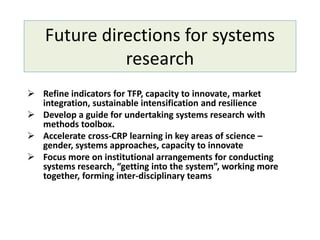
Future directions for systems
research
 Refine indicators for TFP, capacity to innovate, market
integration, sustainable intensification and resilience
 Develop a guide for undertaking systems research with
methods toolbox.
 Accelerate cross-CRP learning in key areas of science –
gender, systems approaches, capacity to innovate
 Focus more on institutional arrangements for conducting
systems research, “getting into the system”, working more
together, forming inter-disciplinary teams
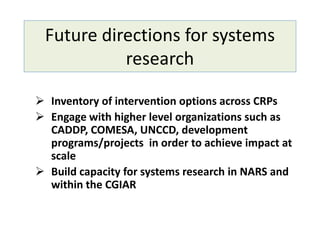
Future directions for systems
research
 Inventory of intervention options across CRPs
 Engage with higher level organizations such as
CADDP, COMESA, UNCCD, development
programs/projects in order to achieve impact at
scale
 Build capacity for systems research in NARS and
within the CGIAR
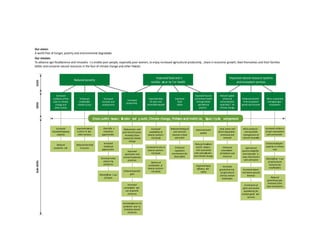
Cross-cuttin issues: Gender and y outh, Climate change, Policies and institu t ions , Capaci tyde velopment
Reduced poverty
Improved food and
nutritio
n
secur ity f or health
Improved natural resource systems
and ecosystem services
Improved human
and animal health
through better
agricultural
practic
e
s
Improved water
quality
Reduced livestock
and fis
h
di sease
risks associated
with intensification
and climate change
Improved input
effic
i
ency and
safety
SLOsIDOsSub-IDOs
Natural capital
enhanced
and protected,
especially from
climate change
Land, water and
forest degradatio
n
minimized and
reversed
Enhanced
conservation
of habitats and
resources
Increased
geneticdi versity
of agricultural
and associated
landscapes
Increased
productiv
i
ty
Reduced pre- and
post-harvest losses,
including those
caused by climate
change
Improved
agronomic and
animal husbandry
practices
Enhanced genetic
gain
Increased
conservation and
use of genetic
resources
Increased access to
productiv
e
asse ts,
including natural
resources
Increased
resilience of the
poor to climate
change and
other shocks
Increased
household coping
capacity
Reduced
productio
n
risk
Enhanced
smallholder
market access
Improved access
to fin
a
nci al and
other services
Reduced barriers
to access
Increased
incomes and
employment
Diversifie
d
enterprise
opportunitie
s
Increased
livelihood
opportunitie
s
Increased value
capture by
producers
More effici en t use
of inputs
Improved diets
for poor and
vulnerable people
Increased
availability of
diverse nutrient-
rich foods
Optim
i
z ed
consumption of
diverse nutrient-
rich foods
Increased access to
diverse nutrient-
rich foods
More sustainably
managed agro-
ecosystems
Increased resilience
of agro-ecosystems
and communitie
s
More effici en t use
of agricultural
resources by
smallholders
Reduced
greenhouse gas
emissions from
agro-ecosystems
Enhanced adaptive
capacity to climate
risks
Improved
food
safety
Reduced biological
and chemical
hazards in food
and water
Enhanced
regulatory
environment for
food safety
Our vision:
A world free of hunger, poverty and environmental degradation
Our mission:
To advance agri-food science and innovation t o enable poor people, especially poor women, to enjoy increased agricultural productivi ty , share in economic growth, feed themselves and their families
better and conserve natural resources in the face of climate change and other threats
Enhanced benefits
from ecosystem
goods and services
More productiv
e
and equitable
management of
natural resources
Agricultural
systems diversifie
d
and intensifie
d
in
ways that protect
soils and water
Enrichment of
plant and animal
biodiversity for
multip
l
e goods and
services
Increased above-
and below-ground
biomass

Value proposition for systems research by Richard Thomas (DS-ICARDA)

  • 1.
    Value proposition forsystems research • Integrated Systems Research develops and tests, with farming households and development partners, feasible combinations of technical, market, governance and policy options capable of improving agricultural livelihood systems. • The research improves the understanding of place- based social, financial, technical and environmental contexts providing a knowledge resource to enhance the targeting and relevance of potential systems interventions with an aim to scale these out to similar extrapolation domains.
  • 2.
    Value proposition forsystems research • The focus is on total farm productivity including closing systems’ yield gaps of systems components with greatest relevance to small holder farmers. • A fully integrated systems approach also requires further development of monitoring and evaluation systems with indicators that that can show whether systems approaches are working, for whom, where, to what extent and how fast enough to support adaptive management and donors’ needs.
  • 3.
    Value proposition forsystems research • Systems research strengthens the science-policy interface that has prevented governments and international bodies from delivering changes on the ground to rural people. A fully integrated systems approach identifies diversified opportunities for the agricultural sector that can reverse the lack of investment in rural areas. • New science is being applied in systems research on how to cope with wicked problems, productivity trade-offs and synergies, climate change, land degradation, gender inequities, and youth unemployment at the expected scale of impact; that is, with millions of farmers across millions of hectares
  • 4.
    Value proposition forsystems research Systems research will directly improve the effectiveness of development spending at local scales, at the same time producing generalizable knowledge, and forging new partnerships to improve livelihood systems. Research on foresight, synergies, trade-offs, etc., are core components that help prioritize interventions and predict possible early successes.
  • 5.
    Future directions forsystems research  Refine indicators for TFP, capacity to innovate, market integration, sustainable intensification and resilience  Develop a guide for undertaking systems research with methods toolbox.  Accelerate cross-CRP learning in key areas of science – gender, systems approaches, capacity to innovate  Focus more on institutional arrangements for conducting systems research, “getting into the system”, working more together, forming inter-disciplinary teams
  • 6.
    Future directions forsystems research  Inventory of intervention options across CRPs  Engage with higher level organizations such as CADDP, COMESA, UNCCD, development programs/projects in order to achieve impact at scale  Build capacity for systems research in NARS and within the CGIAR
  • 7.
    Cross-cuttin issues: Genderand y outh, Climate change, Policies and institu t ions , Capaci tyde velopment Reduced poverty Improved food and nutritio n secur ity f or health Improved natural resource systems and ecosystem services Improved human and animal health through better agricultural practic e s Improved water quality Reduced livestock and fis h di sease risks associated with intensification and climate change Improved input effic i ency and safety SLOsIDOsSub-IDOs Natural capital enhanced and protected, especially from climate change Land, water and forest degradatio n minimized and reversed Enhanced conservation of habitats and resources Increased geneticdi versity of agricultural and associated landscapes Increased productiv i ty Reduced pre- and post-harvest losses, including those caused by climate change Improved agronomic and animal husbandry practices Enhanced genetic gain Increased conservation and use of genetic resources Increased access to productiv e asse ts, including natural resources Increased resilience of the poor to climate change and other shocks Increased household coping capacity Reduced productio n risk Enhanced smallholder market access Improved access to fin a nci al and other services Reduced barriers to access Increased incomes and employment Diversifie d enterprise opportunitie s Increased livelihood opportunitie s Increased value capture by producers More effici en t use of inputs Improved diets for poor and vulnerable people Increased availability of diverse nutrient- rich foods Optim i z ed consumption of diverse nutrient- rich foods Increased access to diverse nutrient- rich foods More sustainably managed agro- ecosystems Increased resilience of agro-ecosystems and communitie s More effici en t use of agricultural resources by smallholders Reduced greenhouse gas emissions from agro-ecosystems Enhanced adaptive capacity to climate risks Improved food safety Reduced biological and chemical hazards in food and water Enhanced regulatory environment for food safety Our vision: A world free of hunger, poverty and environmental degradation Our mission: To advance agri-food science and innovation t o enable poor people, especially poor women, to enjoy increased agricultural productivi ty , share in economic growth, feed themselves and their families better and conserve natural resources in the face of climate change and other threats Enhanced benefits from ecosystem goods and services More productiv e and equitable management of natural resources Agricultural systems diversifie d and intensifie d in ways that protect soils and water Enrichment of plant and animal biodiversity for multip l e goods and services Increased above- and below-ground biomass