Value Addition Courses
1.Information Technology and Cyber Law
2. Arbitration and Mediation
St. Thomas' College of Law, Greater Noida
Course Coordinator: Dr. Niti Sinha
2.
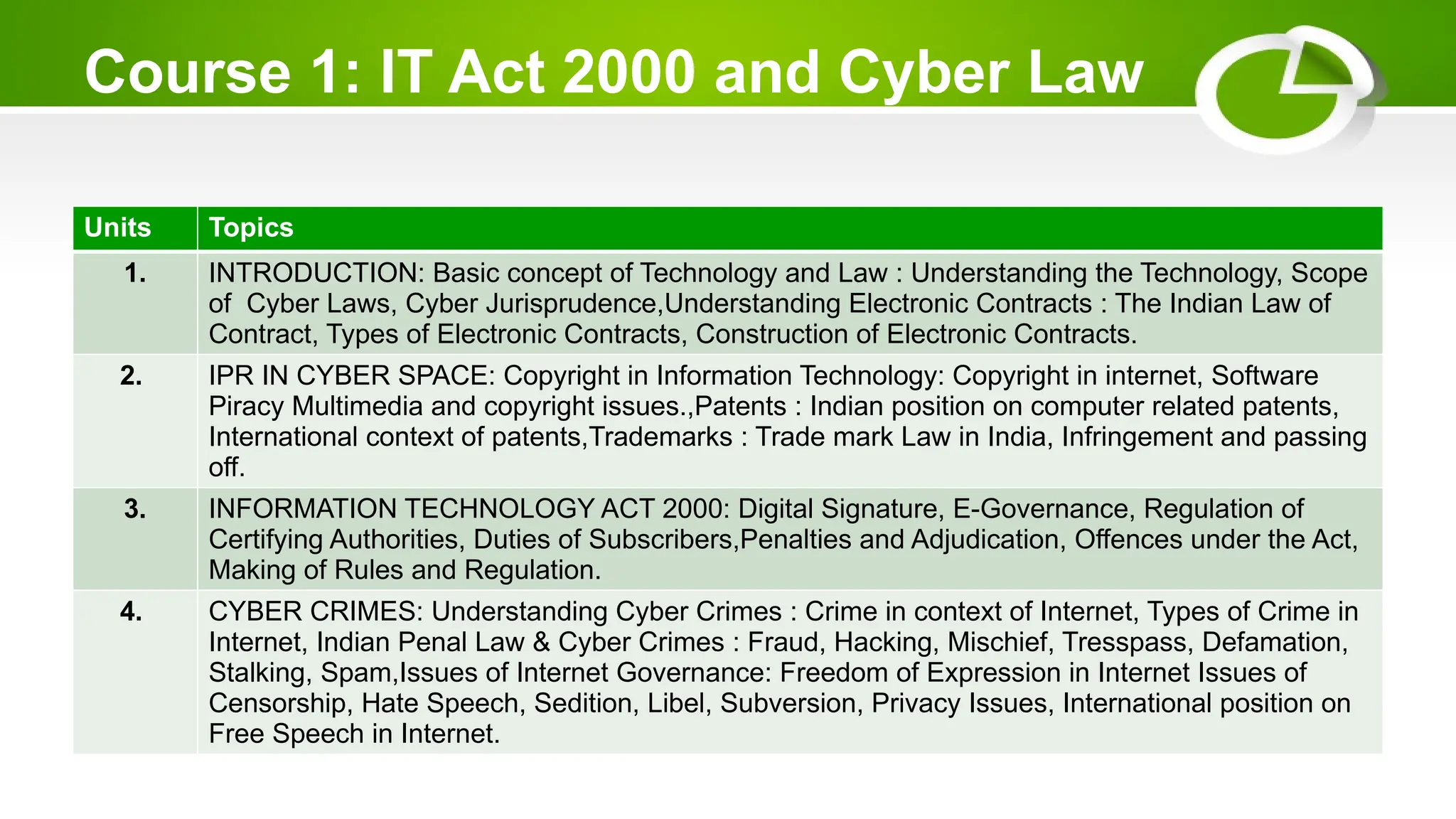
Course 1: ITAct 2000 and Cyber Law
Units Topics
1. INTRODUCTION: Basic concept of Technology and Law : Understanding the Technology, Scope
of Cyber Laws, Cyber Jurisprudence,Understanding Electronic Contracts : The Indian Law of
Contract, Types of Electronic Contracts, Construction of Electronic Contracts.
2. IPR IN CYBER SPACE: Copyright in Information Technology: Copyright in internet, Software
Piracy Multimedia and copyright issues.,Patents : Indian position on computer related patents,
International context of patents,Trademarks : Trade mark Law in India, Infringement and passing
off.
3. INFORMATION TECHNOLOGY ACT 2000: Digital Signature, E-Governance, Regulation of
Certifying Authorities, Duties of Subscribers,Penalties and Adjudication, Offences under the Act,
Making of Rules and Regulation.
4. CYBER CRIMES: Understanding Cyber Crimes : Crime in context of Internet, Types of Crime in
Internet, Indian Penal Law & Cyber Crimes : Fraud, Hacking, Mischief, Tresspass, Defamation,
Stalking, Spam,Issues of Internet Governance: Freedom of Expression in Internet Issues of
Censorship, Hate Speech, Sedition, Libel, Subversion, Privacy Issues, International position on
Free Speech in Internet.
3.
Learning Objectives
The objectiveof the course is:
To introduce the cyber world and cyber law in general.
To explain about the various facets of cyber crimes.
To enhance the understanding of problems arising out of online transactions and provoke
them to find solutions.
To clarify the Intellectual Property issues in the cyber space and the growth and
development of the law in this regard.
To educate about the regulation of cyber space at national and international level.
4.
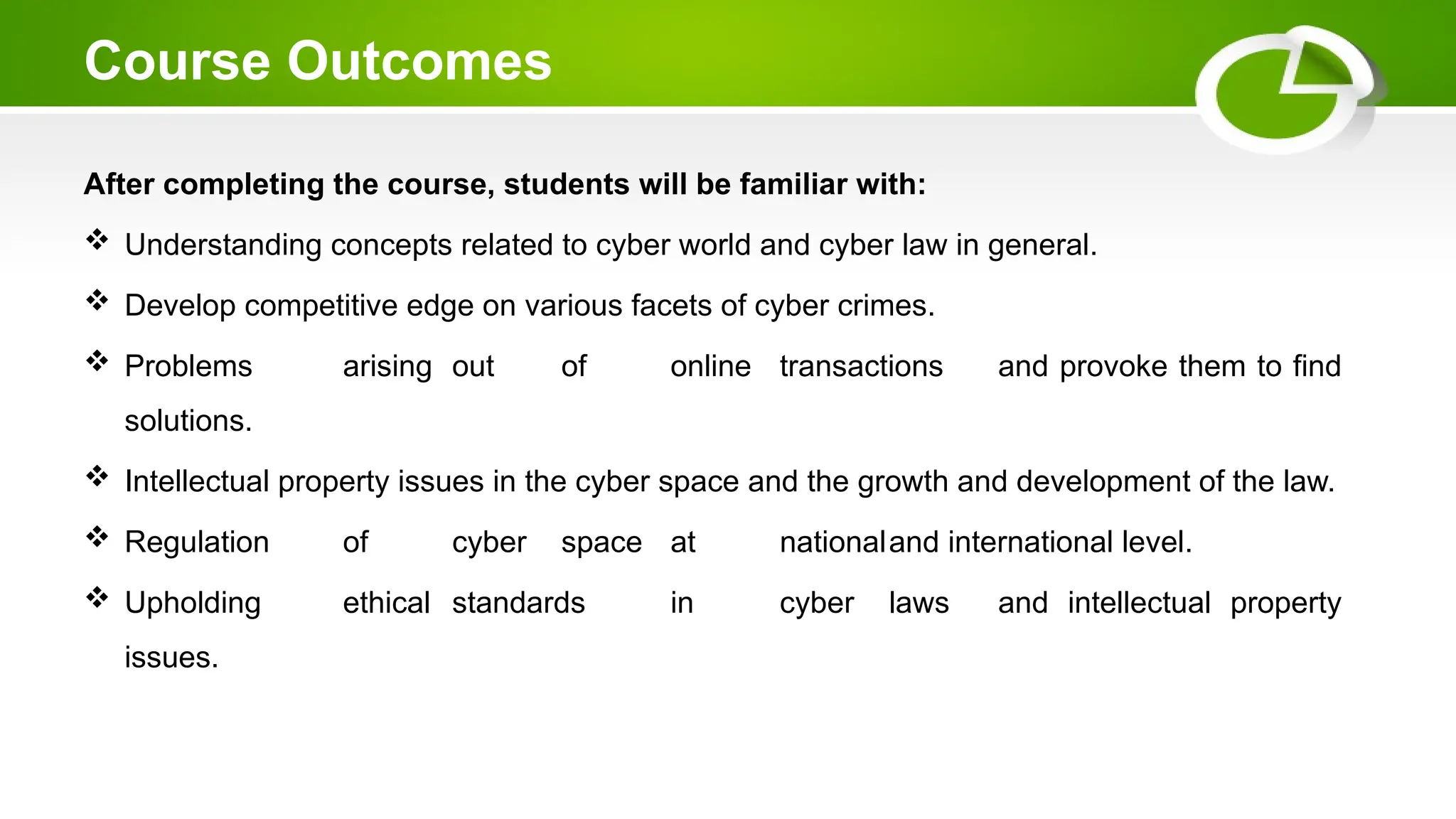
Course Outcomes
After completingthe course, students will be familiar with:
Understanding concepts related to cyber world and cyber law in general.
Develop competitive edge on various facets of cyber crimes.
Problems arising out of online transactions and provoke them to find
solutions.
Intellectual property issues in the cyber space and the growth and development of the law.
Regulation of cyber space at nationaland international level.
Upholding ethical standards in cyber laws and intellectual property
issues.
5.
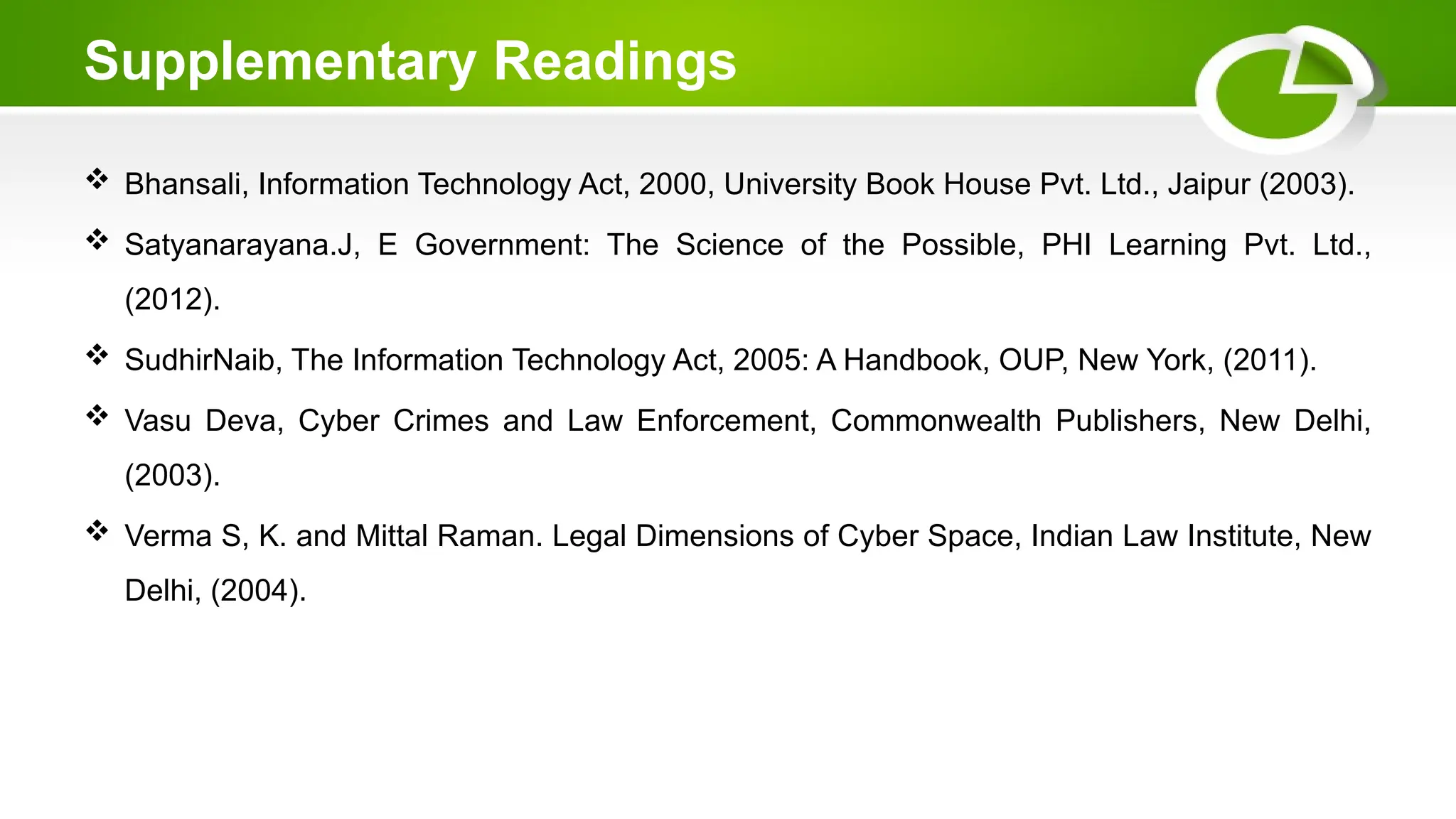
Supplementary Readings
Bhansali,Information Technology Act, 2000, University Book House Pvt. Ltd., Jaipur (2003).
Satyanarayana.J, E Government: The Science of the Possible, PHI Learning Pvt. Ltd.,
(2012).
SudhirNaib, The Information Technology Act, 2005: A Handbook, OUP, New York, (2011).
Vasu Deva, Cyber Crimes and Law Enforcement, Commonwealth Publishers, New Delhi,
(2003).
Verma S, K. and Mittal Raman. Legal Dimensions of Cyber Space, Indian Law Institute, New
Delhi, (2004).
6.
Course 2: Arbitrationand Mediation
About the Course:
Indian courts are overcrowded. It can take ages to resolve a simple dispute. Then where should
parties with serious legal disputes involving stakes of crores of rupees (often hundreds or
thousands of crores) go? They cannot let disputes over high-stake contracts languish in the court
for decades! Can the Indian justice system offer a solution? The Mediation Skills emphasizes on
the key principles that beginning mediators must know how to apply them in a real-world
environment. Let’s say the government has hired a company to build the bullet train between
Ahmedabad and Mumbai. It is but obvious that the company that got the contract to build the
entire infrastructure will now have to involve many different companies to do various things -
provide important materials, parts, build various parts of the infrastructure, provide insurance,
provide storage facility, security systems, transportation of goods, manpower, architectural
designs and what not. This course will make students learn about the mediation and Arbitration
process into predictable stages, with guidance and expertise from industry pioneers. It is for
individuals who wish to work in commercial mediation, community mediation or mediate in the
workplace. Our students will learn how to mediate formal disputes, including those in litigation as
well as proactively prevent disputes.
7.
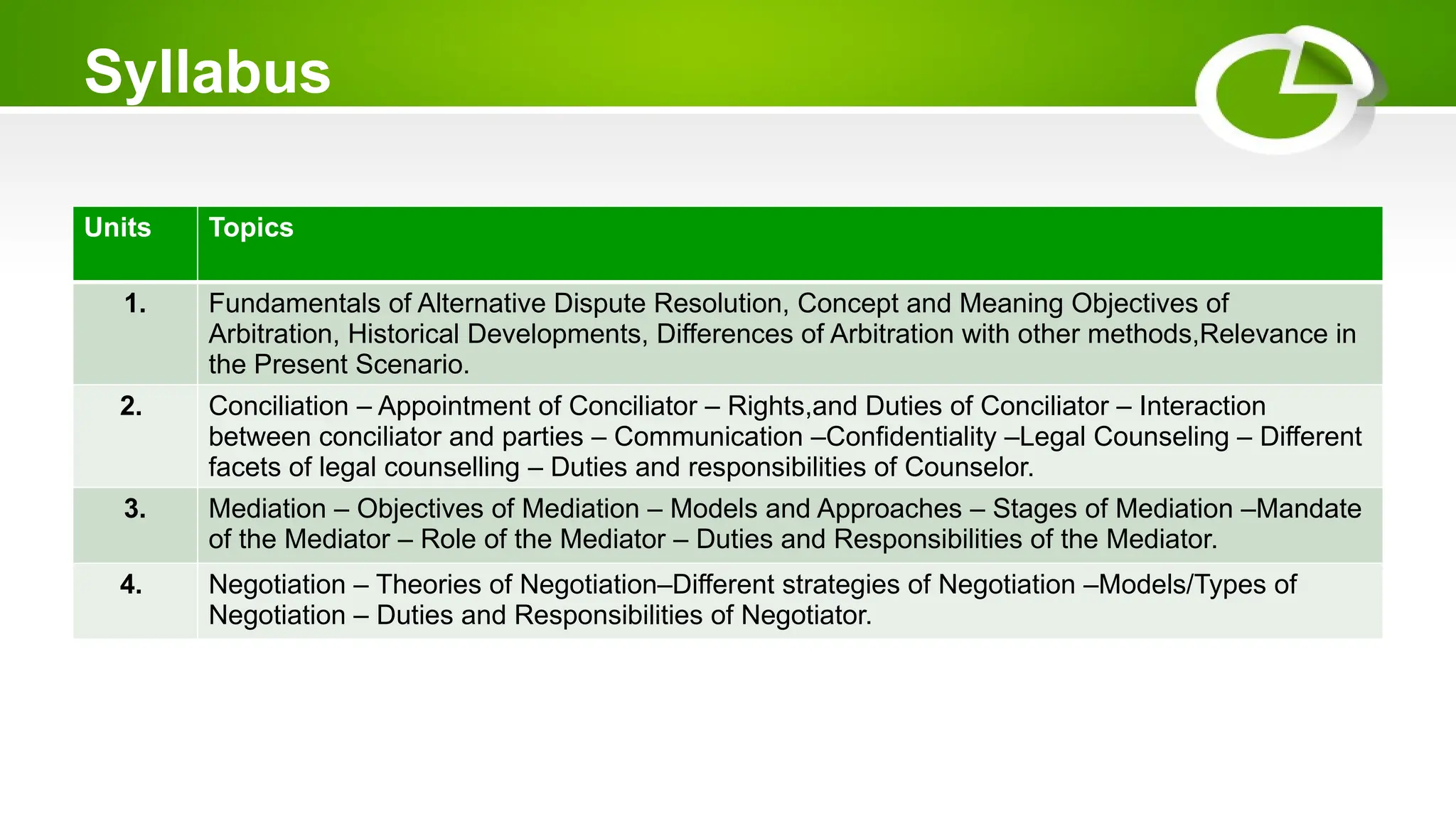
Syllabus
Units Topics
1. Fundamentalsof Alternative Dispute Resolution, Concept and Meaning Objectives of
Arbitration, Historical Developments, Differences of Arbitration with other methods,Relevance in
the Present Scenario.
2. Conciliation – Appointment of Conciliator – Rights,and Duties of Conciliator – Interaction
between conciliator and parties – Communication –Confidentiality –Legal Counseling – Different
facets of legal counselling – Duties and responsibilities of Counselor.
3. Mediation – Objectives of Mediation – Models and Approaches – Stages of Mediation –Mandate
of the Mediator – Role of the Mediator – Duties and Responsibilities of the Mediator.
4. Negotiation – Theories of Negotiation–Different strategies of Negotiation –Models/Types of
Negotiation – Duties and Responsibilities of Negotiator.
8.
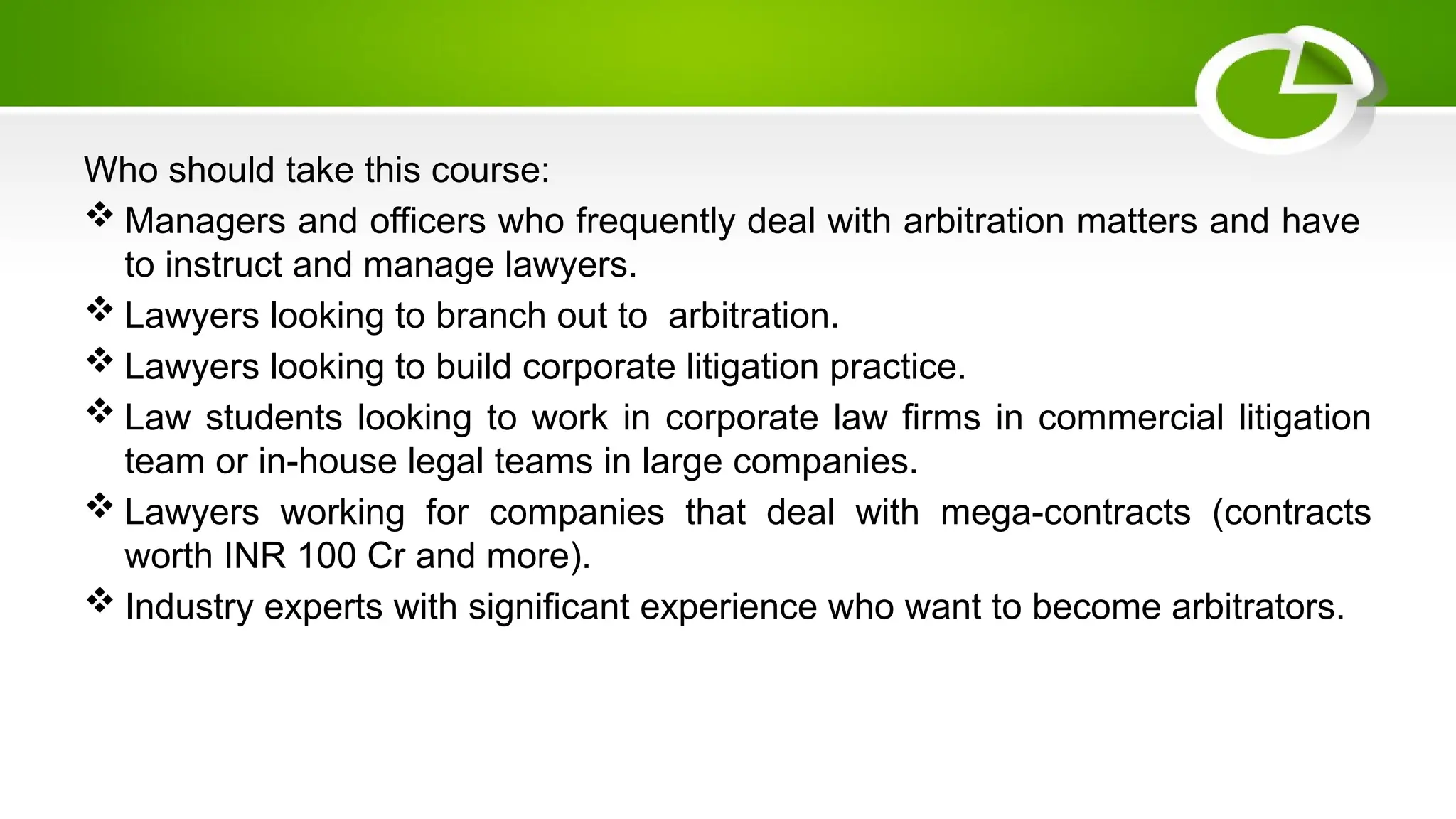
Who should takethis course:
Managers and officers who frequently deal with arbitration matters and have
to instruct and manage lawyers.
Lawyers looking to branch out to arbitration.
Lawyers looking to build corporate litigation practice.
Law students looking to work in corporate law firms in commercial litigation
team or in-house legal teams in large companies.
Lawyers working for companies that deal with mega-contracts (contracts
worth INR 100 Cr and more).
Industry experts with significant experience who want to become arbitrators.
9.
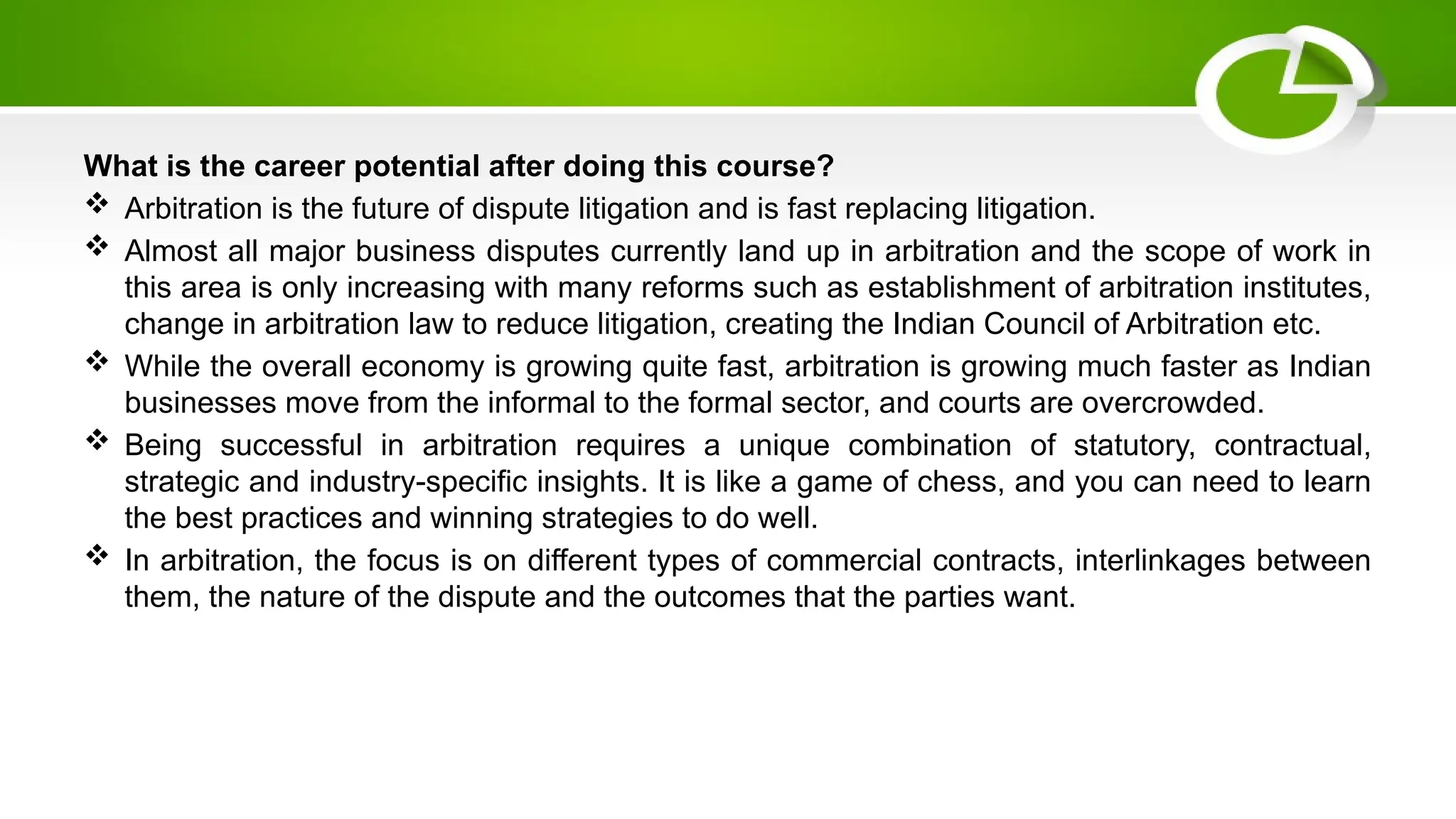
What is thecareer potential after doing this course?
Arbitration is the future of dispute litigation and is fast replacing litigation.
Almost all major business disputes currently land up in arbitration and the scope of work in
this area is only increasing with many reforms such as establishment of arbitration institutes,
change in arbitration law to reduce litigation, creating the Indian Council of Arbitration etc.
While the overall economy is growing quite fast, arbitration is growing much faster as Indian
businesses move from the informal to the formal sector, and courts are overcrowded.
Being successful in arbitration requires a unique combination of statutory, contractual,
strategic and industry-specific insights. It is like a game of chess, and you can need to learn
the best practices and winning strategies to do well.
In arbitration, the focus is on different types of commercial contracts, interlinkages between
them, the nature of the dispute and the outcomes that the parties want.
10.
What will youlearn?
Get exposure to strategic and drafting work in connection to arbitration and
Mediation.
Understand the entire arbitral and Mediation process from serving a notice
of default to the enforcement of arbitral awards.
Develop a practical understanding about the mechanisms for the
appointment of an arbitral tribunal and different skills of a good mediator.
Learn skills of a good mediator and to know how to create or assess dispute
resolution strategies for a large corporation.
Learn to draft various documents, petitions, applications relevant for arbitral
proceedings until you are conversant with each of them.




![Cs from corporate laws expert to corporate leader kanpur 12-oct[1]](https://cdn.slidesharecdn.com/ss_thumbnails/csfromcorporatelawsexperttocorporateleader-kanpur12oct1-120117044002-phpapp02-thumbnail.jpg?width=640&height=640&fit=bounds)


