

Business function
: legal
Features
Benefits
Application
By- Ms.Shivani Naik Devrukhkar, ASSISTANT PROFESSOR,
(MBA, MCOM, PGDHE, NET, B.ED)
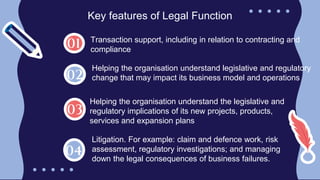
Key features of Legal Function
01
03
02
04
Transaction support, including in relation to contracting and
compliance
Helping the organisation understand legislative and regulatory
change that may impact its business model and operations
Helping the organisation understand the legislative and
regulatory implications of its new projects, products,
services and expansion plans
Litigation. For example: claim and defence work, risk
assessment, regulatory investigations; and managing
down the legal consequences of business failures.
Key features of Legal Function
05
06
Intellectual property work
Managing external counsel and controlling costs
In addition, you may manage risk and help your organisation
improve its efficiency by providing early warning and intelligence,
and be involved in formulating its strategy. Good business
planning should factor in legal, regulatory and compliance risks,
and associated spending.
Source: (Thomson Reuters – Practical Law)
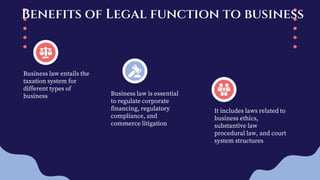
Benefits of Legal function to business
Business law entails the
taxation system for
different types of
business Business law is essential
to regulate corporate
financing, regulatory
compliance, and
commerce litigation
It includes laws related to
business ethics,
substantive law
procedural law, and court
system structures
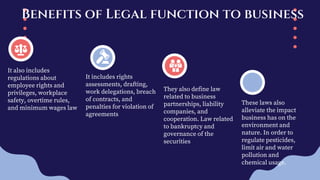
Benefits of Legal function to business
It also includes
regulations about
employee rights and
privileges, workplace
safety, overtime rules,
and minimum wages law
It includes rights
assessments, drafting,
work delegations, breach
of contracts, and
penalties for violation of
agreements
They also define law
related to business
partnerships, liability
companies, and
cooperation. Law related
to bankruptcy and
governance of the
securities
Benefits of Legal function to business
It also includes
regulations about
employee rights and
privileges, workplace
safety, overtime rules,
and minimum wages law
It includes rights
assessments, drafting,
work delegations, breach
of contracts, and
penalties for violation of
agreements
They also define law
related to business
partnerships, liability
companies, and
cooperation. Law related
to bankruptcy and
governance of the
securities
These laws also
alleviate the impact
business has on the
environment and
nature. In order to
regulate pesticides,
limit air and water
pollution and
chemical usage.
Application of Legal
Function in all
aspects of business
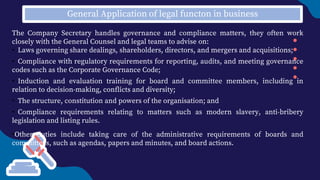
General Application of legal functon in business
The Company Secretary handles governance and compliance matters, they often work
closely with the General Counsel and legal teams to advise on:
• Laws governing share dealings, shareholders, directors, and mergers and acquisitions;
• Compliance with regulatory requirements for reporting, audits, and meeting governance
codes such as the Corporate Governance Code;
• Induction and evaluation training for board and committee members, including in
relation to decision-making, conflicts and diversity;
• The structure, constitution and powers of the organisation; and
• Compliance requirements relating to matters such as modern slavery, anti-bribery
legislation and listing rules.
•Other duties include taking care of the administrative requirements of boards and
committees, such as agendas, papers and minutes, and board actions.
Legal application in Corporate Communication
Today, managing the tone and consistency of communications across multiple internal
and external channels is vital in all organisations. A busy CC team will deal with:
•Media relations;
•Reputation management;
•Corporate social responsibility and sustainability;
•Crisis communications;
•Government and regulator liaison; and
•Internal communications.
•In all these areas, CC will work closely with other departments, including the legal team.
For example, they’ll handle media enquiries about any litigation involving the
organisation or negative media coverage. In sensitive areas, CC will liaise closely with the
legal team to clarify the facts, understand what they legally can say and adopt a company
position.
Legal Application in Finance
 Legal and finance can use predictive analytics and scenario modeling to measure key metrics such as
actual spend, types of legal matters, and budget on a year-to-year basis. This allows for data-based
budget creation, which allots legal the money it needs to operate efficiently while proving the return to
the overall business. Legal and finance can work together to form and analyze budgets, and use this
model for various analyses across the organization.
 In order to make data-based vendor-sourcing decisions, legal and finance departments should align on a
vendor management program to ensure quality outside counsel support under optimal fee
arrangements. This will empower both departments to hold regular business reviews, negotiate fee
agreements, and drive governance of billing guidelines.
 By working together to determine standard terms across contracts and outlining which terms can or must
be personalized per transaction, they can eliminate unnecessary time spent reviewing standard terms.
Rather than reviewing each and every finance-related clause in a contract, finance only needs to review
personalized sections in the agreement.
Legal Application in Finance
 Pair in-house counsel with someone in finance so each has direct points of communication within
departments. Having an assigned go-to person in another department can help expedite business as
well as build rapport between team members who would not have otherwise worked together.
 Finance will need insight and access into executed contracts to ensure revenue recognition. This is why
it will be imperative that they also play a role in the company’s shift toward digital transformation. The
finance team will likely need to know certain financial terms within the contract to run reports, create
contract reminders for key compliance terms, and ensure that the milestones are reached and billed.
 Expanding legal’s budget empowers them to consider and purchase software that optimizes business’
processes and outcomes, including comprehensive contracting solutions – which can often only be
considered a sales resource. It also allows them opportunities for continued professional development,
trainings, and off-site meetings, a practice with long-term benefits for the company at large.
Application of Legal Function in HR
The scope of work HR departments now undertake has increased the need for expert
legal advice on many issues. Examples include:
•Business expansions, contractions or relocations and the attendant workforce issues,
consultations and bargaining rights or changes to T&Cs and severance terms. These
issues may arise in a national or international context;
•Recruitment checks, movement of labour rules and taxation and reward strategies;
•Use of social media by the organisation and its staff, which require user and privacy
policies;
•Flexible working, both in the context of working "health and safety" outside the office;
and in relation to different types of engagement, such as employment and contracting.
Application of Legal Function in HR
• Employment contracts, handbooks, disciplinary manuals and employment policies
generally;
• Internal investigations;
• Equal Pay Act reporting, Modern Slavery checks, National Minimum Wage,
Workplace Pensions and other recent important and high reputational profile
compliance and reporting obligations around employees;
• Dealings with external counsel, employment tribunal cases and subsequent training
and guidance on lessons learned;
• Hiring and firing issues, together with redundancy procedures and severance terms;
and
• Equality, diversity and gender balance policies and requirements with the growing
focus on mental health and transgender in the workplace.
Application of legal functon in IT
Policies regarding IT are another important part of the legal team’s work, with
wide-ranging responsibilities that include understanding the technology and the
supplier business model as well as the law in order to advise on:
• NDAs, software development agreements, outsourcing agreements, software
licenses, cloud services, SaaS agreements, telecommunications services
agreements and SLAs;
• Intellectual property rights;
• Legal status, issues, risks and contracting needs around new Internet of
Things services and advertising;
• Data protection and data security policies and procedures;
• How and which systems to search for a claim, a regulatory investigation, a
data subject data access request, or a dawn raid;
• Issues arising out of software license audits;
• Disputes with suppliers, interruption of supplies or supplier insolvency; and
• Risk allocation, liability allocation and responses to cyber breaches and data
breach notifications.
Legal application in Property and facilities and health and
safety
 Leases, licenses and wayleaves;
 Utility service contracts, facilities management and outsourcing agreements;
 The development of a property database recording notice periods, renewal dates
and term end dates;
 Disputes and notices to quit;
 Construction contracts and agreements with external advisors;
 Premises and occupier liability, health and safety training and compliance
assessments - especially when there are a high proportion of outsourcers,
consulting/contracting staff and short term staff in the "onsite personnel mix";
and
 Insurance
Business Function Legal.pptx

Business Function Legal.pptx

  • 1.
    Business function : legal Features Benefits Application By-Ms.Shivani Naik Devrukhkar, ASSISTANT PROFESSOR, (MBA, MCOM, PGDHE, NET, B.ED)
  • 2.
    Key features ofLegal Function 01 03 02 04 Transaction support, including in relation to contracting and compliance Helping the organisation understand legislative and regulatory change that may impact its business model and operations Helping the organisation understand the legislative and regulatory implications of its new projects, products, services and expansion plans Litigation. For example: claim and defence work, risk assessment, regulatory investigations; and managing down the legal consequences of business failures.
  • 3.
    Key features ofLegal Function 05 06 Intellectual property work Managing external counsel and controlling costs In addition, you may manage risk and help your organisation improve its efficiency by providing early warning and intelligence, and be involved in formulating its strategy. Good business planning should factor in legal, regulatory and compliance risks, and associated spending. Source: (Thomson Reuters – Practical Law)
  • 4.
    Benefits of Legalfunction to business Business law entails the taxation system for different types of business Business law is essential to regulate corporate financing, regulatory compliance, and commerce litigation It includes laws related to business ethics, substantive law procedural law, and court system structures
  • 5.
    Benefits of Legalfunction to business It also includes regulations about employee rights and privileges, workplace safety, overtime rules, and minimum wages law It includes rights assessments, drafting, work delegations, breach of contracts, and penalties for violation of agreements They also define law related to business partnerships, liability companies, and cooperation. Law related to bankruptcy and governance of the securities
  • 6.
    Benefits of Legalfunction to business It also includes regulations about employee rights and privileges, workplace safety, overtime rules, and minimum wages law It includes rights assessments, drafting, work delegations, breach of contracts, and penalties for violation of agreements They also define law related to business partnerships, liability companies, and cooperation. Law related to bankruptcy and governance of the securities These laws also alleviate the impact business has on the environment and nature. In order to regulate pesticides, limit air and water pollution and chemical usage.
  • 7.
    Application of Legal Functionin all aspects of business
  • 8.
    General Application oflegal functon in business The Company Secretary handles governance and compliance matters, they often work closely with the General Counsel and legal teams to advise on: • Laws governing share dealings, shareholders, directors, and mergers and acquisitions; • Compliance with regulatory requirements for reporting, audits, and meeting governance codes such as the Corporate Governance Code; • Induction and evaluation training for board and committee members, including in relation to decision-making, conflicts and diversity; • The structure, constitution and powers of the organisation; and • Compliance requirements relating to matters such as modern slavery, anti-bribery legislation and listing rules. •Other duties include taking care of the administrative requirements of boards and committees, such as agendas, papers and minutes, and board actions.
  • 9.
    Legal application inCorporate Communication Today, managing the tone and consistency of communications across multiple internal and external channels is vital in all organisations. A busy CC team will deal with: •Media relations; •Reputation management; •Corporate social responsibility and sustainability; •Crisis communications; •Government and regulator liaison; and •Internal communications. •In all these areas, CC will work closely with other departments, including the legal team. For example, they’ll handle media enquiries about any litigation involving the organisation or negative media coverage. In sensitive areas, CC will liaise closely with the legal team to clarify the facts, understand what they legally can say and adopt a company position.
  • 10.
    Legal Application inFinance  Legal and finance can use predictive analytics and scenario modeling to measure key metrics such as actual spend, types of legal matters, and budget on a year-to-year basis. This allows for data-based budget creation, which allots legal the money it needs to operate efficiently while proving the return to the overall business. Legal and finance can work together to form and analyze budgets, and use this model for various analyses across the organization.  In order to make data-based vendor-sourcing decisions, legal and finance departments should align on a vendor management program to ensure quality outside counsel support under optimal fee arrangements. This will empower both departments to hold regular business reviews, negotiate fee agreements, and drive governance of billing guidelines.  By working together to determine standard terms across contracts and outlining which terms can or must be personalized per transaction, they can eliminate unnecessary time spent reviewing standard terms. Rather than reviewing each and every finance-related clause in a contract, finance only needs to review personalized sections in the agreement.
  • 11.
    Legal Application inFinance  Pair in-house counsel with someone in finance so each has direct points of communication within departments. Having an assigned go-to person in another department can help expedite business as well as build rapport between team members who would not have otherwise worked together.  Finance will need insight and access into executed contracts to ensure revenue recognition. This is why it will be imperative that they also play a role in the company’s shift toward digital transformation. The finance team will likely need to know certain financial terms within the contract to run reports, create contract reminders for key compliance terms, and ensure that the milestones are reached and billed.  Expanding legal’s budget empowers them to consider and purchase software that optimizes business’ processes and outcomes, including comprehensive contracting solutions – which can often only be considered a sales resource. It also allows them opportunities for continued professional development, trainings, and off-site meetings, a practice with long-term benefits for the company at large.
  • 12.
    Application of LegalFunction in HR The scope of work HR departments now undertake has increased the need for expert legal advice on many issues. Examples include: •Business expansions, contractions or relocations and the attendant workforce issues, consultations and bargaining rights or changes to T&Cs and severance terms. These issues may arise in a national or international context; •Recruitment checks, movement of labour rules and taxation and reward strategies; •Use of social media by the organisation and its staff, which require user and privacy policies; •Flexible working, both in the context of working "health and safety" outside the office; and in relation to different types of engagement, such as employment and contracting.
  • 13.
    Application of LegalFunction in HR • Employment contracts, handbooks, disciplinary manuals and employment policies generally; • Internal investigations; • Equal Pay Act reporting, Modern Slavery checks, National Minimum Wage, Workplace Pensions and other recent important and high reputational profile compliance and reporting obligations around employees; • Dealings with external counsel, employment tribunal cases and subsequent training and guidance on lessons learned; • Hiring and firing issues, together with redundancy procedures and severance terms; and • Equality, diversity and gender balance policies and requirements with the growing focus on mental health and transgender in the workplace.
  • 14.
    Application of legalfuncton in IT Policies regarding IT are another important part of the legal team’s work, with wide-ranging responsibilities that include understanding the technology and the supplier business model as well as the law in order to advise on: • NDAs, software development agreements, outsourcing agreements, software licenses, cloud services, SaaS agreements, telecommunications services agreements and SLAs; • Intellectual property rights; • Legal status, issues, risks and contracting needs around new Internet of Things services and advertising; • Data protection and data security policies and procedures; • How and which systems to search for a claim, a regulatory investigation, a data subject data access request, or a dawn raid; • Issues arising out of software license audits; • Disputes with suppliers, interruption of supplies or supplier insolvency; and • Risk allocation, liability allocation and responses to cyber breaches and data breach notifications.
  • 15.
    Legal application inProperty and facilities and health and safety  Leases, licenses and wayleaves;  Utility service contracts, facilities management and outsourcing agreements;  The development of a property database recording notice periods, renewal dates and term end dates;  Disputes and notices to quit;  Construction contracts and agreements with external advisors;  Premises and occupier liability, health and safety training and compliance assessments - especially when there are a high proportion of outsourcers, consulting/contracting staff and short term staff in the "onsite personnel mix"; and  Insurance