Validity of
Electronic
signature in India
Content
▪ INTRODUCTION
▪ Electronic Signatures and Digital Signatures
▪ Features of Digital Signatures
▪ Types of electronic signature
▪ Factors make e-signatures valid in India
▪ Validity of E-Sign in India (Sec 3a)
▪ Validity under Evidence act
▪ Provisions Recognizing the E-Signature or Digital Signature under the Information
Technology Act, 2000
▪ Other statute regarding electronic signature
▪ Documents on Which Digital Signature is Invalid
▪ Offences relating to e-signature
▪ Landmark judgement
▪ Law around E- Adhaar
▪ Conclusion
▪ e-signatures have been legally valid in India for over 20 years now:
the Information Technology act(IT Act), passed in 2000, granted e-
signatures the same legal status as handwritten signatures.
▪ Signature helps a document to get validation in the eyes of law.
▪
▪
▪ Authorised Signatory may not be at a particular place and still allow
his assent.Technology has duly provided his boon.
▪ In 1996 the United Nations with a majority passing resolution
enacted UNCITRAL Model Law on Electronic Commerce. In
2001, UNCITRAL Model Law on Electronic Signatures was
passed which has been adopted by 30 states in their jurisdictions.
▪
▪ the definition under Section 2(1)(ta), Information Technology Act, 2000 as follows:
▪ “Electronic signature” signifies authentication of any electronic record by a subscriber by
methods for the electronic techniques determined in the Second Schedule and comprises Digital
Signature”.
▪ The defination under section 2(1)(p),IT Act 2000 as Fallows :
"digital signature "means authentication of any electronic record by a subscriber by means of
an electronic method or procedure in accordance with the provision of Section 3, IT Act, 2000.
▪ Whereas E-signature is affixing or attachment of symbols or other data or combined
together, although in digital form, without any encryption, in any electronic document.
▪ The subscriber can authenticate an electronic record by affixing his digital signature, which shall
be effected by the use of the asymmetric crypto system and hash function, enveloping &
transforming the initial electronic record into another.
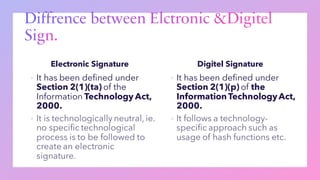
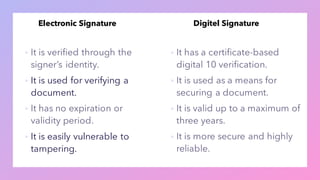
Electronic Signature
▪ It has been defined under
Section 2(1)(ta) of the
Information Technology Act,
2000.
▪
Digitel Signature
▪ It has been defined under
Section 2(1)(p) of the
Information TechnologyAct,
2000.
▪
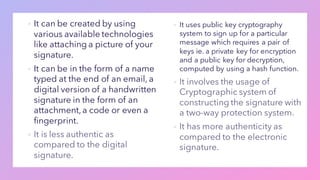
▪ It can be created by using
various available technologies
like attaching a picture of your
signature.
▪ It can be in the form of a name
typed at the end of an email, a
digital version of a handwritten
signature in the form of an
attachment,a code or even a
fingerprint.
▪
▪ It uses public key cryptography
system to sign up for a particular
message which requires a pair of
keys ie. a private key for encryption
and a public key for decryption,
computed by using a hash function.
▪
▪
▪
▪ It is used for verifying a
document.
▪
▪ It is easily vulnerable to
tampering.
▪
▪
▪
▪
Electronic Signature Digitel Signature
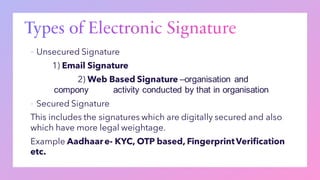
▪ Unsecured Signature
1) Email Signature
2) Web Based Signature –organisation and
compony activity conducted by that in organisation
▪ Secured Signature
This includes the signatures which are digitally secured and also
which have more legal weightage.
Example Aadhaare- KYC, OTP based, FingerprintVerification
etc.
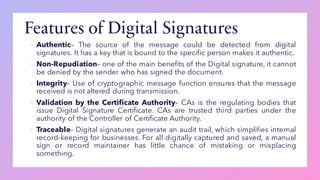
Features of Digital Signatures
▪ Authentic– The source of the message could be detected from digital
signatures. It has a key that is bound to the specific person makes it authentic.
▪ Non-Repudiation– one of the main benefits of the Digital signature, it cannot
be denied by the sender who has signed the document.
▪ Integrity– Use of cryptographic message function ensures that the message
received is not altered during transmission.
▪ Validation by the Certificate Authority– CAs is the regulating bodies that
issue Digital Signature Certificate. CAs are trusted third parties under the
authority of the Controller of Certificate Authority.
▪ Traceable– Digital signatures generate an audit trail, which simplifies internal
record-keeping for businesses. For all digitally captured and saved, a manual
sign or record maintainer has little chance of mistaking or misplacing
something.
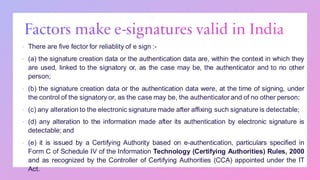
▪ There are five fector for reliablity of e sign :-
▪ (a) the signature creation data or the authentication data are, within the context in which they
are used, linked to the signatory or, as the case may be, the authenticator and to no other
person;
▪ (b) the signature creation data or the authentication data were, at the time of signing, under
the control of the signatory or, as the case may be, the authenticator and of no other person;
▪ (c) any alteration to the electronic signature made after affixing such signature is detectable;
▪ (d) any alteration to the information made after its authentication by electronic signature is
detectable; and
▪ (e) it is issued by a Certifying Authority based on e-authentication, particulars specified in
Form C of Schedule IV of the Information Technology (Certifying Authorities) Rules, 2000
and as recognized by the Controller of Certifying Authorities (CCA) appointed under the IT
Act.
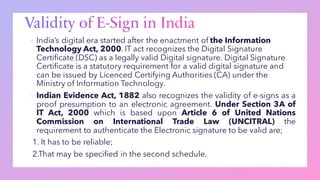
▪ India’s digital era started after the enactment of the Information
Technology Act, 2000. IT act recognizes the Digital Signature
Certificate (DSC) as a legally valid Digital signature. Digital Signature
Certificate is a statutory requirement for a valid digital signature and
can be issued by Licenced Certifying Authorities (CA) under the
Ministry of Information Technology.
▪ Indian Evidence Act, 1882 also recognizes the validity of e-signs as a
proof presumption to an electronic agreement. Under Section 3A of
IT Act, 2000 which is based upon Article 6 of United Nations
Commission on International Trade Law (UNCITRAL) the
requirement to authenticate the Electronic signature to be valid are;
1. It has to be reliable;
2.That may be specified in the second schedule.
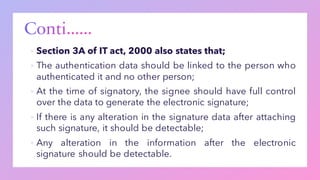
▪ Section 3A of IT act, 2000 also states that;
▪ The authentication data should be linked to the person who
authenticated it and no other person;
▪ At the time of signatory, the signee should have full control
over the data to generate the electronic signature;
▪ If there is any alteration in the signature data after attaching
such signature, it should be detectable;
▪ Any alteration in the information after the electronic
signature should be detectable.
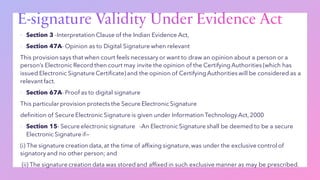
▪ Section 3 -Interpretation Clause of the Indian Evidence Act,
▪ Section 47A- Opinion as to Digital Signature when relevant
This provision says that when court feels necessary or want to draw an opinion about a person or a
person’s Electronic Record then court may invite the opinion of the Certifying Authorities (which has
issued Electronic Signature Certificate) and the opinion of Certifying Authorities will be considered as a
relevant fact.
▪ Section 67A- Proof as to digital signature
This particular provision protects the Secure Electronic Signature
definition of Secure Electronic Signature is given under Information Technology Act, 2000
▪ Section 15- Secure electronic signature -An Electronic Signature shall be deemed to be a secure
Electronic Signature if—
(i) The signature creation data, at the time of affixing signature,was under the exclusive control of
signatory and no other person; and
(ii) The signature creation data was stored and affixed in such exclusive manner as may be prescribed.
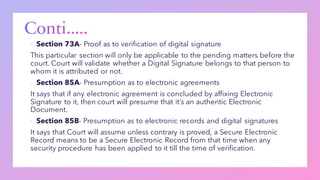
▪ Section 73A- Proof as to verification of digital signature
This particular section will only be applicable to the pending matters before the
court. Court will validate whether a Digital Signature belongs to that person to
whom it is attributed or not.
▪ Section 85A- Presumption as to electronic agreements
It says that if any electronic agreement is concluded by affixing Electronic
Signature to it, then court will presume that it’s an authentic Electronic
Document.
▪ Section 85B- Presumption as to electronic records and digital signatures
It says that Court will assume unless contrary is proved, a Secure Electronic
Record means to be a Secure Electronic Record from that time when any
security procedure has been applied to it till the time of verification.
▪ Section 85C- Presumption as to Digital Signature
This particular section says that court shall presume unless contrary is
proved, that information recorded in Digital Signature Certificate is
correct and true as well.
▪ Section 90-Presumption as to electronic records five years old-It talks
about two main conditions that;
(1) If Electronic Record is proved to be five year old;
(2) If it is proved to be in proper custody; then, court may assume that
the validity of agreement is authenticated by Digital Signature which is
fixed with it. Person who is authorized to use Digital Signature can also fix
the Digital Signature. Custody of the Electronic Record should remain
with the authorized person
▪ recognition of Electronic Signature (according to Section 5 of the
Information Technology Act, 2000):
Where any law provides that information or any other matter shall be
authenticated by affixing the signature or any document should be signed or
bear the signature of any person then, notwithstanding anything contained in
such law, such requirement shall be deemed to have been satisfied if such
information or matter is authenticated through digital signature affixed in such
manner as may be prescribed by the Central Government.
As per the SECOND SCHEDULE the IT Act, read with the Electronic Signature
or Electronic Authentication Technique and Procedure Rules, 2015, methods
have been recognized as valid legal methods of Electronic signing or
Authentication which shall be done by:
▪ a) Digital Signature Method
▪ This applies the use of e-authentication, hash, and asymmetric
cryptosystemtechniques, leading to the issuance of Digital
Signature Certificate by Certifying Authority
▪ b) E-Sign method using Aadhaar e- KYC Service: –
E-Sign facilitates the digitally signing of a document by an eSign
user using an Online Service.
eSign service operates under the provisions of the Second
Schedule of Information Technology Act, 2000 (e-authentication
technique using Aadhaar e-KYC services) as notified vide
Electronic AuthenticationTechnique and Procedure Rules, 2015.
▪ DSC under the Information Technology Act, 2000
▪ Section 35:Any person who wishes to get a Digital Signature
Certificate may file an application to the certifying authority for issuance
of the Electronic Certificate along with the submission of the required
amount of fees not exceeding Rs. 25,000, including a statement of
certification practice or stating such particulars as prescribed.
▪ Section 36 :Representations upon issuance of the DSC.
▪ Section 37 :Suspension in public interest, not more than 15 days, unless
given the opportunity to present the case.
▪ Section 38 :Revocation on death or request of a subscriber, dissolution
of a company or a firm.
▪
▪
▪
▪
▪
▪
▪ Rule 5 of the Information Technology (Certifying
Authorities) Rules, 2000, explains the method of
verification of digital signature as:
▪ The verification of a Digital Signature shall be accomplished
by computing a new hash result of the original electronic
record by means of a hash function which is used to create a
Digital Signature and by using the public key and the new
hash result.
▪ 1. Companies Act, 2013
As per Sub Rule (1) of Rule 8 of Companies (Registration offices and
Fees) Rules, 2014 An electronic form shall be authenticated by
authorized signatories using a digital signature.
2. Taxation Laws & Labour Laws
This Position is the same in the Taxation laws as well as already the use
of Digital Signatures for filing of returns and documents under the
Income Tax Act, the GST Act has widespread prevalence. Even, in the
Labour Laws such as the EPF Act ESI Act, Factories Act, and other
Labour Welfare laws the use of Digital modes of signing as increased
a lot in recent years and hence is validly accepted and recognized.
Some documents required a notarial process with a physical
signature and required to be registered with the Registrar in
order to be legally enforceable. Section 1(4) of the Information
Technology Act, 2000 states that the Act does not apply to;
▪ A negotiable instrument other than cheque;
▪ Power of Attorney;
▪ A trust;
▪ A Will including any other testamentary disposition;
▪ A contract for the sale of real estate or immovable property.
A. Section 463: Making a false document:
▪ The punishment for making a false document (forgery)
under Section 465, IPC, 1860 is imprisonment of a term which
may extend to two years, or with fine, or with both.
B. Section 66C: Punishment for identity theft
▪ shall be punished with imprisonment for a term which may
extend to three years and shall be liable to fine which may
extend to Rupees one lakh
C. Section 71: Penalty for misrepresentation
▪ shall be punished with imprisonment for a term which may extend to two
years, or with fine which may extend to Rupees one lakh, or with both.
D. Section 73: Penalty for publishing electronic signature certificate false
in certain particulars
▪ Any person who contravenes the above provisions shall be punished with
imprisonment for a term which may extend to two years, or with fine which
may extend to Rupees one lakh, or with both
E. Section 74: Publication for Fraudulent purpose
▪ shall be punished with imprisonment for a term which may extend to two
years, or with fine which may extend to Rupees one lakh, or with both.
▪ Berkson v. Gogo LLC
The US district court observed & explained the concept of the click-
wrap agreements.These agreements basically require the click the
“accept” button to the “terms & conditions” before entering into a
transaction.These sorts of agreements are enforceable because it
would then become tedious for the company to engage in litigation
with each end-user.
▪ Zakuski v GeneralAmerican
the court observed that in the process of electronic signature
reasonably involves sufficiently more security measures & that the
process physical signature & E-signature doesn’t differ much.
▪ E-Aadhaar is basically a password protected electronic copy of Aadhaar,
which is digitally signed by the competent authority of the Unique
Identification Authority of India (UIDAI), it substitutes the execution of
documents by physical signature by E-signature (E-Aadhaar).
▪ The Aadhar project was initiated by the government of India in 2009
▪ It was envisaged as a biometric-based unique identity number, to identify the
real & eligible beneficiary.
▪ The process of obtaining the Aadhaar number involves grossly two
categories of information & details:
▪ (i) Biometric information (photograph, 10 fingerprints, scans of both irises); &
▪ (ii) Demographic information (name, date of birth, gender, residential
address) to the UIDAI, which is stored by the Central Identities Data
Repository.
▪ In 2016, Parliament enacted the Aadhaar (Targeted Delivery of Financial
and Other Subsidies, Benefits and Services) Act, 2016. to emboss the
legislative sanction to this project. The act allowed both the central & state
government, as well as the private entities to use Aadhaar for
authentication purposes.
▪ In 2017, the Parliament passed the Finance Act, 2017, amending
the Section 139AA, Income Tax Act 1961 & making Aadhaar mandatory for
filing income tax returns & applying for PAN.
▪ Under the Aadhaar Act, it entitles the government & permitted private
entities to obtain biometric & demographic information to verify the
identity of the person. Such information collected, is stored in a central
database & is argued that it leads to the creation of a “surveillance state.”
▪ Judgment
The Hon’ble Supreme Court with a majority (3:2) ruled most of
the provisions of the Aadhaar Act, 2016 serves legitimate aim
& thus constitutional not to be violating the reasonable
exception of right to privacy which is envisaged as one of the
vital rights under Article 21 of the Constitution of India
▪ With the advent of technologies in the 21st century, the use of digital
signatures in place of traditional signatures has expanded dramatically.
▪ The Information Technology Act of 2000 covers a broad range of topics,
including the definition of digital signatures, the authority charged with
awarding digital signature certificates, and the conditions that necessitate
the affixation of a digital signature.
▪ The Act gives a statutory grant to the Digital Signature and provisions to
revoke and suspend the Digital Signature Certificate.
▪ The electronic medium of encryption is a relatively modern and complex
process that provides ease of convenience, efficiency, and protection from
third-party interference, as well as the subtlety of the user’s identity.

Validity Of E singnature In India

  • 2.
  • 3.
    Content ▪ INTRODUCTION ▪ ElectronicSignatures and Digital Signatures ▪ Features of Digital Signatures ▪ Types of electronic signature ▪ Factors make e-signatures valid in India ▪ Validity of E-Sign in India (Sec 3a) ▪ Validity under Evidence act ▪ Provisions Recognizing the E-Signature or Digital Signature under the Information Technology Act, 2000 ▪ Other statute regarding electronic signature ▪ Documents on Which Digital Signature is Invalid ▪ Offences relating to e-signature ▪ Landmark judgement ▪ Law around E- Adhaar ▪ Conclusion
  • 4.
    ▪ e-signatures havebeen legally valid in India for over 20 years now: the Information Technology act(IT Act), passed in 2000, granted e- signatures the same legal status as handwritten signatures. ▪ Signature helps a document to get validation in the eyes of law. ▪
  • 5.
    ▪ ▪ Authorised Signatorymay not be at a particular place and still allow his assent.Technology has duly provided his boon. ▪ In 1996 the United Nations with a majority passing resolution enacted UNCITRAL Model Law on Electronic Commerce. In 2001, UNCITRAL Model Law on Electronic Signatures was passed which has been adopted by 30 states in their jurisdictions. ▪
  • 6.
    ▪ the definitionunder Section 2(1)(ta), Information Technology Act, 2000 as follows: ▪ “Electronic signature” signifies authentication of any electronic record by a subscriber by methods for the electronic techniques determined in the Second Schedule and comprises Digital Signature”. ▪ The defination under section 2(1)(p),IT Act 2000 as Fallows : "digital signature "means authentication of any electronic record by a subscriber by means of an electronic method or procedure in accordance with the provision of Section 3, IT Act, 2000. ▪ Whereas E-signature is affixing or attachment of symbols or other data or combined together, although in digital form, without any encryption, in any electronic document. ▪ The subscriber can authenticate an electronic record by affixing his digital signature, which shall be effected by the use of the asymmetric crypto system and hash function, enveloping & transforming the initial electronic record into another.
  • 7.
    Electronic Signature ▪ Ithas been defined under Section 2(1)(ta) of the Information Technology Act, 2000. ▪ Digitel Signature ▪ It has been defined under Section 2(1)(p) of the Information TechnologyAct, 2000. ▪
  • 8.
    ▪ It canbe created by using various available technologies like attaching a picture of your signature. ▪ It can be in the form of a name typed at the end of an email, a digital version of a handwritten signature in the form of an attachment,a code or even a fingerprint. ▪ ▪ It uses public key cryptography system to sign up for a particular message which requires a pair of keys ie. a private key for encryption and a public key for decryption, computed by using a hash function. ▪ ▪
  • 9.
    ▪ ▪ It isused for verifying a document. ▪ ▪ It is easily vulnerable to tampering. ▪ ▪ ▪ ▪ Electronic Signature Digitel Signature
  • 10.
    ▪ Unsecured Signature 1)Email Signature 2) Web Based Signature –organisation and compony activity conducted by that in organisation ▪ Secured Signature This includes the signatures which are digitally secured and also which have more legal weightage. Example Aadhaare- KYC, OTP based, FingerprintVerification etc.
  • 11.
    Features of DigitalSignatures ▪ Authentic– The source of the message could be detected from digital signatures. It has a key that is bound to the specific person makes it authentic. ▪ Non-Repudiation– one of the main benefits of the Digital signature, it cannot be denied by the sender who has signed the document. ▪ Integrity– Use of cryptographic message function ensures that the message received is not altered during transmission. ▪ Validation by the Certificate Authority– CAs is the regulating bodies that issue Digital Signature Certificate. CAs are trusted third parties under the authority of the Controller of Certificate Authority. ▪ Traceable– Digital signatures generate an audit trail, which simplifies internal record-keeping for businesses. For all digitally captured and saved, a manual sign or record maintainer has little chance of mistaking or misplacing something.
  • 12.
    ▪ There arefive fector for reliablity of e sign :- ▪ (a) the signature creation data or the authentication data are, within the context in which they are used, linked to the signatory or, as the case may be, the authenticator and to no other person; ▪ (b) the signature creation data or the authentication data were, at the time of signing, under the control of the signatory or, as the case may be, the authenticator and of no other person; ▪ (c) any alteration to the electronic signature made after affixing such signature is detectable; ▪ (d) any alteration to the information made after its authentication by electronic signature is detectable; and ▪ (e) it is issued by a Certifying Authority based on e-authentication, particulars specified in Form C of Schedule IV of the Information Technology (Certifying Authorities) Rules, 2000 and as recognized by the Controller of Certifying Authorities (CCA) appointed under the IT Act.
  • 13.
    ▪ India’s digitalera started after the enactment of the Information Technology Act, 2000. IT act recognizes the Digital Signature Certificate (DSC) as a legally valid Digital signature. Digital Signature Certificate is a statutory requirement for a valid digital signature and can be issued by Licenced Certifying Authorities (CA) under the Ministry of Information Technology. ▪ Indian Evidence Act, 1882 also recognizes the validity of e-signs as a proof presumption to an electronic agreement. Under Section 3A of IT Act, 2000 which is based upon Article 6 of United Nations Commission on International Trade Law (UNCITRAL) the requirement to authenticate the Electronic signature to be valid are; 1. It has to be reliable; 2.That may be specified in the second schedule.
  • 14.
    ▪ Section 3Aof IT act, 2000 also states that; ▪ The authentication data should be linked to the person who authenticated it and no other person; ▪ At the time of signatory, the signee should have full control over the data to generate the electronic signature; ▪ If there is any alteration in the signature data after attaching such signature, it should be detectable; ▪ Any alteration in the information after the electronic signature should be detectable.
  • 15.
    ▪ Section 3-Interpretation Clause of the Indian Evidence Act, ▪ Section 47A- Opinion as to Digital Signature when relevant This provision says that when court feels necessary or want to draw an opinion about a person or a person’s Electronic Record then court may invite the opinion of the Certifying Authorities (which has issued Electronic Signature Certificate) and the opinion of Certifying Authorities will be considered as a relevant fact. ▪ Section 67A- Proof as to digital signature This particular provision protects the Secure Electronic Signature definition of Secure Electronic Signature is given under Information Technology Act, 2000 ▪ Section 15- Secure electronic signature -An Electronic Signature shall be deemed to be a secure Electronic Signature if— (i) The signature creation data, at the time of affixing signature,was under the exclusive control of signatory and no other person; and (ii) The signature creation data was stored and affixed in such exclusive manner as may be prescribed.
  • 16.
    ▪ Section 73A-Proof as to verification of digital signature This particular section will only be applicable to the pending matters before the court. Court will validate whether a Digital Signature belongs to that person to whom it is attributed or not. ▪ Section 85A- Presumption as to electronic agreements It says that if any electronic agreement is concluded by affixing Electronic Signature to it, then court will presume that it’s an authentic Electronic Document. ▪ Section 85B- Presumption as to electronic records and digital signatures It says that Court will assume unless contrary is proved, a Secure Electronic Record means to be a Secure Electronic Record from that time when any security procedure has been applied to it till the time of verification.
  • 17.
    ▪ Section 85C-Presumption as to Digital Signature This particular section says that court shall presume unless contrary is proved, that information recorded in Digital Signature Certificate is correct and true as well. ▪ Section 90-Presumption as to electronic records five years old-It talks about two main conditions that; (1) If Electronic Record is proved to be five year old; (2) If it is proved to be in proper custody; then, court may assume that the validity of agreement is authenticated by Digital Signature which is fixed with it. Person who is authorized to use Digital Signature can also fix the Digital Signature. Custody of the Electronic Record should remain with the authorized person
  • 18.
    ▪ recognition ofElectronic Signature (according to Section 5 of the Information Technology Act, 2000): Where any law provides that information or any other matter shall be authenticated by affixing the signature or any document should be signed or bear the signature of any person then, notwithstanding anything contained in such law, such requirement shall be deemed to have been satisfied if such information or matter is authenticated through digital signature affixed in such manner as may be prescribed by the Central Government. As per the SECOND SCHEDULE the IT Act, read with the Electronic Signature or Electronic Authentication Technique and Procedure Rules, 2015, methods have been recognized as valid legal methods of Electronic signing or Authentication which shall be done by:
  • 19.
    ▪ a) DigitalSignature Method ▪ This applies the use of e-authentication, hash, and asymmetric cryptosystemtechniques, leading to the issuance of Digital Signature Certificate by Certifying Authority ▪ b) E-Sign method using Aadhaar e- KYC Service: – E-Sign facilitates the digitally signing of a document by an eSign user using an Online Service. eSign service operates under the provisions of the Second Schedule of Information Technology Act, 2000 (e-authentication technique using Aadhaar e-KYC services) as notified vide Electronic AuthenticationTechnique and Procedure Rules, 2015.
  • 20.
    ▪ DSC underthe Information Technology Act, 2000 ▪ Section 35:Any person who wishes to get a Digital Signature Certificate may file an application to the certifying authority for issuance of the Electronic Certificate along with the submission of the required amount of fees not exceeding Rs. 25,000, including a statement of certification practice or stating such particulars as prescribed. ▪ Section 36 :Representations upon issuance of the DSC. ▪ Section 37 :Suspension in public interest, not more than 15 days, unless given the opportunity to present the case. ▪ Section 38 :Revocation on death or request of a subscriber, dissolution of a company or a firm.
  • 21.
  • 22.
    ▪ Rule 5of the Information Technology (Certifying Authorities) Rules, 2000, explains the method of verification of digital signature as: ▪ The verification of a Digital Signature shall be accomplished by computing a new hash result of the original electronic record by means of a hash function which is used to create a Digital Signature and by using the public key and the new hash result.
  • 23.
    ▪ 1. CompaniesAct, 2013 As per Sub Rule (1) of Rule 8 of Companies (Registration offices and Fees) Rules, 2014 An electronic form shall be authenticated by authorized signatories using a digital signature. 2. Taxation Laws & Labour Laws This Position is the same in the Taxation laws as well as already the use of Digital Signatures for filing of returns and documents under the Income Tax Act, the GST Act has widespread prevalence. Even, in the Labour Laws such as the EPF Act ESI Act, Factories Act, and other Labour Welfare laws the use of Digital modes of signing as increased a lot in recent years and hence is validly accepted and recognized.
  • 24.
    Some documents requireda notarial process with a physical signature and required to be registered with the Registrar in order to be legally enforceable. Section 1(4) of the Information Technology Act, 2000 states that the Act does not apply to; ▪ A negotiable instrument other than cheque; ▪ Power of Attorney; ▪ A trust; ▪ A Will including any other testamentary disposition; ▪ A contract for the sale of real estate or immovable property.
  • 25.
    A. Section 463:Making a false document: ▪ The punishment for making a false document (forgery) under Section 465, IPC, 1860 is imprisonment of a term which may extend to two years, or with fine, or with both. B. Section 66C: Punishment for identity theft ▪ shall be punished with imprisonment for a term which may extend to three years and shall be liable to fine which may extend to Rupees one lakh
  • 26.
    C. Section 71:Penalty for misrepresentation ▪ shall be punished with imprisonment for a term which may extend to two years, or with fine which may extend to Rupees one lakh, or with both. D. Section 73: Penalty for publishing electronic signature certificate false in certain particulars ▪ Any person who contravenes the above provisions shall be punished with imprisonment for a term which may extend to two years, or with fine which may extend to Rupees one lakh, or with both E. Section 74: Publication for Fraudulent purpose ▪ shall be punished with imprisonment for a term which may extend to two years, or with fine which may extend to Rupees one lakh, or with both.
  • 27.
    ▪ Berkson v.Gogo LLC The US district court observed & explained the concept of the click- wrap agreements.These agreements basically require the click the “accept” button to the “terms & conditions” before entering into a transaction.These sorts of agreements are enforceable because it would then become tedious for the company to engage in litigation with each end-user. ▪ Zakuski v GeneralAmerican the court observed that in the process of electronic signature reasonably involves sufficiently more security measures & that the process physical signature & E-signature doesn’t differ much.
  • 28.
    ▪ E-Aadhaar isbasically a password protected electronic copy of Aadhaar, which is digitally signed by the competent authority of the Unique Identification Authority of India (UIDAI), it substitutes the execution of documents by physical signature by E-signature (E-Aadhaar). ▪ The Aadhar project was initiated by the government of India in 2009 ▪ It was envisaged as a biometric-based unique identity number, to identify the real & eligible beneficiary. ▪ The process of obtaining the Aadhaar number involves grossly two categories of information & details: ▪ (i) Biometric information (photograph, 10 fingerprints, scans of both irises); & ▪ (ii) Demographic information (name, date of birth, gender, residential address) to the UIDAI, which is stored by the Central Identities Data Repository.
  • 29.
    ▪ In 2016,Parliament enacted the Aadhaar (Targeted Delivery of Financial and Other Subsidies, Benefits and Services) Act, 2016. to emboss the legislative sanction to this project. The act allowed both the central & state government, as well as the private entities to use Aadhaar for authentication purposes. ▪ In 2017, the Parliament passed the Finance Act, 2017, amending the Section 139AA, Income Tax Act 1961 & making Aadhaar mandatory for filing income tax returns & applying for PAN. ▪ Under the Aadhaar Act, it entitles the government & permitted private entities to obtain biometric & demographic information to verify the identity of the person. Such information collected, is stored in a central database & is argued that it leads to the creation of a “surveillance state.”
  • 30.
    ▪ Judgment The Hon’bleSupreme Court with a majority (3:2) ruled most of the provisions of the Aadhaar Act, 2016 serves legitimate aim & thus constitutional not to be violating the reasonable exception of right to privacy which is envisaged as one of the vital rights under Article 21 of the Constitution of India
  • 31.
    ▪ With theadvent of technologies in the 21st century, the use of digital signatures in place of traditional signatures has expanded dramatically. ▪ The Information Technology Act of 2000 covers a broad range of topics, including the definition of digital signatures, the authority charged with awarding digital signature certificates, and the conditions that necessitate the affixation of a digital signature. ▪ The Act gives a statutory grant to the Digital Signature and provisions to revoke and suspend the Digital Signature Certificate. ▪ The electronic medium of encryption is a relatively modern and complex process that provides ease of convenience, efficiency, and protection from third-party interference, as well as the subtlety of the user’s identity.