Integrated Intelligent Research (IIR) International Journal of Data Mining Techniques and Applications
Volume: 01 Issue: 01 June 2015 Page No.17-20
ISSN: 2278-2419
17
GASCAN: A Novel Database for Gastric Cancer
Genes and Primers
V.Khanaa1
, Krishna Mohanta2
1
Dean - Information. Bharath University, Chennai,
2
Sri Sai Ram Engg. College Chennai
Email: drvkannan62@yahoo.com, krishnamohanta@gmail.com
Abstract-GasCan is a specialized and unique database of
gastric cancer protein encoding genes expressed in human and
mouse. The features that make GasCan unique are availability
of gene information, availability of primers for each gene, with
their features and conditions given that are useful in PCR
amplification, especially in cloning experiments and to make it
more unique built in programmed sequence analysis facility is
provided that analyze gene sequences in database itself,
resulting sequence analysis information can be valuable for
researchers in different experiments. Furthermore, DNA
sequence analysis tool is provided that can be access freely.
GasCan will expand in future to other species, genes and cover
more useful information of other species. Flexible database
design, expandability and easy access of information to all of
the users are the main features of the database. The Database is
publicly available at http://www.gastric-cancer.site40.net.
Key words: Gastric Cancer, Database, Human, Mouse,
Sumatran, Sequence Analysis
I. INTRODUCTION
Historically, databases have been arisen, to satisfy diverse
needs, whether it address a biological question of an interest to
an individual scientist, to better serve a particular section of
biological community, to co-ordinate data from sequencing
projects, or to facilitate drug discovery in pharmaceutical
companies. According to Nucleic Acids Research annual
database issues, in 2010 update, the online Database Collection
that accompanies the issue holds 1230 data resources, a growth
of 5% over last year [6].Databases are great tools because they
offer a unique window on the past. They make it possible to
answer today’s biological questions by enabling us to analyze
sequences that may have been determined as many as 25 years
ago, when the whole technology emerged. By doing this, they
connect past and present molecular biology and other life
sciences [5].
The exponential growth of biological data over the past decade
has created an enormous challenge to make effective use of the
accumulated information. Correctly cataloging, labeling and
connecting sequence, structural and functional information of
genes and proteins of various trends and laws crucial to our
understanding of life on earth as complex systems [4]. Most
available data are computationally derived and include errors
and inconsistencies. Effective use of available data in order to
derive new knowledge hence requires data integration and
quality improvement [9].Computational analysis of biological
sequences has become an extremely rich field of modern
science and a highly interdisciplinary area, where statistical
and algorithmic methods play a key role. In particular,
sequence alignment tools have been at the hearth of this field
for nearly 50 years [10].However, given the burgeoning array
of molecular biology databases as well as data retrieval and
analysis tools, users are challenged daily to identify the
resources that best fit their needs and to use them effectively.
This raises questions about the demographics of bioinformatics
users, their needs, and libraries' roles in meeting those needs
[8].Due to day by day increase in information present in online
resources, data searching is becoming difficult. To tackle with
this problem specialized databases are being developed that
provide data related to particular problem. Such specialized
databases are more quick and easy to use. These databases can
be species specific or disease specific or providing information
about specific genes, proteins or their respective families. We
noticed these new trends in information management and
devised a new way to provide gene information of gastric
cancer with sequence analysis facility.
The main objectives of our project are to provide;
 A specialized, minimally redundant, and curated
nucleotide sequence database of human and mouse that
strives to provide highlevel annotations, including species
based categorization of expressed genes.
 Automatic sequence analysis facility in database.
 Designed primer that can help in the amplification of
expressed genes.
 User friendly data retrieval facility so that even novice
user can retrieve data without headache.
 Single plateform where researcher can retrieve and
perform analysis.
 Sequence analysis tools.
II. MATERIALS AND METHODS
A. Data collection
In the present study to develop the desired database, genes
sequences that are expressed in different species and their
relevant annotations were required. To collect the data we
searched for protein coding genes in NCBI’s ‘GenBank’ and
‘Gene’ databases. We used nucleotide sequences in FASTA
format and designed primers using Primer3. Then we analyzed
the designed primers for primer-dimer formation and
secondary structures using NetPrimer.
B. Database Design
In this project, special efforts are employed to get right details
for effective database development, because designing,
Integrated Intelligent Research (IIR) International Journal of Data Mining Techniques and Applications
Volume: 01 Issue: 01 June 2015 Page No.17-20
ISSN: 2278-2419
18
implementing and running databases are predominantly a
series of decisions about intricate details [3]. Fig.1 shows the
database structure and working strategy
.
Fig. 1: Database structure and working.
a) Species Section
In this section, we can add new specie; edit the information
about currently existing families and delete the currently
existing specie.
b) Genes Section
In this section we can add new genes, second, edit the current
genes or other information related to it and third, delete
existing genes.
c) Article Section
In this section we can add new article, second, edit the current
articles or other information related to it and third, delete
existing articles.
d) Sequence analysis Section
This section is programmed to analyze the sequence. User
searches the sequence and before the retrieval, the data is first
analyzed by this section and resulting information is sent to
user.
III. SEQUENCE ANALYSIS TOOLS
Sequence analysis tools i-e. In-silico central dogma of
molecular biology, complement, reverse complement,
nucleotide weight, melting temperature of primers, GC content
percentage and nucleotide composition etc with interactive
graphical representation are developed and included in
database to facilitate the researchers.In the present study, we
included complementary DNA nucleotide sequences for each
gene. The primers designed for theses complementary DNA
sequences are really useful in their PCR amplification when
they are cloned into some sort of vector. The current database
also includes protein information of the relevant genes and
their function. These features are the result of our flexible
database design. Fig. 2 shows the proportion of entries of each
species. Followings are the salient features of the GasCan:
Fig. 2: Proportion of gene data in each specie.
Integrated Intelligent Research (IIR) International Journal of Data Mining Techniques and Applications
Volume: 01 Issue: 01 June 2015 Page No.17-20
ISSN: 2278-2419
19
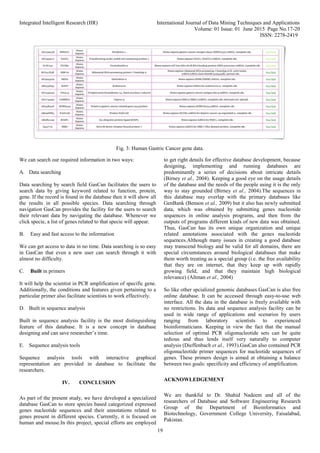
Fig. 3: Human Gastric Cancer gene data.
We can search our required information in two ways:
A. Data searching
Data searching by search field GasCan facilitates the users to
search data by giving keyword related to function, protein,
gene. If the record is found in the database then it will show all
the results in all possible species. Data searching through
navigation GasCan provides the facility for the users to search
their relevant data by navigating the database. Whenever we
click specie, a list of genes related to that specie will appear.
B. Easy and fast access to the information
We can get access to data in no time. Data searching is so easy
in GasCan that even a new user can search through it with
almost no difficulty.
C. Built in primers
It will help the scientist in PCR amplification of specific gene.
Additionally, the conditions and features given pertaining to a
particular primer also facilitate scientists to work effectively.
D. Built in sequence analysis
Built in sequence analysis facility is the most distinguishing
feature of this database. It is a new concept in database
designing and can save researcher’s time.
E. Sequence analysis tools
Sequence analysis tools with interactive graphical
representation are provided in database to facilitate the
researchers.
IV. CONCLUSION
As part of the present study, we have developed a specialized
database GasCan to store species based categorized expressed
genes nucleotide sequences and their annotations related to
genes present in different species. Currently, it is focused on
human and mouse.In this project, special efforts are employed
to get right details for effective database development, because
designing, implementing and running databases are
predominantly a series of decisions about intricate details
(Birney et al., 2004). Keeping a good eye on the usage details
of the database and the needs of the people using it is the only
way to stay grounded (Birney et al., 2004).The sequences in
this database may overlap with the primary databases like
GenBank (Benson et al., 2009) but it also has newly submitted
data, which was obtained by submitting genes nucleotide
sequences in online analysis programs, and then from the
outputs of programs different kinds of new data was obtained.
Thus, GasCan has its own unique organization and unique
related annotations associated with the genes nucleotide
sequences.Although many issues in creating a good database
may transcend biology and be valid for all domains, there are
special circumstances around biological databases that make
them worth treating as a special group (i.e. the free availability
that they are on internet, that they keep up with rapidly
growing field, and that they maintain high biological
relevance) (Altman et al., 2004)
So like other spcialized genomic databases GasCan is also free
online database. It can be accessed through easy-to-use web
interface. All the data in the database is freely available with
no restrictions. Its data and sequence analysis facility can be
used in wide range of applications and scenarios by users
ranging from laboratory scientists to experienced
bioinformaticians. Keeping in view the fact that the manual
selection of optimal PCR oligonucleotide sets can be quite
tedious and thus lends itself very naturally to computer
analysis (Dieffenbach et al., 1993).GasCan also contained PCR
oligonucleotide primer sequences for nucleotide sequences of
genes. These primers design is aimed at obtaining a balance
between two goals: specificity and efficiency of amplification.
ACKNOWLEDGEMENT
We are thankful to Dr. Shahid Nadeem and all of the
researchers of Database and Software Engineering Research
Group of the Department of Bioinformatics and
Biotechnology, Government College University, Faisalabad,
Pakistan.
Integrated Intelligent Research (IIR) International Journal of Data Mining Techniques and Applications
Volume: 01 Issue: 01 June 2015 Page No.17-20
ISSN: 2278-2419
20
REFERENCES
[1] Altman R. B. (2004) Building Successful Biological Databases,
Brief Bioinf. 5(1), 4-5.182
[2] Benson D. A., I. Karsch-Mizrachi, D. J. Lipman, J. Ostell, E. W.
Sayers (2009). GenBank, Nucleic Acids Res, 38(Database issue),
D14-D15.
[3] Birney E., M. Clamp (2004). Biological Database Design and
Implementation, Brief Bioinformatics, 5(1), 31-38.
[4] Buehler L. K., H. H. Rashidi (2005). Bioinformatics Basics:
Applications in Biological Science and Medicine, CRC Press, USA,
166 pp.
[5] Claverie J. M., C. Notredame (2006). Bioinformatics for Dummies,
2nd Edition, John Wiley & Sons Inc., 69-104.
[6] Cochrane G. R., M. Y. Galperin (2010). The 2010 Nucleic Acids
Research Database Issue and Online Database Collection: A
Community of Data Resources, Nucleic Acids Res, 38(Database
issue), D1-D4.
[7] Dieffenbach C. W., T. M. Lowe, G. S. Dveksler (1993). General
Concepts for PCR Primer Design, PCR Method Appl, 3(3), S30-
S37.
[8] Geer, R.C. (2006). Broad issues to consider for library involvement
in bioinformatics, JMed LibrAssoc., 94(3), 286-298.
[9] Ghisalberti G., M. Masseroli, L. Tettamanti (2010). Quality Controls
in Integrative Approaches to Detect Errors and Inconsistencies in
Biological Databases, J Integr Bioinform, 7(3), 2010-2119.
[10] Giancarlo, R., A. Siragusa, E. Siragusa, F. Utro (2007). A basic
analysis toolkit for biological sequences, Algo Mol Biol., 2(10),
404-406.
[11] Xiong J. (2006). Essential Bioinformatics, Cambridge University
Press, New York, USA.

V1_I1_2012_Paper5.doc

  • 1.
    Integrated Intelligent Research(IIR) International Journal of Data Mining Techniques and Applications Volume: 01 Issue: 01 June 2015 Page No.17-20 ISSN: 2278-2419 17 GASCAN: A Novel Database for Gastric Cancer Genes and Primers V.Khanaa1 , Krishna Mohanta2 1 Dean - Information. Bharath University, Chennai, 2 Sri Sai Ram Engg. College Chennai Email: drvkannan62@yahoo.com, krishnamohanta@gmail.com Abstract-GasCan is a specialized and unique database of gastric cancer protein encoding genes expressed in human and mouse. The features that make GasCan unique are availability of gene information, availability of primers for each gene, with their features and conditions given that are useful in PCR amplification, especially in cloning experiments and to make it more unique built in programmed sequence analysis facility is provided that analyze gene sequences in database itself, resulting sequence analysis information can be valuable for researchers in different experiments. Furthermore, DNA sequence analysis tool is provided that can be access freely. GasCan will expand in future to other species, genes and cover more useful information of other species. Flexible database design, expandability and easy access of information to all of the users are the main features of the database. The Database is publicly available at http://www.gastric-cancer.site40.net. Key words: Gastric Cancer, Database, Human, Mouse, Sumatran, Sequence Analysis I. INTRODUCTION Historically, databases have been arisen, to satisfy diverse needs, whether it address a biological question of an interest to an individual scientist, to better serve a particular section of biological community, to co-ordinate data from sequencing projects, or to facilitate drug discovery in pharmaceutical companies. According to Nucleic Acids Research annual database issues, in 2010 update, the online Database Collection that accompanies the issue holds 1230 data resources, a growth of 5% over last year [6].Databases are great tools because they offer a unique window on the past. They make it possible to answer today’s biological questions by enabling us to analyze sequences that may have been determined as many as 25 years ago, when the whole technology emerged. By doing this, they connect past and present molecular biology and other life sciences [5]. The exponential growth of biological data over the past decade has created an enormous challenge to make effective use of the accumulated information. Correctly cataloging, labeling and connecting sequence, structural and functional information of genes and proteins of various trends and laws crucial to our understanding of life on earth as complex systems [4]. Most available data are computationally derived and include errors and inconsistencies. Effective use of available data in order to derive new knowledge hence requires data integration and quality improvement [9].Computational analysis of biological sequences has become an extremely rich field of modern science and a highly interdisciplinary area, where statistical and algorithmic methods play a key role. In particular, sequence alignment tools have been at the hearth of this field for nearly 50 years [10].However, given the burgeoning array of molecular biology databases as well as data retrieval and analysis tools, users are challenged daily to identify the resources that best fit their needs and to use them effectively. This raises questions about the demographics of bioinformatics users, their needs, and libraries' roles in meeting those needs [8].Due to day by day increase in information present in online resources, data searching is becoming difficult. To tackle with this problem specialized databases are being developed that provide data related to particular problem. Such specialized databases are more quick and easy to use. These databases can be species specific or disease specific or providing information about specific genes, proteins or their respective families. We noticed these new trends in information management and devised a new way to provide gene information of gastric cancer with sequence analysis facility. The main objectives of our project are to provide;  A specialized, minimally redundant, and curated nucleotide sequence database of human and mouse that strives to provide highlevel annotations, including species based categorization of expressed genes.  Automatic sequence analysis facility in database.  Designed primer that can help in the amplification of expressed genes.  User friendly data retrieval facility so that even novice user can retrieve data without headache.  Single plateform where researcher can retrieve and perform analysis.  Sequence analysis tools. II. MATERIALS AND METHODS A. Data collection In the present study to develop the desired database, genes sequences that are expressed in different species and their relevant annotations were required. To collect the data we searched for protein coding genes in NCBI’s ‘GenBank’ and ‘Gene’ databases. We used nucleotide sequences in FASTA format and designed primers using Primer3. Then we analyzed the designed primers for primer-dimer formation and secondary structures using NetPrimer. B. Database Design In this project, special efforts are employed to get right details for effective database development, because designing,
  • 2.
    Integrated Intelligent Research(IIR) International Journal of Data Mining Techniques and Applications Volume: 01 Issue: 01 June 2015 Page No.17-20 ISSN: 2278-2419 18 implementing and running databases are predominantly a series of decisions about intricate details [3]. Fig.1 shows the database structure and working strategy . Fig. 1: Database structure and working. a) Species Section In this section, we can add new specie; edit the information about currently existing families and delete the currently existing specie. b) Genes Section In this section we can add new genes, second, edit the current genes or other information related to it and third, delete existing genes. c) Article Section In this section we can add new article, second, edit the current articles or other information related to it and third, delete existing articles. d) Sequence analysis Section This section is programmed to analyze the sequence. User searches the sequence and before the retrieval, the data is first analyzed by this section and resulting information is sent to user. III. SEQUENCE ANALYSIS TOOLS Sequence analysis tools i-e. In-silico central dogma of molecular biology, complement, reverse complement, nucleotide weight, melting temperature of primers, GC content percentage and nucleotide composition etc with interactive graphical representation are developed and included in database to facilitate the researchers.In the present study, we included complementary DNA nucleotide sequences for each gene. The primers designed for theses complementary DNA sequences are really useful in their PCR amplification when they are cloned into some sort of vector. The current database also includes protein information of the relevant genes and their function. These features are the result of our flexible database design. Fig. 2 shows the proportion of entries of each species. Followings are the salient features of the GasCan: Fig. 2: Proportion of gene data in each specie.
  • 3.
    Integrated Intelligent Research(IIR) International Journal of Data Mining Techniques and Applications Volume: 01 Issue: 01 June 2015 Page No.17-20 ISSN: 2278-2419 19 Fig. 3: Human Gastric Cancer gene data. We can search our required information in two ways: A. Data searching Data searching by search field GasCan facilitates the users to search data by giving keyword related to function, protein, gene. If the record is found in the database then it will show all the results in all possible species. Data searching through navigation GasCan provides the facility for the users to search their relevant data by navigating the database. Whenever we click specie, a list of genes related to that specie will appear. B. Easy and fast access to the information We can get access to data in no time. Data searching is so easy in GasCan that even a new user can search through it with almost no difficulty. C. Built in primers It will help the scientist in PCR amplification of specific gene. Additionally, the conditions and features given pertaining to a particular primer also facilitate scientists to work effectively. D. Built in sequence analysis Built in sequence analysis facility is the most distinguishing feature of this database. It is a new concept in database designing and can save researcher’s time. E. Sequence analysis tools Sequence analysis tools with interactive graphical representation are provided in database to facilitate the researchers. IV. CONCLUSION As part of the present study, we have developed a specialized database GasCan to store species based categorized expressed genes nucleotide sequences and their annotations related to genes present in different species. Currently, it is focused on human and mouse.In this project, special efforts are employed to get right details for effective database development, because designing, implementing and running databases are predominantly a series of decisions about intricate details (Birney et al., 2004). Keeping a good eye on the usage details of the database and the needs of the people using it is the only way to stay grounded (Birney et al., 2004).The sequences in this database may overlap with the primary databases like GenBank (Benson et al., 2009) but it also has newly submitted data, which was obtained by submitting genes nucleotide sequences in online analysis programs, and then from the outputs of programs different kinds of new data was obtained. Thus, GasCan has its own unique organization and unique related annotations associated with the genes nucleotide sequences.Although many issues in creating a good database may transcend biology and be valid for all domains, there are special circumstances around biological databases that make them worth treating as a special group (i.e. the free availability that they are on internet, that they keep up with rapidly growing field, and that they maintain high biological relevance) (Altman et al., 2004) So like other spcialized genomic databases GasCan is also free online database. It can be accessed through easy-to-use web interface. All the data in the database is freely available with no restrictions. Its data and sequence analysis facility can be used in wide range of applications and scenarios by users ranging from laboratory scientists to experienced bioinformaticians. Keeping in view the fact that the manual selection of optimal PCR oligonucleotide sets can be quite tedious and thus lends itself very naturally to computer analysis (Dieffenbach et al., 1993).GasCan also contained PCR oligonucleotide primer sequences for nucleotide sequences of genes. These primers design is aimed at obtaining a balance between two goals: specificity and efficiency of amplification. ACKNOWLEDGEMENT We are thankful to Dr. Shahid Nadeem and all of the researchers of Database and Software Engineering Research Group of the Department of Bioinformatics and Biotechnology, Government College University, Faisalabad, Pakistan.
  • 4.
    Integrated Intelligent Research(IIR) International Journal of Data Mining Techniques and Applications Volume: 01 Issue: 01 June 2015 Page No.17-20 ISSN: 2278-2419 20 REFERENCES [1] Altman R. B. (2004) Building Successful Biological Databases, Brief Bioinf. 5(1), 4-5.182 [2] Benson D. A., I. Karsch-Mizrachi, D. J. Lipman, J. Ostell, E. W. Sayers (2009). GenBank, Nucleic Acids Res, 38(Database issue), D14-D15. [3] Birney E., M. Clamp (2004). Biological Database Design and Implementation, Brief Bioinformatics, 5(1), 31-38. [4] Buehler L. K., H. H. Rashidi (2005). Bioinformatics Basics: Applications in Biological Science and Medicine, CRC Press, USA, 166 pp. [5] Claverie J. M., C. Notredame (2006). Bioinformatics for Dummies, 2nd Edition, John Wiley & Sons Inc., 69-104. [6] Cochrane G. R., M. Y. Galperin (2010). The 2010 Nucleic Acids Research Database Issue and Online Database Collection: A Community of Data Resources, Nucleic Acids Res, 38(Database issue), D1-D4. [7] Dieffenbach C. W., T. M. Lowe, G. S. Dveksler (1993). General Concepts for PCR Primer Design, PCR Method Appl, 3(3), S30- S37. [8] Geer, R.C. (2006). Broad issues to consider for library involvement in bioinformatics, JMed LibrAssoc., 94(3), 286-298. [9] Ghisalberti G., M. Masseroli, L. Tettamanti (2010). Quality Controls in Integrative Approaches to Detect Errors and Inconsistencies in Biological Databases, J Integr Bioinform, 7(3), 2010-2119. [10] Giancarlo, R., A. Siragusa, E. Siragusa, F. Utro (2007). A basic analysis toolkit for biological sequences, Algo Mol Biol., 2(10), 404-406. [11] Xiong J. (2006). Essential Bioinformatics, Cambridge University Press, New York, USA.