Best practices for supporting a version 1.0
product
Lala Mamedov
Supporting V1: Where do we start?
I cannot tell you how to do it…
I can tell you what questions to ask
2
The Four Questions
3
1. What is the
support strategy?
2. What is demand
for support?
4. How can we
preempt customer
issues?
3. How can the
issues be
resolved?
V 1.0
Strategy
4
What is the
support strategy?
What is demand
for support?
How can we
preempt customer
issues?
How can the issues
be resolved?
V 1.0
Support Strategy
• Why do we do support? What business are we in?
We are in the business of helping our customers achieve full benefit of
using our product, so they can be more productive and successful.
5
Our Support Goal
6
Eliminate the reason for the customers to contact us and if they do, rapidly resolve
issues to deliver delight and trust
Support Strategy: Choices
Offerings
• Paid?
• Free?
• Entitlements?
• Subscription?
Channels
• Phone?
• e-Case?
• Email?
• Chat?
• Forums?
• Blogs?
• Twitter
SLA
• 7 x 24?
• Time to response?
• Time to resolve?
Agent
sourcing
• Outsource or badged?
• Offshore or onshore?
• WFH?
Rooftop
• Sites?
• Agent distribution?
Partners
• Who owns customer?
• Case handoffs?
• Reporting?
7
STRATEG
Y
Support Process
8
A WOW Customer
Experience
Delight!
3. For new issues or customers preferring
assisted help, rapidly resolve their issue
in a manner that creates delight.
When appropriate, educate how to
solve for themselves.
1. Ensure our Products/Services are so easy to use
that it minimizes the need to contact us for issue
resolution.
2. For known issues make it easy for
customers to rapidly find answers
through online channel of their choice
4. Identify root cause and
partner with product and
marketing teams and
to “find once, prevent many”
Strategy: KB is the heart of the support system
9
• Knowledge creation is how support is delivered – not an afterthought
• Reward agents for what they share broadly, not just 1:1 with an individual customer
• Focus on proactive and preemptive support rather than reactive
• Allow and enable customers to create and share knowledge
• Accurate, actionable answers available to customers immediately
• Product is continually improved based on the analysis of answer reuse rate
• Few predefined case handoff options for the partners – no custom work
• Focus on proactive and preemptive support rather than reactive
• Solve for speed to publish and immediate product feedback
• Focus on cost-efficiency and scalability
• Leverage (and share) best practices
Guiding Principles
Support Model
10
In-Product
Self-Service
Support Site
Community
Agent-Assisted
• Embedded Content
• Plain English language
• Context Sensitive Help
• Support team authored,
professionally reviewed content
• Answers when people need
them
• Enriched by member interaction
• Multimedia FAQs
• People helping people
• Moderated by support agents
• Content transferred into KB
• E-case w/callback or email
•One business day
committed turnaround
• Support delivered in process of
creating knowledge
• Remote support access
as needed
• Self service site: main entry for customer assistance
10
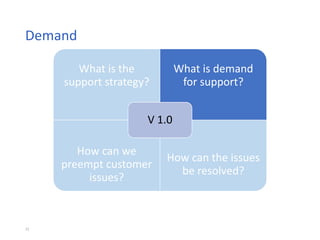
Demand
11
What is the
support strategy?
What is demand
for support?
How can we
preempt customer
issues?
How can the issues
be resolved?
V 1.0
Support Demand
• Users
• How many users will we have?
• Usually available from Marketing, PM of BusDev
• One to three year model
• Segmentation
• Consumer, SMB or Enterprise?
• What are the customer roles?
• IT, developers, end-users, CFOs, CIOs, small business owners … etc
• What are their expectations of support?
12
Adoption Model
13
Column1 5/1/2009 6/1/2009 7/1/2009 8/1/2009 9/1/2009 10/1/2009 11/1/2009
Month Month Month Month Month Month Month
Total Practices 30 40 60 90 135 202.5 303.75
Total Physicians 240 300 720 1020 1500 1980 2700
New Practices data to load: # patients 208000 208000 416000 832000 832000 832000 1248000
Patient visits to physician 64800 108000 194400 367200 540000 712800 972000
Patients eligible 31104 51840 93312 176256 259200 342144 466560
Patients signing up 13478.4 22464 40435.2 76377.6 112320 148262.4 202176
Use Cases
• What are going to be the top issues?
• Define 20-30 use cases
• What is the probability and impact of each?
• Assign severity
• Contact mechanism per customer role and use case?
14
Resolution
15
What is the
support strategy?
What is demand
for support?
How can we
preempt customer
issues?
How can the issues
be resolved?
V 1.0
Resolution
People
• What is the skill profile
needed to resolve issues?
• What is support HC
model?
• Who are the SMEs to
train?
• Can we use PD to deliver
support?
Process
• What is the difference
between issues and
incidents?
• What will be the
resolution process?
• Should we use just-in-
case or just-in-time
knowledge creation?
• What listening posts
should we have in place?
• What are the KPIs?
Tools
• What tools do we need in
support of the
workflows?
• How can we effectively
capture and share
knowledge?
• What are the gaps in the
tools availability?
• How can we mitigate the
risk?
Support Pyramid
T3: 50%
T2: 40%
T1:10%
T0
T3: 5%
T2: 25%
T1: 70%
T0: Self-Service
Tiered Support - Mature Product Tiered Support – New Product
Contacts
• What will be the contact ratio?
• Estimates from benchmarks
• Handle time per case?
• Estimates from simulations
• Time to resolve?
• Estimates from process mapping
• Self-service deflection?
• Estimates from benchmarks
18
Headcount Model Assumptions
• Alpha: two cases per tester per week down to one case/week
• Beta: one case per tester per week contact ratio
• Launch: contact ratio from 0.15 to 0.05/mo (three models)
• Processing time 15 min/case in first 2 months, then down to 10
• Available time per agent per day 6.5 hrs
• Not including root cause elimination gains
• Self-service deflection rate 30% going up by 0.01% after first 2
months up to 50%, then slows down
19
Support Headcount Model
• N= eligible users
• CR= contact ratio
• T = throughput (in hours)
• M= available work hours per agent per month
• D= self-service deflection
• S = shrinkage
• X= agents needed
X= N*CR*T*(1-D)/M*(1-S)
Contact Ratio .05 Q4 Q1 Q1 Q1 Q2 Q2 Q2 Q3 Q3 Q3 Q4 Q4 Q4
L.M. 1.0 1.0 1.0 1.0 1.0 1.0 1.0 1.0 1.0 1.0 1.0 1.0 1.0
C.B. 1.0 1.0 1.0 1.0 1.0 1.0 1.0 1.0 1.0 1.0 1.0 1.0 1.0
M.W. 1.0 1.0 1.0 1.0 1.0 1.0 1.0 1.0 1.0 1.0 1.0 1.0 1.0
H.M. 1.0 1.0 1.0 1.0 1.0 1.0 1.0 1.0 1.0 1.0 1.0 1.0 1.0
Z.Z. 0.5 0.5 0.5 0.5 0.5 0.5 0.5 0.5 0.5 0.5 0.5
TBH - Tier 2 Agent 1.0 1.0 1.0
TBH - Tier 2 Agent 1.0 1.0
TBH - Mgr/Escalation 1.0 1.0
TBH - Tier 2 Agent 1.0
Total Headcount 4.0 4.0 4.5 4.5 4.5 4.5 4.5 4.5 4.5 4.5 6.5 11.5 14.5
Staffing Mix
• Resources
• Headcount model driven by product adoption rates, contact ratio, agent
productivity and self-service deflection rates
• Staffing mix driven by Knowledge Base maturity levels
Immature KB Medium KB Maturity Mature KB
Phase 1 Phase 2 Phase 3
Staffing mix:
Permanent co-located
employees, Tier 2 skills, PD
backup
Staffing mix:
Permanent employees, growing
offsite and WFH, Tier 1 and 2
skills
Staffing mix:
Mostly offsite and WFH employees,
mostly Tier1 skills, consider
outsourced support
Product lifecycle and KB maturity levels
Resolution
People
• What is the skill profile
needed to resolve issues?
• What is support HC
model?
• Who are the SMEs to
train?
• Can we use PD to deliver
support?
Process
• What is the difference
between issues and
incidents?
• What will be the
resolution process?
• Should we use just-in-
case or just-in-time
knowledge creation?
• What listening posts
should we have in place?
• What are the KPIs?
Tools
• What tools do we need in
support of the
workflows?
• How can we effectively
capture and share
knowledge?
• What are the gaps in the
tools availability?
• How can we mitigate the
risk?
Issues vs. Incidents
• An Incident is a problem report from an end-user; it generally describes
the specific symptoms being experienced that may be specific to a
particular environment or setup. Incidents are all about the customer;
they are managed at the Tier 1 level.
• An Issue is the underlying problem that caused the incidents; may
impact more than one customer. Issues are all about the product, and
are managed at Tier 2 level.
• Issues may be resolved by Tier 2 or Tier 3; associated incidents are
closed by Tier 1.
23
Issue Workflow
24
Knowledge Creation
Just in
Time
Just in Case
25
Listening Posts in Place:
•Member-submitted Incidents
•KB reuse
•Feedback form in product
•KB feedback form
•Internal monitoring
•Usability/FMH sessions
•Partner support teams
•Web analytics
Listening Posts
26
Operational Metrics
Jeff, 4
John, 5
Jane, 5
Peter, 2
Mark, 2
Mary, 8
-5
0
5
10
15
20
25
30
35
40
45
50
-5 0 5 10 15 20 25 30 35
Knowledge Contribution
CaseProductvity
Interface # incidents created # Solved % Solved
quickenmedical 74 65 87%
quickenhealth 57 52 91%
Total 131
% Solved Within 1 Business Day
KPIs
28
Measurement Goal Jan Feb Trend
Self-service solve rate 25% 15% 20%
Self-service deflection rate 25% 12% 10%
Sat Scores 85% 80% 84%
% of cases within SLA 80% 80% 82%
Average daily backlog 30 20 25
KB maturity level 50% 25% 35%
Resolution
People
• What is the skill profile
needed to resolve issues?
• What is support HC
model?
• Who are the SMEs to
train?
• Can we use PD to deliver
support?
Process
• What is the difference
between issues and
incidents?
• What will be the
resolution process?
• Should we use just-in-
case or just-in-time
knowledge creation?
• What listening posts
should we have in place?
• What are the KPIs?
Tools
• What tools do we need in
support of the
workflows?
• How can we effectively
capture and share
knowledge?
• What are the gaps in the
tools availability?
• How can we mitigate the
risk?
Tools Assessment
30
Element
8- most important,
1 - least imortant
8- perfect,
1- horrible Size
Importance Score
e-Case submission 8 6 14
Agent interface 4 6 10
Reporting 2 2 4
KB authoring 7 3 10
Escalation flow 2 6 8
VOC 5 3 8
Partner cases 5 1 6
Prioritization
0
1
2
3
4
5
6
7
8
9
0 1 2 3 4 5 6 7 8 9
Score
Importance
Tools Assessment
e-Case submission
Agent interface
Reporting
Escalation flow
VOC
Partner cases
KB authoring
Reporting
Escalation flow
e-CaseVOC
KB Authoring
Agent Interface
Partner cases
Priority Attention
31
Preemptive model
32
What is the
support strategy?
What is demand
for support?
How can we
preempt customer
issues?
How can the issues
be resolved?
V 1.0
Moving to preemptive model
• Do we understand desired vs. undesired contacts?
• Are we ready to track root cause of every issue?
• Do we have a mechanism to quantify impact per issue?
• What can the product do that we manually do today?
• What can the customers do on their own that we manually do for
them today?
• How can we establish a closed loop process?
33
Contact Value Matrix
Simplify & Improve
Underlying
operations
(“I just want to activate
my product”)
Leverage, exploit and
spend more time
(“How do I develop a
profitability report)
Eliminate through
root-cause
analysis
development
(“I’m getting this error
message”)
Automate through
self-help tools &
alerts
(“Can you send me my
monthly statement”)
Value of contact
to Customer
HIGH
(Save money, get
support, get advice)
LOW
(Irritant: No need for
interaction)
ValueofContact
tous
HIGH
(Learn, cut costs,
increase revenue)
LOW
(Do not want the
interaction)
Based on the “Value-Irritant Matrix” from “The Best Service is No Service” by Bill Price & David Jaffe
KB Reports
35
Top 5 agent reused answers
Top 5 customer reused answers
HOT: Issues causing most dissatisfaction
Business impact of
top customer issues
Closed loop process
Customer
Support
works the
case
Root cause
to PM
Issue
disposition
Update
back to
customer
37
Tips and Tricks
• Use cases review
• Knowledge contribution events
• Less is more
 Clear expectation on resources needed at launch
 Knowledge transfer from PD/PM is critical for success
 Transition from consumer to enterprise support mindset may be a
challenge
• War room
• Core vs. context
38
The Four Questions
39
1. What is the
support strategy?
2. What is demand
for support?
4. How can we
preempt customer
issues?
3. How can the
issues be
resolved?
V 1.0

Supporting a version 1.0 of a product

  • 1.
    Best practices forsupporting a version 1.0 product Lala Mamedov
  • 2.
    Supporting V1: Wheredo we start? I cannot tell you how to do it… I can tell you what questions to ask 2
  • 3.
    The Four Questions 3 1.What is the support strategy? 2. What is demand for support? 4. How can we preempt customer issues? 3. How can the issues be resolved? V 1.0
  • 4.
    Strategy 4 What is the supportstrategy? What is demand for support? How can we preempt customer issues? How can the issues be resolved? V 1.0
  • 5.
    Support Strategy • Whydo we do support? What business are we in? We are in the business of helping our customers achieve full benefit of using our product, so they can be more productive and successful. 5
  • 6.
    Our Support Goal 6 Eliminatethe reason for the customers to contact us and if they do, rapidly resolve issues to deliver delight and trust
  • 7.
    Support Strategy: Choices Offerings •Paid? • Free? • Entitlements? • Subscription? Channels • Phone? • e-Case? • Email? • Chat? • Forums? • Blogs? • Twitter SLA • 7 x 24? • Time to response? • Time to resolve? Agent sourcing • Outsource or badged? • Offshore or onshore? • WFH? Rooftop • Sites? • Agent distribution? Partners • Who owns customer? • Case handoffs? • Reporting? 7 STRATEG Y
  • 8.
    Support Process 8 A WOWCustomer Experience Delight! 3. For new issues or customers preferring assisted help, rapidly resolve their issue in a manner that creates delight. When appropriate, educate how to solve for themselves. 1. Ensure our Products/Services are so easy to use that it minimizes the need to contact us for issue resolution. 2. For known issues make it easy for customers to rapidly find answers through online channel of their choice 4. Identify root cause and partner with product and marketing teams and to “find once, prevent many”
  • 9.
    Strategy: KB isthe heart of the support system 9 • Knowledge creation is how support is delivered – not an afterthought • Reward agents for what they share broadly, not just 1:1 with an individual customer • Focus on proactive and preemptive support rather than reactive • Allow and enable customers to create and share knowledge • Accurate, actionable answers available to customers immediately • Product is continually improved based on the analysis of answer reuse rate • Few predefined case handoff options for the partners – no custom work • Focus on proactive and preemptive support rather than reactive • Solve for speed to publish and immediate product feedback • Focus on cost-efficiency and scalability • Leverage (and share) best practices Guiding Principles
  • 10.
    Support Model 10 In-Product Self-Service Support Site Community Agent-Assisted •Embedded Content • Plain English language • Context Sensitive Help • Support team authored, professionally reviewed content • Answers when people need them • Enriched by member interaction • Multimedia FAQs • People helping people • Moderated by support agents • Content transferred into KB • E-case w/callback or email •One business day committed turnaround • Support delivered in process of creating knowledge • Remote support access as needed • Self service site: main entry for customer assistance 10
  • 11.
    Demand 11 What is the supportstrategy? What is demand for support? How can we preempt customer issues? How can the issues be resolved? V 1.0
  • 12.
    Support Demand • Users •How many users will we have? • Usually available from Marketing, PM of BusDev • One to three year model • Segmentation • Consumer, SMB or Enterprise? • What are the customer roles? • IT, developers, end-users, CFOs, CIOs, small business owners … etc • What are their expectations of support? 12
  • 13.
    Adoption Model 13 Column1 5/1/20096/1/2009 7/1/2009 8/1/2009 9/1/2009 10/1/2009 11/1/2009 Month Month Month Month Month Month Month Total Practices 30 40 60 90 135 202.5 303.75 Total Physicians 240 300 720 1020 1500 1980 2700 New Practices data to load: # patients 208000 208000 416000 832000 832000 832000 1248000 Patient visits to physician 64800 108000 194400 367200 540000 712800 972000 Patients eligible 31104 51840 93312 176256 259200 342144 466560 Patients signing up 13478.4 22464 40435.2 76377.6 112320 148262.4 202176
  • 14.
    Use Cases • Whatare going to be the top issues? • Define 20-30 use cases • What is the probability and impact of each? • Assign severity • Contact mechanism per customer role and use case? 14
  • 15.
    Resolution 15 What is the supportstrategy? What is demand for support? How can we preempt customer issues? How can the issues be resolved? V 1.0
  • 16.
    Resolution People • What isthe skill profile needed to resolve issues? • What is support HC model? • Who are the SMEs to train? • Can we use PD to deliver support? Process • What is the difference between issues and incidents? • What will be the resolution process? • Should we use just-in- case or just-in-time knowledge creation? • What listening posts should we have in place? • What are the KPIs? Tools • What tools do we need in support of the workflows? • How can we effectively capture and share knowledge? • What are the gaps in the tools availability? • How can we mitigate the risk?
  • 17.
    Support Pyramid T3: 50% T2:40% T1:10% T0 T3: 5% T2: 25% T1: 70% T0: Self-Service Tiered Support - Mature Product Tiered Support – New Product
  • 18.
    Contacts • What willbe the contact ratio? • Estimates from benchmarks • Handle time per case? • Estimates from simulations • Time to resolve? • Estimates from process mapping • Self-service deflection? • Estimates from benchmarks 18
  • 19.
    Headcount Model Assumptions •Alpha: two cases per tester per week down to one case/week • Beta: one case per tester per week contact ratio • Launch: contact ratio from 0.15 to 0.05/mo (three models) • Processing time 15 min/case in first 2 months, then down to 10 • Available time per agent per day 6.5 hrs • Not including root cause elimination gains • Self-service deflection rate 30% going up by 0.01% after first 2 months up to 50%, then slows down 19
  • 20.
    Support Headcount Model •N= eligible users • CR= contact ratio • T = throughput (in hours) • M= available work hours per agent per month • D= self-service deflection • S = shrinkage • X= agents needed X= N*CR*T*(1-D)/M*(1-S) Contact Ratio .05 Q4 Q1 Q1 Q1 Q2 Q2 Q2 Q3 Q3 Q3 Q4 Q4 Q4 L.M. 1.0 1.0 1.0 1.0 1.0 1.0 1.0 1.0 1.0 1.0 1.0 1.0 1.0 C.B. 1.0 1.0 1.0 1.0 1.0 1.0 1.0 1.0 1.0 1.0 1.0 1.0 1.0 M.W. 1.0 1.0 1.0 1.0 1.0 1.0 1.0 1.0 1.0 1.0 1.0 1.0 1.0 H.M. 1.0 1.0 1.0 1.0 1.0 1.0 1.0 1.0 1.0 1.0 1.0 1.0 1.0 Z.Z. 0.5 0.5 0.5 0.5 0.5 0.5 0.5 0.5 0.5 0.5 0.5 TBH - Tier 2 Agent 1.0 1.0 1.0 TBH - Tier 2 Agent 1.0 1.0 1.0 TBH - Tier 2 Agent 1.0 1.0 TBH - Tier 2 Agent 1.0 1.0 TBH - Tier 2 Agent 1.0 1.0 TBH - Tier 2 Agent 1.0 1.0 TBH - Mgr/Escalation 1.0 1.0 TBH - Tier 2 Agent 1.0 TBH - Tier 2 Agent 1.0 TBH - Tier 2 Agent 1.0 Total Headcount 4.0 4.0 4.5 4.5 4.5 4.5 4.5 4.5 4.5 4.5 6.5 11.5 14.5
  • 21.
    Staffing Mix • Resources •Headcount model driven by product adoption rates, contact ratio, agent productivity and self-service deflection rates • Staffing mix driven by Knowledge Base maturity levels Immature KB Medium KB Maturity Mature KB Phase 1 Phase 2 Phase 3 Staffing mix: Permanent co-located employees, Tier 2 skills, PD backup Staffing mix: Permanent employees, growing offsite and WFH, Tier 1 and 2 skills Staffing mix: Mostly offsite and WFH employees, mostly Tier1 skills, consider outsourced support Product lifecycle and KB maturity levels
  • 22.
    Resolution People • What isthe skill profile needed to resolve issues? • What is support HC model? • Who are the SMEs to train? • Can we use PD to deliver support? Process • What is the difference between issues and incidents? • What will be the resolution process? • Should we use just-in- case or just-in-time knowledge creation? • What listening posts should we have in place? • What are the KPIs? Tools • What tools do we need in support of the workflows? • How can we effectively capture and share knowledge? • What are the gaps in the tools availability? • How can we mitigate the risk?
  • 23.
    Issues vs. Incidents •An Incident is a problem report from an end-user; it generally describes the specific symptoms being experienced that may be specific to a particular environment or setup. Incidents are all about the customer; they are managed at the Tier 1 level. • An Issue is the underlying problem that caused the incidents; may impact more than one customer. Issues are all about the product, and are managed at Tier 2 level. • Issues may be resolved by Tier 2 or Tier 3; associated incidents are closed by Tier 1. 23
  • 24.
  • 25.
  • 26.
    Listening Posts inPlace: •Member-submitted Incidents •KB reuse •Feedback form in product •KB feedback form •Internal monitoring •Usability/FMH sessions •Partner support teams •Web analytics Listening Posts 26
  • 27.
    Operational Metrics Jeff, 4 John,5 Jane, 5 Peter, 2 Mark, 2 Mary, 8 -5 0 5 10 15 20 25 30 35 40 45 50 -5 0 5 10 15 20 25 30 35 Knowledge Contribution CaseProductvity Interface # incidents created # Solved % Solved quickenmedical 74 65 87% quickenhealth 57 52 91% Total 131 % Solved Within 1 Business Day
  • 28.
    KPIs 28 Measurement Goal JanFeb Trend Self-service solve rate 25% 15% 20% Self-service deflection rate 25% 12% 10% Sat Scores 85% 80% 84% % of cases within SLA 80% 80% 82% Average daily backlog 30 20 25 KB maturity level 50% 25% 35%
  • 29.
    Resolution People • What isthe skill profile needed to resolve issues? • What is support HC model? • Who are the SMEs to train? • Can we use PD to deliver support? Process • What is the difference between issues and incidents? • What will be the resolution process? • Should we use just-in- case or just-in-time knowledge creation? • What listening posts should we have in place? • What are the KPIs? Tools • What tools do we need in support of the workflows? • How can we effectively capture and share knowledge? • What are the gaps in the tools availability? • How can we mitigate the risk?
  • 30.
    Tools Assessment 30 Element 8- mostimportant, 1 - least imortant 8- perfect, 1- horrible Size Importance Score e-Case submission 8 6 14 Agent interface 4 6 10 Reporting 2 2 4 KB authoring 7 3 10 Escalation flow 2 6 8 VOC 5 3 8 Partner cases 5 1 6
  • 31.
    Prioritization 0 1 2 3 4 5 6 7 8 9 0 1 23 4 5 6 7 8 9 Score Importance Tools Assessment e-Case submission Agent interface Reporting Escalation flow VOC Partner cases KB authoring Reporting Escalation flow e-CaseVOC KB Authoring Agent Interface Partner cases Priority Attention 31
  • 32.
    Preemptive model 32 What isthe support strategy? What is demand for support? How can we preempt customer issues? How can the issues be resolved? V 1.0
  • 33.
    Moving to preemptivemodel • Do we understand desired vs. undesired contacts? • Are we ready to track root cause of every issue? • Do we have a mechanism to quantify impact per issue? • What can the product do that we manually do today? • What can the customers do on their own that we manually do for them today? • How can we establish a closed loop process? 33
  • 34.
    Contact Value Matrix Simplify& Improve Underlying operations (“I just want to activate my product”) Leverage, exploit and spend more time (“How do I develop a profitability report) Eliminate through root-cause analysis development (“I’m getting this error message”) Automate through self-help tools & alerts (“Can you send me my monthly statement”) Value of contact to Customer HIGH (Save money, get support, get advice) LOW (Irritant: No need for interaction) ValueofContact tous HIGH (Learn, cut costs, increase revenue) LOW (Do not want the interaction) Based on the “Value-Irritant Matrix” from “The Best Service is No Service” by Bill Price & David Jaffe
  • 35.
    KB Reports 35 Top 5agent reused answers Top 5 customer reused answers HOT: Issues causing most dissatisfaction
  • 36.
    Business impact of topcustomer issues
  • 37.
    Closed loop process Customer Support worksthe case Root cause to PM Issue disposition Update back to customer 37
  • 38.
    Tips and Tricks •Use cases review • Knowledge contribution events • Less is more  Clear expectation on resources needed at launch  Knowledge transfer from PD/PM is critical for success  Transition from consumer to enterprise support mindset may be a challenge • War room • Core vs. context 38
  • 39.
    The Four Questions 39 1.What is the support strategy? 2. What is demand for support? 4. How can we preempt customer issues? 3. How can the issues be resolved? V 1.0