   Although learning advisors are often qualified teachers, the skills they
    apply, such as those discussed by Kelly (1996), require a significant shift
    in approach regarding interaction with students. As teachers reorient
    themselves to advising, their role changes quite markedly from teaching
    language to advising on learning (Mozzon-McPherson, 2001). This
    challenging move requires professional development training to support
    and ease the alteration of professional roles (Hafner& Young, 2007). As
    part of the professional development for advisors at Kanda University of
    International Studies (KUIS) in Japan, advisors undertake a series of
    ‘observations’ where they record and reflect on advising sessions. The
    reflection is written up and discussed with a more experienced advisor.
    An analysis of these reflections was recently carried out at KUIS with a
    view to identify common themes which provide important insights and
    practical implications for potential advisors and those providing
    professional support to new advisors. This presentation outlines the
    context before moving on to provide the findings of the study.
Brian R. Morrison
Kanda University of International Studies (KUIS)

Specialist language university

Students generally come from a controlled, exam-
  based language learning experience, and have been
  successful in this environment

KUIS students expected to use (and assessed on their
 use of) English. Previous successful learning
 strategies are unlikely to be so effective.
As well as language classes & a Self Access
 Centre (SAC), KUIS has employed teachers to
 work in the SAC
but not as teachers, as learning advisors
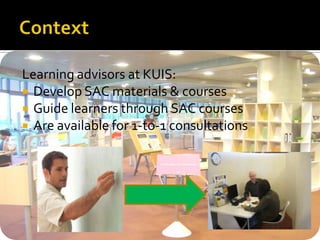
Learning advisors at KUIS:
 Develop SAC materials & courses
 Guide learners through SAC courses
 Are available for 1-to-1 consultations
1. Help learners identify strengths
   and weaknesses & set goals
2. Support learners as they develop,
   implement & modify learning
   plans
3. Increase learners’ understanding
   of their own learning
Kelly’s (1996) skills (taken from 1-to-1
 counselling skills)

 Macro skills
Initiating, Goal-
  setting, Guiding, Modelling, Supporting, Givin
  g feedback, Evaluating, Linking, Concluding

- Vaguely sequential but they may occur or re-
   occur at any point
Kelly’s (1996) skills (taken from 1-to-1
 counselling skills)

Micro skills
Attending, Restating, Paraphrasing, Summarizi
 ng, Questioning, Interpreting, Reflecting
 feelings, Empathising, Confronting

- May occur in combination e.g. questioning
  requires attending and may also confront
Formal reflections on advising
 Mandatory
 3 completed over the first 3 semesters at
  KUIS
 Either on
   written feedback
           (using learners’ written course work)
   face-to-face advising sessions
           (using audio recordings of the sessions)
   Formal reflections
     Advisor writes a reflection document
     More experienced advisor adds comments
     Advisor responds to comments


These documents are confidential and only normally
  seen by the ELI management & the learning
  advisors who wrote them
   Carried out in 2010
   All 15 LAs (past & present) asked for permission to
    analyse their documents - permission obtained from
    14
   Focused on face-to-face session reflections
   21 face-to-face professional development session
    reflections analysed

Research questions:
Which of Kelly’s skills seem most relevant for new
  learning advisors to focus on?
Are there any additional salient skills to be considered?
   Macro-skills
     Goal-setting
     Guiding
   Micro-skills
     Questioning
     Attending
   Another skill?
     Negotiating meaning
Viewed as a vital starting point to the entire
  session
 Important to confirm goals meet a
  combination of learner’s wants, interests &
  needs
 Encourage learners to focus or adjust goals to
  reflect the timeframe, when appropriate
Advisors also set goals:
 Effectively when focusing on their own
  advising skills
 Effectively when a learning plan was
  previewed before an advising session and the
  advisor could focus on areas to find out more
 Less effectively when a learning plan was
  previewed and seen as a document
  containing problems to fix
Many advisors identified this as the most
  problematic macro-skill, commonly observed
  as:
 Too much advisor talk time
 Closed (yes/no) questions used to lead the
  learners to a particular point with no real
  learner choice
More appropriate guiding involved:
 Delving deeper with open questions
 Finding out why learners had made their
  choices as it could:
  Reveal learners had clear rationale
  Allow more learner reflection around the choices
   they made
  Keep ownership of learning plans with the
   learners
Many advisors identified this as the most
  problematic micro-skill, commonly observed
  as:
 Closed questions used to lead
 Open questions which are difficult to answer
     Opaque
     Tangential
     Requiring specialist knowledge
   Asking several questions in 1 utterance
More appropriate questioning involved:
 Closed questions used to establish a fact or
  belief that was unknown to the advisor before
  moving to open questions
 With difficult-to-answer open
  questions, advisors who dealt well after uttering
  these:
     Stopped
     Summarised the recent part of the discussion
     Contextualised the question
     Restated or broke down the question
Attending was referred to as much as
 questioning in session reflections but not
 always by the advisor. It often took
 comments from the experienced learning
 advisor to identify it as absent

   The underlying reasons appeared to be:
     Learning advisor agenda
     Pressure to perform (evidence knowledge)
     Discomfort with silence
“Pausing and leaving time for reflection is one of
  the difficult skills which and advisor has to learn”
Mozzon-McPherson (2000)
Learning advisor awareness appears to be key
  to improving this skill

   Where data was available for more than 1
    session reflection, subsequent sessions had
    attending clearly identified as requiring and
    receiving attention and this heightened
    awareness led to greater satisfaction with the
    implementation
This could be realised by any or a combination
 of micro-skills such as
 paraphrasing, attending, summarizing, restat
 ing or questioning

Negotiating meaning could be instigated by
 either the advisor or learner and would go
 some way to ensuring the dialogue
 progresses in a direction both participants
 understand.
However on reflection I could have clarified a little
  more, for example when she said, “I write sentence”
  does she copy the sentence from the book or does she
  make her own sentences? Also I assumed when she
  says, “and speaking” that she means she repeats out
  loud the new vocabulary and sentences she has
  written down however she could have meant that she
  uses it in conversation.
Learning advisor session reflection
This presentation gives an insight into the perception
  advisors have of their advising sessions and the
  common areas they focus on using Kelly’s (1996)
  counselling skills as categories for analysis. Despite
  the diverse teaching experience LAs had before
  coming to KUIS it became apparent through this
  investigation that goal-setting, guiding, questioning
  and attending are perceived as particularly important
  and requiring attention. The findings also suggest that
  Kelly’s skills require modification with the addition of
  negotiating meaning, a skill implemented to provide
  clarification and focus.
Brian R. Morrison

       morrison_brian@yahoo.com

  This presentation is available online at:

http://kandaeli.academia.edu/BobMorrison
   Kelly, R. (1996). Language counselling for learner
    autonomy: the skilled helper in self-access language
    learning. In Pemberton, R., Li, E.S.L., Or, W.W.F.,
    Pierson, H.D. (Eds.). Taking control: Autonomy in
    language learning. Hong Kong University Press, pp.93-
    113.

   Mozzon-McPherson M., (2000) An analysis of the skills
    and functions of language learning advisers. In Victori
    M. (Ed.), Links and Letters 7: Autonomy in L2
    Learning, Barcelona: Universidad Autonoma de
    Barcelona. pp.111-126.

V10 Morrison

  • 1.
    Although learning advisors are often qualified teachers, the skills they apply, such as those discussed by Kelly (1996), require a significant shift in approach regarding interaction with students. As teachers reorient themselves to advising, their role changes quite markedly from teaching language to advising on learning (Mozzon-McPherson, 2001). This challenging move requires professional development training to support and ease the alteration of professional roles (Hafner& Young, 2007). As part of the professional development for advisors at Kanda University of International Studies (KUIS) in Japan, advisors undertake a series of ‘observations’ where they record and reflect on advising sessions. The reflection is written up and discussed with a more experienced advisor. An analysis of these reflections was recently carried out at KUIS with a view to identify common themes which provide important insights and practical implications for potential advisors and those providing professional support to new advisors. This presentation outlines the context before moving on to provide the findings of the study.
  • 2.
  • 3.
    Kanda University ofInternational Studies (KUIS) Specialist language university Students generally come from a controlled, exam- based language learning experience, and have been successful in this environment KUIS students expected to use (and assessed on their use of) English. Previous successful learning strategies are unlikely to be so effective.
  • 4.
    As well aslanguage classes & a Self Access Centre (SAC), KUIS has employed teachers to work in the SAC
  • 5.
    but not asteachers, as learning advisors
  • 7.
    Learning advisors atKUIS:  Develop SAC materials & courses  Guide learners through SAC courses  Are available for 1-to-1 consultations
  • 8.
    1. Help learnersidentify strengths and weaknesses & set goals 2. Support learners as they develop, implement & modify learning plans 3. Increase learners’ understanding of their own learning
  • 9.
    Kelly’s (1996) skills(taken from 1-to-1 counselling skills)  Macro skills Initiating, Goal- setting, Guiding, Modelling, Supporting, Givin g feedback, Evaluating, Linking, Concluding - Vaguely sequential but they may occur or re- occur at any point
  • 10.
    Kelly’s (1996) skills(taken from 1-to-1 counselling skills) Micro skills Attending, Restating, Paraphrasing, Summarizi ng, Questioning, Interpreting, Reflecting feelings, Empathising, Confronting - May occur in combination e.g. questioning requires attending and may also confront
  • 11.
    Formal reflections onadvising  Mandatory  3 completed over the first 3 semesters at KUIS  Either on  written feedback (using learners’ written course work)  face-to-face advising sessions (using audio recordings of the sessions)
  • 12.
    Formal reflections  Advisor writes a reflection document  More experienced advisor adds comments  Advisor responds to comments These documents are confidential and only normally seen by the ELI management & the learning advisors who wrote them
  • 13.
    Carried out in 2010  All 15 LAs (past & present) asked for permission to analyse their documents - permission obtained from 14  Focused on face-to-face session reflections  21 face-to-face professional development session reflections analysed Research questions: Which of Kelly’s skills seem most relevant for new learning advisors to focus on? Are there any additional salient skills to be considered?
  • 14.
    Macro-skills  Goal-setting  Guiding  Micro-skills  Questioning  Attending  Another skill?  Negotiating meaning
  • 15.
    Viewed as avital starting point to the entire session  Important to confirm goals meet a combination of learner’s wants, interests & needs  Encourage learners to focus or adjust goals to reflect the timeframe, when appropriate
  • 16.
    Advisors also setgoals:  Effectively when focusing on their own advising skills  Effectively when a learning plan was previewed before an advising session and the advisor could focus on areas to find out more  Less effectively when a learning plan was previewed and seen as a document containing problems to fix
  • 17.
    Many advisors identifiedthis as the most problematic macro-skill, commonly observed as:  Too much advisor talk time  Closed (yes/no) questions used to lead the learners to a particular point with no real learner choice
  • 18.
    More appropriate guidinginvolved:  Delving deeper with open questions  Finding out why learners had made their choices as it could:  Reveal learners had clear rationale  Allow more learner reflection around the choices they made  Keep ownership of learning plans with the learners
  • 19.
    Many advisors identifiedthis as the most problematic micro-skill, commonly observed as:  Closed questions used to lead  Open questions which are difficult to answer  Opaque  Tangential  Requiring specialist knowledge  Asking several questions in 1 utterance
  • 20.
    More appropriate questioninginvolved:  Closed questions used to establish a fact or belief that was unknown to the advisor before moving to open questions  With difficult-to-answer open questions, advisors who dealt well after uttering these:  Stopped  Summarised the recent part of the discussion  Contextualised the question  Restated or broke down the question
  • 21.
    Attending was referredto as much as questioning in session reflections but not always by the advisor. It often took comments from the experienced learning advisor to identify it as absent  The underlying reasons appeared to be:  Learning advisor agenda  Pressure to perform (evidence knowledge)  Discomfort with silence
  • 22.
    “Pausing and leavingtime for reflection is one of the difficult skills which and advisor has to learn” Mozzon-McPherson (2000)
  • 23.
    Learning advisor awarenessappears to be key to improving this skill  Where data was available for more than 1 session reflection, subsequent sessions had attending clearly identified as requiring and receiving attention and this heightened awareness led to greater satisfaction with the implementation
  • 24.
    This could berealised by any or a combination of micro-skills such as paraphrasing, attending, summarizing, restat ing or questioning Negotiating meaning could be instigated by either the advisor or learner and would go some way to ensuring the dialogue progresses in a direction both participants understand.
  • 25.
    However on reflectionI could have clarified a little more, for example when she said, “I write sentence” does she copy the sentence from the book or does she make her own sentences? Also I assumed when she says, “and speaking” that she means she repeats out loud the new vocabulary and sentences she has written down however she could have meant that she uses it in conversation. Learning advisor session reflection
  • 26.
    This presentation givesan insight into the perception advisors have of their advising sessions and the common areas they focus on using Kelly’s (1996) counselling skills as categories for analysis. Despite the diverse teaching experience LAs had before coming to KUIS it became apparent through this investigation that goal-setting, guiding, questioning and attending are perceived as particularly important and requiring attention. The findings also suggest that Kelly’s skills require modification with the addition of negotiating meaning, a skill implemented to provide clarification and focus.
  • 27.
    Brian R. Morrison morrison_brian@yahoo.com This presentation is available online at: http://kandaeli.academia.edu/BobMorrison
  • 28.
    Kelly, R. (1996). Language counselling for learner autonomy: the skilled helper in self-access language learning. In Pemberton, R., Li, E.S.L., Or, W.W.F., Pierson, H.D. (Eds.). Taking control: Autonomy in language learning. Hong Kong University Press, pp.93- 113.  Mozzon-McPherson M., (2000) An analysis of the skills and functions of language learning advisers. In Victori M. (Ed.), Links and Letters 7: Autonomy in L2 Learning, Barcelona: Universidad Autonoma de Barcelona. pp.111-126.