Softwaretechnik
                          Vorlesung 02: Specification with Types


                                      Peter Thiemann

                                  Universit¨t Freiburg, Germany
                                           a


                                           SS 2009


Peter Thiemann (Univ. Freiburg)           Softwaretechnik         SWT   1 / 21
Inhalt


Specification with Types
   Excursion: Scripting Languages
   Ultra-Brief JavaScript Tutorial
   Thesis


 Peter Thiemann (Univ. Freiburg)   Softwaretechnik   SWT   2 / 21
Specification with Types   Excursion: Scripting Languages


    Excursion to a World Without Types:
            Scripting Languages


Peter Thiemann (Univ. Freiburg)                    Softwaretechnik                           SWT   3 / 21
Specification with Types   Excursion: Scripting Languages


Scripting Languages

      Lightweight programming languages
      evolved from command languages
      Lightweight data structures
      hashmap (object), strings
      Lightweight syntax
      familiar, no semicolon, (often not well specified), . . .
      Lightweight typing
      dynamic, weak, duck typing
      Lightweight metaprogramming
      Lightweight implementation
      interpreted, few tools


 Peter Thiemann (Univ. Freiburg)                    Softwaretechnik                           SWT   4 / 21
Specification with Types   Excursion: Scripting Languages


JavaScript, a Typical Scripting Language


      Initially developed by Netscape’s Brendan Eich
      Standardized as ECMAScript (ECMA-262 Edition 3)
      Application areas (scripting targets)
              client-side web scripting (dynamic HTML, SVG, XUL)
              server-side scripting (Whitebeam, Helma, Cocoon, iPlanet)
              animation scripting (diablo, dim3, k3d)
              and many more


 Peter Thiemann (Univ. Freiburg)                    Softwaretechnik                           SWT   5 / 21
Specification with Types   Excursion: Scripting Languages


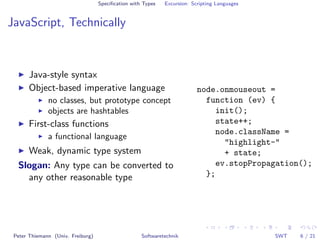
JavaScript, Technically


      Java-style syntax
      Object-based imperative language                                    node.onmouseout =
              no classes, but prototype concept                             function (ev) {
              objects are hashtables                                          init();
      First-class functions                                                   state++;
                                                                              node.className =
              a functional language
                                                                                "highlight-"
      Weak, dynamic type system                                                 + state;
  Slogan: Any type can be converted to                                        ev.stopPropagation();
    any other reasonable type                                               };


 Peter Thiemann (Univ. Freiburg)                    Softwaretechnik                           SWT   6 / 21
Specification with Types   Excursion: Scripting Languages


Problems with JavaScript

Symptomatic for other scripting languages

       No module system
               No namespace management
               No interface descriptions
       No static type system
       No application specific datatypes
       primitive datatypes, strings, hashtables
       Type conversions are sometimes surprising
       “A scripting language should never throw an exception [the script
       should just continue]” (Rob Pike, Google)
 ⇒ Limited to small applications


 Peter Thiemann (Univ. Freiburg)                     Softwaretechnik                           SWT   7 / 21
Specification with Types   Excursion: Scripting Languages


Specific Problems with JavaScript


      Most popular applications
              client-side scripting
              AJAX
      Dynamic modification of page content via DOM interface
              DOM = document object model
              W3C standard interface for accessing and modifying XML
              Mainly used in web browers


 Peter Thiemann (Univ. Freiburg)                    Softwaretechnik                           SWT   8 / 21
Specification with Types   Excursion: Scripting Languages


Specific Problems with JavaScript


      Most popular applications
              client-side scripting
              AJAX
      Dynamic modification of page content via DOM interface
              DOM = document object model
              W3C standard interface for accessing and modifying XML
              Mainly used in web browers
      Incompatible DOM implementations in Web browsers
 ⇒ programming recipes instead of techniques


 Peter Thiemann (Univ. Freiburg)                    Softwaretechnik                           SWT   8 / 21
Specification with Types   Excursion: Scripting Languages


Can You Write Reliable Programs in JavaScript?


      Struggle with the lack of e.g. a module system
              Ad-hoc structuring of large programs
              Naming conventions
              Working in a team
      Work around DOM incompatibilities
              Use existing JavaScript frameworks (widgets, networking)
              Frameworks are also incompatible
      Wonder about unexpected results


 Peter Thiemann (Univ. Freiburg)                    Softwaretechnik                           SWT   9 / 21
Specification with Types   Ultra-Brief JavaScript Tutorial


An Ultra-Brief JavaScript Tutorial

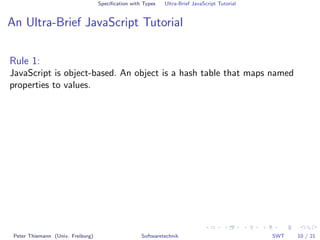
Rule 1:
JavaScript is object-based. An object is a hash table that maps named
properties to values.


 Peter Thiemann (Univ. Freiburg)                    Softwaretechnik                            SWT   10 / 21
Specification with Types   Ultra-Brief JavaScript Tutorial


An Ultra-Brief JavaScript Tutorial

Rule 1:
JavaScript is object-based. An object is a hash table that maps named
properties to values.

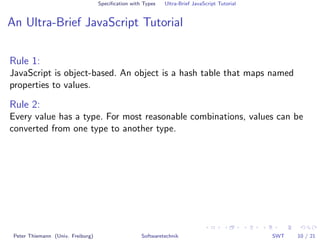
Rule 2:
Every value has a type. For most reasonable combinations, values can be
converted from one type to another type.


 Peter Thiemann (Univ. Freiburg)                    Softwaretechnik                            SWT   10 / 21
Specification with Types   Ultra-Brief JavaScript Tutorial


An Ultra-Brief JavaScript Tutorial

Rule 1:
JavaScript is object-based. An object is a hash table that maps named
properties to values.

Rule 2:
Every value has a type. For most reasonable combinations, values can be
converted from one type to another type.

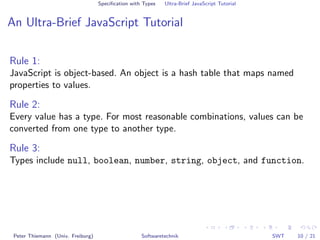
Rule 3:
Types include null, boolean, number, string, object, and function.


 Peter Thiemann (Univ. Freiburg)                    Softwaretechnik                            SWT   10 / 21
Specification with Types   Ultra-Brief JavaScript Tutorial


An Ultra-Brief JavaScript Tutorial

Rule 1:
JavaScript is object-based. An object is a hash table that maps named
properties to values.

Rule 2:
Every value has a type. For most reasonable combinations, values can be
converted from one type to another type.

Rule 3:
Types include null, boolean, number, string, object, and function.

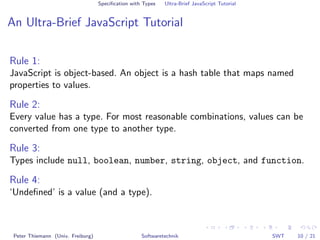
Rule 4:
‘Undefined’ is a value (and a type).


 Peter Thiemann (Univ. Freiburg)                    Softwaretechnik                            SWT   10 / 21
Specification with Types   Ultra-Brief JavaScript Tutorial


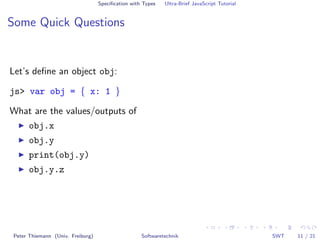
Some Quick Questions


Let’s define an object obj:

js> var obj = { x: 1 }

What are the values/outputs of
      obj.x
      obj.y
      print(obj.y)
      obj.y.z


 Peter Thiemann (Univ. Freiburg)                    Softwaretechnik                            SWT   11 / 21
Specification with Types   Ultra-Brief JavaScript Tutorial


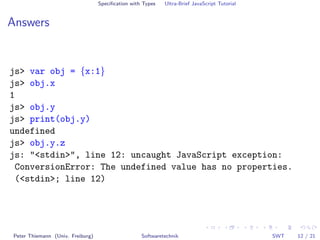
Answers


js> var obj = {x:1}
js> obj.x
1
js> obj.y
js> print(obj.y)
undefined
js> obj.y.z
js: "<stdin>", line 12: uncaught JavaScript exception:
 ConversionError: The undefined value has no properties.
 (<stdin>; line 12)


Peter Thiemann (Univ. Freiburg)                    Softwaretechnik                            SWT   12 / 21
Specification with Types   Ultra-Brief JavaScript Tutorial


Weak, Dynamic Types in JavaScript II

Rule 5:
An object is really a dynamic mapping from strings to values.

js> var x = "x"
js> obj[x]
1
js> obj.undefined = "gotcha"
gotcha
js> obj[obj.y]

What is the effect/result of the last expression?

       == "gotcha"


 Peter Thiemann (Univ. Freiburg)                    Softwaretechnik                            SWT   13 / 21
Specification with Types   Ultra-Brief JavaScript Tutorial


Weak, Dynamic Types in JavaScript II

Rule 5:
An object is really a dynamic mapping from strings to values.

js> var x = "x"
js> obj[x]
1
js> obj.undefined = "gotcha"
gotcha
js> obj[obj.y]
    == obj[undefined]
    == obj["undefined"]
    == obj.undefined
    == "gotcha"


 Peter Thiemann (Univ. Freiburg)                    Softwaretechnik                            SWT   14 / 21
Specification with Types   Ultra-Brief JavaScript Tutorial


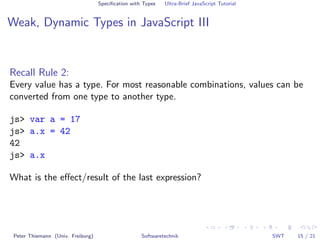
Weak, Dynamic Types in JavaScript III


Recall Rule 2:
Every value has a type. For most reasonable combinations, values can be
converted from one type to another type.

js> var a = 17
js> a.x = 42
42
js> a.x

What is the effect/result of the last expression?


 Peter Thiemann (Univ. Freiburg)                    Softwaretechnik                            SWT   15 / 21
Specification with Types   Ultra-Brief JavaScript Tutorial


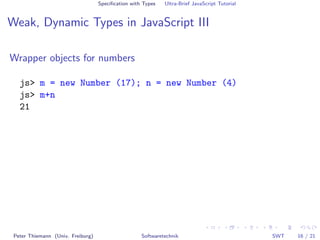
Weak, Dynamic Types in JavaScript III

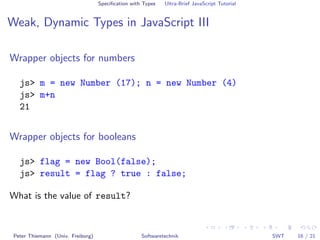
Wrapper objects for numbers

   js> m = new Number (17); n = new Number (4)
   js> m+n
   21


 Peter Thiemann (Univ. Freiburg)                    Softwaretechnik                            SWT   16 / 21
Specification with Types   Ultra-Brief JavaScript Tutorial


Weak, Dynamic Types in JavaScript III

Wrapper objects for numbers

   js> m = new Number (17); n = new Number (4)
   js> m+n
   21


Wrapper objects for booleans

   js> flag = new Bool(false);
   js> result = flag ? true : false;

What is the value of result?


 Peter Thiemann (Univ. Freiburg)                    Softwaretechnik                            SWT   16 / 21
Specification with Types   Ultra-Brief JavaScript Tutorial


Weak, Dynamic Types in JavaScript IV

Rule 6:
Functions are first-class, but behave differently when used as methods or
as constructors.

js> function f () { return this.x }
js> f()
x
js> obj.f = f
function f() { return this.x; }
js> obj.f()
1
js> new f()
[object Object]


 Peter Thiemann (Univ. Freiburg)                    Softwaretechnik                            SWT   17 / 21
Specification with Types   Ultra-Brief JavaScript Tutorial


Distinguishing Absence and Undefinedness I


js> obju = { u : {}.xx }
[object Object]
js> objv = { v : {}.xx }
[object Object]
js> print(obju.u)
undefined
js> print(objv.u)
undefined


 Peter Thiemann (Univ. Freiburg)                    Softwaretechnik                            SWT   18 / 21
Specification with Types   Ultra-Brief JavaScript Tutorial


Distinguishing Absence and Undefinedness II


Rule 7:
The with construct puts its argument object on top of the current
environment stack.

js> u = "defined"
defined
js> with (obju) print(u)
undefined
js> with (objv) print(u)
defined


 Peter Thiemann (Univ. Freiburg)                    Softwaretechnik                            SWT   19 / 21
Specification with Types   Ultra-Brief JavaScript Tutorial


Distinguishing Absence and Undefinedness III

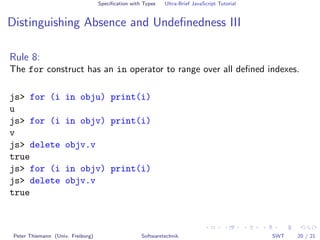
Rule 8:
The for construct has an in operator to range over all defined indexes.

js> for (i           in obju) print(i)
u
js> for (i           in objv) print(i)
v
js> delete           objv.v
true
js> for (i           in objv) print(i)
js> delete           objv.v
true


 Peter Thiemann (Univ. Freiburg)                    Softwaretechnik                            SWT   20 / 21
Specification with Types   Thesis


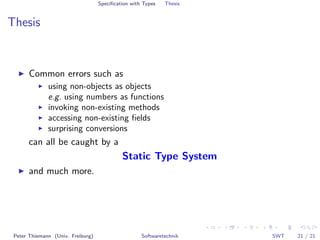
Thesis


      Common errors such as
              using non-objects as objects
              e.g. using numbers as functions
              invoking non-existing methods
              accessing non-existing fields
              surprising conversions
      can all be caught by a
                                            Static Type System
      and much more.


 Peter Thiemann (Univ. Freiburg)                    Softwaretechnik   SWT   21 / 21

v02-types.en

  • 1.
    Softwaretechnik Vorlesung 02: Specification with Types Peter Thiemann Universit¨t Freiburg, Germany a SS 2009 Peter Thiemann (Univ. Freiburg) Softwaretechnik SWT 1 / 21
  • 2.
    Inhalt Specification with Types Excursion: Scripting Languages Ultra-Brief JavaScript Tutorial Thesis Peter Thiemann (Univ. Freiburg) Softwaretechnik SWT 2 / 21
  • 3.
    Specification with Types Excursion: Scripting Languages Excursion to a World Without Types: Scripting Languages Peter Thiemann (Univ. Freiburg) Softwaretechnik SWT 3 / 21
  • 4.
    Specification with Types Excursion: Scripting Languages Scripting Languages Lightweight programming languages evolved from command languages Lightweight data structures hashmap (object), strings Lightweight syntax familiar, no semicolon, (often not well specified), . . . Lightweight typing dynamic, weak, duck typing Lightweight metaprogramming Lightweight implementation interpreted, few tools Peter Thiemann (Univ. Freiburg) Softwaretechnik SWT 4 / 21
  • 5.
    Specification with Types Excursion: Scripting Languages JavaScript, a Typical Scripting Language Initially developed by Netscape’s Brendan Eich Standardized as ECMAScript (ECMA-262 Edition 3) Application areas (scripting targets) client-side web scripting (dynamic HTML, SVG, XUL) server-side scripting (Whitebeam, Helma, Cocoon, iPlanet) animation scripting (diablo, dim3, k3d) and many more Peter Thiemann (Univ. Freiburg) Softwaretechnik SWT 5 / 21
  • 6.
    Specification with Types Excursion: Scripting Languages JavaScript, Technically Java-style syntax Object-based imperative language node.onmouseout = no classes, but prototype concept function (ev) { objects are hashtables init(); First-class functions state++; node.className = a functional language "highlight-" Weak, dynamic type system + state; Slogan: Any type can be converted to ev.stopPropagation(); any other reasonable type }; Peter Thiemann (Univ. Freiburg) Softwaretechnik SWT 6 / 21
  • 7.
    Specification with Types Excursion: Scripting Languages Problems with JavaScript Symptomatic for other scripting languages No module system No namespace management No interface descriptions No static type system No application specific datatypes primitive datatypes, strings, hashtables Type conversions are sometimes surprising “A scripting language should never throw an exception [the script should just continue]” (Rob Pike, Google) ⇒ Limited to small applications Peter Thiemann (Univ. Freiburg) Softwaretechnik SWT 7 / 21
  • 8.
    Specification with Types Excursion: Scripting Languages Specific Problems with JavaScript Most popular applications client-side scripting AJAX Dynamic modification of page content via DOM interface DOM = document object model W3C standard interface for accessing and modifying XML Mainly used in web browers Peter Thiemann (Univ. Freiburg) Softwaretechnik SWT 8 / 21
  • 9.
    Specification with Types Excursion: Scripting Languages Specific Problems with JavaScript Most popular applications client-side scripting AJAX Dynamic modification of page content via DOM interface DOM = document object model W3C standard interface for accessing and modifying XML Mainly used in web browers Incompatible DOM implementations in Web browsers ⇒ programming recipes instead of techniques Peter Thiemann (Univ. Freiburg) Softwaretechnik SWT 8 / 21
  • 10.
    Specification with Types Excursion: Scripting Languages Can You Write Reliable Programs in JavaScript? Struggle with the lack of e.g. a module system Ad-hoc structuring of large programs Naming conventions Working in a team Work around DOM incompatibilities Use existing JavaScript frameworks (widgets, networking) Frameworks are also incompatible Wonder about unexpected results Peter Thiemann (Univ. Freiburg) Softwaretechnik SWT 9 / 21
  • 11.
    Specification with Types Ultra-Brief JavaScript Tutorial An Ultra-Brief JavaScript Tutorial Rule 1: JavaScript is object-based. An object is a hash table that maps named properties to values. Peter Thiemann (Univ. Freiburg) Softwaretechnik SWT 10 / 21
  • 12.
    Specification with Types Ultra-Brief JavaScript Tutorial An Ultra-Brief JavaScript Tutorial Rule 1: JavaScript is object-based. An object is a hash table that maps named properties to values. Rule 2: Every value has a type. For most reasonable combinations, values can be converted from one type to another type. Peter Thiemann (Univ. Freiburg) Softwaretechnik SWT 10 / 21
  • 13.
    Specification with Types Ultra-Brief JavaScript Tutorial An Ultra-Brief JavaScript Tutorial Rule 1: JavaScript is object-based. An object is a hash table that maps named properties to values. Rule 2: Every value has a type. For most reasonable combinations, values can be converted from one type to another type. Rule 3: Types include null, boolean, number, string, object, and function. Peter Thiemann (Univ. Freiburg) Softwaretechnik SWT 10 / 21
  • 14.
    Specification with Types Ultra-Brief JavaScript Tutorial An Ultra-Brief JavaScript Tutorial Rule 1: JavaScript is object-based. An object is a hash table that maps named properties to values. Rule 2: Every value has a type. For most reasonable combinations, values can be converted from one type to another type. Rule 3: Types include null, boolean, number, string, object, and function. Rule 4: ‘Undefined’ is a value (and a type). Peter Thiemann (Univ. Freiburg) Softwaretechnik SWT 10 / 21
  • 15.
    Specification with Types Ultra-Brief JavaScript Tutorial Some Quick Questions Let’s define an object obj: js> var obj = { x: 1 } What are the values/outputs of obj.x obj.y print(obj.y) obj.y.z Peter Thiemann (Univ. Freiburg) Softwaretechnik SWT 11 / 21
  • 16.
    Specification with Types Ultra-Brief JavaScript Tutorial Answers js> var obj = {x:1} js> obj.x 1 js> obj.y js> print(obj.y) undefined js> obj.y.z js: "<stdin>", line 12: uncaught JavaScript exception: ConversionError: The undefined value has no properties. (<stdin>; line 12) Peter Thiemann (Univ. Freiburg) Softwaretechnik SWT 12 / 21
  • 17.
    Specification with Types Ultra-Brief JavaScript Tutorial Weak, Dynamic Types in JavaScript II Rule 5: An object is really a dynamic mapping from strings to values. js> var x = "x" js> obj[x] 1 js> obj.undefined = "gotcha" gotcha js> obj[obj.y] What is the effect/result of the last expression? == "gotcha" Peter Thiemann (Univ. Freiburg) Softwaretechnik SWT 13 / 21
  • 18.
    Specification with Types Ultra-Brief JavaScript Tutorial Weak, Dynamic Types in JavaScript II Rule 5: An object is really a dynamic mapping from strings to values. js> var x = "x" js> obj[x] 1 js> obj.undefined = "gotcha" gotcha js> obj[obj.y] == obj[undefined] == obj["undefined"] == obj.undefined == "gotcha" Peter Thiemann (Univ. Freiburg) Softwaretechnik SWT 14 / 21
  • 19.
    Specification with Types Ultra-Brief JavaScript Tutorial Weak, Dynamic Types in JavaScript III Recall Rule 2: Every value has a type. For most reasonable combinations, values can be converted from one type to another type. js> var a = 17 js> a.x = 42 42 js> a.x What is the effect/result of the last expression? Peter Thiemann (Univ. Freiburg) Softwaretechnik SWT 15 / 21
  • 20.
    Specification with Types Ultra-Brief JavaScript Tutorial Weak, Dynamic Types in JavaScript III Wrapper objects for numbers js> m = new Number (17); n = new Number (4) js> m+n 21 Peter Thiemann (Univ. Freiburg) Softwaretechnik SWT 16 / 21
  • 21.
    Specification with Types Ultra-Brief JavaScript Tutorial Weak, Dynamic Types in JavaScript III Wrapper objects for numbers js> m = new Number (17); n = new Number (4) js> m+n 21 Wrapper objects for booleans js> flag = new Bool(false); js> result = flag ? true : false; What is the value of result? Peter Thiemann (Univ. Freiburg) Softwaretechnik SWT 16 / 21
  • 22.
    Specification with Types Ultra-Brief JavaScript Tutorial Weak, Dynamic Types in JavaScript IV Rule 6: Functions are first-class, but behave differently when used as methods or as constructors. js> function f () { return this.x } js> f() x js> obj.f = f function f() { return this.x; } js> obj.f() 1 js> new f() [object Object] Peter Thiemann (Univ. Freiburg) Softwaretechnik SWT 17 / 21
  • 23.
    Specification with Types Ultra-Brief JavaScript Tutorial Distinguishing Absence and Undefinedness I js> obju = { u : {}.xx } [object Object] js> objv = { v : {}.xx } [object Object] js> print(obju.u) undefined js> print(objv.u) undefined Peter Thiemann (Univ. Freiburg) Softwaretechnik SWT 18 / 21
  • 24.
    Specification with Types Ultra-Brief JavaScript Tutorial Distinguishing Absence and Undefinedness II Rule 7: The with construct puts its argument object on top of the current environment stack. js> u = "defined" defined js> with (obju) print(u) undefined js> with (objv) print(u) defined Peter Thiemann (Univ. Freiburg) Softwaretechnik SWT 19 / 21
  • 25.
    Specification with Types Ultra-Brief JavaScript Tutorial Distinguishing Absence and Undefinedness III Rule 8: The for construct has an in operator to range over all defined indexes. js> for (i in obju) print(i) u js> for (i in objv) print(i) v js> delete objv.v true js> for (i in objv) print(i) js> delete objv.v true Peter Thiemann (Univ. Freiburg) Softwaretechnik SWT 20 / 21
  • 26.
    Specification with Types Thesis Thesis Common errors such as using non-objects as objects e.g. using numbers as functions invoking non-existing methods accessing non-existing fields surprising conversions can all be caught by a Static Type System and much more. Peter Thiemann (Univ. Freiburg) Softwaretechnik SWT 21 / 21