

The Future of JavaScript
      John Resig (ejohn.org)
       Mozilla Corporation
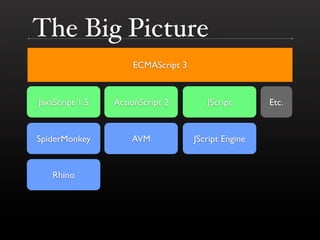
The Big Picture
                     ECMAScript 3


JavaScript 1.5   ActionScript 2        JScript       Etc.


SpiderMonkey         AVM            JScript Engine


   Rhino
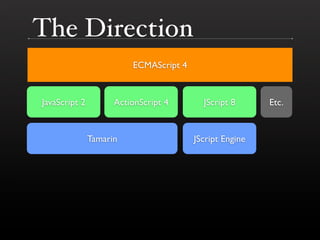
The Direction
                         ECMAScript 4


JavaScript 2         ActionScript 4       JScript 8      Etc.


               Tamarin                  JScript Engine
Tamarin
✦   Tamarin
    ✦ New Virtual Machine from Adobe
    ✦ Perfect for ActionScript
      ✦ (a mutant cousin of JavaScript 2)

✦   The Three Monkeys:
    ✦ ActionMonkey
    ✦ ScreamingMonkey
    ✦ IronMonkey
Three Monkies
✦   ActionMonkey
    ✦ Integrating Tamarin into SpiderMonkey
    ✦ Powering Firefox 4 (?) + JavaScript 2

✦   ScreamingMonkey
    ✦ Forcing Tamarin into Internet Explorer
    ✦ (Kicking and screaming?)

✦   IronMonkey
    ✦ Bringing Python + Ruby to Tamarin
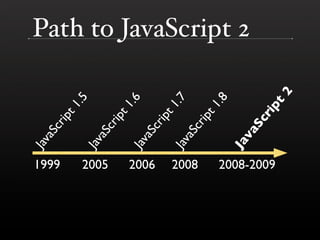
Jav
                a


1999
                 Sc
                      rip
                         t1
                             .5
            Jav
                a


2005
                 Sc
                      rip
                         t1
            Jav              .6
                a
2006
                 Sc
                      rip
                         t1
            Jav              .7
                a
2008
                 Sc
                      rip
                         t1
                             .8
            Ja
                                      Path to JavaScript 2


               va
                  S   cr
2008-2009


                        ip
                            t
                                  2
The JavaScript Language
✦   Current:
    JavaScript 1.5 (ECMAScript 3)
✦   JavaScript 1.6 (Firefox 1.5)
✦   JavaScript 1.7 (Firefox 2)
✦   JavaScipt 1.8 (Firefox 3)
✦   ...
✦   JavaScript 2 (ECMAScript 4)
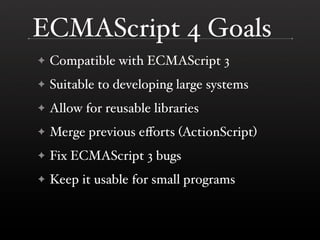
ECMAScript 4 Goals
✦   Compatible with ECMAScript 3
✦   Suitable to developing large systems
✦   Allow for reusable libraries
✦   Merge previous efforts (ActionScript)
✦   Fix ECMAScript 3 bugs
✦   Keep it usable for small programs
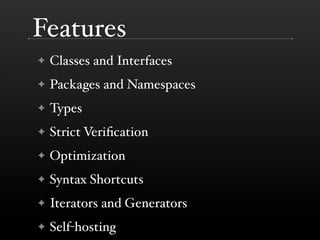
Features
✦   Classes and Interfaces
✦   Packages and Namespaces
✦   Types
✦   Strict Verification
✦   Optimization
✦   Syntax Shortcuts
✦   Iterators and Generators
✦   Self-hosting
Classes
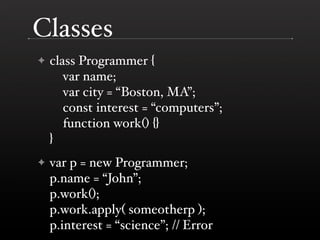
Classes
✦   class Programmer {
       var name;
       var city = “Boston, MA”;
       const interest = “computers”;
       function work() {}
    }
✦   var p = new Programmer;
    p.name = “John”;
    p.work();
    p.work.apply( someotherp );
    p.interest = “science”; // Error
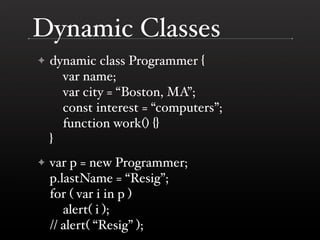
Dynamic Classes
✦   dynamic class Programmer {
      var name;
      var city = “Boston, MA”;
      const interest = “computers”;
      function work() {}
    }
✦   var p = new Programmer;
    p.lastName = “Resig”;
    for ( var i in p )
       alert( i );
    // alert( “Resig” );
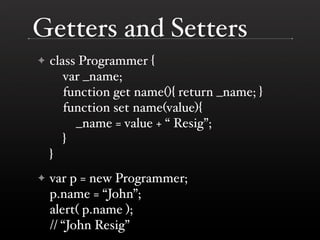
Getters and Setters
✦   class Programmer {
       var _name;
       function get name(){ return _name; }
       function set name(value){
         _name = value + “ Resig”;
       }
    }
✦   var p = new Programmer;
    p.name = “John”;
    alert( p.name );
    // “John Resig”
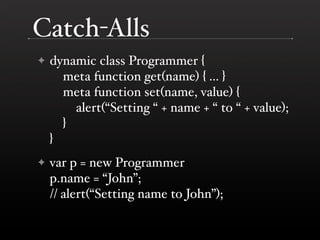
Catch-Alls
✦   dynamic class Programmer {
      meta function get(name) { ... }
      meta function set(name, value) {
        alert(“Setting “ + name + “ to “ + value);
      }
    }
✦   var p = new Programmer
    p.name = “John”;
    // alert(“Setting name to John”);
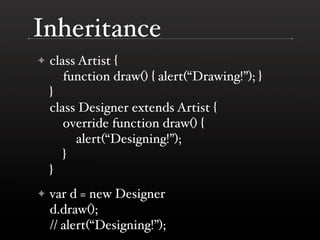
Inheritance
✦   class Artist {
       function draw() { alert(“Drawing!”); }
    }
    class Designer extends Artist {
       override function draw() {
         alert(“Designing!”);
       }
    }
✦   var d = new Designer
    d.draw();
    // alert(“Designing!”);
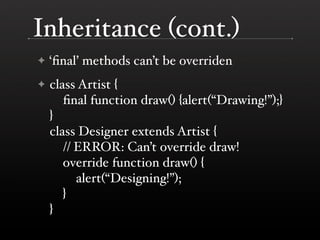
Inheritance (cont.)
✦   ‘final’ methods can’t be overriden
✦   class Artist {
       final function draw() {alert(“Drawing!”);}
    }
    class Designer extends Artist {
       // ERROR: Can’t override draw!
       override function draw() {
          alert(“Designing!”);
       }
    }
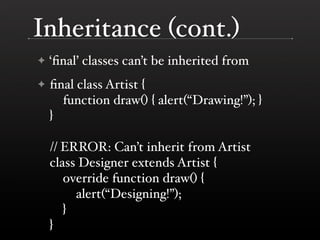
Inheritance (cont.)
✦   ‘final’ classes can’t be inherited from
✦   final class Artist {
      function draw() { alert(“Drawing!”); }
    }

    // ERROR: Can’t inherit from Artist
    class Designer extends Artist {
       override function draw() {
         alert(“Designing!”);
       }
    }
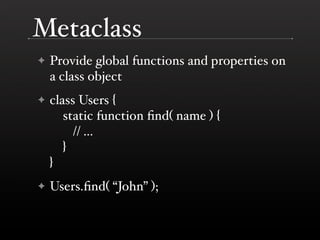
Metaclass
✦   Provide global functions and properties on
    a class object
✦   class Users {
       static function find( name ) {
         // ...
       }
    }
✦   Users.find( “John” );
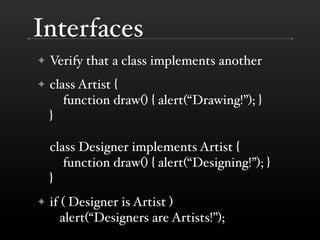
Interfaces
✦   Verify that a class implements another
✦   class Artist {
       function draw() { alert(“Drawing!”); }
    }

    class Designer implements Artist {
       function draw() { alert(“Designing!”); }
    }
✦   if ( Designer is Artist )
       alert(“Designers are Artists!”);
Types
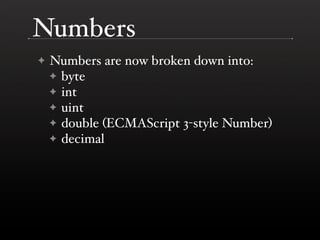
Numbers
✦   Numbers are now broken down into:
    ✦ byte
    ✦ int
    ✦ uint
    ✦ double (ECMAScript 3-style Number)
    ✦ decimal
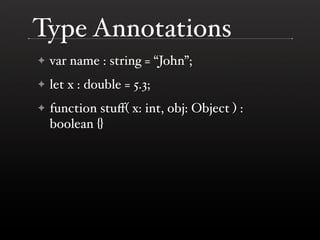
Type Annotations
✦   var name : string = “John”;
✦   let x : double = 5.3;
✦   function stuff( x: int, obj: Object ) :
    boolean {}
Function Types
✦   Only return specific types:
    function isValid() : boolean { }
✦   Only be used on certain objects types:
    function every( this: Array ) {
       for ( var i = 0; i < this.length; i++ )
          alert( this[i] );
    }
    every.call( [0,1,2] );
    // alert(0); alert(1); alert(2);
    every.call({a: “b”});
    // ERROR
Rest Arguments
✦   function stuff( name, ...values ){
      alert( values.length );
    }
✦   stuff( “John”, 1, 2, 3, 4 );
    // alert( 4 );
✦   function stuff( name : string, ...values :
    [int] )
     : void {
        alert( values.length );
    }
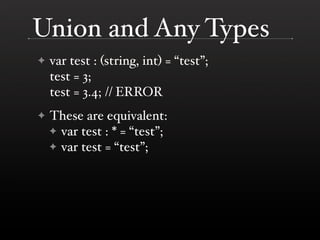
Union and Any Types
✦   var test : (string, int) = “test”;
    test = 3;
    test = 3.4; // ERROR
✦   These are equivalent:
    ✦ var test : * = “test”;
    ✦ var test = “test”;
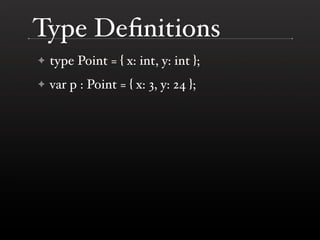
Type Definitions
✦   type Point = { x: int, y: int };
✦   var p : Point = { x: 3, y: 24 };
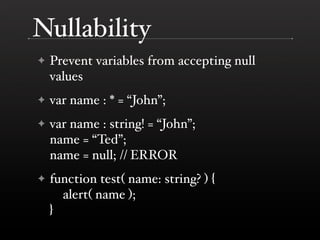
Nullability
✦   Prevent variables from accepting null
    values
✦   var name : * = “John”;
✦   var name : string! = “John”;
    name = “Ted”;
    name = null; // ERROR
✦   function test( name: string? ) {
      alert( name );
    }
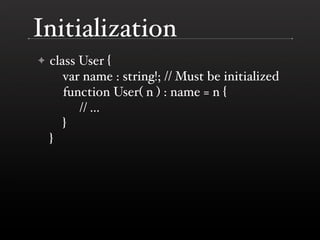
Initialization
✦   class User {
       var name : string!; // Must be initialized
       function User( n ) : name = n {
          // ...
       }
    }
“like”
✦   type Point = { x: int, y: int };
✦   if ( { x: 3, y: 5 } like Point )
       alert( “That looks like a point to me!” );
✦   if ( !({ x: 3 } like Point) )
       alert( “Not a point!” );
✦   // Loop over array-like things:
    function every( a: like { length: int } ) {
       for ( var i = 0; i < a.length; i++ )
         alert( a[i] );
    }
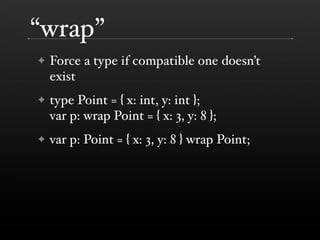
“wrap”
✦   Force a type if compatible one doesn’t
    exist
✦   type Point = { x: int, y: int };
    var p: wrap Point = { x: 3, y: 8 };
✦   var p: Point = { x: 3, y: 8 } wrap Point;
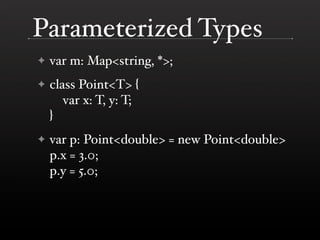
Parameterized Types
✦   var m: Map<string, *>;
✦   class Point<T> {
       var x: T, y: T;
    }
✦   var p: Point<double> = new Point<double>
    p.x = 3.0;
    p.y = 5.0;
Structure
let statements
✦   for ( let i = 0; i < a.length; i++ )
      alert( a[i] );
    typeof i == “undefined”
✦   Using block statements:
    {
        let x = 5;
        {
           let x = 6;
           alert( x ); // 6
        }
        alert( x ); // 5
    }
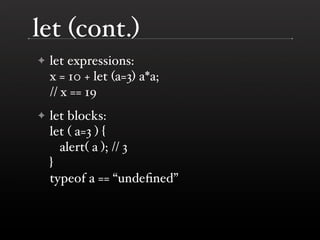
let (cont.)
✦   let expressions:
    x = 10 + let (a=3) a*a;
    // x == 19
✦   let blocks:
    let ( a=3 ) {
      alert( a ); // 3
    }
    typeof a == “undefined”
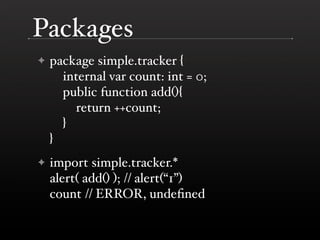
Packages
✦   package simple.tracker {
      internal var count: int = 0;
      public function add(){
        return ++count;
      }
    }
✦   import simple.tracker.*
    alert( add() ); // alert(“1”)
    count // ERROR, undefined
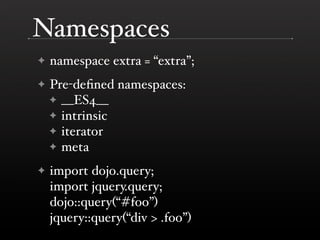
Namespaces
✦   namespace extra = “extra”;
✦   Pre-defined namespaces:
    ✦ __ES4__
    ✦ intrinsic
    ✦ iterator
    ✦ meta

✦   import dojo.query;
    import jquery.query;
    dojo::query(“#foo”)
    jquery::query(“div > .foo”)
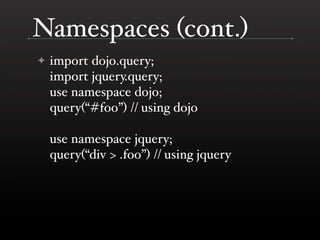
Namespaces (cont.)
✦   import dojo.query;
    import jquery.query;
    use namespace dojo;
    query(“#foo”) // using dojo

    use namespace jquery;
    query(“div > .foo”) // using jquery
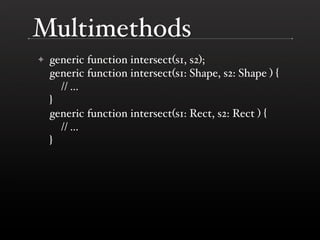
Multimethods
✦   generic function intersect(s1, s2);
    generic function intersect(s1: Shape, s2: Shape ) {
      // ...
    }
    generic function intersect(s1: Rect, s2: Rect ) {
      // ...
    }
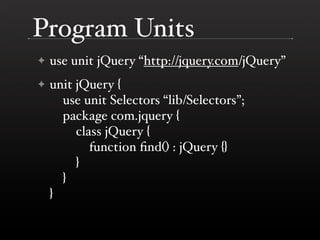
Program Units
✦   use unit jQuery “http://jquery.com/jQuery”
✦   unit jQuery {
      use unit Selectors “lib/Selectors”;
      package com.jquery {
         class jQuery {
            function find() : jQuery {}
         }
      }
    }
Iteration
✦   class Fib {
       private var a=0, b=1;

        iterator function get(deep:boolean = false) : IteratorType.<int>
           this

        public function next(): int {
          if ( b > 100 )
              throw iterator::StopIteration;
          [a,b] = [b,a+b];
          return a;
        }
    }

✦   for ( let i in new Fib )
      alert( i );
For .. Each
✦   For each loops through values
✦   let s = “”;
    for each ( let n in [“a”,”b”,”c”] )
        s += n;
    alert(s);
    // “abc”
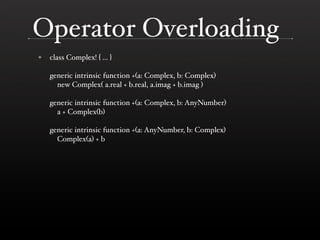
Operator Overloading
✦   class Complex! { ... }

    generic intrinsic function +(a: Complex, b: Complex)
      new Complex( a.real + b.real, a.imag + b.imag )

    generic intrinsic function +(a: Complex, b: AnyNumber)
      a + Complex(b)

    generic intrinsic function +(a: AnyNumber, b: Complex)
      Complex(a) + b
Self-Hosting
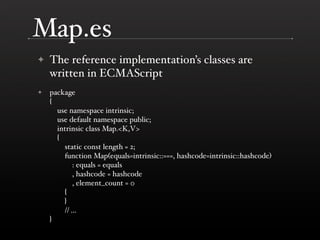
Map.es
✦   The reference implementation’s classes are
    written in ECMAScript
✦   package
    {
      use namespace intrinsic;
      use default namespace public;
      intrinsic class Map.<K,V>
      {
        static const length = 2;
        function Map(equals=intrinsic::===, hashcode=intrinsic::hashcode)
            : equals = equals
            , hashcode = hashcode
            , element_count = 0
        {
        }
        // ...
    }
More Info
✦   ECMAScript 4 White Paper Overview:
    http://www.ecmascript.org/es4/spec/overview.pdf
✦   Blogging:
    http://ejohn.org/

The Future of JavaScript (Ajax Exp '07)

  • 1.
    The Future ofJavaScript John Resig (ejohn.org) Mozilla Corporation
  • 2.
    The Big Picture ECMAScript 3 JavaScript 1.5 ActionScript 2 JScript Etc. SpiderMonkey AVM JScript Engine Rhino
  • 3.
    The Direction ECMAScript 4 JavaScript 2 ActionScript 4 JScript 8 Etc. Tamarin JScript Engine
  • 4.
    Tamarin ✦ Tamarin ✦ New Virtual Machine from Adobe ✦ Perfect for ActionScript ✦ (a mutant cousin of JavaScript 2) ✦ The Three Monkeys: ✦ ActionMonkey ✦ ScreamingMonkey ✦ IronMonkey
  • 5.
    Three Monkies ✦ ActionMonkey ✦ Integrating Tamarin into SpiderMonkey ✦ Powering Firefox 4 (?) + JavaScript 2 ✦ ScreamingMonkey ✦ Forcing Tamarin into Internet Explorer ✦ (Kicking and screaming?) ✦ IronMonkey ✦ Bringing Python + Ruby to Tamarin
  • 6.
    Jav a 1999 Sc rip t1 .5 Jav a 2005 Sc rip t1 Jav .6 a 2006 Sc rip t1 Jav .7 a 2008 Sc rip t1 .8 Ja Path to JavaScript 2 va S cr 2008-2009 ip t 2
  • 7.
    The JavaScript Language ✦ Current: JavaScript 1.5 (ECMAScript 3) ✦ JavaScript 1.6 (Firefox 1.5) ✦ JavaScript 1.7 (Firefox 2) ✦ JavaScipt 1.8 (Firefox 3) ✦ ... ✦ JavaScript 2 (ECMAScript 4)
  • 8.
    ECMAScript 4 Goals ✦ Compatible with ECMAScript 3 ✦ Suitable to developing large systems ✦ Allow for reusable libraries ✦ Merge previous efforts (ActionScript) ✦ Fix ECMAScript 3 bugs ✦ Keep it usable for small programs
  • 9.
    Features ✦ Classes and Interfaces ✦ Packages and Namespaces ✦ Types ✦ Strict Verification ✦ Optimization ✦ Syntax Shortcuts ✦ Iterators and Generators ✦ Self-hosting
  • 10.
  • 11.
    Classes ✦ class Programmer { var name; var city = “Boston, MA”; const interest = “computers”; function work() {} } ✦ var p = new Programmer; p.name = “John”; p.work(); p.work.apply( someotherp ); p.interest = “science”; // Error
  • 12.
    Dynamic Classes ✦ dynamic class Programmer { var name; var city = “Boston, MA”; const interest = “computers”; function work() {} } ✦ var p = new Programmer; p.lastName = “Resig”; for ( var i in p ) alert( i ); // alert( “Resig” );
  • 13.
    Getters and Setters ✦ class Programmer { var _name; function get name(){ return _name; } function set name(value){ _name = value + “ Resig”; } } ✦ var p = new Programmer; p.name = “John”; alert( p.name ); // “John Resig”
  • 14.
    Catch-Alls ✦ dynamic class Programmer { meta function get(name) { ... } meta function set(name, value) { alert(“Setting “ + name + “ to “ + value); } } ✦ var p = new Programmer p.name = “John”; // alert(“Setting name to John”);
  • 15.
    Inheritance ✦ class Artist { function draw() { alert(“Drawing!”); } } class Designer extends Artist { override function draw() { alert(“Designing!”); } } ✦ var d = new Designer d.draw(); // alert(“Designing!”);
  • 16.
    Inheritance (cont.) ✦ ‘final’ methods can’t be overriden ✦ class Artist { final function draw() {alert(“Drawing!”);} } class Designer extends Artist { // ERROR: Can’t override draw! override function draw() { alert(“Designing!”); } }
  • 17.
    Inheritance (cont.) ✦ ‘final’ classes can’t be inherited from ✦ final class Artist { function draw() { alert(“Drawing!”); } } // ERROR: Can’t inherit from Artist class Designer extends Artist { override function draw() { alert(“Designing!”); } }
  • 18.
    Metaclass ✦ Provide global functions and properties on a class object ✦ class Users { static function find( name ) { // ... } } ✦ Users.find( “John” );
  • 19.
    Interfaces ✦ Verify that a class implements another ✦ class Artist { function draw() { alert(“Drawing!”); } } class Designer implements Artist { function draw() { alert(“Designing!”); } } ✦ if ( Designer is Artist ) alert(“Designers are Artists!”);
  • 20.
  • 21.
    Numbers ✦ Numbers are now broken down into: ✦ byte ✦ int ✦ uint ✦ double (ECMAScript 3-style Number) ✦ decimal
  • 22.
    Type Annotations ✦ var name : string = “John”; ✦ let x : double = 5.3; ✦ function stuff( x: int, obj: Object ) : boolean {}
  • 23.
    Function Types ✦ Only return specific types: function isValid() : boolean { } ✦ Only be used on certain objects types: function every( this: Array ) { for ( var i = 0; i < this.length; i++ ) alert( this[i] ); } every.call( [0,1,2] ); // alert(0); alert(1); alert(2); every.call({a: “b”}); // ERROR
  • 24.
    Rest Arguments ✦ function stuff( name, ...values ){ alert( values.length ); } ✦ stuff( “John”, 1, 2, 3, 4 ); // alert( 4 ); ✦ function stuff( name : string, ...values : [int] ) : void { alert( values.length ); }
  • 25.
    Union and AnyTypes ✦ var test : (string, int) = “test”; test = 3; test = 3.4; // ERROR ✦ These are equivalent: ✦ var test : * = “test”; ✦ var test = “test”;
  • 26.
    Type Definitions ✦ type Point = { x: int, y: int }; ✦ var p : Point = { x: 3, y: 24 };
  • 27.
    Nullability ✦ Prevent variables from accepting null values ✦ var name : * = “John”; ✦ var name : string! = “John”; name = “Ted”; name = null; // ERROR ✦ function test( name: string? ) { alert( name ); }
  • 28.
    Initialization ✦ class User { var name : string!; // Must be initialized function User( n ) : name = n { // ... } }
  • 29.
    “like” ✦ type Point = { x: int, y: int }; ✦ if ( { x: 3, y: 5 } like Point ) alert( “That looks like a point to me!” ); ✦ if ( !({ x: 3 } like Point) ) alert( “Not a point!” ); ✦ // Loop over array-like things: function every( a: like { length: int } ) { for ( var i = 0; i < a.length; i++ ) alert( a[i] ); }
  • 30.
    “wrap” ✦ Force a type if compatible one doesn’t exist ✦ type Point = { x: int, y: int }; var p: wrap Point = { x: 3, y: 8 }; ✦ var p: Point = { x: 3, y: 8 } wrap Point;
  • 31.
    Parameterized Types ✦ var m: Map<string, *>; ✦ class Point<T> { var x: T, y: T; } ✦ var p: Point<double> = new Point<double> p.x = 3.0; p.y = 5.0;
  • 32.
  • 33.
    let statements ✦ for ( let i = 0; i < a.length; i++ ) alert( a[i] ); typeof i == “undefined” ✦ Using block statements: { let x = 5; { let x = 6; alert( x ); // 6 } alert( x ); // 5 }
  • 34.
    let (cont.) ✦ let expressions: x = 10 + let (a=3) a*a; // x == 19 ✦ let blocks: let ( a=3 ) { alert( a ); // 3 } typeof a == “undefined”
  • 35.
    Packages ✦ package simple.tracker { internal var count: int = 0; public function add(){ return ++count; } } ✦ import simple.tracker.* alert( add() ); // alert(“1”) count // ERROR, undefined
  • 36.
    Namespaces ✦ namespace extra = “extra”; ✦ Pre-defined namespaces: ✦ __ES4__ ✦ intrinsic ✦ iterator ✦ meta ✦ import dojo.query; import jquery.query; dojo::query(“#foo”) jquery::query(“div > .foo”)
  • 37.
    Namespaces (cont.) ✦ import dojo.query; import jquery.query; use namespace dojo; query(“#foo”) // using dojo use namespace jquery; query(“div > .foo”) // using jquery
  • 38.
    Multimethods ✦ generic function intersect(s1, s2); generic function intersect(s1: Shape, s2: Shape ) { // ... } generic function intersect(s1: Rect, s2: Rect ) { // ... }
  • 39.
    Program Units ✦ use unit jQuery “http://jquery.com/jQuery” ✦ unit jQuery { use unit Selectors “lib/Selectors”; package com.jquery { class jQuery { function find() : jQuery {} } } }
  • 40.
    Iteration ✦ class Fib { private var a=0, b=1; iterator function get(deep:boolean = false) : IteratorType.<int> this public function next(): int { if ( b > 100 ) throw iterator::StopIteration; [a,b] = [b,a+b]; return a; } } ✦ for ( let i in new Fib ) alert( i );
  • 41.
    For .. Each ✦ For each loops through values ✦ let s = “”; for each ( let n in [“a”,”b”,”c”] ) s += n; alert(s); // “abc”
  • 42.
    Operator Overloading ✦ class Complex! { ... } generic intrinsic function +(a: Complex, b: Complex) new Complex( a.real + b.real, a.imag + b.imag ) generic intrinsic function +(a: Complex, b: AnyNumber) a + Complex(b) generic intrinsic function +(a: AnyNumber, b: Complex) Complex(a) + b
  • 43.
  • 44.
    Map.es ✦ The reference implementation’s classes are written in ECMAScript ✦ package { use namespace intrinsic; use default namespace public; intrinsic class Map.<K,V> { static const length = 2; function Map(equals=intrinsic::===, hashcode=intrinsic::hashcode) : equals = equals , hashcode = hashcode , element_count = 0 { } // ... }
  • 45.
    More Info ✦ ECMAScript 4 White Paper Overview: http://www.ecmascript.org/es4/spec/overview.pdf ✦ Blogging: http://ejohn.org/