Rising to the
      Occasion
Roles of Universities in EfSD

         Dr. Hans van Ginkel
         Honorary Professor
 Utrecht University, The Netherlands
The cyclone and floods in the
Irrawaddy-delta and the earthquake in
Sichuan are just two recent, horrific
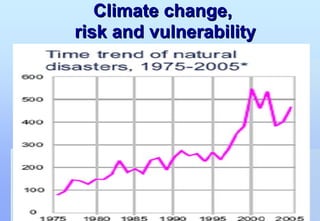
examples of the unquestionable trend
that (un)natural disasters are on the
increase, both in frequency and in
impacts. Our common future is under
threat.
The two examples already indicate
that our environmental risks go well
beyond climate change and include
risks of a geo-tectonic and a human
nature.
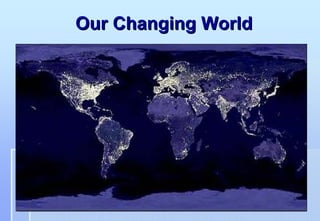
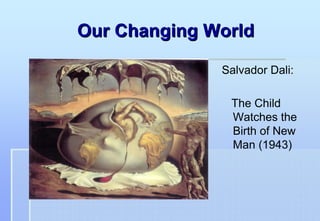
Our Changing World
Our Changing World

              Salvador Dali:

               The Child
               Watches the
               Birth of New
               Man (1943)
Challenges of Our Times

Core Processes Leading to Change
 Globalization and Localization
 Increasing frequency and impact of
 environmental hazards
 Development of the knowledge society
 Growing importance of ethics and
 values
Challenges of Our Times
Main Challenges
1. World governance, peace and security
2. Climate change, risk and vulnerability
3. Globalization and urbanization
4. Global health
5. International crime and terrorism
6. Ethics, values and inter-cultural leadership
7. Fragile ecosystems, access and
    benefit-sharing
Precious Niche of UNU
  = given by the two parts of its name:
     United Nations and University

Being a university provides the autonomy and
independence that guarantee its objectivity and
integrity;

Being United Nations focuses the work of UNU
on the agenda of UN: peace, security, governance;
development, environment and the related science
and technology.
Mission of UNU

“to contribute, through research and capacity
    development, to efforts to resolve the
    pressing global problems that are the
  concern of the United Nations, its Peoples
             and Member States.”
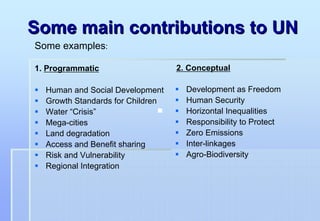
Some main contributions to UN
Some examples:

1. Programmatic                   2. Conceptual

  Human and Social Development      Development as Freedom
  Growth Standards for Children     Human Security
  Water “Crisis”                    Horizontal Inequalities
  Mega-cities                       Responsibility to Protect
  Land degradation                  Zero Emissions
  Access and Benefit sharing        Inter-linkages
  Risk and Vulnerability            Agro-Biodiversity
  Regional Integration
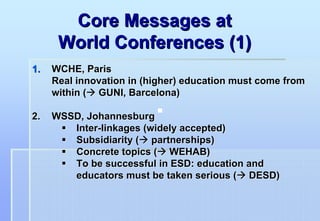
Core Messages at
      World Conferences (1)
1.   WCHE, Paris
     Real innovation in (higher) education must come from
     within ( GUNI, Barcelona)

2.   WSSD, Johannesburg
        Inter-linkages (widely accepted)
        Subsidiarity ( partnerships)
        Concrete topics ( WEHAB)
        To be successful in ESD: education and
        educators must be taken serious ( DESD)
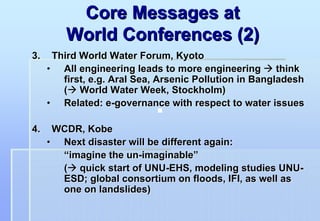
Core Messages at
         World Conferences (2)
3.    Third World Water Forum, Kyoto
     • All engineering leads to more engineering        think
        first, e.g. Aral Sea, Arsenic Pollution in Bangladesh
        ( World Water Week, Stockholm)
     • Related: e-governance with respect to water issues

4.    WCDR, Kobe
     • Next disaster will be different again:
       “imagine the un-imaginable”
       ( quick start of UNU-EHS, modeling studies UNU-
       ESD; global consortium on floods, IFI, as well as
       one on landslides)
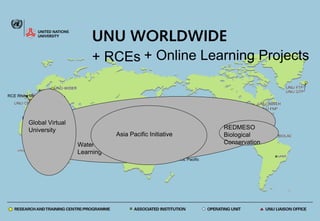
+ RCEs + Online Learning Projects

RCE Rhine Meuse


                                                        RCE Greater Sendai
                                                                                       RCE Toronto
      RCE Barcelona
                                      RCE Tongyeong
         Global Virtual
         University
                        RCE Jordan                      RCE Okayama                   REDMESO
                                            Asia Pacific Initiative                   Biological
                             Water Virtual RCE Penang                                 Conservation
                             Learning Centre
                                                                        RCE Pacific
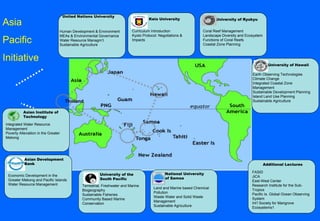
United Nations University
                                                                                     Keio University                    University of Ryukyu
Asia
                                 Human Development & Environment           Curriculum Introduction               Coral Reef Management
                                 MEAs & Environmental Governance           Kyoto Protocol: Negotiations &        Landscape Diversity and Ecosystem
Pacific                          Water Resource Managm’t
                                 Sustainable Agriculture
                                                                           Impacts                               Functions of Coral Reefs
                                                                                                                 Coastal Zone Planning


Initiative
                                                                                                                                                       University of Hawaii

                                                                                                                                            Earth Observing Technologies
                                                                                                                                            Climate Change
                                                                                                                                            Integrated Coastal Zone
                                                                                                                                            Management
                                                                                                                                            Sustainable Development Planning
                                                                                                                                            Island Land Use Planning
                                      Thailand                                                                                              Sustainable Agriculture


           Asian Institute of
           Technology

Integrated Water Resource
Management
Poverty Alleviation in the Greater
Mekong


           Asian Development
           Bank                                                                                                                                      Additional Lectures

                                                                                              National University                           FASID
 Economic Development in the                            University of the
                                                                                              of Samoa                                      JiCA
 Greater Mekong and Pacific Islands                     South Pacific
                                                                                                                                            East-West Center
 Water Resource Management                    Terrestrial, Freshwater and Marine                                                            Research Institute for the Sub-
                                                                                       Land and Marine based Chemical                       Tropics
                                              Biogeography
                                                                                       Pollution                                            Pacific Is. Global Ocean Observing
                                              Sustainable Fisheries
                                                                                       Waste Water and Solid Waste                          System
                                              Community Based Marine
                                                                                       Management                                           Int’l Society for Mangrove
                                              Conservation
                                                                                       Sustainable Agriculture                              Ecosystems1
Climate change,
risk and vulnerability
Climate change,
risk and vulnerability
Climate change,
risk and vulnerability
Climate change,
risk and vulnerability
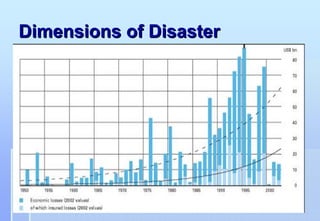
Dimensions of Disaster
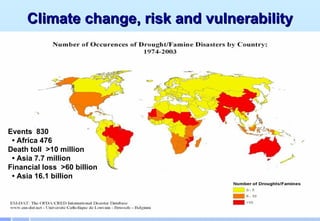
Climate change, risk and vulnerability


Events 830
 • Africa 476
Death toll >10 million
 • Asia 7.7 million
Financial loss >60 billion
 • Asia 16.1 billion
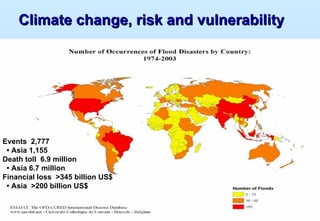
Climate change, risk and vulnerability


Events 2,777
 • Asia 1,155
Death toll 6.9 million
 • Asia 6.7 million
Financial loss >345 billion US$
 • Asia >200 billion US$
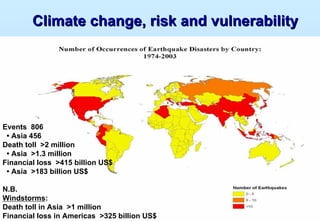
Climate change, risk and vulnerability


Events 806
 • Asia 456
Death toll >2 million
 • Asia >1.3 million
Financial loss >415 billion US$
 • Asia >183 billion US$

N.B.
Windstorms:
Death toll in Asia >1 million
Financial loss in Americas >325 billion US$
Creeping Disasters
Land Degradation (1)

    Affects 23% of the landscape under
    human use, including about 60% of the
    area of Africa and Asia
    Each year an additional 20 million
    hectares of agricultural land becomes
    too degraded for crop production or is
    lost to other uses
Creeping Disasters
Land Degradation (3)

    Prevention and reversal of land
    degradation fosters the achievement of
    UN Millennium Development Goals
    (MDGs) and the objectives of major
    global environment conventions
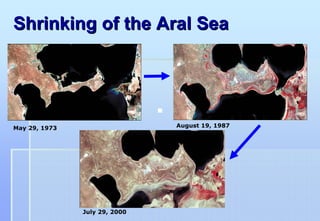
Shrinking of the Aral Sea


May 29, 1973                   August 19, 1987


               July 29, 2000
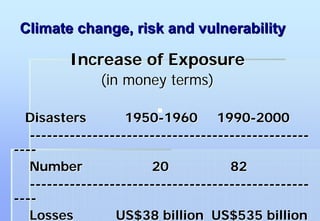
Climate change, risk and vulnerability

         Increase of Exposure
               (in money terms)

  Disasters         1950-1960 1990-2000
   -------------------------------------------------
----
   Number               20            82
   -------------------------------------------------
----
   Losses         US$38 billion US$535 billion
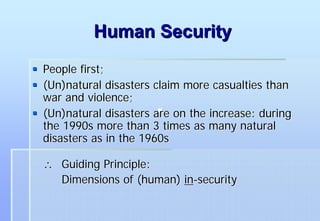
Human Security
People first;
(Un)natural disasters claim more casualties than
war and violence;
(Un)natural disasters are on the increase: during
the 1990s more than 3 times as many natural
disasters as in the 1960s

∴ Guiding Principle:
  Dimensions of (human) in-security
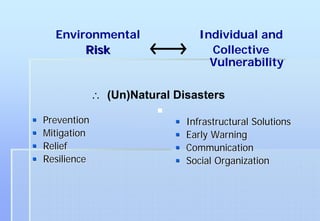
Environmental                 Individual and
       Risk                       Collective
                                  Vulnerability

             ∴ (Un)Natural Disasters

Prevention                   Infrastructural Solutions
Mitigation                   Early Warning
Relief                       Communication
Resilience                   Social Organization
Approaches to Reduce Risks
define acceptable risks to each society
prioritize strengthening critical infrastructure including
lifelines, such as energy and water supplies,
transportation
develop policies to promote incremental strengthening
of infrastructure through legislation and incentives
find ways to share risks through financial and
insurance mechanisms
develop safety nets to support recovery after
disasters
Education for Sustainable Development:
  a Vehicle to Build Winning Alliances
   A multi disciplinary approach

   Research on ‘hard’ – meaning infrastructure and ‘soft’
   – meaning non-structural measures, to develop
   effective policies and innovative solutions

   An educated public supporting long term measures

   Community participation and support in strategic
   development agenda that incorporate disaster risk
   reduction in development planning
Decade of Education
for Sustainable Development (DESD)
  Proposed in JPOI (2005-2014)
  Adopted by UN General Assembly in 2002
  The International Implementation Scheme (IIS)
  for DESD was approved in Sep. 2005.
  Governments are invited to consider the measures
  to implement DESD in their educational strategies
  and action plans.
DESD Vision
Creation of the Global Learning Space
       for EfSD, based on RCEs

Create a world where everyone has
the opportunity to benefit from quality
education and learn the values,
behavior and lifestyles required for a
sustainable future and for positive
societal transition.
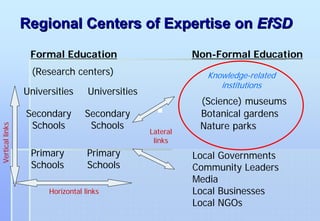
Regional Centers of Expertise on EfSD
                  Formal Education                          Non-Formal Education
                  (Research centers)                          Knowledge-related
                                                                 institutions
                 Universities      Universities
                                                             (Science) museums
                 Secondary        Secondary                  Botanical gardens
                  Schools          Schools                   Nature parks
Vertical links


                                                  Lateral
                                                   links
                  Primary          Primary                  Local Governments
                  Schools          Schools                  Community Leaders
                                                            Media
                       Horizontal links                     Local Businesses
                                                            Local NGOs
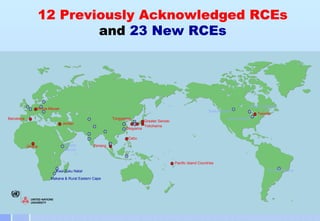
12 Previously Acknowledged RCEs
                            and 23 New RCEs


                                                                                                                               Greater Sudbury
                Rhine-Meuse
                                                                                                           Saskatchewan
                                                                                                                                    Toronto
Barcelona                                             Tongyeong                                                     Grand Rapids
                                                                      Greater Sendai
                              Jordan
                                                                      Yokohama
                                                            Okayama

                                                             Cebu

            Ghana             Greater        Penang
                              Nairobi


                                                                                       Pacific Island Countries

                         Kwa-Zuku Natal                                                                                                  Curitiba-Parana

                      Makana & Rural Eastern Cape
About Knowing
                       You Know
        It is just not what you see, you know


    •   “New Society”: ...    new challenges
    •   Surprise:…………         be prepared
    •   Engineering:……        never stops
    •   Complexity:……..       respect nature
    •   Education:………         WEHAB
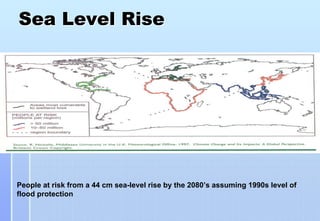
Sea Level Rise


People at risk from a 44 cm sea-level rise by the 2080’s assuming 1990s level of
flood protection
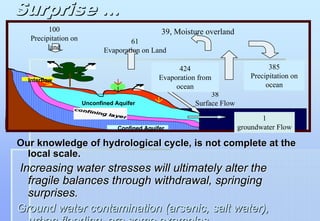
Surprise …
        100                                     39, Moisture overland
  Precipitation on                  61
        land                Evaporation on Land

                                                     424                          385
                                               Evaporation from             Precipitation on
  Interflow
                                                    ocean                        ocean
                                                               38
                     Unconfined Aquifer                   Surface Flow

                                                                                1
                                 Confined Aquifer                        groundwater Flow

Our knowledge of hydrological cycle, is not complete at the
  local scale.
Increasing water stresses will ultimately alter the
  fragile balances through withdrawal, springing
  surprises.
Ground water contamination (arsenic, salt water),
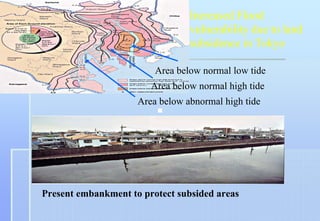
Increased Flood
                                 vulnerability due to land
                                 subsidence in Tokyo

                         Area below normal low tide
                        Area below normal high tide
                     Area below abnormal high tide


Present embankment to protect subsided areas
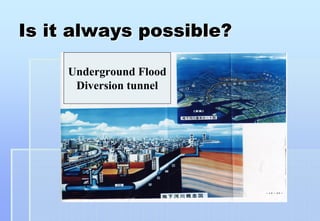
Is it always possible?

     Underground Flood
      Diversion tunnel
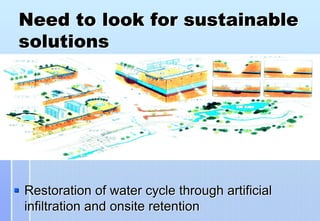
Need to look for sustainable
solutions


Restoration of water cycle through artificial
infiltration and onsite retention
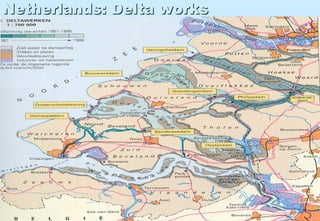
Netherlands: Delta works
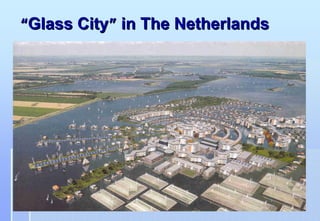
“Glass City” in The Netherlands
An important decision for the G-8 to
take in Hokkaido would be to agree
that in all their countries in all curricula
from primary to higher education
elements of EfSD must be included in
a thoughtful, systematic way, as was
already done e.g. in Sweden.
Another important strategic decision
would be that all agree to
systematically support the formation
of RCEs in all G-8 countries, as has
already been decided by Japan in its
EfSD policy.

Utrecht sa- hans van ginkel

  • 1.
    Rising to the Occasion Roles of Universities in EfSD Dr. Hans van Ginkel Honorary Professor Utrecht University, The Netherlands
  • 2.
    The cyclone andfloods in the Irrawaddy-delta and the earthquake in Sichuan are just two recent, horrific examples of the unquestionable trend that (un)natural disasters are on the increase, both in frequency and in impacts. Our common future is under threat.
  • 3.
    The two examplesalready indicate that our environmental risks go well beyond climate change and include risks of a geo-tectonic and a human nature.
  • 4.
  • 5.
    Our Changing World Salvador Dali: The Child Watches the Birth of New Man (1943)
  • 6.
    Challenges of OurTimes Core Processes Leading to Change Globalization and Localization Increasing frequency and impact of environmental hazards Development of the knowledge society Growing importance of ethics and values
  • 7.
    Challenges of OurTimes Main Challenges 1. World governance, peace and security 2. Climate change, risk and vulnerability 3. Globalization and urbanization 4. Global health 5. International crime and terrorism 6. Ethics, values and inter-cultural leadership 7. Fragile ecosystems, access and benefit-sharing
  • 8.
    Precious Niche ofUNU = given by the two parts of its name: United Nations and University Being a university provides the autonomy and independence that guarantee its objectivity and integrity; Being United Nations focuses the work of UNU on the agenda of UN: peace, security, governance; development, environment and the related science and technology.
  • 9.
    Mission of UNU “tocontribute, through research and capacity development, to efforts to resolve the pressing global problems that are the concern of the United Nations, its Peoples and Member States.”
  • 10.
    Some main contributionsto UN Some examples: 1. Programmatic 2. Conceptual Human and Social Development Development as Freedom Growth Standards for Children Human Security Water “Crisis” Horizontal Inequalities Mega-cities Responsibility to Protect Land degradation Zero Emissions Access and Benefit sharing Inter-linkages Risk and Vulnerability Agro-Biodiversity Regional Integration
  • 11.
    Core Messages at World Conferences (1) 1. WCHE, Paris Real innovation in (higher) education must come from within ( GUNI, Barcelona) 2. WSSD, Johannesburg Inter-linkages (widely accepted) Subsidiarity ( partnerships) Concrete topics ( WEHAB) To be successful in ESD: education and educators must be taken serious ( DESD)
  • 12.
    Core Messages at World Conferences (2) 3. Third World Water Forum, Kyoto • All engineering leads to more engineering think first, e.g. Aral Sea, Arsenic Pollution in Bangladesh ( World Water Week, Stockholm) • Related: e-governance with respect to water issues 4. WCDR, Kobe • Next disaster will be different again: “imagine the un-imaginable” ( quick start of UNU-EHS, modeling studies UNU- ESD; global consortium on floods, IFI, as well as one on landslides)
  • 13.
    + RCEs +Online Learning Projects RCE Rhine Meuse RCE Greater Sendai RCE Toronto RCE Barcelona RCE Tongyeong Global Virtual University RCE Jordan RCE Okayama REDMESO Asia Pacific Initiative Biological Water Virtual RCE Penang Conservation Learning Centre RCE Pacific
  • 14.
    United Nations University Keio University University of Ryukyu Asia Human Development & Environment Curriculum Introduction Coral Reef Management MEAs & Environmental Governance Kyoto Protocol: Negotiations & Landscape Diversity and Ecosystem Pacific Water Resource Managm’t Sustainable Agriculture Impacts Functions of Coral Reefs Coastal Zone Planning Initiative University of Hawaii Earth Observing Technologies Climate Change Integrated Coastal Zone Management Sustainable Development Planning Island Land Use Planning Thailand Sustainable Agriculture Asian Institute of Technology Integrated Water Resource Management Poverty Alleviation in the Greater Mekong Asian Development Bank Additional Lectures National University FASID Economic Development in the University of the of Samoa JiCA Greater Mekong and Pacific Islands South Pacific East-West Center Water Resource Management Terrestrial, Freshwater and Marine Research Institute for the Sub- Land and Marine based Chemical Tropics Biogeography Pollution Pacific Is. Global Ocean Observing Sustainable Fisheries Waste Water and Solid Waste System Community Based Marine Management Int’l Society for Mangrove Conservation Sustainable Agriculture Ecosystems1
  • 15.
  • 16.
  • 17.
  • 18.
  • 19.
  • 20.
    Climate change, riskand vulnerability Events 830 • Africa 476 Death toll >10 million • Asia 7.7 million Financial loss >60 billion • Asia 16.1 billion
  • 21.
    Climate change, riskand vulnerability Events 2,777 • Asia 1,155 Death toll 6.9 million • Asia 6.7 million Financial loss >345 billion US$ • Asia >200 billion US$
  • 22.
    Climate change, riskand vulnerability Events 806 • Asia 456 Death toll >2 million • Asia >1.3 million Financial loss >415 billion US$ • Asia >183 billion US$ N.B. Windstorms: Death toll in Asia >1 million Financial loss in Americas >325 billion US$
  • 23.
    Creeping Disasters Land Degradation(1) Affects 23% of the landscape under human use, including about 60% of the area of Africa and Asia Each year an additional 20 million hectares of agricultural land becomes too degraded for crop production or is lost to other uses
  • 24.
    Creeping Disasters Land Degradation(3) Prevention and reversal of land degradation fosters the achievement of UN Millennium Development Goals (MDGs) and the objectives of major global environment conventions
  • 25.
    Shrinking of theAral Sea May 29, 1973 August 19, 1987 July 29, 2000
  • 26.
    Climate change, riskand vulnerability Increase of Exposure (in money terms) Disasters 1950-1960 1990-2000 ------------------------------------------------- ---- Number 20 82 ------------------------------------------------- ---- Losses US$38 billion US$535 billion
  • 27.
    Human Security People first; (Un)naturaldisasters claim more casualties than war and violence; (Un)natural disasters are on the increase: during the 1990s more than 3 times as many natural disasters as in the 1960s ∴ Guiding Principle: Dimensions of (human) in-security
  • 28.
    Environmental Individual and Risk Collective Vulnerability ∴ (Un)Natural Disasters Prevention Infrastructural Solutions Mitigation Early Warning Relief Communication Resilience Social Organization
  • 29.
    Approaches to ReduceRisks define acceptable risks to each society prioritize strengthening critical infrastructure including lifelines, such as energy and water supplies, transportation develop policies to promote incremental strengthening of infrastructure through legislation and incentives find ways to share risks through financial and insurance mechanisms develop safety nets to support recovery after disasters
  • 30.
    Education for SustainableDevelopment: a Vehicle to Build Winning Alliances A multi disciplinary approach Research on ‘hard’ – meaning infrastructure and ‘soft’ – meaning non-structural measures, to develop effective policies and innovative solutions An educated public supporting long term measures Community participation and support in strategic development agenda that incorporate disaster risk reduction in development planning
  • 31.
    Decade of Education forSustainable Development (DESD) Proposed in JPOI (2005-2014) Adopted by UN General Assembly in 2002 The International Implementation Scheme (IIS) for DESD was approved in Sep. 2005. Governments are invited to consider the measures to implement DESD in their educational strategies and action plans.
  • 32.
    DESD Vision Creation ofthe Global Learning Space for EfSD, based on RCEs Create a world where everyone has the opportunity to benefit from quality education and learn the values, behavior and lifestyles required for a sustainable future and for positive societal transition.
  • 33.
    Regional Centers ofExpertise on EfSD Formal Education Non-Formal Education (Research centers) Knowledge-related institutions Universities Universities (Science) museums Secondary Secondary Botanical gardens Schools Schools Nature parks Vertical links Lateral links Primary Primary Local Governments Schools Schools Community Leaders Media Horizontal links Local Businesses Local NGOs
  • 34.
    12 Previously AcknowledgedRCEs and 23 New RCEs Greater Sudbury Rhine-Meuse Saskatchewan Toronto Barcelona Tongyeong Grand Rapids Greater Sendai Jordan Yokohama Okayama Cebu Ghana Greater Penang Nairobi Pacific Island Countries Kwa-Zuku Natal Curitiba-Parana Makana & Rural Eastern Cape
  • 35.
    About Knowing You Know It is just not what you see, you know • “New Society”: ... new challenges • Surprise:………… be prepared • Engineering:…… never stops • Complexity:…….. respect nature • Education:……… WEHAB
  • 36.
    Sea Level Rise Peopleat risk from a 44 cm sea-level rise by the 2080’s assuming 1990s level of flood protection
  • 37.
    Surprise … 100 39, Moisture overland Precipitation on 61 land Evaporation on Land 424 385 Evaporation from Precipitation on Interflow ocean ocean 38 Unconfined Aquifer Surface Flow 1 Confined Aquifer groundwater Flow Our knowledge of hydrological cycle, is not complete at the local scale. Increasing water stresses will ultimately alter the fragile balances through withdrawal, springing surprises. Ground water contamination (arsenic, salt water),
  • 38.
    Increased Flood vulnerability due to land subsidence in Tokyo Area below normal low tide Area below normal high tide Area below abnormal high tide Present embankment to protect subsided areas
  • 39.
    Is it alwayspossible? Underground Flood Diversion tunnel
  • 40.
    Need to lookfor sustainable solutions Restoration of water cycle through artificial infiltration and onsite retention
  • 41.
  • 42.
    “Glass City” inThe Netherlands
  • 43.
    An important decisionfor the G-8 to take in Hokkaido would be to agree that in all their countries in all curricula from primary to higher education elements of EfSD must be included in a thoughtful, systematic way, as was already done e.g. in Sweden.
  • 44.
    Another important strategicdecision would be that all agree to systematically support the formation of RCEs in all G-8 countries, as has already been decided by Japan in its EfSD policy.