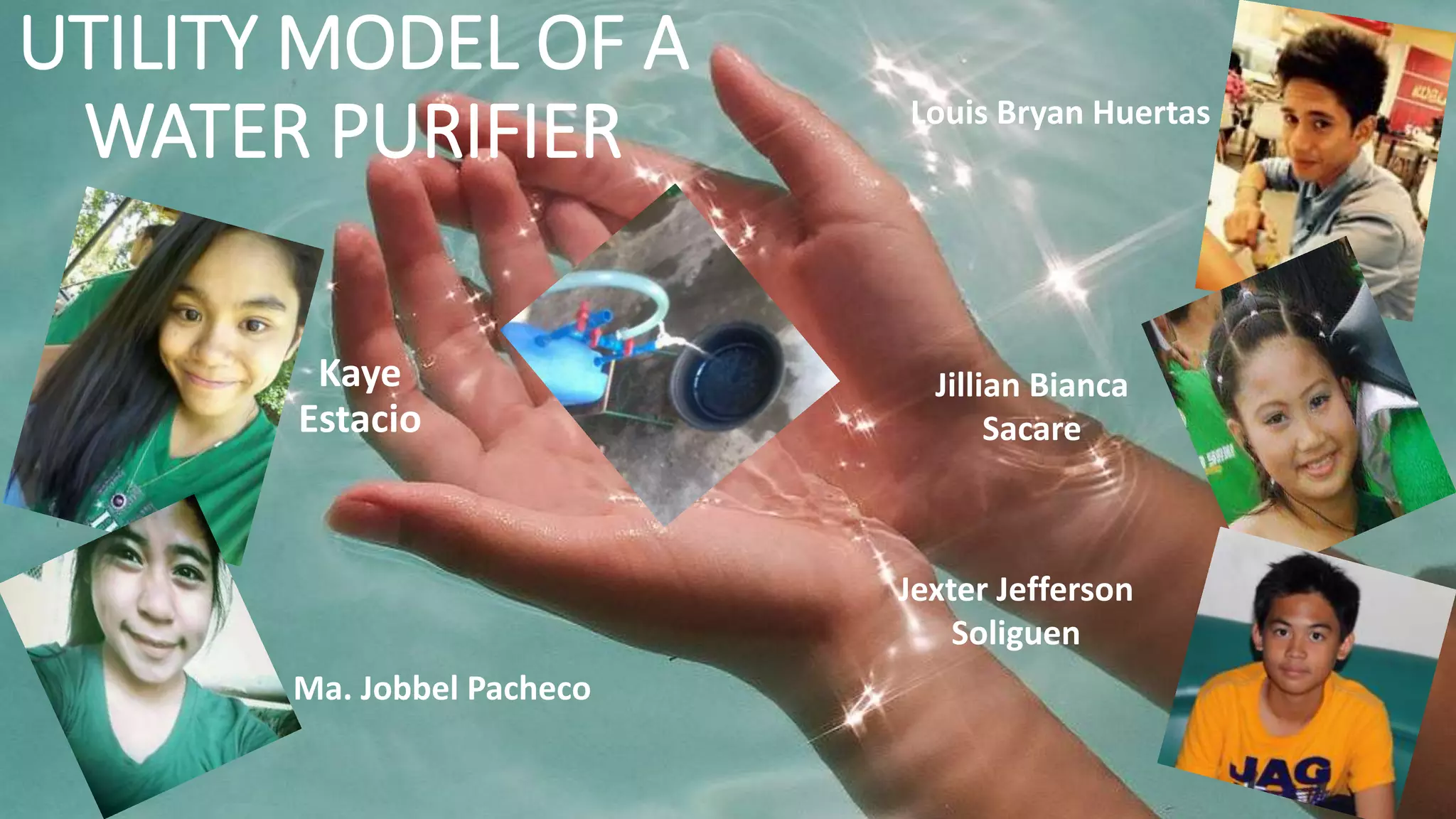
UTILITY MODEL OF A
WATER PURIFIER
Kaye
Estacio
Louis Bryan Huertas
Jillian Bianca
Sacare
Jexter Jefferson
Soliguen
Ma. Jobbel Pacheco
Abstract
Poverty highly affects the health condition of a certain individual. Everyday,
everybody needs water to sustain their body with good health. Nowadays, water shortage
is very common among regions. Some uncivilized cities gets their supply of water from
wells, water pump, or by digging not knowing if it acquires a 100% potability. With the
current dilemma developing, the researchers came up of constructing a utility model of a
water purifier in order to combat this cause knowing that the availability of materials is at
hand locally and indigenously.
• Is Carbon really an effective source that can purify water?
• Yes, it works with the process called adsorption in which it makes pollutant molecules in
the fluid to be treated, entrapped inside the pore structure of the carbon substrate.
• Would/Can it purify water from water pumps or shallow wells and give a consistent
potability?
• Basically it can provide drinkable water by following the process exactly and by making
sure that the materials used, may it be indigenous or not is clean and safe to use.
INTRODUCTION
• True, water is something that people couldn’t live without. As for
planet earth, three fourths (3/4) of its body is comprised by water---
same to human beings and other living things. In view of this, the
researchers see a lot of concern as to the potability which is the
primary matter of finding innovative ways. The researchers decided to
find ways and means on how to address those concerns. From data’s
gathered, the researchers had come up to the conclusion for the
development of a utility model of a water purifier. Indeed this might
as well serve as a solution as per needs of eradicating water borne
diseases. With this, water plays a major role for life.
STATEMENT OF THE PROBLEM
• Why settle for a very expensive water purifier when people would
know how to construct one easily with the aid of observations and
testing? With this at hand, the researchers had come up to the
following questions:
• General Question:
Is the product effective enough to purify water?
STATEMENT OF THE PROBLEM
• Specific Questions:
• Are the materials to be built available?
• Is it affordable enough compared to other commercialized purifiers or
other water purifier improvisations?
• Can it be used daily without affecting its durability?
• Is Carbon really an effective source which contributed much to the
aforementioned water purifier?
OBJECTIVES
General Objective:
• To build a utility model of a water purifier using activated carbon as alternative source.
•
Specific Objectives
• To construct a system of low cost.
• To know if the product is effective or safe to use.
• To know how much activated carbon is needed in order to make the product function
properly.
• To know how much volume of water it can fill in a certain period of time.
• To successfully observe if it purified the water to a 100% potability.
SIGNIFICANCE OF THE STUDY
• For the past decade until these days, so much pollutant has penetrated to
water sources for human and animal consumption. Admit it or not but the
truth is even the Water district that is supposed to supply potable water to
the populace doesn’t even deliver it to a 100% potability. much more on
the rural and sub-urban areas wherein the water supply depends only on
shallow wells. Hence, water borne diseases are basically rampant as per
data’s taken by health centers. From this point of view, the researchers
decided to construct a system to address this common problem. This is a
system the researchers decided to call as a utility model of a water purifier
using activated carbon as alternative source to serve as a multi-faucet as to
serve not only for safe drinking, but also to cover both bath and laundry to
a certain household
SCOPE AND LIMITATIONS
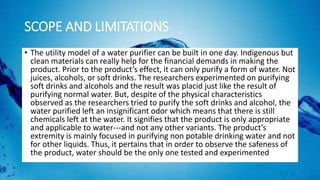
• The utility model of a water purifier can be built in one day. Indigenous but
clean materials can really help for the financial demands in making the
product. Prior to the product’s effect, it can only purify a form of water. Not
juices, alcohols, or soft drinks. The researchers experimented on purifying
soft drinks and alcohols and the result was placid just like the result of
purifying normal water. But, despite of the physical characteristics
observed as the researchers tried to purify the soft drinks and alcohol, the
water purified left an insignificant odor which means that there is still
chemicals left at the water. It signifies that the product is only appropriate
and applicable to water---and not any other variants. The product’s
extremity is mainly focused in purifying non potable drinking water and not
for other liquids. Thus, it pertains that in order to observe the safeness of
the product, water should be the only one tested and experimented
CHAPTER 3
Methodology
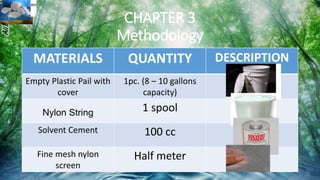
MATERIALS QUANTITY DESCRIPTION
Empty Plastic Pail with
cover
1pc. (8 – 10 gallons
capacity)
Nylon String 1 spool
Solvent Cement 100 cc
Fine mesh nylon
screen
Half meter
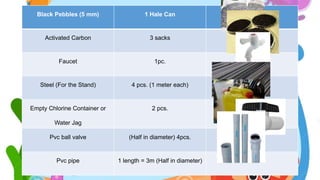
Black Pebbles (5 mm) 1 Hale Can
Activated Carbon 3 sacks
Faucet 1pc.
Steel (For the Stand) 4 pcs. (1 meter each)
Empty Chlorine Container or
Water Jag
2 pcs.
Pvc ball valve (Half in diameter) 4pcs.
Pvc pipe 1 length = 3m (Half in diameter)
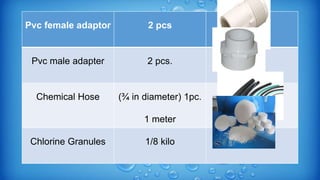
Pvc female adaptor 2 pcs
Pvc male adapter 2 pcs.
Chemical Hose (¾ in diameter) 1pc.
1 meter
Chlorine Granules 1/8 kilo
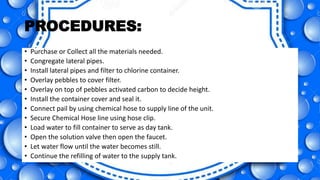
PROCEDURES:
• Purchase or Collect all the materials needed.
• Congregate lateral pipes.
• Install lateral pipes and filter to chlorine container.
• Overlay pebbles to cover filter.
• Overlay on top of pebbles activated carbon to decide height.
• Install the container cover and seal it.
• Connect pail by using chemical hose to supply line of the unit.
• Secure Chemical Hose line using hose clip.
• Load water to fill container to serve as day tank.
• Open the solution valve then open the faucet.
• Let water flow until the water becomes still.
• Continue the refilling of water to the supply tank.
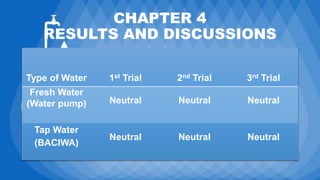
CHAPTER 4
RESULTS AND DISCUSSIONS
Type of Water 1st Trial 2nd Trial 3rd Trial
Fresh Water
(Water pump) Neutral Neutral Neutral
Tap Water
(BACIWA)
Neutral Neutral Neutral
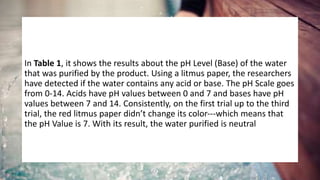
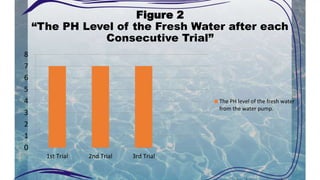
In Table 1, it shows the results about the pH Level (Base) of the water
that was purified by the product. Using a litmus paper, the researchers
have detected if the water contains any acid or base. The pH Scale goes
from 0-14. Acids have pH values between 0 and 7 and bases have pH
values between 7 and 14. Consistently, on the first trial up to the third
trial, the red litmus paper didn’t change its color---which means that
the pH Value is 7. With its result, the water purified is neutral
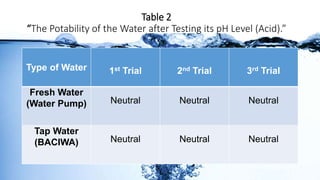
Table 2
“The Potability of the Water after Testing its pH Level (Acid).”
Type of Water 1st Trial 2nd Trial 3rd Trial
Fresh Water
(Water Pump) Neutral Neutral Neutral
Tap Water
(BACIWA) Neutral Neutral Neutral
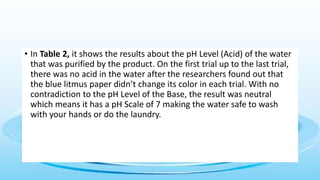
• In Table 2, it shows the results about the pH Level (Acid) of the water
that was purified by the product. On the first trial up to the last trial,
there was no acid in the water after the researchers found out that
the blue litmus paper didn’t change its color in each trial. With no
contradiction to the pH Level of the Base, the result was neutral
which means it has a pH Scale of 7 making the water safe to wash
with your hands or do the laundry.
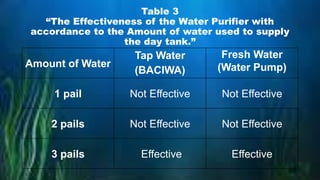
Table 3
“The Effectiveness of the Water Purifier with
accordance to the Amount of water used to supply
the day tank.”
Amount of Water
Tap Water
(BACIWA)
Fresh Water
(Water Pump)
1 pail Not Effective Not Effective
2 pails Not Effective Not Effective
3 pails Effective Effective
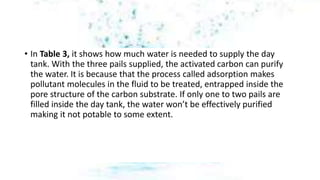
• In Table 3, it shows how much water is needed to supply the day
tank. With the three pails supplied, the activated carbon can purify
the water. It is because that the process called adsorption makes
pollutant molecules in the fluid to be treated, entrapped inside the
pore structure of the carbon substrate. If only one to two pails are
filled inside the day tank, the water won’t be effectively purified
making it not potable to some extent.
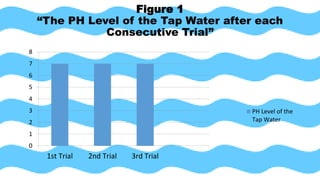
Figure 1
“The PH Level of the Tap Water after each
Consecutive Trial”
0
1
2
3
4
5
6
7
8
1st Trial 2nd Trial 3rd Trial
PH Level of the
Tap Water
Figure 2
“The PH Level of the Fresh Water after each
Consecutive Trial”
0
1
2
3
4
5
6
7
8
1st Trial 2nd Trial 3rd Trial
The PH level of the fresh water
from the water pump.
Chapter 5
Summary, Conclusions and Recommendations
• Summary
• The study bore a good result of making a Utility model of a
Water Purifier. Nowadays, water plays a very important role to
people. Unclean water contributes a dilemma if it is widely spread
and not purified. With the water purifier, it can reduce the chance of
having communicable diseases, unpleasant surroundings, and
morbidity. The study successfully met the expectations of it being
effective. With the aid of indigenous materials, the water purifier will
be affordable making it also useful in purifying water.
Conclusions
• The researchers had concluded that the Utility Model of a Water
Purifier is truly beneficial to the environment. With water one of the
world’s major problems; this purifier can help the world become pleasant
and clean. The group also concluded that it can purify water using three
pails supplied at the day tank. It also can purify water making it safe to
drink, or to wash hands. Its pH Scale is 7 which means it is neutral making it
clear that it is clean and pure. The product successfully met the desired
expectations that it is inexpensive, effective, environmental-friendly, and it
can cleanse stagnant water. This concludes that it is safe to use, free from
harm and prevents the spreading of unpurified water used throughout the
region. Many people can be a benefactor of this product for it saves time,
money, and effort. With just the presence of carbon, the process can be
done cleanly making the model work successfully, cleansing harmful
substances.
RECCOMENDATIONS
• If the people wants to make the world a better place to live at, this
purifier is one solution. With the major problem in the community
raging and continuously spreading internationally, many
disadvantages are likely to occur due to the fact that water can
transmit diseases and make the environment not friendly enough to
humanity. By using the purifier, the following recommendations are
further expected:
• Indigenous Materials are required in order to save and refrain from
high prices. But make sure it is clean and safe to use.
• Make sure to supply the day tank every time the purifier will be used.
• Check every pipe if it has holes.
• If a sample of the dirty substances is required, open the Drain Valve.
• If there is no plastic can to act as the day tank, use a water container
or the container which is the same at the supply tank instead.
• Never try alcohols like beers on the water purifier for it can not be
purified well due to the product’s extremity.
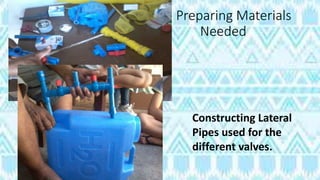
Preparing Materials
Needed
Constructing Lateral
Pipes used for the
different valves.
Letting the
water flow while
undergoing the process
of cleaning.
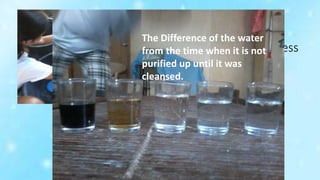
The Difference of the water
from the time when it is not
purified up until it was
cleansed.
Utility model-of-a water purifier

Utility model-of-a water purifier

  • 1.
    UTILITY MODEL OFA WATER PURIFIER Kaye Estacio Louis Bryan Huertas Jillian Bianca Sacare Jexter Jefferson Soliguen Ma. Jobbel Pacheco
  • 2.
    Abstract Poverty highly affectsthe health condition of a certain individual. Everyday, everybody needs water to sustain their body with good health. Nowadays, water shortage is very common among regions. Some uncivilized cities gets their supply of water from wells, water pump, or by digging not knowing if it acquires a 100% potability. With the current dilemma developing, the researchers came up of constructing a utility model of a water purifier in order to combat this cause knowing that the availability of materials is at hand locally and indigenously. • Is Carbon really an effective source that can purify water? • Yes, it works with the process called adsorption in which it makes pollutant molecules in the fluid to be treated, entrapped inside the pore structure of the carbon substrate. • Would/Can it purify water from water pumps or shallow wells and give a consistent potability? • Basically it can provide drinkable water by following the process exactly and by making sure that the materials used, may it be indigenous or not is clean and safe to use.
  • 3.
    INTRODUCTION • True, wateris something that people couldn’t live without. As for planet earth, three fourths (3/4) of its body is comprised by water--- same to human beings and other living things. In view of this, the researchers see a lot of concern as to the potability which is the primary matter of finding innovative ways. The researchers decided to find ways and means on how to address those concerns. From data’s gathered, the researchers had come up to the conclusion for the development of a utility model of a water purifier. Indeed this might as well serve as a solution as per needs of eradicating water borne diseases. With this, water plays a major role for life.
  • 4.
    STATEMENT OF THEPROBLEM • Why settle for a very expensive water purifier when people would know how to construct one easily with the aid of observations and testing? With this at hand, the researchers had come up to the following questions: • General Question: Is the product effective enough to purify water?
  • 5.
    STATEMENT OF THEPROBLEM • Specific Questions: • Are the materials to be built available? • Is it affordable enough compared to other commercialized purifiers or other water purifier improvisations? • Can it be used daily without affecting its durability? • Is Carbon really an effective source which contributed much to the aforementioned water purifier?
  • 6.
    OBJECTIVES General Objective: • Tobuild a utility model of a water purifier using activated carbon as alternative source. • Specific Objectives • To construct a system of low cost. • To know if the product is effective or safe to use. • To know how much activated carbon is needed in order to make the product function properly. • To know how much volume of water it can fill in a certain period of time. • To successfully observe if it purified the water to a 100% potability.
  • 7.
    SIGNIFICANCE OF THESTUDY • For the past decade until these days, so much pollutant has penetrated to water sources for human and animal consumption. Admit it or not but the truth is even the Water district that is supposed to supply potable water to the populace doesn’t even deliver it to a 100% potability. much more on the rural and sub-urban areas wherein the water supply depends only on shallow wells. Hence, water borne diseases are basically rampant as per data’s taken by health centers. From this point of view, the researchers decided to construct a system to address this common problem. This is a system the researchers decided to call as a utility model of a water purifier using activated carbon as alternative source to serve as a multi-faucet as to serve not only for safe drinking, but also to cover both bath and laundry to a certain household
  • 8.
    SCOPE AND LIMITATIONS •The utility model of a water purifier can be built in one day. Indigenous but clean materials can really help for the financial demands in making the product. Prior to the product’s effect, it can only purify a form of water. Not juices, alcohols, or soft drinks. The researchers experimented on purifying soft drinks and alcohols and the result was placid just like the result of purifying normal water. But, despite of the physical characteristics observed as the researchers tried to purify the soft drinks and alcohol, the water purified left an insignificant odor which means that there is still chemicals left at the water. It signifies that the product is only appropriate and applicable to water---and not any other variants. The product’s extremity is mainly focused in purifying non potable drinking water and not for other liquids. Thus, it pertains that in order to observe the safeness of the product, water should be the only one tested and experimented
  • 9.
    CHAPTER 3 Methodology MATERIALS QUANTITYDESCRIPTION Empty Plastic Pail with cover 1pc. (8 – 10 gallons capacity) Nylon String 1 spool Solvent Cement 100 cc Fine mesh nylon screen Half meter
  • 10.
    Black Pebbles (5mm) 1 Hale Can Activated Carbon 3 sacks Faucet 1pc. Steel (For the Stand) 4 pcs. (1 meter each) Empty Chlorine Container or Water Jag 2 pcs. Pvc ball valve (Half in diameter) 4pcs. Pvc pipe 1 length = 3m (Half in diameter)
  • 11.
    Pvc female adaptor2 pcs Pvc male adapter 2 pcs. Chemical Hose (¾ in diameter) 1pc. 1 meter Chlorine Granules 1/8 kilo
  • 12.
    PROCEDURES: • Purchase orCollect all the materials needed. • Congregate lateral pipes. • Install lateral pipes and filter to chlorine container. • Overlay pebbles to cover filter. • Overlay on top of pebbles activated carbon to decide height. • Install the container cover and seal it. • Connect pail by using chemical hose to supply line of the unit. • Secure Chemical Hose line using hose clip. • Load water to fill container to serve as day tank. • Open the solution valve then open the faucet. • Let water flow until the water becomes still. • Continue the refilling of water to the supply tank.
  • 13.
    CHAPTER 4 RESULTS ANDDISCUSSIONS Type of Water 1st Trial 2nd Trial 3rd Trial Fresh Water (Water pump) Neutral Neutral Neutral Tap Water (BACIWA) Neutral Neutral Neutral
  • 14.
    In Table 1,it shows the results about the pH Level (Base) of the water that was purified by the product. Using a litmus paper, the researchers have detected if the water contains any acid or base. The pH Scale goes from 0-14. Acids have pH values between 0 and 7 and bases have pH values between 7 and 14. Consistently, on the first trial up to the third trial, the red litmus paper didn’t change its color---which means that the pH Value is 7. With its result, the water purified is neutral
  • 15.
    Table 2 “The Potabilityof the Water after Testing its pH Level (Acid).” Type of Water 1st Trial 2nd Trial 3rd Trial Fresh Water (Water Pump) Neutral Neutral Neutral Tap Water (BACIWA) Neutral Neutral Neutral
  • 16.
    • In Table2, it shows the results about the pH Level (Acid) of the water that was purified by the product. On the first trial up to the last trial, there was no acid in the water after the researchers found out that the blue litmus paper didn’t change its color in each trial. With no contradiction to the pH Level of the Base, the result was neutral which means it has a pH Scale of 7 making the water safe to wash with your hands or do the laundry.
  • 17.
    Table 3 “The Effectivenessof the Water Purifier with accordance to the Amount of water used to supply the day tank.” Amount of Water Tap Water (BACIWA) Fresh Water (Water Pump) 1 pail Not Effective Not Effective 2 pails Not Effective Not Effective 3 pails Effective Effective
  • 18.
    • In Table3, it shows how much water is needed to supply the day tank. With the three pails supplied, the activated carbon can purify the water. It is because that the process called adsorption makes pollutant molecules in the fluid to be treated, entrapped inside the pore structure of the carbon substrate. If only one to two pails are filled inside the day tank, the water won’t be effectively purified making it not potable to some extent.
  • 19.
    Figure 1 “The PHLevel of the Tap Water after each Consecutive Trial” 0 1 2 3 4 5 6 7 8 1st Trial 2nd Trial 3rd Trial PH Level of the Tap Water
  • 20.
    Figure 2 “The PHLevel of the Fresh Water after each Consecutive Trial” 0 1 2 3 4 5 6 7 8 1st Trial 2nd Trial 3rd Trial The PH level of the fresh water from the water pump.
  • 21.
    Chapter 5 Summary, Conclusionsand Recommendations • Summary • The study bore a good result of making a Utility model of a Water Purifier. Nowadays, water plays a very important role to people. Unclean water contributes a dilemma if it is widely spread and not purified. With the water purifier, it can reduce the chance of having communicable diseases, unpleasant surroundings, and morbidity. The study successfully met the expectations of it being effective. With the aid of indigenous materials, the water purifier will be affordable making it also useful in purifying water.
  • 22.
    Conclusions • The researchershad concluded that the Utility Model of a Water Purifier is truly beneficial to the environment. With water one of the world’s major problems; this purifier can help the world become pleasant and clean. The group also concluded that it can purify water using three pails supplied at the day tank. It also can purify water making it safe to drink, or to wash hands. Its pH Scale is 7 which means it is neutral making it clear that it is clean and pure. The product successfully met the desired expectations that it is inexpensive, effective, environmental-friendly, and it can cleanse stagnant water. This concludes that it is safe to use, free from harm and prevents the spreading of unpurified water used throughout the region. Many people can be a benefactor of this product for it saves time, money, and effort. With just the presence of carbon, the process can be done cleanly making the model work successfully, cleansing harmful substances.
  • 23.
    RECCOMENDATIONS • If thepeople wants to make the world a better place to live at, this purifier is one solution. With the major problem in the community raging and continuously spreading internationally, many disadvantages are likely to occur due to the fact that water can transmit diseases and make the environment not friendly enough to humanity. By using the purifier, the following recommendations are further expected:
  • 24.
    • Indigenous Materialsare required in order to save and refrain from high prices. But make sure it is clean and safe to use. • Make sure to supply the day tank every time the purifier will be used. • Check every pipe if it has holes. • If a sample of the dirty substances is required, open the Drain Valve. • If there is no plastic can to act as the day tank, use a water container or the container which is the same at the supply tank instead. • Never try alcohols like beers on the water purifier for it can not be purified well due to the product’s extremity.
  • 25.
  • 26.
    Letting the water flowwhile undergoing the process of cleaning. The Difference of the water from the time when it is not purified up until it was cleansed.