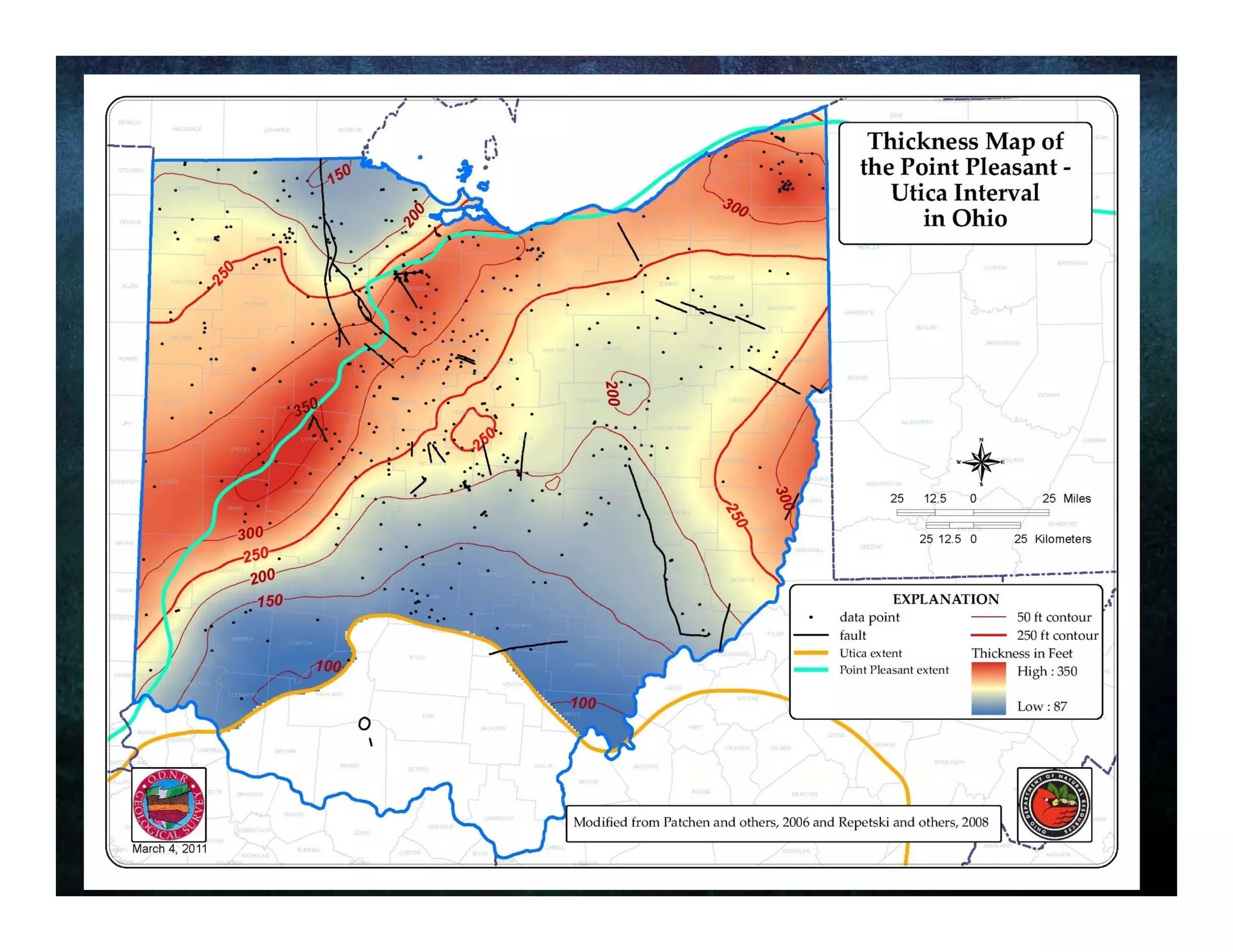
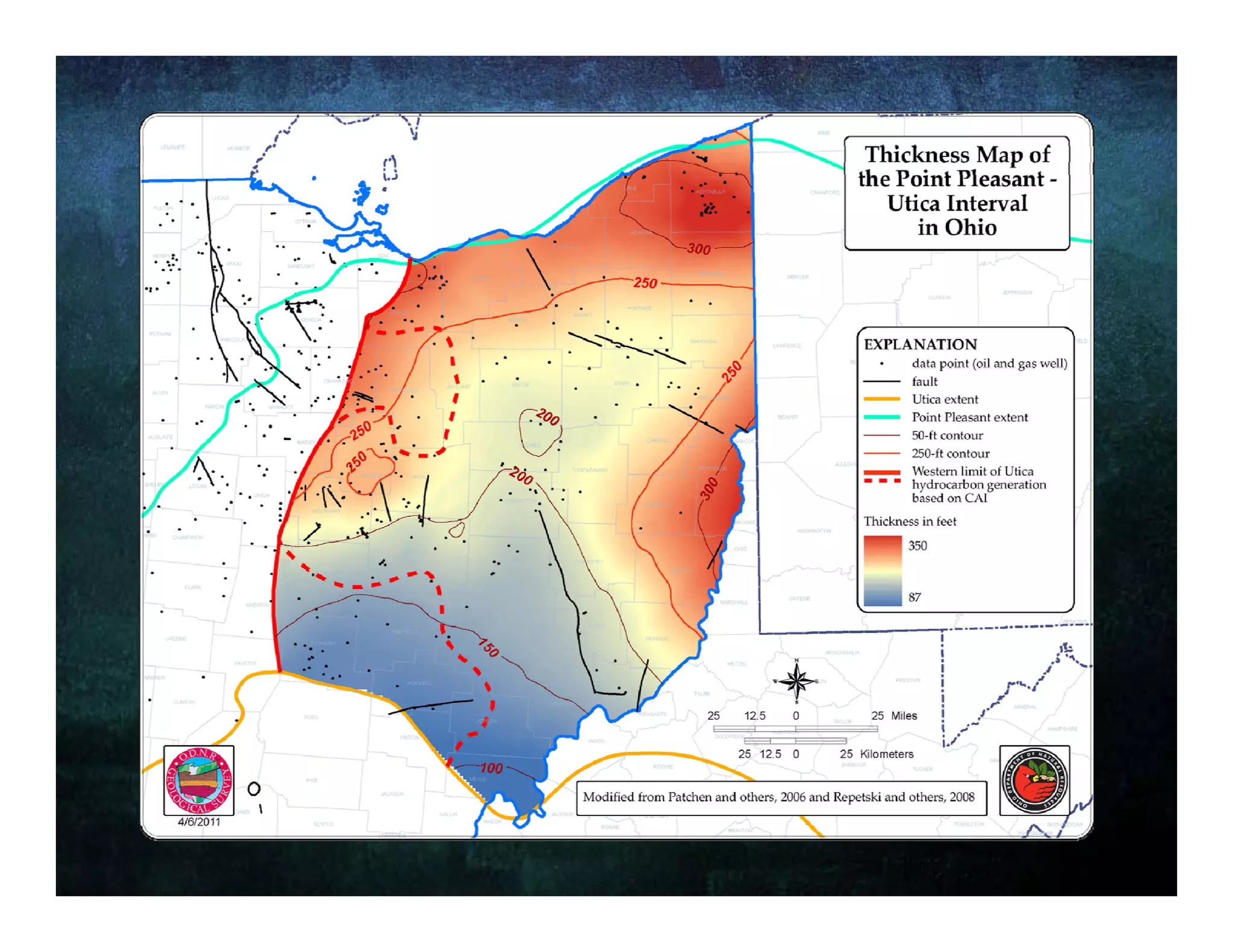
Utica-Point Pleasant Shale
Drilling Activity and Resource
      Assessment in Ohio

    Larry Wickstrom, Chris Perry,
  Matthew Erenpreiss, and Ron Riley

      Ohio Department of Natural Resources
          Division of Geological Survey


                PTTC Workshop
                 June 21 2011
                 J    21,
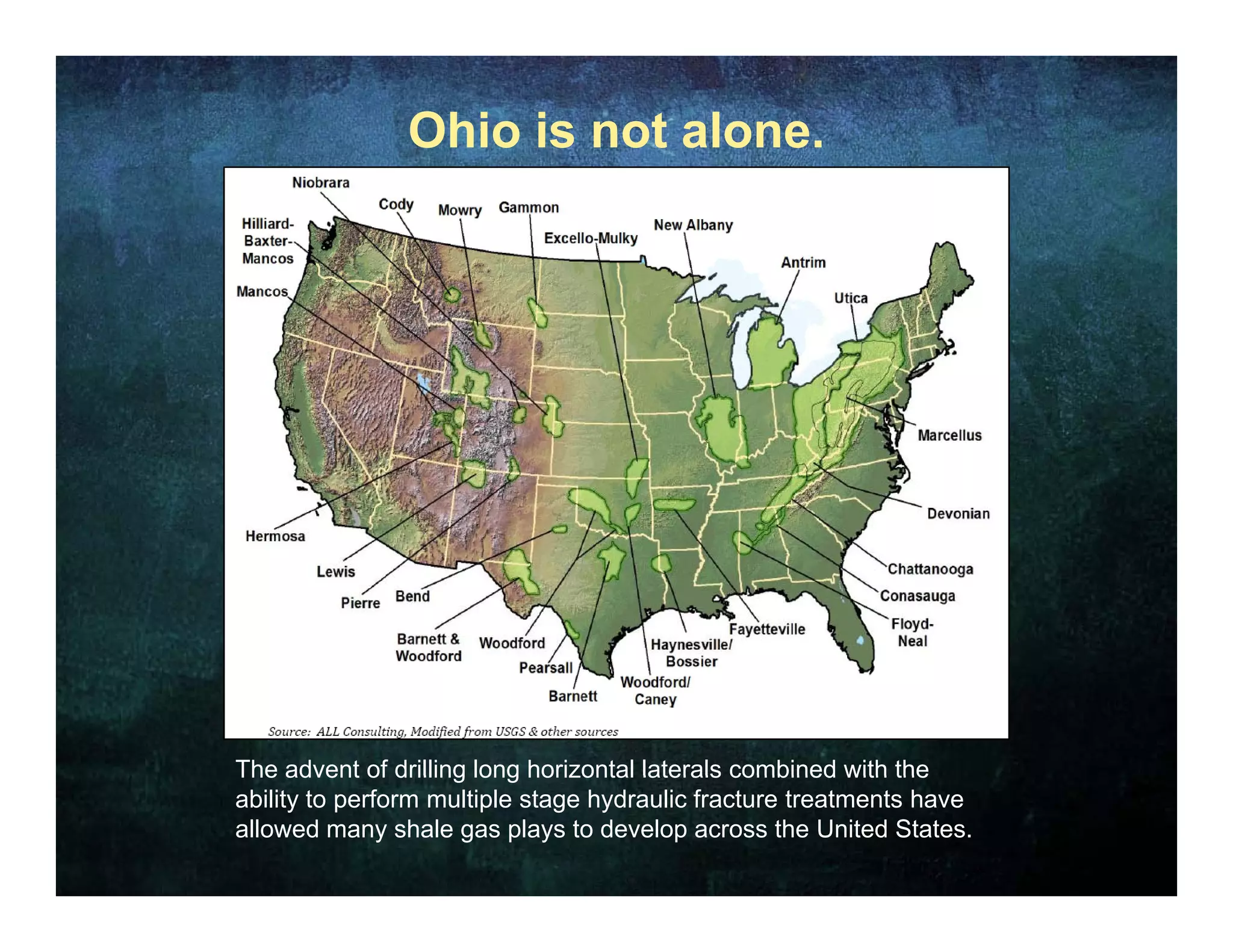
Ohio is not alone.


The advent of drilling long horizontal laterals combined with the
ability to perform multiple stage hydraulic fracture treatments have
allowed many shale gas plays to develop across the United States.
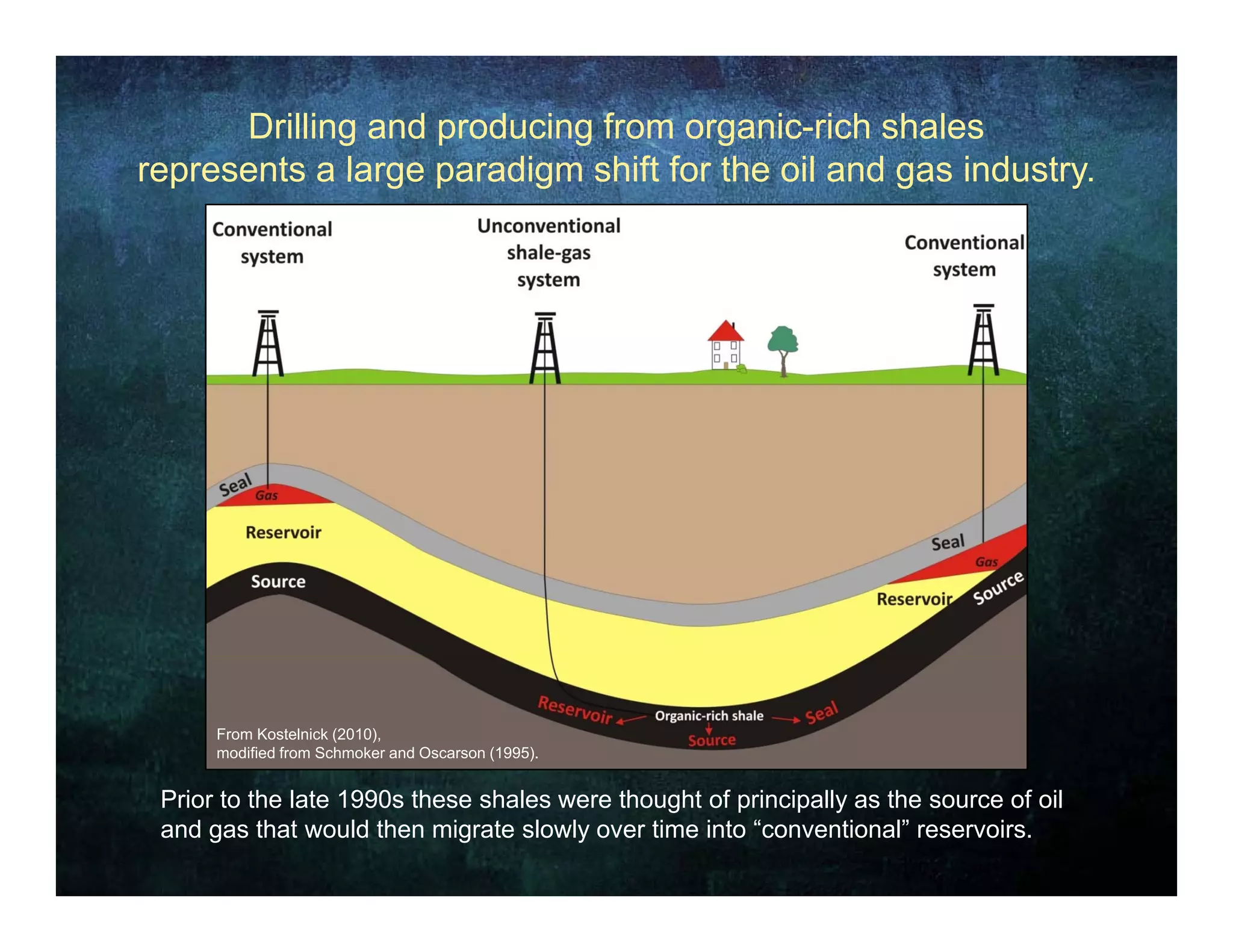
Drilling and producing from organic-rich shales
represents a large paradigm shift for the oil and gas industry
                                                      industry.


      From Kostelnick (2010),
      modified from Schmoker and Oscarson (1995).


 Prior to the late 1990s these shales were thought of principally as the source of oil
 and gas that would then migrate slowly over time into “conventional” reservoirs.
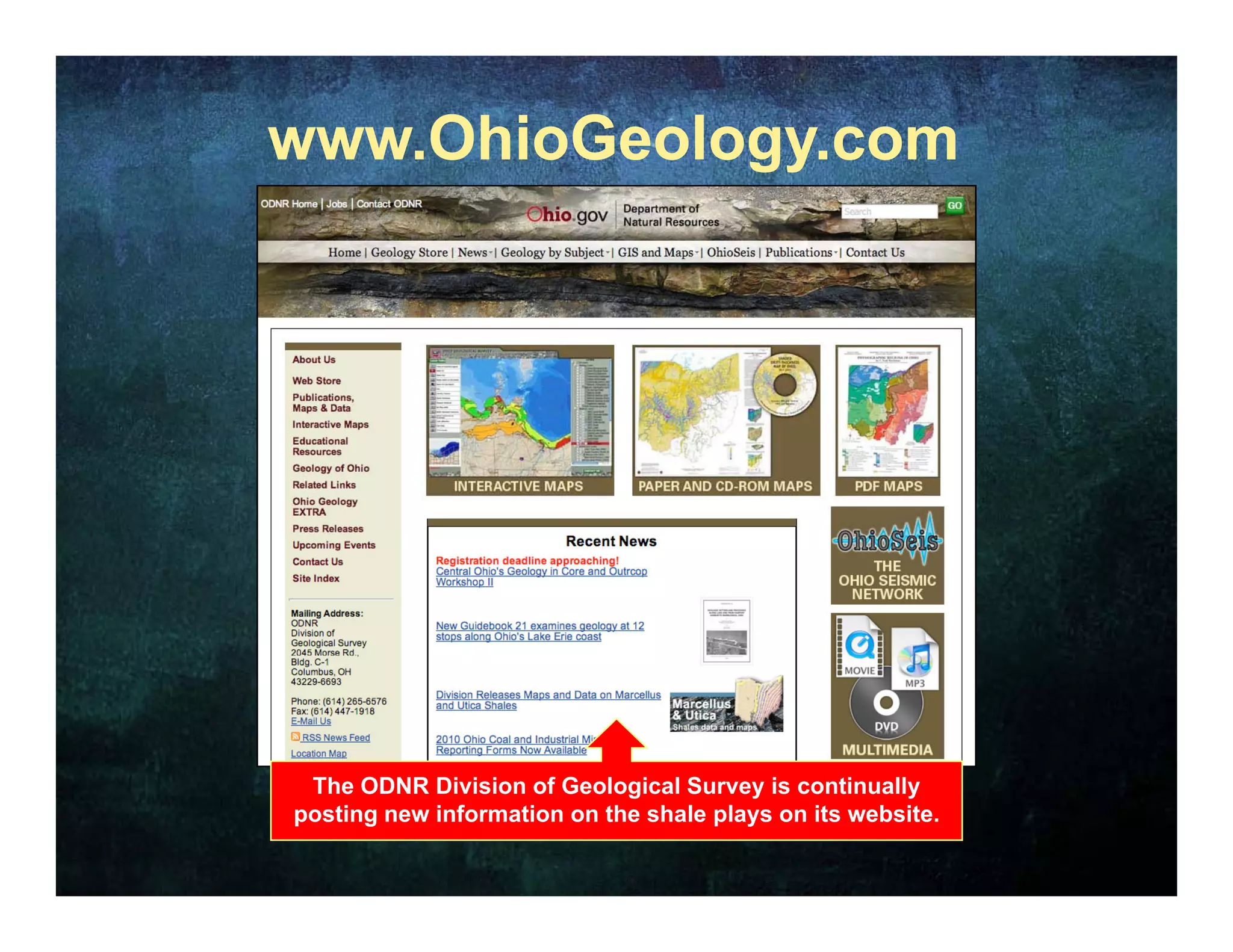
www.OhioGeology.com


 The ODNR Division of Geological Survey is continually
posting new information on the shale plays on its website.
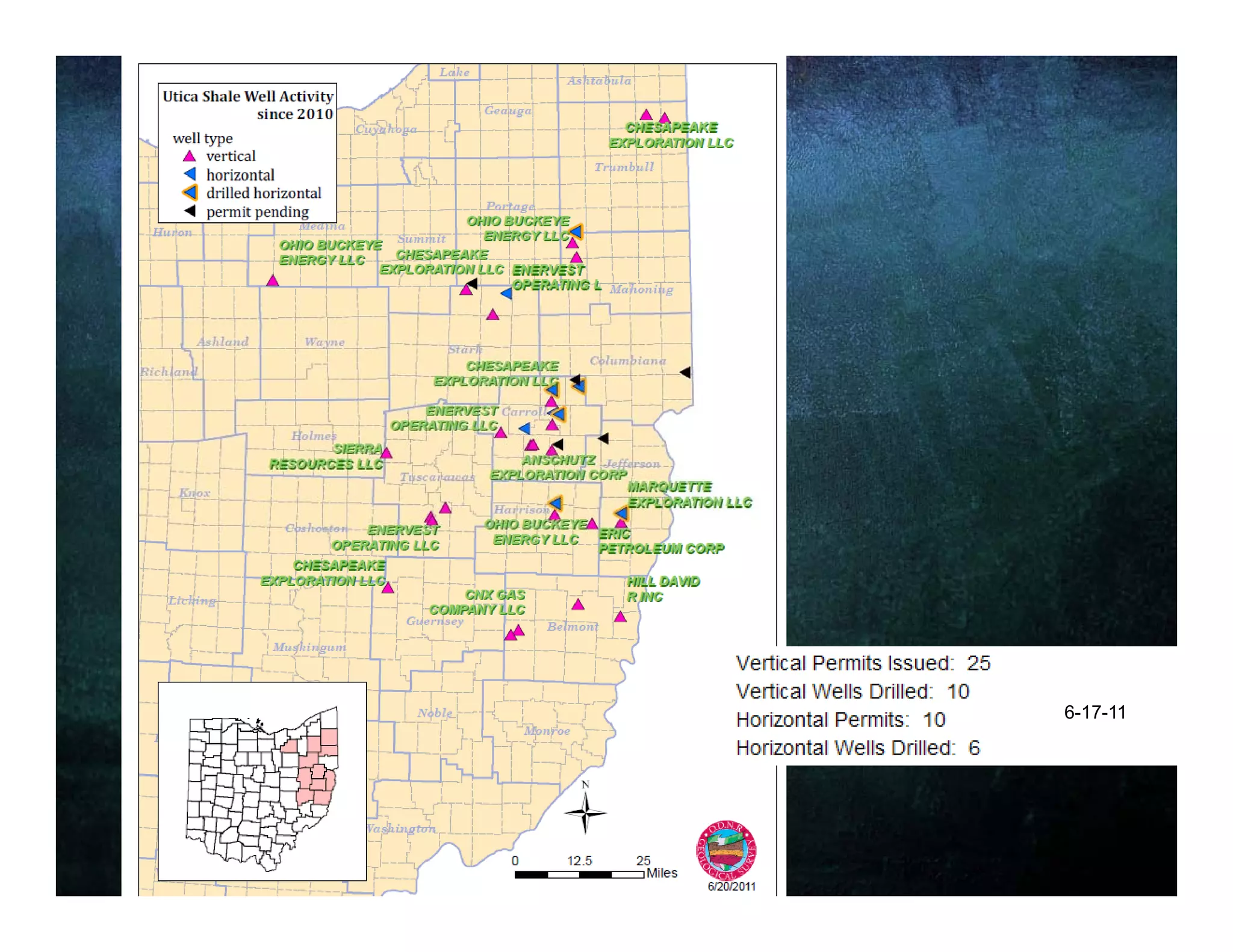
6-17-11


3/14/2011
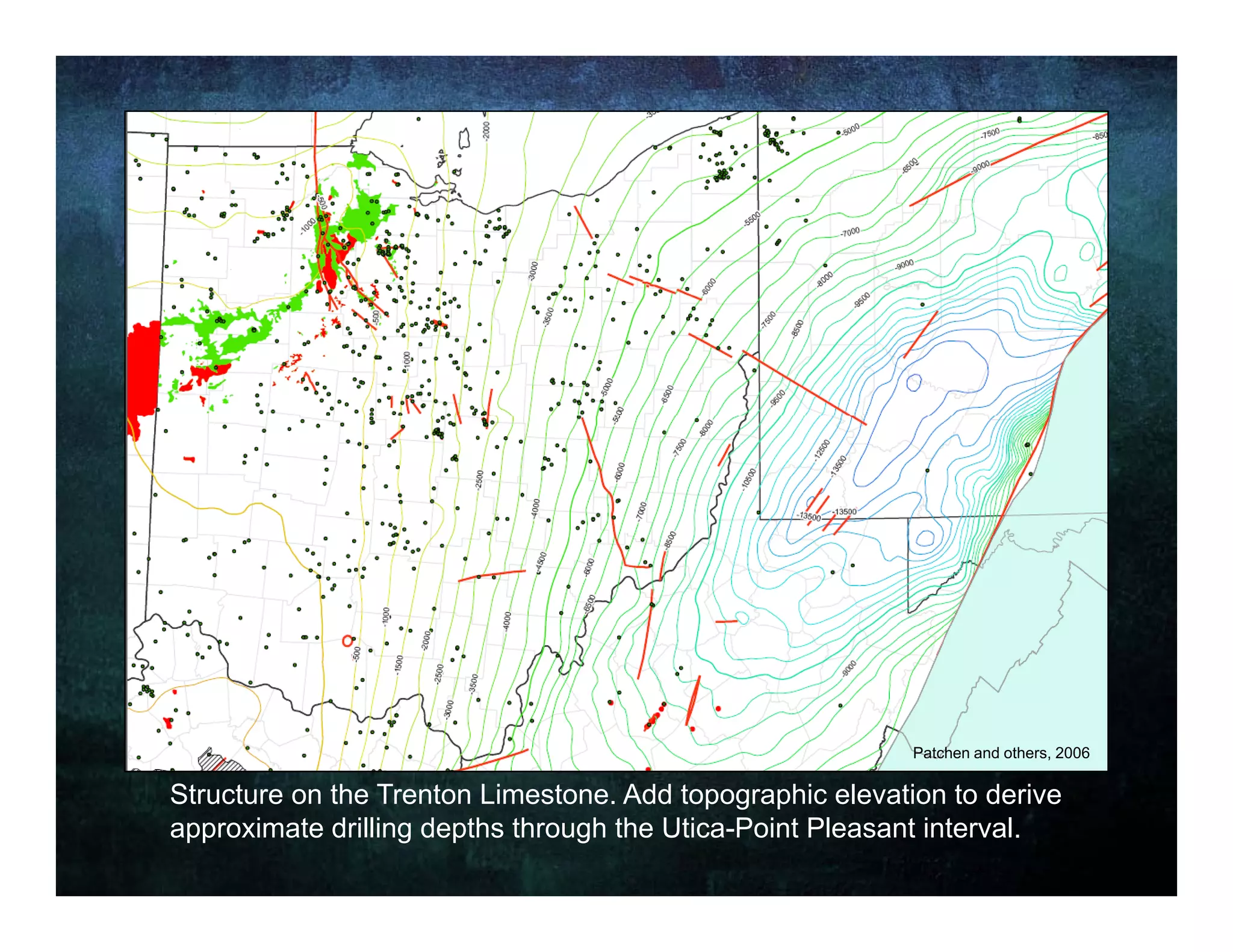
Patchen and others, 2006

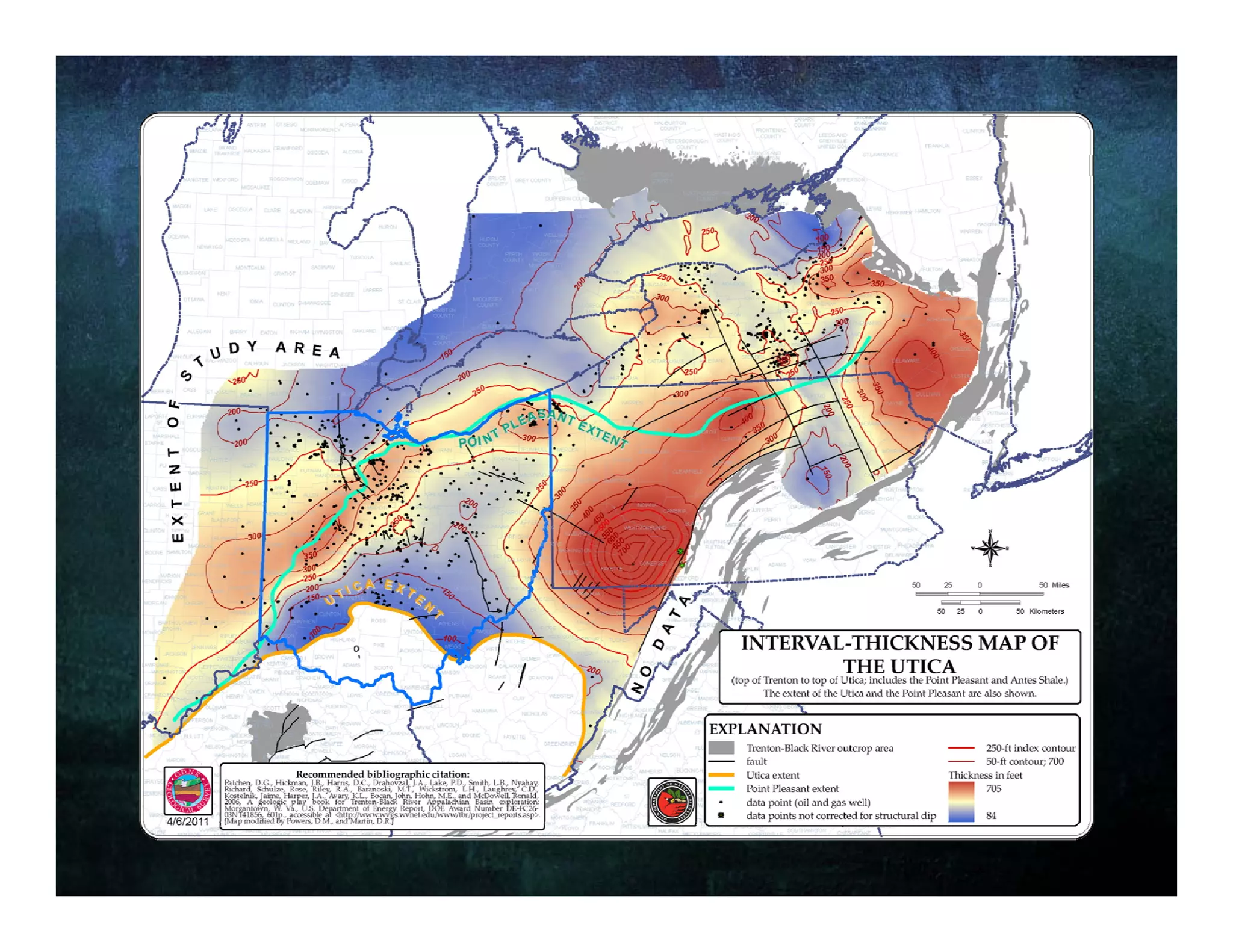
Structure on the Trenton Limestone. Add topographic elevation to derive
approximate drilling depths through the Utica-Point Pleasant interval.
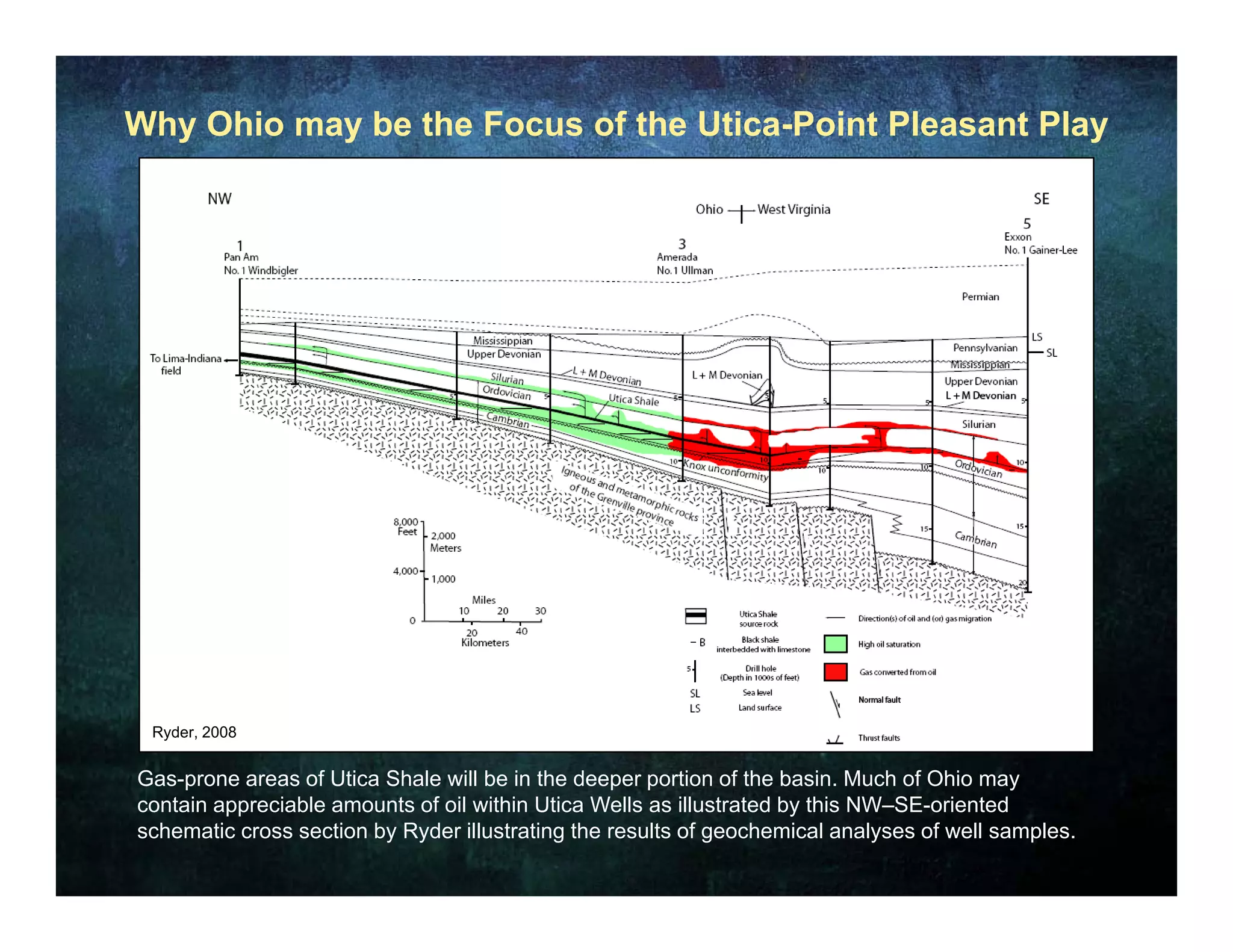
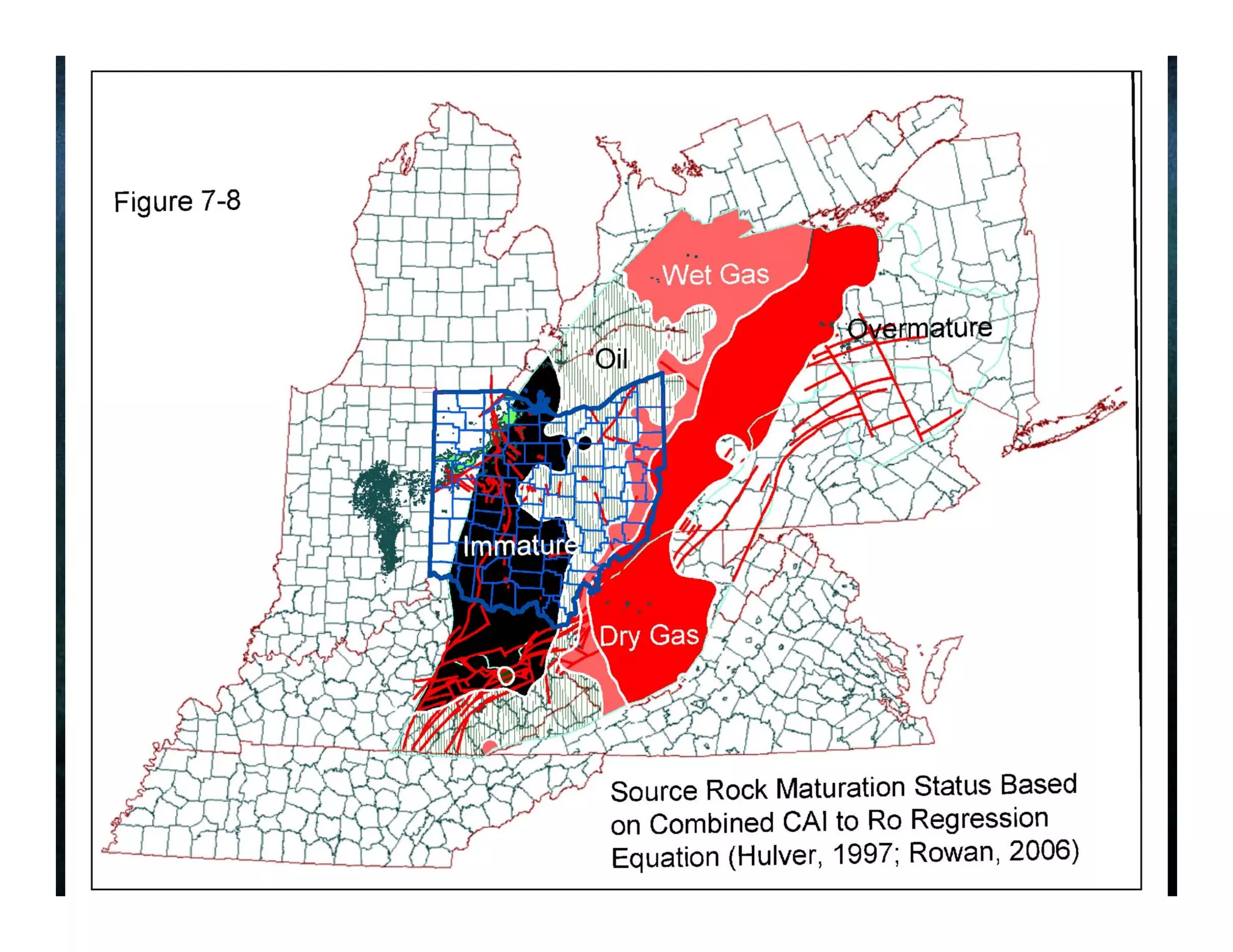
Why Ohio may be the Focus of the Utica-Point Pleasant Play


 Ryder, 2008


Gas-prone
Gas prone areas of Utica Shale will be in the deeper portion of the basin Much of Ohio may
                                                                     basin.
contain appreciable amounts of oil within Utica Wells as illustrated by this NW–SE-oriented
schematic cross section by Ryder illustrating the results of geochemical analyses of well samples.
6-17-11
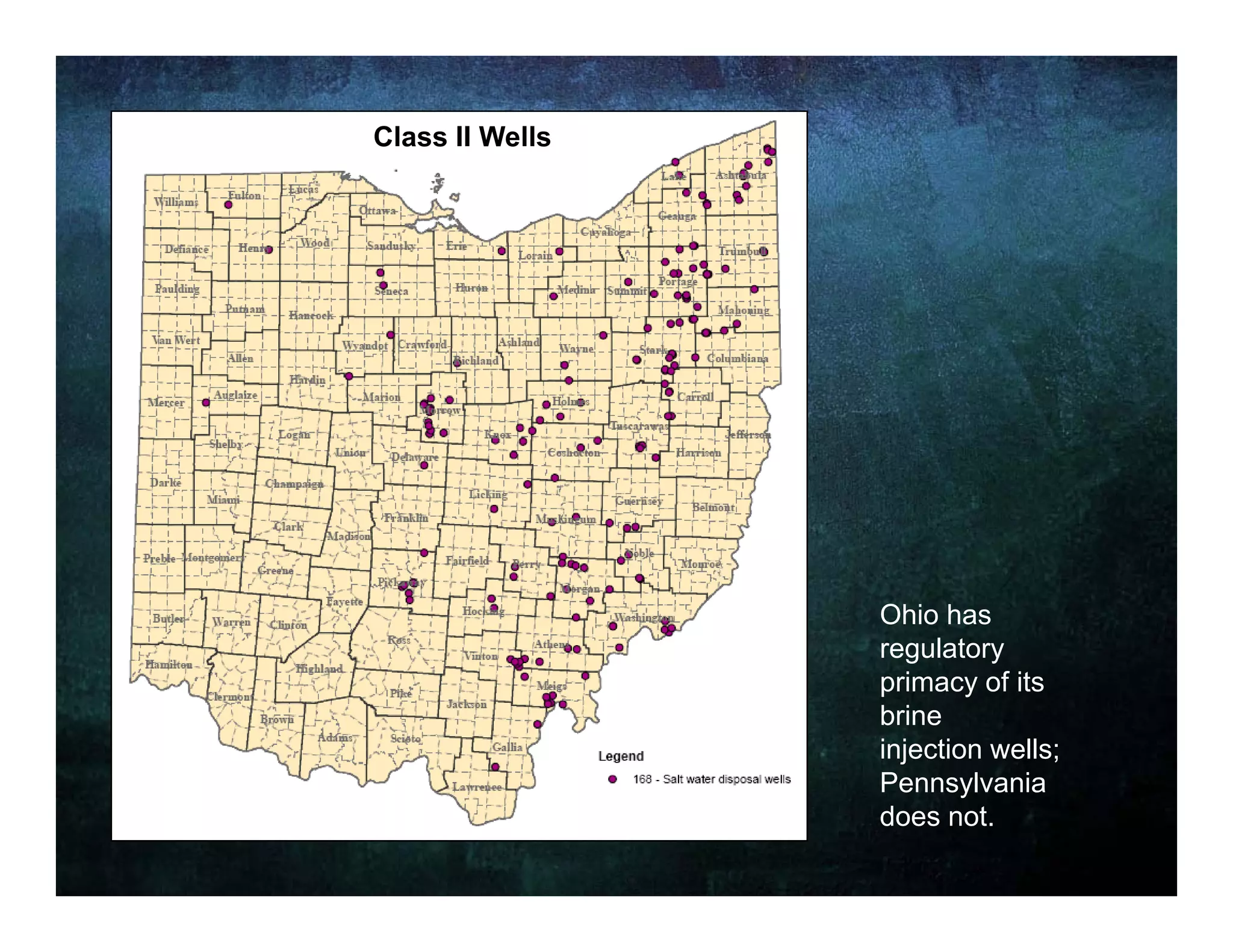
Class II Wells


                 Ohio has
                 regulatory
                 primacy of its
                 brine
                 injection wells;
                 Pennsylvania
                 P       l   i
                 does not.
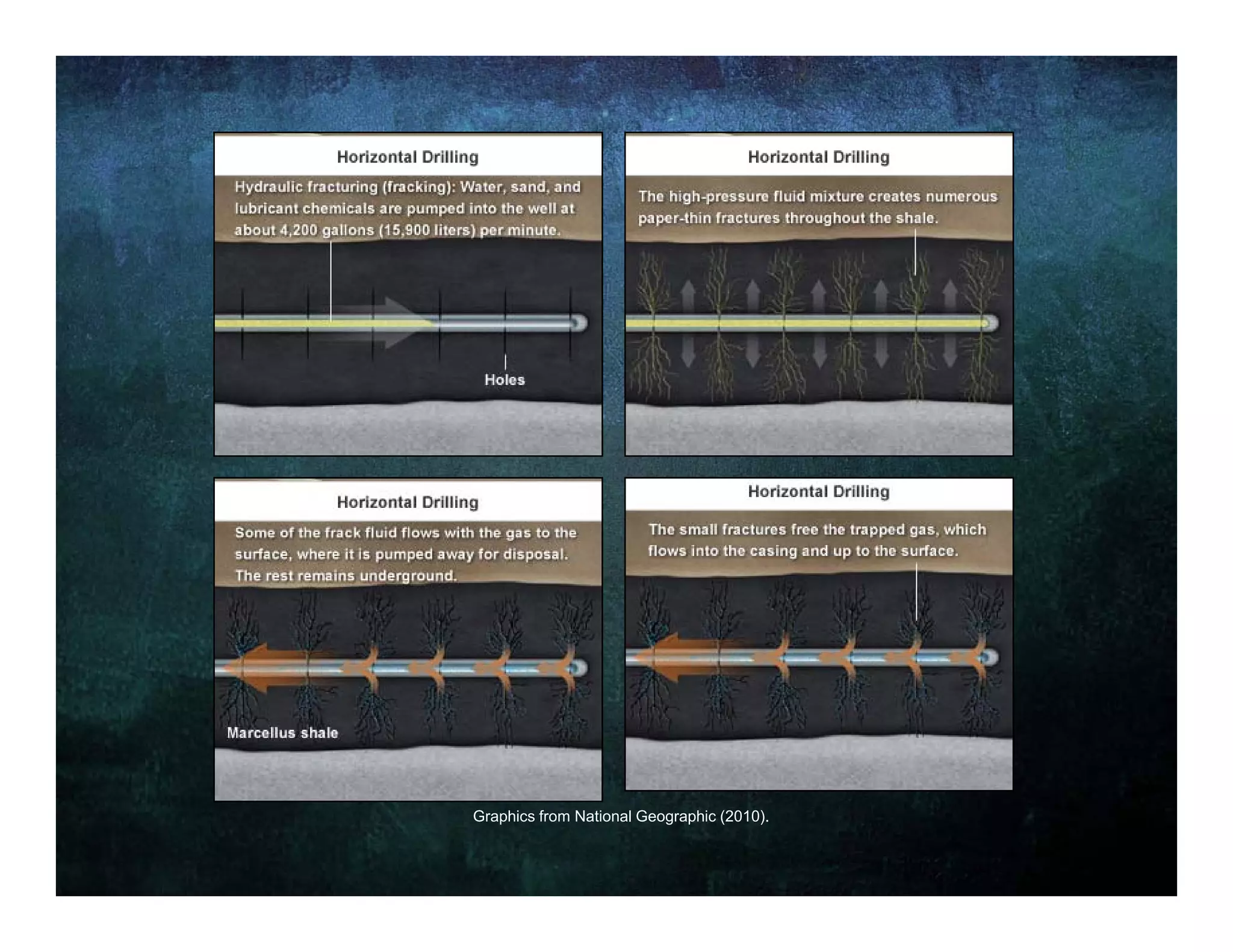
Graphics from National Geographic (2010).
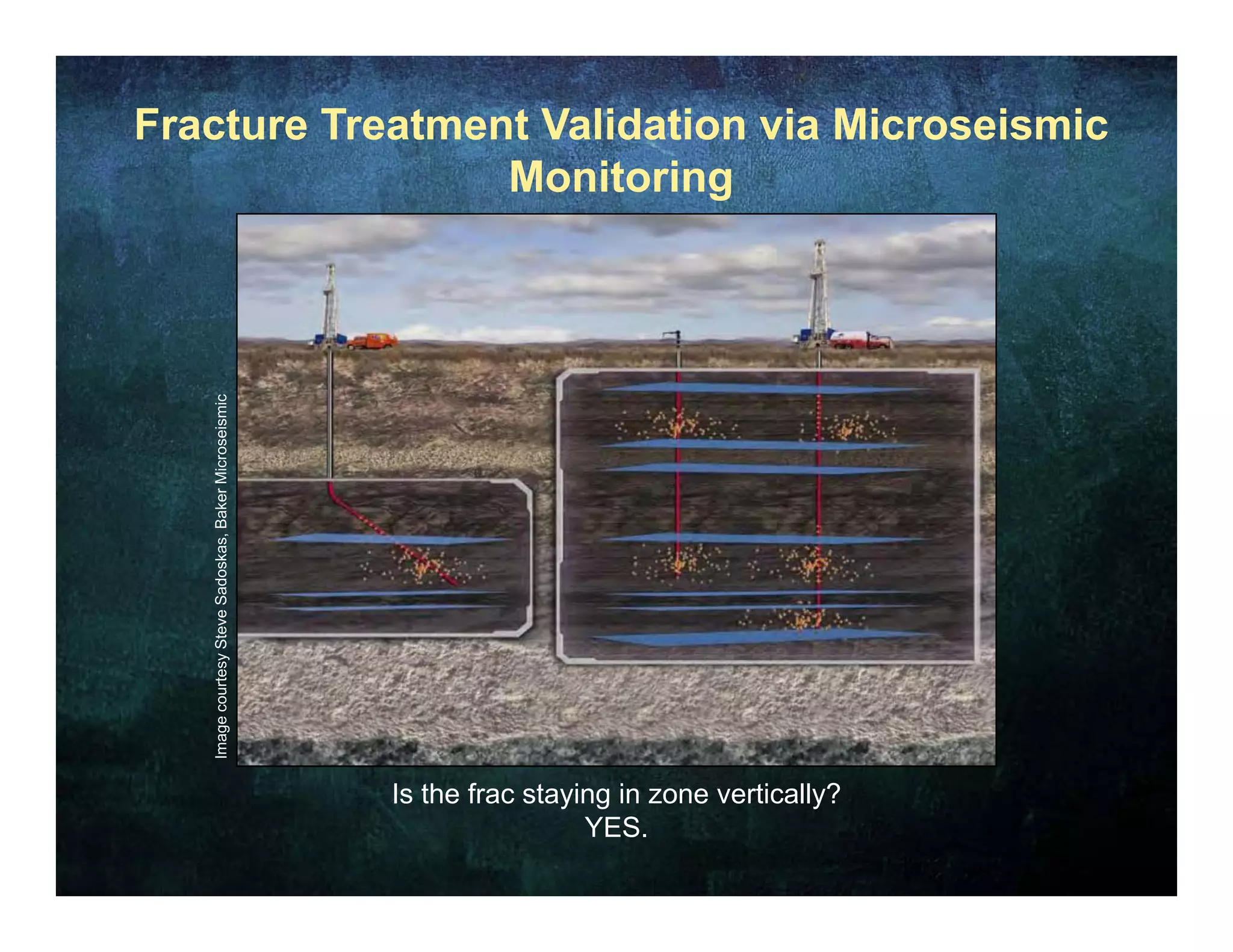
Fracture Treatment Validation via Microseismic
                 Monitoring
                y               ,                mic
   Image courtesy Steve Sadoskas, Baker Microseism


                                                       Is the frac staying in zone vertically?
                                                                        YES.
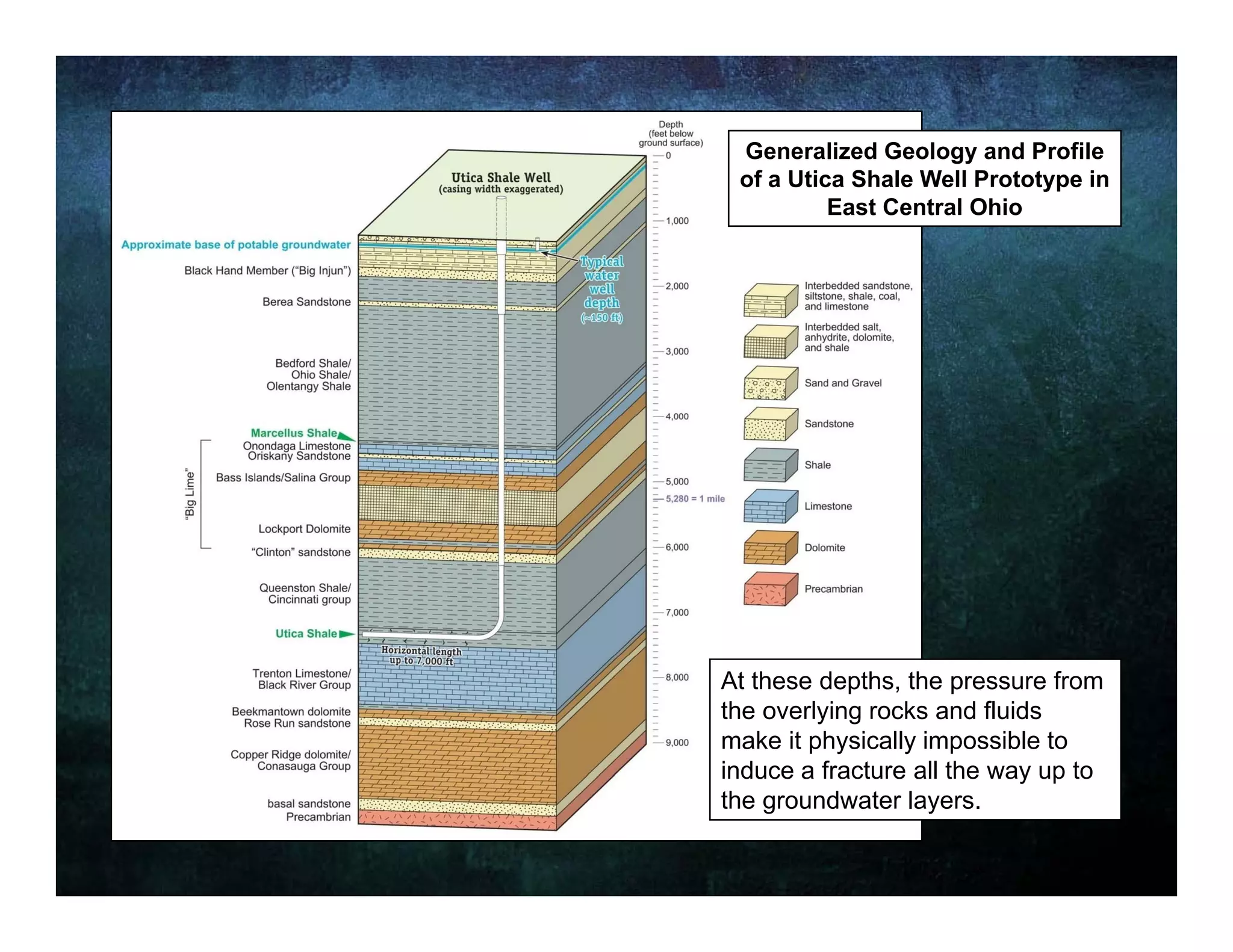
Generalized Geology and Profile
 of a Utica Shale Well Prototype in
          East Central Ohio


At these depths, the pressure from
the overlying rocks and fluids
make it physically impossible to
induce a fracture all the way up to
the groundwater layers.
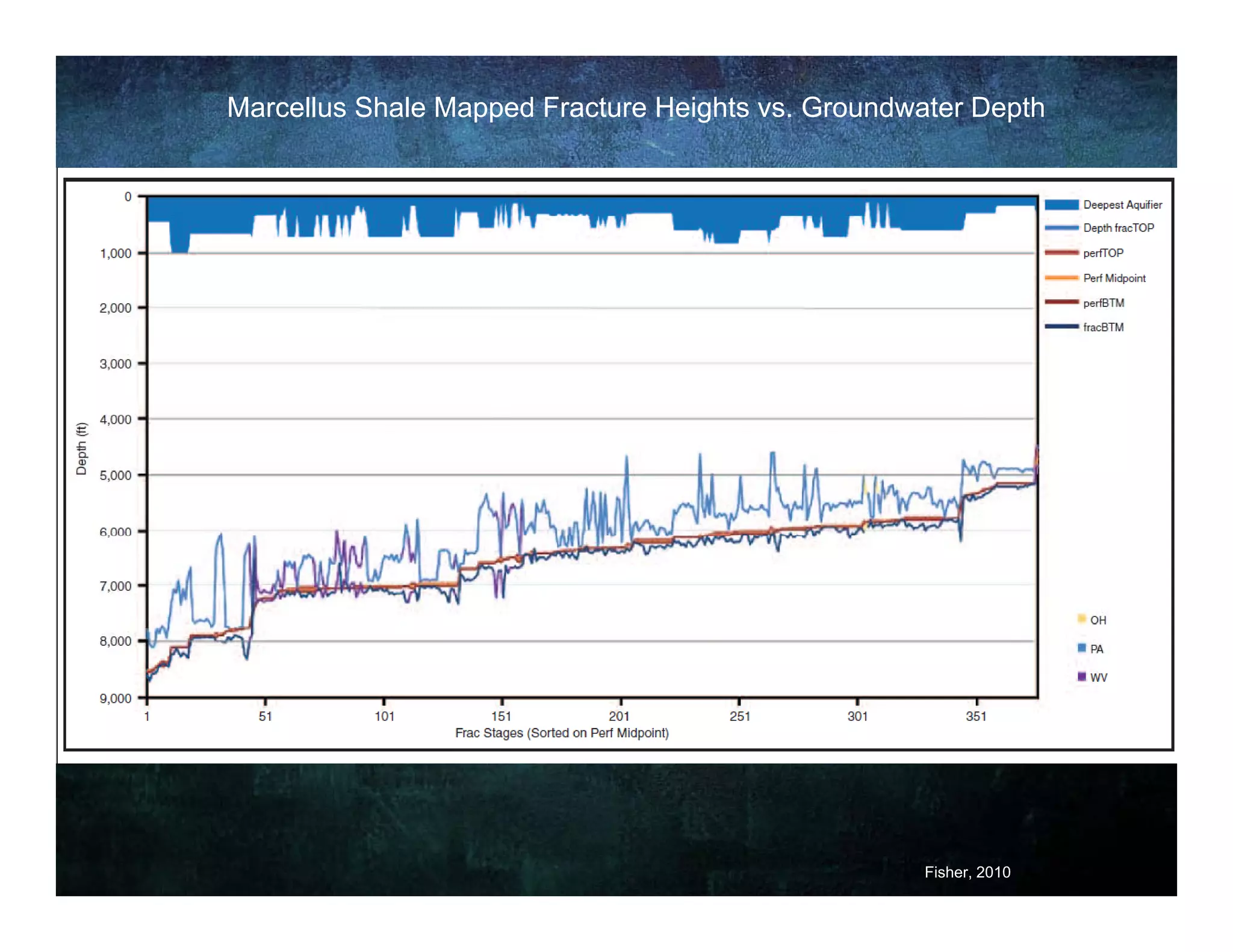
Marcellus Shale Mapped Fracture Heights vs. Groundwater Depth


                                                   Fisher, 2010
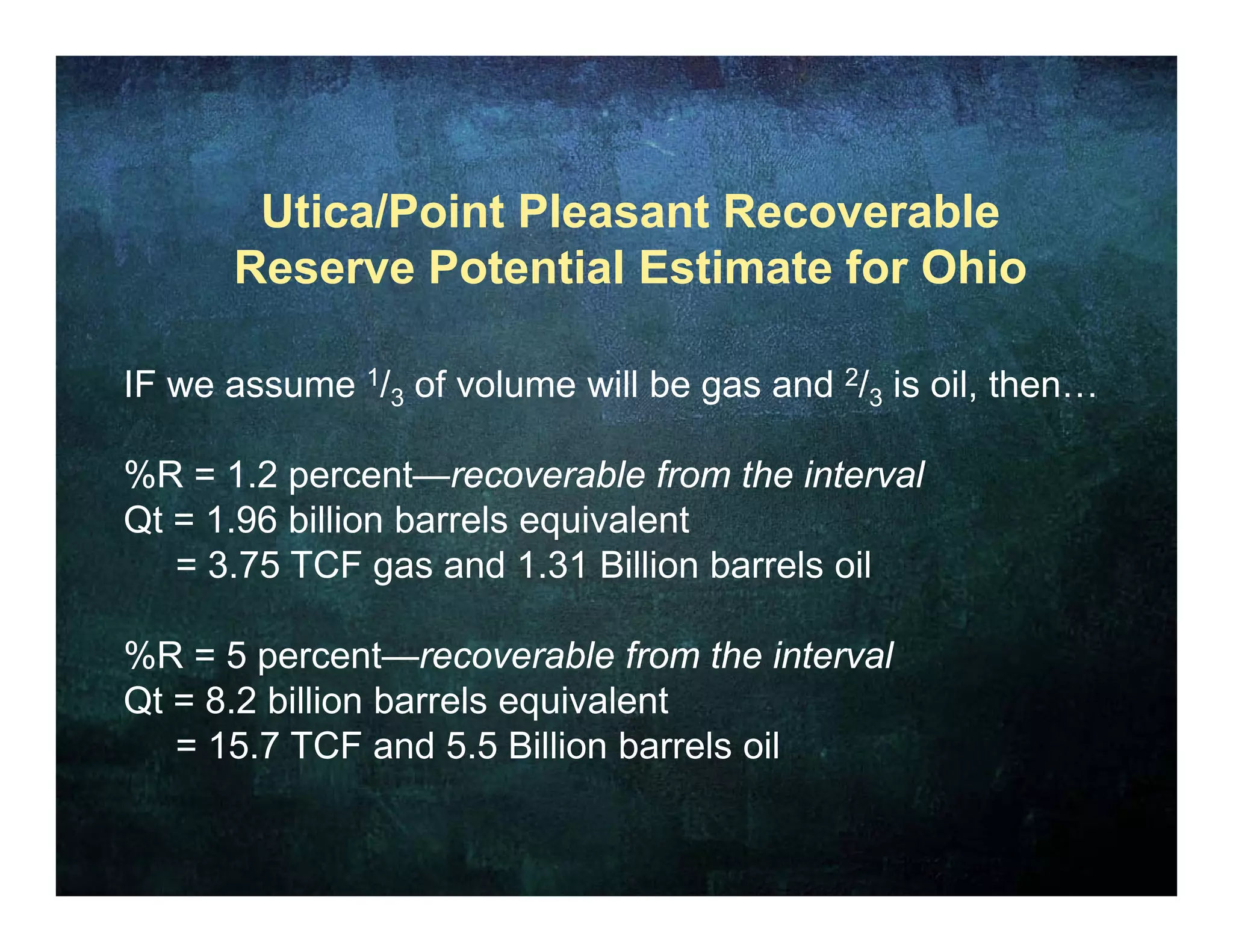
Utica/Point Pleasant Recoverable
      Reserve Potential Estimate for Ohio

IF we assume 1/3 of volume will be gas and 2/3 is oil, then…

%R = 1.2 percent—recoverable from the interval
Qt = 1.96 billion barrels equivalent
                           q
   = 3.75 TCF gas and 1.31 Billion barrels oil

%R = 5 percent recoverable from the interval
        percent—recoverable
Qt = 8.2 billion barrels equivalent
   = 15.7 TCF and 5.5 Billion barrels oil
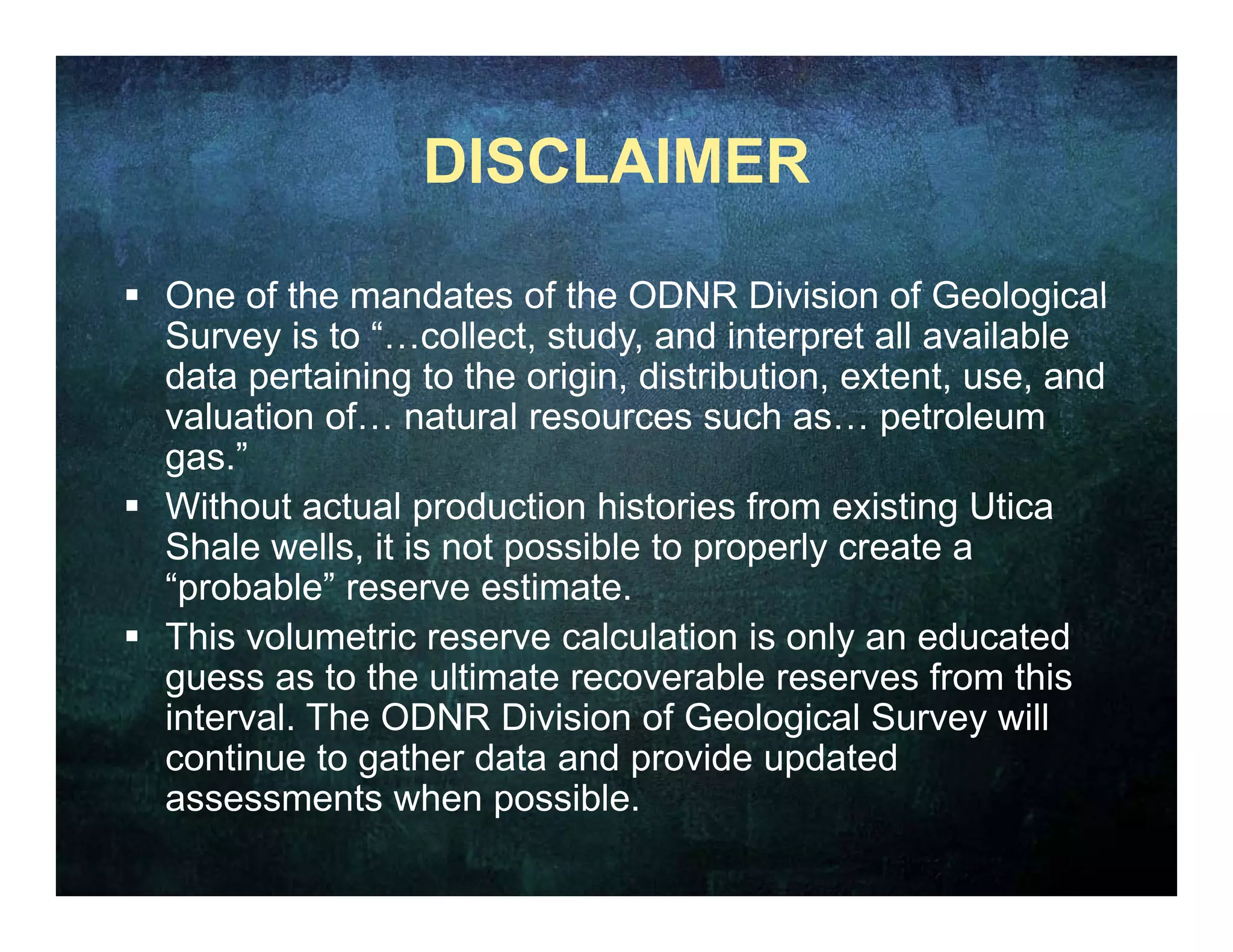
DISCLAIMER

 One of the mandates of the ODNR Division of Geological
  Survey is to “…collect, study, and interpret all available
  data pertaining to the origin, distribution, extent, use, and
  valuation of natural resources such as… petroleum
              of…                           as
  gas.”
 Without actual production histories from existing Utica
  Shale
  Sh l wells, it i not possible t properly create a
             ll   is t       ibl to         l      t
  “probable” reserve estimate.
 This volumetric reserve calculation is only an educated
                                               y
  guess as to the ultimate recoverable reserves from this
  interval. The ODNR Division of Geological Survey will
  continue to gather data and p
                g               provide updated
                                           p
  assessments when possible.
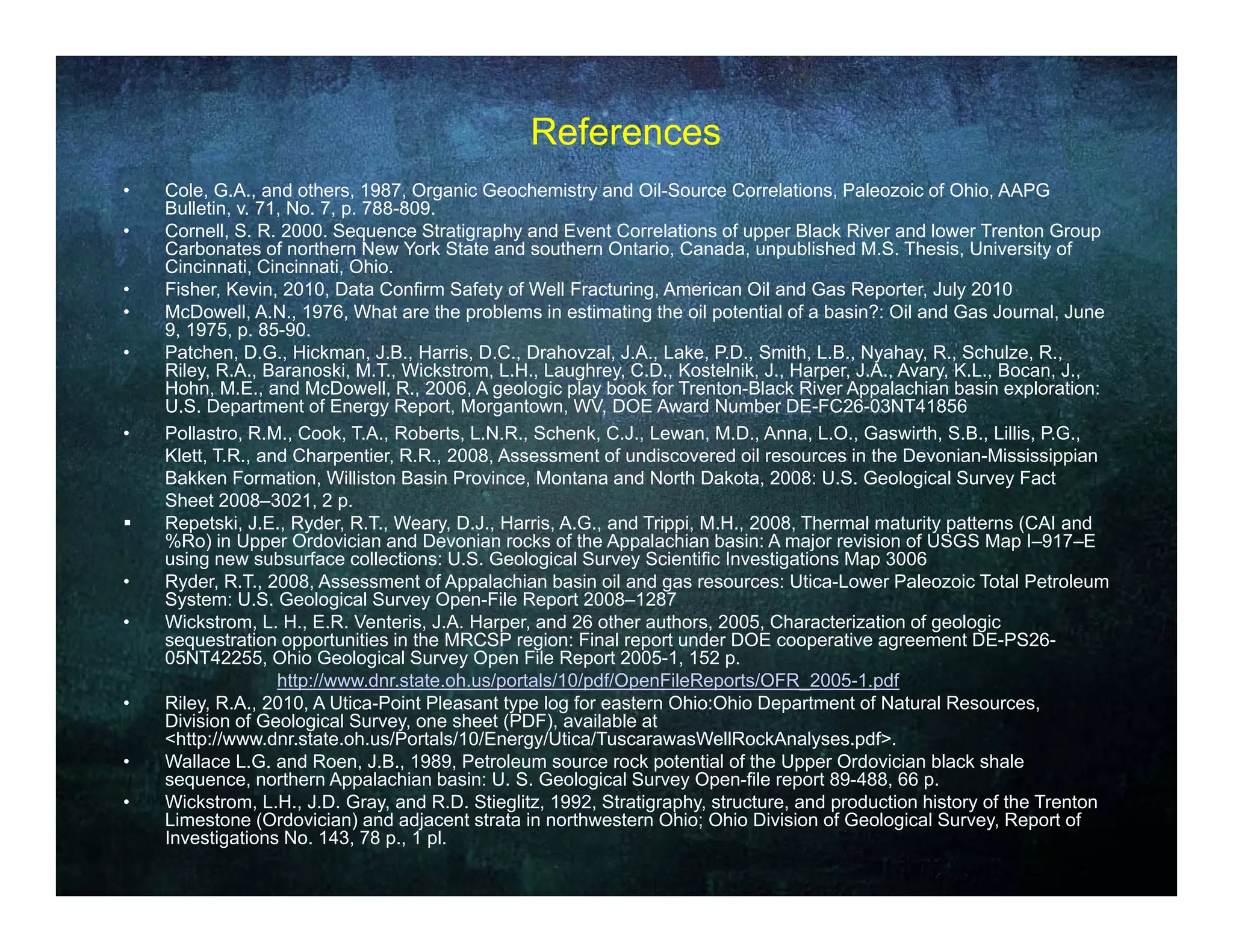
References
•   Cole, G.A., and others, 1987, Organic Geochemistry and Oil-Source Correlations, Paleozoic of Ohio, AAPG
    Bulletin, v. 71, No. 7, p. 788-809.
•   Cornell, S. R. 2000. Sequence Stratigraphy and Event Correlations of upper Black River and lower Trenton Group
    Carbonates of northern New York State and southern Ontario, Canada, unpublished M.S. Thesis, University of
    Cincinnati, Cincinnati, Ohio.
•   Fisher, Kevin, 2010, Data Confirm Safety of Well Fracturing, American Oil and Gas Reporter, July 2010
           ,       ,       ,                   y                g,                             p    ,  y
•   McDowell, A.N., 1976, What are the problems in estimating the oil potential of a basin?: Oil and Gas Journal, June
    9, 1975, p. 85-90.
•   Patchen, D.G., Hickman, J.B., Harris, D.C., Drahovzal, J.A., Lake, P.D., Smith, L.B., Nyahay, R., Schulze, R.,
    Riley, R.A., Baranoski, M.T., Wickstrom, L.H., Laughrey, C.D., Kostelnik, J., Harper, J.A., Avary, K.L., Bocan, J.,
    Hohn, M.E., and McDowell, R., 2006, A geologic play book for Trenton-Black River Appalachian basin exploration:
    U.S. Department of Energy Report, Morgantown, WV, DOE Award Number DE-FC26-03NT41856
             p                  gy    p       g
•   Pollastro, R.M., Cook, T.A., Roberts, L.N.R., Schenk, C.J., Lewan, M.D., Anna, L.O., Gaswirth, S.B., Lillis, P.G.,
    Klett, T.R., and Charpentier, R.R., 2008, Assessment of undiscovered oil resources in the Devonian-Mississippian
    Bakken Formation, Williston Basin Province, Montana and North Dakota, 2008: U.S. Geological Survey Fact
    Sheet 2008–3021, 2 p.
   Repetski, J.E., Ryder, R.T., Weary, D.J., Harris, A.G., and Trippi, M.H., 2008, Thermal maturity patterns (CAI and
    %Ro) in Upper O d i i and D
    %R ) i U          Ordovician d Devonian rocks of th A
                                            i      k f the Appalachian b i A major revision of USGS M I 917 E
                                                                 l hi basin:         j       i i  f        Map I–917–E
    using new subsurface collections: U.S. Geological Survey Scientific Investigations Map 3006
•   Ryder, R.T., 2008, Assessment of Appalachian basin oil and gas resources: Utica-Lower Paleozoic Total Petroleum
    System: U.S. Geological Survey Open-File Report 2008–1287
•   Wickstrom, L. H., E.R. Venteris, J.A. Harper, and 26 other authors, 2005, Characterization of geologic
    sequestration opportunities in the MRCSP region: Final report under DOE cooperative agreement DE-PS26-
    05NT42255,
    05NT42255 Ohio Geological Survey Open File Report 2005 1 152 p
                                                              2005-1,     p.
                    http://www.dnr.state.oh.us/portals/10/pdf/OpenFileReports/OFR_2005-1.pdf
•   Riley, R.A., 2010, A Utica-Point Pleasant type log for eastern Ohio:Ohio Department of Natural Resources,
    Division of Geological Survey, one sheet (PDF), available at
    <http://www.dnr.state.oh.us/Portals/10/Energy/Utica/TuscarawasWellRockAnalyses.pdf>.
•   Wallace L.G. and Roen, J.B., 1989, Petroleum source rock potential of the Upper Ordovician black shale
    sequence, northern A
                     th     Appalachian b i U S G l i l S
                                l hi basin: U. S. Geological Survey O  Open-file report 89 488 66 p.
                                                                              fil      t 89-488,
•   Wickstrom, L.H., J.D. Gray, and R.D. Stieglitz, 1992, Stratigraphy, structure, and production history of the Trenton
    Limestone (Ordovician) and adjacent strata in northwestern Ohio; Ohio Division of Geological Survey, Report of
    Investigations No. 143, 78 p., 1 pl.
Utica shale presentation_cwc2011

Utica shale presentation_cwc2011

  • 1.
    Utica-Point Pleasant Shale DrillingActivity and Resource Assessment in Ohio Larry Wickstrom, Chris Perry, Matthew Erenpreiss, and Ron Riley Ohio Department of Natural Resources Division of Geological Survey PTTC Workshop June 21 2011 J 21,
  • 2.
    Ohio is notalone. The advent of drilling long horizontal laterals combined with the ability to perform multiple stage hydraulic fracture treatments have allowed many shale gas plays to develop across the United States.
  • 3.
    Drilling and producingfrom organic-rich shales represents a large paradigm shift for the oil and gas industry industry. From Kostelnick (2010), modified from Schmoker and Oscarson (1995). Prior to the late 1990s these shales were thought of principally as the source of oil and gas that would then migrate slowly over time into “conventional” reservoirs.
  • 4.
    www.OhioGeology.com The ODNRDivision of Geological Survey is continually posting new information on the shale plays on its website.
  • 7.
  • 11.
    Patchen and others,2006 Structure on the Trenton Limestone. Add topographic elevation to derive approximate drilling depths through the Utica-Point Pleasant interval.
  • 12.
    Why Ohio maybe the Focus of the Utica-Point Pleasant Play Ryder, 2008 Gas-prone Gas prone areas of Utica Shale will be in the deeper portion of the basin Much of Ohio may basin. contain appreciable amounts of oil within Utica Wells as illustrated by this NW–SE-oriented schematic cross section by Ryder illustrating the results of geochemical analyses of well samples.
  • 14.
  • 16.
    Class II Wells Ohio has regulatory primacy of its brine injection wells; Pennsylvania P l i does not.
  • 17.
    Graphics from NationalGeographic (2010).
  • 18.
    Fracture Treatment Validationvia Microseismic Monitoring y , mic Image courtesy Steve Sadoskas, Baker Microseism Is the frac staying in zone vertically? YES.
  • 19.
    Generalized Geology andProfile of a Utica Shale Well Prototype in East Central Ohio At these depths, the pressure from the overlying rocks and fluids make it physically impossible to induce a fracture all the way up to the groundwater layers.
  • 20.
    Marcellus Shale MappedFracture Heights vs. Groundwater Depth Fisher, 2010
  • 21.
    Utica/Point Pleasant Recoverable Reserve Potential Estimate for Ohio IF we assume 1/3 of volume will be gas and 2/3 is oil, then… %R = 1.2 percent—recoverable from the interval Qt = 1.96 billion barrels equivalent q = 3.75 TCF gas and 1.31 Billion barrels oil %R = 5 percent recoverable from the interval percent—recoverable Qt = 8.2 billion barrels equivalent = 15.7 TCF and 5.5 Billion barrels oil
  • 22.
    DISCLAIMER  One ofthe mandates of the ODNR Division of Geological Survey is to “…collect, study, and interpret all available data pertaining to the origin, distribution, extent, use, and valuation of natural resources such as… petroleum of… as gas.”  Without actual production histories from existing Utica Shale Sh l wells, it i not possible t properly create a ll is t ibl to l t “probable” reserve estimate.  This volumetric reserve calculation is only an educated y guess as to the ultimate recoverable reserves from this interval. The ODNR Division of Geological Survey will continue to gather data and p g provide updated p assessments when possible.
  • 24.
    References • Cole, G.A., and others, 1987, Organic Geochemistry and Oil-Source Correlations, Paleozoic of Ohio, AAPG Bulletin, v. 71, No. 7, p. 788-809. • Cornell, S. R. 2000. Sequence Stratigraphy and Event Correlations of upper Black River and lower Trenton Group Carbonates of northern New York State and southern Ontario, Canada, unpublished M.S. Thesis, University of Cincinnati, Cincinnati, Ohio. • Fisher, Kevin, 2010, Data Confirm Safety of Well Fracturing, American Oil and Gas Reporter, July 2010 , , , y g, p , y • McDowell, A.N., 1976, What are the problems in estimating the oil potential of a basin?: Oil and Gas Journal, June 9, 1975, p. 85-90. • Patchen, D.G., Hickman, J.B., Harris, D.C., Drahovzal, J.A., Lake, P.D., Smith, L.B., Nyahay, R., Schulze, R., Riley, R.A., Baranoski, M.T., Wickstrom, L.H., Laughrey, C.D., Kostelnik, J., Harper, J.A., Avary, K.L., Bocan, J., Hohn, M.E., and McDowell, R., 2006, A geologic play book for Trenton-Black River Appalachian basin exploration: U.S. Department of Energy Report, Morgantown, WV, DOE Award Number DE-FC26-03NT41856 p gy p g • Pollastro, R.M., Cook, T.A., Roberts, L.N.R., Schenk, C.J., Lewan, M.D., Anna, L.O., Gaswirth, S.B., Lillis, P.G., Klett, T.R., and Charpentier, R.R., 2008, Assessment of undiscovered oil resources in the Devonian-Mississippian Bakken Formation, Williston Basin Province, Montana and North Dakota, 2008: U.S. Geological Survey Fact Sheet 2008–3021, 2 p.  Repetski, J.E., Ryder, R.T., Weary, D.J., Harris, A.G., and Trippi, M.H., 2008, Thermal maturity patterns (CAI and %Ro) in Upper O d i i and D %R ) i U Ordovician d Devonian rocks of th A i k f the Appalachian b i A major revision of USGS M I 917 E l hi basin: j i i f Map I–917–E using new subsurface collections: U.S. Geological Survey Scientific Investigations Map 3006 • Ryder, R.T., 2008, Assessment of Appalachian basin oil and gas resources: Utica-Lower Paleozoic Total Petroleum System: U.S. Geological Survey Open-File Report 2008–1287 • Wickstrom, L. H., E.R. Venteris, J.A. Harper, and 26 other authors, 2005, Characterization of geologic sequestration opportunities in the MRCSP region: Final report under DOE cooperative agreement DE-PS26- 05NT42255, 05NT42255 Ohio Geological Survey Open File Report 2005 1 152 p 2005-1, p. http://www.dnr.state.oh.us/portals/10/pdf/OpenFileReports/OFR_2005-1.pdf • Riley, R.A., 2010, A Utica-Point Pleasant type log for eastern Ohio:Ohio Department of Natural Resources, Division of Geological Survey, one sheet (PDF), available at <http://www.dnr.state.oh.us/Portals/10/Energy/Utica/TuscarawasWellRockAnalyses.pdf>. • Wallace L.G. and Roen, J.B., 1989, Petroleum source rock potential of the Upper Ordovician black shale sequence, northern A th Appalachian b i U S G l i l S l hi basin: U. S. Geological Survey O Open-file report 89 488 66 p. fil t 89-488, • Wickstrom, L.H., J.D. Gray, and R.D. Stieglitz, 1992, Stratigraphy, structure, and production history of the Trenton Limestone (Ordovician) and adjacent strata in northwestern Ohio; Ohio Division of Geological Survey, Report of Investigations No. 143, 78 p., 1 pl.