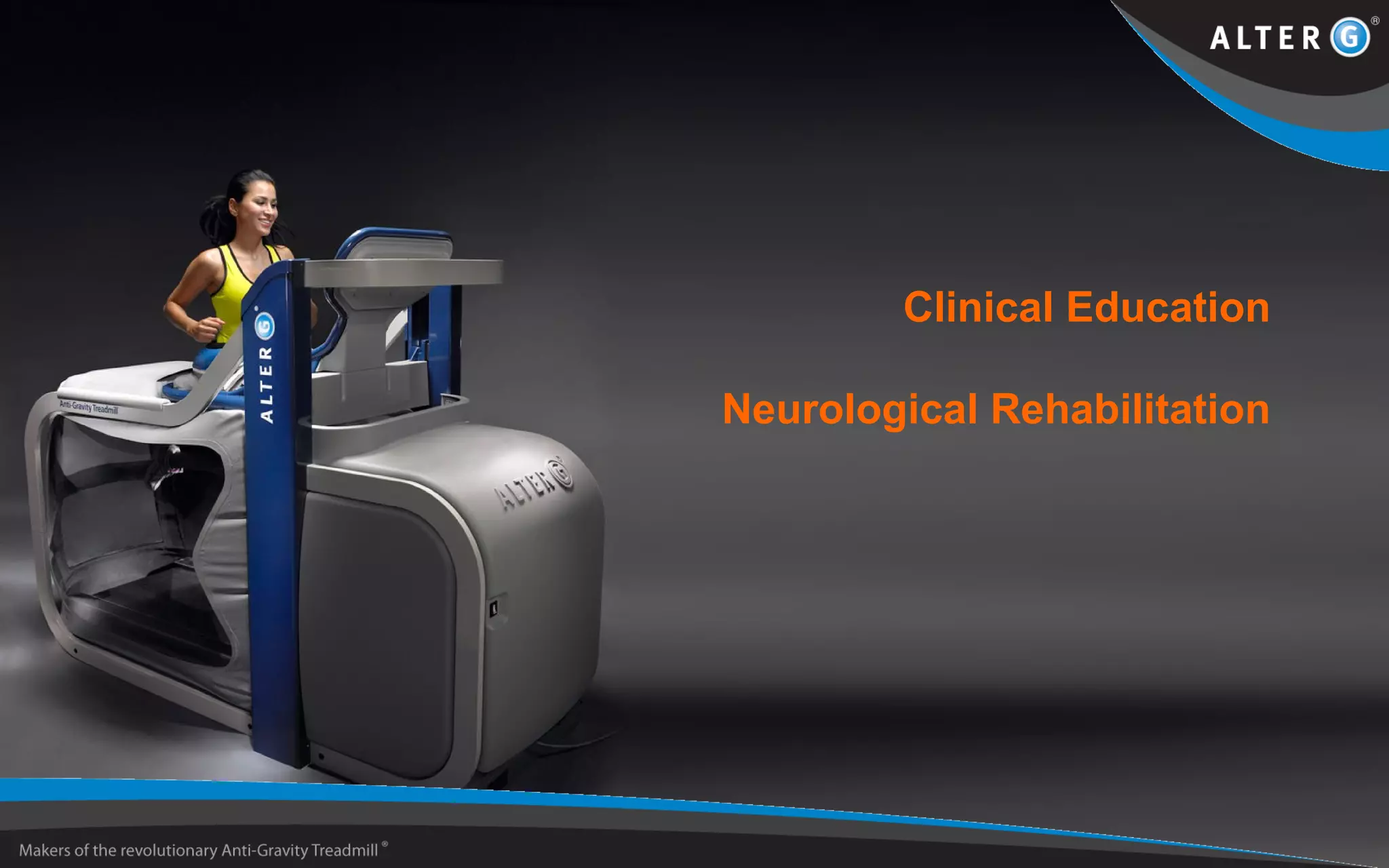
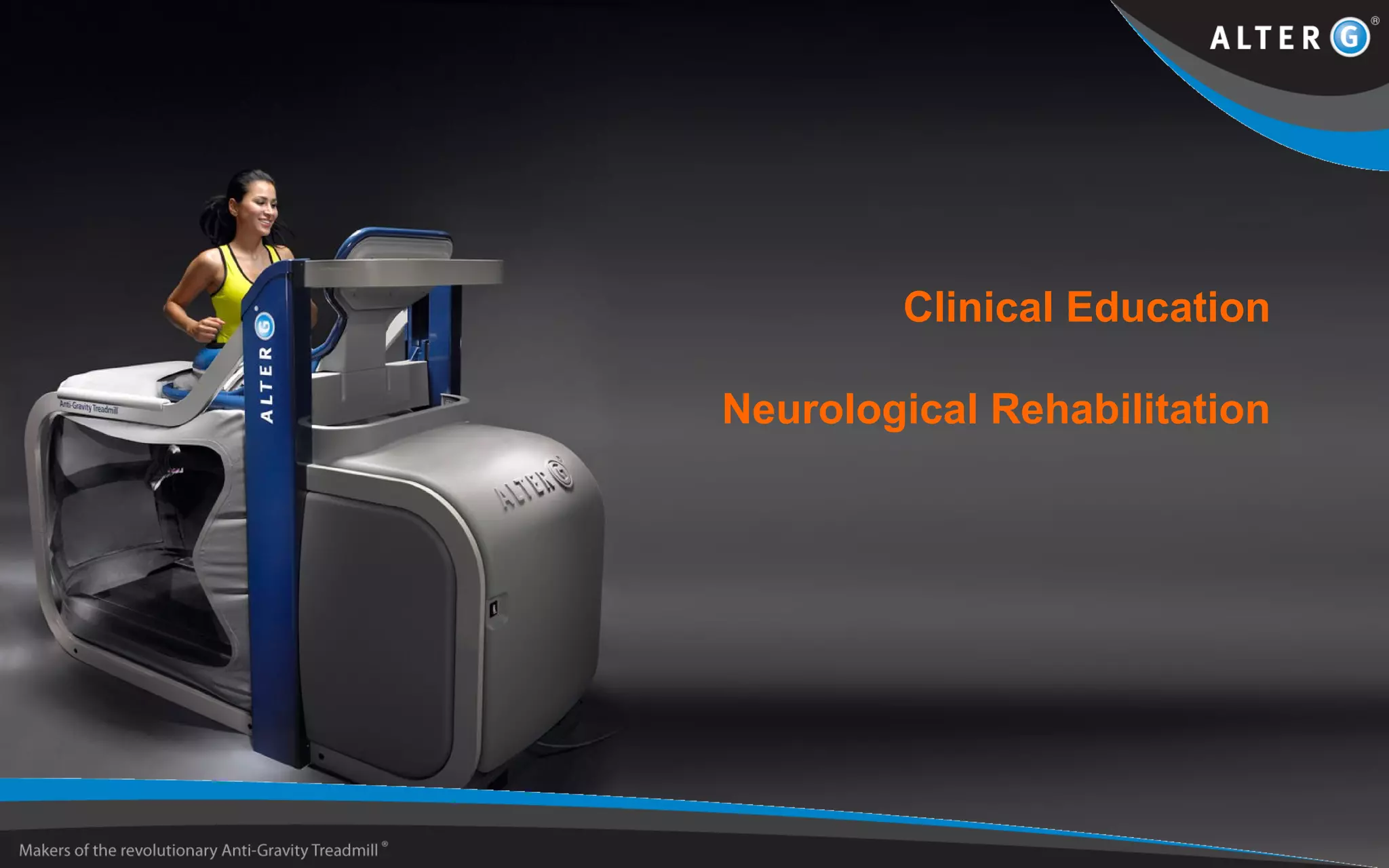
Clinical Education
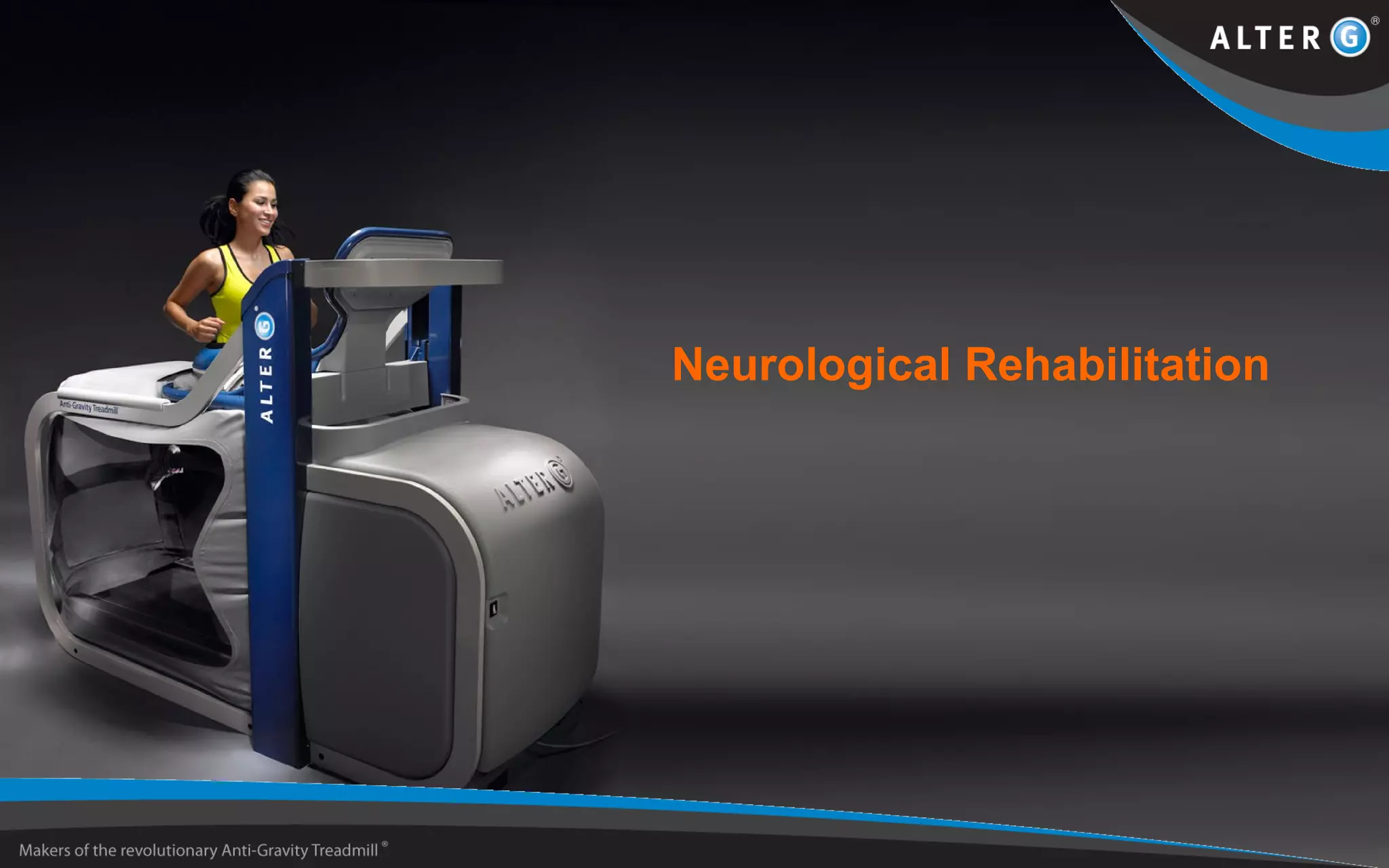
Neurological Rehabilitation
Objectives
• Become familiar with common neurological diagnoses
appropriate for the AlterG
• Understand how the AlterG can be used by neurological
patients
• Learn how to respond to common PT objections regarding
the AlterG with neuro populations
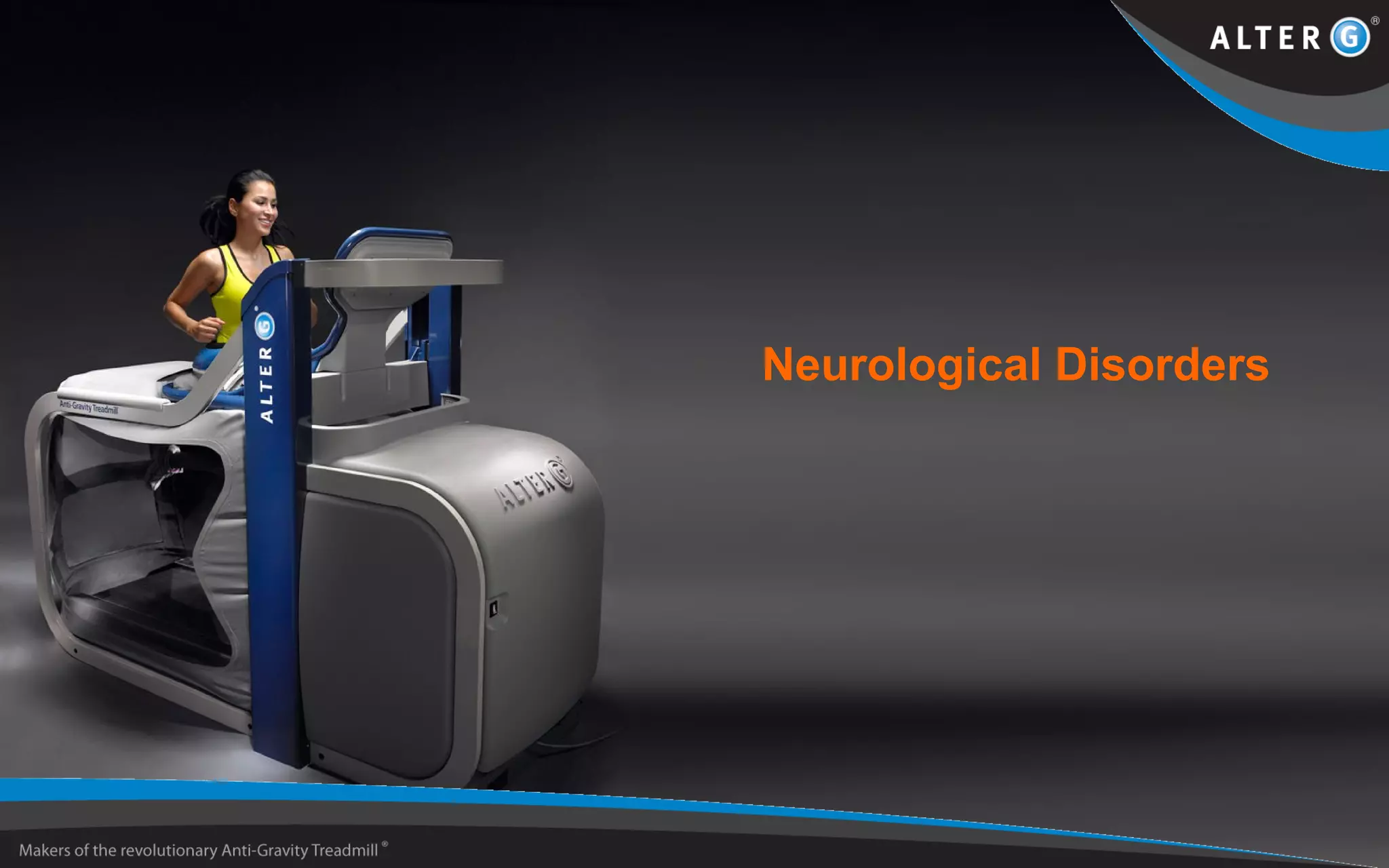
Neurological Disorders
Common Neurological Disorders
• Parkinson’s Disease
• Stroke- Cerebrovascular Accident (CVA)
• Traumatic Brain Injury (TBI)
• Spinal Cord Injury (SCI)
• Cerebral Palsy (CP)
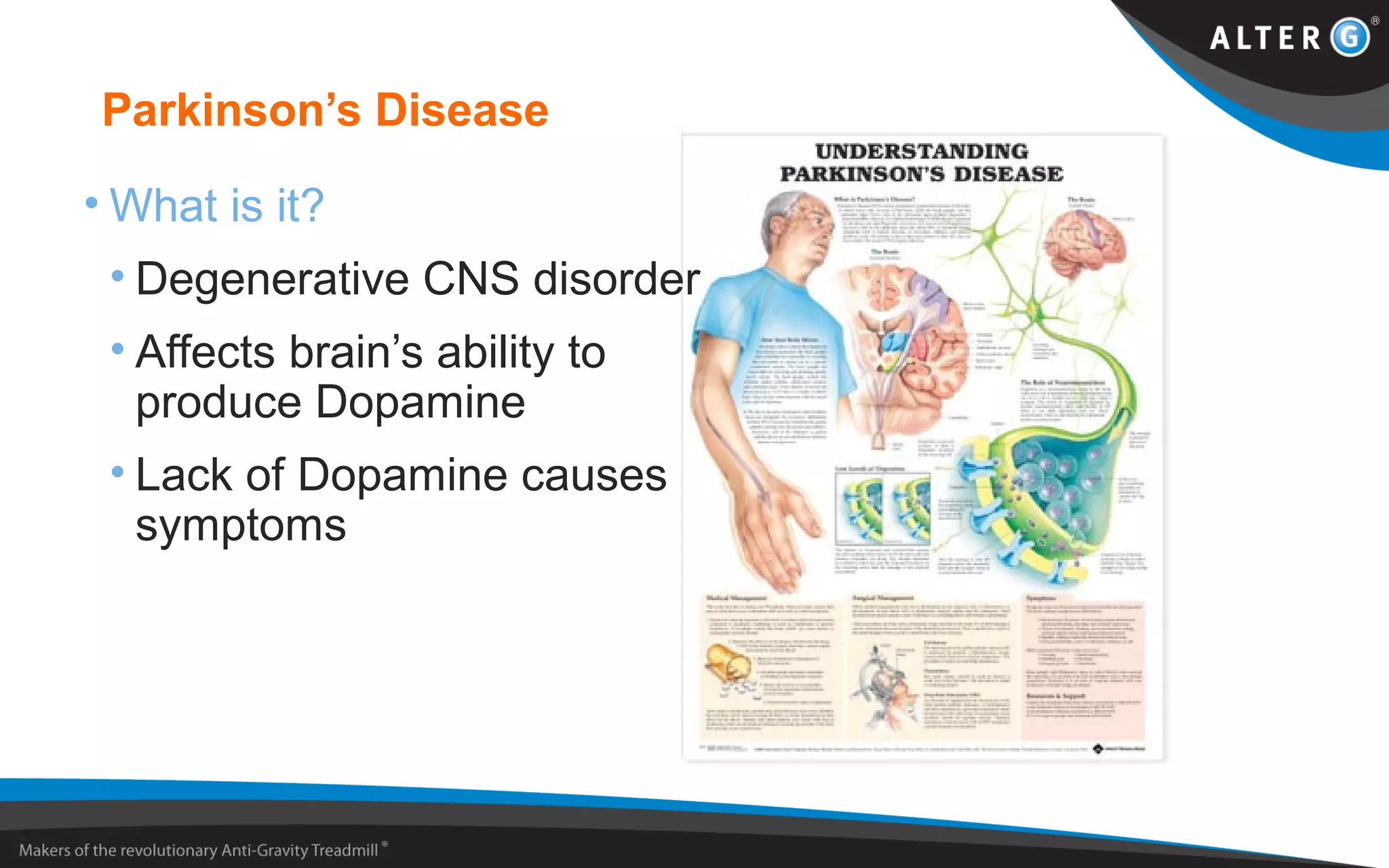
Parkinson’s Disease
• What is it?
• Degenerative CNS disorder
• Affects brain’s ability to
produce Dopamine
• Lack of Dopamine causes
symptoms
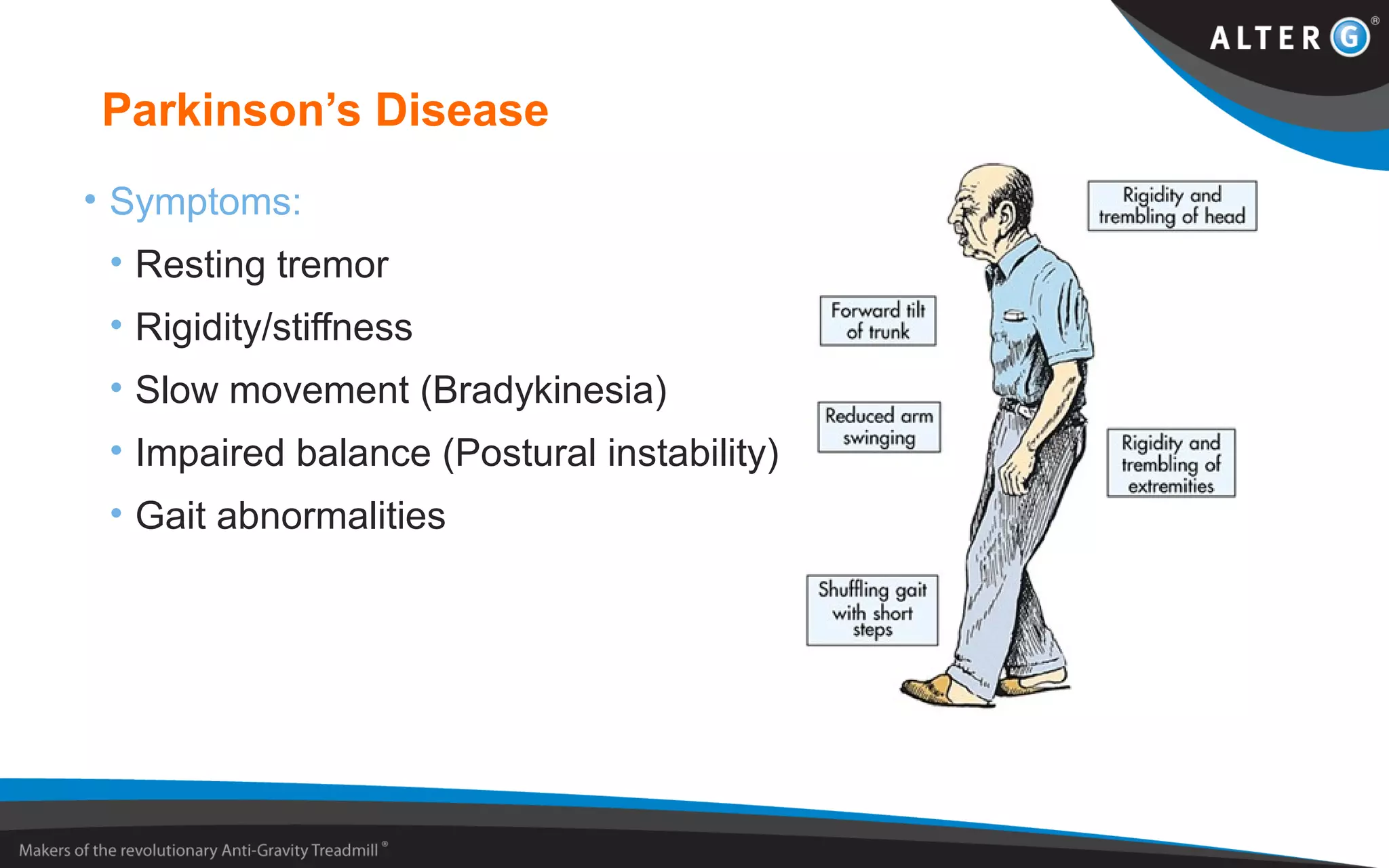
Parkinson’s Disease
• Symptoms:
• Resting tremor
• Rigidity/stiffness
• Slow movement (Bradykinesia)
• Impaired balance (Postural instability)
• Gait abnormalities
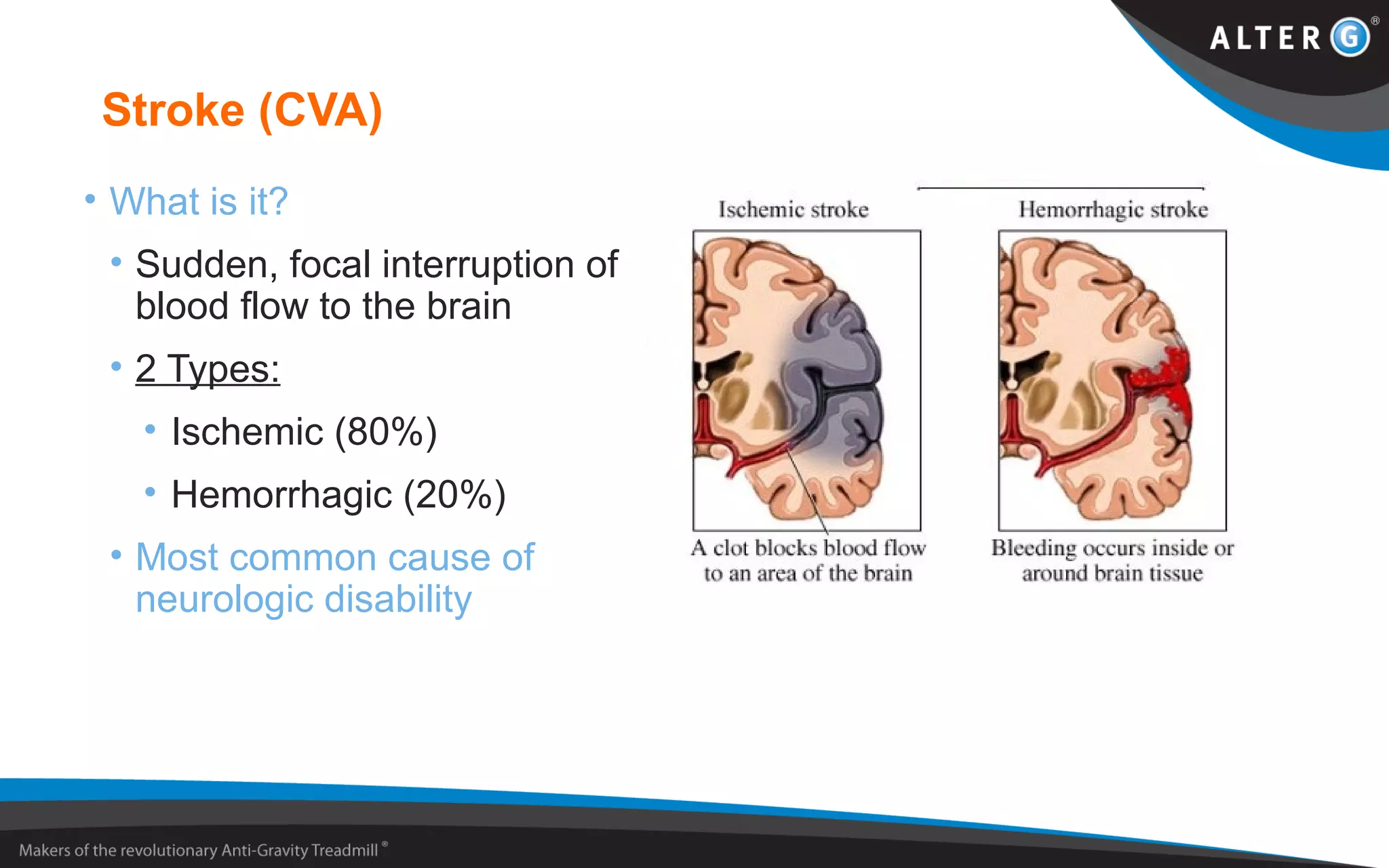
Stroke (CVA)
• What is it?
• Sudden, focal interruption of
blood flow to the brain
• 2 Types:
• Ischemic (80%)
• Hemorrhagic (20%)
• Most common cause of
neurologic disability
Stroke (CVA)
• Symptoms:
• Paresthesias
• Weakness/paralysis
• Speech/ Visual Disturbances
• Confusion
• Loss of balance/coordination
• Gait disturbances
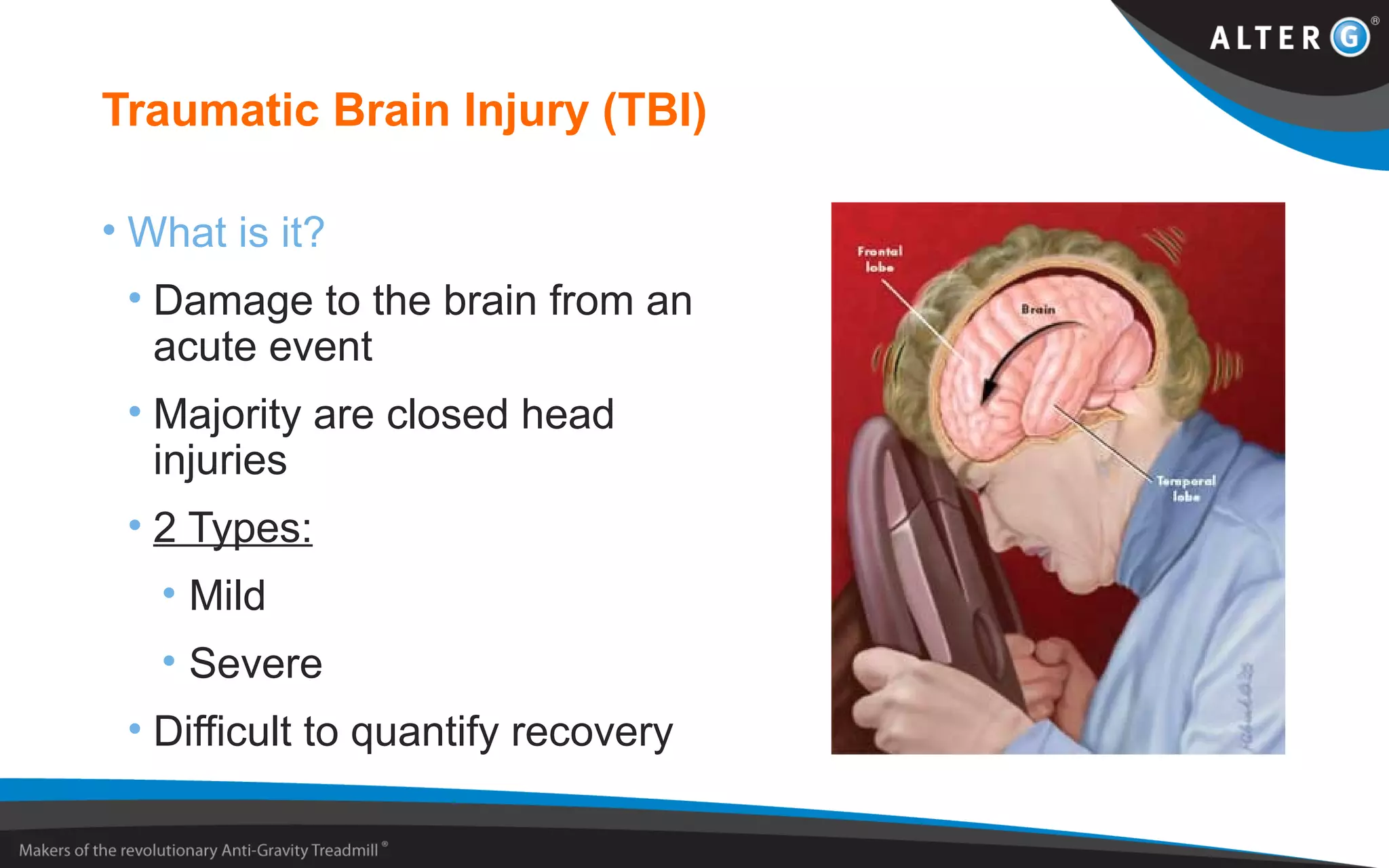
Traumatic Brain Injury (TBI)
• What is it?
• Damage to the brain from an
acute event
• Majority are closed head
injuries
• 2 Types:
• Mild
• Severe
• Difficult to quantify recovery
Traumatic Brain Injury (TBI)
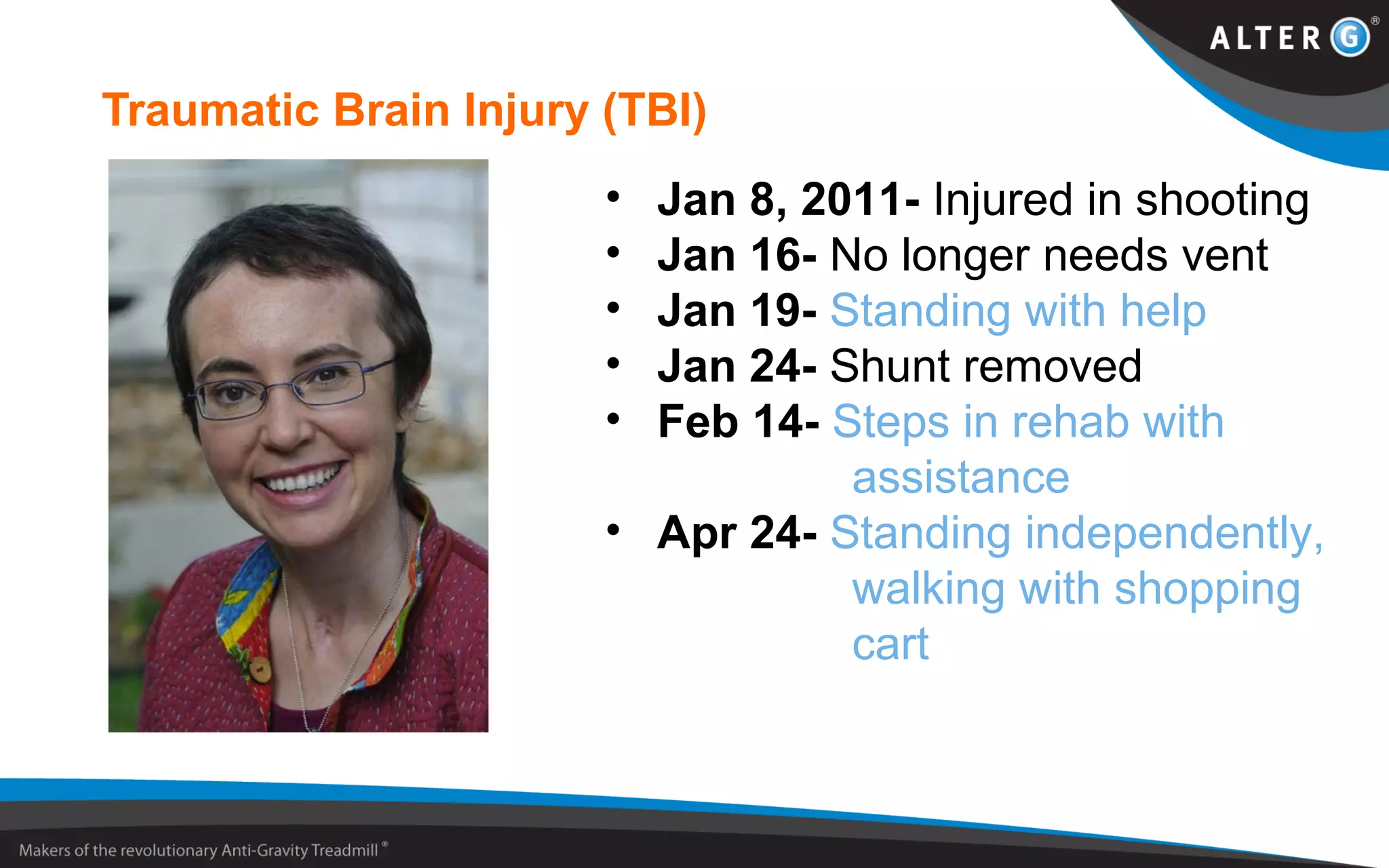
• Jan 8, 2011- Injured in shooting
• Jan 16- No longer needs vent
• Jan 19- Standing with help
• Jan 24- Shunt removed
• Feb 14- Steps in rehab with
assistance
• Apr 24- Standing independently,
walking with shopping
cart
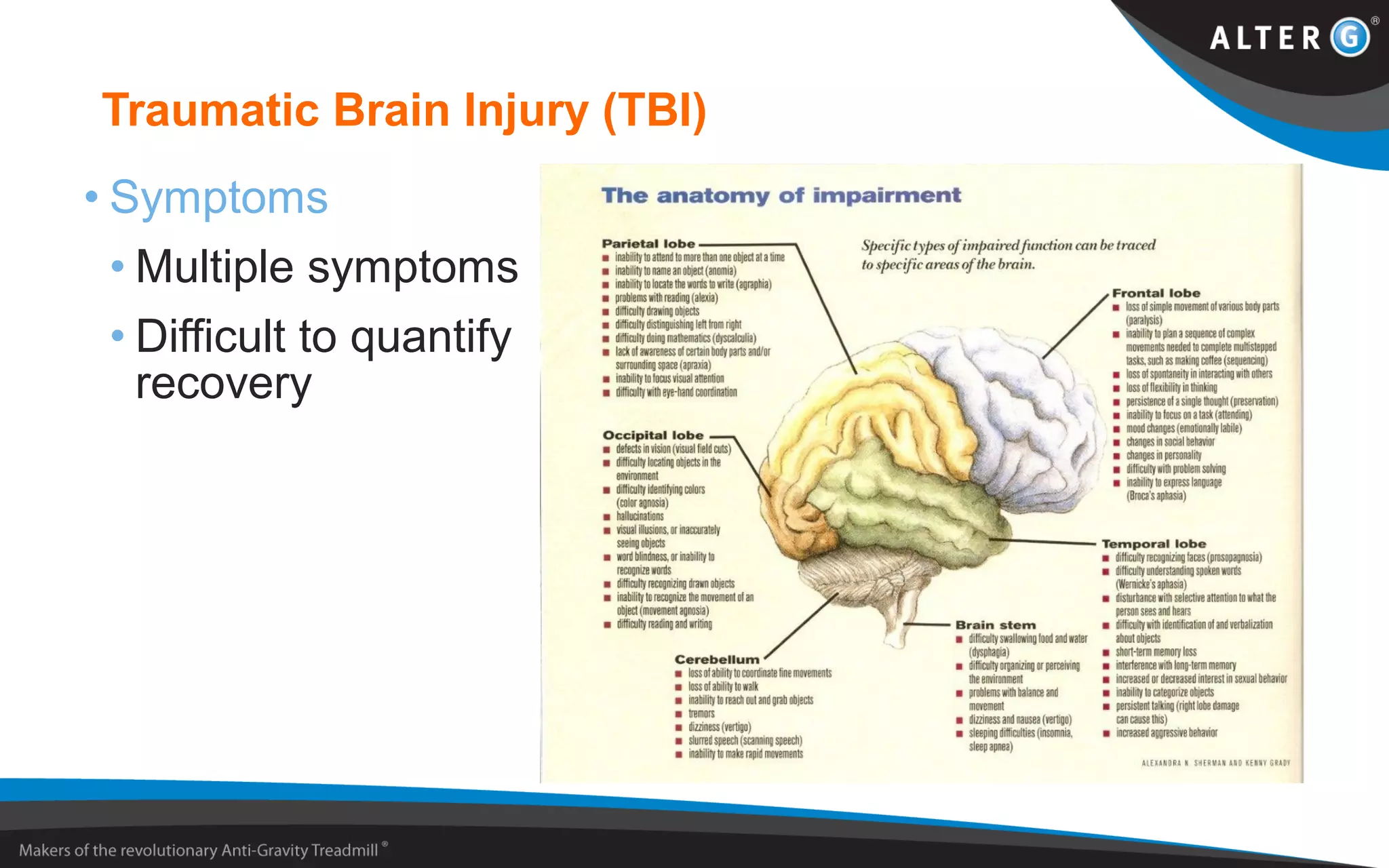
Traumatic Brain Injury (TBI)
• Symptoms
• Multiple symptoms
• Difficult to quantify
recovery
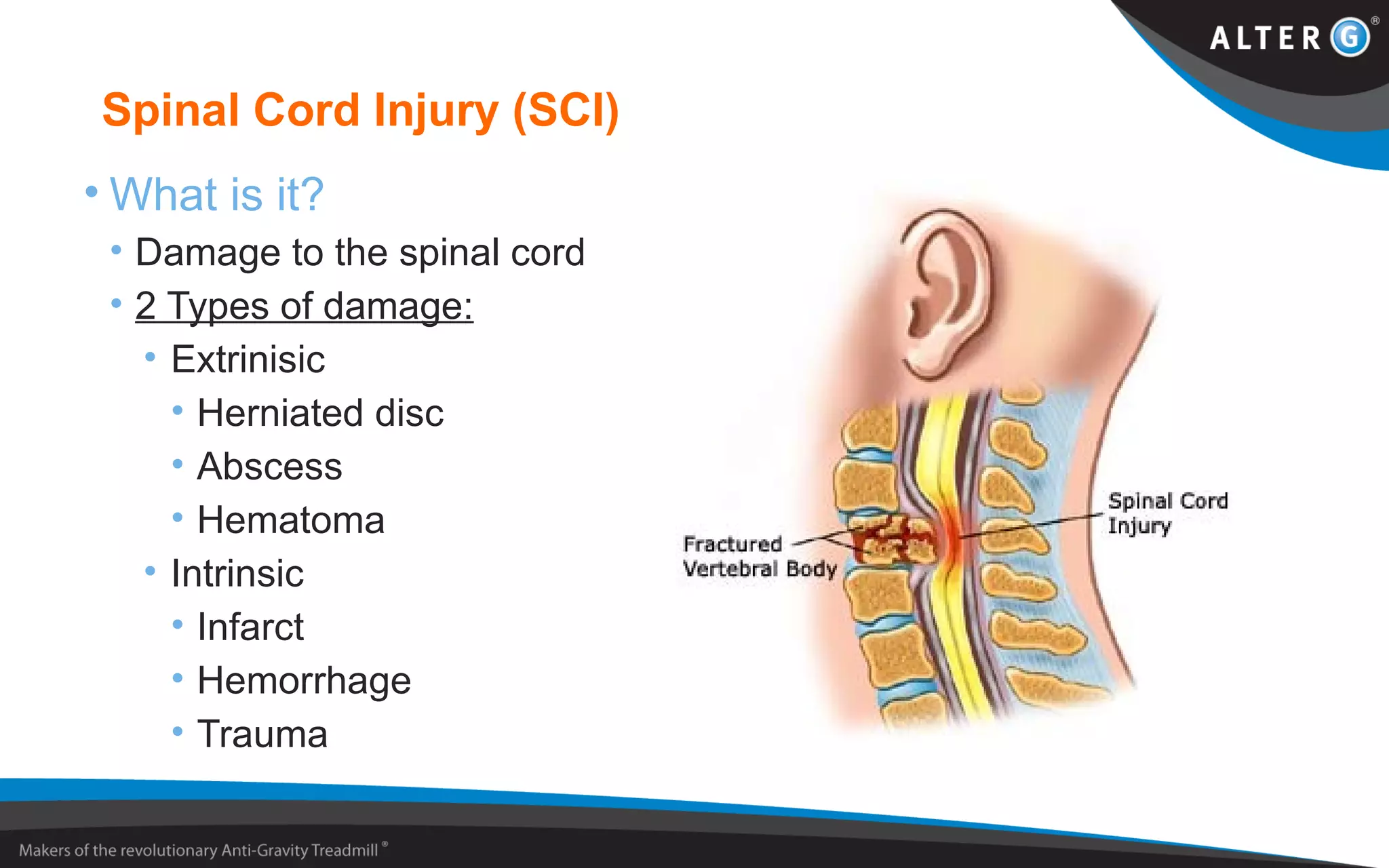
Spinal Cord Injury (SCI)
• What is it?
• Damage to the spinal cord
• 2 Types of damage:
• Extrinisic
• Herniated disc
• Abscess
• Hematoma
• Intrinsic
• Infarct
• Hemorrhage
• Trauma
Spinal Cord Injury (SCI)
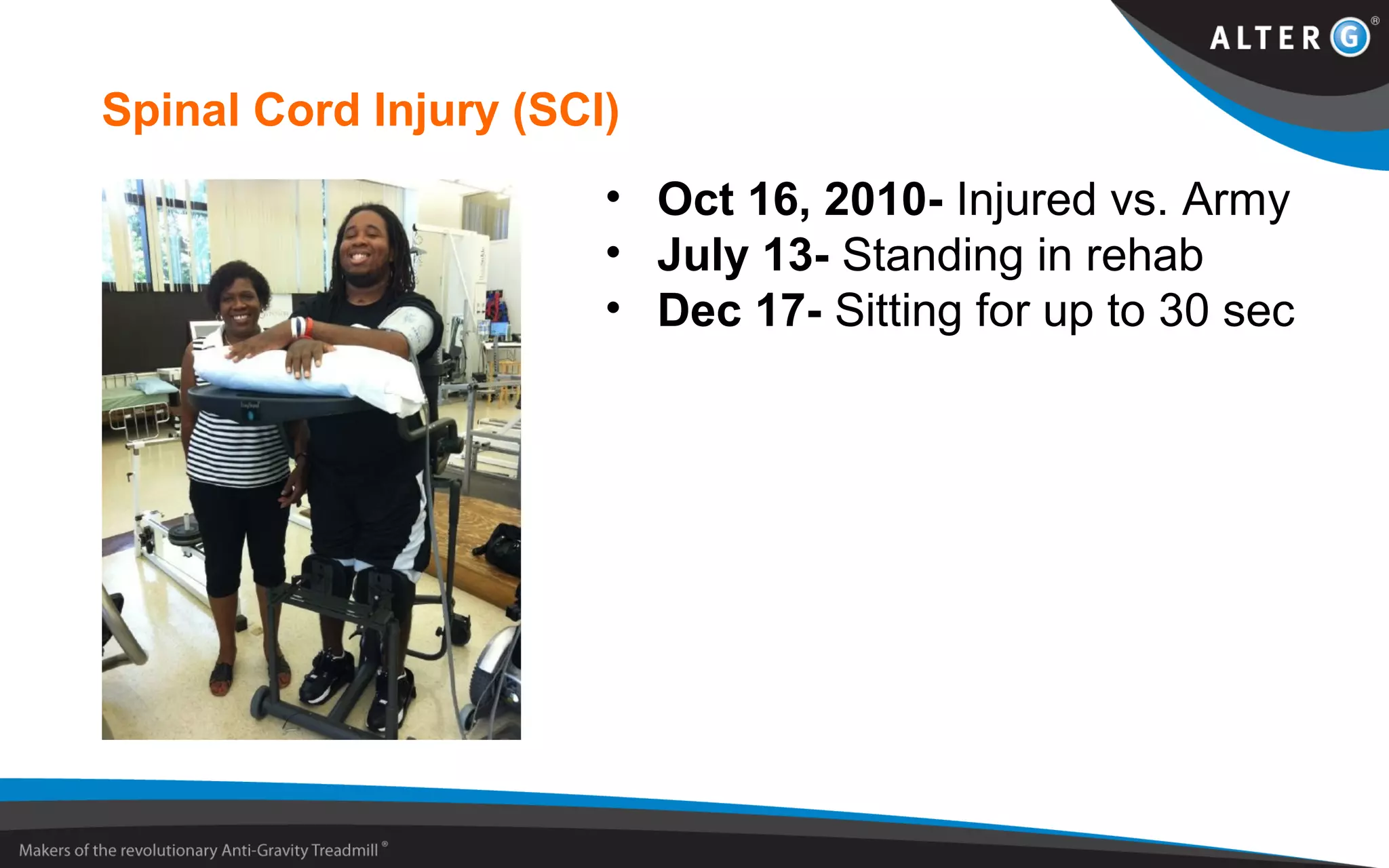
• Oct 16, 2010- Injured vs. Army
• July 13- Standing in rehab
• Dec 17- Sitting for up to 30 sec
Spinal Cord Injury (SCI)
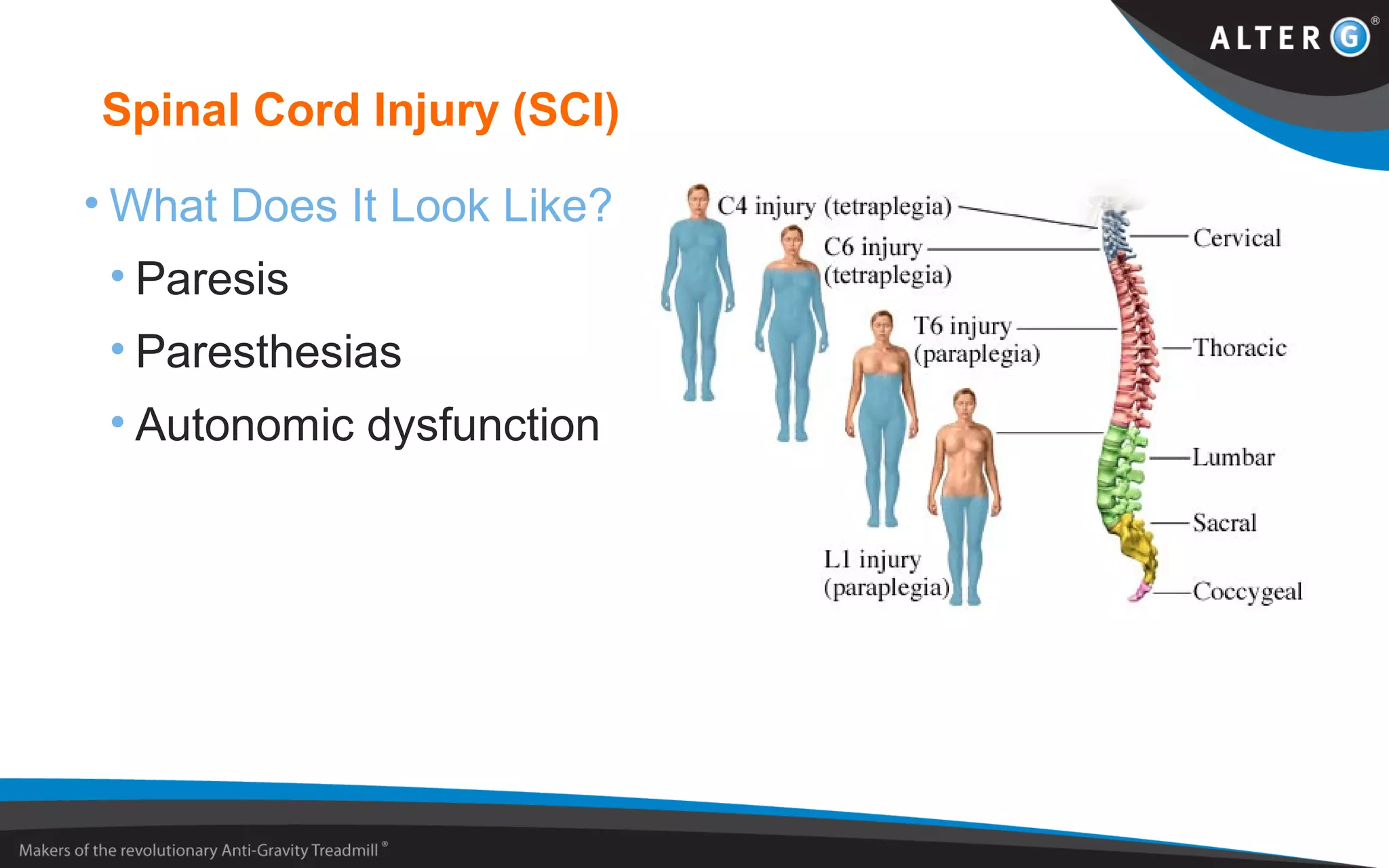
• What Does It Look Like?
• Paresis
• Paresthesias
• Autonomic dysfunction
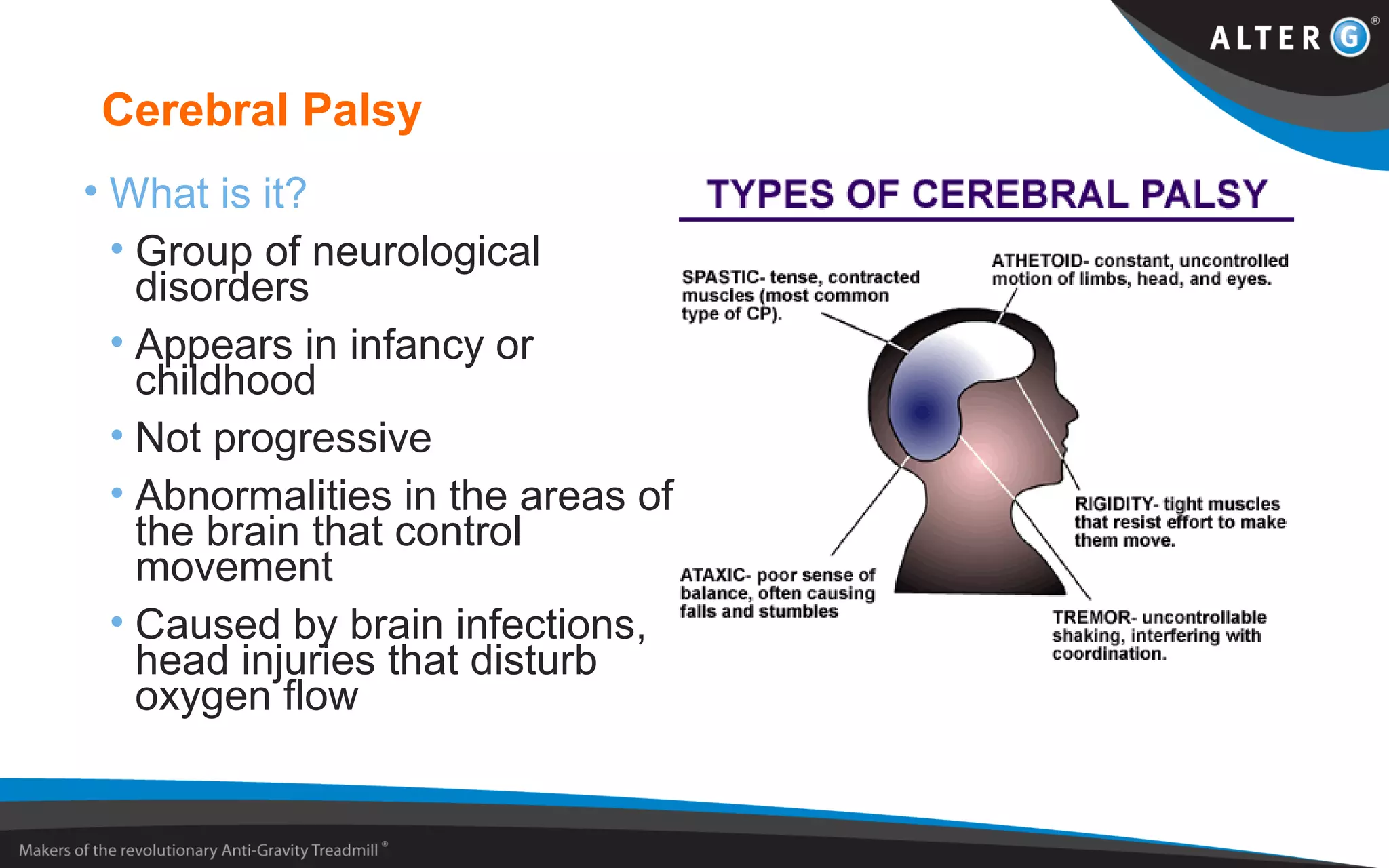
Cerebral Palsy
• What is it?
• Group of neurological
disorders
• Appears in infancy or
childhood
• Not progressive
• Abnormalities in the areas of
the brain that control
movement
• Caused by brain infections,
head injuries that disturb
oxygen flow
Cerebral Palsy
• Symptoms:
• Seizures
• Epilepsy
• Communication disorders
• Sensory impairments
• Abnormal muscle tone
(spasms)
• Joint and bone deformities
• Unsteady gait and balance
problems
Neurological Rehabilitation
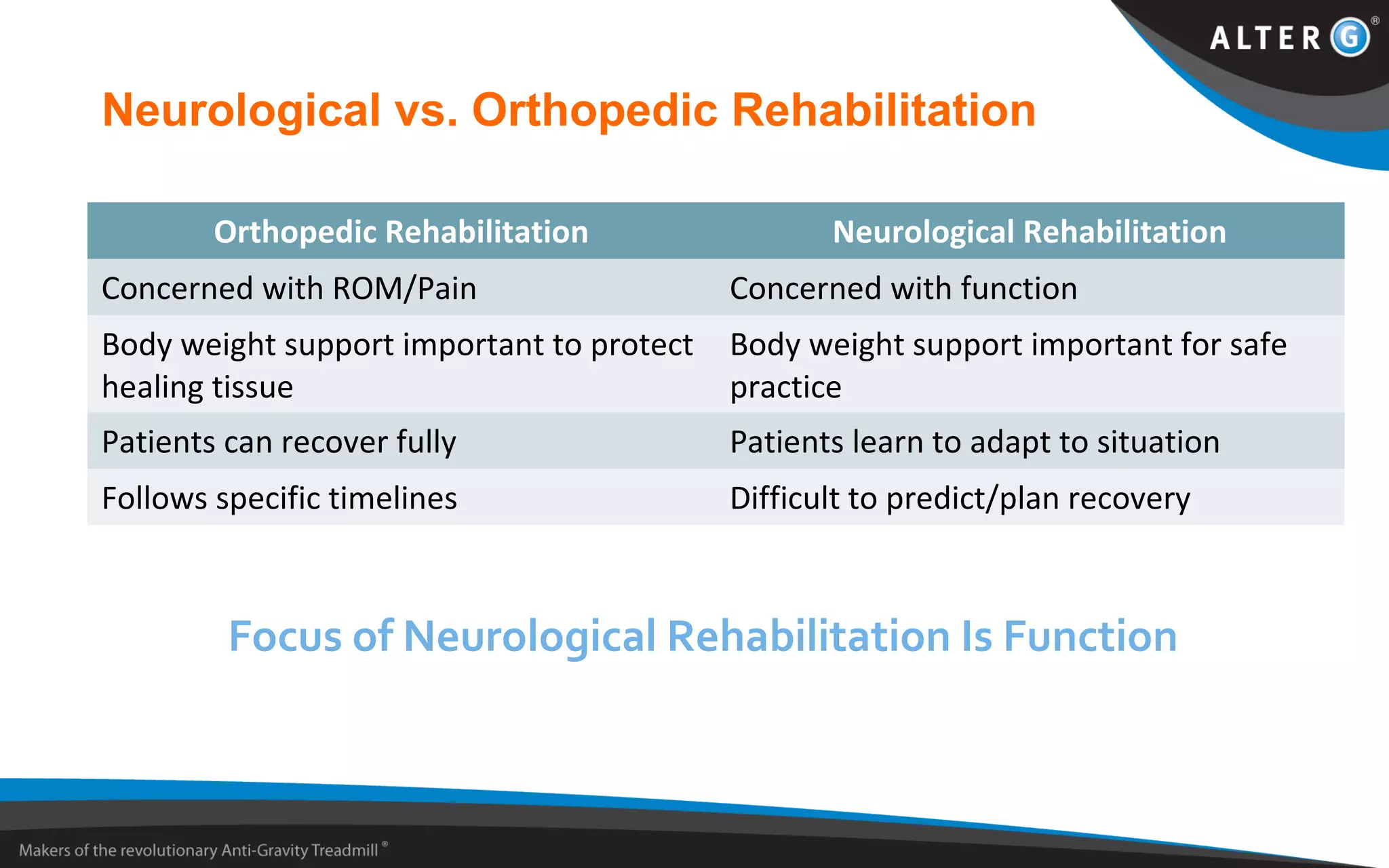
Neurological vs. Orthopedic Rehabilitation
Orthopedic Rehabilitation Neurological Rehabilitation
Concerned with ROM/Pain Concerned with function
Body weight support important to protect
healing tissue
Body weight support important for safe
practice
Patients can recover fully Patients learn to adapt to situation
Follows specific timelines Difficult to predict/plan recovery
Focus of Neurological Rehabilitation Is Function
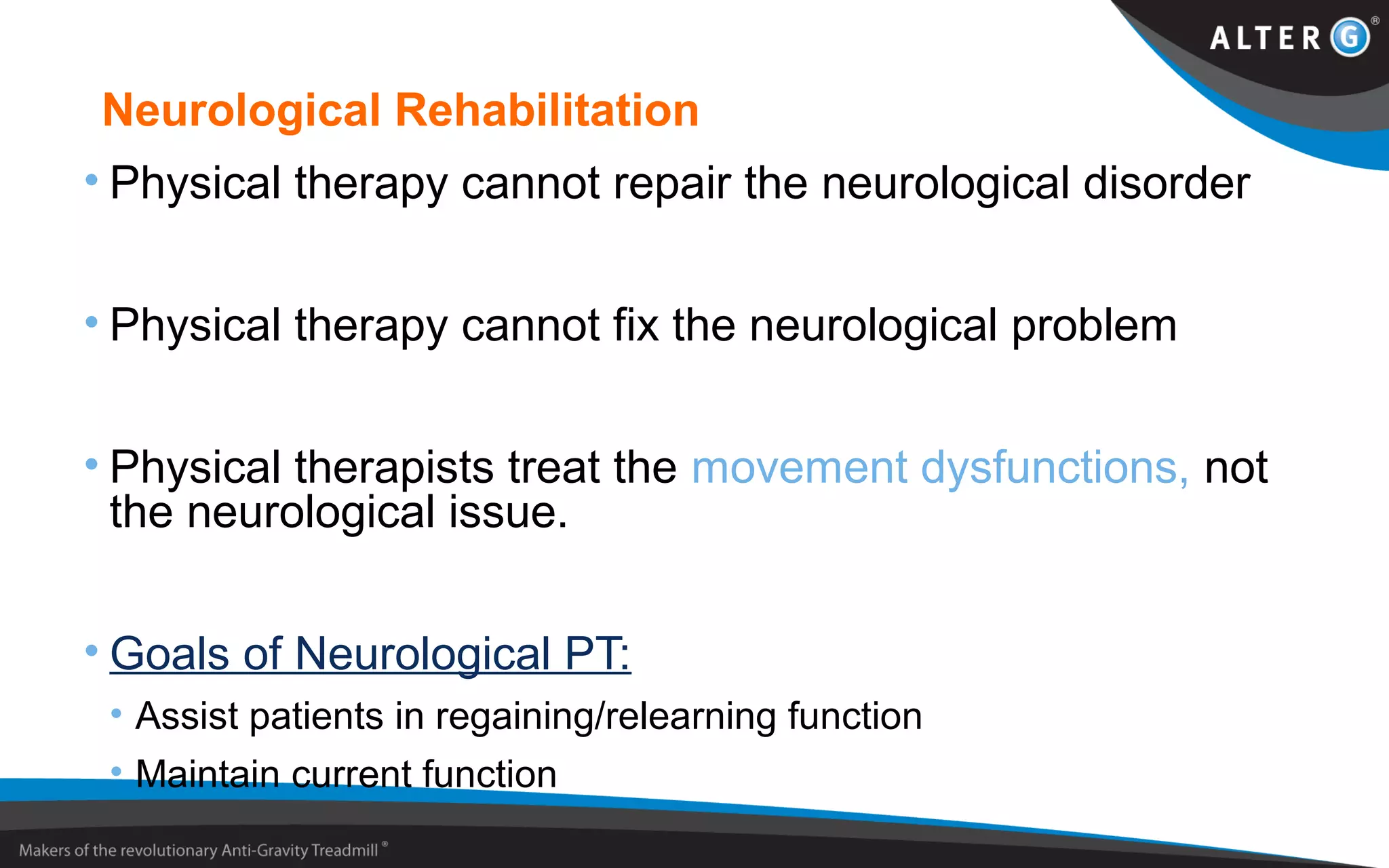
Neurological Rehabilitation
• Physical therapy cannot repair the neurological disorder
• Physical therapy cannot fix the neurological problem
• Physical therapists treat the movement dysfunctions, not
the neurological issue.
• Goals of Neurological PT:
• Assist patients in regaining/relearning function
• Maintain current function
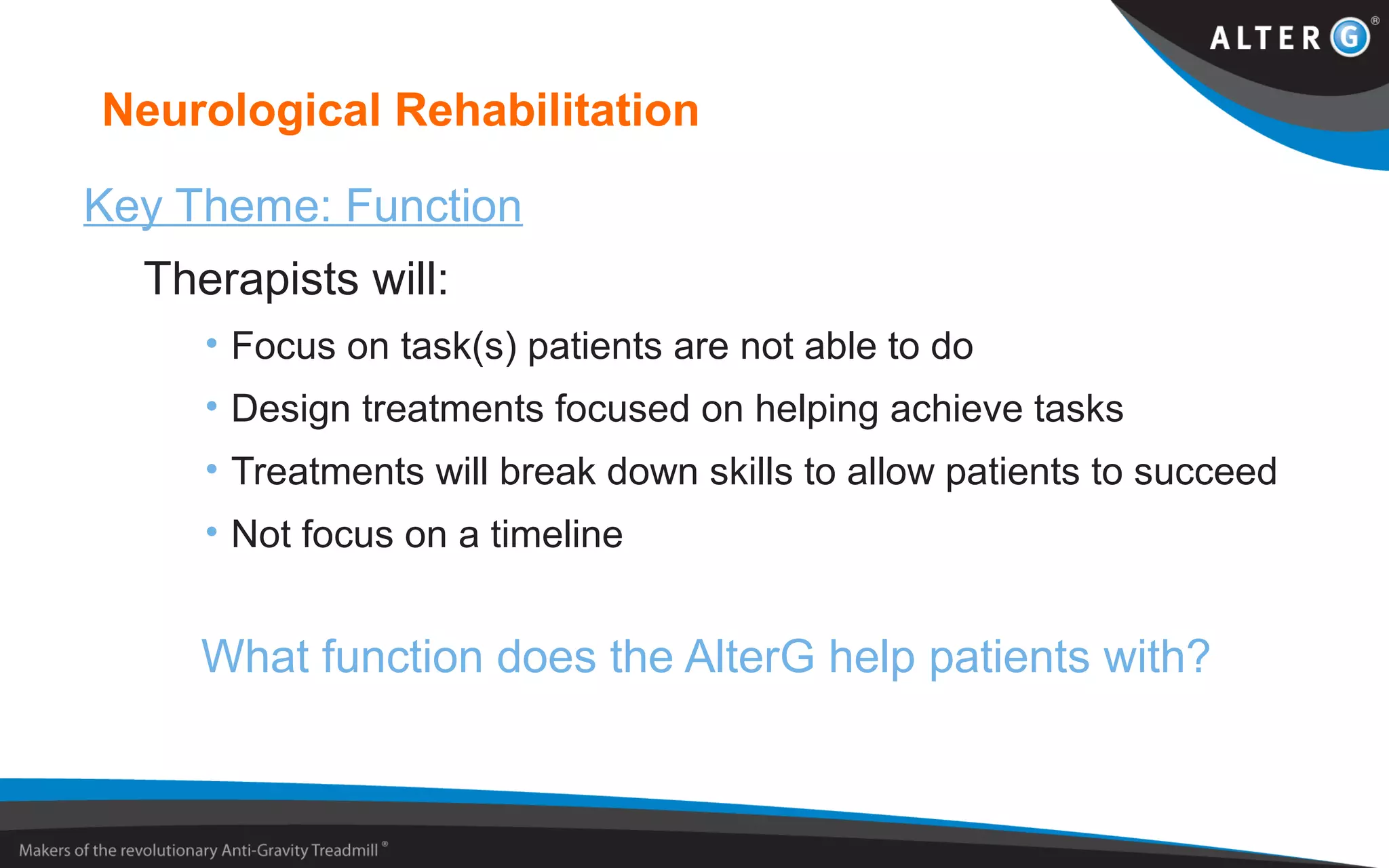
Neurological Rehabilitation
Key Theme: Function
Therapists will:
• Focus on task(s) patients are not able to do
• Design treatments focused on helping achieve tasks
• Treatments will break down skills to allow patients to succeed
• Not focus on a timeline
What function does the AlterG help patients with?
Neurological Rehabilitation
Key Theme: Function
Medicare is only concerned with function:
• Decreasing pain, improving range of motion do not matter
• If a patient does not show improved function, they will not get
continued PT
How does the AlterG help patients with improving function?
Neurological Rehabilitation
• Functional Tests
1) Berg
2) TUG (Timed Up-and-Go)
3) 6-Min Walk
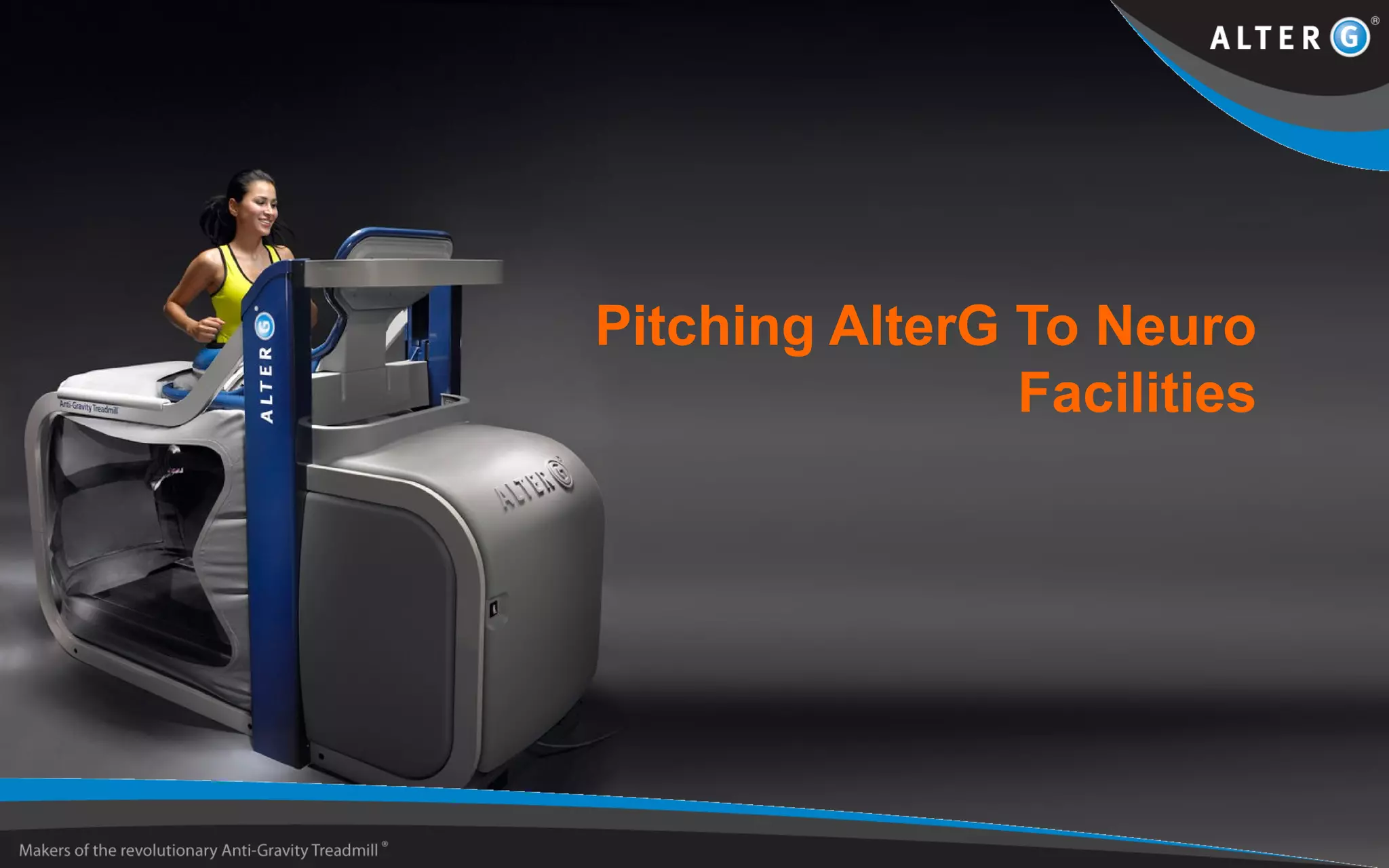
Pitching AlterG To Neuro
Facilities
Key Points
• AlterG is the best modality for assisting a patient with gait
training, balance training
• Superior comfort allows for longer practice sessions
• Longer practice sessions = Greater motor learning
opportunities= Better outcomes
AlterG allows for comfortable functional rehabilitation
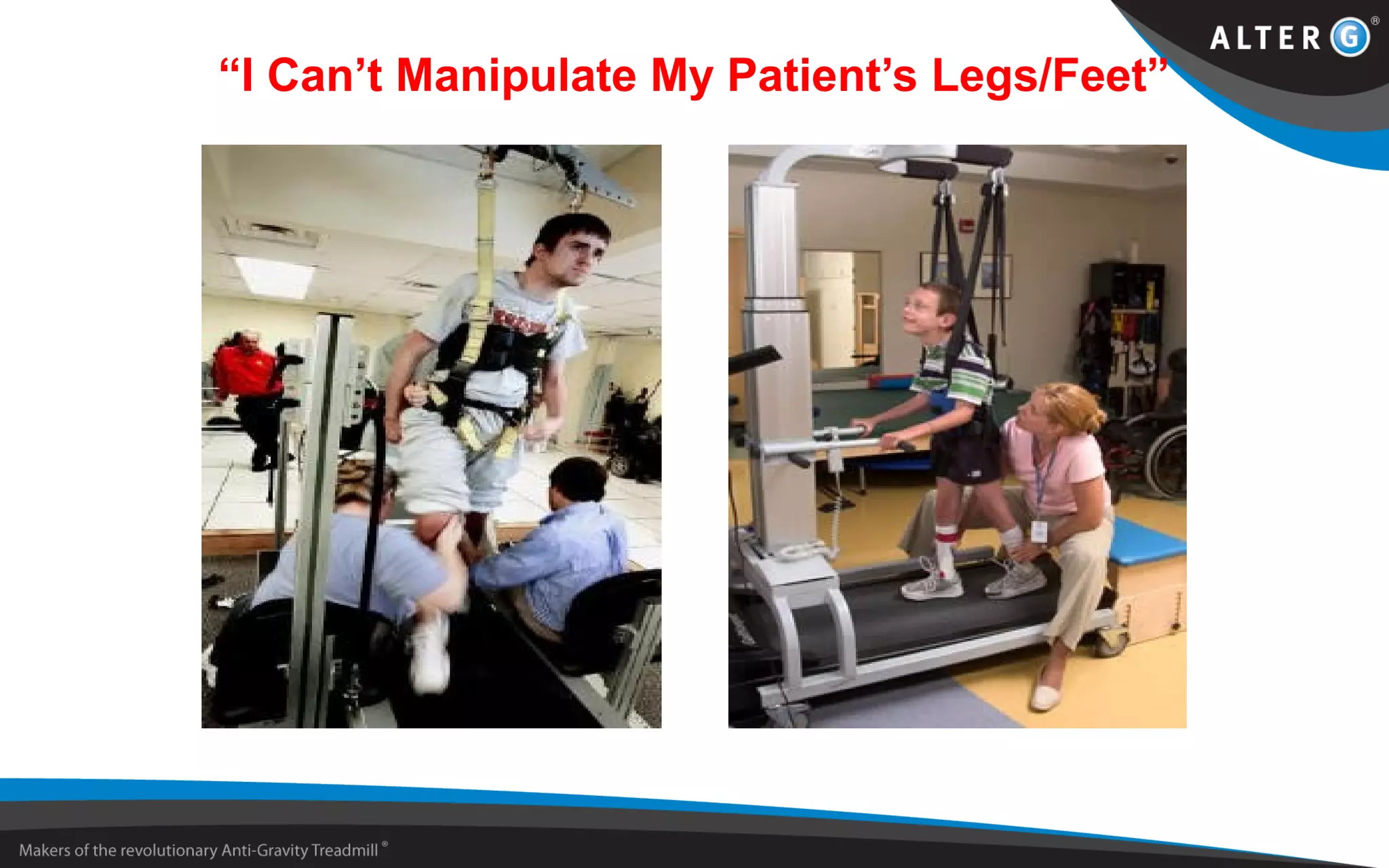
“I Can’t Manipulate My Patient’s Legs/Feet”
• AlterG is an excellent modality for gait training, balance training
• It supports the patient’s ability to walk
• Mod Assist (FIM 3) or higher functional level
• Dependent (1)  Max Assist (2) patients may not be appropriate
• Patients that can “walk” are perfect candidates for the AlterG
• Have motor function
• Can correct leg position with verbal and visual cues
“I Can’t Manipulate My Patient’s Legs/Feet”
• Once patients are READY, the AlterG assists with weight
bearing therapy better than any other product on the market
• Response Theme: The perfect tool makes the job easier
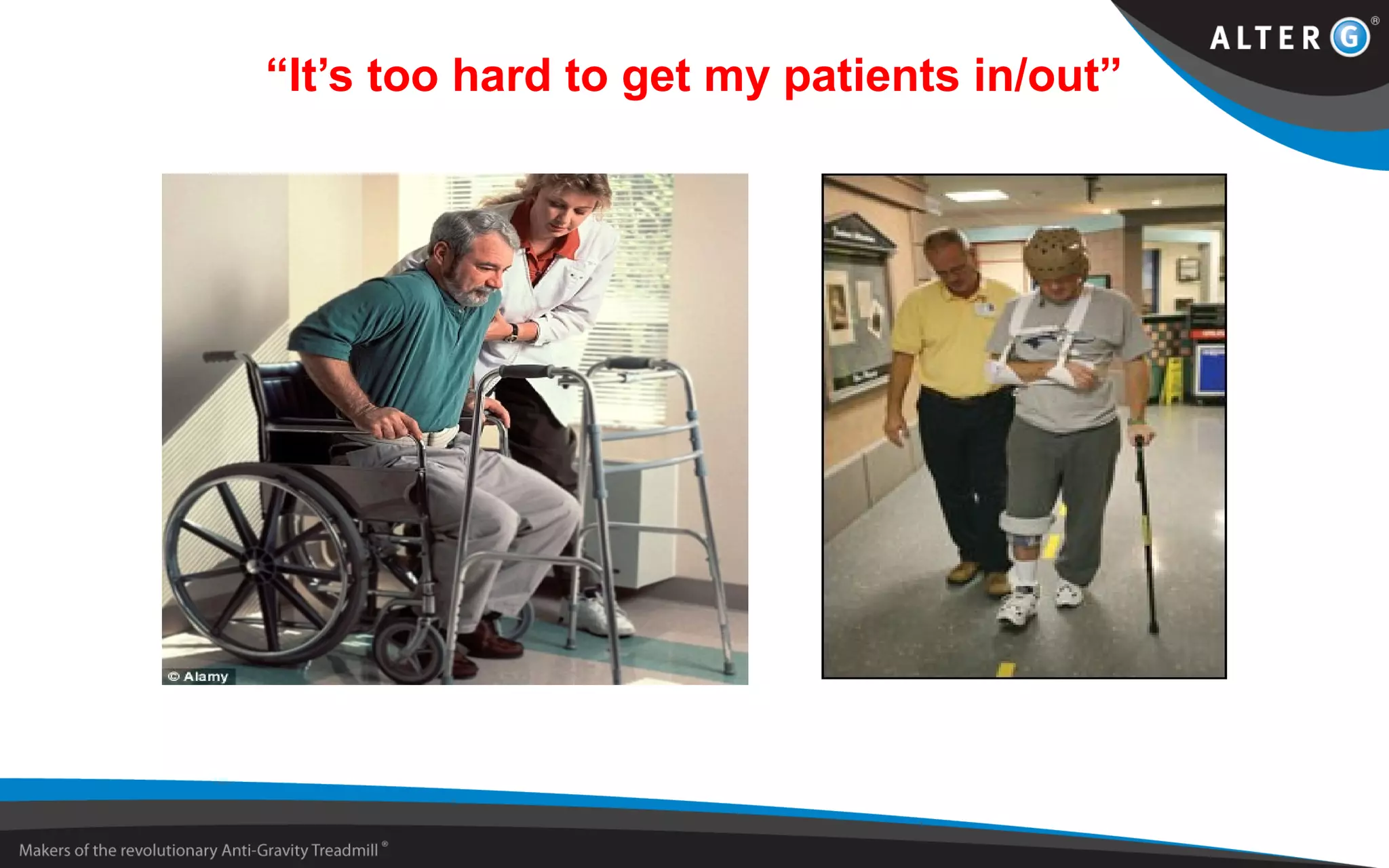
“It’s too hard to get my patients in/out”
• AlterG is an excellent modality that will assist with weight
bearing rehabilitation
• PT’s should have other treatment techniques at their
disposal to get patients ready for the AlterG
• If patients need a little more assistance:
• LiftAccess
• Transfer Bench
“It’s too hard to get my patients in/out”
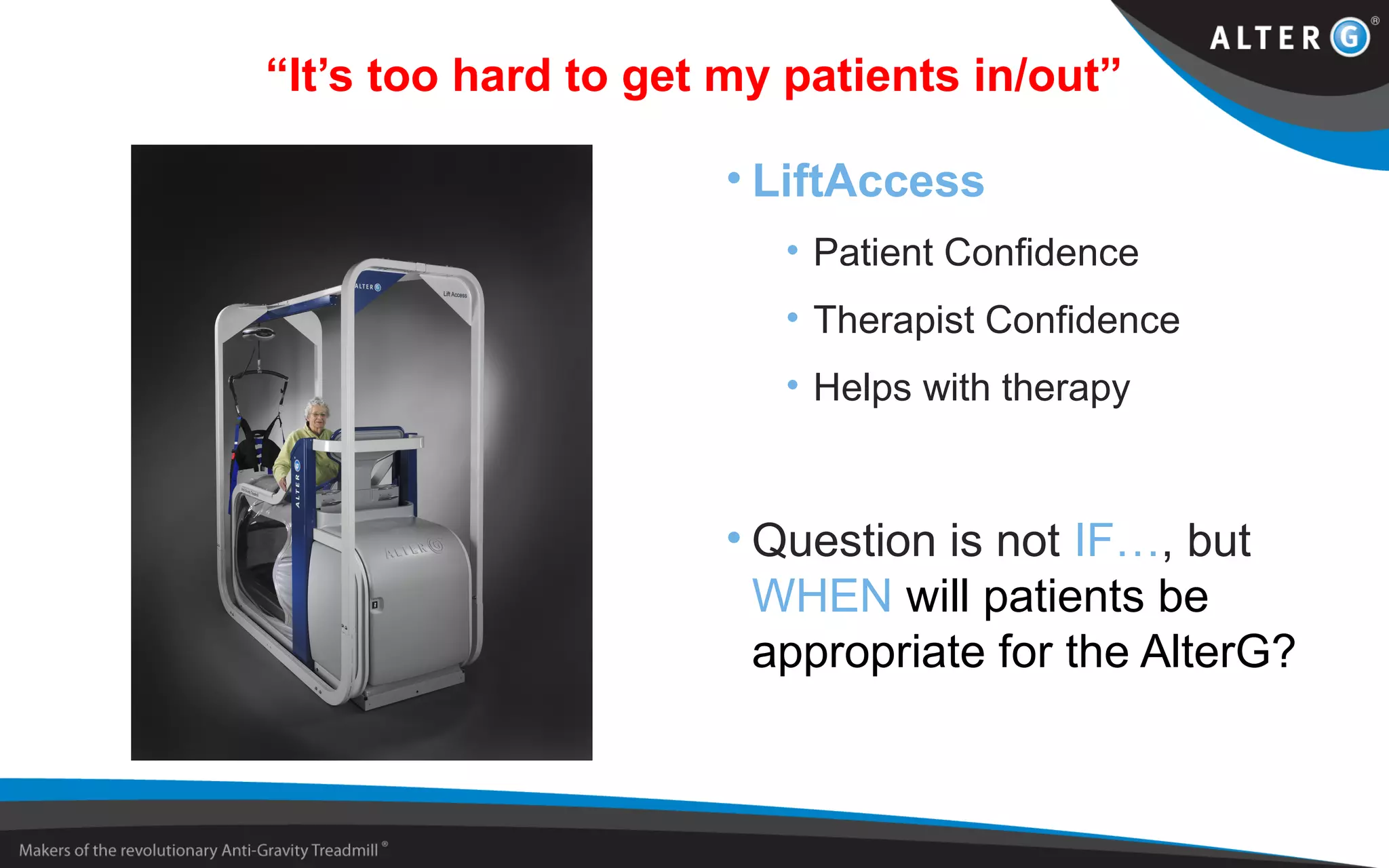
• LiftAccess
• Patient Confidence
• Therapist Confidence
• Helps with therapy
• Question is not IF…, but
WHEN will patients be
appropriate for the AlterG?
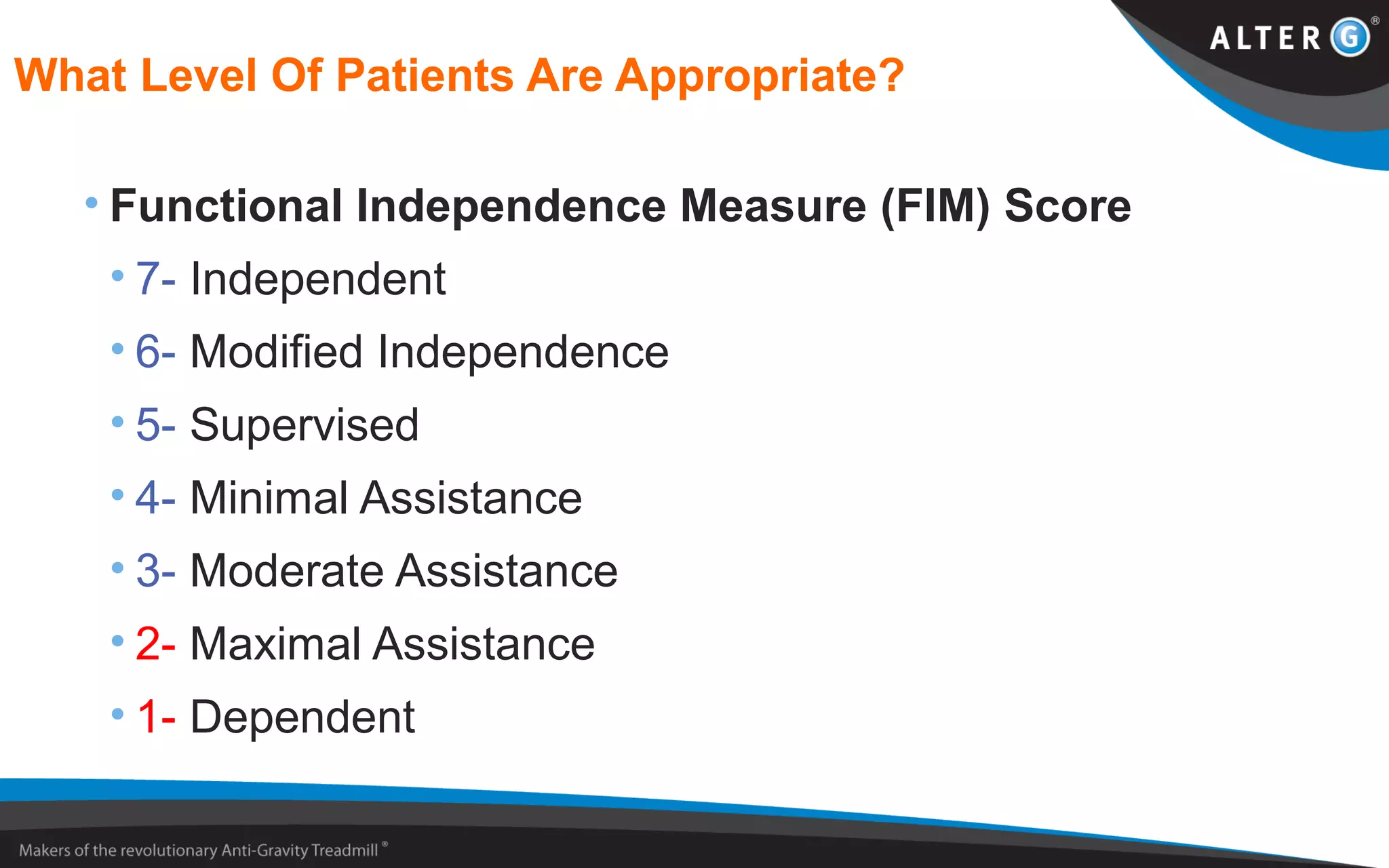
What Level Of Patients Are Appropriate?
• Functional Independence Measure (FIM) Score
• 7- Independent
• 6- Modified Independence
• 5- Supervised
• 4- Minimal Assistance
• 3- Moderate Assistance
• 2- Maximal Assistance
• 1- Dependent
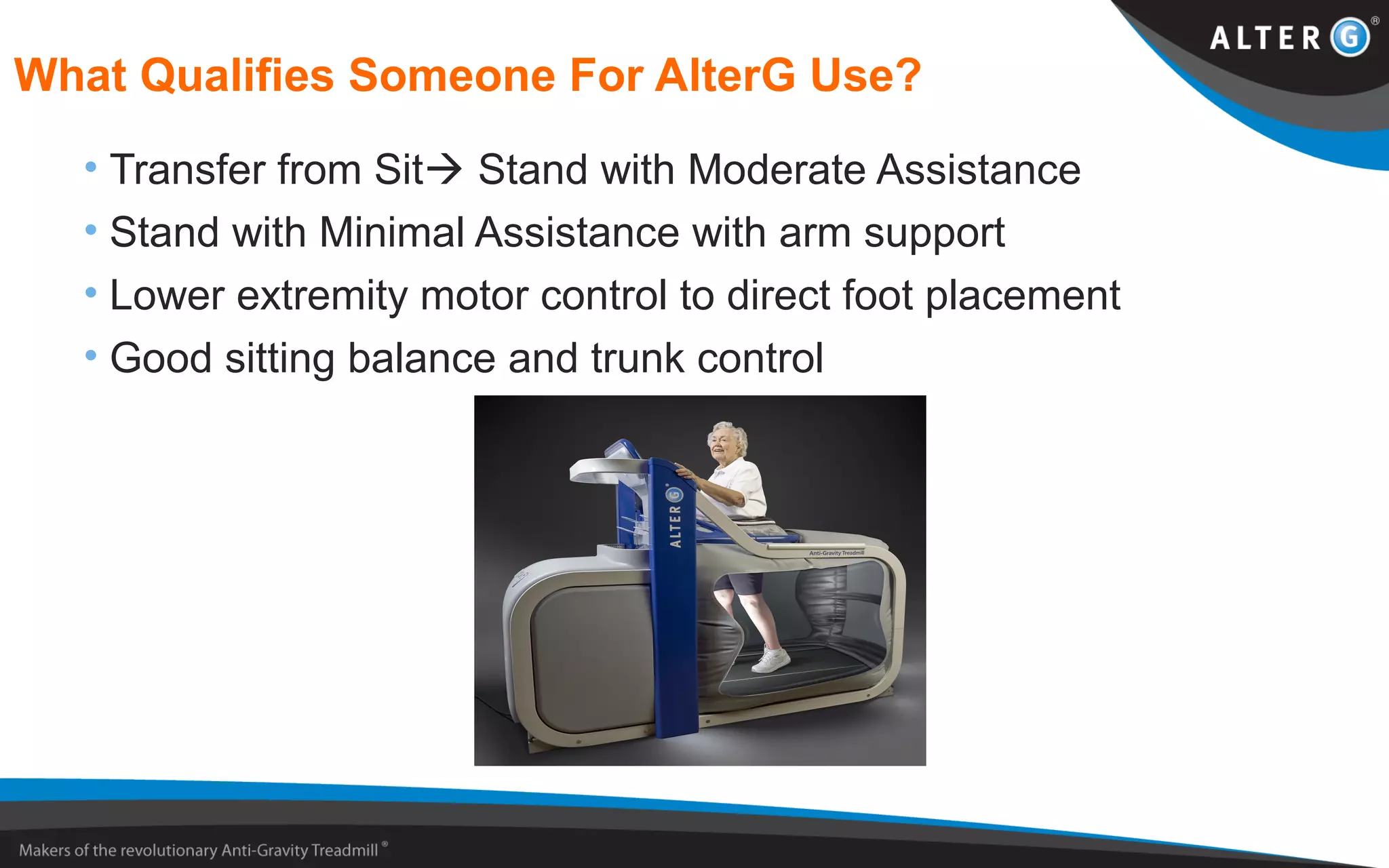
What Qualifies Someone For AlterG Use?
• Transfer from Sit Stand with Moderate Assistance
• Stand with Minimal Assistance with arm support
• Lower extremity motor control to direct foot placement
• Good sitting balance and trunk control
Neurological Rehab and the AlterG
• Remember, neuro rehabilitation goals are based on function not
timelines
• Focus is on relearning/retraining movement patterns, not fixing
neurological problems
• Be sure prospects understand where and how the AlterG fits into
the rehabilitation process
• Question is not IF patients will be appropriate for the AlterG, but
WHEN?
Clinical Education
Neurological Rehabilitation

Using the AlterG Anti-Gravity Treadmill with Neurological Patients

  • 1.
  • 2.
    Objectives • Become familiarwith common neurological diagnoses appropriate for the AlterG • Understand how the AlterG can be used by neurological patients • Learn how to respond to common PT objections regarding the AlterG with neuro populations
  • 3.
  • 4.
    Common Neurological Disorders •Parkinson’s Disease • Stroke- Cerebrovascular Accident (CVA) • Traumatic Brain Injury (TBI) • Spinal Cord Injury (SCI) • Cerebral Palsy (CP)
  • 5.
    Parkinson’s Disease • Whatis it? • Degenerative CNS disorder • Affects brain’s ability to produce Dopamine • Lack of Dopamine causes symptoms
  • 6.
    Parkinson’s Disease • Symptoms: •Resting tremor • Rigidity/stiffness • Slow movement (Bradykinesia) • Impaired balance (Postural instability) • Gait abnormalities
  • 7.
    Stroke (CVA) • Whatis it? • Sudden, focal interruption of blood flow to the brain • 2 Types: • Ischemic (80%) • Hemorrhagic (20%) • Most common cause of neurologic disability
  • 8.
    Stroke (CVA) • Symptoms: •Paresthesias • Weakness/paralysis • Speech/ Visual Disturbances • Confusion • Loss of balance/coordination • Gait disturbances
  • 9.
    Traumatic Brain Injury(TBI) • What is it? • Damage to the brain from an acute event • Majority are closed head injuries • 2 Types: • Mild • Severe • Difficult to quantify recovery
  • 10.
    Traumatic Brain Injury(TBI) • Jan 8, 2011- Injured in shooting • Jan 16- No longer needs vent • Jan 19- Standing with help • Jan 24- Shunt removed • Feb 14- Steps in rehab with assistance • Apr 24- Standing independently, walking with shopping cart
  • 11.
    Traumatic Brain Injury(TBI) • Symptoms • Multiple symptoms • Difficult to quantify recovery
  • 12.
    Spinal Cord Injury(SCI) • What is it? • Damage to the spinal cord • 2 Types of damage: • Extrinisic • Herniated disc • Abscess • Hematoma • Intrinsic • Infarct • Hemorrhage • Trauma
  • 13.
    Spinal Cord Injury(SCI) • Oct 16, 2010- Injured vs. Army • July 13- Standing in rehab • Dec 17- Sitting for up to 30 sec
  • 14.
    Spinal Cord Injury(SCI) • What Does It Look Like? • Paresis • Paresthesias • Autonomic dysfunction
  • 15.
    Cerebral Palsy • Whatis it? • Group of neurological disorders • Appears in infancy or childhood • Not progressive • Abnormalities in the areas of the brain that control movement • Caused by brain infections, head injuries that disturb oxygen flow
  • 16.
    Cerebral Palsy • Symptoms: •Seizures • Epilepsy • Communication disorders • Sensory impairments • Abnormal muscle tone (spasms) • Joint and bone deformities • Unsteady gait and balance problems
  • 17.
  • 18.
    Neurological vs. OrthopedicRehabilitation Orthopedic Rehabilitation Neurological Rehabilitation Concerned with ROM/Pain Concerned with function Body weight support important to protect healing tissue Body weight support important for safe practice Patients can recover fully Patients learn to adapt to situation Follows specific timelines Difficult to predict/plan recovery Focus of Neurological Rehabilitation Is Function
  • 19.
    Neurological Rehabilitation • Physicaltherapy cannot repair the neurological disorder • Physical therapy cannot fix the neurological problem • Physical therapists treat the movement dysfunctions, not the neurological issue. • Goals of Neurological PT: • Assist patients in regaining/relearning function • Maintain current function
  • 20.
    Neurological Rehabilitation Key Theme:Function Therapists will: • Focus on task(s) patients are not able to do • Design treatments focused on helping achieve tasks • Treatments will break down skills to allow patients to succeed • Not focus on a timeline What function does the AlterG help patients with?
  • 21.
    Neurological Rehabilitation Key Theme:Function Medicare is only concerned with function: • Decreasing pain, improving range of motion do not matter • If a patient does not show improved function, they will not get continued PT How does the AlterG help patients with improving function?
  • 22.
    Neurological Rehabilitation • FunctionalTests 1) Berg 2) TUG (Timed Up-and-Go) 3) 6-Min Walk
  • 23.
    Pitching AlterG ToNeuro Facilities
  • 24.
    Key Points • AlterGis the best modality for assisting a patient with gait training, balance training • Superior comfort allows for longer practice sessions • Longer practice sessions = Greater motor learning opportunities= Better outcomes AlterG allows for comfortable functional rehabilitation
  • 25.
    “I Can’t ManipulateMy Patient’s Legs/Feet”
  • 26.
    “I Can’t ManipulateMy Patient’s Legs/Feet” • AlterG is an excellent modality for gait training, balance training • It supports the patient’s ability to walk • Mod Assist (FIM 3) or higher functional level • Dependent (1)  Max Assist (2) patients may not be appropriate • Patients that can “walk” are perfect candidates for the AlterG • Have motor function • Can correct leg position with verbal and visual cues
  • 27.
    “I Can’t ManipulateMy Patient’s Legs/Feet” • Once patients are READY, the AlterG assists with weight bearing therapy better than any other product on the market • Response Theme: The perfect tool makes the job easier
  • 28.
    “It’s too hardto get my patients in/out”
  • 29.
    “It’s too hardto get my patients in/out” • AlterG is an excellent modality that will assist with weight bearing rehabilitation • PT’s should have other treatment techniques at their disposal to get patients ready for the AlterG • If patients need a little more assistance: • LiftAccess • Transfer Bench
  • 30.
    “It’s too hardto get my patients in/out” • LiftAccess • Patient Confidence • Therapist Confidence • Helps with therapy • Question is not IF…, but WHEN will patients be appropriate for the AlterG?
  • 31.
    What Level OfPatients Are Appropriate? • Functional Independence Measure (FIM) Score • 7- Independent • 6- Modified Independence • 5- Supervised • 4- Minimal Assistance • 3- Moderate Assistance • 2- Maximal Assistance • 1- Dependent
  • 32.
    What Qualifies SomeoneFor AlterG Use? • Transfer from Sit Stand with Moderate Assistance • Stand with Minimal Assistance with arm support • Lower extremity motor control to direct foot placement • Good sitting balance and trunk control
  • 33.
    Neurological Rehab andthe AlterG • Remember, neuro rehabilitation goals are based on function not timelines • Focus is on relearning/retraining movement patterns, not fixing neurological problems • Be sure prospects understand where and how the AlterG fits into the rehabilitation process • Question is not IF patients will be appropriate for the AlterG, but WHEN?
  • 34.