April 29 - May 1, 2015
Using Play as a Platform to Give Every
Child the Chance to Succeed
Agenda
• Introductions
• who we are and why we do what we do
• Positive About Play fly –by
• What play means to you
• Play theory
• looking at the science behind play
• Positive About Play in a little more detail
• the challenges
• Strategy and development
Introductions: about Liverpool
• City 800 years old
• Huge heritage as ‘second city of the British Empire’, The
Beatles and Football….but so much more!
• Population of 460,000 in the city
• 2.2 million in wider metro area (Merseyside)
• Population in the city declined consistently from 850,000 in
1930s
• …… until last 10 years (up 5%)
• City of huge contrasts….and inequality
Introductions: Liverpool and Inequality
Levels of deprivation and child poverty in Liverpool are
extremely high:
•Liverpool is the most deprived local authority area nationally.
•Just over a third of Liverpool children (34.4%) live in poverty and in
some areas of the city three fifths of children live in poverty.
•In some schools in the city 73% of children are eligible for Free
School Meals.
•More than a third of Liverpool wards have unemployment rates that
are twice the national average and Liverpool's incapacity rate is
nearly twice the national rate.
•Liverpool has a larger proportion of the working age population with
no qualifications than nationally.
Introductions: about LCVS
• LCVS established in 1909 to “help charities co-ordinate their
efforts”
• At the forefront of social action in Liverpool, and nationally, for
over a century
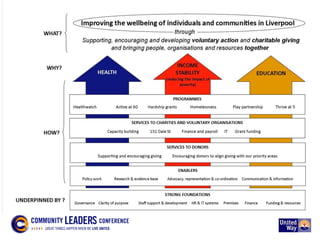
• Diverse range of services and activities with an underpinning,
clear, aim:
• Together – for Liverpool – for Good
Slide Example With Medium Photo
Positive About Play – What exactly is a playscheme?
• Play schemes provide vital out of school provision for children
in safe, group environments.
• Play schemes vary in their shape and size, in where they take
place and who runs them, but every play scheme has, at its heart,
the commitment to proving children with the chance to play,
explore and learn together (with adult support when it’s needed).
Positive about Play ‘fly-by’
• In the 1980’s Liverpool had over 200 playschemes
• Cuts to budgets gradually reduced this figure to less than 30 in
2011
• Local groups and families were telling us that more provision was
needed for out of school activities
• At the same time, foodbanks were on the rise as families found it
hard to get by
• So what to do….?
Positive About Play ‘fly-by’
• We convened local partners involved in children’s play including
the Local Authority
• We invested some of our own grant funds and encouraged
partners to do the same in a ‘pooled’ budget’
• In 2012 we raised the number of playschemes to 46
• We also teamed up with Fareshare who redistributes surplus food
to charities and community organisations
• By 2014 we were running over 70 playschemes and attracted
support from Public Health and other funders and donors
• Our aim is to break the 100 playscheme barrier in 2015
What play means to you – group exercise
Think about a positive play experience from your childhood,
something you remember fondly.
•It doesn’t have to be a life-changing moment, just something you
enjoyed doing.
•Have a chat with your neighbours and make a list of the activities.
Follow this up with another list, looking at the activity, and write down
what type of play took place; for example it may have been:
•something you did on your own (like sorting bubblegum cards or
collecting something)
•it may have been physical and social (climbing a tree with friends).
You get the
idea…
Play theory – looking at the science behind play
Plenty of evidence to support the fact that play is essential to
our development e.g.
• Sutton-Smith, in his book In The Ambiguity of Play, refers to
Huttenlocher’s work on brain imaging. This suggests that
“children under the age of 10 have at least twice the potential
brain capacity of children over 10”.
• Sutton-Smith suggests that this ‘over-capacity’ can be exploited
if children are exposed to a range of experiences through play.
Other research exists that backs up this theory that stimulus
through play actually modifies the brain and increases the
child’s capacity for learning for life.
Play theory – looking at the science behind play
Play is vital to children’s social development.
The Play Return by the Children’s Play Policy Forum (2014) found
that Play initiatives lead to improvements in children’s health and
well-being, and are linked to a range of other cognitive and social
developmental benefits. While the evidence is strongest for play in
schools, it is reasonable to expect that they will also be seen in other
similar contexts.
Play enables children to do the following:
• Respond to their peers’ feelings while waiting for their turn and
sharing materials and experiences (Sapon-Shevin, Dobbelgere,
Carrigan, Goodman, & Mastin, 1998; Wheeler, 2004).
• Experiment with roles of the people in their home, school, and
community by coming into contact with the needs and wishes of
others ( Creasey, Jarvis, & Berk, 1998 )
Positive About Play in a little more detail
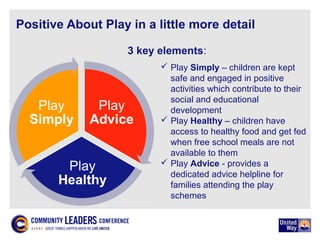
 Play Simply – children are kept
safe and engaged in positive
activities which contribute to their
social and educational
development
 Play Healthy – children have
access to healthy food and get fed
when free school meals are not
available to them
 Play Advice - provides a
dedicated advice helpline for
families attending the play
schemes
3 key elements:
Positive About Play in a little more detail
Challenges and moving forward:
Partnership has grown organically – now need to
formalise
We now have a clear aspiration
 16,236 children in Liverpool live in the most
deprived areas and by 2020 we want them, and
all children across the city, to have access to
play activities 12 weeks of the year during all
school holidays.
We can quantify the cost
 £760,000 pa / $1.1 million USD
Positive About Play in a little more detail
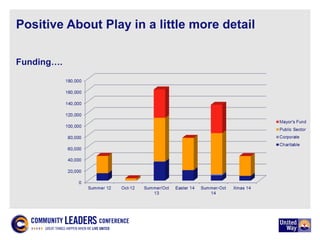
Funding….
Positive About Play in a little more detail
 Income coming from a variety of sources
 public, private, corporate
 Challenge to protect / fund the ‘core’
infrastructure activity
Strategy and development – developing Play
in your community
Small group exercise
•From what you’ve heard, is there a role for a Play Partnership in
your community?
•4 Qs:
1. What are the challenges in your community facing children,
young people and their families?
2. What does your United Way do now?
3. What other groups or organisations support children and
young people in your community?
4. What resources (time, money, expertise) would you need to
establish a play partnership?
Question time?
More information
Tony Okotie
Chief Executive
Email: tony.okotie@lcvs.org.uk
Colin Heaney
Policy, Partnerships and
Programmes Manager
Email: colin.heaney@lcvs.org.uk
Liverpool Charity and Voluntary Services (LCVS)
Web: www.lcvs.org.uk Twitter: @lcvsuw
Using Play as a Platform for every child to succeed

Using Play as a Platform for every child to succeed

  • 1.
    April 29 -May 1, 2015 Using Play as a Platform to Give Every Child the Chance to Succeed
  • 2.
    Agenda • Introductions • whowe are and why we do what we do • Positive About Play fly –by • What play means to you • Play theory • looking at the science behind play • Positive About Play in a little more detail • the challenges • Strategy and development
  • 3.
    Introductions: about Liverpool •City 800 years old • Huge heritage as ‘second city of the British Empire’, The Beatles and Football….but so much more! • Population of 460,000 in the city • 2.2 million in wider metro area (Merseyside) • Population in the city declined consistently from 850,000 in 1930s • …… until last 10 years (up 5%) • City of huge contrasts….and inequality
  • 4.
    Introductions: Liverpool andInequality Levels of deprivation and child poverty in Liverpool are extremely high: •Liverpool is the most deprived local authority area nationally. •Just over a third of Liverpool children (34.4%) live in poverty and in some areas of the city three fifths of children live in poverty. •In some schools in the city 73% of children are eligible for Free School Meals. •More than a third of Liverpool wards have unemployment rates that are twice the national average and Liverpool's incapacity rate is nearly twice the national rate. •Liverpool has a larger proportion of the working age population with no qualifications than nationally.
  • 5.
    Introductions: about LCVS •LCVS established in 1909 to “help charities co-ordinate their efforts” • At the forefront of social action in Liverpool, and nationally, for over a century • Diverse range of services and activities with an underpinning, clear, aim: • Together – for Liverpool – for Good
  • 6.
    Slide Example WithMedium Photo
  • 7.
    Positive About Play– What exactly is a playscheme? • Play schemes provide vital out of school provision for children in safe, group environments. • Play schemes vary in their shape and size, in where they take place and who runs them, but every play scheme has, at its heart, the commitment to proving children with the chance to play, explore and learn together (with adult support when it’s needed).
  • 8.
    Positive about Play‘fly-by’ • In the 1980’s Liverpool had over 200 playschemes • Cuts to budgets gradually reduced this figure to less than 30 in 2011 • Local groups and families were telling us that more provision was needed for out of school activities • At the same time, foodbanks were on the rise as families found it hard to get by • So what to do….?
  • 9.
    Positive About Play‘fly-by’ • We convened local partners involved in children’s play including the Local Authority • We invested some of our own grant funds and encouraged partners to do the same in a ‘pooled’ budget’ • In 2012 we raised the number of playschemes to 46 • We also teamed up with Fareshare who redistributes surplus food to charities and community organisations • By 2014 we were running over 70 playschemes and attracted support from Public Health and other funders and donors • Our aim is to break the 100 playscheme barrier in 2015
  • 10.
    What play meansto you – group exercise Think about a positive play experience from your childhood, something you remember fondly. •It doesn’t have to be a life-changing moment, just something you enjoyed doing. •Have a chat with your neighbours and make a list of the activities. Follow this up with another list, looking at the activity, and write down what type of play took place; for example it may have been: •something you did on your own (like sorting bubblegum cards or collecting something) •it may have been physical and social (climbing a tree with friends). You get the idea…
  • 11.
    Play theory –looking at the science behind play Plenty of evidence to support the fact that play is essential to our development e.g. • Sutton-Smith, in his book In The Ambiguity of Play, refers to Huttenlocher’s work on brain imaging. This suggests that “children under the age of 10 have at least twice the potential brain capacity of children over 10”. • Sutton-Smith suggests that this ‘over-capacity’ can be exploited if children are exposed to a range of experiences through play. Other research exists that backs up this theory that stimulus through play actually modifies the brain and increases the child’s capacity for learning for life.
  • 12.
    Play theory –looking at the science behind play Play is vital to children’s social development. The Play Return by the Children’s Play Policy Forum (2014) found that Play initiatives lead to improvements in children’s health and well-being, and are linked to a range of other cognitive and social developmental benefits. While the evidence is strongest for play in schools, it is reasonable to expect that they will also be seen in other similar contexts. Play enables children to do the following: • Respond to their peers’ feelings while waiting for their turn and sharing materials and experiences (Sapon-Shevin, Dobbelgere, Carrigan, Goodman, & Mastin, 1998; Wheeler, 2004). • Experiment with roles of the people in their home, school, and community by coming into contact with the needs and wishes of others ( Creasey, Jarvis, & Berk, 1998 )
  • 13.
    Positive About Playin a little more detail  Play Simply – children are kept safe and engaged in positive activities which contribute to their social and educational development  Play Healthy – children have access to healthy food and get fed when free school meals are not available to them  Play Advice - provides a dedicated advice helpline for families attending the play schemes 3 key elements:
  • 14.
    Positive About Playin a little more detail Challenges and moving forward: Partnership has grown organically – now need to formalise We now have a clear aspiration  16,236 children in Liverpool live in the most deprived areas and by 2020 we want them, and all children across the city, to have access to play activities 12 weeks of the year during all school holidays. We can quantify the cost  £760,000 pa / $1.1 million USD
  • 15.
    Positive About Playin a little more detail Funding….
  • 16.
    Positive About Playin a little more detail  Income coming from a variety of sources  public, private, corporate  Challenge to protect / fund the ‘core’ infrastructure activity
  • 17.
    Strategy and development– developing Play in your community Small group exercise •From what you’ve heard, is there a role for a Play Partnership in your community? •4 Qs: 1. What are the challenges in your community facing children, young people and their families? 2. What does your United Way do now? 3. What other groups or organisations support children and young people in your community? 4. What resources (time, money, expertise) would you need to establish a play partnership?
  • 18.
  • 19.
    More information Tony Okotie ChiefExecutive Email: tony.okotie@lcvs.org.uk Colin Heaney Policy, Partnerships and Programmes Manager Email: colin.heaney@lcvs.org.uk Liverpool Charity and Voluntary Services (LCVS) Web: www.lcvs.org.uk Twitter: @lcvsuw

Editor's Notes

  • #6 We are not a direct service delivery organisation! But we are proud to be part of the UW network – but also part of a family of similar organisations (CVS) across UK with a rich tradition of capacity building.
  • #9 Many schemes small, volunteer run
  • #14 Using play activities to engage with families so we can offer support such feeding the children and debt and housing advice to family members. Last summer, provided meals to over 2,400 in most depreived communities Why? Evidence shows children receiving free school meals suffer during the school holiday and many return to school after the summer weighing less due to lack of proper meals. Families are struggling with debt and need access to proper advice and support. Many of the families who are struggling are working families unable to get help elsewhere Provides positive learning experiences over the summer period Aim to grow -target every child in deprived neighbourhood in Liverpool (over 16,000)to be able to access playscheme for all 12 weeks of school holidays – cost £760k pa. 16,236 children in Liverpool live in the most deprived areas and by 2020 we want them, and all children across the city, to have access to play activities 12 weeks of the year during all school holidays. 3 elements – relevant to capacity building is Play Simply We don’t deliver schemes ourselves – we work with, and through, 70 small play schemes. Play Simply undertakes workforce development: Training for volunteer play leaders / paid staff
  • #15 Using play activities to engage with families so we can offer support such feeding the children and debt and housing advice to family members. Last summer, provided meals to over 2,400 in most depreived communities Why? Evidence shows children receiving free school meals suffer during the school holiday and many return to school after the summer weighing less due to lack of proper meals. Families are struggling with debt and need access to proper advice and support. Many of the families who are struggling are working families unable to get help elsewhere Provides positive learning experiences over the summer period Aim to grow -target every child in deprived neighbourhood in Liverpool (over 16,000)to be able to access playscheme for all 12 weeks of school holidays – cost £760k pa. 16,236 children in Liverpool live in the most deprived areas and by 2020 we want them, and all children across the city, to have access to play activities 12 weeks of the year during all school holidays.
  • #16 Last summer, provided meals to over 2,400 in most depreived communities Why? Evidence shows children receiving free school meals suffer during the school holiday and many return to school after the summer weighing less due to lack of proper meals. Families are struggling with debt and need access to proper advice and support. Many of the families who are struggling are working families unable to get help elsewhere Provides positive learning experiences over the summer period Aim to grow -target every child in deprived neighbourhood in Liverpool (over 16,000)to be able to access playscheme for all 12 weeks of school holidays – cost £760k pa. 16,236 children in Liverpool live in the most deprived areas and by 2020 we want them, and all children across the city, to have access to play activities 12 weeks of the year during all school holidays.
  • #17 Using play activities to engage with families so we can offer support such feeding the children and debt and housing advice to family members. Last summer, provided meals to over 2,400 in most depreived communities Why? Evidence shows children receiving free school meals suffer during the school holiday and many return to school after the summer weighing less due to lack of proper meals. Families are struggling with debt and need access to proper advice and support. Many of the families who are struggling are working families unable to get help elsewhere Provides positive learning experiences over the summer period Aim to grow -target every child in deprived neighbourhood in Liverpool (over 16,000)to be able to access playscheme for all 12 weeks of school holidays – cost £760k pa. 16,236 children in Liverpool live in the most deprived areas and by 2020 we want them, and all children across the city, to have access to play activities 12 weeks of the year during all school holidays.