LCVS Strategic framework – our 
roadmap for the next 5 years 
November 2014 
Summary version – draft for consultation
Introduction 
• We operate in an environment of substantial societal change, and 
where the pace of that change is increasing vastly. At the same 
time, there remains huge need, poverty and inequality in the city. 
• Therefore, against this backdrop there is a need for us to consider 
our role and how we go about delivering it: to ensure that we 
continue to be relevant, respected and add value – for LCVS to be 
‘great’ again. 
• Our strategic framework is designed to provide us with a roadmap 
for the next 3 to 5 years (towards the general election in 2020). This 
document sets out the context that LCVS is operating in, our high 
level ambition and key programmes of work over the next 5 years. 
2
Developing our strategic framework 
• To inform the development of this strategic framework for LCVS, we have 
undertaken a number of activities, including: 
– Understanding our stakeholders views, needs and aspiration, through: 
– 150+ 1-2-1 meetings with partners and stakeholders since January 
2014 
– A formal Stakeholder survey (summer 2014), which received over 170 
responses 
– Survey of Welfare Organisations Committee (WOC) members and 
follow up development activity 
– An extensive programme of ‘round table’ stakeholder / community 
conversations in September 2014– in total we spoke with over 100 key 
stakeholders 
– Engagement programme with LCVS staff 
– Commissioning a small series of thought pieces on key subject areas 
– Strategy development sessions with LCVS board members 
– Use of recognized business planning tools - SWOT analysis; PEST; 
GOOD 
3
Making sense of it all 
• A key message from our engagement activity over the last few months, 
with both external stakeholders and staff, was that we need to provide 
greater clarity about our purpose – about why we exist and what we are 
trying to change. 
• Secondly, the vast majority of our stakeholders are not aware of the 
extent of the work we undertake – they tended to see LCVS from a 
narrow perspective in terms of the services that they received. 
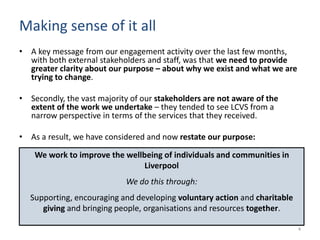
• As a result, we have considered and now restate our purpose: 
We work to improve the wellbeing of individuals and communities in 
Liverpool 
We do this through: 
Supporting, encouraging and developing voluntary action and charitable 
giving and bringing people, organisations and resources together. 
4
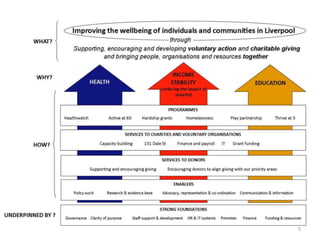
Where I think we’re going 
Diagram 
5
Our priorities: Education, Health, Income 
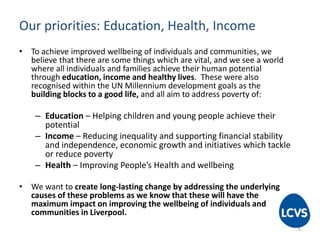
• To achieve improved wellbeing of individuals and communities, we 
believe that there are some things which are vital, and we see a world 
where all individuals and families achieve their human potential 
through education, income and healthy lives. These were also 
recognised within the UN Millennium development goals as the 
building blocks to a good life, and all aim to address poverty of: 
– Education – Helping children and young people achieve their 
potential 
– Income – Reducing inequality and supporting financial stability 
and independence, economic growth and initiatives which tackle 
or reduce poverty 
– Health – Improving People’s Health and wellbeing 
• We want to create long-lasting change by addressing the underlying 
causes of these problems as we know that these will have the 
maximum impact on improving the wellbeing of individuals and 
communities in Liverpool. 
6
Our priorities: Education, Health, Income 
• Whilst we have used the shorthand of ‘income’, we recognize that 
this encompasses a wider sphere of work – work towards financial 
resilience / access to opportunities / reducing barriers to 
employment / increasing aspirations to help achieve (economic) 
potential / promoting and encouraging the living wage. 
• We believe that supporting, encouraging and developing voluntary 
action and charitable giving and bringing people, organisations and 
resources together will help us achieve this. All of our activities, 
combined and individually, seek to create positive community 
impact – whether that be through our programmes, supporting and 
encouraging voluntary action or charitable giving, and through our 
enabling activities. 
7
Cross cutting themes 
Working together 
• LCVS believes that collaboration between organisations is important. 
We will help other organisations to collaborate, and apply a clear set 
of rules or tests which we can apply in considering which 
collaborations to pursue or when approached by other organisations 
to collaborate formally. 
Thought leadership and our role as a place shaper 
• A consistent theme in developing this strategic framework was 
disappointment that we have been less visible, and provided less 
‘leadership’, views and representation in the last 3-5 years than 
previously - a crucial time for the city and VCS organisations given the 
reductions in funding, and changes in national policy. Put simply, we 
are seen as having ‘withdrawn’ (both by public and VCS organisations) 
and been passive in presenting our views and the views of the sector. 
• Feedback has also indicated that this is a legitimate role for LCVS, and 
part of our role as a ‘place shaper’ – more than simply providing a 
range of ‘transactional’ services to individual organisations. 
• It is part of our uniqueness and a key attribute of a successful VCS 
infrastructure organisation. 8
Our programmes 
• LCVS has never been an organisation that directly delivers 
‘frontline’ services – instead, we generally support, empower, work 
with and through (and in some cases fund) other not for profit 
organisations. 
In developing this strategic framework, we have reviewed our position 
and reaffirm our stance: 
that LCVS will not seek to become an organisation that delivers 
frontline services. 
• However, there are times when we will take a lead in bringing 
together partnerships to meet an identified need or to help 
change the conditions that create the need in the first 
instance. 
9
Our programmes 
• We already work with partners and co-ordinate a small number of key 
programmes that work in the 3 pillars of health – education – income 
stability. 
• These programmes have had significant impact in the last three years, and 
demonstrate the positive impact of our collaborative approach 
• Going forward, our programmes will always work within the three pillars 
but will, over time, change according to our assessment of priorities and 
where we can make most difference. 
During the lifetime of this strategic framework we will seek out and consider 
how we can grow our programmes, particularly focusing on interventions 
that disrupt the cycle of poverty. In doing so, we will work with a range of 
delivery partners. 
10
Supporting and encouraging charitable giving 
• LCVS has a rich heritage of supporting philanthropic and charitable 
activities in Liverpool since 1909, before there was any significant form of 
state funding of charities and voluntary sector organisations. 
• Currently, we help donors spend £4m per year – of which approximately 
25% stays in the city and the wider Merseyside area. 
• We know that people want to give locally, and increasingly want to see the 
positive impact from their giving. 
• We believe that this continues to be a legitimate area of work for LCVS, 
and that we have an important role to play to help people give locally. 
11 
To support this, we will: 
• Consider the development of a separate ‘giving’ brand, to raise 
awareness and make it easier for people to give locally. 
• Increase our work in demonstrating local need and provide solutions 
(such as Positive about Play) where people can invest.
Services to charities & voluntary organisations 
• We provide a range of services that help voluntary organisations (and 
those that work in them, in either a paid or voluntary capacity) to 
start, grow, develop and thrive. 
• These services include: 
– Capacity building – a range of development services, delivered 
through group training, facilitation and 1-2-1, with voluntary and 
community groups in the city. 
– Community accountancy and payroll– financial management, 
independent examination of accounts and payroll administration 
for charities and social enterprises 
– 151 Dale Street – our building provides office space and 
conference facilities to other charities and social enterprises 
locally. 
– IT and telephony – to building tenants 
12
Services to charities & voluntary organisations 
Capacity building 
• In our stakeholder survey, where over three quarters of respondents had use the 
service, 84% of respondents ranked the quality of the service as excellent (61%) or 
good (23%). This area of our work has a tangible impact, and we believe that it 
should remain a core part of our offer going forward. 
13 
• Going forward, our service needs to be more forward looking, advising and helping 
organisations adjust to a changing future landscape and new issues and needs. For example: 
• We will widen the range of funding support we offer, to include trading, fundraising, 
contracts and social finance. 
• We will increase the support we offer to organisations to collaborate, both thematically 
and geographically. This may include, where the sector agrees, LCVS developing and 
leading supply chains and consortia arrangements. 
• We will consider ways to differentiate our costs, based on ability of organisations to pay, and 
continue to seek public sector (and potentially private sector / individual) investment to 
support our work with organsiations least able to pay themselves. 
• To enable us to focus our time on those organisations who most need our support, we will 
develop a ‘self-service’ offer, enabling organisatons to access a range of simple advice 
digitally.
Services to charities & voluntary organisations 
151 Dale Street – the home to Liverpool’s charities and voluntary organisations 
• LCVS purchased 151 Dale Street in 2008, and completely refurbished the building. 
It is now a vibrant hub for a wide range of voluntary community and social 
enterprise organisations, and a very visible ‘symbol’ of LCVS and the wider sector. 
• We will continue to ensure that the building provides good quality office space, 
and conferencing facilities, and we will consider ways in which we can maximise 
our experience of being ‘a landlord’ in other settings. 
Community accountancy and payroll adminstration 
• LCVSs community accountancy service was reestablished in 2004, and initially 
funded through Big Lottery BASIS. It provides a range of services to small voluntary 
and community organisations and social enterprises 
• Our strategy is to increase the range of services provided and client numbers, as 
well as building on increased responsiveness. To date we have not undertaken any 
proactive publicity of this area of work, and doing so from 15/16 onwards will be a 
key step in increasing the portfolio of clients and income. 
14
Voluntary sector infrastructure ‘enablers’ to help thriving 
communities 
• There are a range of activities – we’ve called them enablers – which are vital to support 
our role in improving the wellbeing of individuals and communities in Liverpool through 
supporting, encouraging and developing voluntary action and charitable giving and 
bringing people, organisations and resources together. Examples of these enablers 
include providing networking opportunities and bringing people together to address 
problems; developing an evidence and research base and providing a policy function so 
we know where to put our efforts and we can encourage others. 
Our strategy, based on the evidence above, clearly recognises the importance of getting the 
‘enablers’ right. In summary: 
• Networking and facilitating networks should be a central part, but delivered in a more 
flexible way, based on demand. We should focus on bringing people together, across sectors 
and within the voluntary sector, where there is ‘common purpose’ – our vital role as a 
convenor. In some cases this may lead to formal partnerships, and where appropriate LCVS 
could be the ‘supply chain manager’ 
• We need to deploy online tools / provide feedback etc to enable groups to feel connected 
even if they are unable to attend meetings 
• We should provide a policy function, to enable VCS organisations to understand public policy 
issues and help shape them, and should provide produce regular thought pieces, 
• We have an important role to play in helping and supporting representation from the sector 
• This has to be underpinned by a stronger research and evidence base, which itself informs 
and drives both our support to encouraging giving and the programmes we get involved in 
developing and delivering 
15
Solid and strong foundations 
• Finally, to be effective, we need to be a strong, healthy 
organisation ourselves – and so we can’t forget to focus 
on strong foundations, ensuring we are fit for purpose 
going forward. 
• Our focus on strong foundations will include a number of 
areas, for example: 
Clarity of purpose 
• Ensuring that we are clear about our role, and how the 
activities that we deliver support this. 
• The development of this new strategic framework, and 
the operational plan that will sit alongside this, is a 
significant step in meeting this. 
16
Solid and strong foundations 
Governance 
• As a registered charity, we have a legal and moral 
responsibility to ensure that our affairs are well 
governed. As a support / umbrella organization to other 
charities, often advising them on governance matters, 
and as the custodian and trustee of a large amount of 
funds on behalf of beneficiaries and settlors, this is even 
more important. 
• During the lifetime of this strategic framework, we will 
therefore continue to ensure focus and reflect on our 
own governance to ensure that it remains appropriate 
and robust. 
17
Solid and strong foundations 
Staff support and development 
• Our people are LCVS’ biggest asset. We know we 
need to build on this to create a positive culture 
across the organisation, and provide the correct 
support to bring to life the passion that our staff 
have for our work. 
Measuring and demonstrating impact 
• Ensuring we have robust tools to measure, 
demonstrate and communicate the positive 
difference our work makes. 
18
Finally….. 
• Thank you to everyone who helped to contribute so far 
to the development of our strategic framework – our 
roadmap. 
• This document is the short summary of the draft. 
• For LCVS to be valuable and valued, we need to have 
your help in getting it right. 
• So, we want to know what you think, before we finalise 
it. Tell us what we’ve got right, what we’ve got wrong, 
and what we’ve missed. Connect with us: 
– info@lcvs.org.uk 
– Tel: 0151 227 5177 
– Twitter.com/@lcvsuw 
19

LCVS Strategic framework - our roadmap for the next 5 years

  • 1.
    LCVS Strategic framework– our roadmap for the next 5 years November 2014 Summary version – draft for consultation
  • 2.
    Introduction • Weoperate in an environment of substantial societal change, and where the pace of that change is increasing vastly. At the same time, there remains huge need, poverty and inequality in the city. • Therefore, against this backdrop there is a need for us to consider our role and how we go about delivering it: to ensure that we continue to be relevant, respected and add value – for LCVS to be ‘great’ again. • Our strategic framework is designed to provide us with a roadmap for the next 3 to 5 years (towards the general election in 2020). This document sets out the context that LCVS is operating in, our high level ambition and key programmes of work over the next 5 years. 2
  • 3.
    Developing our strategicframework • To inform the development of this strategic framework for LCVS, we have undertaken a number of activities, including: – Understanding our stakeholders views, needs and aspiration, through: – 150+ 1-2-1 meetings with partners and stakeholders since January 2014 – A formal Stakeholder survey (summer 2014), which received over 170 responses – Survey of Welfare Organisations Committee (WOC) members and follow up development activity – An extensive programme of ‘round table’ stakeholder / community conversations in September 2014– in total we spoke with over 100 key stakeholders – Engagement programme with LCVS staff – Commissioning a small series of thought pieces on key subject areas – Strategy development sessions with LCVS board members – Use of recognized business planning tools - SWOT analysis; PEST; GOOD 3
  • 4.
    Making sense ofit all • A key message from our engagement activity over the last few months, with both external stakeholders and staff, was that we need to provide greater clarity about our purpose – about why we exist and what we are trying to change. • Secondly, the vast majority of our stakeholders are not aware of the extent of the work we undertake – they tended to see LCVS from a narrow perspective in terms of the services that they received. • As a result, we have considered and now restate our purpose: We work to improve the wellbeing of individuals and communities in Liverpool We do this through: Supporting, encouraging and developing voluntary action and charitable giving and bringing people, organisations and resources together. 4
  • 5.
    Where I thinkwe’re going Diagram 5
  • 6.
    Our priorities: Education,Health, Income • To achieve improved wellbeing of individuals and communities, we believe that there are some things which are vital, and we see a world where all individuals and families achieve their human potential through education, income and healthy lives. These were also recognised within the UN Millennium development goals as the building blocks to a good life, and all aim to address poverty of: – Education – Helping children and young people achieve their potential – Income – Reducing inequality and supporting financial stability and independence, economic growth and initiatives which tackle or reduce poverty – Health – Improving People’s Health and wellbeing • We want to create long-lasting change by addressing the underlying causes of these problems as we know that these will have the maximum impact on improving the wellbeing of individuals and communities in Liverpool. 6
  • 7.
    Our priorities: Education,Health, Income • Whilst we have used the shorthand of ‘income’, we recognize that this encompasses a wider sphere of work – work towards financial resilience / access to opportunities / reducing barriers to employment / increasing aspirations to help achieve (economic) potential / promoting and encouraging the living wage. • We believe that supporting, encouraging and developing voluntary action and charitable giving and bringing people, organisations and resources together will help us achieve this. All of our activities, combined and individually, seek to create positive community impact – whether that be through our programmes, supporting and encouraging voluntary action or charitable giving, and through our enabling activities. 7
  • 8.
    Cross cutting themes Working together • LCVS believes that collaboration between organisations is important. We will help other organisations to collaborate, and apply a clear set of rules or tests which we can apply in considering which collaborations to pursue or when approached by other organisations to collaborate formally. Thought leadership and our role as a place shaper • A consistent theme in developing this strategic framework was disappointment that we have been less visible, and provided less ‘leadership’, views and representation in the last 3-5 years than previously - a crucial time for the city and VCS organisations given the reductions in funding, and changes in national policy. Put simply, we are seen as having ‘withdrawn’ (both by public and VCS organisations) and been passive in presenting our views and the views of the sector. • Feedback has also indicated that this is a legitimate role for LCVS, and part of our role as a ‘place shaper’ – more than simply providing a range of ‘transactional’ services to individual organisations. • It is part of our uniqueness and a key attribute of a successful VCS infrastructure organisation. 8
  • 9.
    Our programmes •LCVS has never been an organisation that directly delivers ‘frontline’ services – instead, we generally support, empower, work with and through (and in some cases fund) other not for profit organisations. In developing this strategic framework, we have reviewed our position and reaffirm our stance: that LCVS will not seek to become an organisation that delivers frontline services. • However, there are times when we will take a lead in bringing together partnerships to meet an identified need or to help change the conditions that create the need in the first instance. 9
  • 10.
    Our programmes •We already work with partners and co-ordinate a small number of key programmes that work in the 3 pillars of health – education – income stability. • These programmes have had significant impact in the last three years, and demonstrate the positive impact of our collaborative approach • Going forward, our programmes will always work within the three pillars but will, over time, change according to our assessment of priorities and where we can make most difference. During the lifetime of this strategic framework we will seek out and consider how we can grow our programmes, particularly focusing on interventions that disrupt the cycle of poverty. In doing so, we will work with a range of delivery partners. 10
  • 11.
    Supporting and encouragingcharitable giving • LCVS has a rich heritage of supporting philanthropic and charitable activities in Liverpool since 1909, before there was any significant form of state funding of charities and voluntary sector organisations. • Currently, we help donors spend £4m per year – of which approximately 25% stays in the city and the wider Merseyside area. • We know that people want to give locally, and increasingly want to see the positive impact from their giving. • We believe that this continues to be a legitimate area of work for LCVS, and that we have an important role to play to help people give locally. 11 To support this, we will: • Consider the development of a separate ‘giving’ brand, to raise awareness and make it easier for people to give locally. • Increase our work in demonstrating local need and provide solutions (such as Positive about Play) where people can invest.
  • 12.
    Services to charities& voluntary organisations • We provide a range of services that help voluntary organisations (and those that work in them, in either a paid or voluntary capacity) to start, grow, develop and thrive. • These services include: – Capacity building – a range of development services, delivered through group training, facilitation and 1-2-1, with voluntary and community groups in the city. – Community accountancy and payroll– financial management, independent examination of accounts and payroll administration for charities and social enterprises – 151 Dale Street – our building provides office space and conference facilities to other charities and social enterprises locally. – IT and telephony – to building tenants 12
  • 13.
    Services to charities& voluntary organisations Capacity building • In our stakeholder survey, where over three quarters of respondents had use the service, 84% of respondents ranked the quality of the service as excellent (61%) or good (23%). This area of our work has a tangible impact, and we believe that it should remain a core part of our offer going forward. 13 • Going forward, our service needs to be more forward looking, advising and helping organisations adjust to a changing future landscape and new issues and needs. For example: • We will widen the range of funding support we offer, to include trading, fundraising, contracts and social finance. • We will increase the support we offer to organisations to collaborate, both thematically and geographically. This may include, where the sector agrees, LCVS developing and leading supply chains and consortia arrangements. • We will consider ways to differentiate our costs, based on ability of organisations to pay, and continue to seek public sector (and potentially private sector / individual) investment to support our work with organsiations least able to pay themselves. • To enable us to focus our time on those organisations who most need our support, we will develop a ‘self-service’ offer, enabling organisatons to access a range of simple advice digitally.
  • 14.
    Services to charities& voluntary organisations 151 Dale Street – the home to Liverpool’s charities and voluntary organisations • LCVS purchased 151 Dale Street in 2008, and completely refurbished the building. It is now a vibrant hub for a wide range of voluntary community and social enterprise organisations, and a very visible ‘symbol’ of LCVS and the wider sector. • We will continue to ensure that the building provides good quality office space, and conferencing facilities, and we will consider ways in which we can maximise our experience of being ‘a landlord’ in other settings. Community accountancy and payroll adminstration • LCVSs community accountancy service was reestablished in 2004, and initially funded through Big Lottery BASIS. It provides a range of services to small voluntary and community organisations and social enterprises • Our strategy is to increase the range of services provided and client numbers, as well as building on increased responsiveness. To date we have not undertaken any proactive publicity of this area of work, and doing so from 15/16 onwards will be a key step in increasing the portfolio of clients and income. 14
  • 15.
    Voluntary sector infrastructure‘enablers’ to help thriving communities • There are a range of activities – we’ve called them enablers – which are vital to support our role in improving the wellbeing of individuals and communities in Liverpool through supporting, encouraging and developing voluntary action and charitable giving and bringing people, organisations and resources together. Examples of these enablers include providing networking opportunities and bringing people together to address problems; developing an evidence and research base and providing a policy function so we know where to put our efforts and we can encourage others. Our strategy, based on the evidence above, clearly recognises the importance of getting the ‘enablers’ right. In summary: • Networking and facilitating networks should be a central part, but delivered in a more flexible way, based on demand. We should focus on bringing people together, across sectors and within the voluntary sector, where there is ‘common purpose’ – our vital role as a convenor. In some cases this may lead to formal partnerships, and where appropriate LCVS could be the ‘supply chain manager’ • We need to deploy online tools / provide feedback etc to enable groups to feel connected even if they are unable to attend meetings • We should provide a policy function, to enable VCS organisations to understand public policy issues and help shape them, and should provide produce regular thought pieces, • We have an important role to play in helping and supporting representation from the sector • This has to be underpinned by a stronger research and evidence base, which itself informs and drives both our support to encouraging giving and the programmes we get involved in developing and delivering 15
  • 16.
    Solid and strongfoundations • Finally, to be effective, we need to be a strong, healthy organisation ourselves – and so we can’t forget to focus on strong foundations, ensuring we are fit for purpose going forward. • Our focus on strong foundations will include a number of areas, for example: Clarity of purpose • Ensuring that we are clear about our role, and how the activities that we deliver support this. • The development of this new strategic framework, and the operational plan that will sit alongside this, is a significant step in meeting this. 16
  • 17.
    Solid and strongfoundations Governance • As a registered charity, we have a legal and moral responsibility to ensure that our affairs are well governed. As a support / umbrella organization to other charities, often advising them on governance matters, and as the custodian and trustee of a large amount of funds on behalf of beneficiaries and settlors, this is even more important. • During the lifetime of this strategic framework, we will therefore continue to ensure focus and reflect on our own governance to ensure that it remains appropriate and robust. 17
  • 18.
    Solid and strongfoundations Staff support and development • Our people are LCVS’ biggest asset. We know we need to build on this to create a positive culture across the organisation, and provide the correct support to bring to life the passion that our staff have for our work. Measuring and demonstrating impact • Ensuring we have robust tools to measure, demonstrate and communicate the positive difference our work makes. 18
  • 19.
    Finally….. • Thankyou to everyone who helped to contribute so far to the development of our strategic framework – our roadmap. • This document is the short summary of the draft. • For LCVS to be valuable and valued, we need to have your help in getting it right. • So, we want to know what you think, before we finalise it. Tell us what we’ve got right, what we’ve got wrong, and what we’ve missed. Connect with us: – info@lcvs.org.uk – Tel: 0151 227 5177 – Twitter.com/@lcvsuw 19

Editor's Notes