Using Drones for
Business
A New Era In Civil Aviation
MEHDI HAMEDANI
“For once you have tasted flight you will walk the
earth with your eyes turned skywards, for there you
have been and there you will long to return.”
Leonardo da Vinci
1452 – 1519
Terminology and History
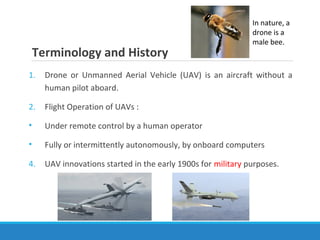
1. Drone or Unmanned Aerial Vehicle (UAV) is an aircraft without a
human pilot aboard.
2. Flight Operation of UAVs :
• Under remote control by a human operator
• Fully or intermittently autonomously, by onboard computers
4. UAV innovations started in the early 1900s for military purposes.
In nature, a
drone is a
male bee.
Classification
Functional classification:
1.Military (defensive)
2.Civil and commercial UAVs
3.Logistics and delivering cargo
4.Research and development
5.Recreational / Non-commercial
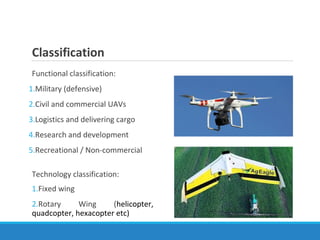
Technology classification:
1.Fixed wing
2.Rotary Wing (helicopter,
quadcopter, hexacopter etc)
Anatomy of Commercial Drones
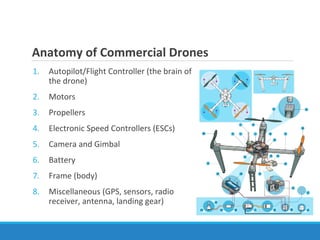
1. Autopilot/Flight Controller (the brain of
the drone)
2. Motors
3. Propellers
4. Electronic Speed Controllers (ESCs)
5. Camera and Gimbal
6. Battery
7. Frame (body)
8. Miscellaneous (GPS, sensors, radio
receiver, antenna, landing gear)
Main Applications of Civil and Commercial
UAVs
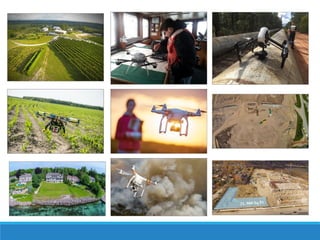
 Aerial crop surveys (agriculture)
 Aerial photography and video
 Land surveying and landslide measurement
 Inspecting and monitoring
 Search and rescue
 Counting wildlife
 Delivering medical supplies to inaccessible
regions
 Police patrol missions
 Fire and large-accident investigation
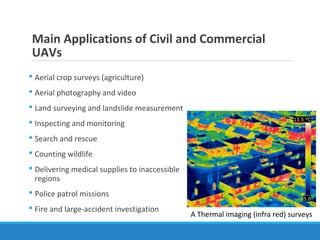
A Thermal imaging (infra red) surveys
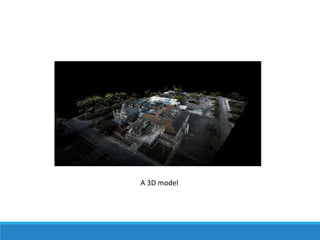
A 3D model
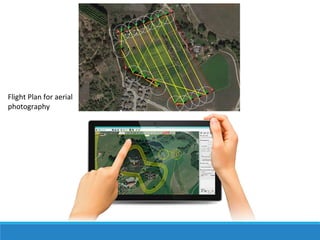
Flight Plan for aerial
photography
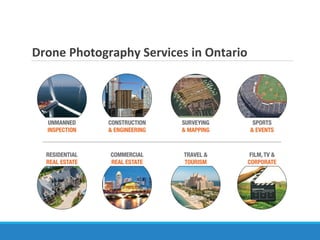
Drone Photography Services in Ontario
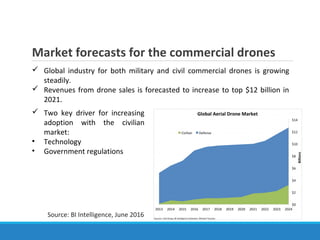
Market forecasts for the commercial drones
 Global industry for both military and civil commercial drones is growing
steadily.
 Revenues from drone sales is forecasted to increase to top $12 billion in
2021.
Source: BI Intelligence, June 2016
 Two key driver for increasing
adoption with the civilian
market:
• Technology
• Government regulations
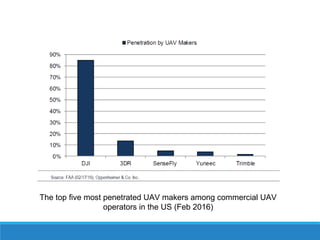
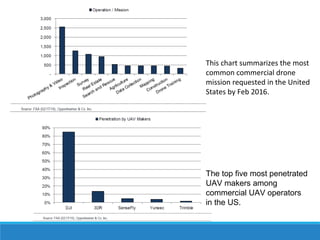
The top five most penetrated UAV makers among commercial UAV
operators in the US (Feb 2016)
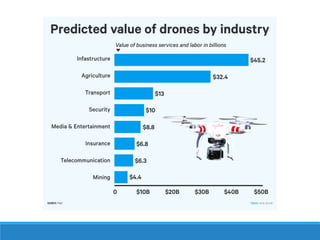
This chart summarizes the most
common commercial drone
mission requested in the United
States by Feb 2016.
The top five most penetrated
UAV makers among
commercial UAV operators
in the US.
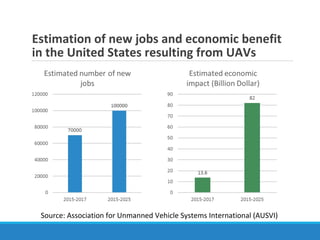
Estimation of new jobs and economic benefit
in the United States resulting from UAVs
Source: Association for Unmanned Vehicle Systems International (AUSVI)
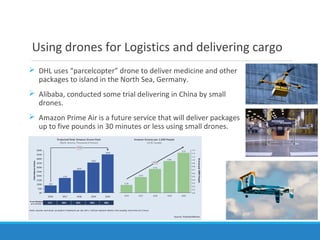
Using drones for Logistics and delivering cargo
 DHL uses “parcelcopter” drone to deliver medicine and other
packages to island in the North Sea, Germany.
 Alibaba, conducted some trial delivering in China by small
drones.
 Amazon Prime Air is a future service that will deliver packages
up to five pounds in 30 minutes or less using small drones.
Regulations
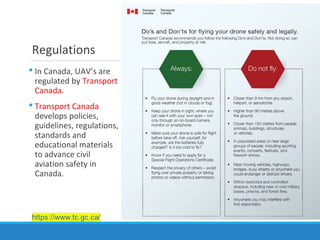
 In Canada, UAV’s are
regulated by Transport
Canada.

 Transport Canada
develops policies,
guidelines, regulations,
standards and
educational materials
to advance civil
aviation safety in
Canada.
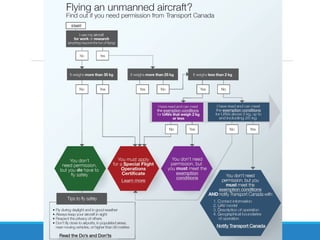
 According to Canadian Aviation
Regulations:
“No person shall operate an
unmanned air vehicle in flight
except in accordance with a
special flight operations
certificate or an air operator
certificate.”
 A typical SFOC is 9 pages long
and up to 70 conditions
19
Special Flight Operations Certificates (SFOC)
Using Drones for Business

Using Drones for Business

  • 1.
    Using Drones for Business ANew Era In Civil Aviation MEHDI HAMEDANI
  • 2.
    “For once youhave tasted flight you will walk the earth with your eyes turned skywards, for there you have been and there you will long to return.” Leonardo da Vinci 1452 – 1519
  • 3.
    Terminology and History 1.Drone or Unmanned Aerial Vehicle (UAV) is an aircraft without a human pilot aboard. 2. Flight Operation of UAVs : • Under remote control by a human operator • Fully or intermittently autonomously, by onboard computers 4. UAV innovations started in the early 1900s for military purposes. In nature, a drone is a male bee.
  • 4.
    Classification Functional classification: 1.Military (defensive) 2.Civiland commercial UAVs 3.Logistics and delivering cargo 4.Research and development 5.Recreational / Non-commercial Technology classification: 1.Fixed wing 2.Rotary Wing (helicopter, quadcopter, hexacopter etc)
  • 5.
    Anatomy of CommercialDrones 1. Autopilot/Flight Controller (the brain of the drone) 2. Motors 3. Propellers 4. Electronic Speed Controllers (ESCs) 5. Camera and Gimbal 6. Battery 7. Frame (body) 8. Miscellaneous (GPS, sensors, radio receiver, antenna, landing gear)
  • 6.
    Main Applications ofCivil and Commercial UAVs  Aerial crop surveys (agriculture)  Aerial photography and video  Land surveying and landslide measurement  Inspecting and monitoring  Search and rescue  Counting wildlife  Delivering medical supplies to inaccessible regions  Police patrol missions  Fire and large-accident investigation A Thermal imaging (infra red) surveys
  • 8.
  • 9.
    Flight Plan foraerial photography
  • 10.
  • 11.
    Market forecasts forthe commercial drones  Global industry for both military and civil commercial drones is growing steadily.  Revenues from drone sales is forecasted to increase to top $12 billion in 2021. Source: BI Intelligence, June 2016  Two key driver for increasing adoption with the civilian market: • Technology • Government regulations
  • 13.
    The top fivemost penetrated UAV makers among commercial UAV operators in the US (Feb 2016)
  • 14.
    This chart summarizesthe most common commercial drone mission requested in the United States by Feb 2016. The top five most penetrated UAV makers among commercial UAV operators in the US.
  • 15.
    Estimation of newjobs and economic benefit in the United States resulting from UAVs Source: Association for Unmanned Vehicle Systems International (AUSVI)
  • 17.
    Using drones forLogistics and delivering cargo  DHL uses “parcelcopter” drone to deliver medicine and other packages to island in the North Sea, Germany.  Alibaba, conducted some trial delivering in China by small drones.  Amazon Prime Air is a future service that will deliver packages up to five pounds in 30 minutes or less using small drones.
  • 18.
    Regulations  In Canada,UAV’s are regulated by Transport Canada.  Transport Canada develops policies, guidelines, regulations, standards and educational materials to advance civil aviation safety in Canada.
  • 19.
     According toCanadian Aviation Regulations: “No person shall operate an unmanned air vehicle in flight except in accordance with a special flight operations certificate or an air operator certificate.”  A typical SFOC is 9 pages long and up to 70 conditions 19 Special Flight Operations Certificates (SFOC)

Editor's Notes

  • #20 Applications are reviewed on a case-by-case basis, including Risk assessment and mitigation Also taken into account are: performances of the UAV, the nature and complexity of the operation as well as the operations location. Applicants are responsible for ensuring that the safety of persons and property on the ground and other airspace users is not jeopardized We dont charge for the SFOC a Standing SFOC - will provide greater flexibility (validity periods, locations and the ability to conduct short notice operations) to those that become professional operators Applicants must apply for certificates 20 working days before the proposed UAV operation, Transport Canada is not obliged to review an application or issue a SFOC within those 20 working days. A lot of jobs are date-specific and if each job requires a separate SFOC, then there is a possibility that a SFOC will not be issued in time.