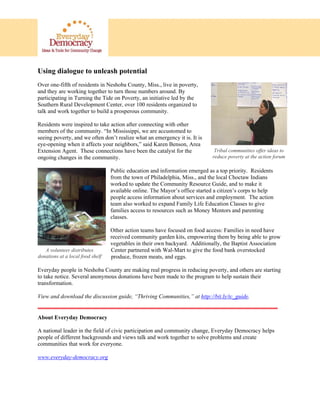
Tribal communities offer ideas to
reduce poverty at the action forum
A volunteer distributes
donations at a local food shelf
Using dialogue to unleash potential
Over one-fifth of residents in Neshoba County, Miss., live in poverty,
and they are working together to turn those numbers around. By
participating in Turning the Tide on Poverty, an initiative led by the
Southern Rural Development Center, over 100 residents organized to
talk and work together to build a prosperous community.
Residents were inspired to take action after connecting with other
members of the community. “In Mississippi, we are accustomed to
seeing poverty, and we often don’t realize what an emergency it is. It is
eye-opening when it affects your neighbors,” said Karen Benson, Area
Extension Agent. These connections have been the catalyst for the
ongoing changes in the community.
Public education and information emerged as a top priority. Residents
from the town of Philadelphia, Miss., and the local Choctaw Indians
worked to update the Community Resource Guide, and to make it
available online. The Mayor’s office started a citizen’s corps to help
people access information about services and employment. The action
team also worked to expand Family Life Education Classes to give
families access to resources such as Money Mentors and parenting
classes.
Other action teams have focused on food access: Families in need have
received community garden kits, empowering them by being able to grow
vegetables in their own backyard. Additionally, the Baptist Association
Center partnered with Wal-Mart to give the food bank overstocked
produce, frozen meats, and eggs.
Everyday people in Neshoba County are making real progress in reducing poverty, and others are starting
to take notice. Several anonymous donations have been made to the program to help sustain their
transformation.
View and download the discussion guide, “Thriving Communities,” at http://bit.ly/tc_guide.
About Everyday Democracy
A national leader in the field of civic participation and community change, Everyday Democracy helps
people of different backgrounds and views talk and work together to solve problems and create
communities that work for everyone.
www.everyday-democracy.org

Using Dialogue to Unleash Potential

  • 1.
    Tribal communities offerideas to reduce poverty at the action forum A volunteer distributes donations at a local food shelf Using dialogue to unleash potential Over one-fifth of residents in Neshoba County, Miss., live in poverty, and they are working together to turn those numbers around. By participating in Turning the Tide on Poverty, an initiative led by the Southern Rural Development Center, over 100 residents organized to talk and work together to build a prosperous community. Residents were inspired to take action after connecting with other members of the community. “In Mississippi, we are accustomed to seeing poverty, and we often don’t realize what an emergency it is. It is eye-opening when it affects your neighbors,” said Karen Benson, Area Extension Agent. These connections have been the catalyst for the ongoing changes in the community. Public education and information emerged as a top priority. Residents from the town of Philadelphia, Miss., and the local Choctaw Indians worked to update the Community Resource Guide, and to make it available online. The Mayor’s office started a citizen’s corps to help people access information about services and employment. The action team also worked to expand Family Life Education Classes to give families access to resources such as Money Mentors and parenting classes. Other action teams have focused on food access: Families in need have received community garden kits, empowering them by being able to grow vegetables in their own backyard. Additionally, the Baptist Association Center partnered with Wal-Mart to give the food bank overstocked produce, frozen meats, and eggs. Everyday people in Neshoba County are making real progress in reducing poverty, and others are starting to take notice. Several anonymous donations have been made to the program to help sustain their transformation. View and download the discussion guide, “Thriving Communities,” at http://bit.ly/tc_guide. About Everyday Democracy A national leader in the field of civic participation and community change, Everyday Democracy helps people of different backgrounds and views talk and work together to solve problems and create communities that work for everyone. www.everyday-democracy.org