AARP Livable Communities
Great Places for All Ages
Newport City — Vermont’s First
Designated Age-Friendly Community
2
“Affordable and appropriate housing, supportive
community services, and adequate mobility options,
which facilitate personal independence and the
engagement of residents in civic and social life.”
AARP Livable Communities Definition
Multiple benefits
• Cultural
• Economic
• Environmental
• Fiscal
• Health
• Social
Multiple beneficiaries
• People
• Business
• Community
Reasons for making communities more
Livable and Age-Friendly
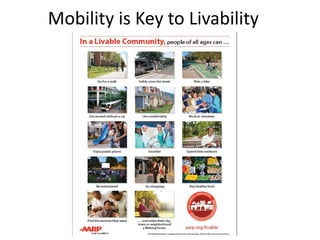
Mobility is Key to Livability
5
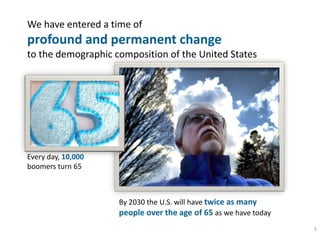
We have entered a time of
profound and permanent change
to the demographic composition of the United States
By 2030 the U.S. will have twice as many
people over the age of 65 as we have today
Every day, 10,000
boomers turn 65
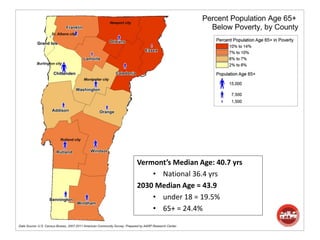
Vermont’s Median Age: 40.7 yrs
• National 36.4 yrs
2030 Median Age = 43.9
• under 18 = 19.5%
• 65+ = 24.4%
Source: U.S. National Center for Health Statistics, National Vital Statistics Reports (NVSR), Deaths:
Preliminary Data for 2008, Vol. 59, No. 2, December 9, 2010.
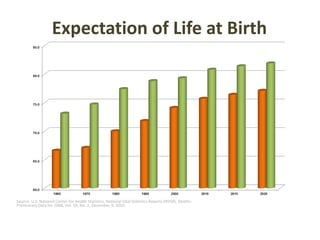
Expectation of Life at Birth
8
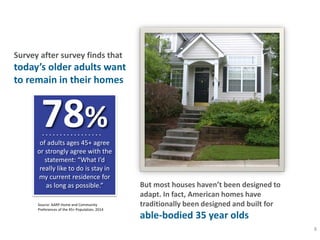
Survey after survey finds that
today’s older adults want
to remain in their homes
But most houses haven’t been designed to
adapt. In fact, American homes have
traditionally been designed and built for
able-bodied 35 year olds
78%
of adults ages 45+ agree
or strongly agree with the
statement: “What I’d
really like to do is stay in
my current residence for
as long as possible.”
Source: AARP Home and Community
Preferences of the 45+ Population, 2014
9
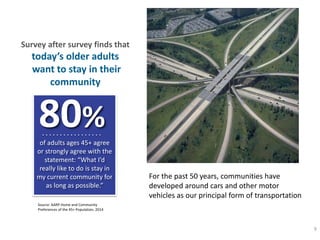
Survey after survey finds that
today’s older adults
want to stay in their
community
For the past 50 years, communities have
developed around cars and other motor
vehicles as our principal form of transportation
80%
of adults ages 45+ agree
or strongly agree with the
statement: “What I’d
really like to do is stay in
my current community for
as long as possible.”
Source: AARP Home and Community
Preferences of the 45+ Population, 2014
10
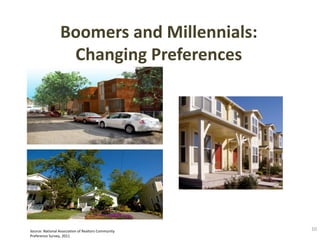
Boomers and Millennials:
Changing Preferences
Source: National Association of Realtors Community
Preference Survey, 2011
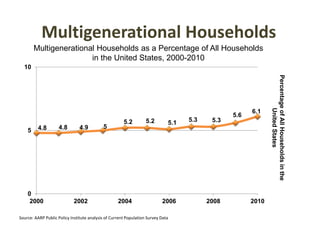
Multigenerational Households
Multigenerational Households as a Percentage of All Households
in the United States, 2000-2010
4.8 4.8 4.9 5
5.2 5.2 5.1 5.3 5.3
5.6
6.1
0
5
10
2000 2002 2004 2006 2008 2010
Source: AARP Public Policy Institute analysis of Current Population Survey Data
PercentageofAllHouseholdsinthe
UnitedStates
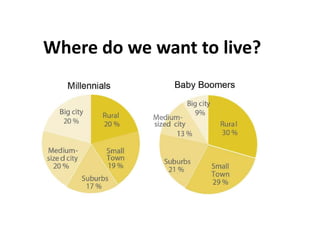
Where do we want to live?
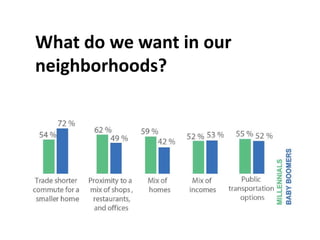
What do we want in our
neighborhoods?
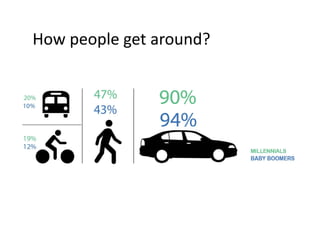
How people get around?
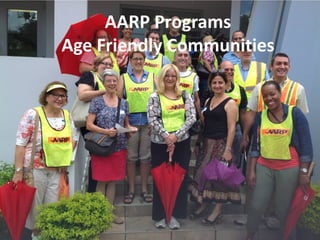
AARP Programs
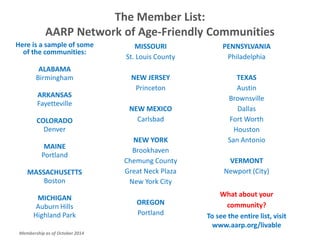
Age Friendly Communities
PENNSYLVANIA
Philadelphia
TEXAS
Austin
Brownsville
Dallas
Fort Worth
Houston
San Antonio
VERMONT
Newport (City)
What about your
community?
To see the entire list, visit
www.aarp.org/livable
Here is a sample of some
of the communities:
ALABAMA
Birmingham
ARKANSAS
Fayetteville
COLORADO
Denver
MAINE
Portland
MASSACHUSETTS
Boston
MICHIGAN
Auburn Hills
Highland Park
MISSOURI
St. Louis County
NEW JERSEY
Princeton
NEW MEXICO
Carlsbad
NEW YORK
Brookhaven
Chemung County
Great Neck Plaza
New York City
OREGON
Portland
Membership as of October 2014
The Member List:
AARP Network of Age-Friendly Communities
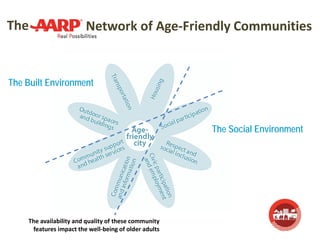
The Built Environment
The Social Environment
Network of Age-Friendly CommunitiesThe
The availability and quality of these community
features impact the well-being of older adults
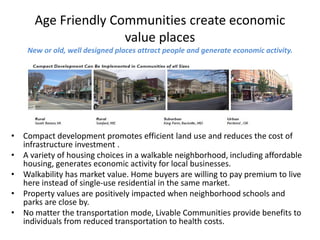
Age Friendly Communities create economic
value places
New or old, well designed places attract people and generate economic activity.
• Compact development promotes efficient land use and reduces the cost of
infrastructure investment .
• A variety of housing choices in a walkable neighborhood, including affordable
housing, generates economic activity for local businesses.
• Walkability has market value. Home buyers are willing to pay premium to live
here instead of single-use residential in the same market.
• Property values are positively impacted when neighborhood schools and
parks are close by.
• No matter the transportation mode, Livable Communities provide benefits to
individuals from reduced transportation to health costs.
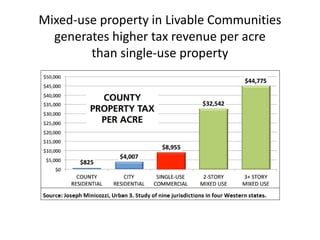
Mixed-use property in Livable Communities
generates higher tax revenue per acre
than single-use property
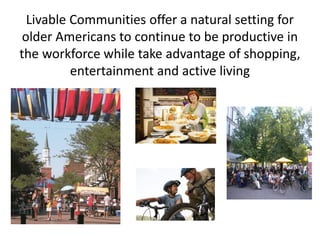
Livable Communities offer a natural setting for
older Americans to continue to be productive in
the workforce while take advantage of shopping,
entertainment and active living
Getting Newport Age Friendly
Turn over the rocks to collect the
dots…
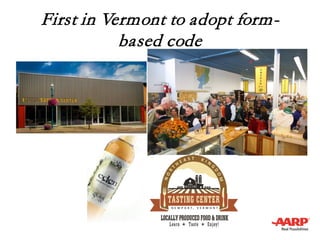
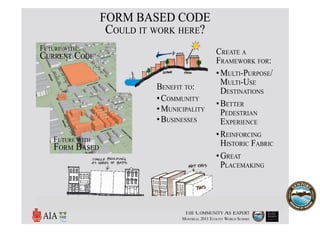
First in Vermont to adopt form-
based code
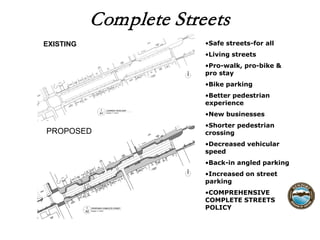
Complete Streets•Great placemaking!
•Safe streets-for all
•Living streets
•Pro-walk, pro-bike &
pro stay
•Bike parking
•Better pedestrian
experience
•New businesses
•Shorter pedestrian
crossing
•Decreased vehicular
speed
•Back-in angled parking
•Increased on street
parking
•COMPREHENSIVE
COMPLETE STREETS
POLICY
EXISTING
PROPOSED
Connect the dots …
Community Matters
Nourishing Relationships into Partnerships
http://video.vpt.org/video/2365167090/
Assets–based Approach
Community Development Integrated
into Economic Development
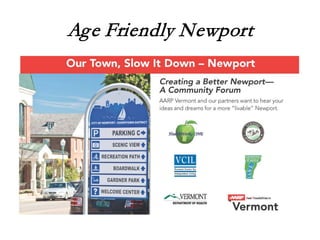
Age Friendly Newport
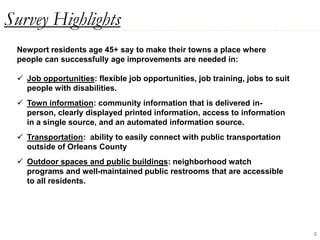
Survey Highlights
2
Newport residents age 45+ say to make their towns a place where
people can successfully age improvements are needed in:
 Job opportunities: flexible job opportunities, job training, jobs to suit
people with disabilities.
 Town information: community information that is delivered in-
person, clearly displayed printed information, access to information
in a single source, and an automated information source.
 Transportation: ability to easily connect with public transportation
outside of Orleans County
 Outdoor spaces and public buildings: neighborhood watch
programs and well-maintained public restrooms that are accessible
to all residents.
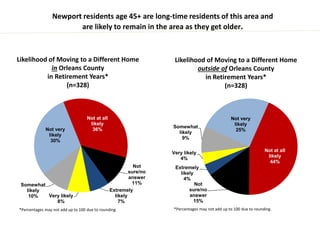
Newport residents age 45+ are long-time residents of this area and
are likely to remain in the area as they get older.
Likelihood of Moving to a Different Home
in Orleans County
in Retirement Years*
(n=328)
Likelihood of Moving to a Different Home
outside of Orleans County
in Retirement Years*
(n=328)
*Percentages may not add up to 100 due to rounding.
4
Extremely
likely
7%
Very likely
8%
Somewhat
likely
10%
Not very
likely
30%
Not at all
likely
36%
Not
sure/no
answer
11%
Extremely
likely
4%
Very likely
4%
Somewhat
likely
9%
Not very
likely
25%
Not at all
likely
44%
Not
sure/no
answer
15%
*Percentages may not add up to 100 due to rounding.
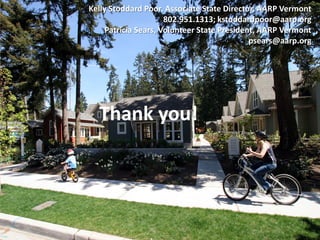
Thank you!
Kelly Stoddard Poor, Associate State Director, AARP Vermont
802.951.1313; kstoddardpoor@aarp.org
Patricia Sears, Volunteer State President, AARP Vermont
psears@aarp.org

AARPVT_Livable communities_May2015

  • 1.
    AARP Livable Communities GreatPlaces for All Ages Newport City — Vermont’s First Designated Age-Friendly Community
  • 2.
    2 “Affordable and appropriatehousing, supportive community services, and adequate mobility options, which facilitate personal independence and the engagement of residents in civic and social life.” AARP Livable Communities Definition
  • 3.
    Multiple benefits • Cultural •Economic • Environmental • Fiscal • Health • Social Multiple beneficiaries • People • Business • Community Reasons for making communities more Livable and Age-Friendly
  • 4.
    Mobility is Keyto Livability
  • 5.
    5 We have entereda time of profound and permanent change to the demographic composition of the United States By 2030 the U.S. will have twice as many people over the age of 65 as we have today Every day, 10,000 boomers turn 65
  • 6.
    Vermont’s Median Age:40.7 yrs • National 36.4 yrs 2030 Median Age = 43.9 • under 18 = 19.5% • 65+ = 24.4%
  • 7.
    Source: U.S. NationalCenter for Health Statistics, National Vital Statistics Reports (NVSR), Deaths: Preliminary Data for 2008, Vol. 59, No. 2, December 9, 2010. Expectation of Life at Birth
  • 8.
    8 Survey after surveyfinds that today’s older adults want to remain in their homes But most houses haven’t been designed to adapt. In fact, American homes have traditionally been designed and built for able-bodied 35 year olds 78% of adults ages 45+ agree or strongly agree with the statement: “What I’d really like to do is stay in my current residence for as long as possible.” Source: AARP Home and Community Preferences of the 45+ Population, 2014
  • 9.
    9 Survey after surveyfinds that today’s older adults want to stay in their community For the past 50 years, communities have developed around cars and other motor vehicles as our principal form of transportation 80% of adults ages 45+ agree or strongly agree with the statement: “What I’d really like to do is stay in my current community for as long as possible.” Source: AARP Home and Community Preferences of the 45+ Population, 2014
  • 10.
    10 Boomers and Millennials: ChangingPreferences Source: National Association of Realtors Community Preference Survey, 2011
  • 11.
    Multigenerational Households Multigenerational Householdsas a Percentage of All Households in the United States, 2000-2010 4.8 4.8 4.9 5 5.2 5.2 5.1 5.3 5.3 5.6 6.1 0 5 10 2000 2002 2004 2006 2008 2010 Source: AARP Public Policy Institute analysis of Current Population Survey Data PercentageofAllHouseholdsinthe UnitedStates
  • 12.
    Where do wewant to live?
  • 13.
    What do wewant in our neighborhoods?
  • 15.
  • 16.
  • 17.
    PENNSYLVANIA Philadelphia TEXAS Austin Brownsville Dallas Fort Worth Houston San Antonio VERMONT Newport(City) What about your community? To see the entire list, visit www.aarp.org/livable Here is a sample of some of the communities: ALABAMA Birmingham ARKANSAS Fayetteville COLORADO Denver MAINE Portland MASSACHUSETTS Boston MICHIGAN Auburn Hills Highland Park MISSOURI St. Louis County NEW JERSEY Princeton NEW MEXICO Carlsbad NEW YORK Brookhaven Chemung County Great Neck Plaza New York City OREGON Portland Membership as of October 2014 The Member List: AARP Network of Age-Friendly Communities
  • 18.
    The Built Environment TheSocial Environment Network of Age-Friendly CommunitiesThe The availability and quality of these community features impact the well-being of older adults
  • 19.
    Age Friendly Communitiescreate economic value places New or old, well designed places attract people and generate economic activity. • Compact development promotes efficient land use and reduces the cost of infrastructure investment . • A variety of housing choices in a walkable neighborhood, including affordable housing, generates economic activity for local businesses. • Walkability has market value. Home buyers are willing to pay premium to live here instead of single-use residential in the same market. • Property values are positively impacted when neighborhood schools and parks are close by. • No matter the transportation mode, Livable Communities provide benefits to individuals from reduced transportation to health costs.
  • 20.
    Mixed-use property inLivable Communities generates higher tax revenue per acre than single-use property
  • 21.
    Livable Communities offera natural setting for older Americans to continue to be productive in the workforce while take advantage of shopping, entertainment and active living
  • 22.
  • 23.
    Turn over therocks to collect the dots…
  • 24.
    First in Vermontto adopt form- based code
  • 26.
    Complete Streets•Great placemaking! •Safestreets-for all •Living streets •Pro-walk, pro-bike & pro stay •Bike parking •Better pedestrian experience •New businesses •Shorter pedestrian crossing •Decreased vehicular speed •Back-in angled parking •Increased on street parking •COMPREHENSIVE COMPLETE STREETS POLICY EXISTING PROPOSED
  • 27.
  • 28.
    Community Matters Nourishing Relationshipsinto Partnerships http://video.vpt.org/video/2365167090/
  • 29.
    Assets–based Approach Community DevelopmentIntegrated into Economic Development
  • 30.
  • 31.
    Survey Highlights 2 Newport residentsage 45+ say to make their towns a place where people can successfully age improvements are needed in:  Job opportunities: flexible job opportunities, job training, jobs to suit people with disabilities.  Town information: community information that is delivered in- person, clearly displayed printed information, access to information in a single source, and an automated information source.  Transportation: ability to easily connect with public transportation outside of Orleans County  Outdoor spaces and public buildings: neighborhood watch programs and well-maintained public restrooms that are accessible to all residents.
  • 32.
    Newport residents age45+ are long-time residents of this area and are likely to remain in the area as they get older. Likelihood of Moving to a Different Home in Orleans County in Retirement Years* (n=328) Likelihood of Moving to a Different Home outside of Orleans County in Retirement Years* (n=328) *Percentages may not add up to 100 due to rounding. 4 Extremely likely 7% Very likely 8% Somewhat likely 10% Not very likely 30% Not at all likely 36% Not sure/no answer 11% Extremely likely 4% Very likely 4% Somewhat likely 9% Not very likely 25% Not at all likely 44% Not sure/no answer 15% *Percentages may not add up to 100 due to rounding.
  • 33.
    Thank you! Kelly StoddardPoor, Associate State Director, AARP Vermont 802.951.1313; kstoddardpoor@aarp.org Patricia Sears, Volunteer State President, AARP Vermont psears@aarp.org