Leaseweb CloudStack
Using AI to place VMs
Sina Kashipazha
• Software Engineer @Leaseweb
• Love Java and Cloud
• Hobbies:
• Cooking
• Coding
• Scale models
• Virtual Private Servers
• Private Cloud Resource pools
• Leaseweb Internal
Globally operating Infrastructure as
a Service provider. Active
CloudStack platforms in:
• Germany
• Netherlands
• Singapore
• United Kingdom
• United States
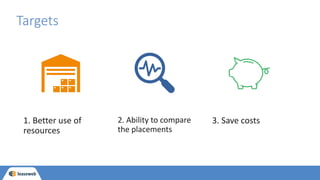
1. Better use of
resources
Targets
3. Save costs
2. Ability to compare
the placements
The How
How we approached this initiative and what we have learned along the way
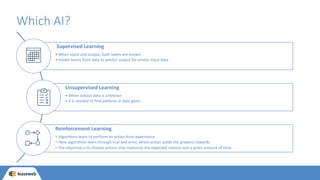
Supervised Learning
• When input and output, both labels are known
• model learns from data to predict output for similar input data
Unsupervised Learning
• When output data is unknown
• it is needed to find patterns in data given
Reinforcement Learning
• Algorithms learn to perform an action from experience.
• Here algorithms learn through trial and error, which action yields the greatest rewards.
• The objective is to choose actions that maximize the expected reward over a given amount of time.
Which AI?
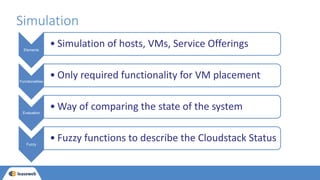
Simulation
Elements
• Simulation of hosts, VMs, Service Offerings
Functionalities
• Only required functionality for VM placement
Evaluation
• Way of comparing the state of the system
Fuzzy
• Fuzzy functions to describe the Cloudstack Status
Let’s see the code J

Using AI To Place VMs On Hypervisors

  • 1.
  • 2.
    Sina Kashipazha • SoftwareEngineer @Leaseweb • Love Java and Cloud • Hobbies: • Cooking • Coding • Scale models
  • 3.
    • Virtual PrivateServers • Private Cloud Resource pools • Leaseweb Internal Globally operating Infrastructure as a Service provider. Active CloudStack platforms in: • Germany • Netherlands • Singapore • United Kingdom • United States
  • 4.
    1. Better useof resources Targets 3. Save costs 2. Ability to compare the placements
  • 5.
    The How How weapproached this initiative and what we have learned along the way
  • 6.
    Supervised Learning • Wheninput and output, both labels are known • model learns from data to predict output for similar input data Unsupervised Learning • When output data is unknown • it is needed to find patterns in data given Reinforcement Learning • Algorithms learn to perform an action from experience. • Here algorithms learn through trial and error, which action yields the greatest rewards. • The objective is to choose actions that maximize the expected reward over a given amount of time. Which AI?
  • 7.
    Simulation Elements • Simulation ofhosts, VMs, Service Offerings Functionalities • Only required functionality for VM placement Evaluation • Way of comparing the state of the system Fuzzy • Fuzzy functions to describe the Cloudstack Status
  • 8.