Rapid Communication/
Using a Cloud to Replenish Parched Groundwater
Modeling Efforts
by Randall J. Hunt1, Joseph Luchette2, Willem A. Schreuder3, James O. Rumbaugh4, John Doherty5,6,
Matthew J. Tonkin7, and Douglas B. Rumbaugh4
Abstract
Groundwater models can be improved by introduction of additional parameter flexibility and simultaneous
use of soft-knowledge. However, these sophisticated approaches have high computational requirements. Cloud
computing provides unprecedented access to computing power via the Internet to facilitate the use of these
techniques. A modeler can create, launch, and terminate “virtual” computers as needed, paying by the hour, and
save machine images for future use. Such cost-effective and flexible computing power empowers groundwater
modelers to routinely perform model calibration and uncertainty analysis in ways not previously possible.
Introduction
Societal decision-making on water issues—both
quantity and quality—requires science-based tools such as
computer models. Numerical models are vital for inform-
ing such decisions because the models can be used to
investigate a range of actions using a quantitative and
physically based framework, which in turn facilitates
reactive as well as proactive action. However, ground-
water models can have long runtimes; large, transient
groundwater flow, contaminant transport, and coupled
groundwater-surface water models can take more than a
day to complete a single run. Such long runtimes are an
impediment to investigating alternate conceptual models
1Corresponding author: U.S. Geological Survey, 8505 Research
Way, Middleton, WI 53562; (608) 821-3847; fax: (608) 821-3817;
rjhunt@usgs.gov
2McLane Environmental LLC., Princeton, NJ.
3Principia Mathematica, Lakewood, CO.
4Environmental Simulations Inc., Reinholds, PA.
5Watermark Numerical Computing, Brisbane, Australia.
6
National Centre for Groundwater Research and Training,
Flinders University, Adelaide SA, Australia.
7
S.S. Papadopulos & Assoc. Inc., Bethesda, MD.
Received January 2010, accepted February 2010.
Journalcompilation©2010NationalGroundWaterAssociation.
No claim to original US government works.
doi: 10.1111/j.1745-6584.2010.00699.x
and alternate management scenarios with models—
especially when performing model calibration and sen-
sitivity analysis where the model is run many times.
At the November 2009 PEST (Parameter Esti-
mation) Conference in Potomac, Maryland, the recent
development of “cloud computing” was discussed as
a means to bring unprecedented computing power to
bear on groundwater problems (Luchette et al. 2009;
Schreuder 2009). Cloud computing has been widely
covered in the recent popular press (e.g., http://www.
newsweek.com/id/140864), and in its simplest form
includes Internet-accessible e-mail. However, cloud com-
puting also includes other capabilities, including allowing
customers to create multiprocessor configurations, or
“supercomputers,” by renting virtual computers over the
Internet. Thus, cloud computing allows the modeler to
access the number of machines that best suit the model-
ing problem rather than restricting that number to those
machines available locally. In a common parallel com-
puting application, multiple processors are used to reduce
runtimes by parallelizing a single model run. For example,
Arnett and Greenwade (2000) reported an almost fivefold
reduction in runtime when a contaminant transport model
run on a single processor was split among 10 parallel
processors.
Many groundwater models are not well suited for
parallel computing, however, because communication
NGWA.org GROUND WATER 1
overhead between processors can offset the gain of
adding processors. Therefore, such speedups cannot be
universally expected even with additional computing
capability provided by cloud computing. However, all
models can benefit from another parallel computing
application—automated calibration and uncertainty anal-
ysis using parameter estimation techniques. During the
parameter estimation process, each user-specified model
parameter is adjusted and the model outputs are com-
pared with corresponding field measurements. The effect
of each parameter change on the model-generated coun-
terparts to field observations is used to develop an updated
estimate of the optimal parameters. Hence, a large number
of runs must be performed to compute the updated param-
eter set that improves a model’s fit to the data. Fortunately,
parameter estimation has properties of an “embarrassingly
parallel” problem (Foster 1995), thus making it well suited
for parallel (and thus cloud) computing. Three aspects
make this the case: (1) the runs are completely indepen-
dent of each other (no interaction between runs); (2) all
the runs can be decided before any run is launched; and
(3) the runs are idempotent, that is, doing the same run
more than once has no side effects. Given this universal
application to groundwater models, indeed to all envi-
ronmental models, the remainder of the discussion will
focus on the application of cloud computing to parameter
estimation problems.
Parameter estimation, like all groundwater modeling,
confronts a common problem—the natural world always
has more complexity than can be included in any model
parameter set. To the extent that processes and character-
istics are so simplified that observed system behavior is
not completely replicated in a model, so-called “structural
noise” (e.g., Doherty and Welter 2010) degrades model
outputs that correspond to these observations (as well
as predictions that the model is required to make). The
more salient information that is omitted, the more over-
simplified the model and the larger its structural error.
These deficiencies in model behavior can be addressed
to some degree through use of appropriate complexity,
attained by using higher numbers of parameters than have
been traditionally included. This increased model flexi-
bility can help reduce structural noise by allowing model
parameterization to be more receptive to information con-
tained in calibration data, which in turn can reduce the
potential for error in model predictions. Moreover, new
complimentary methods have taken advantage of insight
gained from highly parameterized models to better esti-
mate the potential for prediction error (e.g., Moore and
Doherty 2005).
Why not run all models with hundreds or thousands
of parameters as a means to maximize model flexibility
and keep the structural error associated with omitted detail
small? Estimation of parameters for overly complex mod-
els can be unstable and nonunique, though these problems
can be overcome with a “regularized inversion” approach
where large numbers of parameters are constrained
using mathematical methods and soft-knowledge of the
system (Hunt et al. 2007). Carrying many parameters
during model calibration, however, still carries high
computational costs; most parameter estimation methods
commonly require at least one model run per parameter
during each iteration. Even mathematical enhancements
such as the use of “super parameters,” (linear combi-
nations of base parameters, Tonkin and Doherty 2005),
require an initial sensitivity analysis where sensitivity
of all model outputs to each parameter must be calcu-
lated before defining the more limited number of super
parameters. Although such enhanced methods are now
routinely used in everyday modeling practice, the upper
limit on the number of parameters is often still chosen
based on the number of computers available, and not
on what is best suited for calibration, or for analyzing
the uncertainty of a prediction of interest. Thus, these
artificial and arbitrary constraints to model parameter esti-
mation and uncertainty analysis could limit our ability to
bring the best science to water resources decision-making.
Cloud computing is a powerful new tool that can over-
come this restriction (Luchette et al. 2009).
Cloud Computing
The term “cloud computing” refers to leveraging the
computing capability of others through the Internet as
a service. Distant computing power resides in “virtual
machines”—virtual computer resources that mimic actual
machines running a single process or entire operating sys-
tems. The types of services offered using cloud computing
usually fall into one of three categories: (1) software-as-a-
service (SaaS); (2) infrastructure-as-a-service (IaaS); and
(3) platform-as-a-service (Figure 1). SaaS makes other-
wise traditional software available as an online utility.
Webmail (e.g., Gmail, Yahoo) is probably the most com-
mon and simplest example of SaaS: e-mail is stored
on distant servers but accessed by users through a
local web browser. The third, platform-as-a-service, con-
sists of a sophisticated and encompassing framework
that allows applications to be built in one or more
specific programming languages and rolled-out on the
service provider’s computing resources while scaling
automatically to increased user demand. Between these
end members is IaaS, the area of cloud computing likely
to have most utility to environmental modeling. IaaS
provides users instant access to virtual machines that
contain entire operating systems via a web-based interface
or through application programming interfaces (APIs).
Such capability enables vast multiprocessor computing
capabilities to be built without large capital expenses of
hardware and software. Any number of virtual machines
can be brought to bear on a problem; thus, IaaS allows
computational power to scale efficiently to the modeling
need.
A cloud service rigidly offering only one code as
a SaaS would result in an unsatisfactory “one size
fits all” approach. Yet building environmental models
does not require the integrated sophistication (and asso-
ciated expense) of a platform-as-a-service application.
IaaS is attractive in that it possesses easily accessed
2 R.J. Hunt et al. GROUND WATER NGWA.org
Figure 1. Examples of cloud computing and services offered, with brief explanations of each service (modified from Luchette
et al. 2009).
web-based interfaces for starting and stopping virtual
machines, this allowing the user to easily acquire and
terminate the required computing resources. Furthermore,
the customer is granted full “root access” to a cre-
ated virtual machine. Thus, a modeler can upload, setup,
and run software applications as on a local desktop
machine. Private networks between virtual machines can
be constructed via folder sharing or Internet protocols
on the cloud—thereby setting up a scaleable paral-
lel computing environment for model calibration tools
such as Parallel PEST (Doherty 2010). Once a virtual
machine is configured, it can be saved for future use,
reducing the effort needed to start subsequent cloud
sessions. Finally, IaaS resources are becoming more
widespread: examples include Amazon EC2 (http://aws.
amazon.com/ec2), GoGrid (http://www.gogrid.com), and
The Rackspace Cloud (http://www.rackspacecloud.com).
Perhaps the most appealing feature of IaaS cloud
services is the inexpensive metered pricing. Similar to
a household utility meter, costs are calculated on the
basis of the amount of time cloud resources are used.
This allows users to allocate large amounts of computing
resources for set lengths of time, without incurring the up-
front capital expense of purchasing the equipment. Pricing
models are typically based on virtual machine memory
and/or processor speed and are billed by the hour. The
cost currently is typically in the range of $0.08 to $1.20
per hour per processor depending on the memory and
processor specified. Additional pricing for data transfer
is also applied but is typically low (approximately $0.10
to $0.50 per gigabyte [GB] per month).
Harnessing the Cloud
Acquiring computing power solves only one aspect
of the problem; the modeler must also efficiently utilize
the resources provided by the newly available tool.
Schreuder (2009) outlines a parallel parameter estimation
approach suitable for implementation on the cloud using
an extension of Parallel PEST. PEST is the most widely
used parameter estimation code for groundwater modeling
(Ginn et al. 2007) and has been extensively run on local
parallel computing networks. PEST for one processor
is expanded to “Parallel PEST” on multiple processors
where a single supervisor (or “master”) distributes model
runs to individual computers across a network. The master
creates the model input files in a designated directory,
instructs the slave to launch the model, and then reads the
results from the same directory upon completion of model
execution. Communication between the master and slaves
is effected through small message files; this approach
works well for a smaller number of slaves but does not
scale well to high numbers of slaves. When there are
many slaves, the master becomes the bottleneck because
it becomes bogged down with writing the large number
of required input files and reading the output files that
each model instance generates, files that are often large.
Because the master writes the files, it is also necessary
to have a global file system visible to the master and
all slaves. This is clearly not well suited for integrating
local computing resources with virtual machines accessed
through the cloud.
Recently, Parallel PEST was refined to improve
parallel performance through development of BeoPEST
(Schreuder 2009). BeoPEST implements the same param-
eter estimation algorithms as Parallel PEST but supports
two other communications protocols in addition to the
message file approach. BeoPEST/MPI uses the message
passing interface (MPI) protocol to communicate between
the master and slaves and is ideally suited to use on
supercomputers—the “Big Iron” of computing. BeoPEST/
TCP uses the Internet standard Transmission Control
Protocol/Internet Protocol (TCP/IP) protocol to commu-
nicate between the master and slaves; this facilitates
cloud-based parameter estimation because it allows the
master and slaves to run on any computers that can com-
municate via the Internet. It is also well suited to ad hoc
clusters that can be formed using office personal comput-
ers (PCs), either locally or in distributed offices connected
by the Internet.
NGWA.org R.J. Hunt et al. GROUND WATER 3
Enhanced parallel computing also requires a smarter
slave approach than that originally used by Parallel PEST.
With such an approach, the master simply sends a short
message to the slaves indicating the values of parameters
that the model must use during the next model run. The
slaves takes care of writing the model input files using
local templates of these files, running the model, and
extracting the results into a compact format. Writing the
input files and reading the output files may seem trivial;
however, having the slaves perform this task locally
provides three significant benefits. (1) Performance: if it
takes just 1 s per client to read and write the files,
it would take a single server 1 h to perform the same
reading/writing tasks as 3600 smart slaves can accomplish
in a second. (2) Locality: all the files can be written to the
local disk connected to the slave; therefore, a global file
system is not required. (3) Reliability: because TCP/IP is
a reliable protocol, the master can sense when a slave dies
or can no longer be contacted. If a slave fails, BeoPEST
simply reschedules the run that was being executed by
that slave.
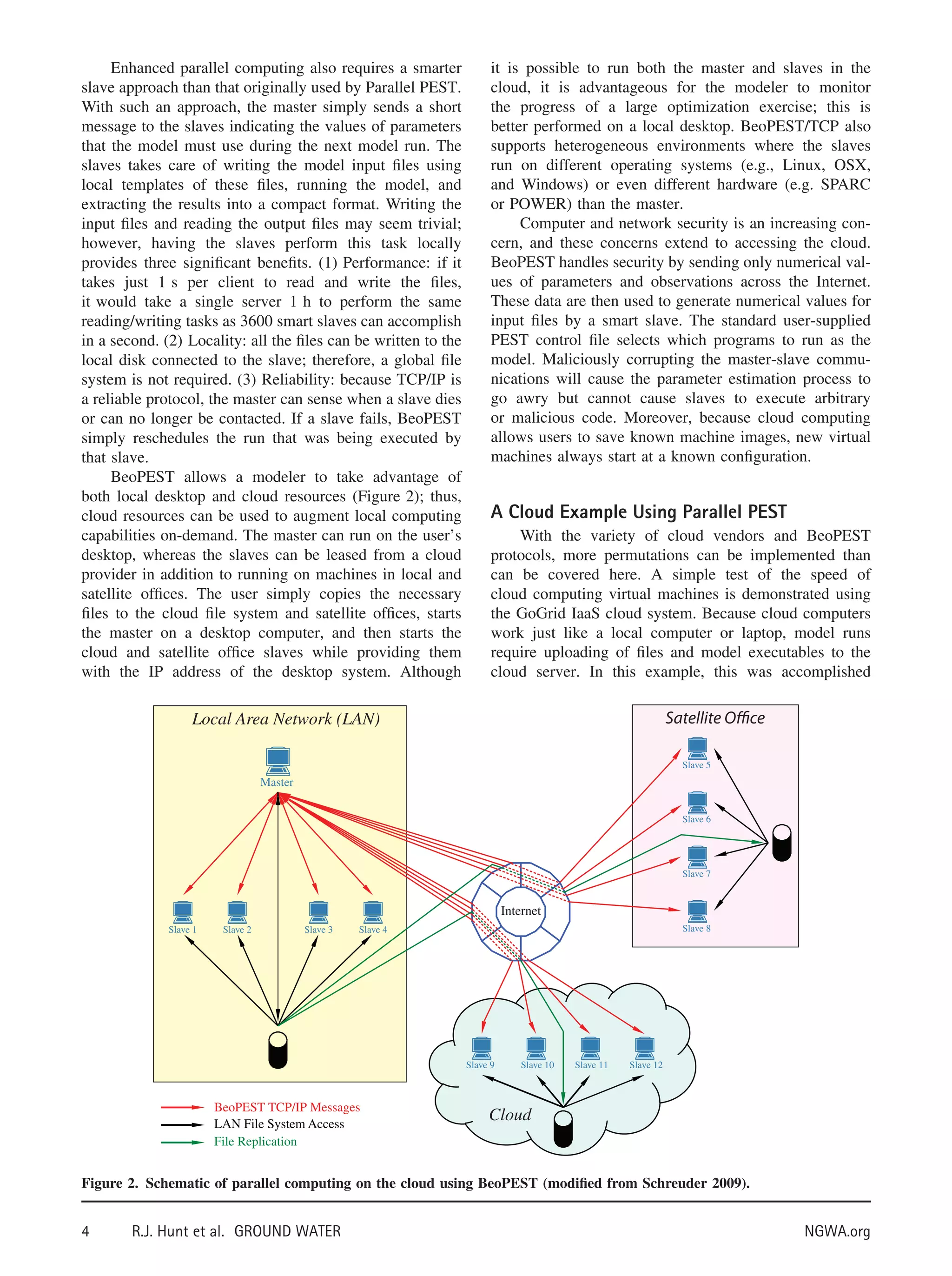
BeoPEST allows a modeler to take advantage of
both local desktop and cloud resources (Figure 2); thus,
cloud resources can be used to augment local computing
capabilities on-demand. The master can run on the user’s
desktop, whereas the slaves can be leased from a cloud
provider in addition to running on machines in local and
satellite offices. The user simply copies the necessary
files to the cloud file system and satellite offices, starts
the master on a desktop computer, and then starts the
cloud and satellite office slaves while providing them
with the IP address of the desktop system. Although
it is possible to run both the master and slaves in the
cloud, it is advantageous for the modeler to monitor
the progress of a large optimization exercise; this is
better performed on a local desktop. BeoPEST/TCP also
supports heterogeneous environments where the slaves
run on different operating systems (e.g., Linux, OSX,
and Windows) or even different hardware (e.g. SPARC
or POWER) than the master.
Computer and network security is an increasing con-
cern, and these concerns extend to accessing the cloud.
BeoPEST handles security by sending only numerical val-
ues of parameters and observations across the Internet.
These data are then used to generate numerical values for
input files by a smart slave. The standard user-supplied
PEST control file selects which programs to run as the
model. Maliciously corrupting the master-slave commu-
nications will cause the parameter estimation process to
go awry but cannot cause slaves to execute arbitrary
or malicious code. Moreover, because cloud computing
allows users to save known machine images, new virtual
machines always start at a known configuration.
A Cloud Example Using Parallel PEST
With the variety of cloud vendors and BeoPEST
protocols, more permutations can be implemented than
can be covered here. A simple test of the speed of
cloud computing virtual machines is demonstrated using
the GoGrid IaaS cloud system. Because cloud computers
work just like a local computer or laptop, model runs
require uploading of files and model executables to the
cloud server. In this example, this was accomplished
Master
Slave 1 Slave 2 Slave 3 Slave 4
Slave 5
Slave 6
Slave 7
Slave 8
Local Area Network (LAN)
Slave 9 Slave 10 Slave 11 Slave 12
Cloud
Internet
BeoPEST TCP/IP Messages
LAN File System Access
File Replication
Figure 2. Schematic of parallel computing on the cloud using BeoPEST (modified from Schreuder 2009).
4 R.J. Hunt et al. GROUND WATER NGWA.org
through the Windows remote desktop protocol (RDP).
A single virtual machine can then be cloned as many
times as required. However, the IP address is usually not
static as in a local computing environment. As a result,
one current limitation of cloud computing is the lack
of robust scripts/batch programs that automatically clone,
load, and launch slaves while accounting for the dynamic
nature of computing resources on the cloud.
A regional groundwater flow model described by
Luchette et al. (2009) was used to compare the speed
of a virtual machine on the cloud to that of typical
local computers. The model consisted of a 5-layer,
50-stress period MODFLOW2000 (Harbaugh et al. 2000)
simulation. The bottom of the model was specified
as no-flow; the top of the model received recharge.
Constant flux boundaries were specified at the model
perimeter and a river was represented using a series of
river cells bisecting the model domain in layer 1. As
expected given the GoGrid virtual machine minimum
configuration, model runtimes obtained from the virtual
machine were comparable with those obtained on local
desktops (Table 1).
The power of cloud computing is more evident during
parameter estimation. Luchette et al. (2009) describe
a 28-parameter problem that required 1691 runs for
parameter estimation completion. This problem would
require between 26 and 41 h on a single processor
that had runtimes similar to those reported in Table 1.
Luchette et al. (2009) ran this problem as a Parallel
PEST run on a four-slave configuration on the GoGrid
cloud in approximately 9 h. A comparable run time
was also obtained when running four slaves on a
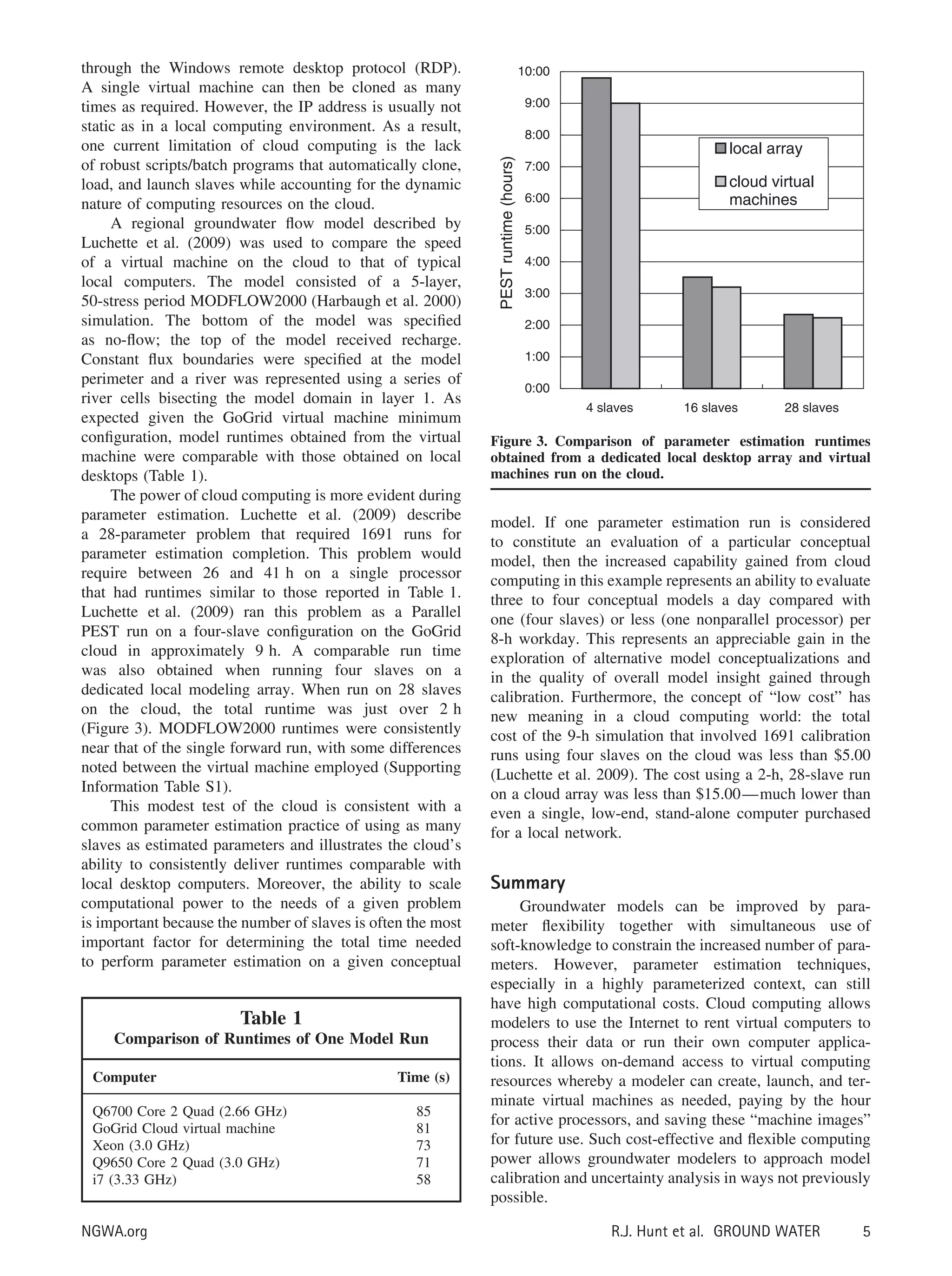
dedicated local modeling array. When run on 28 slaves
on the cloud, the total runtime was just over 2 h
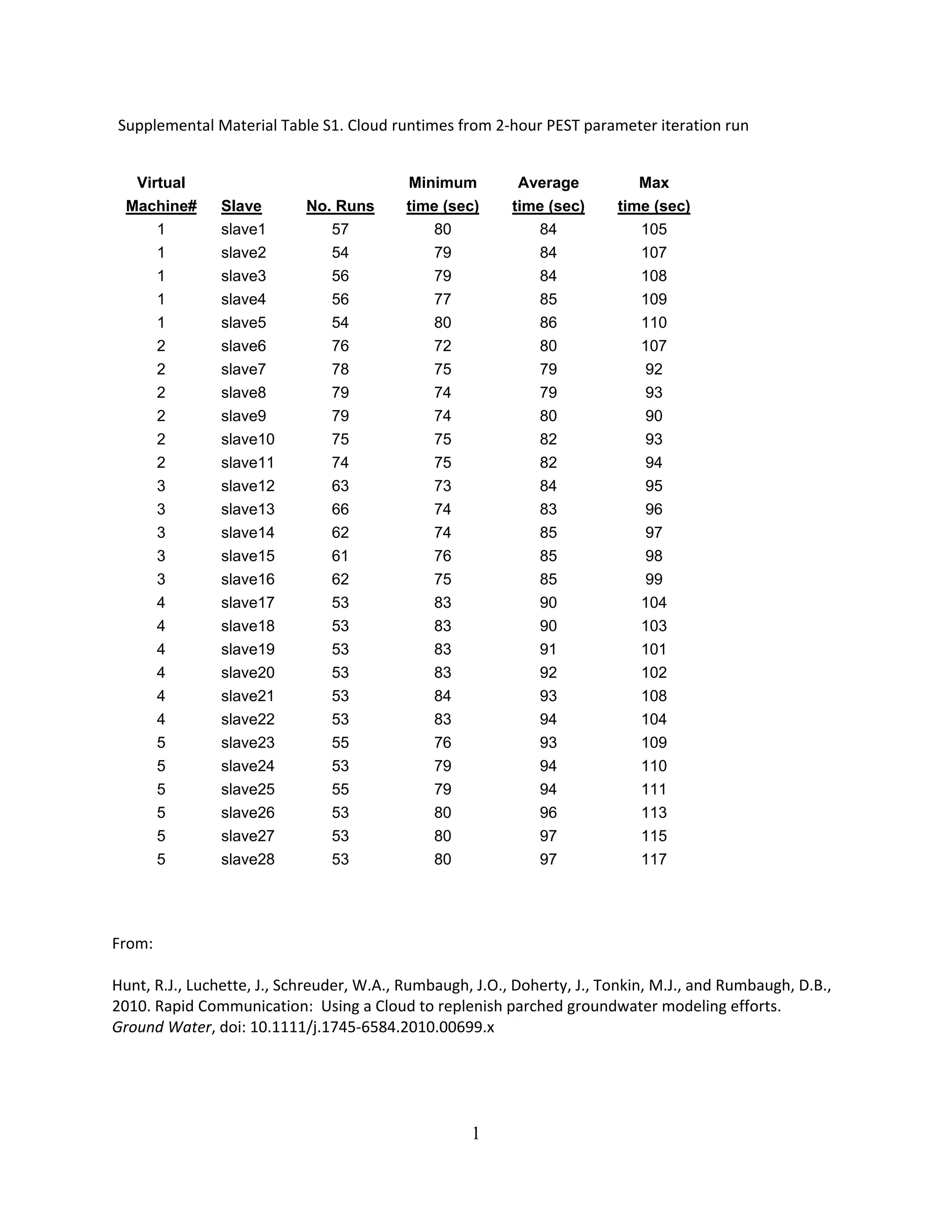
(Figure 3). MODFLOW2000 runtimes were consistently
near that of the single forward run, with some differences
noted between the virtual machine employed (Supporting
Information Table S1).
This modest test of the cloud is consistent with a
common parameter estimation practice of using as many
slaves as estimated parameters and illustrates the cloud’s
ability to consistently deliver runtimes comparable with
local desktop computers. Moreover, the ability to scale
computational power to the needs of a given problem
is important because the number of slaves is often the most
important factor for determining the total time needed
to perform parameter estimation on a given conceptual
Table 1
Comparison of Runtimes of One Model Run
Computer Time (s)
Q6700 Core 2 Quad (2.66 GHz) 85
GoGrid Cloud virtual machine 81
Xeon (3.0 GHz) 73
Q9650 Core 2 Quad (3.0 GHz) 71
i7 (3.33 GHz) 58
0:00
1:00
2:00
3:00
4:00
5:00
6:00
7:00
8:00
9:00
10:00
4 slaves 16 slaves 28 slaves
PESTruntime(hours)
local array
cloud virtual
machines
Figure 3. Comparison of parameter estimation runtimes
obtained from a dedicated local desktop array and virtual
machines run on the cloud.
model. If one parameter estimation run is considered
to constitute an evaluation of a particular conceptual
model, then the increased capability gained from cloud
computing in this example represents an ability to evaluate
three to four conceptual models a day compared with
one (four slaves) or less (one nonparallel processor) per
8-h workday. This represents an appreciable gain in the
exploration of alternative model conceptualizations and
in the quality of overall model insight gained through
calibration. Furthermore, the concept of “low cost” has
new meaning in a cloud computing world: the total
cost of the 9-h simulation that involved 1691 calibration
runs using four slaves on the cloud was less than $5.00
(Luchette et al. 2009). The cost using a 2-h, 28-slave run
on a cloud array was less than $15.00—much lower than
even a single, low-end, stand-alone computer purchased
for a local network.
Summary
Groundwater models can be improved by para-
meter flexibility together with simultaneous use of
soft-knowledge to constrain the increased number of para-
meters. However, parameter estimation techniques,
especially in a highly parameterized context, can still
have high computational costs. Cloud computing allows
modelers to use the Internet to rent virtual computers to
process their data or run their own computer applica-
tions. It allows on-demand access to virtual computing
resources whereby a modeler can create, launch, and ter-
minate virtual machines as needed, paying by the hour
for active processors, and saving these “machine images”
for future use. Such cost-effective and flexible computing
power allows groundwater modelers to approach model
calibration and uncertainty analysis in ways not previously
possible.
NGWA.org R.J. Hunt et al. GROUND WATER 5
Supporting Information
Additional Supporting Information may be found in
the online version of this article:
Table S1. Cloud runtimes from 2-h PEST parameter
iteration run.
Please note: Wiley-Blackwell is not responsible for
the content or functionality of any supporting information
supplied by the authors. Any queries (other than missing
material) should be directed to the corresponding author
for the article.
References
Arnett, R.C., and L.E. Greenwade. 2000. Parallel processing
of a groundwater contaminant code. In Conference Pro-
ceedings of Summit 2000, the 42nd Annual Cray Users
Group Meeting, Noordwijk, The Netherlands, 22–26
May. http://www.inl.gov/technicalpublications/Documents/
2690197.pdf (accessed December 7, 2009).
Doherty, J. 2010. PEST: Model-Independent Parameter Estima-
tion. Australia: Watermark Numerical Computing. http://
www.pesthomepage.org (accessed December 7, 2009).
Doherty, J., and D.E. Welter. 2010. A short exploration of
structural noise. Water Resources Research. In press. DOI:
10.1029/2009WR008377.
Foster, I. 1995. Designing and Building Parallel Programs.
Upper Saddle River, New Jersey: Addison-Wesley Pearson
Education. ISBN 9780201575941, 430 p.
Ginn, T.R., T.D. Scheibe, H. Haeri, and C.N. McClain. 2007.
Paper 40–1: an expanded survey of groundwater modeling
practitioners about how they quantify uncertainty: which
tools they use, why, and why not. Geological Society of
America Abstracts with Programs 39, no. 6: 40–41.
Harbaugh, A.W., E.R. Banta, M.C. Hill, and M.G. McDonald.
2000. MODFLOW-2000, the U.S. Geological Survey mod-
ular ground-water model—user guide to modularization
concepts and the ground-water flow process. U.S. Geo-
logical Survey Open-File Report 00-92. Reston, Virginia:
USGS. 121 p.
Hunt, R.J., J. Doherty, and M.J. Tonkin. 2007. Are models too
simple? Arguments for increased parameterization. Ground
Water 45, no. 3, 254–262.
Luchette, J., G.K. Nelson, C.F. McLane, and L.I. Cecan. 2009.
Unlimited virtual computing capacity using the cloud for
automated parameter estimation. In Proceedings of the 1st
PEST Conference, Potomac, Maryland, 1–3 November.
Moore, C., and J. Doherty. 2005. Role of the calibration
process in reducing model predictive error. Water Resources
Research 41, W05020, DOI: 10.1029/2004WR003501.
Schreuder, W.A. 2009. Running BeoPEST. In Proceedings
of the 1st PEST Conference, Potomac, Maryland, 1–3
November.
Tonkin, M.J., and J. Doherty. 2005. A hybrid regularized inver-
sion methodology for highly parameterized environmen-
tal models. Water Resources Research 41, W10412, DOI:
10.1029/2005WR003995.
Author’s Note: The use of brand, trade, or firm names in
peer-reviewed papers is for identification purposes only
and does not constitute endorsement by the authors, their
employers, or the National Ground Water Association.
6 R.J. Hunt et al. GROUND WATER NGWA.org
1
Supplemental Material Table S1. Cloud runtimes from 2‐hour PEST parameter iteration run 
Virtual Minimum Average Max    
Machine# Slave No. Runs time (sec) time (sec) time (sec)    
1 slave1 57 80 84 105    
1 slave2 54 79 84 107    
1 slave3 56 79 84 108    
1 slave4 56 77 85 109    
1 slave5 54 80 86 110    
2 slave6 76 72 80 107    
2 slave7 78 75 79 92    
2 slave8 79 74 79 93    
2 slave9 79 74 80 90    
2 slave10 75 75 82 93    
2 slave11 74 75 82 94    
3 slave12 63 73 84 95    
3 slave13 66 74 83 96    
3 slave14 62 74 85 97    
3 slave15 61 76 85 98    
3 slave16 62 75 85 99    
4 slave17 53 83 90 104    
4 slave18 53 83 90 103    
4 slave19 53 83 91 101    
4 slave20 53 83 92 102    
4 slave21 53 84 93 108    
4 slave22 53 83 94 104    
5 slave23 55 76 93 109    
5 slave24 53 79 94 110    
5 slave25 55 79 94 111    
5 slave26 53 80 96 113    
5 slave27 53 80 97 115    
5 slave28 53 80 97 117    
From: 
 
Hunt, R.J., Luchette, J., Schreuder, W.A., Rumbaugh, J.O., Doherty, J., Tonkin, M.J., and Rumbaugh, D.B., 
2010. Rapid Communication:  Using a Cloud to replenish parched groundwater modeling efforts.  
Ground Water, doi: 10.1111/j.1745‐6584.2010.00699.x 

Using a Cloud to Replenish Parched Groundwater Modeling Efforts

  • 1.
    Rapid Communication/ Using aCloud to Replenish Parched Groundwater Modeling Efforts by Randall J. Hunt1, Joseph Luchette2, Willem A. Schreuder3, James O. Rumbaugh4, John Doherty5,6, Matthew J. Tonkin7, and Douglas B. Rumbaugh4 Abstract Groundwater models can be improved by introduction of additional parameter flexibility and simultaneous use of soft-knowledge. However, these sophisticated approaches have high computational requirements. Cloud computing provides unprecedented access to computing power via the Internet to facilitate the use of these techniques. A modeler can create, launch, and terminate “virtual” computers as needed, paying by the hour, and save machine images for future use. Such cost-effective and flexible computing power empowers groundwater modelers to routinely perform model calibration and uncertainty analysis in ways not previously possible. Introduction Societal decision-making on water issues—both quantity and quality—requires science-based tools such as computer models. Numerical models are vital for inform- ing such decisions because the models can be used to investigate a range of actions using a quantitative and physically based framework, which in turn facilitates reactive as well as proactive action. However, ground- water models can have long runtimes; large, transient groundwater flow, contaminant transport, and coupled groundwater-surface water models can take more than a day to complete a single run. Such long runtimes are an impediment to investigating alternate conceptual models 1Corresponding author: U.S. Geological Survey, 8505 Research Way, Middleton, WI 53562; (608) 821-3847; fax: (608) 821-3817; rjhunt@usgs.gov 2McLane Environmental LLC., Princeton, NJ. 3Principia Mathematica, Lakewood, CO. 4Environmental Simulations Inc., Reinholds, PA. 5Watermark Numerical Computing, Brisbane, Australia. 6 National Centre for Groundwater Research and Training, Flinders University, Adelaide SA, Australia. 7 S.S. Papadopulos & Assoc. Inc., Bethesda, MD. Received January 2010, accepted February 2010. Journalcompilation©2010NationalGroundWaterAssociation. No claim to original US government works. doi: 10.1111/j.1745-6584.2010.00699.x and alternate management scenarios with models— especially when performing model calibration and sen- sitivity analysis where the model is run many times. At the November 2009 PEST (Parameter Esti- mation) Conference in Potomac, Maryland, the recent development of “cloud computing” was discussed as a means to bring unprecedented computing power to bear on groundwater problems (Luchette et al. 2009; Schreuder 2009). Cloud computing has been widely covered in the recent popular press (e.g., http://www. newsweek.com/id/140864), and in its simplest form includes Internet-accessible e-mail. However, cloud com- puting also includes other capabilities, including allowing customers to create multiprocessor configurations, or “supercomputers,” by renting virtual computers over the Internet. Thus, cloud computing allows the modeler to access the number of machines that best suit the model- ing problem rather than restricting that number to those machines available locally. In a common parallel com- puting application, multiple processors are used to reduce runtimes by parallelizing a single model run. For example, Arnett and Greenwade (2000) reported an almost fivefold reduction in runtime when a contaminant transport model run on a single processor was split among 10 parallel processors. Many groundwater models are not well suited for parallel computing, however, because communication NGWA.org GROUND WATER 1
  • 2.
    overhead between processorscan offset the gain of adding processors. Therefore, such speedups cannot be universally expected even with additional computing capability provided by cloud computing. However, all models can benefit from another parallel computing application—automated calibration and uncertainty anal- ysis using parameter estimation techniques. During the parameter estimation process, each user-specified model parameter is adjusted and the model outputs are com- pared with corresponding field measurements. The effect of each parameter change on the model-generated coun- terparts to field observations is used to develop an updated estimate of the optimal parameters. Hence, a large number of runs must be performed to compute the updated param- eter set that improves a model’s fit to the data. Fortunately, parameter estimation has properties of an “embarrassingly parallel” problem (Foster 1995), thus making it well suited for parallel (and thus cloud) computing. Three aspects make this the case: (1) the runs are completely indepen- dent of each other (no interaction between runs); (2) all the runs can be decided before any run is launched; and (3) the runs are idempotent, that is, doing the same run more than once has no side effects. Given this universal application to groundwater models, indeed to all envi- ronmental models, the remainder of the discussion will focus on the application of cloud computing to parameter estimation problems. Parameter estimation, like all groundwater modeling, confronts a common problem—the natural world always has more complexity than can be included in any model parameter set. To the extent that processes and character- istics are so simplified that observed system behavior is not completely replicated in a model, so-called “structural noise” (e.g., Doherty and Welter 2010) degrades model outputs that correspond to these observations (as well as predictions that the model is required to make). The more salient information that is omitted, the more over- simplified the model and the larger its structural error. These deficiencies in model behavior can be addressed to some degree through use of appropriate complexity, attained by using higher numbers of parameters than have been traditionally included. This increased model flexi- bility can help reduce structural noise by allowing model parameterization to be more receptive to information con- tained in calibration data, which in turn can reduce the potential for error in model predictions. Moreover, new complimentary methods have taken advantage of insight gained from highly parameterized models to better esti- mate the potential for prediction error (e.g., Moore and Doherty 2005). Why not run all models with hundreds or thousands of parameters as a means to maximize model flexibility and keep the structural error associated with omitted detail small? Estimation of parameters for overly complex mod- els can be unstable and nonunique, though these problems can be overcome with a “regularized inversion” approach where large numbers of parameters are constrained using mathematical methods and soft-knowledge of the system (Hunt et al. 2007). Carrying many parameters during model calibration, however, still carries high computational costs; most parameter estimation methods commonly require at least one model run per parameter during each iteration. Even mathematical enhancements such as the use of “super parameters,” (linear combi- nations of base parameters, Tonkin and Doherty 2005), require an initial sensitivity analysis where sensitivity of all model outputs to each parameter must be calcu- lated before defining the more limited number of super parameters. Although such enhanced methods are now routinely used in everyday modeling practice, the upper limit on the number of parameters is often still chosen based on the number of computers available, and not on what is best suited for calibration, or for analyzing the uncertainty of a prediction of interest. Thus, these artificial and arbitrary constraints to model parameter esti- mation and uncertainty analysis could limit our ability to bring the best science to water resources decision-making. Cloud computing is a powerful new tool that can over- come this restriction (Luchette et al. 2009). Cloud Computing The term “cloud computing” refers to leveraging the computing capability of others through the Internet as a service. Distant computing power resides in “virtual machines”—virtual computer resources that mimic actual machines running a single process or entire operating sys- tems. The types of services offered using cloud computing usually fall into one of three categories: (1) software-as-a- service (SaaS); (2) infrastructure-as-a-service (IaaS); and (3) platform-as-a-service (Figure 1). SaaS makes other- wise traditional software available as an online utility. Webmail (e.g., Gmail, Yahoo) is probably the most com- mon and simplest example of SaaS: e-mail is stored on distant servers but accessed by users through a local web browser. The third, platform-as-a-service, con- sists of a sophisticated and encompassing framework that allows applications to be built in one or more specific programming languages and rolled-out on the service provider’s computing resources while scaling automatically to increased user demand. Between these end members is IaaS, the area of cloud computing likely to have most utility to environmental modeling. IaaS provides users instant access to virtual machines that contain entire operating systems via a web-based interface or through application programming interfaces (APIs). Such capability enables vast multiprocessor computing capabilities to be built without large capital expenses of hardware and software. Any number of virtual machines can be brought to bear on a problem; thus, IaaS allows computational power to scale efficiently to the modeling need. A cloud service rigidly offering only one code as a SaaS would result in an unsatisfactory “one size fits all” approach. Yet building environmental models does not require the integrated sophistication (and asso- ciated expense) of a platform-as-a-service application. IaaS is attractive in that it possesses easily accessed 2 R.J. Hunt et al. GROUND WATER NGWA.org
  • 3.
    Figure 1. Examplesof cloud computing and services offered, with brief explanations of each service (modified from Luchette et al. 2009). web-based interfaces for starting and stopping virtual machines, this allowing the user to easily acquire and terminate the required computing resources. Furthermore, the customer is granted full “root access” to a cre- ated virtual machine. Thus, a modeler can upload, setup, and run software applications as on a local desktop machine. Private networks between virtual machines can be constructed via folder sharing or Internet protocols on the cloud—thereby setting up a scaleable paral- lel computing environment for model calibration tools such as Parallel PEST (Doherty 2010). Once a virtual machine is configured, it can be saved for future use, reducing the effort needed to start subsequent cloud sessions. Finally, IaaS resources are becoming more widespread: examples include Amazon EC2 (http://aws. amazon.com/ec2), GoGrid (http://www.gogrid.com), and The Rackspace Cloud (http://www.rackspacecloud.com). Perhaps the most appealing feature of IaaS cloud services is the inexpensive metered pricing. Similar to a household utility meter, costs are calculated on the basis of the amount of time cloud resources are used. This allows users to allocate large amounts of computing resources for set lengths of time, without incurring the up- front capital expense of purchasing the equipment. Pricing models are typically based on virtual machine memory and/or processor speed and are billed by the hour. The cost currently is typically in the range of $0.08 to $1.20 per hour per processor depending on the memory and processor specified. Additional pricing for data transfer is also applied but is typically low (approximately $0.10 to $0.50 per gigabyte [GB] per month). Harnessing the Cloud Acquiring computing power solves only one aspect of the problem; the modeler must also efficiently utilize the resources provided by the newly available tool. Schreuder (2009) outlines a parallel parameter estimation approach suitable for implementation on the cloud using an extension of Parallel PEST. PEST is the most widely used parameter estimation code for groundwater modeling (Ginn et al. 2007) and has been extensively run on local parallel computing networks. PEST for one processor is expanded to “Parallel PEST” on multiple processors where a single supervisor (or “master”) distributes model runs to individual computers across a network. The master creates the model input files in a designated directory, instructs the slave to launch the model, and then reads the results from the same directory upon completion of model execution. Communication between the master and slaves is effected through small message files; this approach works well for a smaller number of slaves but does not scale well to high numbers of slaves. When there are many slaves, the master becomes the bottleneck because it becomes bogged down with writing the large number of required input files and reading the output files that each model instance generates, files that are often large. Because the master writes the files, it is also necessary to have a global file system visible to the master and all slaves. This is clearly not well suited for integrating local computing resources with virtual machines accessed through the cloud. Recently, Parallel PEST was refined to improve parallel performance through development of BeoPEST (Schreuder 2009). BeoPEST implements the same param- eter estimation algorithms as Parallel PEST but supports two other communications protocols in addition to the message file approach. BeoPEST/MPI uses the message passing interface (MPI) protocol to communicate between the master and slaves and is ideally suited to use on supercomputers—the “Big Iron” of computing. BeoPEST/ TCP uses the Internet standard Transmission Control Protocol/Internet Protocol (TCP/IP) protocol to commu- nicate between the master and slaves; this facilitates cloud-based parameter estimation because it allows the master and slaves to run on any computers that can com- municate via the Internet. It is also well suited to ad hoc clusters that can be formed using office personal comput- ers (PCs), either locally or in distributed offices connected by the Internet. NGWA.org R.J. Hunt et al. GROUND WATER 3
  • 4.
    Enhanced parallel computingalso requires a smarter slave approach than that originally used by Parallel PEST. With such an approach, the master simply sends a short message to the slaves indicating the values of parameters that the model must use during the next model run. The slaves takes care of writing the model input files using local templates of these files, running the model, and extracting the results into a compact format. Writing the input files and reading the output files may seem trivial; however, having the slaves perform this task locally provides three significant benefits. (1) Performance: if it takes just 1 s per client to read and write the files, it would take a single server 1 h to perform the same reading/writing tasks as 3600 smart slaves can accomplish in a second. (2) Locality: all the files can be written to the local disk connected to the slave; therefore, a global file system is not required. (3) Reliability: because TCP/IP is a reliable protocol, the master can sense when a slave dies or can no longer be contacted. If a slave fails, BeoPEST simply reschedules the run that was being executed by that slave. BeoPEST allows a modeler to take advantage of both local desktop and cloud resources (Figure 2); thus, cloud resources can be used to augment local computing capabilities on-demand. The master can run on the user’s desktop, whereas the slaves can be leased from a cloud provider in addition to running on machines in local and satellite offices. The user simply copies the necessary files to the cloud file system and satellite offices, starts the master on a desktop computer, and then starts the cloud and satellite office slaves while providing them with the IP address of the desktop system. Although it is possible to run both the master and slaves in the cloud, it is advantageous for the modeler to monitor the progress of a large optimization exercise; this is better performed on a local desktop. BeoPEST/TCP also supports heterogeneous environments where the slaves run on different operating systems (e.g., Linux, OSX, and Windows) or even different hardware (e.g. SPARC or POWER) than the master. Computer and network security is an increasing con- cern, and these concerns extend to accessing the cloud. BeoPEST handles security by sending only numerical val- ues of parameters and observations across the Internet. These data are then used to generate numerical values for input files by a smart slave. The standard user-supplied PEST control file selects which programs to run as the model. Maliciously corrupting the master-slave commu- nications will cause the parameter estimation process to go awry but cannot cause slaves to execute arbitrary or malicious code. Moreover, because cloud computing allows users to save known machine images, new virtual machines always start at a known configuration. A Cloud Example Using Parallel PEST With the variety of cloud vendors and BeoPEST protocols, more permutations can be implemented than can be covered here. A simple test of the speed of cloud computing virtual machines is demonstrated using the GoGrid IaaS cloud system. Because cloud computers work just like a local computer or laptop, model runs require uploading of files and model executables to the cloud server. In this example, this was accomplished Master Slave 1 Slave 2 Slave 3 Slave 4 Slave 5 Slave 6 Slave 7 Slave 8 Local Area Network (LAN) Slave 9 Slave 10 Slave 11 Slave 12 Cloud Internet BeoPEST TCP/IP Messages LAN File System Access File Replication Figure 2. Schematic of parallel computing on the cloud using BeoPEST (modified from Schreuder 2009). 4 R.J. Hunt et al. GROUND WATER NGWA.org
  • 5.
    through the Windowsremote desktop protocol (RDP). A single virtual machine can then be cloned as many times as required. However, the IP address is usually not static as in a local computing environment. As a result, one current limitation of cloud computing is the lack of robust scripts/batch programs that automatically clone, load, and launch slaves while accounting for the dynamic nature of computing resources on the cloud. A regional groundwater flow model described by Luchette et al. (2009) was used to compare the speed of a virtual machine on the cloud to that of typical local computers. The model consisted of a 5-layer, 50-stress period MODFLOW2000 (Harbaugh et al. 2000) simulation. The bottom of the model was specified as no-flow; the top of the model received recharge. Constant flux boundaries were specified at the model perimeter and a river was represented using a series of river cells bisecting the model domain in layer 1. As expected given the GoGrid virtual machine minimum configuration, model runtimes obtained from the virtual machine were comparable with those obtained on local desktops (Table 1). The power of cloud computing is more evident during parameter estimation. Luchette et al. (2009) describe a 28-parameter problem that required 1691 runs for parameter estimation completion. This problem would require between 26 and 41 h on a single processor that had runtimes similar to those reported in Table 1. Luchette et al. (2009) ran this problem as a Parallel PEST run on a four-slave configuration on the GoGrid cloud in approximately 9 h. A comparable run time was also obtained when running four slaves on a dedicated local modeling array. When run on 28 slaves on the cloud, the total runtime was just over 2 h (Figure 3). MODFLOW2000 runtimes were consistently near that of the single forward run, with some differences noted between the virtual machine employed (Supporting Information Table S1). This modest test of the cloud is consistent with a common parameter estimation practice of using as many slaves as estimated parameters and illustrates the cloud’s ability to consistently deliver runtimes comparable with local desktop computers. Moreover, the ability to scale computational power to the needs of a given problem is important because the number of slaves is often the most important factor for determining the total time needed to perform parameter estimation on a given conceptual Table 1 Comparison of Runtimes of One Model Run Computer Time (s) Q6700 Core 2 Quad (2.66 GHz) 85 GoGrid Cloud virtual machine 81 Xeon (3.0 GHz) 73 Q9650 Core 2 Quad (3.0 GHz) 71 i7 (3.33 GHz) 58 0:00 1:00 2:00 3:00 4:00 5:00 6:00 7:00 8:00 9:00 10:00 4 slaves 16 slaves 28 slaves PESTruntime(hours) local array cloud virtual machines Figure 3. Comparison of parameter estimation runtimes obtained from a dedicated local desktop array and virtual machines run on the cloud. model. If one parameter estimation run is considered to constitute an evaluation of a particular conceptual model, then the increased capability gained from cloud computing in this example represents an ability to evaluate three to four conceptual models a day compared with one (four slaves) or less (one nonparallel processor) per 8-h workday. This represents an appreciable gain in the exploration of alternative model conceptualizations and in the quality of overall model insight gained through calibration. Furthermore, the concept of “low cost” has new meaning in a cloud computing world: the total cost of the 9-h simulation that involved 1691 calibration runs using four slaves on the cloud was less than $5.00 (Luchette et al. 2009). The cost using a 2-h, 28-slave run on a cloud array was less than $15.00—much lower than even a single, low-end, stand-alone computer purchased for a local network. Summary Groundwater models can be improved by para- meter flexibility together with simultaneous use of soft-knowledge to constrain the increased number of para- meters. However, parameter estimation techniques, especially in a highly parameterized context, can still have high computational costs. Cloud computing allows modelers to use the Internet to rent virtual computers to process their data or run their own computer applica- tions. It allows on-demand access to virtual computing resources whereby a modeler can create, launch, and ter- minate virtual machines as needed, paying by the hour for active processors, and saving these “machine images” for future use. Such cost-effective and flexible computing power allows groundwater modelers to approach model calibration and uncertainty analysis in ways not previously possible. NGWA.org R.J. Hunt et al. GROUND WATER 5
  • 6.
    Supporting Information Additional SupportingInformation may be found in the online version of this article: Table S1. Cloud runtimes from 2-h PEST parameter iteration run. Please note: Wiley-Blackwell is not responsible for the content or functionality of any supporting information supplied by the authors. Any queries (other than missing material) should be directed to the corresponding author for the article. References Arnett, R.C., and L.E. Greenwade. 2000. Parallel processing of a groundwater contaminant code. In Conference Pro- ceedings of Summit 2000, the 42nd Annual Cray Users Group Meeting, Noordwijk, The Netherlands, 22–26 May. http://www.inl.gov/technicalpublications/Documents/ 2690197.pdf (accessed December 7, 2009). Doherty, J. 2010. PEST: Model-Independent Parameter Estima- tion. Australia: Watermark Numerical Computing. http:// www.pesthomepage.org (accessed December 7, 2009). Doherty, J., and D.E. Welter. 2010. A short exploration of structural noise. Water Resources Research. In press. DOI: 10.1029/2009WR008377. Foster, I. 1995. Designing and Building Parallel Programs. Upper Saddle River, New Jersey: Addison-Wesley Pearson Education. ISBN 9780201575941, 430 p. Ginn, T.R., T.D. Scheibe, H. Haeri, and C.N. McClain. 2007. Paper 40–1: an expanded survey of groundwater modeling practitioners about how they quantify uncertainty: which tools they use, why, and why not. Geological Society of America Abstracts with Programs 39, no. 6: 40–41. Harbaugh, A.W., E.R. Banta, M.C. Hill, and M.G. McDonald. 2000. MODFLOW-2000, the U.S. Geological Survey mod- ular ground-water model—user guide to modularization concepts and the ground-water flow process. U.S. Geo- logical Survey Open-File Report 00-92. Reston, Virginia: USGS. 121 p. Hunt, R.J., J. Doherty, and M.J. Tonkin. 2007. Are models too simple? Arguments for increased parameterization. Ground Water 45, no. 3, 254–262. Luchette, J., G.K. Nelson, C.F. McLane, and L.I. Cecan. 2009. Unlimited virtual computing capacity using the cloud for automated parameter estimation. In Proceedings of the 1st PEST Conference, Potomac, Maryland, 1–3 November. Moore, C., and J. Doherty. 2005. Role of the calibration process in reducing model predictive error. Water Resources Research 41, W05020, DOI: 10.1029/2004WR003501. Schreuder, W.A. 2009. Running BeoPEST. In Proceedings of the 1st PEST Conference, Potomac, Maryland, 1–3 November. Tonkin, M.J., and J. Doherty. 2005. A hybrid regularized inver- sion methodology for highly parameterized environmen- tal models. Water Resources Research 41, W10412, DOI: 10.1029/2005WR003995. Author’s Note: The use of brand, trade, or firm names in peer-reviewed papers is for identification purposes only and does not constitute endorsement by the authors, their employers, or the National Ground Water Association. 6 R.J. Hunt et al. GROUND WATER NGWA.org
  • 7.
    1 Supplemental Material Table S1. Cloud runtimes from 2‐hour PEST parameter iteration run  Virtual Minimum AverageMax     Machine# Slave No. Runs time (sec) time (sec) time (sec)     1 slave1 57 80 84 105     1 slave2 54 79 84 107     1 slave3 56 79 84 108     1 slave4 56 77 85 109     1 slave5 54 80 86 110     2 slave6 76 72 80 107     2 slave7 78 75 79 92     2 slave8 79 74 79 93     2 slave9 79 74 80 90     2 slave10 75 75 82 93     2 slave11 74 75 82 94     3 slave12 63 73 84 95     3 slave13 66 74 83 96     3 slave14 62 74 85 97     3 slave15 61 76 85 98     3 slave16 62 75 85 99     4 slave17 53 83 90 104     4 slave18 53 83 90 103     4 slave19 53 83 91 101     4 slave20 53 83 92 102     4 slave21 53 84 93 108     4 slave22 53 83 94 104     5 slave23 55 76 93 109     5 slave24 53 79 94 110     5 slave25 55 79 94 111     5 slave26 53 80 96 113     5 slave27 53 80 97 115     5 slave28 53 80 97 117     From:    Hunt, R.J., Luchette, J., Schreuder, W.A., Rumbaugh, J.O., Doherty, J., Tonkin, M.J., and Rumbaugh, D.B.,  2010. Rapid Communication:  Using a Cloud to replenish parched groundwater modeling efforts.   Ground Water, doi: 10.1111/j.1745‐6584.2010.00699.x