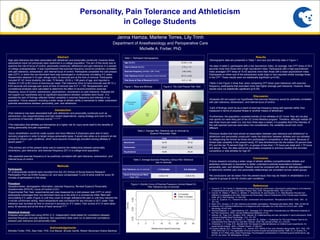
Jenna Hamza, Marlene Torres, Lily Trinh
Department of Anesthesiology and Perioperative Care
Michelle A. Fortier, PhD
Personality, Pain Tolerance and Athleticism
in College Students
Introduction
•Pain tolerance has been associated both with athleticism and personality constructs such as
extraversion, low cooperativeness and high reward dependence, coping strategy and even to the
occurrence of traumatic childhood events.1,2,3,4,5,6
•The implication that athletes put themselves at a higher risk for injury lends itself to the benefits of
linking personality and pain experience.
•Injury rehabilitation would be made quicker and more effective if physicians were able to tailor
recovery programs in order to target unique personality types. It would also allow us to pinpoint at-risk
groups for chronic pain conditions, which have become increasingly prevalent among athletes in
recent years.5,7
•The primary aim of the present study was to examine the relationship between personality
dimensions, pain tolerance, and exercise frequency (EF) in a college-level population.
•We expected exercise frequency to be positively correlated with pain tolerance, extraversion, and
internal locus of control.
Abstract
High pain tolerance has been associated with athleticism and personality constructs; however these
associations have not previously been examined in a college population. The aim of this study was to
examine the role of locus of control, personality constructs, athleticism and pain tolerance in a sample
of college undergraduates. It was hypothesized that exercise frequency would be positively correlated
with pain tolerance, extraversion, and internal locus of control. Participants completed the cold pressor
task (CPT), in which the non-dominant hand was submerged in continuously circulating 4°C water.
Researchers obtained 0-10 pain ratings every 30 seconds and at the time of removal. Participants
included 97 UC Irvine students (24 male, 73 female), 20.55 ± 1.99 years of age, and reported a
median of 3.00 (4.50) hours of exercise per week. Pain tolerance (time to hand removal) was 85.72 ±
8.63 seconds and average pain score at time of removal was 8.01 ± 1.95. Nonparametric and
correlational analyses were calculated to determine the effect of several predictors (exercise
frequency, locus of control, extraversion, psychoticism, neuroticism) on pain tolerance. Analyses did
not support our hypotheses and no significant associations between variables were found. It is
possible the lack of findings reflected limited variability in exercise frequency and intensity in our
population. Future research including a wider range of athletic ability is warranted to better understand
potential associations between personality, pain, and athleticism.
References
1. Ferracuti, S., De Carolis, A. Relationships among Eysenck’s extraversion, Rorschach’s erlebnistypus, and tolerance
of experimental tonic pain (Cold Water Pressor Test). 2005. Percept Mot Skills. 100(1):237-48.
2. Freund, W., Weber, F., Billich, C., Birklein, F., Breimhorst, M. and Schuetz, U. H. Ultra-Marathon Runners Are
Different: Investigations into Pain Tolerance and Personality Traits of Participants of the TransEurope FootRace
2009. 2013. Pain Practice. 13: 524–532.
3. Lynn, R., Eysenck, H.J. Tolerance for pain, extraversion and neuroticism. Perceptual and Motor Skills. 1961. 12:
161-162.
4. Ryan, E.D., Kovacic, C.R. Pain tolerance and athletic participation. Perceptual and Motor Skills. 1966. 22:383-39.
5. Edwards, R.R. Individual differences in endogenous pain modulation as a risk factor for chronic pain. 2005.
Neurology. 65:437-443.
6. Ramırez-Maestre, C., Lopez Martınez, A.E., Zarazaga, R.E. Personality Characteristics as Differential Variables of
the Pain Experience. 2004. Journal of Behavioral Medicine. 27 (2).
7. Sullivan, M., Tripp, D.A., Rodgers, W.M., Stanish, W. Catastrophizing and pain perception in sport participants. 2000.
Journal of Applied Sport Psychology. 12:2, 151-167.
8. Von Baeyer, C., Piira, T., Chambers, C., Trapanotto, M., Zeltzer, L. Guidelines For The Cold Pressor Task As An
Experimental Pain Stimulus For Use With Children. 2005 The Journal of Pain. 6.4: 218-227.
9. Chambers, C.T., Craig, K.D., Bennett S.M. The impact of maternal behavior on children’s pain experiences: An
experimental analysis. 2002. J Pediatr Psycho. 27:293-301.
10.Ferreira-Valente, M.A., Pais-Ribeiro, J.L., Jensen, M.P. Validity of four pain intensity rating scales. 2011. Pain. 152:
2399-2404.Hall, E.G. The application of locus of control to sport and physical activity. 1985. In L.K. Bunker, R.J.
Rotella, & A.S. Reilly (Eds.) Sport Psychology: Psychological considerations in maximising sport performance, (pp.
65-73). Ann Arbur, MI: McNaughton & Gunn.
Methods
Participants
97 undergraduate students were recruited from the UCI School of Social Science Research
Participation Pool via SONA Systems Ltd. and were compensated ½ unit of extra credit for every 30
minutes of participation in the study.
Procedure
•Questionnaires: demographic information, exercise frequency, Revised Eysenck Personality
Questionnaire (EPQ-R), Locus of Control (LOC)
•Experimental Pain Task: experimental pain was measured by a cold pressor task (CPT) in which
participants submerged their non-dominant hand up to the wrist in a commercial chiller filled with
recirculating 4°C water (Figure 2) until they could no longer withstand the pain or until they reached the
4 minute uninformed ceiling. Hand temperature was normalized for two minutes in 20°C water. Pain
tolerance was recorded as time to removal in seconds (in 4°C water). Pain scores of 0-10 were taken
every 30 seconds and at the time of hand removal.8,9,10
Statistical Analysis
Analyses were performed using SPSS 21.0. Independent t-tests tested for correlations between
exercise frequency and pain tolerance. Non-parametric tests were run to determine correlations
between pain tolerance and personality traits.
Table 1. Participant Demographics
Table 2. Average Pain Tolerance (sec to removal) by
Eysenck Personality Traits
Figure 2. The Cold Pressor Pain Task
Results
•Demographic data are presented in Table 1 and race and ethnicity data in Figure 1.
•As seen in table 2, participants with a low neuroticism index, on average, had CPT times of 25.2
seconds more than those with a high neuroticism index. Participants with a high psychoticism
index averaged CPT times of 15.42 seconds more than those with a lower psychoticism index.
Participants on either end of the extraversion scale (high or low) reported similar average times
in the CPT. These results were not statistically significant (p>0.05).
•Table 3 and Figure 3 show that, when comparing CPT times (pain tolerance) with exercise
frequency, participants that exercised more had higher average pain tolerance. However, these
results were not statistically significant (p>0.05).
Acknowledgements
Michelle Fortier, PhD, Zeev Kain, PhD, Eva Maurer, Brooke Gentle, Robert Stevenson Ariana Martinez
Age (M+SD) 20.55 + 1.99
Year in School (M+SD) 2.79 + 1.12
Exercise Frequency (median, IQR; hr/wk) 3.00 (4.50)
Pain Tolerance (M+SD; seconds to hand removal) 85.72 + 8.63
Pain Score at Time of Removal (M+SD) 8.01 + 1.95
Low High
Neuroticism 92.49 67.23
Extraversion 85.43 85.96
Psychoticism 76.98 92.40
Conclusion
•Future research including a wider range of athletic abilities (competitive/elite athletes and
sedentary individuals) is warranted to better understand potential associations between
personality, pain, and athleticism. Results could be compared with data on alternate populations
to determine whether pain and personality relationships are consistent across varied groups.
•No conclusions can be drawn from the present study that may be helpful in rehabilitation or in
regards to groups at risk for chronic pain conditions.
Figure 1. Race and Ethnicity
Pain Tolerance (sec to removal) < 3 minutes 3-4 minutes
Hours of Exercise per Week
Mean (SD)
4.69 (4.74) 5.48 (5.78)
Figure 3. Density Curve of Exercise Frequency (hrs/wk) Based On
Pain Tolerance (sec to removal)
Table 3. Average Exercise Frequency Versus Pain Tolerance
(sec to removal)
Discussion
•Analyses did not support our hypotheses that exercise frequency would be positively correlated
with pain tolerance, extraversion, and internal locus of control.
•Lack of findings could be as a result of exercise frequency being self-reported rather than
measured in terms of physical fitness or another means of athleticism.
•Furthermore, the population consisted entirely of non-athletes at UC Irvine: they did not play
club sports nor were they part of the UC Irvine Athletics program. Therefore, although median EF
was three hours per week (i.e. one hour three days a week), it is possible that if the intensity of
this self-reported exercise were taken into consideration, the variability would look much
different.
•Previous studies that have shown an association between pain tolerance and athleticism2 or
athleticism and personality constructs4 made the distinction between athletes and non-athletes
by categorizing the former as those who participated in competitive or elite sports. Because of
limited data variability in the present study, EF was dichotomized into the bottom 25 percent (low
EF) and the top 75 percent (high EF), or groups of less than 1.75 hours per week and 1.75 hours
and above. Thus, the data cannot be accurately compared to previous studies that recruited
competitive or elite athletes for high EF.

UROP Poster

  • 1.
    Jenna Hamza, MarleneTorres, Lily Trinh Department of Anesthesiology and Perioperative Care Michelle A. Fortier, PhD Personality, Pain Tolerance and Athleticism in College Students Introduction •Pain tolerance has been associated both with athleticism and personality constructs such as extraversion, low cooperativeness and high reward dependence, coping strategy and even to the occurrence of traumatic childhood events.1,2,3,4,5,6 •The implication that athletes put themselves at a higher risk for injury lends itself to the benefits of linking personality and pain experience. •Injury rehabilitation would be made quicker and more effective if physicians were able to tailor recovery programs in order to target unique personality types. It would also allow us to pinpoint at-risk groups for chronic pain conditions, which have become increasingly prevalent among athletes in recent years.5,7 •The primary aim of the present study was to examine the relationship between personality dimensions, pain tolerance, and exercise frequency (EF) in a college-level population. •We expected exercise frequency to be positively correlated with pain tolerance, extraversion, and internal locus of control. Abstract High pain tolerance has been associated with athleticism and personality constructs; however these associations have not previously been examined in a college population. The aim of this study was to examine the role of locus of control, personality constructs, athleticism and pain tolerance in a sample of college undergraduates. It was hypothesized that exercise frequency would be positively correlated with pain tolerance, extraversion, and internal locus of control. Participants completed the cold pressor task (CPT), in which the non-dominant hand was submerged in continuously circulating 4°C water. Researchers obtained 0-10 pain ratings every 30 seconds and at the time of removal. Participants included 97 UC Irvine students (24 male, 73 female), 20.55 ± 1.99 years of age, and reported a median of 3.00 (4.50) hours of exercise per week. Pain tolerance (time to hand removal) was 85.72 ± 8.63 seconds and average pain score at time of removal was 8.01 ± 1.95. Nonparametric and correlational analyses were calculated to determine the effect of several predictors (exercise frequency, locus of control, extraversion, psychoticism, neuroticism) on pain tolerance. Analyses did not support our hypotheses and no significant associations between variables were found. It is possible the lack of findings reflected limited variability in exercise frequency and intensity in our population. Future research including a wider range of athletic ability is warranted to better understand potential associations between personality, pain, and athleticism. References 1. Ferracuti, S., De Carolis, A. Relationships among Eysenck’s extraversion, Rorschach’s erlebnistypus, and tolerance of experimental tonic pain (Cold Water Pressor Test). 2005. Percept Mot Skills. 100(1):237-48. 2. Freund, W., Weber, F., Billich, C., Birklein, F., Breimhorst, M. and Schuetz, U. H. Ultra-Marathon Runners Are Different: Investigations into Pain Tolerance and Personality Traits of Participants of the TransEurope FootRace 2009. 2013. Pain Practice. 13: 524–532. 3. Lynn, R., Eysenck, H.J. Tolerance for pain, extraversion and neuroticism. Perceptual and Motor Skills. 1961. 12: 161-162. 4. Ryan, E.D., Kovacic, C.R. Pain tolerance and athletic participation. Perceptual and Motor Skills. 1966. 22:383-39. 5. Edwards, R.R. Individual differences in endogenous pain modulation as a risk factor for chronic pain. 2005. Neurology. 65:437-443. 6. Ramırez-Maestre, C., Lopez Martınez, A.E., Zarazaga, R.E. Personality Characteristics as Differential Variables of the Pain Experience. 2004. Journal of Behavioral Medicine. 27 (2). 7. Sullivan, M., Tripp, D.A., Rodgers, W.M., Stanish, W. Catastrophizing and pain perception in sport participants. 2000. Journal of Applied Sport Psychology. 12:2, 151-167. 8. Von Baeyer, C., Piira, T., Chambers, C., Trapanotto, M., Zeltzer, L. Guidelines For The Cold Pressor Task As An Experimental Pain Stimulus For Use With Children. 2005 The Journal of Pain. 6.4: 218-227. 9. Chambers, C.T., Craig, K.D., Bennett S.M. The impact of maternal behavior on children’s pain experiences: An experimental analysis. 2002. J Pediatr Psycho. 27:293-301. 10.Ferreira-Valente, M.A., Pais-Ribeiro, J.L., Jensen, M.P. Validity of four pain intensity rating scales. 2011. Pain. 152: 2399-2404.Hall, E.G. The application of locus of control to sport and physical activity. 1985. In L.K. Bunker, R.J. Rotella, & A.S. Reilly (Eds.) Sport Psychology: Psychological considerations in maximising sport performance, (pp. 65-73). Ann Arbur, MI: McNaughton & Gunn. Methods Participants 97 undergraduate students were recruited from the UCI School of Social Science Research Participation Pool via SONA Systems Ltd. and were compensated ½ unit of extra credit for every 30 minutes of participation in the study. Procedure •Questionnaires: demographic information, exercise frequency, Revised Eysenck Personality Questionnaire (EPQ-R), Locus of Control (LOC) •Experimental Pain Task: experimental pain was measured by a cold pressor task (CPT) in which participants submerged their non-dominant hand up to the wrist in a commercial chiller filled with recirculating 4°C water (Figure 2) until they could no longer withstand the pain or until they reached the 4 minute uninformed ceiling. Hand temperature was normalized for two minutes in 20°C water. Pain tolerance was recorded as time to removal in seconds (in 4°C water). Pain scores of 0-10 were taken every 30 seconds and at the time of hand removal.8,9,10 Statistical Analysis Analyses were performed using SPSS 21.0. Independent t-tests tested for correlations between exercise frequency and pain tolerance. Non-parametric tests were run to determine correlations between pain tolerance and personality traits. Table 1. Participant Demographics Table 2. Average Pain Tolerance (sec to removal) by Eysenck Personality Traits Figure 2. The Cold Pressor Pain Task Results •Demographic data are presented in Table 1 and race and ethnicity data in Figure 1. •As seen in table 2, participants with a low neuroticism index, on average, had CPT times of 25.2 seconds more than those with a high neuroticism index. Participants with a high psychoticism index averaged CPT times of 15.42 seconds more than those with a lower psychoticism index. Participants on either end of the extraversion scale (high or low) reported similar average times in the CPT. These results were not statistically significant (p>0.05). •Table 3 and Figure 3 show that, when comparing CPT times (pain tolerance) with exercise frequency, participants that exercised more had higher average pain tolerance. However, these results were not statistically significant (p>0.05). Acknowledgements Michelle Fortier, PhD, Zeev Kain, PhD, Eva Maurer, Brooke Gentle, Robert Stevenson Ariana Martinez Age (M+SD) 20.55 + 1.99 Year in School (M+SD) 2.79 + 1.12 Exercise Frequency (median, IQR; hr/wk) 3.00 (4.50) Pain Tolerance (M+SD; seconds to hand removal) 85.72 + 8.63 Pain Score at Time of Removal (M+SD) 8.01 + 1.95 Low High Neuroticism 92.49 67.23 Extraversion 85.43 85.96 Psychoticism 76.98 92.40 Conclusion •Future research including a wider range of athletic abilities (competitive/elite athletes and sedentary individuals) is warranted to better understand potential associations between personality, pain, and athleticism. Results could be compared with data on alternate populations to determine whether pain and personality relationships are consistent across varied groups. •No conclusions can be drawn from the present study that may be helpful in rehabilitation or in regards to groups at risk for chronic pain conditions. Figure 1. Race and Ethnicity Pain Tolerance (sec to removal) < 3 minutes 3-4 minutes Hours of Exercise per Week Mean (SD) 4.69 (4.74) 5.48 (5.78) Figure 3. Density Curve of Exercise Frequency (hrs/wk) Based On Pain Tolerance (sec to removal) Table 3. Average Exercise Frequency Versus Pain Tolerance (sec to removal) Discussion •Analyses did not support our hypotheses that exercise frequency would be positively correlated with pain tolerance, extraversion, and internal locus of control. •Lack of findings could be as a result of exercise frequency being self-reported rather than measured in terms of physical fitness or another means of athleticism. •Furthermore, the population consisted entirely of non-athletes at UC Irvine: they did not play club sports nor were they part of the UC Irvine Athletics program. Therefore, although median EF was three hours per week (i.e. one hour three days a week), it is possible that if the intensity of this self-reported exercise were taken into consideration, the variability would look much different. •Previous studies that have shown an association between pain tolerance and athleticism2 or athleticism and personality constructs4 made the distinction between athletes and non-athletes by categorizing the former as those who participated in competitive or elite sports. Because of limited data variability in the present study, EF was dichotomized into the bottom 25 percent (low EF) and the top 75 percent (high EF), or groups of less than 1.75 hours per week and 1.75 hours and above. Thus, the data cannot be accurately compared to previous studies that recruited competitive or elite athletes for high EF.