URISA’s Local Government
GIS Capability Maturity Model
Greg Babinski, MA, GISP
URISA President-Elect
Finance & Marketing Manager
King County GIS Center
Seattle, WA
URISA Connect
Live Event: August 10, 2011
Why Develop a GISCMM?
• Introduction & framing the problem
• What is a capability maturity model?
• Why develop a GIS CMM?
The Proposed URISA GIS Capability Maturity Model
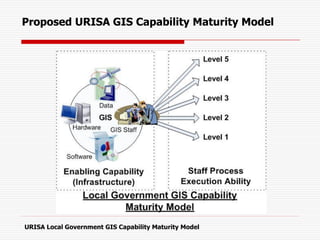
• Enabling capability
• Execution ability
GISCMM Description and Critique
• Walkthrough
• Critique
Feedback, Refining the Model & Next Steps
• Portfolio/certification
• Peer review
• DOLETA GTCM & URISA’s Proposed GMCM
• Next steps discussion
Q & A
URISA Local Government GIS Capability Maturity Model
Agenda
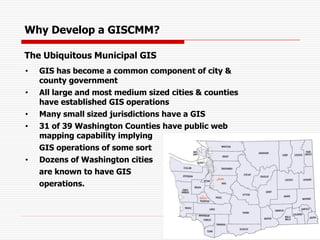
The Ubiquitous Municipal GIS
• GIS has become a common component of city &
county government
• All large and most medium sized cities & counties
have established GIS operations
• Many small sized jurisdictions have a GIS
• 31 of 39 Washington Counties have public web
mapping capability implying
GIS operations of some sort
• Dozens of Washington cities
are known to have GIS
operations.
Why Develop a GISCMM?
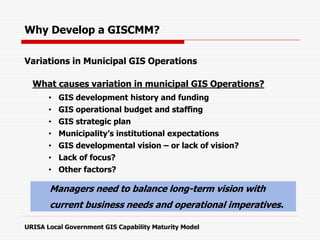
Variations in Municipal GIS Operations
What causes variation in municipal GIS Operations?
 Each municipality is unique
 City and county business focus often varies
 Population
 Nature and level of economic development
URISA Local Government GIS Capability Maturity Model
Variations in Municipal GIS Operations
What causes variation in municipal GIS Operations?
• GIS development history and funding
• GIS operational budget and staffing
• GIS strategic plan
• Municipality’s institutional expectations
• GIS developmental vision – or lack of vision?
• Lack of focus?
• Other factors?
URISA Local Government GIS Capability Maturity Model
Why Develop a GISCMM?
Managers need to balance long-term vision with
current business needs and operational imperatives.
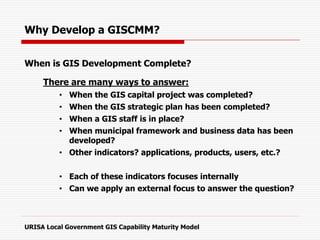
When is GIS Development Complete?
There are many ways to answer:
• When the GIS capital project was completed?
• When the GIS strategic plan has been completed?
• When a GIS staff is in place?
• When municipal framework and business data has been
developed?
• Other indicators? applications, products, users, etc.?
• Each of these indicators focuses internally
• Can we apply an external focus to answer the question?
URISA Local Government GIS Capability Maturity Model
Why Develop a GISCMM?
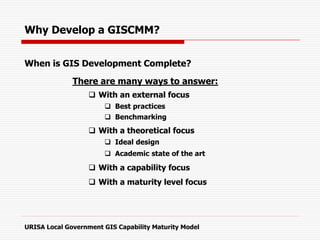
There are many ways to answer:
 With an external focus
 Best practices
 Benchmarking
 With a theoretical focus
 Ideal design
 Academic state of the art
 With a capability focus
 With a maturity level focus
When is GIS Development Complete?
URISA Local Government GIS Capability Maturity Model
Why Develop a GISCMM?
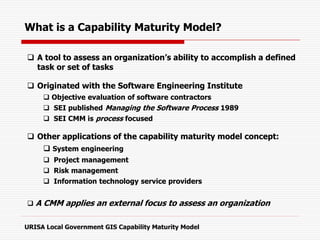
 A tool to assess an organization’s ability to accomplish a defined
task or set of tasks
 Originated with the Software Engineering Institute
 Objective evaluation of software contractors
 SEI published Managing the Software Process 1989
 SEI CMM is process focused
 Other applications of the capability maturity model concept:
 System engineering
 Project management
 Risk management
 Information technology service providers
 A CMM applies an external focus to assess an organization
URISA Local Government GIS Capability Maturity Model
What is a Capability Maturity Model?
The typical capability maturity
model is an assessment of the
subject organization’s maturity level
based on the characteristics of the
organization’s approach to
individual defined processes.
URISA Local Government GIS Capability Maturity Model
What is a Capability Maturity Model?
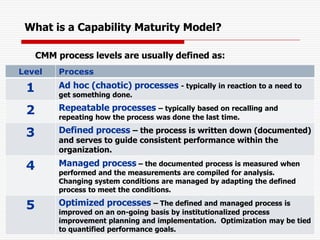
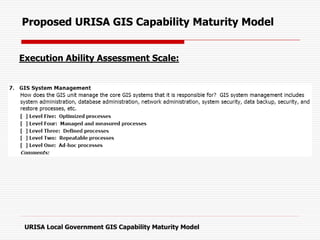
CMM process levels are usually defined as:
URISA Local Government GIS Capability Maturity Model
Level Process
1 Ad hoc (chaotic) processes - typically in reaction to a need to
get something done.
2 Repeatable processes – typically based on recalling and
repeating how the process was done the last time.
3 Defined process – the process is written down (documented)
and serves to guide consistent performance within the
organization.
4 Managed process – the documented process is measured when
performed and the measurements are compiled for analysis.
Changing system conditions are managed by adapting the defined
process to meet the conditions.
5 Optimized processes – The defined and managed process is
improved on an on-going basis by institutionalized process
improvement planning and implementation. Optimization may be tied
to quantified performance goals.
To provide a means for any municipal GIS operation to gauge its
maturity against a variety of standards and/or measures, including:
 A theoretical ideal end state of GIS organizational development
 The maturity level of other peer GIS organizations , either individually or
in aggregate
 The maturity level of the subject organization over time
 The maturity level of the organization against an agreed or defined target
state (perhaps set by organizational policy, budget limitations, etc.)
URISA Local Government GIS Capability Maturity Model
Why Develop a GISCMM?
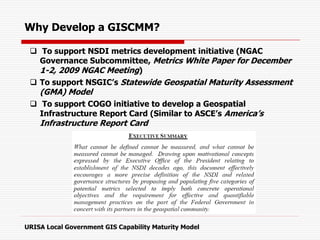
 To support NSDI metrics development initiative (NGAC
Governance Subcommittee, Metrics White Paper for December
1-2, 2009 NGAC Meeting)
 To support NSGIC’s Statewide Geospatial Maturity Assessment
(GMA) Model
 To support COGO initiative to develop a Geospatial
Infrastructure Report Card (Similar to ASCE’s America’s
Infrastructure Report Card
URISA Local Government GIS Capability Maturity Model
GISCMM Precursors
 Gaudet, C., Annulis, H., and Carr, J., Workforce Development Models for
Geospatial Technology, University of Southern Mississippi, 2001.
 Niessinka, F., Clerca, V., Tijdinka, T., and van Vlietb, H., The IT Service
Capability Maturity Model, CIBIT Consultants | Educators, 2005
 Introducing a Maturity Model for Enterprise GIS. Even Keel Strategies,
2008.
 Sonnen, David, Moeller, John, and LeBranche, David, Geospatial Enterprise
Integration Maturity Model. Northrup Grumman, June 24, 2009.
URISA Local Government GIS Capability Maturity Model
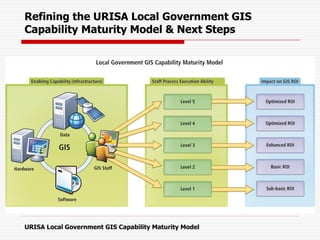
Proposed URISA Local Government
GIS Capability Maturity Model
 Maturity for the proposed model indicates progression of
an organization towards GIS capability that maximizes:
 Potential for the use of state of the art GIS technology
 Commonly recognized quality data
 Organizational best practices appropriate for municipal
business use
 The Local Government GIS Capability Maturity Model
assumes two broad areas of GIS operational
development:
 Enabling capability
 Execution ability
URISA Local Government GIS Capability Maturity Model
Proposed URISA GIS Capability Maturity Model
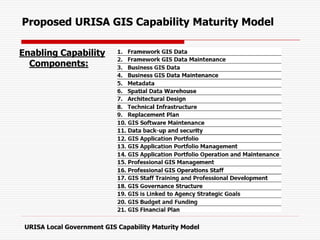
 Enabling Capability (21 components):
 Technology
 Data
 Resources
 Infrastructure
 GIS professional staff
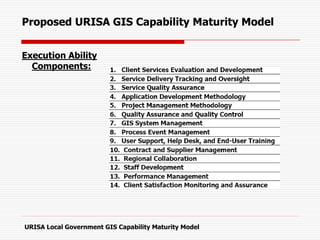
 Execution Ability (14 components):
 Ability of the staff to maximize use of available capability
 Ability to execute relative to normative ideal
URISA Local Government GIS Capability Maturity Model
Proposed URISA GIS Capability Maturity Model
URISA Local Government GIS Capability Maturity Model
Enabling Capability
Components:
Proposed URISA GIS Capability Maturity Model
URISA Local Government GIS Capability Maturity Model
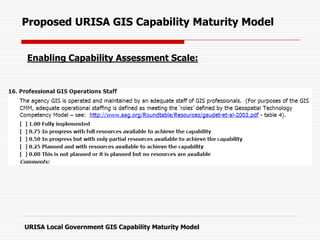
Enabling Capability Assessment Scale:
Proposed URISA GIS Capability Maturity Model
URISA Local Government GIS Capability Maturity Model
Execution Ability
Components:
Proposed URISA GIS Capability Maturity Model
URISA Local Government GIS Capability Maturity Model
Execution Ability Assessment Scale:
Proposed URISA GIS Capability Maturity Model
URISA Local Government GIS Capability Maturity Model
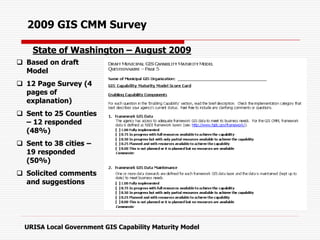
2009 GIS CMM Survey
State of Washington – August 2009
 Based on draft
Model
 12 Page Survey (4
pages of
explanation)
 Sent to 25 Counties
– 12 responded
(48%)
 Sent to 38 cities –
19 responded
(50%)
 Solicited comments
and suggestions
URISA Local Government GIS Capability Maturity Model
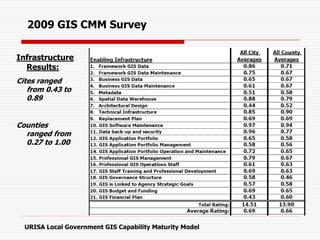
Infrastructure
Results:
Cites ranged
from 0.43 to
0.89
Counties
ranged from
0.27 to 1.00
2009 GIS CMM Survey
URISA Local Government GIS Capability Maturity Model
2009 GIS CMM Survey
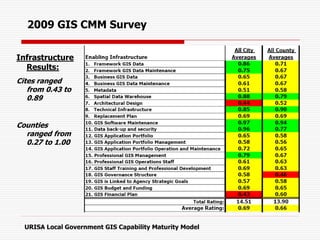
Infrastructure
Results:
Cites ranged
from 0.43 to
0.89
Counties
ranged from
0.27 to 1.00
URISA Local Government GIS Capability Maturity Model
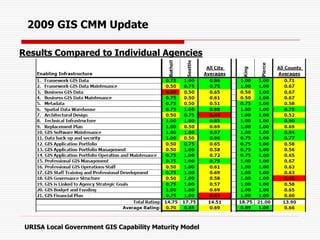
Results Compared to Individual Agencies
2009 GIS CMM Update
URISA Local Government GIS Capability Maturity Model
Process
Ability
Results:
Cites range
from 1.00 to
3.93
Counties range
from 1.00 to
4.57
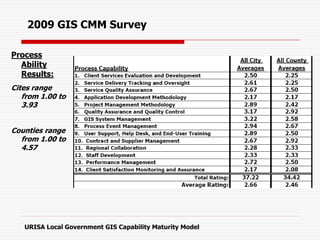
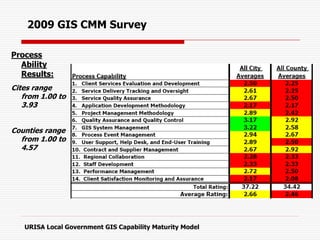
2009 GIS CMM Survey
URISA Local Government GIS Capability Maturity Model
2009 GIS CMM Survey
Process
Ability
Results:
Cites range
from 1.00 to
3.93
Counties range
from 1.00 to
4.57
URISA Local Government GIS Capability Maturity Model
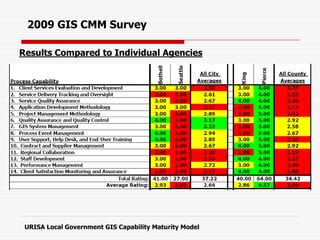
2009 GIS CMM Survey
Results Compared to Individual Agencies
URISA Local Government GIS Capability Maturity Model
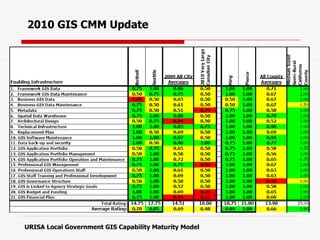
2010 GIS CMM Update
URISA Local Government GIS Capability Maturity Model
URISA Local Government GISCMM Critique
 Questions
 Suggestions
 Discussion
 Add benchmarking metrics?
 Online version?
 What else is missing from the model?
URISA Local Government GIS Capability Maturity Model
 Portfolio
 Peer Review
 Certification
 Institutionalization
 Other ideas
Refining the URISA Local Government GIS
Capability Maturity Model & Next Steps
URISA Local Government GIS Capability Maturity Model
 Portfolio
 Ensures more rigorous self assessment
 Promotes best practices
 Supports peer review
 Enhances credibility of results
Refining the URISA Local Government GIS
Capability Maturity Model & Next Steps
URISA Local Government GIS Capability Maturity Model
 Peer Review
 Normalizes results
 Enhances credibility of rating
URISA Local Government GIS Capability Maturity Model
Refining the URISA Local Government GIS
Capability Maturity Model & Next Steps
 Certification & Institutionalization
 Enhance credibility of results
 Promote sound professional practices
 Similar to ISO 9000 and CMMI certification
Refining the URISA Local Government GIS
Capability Maturity Model & Next Steps
URISA Local Government GIS Capability Maturity Model
 Certification & Institutionalization
 Green Building Council LEED Certification model?
Refining the URISA Local Government GIS
Capability Maturity Model & Next Steps
URISA Local Government GIS Capability Maturity Model
 Pilot Application of the model across counties in
Georgia
 Translation of the model into Mandarin Chinese by
the Taiwan GIS Center & Taiwan GIS Society
 Presentation in Washington, D.C. to NGAC on
9/22/10 and request report back on future
development
 2011 FGDC CAP Grant Proposal
Refining the URISA Local Government GIS
Capability Maturity Model & Next Steps
URISA Local Government GIS Capability Maturity Model
Refining the URISA Local Government GIS
Capability Maturity Model & Next Steps
 Link to ROI
URISA Local Government GIS Capability Maturity Model
Refining the URISA Local Government GIS
Capability Maturity Model & Next Steps
URISA Local Government GIS Capability Maturity Model
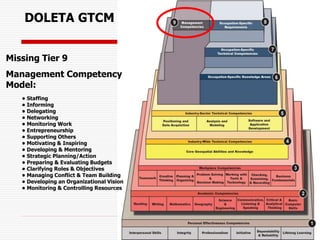
DOLETA GTCM
Missing Tier 9
Management Competency
Model:
• Staffing
• Informing
• Delegating
• Networking
• Monitoring Work
• Entrepreneurship
• Supporting Others
• Motivating & Inspiring
• Developing & Mentoring
• Strategic Planning/Action
• Preparing & Evaluating Budgets
• Clarifying Roles & Objectives
• Managing Conflict & Team Building
• Developing an Organizational Vision
• Monitoring & Controlling Resources
Refining the URISA Local Government GIS
Capability Maturity Model & Next Steps
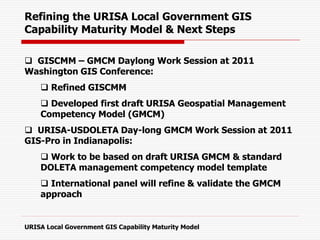
 GISCMM – GMCM Daylong Work Session at 2011
Washington GIS Conference:
 Refined GISCMM
 Developed first draft URISA Geospatial Management
Competency Model (GMCM)
 URISA-USDOLETA Day-long GMCM Work Session at 2011
GIS-Pro in Indianapolis:
 Work to be based on draft URISA GMCM & standard
DOLETA management competency model template
 International panel will refine & validate the GMCM
approach
URISA Local Government GIS Capability Maturity Model
Refining the URISA Local Government GIS
Capability Maturity Model & Next Steps
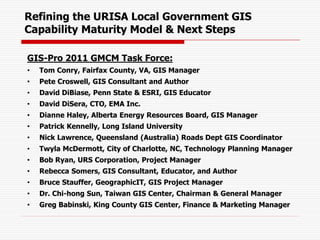
GIS-Pro 2011 GMCM Task Force:
• Tom Conry, Fairfax County, VA, GIS Manager
• Pete Croswell, GIS Consultant and Author
• David DiBiase, Penn State & ESRI, GIS Educator
• David DiSera, CTO, EMA Inc.
• Dianne Haley, Alberta Energy Resources Board, GIS Manager
• Patrick Kennelly, Long Island University
• Nick Lawrence, Queensland (Australia) Roads Dept GIS Coordinator
• Twyla McDermott, City of Charlotte, NC, Technology Planning Manager
• Bob Ryan, URS Corporation, Project Manager
• Rebecca Somers, GIS Consultant, Educator, and Author
• Bruce Stauffer, GeographicIT, GIS Project Manager
• Dr. Chi-hong Sun, Taiwan GIS Center, Chairman & General Manager
• Greg Babinski, King County GIS Center, Finance & Marketing Manager
Refining the URISA Local Government GIS
Capability Maturity Model & Next Steps
What is the link between the GISCMM & the
GMCM?
 Standards
 Best Practices
 Benchmarking
The URISA Board of Directors has authorized a work group
to explore certifying GIS operations and GIS managers.
URISA Local Government GIS Capability Maturity Model
Refining the URISA Local Government GIS
Capability Maturity Model & Next Steps
 Other ideas?
 Open Discussion
 Continue the discussion via the URISA work group
URISA Local Government GIS Capability Maturity Model
Acknowledgements
Reviewers:
• Danielle Ayan, GISP, State of Georgia
• Lisa Castle, King County GIS Center
• Richard Gelb, King County DNRP
• George Horning, King County GIS Center
• Mike Leathers, King County GIS Center
Washington State City & County GIS Managers
2010 GIS-Pro Workshop Participants
2011 Washington GIS Conference GISCMM/GMCM Panel Participants
URISA GISCMM Advisors:
• Hilary Perkins
• Twyla McDermott
• David DiBiase
URISA Local Government GIS Capability Maturity Model
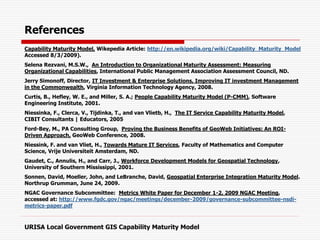
References
URISA Local Government GIS Capability Maturity Model
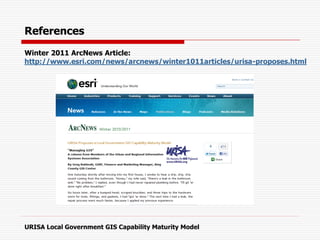
Winter 2011 ArcNews Article:
http://www.esri.com/news/arcnews/winter1011articles/urisa-proposes.html
References
Capability Maturity Model, Wikepedia Article: http://en.wikipedia.org/wiki/Capability_Maturity_Model
Accessed 8/3/2009).
Selena Rezvani, M.S.W., An Introduction to Organizational Maturity Assessment: Measuring
Organizational Capabilities, International Public Management Association Assessment Council, ND.
Jerry Simonoff, Director, IT Investment & Enterprise Solutions, Improving IT investment Management
in the Commonwealth, Virginia Information Technology Agency, 2008.
Curtis, B., Hefley, W. E., and Miller, S. A.; People Capability Maturity Model (P-CMM), Software
Engineering Institute, 2001.
Niessinka, F., Clerca, V., Tijdinka, T., and van Vlietb, H., The IT Service Capability Maturity Model,
CIBIT Consultants | Educators, 2005
Ford-Bey, M., PA Consulting Group, Proving the Business Benefits of GeoWeb Initiatives: An ROI-
Driven Approach, GeoWeb Conference, 2008.
Niessink, F. and van Vliet, H., Towards Mature IT Services, Faculty of Mathematics and Computer
Science, Vrije Universiteit Amsterdam, ND.
Gaudet, C., Annulis, H., and Carr, J., Workforce Development Models for Geospatial Technology,
University of Southern Mississippi, 2001.
Sonnen, David, Moeller, John, and LeBranche, David, Geospatial Enterprise Integration Maturity Model.
Northrup Grumman, June 24, 2009.
NGAC Governance Subcommittee: Metrics White Paper for December 1-2, 2009 NGAC Meeting,
accessed at: http://www.fgdc.gov/ngac/meetings/december-2009/governance-subcommittee-nsdi-
metrics-paper.pdf
URISA Local Government GIS Capability Maturity Model
Contact Information
Greg Babinski, GISP, King County GIS Center, Seattle, WA
Greg.babinski@kingcounty.gov
206-263-3753
URISA Local Government GIS Capability Maturity Model

URISA’s Local Government GIS Capability Maturity Model

  • 1.
    URISA’s Local Government GISCapability Maturity Model Greg Babinski, MA, GISP URISA President-Elect Finance & Marketing Manager King County GIS Center Seattle, WA URISA Connect Live Event: August 10, 2011
  • 2.
    Why Develop aGISCMM? • Introduction & framing the problem • What is a capability maturity model? • Why develop a GIS CMM? The Proposed URISA GIS Capability Maturity Model • Enabling capability • Execution ability GISCMM Description and Critique • Walkthrough • Critique Feedback, Refining the Model & Next Steps • Portfolio/certification • Peer review • DOLETA GTCM & URISA’s Proposed GMCM • Next steps discussion Q & A URISA Local Government GIS Capability Maturity Model Agenda
  • 3.
    The Ubiquitous MunicipalGIS • GIS has become a common component of city & county government • All large and most medium sized cities & counties have established GIS operations • Many small sized jurisdictions have a GIS • 31 of 39 Washington Counties have public web mapping capability implying GIS operations of some sort • Dozens of Washington cities are known to have GIS operations. Why Develop a GISCMM?
  • 4.
    Why Develop aGISCMM? Variations in Municipal GIS Operations What causes variation in municipal GIS Operations?  Each municipality is unique  City and county business focus often varies  Population  Nature and level of economic development URISA Local Government GIS Capability Maturity Model
  • 5.
    Variations in MunicipalGIS Operations What causes variation in municipal GIS Operations? • GIS development history and funding • GIS operational budget and staffing • GIS strategic plan • Municipality’s institutional expectations • GIS developmental vision – or lack of vision? • Lack of focus? • Other factors? URISA Local Government GIS Capability Maturity Model Why Develop a GISCMM? Managers need to balance long-term vision with current business needs and operational imperatives.
  • 6.
    When is GISDevelopment Complete? There are many ways to answer: • When the GIS capital project was completed? • When the GIS strategic plan has been completed? • When a GIS staff is in place? • When municipal framework and business data has been developed? • Other indicators? applications, products, users, etc.? • Each of these indicators focuses internally • Can we apply an external focus to answer the question? URISA Local Government GIS Capability Maturity Model Why Develop a GISCMM?
  • 7.
    There are manyways to answer:  With an external focus  Best practices  Benchmarking  With a theoretical focus  Ideal design  Academic state of the art  With a capability focus  With a maturity level focus When is GIS Development Complete? URISA Local Government GIS Capability Maturity Model Why Develop a GISCMM?
  • 8.
     A toolto assess an organization’s ability to accomplish a defined task or set of tasks  Originated with the Software Engineering Institute  Objective evaluation of software contractors  SEI published Managing the Software Process 1989  SEI CMM is process focused  Other applications of the capability maturity model concept:  System engineering  Project management  Risk management  Information technology service providers  A CMM applies an external focus to assess an organization URISA Local Government GIS Capability Maturity Model What is a Capability Maturity Model?
  • 9.
    The typical capabilitymaturity model is an assessment of the subject organization’s maturity level based on the characteristics of the organization’s approach to individual defined processes. URISA Local Government GIS Capability Maturity Model What is a Capability Maturity Model?
  • 10.
    What is aCapability Maturity Model? CMM process levels are usually defined as: URISA Local Government GIS Capability Maturity Model Level Process 1 Ad hoc (chaotic) processes - typically in reaction to a need to get something done. 2 Repeatable processes – typically based on recalling and repeating how the process was done the last time. 3 Defined process – the process is written down (documented) and serves to guide consistent performance within the organization. 4 Managed process – the documented process is measured when performed and the measurements are compiled for analysis. Changing system conditions are managed by adapting the defined process to meet the conditions. 5 Optimized processes – The defined and managed process is improved on an on-going basis by institutionalized process improvement planning and implementation. Optimization may be tied to quantified performance goals.
  • 11.
    To provide ameans for any municipal GIS operation to gauge its maturity against a variety of standards and/or measures, including:  A theoretical ideal end state of GIS organizational development  The maturity level of other peer GIS organizations , either individually or in aggregate  The maturity level of the subject organization over time  The maturity level of the organization against an agreed or defined target state (perhaps set by organizational policy, budget limitations, etc.) URISA Local Government GIS Capability Maturity Model Why Develop a GISCMM?
  • 12.
    Why Develop aGISCMM?  To support NSDI metrics development initiative (NGAC Governance Subcommittee, Metrics White Paper for December 1-2, 2009 NGAC Meeting)  To support NSGIC’s Statewide Geospatial Maturity Assessment (GMA) Model  To support COGO initiative to develop a Geospatial Infrastructure Report Card (Similar to ASCE’s America’s Infrastructure Report Card URISA Local Government GIS Capability Maturity Model
  • 13.
    GISCMM Precursors  Gaudet,C., Annulis, H., and Carr, J., Workforce Development Models for Geospatial Technology, University of Southern Mississippi, 2001.  Niessinka, F., Clerca, V., Tijdinka, T., and van Vlietb, H., The IT Service Capability Maturity Model, CIBIT Consultants | Educators, 2005  Introducing a Maturity Model for Enterprise GIS. Even Keel Strategies, 2008.  Sonnen, David, Moeller, John, and LeBranche, David, Geospatial Enterprise Integration Maturity Model. Northrup Grumman, June 24, 2009. URISA Local Government GIS Capability Maturity Model
  • 14.
    Proposed URISA LocalGovernment GIS Capability Maturity Model  Maturity for the proposed model indicates progression of an organization towards GIS capability that maximizes:  Potential for the use of state of the art GIS technology  Commonly recognized quality data  Organizational best practices appropriate for municipal business use  The Local Government GIS Capability Maturity Model assumes two broad areas of GIS operational development:  Enabling capability  Execution ability URISA Local Government GIS Capability Maturity Model
  • 15.
    Proposed URISA GISCapability Maturity Model  Enabling Capability (21 components):  Technology  Data  Resources  Infrastructure  GIS professional staff  Execution Ability (14 components):  Ability of the staff to maximize use of available capability  Ability to execute relative to normative ideal URISA Local Government GIS Capability Maturity Model
  • 16.
    Proposed URISA GISCapability Maturity Model URISA Local Government GIS Capability Maturity Model
  • 17.
    Enabling Capability Components: Proposed URISAGIS Capability Maturity Model URISA Local Government GIS Capability Maturity Model
  • 18.
    Enabling Capability AssessmentScale: Proposed URISA GIS Capability Maturity Model URISA Local Government GIS Capability Maturity Model
  • 19.
    Execution Ability Components: Proposed URISAGIS Capability Maturity Model URISA Local Government GIS Capability Maturity Model
  • 20.
    Execution Ability AssessmentScale: Proposed URISA GIS Capability Maturity Model URISA Local Government GIS Capability Maturity Model
  • 21.
    2009 GIS CMMSurvey State of Washington – August 2009  Based on draft Model  12 Page Survey (4 pages of explanation)  Sent to 25 Counties – 12 responded (48%)  Sent to 38 cities – 19 responded (50%)  Solicited comments and suggestions URISA Local Government GIS Capability Maturity Model
  • 22.
    Infrastructure Results: Cites ranged from 0.43to 0.89 Counties ranged from 0.27 to 1.00 2009 GIS CMM Survey URISA Local Government GIS Capability Maturity Model
  • 23.
    2009 GIS CMMSurvey Infrastructure Results: Cites ranged from 0.43 to 0.89 Counties ranged from 0.27 to 1.00 URISA Local Government GIS Capability Maturity Model
  • 24.
    Results Compared toIndividual Agencies 2009 GIS CMM Update URISA Local Government GIS Capability Maturity Model
  • 25.
    Process Ability Results: Cites range from 1.00to 3.93 Counties range from 1.00 to 4.57 2009 GIS CMM Survey URISA Local Government GIS Capability Maturity Model
  • 26.
    2009 GIS CMMSurvey Process Ability Results: Cites range from 1.00 to 3.93 Counties range from 1.00 to 4.57 URISA Local Government GIS Capability Maturity Model
  • 27.
    2009 GIS CMMSurvey Results Compared to Individual Agencies URISA Local Government GIS Capability Maturity Model
  • 28.
    2010 GIS CMMUpdate URISA Local Government GIS Capability Maturity Model
  • 29.
    URISA Local GovernmentGISCMM Critique  Questions  Suggestions  Discussion  Add benchmarking metrics?  Online version?  What else is missing from the model? URISA Local Government GIS Capability Maturity Model
  • 30.
     Portfolio  PeerReview  Certification  Institutionalization  Other ideas Refining the URISA Local Government GIS Capability Maturity Model & Next Steps URISA Local Government GIS Capability Maturity Model
  • 31.
     Portfolio  Ensuresmore rigorous self assessment  Promotes best practices  Supports peer review  Enhances credibility of results Refining the URISA Local Government GIS Capability Maturity Model & Next Steps URISA Local Government GIS Capability Maturity Model
  • 32.
     Peer Review Normalizes results  Enhances credibility of rating URISA Local Government GIS Capability Maturity Model Refining the URISA Local Government GIS Capability Maturity Model & Next Steps
  • 33.
     Certification &Institutionalization  Enhance credibility of results  Promote sound professional practices  Similar to ISO 9000 and CMMI certification Refining the URISA Local Government GIS Capability Maturity Model & Next Steps URISA Local Government GIS Capability Maturity Model
  • 34.
     Certification &Institutionalization  Green Building Council LEED Certification model? Refining the URISA Local Government GIS Capability Maturity Model & Next Steps URISA Local Government GIS Capability Maturity Model
  • 35.
     Pilot Applicationof the model across counties in Georgia  Translation of the model into Mandarin Chinese by the Taiwan GIS Center & Taiwan GIS Society  Presentation in Washington, D.C. to NGAC on 9/22/10 and request report back on future development  2011 FGDC CAP Grant Proposal Refining the URISA Local Government GIS Capability Maturity Model & Next Steps URISA Local Government GIS Capability Maturity Model
  • 36.
    Refining the URISALocal Government GIS Capability Maturity Model & Next Steps  Link to ROI URISA Local Government GIS Capability Maturity Model
  • 37.
    Refining the URISALocal Government GIS Capability Maturity Model & Next Steps URISA Local Government GIS Capability Maturity Model
  • 38.
    DOLETA GTCM Missing Tier9 Management Competency Model: • Staffing • Informing • Delegating • Networking • Monitoring Work • Entrepreneurship • Supporting Others • Motivating & Inspiring • Developing & Mentoring • Strategic Planning/Action • Preparing & Evaluating Budgets • Clarifying Roles & Objectives • Managing Conflict & Team Building • Developing an Organizational Vision • Monitoring & Controlling Resources
  • 39.
    Refining the URISALocal Government GIS Capability Maturity Model & Next Steps  GISCMM – GMCM Daylong Work Session at 2011 Washington GIS Conference:  Refined GISCMM  Developed first draft URISA Geospatial Management Competency Model (GMCM)  URISA-USDOLETA Day-long GMCM Work Session at 2011 GIS-Pro in Indianapolis:  Work to be based on draft URISA GMCM & standard DOLETA management competency model template  International panel will refine & validate the GMCM approach URISA Local Government GIS Capability Maturity Model
  • 40.
    Refining the URISALocal Government GIS Capability Maturity Model & Next Steps GIS-Pro 2011 GMCM Task Force: • Tom Conry, Fairfax County, VA, GIS Manager • Pete Croswell, GIS Consultant and Author • David DiBiase, Penn State & ESRI, GIS Educator • David DiSera, CTO, EMA Inc. • Dianne Haley, Alberta Energy Resources Board, GIS Manager • Patrick Kennelly, Long Island University • Nick Lawrence, Queensland (Australia) Roads Dept GIS Coordinator • Twyla McDermott, City of Charlotte, NC, Technology Planning Manager • Bob Ryan, URS Corporation, Project Manager • Rebecca Somers, GIS Consultant, Educator, and Author • Bruce Stauffer, GeographicIT, GIS Project Manager • Dr. Chi-hong Sun, Taiwan GIS Center, Chairman & General Manager • Greg Babinski, King County GIS Center, Finance & Marketing Manager
  • 41.
    Refining the URISALocal Government GIS Capability Maturity Model & Next Steps What is the link between the GISCMM & the GMCM?  Standards  Best Practices  Benchmarking The URISA Board of Directors has authorized a work group to explore certifying GIS operations and GIS managers. URISA Local Government GIS Capability Maturity Model
  • 42.
    Refining the URISALocal Government GIS Capability Maturity Model & Next Steps  Other ideas?  Open Discussion  Continue the discussion via the URISA work group URISA Local Government GIS Capability Maturity Model
  • 43.
    Acknowledgements Reviewers: • Danielle Ayan,GISP, State of Georgia • Lisa Castle, King County GIS Center • Richard Gelb, King County DNRP • George Horning, King County GIS Center • Mike Leathers, King County GIS Center Washington State City & County GIS Managers 2010 GIS-Pro Workshop Participants 2011 Washington GIS Conference GISCMM/GMCM Panel Participants URISA GISCMM Advisors: • Hilary Perkins • Twyla McDermott • David DiBiase URISA Local Government GIS Capability Maturity Model
  • 44.
    References URISA Local GovernmentGIS Capability Maturity Model Winter 2011 ArcNews Article: http://www.esri.com/news/arcnews/winter1011articles/urisa-proposes.html
  • 45.
    References Capability Maturity Model,Wikepedia Article: http://en.wikipedia.org/wiki/Capability_Maturity_Model Accessed 8/3/2009). Selena Rezvani, M.S.W., An Introduction to Organizational Maturity Assessment: Measuring Organizational Capabilities, International Public Management Association Assessment Council, ND. Jerry Simonoff, Director, IT Investment & Enterprise Solutions, Improving IT investment Management in the Commonwealth, Virginia Information Technology Agency, 2008. Curtis, B., Hefley, W. E., and Miller, S. A.; People Capability Maturity Model (P-CMM), Software Engineering Institute, 2001. Niessinka, F., Clerca, V., Tijdinka, T., and van Vlietb, H., The IT Service Capability Maturity Model, CIBIT Consultants | Educators, 2005 Ford-Bey, M., PA Consulting Group, Proving the Business Benefits of GeoWeb Initiatives: An ROI- Driven Approach, GeoWeb Conference, 2008. Niessink, F. and van Vliet, H., Towards Mature IT Services, Faculty of Mathematics and Computer Science, Vrije Universiteit Amsterdam, ND. Gaudet, C., Annulis, H., and Carr, J., Workforce Development Models for Geospatial Technology, University of Southern Mississippi, 2001. Sonnen, David, Moeller, John, and LeBranche, David, Geospatial Enterprise Integration Maturity Model. Northrup Grumman, June 24, 2009. NGAC Governance Subcommittee: Metrics White Paper for December 1-2, 2009 NGAC Meeting, accessed at: http://www.fgdc.gov/ngac/meetings/december-2009/governance-subcommittee-nsdi- metrics-paper.pdf URISA Local Government GIS Capability Maturity Model
  • 46.
    Contact Information Greg Babinski,GISP, King County GIS Center, Seattle, WA Greg.babinski@kingcounty.gov 206-263-3753 URISA Local Government GIS Capability Maturity Model