Greg Babinski, MA, GISP
Finance & Marketing Manager
King County GIS Center
Seattle, WA
URISA President
Summit Chief Editor
URISA’s GIS Management Institute
Esri Annual User Conference
San Diego, California - July 24, 2012
Origins and why focus on GIS management?
What is the business need?
What will the GMI do?
What will the GMI do in cooperation with others?
Why URISA?
Who will use the GMI and why?
How will the GMI operate?
Questions and suggestions?
URISA’s GIS Management Institute
Originated with basic questions:
 What causes variation in municipal GIS operations?
 Why do some GIS operations fail?
 Each municipality is unique
 City and county business focus often varies
 Population
 Nature and level of economic development
 GIS development history and funding
 GIS operational budget and staffing
 GIS strategic plan
 Municipality’s institutional expectations
 GIS operational vision – or lack of vision?
URISA’s GIS Management Institute
Originated with basic questions:
 What causes variation in municipal GIS operations?
 Why do some GIS operations fail?
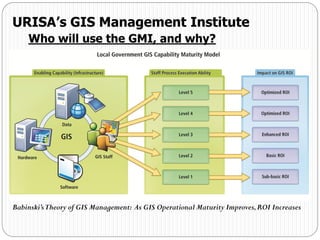
Outcome: URISA’s GIS Capability Maturity Model
 Maturity for the model indicates progression of an organization
towards GIS capability that maximizes:
 Potential for the use of state of the art GIS technology
 Commonly recognized quality data
 Organizational best practices appropriate for municipal business use
 The Municipal GIS Capability Maturity Model assumes two broad
areas of GIS operational development:
 Enabling capability
 Execution process ability
See: URISA Proposes a Local Government GIS Capability Maturity Model:
http://www.esri.com/news/arcnews/winter1011articles/urisa-
proposes.html
URISA’s GIS Management Institute
Originated with basic questions:
 Is there a GIS profession?
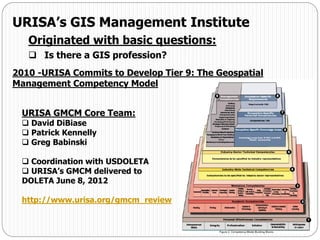
2010 -URISA Commits to Develop Tier 9: The Geospatial
Management Competency Model
URISA GMCM Core Team:
 David DiBiase
 Patrick Kennelly
 Greg Babinski
 Coordination with USDOLETA
 URISA’s GMCM delivered to
DOLETA June 8, 2012
http://www.urisa.org/gmcm_review
URISA’s GIS Management Institute
Originated with basic questions:
 Is there a GIS profession?
 What is the GIS Profession’s Moral Imperative?
 Does GIS provide value to society?
Is There a GIS Profession?
ArcNews, Summer 2012: Strengthening the GIS Profession, by
David DiBiase
What is the Moral Imperative of the GIS Profession?
The GIS profession uses geographic theory, spatial analysis, and
geospatial technology to help society manage the Earth’s finite space,
with its natural resources and communities, on a just and sustainable
basis for the benefit of humanity.
Does GIS Provide Value to Society?
ArcNews, Summer 2012: King County Documents ROI of GIS
(minimum $776 million net benefit over 18 years, $87 million
in 2010)
http://www.esri.com/news/arcnews/index.html
 GIS operations are maturing – or they should be
 GIS operations manage large capital investments
 GIS operations require large operating budgets
 GIS is a proven technology for effective municipal
administration (standard of care)
 GIS operations deliver huge returns on investment
 Local agency leaders and managers must deploy GIS for
cost-effective government services (and to comply with the
standard of care)
 Geospatial technology is complex, continues to evolve, and
continues to provide new opportunities
 The management of municipal GIS operations is complex,
evolving, and requires a scientific, professional approach
URISA’s GIS Management Institute
What is the Business Need?
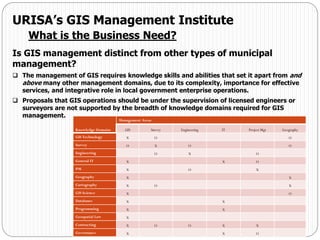
Is GIS management distinct from other types of municipal
management?
 The management of GIS requires knowledge skills and abilities that set it apart from and
above many other management domains, due to its complexity, importance for effective
services, and integrative role in local government enterprise operations.
 Proposals that GIS operations should be under the supervision of licensed engineers or
surveyors are not supported by the breadth of knowledge domains required for GIS
management.
URISA’s GIS Management Institute
What is the Business Need?
Knowledge Domains
Management Areas
GIS Survey Engineering IT Project Mgt Geography
GIS Technology X O O
Survey O X O O
Engineering O X O
General IT X X O
PM X O X
Geography X X
Cartography X O X
GIS Science X O
Databases X X
Programming X X
Geospatial Law X
Contracting X O O X X
Governance X X O
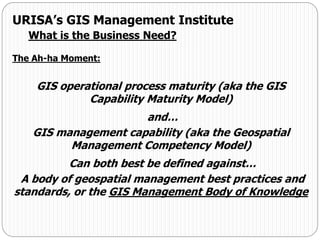
The Ah-ha Moment:
GIS operational process maturity (aka the GIS
Capability Maturity Model)
and…
GIS management capability (aka the Geospatial
Management Competency Model)
Can both best be defined against…
A body of geospatial management best practices and
standards, or the GIS Management Body of Knowledge
URISA’s GIS Management Institute
What is the Business Need?
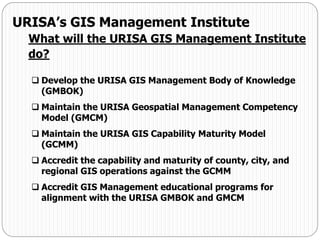
 Develop the URISA GIS Management Body of Knowledge
(GMBOK)
 Maintain the URISA Geospatial Management Competency
Model (GMCM)
 Maintain the URISA GIS Capability Maturity Model
(GCMM)
 Accredit the capability and maturity of county, city, and
regional GIS operations against the GCMM
 Accredit GIS Management educational programs for
alignment with the URISA GMBOK and GMCM
URISA’s GIS Management Institute
What will the URISA GIS Management Institute
do?
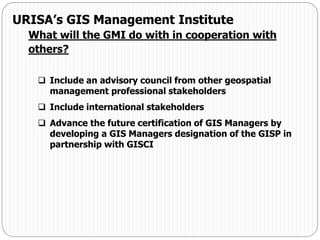
 Include an advisory council from other geospatial
management professional stakeholders
 Include international stakeholders
 Advance the future certification of GIS Managers by
developing a GIS Managers designation of the GISP in
partnership with GISCI
URISA’s GIS Management Institute
What will the GMI do with in cooperation with
others?
 URISA developed and launched GISCI
 URISA developed and manages GISCorps
 URISA has 50 years of study, experience & intellectual
capital related to GIS development and management
 URISA has a portfolio of publications and educational
offerings, including the ULA, that can be aligned to
support GIS management
 URISA has a history of 31 years of ESIG awards that
form an initial resource for recognizing GIS
management best practices
 URISA has designated the development of the GIS
Management Institute as a priority initiative
URISA’s GIS Management Institute
Why URISA?
URISA’s GIS Management Institute
Who will use the GMI, and why?
Babinski’sTheory of GIS Management: As GIS Operational Maturity Improves,ROI Increases
 GIS Managers – to assess their competency against the GMCM and
GMBOK and plan their professional development
 Organizations with GIS Operations – to assess their capability and
process maturity against peer agencies and by becoming GMI
accredited against the GMBOK via the GCMM
 Geospatial professionals – to assess and align their own practices
against the GMBOK
 GIS management educational programs – to assess and refine their
curriculum by becoming GMI accredited against the GMBOK, GMCM
& GCMM
 GIS management consultants – to assess and refine their practices
against the GMBOK, GMCM & GCMM
 In the future, GIS managers will use GMI products and services to
prepare for achieving a GISP manager designation through GISCI
URISA’s GIS Management Institute
Who will use the GMI, and why?
URISA’s GIS Management Institute
How will the GMI Operate?
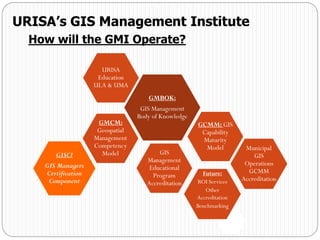
GMBOK:
GIS Management
Body of Knowledge
Municipal
GIS
Operations
GCMM
Accreditation
GCMM: GIS
Capability
Maturity
Model
URISA
Education
ULA & UMA
GIS
Management
Educational
Program
Accreditation
GISCI
GIS Managers
Certification
Component
GMCM:
Geospatial
Management
Competency
Model
Future:
ROI Services
Other
Accreditation
Benchmarking
 An operational program of URISA
 Possible 501(c)(6) status
 Under the management of a geospatial
management professional
 Broad geospatial advisory council
 After initial development, sustained via GMBOK
subscriptions & GMI accreditation fees
 URISA priority initiative
URISA’s GIS Management Institute
How will the GMI Operate?
URISA’s GIS Management Institute
Questions, Comments, Suggestions?
 Q: Why an ‘Institute’?
A: An authoritative organization, based on research, for the
promotion of best practices in geospatial management.
 Q: Why ‘accreditation’?
A: GMI accreditation recognizes the standards and practices of
organizations, while GISCI certification recognizes the skills of
individuals
Greg Babinski, MA, GISP
URISA President
SUMMIT Chief Editor
Finance & Marketing Manager
King County GIS Center
201 South Jackson Street, Suite 706
Seattle, WA 98104
206-263-3753
greg.babinski@kingcounty.gov
www.kingcounty.gov/gis

URISA’s GIS Management Institute

  • 1.
    Greg Babinski, MA,GISP Finance & Marketing Manager King County GIS Center Seattle, WA URISA President Summit Chief Editor URISA’s GIS Management Institute Esri Annual User Conference San Diego, California - July 24, 2012
  • 2.
    Origins and whyfocus on GIS management? What is the business need? What will the GMI do? What will the GMI do in cooperation with others? Why URISA? Who will use the GMI and why? How will the GMI operate? Questions and suggestions? URISA’s GIS Management Institute
  • 3.
    URISA’s GIS ManagementInstitute Originated with basic questions:  What causes variation in municipal GIS operations?  Why do some GIS operations fail?  Each municipality is unique  City and county business focus often varies  Population  Nature and level of economic development  GIS development history and funding  GIS operational budget and staffing  GIS strategic plan  Municipality’s institutional expectations  GIS operational vision – or lack of vision?
  • 4.
    URISA’s GIS ManagementInstitute Originated with basic questions:  What causes variation in municipal GIS operations?  Why do some GIS operations fail? Outcome: URISA’s GIS Capability Maturity Model  Maturity for the model indicates progression of an organization towards GIS capability that maximizes:  Potential for the use of state of the art GIS technology  Commonly recognized quality data  Organizational best practices appropriate for municipal business use  The Municipal GIS Capability Maturity Model assumes two broad areas of GIS operational development:  Enabling capability  Execution process ability See: URISA Proposes a Local Government GIS Capability Maturity Model: http://www.esri.com/news/arcnews/winter1011articles/urisa- proposes.html
  • 5.
    URISA’s GIS ManagementInstitute Originated with basic questions:  Is there a GIS profession? 2010 -URISA Commits to Develop Tier 9: The Geospatial Management Competency Model URISA GMCM Core Team:  David DiBiase  Patrick Kennelly  Greg Babinski  Coordination with USDOLETA  URISA’s GMCM delivered to DOLETA June 8, 2012 http://www.urisa.org/gmcm_review
  • 6.
    URISA’s GIS ManagementInstitute Originated with basic questions:  Is there a GIS profession?  What is the GIS Profession’s Moral Imperative?  Does GIS provide value to society? Is There a GIS Profession? ArcNews, Summer 2012: Strengthening the GIS Profession, by David DiBiase What is the Moral Imperative of the GIS Profession? The GIS profession uses geographic theory, spatial analysis, and geospatial technology to help society manage the Earth’s finite space, with its natural resources and communities, on a just and sustainable basis for the benefit of humanity. Does GIS Provide Value to Society? ArcNews, Summer 2012: King County Documents ROI of GIS (minimum $776 million net benefit over 18 years, $87 million in 2010) http://www.esri.com/news/arcnews/index.html
  • 7.
     GIS operationsare maturing – or they should be  GIS operations manage large capital investments  GIS operations require large operating budgets  GIS is a proven technology for effective municipal administration (standard of care)  GIS operations deliver huge returns on investment  Local agency leaders and managers must deploy GIS for cost-effective government services (and to comply with the standard of care)  Geospatial technology is complex, continues to evolve, and continues to provide new opportunities  The management of municipal GIS operations is complex, evolving, and requires a scientific, professional approach URISA’s GIS Management Institute What is the Business Need?
  • 8.
    Is GIS managementdistinct from other types of municipal management?  The management of GIS requires knowledge skills and abilities that set it apart from and above many other management domains, due to its complexity, importance for effective services, and integrative role in local government enterprise operations.  Proposals that GIS operations should be under the supervision of licensed engineers or surveyors are not supported by the breadth of knowledge domains required for GIS management. URISA’s GIS Management Institute What is the Business Need? Knowledge Domains Management Areas GIS Survey Engineering IT Project Mgt Geography GIS Technology X O O Survey O X O O Engineering O X O General IT X X O PM X O X Geography X X Cartography X O X GIS Science X O Databases X X Programming X X Geospatial Law X Contracting X O O X X Governance X X O
  • 9.
    The Ah-ha Moment: GISoperational process maturity (aka the GIS Capability Maturity Model) and… GIS management capability (aka the Geospatial Management Competency Model) Can both best be defined against… A body of geospatial management best practices and standards, or the GIS Management Body of Knowledge URISA’s GIS Management Institute What is the Business Need?
  • 10.
     Develop theURISA GIS Management Body of Knowledge (GMBOK)  Maintain the URISA Geospatial Management Competency Model (GMCM)  Maintain the URISA GIS Capability Maturity Model (GCMM)  Accredit the capability and maturity of county, city, and regional GIS operations against the GCMM  Accredit GIS Management educational programs for alignment with the URISA GMBOK and GMCM URISA’s GIS Management Institute What will the URISA GIS Management Institute do?
  • 11.
     Include anadvisory council from other geospatial management professional stakeholders  Include international stakeholders  Advance the future certification of GIS Managers by developing a GIS Managers designation of the GISP in partnership with GISCI URISA’s GIS Management Institute What will the GMI do with in cooperation with others?
  • 12.
     URISA developedand launched GISCI  URISA developed and manages GISCorps  URISA has 50 years of study, experience & intellectual capital related to GIS development and management  URISA has a portfolio of publications and educational offerings, including the ULA, that can be aligned to support GIS management  URISA has a history of 31 years of ESIG awards that form an initial resource for recognizing GIS management best practices  URISA has designated the development of the GIS Management Institute as a priority initiative URISA’s GIS Management Institute Why URISA?
  • 13.
    URISA’s GIS ManagementInstitute Who will use the GMI, and why? Babinski’sTheory of GIS Management: As GIS Operational Maturity Improves,ROI Increases
  • 14.
     GIS Managers– to assess their competency against the GMCM and GMBOK and plan their professional development  Organizations with GIS Operations – to assess their capability and process maturity against peer agencies and by becoming GMI accredited against the GMBOK via the GCMM  Geospatial professionals – to assess and align their own practices against the GMBOK  GIS management educational programs – to assess and refine their curriculum by becoming GMI accredited against the GMBOK, GMCM & GCMM  GIS management consultants – to assess and refine their practices against the GMBOK, GMCM & GCMM  In the future, GIS managers will use GMI products and services to prepare for achieving a GISP manager designation through GISCI URISA’s GIS Management Institute Who will use the GMI, and why?
  • 15.
    URISA’s GIS ManagementInstitute How will the GMI Operate? GMBOK: GIS Management Body of Knowledge Municipal GIS Operations GCMM Accreditation GCMM: GIS Capability Maturity Model URISA Education ULA & UMA GIS Management Educational Program Accreditation GISCI GIS Managers Certification Component GMCM: Geospatial Management Competency Model Future: ROI Services Other Accreditation Benchmarking
  • 16.
     An operationalprogram of URISA  Possible 501(c)(6) status  Under the management of a geospatial management professional  Broad geospatial advisory council  After initial development, sustained via GMBOK subscriptions & GMI accreditation fees  URISA priority initiative URISA’s GIS Management Institute How will the GMI Operate?
  • 17.
    URISA’s GIS ManagementInstitute Questions, Comments, Suggestions?  Q: Why an ‘Institute’? A: An authoritative organization, based on research, for the promotion of best practices in geospatial management.  Q: Why ‘accreditation’? A: GMI accreditation recognizes the standards and practices of organizations, while GISCI certification recognizes the skills of individuals
  • 18.
    Greg Babinski, MA,GISP URISA President SUMMIT Chief Editor Finance & Marketing Manager King County GIS Center 201 South Jackson Street, Suite 706 Seattle, WA 98104 206-263-3753 greg.babinski@kingcounty.gov www.kingcounty.gov/gis