URBAN.AG
simple, sustainable rooftop agriculture
             @urbandotag
URBAN.AG
Rooftop farming in the heart of urban
centers.

Sustainable, efficient design keeps costs
incredibly low, and yields incredibly high.
SNAPSHOT
Founders
Chad Etsell - Business Development
Kelly Monaghan - Sustainable Agriculture

Based in Seattle, founded in 2010
Farm outside Olympia, WA


Advisors
Terry Vincent - Founder, Waterworks
Hydroponics
Tom Frye - Partner, Baylis Architects
Dave Goebel - CEO, Methuselah Foundation

Partners
Cedar Grove Compost
Waterworks Hydroponics
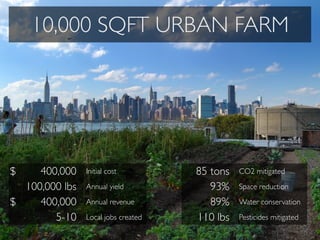
10,000 SQFT URBAN FARM


$
    400,000    Initial cost         85 tons   CO2 mitigated

   100,000 lbs   Annual yield            93%    Space reduction

$
    400,000    Annual revenue          89%    Water conservation

         5-10    Local jobs created   110 lbs   Pesticides mitigated
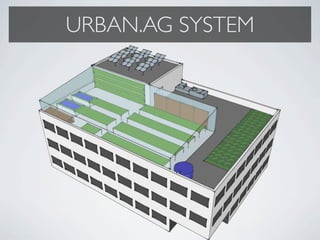
URBAN.AG SYSTEM
MARKET
    Pilot       Pipeline   Beyond

Olympia Farm


  Strip Mall
MILESTONES

Pilot: Olympia farm and greenhouse, online store
MVP: First working rooftop partner
Scale: Profitable online store, new rooftop customers


Regardless of scale (small, medium, or large):
Construction in weeks
Fast harvest that never ends
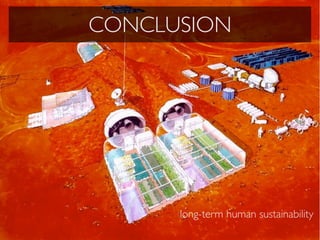
CONCLUSION


      long-term human sustainability
APPENDICES
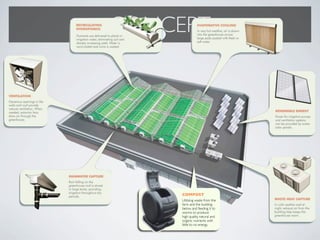
CONCEPT


     COMPOST
     Utilizing waste from the
     farm and the building
     below, and feeding it to
     worms to produce
     high quality, natural and
     organic nutrients with
     little to no energy.
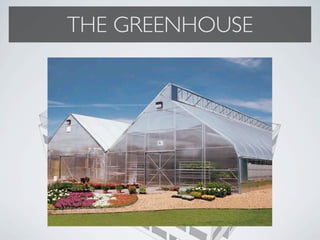
THE GREENHOUSE
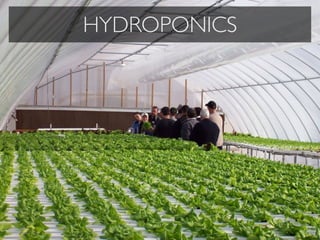
HYDROPONICS
RAIN HARVESTING
COMPOSTING
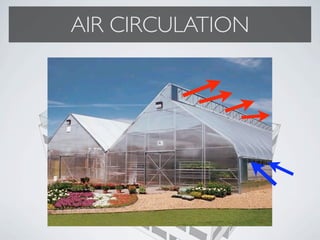
AIR CIRCULATION
RENEWABLE ENERGY
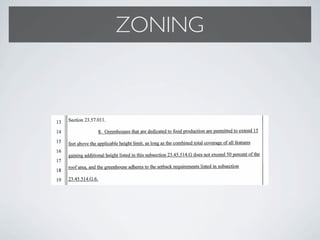
ZONING
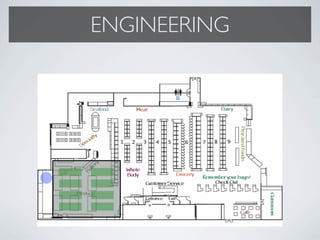
ENGINEERING
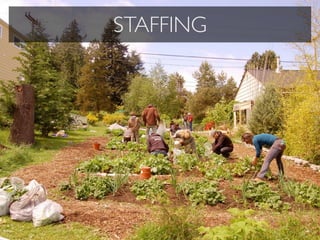
STAFFING
OPERATION
DISTRIBUTION


Farmers


Partners


Shoppers
http://urban.ag/     chad@urban.ag
@urbandotag        angel.co/urban-ag

Urban ag

Editor's Notes

  • #2 \n
  • #3 Image: Sustainable greenhouse farms in urban centers pilot strategies for use in space. Eventually to grow food and supplies on Mars.\n
  • #4 Image: Kelly getting started on the farm\n
  • #5 Image: Eagle St. Farm, Brooklyn\n\nThese numbers scale accordingly both up and down based on size of Greenhouse (can go as small as 1,000, to higher than 40,000 sqft)\n
  • #6 None of this gear is proprietary, rather the execution combines scalability and sustainability\n1. The Greenhouse\n2. Lightweight hydroponic growing\n3. Rainwater harvesting\n4. Composting nutrients\n5. Natural heating and cooling\n6. Renewable energy\n
  • #7 Pilot: our farm is up and running. Soon opening retail space with a greenhouse on the roof.\nPipeline: Local grocery chains in discussions. A tangible proof of concept would be nice.\nBeyond: Further investment, scaling, and R&D.\n
  • #8 Continuous harvest to maximize profitability.\n\nSmall: <$100k - strip mall grocery\nMedium: $200k - urban grocery store\nLarge: $500k - local grocery chain\n
  • #9 In 10 years space travel will be much more accessible, and Mars will not be impossible. For any long-term human action off this planet, we need sustainable sources of food and supplies. \n
  • #10 thank you!\n
  • #11 \n
  • #12 The basic ingredients (Image via Fast Company)\n
  • #13 Versatile sizing\nControlled environment\nNatural, efficient light\n
  • #14 Very efficient systems, utilize less then 10% the water and space of traditional methods.\nHydroponics- nutrient solution runs through tubing to roots\nAeroponics- roots grow in nutrient vapor\nAquaculture- nutrient rich water cycles between crops and fish tanks, constantly fertilized\nDrip irrigation- traditional soil-based medium, with highly-controlled nutrient/water supply\n
  • #15 Uses so little water that it can rely on rain harvesting from greenhouse and roof of building. Reduce/eliminate storm runoff\n
  • #16 Recycle waste from building and surrounding community into nutrients for crops. Rabbits and Earthworms super charge the system without using excess energy\n
  • #17 Evaporative cooling, and energy efficient design keep climate regulated\n
  • #18 We’re already up on the roof, lets put some PV arrays and wind turbines up there for when we do need power.\n
  • #19 Non issue, Seattle loves urban agriculture.\n
  • #20 Work with engineers and contractors to avoid structural problems, build near load bearing sections of the building (in this case, conveniently right above the produce section)\n
  • #21 Seattle has a huge local gardening/farming population.\nP-Patches, organic local farms, immigrant population\n
  • #22 Automation and Analytics keep yields maxed out.\n\n(Screenshot via Growtronix)\n
  • #23 The three key people in our life\nPartners: Give us a rooftop, customer base, and reputation. Gets revenue share, green/local credibility.\nFarmers: Give us skilled labor, and detailed knowledge. Gets steady income, direct relationship with consumers, community.\nShoppers: Give us their money, attention, and referrals. Gets healthy, delicious food in their community.\n
  • #24 \n