Examples from use of Biogas as a Source of Transportation Fuel
Presentation from municipality of Uppsala – Sweden
May 20, 2014
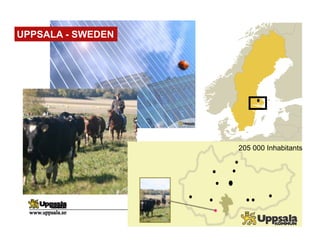
205 000 Inhabitants
UPPSALA - SWEDEN
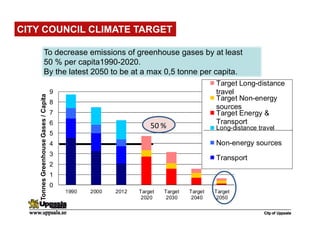
CITY COUNCIL CLIMATE TARGET
To decrease emissions of greenhouse gases by at least
50 % per capita1990-2020.
By the latest 2050 to be at a max 0,5 tonne per capita.
0
1
2
3
4
5
6
7
8
9
1990 2000 2012 Target
2020
Target
2030
Target
2040
Target
2050
TonnesGreenhouseGases/Capita
Target Long-distance
travel
Target Non-energy
sources
Target Energy &
Transport
Long-distance travel
Non-energy sources
Transport
50 %
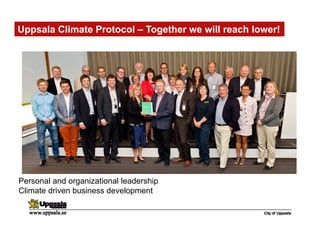
Personal and organizational leadership
Climate driven business development
Uppsala Climate Protocol – Together we will reach lower!
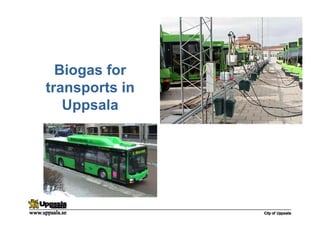
Biogas for
transports in
Uppsala
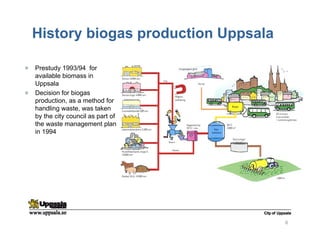
History biogas production Uppsala
Prestudy 1993/94 for
available biomass in
Uppsala
Decision for biogas
production, as a method for
handling waste, was taken
by the city council as part of
the waste management plan
in 1994
6
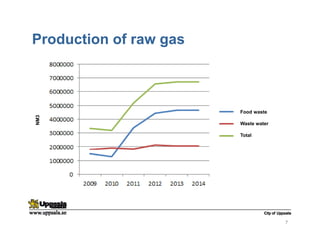
Production of raw gas
7
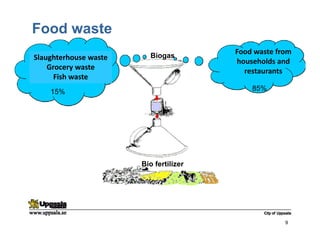
Food waste
Waste water
Total
NM3
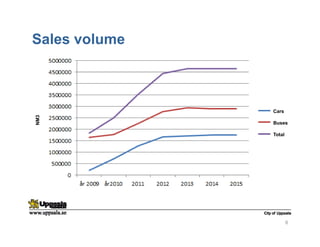
Sales volume
8
Cars
Buses
Total
NM3
9
Bio fertilizer
Biogas
Food waste from 
households and 
restaurants 
85%15%
Slaughterhouse waste 
Grocery waste 
Fish waste
Food waste
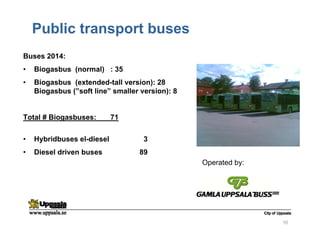
Public transport buses
Buses 2014:
• Biogasbus (normal) : 35
• Biogasbus (extended-tall version): 28
Biogasbus (”soft line” smaller version): 8
Total # Biogasbuses: 71
• Hybridbuses el-diesel 3
• Diesel driven buses 89
10
Operated by:
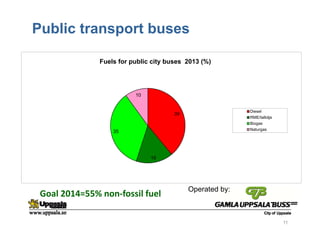
Public transport buses
11
Operated by:
39
16
35
10
Fuels for public city buses 2013 (%)
Diesel
RME/tallolja
Biogas
Naturgas
Goal 2014=55% non‐fossil fuel
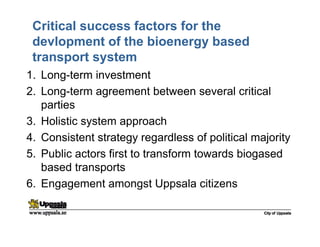
Critical success factors for the
devlopment of the bioenergy based
transport system
1. Long-term investment
2. Long-term agreement between several critical
parties
3. Holistic system approach
4. Consistent strategy regardless of political majority
5. Public actors first to transform towards biogased
based transports
6. Engagement amongst Uppsala citizens
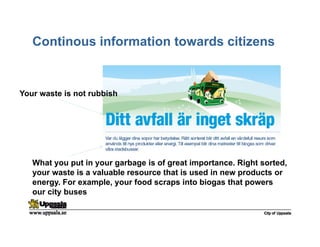
Continous information towards citizens
Your waste is not rubbish
What you put in your garbage is of great importance. Right sorted,
your waste is a valuable resource that is used in new products or
energy. For example, your food scraps into biogas that powers
our city buses
Short term Plans (2014-15) for Biogas
1. Expansion of production plant (new pellet boiler)
2. Further expasion of biobased fuels, phasing out
LNG
3. Complete transfer of waste water resources to
biobased fuels
4. Regional long-term biogas strategy finalized
Challenges going forward towards a
biobased economy
1. Long-term and reliable biomass availability
2. Balance the extraction of biomass without compromising
the environment
3. Long-term profitability for investors
4. Technology development and ability to manage
transformational changes
5. Political decisions on national and EU-level
6. Most effective strategies for biomass usage (food, energy
& material)
7. Handling of the powerful forces that strive to maintain the
status quo
16
Thank you!
Michael Åhlman, City of Uppsala, Executive Office
+46767603403, michael.ahlman@uppsala.se

Uppsala biogas examples_2014_05_a

  • 1.
    Examples from useof Biogas as a Source of Transportation Fuel Presentation from municipality of Uppsala – Sweden May 20, 2014
  • 2.
  • 3.
    CITY COUNCIL CLIMATETARGET To decrease emissions of greenhouse gases by at least 50 % per capita1990-2020. By the latest 2050 to be at a max 0,5 tonne per capita. 0 1 2 3 4 5 6 7 8 9 1990 2000 2012 Target 2020 Target 2030 Target 2040 Target 2050 TonnesGreenhouseGases/Capita Target Long-distance travel Target Non-energy sources Target Energy & Transport Long-distance travel Non-energy sources Transport 50 %
  • 4.
    Personal and organizationalleadership Climate driven business development Uppsala Climate Protocol – Together we will reach lower!
  • 5.
  • 6.
    History biogas productionUppsala Prestudy 1993/94 for available biomass in Uppsala Decision for biogas production, as a method for handling waste, was taken by the city council as part of the waste management plan in 1994 6
  • 7.
    Production of rawgas 7 Food waste Waste water Total NM3
  • 8.
  • 9.
  • 10.
    Public transport buses Buses2014: • Biogasbus (normal) : 35 • Biogasbus (extended-tall version): 28 Biogasbus (”soft line” smaller version): 8 Total # Biogasbuses: 71 • Hybridbuses el-diesel 3 • Diesel driven buses 89 10 Operated by:
  • 11.
    Public transport buses 11 Operatedby: 39 16 35 10 Fuels for public city buses 2013 (%) Diesel RME/tallolja Biogas Naturgas Goal 2014=55% non‐fossil fuel
  • 12.
    Critical success factorsfor the devlopment of the bioenergy based transport system 1. Long-term investment 2. Long-term agreement between several critical parties 3. Holistic system approach 4. Consistent strategy regardless of political majority 5. Public actors first to transform towards biogased based transports 6. Engagement amongst Uppsala citizens
  • 13.
    Continous information towardscitizens Your waste is not rubbish What you put in your garbage is of great importance. Right sorted, your waste is a valuable resource that is used in new products or energy. For example, your food scraps into biogas that powers our city buses
  • 14.
    Short term Plans(2014-15) for Biogas 1. Expansion of production plant (new pellet boiler) 2. Further expasion of biobased fuels, phasing out LNG 3. Complete transfer of waste water resources to biobased fuels 4. Regional long-term biogas strategy finalized
  • 15.
    Challenges going forwardtowards a biobased economy 1. Long-term and reliable biomass availability 2. Balance the extraction of biomass without compromising the environment 3. Long-term profitability for investors 4. Technology development and ability to manage transformational changes 5. Political decisions on national and EU-level 6. Most effective strategies for biomass usage (food, energy & material) 7. Handling of the powerful forces that strive to maintain the status quo
  • 16.
    16 Thank you! Michael Åhlman,City of Uppsala, Executive Office +46767603403, michael.ahlman@uppsala.se