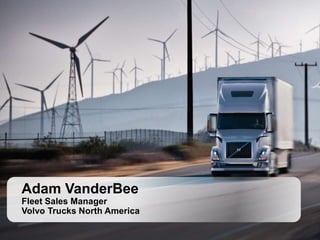
Adam VanderBee
Fleet Sales Manager
Volvo Trucks North America
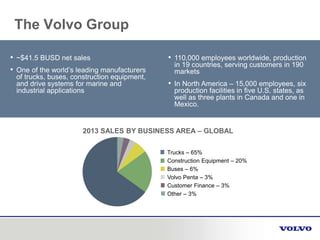
• ~$41.5 BUSD net sales
• One of the world’s leading manufacturers
of trucks, buses, construction equipment,
and drive systems for marine and
industrial applications
• 110,000 employees worldwide, production
in 19 countries, serving customers in 190
markets
• In North America – 15,000 employees, six
production facilities in five U.S. states, as
well as three plants in Canada and one in
Mexico.
Trucks – 65%
Construction Equipment – 20%
Buses – 6%
Volvo Penta – 3%
Customer Finance – 3%
Other – 3%
2013 SALES BY BUSINESS AREA – GLOBAL
The Volvo Group
Environmental Care
We know trucks are part of the
problem; we accept responsibility to
be part of the solution.
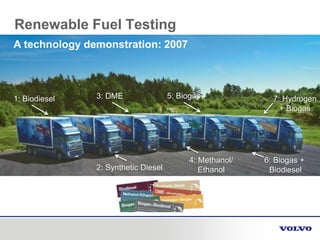
A technology demonstration: 2007
1: Biodiesel
2: Synthetic Diesel
3: DME
4: Methanol/
Ethanol
5: Biogas
6: Biogas +
Biodiesel
7: Hydrogen
+ Biogas
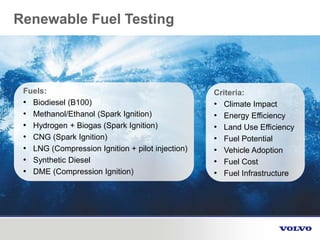
Renewable Fuel Testing
Fuels:
• Biodiesel (B100)
• Methanol/Ethanol (Spark Ignition)
• Hydrogen + Biogas (Spark Ignition)
• CNG (Spark Ignition)
• LNG (Compression Ignition + pilot injection)
• Synthetic Diesel
• DME (Compression Ignition)
Criteria:
• Climate Impact
• Energy Efficiency
• Land Use Efficiency
• Fuel Potential
• Vehicle Adoption
• Fuel Cost
• Fuel Infrastructure
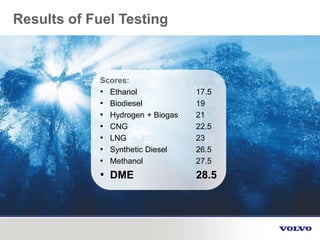
Results of Fuel Testing
Scores:
• Ethanol 17.5
• Biodiesel 19
• Hydrogen + Biogas 21
• CNG 22.5
• LNG 23
• Synthetic Diesel 26.5
• Methanol 27.5
• DME 28.5
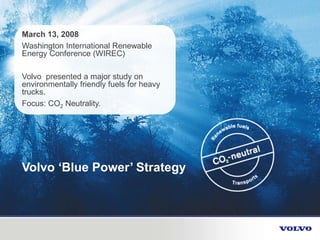
March 13, 2008
Washington International Renewable
Energy Conference (WIREC)
Volvo presented a major study on
environmentally friendly fuels for heavy
trucks.
Focus: CO2 Neutrality.
Volvo ‘Blue Power’ Strategy
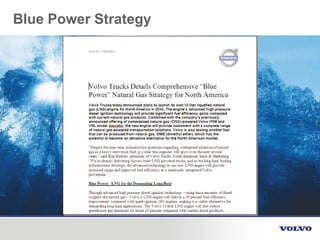
Blue Power Strategy
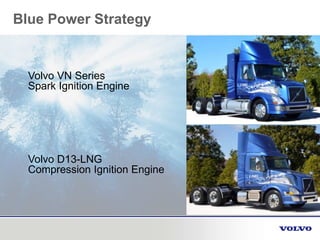
Volvo VN Series
Spark Ignition Engine
Volvo D13-LNG
Compression Ignition Engine
Blue Power Strategy
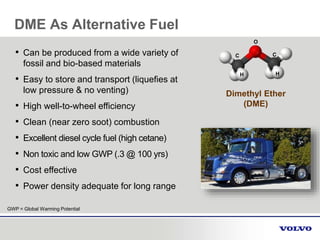
Dimethyl Ether
(DME)
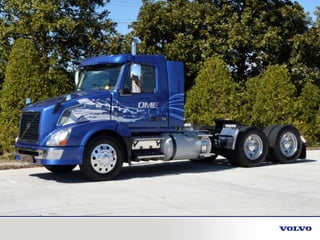
• Can be produced from a wide variety of
fossil and bio-based materials
• Easy to store and transport (liquefies at
low pressure & no venting)
• High well-to-wheel efficiency
• Clean (near zero soot) combustion
• Excellent diesel cycle fuel (high cetane)
• Non toxic and low GWP (.3 @ 100 yrs)
• Cost effective
• Power density adequate for long range
C C
O
H H
GWP = Global Warming Potential
DME As Alternative Fuel
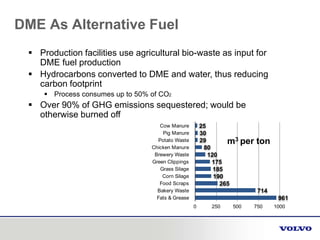
 Production facilities use agricultural bio-waste as input for
DME fuel production
 Hydrocarbons converted to DME and water, thus reducing
carbon footprint
 Process consumes up to 50% of CO2
 Over 90% of GHG emissions sequestered; would be
otherwise burned off
Cow Manure
Pig Manure
Potato Waste
Chicken Manure
Brewery Waste
Green Clippings
Grass Silage
Corn Silage
Food Scraps
Bakery Waste
Fats & Grease
0 250 500 750 1000
961
714
265
190
185
175
120
80
29
30
25
m3 per ton
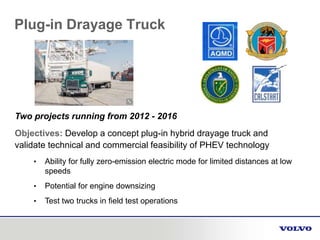
Two projects running from 2012 - 2016
Objectives: Develop a concept plug-in hybrid drayage truck and
validate technical and commercial feasibility of PHEV technology
• Ability for fully zero-emission electric mode for limited distances at low
speeds
• Potential for engine downsizing
• Test two trucks in field test operations
Plug-in Drayage Truck
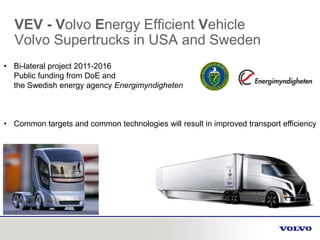
VEV - Volvo Energy Efficient Vehicle
Volvo Supertrucks in USA and Sweden
• Bi-lateral project 2011-2016
Public funding from DoE and
the Swedish energy agency Energimyndigheten
• Common targets and common technologies will result in improved transport efficiency
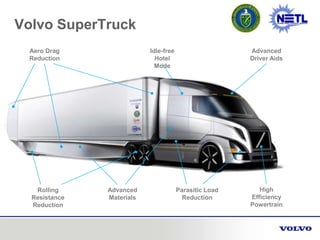
High
Efficiency
Powertrain
Advanced
Driver Aids
Rolling
Resistance
Reduction
Advanced
Materials
Aero Drag
Reduction
Parasitic Load
Reduction
Idle-free
Hotel
Mode
Volvo SuperTruck
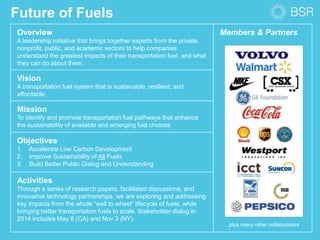
Overview
A leadership initiative that brings together experts from the private,
nonprofit, public, and academic sectors to help companies
understand the greatest impacts of their transportation fuel, and what
they can do about them.
Members & Partners
Vision
A transportation fuel system that is sustainable, resilient, and
affordable.
Mission
To identify and promote transportation fuel pathways that enhance
the sustainability of available and emerging fuel choices
Objectives
1. Accelerate Low Carbon Development
2. Improve Sustainability of All Fuels
3. Build Better Public Dialog and Understanding
Activities
Through a series of research papers, facilitated discussions, and
innovative technology partnerships, we are exploring and addressing
key impacts from the whole “well to wheel” lifecycle of fuels, while
bringing better transportation fuels to scale. Stakeholder dialog in
2014 includes May 8 (CA) and Nov 3 (NY).
Future of Fuels
..plus many other collaborators
Adam VanderBee
Fleet Sales Manager
Volvo Trucks North America
Telephone: (312) 433 9467
Email: Adam.VanderBee@volvo.com

Sustainability seminar volvo

  • 1.
    Adam VanderBee Fleet SalesManager Volvo Trucks North America
  • 2.
    • ~$41.5 BUSDnet sales • One of the world’s leading manufacturers of trucks, buses, construction equipment, and drive systems for marine and industrial applications • 110,000 employees worldwide, production in 19 countries, serving customers in 190 markets • In North America – 15,000 employees, six production facilities in five U.S. states, as well as three plants in Canada and one in Mexico. Trucks – 65% Construction Equipment – 20% Buses – 6% Volvo Penta – 3% Customer Finance – 3% Other – 3% 2013 SALES BY BUSINESS AREA – GLOBAL The Volvo Group
  • 3.
    Environmental Care We knowtrucks are part of the problem; we accept responsibility to be part of the solution.
  • 4.
    A technology demonstration:2007 1: Biodiesel 2: Synthetic Diesel 3: DME 4: Methanol/ Ethanol 5: Biogas 6: Biogas + Biodiesel 7: Hydrogen + Biogas Renewable Fuel Testing
  • 5.
    Renewable Fuel Testing Fuels: •Biodiesel (B100) • Methanol/Ethanol (Spark Ignition) • Hydrogen + Biogas (Spark Ignition) • CNG (Spark Ignition) • LNG (Compression Ignition + pilot injection) • Synthetic Diesel • DME (Compression Ignition) Criteria: • Climate Impact • Energy Efficiency • Land Use Efficiency • Fuel Potential • Vehicle Adoption • Fuel Cost • Fuel Infrastructure
  • 6.
    Results of FuelTesting Scores: • Ethanol 17.5 • Biodiesel 19 • Hydrogen + Biogas 21 • CNG 22.5 • LNG 23 • Synthetic Diesel 26.5 • Methanol 27.5 • DME 28.5
  • 7.
    March 13, 2008 WashingtonInternational Renewable Energy Conference (WIREC) Volvo presented a major study on environmentally friendly fuels for heavy trucks. Focus: CO2 Neutrality. Volvo ‘Blue Power’ Strategy
  • 8.
  • 9.
    Volvo VN Series SparkIgnition Engine Volvo D13-LNG Compression Ignition Engine Blue Power Strategy
  • 11.
    Dimethyl Ether (DME) • Canbe produced from a wide variety of fossil and bio-based materials • Easy to store and transport (liquefies at low pressure & no venting) • High well-to-wheel efficiency • Clean (near zero soot) combustion • Excellent diesel cycle fuel (high cetane) • Non toxic and low GWP (.3 @ 100 yrs) • Cost effective • Power density adequate for long range C C O H H GWP = Global Warming Potential DME As Alternative Fuel
  • 12.
    DME As AlternativeFuel  Production facilities use agricultural bio-waste as input for DME fuel production  Hydrocarbons converted to DME and water, thus reducing carbon footprint  Process consumes up to 50% of CO2  Over 90% of GHG emissions sequestered; would be otherwise burned off Cow Manure Pig Manure Potato Waste Chicken Manure Brewery Waste Green Clippings Grass Silage Corn Silage Food Scraps Bakery Waste Fats & Grease 0 250 500 750 1000 961 714 265 190 185 175 120 80 29 30 25 m3 per ton
  • 13.
    Two projects runningfrom 2012 - 2016 Objectives: Develop a concept plug-in hybrid drayage truck and validate technical and commercial feasibility of PHEV technology • Ability for fully zero-emission electric mode for limited distances at low speeds • Potential for engine downsizing • Test two trucks in field test operations Plug-in Drayage Truck
  • 14.
    VEV - VolvoEnergy Efficient Vehicle Volvo Supertrucks in USA and Sweden • Bi-lateral project 2011-2016 Public funding from DoE and the Swedish energy agency Energimyndigheten • Common targets and common technologies will result in improved transport efficiency
  • 15.
  • 16.
    Overview A leadership initiativethat brings together experts from the private, nonprofit, public, and academic sectors to help companies understand the greatest impacts of their transportation fuel, and what they can do about them. Members & Partners Vision A transportation fuel system that is sustainable, resilient, and affordable. Mission To identify and promote transportation fuel pathways that enhance the sustainability of available and emerging fuel choices Objectives 1. Accelerate Low Carbon Development 2. Improve Sustainability of All Fuels 3. Build Better Public Dialog and Understanding Activities Through a series of research papers, facilitated discussions, and innovative technology partnerships, we are exploring and addressing key impacts from the whole “well to wheel” lifecycle of fuels, while bringing better transportation fuels to scale. Stakeholder dialog in 2014 includes May 8 (CA) and Nov 3 (NY). Future of Fuels ..plus many other collaborators
  • 17.
    Adam VanderBee Fleet SalesManager Volvo Trucks North America Telephone: (312) 433 9467 Email: Adam.VanderBee@volvo.com