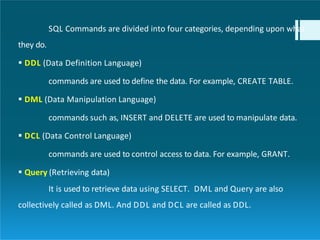
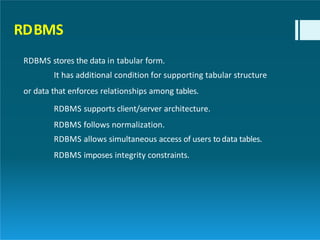
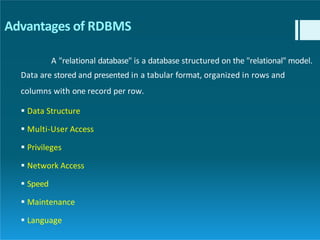
This document provides an overview of relational database management systems (RDBMS). It defines what an RDBMS is, how data is structured in tables with rows and columns, and how relational algebra and SQL are used to manipulate the data. The key differences between RDBMS and traditional DBMS are described, such as how RDBMS supports normalization, integrity constraints, and client/server architecture. Advantages of using an RDBMS include its data structure, support for multiple users, privileges, network access, speed, ease of maintenance, and use of SQL as a standard language.