Equity / Fairness Within Conservation
-
R2P Workshop 2015
Update for UPCLG
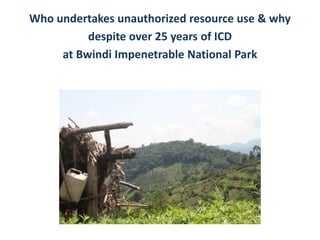
Who undertakes unauthorized resource use & why
despite over 25 years of ICD
at Bwindi Impenetrable National Park
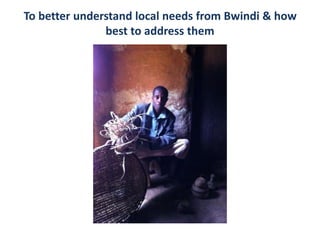
To better understand local needs from Bwindi & how
best to address them
Enhancing Equity / Fairness
• The R2P Research shed new light on drivers of
unauthorised resource use
• Poverty is a major issue
• But it is only half of the story
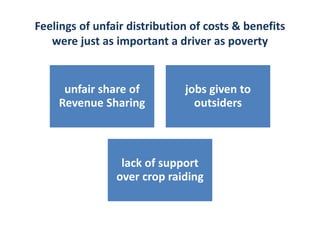
Feelings of unfair distribution of costs & benefits
were just as important a driver as poverty
unfair share of
Revenue Sharing
jobs given to
outsiders
lack of support
over crop raiding
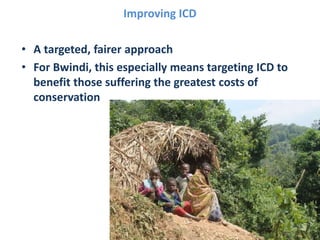
Improving ICD
• A targeted, fairer approach
• For Bwindi, this especially means targeting ICD to
benefit those suffering the greatest costs of
conservation
Equitable / Fair Conservation
• A workshop with UWA, Conservation Practitioners,
Local Govt, Community Representatives
• Objectives:
– Raise awareness of key research findings from R2P project
– Explore different views on fairness / equity in
conservation
– Develop and agree ideas for making Revenue Sharing
more equitable and fair
Exploring Different Views on Equity / Fair
Conservation
Exploring Views
• What does equitable / fair or inequitable / unfair
conservation mean to you – explain this as general
principles or specific examples
• Why is equity / fairness important for communities
and conservation?
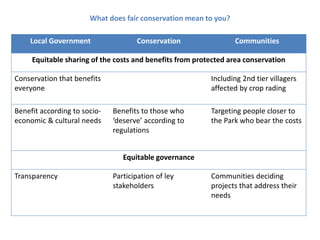
Local Government Conservation Communities
Equitable sharing of the costs and benefits from protected area conservation
Conservation that benefits
everyone
Including 2nd tier villagers
affected by crop rading
Benefit according to socio-
economic & cultural needs
Benefits to those who
‘deserve’ according to
regulations
Targeting people closer to
the Park who bear the costs
Equitable governance
Transparency Participation of ley
stakeholders
Communities deciding
projects that address their
needs
What does fair conservation mean to you?
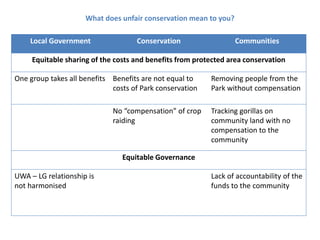
Local Government Conservation Communities
Equitable sharing of the costs and benefits from protected area conservation
One group takes all benefits Benefits are not equal to
costs of Park conservation
Removing people from the
Park without compensation
No “compensation” of crop
raiding
Tracking gorillas on
community land with no
compensation to the
community
Equitable Governance
UWA – LG relationship is
not harmonised
Lack of accountability of the
funds to the community
What does unfair conservation mean to you?
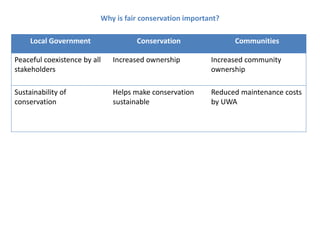
Local Government Conservation Communities
Peaceful coexistence by all
stakeholders
Increased ownership Increased community
ownership
Sustainability of
conservation
Helps make conservation
sustainable
Reduced maintenance costs
by UWA
Why is fair conservation important?
Develop and agree ideas for making Revenue Sharing
more equitable and fair
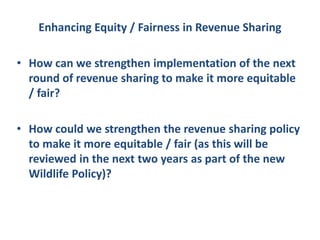
Enhancing Equity / Fairness in Revenue Sharing
• How can we strengthen implementation of the next
round of revenue sharing to make it more equitable
/ fair?
• How could we strengthen the revenue sharing policy
to make it more equitable / fair (as this will be
reviewed in the next two years as part of the new
Wildlife Policy)?
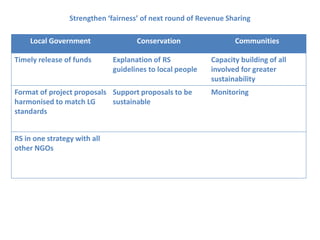
Local Government Conservation Communities
Timely release of funds Explanation of RS
guidelines to local people
Capacity building of all
involved for greater
sustainability
Format of project proposals
harmonised to match LG
standards
Support proposals to be
sustainable
Monitoring
RS in one strategy with all
other NGOs
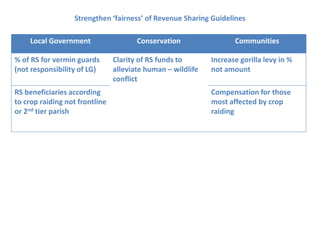
Strengthen ‘fairness’ of next round of Revenue Sharing
Local Government Conservation Communities
% of RS for vermin guards
(not responsibility of LG)
Clarity of RS funds to
alleviate human – wildlife
conflict
Increase gorilla levy in %
not amount
RS beneficiaries according
to crop raiding not frontline
or 2nd tier parish
Compensation for those
most affected by crop
raiding
Strengthen ‘fairness’ of Revenue Sharing Guidelines
Equity / Fairness Within Conservation
-
R2P Workshop 2015
ICD Guidance
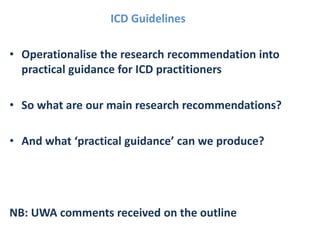
ICD Guidelines
• Operationalise the research recommendation into
practical guidance for ICD practitioners
• So what are our main research recommendations?
• And what ‘practical guidance’ can we produce?
NB: UWA comments received on the outline
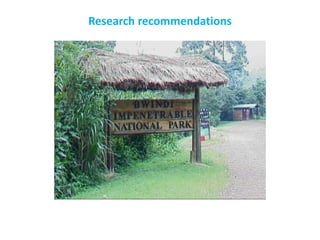
Research recommendations
Resource Users
• Understand the “who & why” of unauthorized
resource use to better target ICD interventions
• Fundamentally this involves understanding those
bearing the greatest cost of conservation
• Improving ICD: a more targeted, equitable
approaches
Governance
• Enabling local voices in decision-making
• How do local people define “participation”?
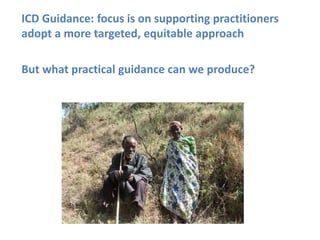
ICD Guidance: focus is on supporting practitioners
adopt a more targeted, equitable approach
But what practical guidance can we produce?
ICD Guidance - Part 1 definitions & information
• Summary of Bwindi research
• Key concepts of ICD & the ICD concept
• Legal & institutional frameworks supporting ICD in
Uganda
• Evidence of what works
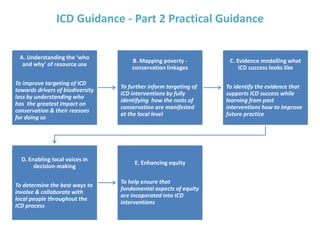
ICD Guidance - Part 2 Practical Guidance
A. Understanding the ‘who
and why’ of resource use
To improve targeting of ICD
towards drivers of biodiversity
loss by understanding who
has the greatest impact on
conservation & their reasons
for doing so
B. Mapping poverty -
conservation linkages
To further inform targeting of
ICD interventions by fully
identifying how the costs of
conservation are manifested
at the local level
C. Evidence modelling what
ICD success looks like
To identify the evidence that
supports ICD success while
learning from past
interventions how to improve
future practice
D. Enabling local voices in
decision-making
To determine the best ways to
involve & collaborate with
local people throughout the
ICD process
E. Enhancing equity
To help ensure that
fundamental aspects of equity
are incoporated into ICD
interventions
ICD Guidance – Your Comments!
Technical aspects
• Technically robust?
• Any gaps?
Usefulness of the practical guidance sheets
• Are the sheets practically useful?
• Any improvements?

U-PCLG update from equity workshop January 2015

  • 1.
    Equity / FairnessWithin Conservation - R2P Workshop 2015 Update for UPCLG
  • 2.
    Who undertakes unauthorizedresource use & why despite over 25 years of ICD at Bwindi Impenetrable National Park
  • 3.
    To better understandlocal needs from Bwindi & how best to address them
  • 4.
    Enhancing Equity /Fairness • The R2P Research shed new light on drivers of unauthorised resource use • Poverty is a major issue • But it is only half of the story
  • 5.
    Feelings of unfairdistribution of costs & benefits were just as important a driver as poverty unfair share of Revenue Sharing jobs given to outsiders lack of support over crop raiding
  • 6.
    Improving ICD • Atargeted, fairer approach • For Bwindi, this especially means targeting ICD to benefit those suffering the greatest costs of conservation
  • 7.
    Equitable / FairConservation • A workshop with UWA, Conservation Practitioners, Local Govt, Community Representatives • Objectives: – Raise awareness of key research findings from R2P project – Explore different views on fairness / equity in conservation – Develop and agree ideas for making Revenue Sharing more equitable and fair
  • 8.
    Exploring Different Viewson Equity / Fair Conservation
  • 9.
    Exploring Views • Whatdoes equitable / fair or inequitable / unfair conservation mean to you – explain this as general principles or specific examples • Why is equity / fairness important for communities and conservation?
  • 10.
    Local Government ConservationCommunities Equitable sharing of the costs and benefits from protected area conservation Conservation that benefits everyone Including 2nd tier villagers affected by crop rading Benefit according to socio- economic & cultural needs Benefits to those who ‘deserve’ according to regulations Targeting people closer to the Park who bear the costs Equitable governance Transparency Participation of ley stakeholders Communities deciding projects that address their needs What does fair conservation mean to you?
  • 11.
    Local Government ConservationCommunities Equitable sharing of the costs and benefits from protected area conservation One group takes all benefits Benefits are not equal to costs of Park conservation Removing people from the Park without compensation No “compensation” of crop raiding Tracking gorillas on community land with no compensation to the community Equitable Governance UWA – LG relationship is not harmonised Lack of accountability of the funds to the community What does unfair conservation mean to you?
  • 12.
    Local Government ConservationCommunities Peaceful coexistence by all stakeholders Increased ownership Increased community ownership Sustainability of conservation Helps make conservation sustainable Reduced maintenance costs by UWA Why is fair conservation important?
  • 13.
    Develop and agreeideas for making Revenue Sharing more equitable and fair
  • 14.
    Enhancing Equity /Fairness in Revenue Sharing • How can we strengthen implementation of the next round of revenue sharing to make it more equitable / fair? • How could we strengthen the revenue sharing policy to make it more equitable / fair (as this will be reviewed in the next two years as part of the new Wildlife Policy)?
  • 15.
    Local Government ConservationCommunities Timely release of funds Explanation of RS guidelines to local people Capacity building of all involved for greater sustainability Format of project proposals harmonised to match LG standards Support proposals to be sustainable Monitoring RS in one strategy with all other NGOs Strengthen ‘fairness’ of next round of Revenue Sharing
  • 16.
    Local Government ConservationCommunities % of RS for vermin guards (not responsibility of LG) Clarity of RS funds to alleviate human – wildlife conflict Increase gorilla levy in % not amount RS beneficiaries according to crop raiding not frontline or 2nd tier parish Compensation for those most affected by crop raiding Strengthen ‘fairness’ of Revenue Sharing Guidelines
  • 17.
    Equity / FairnessWithin Conservation - R2P Workshop 2015 ICD Guidance
  • 18.
    ICD Guidelines • Operationalisethe research recommendation into practical guidance for ICD practitioners • So what are our main research recommendations? • And what ‘practical guidance’ can we produce? NB: UWA comments received on the outline
  • 19.
  • 20.
    Resource Users • Understandthe “who & why” of unauthorized resource use to better target ICD interventions • Fundamentally this involves understanding those bearing the greatest cost of conservation • Improving ICD: a more targeted, equitable approaches
  • 21.
    Governance • Enabling localvoices in decision-making • How do local people define “participation”?
  • 22.
    ICD Guidance: focusis on supporting practitioners adopt a more targeted, equitable approach But what practical guidance can we produce?
  • 23.
    ICD Guidance -Part 1 definitions & information • Summary of Bwindi research • Key concepts of ICD & the ICD concept • Legal & institutional frameworks supporting ICD in Uganda • Evidence of what works
  • 24.
    ICD Guidance -Part 2 Practical Guidance A. Understanding the ‘who and why’ of resource use To improve targeting of ICD towards drivers of biodiversity loss by understanding who has the greatest impact on conservation & their reasons for doing so B. Mapping poverty - conservation linkages To further inform targeting of ICD interventions by fully identifying how the costs of conservation are manifested at the local level C. Evidence modelling what ICD success looks like To identify the evidence that supports ICD success while learning from past interventions how to improve future practice D. Enabling local voices in decision-making To determine the best ways to involve & collaborate with local people throughout the ICD process E. Enhancing equity To help ensure that fundamental aspects of equity are incoporated into ICD interventions
  • 25.
    ICD Guidance –Your Comments! Technical aspects • Technically robust? • Any gaps? Usefulness of the practical guidance sheets • Are the sheets practically useful? • Any improvements?