UOP MKT 571 Final Exam Guide (New, 2018) NEW
Check this A+ tutorial guideline at
http://www.assignmentcloud.com/mkt-571-
uop/mkt-571-final-exam-guide-new-2018-
new
For more classes visit
http://www.uopassignments.com/
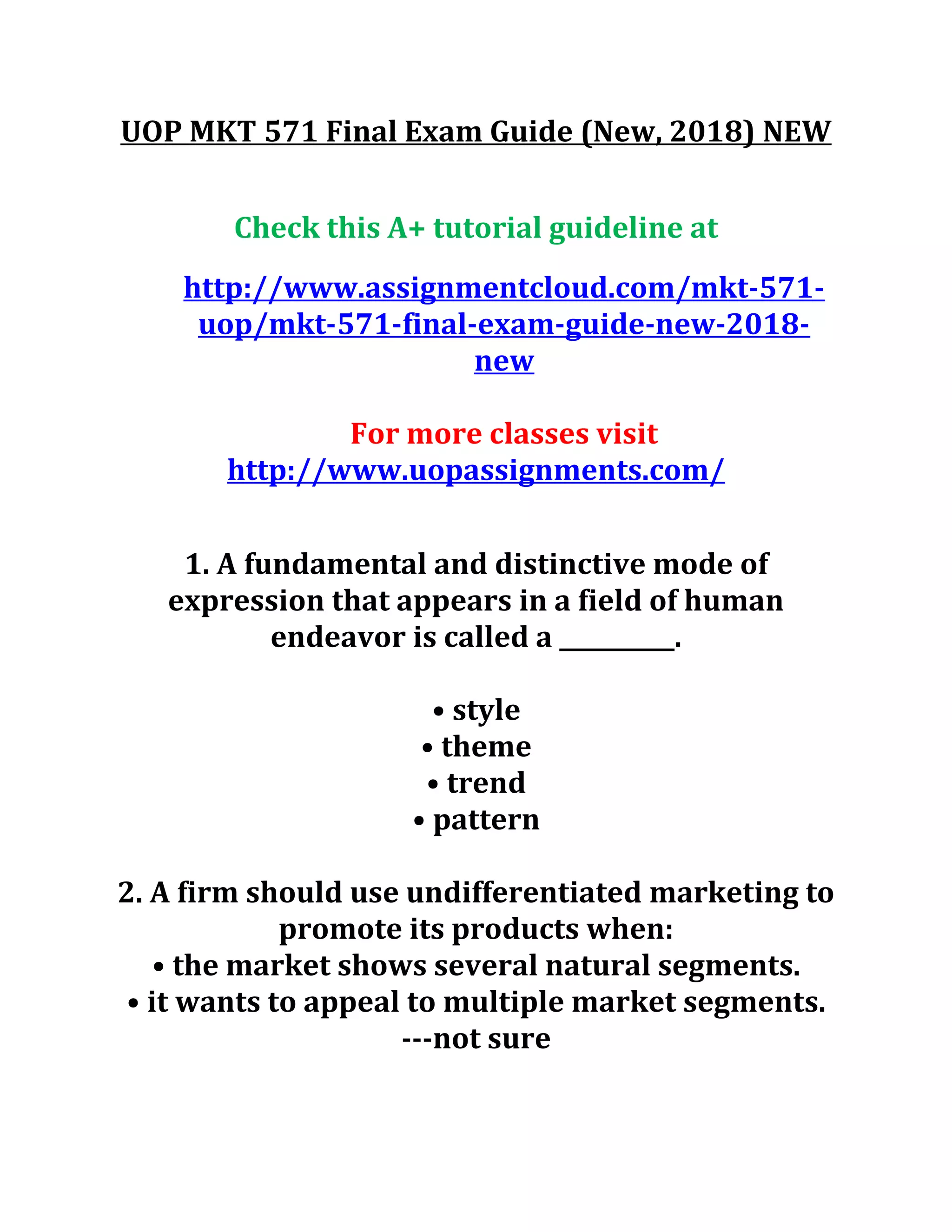
1. A fundamental and distinctive mode of
expression that appears in a field of human
endeavor is called a __________.
• style
• theme
• trend
• pattern
2. A firm should use undifferentiated marketing to
promote its products when:
• the market shows several natural segments.
• it wants to appeal to multiple market segments.
---not sure
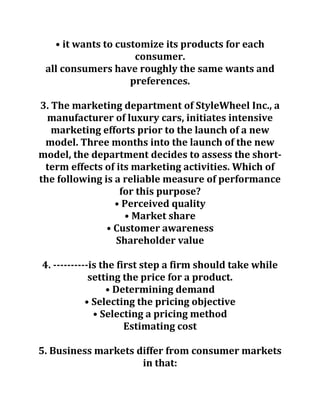
• it wants to customize its products for each
consumer.
all consumers have roughly the same wants and
preferences.
3. The marketing department of StyleWheel Inc., a
manufacturer of luxury cars, initiates intensive
marketing efforts prior to the launch of a new
model. Three months into the launch of the new
model, the department decides to assess the short-
term effects of its marketing activities. Which of
the following is a reliable measure of performance
for this purpose?
• Perceived quality
• Market share
• Customer awareness
Shareholder value
4. ----------is the first step a firm should take while
setting the price for a product.
• Determining demand
• Selecting the pricing objective
• Selecting a pricing method
Estimating cost
5. Business markets differ from consumer markets
in that:
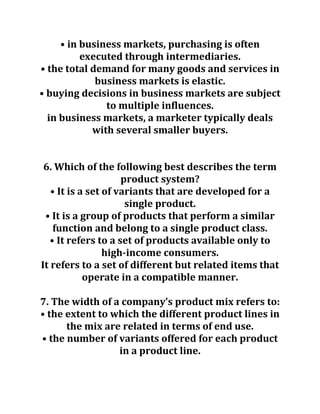
• in business markets, purchasing is often
executed through intermediaries.
• the total demand for many goods and services in
business markets is elastic.
• buying decisions in business markets are subject
to multiple influences.
in business markets, a marketer typically deals
with several smaller buyers.
6. Which of the following best describes the term
product system?
• It is a set of variants that are developed for a
single product.
• It is a group of products that perform a similar
function and belong to a single product class.
• It refers to a set of products available only to
high-income consumers.
It refers to a set of different but related items that
operate in a compatible manner.
7. The width of a company’s product mix refers to:
• the extent to which the different product lines in
the mix are related in terms of end use.
• the number of variants offered for each product
in a product line.
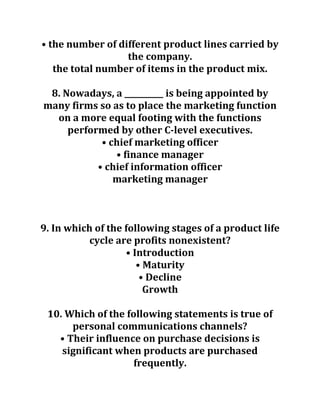
• the number of different product lines carried by
the company.
the total number of items in the product mix.
8. Nowadays, a __________ is being appointed by
many firms so as to place the marketing function
on a more equal footing with the functions
performed by other C-level executives.
• chief marketing officer
• finance manager
• chief information officer
marketing manager
9. In which of the following stages of a product life
cycle are profits nonexistent?
• Introduction
• Maturity
• Decline
Growth
10. Which of the following statements is true of
personal communications channels?
• Their influence on purchase decisions is
significant when products are purchased
frequently.
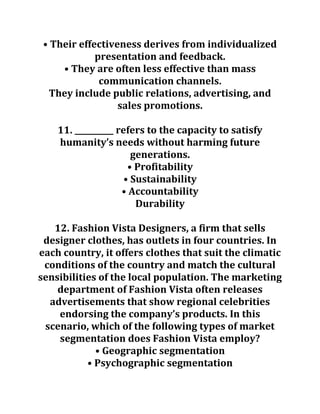
• Their effectiveness derives from individualized
presentation and feedback.
• They are often less effective than mass
communication channels.
They include public relations, advertising, and
sales promotions.
11. __________ refers to the capacity to satisfy
humanity’s needs without harming future
generations.
• Profitability
• Sustainability
• Accountability
Durability
12. Fashion Vista Designers, a firm that sells
designer clothes, has outlets in four countries. In
each country, it offers clothes that suit the climatic
conditions of the country and match the cultural
sensibilities of the local population. The marketing
department of Fashion Vista often releases
advertisements that show regional celebrities
endorsing the company’s products. In this
scenario, which of the following types of market
segmentation does Fashion Vista employ?
• Geographic segmentation
• Psychographic segmentation
• Demographic segmentation
Behavioral segmentation
13. Which of the following is a difference between
business markets and consumer markets?
• In business markets, buyers usually purchase
products through intermediaries, whereas in
consumer markets, buyers usually purchase
products directly from manufacturers.
• Suppliers in business markets are often expected
to customize their products to suit the
requirements of individual business customers,
whereas suppliers in consumer markets are
seldom expected to do so.
• In business markets, the total demand for goods
and services is significantly affected by price
changes, whereas in consumer markets, the total
demand for goods and services is not significantly
affected by price changes.
Purchasing decisions in business markets are
made by the end user, whereas purchasing
decisions in consumer markets are made by a
buying committee.
14. Which of the following measures reflects the
short-term results of a firm’s marketing efforts?
• Perceived quality
• Customer awareness
• Sales turnover
Market share
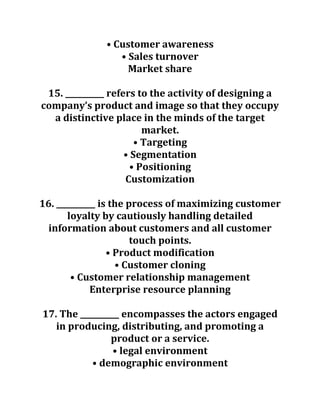
15. __________ refers to the activity of designing a
company’s product and image so that they occupy
a distinctive place in the minds of the target
market.
• Targeting
• Segmentation
• Positioning
Customization
16. __________ is the process of maximizing customer
loyalty by cautiously handling detailed
information about customers and all customer
touch points.
• Product modification
• Customer cloning
• Customer relationship management
Enterprise resource planning
17. The __________ encompasses the actors engaged
in producing, distributing, and promoting a
product or a service.
• legal environment
• demographic environment
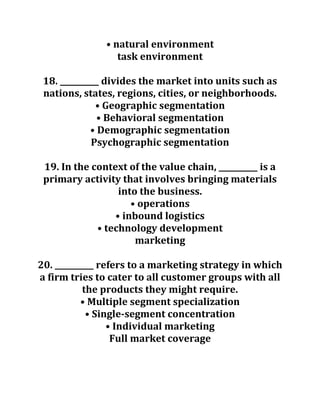
• natural environment
task environment
18. __________ divides the market into units such as
nations, states, regions, cities, or neighborhoods.
• Geographic segmentation
• Behavioral segmentation
• Demographic segmentation
Psychographic segmentation
19. In the context of the value chain, __________ is a
primary activity that involves bringing materials
into the business.
• operations
• inbound logistics
• technology development
marketing
20. __________ refers to a marketing strategy in which
a firm tries to cater to all customer groups with all
the products they might require.
• Multiple segment specialization
• Single-segment concentration
• Individual marketing
Full market coverage
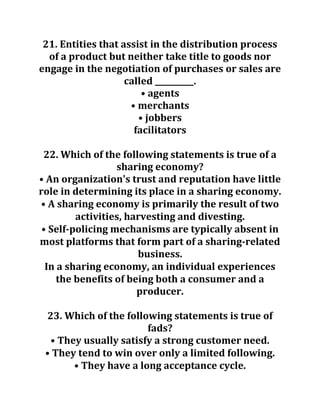
21. Entities that assist in the distribution process
of a product but neither take title to goods nor
engage in the negotiation of purchases or sales are
called __________.
• agents
• merchants
• jobbers
facilitators
22. Which of the following statements is true of a
sharing economy?
• An organization's trust and reputation have little
role in determining its place in a sharing economy.
• A sharing economy is primarily the result of two
activities, harvesting and divesting.
• Self-policing mechanisms are typically absent in
most platforms that form part of a sharing-related
business.
In a sharing economy, an individual experiences
the benefits of being both a consumer and a
producer.
23. Which of the following statements is true of
fads?
• They usually satisfy a strong customer need.
• They tend to win over only a limited following.
• They have a long acceptance cycle.
They last for several generations.
24. The __________ refers to the core business
process in which an organization researches,
develops, and introduces novel, high-quality
products quickly and within the firm’s budget.
• customer acquisition process
• customer relationship management process
• new-offering realization process
fulfillment management process
25. When marketers combine an existing brand
with a new brand, the product is called a __________.
• sub-brand
• parent brand
• master brand
family brand
26. __________ is a period in a typical product life
cycle characterized by rapid market acceptance
and significant profit improvement.
• Introduction
• Growth
• Decline
Maturity
27. __________ seeks to create brand awareness
among consumers and communicate to them
about new products or new features of existing
products.
• Informative advertising
• Reinforcement advertising
• Reminder advertising
Persuasive advertising
28. A customer-focused __________ presents a strong,
convincing reason why the target market should
purchase a product or service.
• value proposition
• value network
• project objective
mission statement
29. A company that interacts with its customers to
get product ideas should:
• engage the right customers in the right way.
• allow all its customers to participate in the
product-design process.
• focus solely on its lead users.
prohibit customers from innovating products
without its consent.
30. __________ is one of the methods used to develop
ideas for a new product in which each feature of an
existing product is noted and modified.
• Attribute listing
• Morphological analysis
• Mind mapping
Reverse-assumption analysis

Uop mkt 571 final exam guide

  • 1.
    UOP MKT 571Final Exam Guide (New, 2018) NEW Check this A+ tutorial guideline at http://www.assignmentcloud.com/mkt-571- uop/mkt-571-final-exam-guide-new-2018- new For more classes visit http://www.uopassignments.com/ 1. A fundamental and distinctive mode of expression that appears in a field of human endeavor is called a __________. • style • theme • trend • pattern 2. A firm should use undifferentiated marketing to promote its products when: • the market shows several natural segments. • it wants to appeal to multiple market segments. ---not sure
  • 2.
    • it wantsto customize its products for each consumer. all consumers have roughly the same wants and preferences. 3. The marketing department of StyleWheel Inc., a manufacturer of luxury cars, initiates intensive marketing efforts prior to the launch of a new model. Three months into the launch of the new model, the department decides to assess the short- term effects of its marketing activities. Which of the following is a reliable measure of performance for this purpose? • Perceived quality • Market share • Customer awareness Shareholder value 4. ----------is the first step a firm should take while setting the price for a product. • Determining demand • Selecting the pricing objective • Selecting a pricing method Estimating cost 5. Business markets differ from consumer markets in that:
  • 3.
    • in businessmarkets, purchasing is often executed through intermediaries. • the total demand for many goods and services in business markets is elastic. • buying decisions in business markets are subject to multiple influences. in business markets, a marketer typically deals with several smaller buyers. 6. Which of the following best describes the term product system? • It is a set of variants that are developed for a single product. • It is a group of products that perform a similar function and belong to a single product class. • It refers to a set of products available only to high-income consumers. It refers to a set of different but related items that operate in a compatible manner. 7. The width of a company’s product mix refers to: • the extent to which the different product lines in the mix are related in terms of end use. • the number of variants offered for each product in a product line.
  • 4.
    • the numberof different product lines carried by the company. the total number of items in the product mix. 8. Nowadays, a __________ is being appointed by many firms so as to place the marketing function on a more equal footing with the functions performed by other C-level executives. • chief marketing officer • finance manager • chief information officer marketing manager 9. In which of the following stages of a product life cycle are profits nonexistent? • Introduction • Maturity • Decline Growth 10. Which of the following statements is true of personal communications channels? • Their influence on purchase decisions is significant when products are purchased frequently.
  • 5.
    • Their effectivenessderives from individualized presentation and feedback. • They are often less effective than mass communication channels. They include public relations, advertising, and sales promotions. 11. __________ refers to the capacity to satisfy humanity’s needs without harming future generations. • Profitability • Sustainability • Accountability Durability 12. Fashion Vista Designers, a firm that sells designer clothes, has outlets in four countries. In each country, it offers clothes that suit the climatic conditions of the country and match the cultural sensibilities of the local population. The marketing department of Fashion Vista often releases advertisements that show regional celebrities endorsing the company’s products. In this scenario, which of the following types of market segmentation does Fashion Vista employ? • Geographic segmentation • Psychographic segmentation
  • 6.
    • Demographic segmentation Behavioralsegmentation 13. Which of the following is a difference between business markets and consumer markets? • In business markets, buyers usually purchase products through intermediaries, whereas in consumer markets, buyers usually purchase products directly from manufacturers. • Suppliers in business markets are often expected to customize their products to suit the requirements of individual business customers, whereas suppliers in consumer markets are seldom expected to do so. • In business markets, the total demand for goods and services is significantly affected by price changes, whereas in consumer markets, the total demand for goods and services is not significantly affected by price changes. Purchasing decisions in business markets are made by the end user, whereas purchasing decisions in consumer markets are made by a buying committee. 14. Which of the following measures reflects the short-term results of a firm’s marketing efforts? • Perceived quality
  • 7.
    • Customer awareness •Sales turnover Market share 15. __________ refers to the activity of designing a company’s product and image so that they occupy a distinctive place in the minds of the target market. • Targeting • Segmentation • Positioning Customization 16. __________ is the process of maximizing customer loyalty by cautiously handling detailed information about customers and all customer touch points. • Product modification • Customer cloning • Customer relationship management Enterprise resource planning 17. The __________ encompasses the actors engaged in producing, distributing, and promoting a product or a service. • legal environment • demographic environment
  • 8.
    • natural environment taskenvironment 18. __________ divides the market into units such as nations, states, regions, cities, or neighborhoods. • Geographic segmentation • Behavioral segmentation • Demographic segmentation Psychographic segmentation 19. In the context of the value chain, __________ is a primary activity that involves bringing materials into the business. • operations • inbound logistics • technology development marketing 20. __________ refers to a marketing strategy in which a firm tries to cater to all customer groups with all the products they might require. • Multiple segment specialization • Single-segment concentration • Individual marketing Full market coverage
  • 9.
    21. Entities thatassist in the distribution process of a product but neither take title to goods nor engage in the negotiation of purchases or sales are called __________. • agents • merchants • jobbers facilitators 22. Which of the following statements is true of a sharing economy? • An organization's trust and reputation have little role in determining its place in a sharing economy. • A sharing economy is primarily the result of two activities, harvesting and divesting. • Self-policing mechanisms are typically absent in most platforms that form part of a sharing-related business. In a sharing economy, an individual experiences the benefits of being both a consumer and a producer. 23. Which of the following statements is true of fads? • They usually satisfy a strong customer need. • They tend to win over only a limited following. • They have a long acceptance cycle.
  • 10.
    They last forseveral generations. 24. The __________ refers to the core business process in which an organization researches, develops, and introduces novel, high-quality products quickly and within the firm’s budget. • customer acquisition process • customer relationship management process • new-offering realization process fulfillment management process 25. When marketers combine an existing brand with a new brand, the product is called a __________. • sub-brand • parent brand • master brand family brand 26. __________ is a period in a typical product life cycle characterized by rapid market acceptance and significant profit improvement. • Introduction • Growth • Decline Maturity
  • 11.
    27. __________ seeksto create brand awareness among consumers and communicate to them about new products or new features of existing products. • Informative advertising • Reinforcement advertising • Reminder advertising Persuasive advertising 28. A customer-focused __________ presents a strong, convincing reason why the target market should purchase a product or service. • value proposition • value network • project objective mission statement 29. A company that interacts with its customers to get product ideas should: • engage the right customers in the right way. • allow all its customers to participate in the product-design process. • focus solely on its lead users. prohibit customers from innovating products without its consent.
  • 12.
    30. __________ isone of the methods used to develop ideas for a new product in which each feature of an existing product is noted and modified. • Attribute listing • Morphological analysis • Mind mapping Reverse-assumption analysis